



Abstract
The aim of the present study was to assess the effect of different storage conditions on prothrombin time (PT), activated partial thromboplastin time (aPTT), and fibrinogen concentration in clinical samples from healthy horses. A total of 100 healthy horses of varying breeds and gender, ranging in age from 4 to 18 years, with a mean body weight of 480 + 70 kg, were used. Blood was collected by jugular venipuncture, and a hemochrome-cytometric examination was conducted on all samples. All blood samples were centrifuged and divided into 4 different aliquots to assess clotting parameters by means of a coagulometer. The first aliquots were analyzed 1 hr after collection, the second aliquots were refrigerated at 8°C for 6 hr, the third aliquots were frozen at −20°C for 24 hr, and the fourth aliquots were frozen at −20°C for 48 hr. Significant differences (P < 0.05) were determined by one-way analysis of variance with repeated measures, and statistical analysis showed a significant effect of the experimental conditions on all parameters studied. In particular, the results demonstrated that coagulation tests can be done within 6 hr when samples are stored at 8°C because the short-term refrigeration does not change the result of analyses; storage at −20°C is acceptable only after 24 hr for PT, aPTT, and fibrinogen measurements because after 48 hr, freezing alters the values of clotting parameters. Therefore, the results of this investigation indicate that clotting parameters remain stable only up to 24 hr in horses without adversely affecting hemostasis test results.
Introduction
The mechanism of blood coagulation constitutes a complex and dynamic interaction of platelets, plasma, and blood vessel endothelium. Blood coagulation is an important part of the hemostatic process. It is usually initiated through damage to the vessel wall and subsequent activation of protease enzymes and ends with the transformation of soluble fibrinogen into insoluble fibrin. 1 Natural anticoagulant mechanisms limit and localize hemostatic plug (thrombus) formation at sites of blood vessel injury, and disorders of coagulation can lead to an increased risk of hemorrhage and/or clotting (thrombosis). 1
The model generally used to describe the mechanism of coagulation is the cascade system, which is separated into 3 areas. The intrinsic system, commonly measured by the activated partial thromboplastin test, is activated by surface contact. The extrinsic system, commonly measured by the prothrombin test, is activated by vascular injury. The common pathway leading to clot formation is activated by the intrinsic and/or extrinsic pathways.
Although modern coagulation diagnostics is becoming increasingly complex, screening tests such as prothrombin time (PT), activated partial thromboplastin time (aPTT), and fibrinogen are still important for the basic assessment of hemostasis. 2 Measurement of PT, aPTT, and fibrinogen concentration is performed using citrated plasma, and they are the most commonly employed laboratory tests in patients with a suspected coagulopathy. 3–8 Prothrombin time is a laboratory screening test used to detect disorders involving the activity of the factors I, II, V, VII, and X of the extrinsic and common pathways. 9 Activated partial thromboplastin time is an assay used to screen for abnormalities of the intrinsic and common clotting systems and to monitor the anticoagulant effect of circulating heparin. It measures the activities of factors I, II, V, VIII, IX–XI, and XII of the intrinsic and common pathways. 10 Fibrinogen is a protein that originates in the liver and is converted to fibrin during the blood-clotting process. Evaluation of fibrinogen abnormalities aids in the diagnosis of suspected clotting or bleeding disorders.
Usually, the measurement of these hemostasis parameters is performed with commercial kits, and according to the manufacturers’ instructions, coagulation testing must be performed within 2 to 3 hr after blood collection. 11 However, previous studies in dogs have measured some coagulation parameters such as PT, aPTT, and fibrinogen concentration following different storage conditions. 9,12 Recent studies have evaluated the effect of anticoagulant and storage conditions on platelet size and clumping in healthy dogs, and the results indicated the importance of interpreting the data in relation to anticoagulant- and temperature-specific reference intervals. 13 Various studies evaluated the stability of stored canine plasma for hemostasis testing, thus demonstrating different effects on test results in relation to temperature. 12,14–17
The aim of the current study was to evaluate the effect of storage conditions on coagulation mechanisms in horses. In equine clinical practice, the hemostasis samples must be transported from stable to laboratory; therefore, this study assessed the effect of storage on some coagulation parameters. Storage conditions, include the freezing of equine samples, could be beneficial for preanalytic handling of samples prior to analysis. 12,18,19 The current study investigated the effect of short-term storage (6 hr) at 8°C on PT, aPTT, and fibrinogen concentration to assess the possibility of measuring hemostasis parameters 2–3 hr after blood collection, contrary to standard protocol. In addition, the effect of long-term storage (24 and 48 hr) at −20°C on PT, aPTT, and fibrinogen concentration was also assessed because hemostasis samples can be stored at this temperature in veterinary practices with a domestic freezer.
Materials and methods
Samples
Blood samples were obtained from 100 healthy horses of varying breeds and gender, ranging in age from 4 to 18 years with mean body weight of 480 + 70 kg. Horses were deemed healthy if they did not have a history of change in hemostatic mechanisms and if their hematological examination, including packed cell volume (reference [ref.] interval: 32–53%) and platelet count (ref. interval: 120–400 K/μl), was within reference limits. Moreover, not all animals were dehydrated because they did not show a decrease of skin elasticity. No pharmacological treatment was administered for 1 month prior to the study. Blood samples were collected from all animals by jugular venipuncture into 2–ml vacutainer tubes with ethylenediamine tetra-acetic acid (EDTA) a for routine hematologic assays and into 3.6-ml tubes containing 3.8% sodium citrate (1 part citrate:9 parts blood) for hemostasis assays. b A hemochrome-cytometric examination was performed using a multiparametric automatic hematology analyzer on blood samples anticoagulated with EDTA. c Blood samples anticoagulated with citrated sodium were centrifuged d at 1,500–g within 15 min following collection. The citrated plasma was removed with a plastic pipette and was transferred into Eppendorf microtubes. Plasma samples were divided into 4 different aliquots to assess PT, aPTT, and fibrinogen concentration by means of a coagulometer. e The first aliquots were analyzed 1 hr after collection, the second aliquots were refrigerated at 8°C for 6 hr, the third aliquots were frozen at −20°C for 24 hr, and the fourth aliquots were frozen at −20°C for 48 hr. All samples were analyzed in duplicate and exhibited parallel displacement from the standard curve.
Prothrombin time test
Prothrombin time was assessed on citrated plasma by means of a standard kit f made especially for the SEAC Clot 2 coagulometer. e The PT kit was based on the assay principle that the addition of an adequately calcified amount of tissue factor (factor III) to citrated plasma activates factor VII, which induced the formation of a stable plug. The assay procedure was performed by placing 200 μl of tissue factor (PT reagent) in a test tube preheated to 37°C and subsequently adding 100 μl of citrated plasma. Upon the addition of test plasma, a stopwatch was started, and the clotting time was measured. The time in seconds from plasma-reagent mixing to visual clot formation was defined as the PT.
Activated partial thromboplastin time test
Activated partial thromboplastin time was determined from citrated plasma by means of a standard kit g made especially for the SEAC Clot 2 coagulometer. e The aPTT kit was based on the addition of a platelet substitute (phospholipids and ellagic acid as a soluble activator) and calcium chloride, which induced the formation of a stable plug. The assay procedure was performed by placing 100 μl of citrated plasma and 100 μl of aPTT reagent (preheated to 37°C) in a test tube preheated to 37°C, followed by an additional incubation for 3 min at 37°C, and then adding 100 μl of calcium chloride that had been preheated to 37°C. Upon the addition of calcium chloride, a stopwatch was started and the clotting time was measured. The time in seconds from calcium chloride addition to visual clot formation was defined as the aPTT.
Fibrinogen determination
Fibrinogen determination was performed using citrated plasma by means of a standard kit h made especially for the SEAC Clot 2 coagulometer. e The standard kit for the quantitative determination of fibrinogen was based on the addition of a relatively large amount of thrombin to diluted citrated plasma, ensuring that the clotting time depended on only the fibrinogen contained in the sample. The assay procedure consisted of placing 200 μl of diluted plasma (diluted 1:10 by the combination of 100 μl of plasma + 900 μl of buffer) in a test tube preheated to 37°C,
Hematological parameters (mean and standard deviation) of 100 healthy horses compared with published reference ranges. *
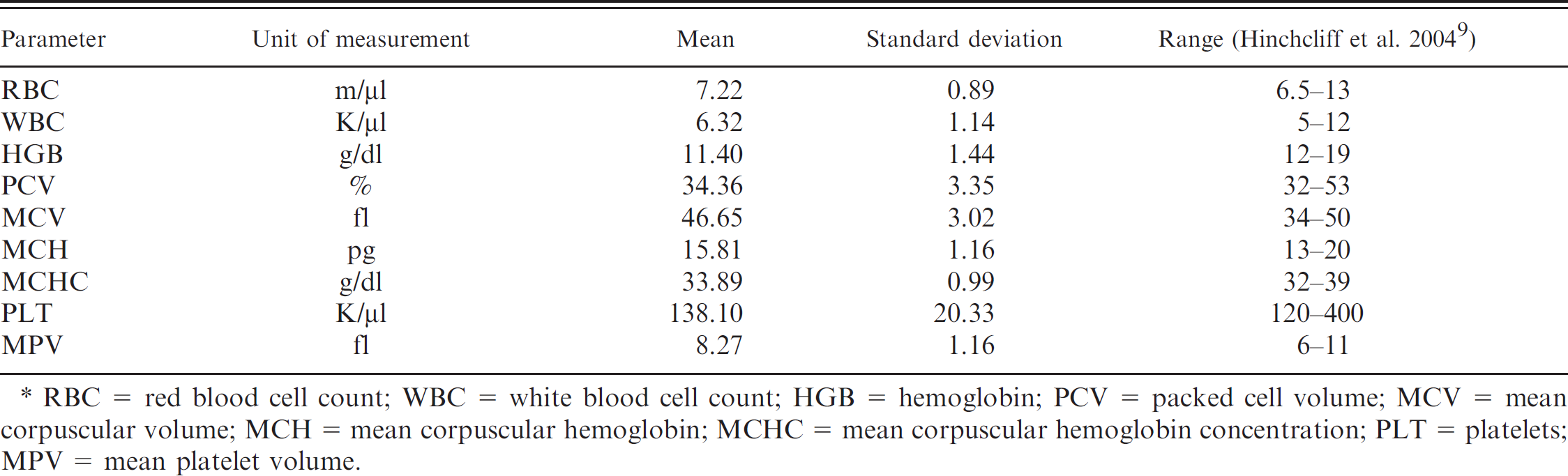
RBC = red blood cell count; WBC = white blood cell count; HGB = hemoglobin; PCV = packed cell volume; MCV = mean corpuscular volume; MCH = mean corpuscular hemoglobin; MCHC = mean corpuscular hemoglobin concentration; PLT = platelets; MPV = mean platelet volume.
incubating for an additional 2 min at 37°C, and then adding 100 μl of the fibrinogen reagent. Upon the addition of fibrinogen reagent, a stopwatch was started, and the clotting time was measured. The time (seconds) until clot formation was automatically converted into mg/dl by the automated mechanical endpoint coagulation instrument.
Statistical analyses
All results were expressed as mean + standard deviation (SD). All data were normally distributed (P < 0.05, Kolmogorov-Smirnov test), and 1-way analysis of variance (ANOVA) for repeated measures was used to determine significant differences. P values <0.05 were considered statistically significant. The Bonferroni multiple comparison test was used to locate significant differences between group means. The data were analyzed using statistical software. i
Results
Table 1 presents the routine hematological data (mean and SD) of 100 healthy horses with reference ranges. 20 Table 2 presents the average hemostasis values of this study including mean, SD, median, range, and statistical significance for PT (sec), aPTT (sec), and fibrinogen (mg/dl) obtained under different experimental conditions.
One-way ANOVA for repeated measures detected a statistically significant effect of the experimental conditions on all parameters studied. The following statistical results were obtained: PT, F (3,297) = 3.46, P = 0.0168; aPTT, F (3,297) = 3.08, P = 0.0276; and fibrinogen concentration, F (3,297) = 4.18, P = 0.0064. The Bonferroni multiple comparison test revealed a statistically significant effect of the experimental conditions as follows: PT increased after 48 hr of freezing versus 1 hr after collection (P < 0.05), aPTT increased after 48 hr of freezing versus 1 hr after collection (P < 0.05), and fibrinogen concentration increased after 48 hr of freezing versus 1 hr after collection (P < 0.05).
Mean, standard deviation (SD), median, range, and statistical significance of prothrombin time (PT), activated partial thromboplastin time (aPTT), and fibrinogen concentration in 100 healthy horses obtained under different analytical time intervals and storage temperatures.
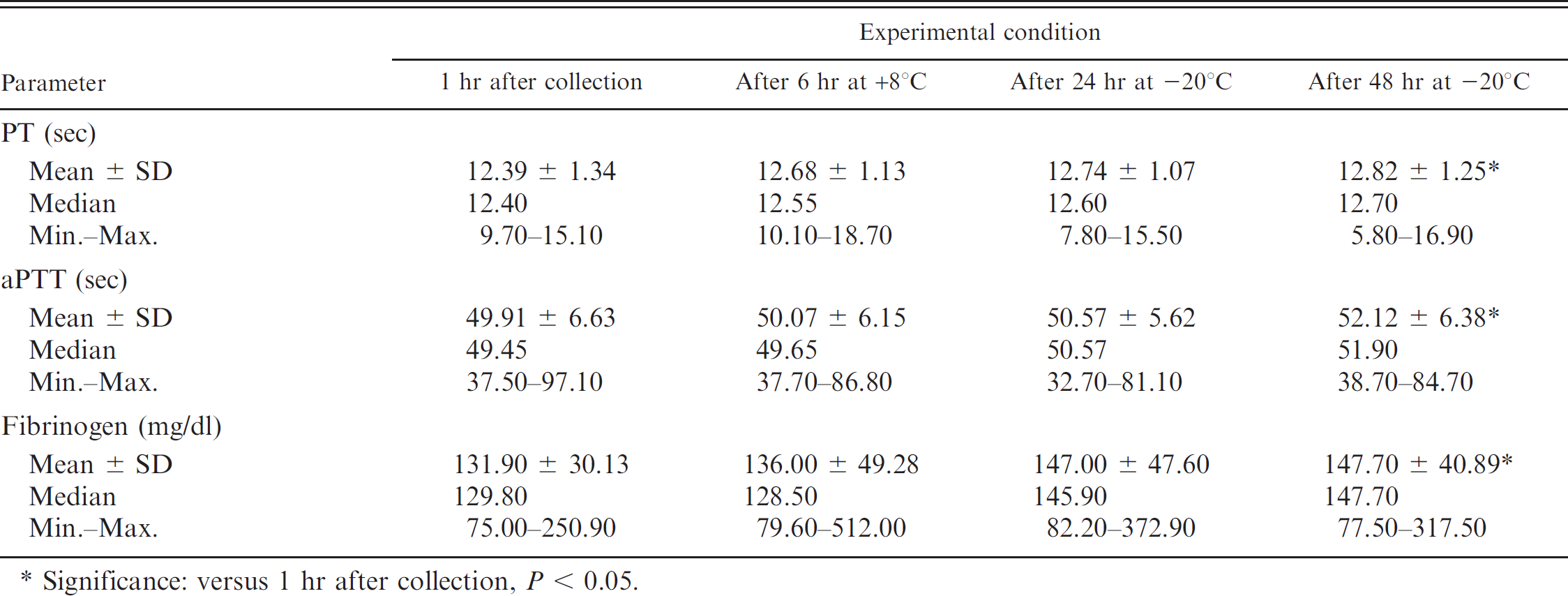
Significance: versus 1 hr after collection, P < 0.05.
Discussion
Many clinicians use frozen plasma samples to assess patient health or identify disease states. However, there is very little information available on the effect of using frozen plasma samples for laboratory analysis in horses other than assessment of standard hematological parameters. The results of the present study provide new insight regarding the methods of plasma storage and their effects on clotting parameters.
The results of the present study indicate that storage of equine plasma for 6 hr at 8°C or for 24 hr at −24°C does not have a significant effect on clotting parameters. However, storage of plasma at −20°C for up to 48 hr results in a significant increase in PT, aPTT, and fibrinogen concentration. Prothrombin time and aPTT reflect the activities of multiple clotting factors, and it has been shown that a significant decrease in any one factor must occur before the PT or aPTT is significantly prolonged. 17 In particular, decreased factor VII activity is supported by previous studies that describe a slight decrease of factor VII activity in fresh frozen plasma. 21–23 This decrease of factor VII activity also explains the small but significant decrease in the activity of factor χ that was reported in dogs when samples were stored for 48 hr 17 and in humans that occurred between baseline testing and analysis after thawing the plasma samples. 23 As factor χ activity affects both PT and aPTT results, marked loss of factor χ activity may explain the statistically significant prolongation of both hemostatic tests reported in the present study.
As previously noted in human plasma specimens, fibrinogen concentrations increased slightly following freezing and storage. 24 Although refrigeration and freezing appeared to have little effect on fibrinogen concentrations, the differences between fresh and frozen plasma samples were small but statistically significant after 48 hr of freezing. However, these variations are not significant if the plasma is stored for a few hours after blood collection. The final turbidity of a fibrin clot generated from previously frozen fibrinogen appears to be greater than the turbidity of a fibrin clot formed from fresh plasma. 24 This difference can be observed in the kinetic assay, indicating that the changes induced by freezing have an effect on fibrinogen concentration.
The results of the current study demonstrate that coagulation can be assessed within 6 hr when plasma samples are stored at 8°C because refrigeration does not change the result of analyses. In fact, it is possible to conclude that short-term storage of equine plasma samples at 8°C for 6 hr is acceptable for the measurement of PT, aPTT, and fibrinogen concentration. In addition, frozen equine plasma is stable for hemostasis testing for 24 hr. In contrast, storage of equine plasma samples at −20°C for 48 hr was deemed unacceptable for hemostasis testing. Plasma samples should be transported to diagnostic laboratories within a few hours for hemostasis testing because the PT, aPTT, and fibrinogen concentration remain stable only up to 24 hr after sample collection without adversely affecting hemostasis test results. Nevertheless, additional studies at different storage temperatures might be useful to further define preanalytic variables when handling equine plasma samples for hemostasis testing.
Footnotes
a.
Venoject-haematology, Terumo Europe N.V., Leuven, Belgium.
b.
Venoject-coagulation, Terumo Europe N.V., Leuven, Belgium.
c.
Automatic analyzer of haematology, HecoVet, SEAC, Florence, Italy.
d.
Thermo Scientific CL10 centrifuge, Thermo Fisher Scientific Inc., Waltham, MA.
e.
Clot 2 automatic coagulometer, SEAC, Florence, Italy.
f.
PT kit test for Clot 2, SEAC, Florence, Italy.
g.
APTT kit test for Clot 2, SEAC, Florence, Italy.
h.
Fibrinogen kit test for Clot 2, SEAC, Florence, Italy.
i.
STATISTICA 5.5, StatSoft Inc., Tulsa, OK.