



Abstract
The neonatal period is probably the only time when a higher incidence of spontaneous thromboembolic complications may occur in the otherwise normal, healthy individual. This study was designed to determine the postnatal development of the kid coagulation system. Ten clinically healthy and full-term-born Maltese kid goats (5 males and 5 females) were used. In each kid, during the first week after birth, the prothrombin time (FT), the activated partial thromboplastin time (aPTT), the thrombin time (TT), and fibrinogen were assessed. Analysis of variance showed a highly significant effect of age on PT, TT, and fibrinogen. Our results of this study indicate that the clotting mechanism in kids is influenced by growth. This investigation contributes to the knowledge of clotting adaptations in kids during the first 7 days of life and provides useful information for the diagnosis and treatment of some neonatal diseases.
Keywords
In all species, the first week after birth represents a critical stage; it is a transition phase from the sheltered intrauterine to the exposed extrauterine environment. Newborns are in metabolically unstable conditions, which make these subjects particularly sensitive to perinatal diseases resulting in high mortality. Kid mortality rates are generally higher than other farm species, especially during the first days of life. 10,22 Diseases of the newborn and neonatal mortality are a major cause of economic loss in livestock production. Thus, specific hematological and serum biochemical reference ranges could help to promote the ability of clinicians to more accurately interpret clinical pathology data and diagnose neonatal disease. 19 The etiology of neonatal morbidity and mortality is multifactorial and is influenced by genetics, age and nutrition of the dam, parturition, and husbandry conditions. 17 Furthermore, bleeding problems often occur during the neonatal period. 7 The hemostatic and fibrinolytic systems of the neonate have unique features as compared with these systems in adults. For instance, in foals, low levels of coagulation factors and prolonged prothrombin (PT) and activated partial thromboplastin times (aPTT) are present at birth. 5 Knowledge of these differences is essential to the diagnosis of thrombotic and hemorrhagic problems of the neonate. However, defining normal values poses several difficulties, including age dependency, sample size and method of collection, and assay technique. 5 Newborn animals are subjected to a number of different stimuli that could possibly lead to activation of the hemostatic system: stress with adrenergic stimulation, acidosis, hypoxia, thermal changes, and possibly, tissue factors liberated during the process of birth and placental separation. 24 Many studies have been carried out on the development of the coagulation system in lambs, 3,16,18 but little is known about kids. The caprine species is one of the least studied among ruminants; however, the economic importance of this species demands a better knowledge of its physiologic characteristics. 11
For optimal prevention, diagnosis, and treatment of related diseases during the postpartum period, it is critical to understand the development of homeostatic processes. The present study investigated the assessment of several clotting parameters in kids during the first 7 days after birth.
Ten clinically healthy and full-term-born Maltese kids (5 males: mean body weight 3.5 ± 0.2 kg; 5 females: mean body weight 3.2 ± 0.1 kg) and 10 adults (females: mean body weight 44.8 ± 0.21) were used for the study, which was carried out in winter in Sicily, Italy. Kids were fed only with maternal milk and were kept in a sheltered outdoor pen. Their health status was evaluated daily based on behavior, rectal temperature, heart rate, respiratory profile, cough, nasal discharge, ocular discharge, appetite, fecal consistency, navel examination, and hematological profile. For each kid, clinical parameters and blood were collected at the same hour (9:00 AM) for 7 days starting from birth. Also in adults, blood was sampled at 9:00 AM. Blood samples were collected from the jugular vein into 10-ml silicone-glass Vacutainer tubes a prefilled with 3.8% sodium citrate (1:9 sodium citrate:blood). Immediately after collection, the Vacutainer tubes were gently rotated to assure a complete mixture of the blood and anticoagulant. Blood samples were centrifuged immediately after the sampling at 2,000 × g for 15 minutes; the obtained plasma was kept at 4°C and analyzed within 2 hours of sampling. The process was carried out with an automatic coagulometer b according to the manufacturer's instructions and according to a standard protocol to exclude differences that result from irregular test procedures.
The PT, aPTT, thrombin time (TT), and fibrinogen were immediately assessed from the obtained plasma by means of standard kits made especially for the SEAC Clot 2 coagulometer. The PT kit c is based on the assay principle that the addition of an adequately calcified amount of tissue factor to citrated plasma activates factor VII. inducing the formation of a stable plug. The assay procedure consists of placing 200 μl of tissue factor (at room temperature) in a test tube preheated to 37°C, followed by incubation for 5 minutes at 37°C, and subsequently adding 100 μl of test plasma. Upon the addition of test plasma, a stopwatch was started, and the clotting time was measured. The aPTT test d is based on the addition of a platelet substitute (rabbit brain-derived phospholipids), a soluble activator (ellagic acid) and calcium chloride that induces plug formation. The assay procedure consists of placing 100 μl of test plasma and 100 μl of an aPTT reagent (preheated to 37°C) in a test tube preheated to 37°C, followed by incubation for 3 minutes at 37°C, then adding 100 μl of calcium chloride. Upon the addition of calcium chloride, the stopwatch was started, and the clotting time was measured. The TT test e is based on the addition of a known amount of thrombin to citrated plasma, which induces direct transformation of fibrinogen into fibrin. The assay procedure consists of placing 200 μl of test plasma in a test tube preheated to 37°C, followed by incubation for 2 minutes at 37°C, and then adding 200 μl of the thrombin reagent. Upon the addition of the thrombin reagent, the stopwatch was started, and the clotting time was measured. The standard kit for the quantitative determination of fibrinogen f is based on the addition of a relatively large amount of thrombin to diluted citrate plasma, so that the clotting time depends only on the fibrinogen contained in the sample. The assay procedure consists of placing 200 μl of 1:10-diluted plasma in a test tube preheated to 37°C, followed by incubation for 2 minutes at 37°C, and then adding 200 μl of the fibrinogen reagent (preheated to 37°C). Upon the addition of the fibrinogen reagent, the stopwatch was started, and the clotting time was measured. For this assay, the results in seconds must be converted into mg/dl using a conversion table supplied with the kit.
All samples were assayed in duplicate. Samples exhibited parallel displacement to the standard curve; the intra-assay coefficient of variation was <8% for all parameter measured. To validate the assay for use with the goat, pooled goat and human plasma samples were serially diluted and assayed. In both pooled plasma, clotting factors showed linear and parallel displacement.
Results were expressed as mean ± standard deviation (SD). All data was normally distributed and the repeated measures 1 -way analysis of variance (ANOVA) was applied to evaluate the effect of age and gender. If ANOVA showed an acceptable level of significance (P < 0.05), Bonferroni test was applied for post hoc comparison. Data was analyzed using the software STATISTIC A 5. g On individual values of clotting factors and postnatal age, a linear regression model (y = a + bx) was applied to determine the degree of correlation between the parameters studied and the correlation coefficient (r).
During the experimental period, no abnormalities, such as fever, anorexia, depression, soft feces, or other condition that can alter the studied parameters, were observed. No statistically significant difference (P > 0.3) between genders was found for the measured parameters in either kids or adults. ANOVA showed a highly significant effect of age on some of the following studied parameters: PT, F(6,54) = 16.71, P < 0.0001; TT, F(6,54) = 8.27, P < 0.0001; and fibrinogen, F(6,54) = 238.7, P < 0.0001. No statistically significant (P > 0.98) effect of age was observed for aPTT.
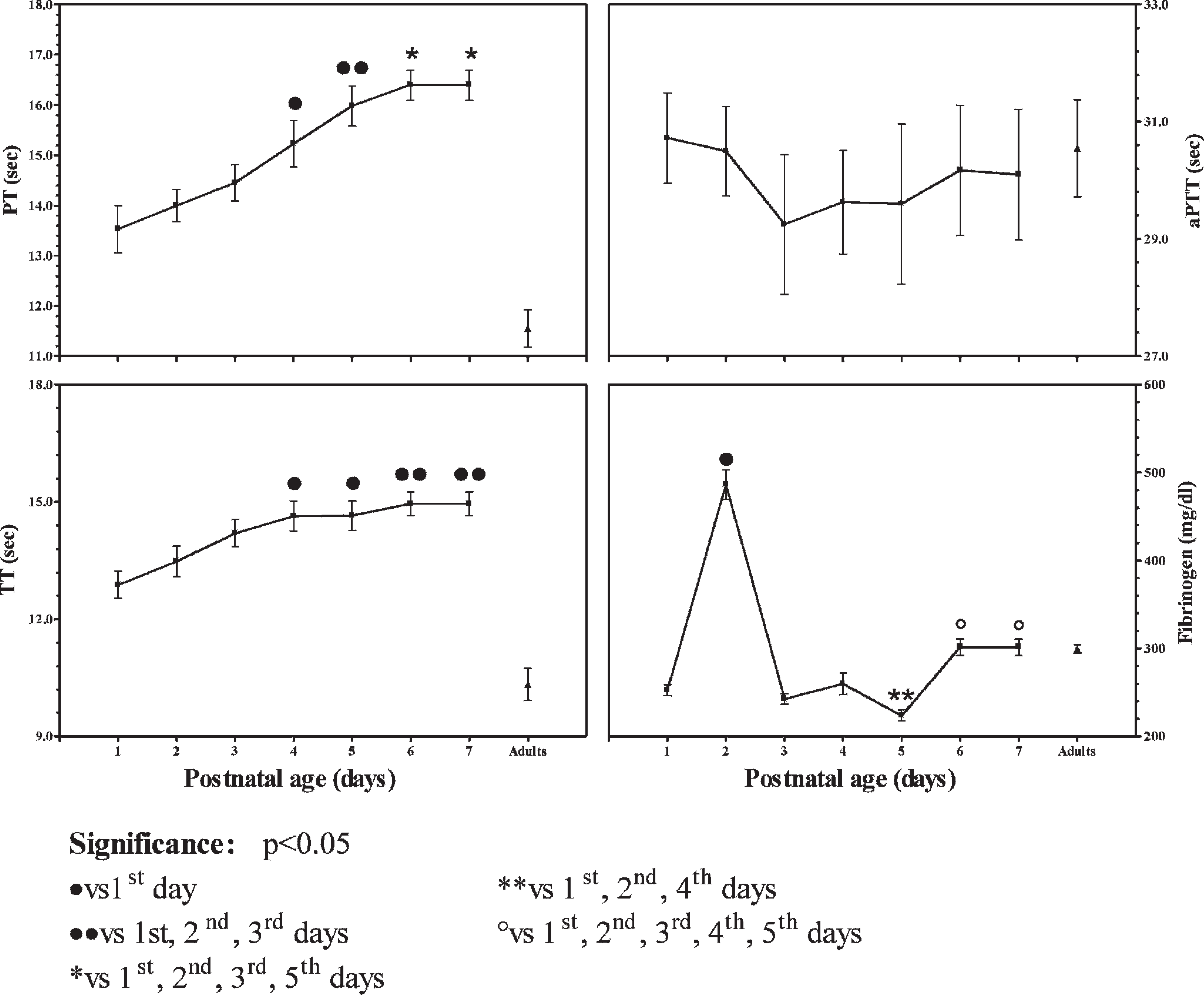
The pattern of mean value and the standard errors of the means together with the relative statistical significance of prothrombin time (sec), activated partial thromboplastin time (sec), thrombin time (sec), and fibrinogen (mg/dl) recorded in kids during the first week of life and in adults.
The pattern of the coagulation profile, obtained in goat kids during the first 7 days of life, is shown in Fig. 1. Both PT and TT were longer than values observed in adults and showed a statistically significant increase during the first week of life (Fig. 1). On the first day, fibrinogen value was lower than the value observed in adults, increasing significantly over that range during the second day, and then decreasing to levels shown on the first day (Fig. 1). On the sixth and seventh days, fibrinogen significantly increased again to the value observed in adults (Fig. 1). aPTT was in the range of values observed in adults (Fig. 1). The application of a linear regression model (y = a + bx) showed a high positive correlation between postnatal age and individual values of PT (r = 0.98) and individual values of TT (r = 0.95; Fig. 2).
The normal development of blood coagulation factor profiles follows a characteristic pattern. Many clotting factors continue to have low activity in the perinatal period, especially during the first few hours and days of life. The results obtained in this study were consistent with the reference range previously reported. 12 14 The current study showed that both PT and TT were markedly prolonged relative to adult samples, whereas aPTT values comprised the adult range. The significant increase of PT during the first 7 days of life in kids could depend on the maturity of the liver, the main site of thrombin production, 8 which, during the perinatal period, undergoes biochemical and morphologic changes. Decreased concentration of liver-derived clotting factors, specifically the decreases in the vitamin K-dependent factors, leads to significant alterations in coagulation, as previously reported for sheep and cattle. 20 Also an effect of age on TT was recorded with a significant increase during the first 7 days of life. The total amount of thrombin generated in newborn plasma is critically dependent on the prothrombin concentration, whereas the rate at which thrombin is generated is dependent on the levels of many other coagulation proteins in combination. The altered regulation of thrombin generation is at least partly due to the presence of low levels of the vitamin K-dependent procoagulants (factors II, VII, IX, X) and the contact factors XI and XII. 4 The modification of PT and TT observed during the first week of life may be also due to a metabolic response of the newborn to the physiological acidosis present at birth and during the first few days of life. 21
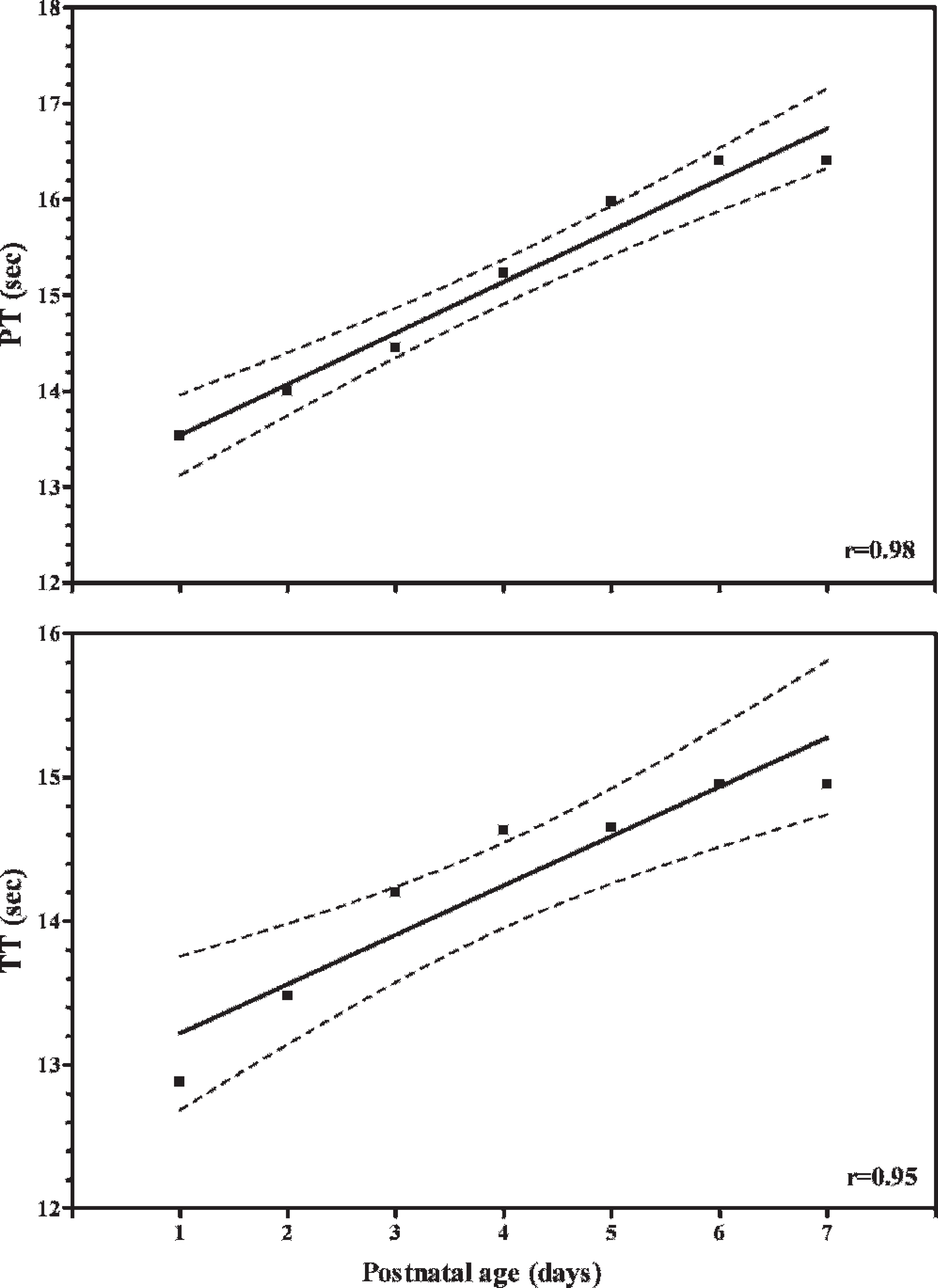
Regression line between postnatal age (days) and prothrombin time (sec) versus postnatal age (days) and thrombin time (sec) of 10 kids, with 95% confidence intervals and correlation coefficient (r).
Fibrinogen values showed a statistically significant increase on the second day when compared with the day 1 or days 3–7. However, those values were within physiological ranges reported for this species. 15 Significant fibrinogen increase on the second day of life could depend on the glucocorticoids secreted to the fetus at birth. In fact, fibrinogen biosynthesis is regulated by glucocorticoids and cytokines that induce simultaneous activation of transcription of fibrinogen subunit genes. 2,23 In vitro hepatocytes stimulation with dexamethasone induces a fibrinogen increase after 48 hours. 1
Taken together, results of the present study suggest that clotting and fibrinolytic factors during the neonatal period undergo continuous modifications leading the organism to adapt to the extrauterine environment. The clotting system of kids is immature at birth and, they may thus be at risk of thrombotic and hemorrhagic diseases during the maturation period. In foals, 9 low levels of factor VII and factor IX probably contribute to the prolonged PT and aPTT. Differently, the significant increase of PT during the first 7 days of life in kids could depend on variations in coagulation factors that leading extrinsic pathway (low levels of factor VII) present during the maturity of the liver. Furthermore, knowing the clotting factor profile during the first week of life is important for clinical management of hereditary diseases of goats, such as factor VII 6 and fibrinogen deficiency, which are associated with severe bleeding. 25 The results of the present study contribute to the knowledge of clotting adaptations in newborn kids and provide useful information for the diagnosis and treatment of some neonatal diseases.
Footnotes
a.
Venoject®-Coagulation-VT-050SBCS, Terumo Europe N.V., Leuven, Belgium.
b.
Automatic coagulometer, Clot 2, SEAC, Florence, Italy.
c.
PT kit test for Clot 2, SEAC, Florence, Italy.
d.
aPTT kit test for Clot 2, SEAC, Florence, Italy.
e.
TT kit test for Clot 2, SEAC, Florence, Italy.
f.
Fibrinogen kit test for Clot 2, SEAC, Florence, Italy.
g.
Software STATISTICA 5.5, StatSoft Inc., Tulsa, OK.