




Abstract
The aim of the current study was to investigate the influence of feeding and fasting on the daily rhythm of serum lipase and α-amylase activity in dogs. Fourteen purebred Beagle dogs were housed in individual pens lined with wood shavings under a 12:12 light:dark cycle. The dogs were divided into 2 groups. Group A received normal feeding once a day, and group
Circadian rhythmicity is a pervasive property of mammalian physiology. A circadian pacemaker located in the suprachiasmatic nuclei of the hypothalamus is responsible for an oscillatory process that is expressed in practically every function in the body. 23,35 Extensive research has established that in mammals this circadian pacemaker generates a daily rhythmicity, which is modulated by environmental cycles of light and darkness, food availability, ambient temperature, and other factors. 12,35 In considering nutrition and circadian rhythms, eating time is an inherited, genetically controlled pattern that can be phase-shifted by conditioning. Feeding, by definition, implies the frequency of food intake and the nature of nutrients and is not only a question of metabolizable energy, minerals, vitamins, and growth factors provided at the right time and frequency, but feeding also carries information with different meanings decoded at the cellular genome level. 26 Many investigators have shown that time of eating is geared to food availability, safety of food gathering, or hunting. Eating time is thus one of the most effective synchronizers of many circadian rhythms. Examples concerning such entrainment include various processes, such as locomotor activity (food anticipatory behavior), body temperature, and various enzyme activity levels. 14,31,32 In addition, previous investigations have shown diurnal variations of various metabolic and neuroendocrine activities in dogs in association with feeding—fasting cycles. 10,13
The circadian clock has been reported to regulate metabolism and energy homeostasis in the liver and other peripheral tissues by mediating the expression and/or the activity of different metabolic enzymes and transport systems involved in cholesterol, glycogen, and glucose metabolism. 6,18,38
Previous studies conducted on laboratory rodents and farm animals have yielded highly reproducible results, yet studies on dogs have been rather inconsistent. In dogs, daily rhythmicity has been described in a variety of physiological functions, such as heart rate, 20,30 circulation and blood pressure, 1,4,7 bone metabolism, 19 serum hormones and electrolytes, 22,37 heat dissipation, 3 urine excretion, 9,11 rest/activity, 25 body temperature, 29 and creatinine. 8 To the extent that daily rhythmicity is a fundamental characteristic of animal physiology, understanding circadian rhythms is a necessity for effective veterinary practice. 28,29 The aims of the current study were to investigate the daily rhythms of serum lipase and α-amylase activity in fed and fasted dogs and to increase the amount of information related to the therapeutic efficacy of timed administration of drugs or rations.
Fourteen clinically healthy purebred Beagle dogs (male, 1-year-old, mean body mass = 12 ± 0.65 kg) were housed in individual pens (140 cm × 200 cm) lined with wood shavings. The pens were separated by concrete walls but had screen doors that allowed the dogs to hear and smell each other but not to see or contact each other. Light timers were set to maintain a light:dark cycle with 12 hr of light and 12 hr of darkness each day (600 lx; lights on at 8:00
The dogs were divided into 2 groups of 7 animals for 48 consecutive hours of recording. Group A received normal feeding (22.5 g/kg for each dog of a certified dog diet [crude protein = 20.5%, crude oil = 8.5%, ash = 9.0%] provided at 10:00
During the 48-hr cycle of measurements, blood samples were collected every 4 hr, starting at 7:00
All results were expressed as means ± standard deviation (SD). Data were normally distributed (P < 0.05, Kolmogorov—Smirnov test), and 2-way repeated-measures analysis of variance (ANOVA) was used to determine the influence of the time of day and the feeding schedules on the lipase and α-amylase serum values. P values of <0.05 were considered statistically significant. Data were analyzed using the software STATISTICA 7. e Four rhythmic parameters were determined: mean level, amplitude, acrophase (time of peak), and robustness (strength of rhythmicity). The amplitude of a rhythm was calculated as half the range of oscillation, which on its turn was computed as the difference between peak and trough. The acrophase of a rhythm was determined by an iterative curve-fitting procedure based on the single cosinor procedure, as described previously. 24 Rhythm robustness was computed as a percentage of the maximal score attained by the chi-square periodogram statistic for ideal data sets of comparable size and 24-hr periodicity. 33 Robustness greater than 70% is above noise level and indicates statistically significant rhythmicity.
Midline estimating statistic of rhythm (MESOR); fiducial limits referred to the MESOR (FL) at 95%; amplitude; acrophase, with confidence interval (CI) referred to the acrophase at 95%; and robustness of lipase and α-amylase in fed and fasted dogs.
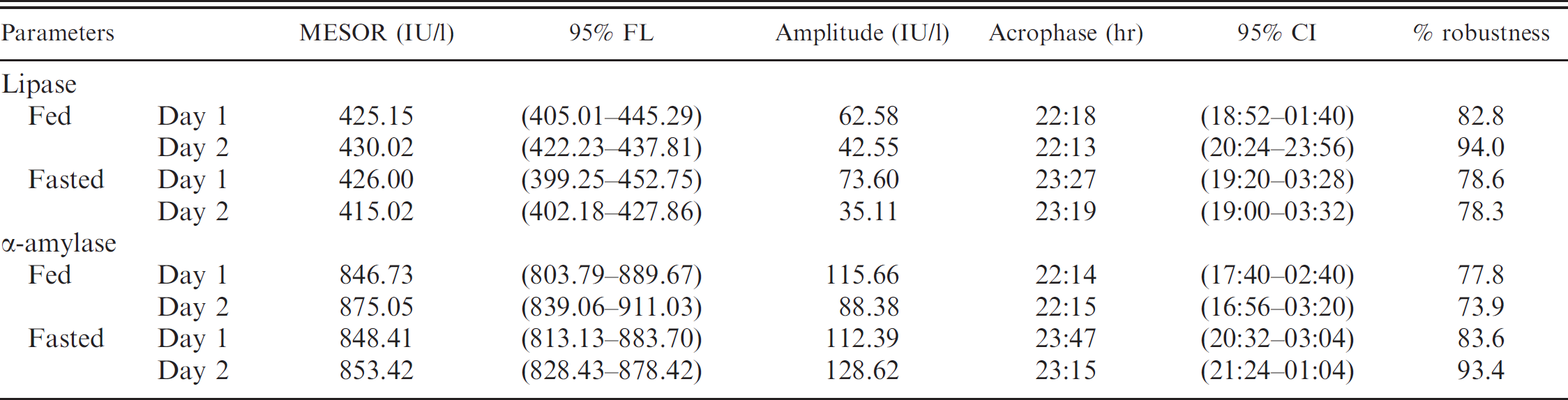
Two-way ANOVA showed a statistically significant effect of time of day on lipase and α-amylase serum values (lipase: F (11,132) = 3.35, P ≤ 0.0004; α-amylase: F (11,132) = 3.37, P ≤ 0.0001). No statistically significant influence of feeding schedule was observed. Application of the periodic model and the statistical analysis of the cosinor procedure throughout the time series studied in the different experimental conditions allowed the authors to ascertain the periodic pattern of the parameter studied. Robust daily rhythmicity was exhibited by lipase and α-amylase during the 2 days of experimentation in fed and fasted dogs. All rhythmic parameters showed a nocturnal acrophase (Table 1).
The circadian clock organizes a wide array of metabolic functions in a coherent daily schedule and ensures synchrony of this schedule with environmental rhythms. 36 Rhythms of food intake present a high capacity to synchronize the rhythmicity of behaviors as well as the circadian oscillation of the peripheral clock. 26 When food is available only for a limited time each day, mammals increase their locomotor activity, body temperature, adrenal secretion of corticosterone, gastrointestinal motility, and activity of digestive enzymes 2–4 hr before the onset of food availability. 5 Also, it well known that gastrointestinal functions such as motility, mucosal blood flow, and gastric or pancreatic exocrine secretions show rhythmic diurnal/nocturnal variations. 17
Results of the present study showed the existence of daily variations in serum levels of lipase and α-amylase in dogs maintained under 12:12-hr light:dark cycles fed a single meal in the day and fasted. Results also showed a nocturnal acrophase and robustness of rhythm not dependent on the feeding schedules. Lipase and α-amylase showed the same trend; the lowest values were observed at 11:00
Even if pancreatic secretion rate seems to be linked to the quantity of the diet consumed, 27 the circadian rhythm of lipase and α-amylase serum values did not vanish when dogs were food deprived. The persistence of circadian rhythms of lipase and α-amylase in food-deprived dogs indicates that they are not driven by the digestive process. This is in agreement with the results of a previous study 2 showing that the daily rhythm of secretion in the pancreas in a rat is independent of gastrointestinal stimulation; these results are in contrast to those of a previous study 16 that showed a direct correlation between amylase output and jejunal motor activity in humans. Thus, circadian effects may modulate interdigestive pancreatic enzyme patterns in dogs.
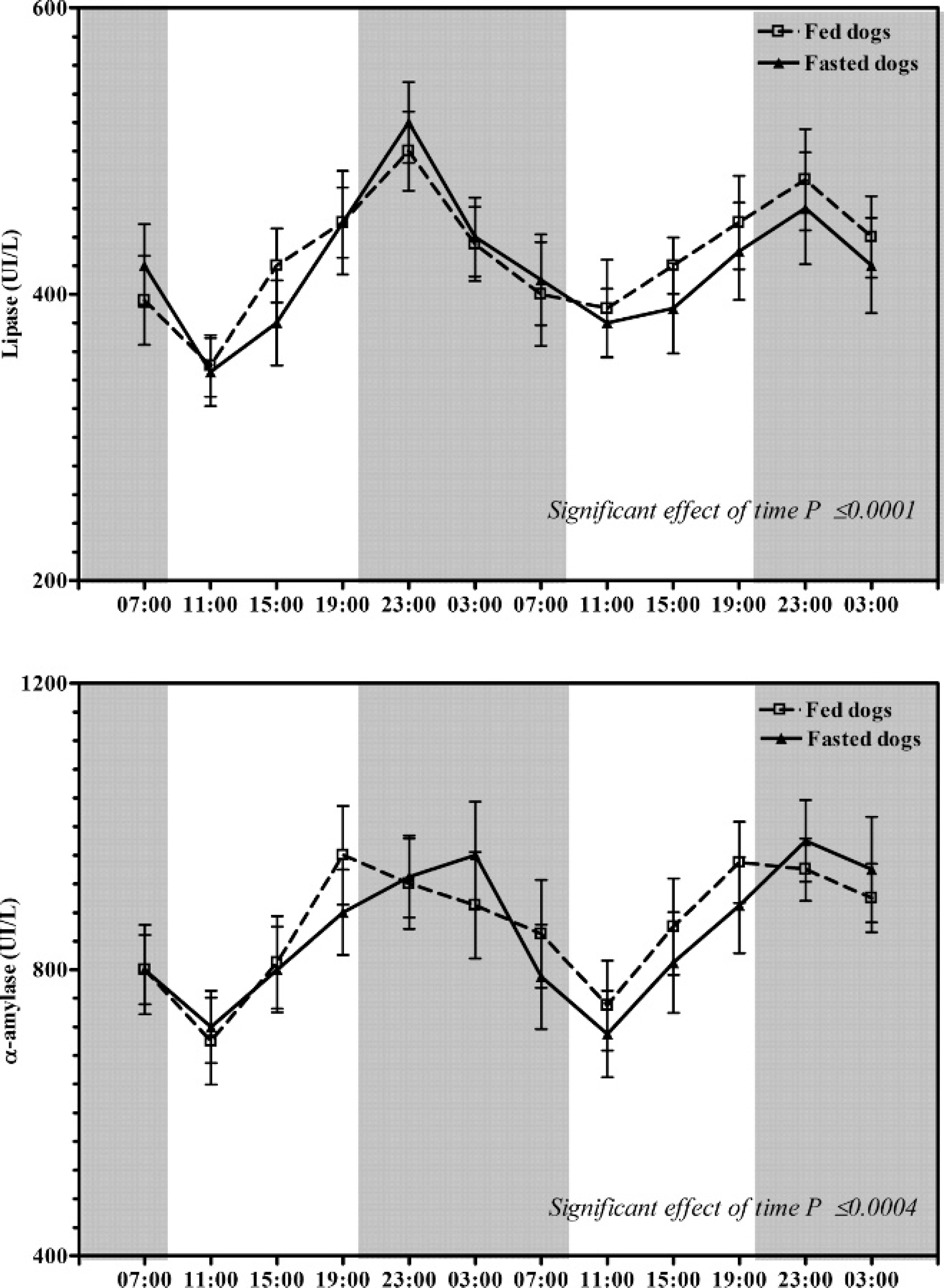
Daily rhythms of serum lipase (
Routine laboratory diagnosis of canine acute pancreatitis is based on the simultaneous measurement of serum or plasma lipase and α-amylase activities. 20 These activities increase at approximately the same rates after pancreatic injury. Activities of both enzymes usually increase within the first 24 hr and then peak at approximately 4–5 days after injury. Both enzymes appear to have very short half-lives in serum (3–6 hr). The short half-lives of these enzymes partially explain why serum activities sometimes are normal in animals with pancreatic injury. 34
Results from the current study showed that the circadian oscillation in lipase and α-amylase (midline estimating statistic of rhythm [MESOR] — amplitude and MESOR + amplitude interval) is very small compared to the range of normal values given by previous studies,
15
even though the MESOR is comparable to that of a 2004 study.
21
Differences of approximately 120 IU/l for lipase and 220 IU/l for α-amylase were recorded between the blood collection performed at 11:00
In conclusion, the results of the current study provide additional documentation of the structure of the dog circadian timing system and could be helpful in establishing the diagnosis of pancreatic injury in the dog if used in combination with patient history, clinical signs, and other laboratory tests.
Footnotes
a.
Venoject® Serum, Terumo Corp., Rome, Italy.
b.
Spectrophotometer, Slim, Seac Banche SpA, Florence, Italy.
c.
Lipase UV Dry Power, Centronic GmbH, Wartenberg, Germany.
d.
α-amylase EPS Fluid, Centronic GmbH, Wartenberg, Germany.
e.
STATISTICA 7, StatSoft Inc., Tulsa, OK.