




Abstract
The potential impact of preanalytical factors, such as type of anticoagulant, storage temperature, and time, on the formation of macroplatelets and platelet aggregates (platelet clumping) in dogs is largely elusive. The objective of the current study was to assess the effect of anticoagulant, temperature, and blood storage time in the light microscopy-generated macroplatelet percentages and the frequency of visually inspected platelet aggregates in clinically healthy dogs. Giemsa-stained blood smears from 70 healthy dogs were reviewed after exposure to different anticoagulants (ethylenediamine tetra-acetic acid [EDTA] vs. citrate), temperatures (25°C vs. 4°C), and storage times (up to 24 hr postsampling). The mean percentage of macroplatelets (platelets with diameter or length ≥ μm) was higher (P = 0.0006) when EDTA was used as the anticoagulant. For either anticoagulant, the mean percentage of macroplatelets was higher (P < 0.0001) at 25°C than at 4°C. Platelet clumping was 1.9 times (P < 0.0001) more likely to occur when citrate- rather than EDTA-anticoagulated blood was examined; regardless of the anticoagulant used, clumping occurred 3 times (P < 0.0001) more often when samples were preserved at 4°C than when they were preserved at 25°C. Storage time did not significantly influence the macroplatelet percentages or the frequency of platelet clumping. The results of this study indicate that macroplatelet percentages in the canine blood should be interpreted in relation to anticoagulant- and temperature-specific reference intervals and that future studies are warranted in order to investigate the clinical relevance of this calculation. In addition, the significant association of citrate with the formation of platelet aggregates may preclude its use for platelet enumeration in the dog.
Introduction
Microscopic examination of blood smears for a 2-dimensional assessment of platelet size and the recognition of platelet aggregation (clumping) is a valuable quality control measure of hematologic testing in thrombocytopenic dogs. 26,28,36 As a rule, numerous large platelets (macroplatelets, megathrom-bocytes) indicate enhanced thrombopoietic activity secondary to accelerated platelet destruction or consumption, while their absence usually indicates impaired production as a result of bone marrow disease. 4,26,32 Although automated blood analyzers often generate mean platelet volume (MPV), which theoretically reflects precisely the alterations in platelet size, the reviewing of blood smears may be a practical alternative when electronic sizing instruments are unavailable. 20,26 The MPV depends on a number of variables including, but not limited to, the anticoagulant, temperature, and blood storage time. 6,8 Likely, light microscopy-generated macro-platelet counts also depend on these variables. However, to the authors' knowledge, this has never been specifically investigated in dogs. Furthermore, there is a lack of standardized methodology for reporting macroplatelets, and reference intervals have not been established. 28
Platelet clumping usually results from platelet activation during collection (traumatic venipuncture) or the laboratory handling of blood and may interfere with accurate platelet enumeration, leading to spuriously low counts. 5,9,28 Historically, the use of citrate anticoagulant was associated with a reduced possibility of the formation of platelet clumps in canine blood 7,32 ; however, in a recent study, platelet aggregates were significantly more frequently visualized in stained blood smears prepared from citrate-anticoagulated blood as compared to ethylenediamine tetraacetic acid (EDTA)-anticoagulated blood. 29 The potential effect of temperature and blood storage time on the development of platelet clumping in the healthy dog is largely elusive, although cooling and storage of blood may reportedly accentuate the formation of aggregates. 7,12 The objective of the present study was to assess the effect of anticoagulant (EDTA vs. citrate), blood storage temperature (25°C vs. 4°C), and time (up to 24 hr postsampling) on the percentage of macroplatelets and the frequency of platelet aggregates, as observed by light microscopy, in blood smears from healthy nonthrombocytopenic dogs.
Materials and methods
Animals, sample handling, and smear preparation
Seventy clinically healthy dogs were enrolled in the study. The dogs were determined to be healthy based on history, physical examination, and a normal complete blood count (EDTA-anticoagulated blood) performed in a QBC buffy coat analyzer a and verified by reviewing a blood smear (range of platelet counts: 176,000–558,000/μl, mean: 349,651/μl, median: 346,000/μl, reference range: 175,000–500,000/μl). The dogs belonged to owners who had brought them for routine vaccination (n = 54) from September 2001 through September 2002 or dogs that were kept in the Companion Animal Clinic for teaching or research purposes (n = 16). They consisted of 41 males and 29 females, 49 purebreds (none belonged to the Cavalier King Charles Spaniel breed), and 21 crossbreds, with an age ranging from 0.17 to 11 years (median: 1.6 years). An informed consent was obtained from the owners for participation in the study, and the management of the inclinic dogs was in compliance with the guidelines of the European Committee for Care of Animals for Scientific Purposes.
A 10-ml blood sample was collected by atraumatic jugular venipuncture performed in all cases by 2 of the authors (M.E.M. and R.F.) using a 21-gauge needle attached to a plain syringe. Only “first stick”—collected samples were further processed, and an appropriate volume was immediately transferred into 4 collection tubes containing potassium EDTA b (2 tubes) and 3.8% sodium citrate c (2 tubes). Two wedge-type blood smears, 1 each from the EDTA- and the citrate-anticoagulated blood, were prepared manually, as quickly as possible following sampling. The collection tubes were subsequently stored in pairs (EDTA- and citrate-anticoagulated blood) either at room temperature (25°C) or at 4°C for up to 24 hr postsampling. Wedge-type smears were prepared from well-mixed blood aliquots at 2, 6, 12, and 24 hr postsampling. All smears were Giemsa stained.
Smear evaluation
In each slide, the area from the feathered edge to the monolayer, covering both the sides and the body of the smear, was evaluated for platelet clumps under 100X and then 400X magnification using a high-quality optical microscope. d Samples were considered to have undergone aggregation if at any magnification they displayed at least 3 aggregates, each consisting of ≥3 platelets. 33,37 The percentage of macroplatelets was calculated following the review of 300 consecutive nonaggregated platelets in the monolayer area with the aid of an ocular micrometer at 1,000X magnification. For the purpose of the current study, spherical platelets with a diameter ≥5 μm or elongated platelets with a length ≥5 μm were considered macroplatelets. 19 In all dogs, a whole smear evaluation was carried out in blind fashion, without evaluator awareness of the anticoagulant, temperature, or blood storage time assigned to the smears.
Statistical analysis
The associations between the macroplatelet percentages and anticoagulant, temperature, and time were modeled in a mixed linear model in the PROC MIXED procedure. e The presence or absence of clumping was associated with the same variables in a mixed logistic model in the PROC GLIMMIX procedure. e The analysis data included doubly repeated measures, in that they occur in 2 dimensions, namely, dog and time. It is likely that observations from the same dog or within the same time are correlated. Since the dependent variables (macroplatelet percentages and platelet clumping) were quantitatively the same in both dimensions of the measures setup, a single parameter was used to model the overall mean of the data and standard variance components to account for the covariance of measurements common in one dimension or the other. Thus, dog and time were included in all models fitted, as random effects. 11 The modeling strategy was similar for both models. Initially, each fixed-effect variable (anticoagulant and temperature) was separately offered to the models. Since the variables were significant at P = 25%, they were then simultaneously offered to the model along with their first-order interaction. In a hierarchical manner, all variables were tested for significance (P < 0.05) with the likelihood ratio test. The fit of the final mixed linear model was assessed by inspection of plots of the residuals against the predicted values, which did not show any unusual patterns. The fit of the final mixed logistic model was checked by evaluating whether the ratio between the Pearson's chi-square statistic and the model's degrees of freedom was close to 1. The anticoagulant- and temperature-specific reference intervals (mean macroplatelet percentage and 95% confidence interval [CI]) were obtained from the final linear mixed model with appropriate estimate statements.
Results
The interaction between anticoagulant and temperature was not significant in either model and was dropped off. The mean macroplatelet percentages were higher (P = 0.0006) when EDTA rather than citrate was used as the anticoagulant, and they were also higher (P < 0.0001) at 25°C than at 4°C. The adjusted reference intervals of macroplatelet percentages are presented in Table 1. There was significant variability of macroplatelet percentages among dogs (s 2 dog = 0.67; 95% CI: 0.4836-0.9919, P < 0.0001), but not among different time points (s 2 time = 0.02; 0.006-0.37, P = 0.13). Dog accounted for 48% of the total variation of macroplatelet percentages, whereas time accounted for only 1%.
Adjusted reference intervals (predicted means and confidence intervals [CI]) of macroplatelet percentages for anticoagulant type (ethylenediamine tetra-acetic acid [EDTA] or citrate) and storage temperature (4°C or 25°C) combinations.

The frequency of platelet clumping for different anticoagulant type and storage temperature at 0-, 2-, 6-,12-, and 24-hr postsampling is presented in Table 2. The platelet clumps ranged in size from small (5–10 platelets) to very large (too numerous to count) aggregates. Platelet clumping was 1.9 (1.4–2.4, P < 0.0001) times more likely when citrate rather than EDTA was used and 3 (2.2–3.8, P < 0.0001) times more likely when samples were preserved at 4°C than at 25°C. The log-likelihood of platelet clumping varied significantly among dogs (log odds of s 2 dog = 1.67; 1.14–1.70, P < 0.0001), but not among time points (log odds of s 2 time = 0.15; 0.05–2.37, P = 0.12). Dog accounted for 51 % and time for 7% of the total variation of the log odds of platelet clumping.
Discussion
Limited information from a small number of healthy dogs indicates that light microscopy-generated macroplatelet percentages range from 0.8% to 1.2% in EDTA-anticoagulated blood. 19 To the authors' knowledge, the present study is the first that establishes reference intervals for macroplatelet percentages from a large number of healthy dogs in the context of different postsampling handling conditions. The macroplatelet percentage may be a useful and cost-effective alternative in determining platelet turnover, avoiding labor-intensive or unavailable methods (examination of bone marrow smears or quantification of reticulated platelets), overcoming the potential inaccuracies of the MPV, or detecting macroplatelets when the MPV is still normal. 27,28,32,35 The accurate measurement of MPV necessitates that all platelets be assessed, that they are not clumped, that their shape is essentially unaltered, and that other particles, such as lipid droplets or cell fragments, are not misinterpreted as platelets. 28 The large proportion of dogs that demonstrate platelet clumping (as was also noticed in the present study) may occasionally invalidate the diagnostic utility of MPV; in addition, MPV is a cell analyzer-dependent variable, in that impedance methods tend to exclude macroplatelets from evaluation, while the sphering effect in optical analyzer-processed platelets may falsely decrease the MPV. 8,21,28 It should be pointed out, however, that the above shortcomings do not minimize the usefulness of automated analyzers, which relieve people of the tedious manual counting of hundreds of cells. Although the clinical relevance of macroplatelets in dogs awaits further investigation, recent evidence indicates that megathrombocytosis (increased MPV) in thrombocytopenic dogs was a relatively good indicator of sufficient bone marrow response; on a comparative basis, an excellent correlation was found between the percentages of blood macroplatelets and bone marrow megakaryocytopoiesis in humans. 4,30 In addition, in canine monocytic ehrlichiosis (Ehrlichia canis), a disease typically manifested by acute non-myelosuppressive and chronic myelosuppressive phases, thrombocytopenia was consistently associated with significantly increased macroplatelet percentages (range: 2–20%, median: 9%) in the acute phase and decreased percentages (range: 0–1%, median: 0%) in the chronic phase, 13 implying that the ranges established in the present study may be useful in the clinical staging of this disease.
Frequency of platelet clumping for different anticoagulants (ethylenediamine tetra-acetic acid [EDTA] or citrate) and storage temperatures (4°C or 25°C) at 0, 2, 6, 12, and 24 hr postbleeding in 70 clinically healthy dogs.
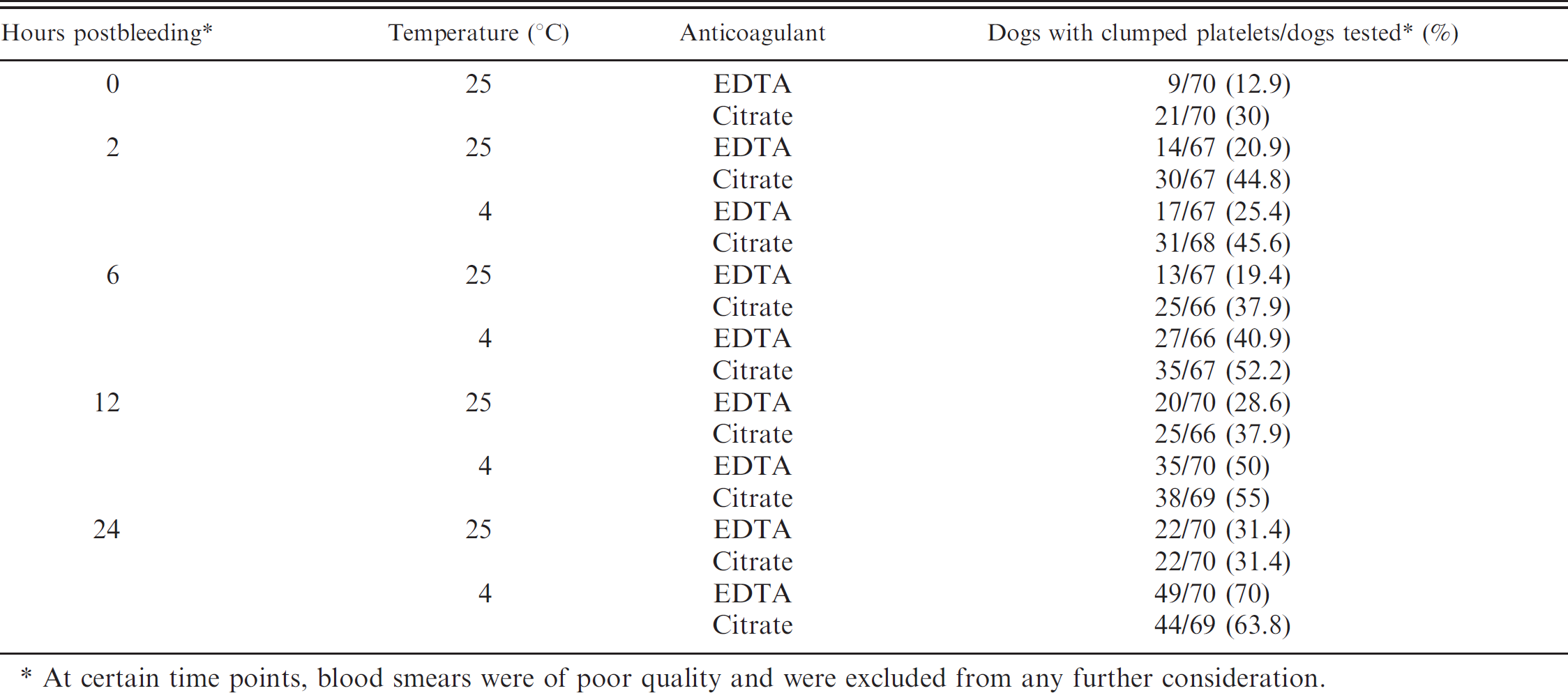
At certain time points, blood smears were of poor quality and were excluded from any further consideration.
The results of the current study indicate that the macroplatelet percentages are significantly higher when EDTA rather than citrate is used as anticoagulant and when the blood is stored at 25°C as opposed to 4°C. The results are partially in line with those of previously published studies in dogs and humans, which indicate an artificially increased MPV in EDTA-anticoagulated blood stored at 25°C. 6,7,28,31 In a 1986 study, 6 the maximum MPV was observed in EDTA-anticoagulated canine blood stored at 4°C, while minimum MPV alteration was observed in citrate-anticoagulated blood stored at 37°C. Interestingly, in a study published in 1989, 34 no EDTA- or storage temperature-mediated impact was demonstrated on the MPV of healthy dogs determined over a period of 30 hr postsampling in an impedance analyzer, while a 2007 study 29 demonstrated a significant increase of MPV in citrate-anticoagulated compared to EDTA-anticoagulated canine blood processed in an optical analyzer within an hour of collection. This discrepancy may be partially explained by the different study design (instrumentation, different blood sampling timing, number of dogs, consideration of macroplatelet percentages instead of MPV, concentration of EDTA, and different degrees of platelet activation or aggregation). 29,34 In the current study, time did not significantly affect the macroplatelet percentages, indicating that blood storage for up to 24 hr postsampling does not play an instrumental role to this effect, as opposed to the effects of anticoagulant and storage temperature. Importantly, there was significant variability of macroplatelet percentages among dogs in the present study, clearly indicating that factors other than those considered in the present study may substantially influence the macroplatelet percentages. For instance, the evaluation of a subset of 300 platelets may not consistently reflect the percentage of macroplatelets in a platelet concentration in excess of 200,000/μl, thus adversely affecting the accuracy and precision of the method.
A limitation of the present study is the lack of concurrent evaluation of the MPV and platelet number; this limitation minimizes the ability to investigate if there is an association between these values and macroplatelet percentages. Further studies are warranted to pursue this objective. Apart from being an indicator of enhanced thrombopoiesis in thrombocytopenic dogs, an increased number of macroplatelets may be observed in nonthrombocytopenic dogs recently recovered from thrombocytopenia or anemia, dogs with myeloproliferative or myelodysplastic disorders, and in Cavalier King Charles spaniels, in which macrothrombocytosis is inherited as an autosomal recessive trait seen in up to 35% of healthy dogs. 3,7,16,25,28 Therefore, in the clinical setting, the integration of macroplatelet percentages in the decision-making process (i.e., intramedullary or extramedullary thrombocytopenia) should be made with due consideration of the underlying disease entities and the postsampling conditions that affect the macroplatelet percentages.
The findings of the present study indicate that platelet clumping is fairly common even in healthy, nonthrombocytopenic dogs, a result that is in accordance with previous reports. 9,23,29 Despite the fact that the overall frequency of platelet clumping in the present study may have been affected by a relatively low threshold for abnormality (at least 3 aggregates, each consisting of ≥3 platelets), clumping was significantly more frequent in citrate- compared to EDTA-anticoagulated blood and was more pronounced at lower temperatures. As is the case with cats, the prolonged storage of blood (up to 24 hr postsampling) does not appear to substantially accentuate this phenomenon in dogs. 15 The higher propensity for platelet clumping assigned to citrate is in line with the results of a recent study in which aggregates were seen in 70% and 28% of citrate- and EDTA-treated blood, respectively, 29 and this result opposes a widespread fallacy that citrate may prevent or minimize the formation of platelet clumps. 7,32 Regardless, platelet clumping appears to be unavoidable (although with a different probability to occur) in a large proportion of canine blood samples using either citrate or EDTA, and future studies may be warranted to investigate if measures such as the collection of blood into anticoagulants containing platelet activation inhibitors or the vortex mixing of blood could minimize aggregation, as has been preliminarily documented in cats. 14,29,33 In addition, further studies should try to clarify if there are species differences in the clumping-inducing effect of citrate or EDTA. Although platelet clumping usually results from activation of platelets during blood collection and handling, the tendency for a more pronounced platelet clumping at 4°C versus 25°C in the present study raises the possibility of an anticoagulant-dependent, cold agglutinin-mediated platelet agglutination, which has been frequently documented in people and rarely in horses but is apparently rare or underestimated in dogs, or of a nonspecific cold activation of normal platelets. 1,10,22,24,36 In humans, EDTA-dependent platelet clumping is presumptively affected by agglutinating antibodies that recognize cytoadhesive receptors on platelet GPIIb-IIIa and/or by calcium chelation-triggered conformational changes in the cellular membrane. 2,17,18
Notably, in the present study, there was a significant variability of the frequency of platelet clumping among dogs, which accounted for 51% of the total variation. This finding is in accordance with the results of a previous study, 9 in which the distribution and the size of the platelet clumps was not always homogeneous in the blood smears, indicating that the evaluation of a single smear may not be an accurate reflection of the overall degree of platelet clumping in a particular sample. Despite this shortcoming, the microscopic reviewing of a blood smear still remains the most reliable method for detecting aggregates, thus validating the automated platelet enumeration, although QBC analyzer and some state-of-the-art optical analyzers may flag their presence in the blood. 9 In a recent study, the sensitivity and specificity of this platelet parameter (automated platelet clump count) generated by an optical analyzer appeared to be less than satisfactory, 29 as has been the case with the QBC analyzer. 9,23
In conclusion, the present study provides baseline data on the macroplatelet percentages in the blood of healthy dogs in a variety of preanalytical conditions. Further studies are warranted to evaluate the diagnostic value of macroplatelets in disease as well as to investigate their potential association with other platelet indices. In addition, results indicate that platelet clumping is substantially higher in citrate-versus EDTA-anticoagulated blood, thus disqualifying the former for the platelet enumeration. Also, cooling (4°C) of blood significantly accentuates the formation of platelet clumps.
Footnotes
a.
QBC VetAutoread™ Hematology System, IDEXX Laboratories Inc., Westbrook, ME.
b.
Potassium-EDTA, Sarstedt, Numbrecht, Germany.
c.
Sodium citrate, Nuova Aptaca Srl, Canelli, Asti Province, Italy.
d.
Axiolab, Zeiss, Germany.
e.
SAS Version 9.1.3, SAS Institute Inc., Cary, NC.