



Abstract
Blood lactate measurements are commonly used in exercising horses to determine the onset of lactate accumulation and in colic patients to assess clinical status and to indicate prognosis. To study the usability of a portable blood lactate meter based on dry chemistry (Lactate Pro), the data from this instrument were compared to data from a laboratory-used lactate meter based on wet chemistry (ABL 605 blood gas analyzer [ABL]). Heparinized blood samples were obtained from horses participating in a jumping experiment (n = 9), from horses cantering at maximal speed on a racetrack (n = 7), and from patients admitted to the Department of Equine Sciences at Utrecht University for severe colic (n = 13). Seventeen of these samples were tested in duplicate on both instruments to determine the repeatability of the measurements. Blood lactate concentrations measured with the Lactate Pro ranged from 0.8–17.6 mmol/liter and with the ABL from 1.0–18.6 mmol/liter. The correlation between lactate concentrations obtained using the Lactate Pro and values from the ABL was 0.90, and the relationship was represented by the following formula: y = 0.90 · x + 0.36, indicating a linear relationship between values produced by the ABL and Lactate Pro. The repeatability for the Lactate Pro was high (0.997), which is comparable to the ABL (0.999).
Blood lactate concentration is an important variable in training and standardized exercise testing of (race) horses. 8,10,11 It is also a useful parameter in equine medicine to estimate the severity of the underlying cause of colic and to assess the prognosis of a colic patient; patients with a blood lactate concentration higher than 6.8 mmol/liter have a low probability of survival. 6
Several portable lactate analyzers, including the Lactate Pro, a have been developed for use in human (sports) medicine and have been tested under field conditions. 4 In a study that compared 4 lactate measurement devices in humans—Lactate Pro, Accusport, b YSI, c and LP8+ d —the Lactate Pro was considered to be the best portable blood lactate measurement device as it was cheap and easy to use and provided reliable results under normal, cold, and low oxygen conditions. 5 Recently, the Accusport analyzer was demonstrated to be useful in measuring lactate concentration in equine blood and peritoneal fluid. 1 The aim of the present study was to evaluate the usability (accuracy and repeatability) of the Lactate Pro as a portable blood lactate analyzer to measure lactate concentrations in equine whole blood using the laboratory-based ABL 605 blood gas analyzer (ABL) e as the comparison assay.
The Lactate Pro (Fig. 1) is a portable blood lactate analyzer designed for lactate measurements in whole blood collected from a fingertip or earlobe in human athletes. It is a pocket-sized, battery-operated instrument measuring 55 × 84 × 15 mm, weighing 50 g, and using single-use test strips. According to the manufacturer's data and earlier studies, the instrument can be operated at a temperature range of 10–40°C and a relative humidity of 20–80%; the measuring range is 1.0–23.0 mmol/L. 4 This makes this handheld analyzer suitable for on-site measurement of blood lactate concentration. The test strip fills itself with 5 μl of whole blood through capillary action. This prevents errors resulting from differences in the amount of blood used for the measurement. The lactate concentration is determined using electrodes coated with lactate oxidase and ferricyanide as an electron mediator. The meter measures the magnitude of the current of the reduced mediator by the enzymatic reaction, and it displays the lactate concentration on screen after 60 seconds. The instrument can be calibrated automatically by selecting the appropriate calibration curve after the use of a calibration strip. 9
The Radiometer ABL 605 is a large laboratory-based analyzer that provides measurements of lactate, glucose. pH, bicarbonate, electrolytes, and blood gas concentrations. This device requires a blood sample of 75 μL. Blood lactate reacts with lactate oxidase to form pyruvate and hydrogen peroxide (H2O2). The H2O2 is subjected to a given potential and oxidized, creating a current that is measured. The amount of the current is directly proportional to the lactate concentration in the sample. 7 Whole blood samples are used in both the Lactate Pro and the ABL; however, the lactate concentration is measured in plasma in presence of the nonlysed erythrocytes.
With permission of the Ethics Committee of Utrecht University, heparinized blood samples were collected from 3 different groups of horses. The first group consisted of 6 riding-school horses that were participating in another experiment in which they had to jump a course of 12 fences and canter the same course at the same speed without jumping the fences (9 samples). The second group consisted of 2 horses that cantered at maximum speed on a race track (7 samples), and the third group consisted of 13 horses admitted to the Department of Equine Sciences at Utrecht University for severe colic (13 samples). Only samples with a blood lactate concentration >0.8 mmol/liter were used in the present study (n = 29) as the Lactate Pro does not measure concentrations <0.8 mmol/liter.
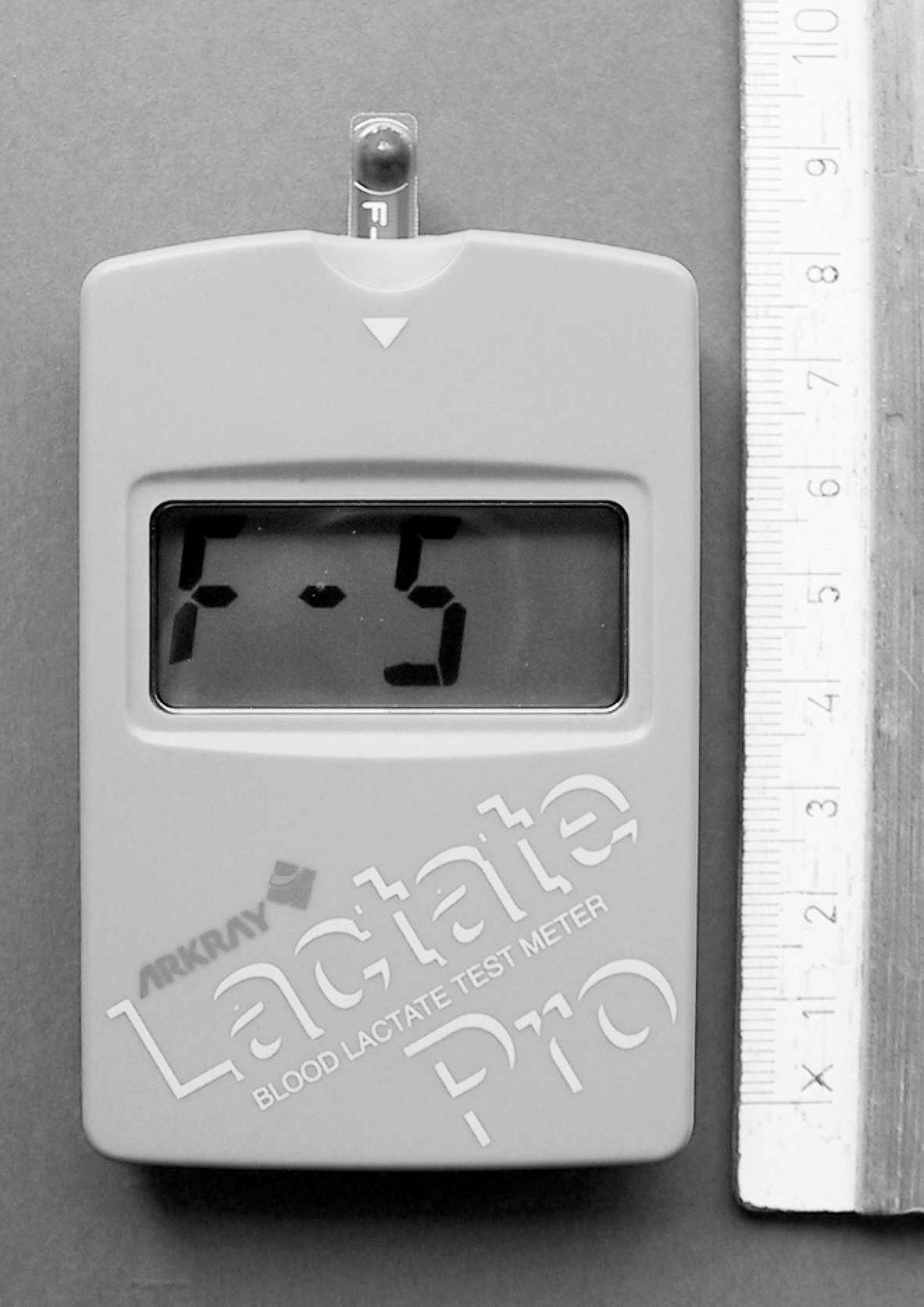
Lactate Pro instrument with the calibration strip in use.
All heparinized blood samples were either processed within 15 minutes (horses with colic) of collection or stored on ice and processed within 60 minutes of collection (exercising horses). All 29 samples were processed by the same person to avoid variation due to processing method, using the ABL blood gas analyzer at the same time using the Lactate Pro. Seventeen of the blood samples were measured in duplicate, both with the ABL and the Lactate Pro.
The results from the Lactate Pro and the ABL were compared using Microsoft Excel 2003 f and SPSS 12.0.l g for Windows. The values produced by the Lactate Pro were plotted against the values produced by the ABL in a regression plot. A correlation coefficient and a regression line could be calculated from this plot with orthogonal regression to compare the 2 different methods of blood lactate determination with the 2 different instruments. The repeated measurements of both the ABL and the Lactate Pro were evaluated using a linear mixed-effect model to calculate the intraclass correlation, that is, the correlation of multiple measurements on the same sample.
The horses ridden in the jumping test had blood lactate concentrations, as measured with the ABL, varying between 1.0 and 6.8 mmol/liters, the horses cantering at maximum speed on a track had blood lactate concentrations between 3.1 and 7.4 mmol/liters, and the horses admitted with severe colic had blood lactate concentrations between 1.6 and 18.6 mmol/L. The results from the measurements of the Lactate Pro were plotted against the results of the ABL (Fig. 2), and a correlation coefficient of 0.90 was found. The regression line that could be calculated with orthogonal regression was characterized by the following formula: y = 0.90 · x + 0.36, indicating that the Lactate Pro slightly underestimates (on average 6.6%) the blood lactate concentration of the samples. The repeatability of the measurements performed with the Lactate Pro and with the ABL was very high: an intraclass correlation of 0.997 was calculated for the Lactate Pro and an intraclass correlation of 0.999 was calculated for the ABL.
The Lactate Pro is an example of a device using “dry chemistry” or solid-phase chemistry that is used to obtain quick results without the need for large laboratory equipment. In general, dry chemistry measurements have a reasonably good correlation with conventional laboratory (“wet chemistry”) measurements, but dry chemistry is not always as reliable as wet chemistry. 3 Dry chemistry techniques can be used to obtain a rapid indication of a particular variable and to determine in practice whether the results are (still) reliable; however, some samples should also be analyzed in a laboratory.
Possible causes for the lower lactate concentrations obtained using the Lactate Pro might be the high packed cell volume (PCV) in the blood of horses and the phenomenon of rouleaux formation by erythrocytes. When a horse exercises the PCV values rises markedly as result of splenic contraction, which releases erythrocytes in the circulating blood. It is not exactly known how the Lactate Pro accounts for the lactate that is stored in the erythrocytes in the blood, especially if samples are not processed immediately. 5,8 The influence of PCV on lactate measurements by the Lactate Pro requires further investigation.
The blood lactate concentrations measured with the Lactate Pro in the present study ranged from 0.8 to 17.6 mmol/liter. These values are in the same range as the values obtained when the device was tested in humans (1–18 mmol/liter) and fall within the range provided by the manufacturer (0.8–23.3 mmol/liter). 7 In horses, plasma lactate concentrations during or shortly after maximal treadmill exercise may rise to even 32 mmol/liter, but this is very rare under field circumstances. 2 Obviously, such values are not within the range provided by the manufacturer and are possibly too high for reliable measurement using the Lactate Pro. Whether this instrument can be used to measure lactate concentrations in high-intensity exercise remains to be determined, using blood samples with higher lactate concentrations.
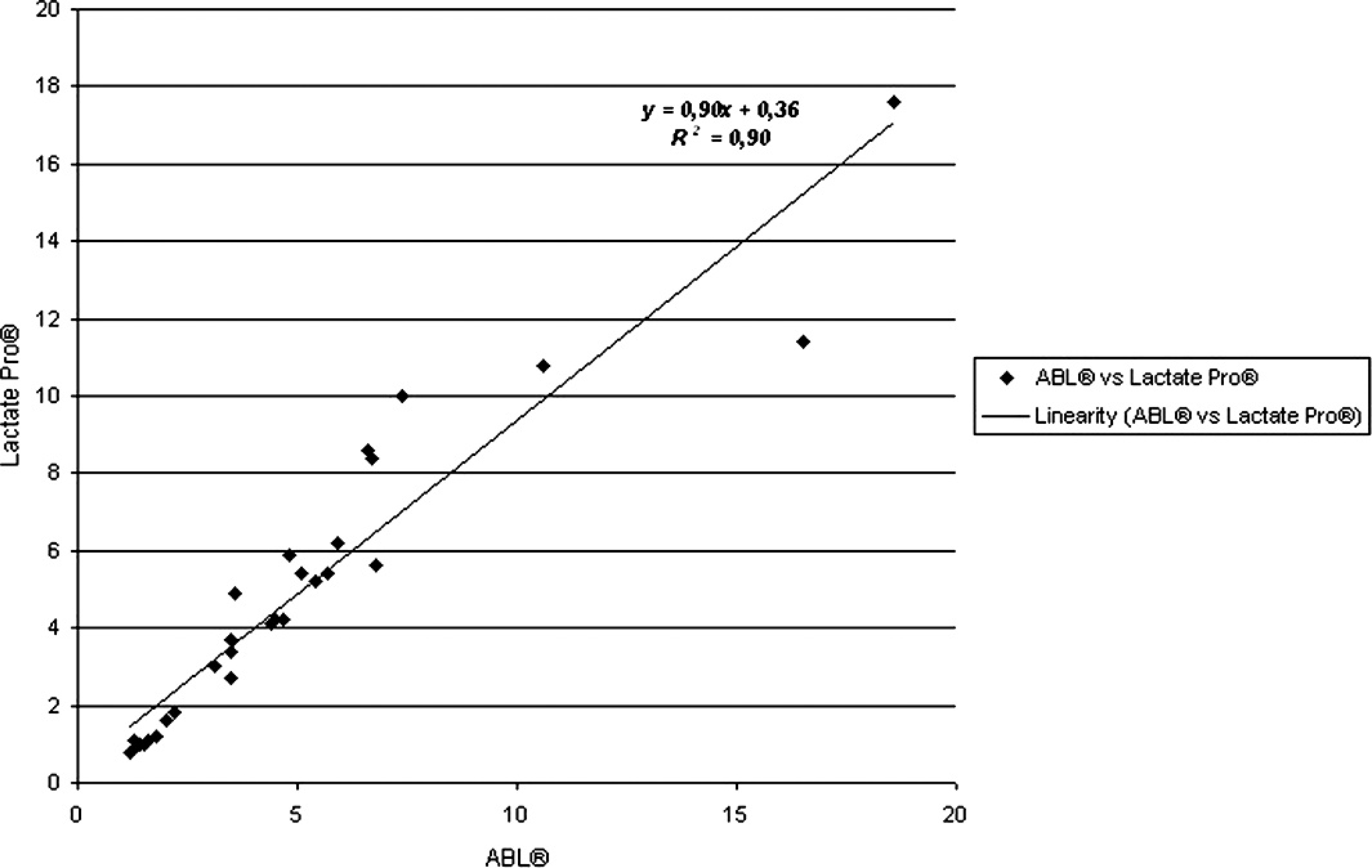
Regression plot of ABL versus Lactate Pro in heparinized equine blood samples (n = 29).
This study demonstrated that, under field conditions, the Lactate Pro provided repeatable and accurate results comparable with the ABL 605. Because it is portable, fast, and easy to handle, the Lactate Pro is a valuable tool for use in equine sports and in clinical medicine.
Acknowledgements. We gratefully acknowledge Menarini Diagnostics for supplying us with the Lactate Pro measurement device and the test strips. We also thank Jan van den Broek for helping us with the statistical evaluation. Ben Kessels for his advices about the lactate analysis procedures, and Robin van den Boom for editorial help.
Footnotes
a.
Lactate Pro, Arkray, KDK Corporation, Kyoto, Japan.
b.
Accusport, Boehringer Mannheim, Germany.
c.
YSI, Yellow Spring Instruments, Yellow Spring, OH.
d.
LP8+, Dr. Bruno Lange, Berlin, Germany.
e.
ABL, Radiometer, Copenhagen, Denmark.
f.
Microsoft B.V., Schiphol-Rijk, The Netherlands.
g.
SPSS, Inc., Chicago,