



Abstract
Aim
To expand our understanding of suicide by examining reports of this behavior from the Chinese mythical era (commencing circa 1200 BCE) and drawing comparisons with subsequent eras.
Method
Four hundred recently published accounts of Chinese myths and folk tales were examined, along with supplementary material. Lists were created including one focused on attempted suicide and another on completed suicide. Comparisons were drawn with the suicide of a later era China and the current west.
Results
No evidence was located of suicide resulting from mental disorder. Six accounts of attempted suicide and 13 of completed suicide were located. Triggers included the death of a loved one, the loss of a valued possession, complicated relationships, and the avoidance of guilt and disgrace. These accord with current western behavior.
Conclusion
There is at least fair agreement in the triggers of suicide in past eras in China and the current western era. This supports the view that suicide may be, in some instances, a customary response to circumstances.
Suicide has been reported in every community in every region of the world, throughout time. During the last century the notion was pushed that suicide was always, or almost always, the result of a mental disorder. 1 In 2014, the WHO refuted that belief allowing the topic to be studied, once again, through a wider lens. 2 While people with mental disorder have higher suicide rates than people without mental disorder, more people live without than with mental disorder, thus suicide in the absence of mental disorder is well described.
In 1897, sociologist Emil Durkheim 3 attributed suicide to inadequate integration of individuals into society, which left/leaves them exposed to the full impact of negative events. Culture and customs are relevant sociological concepts—culture being the set of beliefs, values, and goals shared by people living in a particular region. Those who embrace these ideas/beliefs are accepted by the community and can operate effectively in the local setting. 4 Customs are the culturally accepted behavioral responses to particular circumstances—thus, in many instances, suicide is a culturally appropriate (customary) response.
The centrality of culture and custom to suicidal behavior is apparent in the different rates of suicide observed in different countries/regions. Consider the Philippines, a predominantly Catholic country, and South Korea, a country rejecting tradition and westernizing as rapidly as possible. Located in the Pacific Ocean, the Philippines has a suicide rate of 2.2/100 000; 2000 km directly north, on the Pacific coast, South Korea has a suicide rate of 25/100 000 [10 times greater]. 5 The differences in gender rates of suicide in different countries also illustrate the importance of culture and customs in suicide. In almost all countries, the suicide rate is greater for males than females—however, there are national differences. In China the male rate of suicide is 52% higher than the female, in Australia the male rate is 190% higher and in Oman it is 580% higher. 5
China also clearly demonstrates the impact of culture on suicide rate. Until the 1990s, the suicide rate was higher among women than men (as in Myanmar, Bangladesh, and Pakistan). However, with cultural change in the latter part of the 20th century, female suicide fell and currently remains below the male rate.
Certain circumstances are associated with increased risk of suicide. Apprehension for crimes (especially sex-crimes against minors) carries a much higher risk of suicide. Droughts in low-income countries increase the risk for small-scale farmers. Painful and terminal illness also raises the risk.
To explore the role of social factors in suicide, we had previously studied Romance of the Three Kingdoms—a 14th century Chinese novel.6,7 This work draws on oral and written history—the setting being the turbulent times of the civil war which erupted at the end of the Han dynasty (AD 180) and ended with the establishment of the Jin dynasty (AD 265). During that era, triggers for suicide included loss of status, loved ones, and fortunes—these triggers persist in current western society. 7
The aim of the current study was to further explore the role of culture, custom and social factors in suicide we studied the myths and legends of China. Much of this material is believed originated about 1200 BCE, being transmitted orally for more than a millennium before being recorded in writing. While precise dates are uncertain, the myths and fairy tales examined in this paper predated the material considered in our earlier study of suicide in historical China 7 by at least 500 years.
Method
Our primary source of information was 400 accounts of Chinese myths and folk tales collated by Barnes and Noble and published in 2020. 8 This collection draws predominantly on five collections published in the west between 1880 and 1921. Additional material available on-line through the Project Gutenberg were also examined.9,10 As necessary, we placed the titles of myths/tales from Barnes and Noble 8 in a search engine and examined the generated information.
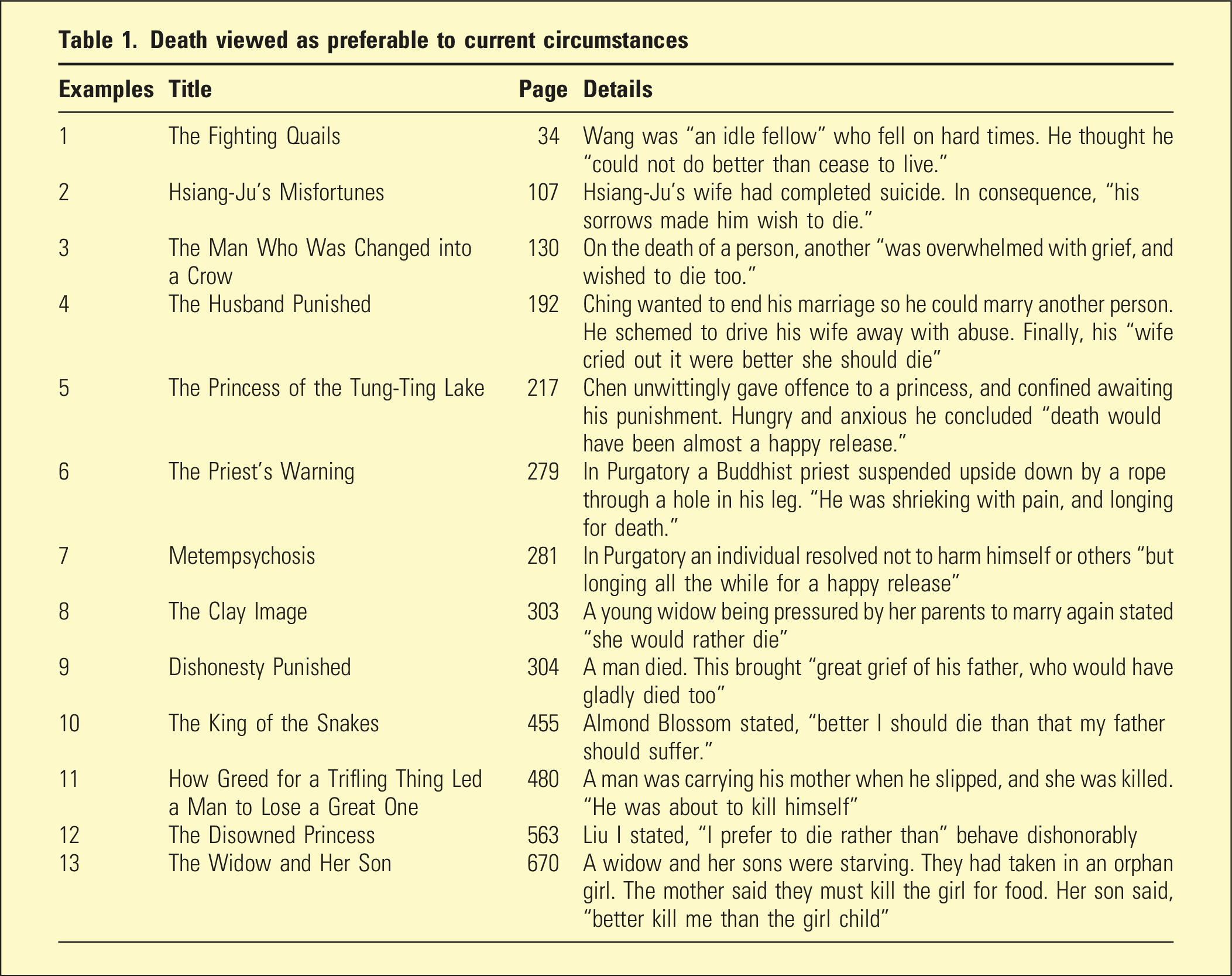
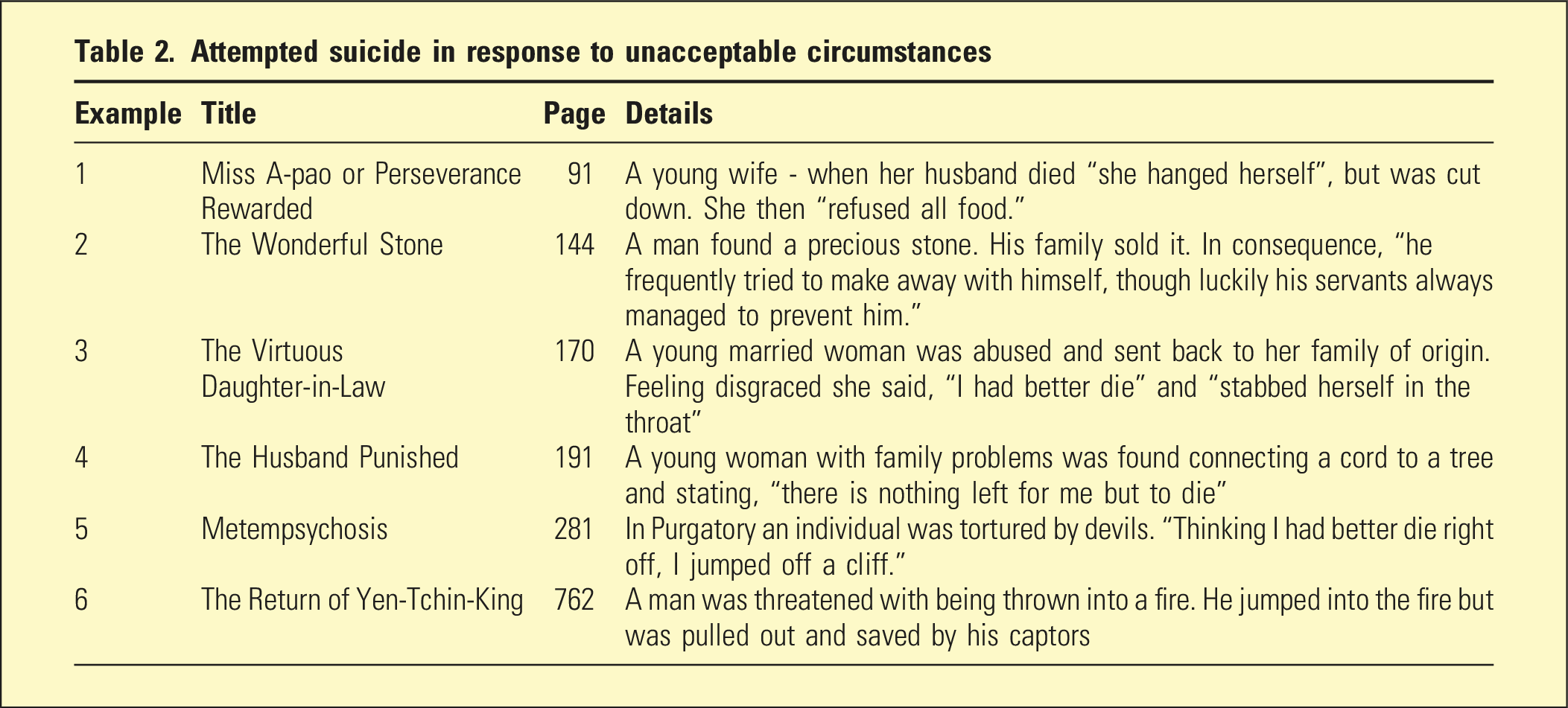
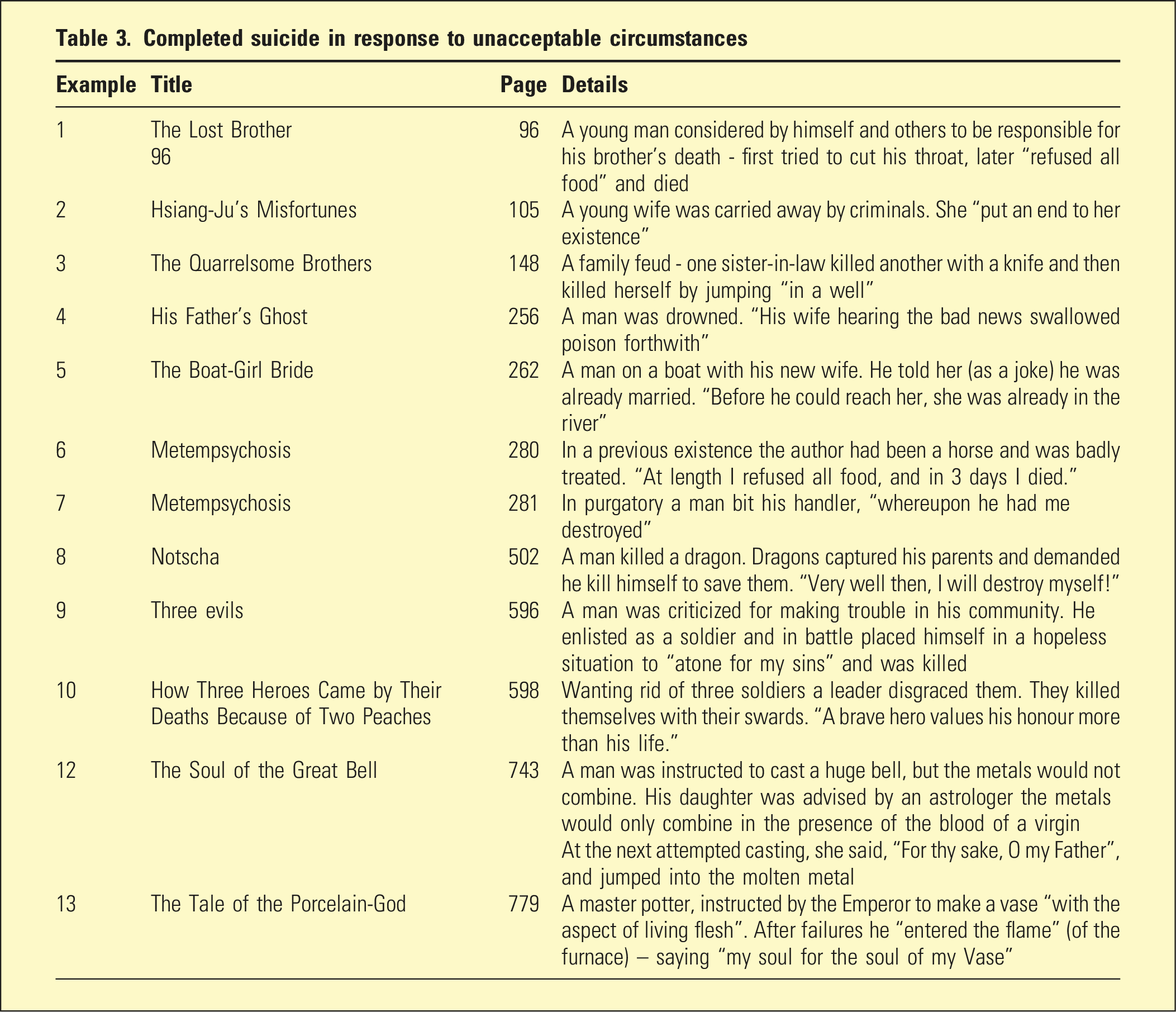
We sought evidence of 1) mental disorder leading to suicide, 2) the view that death is/was preferable to living in unacceptable circumstances, 3) attempted suicide in response to unacceptable circumstances, and 4) completed suicide in response to unacceptable circumstances. Three tables were populated with evidence relevant to the items 2, 3 and 4 in the last sentence. Material is presented under the titles employed by Barnes and Noble 8 and the pages from which extracts were taken are listed.
Results
Death viewed as preferable to current circumstances
Attempted suicide in response to unacceptable circumstances
Completed suicide in response to unacceptable circumstances
Discussion
In the myths of ancient China, we found no account of mental disorder leading to suicide. This was as expected. After years of examining historical accounts of suicide from from this era, around the globe, we have discovered only one case in which mental illness could be identified as the triggering force. This was Cleomenes I, King of Sparta, who died in 489 BCE. 11
Mental disorder may lead to suicide—it is therefore surprising it does not appear as a trigger in the earliest oral and written accounts. However, this may not be the full story, as mental disorder was not readily recognized. Concepts of mental disorder in China were first presented in The Book of Historical documents in 1100 BCE.12,13 Another part of the explanation may be that when people develop severe mental disorder they function less effectively and become less prominent in society—thus, their suicides may pass relatively unnoticed. To conclude, we found no evidence of mental illness or the extant concepts of mental illness impacting on suicide rates in ancient China—that does not prove mental illness driven suicide did not occur, but it does allow that other factors may have been operative.
Thirteen examples were located of individuals stating they would prefer to die than continue living with extant circumstances. These were not individuals stating the intention to suicide—simply statements asserting, in the absence of change, death was a potential escape option. The unacceptable circumstances included the death of a loved one, pressure applied to a widow to remarry, abuse by a spouse, and prolonged physical pain.
Six examples of attempted suicide were located. All involved potentially fatal means. One person hanged herself, she was cut down, but thereafter she refused food. One person made repeated attempts, but his servants managed to prevent his death. One person jumped off a cliff (and survived the fall), another jumped into a fire but was saved by his captors. Triggering factors included the death of a loved one, the loss of a valued possession, family problems, and complicated relationships.
Thirteen examples of completed suicide were located. The means included starvation, jumping into a well, poisoning, jumping into a lake, cutting and stepping into a furnace. The motivations included the avoidance of a sense of guilt, disgrace after being raped, loss of a spouse, and the preservation of loved ones.
The circumstances described in accounts from mythical China are frequently distinct from those described in Romance of the Three Kingdoms. In the mythical stories reference is frequently made to supernatural entities, ghosts, fairies, elves, spirits, supernatural powers, foxes and dragons capable of transmuting into humans, and haunted dwellings. In Table 1, Examples 6 and 7 occur in Purgatory, as do Table 2 Example 5 and Table 3 Example 7. In Table 3 Example 6 is a personal account from a reincarnated man who was previously a horse, and Example 8 concerns a man captured by dragons. Example 12 concerns an artisan experiencing trouble casting an object—his daughter was advised he would only be successful if the smelting involved the blood of a virgin—consequently she jumped into molten metal. Example 13 concerns a potter seeking to make a perfect piece of porcelain—eventually he stepped into the furnace so that his soul could be incorporated into a vase.
Nevertheless, the circumstances precipitating attempted and completed suicide in the mythical era were frequently the same as those of the era of Romance of the Three Kingdoms, and the current era in the west. Among those who attempted suicide (Table 2) were Example 1, a person whose spouse had died; Example 2, a person who had lost a precious object; and Example 3, a person cruelly rejected by their spouse. Among those who completed suicide (Table 3) were Example 1, a person who believed himself responsible for the death of a sibling; Example 2, a woman carried away by criminals; and Example 4, a person who learned of the death of a spouse. Examples 9 and 10 involved the loss/preservation of honor.
In conclusion, we found information indicating that in ancient China, suicide has been a means of dealing with painful and difficult social situation since 1200 BC. In some instances, at least, suicide is a custom, a culturally appropriate response to circumstances—supporting evidence comes from ancient and more recent China, and from the past and present West.
Footnotes
Ethical approval
There are no ethical issues raised in this historical paper.
Informed consent
This is an historical paper and concerns no patients.
Disclosure
The author(s) declared no potential conflicts of interest with respect to the research, authorship, and/or publication of this article.
Funding
The author(s) received no financial support for the research, authorship, and/or publication of this article.
