




Abstract
Suicide by jumping is generally uncommon in New Zealand, accounting for fewer than 3% of suicides (2.7% of all suicides for the years 2002–2004) [1]. In the city of Dunedin, however, a rocky headland (Lawyer's Head) projecting into the Pacific Ocean near a popular city beach has acquired a reputation as a place from which jumping will result in almost certain death (Figure 1). Lawyer's Head became a suicide hotspot, with symbolic significance for local people. Not only were some people actually dying by jumping off it, but also many threatened to jump off it, not infrequently resulting in police being informed. At times this information would lead to a police callout to Lawyer's Head. The callout system involved an initial police response plan in which a police car was directed to Lawyer's Head, and the Search and Rescue paging system was used to contact the callout duty Search and Rescue coordinator. If a person was at the cliff face threatening to jump, the police would also call out the police negotiating team, and the local Emergency Psychiatric Services would be contacted if the person's name was known. The rescue boat, cliff rescue team and the rescue helicopter might also be called at this point. Rescues had become so frequent that permanent anchors had been installed at the three main places from which people jumped, in order to facilitate rescue attempts. Very few who actually jumped survived the 25–30 m drop, with death being due either to drowning or to multiple injuries from landing on rocks.
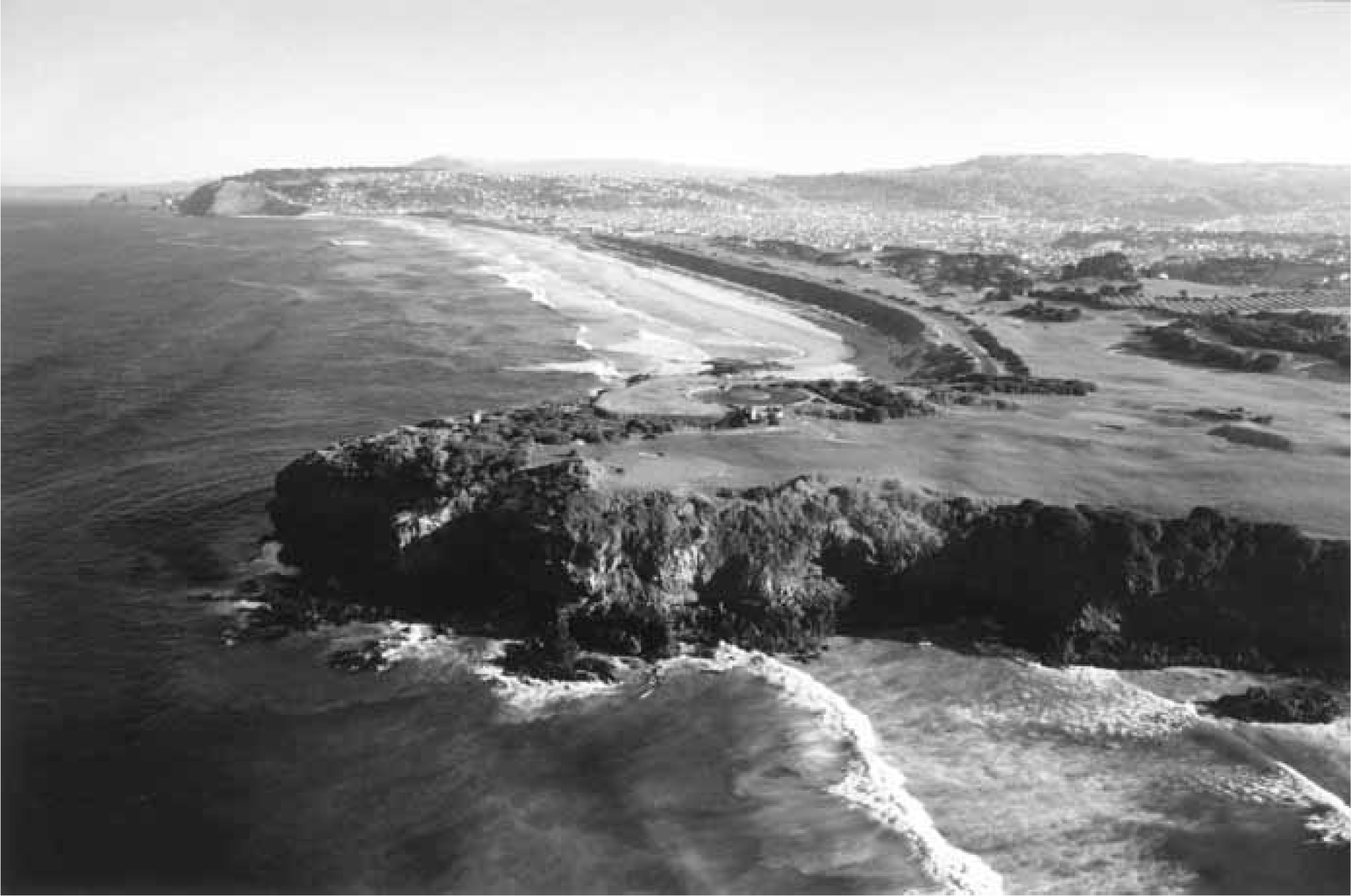
Lawyer's Head.
By coincidence, the only vehicular access to the headland was closed by the Dunedin City Council on 1 August 2006, because a new sewage outfall was being built. Previously, a road provided access to Lawyer's Head, where there was a lookout point. When the sewage outfall work began, a high locked gate was installed (Figure 2) on the access road approximately 1.6 km from the headland. Three months later, on 12 November 2006, the gate was moved to 1.2 km from the headland. At about the same time, security guards were deployed after hours (17.00–07.00 hours), in response to damage caused by some vandals. The temporary road closure created a natural experiment, whereby it could be determined whether such a bar to access would reduce suicides and emergency police callouts for threatened suicide at Lawyer's Head.
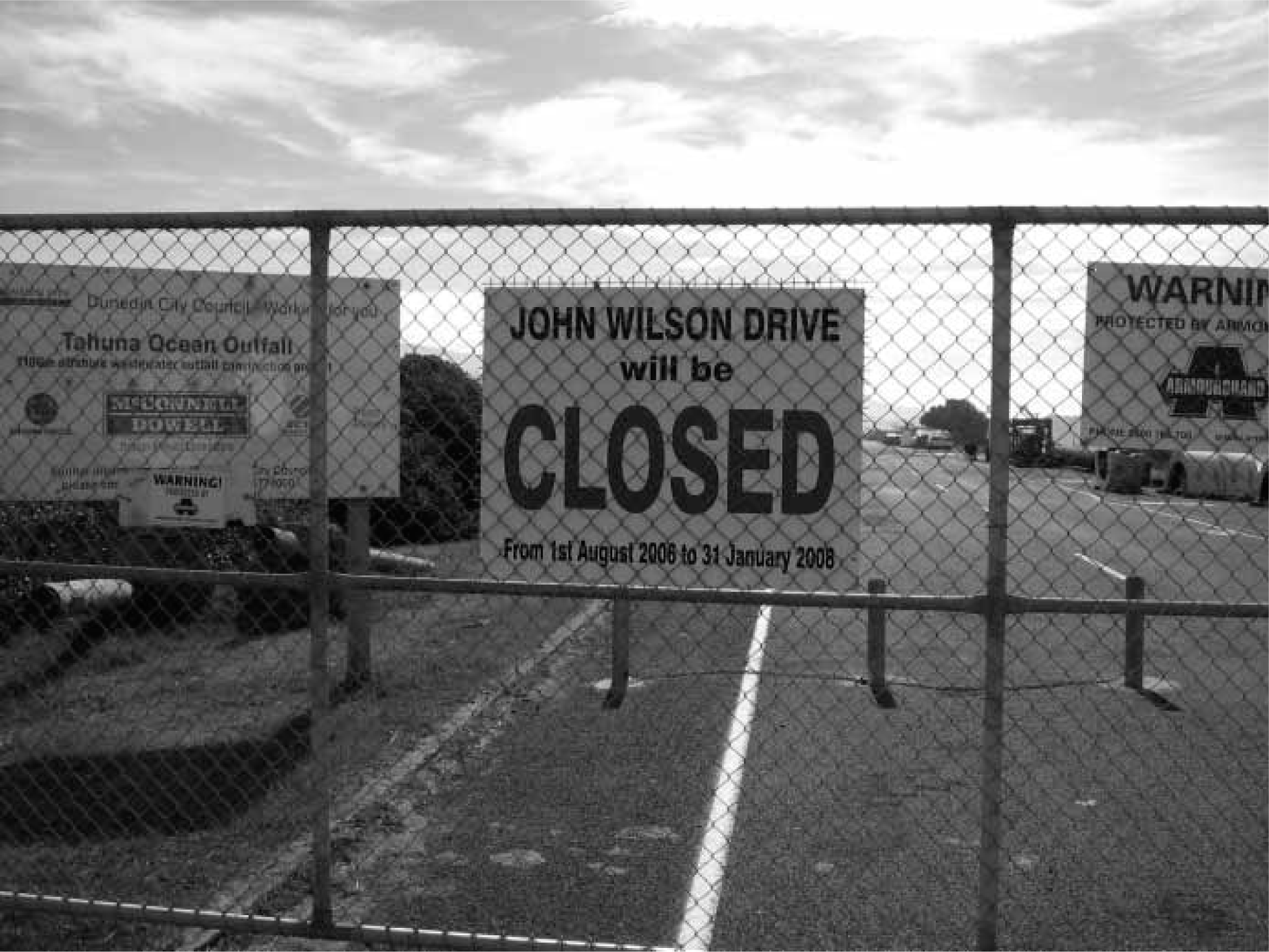
Gate preventing road access.
Suicide prevention through means restriction has been increasingly recognized as an effective strategy [2, 3]. This includes installing barriers at popular jumping sites [4, 5]. Several studies have demonstrated a decline in jumping suicides after barriers were installed on bridges [6–8], and a New Zealand study documented the reverse phenomenon: increased jumping suicides following the removal of barriers from a bridge [9]. In addition, Swiss researchers showed that fewer people jumped after a safety net was installed at a 33 m-high terrace in Bern that had become a suicide hotspot [10].
Natural cliffs and headlands, however, can present practical problems as far as erecting barriers is concerned. In a study of deaths at Beachy Head in the south of England, it was suggested that the relative ease of access (by walking) to Beachy Head compared with the cliffs of Dover might partly explain why Beachy Head had become a suicide hotspot whereas the Dover cliffs had not [11]. This raises the question as to whether the relatively simple measure of preventing vehicular access could be sufficient to reduce deaths at a cliff or headland, even if other access were still possible. In the case of Lawyer's Head, the headland could still be accessed on foot by several routes, although not via the road. Would this partial bar to access be sufficient to deter suicidal people?
Previous studies of the effects of restricting access to jumping sites have been able to examine only the impact on completed suicide. Threatened suicides are also a concern. Ensuring that a suicidal person does not jump can involve enormous resources and take a toll on those involved.
Hence, we took the opportunity to investigate the effects of closure of road access to Lawyer's Head on suicides (including deaths that received an open verdict) and police callouts for threatened suicides at Lawyer's Head. We also aimed to ascertain whether there had been any other suicides by jumping among people living in the Dunedin city area, in case people were simply switching to other sites, and to set the Lawyer's Head deaths in the context of the total number of suicides in Dunedin during the period.
Method
In order to obtain a complete list of deaths at Lawyers Head for a 10 year period before the road closure (1 August 1996–31 July 2006) and for a 2 year period of closure (1 August 2006–31 July 2008), information from three data sources was checked. These were the Otago Coroner's pathologist's records, the Dunedin Police Inquest Officer's records, and the records of Dunedin Marine Search and Rescue. For deaths for which the verdict was not known to the Inquest Officer, the Ministry of Justice was approached for the verdict.
Any other suicides or undetermined deaths involving jumping/falling from high places during either of the aforementioned periods were ascertained by cross-checking data from the records of the Otago Coroner's pathologist and the Dunedin Police Inquest Officer. From these records it was also possible to form a complete list of deaths by suicide in the Dunedin City Police District during the period.
A list giving dates and times of all police callouts for threatened or attempted suicides at Lawyers Head for the period 1 August 2002–31 July 2008 was provided by the Dunedin Police. Police also checked to see how many of those who died at Lawyers Head had previously been the subject of a police callout at that site.
Data analysis involved simple comparison of rates before and after the road closure, and the calculation of incident rate ratios where possible using the Poisson distribution and the cohort analysis facilities in Stata (Statacorp, College Station, TX, USA).
Results
Deaths
In the 10 year period before access was restricted (1 August 1996–31 July 2006) there was a total of 14 deaths at Lawyer's Head. The coroner's verdict was suicide for 11 cases, and two received an open verdict (undetermined intent). In one case the verdict was accidental death. There were also two episodes in which a person jumped but survived, giving in total 16 episodes involving jumping/falling off the cliff in the 10 year period. In the 2 years after restriction of access there were no deaths and no jumps from Lawyer's Head. This difference was statistically significant both for the total of 16 episodes (incident rate difference = 1.6 deaths per year, 95% confidence interval (CI) = 0.8–2.4) and for the 13 deaths with suicide/open verdicts (incident rate difference = 1.3 deaths per year, 95%CI = 0.6–2.0). Nine of the 16 cases involved women, including one who jumped and survived, and the other seven involved men. Among the 14 who died, 10 were noted to have been under the care of the Mental Health Service at the time, of whom five were inpatients.
During the 10 years before restricted access to Lawyer's Head there were five other deaths due to jumping or falling from a height in the Dunedin City police district. Four of these involved falls or jumps from cliffs or, in one case, a dam. For two of these the verdict was suicide, and the other two received an open verdict. The fifth case was somewhat different, involving a fall from a garage roof, and was judged to be accidental. There were also two deaths resulting from vehicles being driven over a nearby cliff in one case and a bluff some distance away in the other. For one of these deaths the verdict was suicide and for the other there was an open verdict. In the 2 year period following restricted access to Lawyer's Head there were no deaths involving jumping or falling from a height in the Dunedin City police district.
The 11 deaths at Lawyer's Head for which there were suicide verdicts during the 10 year period before restricted access were among a total of 149 in the Dunedin City police district in that period. Thus 7.4% of local suicides occurred at that one site. In the 2 year period following restricted access to Lawyer's Head there were a total of 29 local deaths receiving suicide verdicts.
Police callouts
During the 4 year period prior to restricted access to Lawyer's Head (1 August 2002–31 July 2006) there were 77 police callouts (19.3 per year). In the 2 year period following restricted access (1 August 2006–31 July 2008) there were 19 callouts (9.5 per year). These figures give an incident rate difference of 9.8 (95%CI = 3.7–15.8) and an incidence rate ratio of 2.0 (95%CI = 1.2–3.5), indicating a statistically significant reduction in callouts. There were no police records of earlier callouts involving any of those who died at Lawyer's Head.
Discussion
In the 2 years following erection of a gate preventing vehicular access to a cliff that had become a suicide hotspot, no deaths by jumping occurred either at the cliff or anywhere else in the city of Dunedin. This was in contrast to 13 deaths by jumping (suicide or open verdict) at the site in the preceding 10 years, with the result reaching statistical significance despite numbers being small. Moreover, police callouts to Lawyer's Head because of threatened suicide fell to 9.5 per year, compared with 19.3 per year for the preceding 4 years at the cliff. These results occurred despite the fact that people could still access the cliff on foot via several routes.
This natural experiment supports findings from other studies that restricting access to suicide jumping sites reduces suicides at the site without evidence of switching to other jumping sites [7, 8]. Both previous studies involved bridges, on which physical barriers could be installed, whereas installation of barriers at the cliff edges would be a daunting proposition on a large headland such as Lawyer's Head. In the present study, even a limited restriction on ease of access that required a person to walk some distance rather than drive up to the headland made a difference. This is similar to what happened in Bern when safety nets were installed below the Bern Muenster Terrace, mainly to protect people at the bottom of the terrace [10]. The net did not completely surround the terrace, yet after its installation there were no suicides at the site in the following 4 years. Reisch and Michel commented that the presence of the nets appeared to have a psychological as well as a physical effect, perhaps influencing the dynamics of suicide actions or plans [10]. In the present case also, the gate may have placed a psychological as well as a physical obstacle in the way of suicidal people that might have given them a chance to change their minds or seek help [5]. In all the aforementioned studies the site had acquired symbolic significance. The weight of evidence is that when access to such places is made difficult, people do not tend to turn to sites that lack this significance [4].
A limitation of the present study was that numbers per year rather than incidence rates were used. Dunedin is a small city with a population that has been stable over many years at just under 120 000. There was no evidence of any decline in the local suicide rate that could explain the present results.
Although no deaths by jumping occurred anywhere else in Dunedin following the road closure, we were not able to establish whether people who would otherwise have jumped off Lawyer's Head committed suicide by using a different method instead. It was clear from the outset that, with only 15 local suicides annually and only one or two jumpings in most years, it would not be possible to demonstrate any effect on the total number of suicides. This limitation is common to other studies of jumping suicide because of the low base rate of suicide and the fact that jumping is not generally a widely used method [4]. There is, however, evidence that individuals tend to have preferences for particular methods that would limit substitution if the favoured method became unavailable [2]. Where the method is widely used, reductions in total suicide rates have been observed after means restriction [3]. Examples of this include detoxification of domestic gas in the UK [12], reduced availability of barbiturates in Australia [13] and New Zealand [14], and of firearms in the USA [15].
Another limitation was the small size of the population at risk. Without including those with open verdicts there would have been too few deaths to show a significant difference. Open verdict deaths are not infrequently combined with suicides, however, because of evidence that the majority of them are likely to have been suicides [16–18]. The time period following installation of the gate involved only 2 years. Because the gate was due to be removed on completion of the sewage outfall project, it was important to identify any benefits urgently. It could be that gradually a new jumping site may emerge, but at this stage there has been no sign of this for completed suicide. Unfortunately, it was not possible to obtain data about any callouts for threatened jumpings at other Dunedin sites because this would have involved the police having to search records of all of six local police stations manually. Anecdotally, however, both the police and the Emergency Psychiatric Service were of the opinion that there had been no discernible displacement to other jumping sites (Benn B, Wood M: personal communications).
The employment of a security guard at night and at weekends to protect against vandalism may have played a part in preventing some suicides, and we were not able to assess the possible impact of this factor. Although he was there to protect property, not to prevent suicide, naturally the guard responded to people in distress and initiated some of the police callouts. The major reduction in callouts, as well as deaths, following restricted access would suggest that restricted access was a more important factor than the presence of the guard. At times it was observed that a distressed person would act in such a way as to draw the guard's attention. The police callout data were unidentified, but police commented that callouts often involved the same people a number of times. This was in marked contrast to those who actually jumped. This may reflect differing psychopathology between people who commit suicide by jumping and people who threaten to jump. In a Brisbane study of jumping from river bridges, the most common diagnosis among those who did not actually jump was personality disorder, whereas nearly half of those who jumped were suffering from schizophrenia [19]. In a report of a spate of jumping suicides among psychiatric patients in South Australia, it was noted that all 11 patients were suffering from schizophrenia or schizoaffective disorder [20].
The strengths of this small study include the ability to gather reliable information by cross-checking against several local record systems, and the willingness of local police to provide callout information relating to Lawyers Head. To our knowledge, this is the first study to show that threatened jumpings as well as actual jumpings have been reduced by restricted access.
The Dunedin City Council has not yet decided on future plans for access to Lawyers Head, but has continued the status quo in the meantime. There are different values to be balanced – that of safeguarding human life and that of freedom to gain easy access to a lookout point. In the period since vehicular access has been barred, seals and penguins have returned to the headland, leading wildlife advocates to add their voice in support of some form of continuing restriction. One compromise that has been suggested is that access in future should be for pedestrians only. Unlike the present arrangement, such a solution would not be evidence-based, but if it were implemented its effectiveness for suicide prevention could be compared with that of the present barrier in a few years’ time.
An encouraging aspect of suicide prevention by restricting access to jumping sites is that most people who were prevented from jumping [19, 21] or survived a jump [22] did not go on to commit suicide later. In studies of suicides from Brisbane and Melbourne river bridges and from a bridge in a New Zealand city, most were suffering from treatable psychiatric disorders at the time [9, 19, 23]. Suicidal crises can be short-lived [24] and often involve intense ambivalence [25], so circumstances that make access to the favoured method difficult may allow time for the crisis to pass or for the person to seek help. It is to be hoped that any future access to Lawyers Head will be sufficiently restricted to enable lives to be spared in this way.
Footnotes
Acknowledgements
We thank the New Zealand Police for their help, particularly Robert Murray, the Dunedin Police Inquest Officer; Brian Benn, the head of Dunedin Search and Rescue; and Tony Ritchie and Craig McDowall from the Intelligence Section. We also gratefully acknowledge the help of Pam Baxter, Department of Pathology; and Clifford Slade from the Ministry of Justice. Dr Richard Mullen provided helpful comments. The image of Lawyers Head was provided by the Dunedin City Council.