




Abstract
Parallel career tracks have become more prevalent today, especially in Brazil, where more than a quarter of all postgrads have one. Despite its growing popularity, little research has tapped into this new career phenomenon. This study examines whether having a parallel career track leads to negative work outcomes related to sustainable careers, such as higher absenteeism and lower engagement, in comparison to a single career track. Cross-sectional and longitudinal data were gathered from 380 and 102 Brazilian professionals respectively, who filled out an online survey. A normal and a repeated-measures multivariate analysis of variance were used to examine whether work outcomes differed between those with parallel career tracks versus single career tracks. The findings indicate that parallel career tracks do not have different effects on individual sustainable employability outcomes when compared to single career tracks, including employability, engagement, absenteeism, presenteeism, and burnout. Therefore, organizations can face this new career trend without reluctance as it does not harm individual work outcomes related to sustainable careers. This study contributes significantly to improving the understanding of this new career format by examining the impact of parallel career tracks on individual work outcomes through a longitudinal design.
Keywords
Introduction
Organizations need talented, flexible, engaged, and energetic people to function sustainably in today's work environment (Semeijn et al., 2015). Individuals, organizations, and societies have the responsibility to develop and foster so-called sustainable careers, which can be defined as: “the sequence of an individual's different career experiences, reflected through a variety of patterns of continuity over time, crossing several social spaces, and characterized by individual agency, herewith providing meaning to the individual” (Van der Heijden & De Vos, 2015, p. 7). Indicators of sustainable careers refer to health, happiness, and productivity (De Vos et al., 2018; Van der Heijden, 2005; Van der Heijden & De Vos, 2015). Therefore, it is increasingly important to better understand how we can protect and promote positive individual work outcomes, such as work engagement, and decrease negative ones, like burnout and absenteeism. The structure and dynamics of work have changed drastically, and there has been a decline in linear and stable organizational careers in which professionals follow a single upward career path in one organization (Briscoe & Hall, 2006). Today, with the responsibility for careers shifting from organizations to individuals, employees are increasingly called upon to take ownership of their own work experiences (Arthur et al., 2017).
At the same time, organizations are becoming flattered, which makes upward moves less prevalent (Arthur et al., 2017). As a result, employees are confronted with both the possibility and the necessity of engaging in a diverse set of career moves, such as lateral moves or international relocations (Arthur et al., 2017). Hence, new career models continue to appear (Arthur et al., 2017; Hall, 1996). For example, the protean career describes a person as value-driven, self-directed, and focused more on one's own psychological success than a set of standards that are organizationally imposed (Briscoe & Hall, 2006). This can nowadays be aligned with the new psychological contract, in which the needs of the different career stakeholders are to be taken into account over time (Baruch & Rousseau, 2019; Donald et al., 2020). Also recently, the intelligent career has described careers based on how people work, the reasons why they work, and the relationships they work with (Arthur et al., 2017). Yet another example is the boundaryless career, which describes careers that cross either physical boundaries (e.g. moving across organizational or national boundaries) or psychological boundaries (e.g. rejecting career opportunities for personal or family reasons, thus crossing boundaries between different roles and identities) (Arthur & Rousseau, 1996; Sullivan & Arthur, 2006).
A new type of boundaryless career is the parallel career track (PCT), in which professionals have more than one career track at the same time (Alboher, 2007). This is different from so-called multiple job holding (Järvensivu & Pulkki, 2020) in the sense that these career tracks can either be related, as in the case of a lawyer who also teaches at a university or unrelated, as in the case of an IT executive who is also a scuba diving instructor. In both cases, employees tear down physical boundaries at work by developing work relations with multiple employers or contractors simultaneously and by constantly switching between employers and work environments. They also tear down psychological boundaries by continuously changing work roles and work identities.
This new type of boundaryless career is becoming increasingly relevant, especially in Brazil. As noted by Azevedo (2015), 27% of postgraduate professionals in Brazil have PCTs. But despite its growing significance, PCTs have rarely been investigated. Alboher (2007) and Schuiling (2012) discuss PCTs from an individual perspective and look at singular cases to describe the different possible career combinations of PCT holders. Azevedo (2014) further explores the organization's perceptions towards PCT holders, the reasons why people pursue PCTs, and the benefits and drawbacks for both the individual and the organization. All three studies were based on explorative qualitative research, which is relevant to beginning to understand the new phenomenon but is insufficient to measure it more rigorously along with its possible predictors and consequences.
This study expands upon these initial observations by empirically investigating differences in work outcomes between those with PCTs and single career tracks (SCTs) via a quantitative longitudinal study. As such, this study provides a more rigorous investigation of PCTs and their related outcomes. As earlier explorative research has argued, PCT holders are perceived to be more prone to difficulties and negative outcomes in combining two or more career tracks in comparison to SCT holders (Azevedo, 2014). To explain how multiple career tracks may hamper their individual work outcomes, we draw upon the Conservation of Resources (COR) theory of Hobfoll (1989) and role conflict theory (Marks, 1977) in particular. The COR theory explains the general process by which people can (or cannot) develop and protect their resources which also counts for their resources in work and careers (Hobfoll, 1989; Hobfoll, 2002). The role conflict theory has traditionally been used to explain how work and home roles can influence each other, particularly how they can deplete one another (Greenhaus & Beutell, 1985; Greenhaus & Powell, 2006). In this study, we translate these ideas about combining work and home roles to combining work and work roles, thus providing a novel perspective on the study of PCTs. More specifically, we argue that PCTs are more prone to the depletion process than SCTs while combining work-work roles. Finally, we use both a cross-sectional and a longitudinal approach. The cross-sectional analysis helps to investigate the associations between PCTs and individual work outcomes. The longitudinal analysis provides the first look into the effects of having a PCT as compared to having an SCT after one year.
Conceptual background
Parallel career tracks
PCTs involve having more than one professional life trajectory at the same time, regardless of the amount of time devoted to each career track, whether the career tracks are related, whether financial compensation is earned, or whether the individual has an employer or is self-employed (Alboher, 2007). Importantly, having PCTs is not the same as having multiple jobs (e.g. a doctor working for different hospitals) or as combining a career with a hobby (e.g. a lawyer who loves taking pictures or an accountant who plays basketball on a weekly basis without being hired by any team). However, the latter situation can become a PCT with the addition of a professional relationship, which can include a recruiter, boss, or client who has hiring or contracting options (Azevedo, 2014).
The impact of PCTs on the individual’s sustainable career
To be competitive, organizations need employees that are fully present and productive and can be counted on for consistently creating good results in the long term (Bansal & Desjardine, 2014). A crucial element in realizing this is sustainable employability, which is defined as the extent to which people are able and willing to conduct their current and future work (Semeijn et al., 2015; Van Vuuren, 2012; Ybema et al., 2020). Recently, the framework for sustainable careers extended sustainable employability into a broader, dynamic, and contextually based career perspective (De Vos et al., 2018; Van der Heijden & De Vos, 2015; Ybema et al., 2020), in which lifelong development is important and needs of multiple stakeholders can play competing and complementary roles in the so-called career eco-systems (Baruch, 2015; Donald et al., 2020).
Therefore, we examine whether having PCTs influences core dimensions of sustainable careers: their productivity, happiness, and health (Van der Heijden, 2005; Van der Heijden & De Vos, 2015), which are still much in line with the indicators of sustainable employability; a workers’ (perceived) employability (as an indication of possible productivity), vitality, or engagement (as an indication of happiness), and workability (as an indication of health) (Semeijn et al., 2015). To be sustainable, the career must be characterized by mutually beneficial consequences for the individual and the surrounding context and should be considered by taking a long-term perspective (De Vos et al., 2018). In this study, we explore the possible initial unsustainability of a PCT as compared to an SCT, with both a cross-sectional and a longitudinal design. To this end, we first elaborate on the possible underlying mechanisms that may be responsible for the possible differences between PCTs and SCTs. According to COR theory (Hobfoll, 1989, 2002), people have only limited resources available (in this case work related) that need to be preserved, to remain productive, happy, and healthy. People differ in the amount of available resources, personally, as well as contextually, and may act differently on these, leading to different consequences for their indicators of sustainable careers. In the next sections, we will elaborate on this for all three indications of sustainable careers, considering the differences between PCTs ad SCTs.
Perceived employability as an indication of productivity
First, perceived employability refers to the amount of available resources that determine employees’ perceptions of their chance of obtaining a job in the internal or external labor market (Forrier et al., 2015), indicating their possible productivity. Current uncertain times, characterized by rapid changes and increasing responsibility of employees for developing their own careers, have underscored the importance of remaining employable at all times by continuously developing ones competencies and adapting to the changing needs of organizations (Forrier et al., 2015; Van der Heijden & Van der Heijden, 2006). Applying principles of COR theory, this means that people will have to use their available resources to stay up to date and gather new knowledge and competencies to keep up with their current and future job(s) to be able to develop their career (Hobfoll, 1989; Hobfoll, 2002). In a PCT this means multiple jobs from different career paths, which makes the process more complicated. The PCT holder would need to be up to date with a higher number of competencies once compared with an SCT holder (Azevedo, 2014). For example, the amount of effort required from a marketing executive to keep himself updated on this field requires a lot of reading, studying, and experimenting (Pouliakas, 2017). The effort gets considered higher if this person needs to add another continuous learning package to keep up with a second career track as a diving instructor. Considering this more specifically from the perspective of role conflict theory (Marks, 1977), PCTs will therefore be more prone to resource depletion or difficulties in gaining and developing new resources than an SCT. As a result, we propose that:
H1: PCT holders experience lower perceived employability than SCT holders.
Engagement as an indication of happiness
Second, vitality refers to the positive feeling associated with having energy available for oneself (Nix et al., 1999). Vitality is considered to be a dimension of work engagement (Bakker et al., 2008), which is the second important work outcome in this study, related to happiness. Work engagement refers to a positive work-related state of fulfillment that is characterized by a feeling of vigor, dedication, and absorption (Schaufeli et al., 2006). Considering the process as indicated by COR, people who are engaged have enough energy to preserve their resources or gain even more, as they are able to keep up a positive and vibrant spirit, without depletion. For PCTs this is however more complex that for SCTs. In terms of role conflict theory, PCT holders will encounter more challenges to combine their careers than SCT holders, which will require more energy and makes them more prone to depletion of their resources, instead of gaining more or new ones. Overwhelming job demands should be avoided since they are the main predictor of exhaustion (Xanthopoulou et al., 2007). As one day only counts for 24 h, and a person fulfills it with more than one career track, there will be less time to restore vitality and engagement. As such, we assume that:
H2: PCT holders experience less engagement than SCT holders.
Work ability as an indication of health
Third, work ability refers to people's work capacity based on their personal health (Tuomi et al., 2005). To gain an idea of how PCTs influence employees’ personal health as compared to SCTs, we examined both absenteeism and presenteeism. Absenteeism is defined as not showing up for work because of being ill (Johns, 2009) and has had a long research history, because of its perennial cost to organizations. It drains financial resources as the company pays wages but receives no work done in return (Johns, 2009). In contrast, presenteeism is defined as when people are at work, but are not working at full capacity (Johns, 2010). It involves individuals who still go to work despite complaints and ill health (Johns, 2009), which may lead to decreased productivity (Strömberg et al., 2017) and reduced safety for both the person and colleagues (Brborović et al., 2014). From a COR perspective, PCTs reveal a more complex work situation to deal with than SCTs, because of the multiple career characteristics. PCTs require the full application of resources within more than one career, possibly resulting in earlier, or more severe conflictual situations when it comes to the application and preservation of resources. Role conflict theory explicitly states that dividing attention and energy may result in negative consequences, such as hampered health (Kahn et al., 1964; Marks, 1977). Therefore, we assume that:
H3: PCT holders experience more absenteeism than SCT holders. H4: PCT holders experience more presenteeism than SCT holders.
Finally, also Burnout was taken into account to look at sustainable careers from the angle of what might hamper people's health. In the early days, engagement and burnout were often seen as opposites (Schaufeli et al., 2006). Today, this is no longer the case, as research has repeatedly shown that engagement and burnout are independent processes with different predictors and outcomes (Hakanen & Schaufeli, 2012). Also in terms of COR theory, when engagement and burnout symptoms can co-exist, this might lead to different outcomes in the processes of conservation and depletion of resources. We study Burnout as the multi-dimensional stress syndrome consisting of emotional exhaustion, depersonalization, and reduced personal accomplishment (Maslach, 1976). Burnout has been linked to further negative outcomes, such as absenteeism and turnover (Ahola et al., 2008; Taris, 2006). However, in the context of PCTs as compared to SCTs, it can be expected that PCTs make people more prone to burnout than SCTs, as a multiple career context may enlarge the need for more resources while at the same time a more intense depletion of resources can be expected as well. In terms of COR theory (Hobfoll, 1989; Hobfoll, 2002), a person with a PCT will experience a more demanding job in protecting resources against loss, which may include objects, conditions, personal characteristics, and energies, than a person with an SCT. More specifically, one can argue that more role conflict will arise when having a PCT as compared to having an SCT (Marks, 1977). Thus, adding more (career) roles complicates this division exercise as it increases the number or diversity of tasks to be performed, the content to absorb, and the stakeholders to relate with. Therefore, PCTs might increase the risk of role overload taking place when individuals perceive the demands of all roles as being too much to handle with the resources at hand (i.e. time and energy) (Jones et al., 2007; Matthews et al., 2014). As a result, we assume that:
H5: PCT holders experience more burnout than SCT holders.
Method
Sample and procedure
Data were collected for three consecutive years (2013–2015) via an online questionnaire using Survey Monkey as the data gathering platform. Data gathering complied with standards for ethical research and protection of privacy. Informed consent was addressed at the start of the online survey for active agreement by respondents. Still, they remained free to quit the survey at any moment if they wished so. Email addresses were only gathered on a voluntary basis to be able to reach the respondents for the second and third surveys. The questionnaires were sent to postgraduate alumni from the 10 best Brazilian universities, which were determined by Ranking Universitário Folha (RUF) (2012). In Brazil, graduate students are allowed to work and study at the same time. Postgraduate alumni have at least 2 years of work experience after graduating. In the first wave, an invitation to participate in the online survey was posted on the official LinkedIn page for each school. The invitation was called “New Career Trends Research” in order to gain the attention of a broader population than only the PCT holders. The selected LinkedIn groups had a total of 99,294 members as of 30 March 2013. There were 489 respondents with a postgraduate degree that replied to the survey, of whom 380 completed all questions in the survey and constituted our sample in wave 1. All participants from wave 1 were also invited by e-mail to participate in wave 2 (October 2014) and wave 3 (October 2015). In total, 102 respondents filled in the questionnaire in all three waves. Data were stored safely at Open University without personal information, for an anonymous analysis.
All 380 participants had a postgraduate degree. We specifically focused on a highly educated sample because we wanted to study participants who have PCTs for a variety of different motives. As lower education correlates with poorer compensation, the financial need could overwhelm any other motive to have PCTs in a less educated sample.
Measures
The current study investigated five validated scales to measure indications of sustainable careers. After presenting each scale, the data considered to classify a professional as either a PCT or an SCT holder are described as well.
Perceived employability. Internal and external employability was assessed using a Portuguese back translation using Brislin's model (1970) adapted by Jones et al. (2001) was made for a three-item scale from Veld et al. (2015). An example item is: “If I would have to apply for a job, I would have a new job soon.” All items were measured on a five-point scale ranging from 1 (“absolutely do not agree”) to 5 (“absolutely agree”). The reliability of the scale was sufficient in all three waves (α at T1 = 0.66; α at T2 = 0.84; α at T3 = 0.92).
Work engagement. The Portuguese version of the nine-item UWES (Schaufeli et al., 2006) was used to assess the three core dimensions of work engagement. Example items included: “At work, I am bursting with energy” (vigor), “I am enthusiastic about my job” (dedication), and “I get carried away when I am working” (absorption). All items were scored on a seven-point rating scale ranging from 0 (“never”) to 6 (“always”). The reliability of the scale was high in all three waves (α at T1 = 0.93; α at T2 = 0.98; α at T3 = 0.98).
Absenteeism. A single item based on the Work Ability Index (Tuomi et al., 2005) was used to assess absenteeism. The Portuguese version (Martinez et al., 2009) of this item asks respondents the following question: “In the previous 12 months, I have had one or more instants of sick leave for a total of … calendar days.” There were 10 answer categories ranging from 0 to 365 days of the absence.
Presenteeism. Following Aronsson et al. (2000), we used a single item to measure presenteeism at work. A Portuguese back translation using Brislin's model (1970) adapted by Jones et al. (2001) was used for the following question: “Over the previous 12 months, have you gone to work despite feeling sick?” The response was scored on a four-point scale ranging from 1 (“no, never”) to 4 (“yes, more than five times”).
Burnout. The Portuguese version (Campos et al., 2012) of the 16-item OLBI (Demerouti et al., 2010) was used to measure burnout. An example item is: “There are days when I feel tired before I arrive at work.” The possible answers range from 1 (“strongly agree”) to 4 (“strongly disagree”). The reliability of the scale was high in all three waves (α at T1 = 0.87; α at T2 = 0.96; α at T3 = 0.97).
PCT and SCT holders. Respondents were classified as either a PCT or an SCT holders by analyzing the list of career tracks that each person indicated that they currently had. If there was only one career track listed, the person was classified as an SCT holder. If more than one career track was indicated, another check was applied in order to remove respondents with multiple jobs under the same career title. Actually, there were none. The ones saying yes to having parallel careers, but did not mention the area of work of the second track, were also considered SCT holders (n = 12). Any remaining individuals were defined as PCT holders, resulting in a dummy variable for PCT holders in our analyses (PCT = 1, SCT = 0). We considered the first career the one in which the respondent dedicates more hours a week.
Analytical strategy
Using the mean scores of each scale, t-tests and χ2-tests were used in the first preliminary step to examine possible non-response bias. This was done by comparing the demographics and study variables between people who only filled out the questionnaire at T1 (N = 380) and people who filled out the questionnaire in all three waves (N = 102). Afterward, the proposed hypotheses were tested between subjects (wave 1) and within subjects (repeated-measures) (wave 1 to wave 3) multivariate analysis of variance (MANOVA) was performed in SPSS. This analytical technique has an advantage in that not only can we examine whether differences exist in individual work outcomes between groups (PCT and SCT holders), but we can also take into account effects within groups (i.e. effects over time) from wave 1 to wave 3.
Differences between the sub-samples
The demographics of both samples can be found in Table 1. Of these 380 respondents, 91 were PCT holders and 56% were male. The mean age was 38 years. A little more than half of the respondents (55%) had a partner and 47% had children. From the 102 respondents that were measured longitudinally, 26 were PCT holders, 59% were male, and the mean age was 36 years. Also from the 102 respondents, 55% had a partner, and 41% had children. Respondents worked in different occupational areas, such as Business (20%), Engineering (12%), Economics (5%), and Psychology (5%), with different types of contract status, for example, employed (79%, self-employed (11%), and currently unemployed (10%)). Table 1 shows that there were some differences between PCT and SCT holders, probably because the PCT holders were a smaller group, but the differences were not really very substantial in comparison to SCT holders. To examine possible non-response bias, we compared demographics and study variables between people who filled out the questionnaire at T1 (N = 380) and the ones who filled it out at all three times (N = 102). For demographic variables, no significant differences were reported between both groups for age (t = 1.20, p >.05), number of children (t = 1.52, p > .05), marital status (χ2 = 3.78, p >.05), and gender (χ2 = 0.47, p >.05).
Sample characteristics.

Results
Descriptives and correlations
Means, standard deviations, and correlations between all variables of the subsample (N = 102) that is followed over time can be found in Table 2. Regarding study variables, no significant differences were found between both groups for PCT holdership (χ2 = 0.10, p >.05), employability (t = 1.15, p > .05), engagement (t = 0.69, p > .05), commitment (t = 1.58, p > .05), presenteeism (χ2 = 2.55, p >.05), absenteeism (χ2 = 0.01, p >.05) and burnout (t = 0.15, p > .05). As such, we can conclude that the possibility of non-response biases distorting results is small.
Means, standard deviations, and correlations between all variables for sample wave 1 to wave 3 (N = 102).
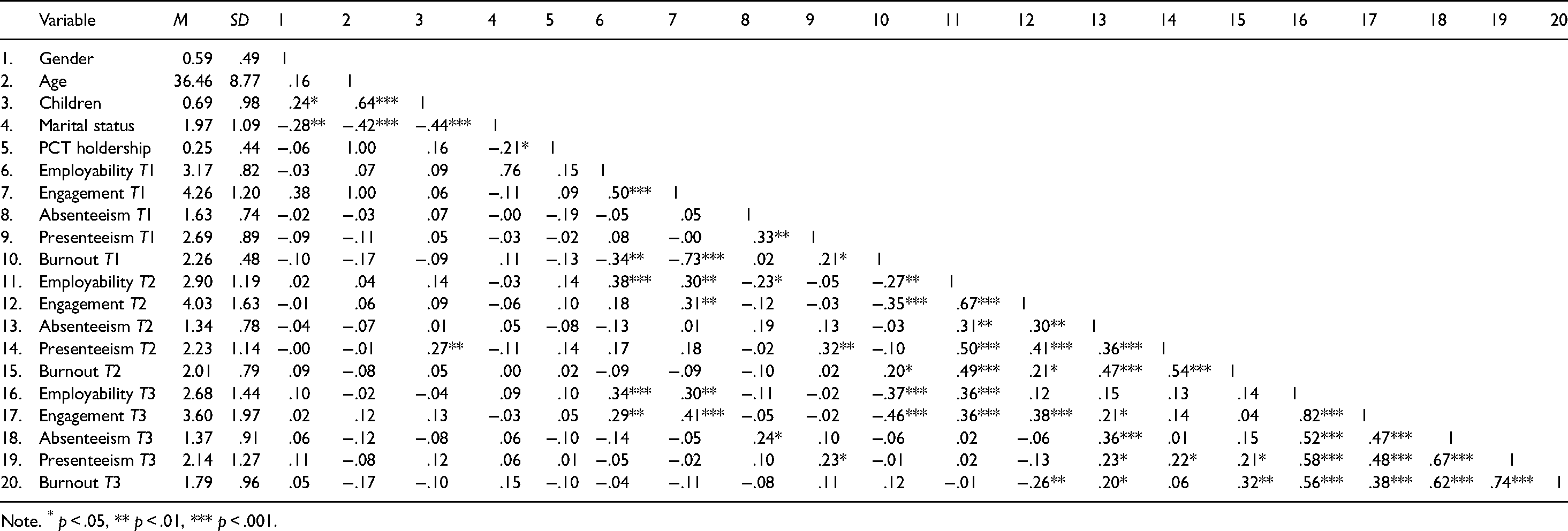
Note. * p < .05, ** p < .01, *** p < .001.
Hypothesis testing
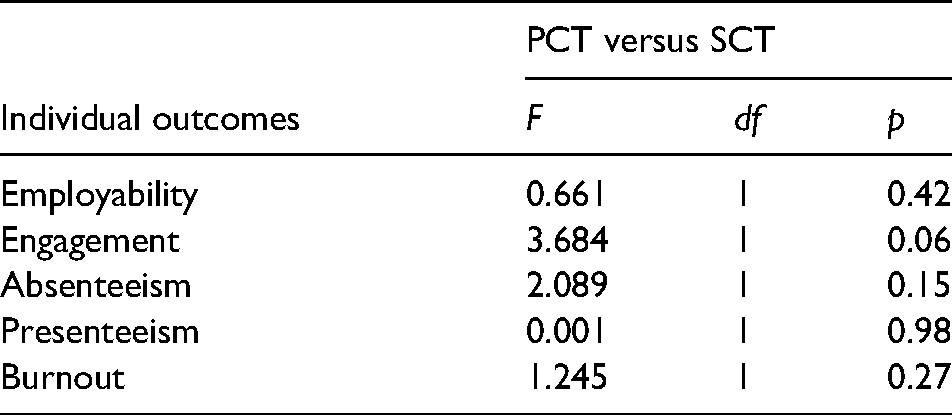
To test our hypotheses, we first used MANOVA for the respondents of T1 (N = 380), cross-sectionally. The results can be found in Table 3a. In the next step, we used a repeated-measures MANOVA for the longitudinal data (N = 102). The results of the repeated measures analysis can be found in Table 3b. By doing so, we could not only gain insight into the between-subject effects for PCT and SCT holders, but also estimate whether time as a within-subject effect made a difference in all five individual work outcomes.
Results of the MANOVA between groups effects for N = 380.
Results of the repeated measures MANOVA for all five individual work outcomes with N = 102.
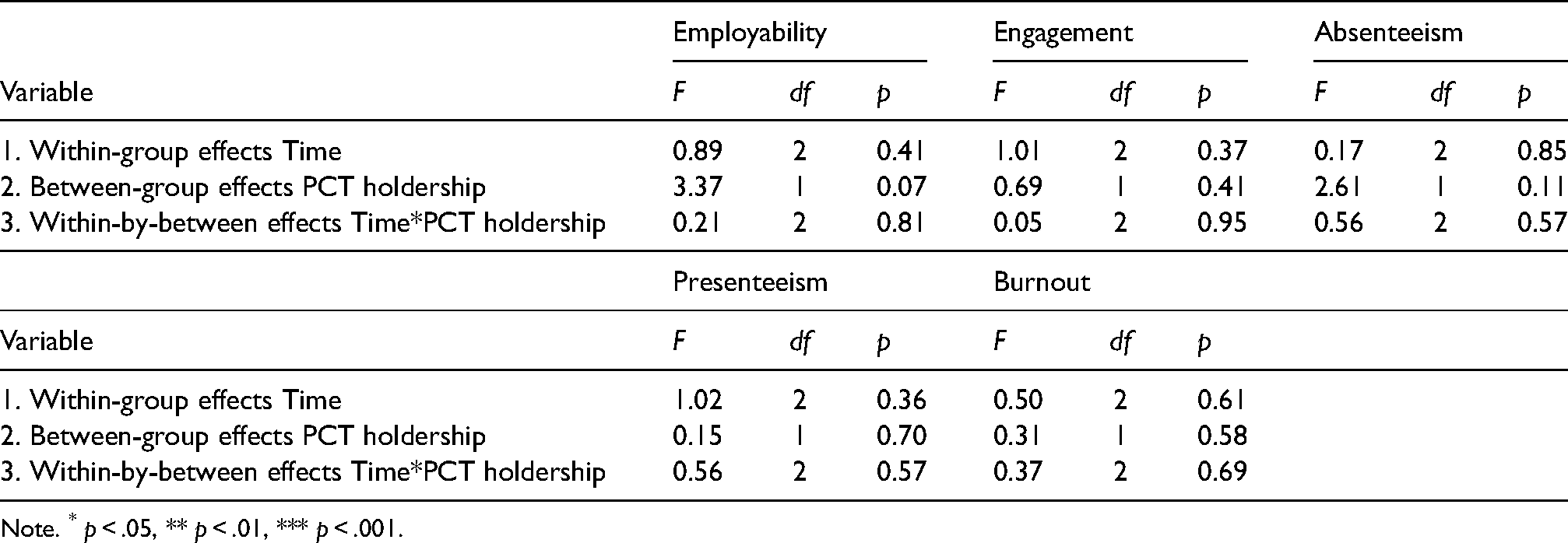
Note. * p < .05, ** p < .01, *** p < .001.
As can be noted in Table 3a, no significant differences are found for any of the five individual outcomes between PCTs and SCTs in wave 1 (N = 380). Significance levels did not reach the 0.05 reliability level. Only a marginally significant effect was found for engagement, with F(3,684) and p = .056, indicating a very reluctant tendency toward PCT holders experiencing more engagement than SCT holders.
As can be noted in Table 3b, no significant between-subject effect of PCT status in wave 1 to wave 3 (N = 102) can be found for any of the five individual work outcomes, either. A marginally significant effect could be found for only absenteeism (F = 2.61, p = .11) and employability (F = 3.37, p = .07), which may cautiously indicate a trend toward PCT holders experiencing less absenteeism (β = −.36, p < .05) and more employability (β = .30, p = .13). Furthermore, no significant effects of Time*PCT status could be found for any of the five individual work outcomes, indicating that PCT status does not account for changes in employability, engagement, absenteeism, presenteeism, and burnout. In sum, PCT holders do not score lower or higher than SCT holders on the five investigated work outcomes. As such, none of the hypotheses were supported.
Discussion, implications, and limitations
PCTs are a rather new type of career format that has only recently become relevant due to new economical and societal trends reshaping work boundaries. The question is to what extent this new career format is detrimental to the development of sustainable careers. Due to the lack of information regarding its advantages and disadvantages, companies are still doubtful about whether to embrace PCTs (Azevedo, 2014). To help organizations and individuals better understand the phenomenon, the present study examined whether PCTs generate negative consequences as compared to their more traditional counterparts, the SCTs on different indicators of sustainable careers (e.g. lower perceived employability and work engagement, higher perceived absenteeism, presenteeism, and burnout) (De Vos et al., 2018; Van der Heijden & De Vos, 2015).
The findings indicate that PCT holders do not experience differences in their work outcomes compared to SCT holders, not when tested cross-sectionally with the largest group, nor when tested with the smaller group longitudinally. As such, we can conclude that having PCTs does not seem to have direct detrimental effects on individual work outcomes related to indicators of sustainable careers in terms of health, happiness, and productivity (De Vos et al., 2018; Van der Heijden, 2005; Van der Heijden & De Vos, 2015). This lack of effect may indicate that PCTs are not more or less prone to depletion of resources, difficulties in conservating resources by workers (Hobfoll, 1989), or a source of role conflict (Marks, 1977), as compared to SCTs. A study into multiple job-holding suggests that a double work role can, under certain conditions, even help in developing and enriching skills (Panos et al., 2014). This may also be relevant when pursuing a PCT. However, we were not able to measure the depletion and conservation of work resources explicitly, or the existing role conflict as such, to test our theoretical explanations. We have only considered the differences in outcomes directly. Future research should include measures on resources (conservation and depletion) as well as role conflict and enrichment explicitly, to test these explanations.
The findings may also indicate different explanations. It may be the case that other individual factors, such as personality traits, or the organizational willingness to facilitate more than one career track simultaneously might impact these individual work outcomes much more than the type of career format itself. Thus, the impact of the career format itself would then become negligible. Another explanation might be that only certain groups of people experience role conflict due to PCTs, while other groups of people might experience role enrichment (see e.g. Greenhaus & Powell, 2006) instead. Personality can also play a role in this process (Friede Westring & Ryan, 2010). The career format then becomes secondary. Future research can do efforts to explicitly test the different explanations to gain more insights.
It may also be that the type of career format does matter and that whether the type of career format fits ones desired type is more important. Therefore, the person-environment fit theory (Edwards et al., 2006) and person-career fit (Parasuraman et al., 2000) might be interesting theoretical frameworks to study PCTs in future research. It is already known that the experience of fit can enhance work outcomes (Kaur & Kaur, 2020). Organizational factors in terms of facilitation of PCTs (or a lack thereof) could play a role as well with different types of practices, climate, and contextual conditions. For example, healthy leadership, the prevailing organizational culture, as well as job quality, and HR practices in the form of workplace health promotion practices, or HR practices to enhance sustainable employability, do play a role in healthy organizations (Koinig, & Diehl, 2021; Raya & Panneerselvam, 2013; Ybema et al., 2020). As a healthy work environment is also a prerequisite for developing sustainable careers, future research might enrich and extend knowledge on different types of careers and the extent to which they can remain sustainable, with knowledge from the healthy organizations’ framework. Relevant concepts related to this framework, such as for example healthy leadership (Koinig, & Diehl, 2021), task characteristics (Segura-Camacho et al., 2018), and workplace relational civility (Di Fabio et al., 2016) could be tested for their relevance in future studies, and more specifically whether and how these differ for PCT holders as compared to SCT holders.
Practical implications
As the future of work demands a more flexible, diverse, protean, and boundaryless career design (Arthur et al., 2017), PCTs are becoming increasingly relevant for both individuals and organizations. Organizations need flexible and diverse human capital that will remain sustainably employable as well (Semeijn et al., 2015). First, PCTs are relevant for individuals who are increasingly responsible for managing their own careers (Arthur et al., 2017). In the current work environment, it is up to the individual to decide which of the diverse set of possible career formats to engage in, and which will provide the most objective and subjective career success. Second, it is in the best interest of organizations to facilitate workers in remaining sustainable employable and provide a healthy working environment, an environment in which the well-being of people is preserved (Raya & Panneerselvam, 2013). This requires that organizations address the relevant issues that are known to contribute to practice, such as we already mentioned, healthy leadership, task characteristics and workplace civility, to mention a few.
The findings showed that a PCT is not detrimental in itself for outcomes indicative of sustainable employability. However, following the person-environment fit theory (Edwards et al., 2006), the impact may depend on the individuals’ specific needs and desires. From a person-career fit perspective (Parasuraman et al., 2000) the work environment provides career development opportunities that can meet the individual's needs for career success, or the individual has the talents or abilities to seize the career opportunities provided by the job or organization. These perspectives align well with the framework of healthy organizations (Raya & Panneerselvam, 2013), which emphasizes the importance of worker well-being. Therefore, individuals could consider pursuing PCTs when having this type of career format represents a source of personal satisfaction and fulfillment. Second, firms should also be aware of PCTs as a new type of career format and consider it as a possible fit with their attempts to develop a healthy organization and sustainable employability for their workers. The findings indicate that PCTs do not hinder organizations in terms of harming sustainable employability when compared to SCTs, so companies do not have to be reluctant or suspicious of PCT holders (Azevedo, 2014). On the contrary, as one out of four Brazilians with a postgraduate degree has a PCT, it is worth the effort to consider that this career design is attractive to this well-prepared and highly educated portion of the working population.
Limitations and suggestions for future research
Despite its merits, this study is not without limitations. The first important limitation concerns the sample, which consisted of 102 Brazilian workers with postgraduate degrees. This sample might have biased results based on specific cultural values. A larger sample with different cultures and lower-educated people could add new perspectives to this study. Furthermore, we examined a limited set of possible drawbacks in sustainable employability that could possibly be related to having PCTs. It would be interesting for future research to tap into other possible outcomes as well, such as less commitment or job insecurity or, on the positive side, outcomes in terms of career satisfaction and learning agility.
It would also be meaningful to study whether there are different levels of expertise and career competencies when comparing PCTs and SCTs. In that sense, one could test more enriching effects of having a PCT in comparison to an SCT, which corroborates with positive spill-over known from work-family theories (Greenhaus & Powell, 2006; Marks, 1977). From this perspective, different work roles might enrich one another, and this process could be tested explicitly as well. There might also be a number of personal or organizational moderators that might have an important effect on the outcomes of PCTs. Research has yet to tap into these moderating effects.
Another path for analysis could be to distinguish different types of PCTs, comparably to the eight career profiles that come from different levels of protean and boundaryless attitudes (Briscoe & Hall, 2006). Övgü (2018) found that each of the career profiles discussed by Briscoe and Hall (2006) presents significant differences among career competencies, such as identity awareness, adaptability, career planning, proactive job search, and external networking behaviors. Research into PCTs and their differences from SCTs could reveal relevant insights from such an approach as well. More research is needed to further explore the possibly more complex relations between PCTs and their consequences. As one of the first to empirically investigate the consequences of PCTs, this study could be a good starting point to launch this endeavor.
Looking from a sustainable career perspective (De Vos et al., 2018; Donald et al., 2020) and analyzing PCTs on a longer-term timeline (e.g. every 5 years), may bring more insights towards real gains and harms. This perspective could confirm the notion that a dynamic person-career fit (Parasuraman et al., 2000) must be observed to consider the PCTs as indeed sustainable or harmful. It should verify the influence of other stakeholders involved, such as the individual families, peers, supervisor, employer, educational system, and society, also looking at how these factors may change and interact over time (see also Donald et al., 2020). Finally, as mentioned above, the person-environment fit perspective (Edwards et al., 2006) might be another interesting theoretical framework to understand and explore the relations between PCTs and relevant work outcomes, accompanied by insights from the healthy organization framework (Raya & Panneerselvam, 2013). We encourage future research to delve into this currently unexplored territory.
Footnotes
Declaration of conflicting interests
The authors declared no potential conflicts of interest with respect to the research, authorship, and/or publication of this article.
Funding
The authors received no financial support for the research, authorship, and/or publication of this article.
