




Abstract
We contribute to the accounting history and canal literature and the growing interest in environmental reporting by examining the philosophical approaches evident in the accountability documents of two historical canal projects, the Erie and Rideau Canals. We examine official records of the construction of these canals to identify sentences containing terms related to the environment and classify each sentence according to the environmental philosophy reflected. Of the three main streams of environmental ethics, we find evidence of both virtue ethics and utilitarian philosophical perspectives in the accounts, although the utilitarian perspective dominates. There is only sparse evidence of a deontological approach. We find differences in the ethical themes focused on each canal consistent with the degree of settlement nearby. We also find evidence of some common themes for both canals when analysed by the key phase of their planning and construction activities. We also consider the implications of these findings.
Introduction
Present-day environmental issues such as climate change, shifting patterns of precipitation, declining water resources, increasingly hazardous weather, and more frequent and devastating extreme weather events, such as floods and wildfires (Government of Canada, 2021) have increased interest in environmental accounting and reporting dramatically in recent years. The current concern for nature may give the impression that it is a contemporary phenomenon, however, the issues of concern for nature are not new, as evident in the long histories of environmental ethics (Hadot, 2006; Merchant, 1989; Morrison, 2020). To examine these issues from a historical perspective, we apply an environmental ethics perspective to the formal accounts prepared during the construction of the Erie Canal (1808–1825) and the Rideau Canal (1817–1831) in the United States and Canada. We consider these official records to be important accountability statements.
As we describe further in the literature review, other researchers have examined early canal accounts (e.g. Bujaki, 2010, 2014; Bujaki and McConomy, 2022; Forrester, 1980; Kistler, 1980) and governance practices (Russ et al., 2006, 2009). Environmental matters related to eighteenth- and nineteenth-century canal construction have not previously been addressed in the accounting history literature. We contribute this perspective in this article. In addition, we add to the literature on environmental reporting in the public sector. Specifically, we examine environmental ethical dimensions in accountability statements for the Erie and Rideau canals, two large, publicly funded infrastructure projects.
We build on work by Morrison et al. (2018) that uses an environmental ethics framework to explore the ethical approaches taken by an individual company and its stakeholders in corporate environmental reporting. We apply this framework to the Erie and Rideau canals. Adopting such a framework helps to highlight the underlying approaches and attitudes towards nature (Morrison, 2020; Morrison et al., 2018) and helps to highlight a relationship between accounting and the exploitation of the natural world. Environmental ethics is concerned with the moral relationship between humans and the natural world (Brennan and Lo, 2011). It is part of a philosophical tradition that considers issues such as value, epistemology, and the moral status of nature (O'Neill, 2001). For the purposes of this study, we discuss both environmental philosophy and environmental ethics (the application of that philosophy to examine relationships between humans and the natural world) interchangeably. We focus our attention on a specific aspect of the natural world: water in the Erie Canal and Rideau Canal construction projects.
Our examination of the environmental ethics perspectives prevalent in the early 1800s in eastern North America (where both the Erie and Rideau canals are located) reflects a time when settlement, commercial, industrial, political and social systems were nascent (Bernstein, 2005; Kistler, 1980; Legget, 1986). Of the three dominant strands of environmental ethics, we find both utilitarian and virtue ethics approach to the environment in the historical records for the Erie and Rideau canals, though the utilitarian perspective predominates. We find only sparse evidence of a deontological approach.
The balance of this article is organised as follows: we first present a review of the literature on canal accounting, environmental ethics and environmental reporting; our method is presented next; a brief review of the context in which canals and canal construction took place, including brief overviews of each of the Erie and Rideau canals, follows. Separate sections then address an analysis of the disclosures, followed by a discussion and conclusions, including identification of limitations and directions for future research.
Literature review
Accounting history and canals
While canals are acknowledged to have served as an important impetus to settlement, local improvements and economic growth, manufacturing, reduced transportation costs, and trade (Arnold and McCartney, 2008; Bujaki, 2010; Kistler, 1980; Russ et al., 2006; Schultz and Hollister, 2014), within the accounting history literature there is a limited focus on canals (Arnold and McCartney, 2008; Schultz and Hollister, 2014). Researchers in this area have focused primarily on canals in the United Kingdom (Arnold and McCartney, 2008; Edwards, 1985; Forrester, 1980), United States (Kistler, 1980; Russ et al., 2006, 2009; Schultz and Hollister, 2014) or Canada (Bujaki, 2010, 2014; Bujaki and McConomy, 2022).
In addressing the accounting history of canals in the United Kingdom, Forrester (1980) focuses on early efforts at financing, reporting and accountability on the Forth and Clyde Navigation (1768–1816) in Scotland. Edwards (1985) describes early accounting practices and the prevalence of accounting on a cash basis for British canals up until the late 1840s. Arnold and McCartney (2008) examine evidence from seven English canals during the second half of the eighteenth and first half of the nineteenth centuries to assess whether the financial statements produced by canal companies represented early examples of financial capitalism, which would have been indicated by the preparation of balance sheets and statements of profit and loss. Instead, Arnold and McCartney (2008: 1203) conclude the financial statements kept by canals focused on calculating ‘the cash surplus available for distribution’, rather than the return on capital employed. They ‘did not distinguish between capital and revenue expenditure, made no attempt to allocate depreciation or value fixed assets, and displayed no interest in calculating profit’ (Arnold and McCartney, 2008: 1202).
In the United States, Kistler (1980) examines the early annual reports of the Middlesex Canal in Massachusetts, which operated from 1793 to 1850, and identifies the use of a committee of the board of directors to conduct annual internal audits of financial records. Russ et al. (2006, 2009) look at the emergence of corporate governance practices at the Chesapeake and Ohio Canal Company from 1828 to 1857. In particular, Russ et al. (2006: 126) identify the use of a stockholder review committee in fostering corporate governance at a time when ‘there were no known established corporate governance or financial reporting practices in the U.S.’. Schultz and Hollister (2014) examine the early reports (1825–1835) of the Delaware and Hudson (D&H) Canal Company, a vertically integrated company that mined and transported coal to New York City. They explore D&H's sources of financing, communications with shareholders, and technological innovations.
In Canada, research on the accounting history of canals has focused on the Rideau Canal, which was built in 1826–1832 between present-day Ottawa and Kingston, Ontario. Bujaki (2010) explores the use of cost-benefit terminology to justify the construction of the canal and to report on its operations. She examines visual aspects of the Rideau Canal's preliminary budget estimates, including the form of the surveyor's estimates and the use of these estimates to allow decision-makers in Great Britain to visualise the challenges of the canal's construction. These challenges (and those of building the Erie Canal) are explored more fully in Bujaki (2014). Bujaki and McConomy (2022) examine internal controls and labour processes during the early operation of the Rideau Canal (1832–1854) and argue that the accounting technologies represented in these internal controls served to encourage governmentality and discipline among the canal's geographically dispersed workforce.
Among the accounting history literature on canals, the focus so far has been on sources of financing, the emergence of financial statements, the development of governance and accountability practices (including internal audits), reporting practices, and the use of rhetoric, visuals and internal controls during canal planning and operations. There have been calls for additional research on the accounting history of canals. For example, Russ et al. (2006) calls for additional research on the financing, operations, and governance of early canals and Schultz and Hollister (2014: 149) suggest the long history of canal operations ‘could illuminate trends in financial reporting’ over time.
In terms of references to nature and the environment in the accounting history literature on canals, Schultz and Hollister (2014) indicate D&H's 1825 annual report identified various natural resources found along the canal route; the company's 1832 report indicated the number of tons of coal transported on the canal. Its 1833 report commented on ‘higher-than-expected repair costs on the canal that resulted from a severe winter frost’ (Schultz and Hollister, 2014: 138). Other than these references, we have identified no other observations on nature in the accounting history literature on canals. To date, there has been no discussion in the accounting history literature of environmental ethics and nature in the context of canal construction and operations. Thus, our article is the first to systematically explore nature and ethics in the development of canals, which allows us to contribute this additional perspective to the accounting history and canal literature.
Environmental philosophies and ethics
Environmental philosophies and ethics help to articulate the diverse range of relationships people, societies and cultures have with nature (Morrison, 2020). An ethical lens highlights how underpinning attitudes shape the shared values and ultimately, the physical outcomes of the multitude of ways people can relate to nature.
Morrison et al. (2018) and Morrison (2020) demonstrate how to discern particular philosophical and ethical approaches from accounting texts such as sustainability reports. A range of Western environmental philosophies are used in prior literature, including virtue ethics (see Hull, 2005; McPherson, 2013; Whetstone, 2001), deontology (see Kant, 2001/1786; Kenny, 2010), dualism (see Latour, 2004; Plumwood, 1993), feminist ecology (see Plumwood, 1993), transcendence (see Dodson-Gray, 1981; Latour, 2016), interconnectivity (see Hadot, 2006; Kahn and Heraclitus, 1979), and utilitarianism (see Elliot, 2001; Singer, 1975, 2001). This is not an exhaustive list of environmental philosophies and does not include approaches such as environmental pragmatism, which has been described as an approach to environmental activism, rather than a philosophy (Loman, 2020; Pearson, 2014; Samuelsson, 2010). Western philosophies are the focus of this work primarily because of the problematic outcomes of the underpinning attitudes to nature which have dominated what might be considered ‘the West’ (also known as the Global North, or more problematically ‘developed nations’ and ‘advanced economies’). 1 We draw primarily from Morrison et al. (2018), which is based on three primary ethical approaches that have guided Western thought and action towards nature over a long period of time: virtue ethics, utilitarianism and deontology. These three ethical approaches are used by Morrison et al. (2018) as categories within which most other Western environmental ethics sit. These ethical approaches are useful in that most of the commonly adopted approaches to nature fall within these three categories.
Of the three approaches discussed here (virtue ethics, utilitarianism and deontology), virtue ethics is most closely aligned with the earth-based religions and ethics of many Indigenous cultures, for instance, the concept of ‘Connection to Country’ which is central to cultural practices of First Nations people in Australia (Bird Rose, 2004). It is also most closely related to contemporary ethical approaches such as ecofeminism (Elliot, 2001; Plumwood, 1993) and deep ecology (Fox, 2000; Mathews, 2001). What these approaches have in common is the focus on connection or relationship between subjects (or objects). Rather than seeking universalizable rules, they take into consideration the context of the ethical decision, including the subjects involved (O’Neill, 2001).
In comparison, a deontological approach seeks rules, or ‘imperatives’ that are repeatable in any equivalent circumstance (Kant, 2008; Larry and Moore, 2008). This approach was first articulated by Kant during the Enlightenment era although, again, it has likely been used prior to then (Kenny, 2010). When considering the multiplicity of human motivations, a deontological approach to environmental ethics seems less compelling.
While virtue ethics and deontology are primarily concerned with the characteristics or motivation for ethical decisions, utilitarianism is concerned with the consequences of ethical decisions. Essentially, utilitarianism is a method of ethical decision-making whereby the decision is measured by the increase (or decrease) in ‘happiness’ which results from the decision. Utilitarianism is an ethic that is convenient for governments and others making decisions about whole populations and groups and is more easily quantified than the previous two ethics (O'Neill, 2001). For this reason, utilitarianism is most compatible with quantitative and financially informed accounting (Morrison et al., 2018). Despite these conveniences, utilitarianism is a problematic ethic for environmental values for a number of reasons, but most obviously for its reliance on the idea of happiness, which can only be experienced with the criteria of sentience. While the idea of sentience has been expanded over time to include animals (most notably by Singer, 1975), it does not yet encompass aspects of the wider environment such as waterways, wetlands or canals.
These three approaches to environmental ethics have been engaged with in accounting literature from various positions. For example, Vinnari and Laine (2017) discuss consequentialism and utilitarianism in their exploration of accounting for animal rights, calling for a deeper analysis of the moral dimensions of accounting. The concept is useful in that context as a tool for better understanding the mechanics of exploitation. Besides sparse examples, utilitarianism is not examined in the context of accounting and nature, instead focusing on more anthropocentric concerns such as accounting education (Thomas, 2012), and when examining codes of ethics.
Similarly, virtue ethics and deontology tend to be adopted in accounting literature anthropocentrically, rather than in the context of nature. For example, Howieson (2018) assesses the virtues of successful forensic accountants, and West (2018) assesses professional accounting codes of ethics through the lens of virtue ethics. While deontology has been used as a lens through which to examine accounting issues such as public value accounting (Moore, 2014) and financial crimes (Dharmayuni, 2022), it has also rarely been adopted for accounting studies that explore environmental issues.
Understanding the value systems which underpin and inform the process of accounting is critical to developing an effective way to account, not just for nature (in terms of sustainability or environmental reporting), but for accounting more generally (Andrew, 2000). Andrew (2000) takes on a ‘meta-ethics’ point of view, in explaining some of the main environmental ethics approaches evident in accounting literature. She calls on the accounting discipline to better address some of these ethical approaches to nature from non-anthropocentric positions.
We respond to calls from both the accounting history and canals literature (Russ et al., 2006; Schultz and Hollister, 2014) and the environmental ethics and accounting literature (Andrew, 2000; Morrison, 2020; Morrison et al., 2018) for additional research. We next describe the method we use to bring this literature together in examining the philosophical approaches evident in the accountability documents of the Erie and Rideau canals.
Method
We assess the primary accountability documentation relating to the Erie Canal, formally entitled ‘LAWS of the STATE OF NEW YORK, in relation to the ERIE AND CHAMPLAIN CANALS, together with the ANNUAL REPORTS of the CANAL COMMISSIONERS, AND OTHER DOCUMENTS requisite for a complete Official History of those Works’ (emphasis in original) (New York Canal Commissioners, 1825). These accounts were initially maintained on behalf of the New York Canal Commissioners for the Erie Canal and were accessed online via the Hathi Trust Digital Library. The materials for the Erie Canal are maintained in two volumes and focus on the planning and building of the canal for the period from 1808 to 1825 (New York Canal Commissioners, 1825 (hereafter NYCC, 1825)). Similarly, we obtained online access to a ‘CANADA CANAL COMMUNICATION’, dated 4 February 1831, comprising ‘Copies of the Correspondence between the Treasury, the Secretary of State for the Colonies, and the Ordnance, on the Canal Communication in Canada’ from the Canadian Research Knowledge Network for the Rideau (Irish University Press Series of British Parliamentary Papers, 1970 (hereafter Parliamentary Papers, 1830–31)). From these documents, we identified relevant search terms related specifically to the natural aquatic environment (e.g. creek; swamp; stream; rock). A research assistant then identified and collated each sentence within the documents that featured these words.
To analyse the text (now a selection of sentences), we began with the primary codes articulated by Morrison et al. (2018) (virtue ethics, utilitarianism, and deontology), then proceeded by developing a set of themes specific to the documents. Each of the researchers examined one of three documents (Erie Volume 1; Erie Volume 2; Rideau) and coded according to our coding frame. After preliminary coding, we adjusted the frame and clarified some of the subcodes. A significant step during this phase was the removal of deontology as a code since there were virtually no instances of deontology (except some text which discussed the establishment of laws in relation to the canals in Erie Volume 1). In doing so, we streamlined Morrison et al. (2018)'s original framework, since there was little meaningful text which could be categorised as ‘deontological’. Thus, our two primary ethical themes are ‘virtue ethics’ and ‘utilitarianism.’ From this starting point, we developed a series of subthemes specific to the documents at hand.
We then completed the coding of our documents. Once complete, we compared our coding outcomes, and after discussion, returned to the documents and our coding decisions. After this, we exchanged files, so that each researcher re-coded one search term (flood) to check if our coding aligned. It did; we had coded similarly.
Table 1 provides a summary of the themes identified for both the Virtue Ethics and Utilitarian ethical perspectives. The Virtue Ethics perspective (Panel A) takes into account an ‘Appreciation of Nature.’ It also includes ‘Cooperation with Nature’ and ‘Integration’ within the broad societal and temporal context. These subcodes reflect some of the ethical relationships with nature proposed by frameworks that stem from virtue ethics, such as ecofeminism (Plumwood, 1993) and deep ecology (Mathews, 2001). For example, the first theme in Table 1, ‘Appreciation of Nature’, is described as one which ‘… addresses the beauty of nature and an appreciation of the canal as it interconnects with nature’, and in doing so encompasses not only a passive appreciation of the beauty of nature but also an appreciation of how the human and non-human worlds interconnect. This interconnection, and the reduction of the distinction between humans and non-humans, is a key characteristic of environmental virtue ethics (Morrison et al., 2018). Lastly, the virtue ethics perspective addresses the connection of human and non-human actors in terms of the ‘Personification of Nature’ (and/or the canal).
Descriptions and sample quotations for each ethical perspective and theme.
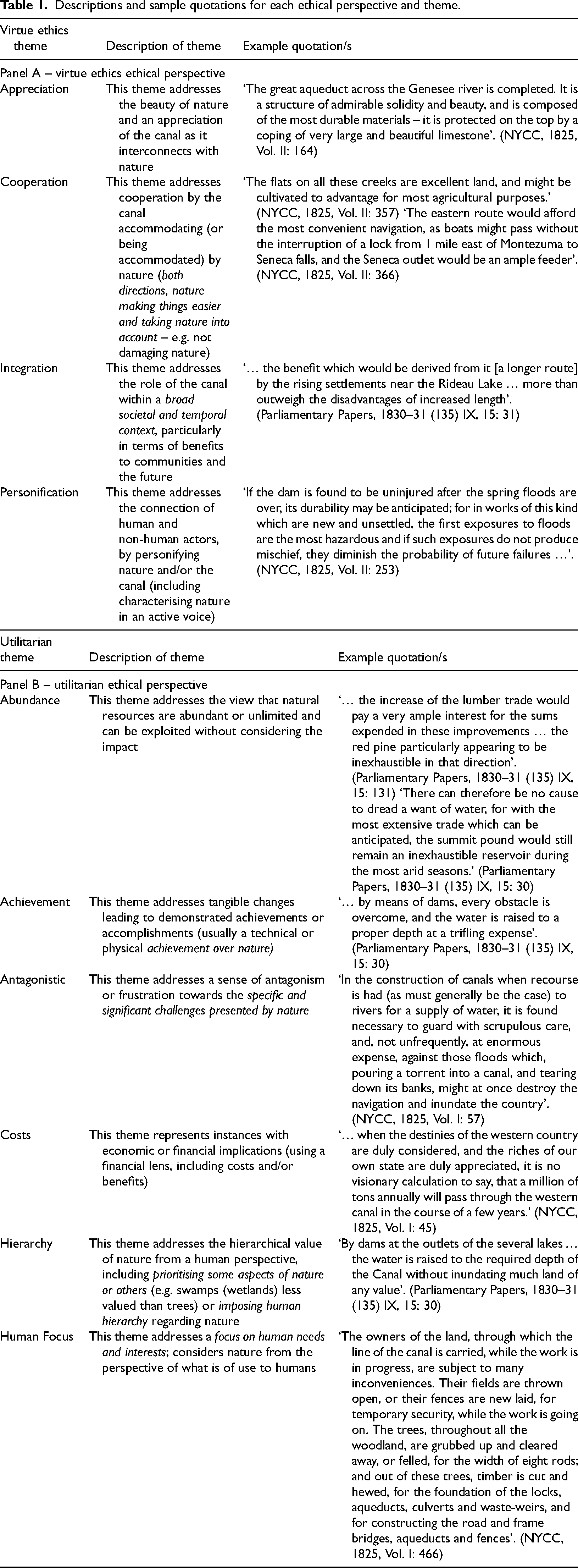
The utilitarian perspective (Table 1, Panel B) considers natural resources to have an ‘Abundance’ that can be exploited and considers ‘Achievement’ of a technical or physical type over nature. This sense of human domination over nature which discursively justifies its exploitation is inherent in the separation between humans and others which characterises a utilitarian approach. For example, even though Singer (1975) extends the net of ethical interests to include animals, the criteria used for doing so is still based on an inherently human trait – sentience (Singer, 1975). A utilitarian approach is easily applied through a financial lens with a focus on ‘Costs’ incurred, and benefits received. This perspective incorporates a ‘hierarchy’ – prioritising some aspect of nature over others or imposing a human hierarchy regarding nature and is biased towards a ‘Human Focus’, in terms of what is of most use to humans (as opposed to non-humans).
We now turn to a description of the context in which our research is set. We briefly describe the roots of canal building, and the role of canals in North America, and provide details on the Erie and Rideau canals. We also briefly describe the consequences of canal building on the natural environment.
Context
Early canal building
The origins of canal building globally date back to China, (Johnson, 2021). The history of canal building in Britain dates to Roman times, with more recent canals being built in Britain in each of the sixteenth to nineteenth centuries (Fisher, 2009; Johnson, 2021). Canal building was particularly popular in Britain during the late eighteenth century during the Industrial Revolution (Fisher, 2009), when it became necessary to move bulk raw materials to factories and finished goods to increasingly urbanised consumers as inexpensively and efficiently as possible (Forrester, 1980; Johnson, 2021). Thus, there was considerable canal-building expertise in Britain in the late 1700s and early 1800s. Prior to the American Revolution in 1776 (and even after) much of this expertise was available to the American colonies and to other British colonies in North America (Utter et al., 2020). Canal building in Britain was primarily for commercial purposes and consisted principally of flat dug channels through which barges were towed by horses (Fisher, 2009), funded through private venture capital (Johnson, 2021).
In comparison to the typical dug canal channels in Britain, both the Erie and Rideau canals are more correctly understood as ‘waterways’ (Legget, 1986) or ‘artificial waterways’ (Utter et al., 2020), rather than ‘canals’, in that they each connect naturally occurring lakes and rivers with short, excavated canal sections. The differing understandings of ‘canal’ in Great Britain and North America led to some confusion regarding the magnitude of challenges when building canals in North America. In particular, decision-makers in Great Britain, when considering budgets for the Rideau Canal struggled to visualise the nature of challenges to be encountered in Canada (Bujaki, 2015). In North America, canal building was undertaken for a wider range of reasons (including political and military priorities) than the commercial reasons which predominated in Britain. North American canal-building also encountered different technological challenges than in Great Britain. In Great Britain, early nineteenth-century canals frequently benefited from long stretches (up to 70 miles) of level terrain (Evans, 1981) and the need for locks to overcome changes in elevation was minimised. In contrast, difficult geological terrain in eastern North America through the Adirondack Mountains and the Canadian Shield (Bujaki, 2014) necessitated the construction of more numerous locks, dams and weirs. 2 The terrain necessitated self-propelled, rather than towed vessels (Bujaki, 2014), and, at least for long-distance canals such as the Erie and Rideau canals, was largely government funded.
Canals in North America
The early 1800s was a time of significant expansion and settlement in both the fledgling United States and the remaining British colonies in North America, including Upper Canada (now the Province of Ontario). The development of transportation infrastructure to support settlement, defence, trade, economic growth, prosperity and political autonomy was important in both these jurisdictions (Bernstein, 2005; Kistler, 1980; Legget, 1986; Utter et al., 2020).
In some respects, the Erie and Rideau canals were in competition with each other (Utter et al., 2020). The New York Canal Commissioners (hereafter NYCC) worried about the possibility of all trade from Lake Erie ‘being diverted to a port in the territory of another nation’ (Montreal, Canada) (NYCC, 1825, Vol. I: 31), while officials in Upper Canada hoped the Rideau Canal would ‘turn a large portion of the present trade of New York towards Canada’ (Macfarlane, 1826: 129).
Waterways in eastern North America were fundamental in supporting trade and development in the early 1800s through territory that was generally heavily forested, without many roads or settlements. Abundant natural resources such as timber, salt, and agricultural produce in the interior of Canada and the United States needed to be moved to industrial and population centres along the Atlantic coast, while finished goods and settlers sought routes inland (Legget, 1986; Utter et al., 2020). Transportation by water was more efficient and less expensive than by road in the early 1800s (if, indeed, roads existed), and the first commercial railway in North America did not begin operations until 1827. Moving people and goods by water was essential.
Water transportation was challenging, however, due to specific geographic and climatic features in eastern North America (Bujaki, 2014). These challenges include mountains, rapids that required portages, and the freezing of rivers and lakes in winter which necessitated interruptions in the navigation season (Bujaki, 2014). Bujaki (2014) documents several categories of parallel challenges faced by the builders of the Erie and Rideau canals. These include natural, technical, social and managerial challenges. The natural challenges are of greatest interest to our present inquiry into the environmental philosophy perspective reflected in reports on building the canals. Natural challenges include the geological features that the Erie and Rideau canals needed to traverse, including the types of rock in which excavation needed to occur and the proximity of rock appropriate for building locks and dams, as well as the rapids and mountains the canal needed to circumvent (Bujaki, 2014). Hydrological and meteorological natural challenges were also encountered. Hydrologically it was a challenge managing water levels to ensure neither too much water, which could damage canal structures, nor too little water, which could halt navigation (Bujaki, 2014). Further, standing water led to mosquito-borne illnesses which cost the lives of many canal workers (Bernstein, 2005; Bujaki, 2014; McKenna, 2008). Meteorologically, canal builders contended with wind and freezing temperatures (Bujaki, 2014). Winter weather and freezing temperatures made construction challenging and generally halted navigation from November to April each season (Bujaki and McConomy, 2022).
Several of the natural challenges encountered in both Canada and the United States relate to water, which is our primary environmental focus in this article. Both a want of water and an excess of water pose challenges for the operation of canals. Builders of the canals were aware the construction of the canal would permanently impact the natural environment and water levels. For example, the NYCCs reported. …to suppose the quantity of water in a river, when turned into a canal, will remain the same, would lead to serious disappointment. Much must be allowed for evaporation, and, notwithstanding the utmost care, more will filter through the sides and bottom of a canal, than those of a river. (NYCC, 1825, Vol I: 57)
Further, the NYCC (1825, Vol I: 57) also noted ‘Large tracts … which appear as swamps, … will become dry fields, when no longer shaded (as at present) by forests impervious to the sun’. In this way, the impact of canal building on the natural environment was identified. While concerns related to possible flooding were also expressed (Legget, 1986), these concerns tended to be more that flooding would damage canal structures, rather than that flooding would harm the natural environment. Canal planners also identified opportunities to work collaboratively with nature, for example, to lengthen the navigation season by judicious selection of the location of the canal. The NYCCs noted that by locating the canal on the north side of a ravine by the Mohawk River, the canal would be ‘exposed to the rays of the sun, by which the ice will be dissolved, and the navigation opened some days earlier in the spring’ (NYCC, 1825, Vol I: 74–75).
The Erie Canal. The original Erie Canal was 363 miles in length, was 40 feet wide at the surface, had 83 locks and overcame a 568-foot change in elevation from Lake Erie to the Atlantic Ocean at New York City (Utter et al., 2020). 3 Initially proposed in 1791 (Utter et al., 2020), the New York Canal (later renamed the Erie Canal), was intended to ‘encourage agriculture, promote commerce and manufactures, facilitate a free and general intercourse between different parts of the United States, tend to the aggrandisement and prosperity of the Country, and consolidate and strengthen the Union’ (NYCC, 1825, Vol. I: 88). Planning for the canal was interrupted by the War of 1812 (1812–1814) between Great Britain and the United States but resumed in 1816 and construction took place from 1817 to 1825, largely by private contractors who bid on various sections of the canal and who hired their own labourers, both local farmers and recent immigrants to the United States (Bernstein, 2005; Utter et al., 2020).
Who should pay for the canal's construction was hotly debated in the United States (Utter et al., 2020). This included questions of whether the project should be undertaken by an individual, private company or the public, and if the public, whether New York itself, neighbouring states or the United States government should cover or contribute to the costs. Ultimately, the Erie Canal was paid for by loans taken out by New York State, with some taxes already collected being reallocated to a separate canal fund to pay the interest on the loans.
The Rideau Canal. When it opened, the Rideau Canal was 123.5 miles in length, and needed 47 locks, each 33 feet wide, to address the 273-foot rise from the Ottawa River to the summit of the canal, before dropping back down 164 feet to Lake Ontario (Legget, 1986). 4 Although originally proposed in 1783, the necessity of canal communication in Upper Canada at some distance from the border with the United States was made evident during the War of 1812 (Bujaki, 2015; Department of Energy and Resources Management, 1970; Legget, 1986). Planning for the Rideau Canal began in earnest in 1816. The canal route from the Ottawa River to Lake Ontario at Kingston was selected to ensure, should further hostilities erupt, that the British military had access to a transportation route that was removed from the Canada–United States border (Bujaki, 2015; Department of Energy and Resources Management, 1970; Legget, 1986). The more secure transportation route offered by the Rideau Canal (compared to the St Lawrence River) would help to ensure the protection of British naval ports and settlements on Lakes Ontario and Erie. In a contemporary account, Macfarlane (1826: 22–23) noted: ‘That a Canal from Kingston to the Ottawa River, would in the event of a war, not merely diminish beyond measure the charge [cost] of our defence, but render its success greatly more certain, admits of no doubt’.
In addition to enhancing the security of the British colonies in North America, the Rideau Canal was also expected to benefit agriculture and business including timber, production of masts, and commodities of importance to British manufacturers and the ‘inhabitants of a new country’ (Macfarlane, 1826: 11). Settlement would also increase, with the construction of the Rideau Canal providing a stimulus to population growth and creation of settlements where new ‘towns and villages would speedily arise’ (Macfarlane, 1826: 11). Indeed, there was no settlement on the southern bank of the Ottawa River when construction on the Rideau Canal began in 1826. The sparse population of Upper Canada in the early 1800s led to some political tensions between colonists and British government representatives in Canada over who should pay for the Rideau Canal. Colonists generally were more interested in improving commercial navigation routes along the St Lawrence River and were unwilling to pay for the Rideau Canal. Great Britain offered its colony, Upper Canada, a loan to support construction, however, the loan was refused as inadequate. Ultimately representatives of the British military concluded: […] there does not appear to be the slightest chance of any pecuniary aid from the Province [of Upper Canada]. The settlers are very poor, and the Province of Upper Canada is yet in its infancy […] It has occurred to us, that the only possible mode of having the Canal executed will be, for the British Government to undertake it, and to complete the whole of the Water Communication […]. (Macfarlane, 1826: 21)
As the Rideau Canal was seen primarily as a military project (Legget, 1986) to support the defence of the Canadas, it was thought appropriate that the British Government should pay for its construction, which is what ultimately occurred.
Much of the work in constructing the Rideau Canal was completed by private contractors, though the British Royal Engineers oversaw the canal's design and completion and companies of Royal Miners and Sappers were employed to work on several of the canal's more complex sections and structures (Legget, 1986). Bytown (renamed Ottawa in 1855) was the settlement that sprung up at the northern terminus of the Rideau Canal (Legget, 1986). Given its comparatively safe location at a distance from the border with the United States, Ottawa was selected in 1857 as Canada's capital city, ensuring the enduring importance of the canal for political reasons.
Disclosure Analysis
We present our disclosure analysis in three parts. First, we offer an overall analysis of the prevalence of environmental perspectives for each canal. Second, we provide additional detail on the various themes used in the documents for each canal, linking each theme to each canal's context. Finally, we compare the ethical themes in use during the various phases of canal planning, development and construction, identifying some similarities across both canals.
Predominant ethical perspective
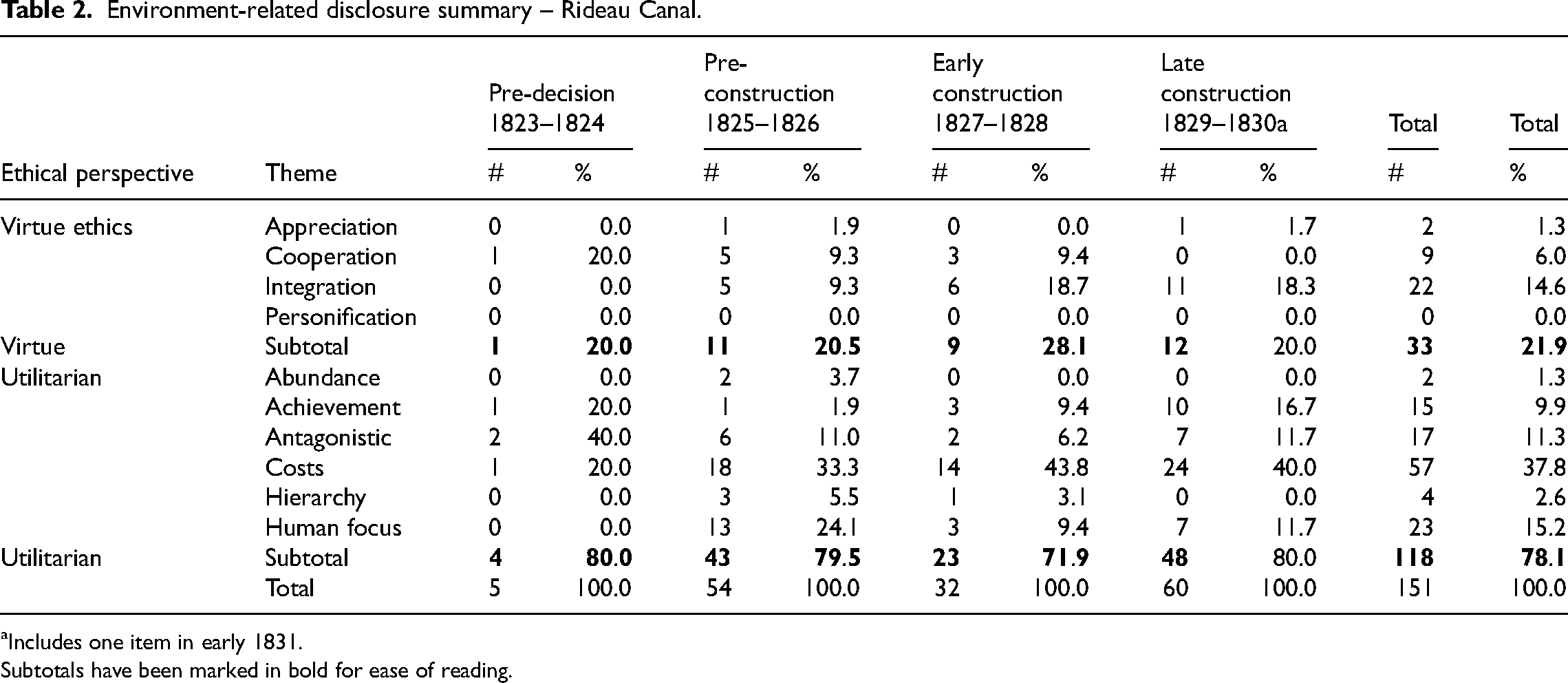
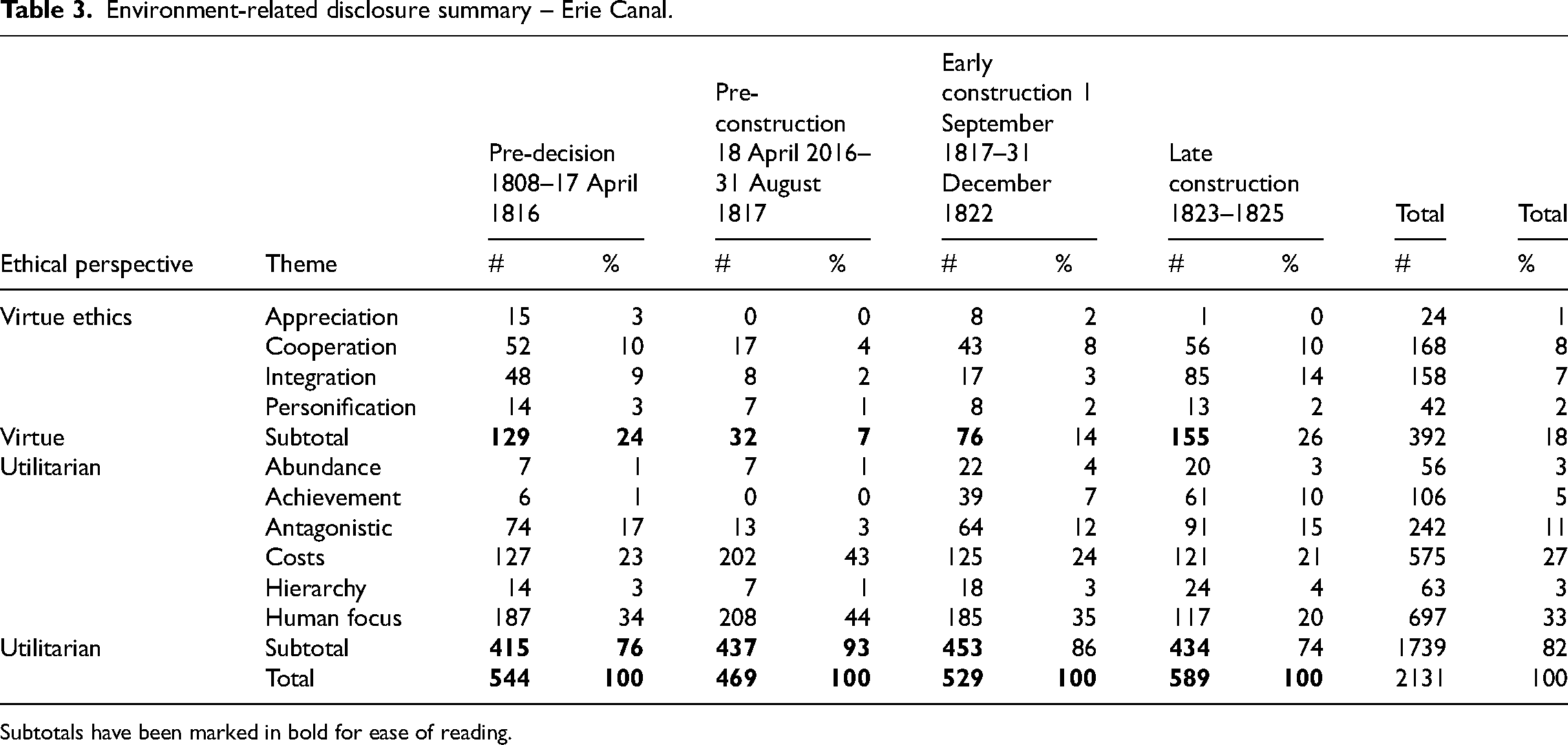
Table 2 provides a summary of the environmental disclosures related to the Rideau Canal. Table 3 summarises the themes within the environmental disclosures related to the Erie Canal. Overall, approximately 80 per cent of all sentences reflect a utilitarian ethical perspective (78% for the Rideau Canal and 82% for the Erie Canal). Approximately 20 per cent of sentences reflect a virtue ethics perspective.
Environment-related disclosure summary – Rideau Canal.
aIncludes one item in early 1831.
Subtotals have been marked in bold for ease of reading.
Environment-related disclosure summary – Erie Canal.
Subtotals have been marked in bold for ease of reading.
Ethical themes by canal
Within the utilitarian perspective, Costs and Human Focus are the most common themes for both Rideau and Erie canals, though the order of these themes differs. Specifically, Costs is the dominant theme for the Rideau Canal, comprising 38 per cent of all disclosures in our database, followed by Human Focus (15%). For the Erie Canal, Human Focus predominates (33%), followed by Costs (27%).
The following quotation is an example of a Human Focus-theme in the context of the Erie Canal. A human focus considers nature from the perspective of what is of use to humans: The top of it would serve as a waste weir or tumbling bay to discharge the floods of the river, for which purpose, as well as for retarding the current, so much as to give safety to the boats towed across the river, its great length would be an eminent advantage. (NYCC, 1825, Vol. I: 213) (Utilitarian – Human Focus – Erie Canal).
It may be that the greater Human Focus in the Erie Canal records reveals that, when each canal was begun New York had more advanced stages of settlement and development compared to Upper Canada. To a large extent, the Erie Canal worked to connect pre-existing settlements, whereas the Rideau Canal preceded settlement in many areas along its route.
The greater focus on Costs for the Rideau Canal may reflect the planners’ concern for economy and efficiency due to the significant cost overruns the canal experienced, even early in its construction. For example, in presenting a civilian surveyor's preliminary estimates for the cost of the Rideau Canal to the Legislature of Upper Canada to support deliberations on whether the canal should be built by the province, the Rideau Canal commissioners remarked that excavating rock from the bed of lakes to deepen them to make them navigable ‘… would indeed be nearly impracticable, and occasion an incalculable waste of money; by means of dams every obstacle is overcome, and the water is raised to a proper depth at a trifling expense’ (Parliamentary Papers, 1830–31 (135) IX, 15: 30) (Utilitarian – Costs – Rideau Canal). The greater focus on costs in the Rideau Canal record may also reflect, in part, the differing ways the two canals were funded. The Erie Canal's progress was dependent upon annual grants and appropriations by New York for each year's construction. This is responsible, in part, for the Erie Canal's eight-year construction period. In contrast, the Rideau Canal's contracts were written by Colonel By, the superintending Royal Engineer, with a focus on the canal's expeditious completion, such that contractors could invoice once work was completed, regardless of the timing. This meant the canal overspent the annual grants approved by the British government as there was no way to limit the invoices submitted and many of the contractors worked to complete their assigned sections as quickly as possible. In fact, the Rideau Canal document analysed for this research represents a collection of correspondence compiled for a Select Committee of the British House of Commons into cost overruns during the canal's construction. Thus, the records pulled together in the document may reflect a bias to reflect cost-related matters.
Examining other themes in the utilitarian ethical perspective we note that the Antagonistic theme is addressed in 11 per cent of sentences for both the Rideau and Erie canals, whereas the Achievement theme is twice as prevalent in the Rideau Canal document (10%) compared to the Erie Canal (5%). The following quote illustrates the nature of Antagonistic natural challenges the builders encountered: ‘On a river which rises 16 or 17 feet or more, … these works would be attended with a most serious expense and difficulty, particularly when cliffs … rise almost perpendicularly up from the bed of the stream’ (NYCC, 1825, Vol. I: 25) (Utilitarian – Antagonistic – Erie Canal (note this sentence was also coded Costs)). Similar reports of challenges on the Rideau Canal exist. Sentences reflecting an Antagonistic relationship with the natural world's challenges are not unexpected given the parallel geological, hydrological, and meteorological challenges these two canals in eastern North America encountered (Bujaki, 2014).
Regarding the Rideau Canal's greater emphasis on Achievement, this may again reflect the different stages of settlement in which each canal's construction took place. The Rideau Canal was constructed through essentially uninhabited forests, which may have influenced the sense of achievement written into related correspondence. Alternatively, since much of the correspondence related to the Rideau Canal collected in the document analysed was written by the military officers responsible for oversight of the canal's construction, they may have been inclined to laud their accomplishments. In contrast, canal commissioners wrote much of the Erie Canal record. The canal commissioners would have been reporting on the work of the canal's builders and might be less inclined to highlight their accomplishments. An example sentence illustrating Achievement (written by Colonel By) reveals: I have the satisfaction to report, that on Friday I raised the Rideau River at the Hog's Back to the height of forty-one feet perpendicular, which is within six feet of the height I expect the water will ever rise in time of floods. (Parliamentary Papers, 1830–31 (135) IX, 15: 82) (Utilitarian – Achievement – Rideau)
Completing the comparison of utilitarian themes by the canal as illustrated in Tables 2 and 3, we observe that both canal's documents show similarly low levels of engagement with the themes of Abundance and Hierarchy. One per cent of the Rideau Canal's themes relate to Abundance and 3 per cent to Hierarchy. The corresponding percentages for the Erie Canal are 3 per cent for Abundance and 3 per cent for Hierarchy. Although these themes are not common, the similar proportions, regardless of the canal, seem to suggest a common early nineteenth-century worldview with respect to the abundance, indeed apparently inexhaustible nature, of untapped natural resources in North America available for exploitation for the benefit of settlers. Further, from the perspective of Hierarchy, there appears to be a common sense view that some types of natural resources are more valuable than others. The following sentences reflect these views: There can therefore be no cause to dread a want of water, for with the most extensive trade which can be anticipated, the summit pound
5
would still remain an inexhaustible reservoir during the most arid seasons. (Parliamentary Papers, 1830–31 (135) IX, 15: 30) (Utilitarian – Abundance – Rideau)
‘By dams at the outlets of the several lakes between Jones’ Rapids and the Rideau, the water is raised to the required depth of the Canal without inundating much land of any value’ (Parliamentary Papers, 1830–31 (135) IX, 15: 30) (Utilitarian – Hierarchy - Rideau) and ‘[t]he only objection which presents itself to this course, is the destruction of about 300 acres of low land, which would be flooded by this dam, and consequently unhealthy’ (NYCC, 1825, Vol. I: 498) (Utilitarian – Hierarchy – Erie).
We now turn to a comparison of the use of virtue ethics themes across the two canals. Cooperation and Integration are the top two virtue ethics themes for both canals, though again the ranking differs. Integration is first for the Rideau Canal (15%), followed by Cooperation (6%). In contrast, for the Erie Canal, Cooperation is 8 per cent and Integration 7 per cent (approximately half that of the Rideau Canal). An illustrative quotation of Cooperation, which represents the canal accommodating (or being accommodated) by nature, is presented next. A bed of clay throughout separates the limestone rock on the west from a species of rock resembling granite which runs along the eastern bank, to which fortunate circumstance is to be ascribed the facility and cheapness with which this part of the work may be effected. (Parliamentary Papers, 1830-31 (135) IX, 15: 29) (Virtue Ethics – Cooperation – Rideau Canal)
The comparatively similar level of sentences coded as Cooperation for both canals may indicate the similar terrain the two canals traverse (Bujaki, 2014).
Integration, which reflects the role of the canal within a broad societal and temporal context, particularly in terms of benefits to communities and the future, is almost twice as common in the Rideau Canal records, compared to the Erie Canal. An example quote is ‘The east end of Lake Erie, where the canal boats and lake vessels shall come together, will one day become a very important spot’ (NYCC, 1825, Vol. I: 44) (Virtue Ethics – Integration – Erie Canal). Given the focus on future benefits to communities, it may not be surprising that there were more statements of this nature for the Rideau Canal. As noted previously, the land through which the Rideau Canal passed was largely unsettled. The Rideau Canal was expected to promote the development of new settlements along its route. The Erie Canal had less potential opportunity in this regard because many settlements already existed.
With respect to Appreciation, both Rideau and Erie canals had a similarly low level (1%) of sentences coded to the Appreciation theme. Appreciation of the beauty of the country through which each canal passed is evident in the following excepts: ‘In many instances, particularly at the summit level on the Rideau Lake, the expanse of water is very extensive, and generally flows through a luxuriant country, interspersed with fine natural views and scenery’ (Parliamentary Papers, 1830–31 (135) IX, 15: 129) (Virtue Ethics – Appreciation – Rideau) and: Along the extended route of a contemplated canal from Hudson river through the waters of the Mohawk, and the intermediate lakes to lake Erie, is presented to the eye of the traveller, a country unequalled for fertility, in so great extent, in any part of the United States, and not surpassed it is believed by the fairest regions of the eastern world. (NYCC, 1825, Vol. I: 9) (Virtue Ethics – Appreciation – Erie)
These sentences illustrate the similar terrain of the two canals and their pristine and unspoiled natural settings (Bujaki, 2014).
Sentences personifying nature were only noted for the Erie Canal, for example: ‘It is also to be noted, by those who shall construct canals in this country, that the true character of a river cannot now be known [before the construction of the canal]’ (NYCC, 1825, Vol. I: 57) (Virtue Ethics – Personification – Erie). This sense of the ‘true character’ of a river suggests a personification of the river's essence. It may be the use of personification reflects a different style of writing in the Erie Canal records. We now turn to examine the prevalence of various ethical themes by phase of construction.
Ethical themes by phase of construction
We separately focus on key time periods related to the construction of the canals: the period before the final decision to construct the canal was taken as identified in the historical record (Pre-decision); the ‘Pre-construction’ period between the formal decision to proceed with building the canal and the start of construction; ‘Early construction’ as indicated by the commencement of construction activities, before any part of the canal opened for navigation, and ‘Late construction’ (the final stages of completion of each canal preceding the opening of its full length for navigation). We note a predominance of the utilitarian ethical perspective across all periods for both canals (see Tables 2 and 3).
The Pre-decision period for the Erie Canal, as reflected in the document analysed, commenced in 1808 and wrapped up in 1816, a period of approximately eight years. The equivalent period for the Rideau Canal was 1817–1824, similar, at about seven years. In terms of utilitarian themes in the Pre-decision period, the Rideau Canal document analysed focused on Antagonistic themes (40%), followed by Costs (20%) and Achievement (20%). The top three Pre-decision themes for the Erie Canal are Human Focus (34%), Costs (23%) and Antagonistic (17%). Anticipating costs and challenges was clearly important in the period leading up to formal legislative decisions to proceed with construction. It makes sense the Erie documents would focus on human needs and interests in the pre-decision period as there were more people present within the Erie Canal's catchment than along the planned route of the Rideau, which seemed to focus more on the potential for achievements. Examples of the Rideau Canal's Antagonistic focus in the Pre-decision phase and the Erie Canal Cost focus follow. The difficulties attending the former plan are numerous and important, in many places it would be necessary to drive piles and secure the banks of the Canal by planking them, and the excavation would be very troublesome in consequence of having to contend with water and a soft mud extending several yards in depth. (Parliamentary Papers, 1830–31 (135) IX, 15: 29) (Utilitarian – Antagonistic – Rideau – Pre-decision)
‘Machinery on such a stream, unless great expense indeed was incurred to obviate it, would be subject to have its works interrupted by every large flood’ (NYCC, 1825, Vol. I: 25) (Utilitarian – Costs – Erie – Pre-decision). Note the use of the conditional word ‘would’ in both examples as they refer to future possibilities.
In terms of virtue ethics themes in the Pre-decision period, Cooperation was the only virtue ethics theme (20%) identified in the Rideau Canal documents. Both Cooperation (10%) and Integration (9%) were reflected many times in Erie Canal records. The Integration theme may signal the anticipated future benefits to the greater numbers of people already living along the route of the Erie Canal. The cooperation reflects the canal accommodating, or being accommodated by, nature, as illustrated by the comment, ‘A certain rise in the line of the Canal was inevitably to be encountered; and no place could be discovered for this purpose presenting fewer obstructions than that in question’ (Parliamentary Papers, 1830–31 (135) IX, 15: 30) (Virtue ethics – Cooperation – Rideau – Pre-decision).
The Pre-construction phase was approximately one year for both canals, 1816–1817 for the Erie and 1825–1826 for the Rideau Canal. For both canals in this phase, the majority of themes were utilitarian. The top three themes for each canal fell in the same order: Costs (33% Rideau, 44% Erie), Human Focus (24% Rideau, 43% Erie) and Antagonistic (11% Rideau, 3% Erie). These themes reflect uncertainty with respect to costs, consideration of how people will benefit (a greater focus for Erie given its pre-existing settlements), and concerns over challenges to be encountered. In the pre-construction phase for the Rideau Canal locks of various sizes and their associated costs were considered, as illustrated in the following example: The comparative expense on a scale of 7 feet in depth, 40 feet in width at the bottom, and 61 feet in width at the surface of the water, the banks to slope 1 1/2 foot to 1 foot perpendicular; the locks to be of stone, and 100 feet in length by 22 feet in width, with turning bridges, with 22 feet in the clear, and 10 feet wide: cost: £230,785.14.1 ½. (Parliamentary Papers, 1830–31 (135) IX, 15: 23) (Utilitarian – Costs – Rideau – Pre-construction)
And, in the pre-construction phase of the Erie Canal, the human focus includes the following: ‘This stream may be passed by a dam with suitable waste gates, without injuring the mill site’ (NYCC, 1825, Vol. I: 261) (Utilitarian – Human Focus – Erie – Pre-construction).
In terms of Pre-construction virtue ethics themes, the top two themes are Cooperation (9% for the Rideau Canal and 4% for the Erie Canal) and Integration (9% for the Rideau Canal and 2% for the Erie Canal). In this phase, the formal decision to proceed with construction had been made and the focus was on the benefits expected to arise from the canals and the relative ease with which construction might occur. For example, the planners of the Rideau Canal observed ‘There appears to be no difficulty whatever with respect to a Canal from the Ottawa to Kingston, by the Rideau River, the Rideau Lake, the Mud Lake, Cranberry Marsh, and Kingston Mill Stream’ (Parliamentary Papers, 1830–31 (135) IX, 15: 21) (Virtue Ethics – Cooperation – Rideau – Pre-construction), reflecting the natural environment accommodating the canal route with relative ease.
The early construction period covered approximately one year for the Rideau Canal (1826–1827) and about five years for the Erie Canal (1817–1822). The longer early construction phase for the Erie Canal is not surprising given the differing funding arrangements described earlier, as well as the much greater length of the Erie Canal (almost three times the length of the Rideau). Regarding the utilitarian perspective in the Early construction period, the top two themes for both the Rideau and Erie canals were Costs and Human Focus, although the order was reversed for the two canals, as follows: Costs (44% for the Rideau Canal, 24% for Erie), Human Focus (35% for the Erie Canal, 9% for Rideau). Even during the early construction of the Rideau Canal considerable emphasis was placed on the Costs theme, and cost control, which is not surprising given that cost overruns were already occurring in that time period. In contrast to the Rideau Canal, a Human Focus within the utilitarian perspective was even more evident than the cost focus for the Erie Canal during the Early construction period. The following examples illustrate the Costs theme for Rideau Canal and the Human Focus theme for the Erie Canal in the Early construction phase: ‘I have succeeded in making the mound across Dow's Great Swamp watertight, which … does away with the original idea of forming an aqueduct in the centre of the said mound, and a considerable saving will be made in consequence’ (Parliamentary Papers, 1830–31 (135) IX, 15: 66) (Utilitarian – Costs – Rideau – Early construction). And ‘the canal commissioners have caused a survey to be made … with a view of ascertaining the improvements of which the waters of these streams are susceptible, as respects their navigation’ (NYCC, 1825, Vol. I: 429) (Utilitarian – Human Focus – Erie – Early construction).
The third most common utilitarian theme during the Early construction phase differed across the two canals. The third most prevalent utilitarian theme in the early construction period was Achievement (9%) for Rideau Canal, whereas it was Antagonistic (12%) for the Erie Canal. As noted earlier, this may reflect the different authors of most of the documents, with military officers involved directly in overseeing the Rideau Canal construction being disposed to focus on accomplishments, whereas the Erie Canal commissioners seem to have focused on the challenges of canal construction. A sample quote for the Achievement of the Rideau Canal in the Early construction phase states: This dam was nearly completed, and the water raised within four feet of the required height, which proves the practicability of the plan and the correctness of our levels, as the water levels perfectly agreed with those taken by the instrument. (Parliamentary Papers, 1830–31 (135) IX, 15: 76) (Utilitarian – Achievement – Rideau – Early construction)
And, reflecting an Antagonistic theme, ‘the eastern to Schoharie crosses so many streams, and there being some difficult digging, and considerable wall required to sustain the banks of the canal and adjacent high grounds …’ (NYCC, 1825, Vol. I: 321) (Utilitarian – Antagonistic – Erie – Early construction).
In terms of virtue ethics coding during the Early construction phase, both canals had Integration and Cooperation as the top two themes, though Integration was first for the Rideau Canal (19%) and second for Erie (3%). In comparison, Cooperation was first for the Erie Canal (8%) and second for the Rideau Canal (9%). As an example, the following reflected a Cooperation theme early during the Erie Canal's construction: For the purpose of ascertaining, whether such a fear [running out of water during the navigation season] were groundless or not, we have had the various springs and streams which might be conducted into the summit level of the canal, on that route, gauged; and have considered the surface and character of the country, from which the rains would naturally drain into that level. (NYCC, 1825, Vol. II: 8) (Virtue Ethics – Cooperation – Erie – Early construction)
The Late construction period in the documents examined covered three years for the Erie Canal (1823–1825) and two years (1829–1830) for the Rideau Canal. It should be noted, however, that this period does not cover the full Late construction period for the Rideau Canal as the canal did not open in its entirety until 1832. So egregious were the cost overruns for the Rideau Canal seen to be, that the document we analyse was ordered to be compiled in early 1831 for presentation at a British Select Committee inquiring into the canal's cost. In terms of utilitarian themes, Costs is the most prominent theme for both canals in the Late construction period (40% for the Rideau Canal, 21% for the Erie Canal). Following Costs, the Rideau Canal's next most prevalent themes in this period are Achievement (17%), Human Focus (12%) and Antagonistic (12%). These three themes are also prevalent for the Erie Canal during the Late construction phase: Human Focus (20%), Antagonistic (15%) and Achievement (10%). Illustrative quotations include the following: ‘The term Canal is scarcely applicable to the Rideau, which is rather a chain of rivers and lakes, united and made navigable by means of dams and locks’ (Parliamentary Papers, 1830–31 (135) IX, 15: 129) (Utilitarian – Human Focus – Rideau Canal – Late construction) and ‘By great and persevering exertions, the excavation was so far completed, through this section of the canal, as to allow of the passage of a boat the thirtieth day of July last, since which time it has been constantly open’ (NYCC, 1825, Vol. II: 103) (Utilitarian – Achievement – Erie – Late construction).
The most common virtue ethics theme in the Late construction period for both canals is Integration (18% for the Rideau Canal; 14% for the Erie Canal). This is followed by Cooperation (10% for the Erie Canal) and Appreciation (2% for the Rideau Canal). The following sentence reflects the theme of Cooperation: In this communication you will perceive the views entertained by this officer, both to facilitate the settlement of the lands in the neighbourhood and on the banks of the Canal, and for the gradual development of the Ottawa and the country above the Chaudière Lake’. (Parliamentary Papers, 1830–31 (135) IX, 15: 131) (Virtue Ethics – Integration – Rideau – Late construction)
Overall, the language reflecting ethical perspectives during various phases of canal building reflects some commonality, regardless of which canal is under consideration. In the Pre-decision phase, the focus tends to centre on Costs and challenges (Antagonistic), while emphasising the relative ease with which the project is expected to progress (Cooperation). This is consistent with the Bujaki (2010) assessment of the use of cost-benefit terminology and the political nature of the deliberations preceding the approval of the Rideau Canal. In the Pre-construction phase, the focus continues to be on (estimated) Costs, how nature will benefit humans (Human Focus), and, to some extent, on anticipated challenges in construction (Antagonistic), regardless of which infrastructure project is considered. These are balanced by pre-construction themes that continued to emphasise Cooperation, and by focusing on Integration (how the canal will benefit communities in the future). These pre-construction themes continue in the Early construction period, with some indications of success or Achievement appearing. Finally, in the Late construction period, an emphasis on Costs and Human Focus is mitigated to some extent by an expanding sense of Achievement, while still acknowledging the challenges faced (Antagonistic).
In summary, we document the predominance of the utilitarian ethical perspective which shaped approaches to the major canal building projects undertaken in the early 1800s as represented by the construction of the Rideau Canal in Canada and the Erie Canal in the United States. As noted earlier, utilitarianism allows for decision-making compatible with quantitative and financially informed accounting (Morrison et al., 2018; O’Neill, 2001). However, in the context of large-scale infrastructure projects, this approach to decision-making frequently only addresses quantitative and financial consequences in the comparatively short-term. In the long-term, infrastructure projects frequently have significant impacts on the natural environment (as indeed the Erie and Rideau Canals do) as we discuss below.
Discussion
Ethical implications at the time
Bergman et al. (2022: 73) argue that historic canals operated as integrated systems (‘coupled social-ecological systems’) where humans and the environment are linked by mutual feedback and evolve together. As such, they must be managed together to achieve conservation goals and to maintain ‘commemorative integrity’. This approach reflects a virtue ethics philosophical orientation to the natural environment. Bergman et al. (2022: 84) explicitly invoke a philosophical perspective when they conclude: There are opportunities to engage in philosophical discussions about modified ecosystems composed of historical built infrastructure within natural reaches, and how our conceptualisations of the ‘natural’ and the ‘human-made’ shape worldviews, behaviours, and social-ecological linkages… Considering which values (e.g. social, environmental) society wants to collectively sustain in the future will be necessary so that we can use appropriate strategies to protect those values.
In this article, we invoke a philosophical perspective to analyse the ethical approaches evident in the accountability documents which recorded the processes through which the Erie and Rideau Canals were conceived, planned and undertaken. By examining these texts, we find a common pattern in the conception, planning and construction of both canals. We use the lens developed by Morrison et al. (2018) to discern patterns of application of the three primary ethical approaches which have guided Western relationships with nature over a long period of time (including the time period we examine in this article). These three ethical approaches are virtue ethics, utilitarianism and deontology. As outlined in our literature review, ethical approaches shape values and ultimately, the physical outcomes of a particular relationship with nature (Hadot, 2006; Merchant, 1989).
First, when we examine the ethical themes evident in the accountability documents of both the Erie and Rideau Canal construction, we find the predominance of the utilitarian theme. This ethical approach aligns with the tasks at hand at the time, with the importance of cost considerations (Costs) and the benefit that the canals were planned to bring to human activities (Human Focus). This may come as no surprise and reflects the purpose of the canals themselves, however, since a utilitarian focus has been critiqued as one which harbours a potentially harmful ontology towards the natural world, it is important to consider it in light of the impacts on the environment (Morrison et al., 2018). Here, a utilitarian approach belies an attitude that the natural environment can (and even should) be exploited for human benefit.
Alongside the utilitarian approach overall, a smaller proportion of virtue ethics sentiments was expressed in the text. In this context, virtue ethics was expressed through a sense that humans and nature were both integrated into this environment (Integration), with nature assisting the construction (Cooperation) (Plumwood, 1993). The virtue ethics approach may have arisen due to the close relationship between the surveyors, builders and the natural environment during this time (e.g. many months spent living in what was then ‘wilderness’ to complete the task).
In the documents we analysed, we did not discern any significant expression of deontology, and therefore, we removed deontology from our framework. This may represent the approach to nature during this period, whereby no deontological type ‘rules’ (categorical imperatives) applied to interactions with nature. For example, the first environmental statute in the United States, the Rivers and Harbours Appropriation Act, was not introduced until 1899. This indicates that the social implications of environmental impact were not explicitly recognised until more than half a century after the completion of the Erie and Rideau canals. Despite not being an explicit, legislated concern, environmental ethics are implicit in interactions with the natural world, as evidenced by our findings.
Once we interrogated the text with the various stages of construction in mind, an even more interesting pattern emerged. The ethical approaches to nature changed over time, depending on the stage of planning or construction. Importantly, this finding demonstrates that attitudes towards nature were not a static representation of a particular era or culture. Instead, within the specificities of the period and geographical locations, environmental ethics were adopted according to context and attitude.
While the engineers, surveyors, government officials and builders were not likely to have explicit knowledge of the ethics and philosophies we assess, their attitudes and actions were shaped by a specific set of ethical approaches, to varying degrees at different stages of the construction. These ethical approaches are reflected in the environmental impacts that were initiated at the time of construction, and which resonate through to contemporary times.
Long-term consequences of exploitation of natural waterways
With the benefit of two centuries of hindsight, we are able to identify that taking a predominantly utilitarian approach to infrastructure construction did not anticipate the long-term effects of exploiting the natural world. To illustrate, we document briefly some adverse consequences arising from the exploitation of nature which took place when the Erie and Rideau canals were built. Our examples are illustrative only, rather than exhaustive. We introduce them to demonstrate how our initial exploitation of the natural environment continues to affect natural, aquatic and human environments for hundreds of years. This accounting is incomplete as we do not fully describe the architectural, engineering, social, industrial, or cultural implications of the canals. We identify below some ongoing impacts of canal construction, including those related to flooding, invasive species, health and safety concerns, and concerns related to industrial activity and pollutants.
Watson (2006: 134) ‘takes a look at the geographical changes brought about by the building of the Rideau Canal … by investigating the amount of flooding caused by the construction of the Rideau Canal’. Watson (2007: 121) identified ‘the pre-flooding outlines of several of the lakes … to show what several of these lakes would have looked like in the pre-flooding era’. For example, he compares pre-flooding (1783) and present-day (2007) lake contours. Watson (2006: 6) suggests his work can help understand the extent of landscape changes brought about by the canal's construction, including areas where new ecosystems developed. One present-day concern in some of these areas is the presence of stagnant water.
The spread of invasive species can be facilitated by canals. Referring specifically to the New York State Canal system (which includes the Erie Canal), Pimentel (2005: 693) observes that connecting watersheds provides ‘an effective mechanism for the introduction and dispersal of aquatic nonindigenous [invasive] species’. He notes exotic species can inflict significant damage to environmentally sensitive aquatic ecosystems (Pimentel, 2005) and invasive species are almost impossible to eliminate. In addition, these invasive species can pose risks to both environmental and human health due to the introduction of pathogens and parasites related to these species.
The magnitude of changes to the natural world resulting from the Rideau Canal is significant. Legget (1986) asserts these changes need to be maintained to ensure public health and safety. This became evident during the Depression when there were calls for the Rideau Canal to be closed as a cost-saving measure. According to Legget (1986: 107): It required little study, however, to show that, once built, a canal cannot easily be abandoned with safety, or indeed with economy, in view of possible damages which may result as dams and lock gates fall into disrepair, and land which has been flooded for a century is suddenly exposed to view with all the hazards to public health which would follow.
Health and safety concerns persist today, including toxins arising from algal blooms (Bergman et al., 2022) and from industrial activity and pollutants.
The opening of both the Erie and Rideau Canals increased settlement, industrial activity, and commerce (Legget, 1986; Utter et al., 2020). According to Utter et al. (2020: 259), the Erie Canal corridor became home to new types of businesses including ‘iron and steel works, clothing processors and manufacturers, food producers, malt houses, boat builders, and sawmills…’. Many of these businesses discharged waste, such as chemicals, toxins and wastewater, directly into the canals (Langbein, 1976). For example, Bergman et al. (2022) note the Rideau Canal's water quality is affected by chemical pollutants from sources such as wastewater, runoff, older infrastructure and septic systems. Indeed, in 2017 sections of the Rideau Canal in downtown Ottawa were added to a list of contaminated sites for which the Federal Government is responsible. Parks Canada, which manages the Rideau Canal noted that contaminated sediment was ‘not unexpected’ given the long history of industrial use of the canal (CBC News, 2017).
Conclusion
We examine the environmental ethics perspectives operating in eastern North America in the early 1800s, at a time when colonial settlement, commercial, industrial, political and social systems were nascent. We find both the utilitarian approach and virtue ethics approach to the environment in the historical records for the Erie and Rideau canals, though the utilitarian perspective predominates.
We contribute to the literature on accounting history and canals related to eighteenth- and nineteenth-century canal construction by introducing environmental ethics to a literature that has previously focused primarily on the development of reporting systems, financing and governance practices. We contribute to the literature on environmental reporting through a historical examination of how the environment, particularly water, is referred to in official records relating to the construction of the Erie and Rideau canals in the early 1800s. We also contribute to the literature on environmental reporting by the public sector through the examination of these two large publicly funded infrastructure projects.
We find evidence of both virtue ethics and utilitarian philosophical perspectives in the official accounts for the construction of the Erie and Rideau canals, though the utilitarian perspective is clearly more evident during the period. This article specifically contributes to the literature by building on the work of Morrison et al. (2018), who find a link between a long durée of environmental ethics (from Ancient Greece to current times), and contemporary environmental reporting. This article adds to the way this linkage is understood by tracing these relationships across time in historical records.
Our analysis is subject to the inherent limitations of historical enquiry. For example, narrative histories cannot provide a complete history of complex events such as the canal construction infrastructure projects under review. Also, while we focus on two primary ethical themes in our analysis, an analysis of this sort is subject to many alternative ‘true histories’ (White, 1967).
There are several avenues for future research that arise from this project. We encourage future researchers to apply an environmental ethics perspective to current corporate and public projects, especially infrastructure projects. Fewer canal projects are being undertaken in the twenty-first century, however, there are many pipeline proposals and transportation projects that might benefit from an environmental ethics perspective. Awareness of the environmental ethical perspective held by various stakeholders regarding these projects should permit more meaningful discussions to take place regarding the benefits and costs of these projects. Another interesting area for future research might be to examine private–public partnerships (so-called ‘3P’ activities) to assess how the environmental concerns of these parties and their stakeholders are addressed in such projects. We also observed several references to Indigenous peoples in the official documents we reviewed. An in-depth examination of the ethical perspectives reflected towards Indigenous peoples (on whose traditional lands these canals were constructed) in early official documents could also point the way to alternative possible relationships between today's Indigenous peoples and settler-colonists and suggest paths to reconciliation with Indigenous peoples.
In light of the current critical state of the environment (IPCC 2022), including Canada's observed and projected changes in temperature, rainfall, snow, ice, permafrost and freshwater quality and availability (Government of Canada, 2021), it is important to reflect on how historical ethical approaches have informed this current trajectory, and perhaps, to inform an alternative, less harmful trajectory. We conclude with the hope that by making the historical roots of our environmental worldview visible, we, collectively, are able to envision a different approach to future development for proposed future infrastructure projects such as pipelines, mines, ports or transit systems.
Footnotes
Acknowledgements
We thank participants at the 16th Accounting History Symposium and, in particular, Nick Davis the discussant, for comments on an early version of this article. We also thank Maria Akbar for her excellent research assistance.
Funding
The author(s) disclosed receipt of the following financial support for the research, authorship and/or publication of this article: We thank the CPA Canada Accounting and Governance Research Centre at the University of Ottawa and the Social Sciences and Humanities Research Council for early financial support which allowed us to collect the archival documents on which this research is based. We also thank KPMG for its financial support.
