




Abstract
Water exploitation is at the centre of current social and environmental sustainability discourses, one form of which is hydropower. Intense damming of rivers and natural basins occurred in nineteenth and twentieth century Europe (and elsewhere). Following Miller and Power's concept of territorialisation and Foucault's notion of visibility, this study sheds light on the water management arena, read through changes in stakeholder objectives and accountabilities. Its focus is on the ‘accounts’ of environmental concerns, from post WWII to the new millennium. The analysis focuses on the case of the Santa Giustina dam in Northern Italy, using archival and oral-history approaches. It is shown how an increasing visibility of environmental concerns translated into a higher degree of ‘territorialisation’ through their itemisation in water quality and quantity parameters. This historical evolution informs policy makers, managers and society in general, about how to address profits and environmental issues regarding current water exploitation.
Introduction
Water distinguishes our planet compared to all the others we know about… Throughout the world, demographic, economic, and technological trends have accelerated our ability to knowingly – and unknowingly – modify the environment we live in and that sustains us. We humans have become the principal driver of environmental change. (Cosgrove and Loucks, 2015: 4823)
Water management is a relatively modern term to describe the use of water resources under set policies and regulations. It includes various activities such as planning, efficient distribution and the optimal use of water resources to meet current and future needs (Cosgrove and Loucks, 2015). There are multiple aspects to it, including water allocation (to different uses), water quality, marine protection, supply planning and project appraisal of damming activities (Bujaki, 2010, 2014; Hajkowicz and Collins, 2007).
The focus herein is on hydropower as a main water allocation (Moran et al., 2018), and its related environmental concerns. Hydropower has been the leading source of renewable energy across the world. This capacity was built-up in North America and Europe between 1920 and 1970 when thousands of dams were built (Moran et al., 2018). The building of big dams in North America and Europe has been driven by the exploitation of available hydropower capacity; until about 1975, when the negative social and environmental impacts stopped this damming trend. According to Moran et al. (2018), new large hydropower dams are now built in developing countries, particularly in mega river basins, such as the Amazon, the Congo, the Nile and the Mekong.
Contemporary accounting literature on water management outlines how environmental concerns (Bebbington and Rubin, 2022; Godfrey and Chalmers, 2012; Larrinaga and Bebbington, 2021; Passetti and Rinaldi, 2020; Truffer et al., 2003; York et al., 2016) have expanded, requiring more explicit recognition of their implications. McCall (2016) and Cohen and Bakker (2014) support a similar call from the field of environmental sciences. Their work problematises the use of environmental concepts, such as landscape, territory or ecological boundaries to show how the framing of natural resources, in terms of regulatory language, has deep political implications and may lead to the reconfiguration of power structures, and the use of such resources.
There are very few examples in accounting history that address forms of water management. A case study by Lana-Berasain (2017) concerns the use of Renaissance calculation technologies on a small irrigation community in Northern Spain for accountability purposes. Bujaki (2010, 2014) considers the cost-benefit evaluation of the Rideau Canal in Ontario (Canada). Nevertheless, there is minimal consideration of environmental concerns.
Pfister (2006) underlines that the historical interest in environmental concerns has pivoted towards natural disasters – floods or droughts, in the case of water resources. Pfister (2006) argues that in the natural and social sciences, this interest has led to a focus on the destructive effects on society wrought by natural forces. Sargiacomo et al. (2021) quote religious inscriptions, such as Genesis (chapters 6–9), to support a catastrophic perspective of the relationship between the natural environment (e.g. floods) and humans. This research adds to the limited accounting history literature on the emergence and evolution of environmental concerns in water management by presenting the case of the Santa Giustina dam in the Province of Trento (Italy) from 1950 to the early 2000s. It is a case of progressivly constraining environmental concerns in water management into measurable and calculable rhetoric. This is elicited by the historical evolution of the legislation around water protection and energy and the social and political dynamics mobilised around them. Paradoxically, more prominent visibility of environmental concerns contributed to more constraining rhetoric.
The trend towards the increased deployment of specific measures or accounts, either via voluntary reporting, regulation of water releases or the level of water quality, on environmental aspects of water management is relatively recent. In turn, these aspects of water management have progressively defined or redefined the visible object of these technologies. This aspect of the ‘construction of calculable spaces’ is defined as ‘territorialisation’ by Miller and Power (2013: 554). This study extends the idea of accounting tools to the ‘accounts’ used for accountability purposes to the stakeholders involved in the water management arena under analysis. As recalled by Bisman (2009: 293), in her research note around the use of censuses in accounting history, an account is ‘presented as an artefact arising from a range of necessities to account and to satisfy obligations to be accountable’. This research uses the extended notion of archives as proposed by Carnegie and Napier (1996) and supported by Parker (2001), to investigate ‘accounts’ as a means of discharging stakeholder accountability. This work is contextualised within the Italian socio-political environment in the period examined. Accordingly, it adopts the view that accounts are a social practice that should be studied in the context in which it operates, and ‘as a phenomenon local in both space and time’ (Carnegie and Napier, 1996: 7). Political, social and environmental considerations, such as economic growth, jobs and water releases, are considered relevant in terms of these accounts (Carnegie and Napier, 1996; Miller et al., 1991), which emerge as a construct of the water management arena.
Miller and Power (2013) use the term ‘arena’, which is loosely identified as a convergence of actors, their networks, their interests, and a plurality of accountabilities. Former studies, such as Renn (1992), recognise the arena as the field space set by a rule enforcer (i.e. the State or a government authority) and characterised by a plurality of actors (or stakeholders) and their reciprocal relationships. Modern applications of Renn's concept of arena (1992) in the environmental accounting field (see Afreen and Kumar, 2016; Dey and Russell, 2014; Georgakopoulos, 2018; Georgakopoulos and Thomson, 2008; Scobie, 2015; Scobie et al., 2016; Thomson et al., 2015, among others) lead to considering specific elements of such an arena. These include stakeholder objectives, their reciprocal accountabilities and the ‘accounts’ used to discharge such accountabilities.
We argue that becoming visible or being granted visibility (Foucault, 1977) is a highly contested game of power (Miller and Power, 2013), where calculative practices make ‘calculable and visible in a specific way what was previously incalculable’ (p. 580). In accounting history, Baker (2022: 4) observes that ‘The demand and supply of information is where we expect to find accounting. Finding accounting where it should be, however, does not always occur’ and ‘The lack of accounting where we might expect to find it in an accountability relationship’ may either signify trust between the accountor and the accountee or ‘may be viewed as constructive ambivalence where agents are required to adapt to changing or new environments’ (Baker, 2022: 4).
To break down how visibility around environmental concerns has been constructed and ‘territorialised’ (Miller and Power, 2013), it is necessary to analyse the historical path through which forms of water accountabilities (including the accounts used to discharge them) and stakeholder objectives have evolved (Allan, 2008; Cech, 2009; Tosh, 2019). Thus, the water management arena of hydropower is where stakeholder objectives and accountabilities dynamically constitute certain forms of practice (and accounts) around the pursuit of environmental visibility. In that, history offers a distinctive mode of thinking which can be critically applied to the ongoing processes of change in the present (see also Dobbin, 2001 on other public goods). As such, arenas open avenues for reflection on the evolving conditions through which visibility of environmental concerns is constructed in the highly significant field of water management, which has not been fully explored yet (Cech, 2009; Möllenkamp et al., 2008; Pahl-Wostl et al., 2008).
In this article, we aim to show how the configuration of a specific water arena in a developed country, from circa 1950s to the early 2000s, has shaped the visibility and ‘territorialisation’ of environmental concerns. In considering this water management arena we analysed stakeholder objectives and accountabilities, including their accounts as elements of power within the arena (Renn, 1992). We expect to contribute to the theme of this Special Issue on ‘Accounting and the Exploitation of the Natural World’ by enriching the variety of the current field studies in agriculture (Brassley et al., 2013; Bryer, 2000a, 2000b, 2006; Giraudeau, 2017; Jack, 2015; Planas and Saguer, 2005; Sargiacomo et al., 2016), mining (Moerman and Van der Laan, 2011; Pitts and Wale, 2008; Vent and Milne, 1997) and forestry (Binkley et al., 2003; Hölzl, 2010; Jobstl and Hogg, 1998; Wiersum, 1995), through an in-depth exploration of a water management arena. Further expected contributions are as follows.
First, we expect that our analysis expands the concept of ‘territorialisation’ (Miller and Power, 2013) using Foucauldian visibility, applying it to the water management arena. Second, methodologically, we expect to clarify how the ‘territorialisation’ of environmental concerns is rendered through how ‘stakeholders’ (groups, individuals and organisations) interact with each other (through reciprocal accountabilities) within the boundaries of action offered by a continuously changing arena (Renn, 1992). This is done in a longitudinal fashion and perspective. In doing so, we also expect to extend the notion of ‘accounts’ as tools to discharge accountability in the arena. Practically, we hope to enhance the understanding of how environmental visibility is constructed and constrained in a water management arena. This may be useful for decision-makers, given the complexity of water management arenas in both developed and developing countries.
This article is structured as follows: the next section introduces the theoretical framework for the ‘territorialisation’ of environmental concerns in water management arenas. The following section provides the historical background of hydropower in the Western world and the case study in the period of reference. The methodological section of the study systematises in detail the conceptual constructs of the water management arena, namely stakeholders, accountabilities and accounts which are used to depict and clarify the ‘territorialisation’ of environmental concerns, and their visibility. This section also offers an in-depth method description and reflection, including the extensive sources used in our qualitative approach and our interpretative lenses of analysis. The fourth section introduces the findings of this case study, presented in a three-phase periodisation of the historical time window considered. The penultimate section summarises and discusses the findings. The final section points out the theoretical and practical contributions achieved by the study, with concluding remarks on how this interplay can be affected by over-arching policies.
Theoretical framing: territorialisation of environmental concerns in a water management arena
Miller and Power (2013) point out the instrumentality of accounts to create ‘calculable spaces’ when representing social and economic life (‘territorialisation’). Their work extends beyond the ‘territorialisation’ function to include their ‘mediating’ capacity, which is making it possible for actors to interact; the ‘adjudication’, such as providing information that would allow activities to be evaluated; and thereby the ‘subjectivisation’ in which control can be achieved (see Bebbington et al., 2020). One of the basic propositions that stands beside each of the four functions of ‘accounts’ is their ‘economising’ nature, meaning ‘the processes and practices through which individuals, activities and organisations are constituted as economic actors and entities’ (Miller, 1994: 2; Miller and Power, 2013: 560). In this conceptualisation, the term ‘economic’ should be intended as ‘calculable’. Thereby, delineating physical spaces such as a factory floor, an office or a hospital ward, implies that the physical space becomes visible (Foucault, 1977) as an economic unit.
The process of delineating physical spaces as ‘calculable objects’ (or economic units) is also a ‘territorialising’ activity. The abstraction of economic units may be very broad, such as public services, or even environmental concerns. Miller and Power (2013) quote the work of Gray (1992), on accounting and environmentalism, to highlight how the visibility and articulation of a ‘calculable object’ provides a relevant source of information for economic decision making, which has both a conceptual and empirical value. The relevance of such ‘territorialisation’ is that once the calculable object or economic unit is defined, further considerations of costs, revenues and their risks can be defined, calculated and controlled. This case study will deepen the ‘territorialisation’ function of the accounts in relation to the emergence of environmental concerns in the water management arena underlying the history of the Santa Giustina dam (Italy).
An important aspect of ‘territorialisation’ recalled by Miller and Power (2013) relates to narratives, the rationales that are assembled at various collective levels and articulated in and across arenas at certain points in time. This aligns with former studies in management accounting, such as Robson (1991: 548) who point out the processes of ‘translation between non-accounting discourses and rationales with their own institutional conditions of existence’, such as environmental concerns, ‘and the problematisation of particular accounting techniques.’ By recalling Gray (1992) on the ideas of greening accounting or corporate social responsibility, Miller and Power (2013) argue that ‘accounts’ appeal to a wider cluster of values and objectives, and are reflective of their changes. When discussing ‘environmental concerns’, Cohen and Bakker (2014) and McCall (2016) explicitly reflect on the political value of narratives in problematising or hindering such concerns. For instance, McCall (2016) explains the ‘landscape’ concept as an ecological unit in forest governance, which has a different value than the use of the ‘territory’ concept, which is an administrative unit. McCall (2016) argues that the ‘landscape’ concept tends to enhance the expertise of conservation and the science of landscape ecology; however, the ‘territory’ concept may more effectively situate legitimate land users’ rights at the core of spatial planning and the implementation of forest governance. From these considerations, it emerges how accounts that ‘reveal and represent economic reality on the one hand’, may represent ‘a body of organised experts who prescribe and diffuse norms of best practice on the other’ (Miller and Power, 2013: 559).
Miller and Power's (2013) reference to the arena means that those narratives and rationales have an institutional character, they emerge and circulate in institutional rather than organisational-specific environments. Studies on arenas, such as Renn (1992), depict arenas in terms of rules, which are partially coded and monitored by a rule enforcement agency such as the State (formal rules). These are partially created through the process of interaction among ‘actors’ (organisations, individuals and social groups) or social mobilisation within the arena (informal rules): ‘The arena concept attempts to explain the process of policy formulation and enforcement in a specific policy field. Its focus is on the meso-level of society rather than on the individual (micro- level) or societal behaviour as a whole (macro-level)’ (Renn, 1992: 181). Arenas have ever-changing boundaries as implied by Cohen and Bakker (2014) when they discuss the re-scaling of ecological issues, at the most relevant scale along one of the three axes: up (from nation-states), down (to local levels of government) and out (from centralised to de-centralised and participatory forms of decision making). In accounting history, identifications of arenas come from Sandu et al. (2022: 6–7) as ‘spaces generating struggles and competition’. In their geopolitical reading of Romanian accounting reforms, Sandu et al. (2022) explicitly connect arenas with the legal boundaries of reforms and the processes of struggle and competition among the actors involved.
Moving to modern studies about environmental concerns, water management arenas are also seen as contested spaces (Crowther et al., 2006; Egan, 2014; Farooq and de Villiers, 2019; Ferdous et al., 2019; Godfrey and Chalmers, 2012; Hazelton, 2013; Jollands and Quinn, 2017; Schneider and Andreaus, 2018; Wood, 2015), where the emergence of environmental concerns progressively affect the perspective of analysis of salmon farming, deep-sea oil extraction, hydropower, port construction, tobacco industry governance and local government decision making.
Miller and Power (2013) loosely identify arenas, and Cohen and Bakker (2014) refer to arenas as networks of hierarchy and power, institutions, decision-making processes and actors, including states. Therefore, the methodological challenge of this study is to select clear constitutive elements of arenas, to study the ‘territorialisation’ of environmental concerns. In that sense, the consideration of arenas as political and social spaces of ‘constructed visibility’ (Foucault, 1977) implies the necessity of a diagram to highlight the ‘distribution of individuals [stakeholders] in relation to one another [accountabilities], … of dispositions of centres and channels of power’ (Foucault, 1977: 205). It is precisely this notion of the structuring of visibility that seems especially interesting and relevant in terms of environmental concerns in the water management arena. The spaces designed by the arena accountabilities are similarly designed to make things visible, and thus knowable or calculable, in a specific way.
Historical context and background of the Santa Giustina dam
The availability of hydropower has long been closely associated with kick-starting economic growth, industrial development and welfare in most European countries (Hydropower Europe, 2022; IHA, 2022). When Richard Arkwright set up Cromford Mill, in England's Derwent Valley in 1771, to spin cotton and so set up one of the world's first factory systems, hydropower was the energy source he used (Mill History, 2022).
Hydropower technology was developed in England in 1878, and spread to Europe, such as Germany (1891); to North America, with hydropower plants installed at Grand Rapids, Michigan (1880); Ottawa, Ontario (1881); Dolgeville, New York (1881); Niagara Falls, Ontario/New York (1895); and to Australia (1895). Hydropower was used to supply mills and to light local buildings. Between the 1940s and 1970s, low-cost hydropower was seen as one of the best ways to meet growing energy demand and was often tied to the development of energy-intensive industries (IHA, 2022). However, capacity growth stagnated in the late 1980s before falling in the 1990s. This was due to increasing financial constraints and concerns expressed about the environmental and social impacts of hydropower development (Moran et al., 2018). The current world leaders in hydropower are Brazil and China (IHA, 2022).
This case study takes place in the Province of Trento (Trentino) in Italy, which is a typical alpine area. The geographical morphology of this area is characterised by deep valleys, which humans tried to shape over the centuries, reclaiming valley bottoms and wresting mountain areas from the forest to clear up space for agriculture and grazing. The Trentino area is also rich in terms of rivers, lakes and underground waters which are affected by the region's geographical morphology. Rivers are relatively short, and their ecosystems are very fragile, due to high seasonal flow variability (hydropeaking) and low self-purifying abilities. Ashraf et al. (2018: 1) indicate that ‘natural hydraulic complexity, sediment transport, hyporheic exchanges, floodplain connections, and habitat structure and complexity’ are linked to flow variability. Magnani (2020: R34) adds that mountain rivers of the Trentino area are fragile ‘because they contain only a few self-purifying elements. They have a reduced cycling capacity, and therefore the impacts of a hydroelectric power plant on water quality are proportionally much higher than in large rivers’. It is recognised that hydropower alters the temporal patterns of water flows to fit the demand for load-balancing energy, causing alteration in the natural hydropeaking, restructuring natural habitats and the ability of the rivers to absorb pollutants from other anthropic pressures, such as agriculture (see also Chiogna et al., 2016). This affects, for instance, fish behaviour, juvenile fish mortality and failure of spawning (Ashraf et al., 2018: 1; Magnani, 2020: R34). In the rivers of Trentino, flow rate is greatly influenced by the construction of dams and artificial basins. The exploitation of water in this region, originally for hydropower production, started in the last part of the nineteenth century and increased after the 1920s when the Italian government encouraged and funded hydroelectric plants. This left everlasting impacts on the management of water, its sustainability, the landscape, and the accountability relations among key stakeholders, whose objectives changed over time. According to the Historical Museum of Trentino (2015), between 1948 and 1955 Italy reached the peak of the hydroelectric construction. The Trentino area was the most exploited by this ‘hydropower rush’ given its morphological characteristics.
The Santa Giustina dam project started in 1923. The 1923 decree n. 953/24 contains the building license for a hydropower plant in Santa Giustina, within the boundaries of the existing regulation on the usage of public waters, such as rivers. Edison 1 began to build the Santa Giustina dam in 1939, suspending the construction during WWII, resuming in 1946 and completing the dam in 1951. The completion followed the 1949 procedural guidelines n. 5120 containing the duties and constraints of the authorisation given to Edison company for that specific dam. In 1951, it was the highest dam in Europe (Historical Museum of Trentino, 2015). Its construction, along the river Noce, formed the artificial lake of Santa Giustina, in the centre of Val di Non, in the Trentino area, therefore causing the submersion of around 406 hectares of land, rural houses, roads and bridges. Moreover, due to the scarce safety and security measures at the time, 22 mortal accidents and a number of injuries signposted the development of the dam (Manella, 2016). The artificial lake covers a surface of 3.5 square kilometres, and it is currently the largest artificial one in Trentino, and the one with the largest water volume (Historical Museum of Trentino, 2015).
Methodology and research design
Methodologically, the central elements of arenas (such as a water management arena), which determine both the architecture of power within the arena and the potential ‘territorialisation’ of specific practices (Miller and Power, 2013), are ‘actors’ (referred to herein as stakeholders) and their ‘accountability’ relationships (see also Foucault, 1977). The latter are discharged through ‘accounts’. The way in which ‘accounts’ present or do not present a certain issue implies ‘territorialisation’ of such issue within the arena. Stakeholders, accountabilities and accounts are not set once and forever, but they dynamically evolve, thus reshaping the visibility or invisibility (‘calculable spaces’) of environmental concerns and their ‘territorialisation’. In the following sub-sections, we discuss how this study has methodologically operationalised these arena infrastructural elements of ‘territorialisation’.
Stakeholders
The use of the term ‘stakeholders’ may include different categories of actors: ‘who stakeholders are is related to the multifarious nature of the demands they can make’ (Ackermann and Eden, 2011: 179). Inspired by Renn (1992) and Sandu et al. (2022), we specifically analyse the stakeholders recalled by the laws and regulations which shape the water management arena in the Trentino area. Given the highly legislated water management arena, most of the ‘demands’ or ‘objectives’ of the stakeholders involved are formally expressed through procedural guidelines and concession acts. For example, the 1949 procedural guidelines n. 5120, containing the duties and constraints of the authorisation given to Edison company for the Santa Giustina dam, provides a starting point for the identification of such stakeholders and their objectives (see Appendix 1). Reforms of the water management arena, such as the 1953 law on water-usage and electricity (see Appendix 1), may have added or reshaped the roles and objectives of certain stakeholders. Therefore, our analysis started from a detailed collection of the laws, regulations and administrative acts concerning the water management arena for the historical period of reference (see Appendix 1).
This body of legislation formally recognises the stakeholders at play, their objectives (more or less in conflict with each other) and their lines of accountability. Of course, the presence of formal rules does not exclude the possibility for some stakeholders, in specific circumstances and historical moments, to affect or modify the content of their accountability relationships and accounts through social mobilisation. McCall (2016) and Cohen and Bakker (2014) emphasise the ‘territorialisation’ of this aspect. They look into the need to address environmental issues at the most relevant social and ecological level (re-scaling) and, in doing so, they reflect on how such issues are highly political matters, which often articulate and restructure the power architecture of the arena. Social mobilisation often uses ways of expression other than via formal rules (see Abdullah et al., 2018; Deegan and Islam, 2014), although, in time, the achievements of such mobilisation may be embedded in legislation. Consequently, our analysis of the archival data is complemented with interviews and vintage media to grasp the depth and relevance of the social mobilisation for the ‘territorialisation’ of environmental concerns in the period considered.
Accounts
The interactions among actors are another feature of the arena concept. Given the difficulty to reconstruct the full extent of interactions among actors, most studies (Baker, 2022; Georgakopoulos, 2018; Georgakopoulos and Thomson, 2008; Sandu et al., 2022; Scobie, 2015; Scobie et al., 2016) frame them in terms of accountabilities, and study them through the accounts used to discharge such accountabilities.The notion of ‘accounts’ includes reports on electricity production, financial reports, environmental reports, media coverage and other technologies. Referring to the practices in Ancient Egypt, Ezzamel (1997: 563) identifies accounts as ‘quantification of input-output relationships… Measures … expressed in physical terms’ as both accounting and accountability systems. Ezzamel (1997) emphasises the characteristics of these accounts to define and constitute the domain of economic activities since they impart meaning and visibility to such activities. Barlev (2006) and Ezzamel et al. (2007) push further the idea of accounts by including a ‘statement of accountability at the level of leader towards his people’ (Barlev, 2006: 173), and ‘discursive practices’ inferred through interviews (Ezzamel et al., 2007: 157).
The accountability concept entails ‘the duty to provide an account (by no means necessarily a financial account) or reckoning of those actions for which one is held responsible’ (Gray et al., 1996: 38). Georgakopoulos and Thomson (2008: 1121) also outline that a primary characteristic of stakeholders’ engagements is ‘demands for the giving and receiving of accounts’.
In this study, specific accounts may be required by the body of legislation addressing the water management arena. We are aware, however, that a range of other, more or less voluntary, reporting activities can be undertaken by arena stakeholders, as shown in the recent studies of Bui et al. (2020) and de Villiers and Van Staden (2011), in relation to environmental issues.
Accountabilities
We consider accountability as a relational concept (Griffith, 2005; Halachmi, 2002; Mulgan, 2002), because it envisages the relationship between organisations, agencies and society, where responsibilities and rights of the parties are both regulatorily, contractually and morally defined and determined within the arena. Any organisation or agency is held responsible (to act responsibly) and accountable (to report on the responsible actions accordingly) to other parties of the arena whom they influence and can be influenced by (Power, 1991).
Different definitions of accountability exist (such as in Busco et al., 2013; Gray and Jenkins, 1993; Gray and Jenkins, 2007; Mansfield, 1982; O’Dwyer and Unerman, 2007; Paul, 1991; Parker and Gould, 1999; Romzek, 2000; Samkin and Schneider, 2010; Unerman and O’Dwyer, 2007). In historical studies, Baker (2022) shapes the relationship between the British government and its agents in the Canadian colonies as a principal-agent accountability one; Barlev (2006) illustrates forms of accountability in ancient civilisations before analysing the specific accountability of a leader towards its population in the biblical texts. As a result, different systematisations of the concept exist.
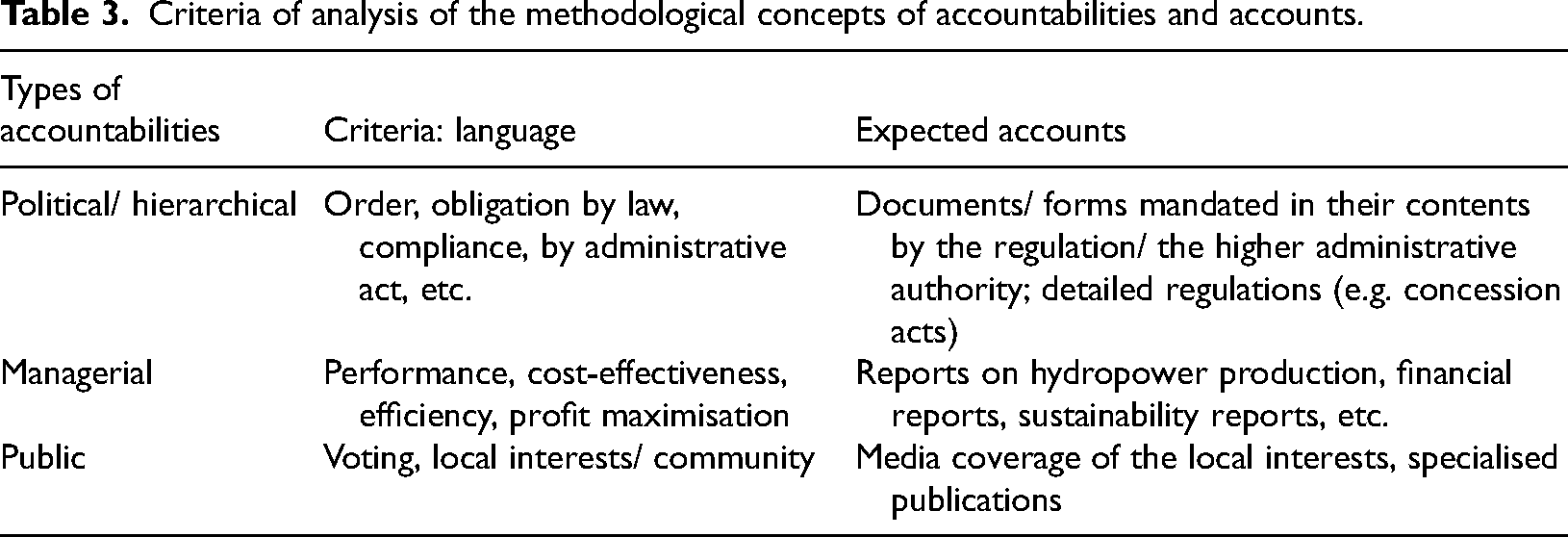
When analysing environmental concerns, a specifically adopted categorisation is Sinclair's (1995) forms of accountability (see Scobie, 2015; Scobie et al., 2016). Sinclair (1995: 231) recognises that accountability relationships are ‘always being re-structured’. This aligns with the premises of this study that accountabilities are the result of a complex social process, which is formally reflected in the arena setting through the legislation body in a certain historical moment. In terms of the water management arena, we identify Sinclair's (1995) political, public and managerial accountability as relevant in the water management arena.
Political accountability reflects the classic hierarchical chain of accountability, where representatives of public sector organisations are directly accountable to their immediate superiors and, in the end, to the government and parliament (Barton, 2006; Bovens, 2010; Wood, 2015). Public accountability is informal, and it involves direct accountability to the public, community groups and individuals. Managerial accountability implies being answerable for producing outputs or for the usage of resources (inputs) to achieve certain ends (Jenkins et al., 1988), and thus, it values cost-effectiveness, efficiency and managerial autonomy (Lonsdale et al., 2011; Parker and Guthrie, 1993). This accountability is also termed ‘accountability for performance’ (Aucoin and Heintzman, 2000; Demirag et al., 2004; Mayne, 2007; Parker and Gould, 1999).
Method
We employed textual analysis of historical documents and transcribed visual media (Liguori et al., 2018; Merino and Mayper, 1993; Parker, 1997, 1999) applied to field-based research (Previts et al., 1990). This textual analysis is complemented with interview methods (Dai et al., 2019; Qu and Dumay, 2011) to depict the evolution of the water management arena, and its infrastructural elements as detailed below. All materials were transcribed (if not already presented in written format) and analysed in their original language (in Italian, by the authors). Outputs (e.g. results) have been translated into English by the authors to facilitate the presentation of the findings.
The textual analysis of historical documents focuses on the laws and regulations related to the water management arena in Italy, the Trentino area, and the Santa Giustina dam from 1950 to the advent of New Public Management (NPM) reforms in 2007. Appendix 1 illustrates the extensive sources utilised (37 laws at the European, national and local levels and other administrative acts, such as concessions, circulars, regulations and law drafts were considered). Three distinct phases are defined based on changes in these laws and regulations within the timeframe considered: 1950–1962, 1963–1991 and 1992–2007 (see Figure 1 for further reference). The stakeholders are then defined as they emerge from these archival data.
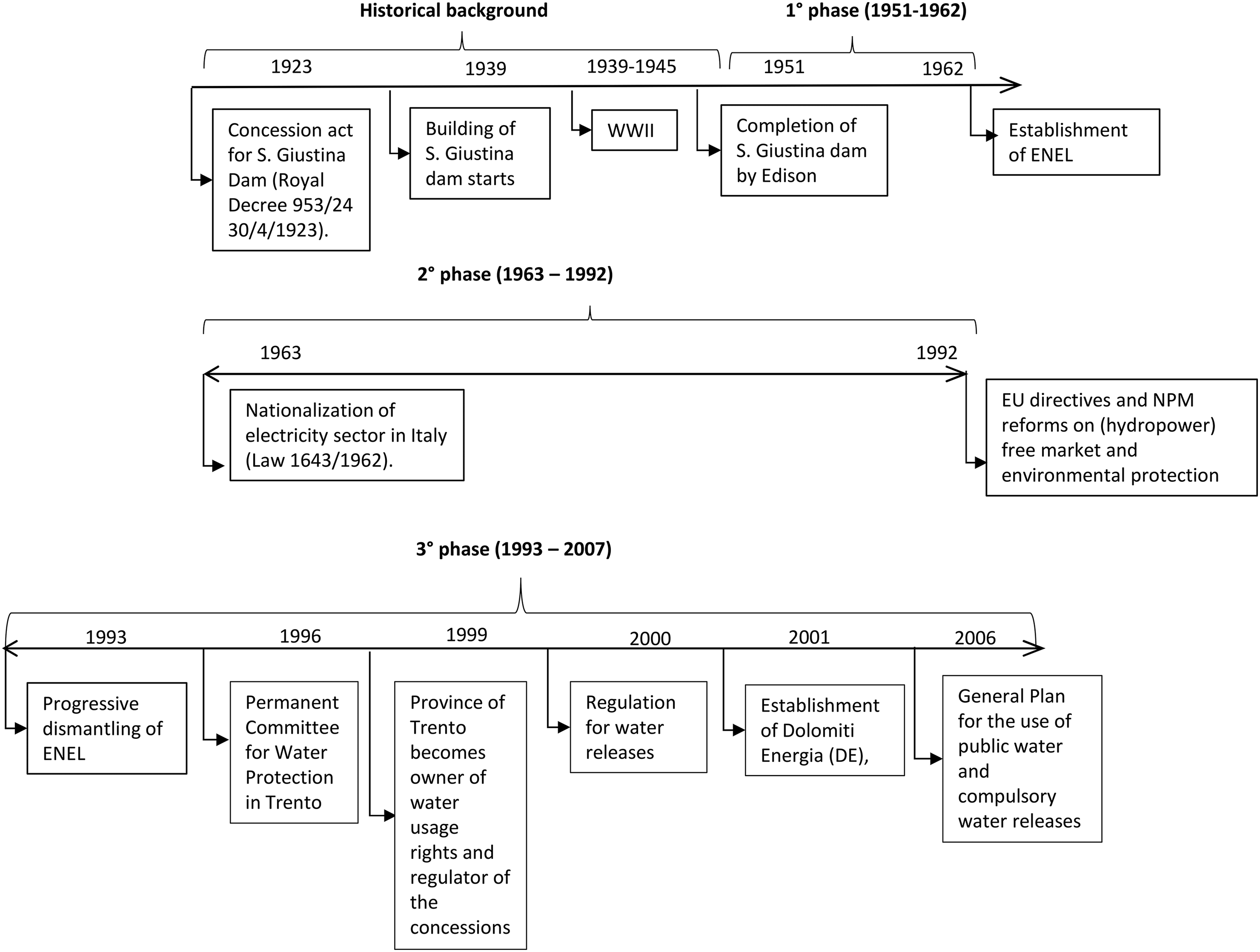
Timeline of analysis.
In addition to these laws and regulations, 24 vintage national newspaper articles, 122 articles from local newspapers, and 244 articles from a specialist review on fisherman's issues (Il Pescatore Trentino) have been analysed as well as press releases, reports to the parliament, sustainability reports and publicly available statutes of the stakeholders identified by the laws, in particular ENEL 2 (a concessionaire) throughout the timespan of analysis. Most of this latter archival documentation represents written media coverage at the time. Visual media include three historical videos of the Santa Giustina dam construction during the building of the dam in the 1950s and still available on YouTube (Risi and Tortorella, 1950, 1950–1955, 1955), which were also transcribed and analysed, to clarify the narrative of the stakeholders involved at the time. Six transcribed interviews of former inhabitants of the Val di Non, kindly made available by the Historical Museum of Trentino (Fondazione Museo Storico del Trentino, 2008, available from the authors on request), also allowed us to define the moods and the sentiments of the inhabitants as stakeholders of the studied arena. Extracts from these transcribed interviews are referred to as ‘inhabitant 1, 2, 3, …, 6’.
Further, six 30–40 minutes interviews took place in the Province of Trento in 2014, involving stakeholders who played a significant role not only in the management of the Santa Giustina dam (see Table 1), but also in the engagement of the different levels of government regarding the water resource. The relatively small number of interviews is justified by the need to target surviving interviewees who remembered the construction and evolution of the Santa Giustina dam.
Interviewees and interviews.
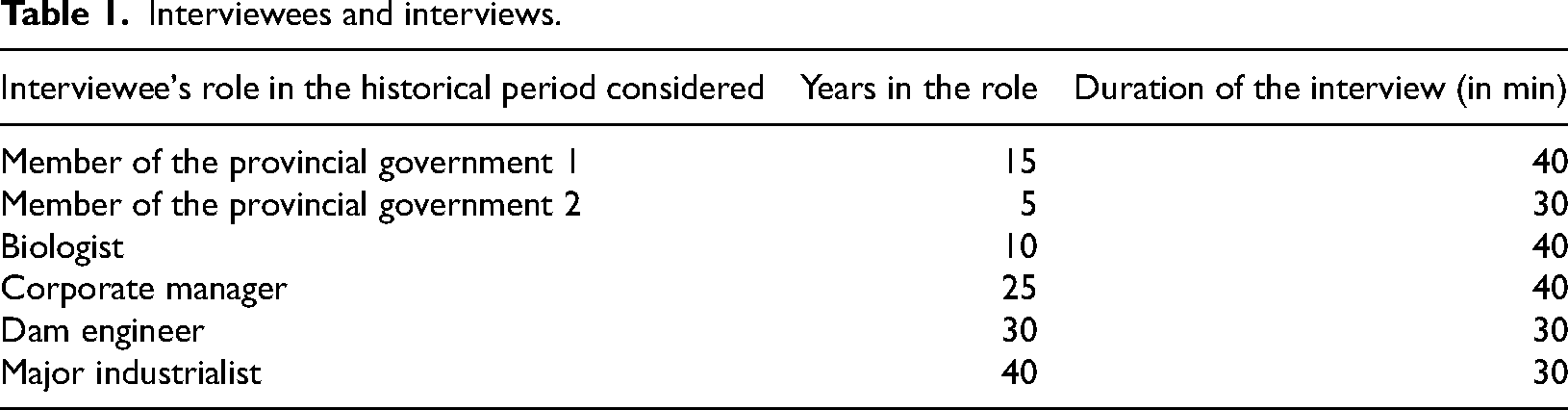
Examples of research designs based on a small number of interviews (Baker, 2012) are Mumford (1991), Carnegie (2004), and Walker (2005) on the oral history of either the UK accounting profession or isolated pastoral communities in colonial Australia. The oral recollection of events of these few surviving interviewees (following the points illustrated in Appendix 2) was useful to understand the sentiment of the local population about the damming of the river Noce, and the perception of accountability towards environmental concerns. To maintain anonymity, in the following sections, the six interviewees will be referred in relation to their former roles in the water management arena during the historical period considered (see Table 1 as reference).
Specific criteria of analysis
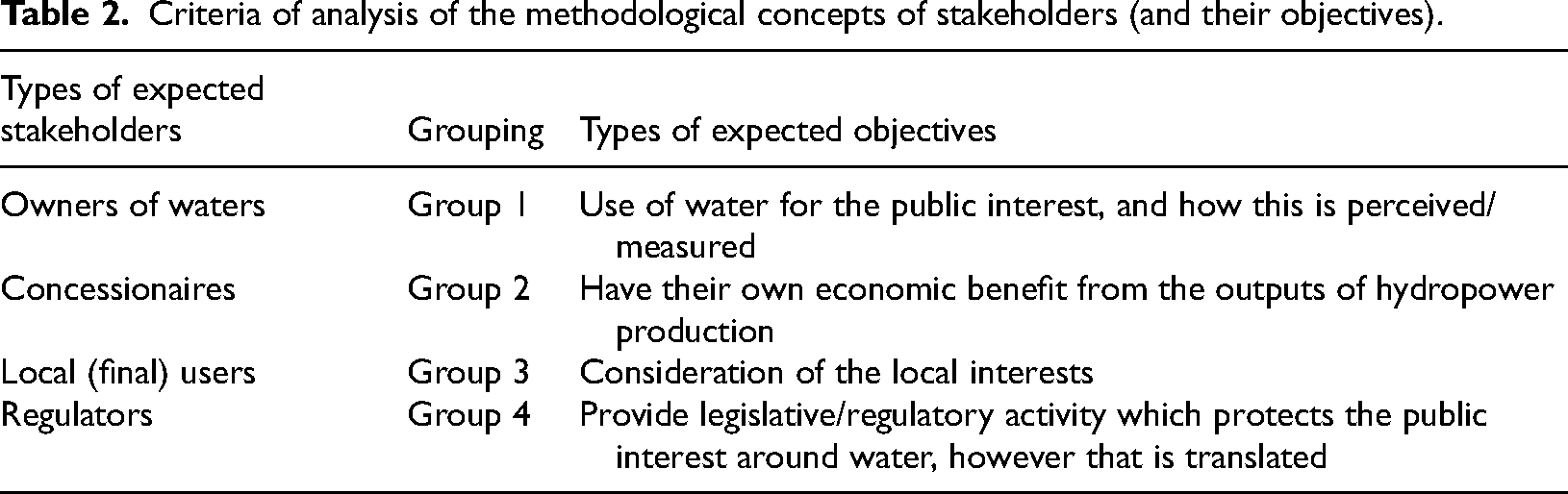
The analysis of the data starts from the identification of stakeholders and their objectives through the body of legislation collected on the water management arena. Media coverage and interviews were used to corroborate or disconfirm the objectives formally recognised by the archival documentation, especially in the case of social mobilisation. As a result, stakeholders were grouped as owners (of waters), concessionaires, local (final) users and regulators (see Table 2).
Criteria of analysis of the methodological concepts of stakeholders (and their objectives).
Regarding accountability and accounts, we applied Sinclair's (1995) systematisation to the same body of legislation to recognise types of accountability (political/hierarchical, managerial and public) and, at the same time, we sought the prescribed ways to discharge them. In the case of public accountability, the analysis extended to media coverage and interviews. The analysis was conducted manually, following the criteria depicted in Table 3.
Criteria of analysis of the methodological concepts of accountabilities and accounts.
Detailed examples of how the analysis has been conducted on the legislation and on video-recorded media are illustrated in Tables 4 and 5. The stakeholders’ objectives, accountabilities and accounts are considered in the periods analysed. Consequently, the visibility or invisibility of environmental concerns and their specific construction as ‘calculable spaces’ depend on the resulting arena.
Example of analysis of law 1643, 12 June 1962 ‘Settlement of the National Authority for Electricity (ENEL) and nationalisation of electricity sector’ for stakeholder goals and accountabilities.
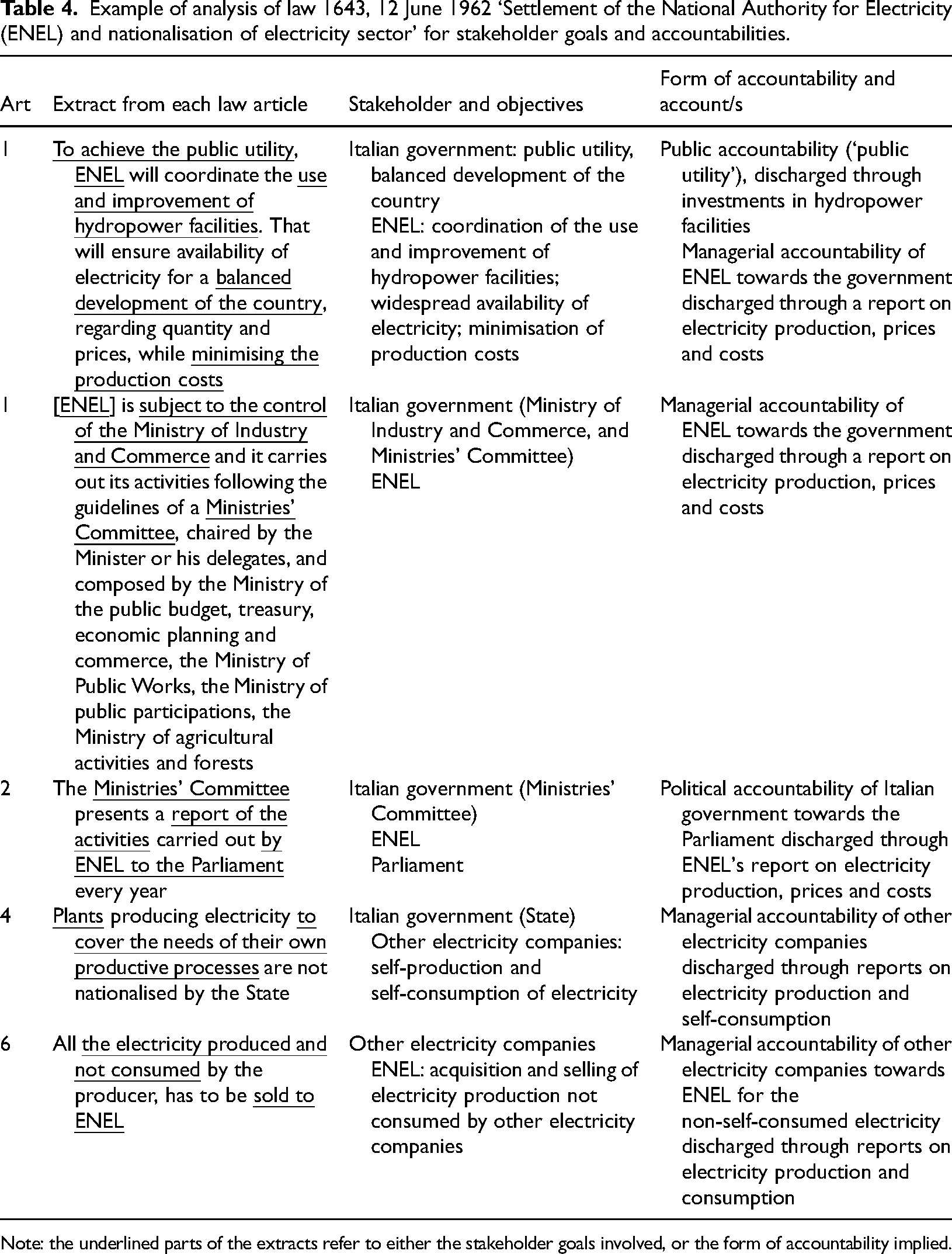
Note: the underlined parts of the extracts refer to either the stakeholder goals involved, or the form of accountability implied.
Example of analysis of an extract of Risi and Tortorella's (1955) visual media on the construction of Santa Giustina dam.
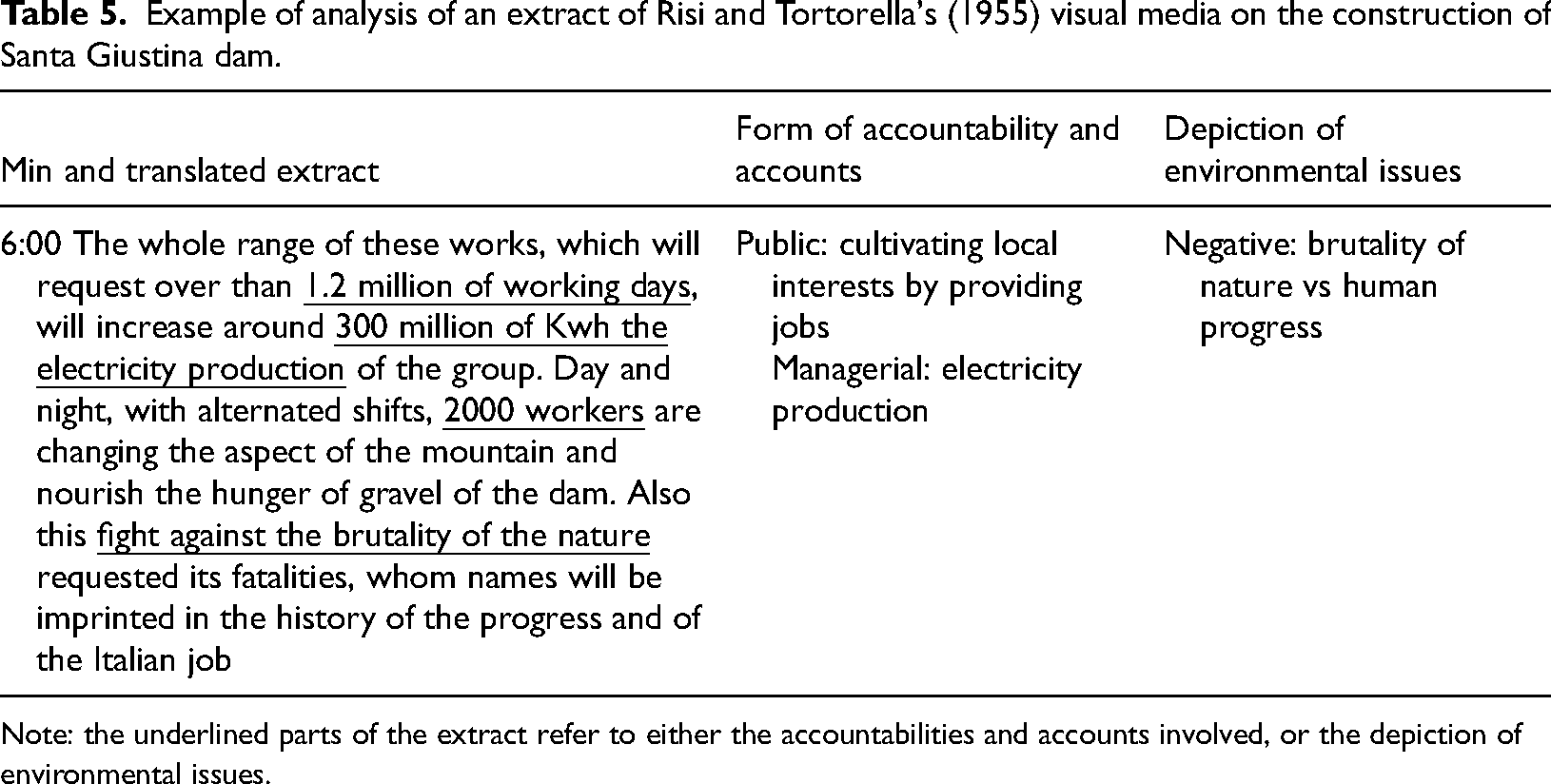
Note: the underlined parts of the extract refer to either the accountabilities and accounts involved, or the depiction of environmental issues.
Periodisation
For clarity purposes, our findings will be structured along three periods. The first one begins with the completion of the dam in 1951 (although the relevant concession act is dated 1923) and runs until 1962. The second phase runs from 1963 to 1992 as 1963 marks the nationalisation of the electricity sector in Italy. The third phase starts in 1993, with the introduction of EU Directives requiring NPM-like reforms in the water management arena. A key event in this period occurs in 2007 when a formal agreement between the Province of Trento, Edison and ENEL (former water concessionaires) introduced a new powerful stakeholder in the water management arena, the Dolomiti Energia (DE) Group. 3 The DE Group is a private for-profit entity, but mostly owned by, and wholly controlled by the Province of Trento. The overall breakdown within the three phases is determined by the formal sanctioning (through laws or administrative acts) of important events in the water management arena. These are presented, as a timeline overlaid on the three periods, in the findings section, as they emerge from the analysis and are not predetermined.
Findings: stakeholder groups and the evolution of the water management arena
The archival analysis led to the identification of a set of stakeholders, which changed over time. Based on fundamental objectives (see the methodology section, Table 2), we identify four groupings: the first group includes the owners of water-usage rights (i.e. the national government and its agencies), and they are therefore in charge of water management. The ownership is defined by the law as follows: ‘All springs, rivers, lakes, and water artificially extracted from underground … are public’ (Law 1775/1933, art. 1). The local government (i.e. the Province of Trento) only became an owner of water-usage rights in the third phase of this study, and in the first and second phases, it shared the goals of local actors. Further connections between the Province of Trento and other groups of stakeholders (such as concessionaires) will be examined below.
The second group of stakeholders includes water rights users (i.e. the concessionaires). Concessionaires are allowed by the owners of water-usage rights to use the water (public good) for commercial purposes through a public concession act. They are mere executors of what is specified in the concession act, so ‘At the expiry date of the concession act, the State takes possession of the hydraulic facilities …’ (Law 1775/1933, art. 25). In the first phase (1951–1962), this was Edison, a private company established in 1884 as a power utility; in the second phase (1963–1991), it was ENEL (Ente Nazionale Energia Elettrica or National Board for Electricity, at the time also the Italian public agency for electricity, a public body directly controlled by the national government) and Edison; in the last phase (1993–2007), it was the DE Group, an enterprise that was majority owned and controlled by the Province of Trento.
The third group of stakeholders include local actors such as local communities, inhabitants, farmers, fishers and environmentalists, who are the final users of electricity and water. They are the ones most affected by the management decisions on dam construction and exploitation. This group of stakeholders includes the local government (Province of Trento) in the first and second phases (1951–1962 and 1963–1991).
A fourth group of stakeholders, which partially overlaps with the first group, includes legislators and regulators, such as the Italian levels of governments (according to their legislative powers) and the EU. Some of these legislators and regulators are also owners of water-usage rights, but here we consider their regulatory or legislative functions. This group of stakeholders has a direct effect on all the other stakeholder groups through their regulatory powers.
By offering an analysis of the above-mentioned arena within the three phases, we expect to uncover the level and form of visibility given to environmental concerns and their ‘territorialisation’. As a summary and grounding of this section, Figure 1 above provides a timeline of many of the events discussed herein.
Phase one (1951–1962)
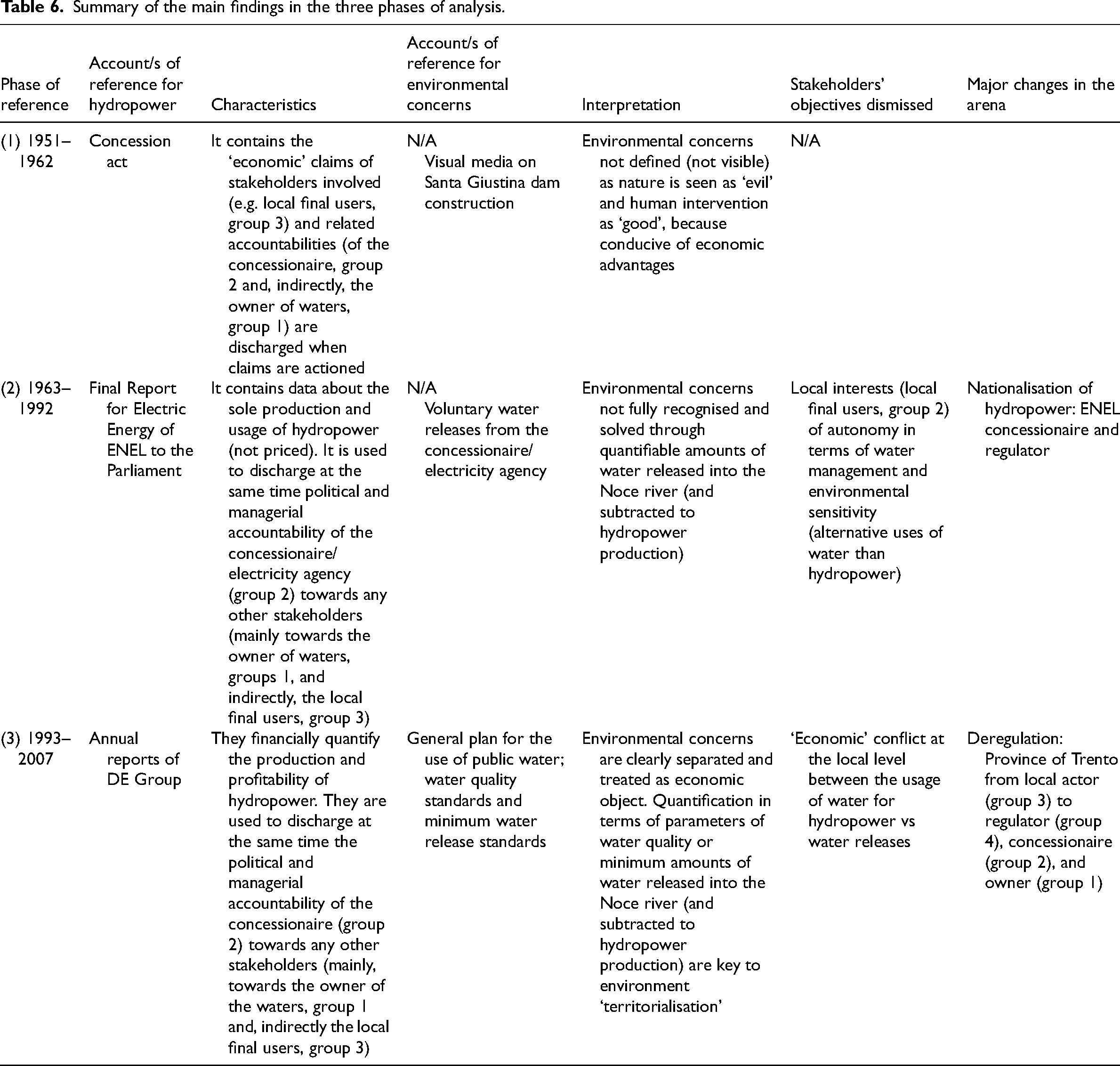
Between 1951 and 1962, the national government owned the water-usage rights (group 1) and was also the main regulator of the electricity sector (group 4). This meant the national government could define concession acts (administrative types of acts) with one or more users (concessionaires) at its discretion. It maintained strong control (political accountability) over the selected concessionaires, which were (hierarchically) accountable for the detailed provisions of the concession act. The concession acts can be considered means that depict both political accountability and managerial accountability of the concessionaire towards the government. Although they can be considered as ‘accounts’, they did not contain any clear outputs or targets about economic, physical (i.e. GWhs) and social and environmental instances affecting the different parties involved. The only outputs pushed towards the concessionaires were the provisions (limitations and constraints) imposed by the act itself (concession act). Through the concession act, the position of any concessionaire was like that of public administration, controlled and monitored by the government. By complying with the concession act, the concessionaire discharged its political accountability. At the same time, managerial accountability of the concessionaire towards the government is identified when ‘in failure’ to respect the limitations imposed by the concession act (see also Table 6). The national government's goal in this phase was to provide energy for the development of the country. We identify this goal as ‘public utility’. Consequently, the government through the concessionaire, depicts a public accountability based on ‘energy provision’ and ‘country development’.
Summary of the main findings in the three phases of analysis.
In the first phase, the concessionaire (group 2) of the Santa Giustina dam was Edison. Given its private for-profit nature, Edison's primary goal was creating value for its shareholders. During the 1920s and 1930s, the national government was very supportive of hydropower: Fortis et al. (2003) and Bernabé (2015: 23) state that ‘… there was a great accord … With an eye on autocracy, [the national government] was very generous in promoting laws in favour of the main electricity groups in Italy’. Edison's growth, and the governmental support it received, are related to Italy's energy development. Edison began to build the Santa Giustina dam in 1939. Edison suspended the construction during WWII, resuming in 1946 and completing the dam in 1951. As the concessionaire of the dam, Edison dealt closely with the local community. The way in which Edison dealt with the local community represents, in this study, the means through which Edison discharges its public accountability.
Following the concession act, any water-use concession for hydropower production had a wide influence on the environment and wealth of the local communities. The requests of the sub-national levels of government affected by the dam construction (e.g. Province of Trento, municipalities, local actors) were generally acknowledged by the national government within the ‘procedural guidelines’ section of the concession act but not necessarily followed through. The national government decided which requests the concessionaires should satisfy or not. The following extract of the concession act (Royal Decree) clarifies that the goal of ‘public utility’ was related to public accountability for the widespread availability of electricity and represented the link between the national government and Edison, which persisted in the 1950s and 1960s: … following the Royal Decree 28 March 1920, no. 401, art. 2, this concession act must be considered as a declaration of public utility [emphasis added], therefore it allows the public authorities to proceed with all dispossessions of grounds and fields, which are going to be permanently affected by the dam and related facilities. (Royal Decree 953/24, 30 April 1923: 4)
This sentiment of the inhabitants is confirmed in other historical sources. In the first concession act for the building of the Santa Giustina dam, the municipality of Cagnò, a small village affected by the dam, asked and obtained that ‘The owner of the expropriated soils and their relatives have to be involved in the works for the execution of the construction and in the services needed for its use at the end of the construction’ (Royal Decree 953/24, 30 April 1923). In the first phase, these are the only forms of visible accounts: accounting aspects refer to the method of quantification and compensation of the recognised direct economic damages (negative externalities) of the damming activity for the parties affected. Vintage newspapers such as Il Proletario (25 January 1947 to 9 September 1950) outlined that there were issues related to the work conditions: salaries, safety and stability of the workplace. However, the poverty of the inhabitants allowed the concessionaires to pursue their interests anyway, since the workers would not have protested or gone on strike to improve their working conditions.
The analysis of visual media (Risi and Tortorella, 1955) enhances the pivotal role of the concessionaire and reveals that environmental concerns existed at that time but they were addressed in a subtle and flexible way. In the following extract, the damage to the landscape is idealised as a better ‘dreaming’ reality referred to as ‘underwater flora’ or ‘Norwegian fjord’: The dam, blockading the Noce River, will create a 180 million cubic meters artificial reservoir. In a short time all vegetation will transform in underwater flora [emphasis added]. A road will be completely submerged too, such as a mill and some farmsteads. The reservoir will have a surface around 3.5 square km and it will extend at the base of the village of Cles, county town of the Val di Non, with a length of about 8 km and a breadth of around 1 km. The artificial lake, insinuating in narrow secondary valleys, will radically change the landscape, to adopt the features of a Norwegian fjord [emphasis added]. (Risi and Tortorella, 1955, min 6:40)
In this phase, the concessionaire (Edison) was very careful to demonstrate its effort to create employment and wealth throughout the valley (positive economic externalities), above and beyond the concession act prescriptions, because it was at the core of the political and managerial accountability towards the government. It was also at the core of its public accountability (see Figure 2). The videos shot by Edison at the time of the dam construction also counterpose the natural environment to the social betterment (i.e. employment) in the valley: The whole range of these works, which will require more than 1.2 million working days [emphasis added], will increase electricity production for the group by around 300 million Kwh. Day and night, with alternated shifts, 2000 workers [emphasis added] are changing the aspect of the mountain and nourish the hunger of the dam for gravel. Also, this fight against the brutality of the nature [emphasis added] requested its fatalities, whom names will be imprinted in the history of the progress and of the Italian job. (Risi and Tortorella, 1955, min 6:00)
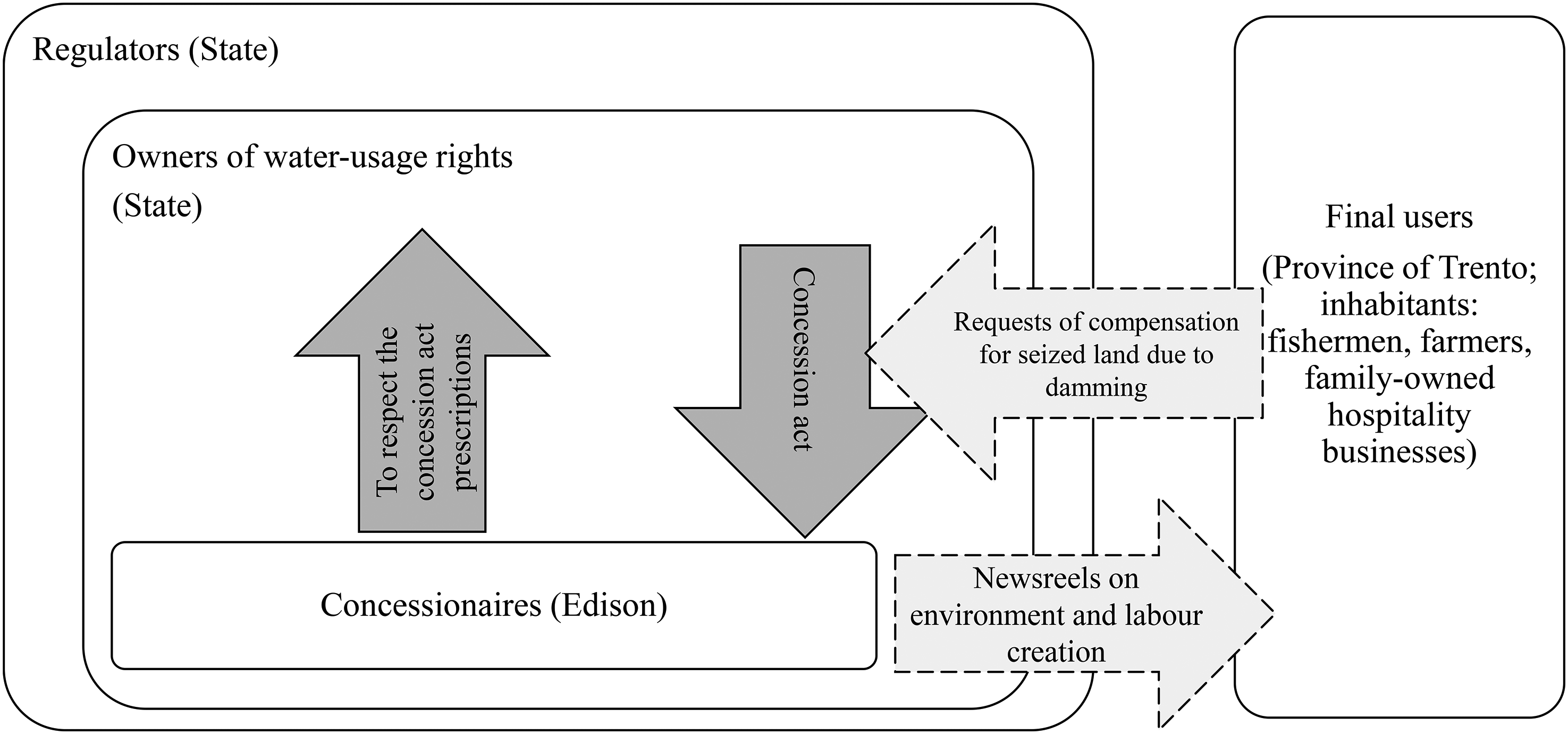
Stakeholders, accountabilities, accounts and environmental concerns in the first phase. Note: bold arrows: accountability relationships (and discharge of accountability) related to hydropower; dotted arrows: accountability relationships (and discharge of accountability) related to environmental concerns; squares: stakeholder groups (with detailed composition).
In phase one, the politicians of the Province of Trento (group 3) wanted to exploit hydropower to support a political claim for the increase of the autonomy of the Province from the national government (Baldo, 2015: 97, 123). Odorizzi, president of the Province at that time, commented in 1957 through Il Popolo Trentino, a local newspaper: Only with the property of the facilities and eventually the ownership of water, we can effectively defend the interests of our territory. We cannot depend on foreign investments, otherwise we will be subjugated forever to a capitalistic exploitation, more focused on the interests of speculation than the interests of the population. (Baldo, 2015: 97)
The water management arena in phase one is dominated by political relationships, which draw a relatively simple and centralised arena, where the national government is the main ‘ruler’ and ‘interpreter’ of national priorities. The consideration of local specificities and the hunger for employment in post-war Italy are addressed through the concession act, which works as a legal constraint for the concessionaire (‘management by decree’, see Panozzo, 2000). The concessionaire (Edison) is keen to mobilise an early version of social media (video disclosure) to demonstrate its alignment towards the national government and also to use its discretion in making visible the existing environmental concerns (see also Table 6). This great discretion slips across the cracks of the multiple accountabilities in the concession act. It includes drawing boundaries around the narrative and the perception of environmental concerns.
Phase two (1963–1992)
In phase two (1963–1992), the electricity sector in Italy was nationalised, and ENEL was established as the public agency for electricity (group 4). In this phase, ENEL monopolised the production, transportation and distribution of electricity as the state-owned power utility (group 2). Although it was formally a concessionaire (temporary user of water rights, group 2), ENEL became an arm of the national government, under the control of the Ministry of Industry (group 4). ENEL was politically accountable to the national government (political accountability). The legal requirement for ENEL was to deliver an annual disclosure (report) to the Parliament through the Ministries’ Committee related to the situation of the electricity sector in Italy (Law 1643/1962). This meant that ENEL also became managerially accountable to the Parliament through the report, which is considered an ‘account’ (see Table 6). Table 7, extracted from the 187-page ‘Final Report for Electric Energy of ENEL to the Parliament– year 1972’, details the status of the electric sector (measured in KWh) produced by ENEL for the Parliament. Detailed financial data were not disclosed, so the managerial accountability was accounts of production and consumption (in Kwh or Kcal). Further evidence of this goal is that ENEL did not make any profit until 1984: ‘Miracle at ENEL: after 20 years, the annual report finally shows a break-even point’ (Leuzzi, 1984).
Example of ENEL's managerial accountability for electricity production.
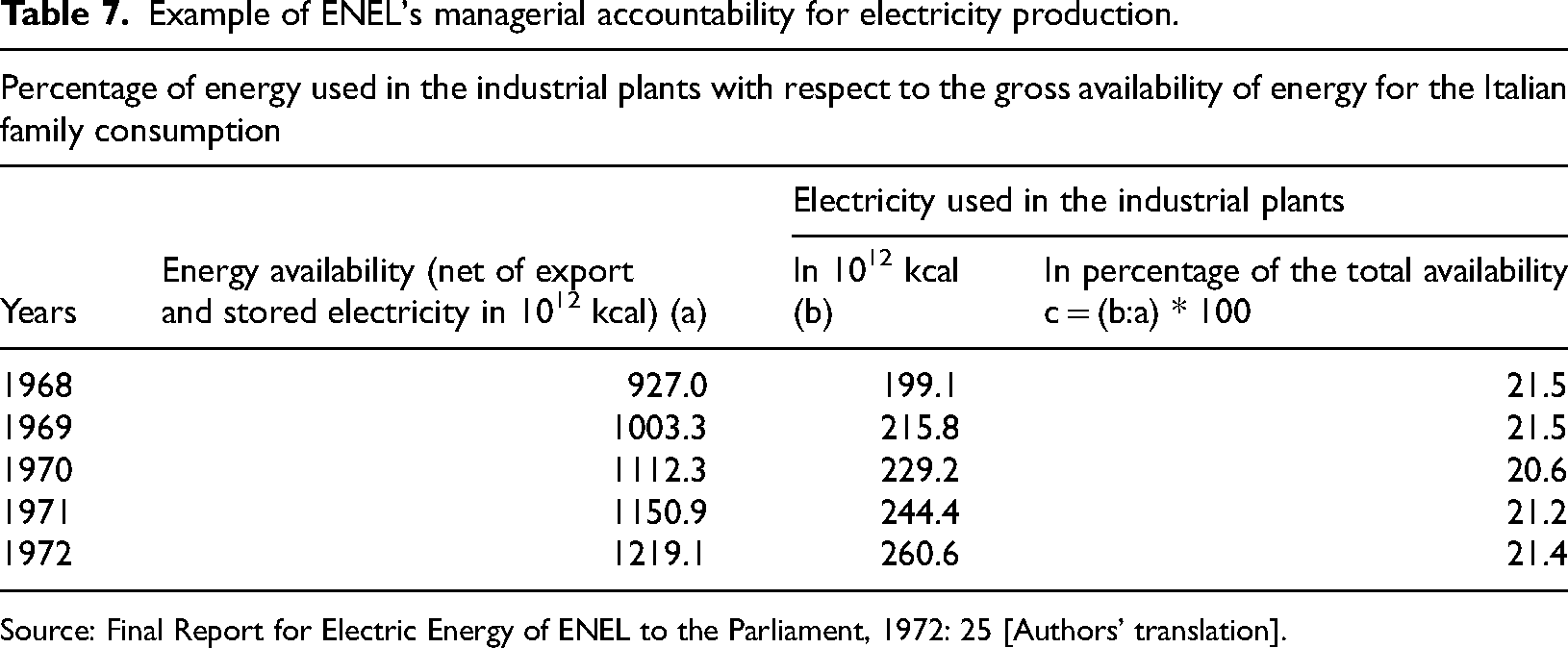
Source: Final Report for Electric Energy of ENEL to the Parliament, 1972: 25 [Authors’ translation].
In this phase, the main goal of the national government, as owner of the water-usage rights (group 1) was to increase the effectiveness of the electricity sector in Italy. Hydropower was of course a part of this water management arena, even if with a lower priority than in the past. The nationalisation of the electricity sector moved the public accountability further away from the government, onto a new player: ENEL. The creation of ENEL shifted political, managerial and public accountabilities from the former multiple concession acts to one real stakeholder, which subsumed multiple accountabilities, by playing multiple roles at the same time (see Figure 3).
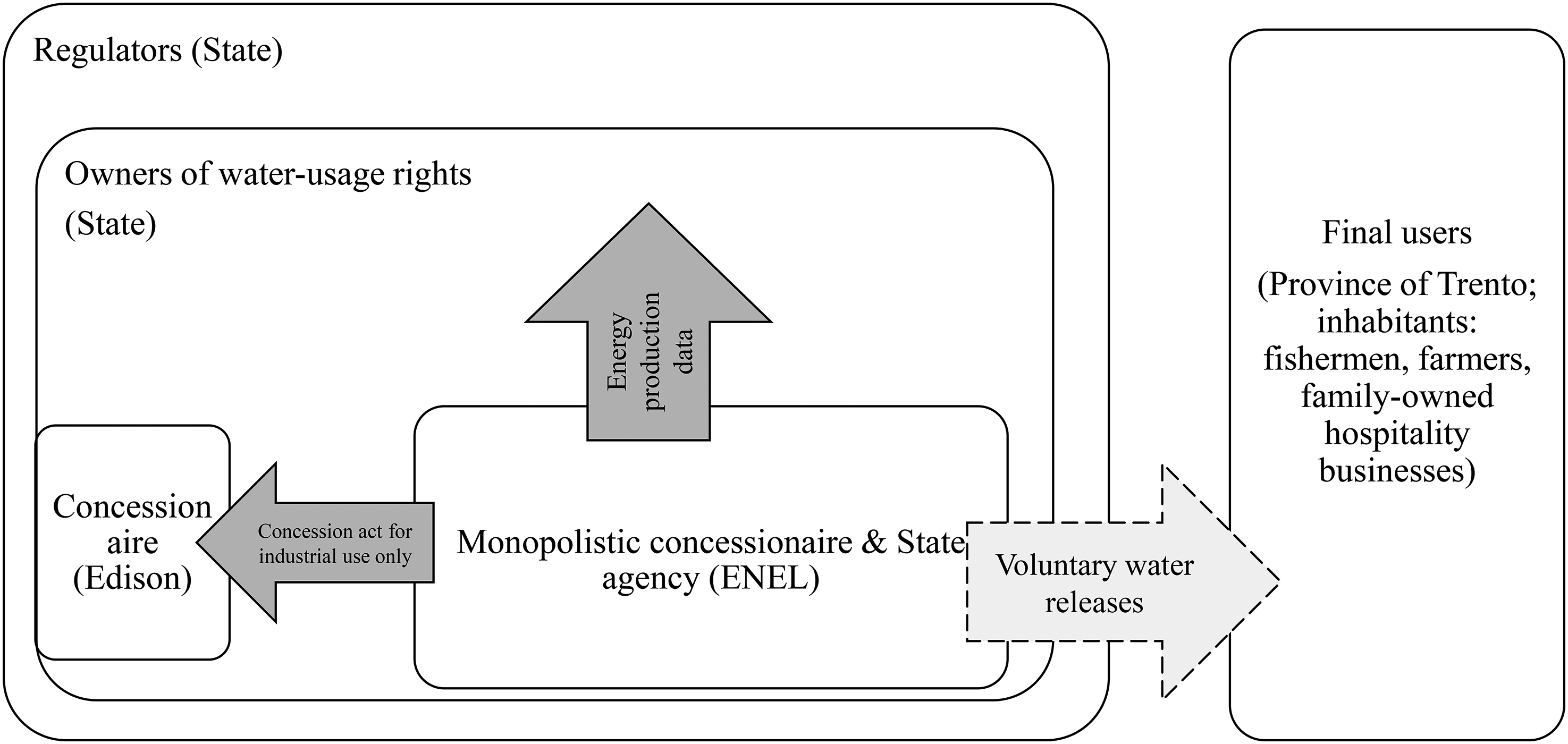
Stakeholders, accountabilities, accounts and environmental concerns in the second phase. Note: bold arrows: accountability relationships (and discharge of accountability) related to hydropower; dotted arrows: accountability relationships (and discharge of accountability) related to environmental concerns; squares: stakeholder groups (with detailed composition).
Since ENEL was directly controlled by the national government, its decision-making role (as both a public agency and concessionaire at the same time) was very similar to that of the owners of the water-usage rights (group 1). Edison continued to produce electricity from the Santa Giustina dam for its own industrial purposes, since electricity for self-consumption was excluded from nationalisation. Edison was politically accountable to ENEL as the arm of the national government, completely detached from the local actors.
From 1963, local actors (group 3) became increasingly concerned about environmental issues, including alternative water uses such as fishing, irrigation and tourism: ‘A gorgeous valley to save [against the exploitation by ENEL through the damming]’ (Ghigi, 1963, La Stampa, 27 July); ‘Against hydropower exploitation [of the rivers in the Trentino area]’ (Cederna, 1968, Il Corriere della Sera, 2 January); ‘During the 1970s and 1980s, an awareness of the damage and the loss of environmental quality arose’ (Biologist).
Energy concessionaires like ENEL tried to manage this local opposition through voluntary initiatives, such as water releases. Thus, existing environmental concerns start to be voiced, but it is again up to the main concessionaire to address this type of public accountability. Differently from the past, ENEL does not use moral suasion through video reconstruction of a narrative of betterment. Instead, ENEL tries to narrow down the visibility of environmental concerns to an ‘account’ which is more manageable. The water releases’ structure as an ‘account’, provides not so much a space for specifically addressing environmental concerns, but a space that makes some environmental features more manageable (see also Table 6). Although water releases were perceived negatively, they represented a shift of attention or a new visible territorialisation of environmental concerns: There were also decisions taken by the concessionaires, with some voluntary water releases, but with no consideration of the environment, just releasing random quantities of water into rivers. There was also some litigation with the local government related to the economic compensation for having less water for electricity production. (Biologist)
The second phase of this analysis shows that the expertise of ENEL in the sector legitimised its transformation into a ‘government agency’ and the related delegation of regulation powers from the national government. This ‘agentification’ of the water management arena drives the emergence of a clearer performance-based managerial accountability, from ENEL to the Parliament, in the form of productivity reports, with scarce interest for a value quantification (e.g. through prices or water fees) until 1984. This phase two arena allows for some local social mobilisation (fisher movements) around environmental concerns, which do lead to their reductionist translation into voluntary ‘water releases’ by the main concessionaire (ENEL).
Phase three (1993–2007)
During phase three (1993–2007), the national government as owner of water-usage rights (group 1) changed its goals and priorities due to NPM pressures. The latter were the result of EU (group 4) regulatory activity (see Appendix 1). The national government became concerned about the efficiency of public administration and the sustainability of public debt, which was becoming increasingly serious (Decree Law 333/1992). NPM reforms in Italy were meant to enhance the progressive devolution of functions and responsibilities from the national level to local governments (for instance, Law 59/1997; Legislative Decree 212/1998). In that, they supported the full acknowledgement of the statutory autonomy of the Province of Trento (for instance, Legislative Decree 463/1999). Thus, the Province of Trento sought control of electricity production, transportation and distribution (achieved through the Law of the Province of Trento 4/1998, for the establishment of the Province Agency of Energy). For the local government, the basic idea was not only to bring back to our community the administrative issues [of water-usage rights], but to become an entrepreneur in the production and distribution of electricity. (Member of the Provincial government 1)
EU Directives (such as 96/92/EC on the free market for electricity, 2000/60/EC on an agreed water management policy for the environmental protection of the waters, 2001/77/EC on the promotion of electricity from renewable sources, 2002/91/CE for energy efficiency, see Appendix 1) shaped a new political accountability of the State members to the EU, meaning that the EU regulation became the point of reference in the specified fields, requiring the translation into actual national laws and regulations by the State members. These Directives favoured the creation of new electricity competitors/concessionaires (such as the DE Group) on the free market for electricity and allowed the Province of Trento to enhance its statutory autonomy on the theme of environmental protection of its waters (Legislative Decree 463/1999). The national government acquired the role of overseeing the correct functioning of the newly free electricity market in terms of quality of the service, it established quality standards and benchmarked electricity prices for the concessionaires, sanctioning those concessionaires who were not able to achieve them. These prescriptions substituted the former political accountability between the national government and concessionaires with a managerial accountability based on prices and quality standards. Analogously, it narrowed down environmental concerns within the realm of a new ‘account’: ‘water quality standard’.
The exact workings of including/excluding more factors (and parameters) of ‘water quality’ than what is established at the national level remain in the hands of the local government, which interprets and implements the supra-national and national guidelines to the local arena (see Law of the Province of Trento 11/1995 on the establishment of the Province Agency for the Water Protection, a technical entity). Key components of structuring the standards of water quality are made visible through formal reporting, and these components are now managed at the local level (i.e. the Province of Trento). What becomes apparent is that parameters of water quality – especially those working at the heart of the water quality standard – occupy a new peculiar epistemological position of ‘territorialisation’ (Cohen and Bakker, 2014; Miller and Power, 2013). This ‘territorialisation’ is determined by the progressive tracing of boundaries around the visibility of environmental concerns about water.
The voices of local actors became more relevant in this phase. In 1996, fishers’ and other environmental movements established the ‘Permanent Committee for Water Protection’ to determine a common strategy to achieve higher environmental protection of the rivers. With the support of the Province of Trento, these local actors pressured the concessionaires ENEL and Edison to address more deeply environmental concerns (see Figure 4): Our territory was actually enslaved to energy production and with no particular attention to its protection and to the landscape … Often the local communities considered hydropower facilities as a foreign body, because they didn’t have any benefits apart from some free electricity for public usages. When I introduced minimum water releases standards, somebody was shocked, because almost everybody considered a river without water as a normal situation. (Member of the Provincial government 1)
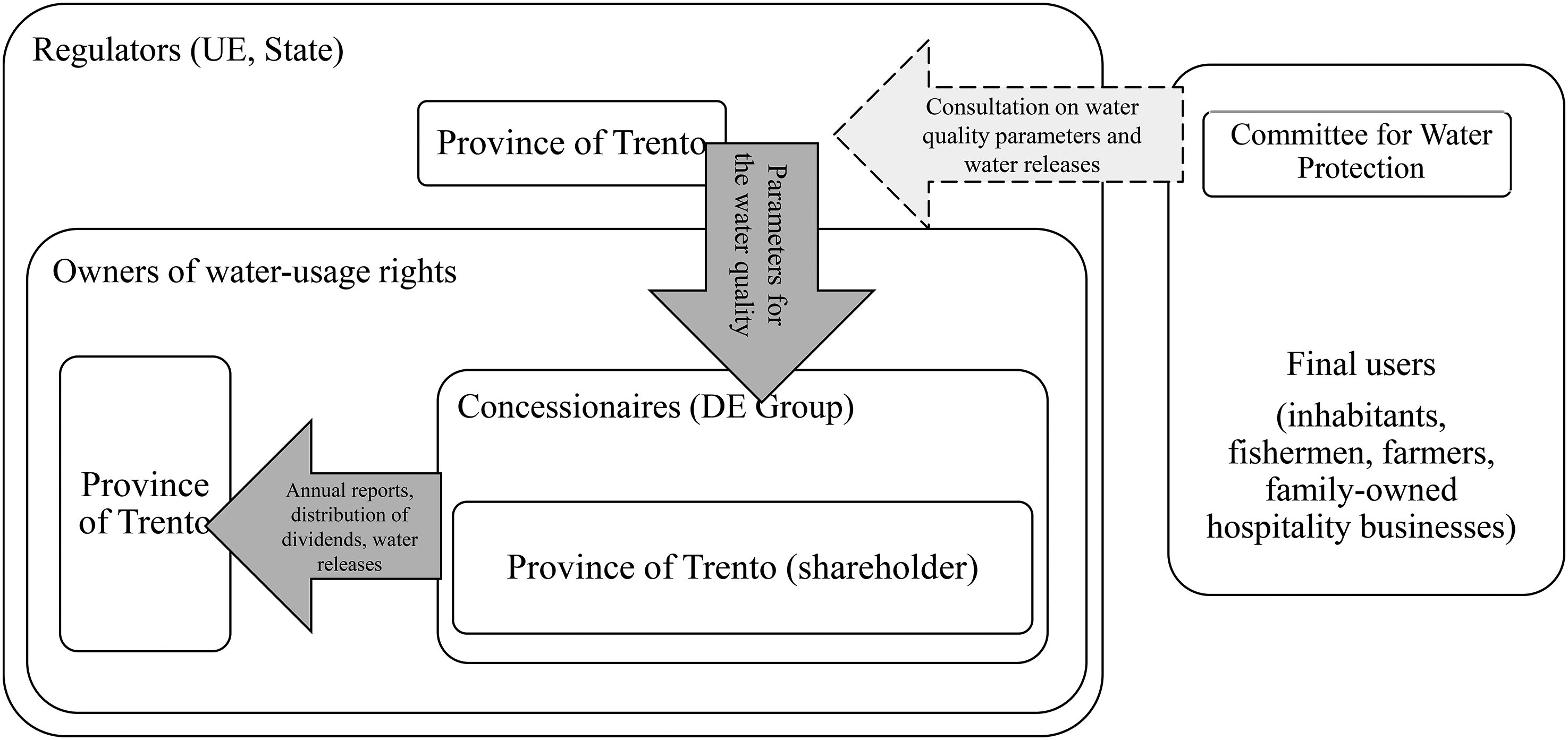
Stakeholders, accountabilities, accounts and environmental concerns in the third phase. Note: bold arrows: accountability relationships (and discharge of accountability) related to hydropower; dotted arrows: accountability relationships (and discharge of accountability) related to environmental concerns; squares: stakeholder groups (with detailed composition).
While trying to adopt the same language as NPM reforms, local actors contributed to narrowing down the visibility of environmental concerns to manageable and standardisable items, which are easier to measure and supervise, such as ‘minimum water release standards’, another ‘account’ of public accountability between the concessionaire and the local users. Among the most important local actors were the local recreational fishers. The extreme exploitation of rivers between the 1950s and the end of the 1990s seriously damaged the fish fauna of the rivers, so fishers developed an awareness of the environmental issues earlier than other actors, and became the most effective defenders of the environment: People involved in fishers’ movements were more influential among the environmentalists because they were experts on the rivers and they knew the actual environmental situation: pollution, dying ecosystems and similar issues … (Member of the Provincial government 2) Environmentalists had a relevant role in changing the rules. I refer to environmentalists as a wider movement, also involving organised environmental groups, such as rafters and fishers, the latter with a very important role. These organised groups were often allied under the common awareness of the increasing relevance of water issues, the degradation of the waters and the possibility to reduce the degradation by reconsidering the electricity production. (Biologist)
The Province of Trento got the ownership of water-usage rights in 1999. With this new role, the Province of Trento had the possibility to define new constraints for the concessionaires, regarding environmental issues, aligned with both EU Directives and the sentiment of the local environmental movements. In this third phase, the alliance with the environmental movements is evidenced through a resolution (administrative act) of the local government (2893/2000) for the establishment of the working group in charge of the definition of water releases. This group was composed of the directors of several departments of the Province of Trento and the president of the former ‘Permanent Committee for Water Protection’: … considering the relevance of a dynamic and open dialogue in this [environmental] matter, we propose the presence of Dr L. B. [Biologist involved in the fishers’ movement] in the working group [of the Province of Trento], as suggested by the Permanent Committee for Water Protection. (Resolution of the Province of Trento, n. 2893 17 November 2000)
The Province of Trento emerged as an environmental champion (group 4) thanks to the ‘General plan for the use of public water’ (Decree 15 February 2006, Annex, art. 4). This regulatory ‘account’ changed the approach to hydropower, with the final establishment of new constraints and measures of environmental protection. The new regulations sought to balance water resources for different uses, such as minimum flows for rivers. While this new visibility of environmental concerns corroborated a more substantial form of public accountability, it confined their contents and interpretation within specified measures and standards.
Meanwhile, the national government dismantled ENEL as a governmental agency and main concessionaire. After Law 239/2004, the Province of Trento decided to take control of the entire business of electricity distribution and sales. The task to make this happen was given to DE group, a limited company controlled by the local government. During this third phase, starting in 2001, DE Group emerged as a new stakeholder.
In 2007, ENEL and Edison's water-usage concession acts expired, while the Province of Trento had acquired from the national government (in 1999) full ownership of water-usage rights (group 1). The Province of Trento allowed a 10-year extension of the water-usage concession acts in the Trentino area, subordinating them to a wider agreement with ENEL and Edison. This wider agreement implied that the DE Group, which was controlled by the Province of Trento and municipalities, could buy 51 per cent of the shares of the new companies established by the demerger of the concessionaires ENEL and Edison for €438 million. In the ENEL press release of 14 November 2007 (Enel, 2007), the ENEL CEO Fulvio Conti remarked that the operation was: an important collaborative initiative, which will help enhance the development of an invaluable source of renewable hydroelectric energy, which the Province of Trento has in an abundance. It is an essential resource, making a real contribution to the fight against climate change and the energy security of the country.
In Edison's ‘Report on operations’ (2007), it is outlined that: The purpose of the agreement is to strengthen the bonds between Edison and the local community, in an area where the group has a historical presence, by sharing ownership of the power plants with Dolomiti Energia, a company with strong local presence in the Trentino region. (p. 10)
The political accountability of the concessionaires was then detached from the national government and delegated to the local government. In this way, the Province of Trento became, at the same time, the owner of the water-usage rights (group 1) and the user of water rights (concessionaire, group 2) through the shareholding control of DE Group. Since DE Group was established as a limited company, its goal was to produce dividends: The goal of DE is to produce cheap energy and renewable energy. Today, the way to exploit the power plants is different from the past. Now, we are on the free energy market, when it [Santa Giustina Dam] was built it was private and it produced energy for a specific organisation [i.e. Edison]. Now we produce energy only when the market price of energy ensures a profit margin, whereas in the 50's, energy was produced because Edison needed it. (Corporate manager)
There seemed to be a commonality of goals (i.e. to produce dividends) between shareholders (including the Province of Trento and municipalities) and DE group (see also Table 6), as it emerged from the interviews: ‘… we have not just one public shareholder and one private, but several public and several private shareholders. Anyway, there is no difference. Both private and public shareholders have, as their first goal, to make money’ (Corporate manager). ‘… public managing is not a warranty for a better acknowledgment of public interests, because public shareholders have the same goals as the private ones’ (Member of the Provincial government 2). Since 2007, hydropower production has become a way to support the provincial budget, through the distribution of dividends (several municipalities, in group 3, are also shareholders of DE Group) and through water-usage fees: I think something went wrong. Our public administrators have an approach that is not able to consider the impact on the environment. We cannot increase the cash of our municipalities through hydropower. There is a conflict of interest between two public interests. (Member of the Provincial government 1)
Here, we can pinpoint an emerging conflict of interest for local actors: The Province of Trento and municipalities seek to use dividends from hydropower to support their public budgets (and provide services to local actors) but they have also to consider the demand of an increasing environmental attention by the local population. The emergence of different goals and the potential marginalisation of other local actors in the third phase seems to correspond to the enhanced visibility of environmental concerns, which, in turn, Foucault (1977: 170) described in terms of surveillance: ‘a state of permanent visibility, where discipline is enhanced by new diagrammatic mechanisms’. This denotes a type of power that economises its functioning by ‘making’ the individuals and, by extension, by ‘making’ environmental concerns through translation and representation in defined issues and measurable items. That is the specific technique of a power that regards water issues both as objects and as instruments of its exercise.
In the third phase, there was a significant change in the accountability relationships of stakeholder groups with a shift of political (hierarchical) accountabilities towards the local government and an emerging economic and performance discourse that would feed a larger penetration of managerial accountability between the concessionaire (DE Group) and the local levels of government (including the municipalities), after 2007. Managerial accountability assumes a more nuanced form as it does not only include a request of disclosure for production, consumption, prices and costs of hydropower, but especially a profit component (measured by the dividends distributed), which was not present in the former phases. For local politicians, balancing these two accountability forms in the public interest is currently difficult: Before every new concession, we introduced an evaluation of ‘public interest’. My successors did not consider the need for an evaluation, or rather they interpreted ‘public interest’ as a balance of a conflict of interests. But this is a different approach. A municipality cannot maximise its budget through the dividends from energy production because there are also different interests to consider. (Member of the Provincial government)
Thus, in this third phase, the water management arena is a proliferation of stakeholders and overlapping of accountabilities. Unfortunately, the new accountabilities are explicitly including business considerations in the arena of water management, a trend that would continue after 2007. As shown above, the ‘retirement’ of the national government as a major stakeholder in the arena, corresponds to the emergence of the local government as the stakeholder responsible to find a new balance between the new business pressures and environmental protection. But environmental protection at this stage has been fully ‘territorialised’.
Discussion
This research has focussed on the evolution of a water management arena in Italy to uncover the ‘territorialisation’ (Cohen and Bakker, 2014; Miller and Power, 2013) of environmental concerns: how environmental concerns visibility engendered (Foucault, 1977) and progressively became an economic and calculable matter. The arena concept (Renn, 1992) was used as a heuristic to represent and make sense of the dynamics of the historical evolution of water management, in this case study of the Santa Giustina dam. Three structural elements of the arena were considered: stakeholders (Ackermann and Eden, 2011), accountabilities (Sinclair, 1995) and the ‘accounts’ (Bisman, 2009) used to discharge them. Since the legislation plays a pivotal role in the arena (Panozzo, 2000), most of our archival analyses were conducted through the laws and regulations of the water management arena. Media and specialised reviews were also analysed to highlight any potential social mobilisation and informal relationships (see Abdullah et al., 2018; Deegan and Islam, 2014), which are not necessarily captured by the formality of the legislation. Our archival analysis (Parker, 1997, 1999) was complemented by visual media and interview analysis (Qu and Dumay, 2011).
As highlighted in the analysis, one of the problems with analysing the way environmental concerns are shaped and made visible through the analytics of the arena is that we may scratch only the surface of the black-boxed political interactions. While some components can be gathered through the representation of stakeholders’ objectives (Ackermann and Eden, 2011) and accountabilities (Sinclair, 1995, see also Scobie et al., 2016), other less formal interactions remain obscure.
Our analysis has shown a progressive multiplication and change of stakeholders involved in the main stakeholder groupings originally identified in the water management arena (at the supra-national, national and local levels). As a result, the way in which accountabilities were shaped contributed to a continuous and fluid re-definition of the boundaries of the arena and, especially, to a progressive narrowing of the ‘territorialisation’ (Miller and Power, 2013) of the environmental concerns Table 6 summarises the main findings across the three periodisation phases of analysis of the Santa Giustina dam.
As shown in Table 6, in the first phase, environmental concerns do not seem visible: they are hidden from the political negotiations that the concession act allows the concessionaire to take with the local actors. While the main shared goal among stakeholders is the government's ‘public interest’ to increase electricity production and provide economic development to the Trentino area, there is a perception of the ‘environment’. There is also an active media action from the concessionaire to modify the narrative around the landscape damages of the damming by presenting the image of a human betterment of the landscape and depicting the casualties as the result of an ‘evil’ mother nature, which needs to be tamed by the anthropic print. In the second phase, the emergence of environmental concerns is managed by the governmental agency and the national concessionaire ENEL through voluntary ‘water releases’. They represent the first attempt to make visible and ‘territorialise’ environmental concerns by an itemisation of their content. On the contrary, the focus of the local population and the fishers’ movement is on the broader consideration of alternative uses of water. The latter provides legitimation to a further regulatory intervention in phase three concerning the identification of ‘water quality standards’ (Law of the Province of Trento 11/1995). This is another epistemological position in the definition of environmental concerns about water as parameters to determine the standard of water quality, which should become publicly known and surveyed through environmental reports (EU Directive 2001/77/EC).
Apparently, the same environmental concerns became pivotal in justifying and legitimising the request for legislative autonomy by the Province of Trento in the energy sector (Law of the Province of Trento 4/1998, for the establishment of the Province Agency of Energy). While the original cooperation between the Province of Trento and the local actor on environmental concerns seems tied to the lack of specification of such concerns, the achievement of full autonomy by the Province of Trento is clearly based on a narrowing down and progressive ‘territorialising’ of the environmental concerns to include reporting on the quality of water and ‘minimum water releases’. The new regime of visibility (Foucault, 1977) enacts control on specific environmental aspects which are rendered more measurable, standardisable and manageable.
The conflict between environmental protection and sustainability of the public budget is still an unresolved issue, which is not unique to the Trentino area (Dey and Russell, 2014; Truffer et al., 2003). The application of Miller and Power's (2013) concept of ‘territorialisation’ to the water management arena allowed us to represent the shift of specific stakeholders, such as the Province of Trento, within stakeholder groups, through the combination of different roles (owner of water-usage rights, regulator and shareholder of the concessionaire). With a new hydropower market and managerial accountability being pushed within the water management arena, managerial accountability ended up including not only output issues (i.e. electricity production and consumption) but also costs/prices and the new element of profit and dividends distributed, which is unprecedented.
While the devolution of water rights opens the opportunity to share in the cash flows, it also introduces a new conflict of interest between dividends distributed to the Province of Trento and municipalities through the shareholding of the concessionaire and environmental interests. As a matter of fact, the newly acquired ‘territorialisation’ of environmental concerns means that anything about water which is not measurable or easily manageable via standardisation processes (on either water quality standards or releases) is not considered within the arena.
Conclusion
This study contributes to the accounting history literature (see Bujaki, 2010, 2014 and Lana-Berasain, 2017) on water, in particular, water management arenas. It also offers a historical depiction of the circumstances which led to the emergence and evolution of related environmental concerns, which have not yet been fully explored (Cech, 2009; Möllenkamp et al., 2008; Pahl-Wostl et al., 2008). Through the representation of a water management arena in the Santa Giustina dam (Italy) via stakeholders (Ackermann and Eden, 2011), accountabilities (Sinclair, 1995) and accounts (Bisman, 2009), this study offers to interpret the progressive visibility (Foucault, 1977) and ‘territorialisation’ (Miller and Power, 2013) of environmental concerns into ‘calculable objects’ in history. The large number of primary sources analysed serves to depict the evolution of the water management arena and environmental concerns in a pivotal historical period for the hydropower sector in Western countries.
Relevant aspects that emerged from the analysis were the deep socially and politically constructed boundaries of the water arena (Carnegie and Napier, 1996; Miller et al., 1991; Renn, 1992). These boundaries (which we read through stakeholders, accountabilities and accounts) were heavily influenced by the generalised sensitivity towards environmental concerns in history. As shown in the first phase, ‘nature’ is conceived as separated from, and opposite to, any ‘economic’ considerations. Its progressive embeddedness into the ‘economic’ world seems to be driven by other instances, which manifest in social mobilisation, such as the request for autonomy by the Province of Trentino. The socialisation and politicisation of environmental concerns, which finally leads to their full recognition and ‘territorialisation’ into economic units, passes through the affirmation of non-accounting expertise (such as biologist, for the quality of water), which is then separated and ‘bounded’ within specific ‘accounts’.
From a methodological perspective, we have added to interdisciplinary studies on ‘territorialisation’ (Miller and Power, 2013) and ‘visibility’ (Foucault, 1977), such as Cohen and Bakker (2014), McCall (2016), Baker (2022), Georgakopoulos (2018), and Georgakopoulos and Thomson (2008), by clarifying the roles of stakeholders, accountabilities and accounts as architectural elements of power in a water management arena. Moreover, we extended the concept of ‘accounts’ in accounting history, following Bisman's (2009) call, by showing how non-accounting documents or visual artefacts can shape ‘calculable spaces’ when used to discharge accountability in the arena.
We demonstrated how the enhanced visibility of environmental concerns corresponded to a narrowing down of the concept. Its final reduction to itemised outputs, such as ‘reported water quality parameters’ and ‘water releases’ contributed to making the topic a less debatable source of political concern and to effectively translate it into a manageable set of easily measurable and therefore monitorable items.
This historical study contributes to illuminating the complexity and connections of issues when one takes a systems-level perspective on accounting and accountability, as well as showing the interplay between water management and energy issues. It explains the roots of the current incongruence between controller (i.e. Province of Trento) and concessionaire in the local water management arena and it warns developing countries currently involved in damming projects for hydropower about the necessity of a strong regulation in place to mediate those incongruences. In doing so, it illustrates the complexity of the historical efforts to generate renewable energy in the context of increasing environmental and social concerns. The conflicts of interest that characterised the water management evolution in Italy also deserve attention, especially if coupled with a broader consideration of the relevance of environmental concerns. The increasing complexity of the accountability relationships at the local level in the last phase suggests a drift towards a possible blended balance among rival objectives (Georgakopoulos and Thomson, 2008).
Both academics and policymakers may benefit from this historical picture of how in the water management arena, slight changes in the regulation, shift the meaning of ‘public utility’ and therefore the visibility of environmental concerns. The findings also point out the critical lack of emphasis on public accountability in solving stakeholder objectives’ divergences. In many other settings, such as in the developing world, one may see accountability relationships that resemble those of the earlier phases of this analysis. Given the role that water management is expected to play in the world's future energy mix (Godfrey and Chalmers, 2012), we propose this historical investigation as a continued area of interest.
Footnotes
Acknowledgements
The authors are grateful for the constructive comments received from attendees of 11th Accounting History International Conference, University of Portsmouth, 6–9 September 2022; Canadian Academic Accounting Association (CAAA) Conference, Saskatoon, 9–11 June 2022; and 12th Spanish C-sear Conference, Public University of Navarre, 11–12 September 2019. The authors are particularly indebted for the support received by Christopher Napier and Lisa Jack, Guest Editors of this Special Issue, the anonymous referees and Giuseppe Grossi, Alan Lowe, Niamh Brennan, and Lee Parker who provided helpful comments on earlier iterations of this work.
Funding
The authors received no financial support for the research, authorship, and/or publication of this article.

Notes
Appendices
Primary sources analysed for the water management arena analysis and evolution.
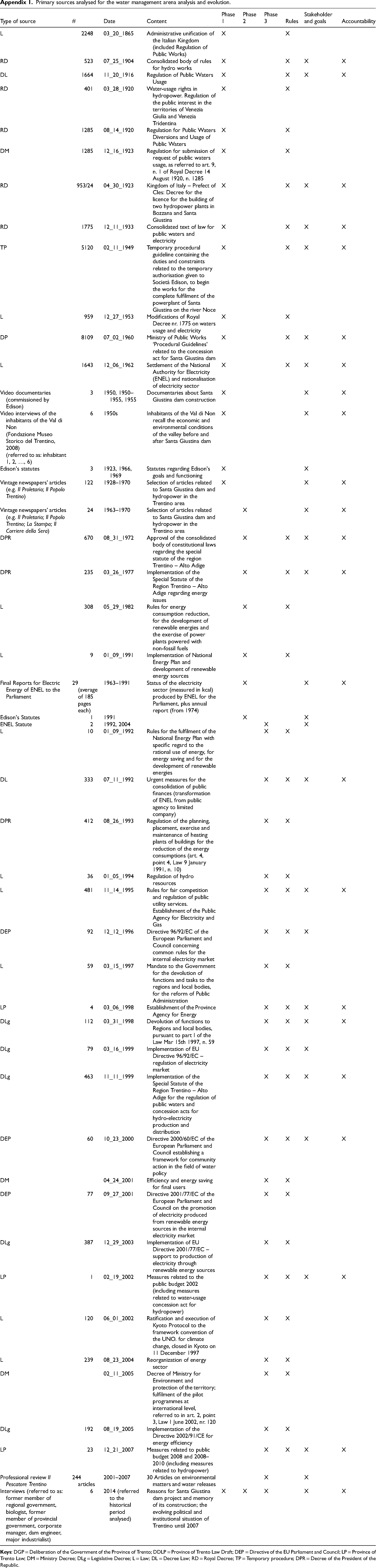
| Type of source | # | Date | Content | Phase 1 | Phase 2 | Phase 3 | Rules | Stakeholder and goals | Accountability |
|---|---|---|---|---|---|---|---|---|---|
| L | 2248 | 03_20_1865 | Administrative unification of the Italian Kingdom (included Regulation of Public Works) | X | X | ||||
| RD | 523 | 07_25_1904 | Consolidated body of rules for hydro works | X | X | X | X | ||
| DL | 1664 | 11_20_1916 | Regulation of Public Waters Usage | X | X | X | X | ||
| RD | 401 | 03_28_1920 | Water-usage rights in hydropower. Regulation of the public interest in the territories of Venezia Giulia and Venezia Tridentina | X | X | ||||
| RD | 1285 | 08_14_1920 | Regulation for Public Waters Diversions and Usage of Public Waters | X | X | ||||
| DM | 1285 | 12_16_1923 | Regulation for submission of request of public waters usage, as referred to art. 9, n. 1 of Royal Decree 14 August 1920, n. 1285 | X | X | ||||
| RD | 953/24 | 04_30_1923 | Kingdom of Italy – Prefect of Cles: Decree for the licence for the building of two hydropower plants in Bozzana and Santa Giustina | X | X | X | X | ||
| RD | 1775 | 12_11_1933 | Consolidated text of law for public waters and electricity | X | X | X | X | ||
| TP | 5120 | 02_11_1949 | Temporary procedural guideline containing the duties and constraints related to the temporary authorisation given to Società Edison, to begin the works for the complete fulfilment of the powerplant of Santa Giustina on the river Noce | X | X | X | X | ||
| L | 959 | 12_27_1953 | Modifications of Royal Decree nr. 1775 on waters usage and electricity | X | X | ||||
| DP | 8109 | 07_02_1960 | Ministry of Public Works ‘Procedural Guidelines’ related to the concession act for Santa Giustina dam | X | X | X | X | ||
| L | 1643 | 12_06_1962 | Settlement of the National Authority for Electricity (ENEL) and nationalisation of electricity sector | X | X | X | X | ||
| Video documentaries (commissioned by Edison) | 3 | 1950, 1950–1955, 1955 | Documentaries about Santa Giustina dam construction | X | X | X | |||
| Video interviews of the inhabitants of the Val di Non (Fondazione Museo Storico del Trentino, 2008) (referred to as: inhabitant 1, 2, …, 6) |
6 | 1950s | Inhabitants of the Val di Non recall the economic and environmental conditions of the valley before and after Santa Giustina dam | X | X | X | |||
| Edison's statutes | 3 | 1923, 1966, 1969 | Statutes regarding Edison's goals and functioning | X | X | ||||
| Vintage newspapers’ articles (e.g. Il Proletario; Il Popolo Trentino) | 122 | 1928–1970 | Selection of articles related to Santa Giustina dam and hydropower in the Trentino area | X | X | X | |||
| Vintage newspapers’ articles (e.g. Il Proletario; Il Popolo Trentino; La Stampa; Il Corriere della Sera) | 24 | 1963–1970 | Selection of articles related to Santa Giustina dam and hydropower in the Trentino area | X | X | X | |||
| DPR | 670 | 08_31_1972 | Approval of the consolidated body of constitutional laws regarding the special statute of the region Trentino – Alto Adige | X | X | X | X | ||
| DPR | 235 | 03_26_1977 | Implementation of the Special Statute of the Region Trentino – Alto Adige regarding energy issues | X | X | X | X | ||
| L | 308 | 05_29_1982 | Rules for energy consumption reduction, for the development of renewable energies and the exercise of power plants powered with non-fossil fuels | X | X | ||||
| L | 9 | 01_09_1991 | Implementation of National Energy Plan and development of renewable energy sources | X | X | ||||
| Final Reports for Electric Energy of ENEL to the Parliament | 29 (average of 185 pages each) | 1963–1991 | Status of the electricity sector (measured in kcal) produced by ENEL for the Parliament, plus annual report (from 1974) | X | X | X | |||
| Edison's Statutes | 1 | 1991 | X | X | |||||
| ENEL Statute | 2 | 1992, 2004 | X | X | |||||
| L | 10 | 01_09_1992 | Rules for the fulfilment of the National Energy Plan with specific regard to the rational use of energy, for energy saving and for the development of renewable energies | X | X | ||||
| DL | 333 | 07_11_1992 | Urgent measures for the consolidation of public finances (transformation of ENEL from public agency to limited company) | X | X | X | X | ||
| DPR | 412 | 08_26_1993 | Regulation of the planning, placement, exercise and maintenance of heating plants of buildings for the reduction of the energy consumptions (art. 4, point 4, Law 9 January 1991, n. 10) | X | X | ||||
| L | 36 | 01_05_1994 | Regulation of hydro resources | X | X | ||||
| L | 481 | 11_14_1995 | Rules for fair competition and regulation of public utility services. Establishment of the Public Agency for Electricity and Gas | X | X | X | X | ||
| DEP | 92 | 12_12_1996 | Directive 96/92/EC of the European Parliament and Council concerning common rules for the internal electricity market | X | X | X | |||
| L | 59 | 03_15_1997 | Mandate to the Government for the devolution of functions and tasks to the regions and local bodies, for the reform of Public Administration | X | X | ||||
| LP | 4 | 03_06_1998 | Establishment of the Province Agency for Energy | X | X | X | X | ||
| DLg | 112 | 03_31_1998 | Devolution of functions to Regions and local bodies, pursuant to part I of the Law Mar 15th 1997, n. 59 | X | X | X | X | ||
| DLg | 79 | 03_16_1999 | Implementation of EU Directive 96/92/EC – regulation of electricity market | X | X | X | |||
| DLg | 463 | 11_11_1999 | Implementation of the Special Statute of the Region Trentino – Alto Adige for the regulation of public waters and concession acts for hydro-electricity production and distribution | X | X | X | X | ||
| DEP | 60 | 10_23_2000 | Directive 2000/60/EC of the European Parliament and Council establishing a framework for community action in the field of water policy | X | X | X | X | ||
| DM | 04_24_2001 | Efficiency and energy saving for final users | X | X | |||||
| DEP | 77 | 09_27_2001 | Directive 2001/77/EC of the European Parliament and Council on the promotion of electricity produced from renewable energy sources in the internal electricity market | X | X | ||||
| DLg | 387 | 12_29_2003 | Implementation of EU Directive 2001/77/EC – support to production of electricity through renewable energy sources | X | X | ||||
| LP | 1 | 02_19_2002 | Measures related to the public budget 2002 (including measures related to water-usage concession act for hydropower) | X | X | X | X | ||
| L | 120 | 06_01_2002 | Ratification and execution of Kyoto Protocol to the framework convention of the UNO. for climate change, closed in Kyoto on 11 December 1997 | X | X | ||||
| L | 239 | 08_23_2004 | Reorganization of energy sector | X | X | ||||
| DM | 02_11_2005 | Decree of Ministry for Environment and protection of the territory; fulfilment of the pilot programmes at international level, referred to in art. 2, point 3, Law 1 June 2002, nr. 120 | X | X | |||||
| DLg | 192 | 08_19_2005 | Implementation of the Directive 2002/91/CE for energy efficiency | X | X | ||||
| LP | 23 | 12_21_2007 | Measures related to public budget 2008 and 2008–2010 (including measures related to hydropower) | X | X | X | X | ||
| Professional review Il Pescatore Trentino | 244 articles | 2001–2007 | 30 Articles on environmental matters and water releases | X | X | ||||
| Interviews (referred to as: former member of regional government, biologist, former member of provincial government, corporate manager, dam engineer, major industrialist) | 6 | 2014 (referred to the historical period analysed) | Reasons for Santa Giustina dam project and memory of its construction; the evolving political and institutional situation of Trentino until 2007 | X | X | X | X | X |