



Abstract
Works of Western art music have been addressed in writing for centuries by different listeners, including critics and music theorists. The question arises, whether today’s listeners still ascribe expressive connotations made in the past to music excerpts with similar features, which might indicate a stability of these connotations over time. To test this idea, we used historic descriptions of the “Glorifying Hymnic” as identified in a previous study on expressive connotations of 19th-century music in a new music-listening experiment. A total of 120 participants completed an online listening study in which they were asked to first read one of a set of historical descriptions and then listen to an excerpt that could either be a passage from (a) a piece of music with similar characteristics as the originally described excerpt or (b) a piece of music with different characteristics. Participants were asked to rate the match between the description and the passage. Participants were also asked about their familiarity with music that they heard, their interest in Western classical music and their musical sophistication. Participants’ performance indicates that present-day listeners do indeed recognize the expressive connotations of the Glorifying Hymnic that were described by 19th-century listeners. Moreover, performance in the listening task was significantly different between participants with different levels of interest in Western classical music, that is, listeners with interest in this kind of music made a correct assignment more often; however, the performance in the listening task did not correlate significantly with measures of musical sophistication. The results show that the connotations of music can still be recognized after a long period of time, at least 150 years, especially among listeners who have an interest in the music in question.
Keywords
Introduction
With the studies of Kate Hevner in the 1930s, the field of music psychology began to systematically investigate the connection between music and emotion via descriptions of the expressive content of music (Hevner, 1935, 1936, 1937). Today’s classical concert repertoire includes a great deal of music from the past, beginning with Medieval music. From the Baroque period onwards, music from more recent times plays a particularly important role (see, for instance, Concert Programmes, 2024). This raises the question of whether the music of the past holds the same expressive connotations for us as it once did for contemporaneous audiences.
Others have similarly demanded psychological research on historical data, further supporting the need for a diachronic perspective: Muthukrishna et al. (2021) note that “our psychology is shaped by millions of years of genetic evolution, thousands of years of cultural evolution, and a short lifetime of experience; and yet, much of the field has focused on that short lifetime of experience.” (p. 720). The field of psychology mainly draws its samples from populations living in Western, Educated, Industrialized, Rich und Democratic (WEIRD) countries or countries with cultural similarity. This WEIRD people problem, however, “is a matter not only of geography but also of history” (Muthukrishna et al., 2021, p. 720). Though of course, 19th-century perceptions of Western art music follow “thousands of years of cultural evolution,” they do offer a window into historical perceptions. While contemporaneous audiences of Western art music were Western, Educated, and presumably Rich, the level of industrialization and certainly democracy were in various stages of development in the 19th century.
The assumption of stable receptive patterns in the recognition of Western art music over time stands in sharp contrast to paucity of research testing this assumption. In other words, little is known about the extent to which today’s listeners still perceive the expressive content of older music in the same way as listeners did in the past. The reason is obvious: Since listeners from the past can no longer be interviewed, there seems to be a lack of systematic data, that is, a data set from multiple listeners, for empirical comparisons.
One solution would be to generate an alternative historical data set based on the expressive connotations as codified in accompanying contemporaneous text, such as libretti, lyrics, or historical music-theoretical treatises. Previously, researchers have compared terminology and semantic content of music treatises from the Baroque era with recent models and results of music emotion recognition studies and found many similarities between them (Tizón Díaz, 2018). In another study, it was found that today’s listeners indeed classify late Medieval music excerpts as more or less “sweet” in line with information from medieval music theory (Stoessel et al., 2021).
However, studies may also diverge in their conclusions after studying historical connotations with music genres through the ears of present-day listeners. Kötter (1995, 1998) observed that even untrained listeners recognized the intended expressive connotations of Baroque arias to a substantial degree (Kötter, 1995, 1998). The connotations that were tested had been deduced from the libretti of the arias. Diverging conclusions were reached in a recent study by Frank et al. (2024) which explored textbook examples from Johann David Heinichen’s (1728) “Der General-Bass in der Composition.” Despite the historical text’s intention to teach how certain expressive connotations could be realized in Baroque opera, that is, in the same kind of music used by Kötter (1995, 1998), the authors found that today’s listeners no longer perceive the historically intended expressive connotations.
Rather than studying the persistence of historical expressive connotations over time by basing assumptions about the historical expressive connotations on the expertise of a single historical librettist, composer, or musicologist, the alternative solution is to base assumptions about the historical expressive connotations on the perception of multiple historical listeners, for instance, critics, musicologists, but also laypeople. In our study, we benefit from a collection of more than 100 historical testimonies which describe a 19th-century musical topos, called “Glorifying Hymnic” by the authors (Hentschel & Kreutz, 2021). These sources are largely concert reviews or reviews of new score releases and, therefore, have the great advantage of testifying to actual contemporaneous listener reactions. This collection of sources thus represents a data set of the perception of a particular type of music from the perspective of multiple historical listeners and may be regarded as a true historical data set.
The main research question of our study is, therefore, whether 19th-century descriptions of musical experience still resonate with musical experience of today’s listeners, that is, whether today’s listeners still can identify the same expressive connotations in 19th-century music which were described by contemporaneous listeners. As we were most interested in whether today’s listeners can assign historical descriptions to the correct “type” of music rather than a specific piece, we approached this question by asking whether today’s listeners can assign descriptions of the musical experience from 19th-century listeners to musical excerpts which share most compositional features with the excerpts that originally elicited the descriptions in the 19th century. In addition, we asked whether familiarity with Western classical music and musical sophistication have an influence on the ability to assign the descriptions correctly to the musical excerpts, given that previous findings indicate that musically trained participants are sometimes better at recognizing expressive qualities of music (Taruffi et al., 2017). We hypothesize that listeners will indicate a match between historical descriptions of the Glorifying Hymnic more often with the respective type of music than with other music in a forced-choice paradigm. We further hypothesize that listeners’ sensitivity to the Glorifying Hymnic as indicated through the commonly used signal detection measure d’ relates to listeners’ musical expertise.
Method
Participants
This study was set up online through the experiment delivery platform SoSciSurvey (Leiner, 2019). Participants were recruited through the personal and professional networks of the researchers. Participation in the experiment was also advertised during a radio interview with one of the researchers in a classical music program. Participants were not compensated for their participation. Data collection ran for 2.5 months from September to November 2023.
Ethical approval for this study was obtained from the University of Oldenburg Ethics Committee (Drs.EK/2023/061).
In total, there were 200 participants. We analyzed data from 120 participants (69 participants identified as female, and 51 participants identified as male) who completed the music-listening part of the study and provided demographic information. Participants’ age ranged from 18 to 82 years (M = 55.08, SD = 17.64 years) and is shown as a histogram in Figure 1. Of the 187 participants who answered a question about their interest in Western music history, 14 participants indicated no interest in music history, 80 indicated some interest, 55 indicated a personal interest, and 38 indicated a professional interest in music history. The proportion of participants who were included in statistical analyses, that is, who also completed the music-listening part of the study, was lowest in the group of participants with no interest at all, 42.86% (six participants), and highest in the group of participants with a professional interest in Western music history, 71.05% (27 participants). The proportion of participants who were included in the analyses was 69.09% (38 participants) for the group with a personal interest and 61.25% (49 participants) for the group with some interest.
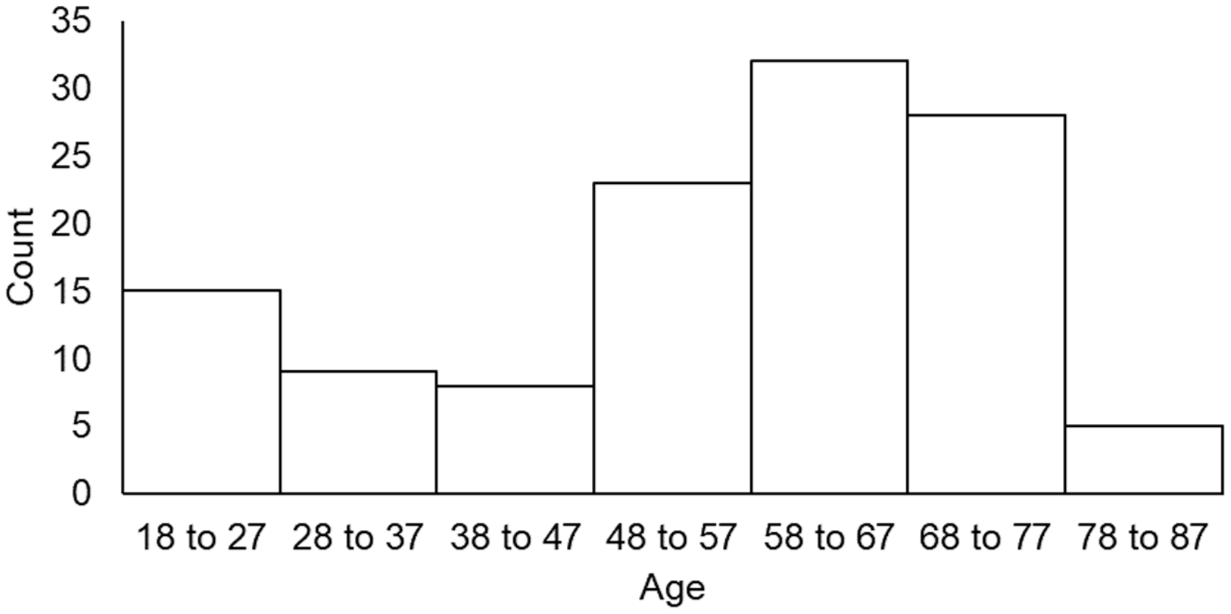
Histogram of participants’ age in years.
Materials
Musical stimuli and 19th-century descriptions were based on the source material collected by Hentschel and Kreutz (2021). These authors identified 48 passages from 19th-century orchestral pieces that shared a certain set of compositional features (see Table 1 in their article). 1 They searched for 19th-century descriptions of the expressive qualities of these excerpts and found that the consistency of the semantic fields used in the descriptions confirmed the similarity of the music excerpts. This also reflected the mutual, intersubjective connotations of music within a certain cultural and temporal context.
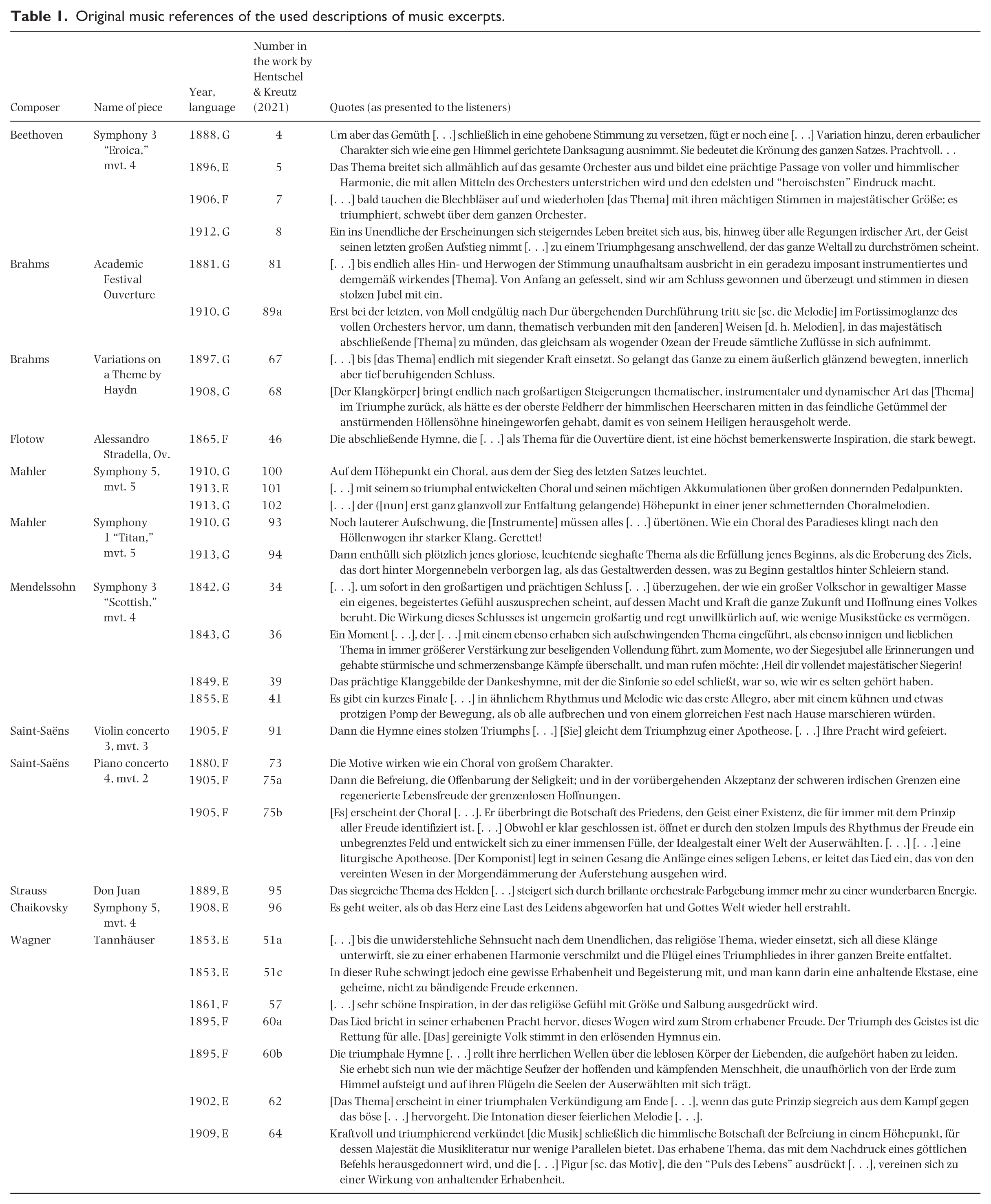
Original music references of the used descriptions of music excerpts.
Specifically, these excerpts were described as
glorious (implying the splendid appearance of something honorable, especially in a religious or political context), powerful (referring to a mixture of physical and psychological [social, political] power and domination), triumphant and victorious, grand (with an emphasis on quantity), joyous and happy, solemn, exciting, noble, sometimes as tranquil and even proud.
This type of music was labeled Glorifying Hymnic (Hentschel & Kreutz, 2021, 14).
Hentschel and Kreutz (2021) found 102 descriptions of such music excerpts in English, French and German. 2 These descriptions are of very different quality, some very short, some rather long, some mention compositional features, while others remain more abstract.
Hymnic descriptions
For our study, we excluded descriptions consisting of only a few words. Ideally, the descriptions consisted of at least one complete sentence although we used a few descriptions consisting of informative half sentences. We further excluded descriptions that contained too much information concerning the compositional means or music-technical information (e.g., specific instruments or time signatures) since we did not want the music excerpts to be assigned based on technical information. Descriptions in English and French were translated into German using DeepL (DeepL Übersetzer: Der Präziseste Übersetzer Der Welt, 2024). We chose to use a translation software to avoid any researcher-led manipulation of the meaning of the sources. The remaining 31 descriptions ranged between a length of 9–90 words (M = 31.69; SD = 17.12). Table 1 lists the compositions referenced by the 19th-century sources, the number of text sources, the year of their origin, and their length in words.
Non-hymnic music passages
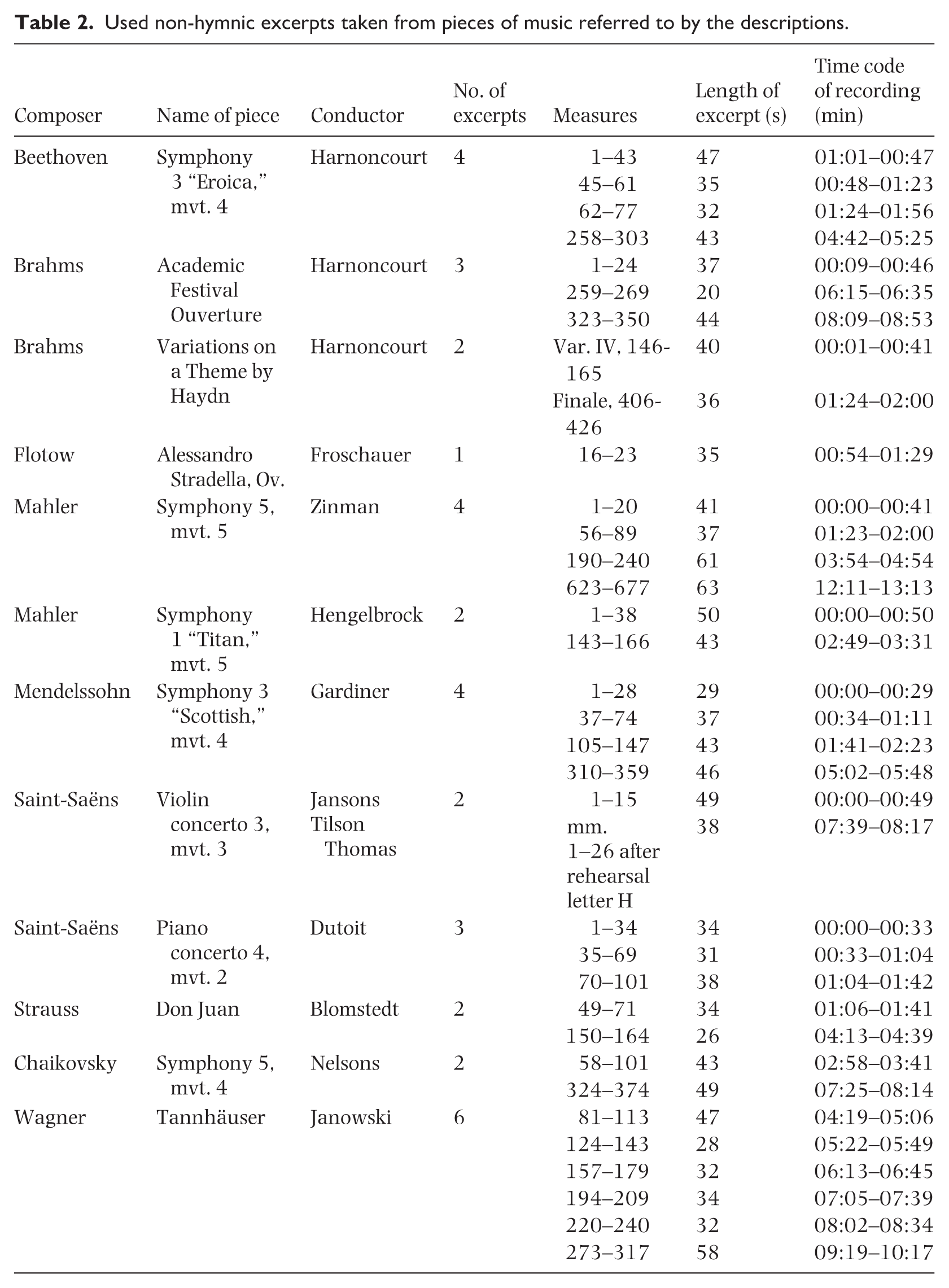
In addition to the hymnic descriptions (text sources), we also used the compositions (music passages) investigated by Hentschel and Kreutz (2021). However, we did not use the excerpts studied by these authors but took other passages from the same compositions, namely passages that are not referenced by the used descriptions. We chose them arbitrarily, starting at the beginning of each movement and looking for distinct sections that had a relatively uniform character and differed from the hymnic excerpt. Table 2 shows the non-hymnic excerpts used for our study, the number of excerpts taken from one recording, the measures of the excerpts, the conductor of the chosen recording, their duration in seconds and their time code within the recording.
Used non-hymnic excerpts taken from pieces of music referred to by the descriptions.
Hymnic music passages
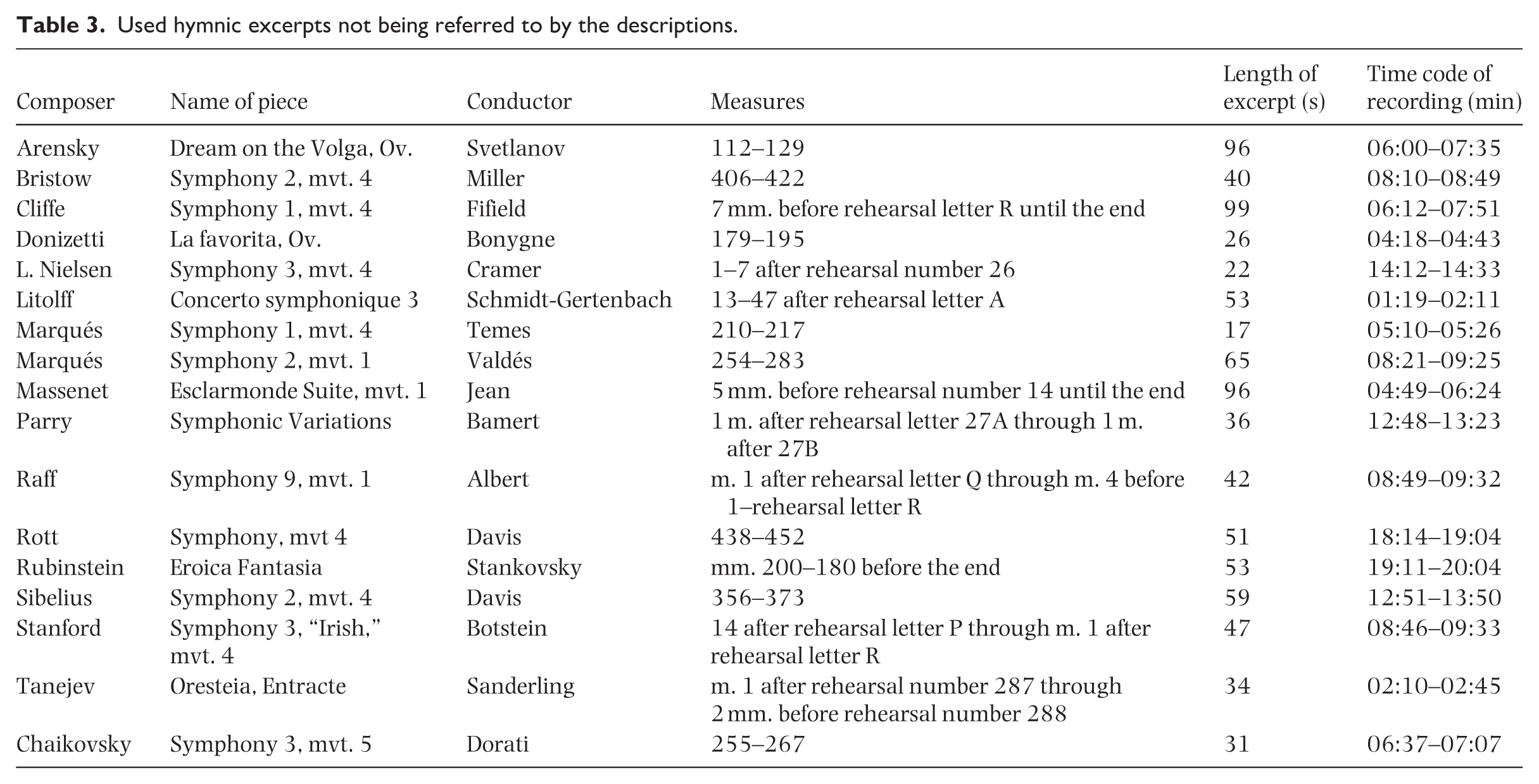
In addition, we used 16 music excerpts, taken from Hentschel and Kreutz (2021), that do, according to their analyses, share the compositional features with the hymnic excerpts for which, however, there were no historical descriptions. These compositions, the measures of the excerpts, the conductor of the chosen recording, their duration in seconds and their time code within the recordings are listed in Table 3.
Used hymnic excerpts not being referred to by the descriptions.
Procedure
After obtaining participants’ informed consent, participants answered demographic questions and completed an 18-item version of the Goldsmiths Musical Sophistication Index (GoldMSI) 3 (Müllensiefen et al., 2014). Participants’ responses to the GoldMSI were summarized for each of the factors and then z-scored before further analysis. Then, participants took part in the music-listening experiment described below.
Descriptions (see Table 1) and music excerpts were paired such that descriptions were either paired with (a) a hymnic music excerpt from another piece (see Table 3), meaning a musical passage sharing the compositional features of the excerpts referred to by the descriptions, or (b) a non-hymnic music excerpt from the piece referred to by the descriptions (see Table 2). Given that only 31 descriptions were of sufficient length but did not contain too much information regarding the compositional features or music-technical information (see above), we did not use the excerpts in relation to which the descriptions were originally written, as we were primarily interested in the recognizability of a certain type or character of music, not that of a specific piece. The choice of only two types of trials allowed us to have at least 15 trials of each type without using a description more than once. We created four possible lists of pairings to which participants were randomly assigned. In two of the lists, there were 15 hymnic and 16 non-hymnic music passages, that is, 15 A trials and 16 B trials, and in the other two lists, there were 16 hymnic and 15 non-hymnic music passages, that is, 16 A trials and 15 B trials. The order of the trials was randomized further for each participant.
Participants were asked to indicate the extent to which the description and music excerpt match on a 5-point Likert scale ranging from 1 (matches very well) to 4 (does not match at all), with the addition of 5 (I do not understand the quote). The latter option was included to ensure that participants were not forced to give a match rating if they did not understand the quote.
Match responses were recoded, such that higher values indicate a higher match (1—“does not match at all”; 4—“matches very well”), and average match responses were compared between A trials, in which a hymnic music passage was used, and B trials, in which a non-hymnic music passage was used. Responses of “I do not understand the quote” were treated as missing values. Responses were further analyzed such that indication of a match (an answer of “matches well” or “matches very well”) for category A trials was regarded as hit responses, and for category B trials was regarded as false alarms. Hits and false alarm rates were used to compute the sensitivity index d’ using the standard formula z(hits) – z(false alarms) (Green & Swets, 1966). The sensitivity index d’ can be regarded as a summary index for a participant’s ability to recognize the hymnic character as it considers both the participant’s recognition of the character itself but also the participant’s confusion of other music as hymnic. A d’ value of 0 indicates chance performance.
Participants were also asked about their familiarity with the musical passage on a 4-point Likert scale ranging from 1 (can name composer and title) to 4 (do not know it). This allowed us to see whether the participant’s sensitivity may have been due to familiarity with the specific compositions.
Results
We analyzed participants’ sensitivity using JASP 0.18.3 (JASP Team, 2024). A paired-samples t-test indicated that average match ratings for A trials, in which hymnic music passages were used, M = 3.14, SD = .46, were significantly higher than average match ratings for B trials, in which non-hymnic music passages were used, M = 2.10, SD = .60, t(119) = 19.93, p < .001, Cohen’s d = 1.82, see Figure 2.
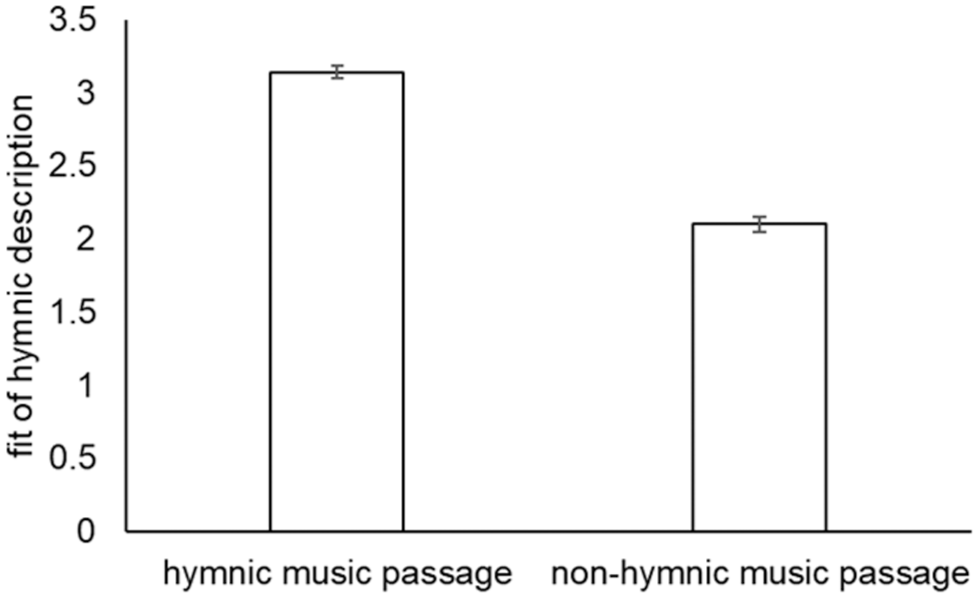
Participants’ average fit ratings of hymnic descriptions with hymnic music passages and non-hymnic passages.
Accordingly, a one-sample t-test against 0 showed that participants had high sensitivity, d’ = 1.51, t(119) = 17.99, p < .001, Cohen’s d = 1.64. Participants selected the option 5 “I do not understand the quote” in 2.93% of the trials. Participants’ familiarity ratings indicated little familiarity with the presented musical excerpts, M = 3.40, SD = .50. We next separated participants into groups based on their interest in music history to investigate possible factors which may have influenced our results. Given that only six participants indicated no interest at all, we excluded them from this analysis. An analysis of variance (ANOVA) on d’ values with group as the between-subjects factor (some interest, personal interest, professional interest) revealed a significant main effect of group, F(2, 111) = 6.57, p = .002, η2 = .11. Including the participants with no interest had no impact on the significance of the main effect, F(3, 116) = 4.35, p = .006, η2 = .10, Figure 3 shows d’ values averaged for all groups.
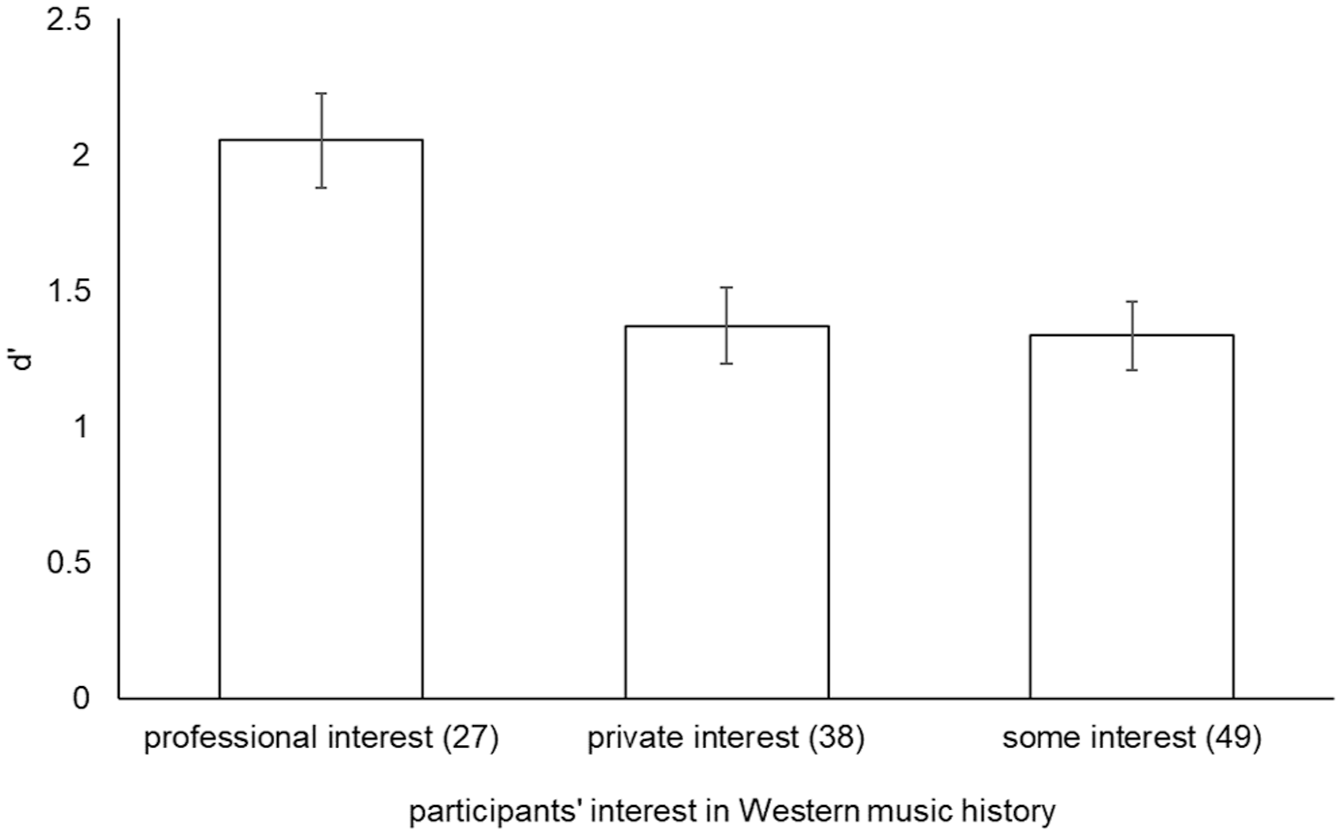
Participants’ d’ values separately for groups with differing interest levels in Western music history.
Bonferroni-corrected post hoc tests indicated that this effect was driven by the significantly higher d’ values for participants with a professional interest in music history, M = 2.05, SD = .90, than d’ values for participants with a personal interest, M = 1.37, SD = .86, t(63) = 3.08, p = .008, and than d’ values for participants with some interest, M = 1.34, SD = .89, t(74) = 3.40, p = .003. No other post hoc comparisons were significant.
Bonferroni-corrected one-sample t-tests further indicated that all of the groups’ d’ values were significantly different from 0, tprofessional interest(26) = 11.87, p < .001, tpersonal interest(37) = 9.80, p < .001, tsome interest(48) = 10.56, p < .001. These participants’ hit rates are plotted against their false alarm rates in Figure 4. Additional lines in their respective group’s color show the best linear fit. The average d’ value for the participants which were excluded from this statistical analysis, that is, participants with no interest at all in music history, was M = 1.44, SD = .97.
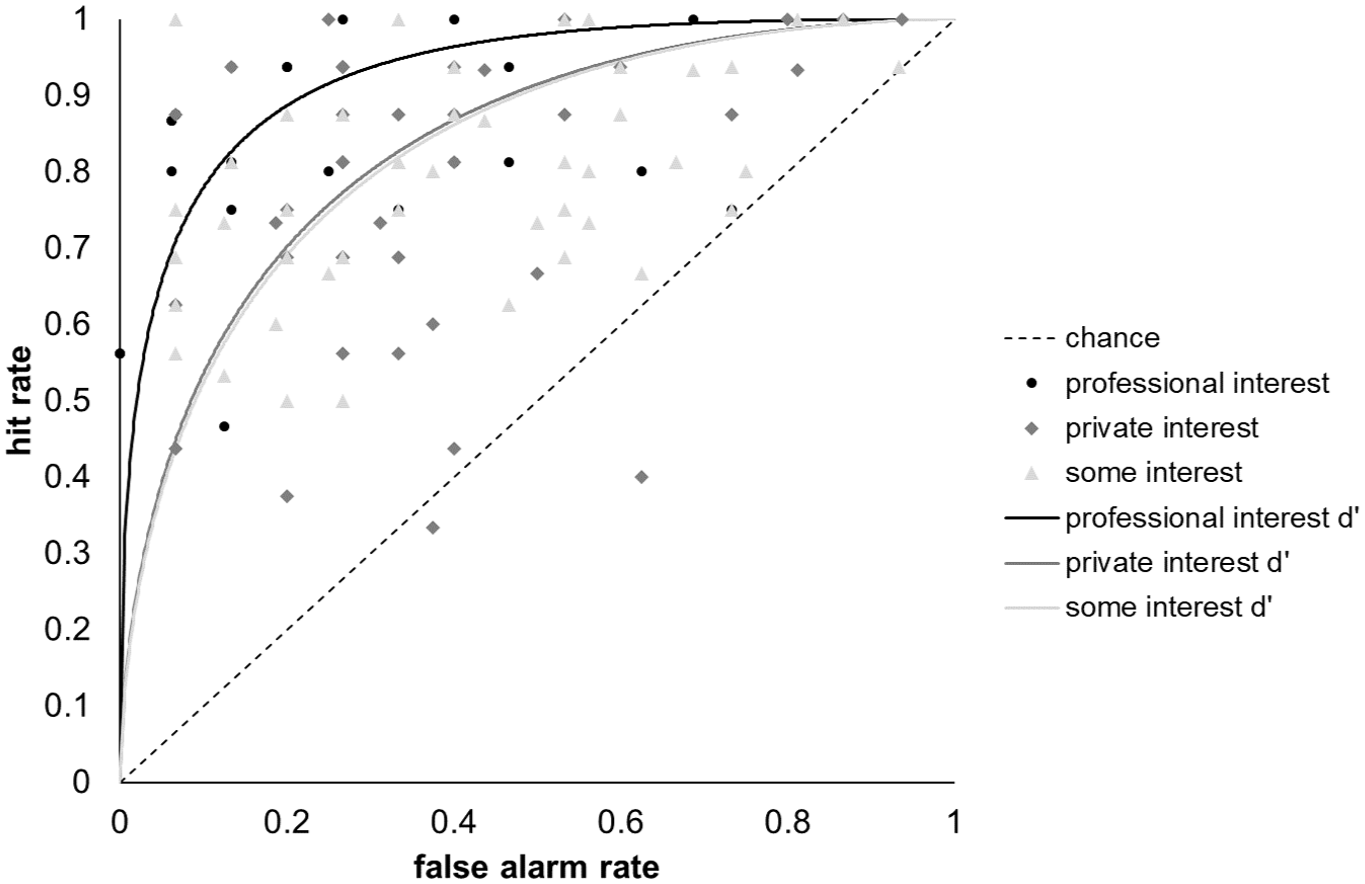
Hit versus false alarm rates for participants with some (light gray circles), private (dark gray diamonds), and professional (black triangles) interest in Western music history.
We also investigated for all participants whether their musical sophistication related to their answers in the music-listening experiment by correlating d’ values with the five z-scored GoldMSI values. Pearson’s r values ranged from remotions(118) = −.05, p = .556, to rmusical training(118) = .21, p = .018. Two correlations, between d’ values and singing abilities, rsinging abilities(118) = .21, p = .020, and between d’ values and musical training, rmusical training(118) = .21, p = .018, were significant but did not survive Bonferroni-correction for multiple comparisons. Finally, we median-split participants into two age groups (below the age of 60 and above the age of 60). The t-test comparing d’ for these two groups was not significant, t(118) = 1.29, p = .200.
Discussion
We asked whether 19th-century descriptions of musical experience still resonate with the musical experience of today’s listeners. Using the case example of the Glorifying Hymnic, we wanted to know whether today’s listeners can identify the same expressive qualities in this particular type of 19th-century music as did contemporaneous listeners. The results supported the hypothesis that this is indeed the case by showing that 19th-century descriptions were correctly applied to excerpts that have similar compositional features to those musical excerpts the descriptions were originally written about: Participants’ sensitivity was high, that is, a match between the hymnic excerpt—which shares the compositional features with the original musical passage—and a hymnic quote was more often perceived than a match between a non-hymnic excerpt—which does not share compositional features with hymnic music—and a hymnic quote. This shows that expressive connotations of music made by multiple historical listeners may still be recognized today.
How can we relate this result in relation to the disagreement of three studies mentioned in the introduction? Ensuring the ecological validity of experiments is a fundamental problem in music psychological research generally; in historical research, however, it is particularly difficult. While the earlier studies (Kötter, 1995, 1998) were at least able to draw on the works of Händel, an opera composer who was extremely successful in his time (Jacobshagen & Mücke, 2009), the more recent study (Frank et al., 2024) had to resort to theoretical examples by a theoretician who was more active as a church composer (see the biographical details and the worklist in Horn, 2016). Moreover, the authors used WAV files generated by the Sibelius notation program, in “piano timbre” (Frank et al., 2024, p. 120). However, Heinichen gives clear indications of the instrumentation, which is probably of great importance. Example E1 is to be played by the flutes in unison (Heinichen, 1728, p. 69), example E2 by the whole orchestra in unison (Heinichen, 1728, p. 32), that is dynamically with great force, and example E4 by the flutes together with the first violin in unison and always piano (Heinichen, 1728, p. 52).
At least two of Heinichen’s three examples also aim more at the tonal representation of a word than at its affective content: example E1 aims to represent the playful glances of love rather than love itself and example E4 to depict the flickering fire rather than the passionate burning of love. The author accentuates this in explaining that it gives rise to pleasant and playful inventions (Heinichen, 1728, p. 51). In the case of the playful glances, we might imagine an opera singer mimicking these glances, thus illustrating the meaning of the music; in the case of the flickering fire, we may even doubt whether contemporaneous listeners would have understood this—to determine this, we needed contemporaneous witnesses whose accounts do not exist.
Of course, we had to make compromises ourselves: For one thing, we had to translate many of the sources and to eliminate technical descriptions from them. Furthermore, we had to use modern recordings of the music. However, the ecological validity of the historical documents can be considered high since these are independently written descriptions of music that arose as more or less spontaneous reactions to concert visits or score readings. Last, our music examples are more than a hundred years younger than the Baroque music used by Kötter (1995, 1998) and Frank et al. (2024).
The persistence of musical expressivity over the least 200 years may be explained by several factors. One of the reasons for this permanence might be seen in the presence of classical-romantic music in today’s concert repertoires, another in the persistence of the musical idiom of the 19th century in film music which reaches a broad audience (Flinn, 1990). In addition to the concepts of cultural difference and universality, diachronic studies deal with different durations of cultural circumstances. Against this backdrop, the theory of historiography introduced the concept of longue durée (Braudel, 1958). It reflects the fact that in history, different aspects of a culture can change at different speeds. Accordingly, the permanence of the mechanisms controlling the understanding of 19th-century music’s expressivity over the last ca. 200 years may reflect such a longue durée.
Expressive connotations of music made by multiple historical listeners were best recognized by listeners with a professional interest in Western music history, who showed higher d’ values than the other participants. Note, however, that the proportion of participants who finished the experiment was highest also for this group and lowest for participants with no interest in music history. Either familiarity with the music from history or simply the personal affinity to music from the 19th century may obviously support the understanding of the expressive qualities of this music. However, musical sophistication had no significant effect on the understanding of the expressive qualities after correcting for multiple comparisons. It seems that the understanding of expressive qualities does not presuppose musical expertise but simply a familiarity with cultural codes. In this, our findings expand on the array of musical capacities that seemingly do not necessitate formal training (Bigand & Poulin-Charronnat, 2006).
Moreover, our results support the idea that language did not undergo such drastic changes during roughly the past 150 years—the earliest text source is from 1842—such that the documents and descriptors they contain would no longer be accessible to today’s readers. Indeed, the option “I do not understand the quote” was rarely used. Note, however, that while we used 19th-century source material from three different languages (French, English, German), we invited only German-speaking listeners to participate and used German translations of the French and English sources.
The component of cultural transmission, as just described, may further be complemented by a biological component as revealed by research focusing on the neurological processing of music. The neural signature associated with the processing of meaning in different languages (though with subtle differences, see Choudhary et al., 2009) can also be elicited through musical means (Koelsch et al., 2004). Given the idea that certain emotions such as joy, fear, and sadness are similarly expressed and, therefore, recognized across cultures (Sauter et al., 2010), one could reason that these emotions may be similarly expressed and, therefore, recognized across time, not only in vocalizations but also in music. In other words, listeners may attach similar meaning to sound as they would otherwise derive from words.
However, this biological component cannot account for studies showing that the expression of other emotions is culturally specific (Sauter et al., 2010) and that musical cues elicit culturally specific narratives (Margulis et al., 2019). Nevertheless, our findings cannot discount the involvement of a biological component especially since it has been found that triumphant, an emotion that is closely related to the Glorifying Hymnic (Hentschel & Kreutz, 2021, pp. 14–16), was one of 13 feelings that were better recognized in music across two cultures (the United States and China) compared with other feelings (Cowen et al., 2020). It is plausible to assume that neural correlates of the cognitive processes do not entirely rely on cultural knowledge: Instead, sound information may be used to form connotations in similar ways across generations, such as sound information which indicates a certain emotion both in vocalizations and in music (Juslin & Laukka, 2003).
Despite having used descriptions of music experiences from French, English and German sources, from different European composers, played by different orchestras and led by different conductors (in the 19th century and today), today’s listeners were able to identify the central expressive qualities. Thus, while performance and context certainly are important factors for musical experiences (Sloboda & Lehmann, 2001), they are not always the primary factors influencing our understanding of the expressive content of the music. Indeed, our findings suggest that the gap between compositional and performer intentions may sometimes be overestimated (Quinto et al., 2014).
However, our conclusions are limited to the specific materials used and the specific participants who took part in our study. The Glorifying Hymnic, the specific type of music we chose based on a previous study (Hentschel & Kreutz, 2021), is a rather bold and obvious expression type. It is often employed as the climax of an entire composition, when complex dramatic processes and events come to a triumphant conclusion. The expressive qualities of these earlier dramatic processes preceding the Glorifying Hymnic are much more ambiguous and thus may be less clearly attributable for listeners then and today. Unfortunately, such a comparison is methodologically more difficult, as less striking and more ambiguous passages received less commentary from historical listeners.
Furthermore, we chose contrasting non-hymnic musical materials which were not based on descriptions from the 19th century but rather were taken from other passages from the described pieces. As a result, we do not know how 19th-century listeners described these decoy passages. In addition, the hymnic musical materials were more uniform than the non-hymnic excerpts. Thus, given the uniformity of the descriptions, participants could have indicated matches more so when they were again presented with a hymnic excerpt that showed similarity to a previous hymnic excerpt.
The results of our study could be refined further had we used several different topics from 19th-century music that were well-described. However, to the best of our knowledge, such true historical data sets are currently not available.
Repeating the experiment with listeners from other cultures may inform us about the extent to which the biological component as described above is relevant for the recognition of the Glorifying Hymnic. Recent results suggest that bodily mappings of musical sensations may be shared across cultures (Putkinen et al., 2024), which may account for the fact that some emotions such as triumphant can be recognized across some cultures (Cowen et al., 2020; though see also Sauter et al., 2010, for a contrary account).
Future studies may want to consider including different expressive qualities and different groups of listeners to specify the mechanisms through which our listeners’ recognition of the Glorifying Hymnic was supported. Future studies may also want to consider including excerpts from additional historical eras to heed the call for historical psychology (Muthukrishna et al., 2021). Music from the time before 1600 may be of particular interest, as this era marks a fundamental change of musical culture (see, for instance, Woolhouse, 2010). Therefore, it would be intriguing to compare listening experiences from that time to today’s listeners. Unfortunately, our knowledge about listening experiences from that time is too limited to allow this .
Finally, in the future, historical music psychology research may capitalize on data gained from earlier music perception experiments, for example, Kate Hevner’s work from the 1930s on the effects of specific musical elements, to compare historical and contemporary music perception (Hevner, 1935, 1936, 1937) Of note is a 2003 paper, where researchers investigated whether Hevner’s model on music-related emotions should be updated given the passage of time by simply asking participants to assess different adjectives’ suitability for describing music (Schubert, 2003). However, given that participants in the 2003 study were not asked to listen to any music, any changes to the model may simply be due to changes in linguistic conventions or a diversification of musical preferences. A historical music psychology approach would replicate Hevner’s music-listening paradigms to compare 1930s listeners’ reactions to today’s listeners’ reactions. To summarize, today’s listeners are able to assign descriptions of music’s expressivity from the 19th century related to the Glorifying Hymnic to the appropriate music. Thus, at least some expressive qualities of 19th-century music still resonate with today’s listeners. This is especially, but not at all exclusively, true with respect to listeners who have a professional interest in Western music history. Musical sophistication, on the contrary, does not significantly influence the understanding of the expressive qualities of the music. Additional research will be necessary to clarify the mechanisms that enhance today’s listeners’ ability to recognize expressive qualities of the past.
Footnotes

Funding
The authors received no financial support for the research, authorship, and/or publication of this article.
Declaration of conflicting interests
The authors declared no potential conflicts of interest with respect to the research, authorship, and/or publication of this article.