




Abstract
This paper examines how the idea of musical genius, a mythical notion used as a device for musical practices, facilitates a split between the genius of an innate learner and that of an apprentice, thus creating an ambiguous discursive space. Genius was firstly a matter of nature, but also most discussed under the topic of nurture, that is, education. In order to understand how this nature and nurture ambiguousness developed in specific terms for the musical genius I focussed on analysing historical documents on the main resources for genius-building. In this article, these resources are considered the raw material for the embodying of the genius in every single person. What I discovered about the term ‘genius’ and its contradictory uses to support both elitist and democratic schooling made me realise that it is treated as an argument to advocate the merits of music and to take concrete steps in implementing educational excellence. The term ‘genius’ can serve any pedagogical purpose and encompass contradictory ideas, potentially serving unlimited purposes. Genius can be applied to the best of students, but equally to virtually anyone. In future studies the question will be whether this reading fits the scenario in other European countries.
Introduction
Why do only some people learn music? Everybody has some relation to music, but only a few people formally learn Western music within a curriculum delivered in educational institutions. Vocational training is usually presented as a matter of choice and/or of talent. We make such considerations by wielding the term ‘genius’ in our everyday language and generally accepting its definition as someone who is chosen by destiny (or genetics) and who possesses great talent and other distinctive characteristics.
Modern schooling processes, speech and debate, including vocational music training, have presented the definition of genius as an outstanding human who is, at times, a hero, and at other times nearly a deity. In the past, a genius was the natural winner under any circumstances (e.g. Mozart or Beethoven) for no other reason than the nature of genius itself (Howe, 1999). This image of the genius as an absolute mystery was embodied in our everyday reasoning and rationality (Popkewitz, 2008).
As the music psychologist Michael Howe states about his own experience, the genius is part of the schooling imagery. It is in school that we first learn about genius and begin to understand that they ‘form a breed apart’ (Howe, 1999: vii). The fact that school attests for this division leads me to question how it can be maintained in the context of democratic politics and tentative equality measures which advocate ‘no child left behind’ education policies. Although scientists, especially after the 19th century, attempted a calibration of this concept, genius still became a consensual notion of common understanding. The development of this vocabulary is now left to everyday speech. Considering these peculiarities, for me genius is an abstract notion, undetermined in its contents, and used to describe the higher stage of musical attainment usually employed while describing a performance (i.e. referring to someone performing in a specific situation).
This paper aims to address the debate around the role of genius in Portuguese music education from 1868 to 1930 – a period of large expansion of music education which covered several political regimes (monarchy, republic and dictatorship). My initial hypothesis was that people who were enrolled in artistic practices had an internal concept of genius. This was the main responsible concept for the maintenance of rarefied practices (Fernandes et al., 2007; Martins, 2011; Ramos et al., 2013). However, over the course of this research I realised that genius could support the most varied goals, including the democratisation of learning. According to these findings, the idea of genius cannot be considered the sole justification for the rarefying practices in educational contexts and speeches; merely an important tool to support the arguments towards the implementation of different pedagogic aims and goals.
Genius: an endless topic
A review of the literature available on artistic genius shows that we are facing a surplus of definitions. However, despite the excess of literature on the topic, the term has not yet been fully explored.
The social and human sciences have sought to understand how the modern notion of genius was fabricated from the end of the 18th century onwards. It first appeared as a philosophical concept, then a scientific one, before becoming an everyday concept. Different disciplinary and multidisciplinary approaches considered the history of genius as an idea which affected practice. Questioning the validity of ‘genius’ as a concept meant asking who the geniuses were at different points in time, what it meant to be a genius, who decided what merited the genius label, and under whose rules. As a result, we now have a vast repertoire of geniuses, of the description of the term, and several interpretations of the word which encompass the contingency and ambiguousness of the concept. But the effort put on the critique and deconstruction of the notion of genius, rather than being a destructive gesture, instead strengthens the concept. The more the idea of genius is analysed, the more it highlights the difficulty in defining genius: ‘speakers continue to use the word as if they can count on listeners to understand what they mean, and the attribution of genius is often used as a clincher in discussions as if to suggest that the word is entirely self-justifying’ (Jefferson, 2014: 1).
The power of genius as an assumption for all common speakers in modern everyday life was also the subject for many researchers, particularly in music sets (DeNora, 2000). In a classical perspective, musical genius was studied either using examples of single genius (Elias, 1993; DeNora, 1995) or existing in small groups (Kivy, 2001).
Large-scale studies on genius performing in different areas have a broader tradition, both in historical and in psychological approaches. Scholars involved in historical analyses sometimes go back as far as Ancient Greece to track the double genius etymology (Jefferson, 2014; Kivy, 2001). Others prefer to analyse it over short but decisive historical periods in a given community (Stadler, 2006). The overall tendency is to question the idea of genius by observing literary, artistic and scientific areas together in order to discuss the essence of this notion and its mutations over time. Bringing this discussion to the present has allowed academics to realise that more and more people in different areas (e.g. sports or fashion) are considered geniuses. The evolution of genius as a cultural concept developed into a new social function. Genius is no longer the exclusive domain of elite and distinctive practices. From 1945 onwards it has also adopted a role as a social equaliser and a double-edged sword of democratisation (McMahon, 2013).
The tradition in psychological studies on genius was founded with the emergence of medical and psychological studies. During the 19th century, the newly born sciences of the mind included genius in their research. The philosophical debate about the nature of genius was enriched by empirical studies on recognised geniuses, living or dead. The conceptualisation of genius was a leading point in the psycho-medical sciences, and studies were conducted to calibrate intelligence and vocational scales or to identify mental disorders (Martins, 2011; Murray, 1989). By the middle of the 20th century, psychological theories on intelligence and personality started to regard genius as an insolvable conceptual problem. Researchers were then encouraged to move on or to study other less ambiguous concepts, such as talent (Howe et al., 1998). Some psychologists tried to discuss the concept of genius by identifying and analysing consecrated geniuses (Howe, 1999). Scientific literature also started to reinvent genius as a synonym for a creative person, which led to more debate about the adequacy of this concept (Eysenk, 1995; Weisberg, 1986).
Recognising the paradigm of the genius today as a lonesome creative person, psychologists Montuori and Purser discussed the historical and conceptual victory of individualism as the basis for this unquestioned myth, bringing about the origin and nature of genius as an educational problem: can genius be taught? By posing this question, the authors follow the lead of historian G. Tonelli, for whom creativity as a ‘natural talent’ is an invention of the Renaissance (quoted by Montuori and Purser, 1995: 77). This was the period when ‘creativity’ first emerged, and when it was separated from genius, as the latter was considered an ‘innate capability, operating with spontaneous facility’, as opposed to talent, ‘which may be taught and learned by diligence’ (Montuori and Purser, 1995: 79).
At a certain point in these studies, whatever the theoretical and methodological framework may be, the tendency is to reignite the nature or nurture debate. This discussion usually involves the problematic of whether genius can be taught. In fact, one of the most prominent research trends aims to identify the different historical perspectives on this subject (McMahon, 2013; Murray, 1989). But the link between genius and schooling is expressed in a false relationship of confrontation, as genius seems to escape the formality of learning but does not exist as a phenomenon outside of school language. As Jimenéz Abadías (2010) argues, the concept of genius as a default within the school institution was embedded sometime in the late 18th century and spread from the German Romanticism as a pedagogical issue in itself.
Portugal and genius-building from a local perspective is an increasingly debated topic. The Portuguese word for genius preserves the complex genius Latin etymology: the dictionary definition of ‘génio’ includes references to a spirit, a person (an artist), a state of mind, a gift or ability. Its semantic richness has been used by education historians as a myth to be deconstructed and as an indicator of structural education problems. The myths outlining conservatory teaching methods and the difficulty in producing excellent artists are some of the issues studied (Gomes, 2002; Fernandes et al., 2007; Martins, 2011). They have shown that the genius concept was frequently intertwined with the idea of learning, without fully exploring this discursive ambiguousness. In fact, the expectation that a genius would have mysteriously learnt to play by his/her talent has been widely expressed throughout history. Nonetheless, at least from the 19th century onwards, genius was also the model for a long and arduous musical apprenticeship (Ramos et al., 2013).
Towards a history of genius in Portugal
The emergence of genius as a technology of speech responsible for the rarefying of school practices and the elitist split of the learning populations according to their social background was identified between the end of the 19th and the beginning of the 20th centuries (Gomes, 2002; Ramos et al., 2013; Paz, 2014). Based on these earlier studies, my hypothesis was that adopting the idea of genius enabled distinctive sets of educational ideas which ultimately led to a clear division between the cultural elite and the rest of society.
To test this hypothesis, I tried to understand how social actors positioned themselves on the topic of genius and education. Using research trends in genealogy as guidelines, I undertook the study of educational musical debates as depicted in the Portuguese periodical press.
The first step was to identify the moment in time when such debates may have been held. I identified the period between 1868 and 1930 through a cross-analysis of legislation, statistics and expert literature on the subject. All of these sources pointed to this moment as a period of expansion of the music education system in Portugal. In fact, from 1868 the constitutional monarchy in place instituted legislation towards schooling the Portuguese at all levels and types of education, including music learning (firstly in conservatories and primary schools, later in secondary school). Until the 1920s there were more and more students enrolled in official music learning, until the new dictatorship government (1926) imposed a different scheme. The legislation forged in the 1930s openly stated that only a few people were to learn music professionally. The conservatories had strict numerus clausus; the rest of the student population would be enrolled in the official school music programmes. These policies prioritised choral singing as a way of learning the basics of music, but they also made it impossible for teachers to delve into further instrumental education. The musical press and expert literature also experienced an upsurge until the 1920s. Given this scenario, I imagine that educational ideas and the concept of genius must have been debated.
Secondly, I conducted a survey of the periodical press in order to ascertain what sort of journals and magazines published articles on music education, and I found more than 70 titles 1 . I started with the educational press (15 titles) 2 realising there was not much material, and then moved on to music journals (45) 3 where most of the data were found. Over the course of this research I ended up including literary and artistic magazines (11) 4 , as well as social life magazines (2), which paid a lot of attention to music issues and were the depository of precious iconographic sources 5 .
At first glance, these magazines and journals comprised about 900 articles related to musicians’ biographies (students, teachers or accomplished geniuses) and allowed me to organise the material into music education, news events (concerts in educational environments) and methods. But there were very few pedagogical debates per se.
I framed an original grid of analysis where I first tried to grasp the explicit and implicit processes which might enable the embodiment of genius in common music apprentices (Paz, 2014), while being aware that previous research had described genius within the context of an individual. This grid was used in a prospective moment and it serves as the basis for the present findings in this paper. It tries to study genius-building within a different perspective of social actors engaged in music education. It was initially thought out as a framework for content analysis, but quickly became the adjuvant of an historical analysis in more classical terms. These findings formed the basis for my doctorate thesis chapter on genius-building in the press, where I analyse in detail most of the topics outlined here.
I attempted to find studies on the various issues and problems in music education analysed in light of the genius issue, and found a restricted corpus of about 80 articles which directly discussed whether genius could be taught. According to the results of this prospective exercise, the main resources for genius-building in Portuguese music education environments are as follows (as we can see most of them depend on context and appropriation abilities): life (body/soul); time (past/future); curricula (mimesis, study methods); and simply being at the right place at the right time. These resources for genius-building focus on genius as a concept: a concept that could subsequently (and not previously) be attributed to a concrete person and/or situation, and that will have thus been built within a complex societal and environmental process.
Can genius be taught? Yes… and no
Firstly, I outline some general findings. At the outset, it must be stressed that Portugal had its own pedagogical debates (e.g. conservatoire organisation and numerus clausus), although the issues in discussion echoed the ones being considered in other European countries (France, Belgium, Germany and the United Kingdom) which held different methods and repertoires. Secondly, the national press published texts penned by renowned French, Belgian and German authors who identified themselves as music educators, but is scarce on local experts. Musical education in Portugal, as we shall see, was usually a subject for a music teacher or a musician. However, any liberal professional, from journalists to physicians, was considered eligible to opine. Despite the lack of specific experts, these multiple points of view amounted to a consensus that genius could and should be taught.
Genius was not just an innate attribute or an intangible ideal, it was grounded on several practices and routines, all of which were tailored either to a particular genius, or considered the apprentice in question. The following items assemble the most vivid resources for genius to thrive: the pupil’s soul and body; his/her relationship with time, space and social conveying; and specific models of studying and acquiring knowledge and technique. Sometimes the word genius was not there, but the character-building resources were present in unexpected familiar forms (e.g. descriptions of body parts that belonged to or were compared to those of geniuses). All of these practices and ideals rested on the concept of genius existing in regular pupils, which takes us to the core of an inner contradiction in the educational arena.
Soul
The secular soul was ground zero for the music apprentice. This idea stood for music both as a democratic territory and as a selective prospect. The imagery of the soul with democratic possibilities was particularly used when considering choral singing, when children or citizens gathered in harmony, thus developing, and therefore representing and being, the (collective) genius of a nation. The composer, teacher and music pedagogue Tomás de Borba (1867–1950) gives a clear example of this notion:
We certainly need to think seriously about addressing this important pedagogical problem: music in schools. It is necessary that our children also learn by cultivating the arts, music, the joy of living, the virtues of a strong sense of homeland and nationality, which are the greatest riches of those who do not want, as we do not want, to succumb and die (Borba, 1916: 4)
6
.
The idea that genius was reflected in a collective soul was strongly argued by republican intellectuals. In their public conferences, they demanded a civic soul and asked people to sing the national anthem together. António Arroio (1856–1934), an engineer, Politian and music amateur, advocated this after a trip to Belgium. There he watched, listened, and felt ‘the people’ of Flanders singing Chant des Gueux ‘as if it was one single man’. In this encounter with the ‘Flanders’ soul’, he wished for the Portuguese soul to emerge, and he realised music education had to be promoted with this purpose (Arroio, 1909: 42–43; originally underlined). He chooses not to discuss the further extension of these mass choral performances as ‘conscious performances of national unity through diversity’ of Belgium/Flanders, gender, class and/or professional identities, otherwise stressing this ‘enactment’ of an ‘interpretation of unity’ and ‘national harmony’ (Hoegaerts, 2014: 14). Following his footsteps, steps, the poet and politically engaged Afonso Lopes Vieira (1878–1946), another important defender of choral singing, firmly stated that ‘only the group lives, only the chorus exists’ (Vieira, 1916: 23). The soul, despite its immateriality, can manifest itself and should be trained, namely in a chorus. Despite the inner contradictions in the arguments, choral singing as a manifestation of the civic soul was advocated as a priority in democratic education. As a result of this belief, choral singing was highly promoted during the Portuguese Republican regime (1910–1926).
Nevertheless, the genius as an individual requires the possession of a singular soul. This had to be a special soul, the result of a gift – from either heaven or earth. By assuming this transcendence, different positions on what the soul was meant to represent as a genius-building resource were stated. Although antagonistic, these positions agreed that an artist had to possess and make good use of his/her soul. This specific debate is commonly found in Portuguese music critique and biography.
A strong but unusual position on this matter was taken by writer Raul Leal (1886–1964) in his youth. Comparing two piano players, and discussing which of them could be called a genius, he considered gift as a criterion, even if he also recognised the value of lifelong learning. He compared internationally-reputed Portuguese pianist Viana da Mota (1868–1948) to the Polish child-prodigy Mieczysław Horszowski (1892–1993), also called ‘Miécio’:
Viana da Mota has (…) a better technique, which took him many years of study to acquire; but what he does not have, because he is not a genius, is the very intensive sentimentality of Miécio Horszowski for it is his sick artist’s soul which makes him perhaps the best of Chopin’s interpreters! (Leal, 1910: 80)
This is not the most commonly held position. Other authors also find that the soul is a fundamental requirement to genius-building, but do not exclude the possibility that the soul can be shaped. In a review written under a pseudonym, pianist Elisa Pedroso (1881–1858) was described in her early career as possessing the ‘great soul of an artist’ inside a ‘tiny body’. The reviewer’s astonishment does not simply stem from this body/soul contrast. He is amazed at the number of hours and dedication that this delicate woman endured in order to ‘forge her style or to conserve her wonderful technique’ (Schaunard, 1899: 33).
This dual opinion about the soul brings about the nature versus nurture debate, one stating the immutable power of Nature, the other heralding the achievements made possible through education.
Body
Choral singing was accessible to almost anyone; its technique could be applied without special training and did not require any instruments. A Portuguese medical report about choral singing was used by a professor and music promoter to guarantee that it was ‘hygienically, intellectually, morally and disciplinarily’ beneficial to the child’s health (Lami, 1905: 110). Nothing could be more democratic.
Undertaking vocational solo training, on the other hand, required not only a basic musical ear, but also what can be considered the perfect body. Piano pedagogues, for instance, focussed on the hands, and there were debates about what they should ideally look like. The literature on the matter advised those with imperfect bodies not to aim at excelling in music, but also considered that the lack of innate traits required could be compensated with appropriate exercises such as the extension of fingers. An example of this sort of advice can be read in a letter to the mother of a young piano learner by Oliva Guerra, a music teacher, piano player and conveyor of the master Viana da Mota’s technique:
The first method is to let the girl grow until the hand achieves the size required. You can assist this growth process with Czerny exercises, Phillipp, Hannon, etc. It is good to do the same exercises by heart while trying to follow the octave, reaching as far as possible on the keys, and opening the hand, pulling the fingers, etc. (Guerra, 1923: 31).
Becoming a genius required the best of bodies, but pedagogy found ways to elude its rigours. With suitable educational support, the concept of genius equalled a level of excellence which the pupil could venture to achieve.
Mimesis
Music journals were the main source of information regarding Music History as a subject, even after it was introduced in Portuguese curriculum around 1901. The study of Music History meant recognising (and identifying) those who qualified as geniuses, building a genius gallery. Mimesis was probably the process used to hold ideal genius traits (e.g. like Beethoven’s) as terms of comparison with the pupils/teachers’ performance. Visual examples were efficient and commonly used, as we can see from this picture published in an article exalting the genius of Ferruccio Busoni (1866–1924), and which focusses on his hands (Figure 1).
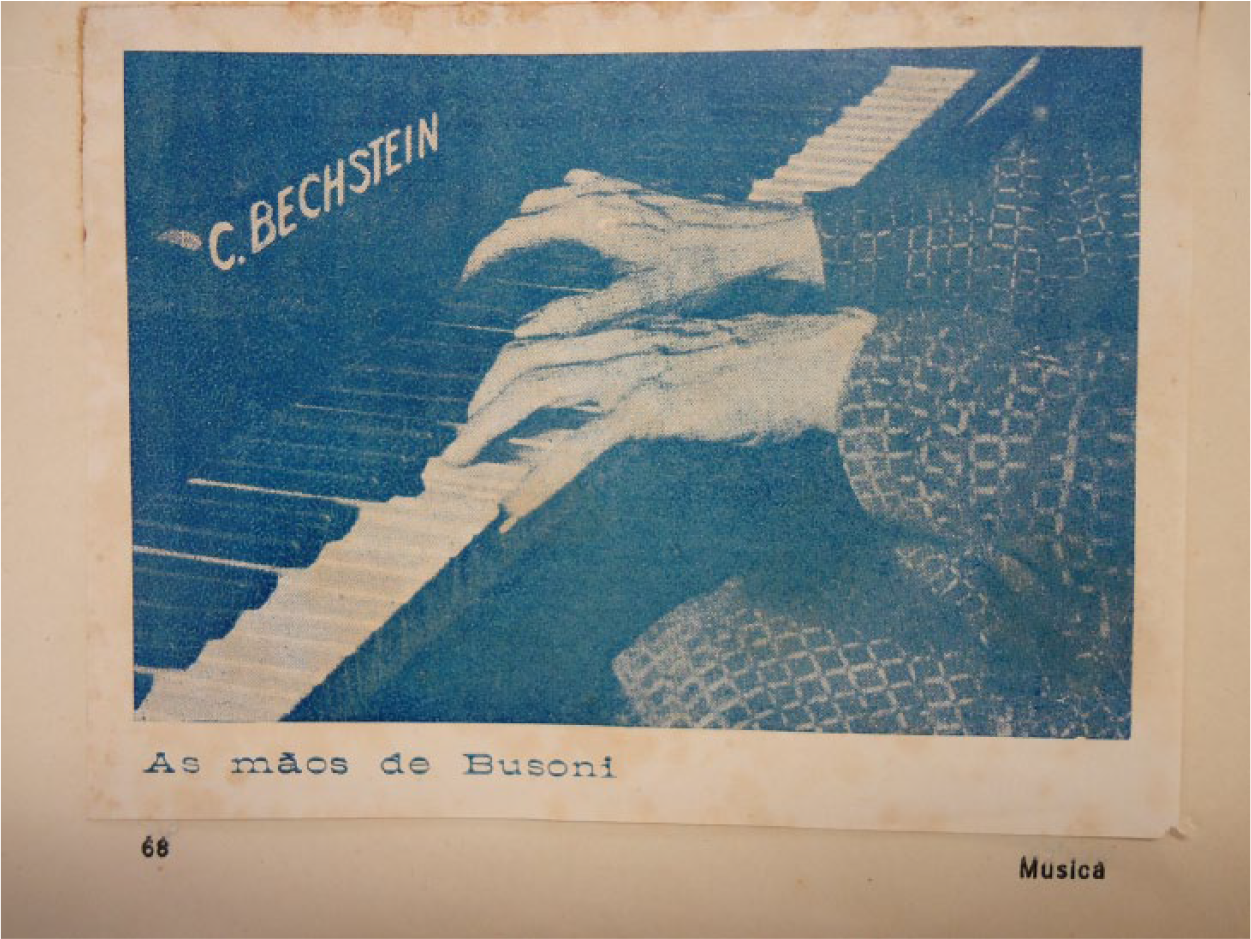
The hands of a genius 7 .
Considering that piano teaching, at its highest level, was conducted on a one-to-one basis, and that the pupil generally met only a few colleagues, this was an effective way to demonstrate what his/her hands should look like and to encourage or deflate aspirations. As there was great diversity in the panoply of genius examples presented, the pupil could always find a model with who he/she could identify.
The future
Music curriculum usually mentions the best teachers and disciples. In fact, some teachers only become known because they once taught someone who later turned into a successful musician. The teacher is not necessarily more important than the student, especially in the final apprenticeship years. As an example, Figure 2 shows the pianist Timóteo da Silveira with some pupils who later surpassed him in reputation as pianists and composers. These include some of the male students, such as international piano concert performer Óscar da Silva (1870–1958), composer Luís de Freitas Branco (1890–1955) or Ivo Cruz (1901–1985), director of the Lisbon Conservatory (1938–1971) during the Estado Novo regime (1933–1974):
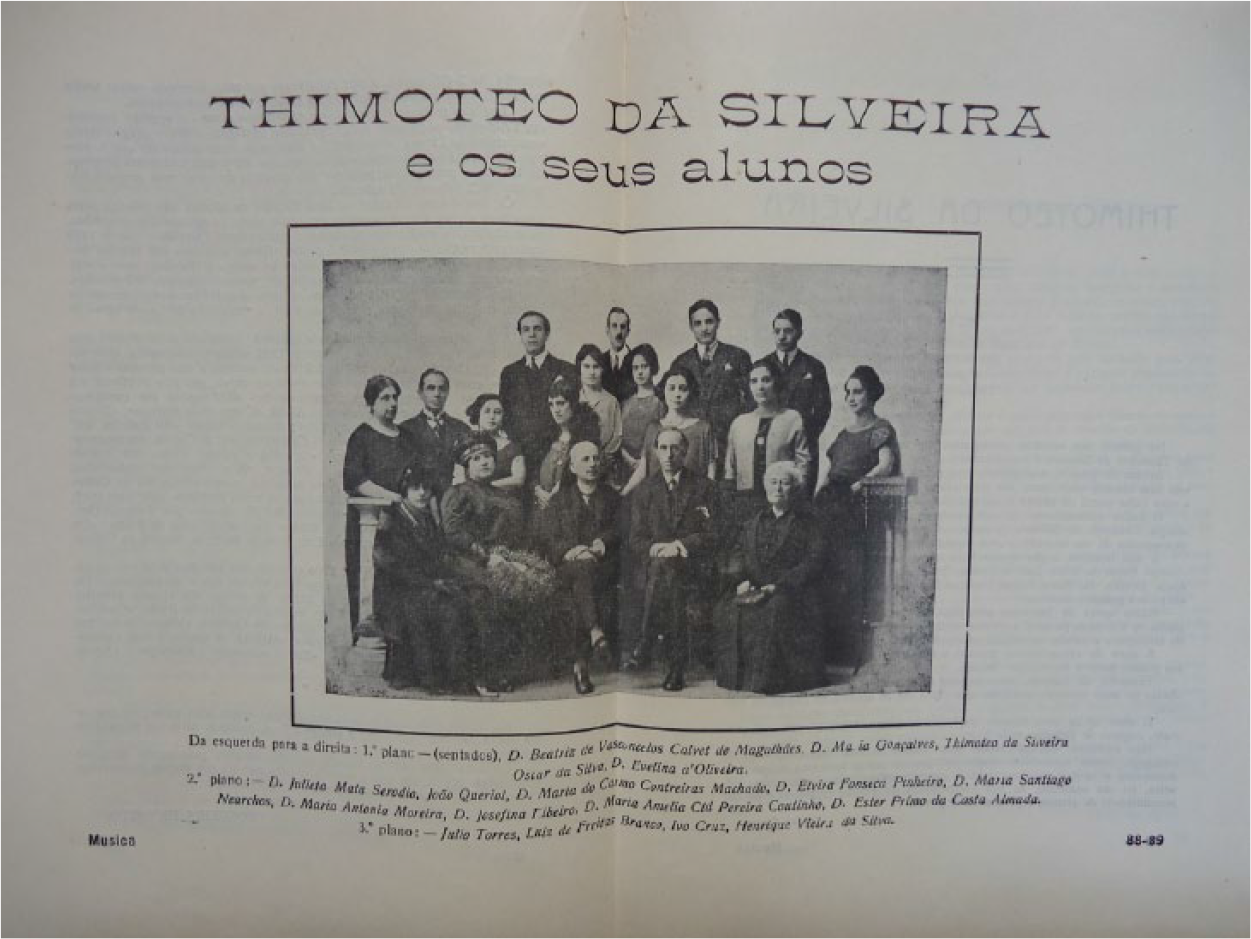
The impossibility of forecasting who will become a genius 8 .
This image made it clear to the student that no one could foretell who might become a reference musician. By eroding the distinction between teacher and pupil, or between promising and average students, this approach maximised the potential of promoting genius among pupils.
The past
While studying, all students followed a model. This model was the starting point to develop from in order to perform or compose according to his/her own rules and emotion. The model remained linked to heritage, and the pupil should become an independent authority in both music culture and repertoire. All pupils had the past as the departing point, but they should then be able to enhance and overcome their cultural heritage. That was the path to genius.
This text by music journalist Armando da Silva, commenting on the winner of the first grant issued by the Royal Conservatory of Lisbon to study abroad, allows for a broader perspective on the importance of heritage, since he starts by referring to Lacerda’s music heroes and professors, before proceeding into cultural heritage. The individual genius of the Portuguese pianist is inseparable from the national and local genius where he stems from:
Francisco de Lacerda is a son of the Azores Islands, a land where musical feeling is almost a local neurosis, where the farmers, at sundown, use their angel fingers to make the guitar strings vibrate, and where popular ditties evoke Slavic pesnya, the Magyar’s doïnas, the Vlachs’ lantars, the Serbs’ guzlars, the Alsatian rounds, all this long series of weird and wild harmonies, and there will also figure, as perhaps the best, the Italian canzoni, seguidillas habaneras and the Spanish malagueñas – he would thus have received such an opulent heritage which fully explains the undeniable virtuosity of his talent (Silva, 1895: 122).
A country’s past and its collective genius can also enable more individuals to emerge as (individual) geniuses – recognising Lacerda as a Portuguese genius also meant admitting the possibility that there might be others in the country. This depiction can also be read as an appeal to new teaching conditions, and a demand for more geniuses such as this Azorean piano player to be recognised and educated both inside and outside the country, thus extending the national heritage. This piece is the most specific example in Portuguese literature on genius-building, as it states that Portugal is just as musical as any other country, thus attesting to its musical genius (both collective and individual). It recognises the inequality of educational access in the country, but admits that in the future better and more equalising opportunities could be created.
Method of studying
In the early 20th century, pedagogues began discussing the nature of the learning–teaching process and some innovative methods were published. Choral singing and the first notation and music elements were the most pervasive subjects under this new current.
Alice Petit Pierre d’Eça, music teacher at the Lisbon High School for Girls, was interviewed by the journal Eco Musical and talked about her experience, mentioning an innovative book entitled Solfejo, by Tomás Borba. The journalist was unable to restrain from commenting: ‘I also know the book Solfejo by Tomás Borba that your excellency is referring to, and although I find it well written and splendidly deducted, I think it’s too elementary to fully satisfy the music program of a school’. For a moment, she admitted: ‘I agree’ (Anonymous, 1916: 254). This agreement did not imply a change of opinion about the book, as she continued to defend its value, but an awareness of the difference between teaching music education at high school level and in the conservatories. It meant that she recognised that excellent music performers and potential geniuses were not expected to be trained with simplified music education and a few singing lessons: they needed a more demanding curriculum, but otherwise could be taught.
The right place at the right time
A genius requires a certain number of hours to be taught, and usually needs to undergo this education from a young age, and although it was generally accepted that a genius needed very little progressive teaching, pedagogues nonetheless always referred to its importance. The right space and the adequate conditions were to be pondered on, and so were the right people who were involved in career building (e.g. teachers, promoters and public).
Since its foundation in 1835, the Lisbon Conservatory and other music schools (e.g. Academia de Amadores de Música, 1884) maintained a reward system to grant books and other musical objects to the best students. By the end of the century these institutions reorganised their reward systems, and the musical press started to publish lists of prizes and short articles, granting public coverage to model students. These were tangible achievements in the steps towards genius. Prizes gave the student a clear indication of his/her progress.
The corollary of these reward systems was the introduction of scholarships in 1895 for students from the Royal Conservatory of Lisbon to go abroad, and also this was one of the most debated policies in the Portuguese press. The opposition argued that it would reduce the chances for Portuguese conservatories to become centres for excellence, but new public policies continued to organise and frame the allowance of money that was already granted in the private sector. Further regulations tried to ensure that the students could in fact return. The hope was that they would become the geniuses of the nation.
Scholarships represented material and symbolic support for genius to reveal itself. They were only available to those who were educated properly, in the right place, and who made the right choices. This was the case of Lacerda as mentioned above. Maria da Conceição Pinheiro dos Santos, ‘a hopeful talent’, was the winner of the scholarship contest to study abroad in 1909 and one of the few women at the time to have benefitted from this grant (Anonymous, 1909). Alas, her genius was not to bear fruits: she studied in Belgium, returned to Portugal and married a famous physician, thus abandoning a promising career. Her case illustrates the social constraints of being a genius: she was renowned as a potential genius, but abandoned her concert career in favour of the demands that society made of her gender.
Concluding thoughts
The first conclusion is the void that existed between the discussion around genius and the education debate. Portuguese music professionals occupied many concurrent positions (e.g. musician, teacher and critic), which was the case in all musical fields in Western countries of this period, but in Portugal it was clear that music pedagogy expertise as a specific field of knowledge was not yet there. In this period of 1868–1930, Portuguese musical pedagogy was discussed under many knowledge fields, like History, Psychology and Medical Sciences by various opinion-makers (writers, and politicians) as well as music teachers.
Despite the absence of an expert role of a music educator, by the end of the 19th century the periodical press enabled forms of debate and consensus between several other sorts of experts who spoke about music and its learning. Their conclusions underline the power of genius as a dynamic concept, and its potential for educational purposes. Identifying the fact that geniuses had specific needs revealed, for example, that music students benefitted from having a gallery of recognised geniuses as role models. There was also a very close relationship and parallel drawn between the music pupil and master, and vice versa, which is distinct from the rest of the education landscape (e.g. the musical curriculum may recognise a teacher’s worth based on specific pupils they taught). Furthermore, the notion of genius is also drawn from social concerns about the proper institutional and pedagogical conditions in which learning should be based. Despite the common definition of genius as an unachievable level of musical excellence, in an educational context the idea of genius can be used as a goal towards which musical curriculum and educational projects should aim at.
These debates redefined the different emanations and forms of genius. The distinction between choral singing (assuming that everybody could sing), the music education delivered in primary and secondary school (implying the first music rudiments), and vocational music training (designed only for a few talented people) was increasingly clarified until the 1930s. The fact that we consider professional learning as a separate path echoes the style of reasoning and organic solutions that were embedded in the educational system forged around this time. Before that, when this delineation was still unclear, it was commonly believed that genius could and should be taught in a progressive way and according to personal aspirations. In fact, nature and nurture were considered convergent in the dynamics of genius. Pedagogical expertise tended to implement practical measures to teach everybody in each of these circumstances, dealing with the different levels of proficiency and with the final profession/activity of music learners.
This brief analysis of genius resources made me realise that speaking of genius in Portugal was not always a matter of putting it on an ideal and unattainable level, nor was it a means to support rarefied practices, as some Portuguese literature suggests. The opinions conveyed by the press, pedagogical debates and stories about geniuses, both living and dead, as much as practices of excellence and real students, gave music teachers and apprentices concrete data about the possibility of progression towards the genius. In fact, I would go so far as to suggest that genius had a democratic potential: anybody was (in theory) a potential genius. The ambiguous and contradictory narratives fully supported this promise. This means that the genius as a democratising ideal was already being used before 1945 in countries such as Portugal. This finding anticipates and expands the idea of genius democratisation advocated by McMahon (2013). The republican plans to use choral singing as a means to demonstrate national genius (inspired by French models) are testament to this potential from as far back as the beginning of the 20th century. Also, the individual genius is presented as someone who performs at the highest possible level. He/she represents an ideal that is rhetorically, politically and wishfully required of more and more people. When transported to the educational context, a genius becomes someone whose path, methods, endurance – in a word, resources – should be copied and made available in music learning within a democratised society.
The idea that genius could and should be taught formed the basis for the emergence of a yet-to-be-established expertise in musical pedagogy. It is possible that the lack of internal debate is related to the absence of a reason to discuss it. Genius and music teaching processes were taken for granted a finding that converges with the findings of DeNora (1995, 2000) and Jefferson (2014). In order to prove this thesis, further research should analyse the notions and ways of regarding genius in other European countries, where the best musicians were trained and where, in theory, the concept of genius probably involves different concerns related to local needs. In the case of Portugal, there is room for subsequent comparative studies, as the rhetoric on the question of genius is partly due to the absence of straightforward policies on music education. And yet, one question remains: around this same period, how was the notion of genius regarded in countries with a strong tradition in musical education?
Footnotes
Declaration of conflicting interests
The author(s) declared no potential conflicts of interest with respect to the research, authorship, and/or publication of this article.
Funding
The author(s) disclosed receipt of the following financial support for the research, authorship, and/or publication of this article: The author has received scholarship from Fundação para a Ciência e Tecnologia (FCT, Portugal), (PhD Grant, SFRH/BD/44621/2008). She also benefited from a financed project “From Pupil to Artist: Inventiveness, Status and Heritage in the History of Art Education in Portugal (1780–1983)” (PTDC/HIS-HEC/104504/2008) as a team member.