



Abstract
In this study, we asked four professional jazz musicians to rehearse, record, and analyze their performances. The musicians used five short pieces, composed for the study using techniques informed by pitch-class theory and inspired by discrete mathematics, as a departing point for group improvisations. The improvisations were transcribed, and the transcriptions and recordings were used during interviews to stimulate the participants’ recollections of their intentions and experiences while improvising. Analyses of the transcriptions and interviews provided insights into how experienced improvisers interact, make decisions, and share responsibility during an improvisation. We show how the participants altered and reused compositional elements, such as intervals and motifs, and how they interacted when phrasing in similar and different ways. The contributions made by this study include the development of a framework for analyzing improvisation, the description of a simplified transcription process, and the production of a recording to accompany this article.
Musical improvisation as a topic of research has attracted interest from researchers across various disciplines. Improvisation plays a more or less central role depending on the musical genre. Still, jazz embodies the very essence of personal expression, and much has been written about the development of the ability to improvise in jazz (Alterhaug, 2004; Cobussen, 2017; Hargreaves, 2012). Improvisation is associated with free creation, a way of choosing unforeseen paths instead of repeating oneself and following orders (Pressing, 1984). During a musically non-idiomatic, free improvisation, there are no given rules, and the degrees of freedom in tonality, rhythm, time, and harmonic structures provide infinite possibilities. However, when musical improvisation is situated within a specific genre or sub-genre, a more or less rigid set of rules is created over time (Johnson-Laird, 2002; Norgaard, 2014).
Many jazz improvisations take compositions as points of departure, although these are sometimes treated as subordinate to the improvising of individual performers. For referring to the elements of composition that inspire improvisation, we use the term referents, as suggested by Pressing (1984):
For example, the referent may be a musical theme, a motive, a mood, a picture, an emotion, a structure in space or time, a guiding visual image, a physical process, a story, an attribute, a movement quality, a poem, a social situation, an animal—virtually any coherent image which allows the improviser a sense of engagement and continuity. (Pressing, 1984, p. 346)
In addition to images as described by Pressing, referents include the structure of the music and its rhythmic and harmonic details, and the final performance is the result of both compositional and improvisational processes.
A central problem in exploring the relationship between composition and the musicians’ improvisation strategies is determining how musicians use referents to create their improvisations. This is difficult to achieve through objective methods. Previous research has attempted to address this by collecting musicians’ subjective accounts of their referents and how they utilize them, using a process known as stimulated or aided recall. This approach, described by Rowe (2009) and Després et al. (2017), has been applied in fields such as education, medicine, and psychotherapy. In a notable study of music, Widdess (1994) collaborated with a dhrupad singer in the transcription, analysis, and discussion of a recording of his performance. While it is time-consuming to transcribe improvised music, Widdess (1994) demonstrates that both the transcription process and the subsequent analysis can be informative.
Although jazz is an oral tradition, most contemporary jazz musicians are familiar with Western notation. Consequently, notated transcripts of the improvisations have been used as prompts for participants’ reflections. For example, Norgaard (2011) asked seven professional jazz musicians to improvise to a backing track. He made schematic transcriptions of each of their solos and used them in a process of stimulated recall (Rowe, 2009) such that they reflected on the decisions they made while playing and thus reported their intentions. Norgaard acknowledges the limitations of using retrospective verbal protocols (Ericsson & Simon, 1984) as a research method, similar to Frieler et al. (2016), who point out that retrospective verbal recall of thinking while playing is a complex task likely to be carried out by musicians with varying degrees of success.
Whereas verbal protocols can be concurrent and retrospective, research in music performance has primarily focused on the latter. Despres (2021) describes the technique of retrospective verbal protocol with subjective aided recall (RVPwSAR). Menezes (2010) studied the use of strategies in free improvisation using the MIR computational toolbox to measure quantitative data such as density and entropy (Lartillot & Toiviainen, 2007), as well as stimulated recall to gather qualitative data from participants. In a pilot study involving the participation of advanced music students who improvised to a backing track, Gulz et al. (2021) evaluated a method of categorizing the strategies reported by participants.
This body of previous research suggests that retrospective verbal protocols are useful for understanding the processes underlying improvisation, especially in jazz. Jazz musicians’ thoughts, intentions, and experiences while improvising have not yet been explored in depth, nor their decision-making strategies or, in particular, their use of referents. Hence, our study addresses two research questions concerning the role of referents and decision-making. First, which elements of a composition would participants use as referents when improvising? (RQ1) Second, how would participants interact, make decisions, and share responsibility while improvising (RQ2)?
To address these questions, the first author composed five short pieces, each inspired by the properties of one of the five axioms from discrete mathematics that define the abelian group, named after the 19th-century mathematician Niels Henrik Abel (Laudal & Piene, 2004), and pitch-class theory (Forte, 1985; Gates, 2013). The compositional process employed a free interpretation of the axioms, contrasting with stricter methods of composing based on mathematical approaches described by Capanna (2001), Fiore (2004), and Mazzola (2001). The underlying connection to mathematics provides the pieces with idiosyncratic tonal structures that serve as potential referents for the participants’ improvisations. The pieces were recorded along with subsequent improvisations by a professional jazz quartet. The recordings and transcripts of the improvisations were used to stimulate the participants’ recollection of their intentions and experiences while improvising using a retrospective verbal protocol. As a novel form of aided recall, we did this by reading the scores while listening to the recordings and allowing the participants to talk about their improvisations and suggest models for explaining their chosen strategies.
Following McPherson and Limb (2013), a richer set of such strategies can be expected when the experimental setting entails ecological validity, leading participants to regard the recording of their improvisations not as an experiment but as an opportunity to create an artistic product. To create such ecological validity in a jazz recording session, we used the concept of a work story to integrate these research questions into an artistic project:
A work story is constructed, shaped, and maintained in a system of talking, staging, performing, dissemination, and circulation as well as re-contextualization. Adjacent to the mediated story of the making of art are the stories of reception, reaction, and consequences of the work. Told and retold, these stories become a part of the work; i.e., fragments of the reception of the work are internalized in the work. (Bärtås, 2010, p. 46)
Our work story begins with the composition of five pieces of music, which provided the basis for improvisations and a conceptual narrative connecting the pieces. Furthermore, the work story includes the subsequent analyses and reflections facilitated by our application of retrospective verbal protocol. Our goal was to refine the work story gradually throughout this process, carving out connections between the elements of the compositions and improvisations as the participants experienced them.
This article is structured as follows: The “Method” section outlines the data collection process, which includes two main components: transcription of improvisations and interviews conducted using stimulated recall. The “Results” section presents the outcome of our analyses focused on our research questions. In the “Synthesis” section, the emerging improvisation strategies are summarized and categorized according to a model established in previous research by Després et al. (2017). Finally, the “Conclusion” section summarizes our findings and their implications.
Method
Participants
Four highly skilled musicians rooted in the contemporary Swedish jazz scene with extensive experience and a history of collaboration in various musical contexts were recruited for the purposes of the project: a clarinetist (50 years old), a pianist (54), a double bassist (23), and a drummer (28). All participants gave written consent for their improvisations and interviews to be recorded and transcribed and agreed to be identified by name in this article.
Compositions
The tonal landscape of the five pieces differed from that of conventional jazz. They were all based on the 12 chromatic notes. Each note was assigned a number, starting with C = 0 and ending with B = 11, forming the following set of numbers:

As most of the music was planned to be played rubato, the rhythmic notation was subordinate to the pitches and primarily featured half-, quarter-, and eighth notes.
Compositional process
Axioms 1 (Closure) and 4 (Inverse) exemplify the compositional process by highlighting how the chromaticism and intervals they produce differ from those typically found in jazz improvisations. To keep our descriptions accessible, we have opted for straightforward language over complex mathematical set-theory terms as much as possible. Each composition is uniquely linked to one of the five axioms. The scores of the remaining three pieces, accompanied by brief commentaries, are presented in the Supplemental Appendix.
Axiom 1: closure
Axiom 1 states that if two numbers a, b∈G, then a*b∈G, where * represents a binary operation. Thus, for two notes belonging to the set G, the result of the operation * is in the same set. We used multiplication as the operator and limited the choice of two subsequent notes, an and an+1, to those pairs of notes that fulfill the condition

This restriction was introduced to keep the notes within their designated octave (C1 to B1). Figure 1 illustrates the compositional principle derived from Axiom 1.
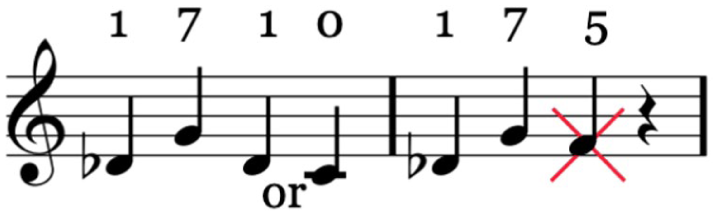
Axiom 1 (Closure). Compositional method: possible choices after the first two notes (first measure) and a choice excluded by Equation 2 (second measure).
The secondary melody, performed by the double bass and the left hand of the piano, adhered to the same guidelines as the primary melody but introduced contrary motion and dissonances. If D♭ (= 1) is designated the first note, then all the notes in set G are possible choices as the second note, a2, because a2*a1 ⩽ 12 for all a2∈G. However, if G (= 7) is designated the first note, the choices are restricted to D♭ (= 1) or C (= 0). Consequently, this interpretation of Axiom 1 produces melodies characterized by large ascending intervals followed immediately by a large descending interval. The final piece is shown in Figure 2.
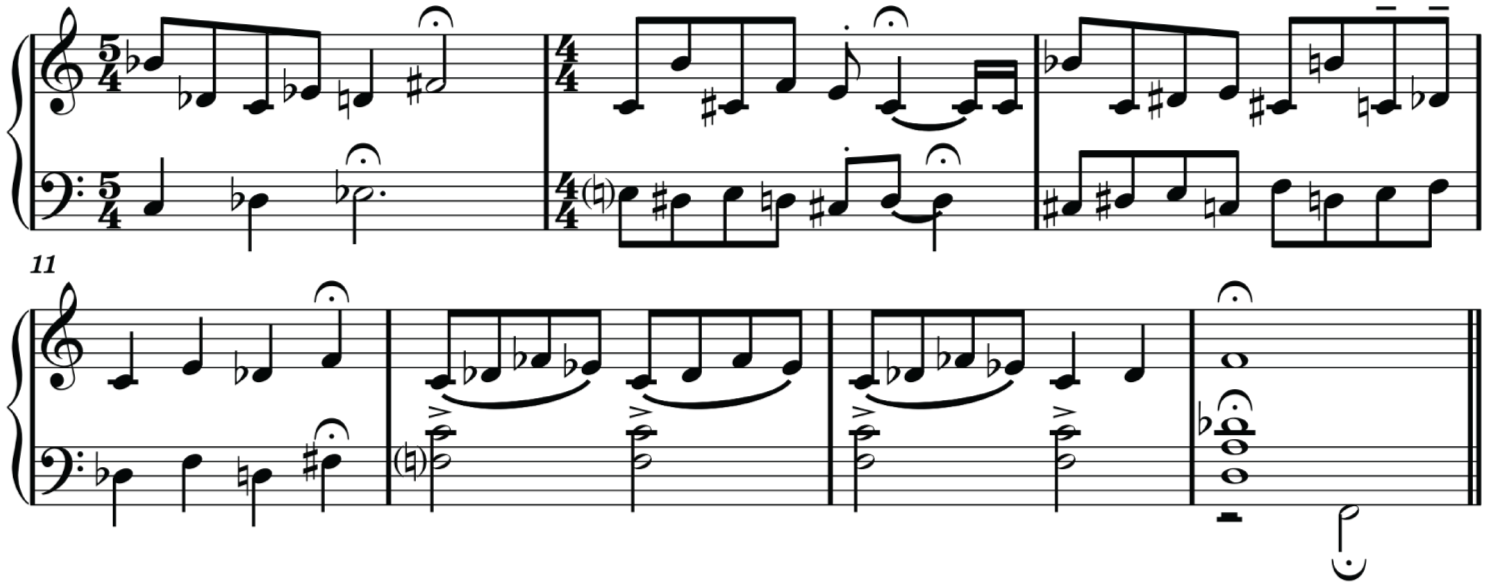
The final composed piece uses Axiom 1 (closure) (
Axiom 4: inverse
Axiom 4 states that for each element a∈G there exists an inverse element b∈G such that a*b = e = b*a, where e is the identity element. Here, the note C was used as a departing point for the melody and served as the identity element. In each subsequent pair of notes, the first note was selected without restriction, while the second note was restricted to the inverse of the first. Consequently, C functioned as a mirror, as shown in Figure 3.
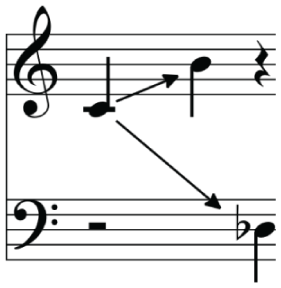
Axiom 4 (inverse). Compositional method: C is used as a mirror.
This approach was maintained throughout the entire piece with the flexibility of allowing octave transpositions; see Figure 4. The prominent elements of the piece include extensive leaps creating unique sounds and chords, with the piano utilizing the sustain pedal. Furthermore, high-pitched chords were juxtaposed with mirrored low-pitched chords, contributing to the piece’s distinctive characteristics.
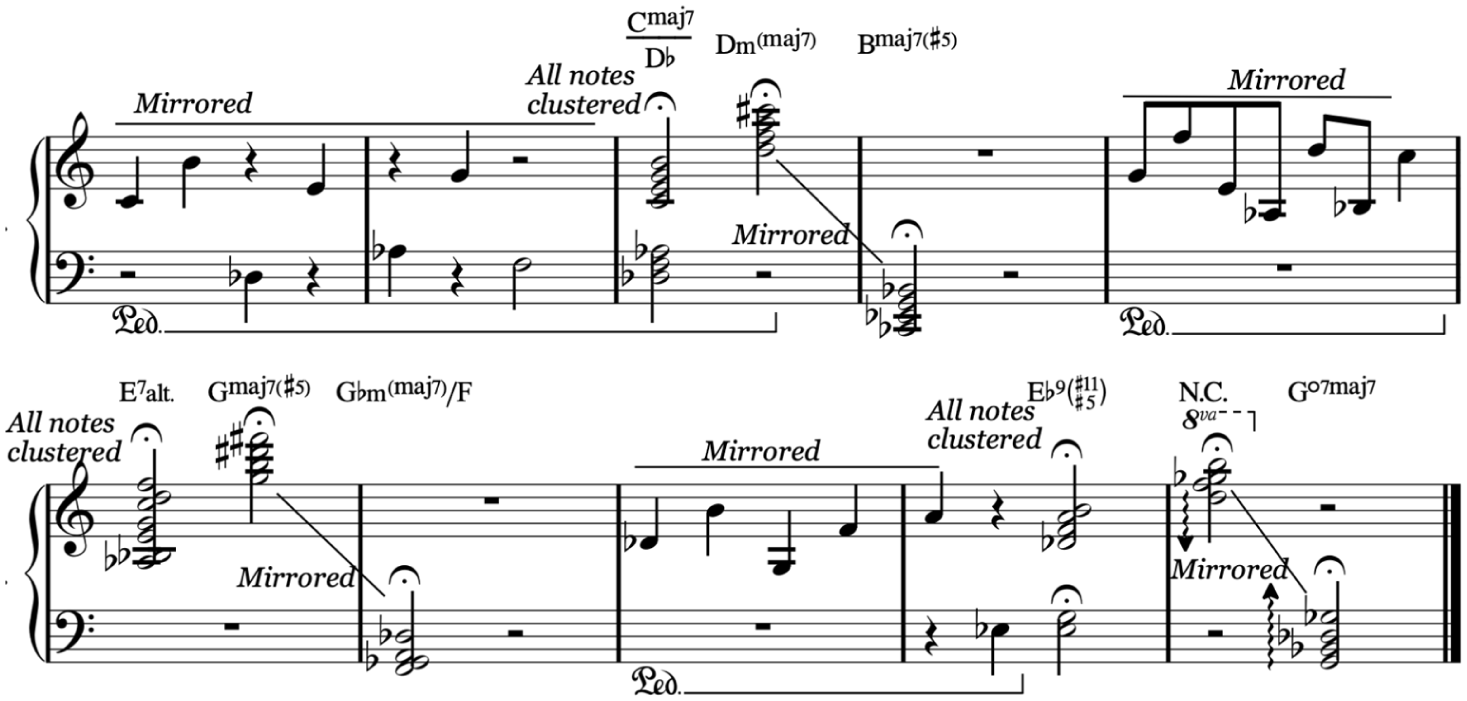
Axiom 4 (inverse) (
Procedure
In this study, the researchers employed a four-step method to delve into the relationship between composition, improvisation, and interaction. These steps involved (1) recording group improvisations, (2) the first author transcribing the improvised music, (3) conducting interviews using these transcriptions as a foundation for discussion. Finally, (4) the interviews were transcribed and analyzed. This section describes the four consecutive steps of our method in the order they were implemented.
Data collection 1: group improvisations
The sessions were recorded in a professional studio environment in October 2019 at the Royal College of Music in Stockholm. The bassist and the drummer were placed in separate rooms to prevent sound leakage, while the clarinetist and the pianist shared a recording space separated by sound-absorbing material. The entire session was also documented using a stationary camera, primarily focusing on the movements of the clarinetist, the pianist, and the drummer.
Before the recording session, the first author provided a brief overview of the background story of the music, including the life of Niels Henrik Abel and the connection to the mathematics behind the axioms. This reference to a non-musical context aimed to provide a broader perspective on the improvisations and the overall work story. The interpretation of compositional methods was simplified and expressed in more musical terms. Regarding “Closure,” the explanation was that the notes were not allowed to leave the octave. In particular, the notes C = (0) and D♭= (1) acted as reset notes, as shown in Figure 1. The concept of “Inverse” was explained by showing the mirroring using note C as the midpoint.
Group improvisations followed each composed axiom while performing/recording in the studio. No specific guidelines were provided regarding musical style or form for the improvisations, except that each piece would be approximately 3 minutes long. Specifically, there was no instruction to follow the pieces’ melodies or draw inspiration from them while improvising. For some axioms, the piano part was based on basic harmony or form inspired by the piece. For example, in Axiom 4, the improvisations followed the structure of the composed part as the pianist outlined the melody and the harmony derived from the melody notes, see Figure 5. Thus, the improvisations in this axiom were not entirely free, but the predetermined structure was not communicated to the other participants before recording.
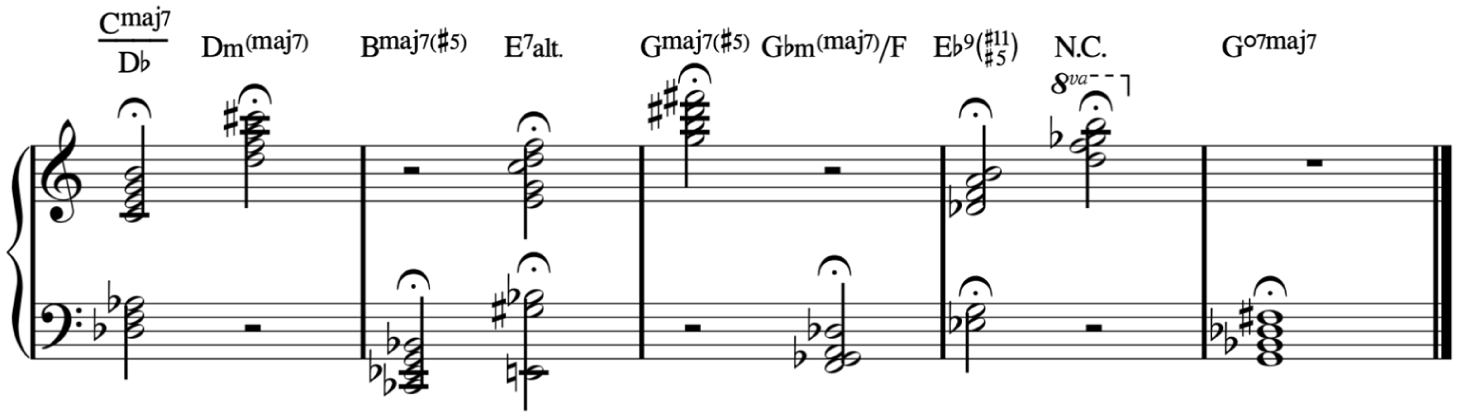
Chord structure during the improvisation of Inverse.
Since most of the music was performed rubato, the musical interpretation was guided by visual signals from the clarinetist. The entire studio session lasted 3 hr, encompassing both rehearsal and recording. This is a timeframe consistent with typical recording sessions for jazz groups in our specific, local context. For most axioms/pieces, only a single take was needed to obtain a satisfactory version. In cases where multiple takes were recorded, such as Axioms 1 and 5, the participants collectively made decisions about the final version after the recording process.
Data Analysis 1: transcription of group improvisations
Our objective was to transcribe the recorded music into Western staff notation, given that most jazz performers are familiar with this notation format for both composition and performance. To analyze the recordings, we uploaded all the WAV sound files into Logic Pro X. We used the Flex Pitch feature in Logic Pro X to transcribe the clarinet and bass notes, as shown in Figure 6. This function provided a helpful starting point for the transcription process. All the following examples are from Axiom 1—Closure, see Figures 6 to 9.
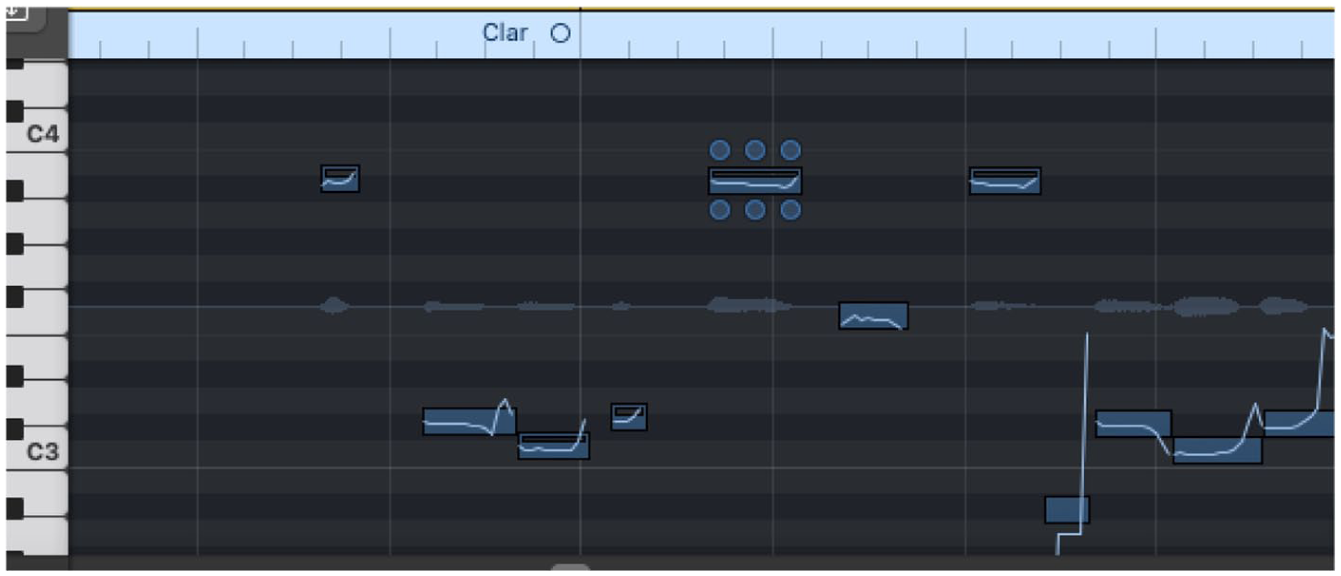
The beginning of the transcription procedure using Flex Pitch in Logic Pro X (clarinet)
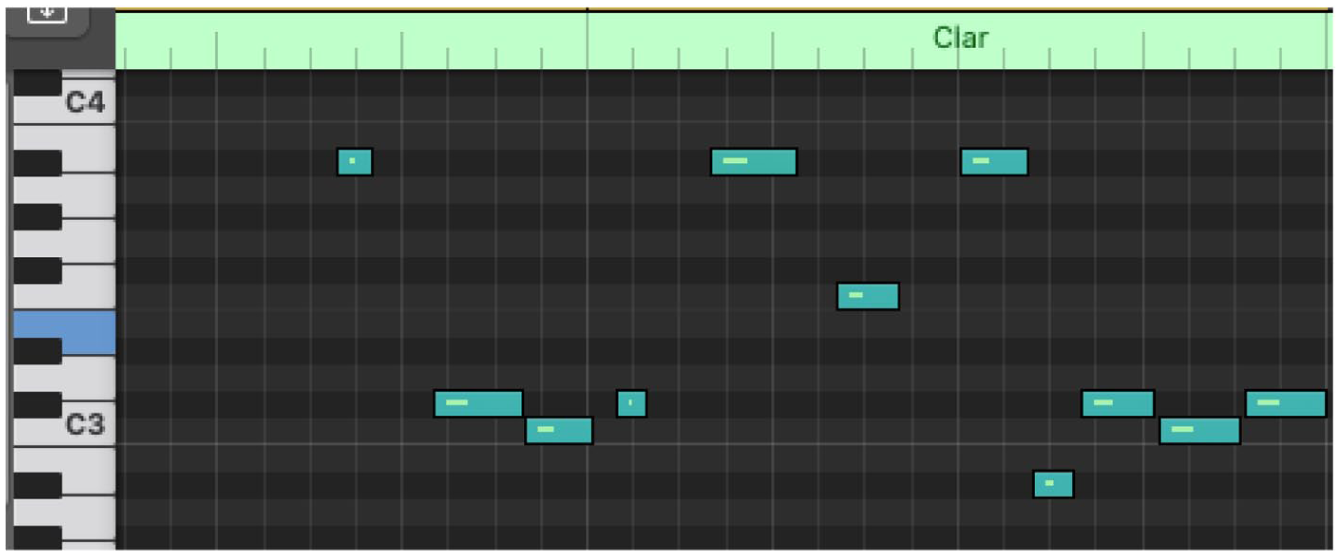
Creating MIDI Track from Flex Pitch Data in Logic Pro X (
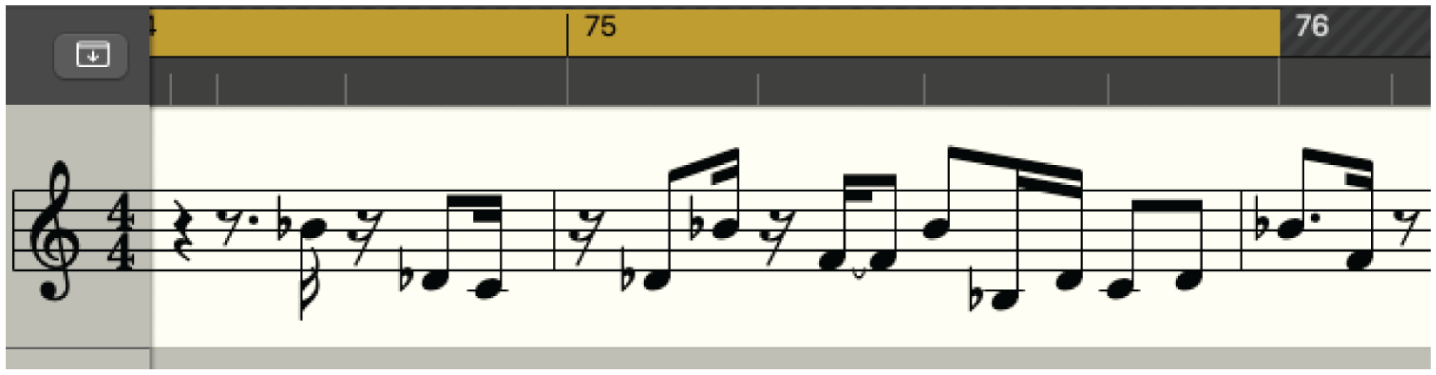
Controlling the transcription in the Score Window of Logic Pro X while listening to the audio (

Transferring music to Sibelius Ultimate (
The next step involved converting data from the clarinet and the bass track into separate MIDI tracks by using the function Create MIDI Track from Flex Pitch Data in Logic Pro X, as shown in Figure 7. Transcribing the piano was more complicated due to its polyphonic structure. Single melodic lines were transcribed in a similar way to the clarinet and bass, while chords were manually transcribed by ear. The drums were manually transcribed and only represented schematically.
The piano roll feature in Logic X was instrumental for closely examining the transcribed music. By playing the original audio file alongside a synthesized version generated from the piano roll, we were able to precisely adjust the timing and length of each note. It was also easy to identify and erase inaccurately transcribed notes . After reviewing the notes in the piano roll window, we transitioned to the score window, as shown in Figure 8.
Given the rubato performance style, there were no distinct downbeats to relate to in the music. Consequently, the bars were adapted to the phrase structure of the music depending on the instrument in focus. We created an adapted metrical grid aligned with the beat when the tempo was easier to discern. Since all instruments—except the clarinet and the piano—were recorded in separate rooms, the analysis was facilitated using separate audio files. The sound leakage between the clarinet and piano did not pose significant problems as these instruments were relatively easy to identify in the audio file.
The final step involved manually transferring the score to Sibelius Ultimate to obtain an improved score formatting, as shown in Figure 9.
This formatting process was afflicted with some problems concerning time accuracy as readability was prioritized. A critical concern was comparing onsets between instruments, as seen in Figure 10. Aligning all instruments in time required manual adjustments concerning the metrical grid to create a comprehensive overview, aiding in conducting the interviews. Since most of the music was played rubato, subjective decisions were occasionally made regarding which instrument would define on-beat and off-beat.
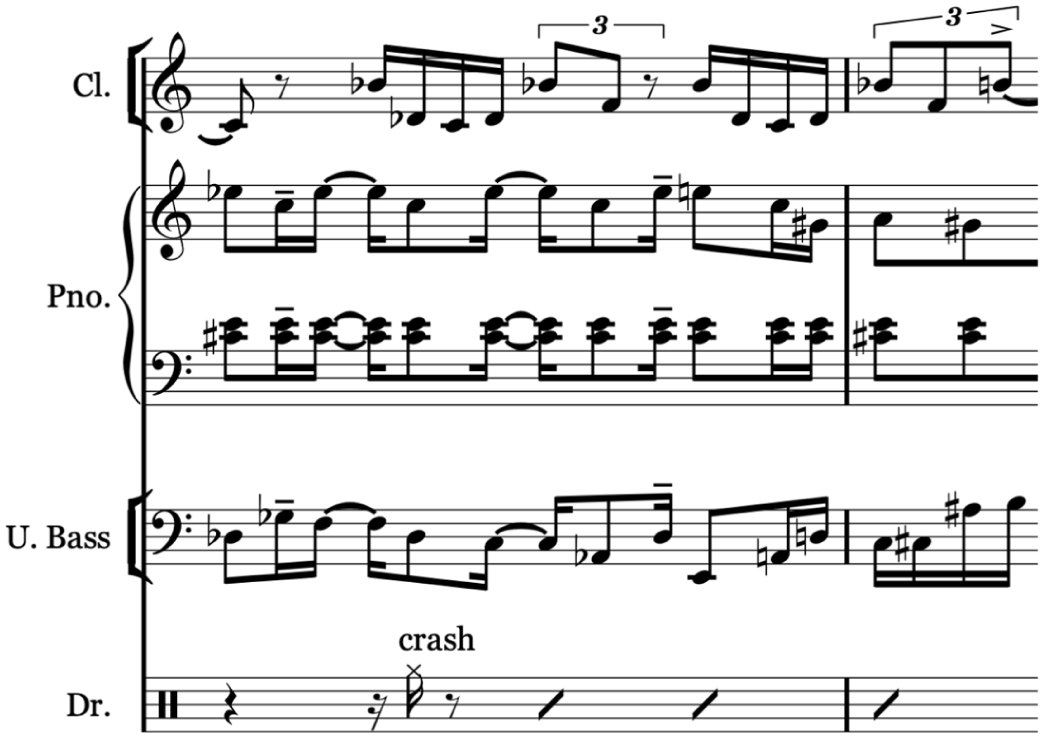
Excerpt from the final score representation in Sibelius (
Data collection 2: interviews
Our method of gathering information from participants, combining interviews with the analysis of previously recorded material, aligns closely with Jean Philippe Després’ concept of retrospective protocols following a comprehensive product analysis (Després, 2021). Hence, our approach integrates two perspectives on musical performance: one involving the transcription and analysis of group improvisations (Data Analysis 1) and the other delving into detailed discussions about how participants describe the emerging discoveries (Data Analysis 2).
The transcription from Data Analysis 1 served as supporting material for interviews and reflections conducted with the participants. Semi-structured interviews were conducted individually with each of the three participants online by the first author and recorded using the Zoom video-conferencing platform (Archibald et al., 2019). Each interview lasted approximately 2.5 hr. The initial questions centered on the participants’ connection to the work story (Bärtås, 2010) and on how elements drawn from the pieces inspired or influenced the improvisation (RQ1) (see Supplemental Appendix). These questions were posed after the participants had listened to the axioms/pieces without viewing the score. For discussions covering more intricate matters related to interaction, improvisation strategies, and decision-making (RQ2), a video that combines score and audio was employed following a stimulated recall structure (Rowe, 2009), as seen in Figure 11.
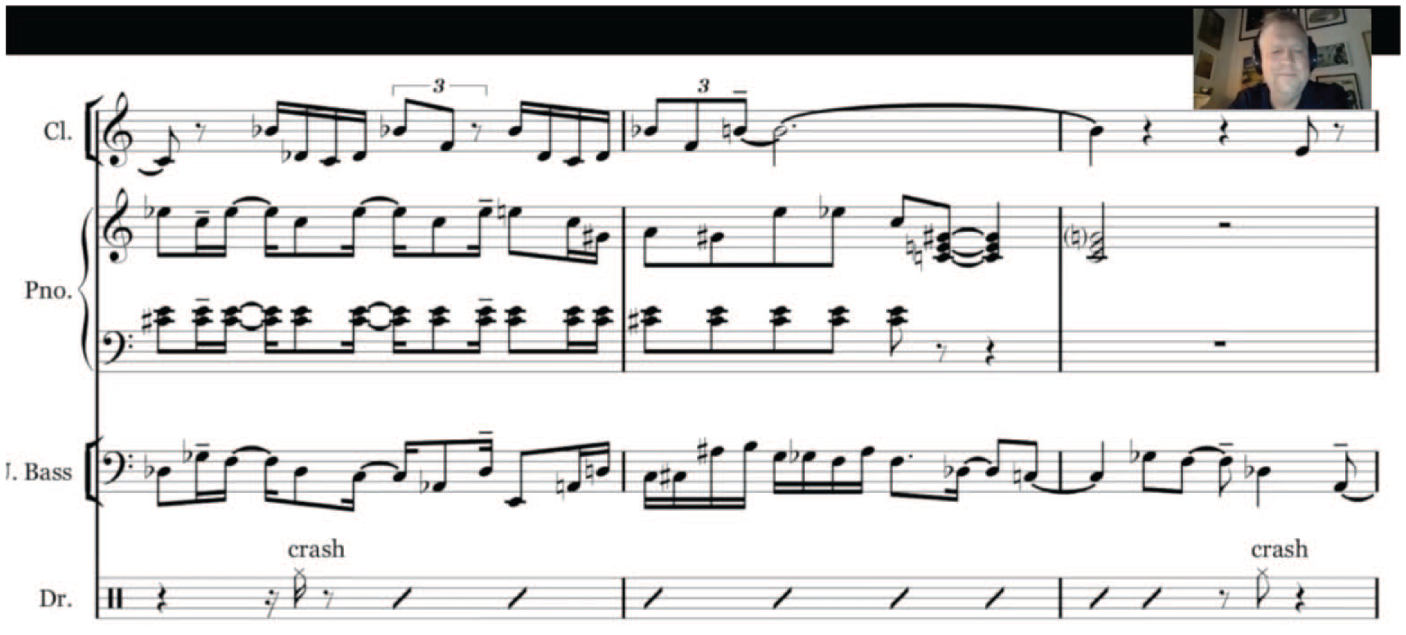
Interviews using Zoom, watching the score synchronized with the audio and mixed in a video (stimulated recall) (
Subsequently, a supplementary Zoom interview session was conducted, focusing on detailed follow-up questions posed to the clarinetist. These questions were motivated by the discussions from the initial interview session. This follow-up interview lasted 3 hr.
Data Analysis 2: interview data
The interview audio files were compressed into MP3 format and automatically transcribed using the online version of Microsoft Word. Afterward, the first author reviewed and edited the transcriptions, identifying sections relevant to the two research questions, that is, the relation between composition and improvisation and, secondly, the interaction between performers. The following section will analyze these identified interview sections, with the analysis following the structure of the five pieces derived from the Abelian axioms. At the end of that section, the strategies discovered in this study are collected and organized systematically.
Results
In this section, we will explore the relationship between composition and improvisation (RQ1) as well as specific aspects of the participants’ roles (RQ2). Results will be illustrated through excerpts from the music transcriptions along with related audio examples. To capture the potential specificity of each axiom, we will present results for each axiom individually and summarize our findings in the Discussion Section. This analysis predominantly focuses on the insights and the analysis by the pianist (first author) and the reflections shared by the clarinetist obtained during stimulated recall sessions. This focus can be partly attributed to the clarinetist’s significant experience in leading musical events and the clarinet’s role as the primary melodic instrument in the ensemble.
Axiom 1: closure
The uniqueness of the melodic elements in this piece emerges from the combination of chromatism, large recurring intervals, and the predominant use of C and D♭ as pitches. The clarinetist characterized the music as having an atonal quality yet within a melodic vein, coining it “lyrical atonality.” The transition from the melody into the improvisations featured a Dm(maj7)/F chord, defined by both a minor sixth and a major sixth, making it initially challenging to identify.
Clarinetist: There is this intriguing minor sixth out there wandering [sings a minor sixth]. It feels like a very cool, pleasant sound with a subtle touch of harshness. . . . I had the option to jump into improvisation right on that chord, but it spontaneously invited me to pause, listen, and anticipate how we should progress in the music. I chose to listen.
Instead, the bassist and the drummer used the composed material as their departure point for the improvisation. The drummer continued to mimic the eighth notes from the melody while the bassist joined in, playing fragments at a significantly slower tempo, see Figure 12.
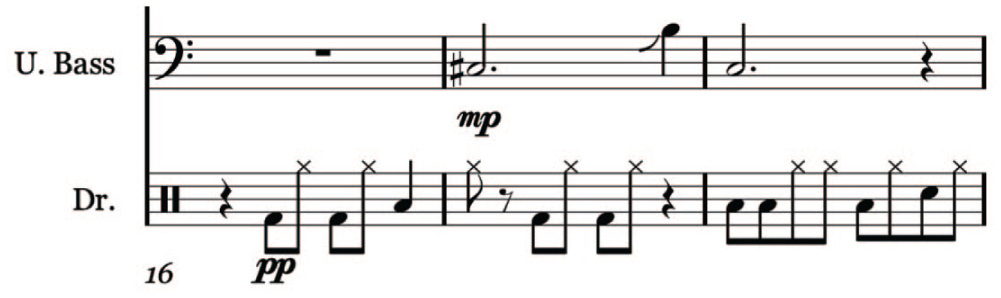
Closure, the beginning of the improvisation (bass and drums, bars 16-18) (
Drummer: It feels like I was trying to stick to different [pause], what to say, melodic or pitch motifs. Yes, I imitate the melody [singing the theme again].
In bars 25–27 (Figure 13), a phrase features two staccato notes (highlighted in red). The clarinetist selects a large interval (C-B) derived from the melody (bar 2, see Figure 2), while the bassist adheres to notes from the beginning of the melody’s bass line. Although the melody influenced the note choices, introducing staccato notes became a novel idea, quickly spreading through the group, injecting energy into the improvisation. In bar 26, a chain reaction starts with the rhythmic cue from the drummer—passing to the clarinet and ending up in the bass. The rapid large interval played by the clarinetist in bar 25 likely triggers the impulse, a move he attributed to being inspired by the distinct sound of the cymbals.
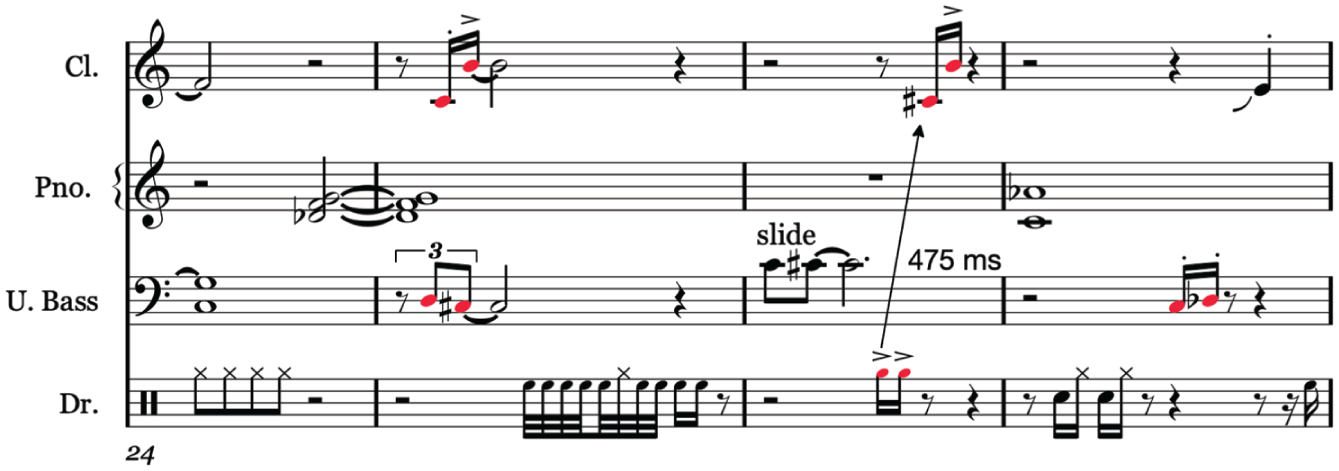
Closure (bars 24-27) (
Starting from bar 28 (Figure 14), the clarinetist abruptly changed the direction of the improvisation again, abolishing the influence of the melody, when he created a brief tonal platform in C♯-minor. However, in bar 29, the pianist introduced chromatic voicing, causing the clarinetist to shift to the quartal chord, ascending by a minor second:
Clarinetist: It creates a rest on C♯-minor, inviting you [the rest of the group] to contribute. You get a space allowing you to engage in something. The pattern would have been completely different if I had been active in this section.
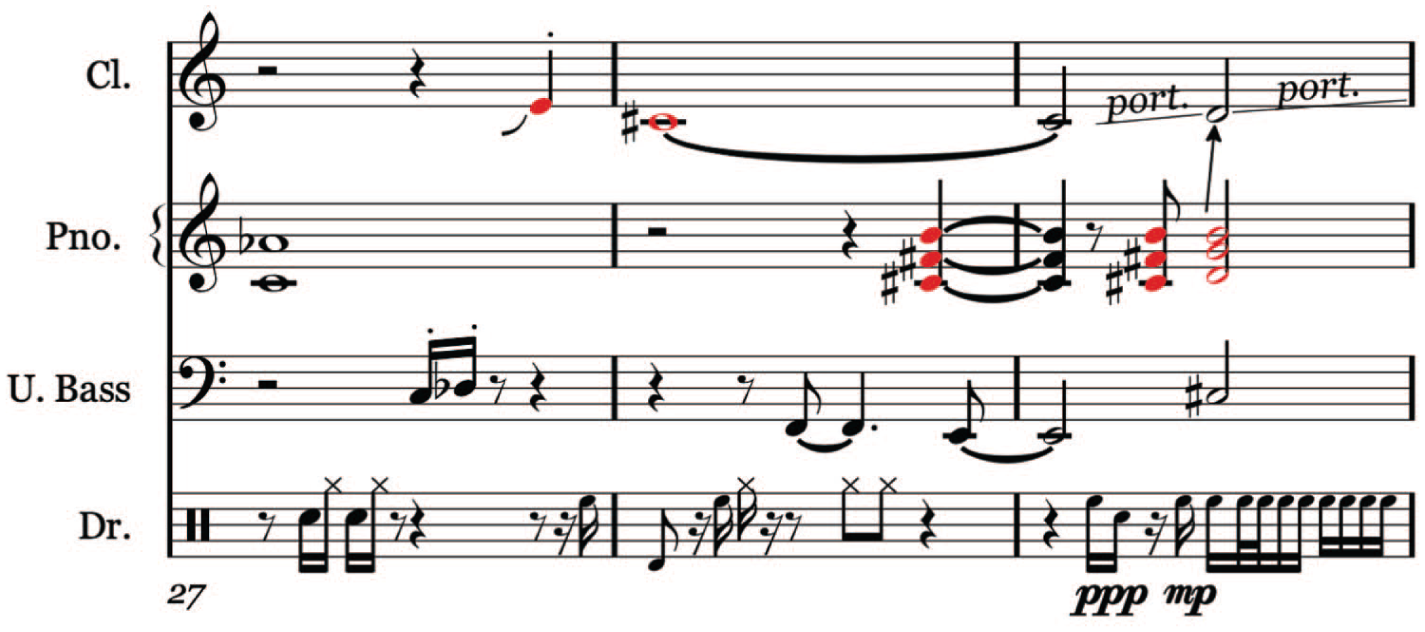
Closure, improvisation (bars 27-29) (
In bar 33 (Figure 15), the bassist suddenly added energy by delivering a powerful ascending phrase. For a moment, the musical exchange resonated with distinct voices. During this time, everyone except the clarinetist steered the improvisation away from melodic referents. Meanwhile, the clarinetist crafted an ostinato based on three notes from bar 4 of the melody, as shown in Figure 2. The clarinetist explained, “I play a loop parameter to create a contrasting element. Then, the rest of you respond or interact with this loop, which is very nice.”
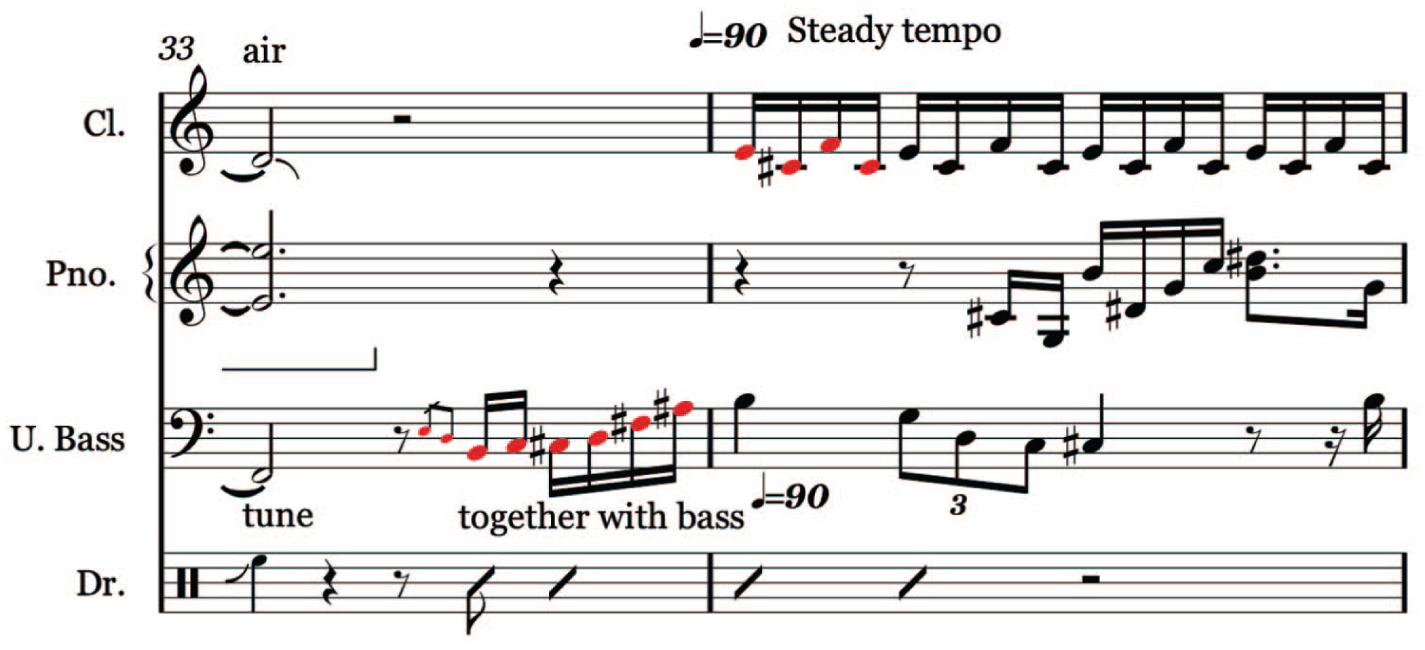
Closure, improvisation (bars 33-34) (
Later, in bar 38 (Figure 16), the bassist suddenly burst out again, playing a very high and intense phrase. However, the clarinetist and the drummer promptly responded to the outburst this time, with the clarinetist almost mirroring the bassist’s performance.
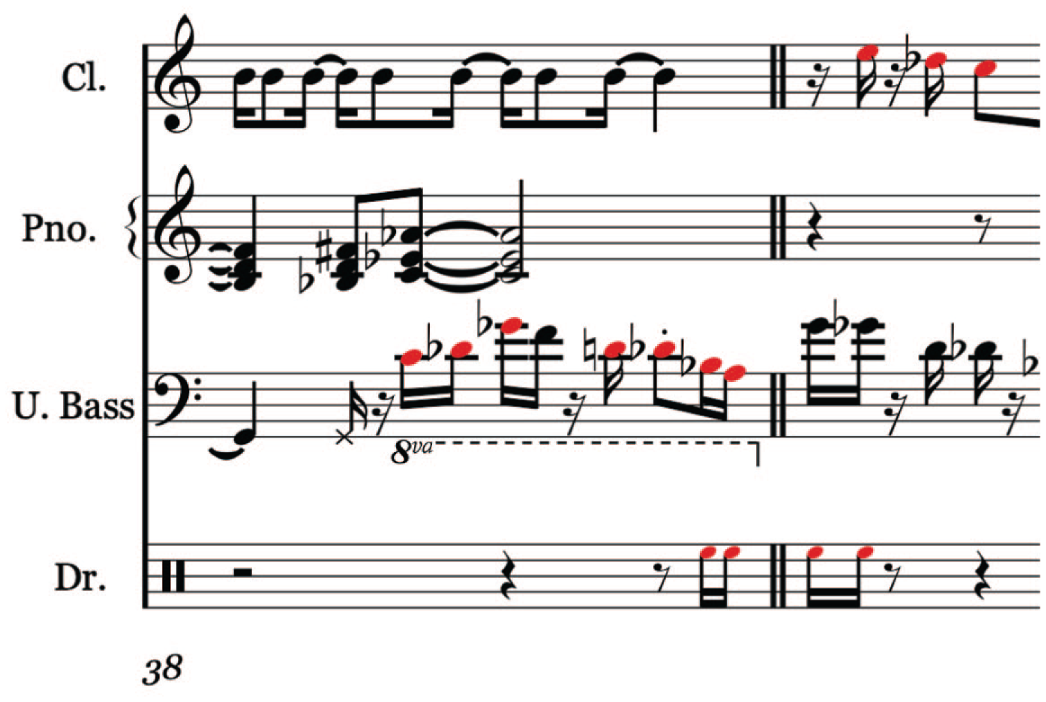
Closure, improvisation (bars 38-39) (
In bar 40 (Figure 17), the clarinetist reconnected to the piece’s melody, incorporating its most characteristic notes (B♭-D♭-C). The remaining three participants were involved in intense interplay where the pianist and the bassist performed an almost identical complex rhythm in precise synchronization.
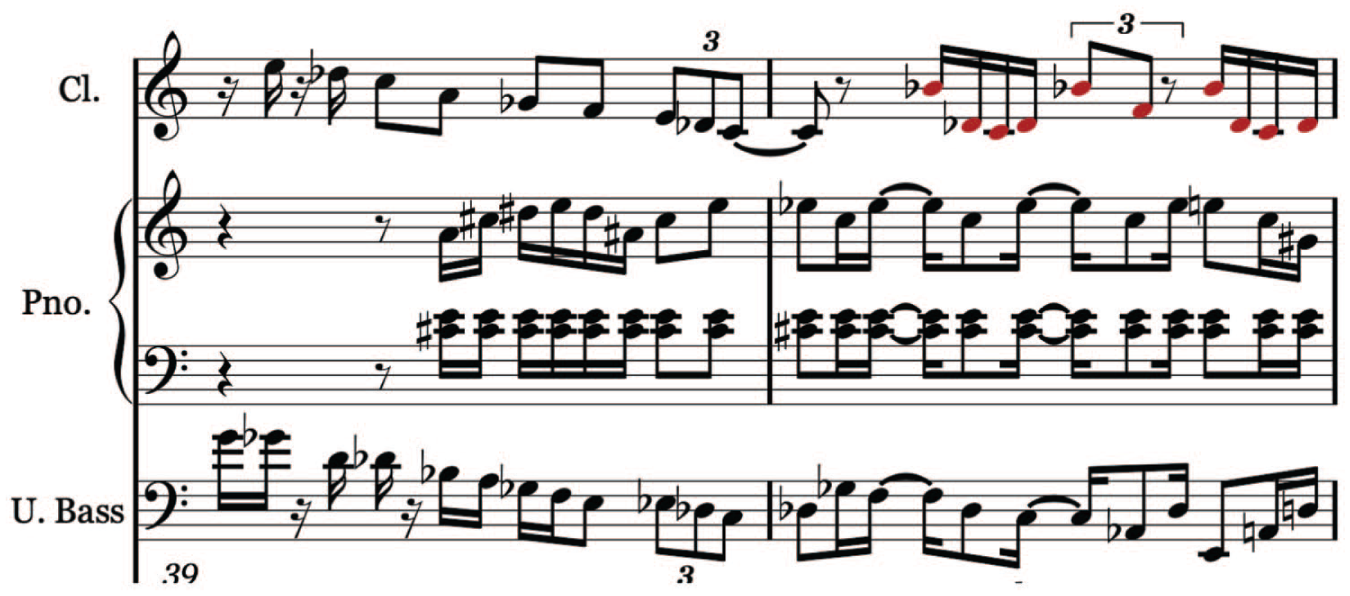
Closure, improvisation (bars 39-40)(
After bar 45, the performance appeared to have concluded; see Figure 18. However, the bassist continued playing by rejoining the melody line in bar 5 of the composition, as highlighted by the red-colored notes in Figure 18. Notably, this reintroduction also introduced a steady tempo for the first time.
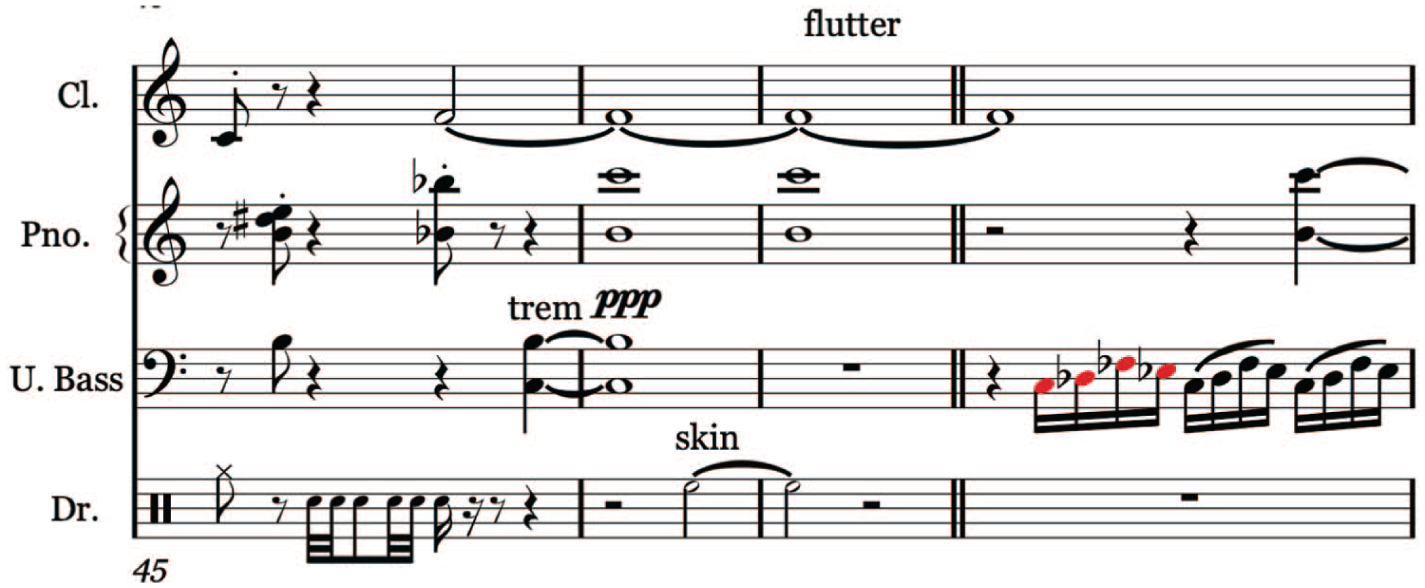
Closure, improvisation (bars 45-48) (
The initiative of the bassist resulted in a short coda played in tempo, during which the clarinetist introduced an unrelated melody, see Figure 19.
Clarinetist: We had the option to incorporate or exclude this concept from the final version, but utilizing it proved intriguing. Normally, such a deviation might disrupt the musical structure, yet in this context, I don’t view it as disruptive; rather, it takes on the role of a coda, transforming the piece.
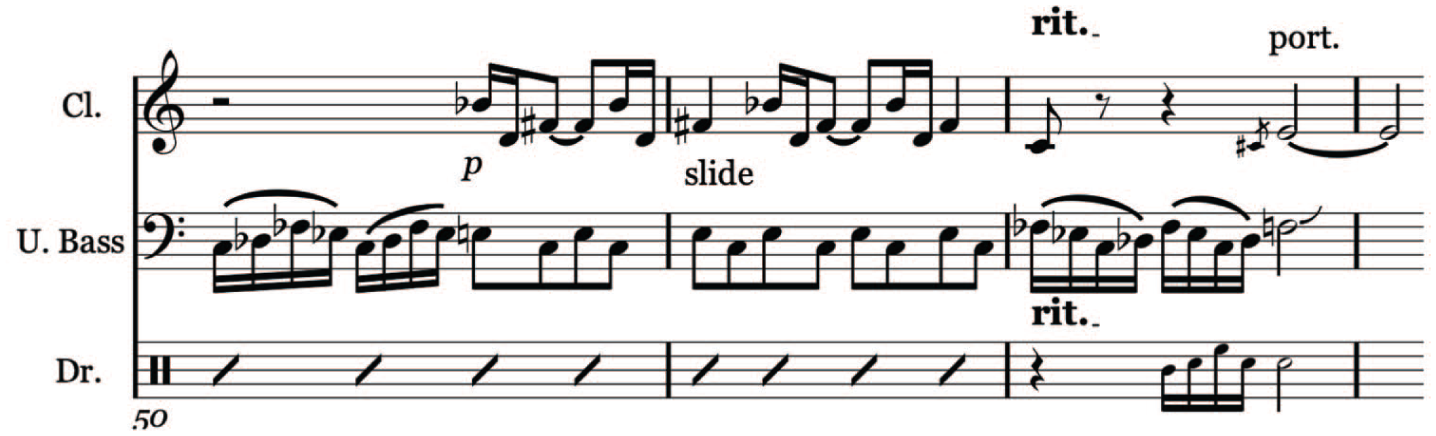
Closure, end of improvisation (bars 50-53) (
Axiom 2: associativity
Associativity is based on a Phrygian dominant scale. However, incorporating notes outside this scale through superimposed triads occasionally leads to a polytonal sound, see Figure 20. The pianist outlines the form, playing rubato, thus constraining the room for free improvisation. The dynamic forte and the polytonal chords created dramatic content, up to the final F♯-minor chord that was played very softly. The clarinetist chose to stay closely aligned to the melody, whereas the bassist took great rhythmic liberties during the improvisation.
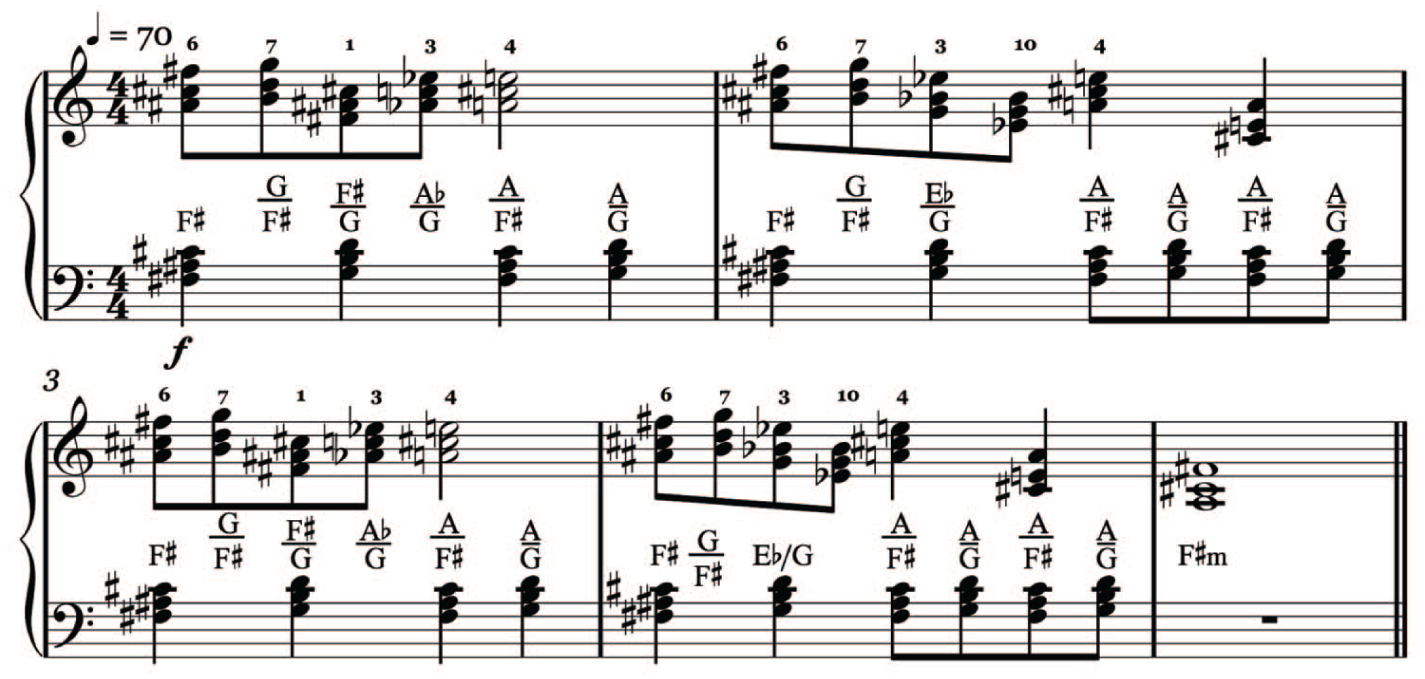
Associativity, piece (
Clarinetist: It [the music] pumps on in this tonality, certain sounds, and at times, I find myself wondering: How should I diverge from this pattern?
He then moved on to reason about possible strategies:
Clarinetist: Music, for me, heavily relies on associations, and here I immediately get some kind of Phrygian (pause), but now (while listening), I get a different view of the whole thing. There’s a D♯ towards the end that grabs the music. I mean, I’m quick to scan that; it contributes to a character, a feeling. I know where I am going, whether I play with or against [the music]. If you . . . explore possibilities beyond the scale and find other modalities or tonalities, this is a challenging balance, but it is possible to go outside in an abstract way. Utilizing abstract sounds in the instrument is also a way to play outside.
He returned to the importance of being true to the ideas of the composition:
Clarinetist: I believe there’s a romantic element to improvisation. It invites you to truly listen to the music rather than just focusing on the sheet music. Although the composition provides essential guidance, it’s important to both engage with the written music and allow yourself some freedom.
In bars 12–14 (Figure 21), there is a lot of activity, especially in the bass. The clarinetist stated the importance of creating a voice of his own, distinct from the sounds and lines produced by fellow participants:
Clarinetist: I might be considering an additional layer here, specifically a tempo layer. I’m seeking a certain elegance and conviction. Again, my goal is to introduce contrast in the music. Where there’s a lot of activity, I might adopt a more singable role, allowing me to play in a cantabile style amidst the chaos.
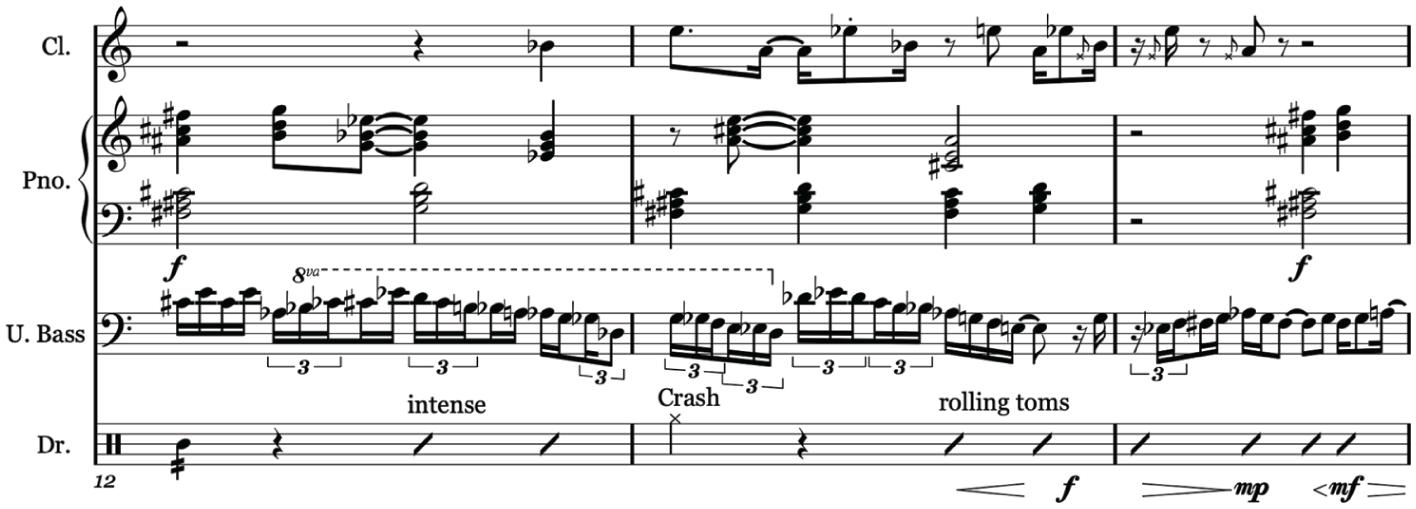
Associativity, improvisation (bars 12-14) (
To better grasp the clarinetist’s explanation, a helpful approach was to introduce a separate tempo layer, demonstrated in Figure 22. This visual representation simplified the understanding of his phrasing. Yet, synchronizing multiple tempo layers in the score proved to be a complex task. Therefore, it was practical to establish a shared tempo linked to time, exemplified in Figure 22, bar 13.

Associativity, improvisation (bars 12-14), another tempo-layer (
Employing an idiomatic playing style adds fresh sounds and provides opportunities to explore tonal or modal elements secondarily, as in Figure 23, where the clarinetist incorporates multiphonics and false fingering techniques.

Associativity, improvisation (bars 21-23) (
Toward the end of Associativity, the clarinetist took the lead, reintroducing the melody using minor thematic variations with a consistent set of notes. He also indicated a ritardando signaling the end of the improvisation, as seen in Figure 24. Reflecting on this moment, the clarinetist remarked, “Here, I exert significant control; I pull some kind of brake.” Although the clarinetist’s alterations to the melody toward the end might initially seem like a personal interpretation, a closer examination reveals how these nuanced changes introduced fresh elements to the composition, see Figure 24.
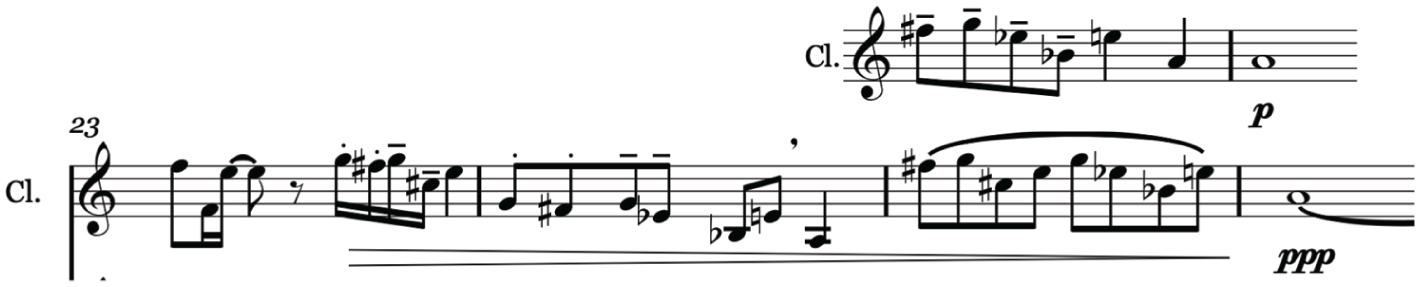
Associativity, improvisation (bars 23-26), original melody on top as a reference (
Axiom 3: identity
Clarinetist: We weave jazz clichés into the material, creating a feel that isn’t quite abstract but leans heavily into atonality. Mastering atonal playing is quite challenging—it’s all too easy to disrupt the atonal vibe, yet I believe we managed to maintain it. I’ve long strived to capture an atonal essence, not through theory but through intuition and emotion [pause], or maybe here I got the information from the score. At the same time, the musical phrases I produce seem to naturally arise from within myself . . .
When examining the improvisations by the clarinetist alongside the piece’s melody depicted in Figures 25 and 26, it becomes clear that melodic references are present. However, the change in melodic rhythm complicates this connection, making it less immediate and challenging to perceive audibly.
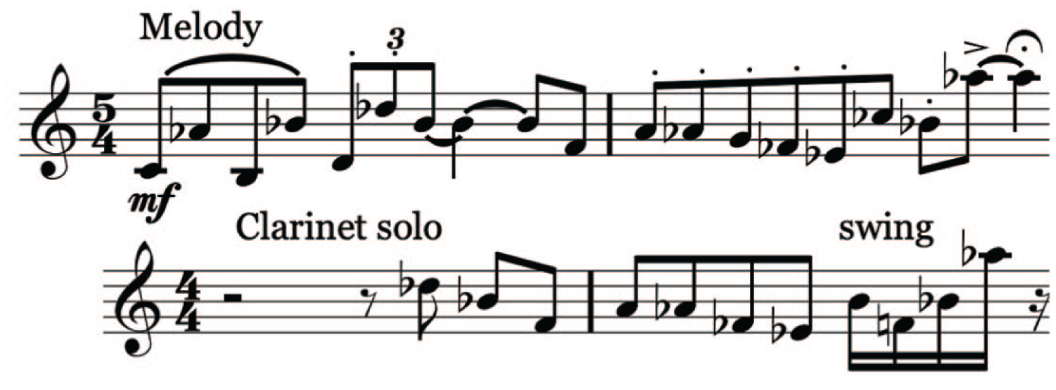
Identity, improvisation (bars 22-23) (
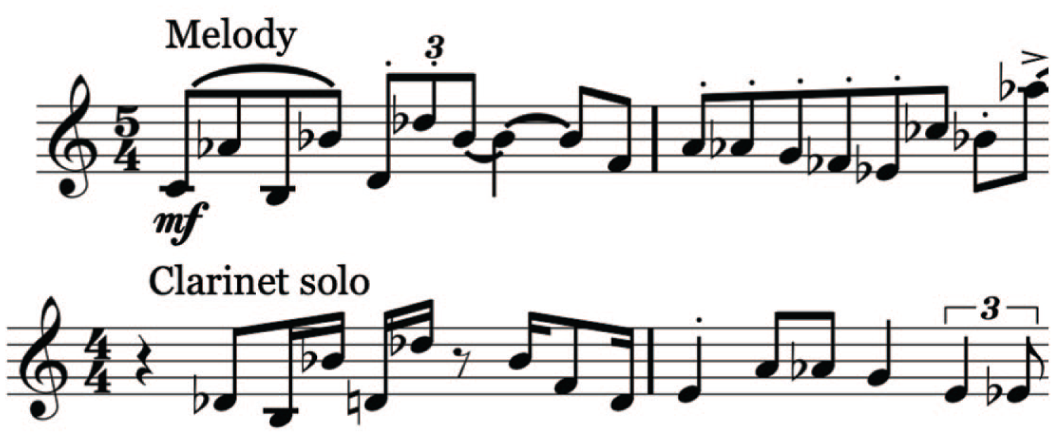
Identity, improvisation (bars 27-28) (
During the interviews, the clarinetist returned to how fragments from the melody were reused, transformed, and twisted, resulting in an exciting space between interpretation and improvisation.
Axiom 4: inverse
This piece, resembling a jazz ballad, engaged the participants in exploring both a very high and a very low register, expanding not only the overall range but also each instrument’s capabilities. The clarinetist articulated his musical vision, saying, “I appreciate that dark sound in the piano and extremely high notes in the clarinet. You find an extensive range there, which is incredibly intriguing.”
The pianist structured the improvisation following the chords derived from the melodies in the piece, see Figure 5. This approach was unknown to the other participants before the improvisation. The clarinetist stated that he did not rely much on the sheet music during the improvisation related to this piece but rather closed his eyes most of the time. He emphasized the importance of creating contrasts, considering it a vital part of his role. In Figure 27, at the beginning of the improvisation, he played a long, continuous, idiomatic portamento that calmed down and horizontally connected the music. This portamento also created a contrast to the earlier leaps in the melody. He stated, “I love playing glissando to evoke the sensation of rubbing against sheer sounds, introducing some intriguing contrast.”
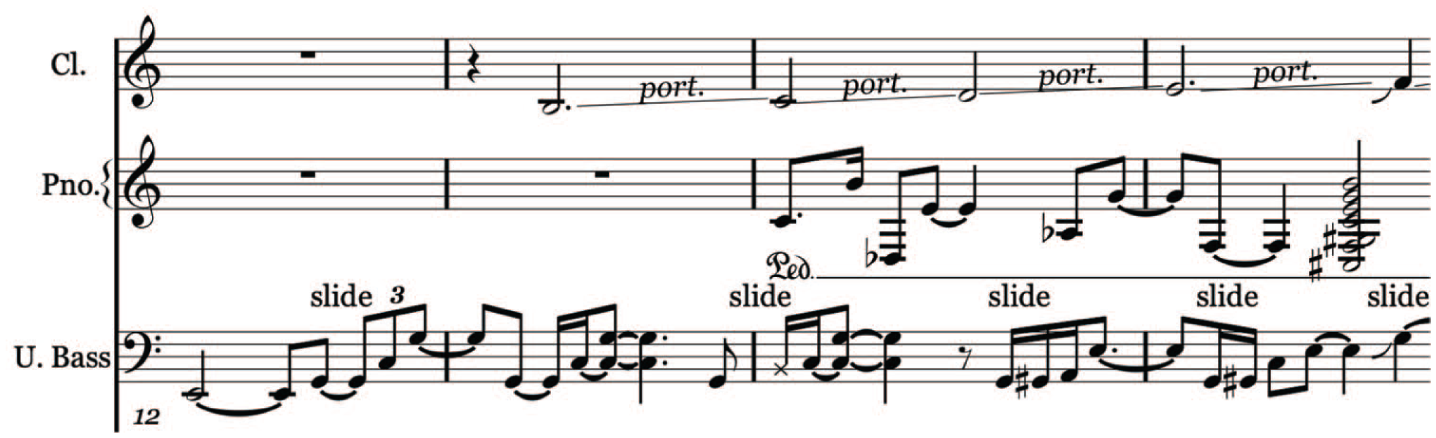
Inverse, improvisation (bars 12-15) (
In bar 23 (Figure 28), the clarinetist echoed the phrase from the melody presented on the piano, creating a subtle reflection of the piece within the improvisation, which evolved interactively among the participants.
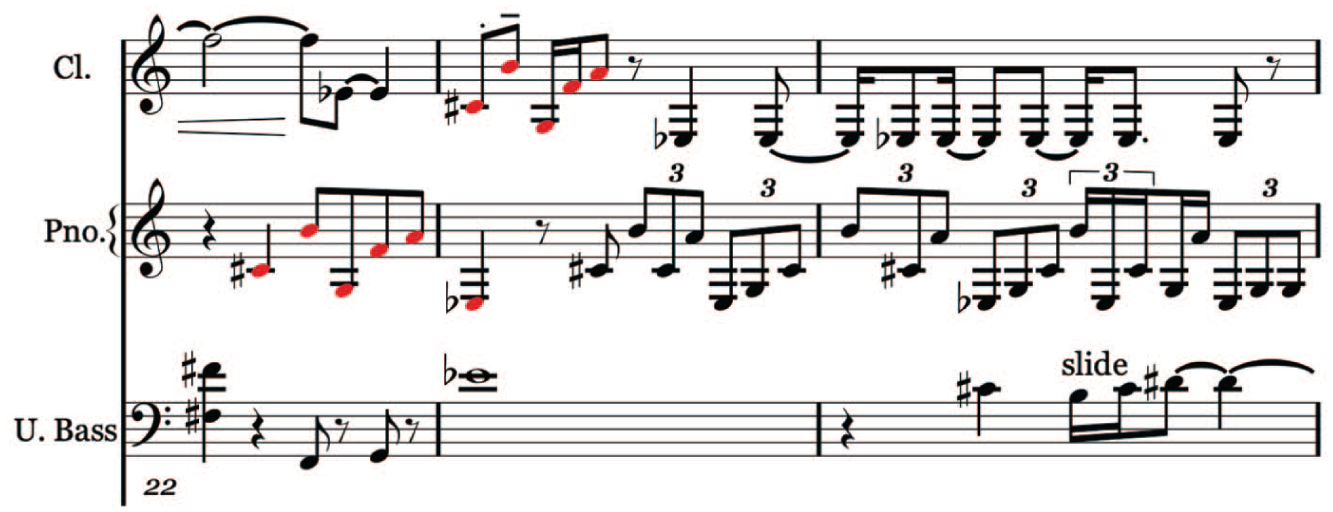
Inverse, improvisation, the clarinetist echoed the piano phrase (bars 22-24) (
A few bars later into the improvisation, in bar 26 (Figure 29), there is a striking contrast between the highly intense piano phrases and the clarinetist’s reintroduction of a portamento. Within this rendition of the piece, the portamento contributed to an overarching and distinctive sonic quality.
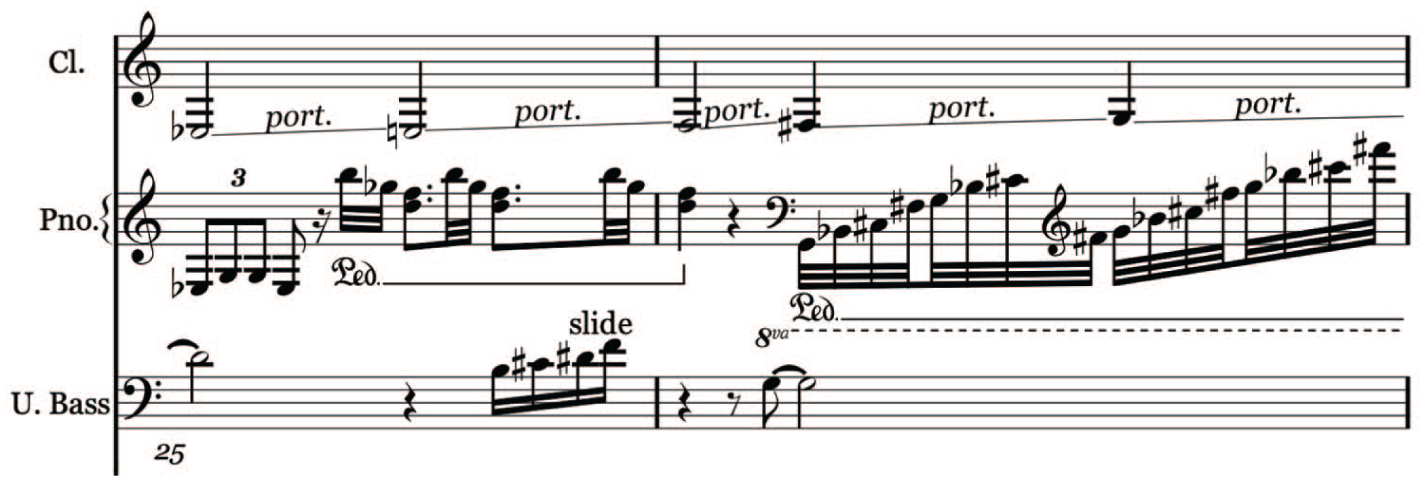
Inverse, improvisation (bars 25-26) (
Figure 30 shows the most intense section in this improvisation, characterized by 16th notes in the piano generating a fast tempo (>300 BPM) quickly picked up by the bassist and the drummer. The drummer remarked, “Indeed, it feels like it becomes easy for everyone to ride the same train when a specific tempo is established. It becomes so contextually clear.” The clarinetist, aiming for a climax, played a hectic, ascending phrase that ultimately reached the note f2.
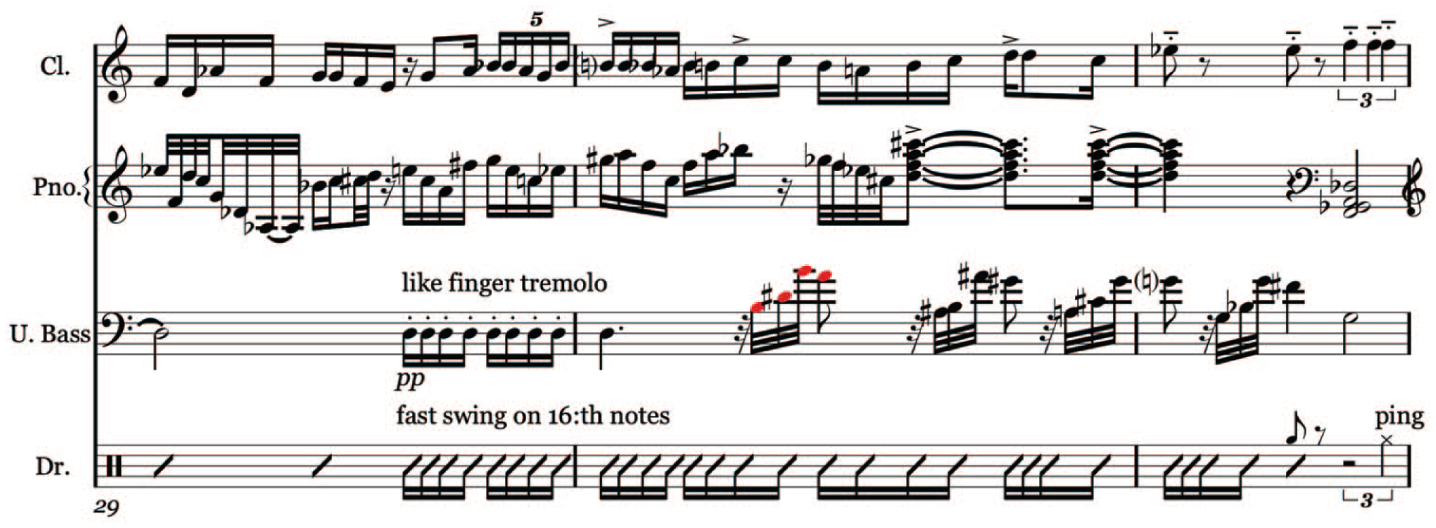
Inverse, improvisation (bars 29-31) (
Figure 31 demonstrates how the clarinetist repurposed melody notes, infusing them with a distinct, almost childlike quality through rhythmic rephrasing.
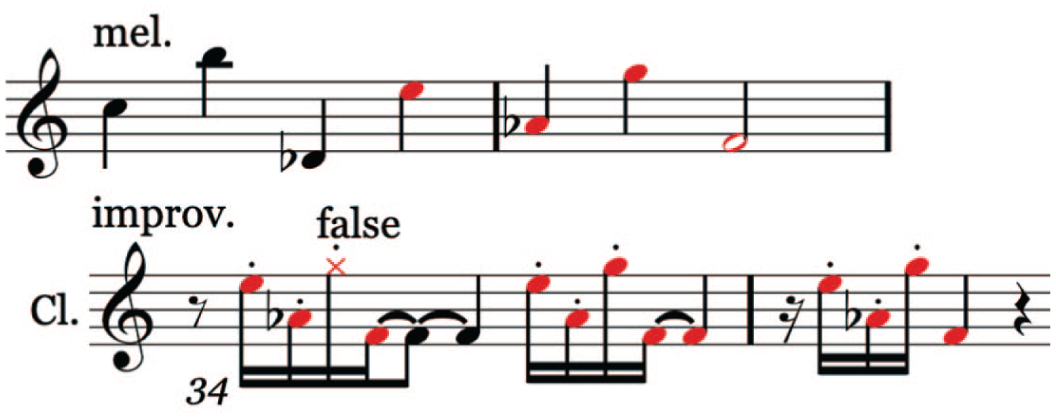
Inverse, improvisation (bars 34-35) (
This signal was followed by a descending melodic line in the clarinet, starting at C♯, the second-highest note in the melody, and concluding at the melody note E♭, as seen in Figure 32. In this figure, the score layout has been adjusted to align with the rhythmic layer of the melody in the clarinet.

Inverse, improvisation, the end (bars 36-43) (
Axiom 5: commutativity
The final piece was the only one performed at a constant tempo, contrasting with the other pieces. Additionally, the roles within the group transformed, leading the clarinetist to shift from his role as the melody presenter to one associated with the bass line. At the same time, the pianist was featured as the soloist throughout the whole piece. The piece was structured around the nonatonic palindromic scale, as seen in Figure 33. This scale has different names, for instance, “Genus Chromaticum” or Scale 3003, also known as “Messiaen Mode 3 Rotation 2.”
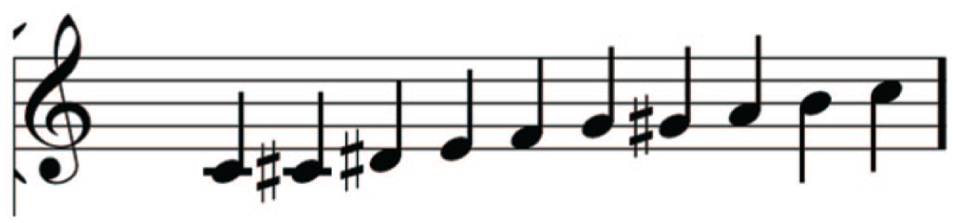
Commutativity (the palindromic nonatonic scale).
The bassist and the clarinetist repeated the scale in compound major thirds, supporting the improvisation; see Figure 34.
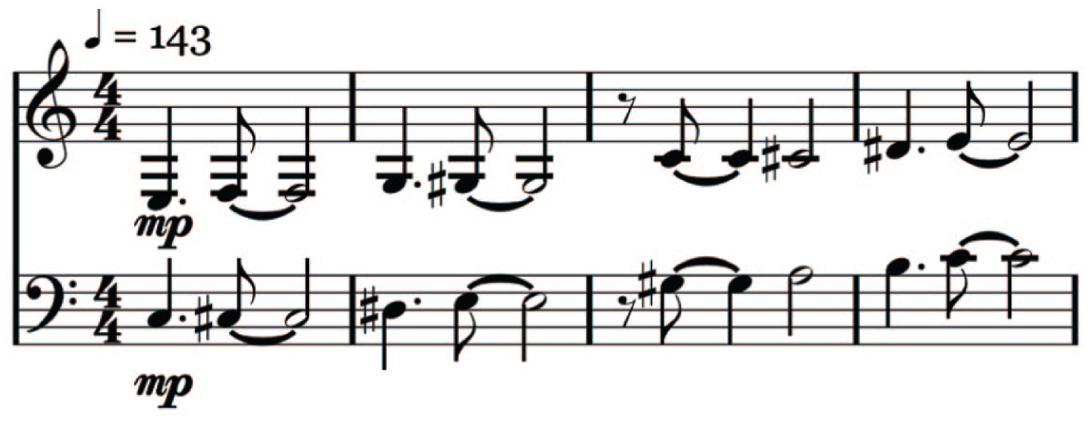
Commutativity, beginning (
Clarinetist: In pieces like this, I sense a particular pressure . . . to join later [in the music] and assume the role of a temperature booster, a common expectation for horn players. Then, I have to build the climax towards the end! . . . It was a bit like being in a straitjacket in some ways, [pause] playing the role of the bassist here.
This piece is centered around a specific scale, see Figure 33, which excludes the note F♯. The clarinetist explained this note:
Clarinetist: I hear nothing from your playing that I could get anything from there. But I simply wanted to introduce a note that had yet to occur in any manner. . . . I was seeking a note [pause] emotionally an abrasive tone, even though it doesn’t seem very [pause] rational; it oddly fits, see Figure 35.
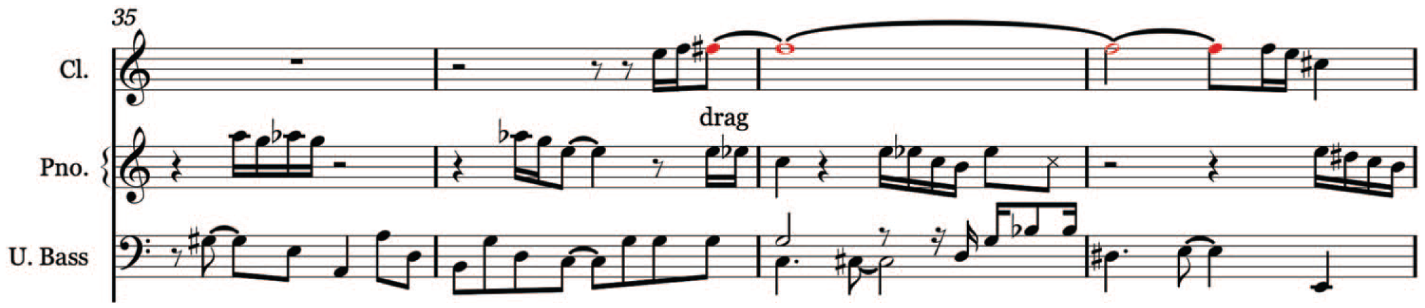
Commutativity, improvisation (bars 35-38) (
Synthesis
Table 1 provides a summary of the strategies discussed in the results section. We employed Després et al. (2017) classifications to categorize these strategies. During this categorization process, we excluded the “Atmospheric and stylistic” category because its strategies were largely absent in our specific context.
Strategies from the analyzed abelian recordings.
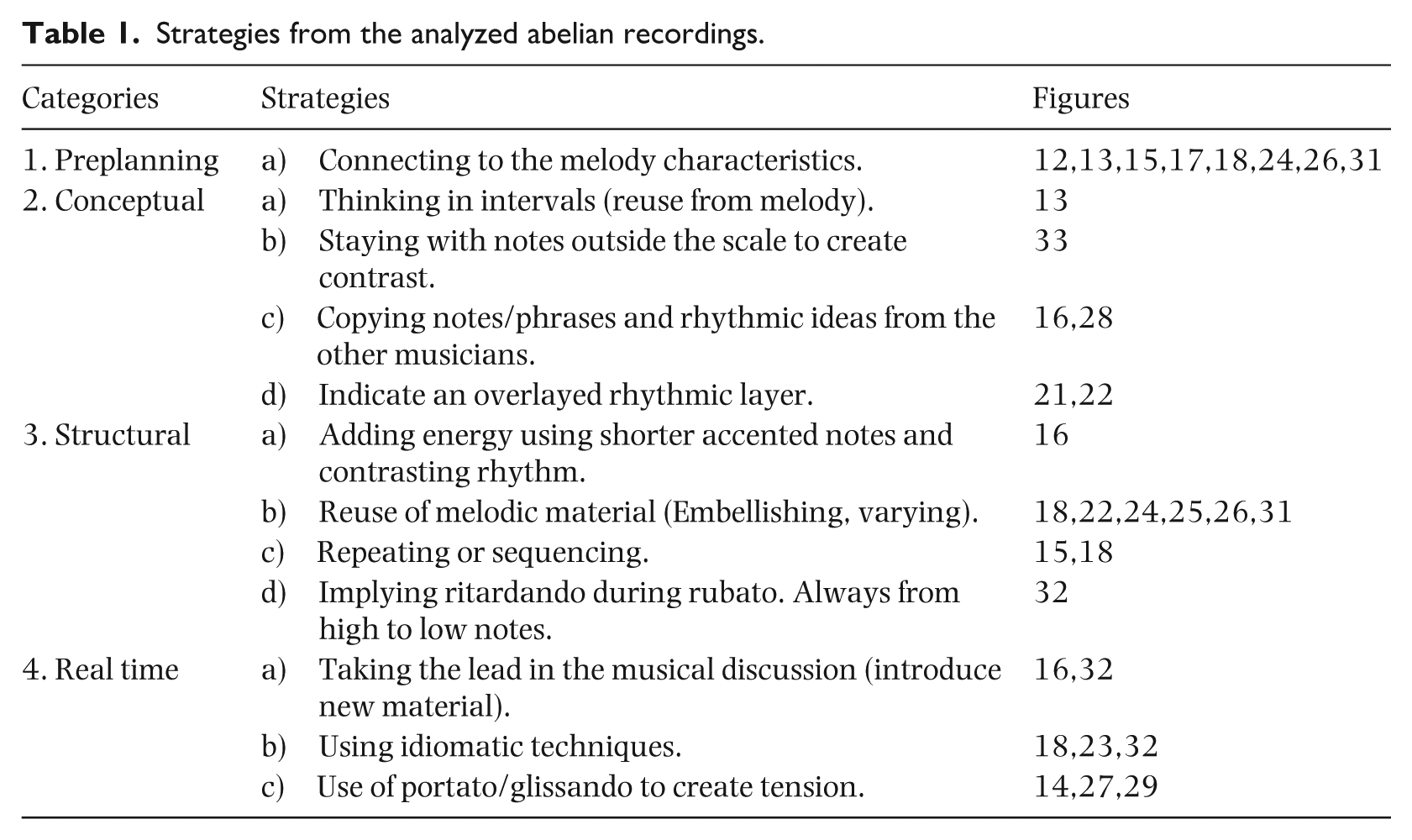
Numerous examples in this study illustrate how improvisations reconnect to melody characteristics (strategy 1a). Still, the melody is frequently disguised through alterations in rhythm, embellished phrases (3b), and the incorporation of idiomatic techniques (4b). Interviews with the clarinetist revealed that connecting to the score was a well-defined preplanning strategy. While analyzing the improvisations, it was sometimes difficult to distinguish between the preplanned and structural reuse of the melody (1a vs. 3b). In the absence of clearly defined harmonic structures and tonal centers, the improvisations were instead guided by short melodic phrases and intervals (2a).
The participants approached the improvisations as a conversation (2c, 4a), engaging with the melody, introducing new material to enhance energy (3a), switching leadership roles (4a), and returning to melodic fragments as needed (1a). The clarinetist shaped the structure by employing strategies such as implying ritardando and indicating superimposed rhythm (2d, 3d).
Discussion
This study aimed to shed light on how jazz musicians incorporate tonal language, intervals, and melodic elements from a specific composition into their improvisations and how this affects the interaction. To identify overall strategies utilized to this end, we built upon the earlier research of Norgaard (2011), Gulz et al. (2021), and Després et al. (2017). The overall analysis of all five movements unveiled strategies employed by the participants, as summarized in Table 1.
To explore the relationship between composition and improvisation, we employed a novel combination of product analysis based on transcription and stimulated recall sessions involving the participating performers. This methodology, along with the ecologically valid recording settings, supported an artistically profound and expressive work story as the central means to enrich our analysis of improvisation strategies. Previous studies by Widdess (1994), Després (2021), and Norgaard (2011) point to the importance of combining product analysis and interviews to better understand improvisation in various music genres. Our results confirm that this combination is key to gaining insights into unexplored areas of musical performance, and offers a vantage point for pedagogical processing of the musical outcomes.
As a central insight, we demonstrated how the clarinetist deliberately reconnected to the characteristics of the melody as a part of his improvisation strategies. The transcriptions and stimulated-recall interviews facilitate an immediate and intuitive display of the emerging strategies. Our methodological choice to use a video that displays the transcriptions along with synchronized audio facilitated explanations and collaborative analysis involving all participants and, in turn, the tangible representation of results in this paper.
The composed material underwent various transformations during improvisations, serving as referents for creative exploration. While some phrases and melodies were reused without alteration, more often, they were subject to rhythmic modifications, fragmentation, or repositioning within the improvisation. The recurring melodies can be compared to how Norgaard (2011) uses the idea bank, though in this case, the ideas emerged from the referent. A hermeneutic product analysis of the transcriptions alone would have failed to identify this large variety of strategies, and the subsequent interviews were instrumental in refining the outcomes of product analysis and increasing its analytic power. Whereas taking inspiration from compositions is not the only way to improvise, it served as a facilitating device when a highly skilled improvisational musician described his strategies in detail within the context of stimulated recall sessions. This way, we collaboratively discovered the elements of the composition that had been given new life by looking at the improvised material.
While composing, the rhythmic elements in the pieces were deliberately minimized, allowing for a clearer focus on the analysis of pitch material, as provided in the results section. However, it remains to be discovered which improvisational processes may emerge in compositions emphasizing rhythmic elements rather than pitch. A second limitation of the present study is the disregard for visual signals, such as the lack of analysis of camera recordings of the improvisers. Bishop and Goebl (2015) have demonstrated that including camera recordings can significantly enhance analysis outcomes. We plan to incorporate such analysis in future studies.
Conclusion
The present study sheds light on jazz musicians’ improvisation strategies based on tonal jazz theory and personal decisions. It shows how the musicians’ improvisations, to a large extent, evolved from the compositions by going beyond scales and harmony. Melody fragments such as intervals and high/low pitches from the pieces were processed, recreated, and thoughtfully used as referents (Pressing, 1984) throughout the improvisations. Equally important was the interaction between the musicians, where it was evident that the roles and responsibilities shifted during the improvisations. The musicians primarily sought to create contrasts and variety without abandoning a framework implicitly constituted by the compositions.
Designing and conducting experiments to delve into the essence of improvisation is challenging as several factors influence the expressiveness of the outcome. It is crucial to limit the referents—the elements in the composition in our case—to unveil the intricate links between referents and improvisation. Additionally, it is vital for the participants to experience the recording as ecologically valid, aiming to create a musical outcome of high artistic value. One significant benefit lies in developing faster and more efficient methods for analyzing music and interviews, considering the substantial amount of data involved.
We anticipate that our research will inspire and encourage further explorations of musicians’ strategies for improvisation. Technical methods and tool development are beneficial as such studies involve labor-intensive music transcriptions and interviews. The transcription method documented in this paper also represents a methodological suggestion for future studies. In our own future work, we intend to further contribute to method development and analysis of improvisation, for instance, by extending the previous work of Gulz et al. (2021) to include a diverse group of (Swedish) professional horn players. A description of strategies, along with their comparison across various studies, will be a valuable asset in pedagogical applications within institutional and non-institutional educational environments.
Supplemental Material
sj-pdf-1-msx-10.1177_10298649251385738 – Supplemental material for The Abelian axioms—A framework for analyzing interaction and improvisation in a jazz group
Supplemental material, sj-pdf-1-msx-10.1177_10298649251385738 for The Abelian axioms—A framework for analyzing interaction and improvisation in a jazz group by Torbjörn Gulz and André Holzapfel in Musicae Scientiae
Footnotes

Funding
The authors received no financial support for the research, authorship, and/or publication of this article.
Declaration of conflicting interests
The authors declared no potential conflicts of interest with respect to the research, authorship, and/or publication of this article.
Supplemental material
Supplemental material for this article is available online.
References
Supplementary Material
Please find the following supplemental material available below.
For Open Access articles published under a Creative Commons License, all supplemental material carries the same license as the article it is associated with.
For non-Open Access articles published, all supplemental material carries a non-exclusive license, and permission requests for re-use of supplemental material or any part of supplemental material shall be sent directly to the copyright owner as specified in the copyright notice associated with the article.
