



Abstract
The process of learning to improvise on a musical instrument is one that often provokes fear among music students, particularly at university. This article explores the existing research to better understand the intersection of teaching jazz improvisation with established strategies such as autonomy-supportive teaching and newer approaches like load-reduction instruction (LRI) emerging from cognitive load theory and self-determination theory (SDT). Although there is some research into the cognitive load of improvising, much of this is geared towards professional contexts, and further investigation into the burden of improvisation activities on students’ cognition is, therefore, much needed. Similarly, studies into motivation to engage in improvisation are also geared towards professional understanding, even though students’ motivation in learning to improvise as part of their studies has been shown to be influenced by different cultures surrounding jazz and jazz education programmes. With limited research, the motivations for studying improvisation are uncertain and spread across the literature, with a high degree of variability based on factors such as prior training and instructors’ and musicians’ goals. This narrative review will illuminate areas of the jazz improvisation pedagogy literature from which strategies can be extrapolated for use in the classroom to reduce the cognitive load of students and boost student motivation. In doing so, it will examine the relationship of these practices to broader understandings of how students are motivated to learn, suggesting avenues for exploration both in terms of teaching strategies and evidence-based approaches to better support the accessibility and inclusivity of jazz improvisation education.
Keywords
Introduction
The process of learning to improvise on a musical instrument is one that often provokes fear among music students, particularly at university (Snell & Azzara, 2015; Wehr-Flowers, 2006). This article explores the existing research to better understand the intersection of teaching jazz improvisation with established strategies emerging from cognitive load theory, understanding of how students are motivated to learn in self-determination theory (SDT), and the combination of cognitive load and autonomy-supportive teaching strategies through approaches like load reduction instruction (LRI; Martin & Evans, 2018; Ryan & Deci, 2020; Sweller, 2011). Although there is some research into the cognitive load or the amount of information that can be processed by a person when engaging in an activity like improvising, much of this is geared towards professional contexts rather than pedagogical applications. Research into the true burden of learning improvisation on students’ cognition, supported by SDT and LRI, is, therefore, much needed. Studies into motivation to engage in improvisation are also geared towards professional understanding, even though students’ motivation in learning to improvise as part of their studies has been shown to be influenced by different cultures surrounding jazz and jazz education programmes (Wehr-Flowers, 2006). With limited research, the motivations for studying improvisation are uncertain and spread across the literature, with a high degree of variability based on factors such as prior training and instructors’ and musicians’ goals. It would seem from general discourse regarding the teaching and learning of improvisation that some students actively pursue jazz improvisation from early in their training while others avoid it, citing fear and unpredictability (Snell & Azzara, 2015; Wehr-Flowers, 2006).
SDT posits that when students feel autonomous and competent and have a sense of relatedness to their peers and teacher, their motivations tend to be more positive and independent. This could reframe how support for learning to improvise is considered by educators. The study of motivation forms a significant portion of research conducted in the context of music education but has not yet touched on improvisation. Research exploring the “relatively agreed upon” (p. 1096) constructs of SDT—intrinsic motivation, “doing an activity for its own sake,” (p. 1096) and extrinsic motivation, doing an activity for an “outcome separable from the activity itself” (p. 137)—has been applied to classical and popular music contexts in recent music education research (Evans & Bonneville-Roussy, 2016; MacIntyre et al., 2018; Niemiec & Ryan, 2009). Ryan and Deci’s (2000) SDT framework adds to the two core concepts of motivation by differentiating between intrinsic motivation, identification, introjection, external regulation, and the concept of amotivation. They also differentiate between those that are autonomous or integrated with the self, and those that are primarily external. The theory of organismic integration posits that these different types of motivation can be changed by supportive teaching practices and engagement with activities that boost the sense of self (Reeve, 2012).
SDT is a valuable concept that could strengthen jazz improvisation pedagogy by considering how we motivate students. Activating pedagogy that supports students’ basic psychological needs of autonomy, competence, and relatedness is, therefore, critical to jazz improvisation pedagogy (Ryan & Deci, 2000). Managing cognitive load is a significant component of addressing these needs given the high demands of improvisation (Sweller, 2011). LRI, which builds student knowledge by providing support and progressively challenging students before shifting to guidance, is an approach that could support these needs (Martin & Evans, 2018). Its synthesis of elements of cognitive load theory, autonomy-supportive teaching, and SDT provides potential ways to better support students to engage meaningfully in learning to improvise. Autonomy—the opposite of controlled motivations—refers to when students carry out an activity such as improvising and see it as congruent with their conception of self. Competence refers to their need to feel they have the skills and abilities to be effective in the context of improvising in jazz. Relatedness refers to the need to develop meaningful connections to the people they interact with, such as teachers, ensemble members, or classmates.
When these basic psychological needs are satisfied, they have been shown to increase students’ attribution of value to high school music (Freer & Evans, 2018), and there is similar potential for pedagogical strategies in jazz improvisation to promote motivation by satisfying these basic psychological needs. However, when these needs are thwarted in musical settings, it becomes necessary to intervene to improve students’ engagement and well-being (Evans & Liu, 2019; Wehr-Flowers, 2006). Adopting an LRI approach that scaffolds learning until students can solve problems on their own could be helpful for including a diverse range of students in the study of jazz improvisation (Martin & Evans, 2018).
This narrative review will illuminate areas of the literature from which strategies can be extrapolated for use in the classroom to reduce the cognitive load of students, boost autonomous student motivation, and avoid controlling teaching styles, thereby addressing negative feelings of embarrassment and external regulators like assessment (Jang et al., 2010; Wieser & Müller, 2024). It is the first step in developing a larger research programme investigating how best to motivate students of jazz improvisation and support their learning by managing cognitive load. It offers insight into what teaching strategies may be worth further investigation through observational and experimental research. Clarifying this situation is important because of the central role that improvisation can and should play in music education, especially given that experts and curriculum bodies have all called for greater use of improvisation in music education programmes.
Method and study selection
Following the method of Ferrari (2015) and Rother (2007), this study uses a narrative literature review approach to engage in qualitative critical analysis and synthesis across a diverse field of literature. It begins by defining search terms and selection criteria to exclude nonrelevant articles. The critical analysis of the remaining articles is conducted by identifying key findings from the literature and their connections to other ideas in the research area. The approach allows for the synthesising of ideas where appropriate and the flexibility to identify differences, explain issues, and evaluate possibilities for future research. The narrative review allows for the synthesising of information across the domains of jazz improvisation pedagogy, SDT, and cognitive load, which, while connected in practice, are not significantly connected in research literature and would be missed in a systematic review’s focus on answering a specific research question (Aromataris & Pearson, 2014; Green et al., 2006).
The literature in this study was limited to English language peer-reviewed publications up until 15 July 2024, identified using the key terms “jazz,” “improvisation,” “pedagogy,” “motivation,” “cognitive load,” “learning,” and “teaching,” conducted with a specific search of Google Scholar. 1 Two advanced-type Google Scholar searches were used with the overarching search of “jazz improvisation pedagogy” with the additional filter to include reference to at least one of the terms “improvisation,” “motivation,” or “cognitive load.” The second search was similar but replaced “pedagogy” with “teaching” to ensure relevant material was included, leading to 1370 results. The abstracts of these results were then reviewed to confirm relevance to the study. Studies were eliminated on the following criteria: they did not address musical improvisation, they only addressed improvisation as a reference point to discuss other musical practices, they addressed jazz dance, they addressed metaphors of jazz improvisation in other patient disciplines such as business and education, 2 or they were not available via databases accessible to the author. Google Scholar provided a large selection of results and allowed for effective identification of literature significant to the research; however, the research was limited by the inaccessibility of some articles that could have been relevant. Although all identified articles are cited in the present article, priority is given to those which offered greatest insight in the discussion.
No studies focusing specifically on the cognitive load involved in learning jazz improvisation were identified, nor studies explicitly addressing the implications of SDT. However, literature on the cognitive load of professional improvisers and the process of improvisation in human cognition was identified (Berkowitz, 2010). Studies aligned with SDT and autonomy-supportive teaching practices, studies exploring implications of cognitive load on improvisation more broadly, and studies addressing the way pedagogy for jazz improvisation are designed, and additional studies suggested by the reviewers and editors of the present article are also included in this article.
Articles were grouped based on the context in which they explored improvisation as either professional performance or for learning purposes. The articles were then categorised based on whether they spoke to jazz improvisation or cognitive load in improvisation. The themes that emerged in this process were the nature of cognitive load in improvisation, how jazz pedagogy can support students, the tension between the desire to learn musical improvisation through constructivist pedagogies and problem-solving, and the need to support students to encourage participation, which can be seen in Appendix 1.
The following discussion connects these studies with how cognitive load theory, autonomy-supportive teaching, and LRI can be used to design effective jazz improvisation learning. It connects how these teaching approaches particularly intersect with understanding and activating students’ motivational resources. Autonomy-supportive teaching strategies and LRI can support students through structure and scaffolding without resorting to control, before reducing guidance to promote autonomy (Evans & Liu, 2019; Freer & Evans, 2018; Martin & Evans, 2018). The applications could be the basis for implementing jazz improvisation pedagogy that supports learning and encourages wider access and participation.
Results
Cognitive load and the nature of jazz improvisation
Cognitive load refers to the intrinsic and extraneous information that must be managed by human working memory to learn activities and knowledge to perform a task like improvisation. Working memory, the cognitive component that processes novel information, has a limited capacity able to process “3–4 items of information” at a time and hold them for twenty seconds (Sweller, 2020, p. 5). Musical improvisation in jazz has been conceptualised by Berliner (1994) as composition in performance, by its very nature involving the generation of novel information in real-time. According to Nooshin (2003), it is equally governed by both contingency and convention, which are contextually dependent. This requires the utilisation of working and long-term memory to simultaneously synthesise past knowledge and new events and produce a musical outcome. It is worth noting in this context that the pedagogy of jazz improvisation tends to be focused on “improvisation as an impetus for creativity” and “improvisation as a learning tool,” filtered through the traditions of the music rather than open-ended improvisation (Siljamäki & Kanellopoulos, 2020, p. 125).
Pressing’s (1984) influential conceptualisation of musical improvisation as one of the rawest and most significant states in which we can observe humans’ cognitive capabilities remains a dominant influence on current research (Berkowitz, 2010; Mendonça & Wallace, 2004). Pressing’s model involves what he described as real-time feedback monitoring and decision-making utilised in relation to previously learnt material, such as song forms and melodies, which he termed “referents.” These referents are then utilised in contexts where they are patient to other external contingencies, like another musician’s contribution that demands a response or affects change. Improvisational processes in Pressing’s (1984) model focus on the use of referents or schema developed by practicing repertoire, forms, and structures such as scales, which are then stored in “long-term ‘object memory,” “mentally and physically encoded,” and used in “compositional problem-solving: transitions, development and variation techniques, and methods of combining and juxtaposition” (p. 355). Norgaard et al. (2013) utilised Pressing’s model of improvisation to develop a computer algorithm modelling the improvisational process in the styles of classical and folk music. They found that Pressing’s belief that improvisation relies on stored banks of musical information, the referent, interpreted in real-time and adapted to context, remained a productive model for understanding the cognitive processes of improvisation. However, they were unable to apply the algorithm model to jazz styles effectively because it did not sufficiently incorporate external contingencies impacting the referent. This explains some of the significant cognitive demands of real-time musical decision-making that must be learnt through practice.
An example of a pedagogical approach influenced by Pressing’s model is Biasutti’s (2015; Biasutti & Frezza, 2009) use of existing music education psychology research to create a pedagogical framework for general improvisation skills. Biasutti recommended a model that involves “anticipation, use of repertoire, emotive communication, feedback, and flow,” plus related strategies to support student autonomy, competence, and load reduction, such as providing examples, verbalising the affective experience of improvisation, and scaffolding (Biasutti, 2015, p. 4; Jang et al., 2010; Martin & Evans, 2018).
The cognitive complexity of improvisation is in part due to the multiple cognitive processes interacting in the performative present. Following Pressing, Bugos et al. (2024) argued that improvisation requires significant training and practice and “contains generative and evaluative processes that contribute to inhibition through conscious monitoring” (p. 379). In their research examining how executive functions and neural oscillatory activity in older adults was boosted by jazz piano improvisation training, connecting long-term memory to working memory was referred to as “a palate from which to draw upon” for creative decision-making (p. 379). However, this perhaps undersells the difficulty of generating novel information and making spur-of-the-moment decisions such as switching between tasks in jazz improvisation (Bugos et al., 2024; De Dreu et al., 2012; Pressing, 1984; Rahman et al., 2021).
The cognitive processes used in improvisation are referred to by many names in the research literature, as described by Després (2022):
Cognition in improvisation (Berkowitz, 2009, 2010), cognitive processes (Biasutti & Frezza, 2009; Chamblee, 2008; Mendonça & Wallace, 2004; Pressing, 1984), cognitive strategies (Hargreaves et al., 1991), generative principles (Clarke, 1988), generative strategies and ongoing processes (Norgaard, 2008, 2011), improvisation processes (Biasutti & Frezza, 2009), mental processes (Kenny & Gellrich, 2002), processes (Berliner, 1994), strategies (Després et al., 2017), thinking processes (Mendonça & Wallace, 2004) and thought processes (Menezes, 2010). (p. 35)
Regardless of this terminology, in-the-moment decision-making and the use of information stored in long-term memory seem to be consistent themes in improvisation thinking (Clarke, 1988). Després (2022) recommended a reframing of this terminology into two categories: “cognitive processes [. . .] broadly defined as brain activity related to information perception and processing”; and strategies defined “as a goal-oriented thinking procedure” (p. 36). This distinction is helpful for teaching purposes because it differentiates between the many cognitive processes involved in learning improvisation, such as listening, taking action, thinking, and storing information in memory that could be “conscious or unconscious” (p. 36). These strategies can be directed to developing skills that support improvisation, if they are practised until they have been internalised, and monitored by a teacher who can support the learning pathway.
Similar observations of the barriers to developing expertise could apply to the interface between the musician and instrument, as argued by scholars of the 4Es model of embodied, embedded, extended, and enactive cognition. A musician may reduce cognitive load by extending onto an external instrument, musical object, or embodied knowledge (Corintha & Cabral, 2021b; Feldman, 2021; Hayes, 2019). As Corintha and Cabral (2021a, 2021b, 2022) have argued, in the 4Es model of cognition the environment in which music-making occurs defines a performer’s cognitive load. However, the embedded nature of cognition in “physical, sonic, historical, social, cultural and gendered world(s)” (p. 11) in which we learn means that prior knowledge is perhaps more significant in shaping the understanding of the student improviser (Corintha & Cabral, 2021b; Çorlu et al., 2015). By practising many of the specified improvisational goals and skills identified earlier, some of these activities can become embodied—for instance, the physical relationship between notes on an instrument, or the pressure required to produce certain rhythms on an instrument. Understanding the instrument as a referent helps to scaffold instruction and practice according to the interface between the person and the instrument and is supported by research into the multiple inputs required for students to achieve in tertiary jazz improvisation programmes: theoretical learning, aural training, formal improvisation instruction, and evaluative reflection (May, 2003). Structuring practice for specific goals such as listening, synthesising melodic and harmonic forms, developing rhythmic understanding, and instrumental performance is valuable to educators because associated strategies chunk information into smaller pieces to build feelings of competence and provide constructive feedback (Després, 2022; Martin & Evans, 2018).
Managing cognitive load with scaffolding and autonomy support
Scaffolding refers to the supports provided to students to help them learn and structure knowledge and is used in cognitive load theory, autonomy-supportive teaching, and LRI. In all three approaches, scaffolds such as notated tasks, chunking melodic phrases (Norgaard, 2011), rationales for learning, and student dialogue and rapport can support the basic psychological needs identified in SDT and lead to higher quality learning (Ryan & Deci, 2020). In learning jazz improvisation, support can be provided in various ways, including via the common pedagogy of aural imitation, but also by the supportive utilisation of notation. A significant amount of stylistic information is inferred when interpreting notation in jazz and depends on prior cultural knowledge. This can create difficulties for novice jazz improvisers in understanding a teacher’s expectations and how sound corresponds to visual representations, particularly when the student comes from a classical background. Recently, Corcoran et al. (2022) found that providing more visual information could better equip classical performers to replicate the swing feel of jazz, based on their stylistic training and culturally engrained use of notation. Instructors’ observations often refer to the importance of aural instruction to improvisational learning, but this dominant approach should be situated in a noncritical or judgmental environment to boost confidence (Shevock, 2018), and could be supported by notation or visual stimuli to improve inclusivity for learners without prior jazz knowledge. With more differentiation in visual resources to clarify the expected sound, learning experiences could be designed to decrease the cognitive load of learning jazz for musicians unfamiliar with the style and increase possibilities for student participation.
Opportunities for formative assessment and feedback also feature in the literature, with Wellmann and Skillicorn (2024) identifying positive impacts of retrieval practice to improve student understanding and use of jazz improvisational language. Their findings indicated that low-stakes formative assessments helped students recall both sounds and knowledge and apply them in other contexts, building feelings of competency. They, in addition, found that free recall (with no prompts), while ideal for promoting retrieval, may need to be supported by prompted retrieval if students are not yet able to perform without support. This shows promise for the integration of autonomy-supportive teaching and LRI approaches (Jang et al., 2010). Providing support to ensure that students can access the curriculum and are not hindered by unrealistic expectations is central to making jazz education inclusive. At higher levels, de Bruin (2019) has framed this process around the continued guidance of the expert and how they relate to students who are beginning to regulate and direct their own learning. Autonomy in these higher levels increasingly involves the ability to make evaluative judgements about one’s own work and to identify areas for improvement that cannot be achieved without prior support (Tai et al., 2018). Working together may also impact the cognitive load of learning to improvise, with Hartley (2023) suggesting that improvisation learning in group settings or with a mentor can reduce the cognitive load of creativity by dispersing it around the group (p. 310).
Supportive retrieval practice to learn jazz may have long-term benefits, with novel findings suggesting that jazz improvisers experience less burden on working memory in their aural recall than classical musicians. Nichols et al. (2018) showed the potential benefits of improvisation training to improve cognitive capacity to retain and utilise information. Exactly how this state is reached is not entirely clear and confirms how much still needs to be researched in this area. But evidence does suggest that improvisation activates different parts of the brain to other activities, utilising a smaller network inside the brain’s frontal cortex, the implications of which are still not fully understood (Dhakal et al., 2019).
There are many aspects of the relationship between cognitive load and improvisation learning that remain to be explored, including the relationship between practice and self-regulation over the life cycle of a student’s development. Miksza et al. (2018) used an intervention where participants took part in mental practice, physical practice, or mental and physical practice and found little to no difference in the ability of participants to create a melodic improvised jazz solo. This suggests that the impact of different types of practice on developing improvisational skills and at various points in learning would be a fruitful area of further exploration, given the theoretical assumptions and supporting evidence for the role that prior learning through referents plays in shaping improvisation. According to Johansen (2018), practice needs to utilise specific strategies to be successful. Johansen’s concept of “explorational practice” (p. 60), which she distinguishes from Sloboda’s (1996) “informal practice” often associated with improvisation, describes a “precondition for making exploration possible” and serves specific goals. Significantly, Johansen’s (2018) study emphasised that while students in a tertiary jazz programme engaged in open-ended explorational practice, like their classical peers they spent much time in deliberate “goal-directed practicing” of technique and theory, which they saw as central to developing necessary improvisational skills (p. 59). The utilisation of multiple types of practice for development suggests that specific structures are required to scaffold improvement in improvisational skills. Although goal-directed practice is often an accurate measure of student engagement, the study of improvisation requires that free-flowing or unstructured practice previously seen as a predictor of lower motivation and achievement be reframed (Sloboda et al., 1996). Explorational practice without a specific goal may be a predictor of the degree to which a student is autonomously engaged in their study of improvisation, and that their relationship with their teacher supports this autonomy.
Balancing constructivist ideals for freedom and support for student learning
A significant issue that emerges from the literature on jazz improvisation pedagogy in music education is that constructivist ideas of experimentation and improvisation used by professionals are privileged over structured tasks (Borgo, 2007; Hickey, 2015). Improvisation by experts, which is thought to be novel, free, and creative, is not usually associated with strain on working memory, indicating a reliance on long-term memory (Johnson-Laird, 2002). This may explain the perspective of some instructors that students will “sink or swim” when improvising, regardless of significant cognitive load. However, newer conceptualisations of “play” remove some constraints, reflecting Pressing’s (1984) model through strategies emphasising freedom through experiential learning, real-time feedback, and supporting structures to make musical decisions. Edmund and Keller (2020) presented a model that combined structure and play in improvisation pedagogy, arguing that the appropriate design of learning experiences is key to diminishing feelings of anxiety about improvisation and enabling engagement and enjoyment. They defined five central activities: (1) experience first, before intellectualising; (2) improvise within structure and syntax; (3) perform by ear; (4) improvisation as a way of being in music; and (5) balance freedom with structure (p. 68). Their approach explicitly set out how to effectively manage cognitive load, reducing pressure “through structured approaches for learning improvisation” (p. 526) by using strategies such as visual scaffolds (Edmund & Chen-Edmund, 2016), chunking, audiation (Snell & Azzara, 2015), and structured opportunities for freedom.
It is important to be cognisant of the role of ideological perception around improvisation advocacy (Borgo, 2007), as well as the impact of past educational experiences as a governing principle in performers’ instructional approach (Després et al., 2016, 2017). However, unsupportive approaches to instruction have generally been associated with reduced engagement and autonomy in student learning, particularly at novice and intermediate levels of expertise (Reeve, 2012), and lack the potential benefits of improvisation to autonomy, competence, and relatedness (Evans McPherson, 2015; Snell & Azzara, 2015). de Bruin (2019) has proposed “cognitive apprenticeships” to tackle such issues, emphasising the one-to-one tuition of expert teachers of improvisation and outlining a seven-step model aligned with both autonomy-supportive teaching practices and LRI: modelling, scaffolding, coaching, articulation, reflection, exploration, and fading. These steps build a supportive student–teacher relationship as students become independent and guidance is decreased at higher levels of expertise.
Despite the empirical evidence advocating the use of supportive and structured strategies to engage and promote students’ autonomy (Evans & Bonneville-Roussy, 2016), many in tertiary education encourage constructivist approaches to teaching improvisation derived from established performers’ current approaches to free jazz, such as Borgo (2007) and Hickey (2015). The problem-solving nature of jazz improvisation could quite reasonably be assumed to overload human cognition because of the demands to generate “novel information” with limited prior knowledge and countless options (Sweller, 2011, p. 56), but if it is viewed as overly restrictive or complex then approaches might remove the embodied and experiential aspects of improvising that can motivate students.
A significant counterbalance to such thinking is Snell and Azzara’s (2015) examination of tertiary students’ responses to an intervention improvisation course and a study by Wehr-Flowers (2006) assessing the attitudes of males and females towards improvising. Both studies suggest that musical improvisation is a source of anxiety for students, and notably so for female students because of competitive, male-dominated environments of learning and performance. Improvisation has the potential to develop autonomy, competence, and relatedness, but students, therefore, require “a scaffolded approach for learning to improvise” (Snell & Azzara, 2015, p. 65). Wehr-Flowers (2006) argued that the issue was less about “ability, skills or talent,” and more about “social psychology” (p. 338) and an environment in which typical instructional practice induces anxiety and hinders learning and creativity, particularly for young women (p. 339). Wehr-Flowers cited the common instructional environment where a student is required to begin improvising in front of others without prior experience or support as a source of student anxiety. To alleviate these concerns, educators need to create safe places in which learning improvisation can be collaborative, supportive, and nonconfrontational, dismantling “barriers to creativity” (Dempsey, 2020; Siljamäki, 2022).
It is important to note that the nature of expert jazz improvisation is currently the patient of some important revision. de Bruin’s (2017; de Bruin et al., 2020) adaptation of Zimmerman’s (2008) theory of self-regulation found that expert improvisers relied on self-regulation strategies to continue to develop their improvisation practices. de Bruin’s (2017) findings reveal that the mysterious and free perceptions of the improvisatory process are potentially inaccurate. These performers “strategically plan for future outcomes, modifying and adapting behaviour” to suit the context of improvisation, drawing on prior knowledge and discrete practice strategies (p. 389).
Discussion and conclusion: Exploring gaps for future research
The study of teaching and learning jazz improvisation has many findings in keeping with cognitive load theory and SDT, despite limited overt references to these areas of scholarship. As a result, applying such constructs and associated instructional approaches like autonomy-supportive teaching and LRI may prove fruitful to explore alternative modes of improvisation instruction and better understand the relationships between disciplinary orthodoxies and students’ learning needs. Current evidence suggests that considering cognitive load, motivation, and engagement leads to improved outcomes in other aspects of music education and is, therefore, a worthwhile consideration for teaching jazz improvisation (Evans & Bonneville-Roussy, 2016; Freer & Evans, 2018). However, there is a need for further practical application of instructional strategies to test their appropriateness in jazz improvisation and understand how they motivate students to learn in relation to different contextual factors such as race, ethnicity, gender, age, and level of expertise.
Implications for designing jazz improvisation pedagogy
A significant issue in jazz improvisation pedagogy is that novice improvisers lack the significant knowledge of repertoire, style, and musical skills required as a referent (Pressing, 1984) to reduce cognitive load (Bugos et al., 2024; Feldman, 2021). The implications of cognitive load and autonomy-supportive instructional approaches suggest that there is an inherent need for structures and scaffolding of musical improvisation, given its requirements to generate novel information (Sweller, 2011). As a result, strategies that guide students towards independence rather than experimentation may have a demonstrative impact on improving motivation, engagement, and feelings of autonomy and competency (Martin & Evans, 2018; Reeve, 2012). Strategies such as visual scaffolds (Edmund & Chen-Edmund, 2016), chunking of aural components, audiation (Edmund & Chen-Edmund, 2016; Edmund, 2009; Snell & Azzara, 2015), and structured opportunities for freedom and play, while known to be beneficial, need further research to ascertain when and how they help students progress (Edmund & Keller, 2020). The effect of these strategies is to reduce the cognitive load of improvisation in ways that can be helpful in skill development before their application to real-world performance settings, which could have benefits in motivating students. These supportive practices have been demonstrated to improve positive engagement and address students’ needs in other domains (Jang et al., 2010).
The application of LRI, an instructional framework that applies cognitive load theory through practices such as scaffolding, feedback, structure, practice, and, significantly for improvisation, guided independence, is shown by recent research to improve achievement and motivational outcomes (Martin & Evans, 2018). Guided independence is an important concept which is absent from extant literature. The layered approach to LRI that scaffolds and then fades would allow constructivist free-improvisation approaches to sit alongside the teaching of musical syntax, rather than in opposition, with free-improvisation boosting feelings of autonomy and musical syntax boosting feelings of competence. As LRI supports students without controlling them, it could prove useful in managing early improvisatory exploration and later creative development as students become more expert in the domain (Martin & Evans, 2018; Reeve, 2012).
There is a need for further research to examine how LRI and autonomy-supportive teaching practices impact different groups of students in jazz improvisation studies (Evans & McPherson, 2015; Martin & Evans, 2018; McPherson et al., 2019). Different musical and cultural backgrounds may be a factor in determining students’ perceptions of jazz improvisation instruction, jazz improvisation difficulty, and desirable musical identities. Research has shown that the cultural context of education can also have a decisive impact on how students feel motivated and whether or not an approach is beneficial to their learning and psychological needs (Chirkov, 2009; Elliot et al., 2001). Given that students’ long-term musical identities have been shown to influence their self-regulation of practice and mastery of performance, there is likely an impact on how students approach the learning and practising of jazz improvisation caused by prior musical experience that would help determine what level of support to provide (Després et al., 2017; Evans & McPherson, 2015). Certainly, Després et al. (2017) suggest that part of the reason improvisation is absent from Western classical music curricula at universities, despite its empirical validity in developing musical skills is the cyclical nature of performers teaching in the way they were taught, therefore involving little to no improvisation. It could be argued that, for students taking up jazz improvisation at later stages, there are far more likely to be external factors at play, with cultural perceptions of improvisation and other musical domains mediating their engagement and providing a useful reference point for targeting autonomy support for musical creativity (Després et al., 2017; Tricot & Sweller, 2014). This suggests a tension in teaching students who are novices in jazz improvisation but seasoned musicians at the higher education level, and may indicate a need for building connections to previous knowledge and people to enhance the learning experience (Després et al., 2017).
The study of motivation and the student experience of learning musical improvisation
As the literature suggests, teachers need to be aware of student fears in regard to improvisation and provide support that is structured but not controlling to engage and motivate them (Niemiec & Ryan, 2009; Reeve, 2012; Snell & Azzara, 2015). Snell and Azzara (2015) argue that students often experience apprehension towards learning to improvise, which can lead to lower-quality motivation when they perceive they lack competence. There is a distinct connection between the reasons for these fears and broader issues in research on improvisation and jazz. Scholarship examining inequitable representation in jazz history and the impact of exclusionary behaviour and the exoticisation or novelisation of female musicians indicates a long-term social inequality in the way women are treated in jazz scenes and educational programmes (McGee, 2013; Tucker, 2004). Fears may, therefore, include a perceived macho culture in jazz that excludes other genders, the sense that improvisation is a risky initiative with unclear outcomes for success, and an educational context that lacks the structure and support necessary for students to flourish (Wehr-Flowers, 2006). Given the lower priority improvisation is given in music education institutions and curricula (Borgo, 2007; Snell and Azzara, 2015), there is a distinct need for further systematic examination of the motivation and engagement of different groups of students studying improvisation at university before they reach professional levels, along the lines of studies about the tertiary study of classical music (Evans & Bonneville-Roussy, 2016; Marino, 2019; Rosen, 2015).
To achieve autonomous motivation in the improvisation classroom, it is necessary to utilise autonomy-supportive teaching practices and LRI to satisfy basic psychological needs through strategies like choice of repertoire, providing rationales for activities, and helping students develop meaningful practice goals that are within their grasp but still challenging and allowing for independence (Evans & McPherson, 2015; Reeve, 2012). As the impact of pedagogical strategies is dependent on the culture of the institution and the style of music being studied, jazz’s historic issues with competitive environments, macho culture, and limited learning supports could be effectively counterbalanced through the perspective of SDT focussed on student needs (Evans & McPherson, 2015). In this context, support for learning helps to enable more people to participate and challenges perceived dependency upon traditions and conventions that can lead to lower intrinsic motivation (Després et al., 2017; Edmund & Keller, 2020; Evans & McPherson, 2015). This highlights the need for experiential or play-oriented activities at all ages to encourage students’ creativity—provided that supportive instruction co-exists (Edmund & Keller, 2020).
Support for less structured contexts can guide students to flourish when improvising, building autonomy and addressing the disengagement associated with unsupportive approaches (Marino, 2019; Reeve, 2012; Snell & Azzara, 2015). A key element to building autonomy is to support effective independent practice of improvisation using both structured and informal modes, guiding students to be independent and self-regulated learners in line with professional practice (de Bruin, 2017; Johansen, 2018; Martin & Evans, 2018). Students’ perceived level of autonomy and the degree to which this is supported by teachers of jazz improvisation, including feelings of equity connected to competence, is an issue that SDT research can help manage. The inclusion of elements of structure and scaffolding, but also choice and the acknowledgement of student opinions, are important features that could contextualise jazz improvisation pedagogy and lead to better engagement from students in the model de Bruin (2019) outlines (Jang et al., 2010). This context highlights the need to engage with students’ perspectives and better understand their relationship with improvisation to improve pedagogical practice (Ojala & Pohjannoro, 2024).
The preliminary findings of this research review indicate that cognitive load and SDT have the potential to reveal insights into the teaching and learning process of jazz improvisation through quantitative and qualitative research. The outcomes of further research would ultimately be beneficial to both teachers and students of music across a range of styles and help review the effectiveness of instructional approaches including LRI and autonomy-supportive teaching. By determining which educational strategies and contexts motivate students to learn to improvise, research can suggest how best to support students’ studies. This would contribute to ongoing debates about whether improvisation can only be taught effectively as a meta-cognitive strategy with limited structures (Borgo, 2007; Hickey, 2015), or whether it requires the learning of complex systems and schemas akin to language development for the spontaneous creation of musical ideas (Pressing, 1984).
Footnotes
Appendix
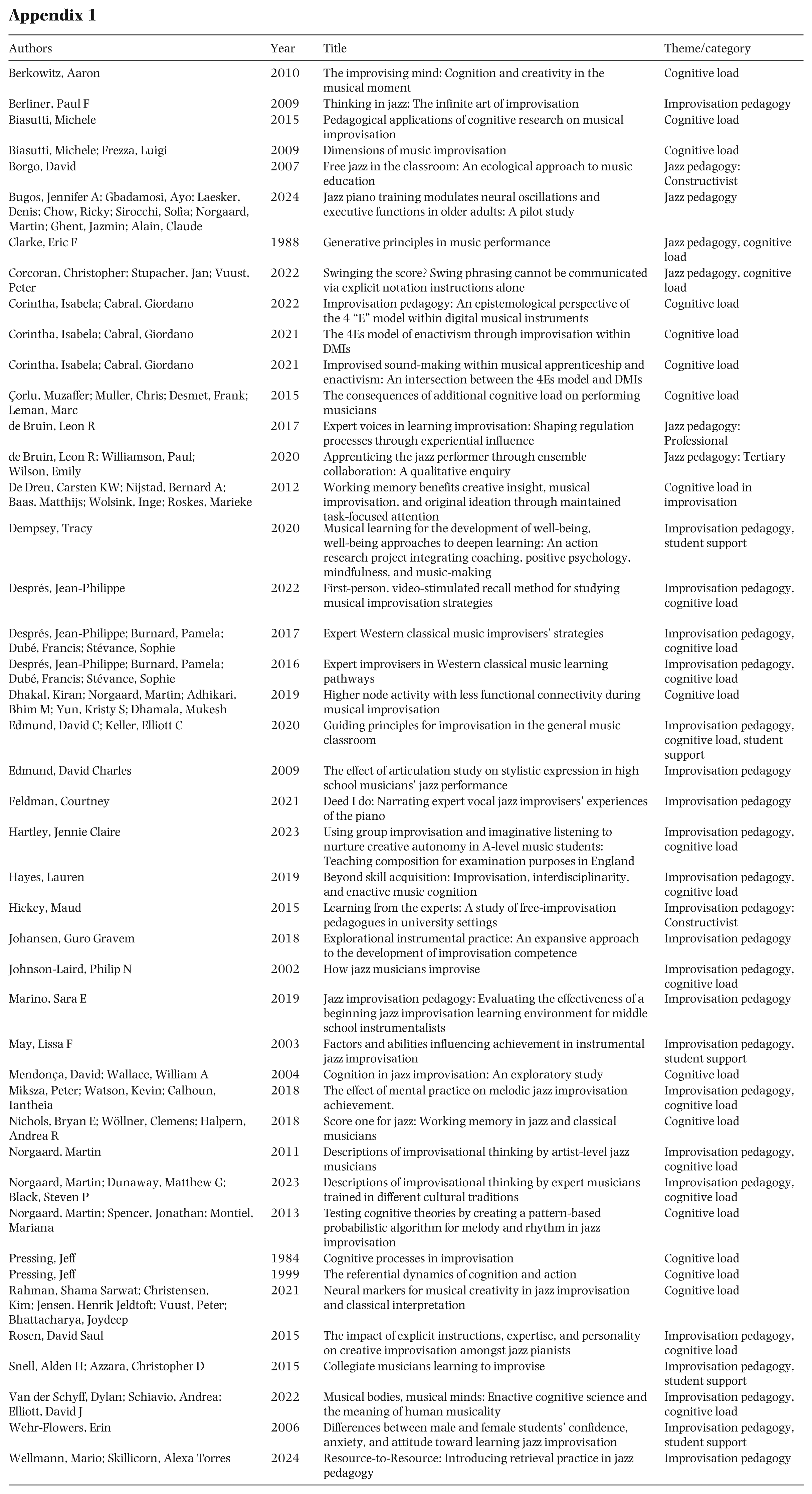
| Authors | Year | Title | Theme/category |
|---|---|---|---|
| Berkowitz, Aaron | 2010 | The improvising mind: Cognition and creativity in the musical moment | Cognitive load |
| Berliner, Paul F | 2009 | Thinking in jazz: The infinite art of improvisation | Improvisation pedagogy |
| Biasutti, Michele | 2015 | Pedagogical applications of cognitive research on musical improvisation | Cognitive load |
| Biasutti, Michele; Frezza, Luigi | 2009 | Dimensions of music improvisation | Cognitive load |
| Borgo, David | 2007 | Free jazz in the classroom: An ecological approach to music education | Jazz pedagogy: Constructivist |
| Bugos, Jennifer A; Gbadamosi, Ayo; Laesker, Denis; Chow, Ricky; Sirocchi, Sofia; Norgaard, Martin; Ghent, Jazmin; Alain, Claude | 2024 | Jazz piano training modulates neural oscillations and executive functions in older adults: A pilot study | Jazz pedagogy |
| Clarke, Eric F | 1988 | Generative principles in music performance | Jazz pedagogy, cognitive load |
| Corcoran, Christopher; Stupacher, Jan; Vuust, Peter | 2022 | Swinging the score? Swing phrasing cannot be communicated via explicit notation instructions alone | Jazz pedagogy, cognitive load |
| Corintha, Isabela; Cabral, Giordano | 2022 | Improvisation pedagogy: An epistemological perspective of the 4 “E” model within digital musical instruments | Cognitive load |
| Corintha, Isabela; Cabral, Giordano | 2021 | The 4Es model of enactivism through improvisation within DMIs | Cognitive load |
| Corintha, Isabela; Cabral, Giordano | 2021 | Improvised sound-making within musical apprenticeship and enactivism: An intersection between the 4Es model and DMIs | Cognitive load |
| Çorlu, Muzaffer; Muller, Chris; Desmet, Frank; Leman, Marc | 2015 | The consequences of additional cognitive load on performing musicians | Cognitive load |
| de Bruin, Leon R | 2017 | Expert voices in learning improvisation: Shaping regulation processes through experiential influence | Jazz pedagogy: Professional |
| de Bruin, Leon R; Williamson, Paul; Wilson, Emily | 2020 | Apprenticing the jazz performer through ensemble collaboration: A qualitative enquiry | Jazz pedagogy: Tertiary |
| De Dreu, Carsten KW; Nijstad, Bernard A; Baas, Matthijs; Wolsink, Inge; Roskes, Marieke | 2012 | Working memory benefits creative insight, musical improvisation, and original ideation through maintained task-focused attention | Cognitive load in improvisation |
| Dempsey, Tracy | 2020 | Musical learning for the development of well-being, well-being approaches to deepen learning: An action research project integrating coaching, positive psychology, mindfulness, and music-making | Improvisation pedagogy, student support |
| Després, Jean-Philippe | 2022 | First-person, video-stimulated recall method for studying musical improvisation strategies | Improvisation pedagogy, cognitive load |
| Després, Jean-Philippe; Burnard, Pamela; Dubé, Francis; Stévance, Sophie | 2017 | Expert Western classical music improvisers’ strategies | Improvisation pedagogy, cognitive load |
| Després, Jean-Philippe; Burnard, Pamela; Dubé, Francis; Stévance, Sophie | 2016 | Expert improvisers in Western classical music learning pathways | Improvisation pedagogy, cognitive load |
| Dhakal, Kiran; Norgaard, Martin; Adhikari, Bhim M; Yun, Kristy S; Dhamala, Mukesh | 2019 | Higher node activity with less functional connectivity during musical improvisation | Cognitive load |
| Edmund, David C; Keller, Elliott C | 2020 | Guiding principles for improvisation in the general music classroom | Improvisation pedagogy, cognitive load, student support |
| Edmund, David Charles | 2009 | The effect of articulation study on stylistic expression in high school musicians’ jazz performance | Improvisation pedagogy |
| Feldman, Courtney | 2021 | Deed I do: Narrating expert vocal jazz improvisers’ experiences of the piano | Improvisation pedagogy |
| Hartley, Jennie Claire | 2023 | Using group improvisation and imaginative listening to nurture creative autonomy in A-level music students: Teaching composition for examination purposes in England | Improvisation pedagogy, cognitive load |
| Hayes, Lauren | 2019 | Beyond skill acquisition: Improvisation, interdisciplinarity, and enactive music cognition | Improvisation pedagogy, cognitive load |
| Hickey, Maud | 2015 | Learning from the experts: A study of free-improvisation pedagogues in university settings | Improvisation pedagogy: Constructivist |
| Johansen, Guro Gravem | 2018 | Explorational instrumental practice: An expansive approach to the development of improvisation competence | Improvisation pedagogy |
| Johnson-Laird, Philip N | 2002 | How jazz musicians improvise | Improvisation pedagogy, cognitive load |
| Marino, Sara E | 2019 | Jazz improvisation pedagogy: Evaluating the effectiveness of a beginning jazz improvisation learning environment for middle school instrumentalists | Improvisation pedagogy |
| May, Lissa F | 2003 | Factors and abilities influencing achievement in instrumental jazz improvisation | Improvisation pedagogy, student support |
| Mendonça, David; Wallace, William A | 2004 | Cognition in jazz improvisation: An exploratory study | Cognitive load |
| Miksza, Peter; Watson, Kevin; Calhoun, Iantheia | 2018 | The effect of mental practice on melodic jazz improvisation achievement. | Improvisation pedagogy, cognitive load |
| Nichols, Bryan E; Wöllner, Clemens; Halpern, Andrea R | 2018 | Score one for jazz: Working memory in jazz and classical musicians | Cognitive load |
| Norgaard, Martin | 2011 | Descriptions of improvisational thinking by artist-level jazz musicians | Improvisation pedagogy, cognitive load |
| Norgaard, Martin; Dunaway, Matthew G; Black, Steven P | 2023 | Descriptions of improvisational thinking by expert musicians trained in different cultural traditions | Improvisation pedagogy, cognitive load |
| Norgaard, Martin; Spencer, Jonathan; Montiel, Mariana | 2013 | Testing cognitive theories by creating a pattern-based probabilistic algorithm for melody and rhythm in jazz improvisation | Cognitive load |
| Pressing, Jeff | 1984 | Cognitive processes in improvisation | Cognitive load |
| Pressing, Jeff | 1999 | The referential dynamics of cognition and action | Cognitive load |
| Rahman, Shama Sarwat; Christensen, Kim; Jensen, Henrik Jeldtoft; Vuust, Peter; Bhattacharya, Joydeep | 2021 | Neural markers for musical creativity in jazz improvisation and classical interpretation | Cognitive load |
| Rosen, David Saul | 2015 | The impact of explicit instructions, expertise, and personality on creative improvisation amongst jazz pianists | Improvisation pedagogy, cognitive load |
| Snell, Alden H; Azzara, Christopher D | 2015 | Collegiate musicians learning to improvise | Improvisation pedagogy, student support |
| Van der Schyff, Dylan; Schiavio, Andrea; Elliott, David J | 2022 | Musical bodies, musical minds: Enactive cognitive science and the meaning of human musicality | Improvisation pedagogy, cognitive load |
| Wehr-Flowers, Erin | 2006 | Differences between male and female students’ confidence, anxiety, and attitude toward learning jazz improvisation | Improvisation pedagogy, student support |
| Wellmann, Mario; Skillicorn, Alexa Torres | 2024 | Resource-to-Resource: Introducing retrieval practice in jazz pedagogy | Improvisation pedagogy |
Author Contributions
Funding
The author received no financial support for the research, authorship, and/or publication of this article.
