



Abstract
The lifespan trajectory of musical achievement in the field of classical music and the factors that promote or hinder the development of talent in music are the focus of Manturzewska’s model of the lifespan development of professional musicians. This article aims to describe Manturzewska’s model briefly, relate it to recent research, and explore the extent to which it fits the diversity of musical careers of contemporary professional musicians. A brief depiction of the developmental model provides insight into the six developmental phases of the model and the factors that influence them. Recent research investigating talent development and career research in music suggests that Manturzewska’s theoretical model is largely consistent with findings from expertise research, research examining the determinants of musical development, and current models of talent development. The development of musicians with traditional careers as orchestral musicians in permanent, full-time employment or as successful soloists in contemporary musical culture is likely to be represented largely accurately in Manturzewska’s model. However, the diversity of typical portfolio careers, characterized by simultaneous irregular musical and non-musical activities in musical and non-musical fields, cannot be depicted in a single, more-or-less linear development model. Appropriate research, especially long-term studies that model the lifetime development of professional musicians (not only) in classical music, is lacking. Furthermore, Manturzewska’s model addresses important aspects that have been insufficiently studied by others, such as the development of professional musicians in the second half of life, and provides a sound and inspiring basis for future research.
The development of musical talent in childhood and adolescence has been an important area of research since the emergence of music psychology in the late 19th century until today. In contrast, the study of musical development throughout the lifespan has received significantly less research attention (cf. Brodsky, 2011). Until the 1970–1980s (and even decades later), very few authors have studied the lifetime achievement of professional musicians (e.g., Bühler, 1933; Dennis, 1966; Lehman, 1953; Lehman & Ingerham, 1939). More recently, Simonton (1977, 1991, 1999) published fundamental research on the development of the creative productivity of classical music composers, and Sosniak (1985) investigated the musical learning and development processes of professional pianists.
In 1975, Manturzewska implemented a unique, comprehensive, and multifaceted “long-term longitudinal research project” (Manturzewska, 1990, p. 113) at the Institute of Music Education of the Frederic Chopin Academy of Music in Warsaw, Poland, which focused on the lifelong development of the professional careers of contemporary musicians in Poland. Based on the data from this research program, she created a model describing the lifelong careers of professional musicians in six stages (Manturzewska, 1986, 1990, 2006).
This article aims to (1) outline the theoretical and empirical underpinnings of Manturzewska’s research on the lifespan development of professional musicians, (2) give a brief account of her model of the lifespan development of professional musicians, (3) contextualize some key aspects of the model in recent research on the lifelong development of musical talent, and (4) consider Manturzewska’s model in relation to the diversification of professional musicians’ careers today.
Theoretical and empirical underpinnings of Manturzewska’s research on the lifespan development of professional musicians
Manturzewska studied the nature of musical talent, its development, and the factors that influence the development of musical talent for more than 10 years before she began her research project on the lifelong development of professional musicians (Manturzewska, 1991). In 1960, she conducted a ground-breaking study on the personality, musical development, and biographical–sociocultural background of the participants of the 6th International Chopin Competition in Warsaw, considered one of the most prestigious and demanding piano competitions worldwide (Manturzewska, 1986, 2011).
1
To investigate the role of personality, biography, and environment in the development of talent and musical achievement, Manturzewska gathered biographical and quantitative data from competition participants. The results opened up a new perspective on the components of musical talent, which she describes as follows:
As a result of this research we have formulated the concept of musical talent as a dynamic constellation of interacting characteristics consisting of five independent sets of factors: specifically musical abilities, general intelligence, personality characteristics, biographical and environmental factors, and practical qualifications acquired in the process of formal training and individual experience. Our assumption was that none of the five sets can alone determine the extent or artistic value of musical achievements. The part played by each of them is relative and depends on the context of the remaining four sets (Manturzewska, 1986, p. 88).
This concept of musical talent was far ahead of the research of that time but shows remarkable conformity with the findings of today’s research. Examples include the Differentiated Model of Giftedness and Talent in Music by McPherson and Williamon (2016; adapted from Gagné’s, 2009, Differentiated Model of Giftedness and Talent), the Multifactorial Gene-Environment Interaction Model (MGIM) by Ullén et al. (2016), and the Talent Development in Achievement Domains Framework (Preckel et al., 2020).
Manturzewska’s multidimensional, dynamic-interaction model of musical talent provided the basis for the subsequent study of the lifetime development of professional musicians. As she says:
In order to obtain additional information about the determinants of life-long development and the professional achievement of musicians and the musically talented, we launched in 1976 biographical research into the careers of contemporary Polish musicians . . . [designed as] a preliminary and explorative field study (Manturzewska, 1986, p. 88).
2
Manturzewska aimed to investigate the course of professional achievement at different ages and explored the process of becoming and functioning as a performing musician in its various stages of development. She examined “the psycho-social determinants of musical achievement” to gain insights into the “emotional ‘costs’ and ‘payoffs’ of artistic careers” (Manturzewska, 1986, p. 112). This approach differs from most previous approaches to research in this field as it focused on the course of artistic achievement and was broadened to reflect the musician in their professional–biographical context and sociocultural environment.
The participants in Manturzewska’s lifespan study included 165 professional Polish musicians (21–89 years, 35 female) representing seven fields of musical activity (composers, conductors, violinists, pianists, woodwind/brass players, and singers). The sample comprised 35 internationally outstanding musicians from Poland and a control group of 130 ordinary Polish musicians. Biographical interviews and quantitative questionnaires were used to collect data. These data were supplemented by concert diaries and programs, published reviews, photographs, demographic data, biographies, and archive data (cf. Manturzewska, 1990, pp. 114–115). Manturzewska applied qualitative and quantitative methods in longitudinal and cross-sectional designs for data analysis.
Manturzewska’s model of the lifespan development of professional musicians
The study’s main result was a model of the lifespan development of professional musicians (Figure 1). This model describes the general course of development and suggests six overlapping stages, each connected by critical transitions between the stages.
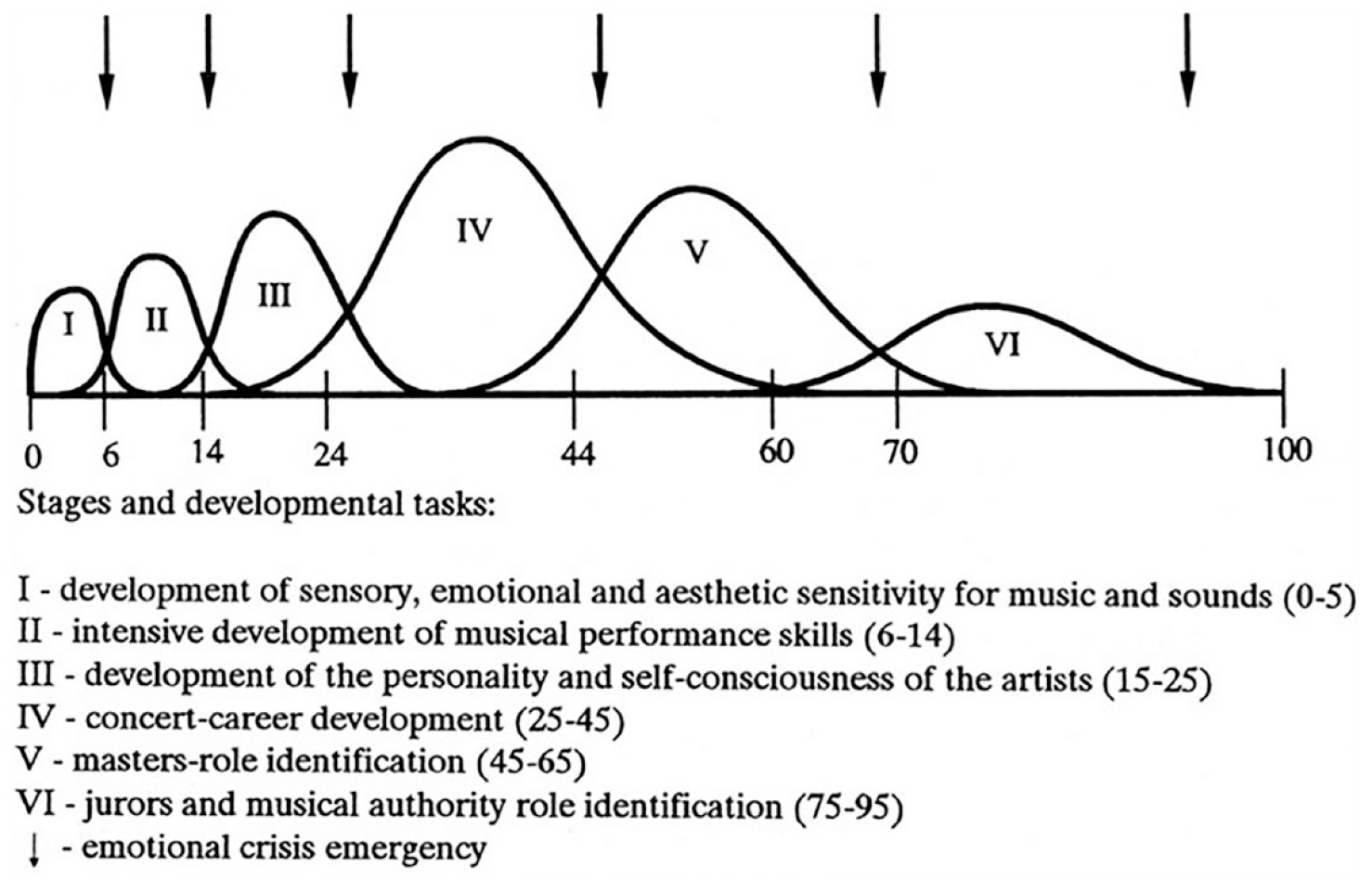
Manturzewska’s model of lifespan development of professional musicians.
Manturzewska gives a detailed description of the stages, which are characterized briefly in the following sections. Stage I (0–6 years) is labeled “the stage of development of sensory-emotional sensitivity and spontaneous musical expression and activity” (Manturzewska, 1990, p. 131). Within this stage, Manturzewska distinguishes three sub-stages. In the first sub-stage, during the first 15 months, the development of sensory-emotional sensitivity to sounds and music is the main focus of the development. In the second sub-stage (up to three years of age), cognitive sensitivity to sounds and music and the categorical perception of pitches develop. In the third sub-stage (from about three years of age), the development of musical memory and imagination and spontaneous vocal and instrumental activities play a significant role. The young musician shows a strong attraction to music, which manifests in intense enjoyment of music, extended listening, and concentration on it. Manturzewska emphasizes the key role of a supportive family environment with strong musical interests. The presence “of at least one person with a strong interest in music, emotionally related to the child . . . [who engages in a] musical dialogue” (Manturzewska, 1990, pp. 132–133) with the child is considered to be a fundamental factor influencing the learning of musical language as a natural means of expression and communication.
Stage II (6–14 years) is the period of intentional musical development guided by a teacher. At about 6 years, future musicians often begin their first instrumental lessons. In this period, “basic technical and performance capacities and musical knowledge are gained” (Manturzewska, 2006, p. 40). In the following years, the structure of motivation changes from the need to play with music to the need to learn music. Starting adequate instrumental instruction early, and engaging in systematic practice behavior between 6 and 9 years of age seems to be a necessary antecedent for later achievement levels. Young musicians often give their first public performances between the ages of 10 and 14.
Stage III (15–24 years) is a “stage of formation and development of artistic personality . . . [characterised by] emergent artistic and professional awareness, philosophical and personal reflection” (Manturzewska, 1990, p. 135), the development of the individual’s own interpretative conceptions, and an artistic personality and identity. The development of outstanding artistic achievements is crucial during this stage. To manage these demanding developmental processes successfully, the musical and social competence of the teacher, their support, and the quality of the student–teacher relationship are of paramount importance. The introduction into the professional community, participating in competitions, and beginning the search for employment opportunities are also important challenges in this stage.
Stage IV (24–44 years) is characterized as “the stage of the first professional stabilisation” (Manturzewska, 1990, p. 136) and starts with entry into professional life around the age of 25 years. The highest artistic performance is achieved between the ages of between 30 and about 45 to 50 years when most concerts are given and professional success is usually at its peak. Interests and motivation are directed toward performing, expanding the repertoire, and the musical career. Between the ages of 45 and 55, there is usually a critical period when the first signs of physical and psychological fatigue and a decline in performance become noticeable. The musician may experience physical and mental fatigue and decreasing mental energy and performance, which may be associated with declining self-esteem and depression. This period is highlighted as “especially critical in creative, introvert types without sufficient support in the professional community. Extroverts and those with good social relationships can get through the period of crisis relatively mildly and almost imperceptibly” (Manturzewska, 1990, p. 136). The careful use of physical and psychological resources is especially important in this physically and mentally demanding phase.
Stage V (44–60 years), referred to as the “teaching phase” (Manturzewska, 1990, p. 127), is characterized by increased teaching activity, a more pronounced sense of social responsibility, and a growing involvement in the musical-organizational field. Violinists and singers often give their last concert around the age of 60. Pianists and orchestral musicians usually remain in this phase much longer. Orchestral musicians who play a wind instrument often retire earlier than violinists.
In Stage VI (from around the age of 60), a gradual withdrawal from professional activities occurs. However, many musicians continue to play and teach until the end of their lives, although not as actively as before. Outstanding musicians often reorient themselves in this last phase of life by taking on the roles of representatives such as jurors, honorary chairpersons, or committee members.
Development processes and influencing factors
Manturzewska describes the transition from one phase to the next as a time of emotional crisis. The more creative and differentiated the musician’s personality, in intellectual, emotional, and cultural terms, the more threatening these transitions can be. Under favorable social and emotional conditions, no crisis may be noticed during the transition period. However, if the circumstances are unfavorable, the musician may face a dramatic crisis, psychological breakdown, or even death (cf. Manturzewska, 1990, pp. 137–138).
An essential element of Manturzewska’s developmental model is that it does not focus solely on the acquisition or development of expertise and professional achievement. Instead, it adopts a holistic, multidimensional perspective and sheds light on the development of the artistic personality and phase-specific influencing factors that determine the development of musical performance. Other essential aspects include
the “master-student” relationship (Stage III), which “steers the development of the entire personality” (Manturzewska, 2006, p. 42)
the critical use of physical and psychological resources and the role of health and prevention, especially in the phase of greatest achievement (Stage IV)
age-related performance losses and their effect on self-esteem, emotions, and health (Stage IV)
the shift of musical interests, especially in the later stages of professional life.
A fundamental condition for the successful development of musical-artistic talent and creativity at any age “seems to be the ‘musical dialogue’ with someone who believes in the talented individual’s potential, who understands his/her musical ideas and accepts them, who supports the musician emotionally in his/her endeavours and helps to overcome the stresses of life” (Manturzewska, 1990, p. 138).
Differences between times and durations of individuals’ periods of greatest achievement
Manturzewska’s model suggests general periods across the lifespan; however, differences may be observed between individuals’ experiences: “The particular stages have different durations in the lives of different musicians, although apparently each has its optimal time and duration” (Manturzewska, 2006, p. 38). Furthermore, there are considerable age-related differences between individuals in terms of their greatest achievements.
The period of optimal performance depends on the instrument, the musical domain, the personality, when the career began, and other possible factors. Figure 2 illustrates differences between periods of optimal artistic achievement experienced by musicians working in different musical domains (conductors, singers, violinists, and pianists) and individual differences between musicians working in the same musical domain (see the different graphs in the same domain), based on musicians’ self-assessments (Manturzewska, 2006, p. 36). Each bar in Figure 2 represents a single case. The positioning and length of the bars mark the chronological positioning and duration of the best performances.
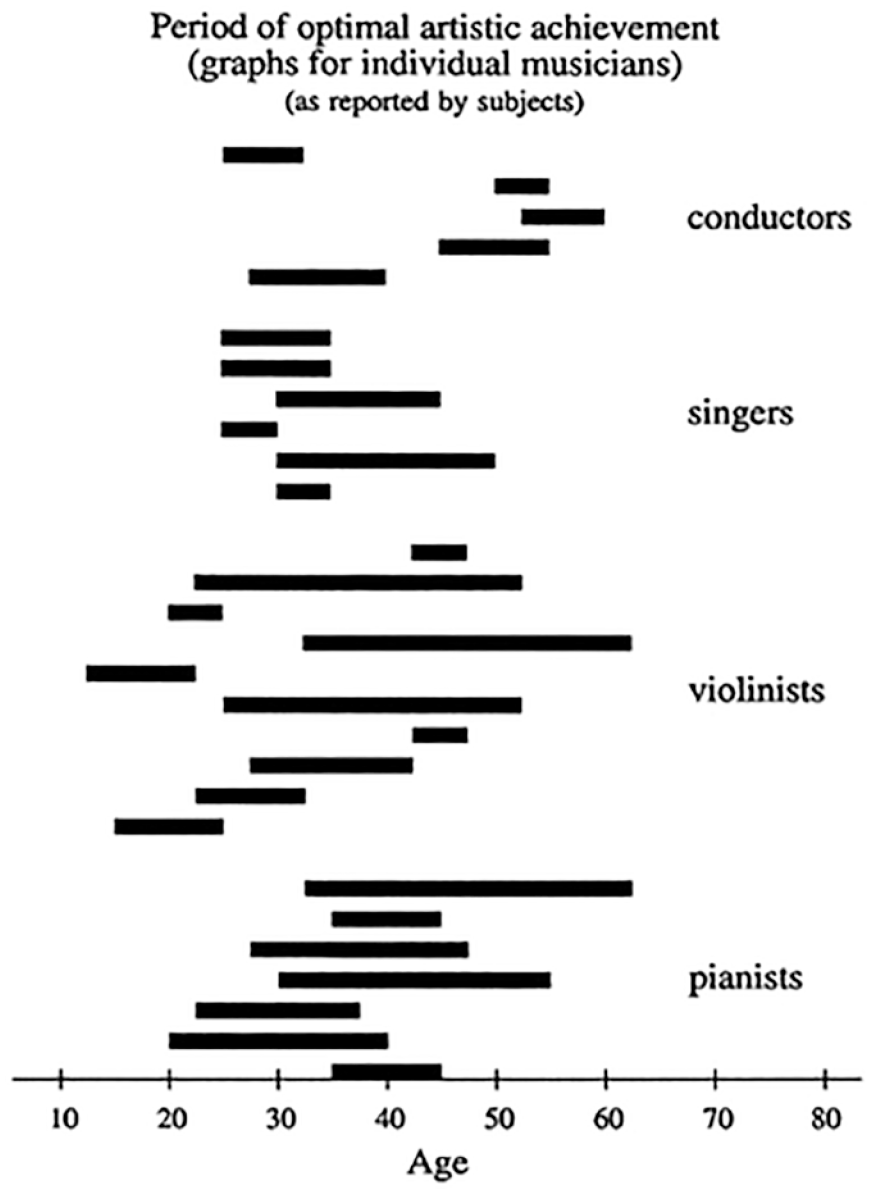
Individual differences between periods of optimal achievement in different musical areas.
For instance, singers usually give their (self-assessed) best performances before the age of 50, and the periods in which they give them are shorter than in other domains. Within the respective domains (e.g., for violinists), there are distinct differences between when the best performances first appear and how long the period of best performances last: some of them appear between the ages of 20 and 40, some around the age of 40 years, some last only a few years, and others extend over several decades beyond the age of 60 years.
Manturzewska’s model in the context of recent research on the lifelong development of musical talent
Several decades since Manturzewska first presented her model, considerable research has confirmed her theory in important aspects. Fundamental aspects and details of the development of musical achievement, as described in Manturzewska’s stages, align with recent research. Examples include the role of family and teachers (Creech, 2018; McPherson, 2009; Reeves, 2015), the process of acquiring expertise on an instrument (Platz & Lehmann, 2018; Preckel et al., 2020), the development of musical identity (Evans & McPherson, 2017; Hargreaves et al., 2018; Spychiger, 2017; Tafuri, 2017), the occurrence of age-related decline in performance at middle age and associated implications for identity and self-image (Gembris & Heye, 2014), and the shift of interests and activities into teaching in the later years of a career (Bennett & Hennekam, 2018).
Trajectories of professional performance from a lifetime perspective
Since the beginnings of research investigating lifelong development in music, its main topic has concerned the study of changes in the musical achievement of professional musicians at different stages of their lives (e.g. Lehman & Ingerham, 1939). This features in Manturzewska’s developmental model, which describes a relatively rapid increase in musical performance in the first three decades of life. The greatest period of achievement (Stage IV) is reached between the ages of 30 and 45. After this phase, musical performance declines more or less markedly but steadily, both subjectively and objectively. This course is consistent with the lifetime trajectory of musical performance described in other studies and is generally regarded as an ideal-type pattern, despite many individual deviations (see Figure 2 for an example); methodological criticisms of data collection and interpretations (Lindauer, 2003); possible variations in trajectory due to different timing of career onset; domain-specific differences; and a general lack of consensus between theoretical interpretations (Simonton, 2018). Manturzewska’s findings on the development of musical achievement also fit very well with the results of a large-scale study on growing older in a symphony orchestra (Gembris & Heye, 2012, 2014), which included 2,536 professional musicians from 133 orchestras in Germany. This study aimed to obtain insights into age-related changes, for example, in self-perception, performance, music-related experiences and attitudes, health, well-being, and perspectives for the future. In this context, the participants indicated at what age they believe musicians generally perform at the highest level on their instrument. While there were slight variations between instrument groups, participants were clear that in general the level of musical performance rises sharply at younger ages, peaks in the years between 35 and 40, and declines relatively quickly after that (see Figure 3). Participants indicated that the period in which musicians were most likely to give their best performances was between the ages of 30 and 45 years, as in Manturzewska’s model.
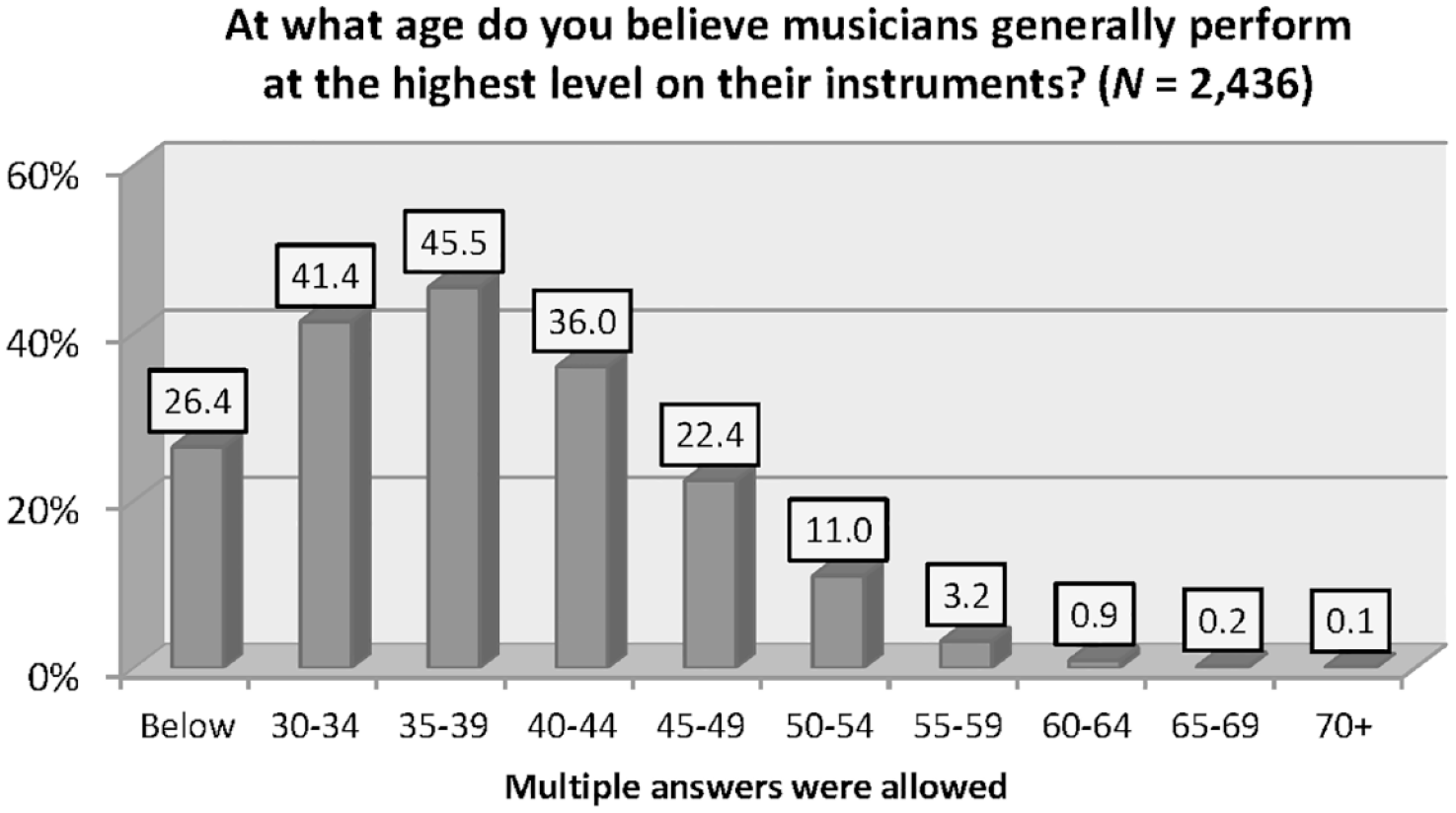
The estimated periods of the highest performance of professional musicians.
According to Manturzewska’s model, a critical period usually occurs between the ages of 45 and 55 years. The data of Gembris and Heye (2012, 2014) show that the self-perceptions of musicians between 40 and 50 years of age change significantly; when asked whether they felt they belonged to the younger or older group of musicians, almost all the musicians younger than 40 (97%) felt they belonged to the younger group. This ratio was reversed between the ages of 40 and 50. Almost all the musicians over 50 considered themselves to belong to the group of older musicians. These data confirm Manturzewska’s description of a critical period of transition between 45 and 55 years.
The biggest change in the assessment of the ability to achieve musical excellence occurs between 40–45 and 50–54 years of age. While 36% of the musicians surveyed still considered musical excellence possible between the ages of 40 and 45, only 11% expected musical peak performance between the ages of 50 and 55. It can be assumed that these changes, in combination with the increasing incidence of physical complaints affecting instrumental playing (cf. Gembris et al., 2018), may be associated with negative changes in musical self-concept, lower self-confidence, and psycho-social crises. However, these data support Manturzewska’s assumption of a critical period between 45 and 55 years of age, which may be individually shorter or longer and more or less pronounced (cf. Manturzewska, 1990, p. 136).
Manturzewska’s model and the Talent Development in Achievement Domains framework
Preckel et al. (2020) recently presented the Talent Development in Achievement Domains (TAD) framework, in which the authors explicitly refer to Manturzewska’s (1990) model of development. The TAD framework is a general, cross-domain model representing talent development as a cumulative process structured according to four developmental levels involving a process of increasing specialization. It was developed on the basis of the Megamodel of talent development suggested by Subotnik et al. (2011). As a general, cross-domain developmental model, the TAD framework corresponds to other models, including Manturzewska’s. Since the TAD framework is a lifespan-oriented talent development model that integrates the latest research, it is particularly suitable for comparison with Manturzewska’s model to examine the extent to which the latter is valid in light of recent theory development; in addition, Preckel et al. (2020) directly refer to Manturewska’s model (see below).
The starting point of talent development in the TAD framework is Aptitude, which is defined as the initial developmental potential for achievement in a particular domain (e.g. music). “It reflects individual differences in psychological variables (e.g. musicality, mathematical cast of mind, spatial ability) that would predispose a person to becoming interested in or engaging in activities relevant to a particular kind of achievement domain” (Preckel et al., 2020, p. 696). The second level of development is Competence, which “refers to a cluster of related and systematically developed abilities, knowledge, and skills that enable a person to act effectively in a situation and that result from systematic learning” (Preckel et al., 2020, p. 696). The third level is Expertise, which “refers to a high level of consistently superior achievement” (Preckel et al., 2020, p. 698) that is recognized by experts as being equivalent to professional-level achievement in the relevant domain. The fourth level of development, Transformational Achievement, goes beyond expertise and refers to extraordinary achievements that have a lasting impact on a field or domain (cf. Preckel et al., 2020, p. 698) and are only accomplished by a few.
The TAD framework and Manturzewska’s model share some key points, but exhibit some important differences. They describe development from initial potential (aptitude or giftedness) to professional and exceptional excellence through several distinguishable developmental stages. Preckel et al. (2020, p. 708) state that “the four developmental levels of the TAD can be closely linked to Levels I to IV in Manturzewska’s (1990) model of lifespan development of professional musicians” (see also Müllensiefen et al., 2022, p. 90). Both models are based on a similar, dynamic, and multidimensional understanding of giftedness and talent. According to this, specific musical potentials, general intelligence, personality traits, practice, and environmental factors interact dynamically (depending on the level of development) and contribute to the development of musical achievement. Alongside these similarities, there are also some differences.
One important difference is that the TAD is a general, non-age-related framework for achievement development that does not refer to any specific domain or age. In contrast, Manturzewska’s model specifically models the development of high-achieving musicians in classical music and assigns the developmental stages to age-related periods. Since the acquisition of outstanding expertise in classical music usually requires an early start on the instrument, appropriate teachers, long-term practice, and institutionalized training at a music academy, it is possible to give rough information on the typical ages at which different stages of development take place, as Manturzewska suggested.
The achievement levels of the TAD framework start with the gradual development from initial potential and end with transformational achievement. Manturzewska’s model goes beyond the peak of achievement (which is always more or less extended in any transitory phase) and describes two additional stages of development, including age-related decline in performance, shifts of interest to teaching and generative activities, and the withdrawal from professional activity.
Unlike the TAD framework, Manturzewska’s model also addresses the costs of achievement-oriented development, such as crisis-like transitions, health risks, age-related performance losses and their effect on development, and emotions. Nevertheless, overall, there are remarkable similarities between the essential elements of Manturzewska’s model and the TAD framework. In taking a domain-specific developmental perspective, Manturzewska’s model goes beyond the TAD framework, representing the development of professional musical performance as an interplay of gains and losses across the entire lifespan. Yet the two models have the potential to complement each other.
To draw an interim conclusion, it can be said that a good starting point for viewing Manturzewska’s model from the perspective of current research is to compare it with the TAD framework because, while the latter provides only a framework for model development, requiring domain-specific elaboration, and Manturzewska’s model provides both a framework and content- specific elaboration, both models deal with the development of talent from potential to excellence. Comparison of the current TAD framework with Manturzewska’s older model reveals remarkable consistencies in the basic multifactorial-dynamic understanding of giftedness; in the indicators of potential and predictors of performance development; the sequence of different developmental phases for achieving peak performance; and the factors that play an essential role in performance development. In other words, Manturzewska’s model, conceived almost 40 years ago, is a valid and theoretically compatible model of musical talent development into adulthood. In accordance with earlier research it suggests that (musical) peak performance and achievement is a temporary phase in life and that talent development changes direction in the second half of life. It can therefore be asked to what extent developmental phase(s) after the achievement of transformational achievement can be modeled by extensions of the TAD framework. Müllensiefen et al. (2022) have proposed several ideas as to how a model of musical talent development could be implemented in the TAD framework. Future studies could, for example, investigate the extent to which Manturzewska’s model could be a starting point for modeling developmental stages beyond the developmental stage of transformational achievement.
Manturzewska’s model in relation to the diversification of professional musicians’ careers today
One of the aims of the project that Manturzewska initiated in 1975 was to investigate “functioning as a professional musician and artist in the contemporary society” (Manturzewska, 1990, p. 113). Almost 50 years have passed since then, and society and musical cultures have changed significantly. A major change affecting the careers of professional musicians is the decrease in permanent positions in orchestras, while portfolio careers encompassing various musical and non-musical roles in alternating employment have simultaneously increased significantly (e.g. Gembris & Langner, 2006; Mills & Smith, 2006). New technologies and digital media have led to profound transformations in the production, reproduction, and reception of music, including in the field of classical music. They have a significant impact on employment opportunities, musicians’ activities, and the development of musical careers (Kavanagh, 2018).
Burland and Bennett (2022) argue that top musicians who can base their careers exclusively on performance activities have always been the exception:
[The] performance career in music—and this is the case across all musical genres–is more typically represented as a portfolio of project-based, self-generated activities that feature diverse performance roles alongside teaching, composition, community work, both music- and non-music roles, and the organisational capacity to bring it all together. (Burland & Bennett, 2022, p. 135)
Although this may be true, potential differences in the labor market for musicians in different countries, for example, between the United States, the United Kingdom, and countries where permanent full-time positions in orchestras continue to exist and play an important role in musicians’ careers, should be taken into account. Despite the dissolution of many orchestras and a significant loss of permanent orchestral positions in Germany, 129 professional, publicly funded orchestras (theater orchestras, concert orchestras, chamber orchestras, radio orchestras) with 9,746 permanent positions still existed in 2018 (Deutsches Musikinformationszentrum, 2020).
Data from a study of graduates from various music universities in Germany showed that 38% of players of string instruments and 42% of players of wind instruments had permanent positions in an orchestra at the time of the survey (Gembris & Langner, 2006, pp. 149–150). Also, since the number of permanent orchestral positions has decreased while freelance work has continuously increased, permanent positions still represent a substantial part of the music labor market and culture. Both forms of employment and the different career paths associated with them coexist simultaneously and contribute to the diversity of musical careers.
Against this background, the question arises as to the extent to which the courses of professional musicians’ careers today are still represented in Manturzewska’s developmental model. After all, the model refers to the talent development and careers of outstanding musicians who, at around 30 years of age (at the beginning of Stage IV in the model), have reached a “relatively stable professional position” (Manturzewska, 1990, p. 136) and can focus mainly on their careers as soloists or traditional orchestral musicians, as depicted in Stages IV, V, and VI. In the terminology of the TAD framework (Preckel et al., 2020), the participants in Manturzewska’s study may be considered as musicians who have reached the highest level of achievement (transformational achievement), which relatively few musicians accomplish (cf. Preckel et al., 2020, p. 698).
Manturzewska’s developmental model is tailored to this type of career trajectory for professional musicians in classical music that, although a minority, still represent a substantial component of contemporary musical culture. The occupational profile of the professional musician in permanent employment (e.g., as an orchestral musician or tenured teacher at a conservatoire), or of the soloist earning a living by performing, has not fundamentally changed. It can therefore be assumed that Manturzewska’s model is still valid for this particular type of career in classical music, even in contemporary music culture. The model does not claim to represent other professional career paths, such as portfolio careers.
Nevertheless, Manturzewska’s model appears to be largely transferable to the early development of professional musicians until the end of their professional training at a conservatoire. Professional classical musicians usually start their training on the instrument around the age of six, investing a lot of time and resources in practicing and acquiring expertise using their instrument and music-related knowledge. They go through rigorous training at the music academy before facing the challenge of finding professional jobs to earn a living. This rigorous process of expertise acquisition (represented in Manturzewska’s model in Stages I to the end of Stage III and beginning of Stage IV) is similar for all musicians in classical music, regardless of whether freelance portfolio work is later pursued or if they find employment in a permanent position. This assumption is in line with models of expertise acquisition (Platz & Lehmann, 2018) and talent development according to the TAD framework, as pointed out by Preckel et al. (2020).
After the stages in which expertise is acquired, however, the developmental paths of musicians do diverge such that portfolio careers with their changing combinations of different occupational activities can take courses deviating from Manturzewska’s model. However, Manturzewska’s model includes some key aspects of development during adulthood and old age that are generally relevant for musicians’ careers, such as health risks, age-related performance losses, the ongoing development of self-image and identity, the growth of a sense of social responsibility, and generative commitment, or the intensification of teaching activities. To find out which courses portfolio careers can take from a lifetime perspective and how they can be represented in a theoretical model, longitudinal studies, biographical studies, and case studies are particularly necessary, as Preckel et al. (2020) suggested.
In the last 20 years, an increasing number of studies of musicians’ professional development and the characteristics and challenges of portfolio careers have been carried out (e.g., Bennett, 2012; Bennett & Hennekam, 2018; Burland & Bennett, 2022; Mills & Smith, 2006; Smilde, 2009). Bennett and Hennekam (2018) conducted case studies with 108 professional musicians, including 10 who were classically trained, and examined their working practices in the early, middle, and late stages of their careers. The authors investigated musicians’ uses of the adaptive strategies of selection, optimization, and compensation (SOC theory) at different stages of their careers to adapt to changing working conditions and maintain their performance. Selection means the selection of goals according to available needs and opportunities, optimization describes focusing and increasing efforts on a specific goal, and compensation refers to strategies to maintain a desired level of performance (Bennett & Hennekam, 2018). The results show, for instance, that early in their careers, participants in the research reconsidered performance as the primary criterion for success to optimize their potential. In the mid-career phase, many participants realized that they “had underestimated the fierce competition for performance work” and “the need to engage in teaching and administration” (Bennett & Hennekam, 2018, p. 114). They changed their career goals accordingly (selection) to optimize their potential. These changes in the evaluation of the field of activity, the adjustment of goals and the focus of activity from the perspective of SOC theory can also be related to the corresponding changes described in Stages V and IV of Manturzewska’s model. The lifespan perspective method of “using a retrospectively longitudinal approach to look back in time within individual accounts and to analyse snapshots of practice at different career phases” (Bennett and Hennekam, 2018, p. 122), also used by Manturzewska, has proved to be a robust method that is promising for future studies.
Conclusion
Since Manturzewska conducted her biographical study of the lifespan development of professional musicians in the 1970s, interdisciplinary research investigating talent and the factors influencing talent development has made considerable progress. The extent to which Manturzewska’s model aligns with current knowledge is remarkable (e.g., in relation to the dynamic, multidimensional, and interactive concept of musical talent, the description of the acquisition of musical expertise and the later stages of development as well as concerning the factors and processes underlying the development of musical performance over the lifespan).
Manturzewska’s model is outstanding compared to other models, as it not only considers the aspect of achievement, achievement maximization, and its determinants (like, for example, expertise research) from a lifetime perspective, but it also takes into account the musician as a human being, the development of their personality and identity, changes in performance, social relationships (family, teachers, people for a “musical dialogue”). Moreover, it integrates critical phases and transitions, health risks, weaknesses, and emotional aspects from the musician’s perspective. For this reason, Manturzewska’s model can be described as a holistic, integrative, and humanistic model of the lifespan development of professional musicians close to musical practice.
All in all, it remains unique to this day, representing the most differentiated and multifaceted model of musical development of a traditional professional career in classical music. It has been the starting point for many researchers since the 1980s and provides a solid basis for further research. The research of Manturzewska and other authors converge on the goal of achieving a better understanding of the lifelong development of musicians in all its possible facets and the diversity of its course. This provides an empirical basis for more practice-oriented education and counseling of future musicians, which supports employability and the creation of sustainable careers.
Footnotes
Author’s note
The author was the Director of the Institut für Begabungsforschung in der Musik (IBFM; Institute for Research on Music Ability) at the Paderborn University until March 2022. The author has been working on the topic of the lifelong development of giftedness and talent in music since the 1980s. On the occasion of an invited lecture in 1992 at the conference of the German Society for Music Psychology (DGM) in Münster, Germany, on lifelong development in music, the author had the opportunity to meet Maria Manturzewska personally. He subsequently remained in personal contact and professional exchange with her until the last years of her life. She followed international developments in music psychology, and especially research on giftedness and talent development, with lively interest until old age, and provided it with important impulses. The conception of her model of the lifespan development of musical talent has remained unique despite growing academic interest in lifespan development processes in music and has therefore been frequently quoted.
Funding
The author received no financial support for the research, authorship, and/or publication of this article.
