



Abstract
Body movements play a crucial role in music performance and perception, and they do so well beyond those devoted to sound production itself. Various movements related to the performer’s emotional intentions or structural aspects of the music are also part of the performance and crucial to the listening experience. In the present study, we investigated the effect of instructed timing on such non-sound producing body movements, focusing on musicians’ body posture. We used an infrared motion-capture system to record the movements of skilled guitarists and bassists while they were playing electric guitar and electric bass, respectively. We instructed the musicians to perform under three different timing-style conditions: laid-back (behind), on-the-beat, and pushed (ahead). We also conducted short semistructured interviews to gain further insight into their movement strategies. The results show that performers generally leaned forward when instructed to play systematically slightly ahead of the pulse. We suggest that this change is related to an alteration in the performer’s experience of the feel of the music. The results support the view that musicians’ non-sound-producing body movements are not random, but integral to the performance, and that they are closely related to the music’s microrhythmic feel.
Musicians’ music-related body movements
It is useful to categorize movements of the body related to the performance of music according to their general function, as follows: sound-producing actions without which sound could not be produced; sound-accompanying movements that are generally made at the same time as some aspect of the sound; communicative gestures made by performers to each other or the audience; and ancillary movements 1 associated with expressivity, emotional intentions, or musical structure (e.g., Godøy & Leman, 2010; Jensenius, 2007). These categories are not mutually exclusive but often overlapping and interactive.
Musicians’ sound-producing actions are those movements directly involved in producing the sound, such as strumming the strings on a guitar, and those involved in modifying the sound, such as moving the fingers on the guitar neck while changing the chord. Researchers have demonstrated that knowledge of sound-producing actions informs the perception of those sounds (e.g., Clarke, 2005; Cox, 2016; Godøy, 2010; Liberman & Mattingly, 1985; Wilson & Knoblich, 2005). For example, researchers have discovered that motor-related areas of the brain associated with piano playing are also activated when pianists listen to piano music (Endestad et al., 2020; Haueisen & Knösche, 2001). It has been suggested that such movement–sound couplings are due to the multimodal nature of human perception (e.g., Berthoz, 2000), which also suggests how performers’ sound-producing actions are intrinsic to the perception of the sound. Schutz and Lipscomb (2007), for example, recorded a marimba player who had been instructed to play long and short notes, and asked participants in the study to evaluate the durations of the notes based on audio-only versus audiovisual input. Participants perceived a difference between the durations of the two categories of notes in the audiovisual but not the audio-only condition, indicating that their perception of the sound was informed by seeing the performer’s body movements.
Musicians’ ancillary movements do not directly produce sound but are nevertheless an integral part of the way the musician plays (e.g., Wanderley, 2002). Researchers have shown that such movements are used to express the performer’s interpretation of structural aspects of the music, such as pulse or phrasing, and their emotional intentions (e.g., Dahl et al., 2010; Davidson, 2007). Like sound-producing actions, these expressive movements are also intrinsic to music perception (e.g., Broughton & Stevens, 2009; Nusseck & Wanderley, 2009; Thompson et al., 2005; Vines et al., 2006). For example, Thompson et al. (2010) discovered that listeners’ pitch and interval perception were influenced by seeing the movements of a singer’s head, mouth, and eyebrows. Thompson and his co-workers suggest that, consciously or unconsciously, performers communicate pitch relations, emotional interpretations, and expressivity associated with vocal pitch range through these movements. Similar results were obtained in a recent study by Laeng et al. (2021).
Among musicians’ ancillary body movements are entrained movements—repetitive movements associated with the endogenous reference structures of musical rhythms. It has been theorized that the experience of musical rhythm encompasses the interaction between the rhythm that is performed and the perceiver’s endogenous reference structures, including pulse (e.g., Danielsen, 2010b; Haugen, 2016; Honing, 2012; London, 2012). Pulse is not necessarily represented by sonic events but nevertheless supplies a framework for perceiving them. The close relationship between pulse and entrained movements such as foot tapping, head nodding, and body swaying has long been highlighted in the literature (e.g., Dahl et al., 2010; Jensenius, 2007; Merchant et al., 2015). Such movements not only respond to sonic rhythmic inputs but also facilitate the processing of temporal structures (Su & Pöppel, 2012), and improve the perception of timing, or even timekeeping (Manning & Schutz, 2013).
Groove, timing, and body movement
In this study, we were particularly interested in musicians’ body movements when playing groove-based music. In recent decades, the groove has been conceptualized in various ways (for an overview, see Câmara & Danielsen, 2018). Here, we use the term to describe style-specific repetitive rhythm patterns performed in a particular manner in terms of their timing, sound, and shaping (e.g., Iyer, 2002; Keil & Feld, 2005). Importantly, such groove templates imply specific ways of articulating the rhythmic figures that are typical of groove.
An important dimension of the concept of groove is that it evokes an experience. Being in the groove has been described as a euphoric feeling, often related to a sense of flow and timelessness (Danielsen, 2006; Janata et al., 2012; Roholt, 2014). The experience of groove relates to the feel of a specific style of music that has been associated with the desire to move (e.g., Keil & Feld, 2005; Madison, 2006; Pressing, 2002) and a sense of pleasure (e.g., Janata et al., 2012; Witek et al., 2014). For the confident listener, both are intrinsically related to learned, style-specific ways of moving.
A performer always shapes a groove in relation to an endogenous pulse (e.g., Danielsen, 2010a). This often involves playing with a specific timing profile such as slightly ahead of or behind the beat (e.g., Honing, 2013). This shaping is also referred to as expressive timing (Clarke, 1985, 1987) or microtiming (Butterfield, 2006; Iyer, 2002; Madison et al., 2011). Importantly, it is not a consequence of human imperfection or lack of ability (Bengtsson, 1987). Rather, it is what makes the music “come alive” (Snyder, 2000, p. 88). In jazz, Keil (1966) observes, some musicians tend to play on top of the pulse, while others tend to be more laid back, or behind it. When musicians with these different tendencies play in the same band or combo, that is, when one musician, for example, a bassist, plays consistently laid back while another musician, for example, a drummer, plays consistently on top, the result is a rhythm pattern described as swing or groove. Musicians well versed in groove-based musical styles are trained to find the aesthetically optimal timing for their own instrument within the whole and maintain this timing for the duration of the pattern. Keil subsequently coined the term participatory discrepancy (PD) for those “little discrepancies within a jazz drummer’s beat, between bass and drums, between the rhythm section and soloist, which create ‘swing’ and invite us to participate” (Keil, 1987, p. 277). 2 Iyer (2002) points out that highly regarded drummers in African American music genres play a typical backbeat pattern with a slight delay. In its most basic form, the backbeat pattern consists of a bass (kick) drum stroke on beats 1 and 3 and an accented snare drum stroke on beats 2 and 4 in a 4-m metric cycle. The snare drum is frequently played slightly behind the pulse, or “in the pocket,” Iyer notes (p. 406), which cultural insiders perceive as relaxed or laid back, as opposed to stiff or on top).
Researchers have highlighted the fact that the feel of a groove performance involves not only intentional changes to onset timing but also the overall microrhythmic expression—that is, those other features that shape sounds that are performed and the way they are perceived, in terms of their duration, intensity, and timbre (Câmara, 2021; Danielsen, 2006, 2010b, 2012). Câmara and colleagues (2020b) found that expert groove-based drummers regularly played laid-back strokes louder and/or longer to distinguish intentionally asynchronous performances from on-the-beat performances. In another study (Câmara et al., 2020a), they also found that expert groove-based guitarists tended to utilize longer stroke duration (both attack and decay) and lower brightness (measured as the spectral centroid) in addition to later onset timing to achieve laid-back performances, and bassists utilized greater stroke intensity (measured as sound pressure level) in addition to early timing to achieve a pushed feel. This research shows that groove and timing are truly multifaceted phenomena, qualities that are difficult to conceptualize as single dimensions. The production of timing appears to involve the manipulation of a host of acoustic features, and the resultant experiences of groove are probably enabled by more than simple changes in onset timing.
In the present study, we investigated yet another dimension of performed microrhythm: its relationship to body movement. The phenomenological experience of groove is strongly linked to what music psychologists describe as a pleasurable urge to move to music (Janata et al., 2012), and discursive descriptions of groove also tend to encompass an embodied and metaphorical aspect. The claim that the microrhythmic feel of being early or late can be reflected in the individual’s body language gains support from theories concerning the metaphorical transfer between different domains of human experience. In Metaphors We Live By, for example, Lakoff and Johnson (2003) introduce the idea that we draw upon basic bodily or physical experiences to understand abstract concepts such as time, as is reflected in our language through expressions such as the future is ahead of us or the past lies behind us. This general tendency to understand and experience “one kind of thing in terms of another” (Lakoff & Johnson, 2003, p. 5) may also inform the way in which musicians play slightly ahead of or behind a pulse reference—that is, their playing may be reflected by their physical movements. Given the close relationship between the feel of a groove and body movements, as well as the importance of microrhythm to groove performance, it is but a small leap to hypothesize the existence of a timing-related movement of the performer’s body that reflects both the feel of the groove for the listener/viewer and what it is the performer wants to achieve and communicate. In other words, the microrhythmic feel of groove might encompass not only its sonic features and their corresponding sound-producing actions but also certain related movements that do not directly produce sound.
In the present study, we looked at the relationship between timing profile and non-sound-producing body movements. Our focus on changes of posture was triggered by the postexperiment interviews where the tendency to change body posture in accordance with different timing feels was mentioned by several participants. We thus asked whether the participants’ hip angle varied systematically with the different timing conditions. Hip angle refers to the angle between a person’s thigh and torso and determines how upright the upper body is. We chose the hip angle for several reasons. First, musicians cultivate highly individualized ways of moving expressively while playing, which makes it hard to compare conditions or even settle upon a common pattern of movements. Hip angle, on the contrary, can be measured in the same manner for everyone. Second, the results of some studies indicate a correspondence between timing, feel, and performers’ changes of posture. In a study of Swedish polska music, Kaminsky (2014) interviewed polska musicians asking them how they made the dancers move, and one of the parameters they emphasized was the lean. They said that leaning backwards was associated with playing sound events slightly after the beat and leaning forwards was associated with playing them slightly before it (and with a slight increase in tempo and upward movement). In performance research carried out by Câmara et al. (2020a, 2020b), musicians often reported altering their strategies to play according to the timing style they had been asked to use. These strategies related to both sound-producing (e.g., slower vs. faster strokes) and accompanying body movements; in addition, they indicated that they needed to change their posture by leaning forwards or backwards to produce a pushed or laid-back feel, respectively. The results of another performance experiment in which drummers were instructed to play with different microrhythmic feels (Danielsen et al., 2015) had similar implications for the role of posture. The relationship between timing profile and posture that emerged indirectly from the themes arising from data obtained from the participants in these studies indicates that some set of basic experiences with time and movement may be activated in relation to the musician’s commitment to a given timing profile.
In the present study, we investigated whether different timing profiles in groove performances are reflected in the movements of performers’ bodies, operationalized here as a change of posture measured in terms of hip angle. The participants in the study played two salient rhythm-section instruments that are ubiquitous in groove-based ensembles: electric guitar and bass. Since the two instruments are held and played in similar ways, and rely on shared performance approaches to timing and microrhythm in groove-based music, we expected the two groups of participants to move in similar ways. We hypothesized that guitarists and bassists would lean forwards when they were instructed to push and backwards when instructed to play in a laid-back manner.
Method
The data were collected as part of the auditory experiments reported by Câmara et al. (2020a). To test whether different timing profiles in groove performances were reflected in performers’ overall body posture, we instructed skilled guitarists and bassists to play with pushed, on-the-beat, or laid-back timing, then used an infrared motion-capture system to record participants’ movements while playing.
We obtained written informed consent from all the participants in the study. 3
Participants and task
Twenty-one electric guitarists (3 female, 18 male) aged 22–50 years (M = 33, SD = 7) and 21 bassists (all male aged 23–49 years of age [M = 32, SD = 7]) took part in the experiment. All were semiprofessional or professional musicians who were well versed in either rock or jazz and/or soul/funk and were recruited from either local performance scenes or conservatory/academic institutions. The guitarists had between nine and 40 years of performance experience (M = 20, SD = 8) and the bassists had between six and 38 years of performance experience (M = 28, SD = 10).
We instructed the participants to play two different rhythmic patterns: for the guitarists, a simple backbeat pattern (1) and a syncopated version of that pattern (2); for the bassists, a simple downbeat pattern (1) and a version of that pattern with additional pickup notes (2). Transcriptions of the two patterns played by the guitarists and bassists are shown in Figure 1. The participants performed them both in three different timing-style conditions: laid-back, on-the-beat, and pushed. They played along with a prerecorded backing track at 96 beats per minute (bpm). The backing track was played by electric bass and drums for the guitarists and electric guitar and drums for the bassists.
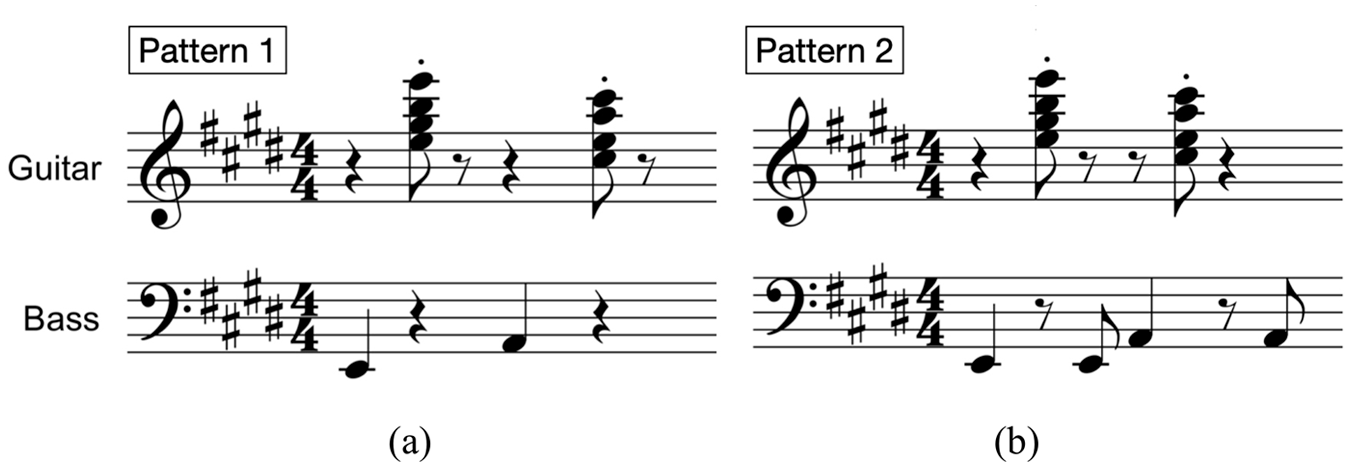
Patterns performed by the guitarists and bassists. Transcriptions of (a) Pattern 1, a simple backbeat pattern and (b) Pattern 2, a syncopated version of the backbeat pattern with additional pickup notes.
Apparatus and procedure
The recordings were carried out in a motion-capture lab and included both the sound and the participants’ body movements. 4 The sound signal from the instruments was recorded using Reaper. 5 The sound was also routed to an analog mixer and fed into headphones that were supplied to the participants for monitoring purposes. The playback reference track was routed into the mixer from Reaper and then into the headphones; in addition, it was combined with the direct monitoring of the instrument signals. The participants’ body movements were recorded using a state-of-the-art optical motion-capture system from Qualisys. 6 Reflective markers were attached to the participants’ bodies and the instruments, and the system tracked the movements of the markers at a frame rate of 400 Hz. Figure 2(a) illustrates the placement of the markers on the participants and instruments (see also Supplemental Appendix A). The sound and movement were recorded simultaneously, and the performances were also video-recorded for reference purposes.
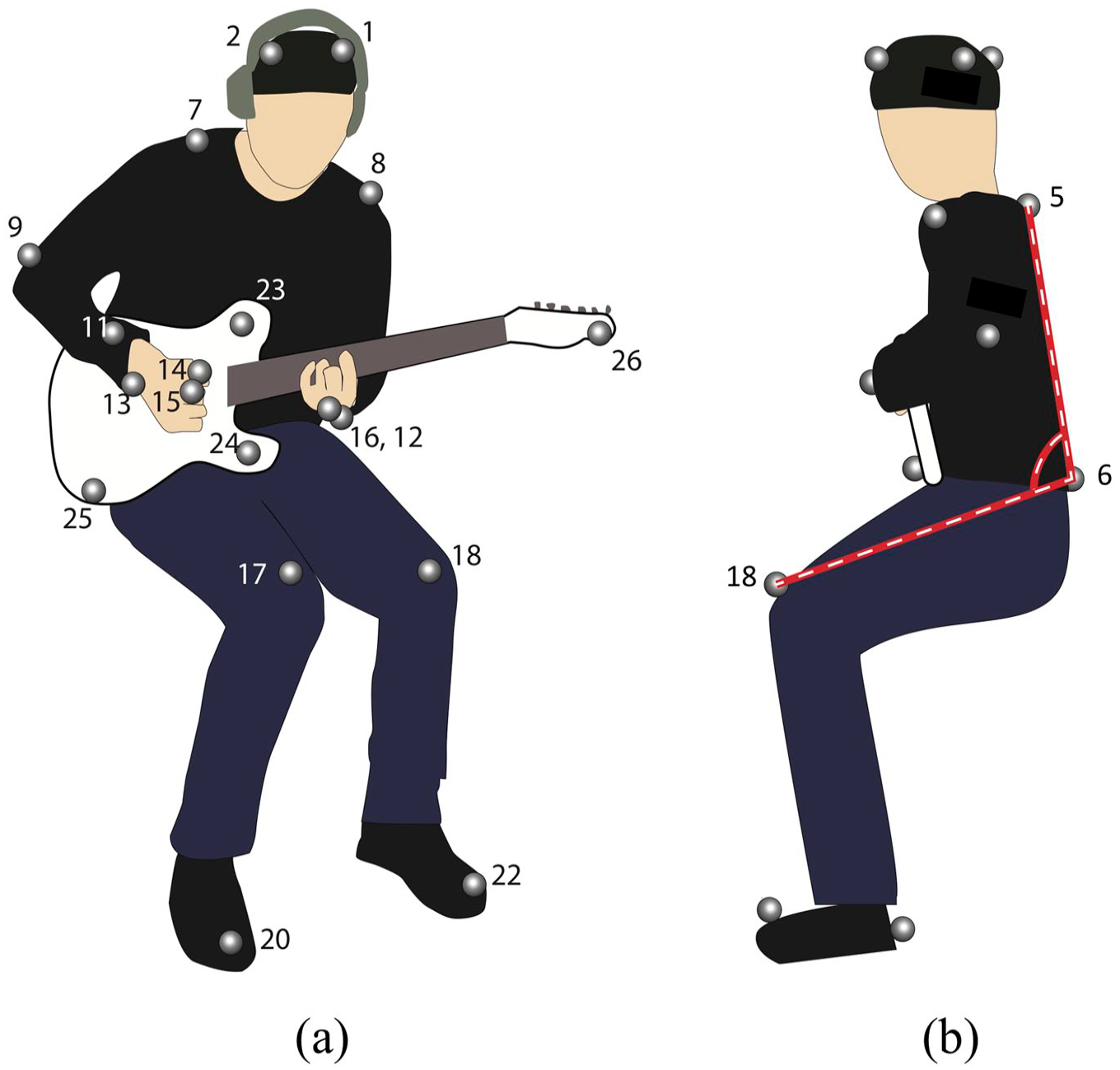
Placement of the markers. Illustrations of (a) the placement of the reflective markers attached to the musicians and the instrument and (b) the participants’ hip angles calculated by the angle between the markers placed on their neck, lower back, and left knee.
All participants sat on a stool while playing. They were given time to acquaint themselves with the instrumental setup, and they indicated when they were ready to start playing. At the beginning of each experimental session, they played the rhythmic pattern using natural timing, to familiarize themselves with it, and as a warm-up. They went on to perform the timing-condition tasks, that is, to play the rhythmic pattern in the laid-back, on-the-beat, and pushed timing conditions, which were randomized. The rhythmic pattern was 27 bars, so each timing-condition task lasted 67.5 s. Participants were invited to repeat their performances until they were satisfied with them.
When the recordings had been made, we conducted short semistructured interviews with the participants to gain insight into the strategies for movement they had used to play under the three conditions. We asked, for example, about sound-producing movements (i.e., related to playing the instrument, for example, slow/fast, long/short, narrow/tight, smooth/choppy or jerky), changes of posture (i.e., unrelated to sound production), and the bodily sensations engendered by each condition (e.g., tense/relaxed, and more or less focused).
Movement analysis
Motion-capture recordings were used to analyze the participants’ posture. This was operationalized in terms of their hip angles, measured by the angle between the markers placed on the participants’ left knee (marker 18), lower back (marker 6), and neck (marker 5; see Figure 2(a) and (b)). Angles were measured in degrees. Data obtained from four participants were excluded from the analysis, in one case a bassist for whom Marker 5 (neck) was missing, and in the other three cases (two further bassists and a guitarist) because their hip angles changed abruptly in the middle of one or more of the recordings. The hip-angle distributions for the remaining recordings were approximately normally distributed. To ensure that all participants had got into their performances by the time the measurements were made, the excerpts analyzed consisted of 16 bars (20–60 s) from each recording.
Statistical analyses
Each participant’s mean hip angle in each condition was calculated and outliers (measurements more than three standard deviations from the mean) were removed. To test the effect of condition on mean hip angle, a mixed 2 × 3 × 2 ANOVA with repeated measures was conducted with rhythm patterns (1 and 2) and instructed timing condition (laid-back, on-the-beat, and pushed) as the independent within-subjects variables, and instrument (guitar and bass) as the between-subjects factor. Post hoc t-tests were conducted using Bonferroni corrections. All statistical analyses were performed using SPSS version 26 (IBM, Inc.).
Results
The mean hip angles, measured in degrees, with corresponding standard deviations (SD) for Patterns 1 and 2 in the laid-back, on-the-beat, and pushed timing conditions, are presented in Table 1.
Mean hip angles with corresponding standard deviations.
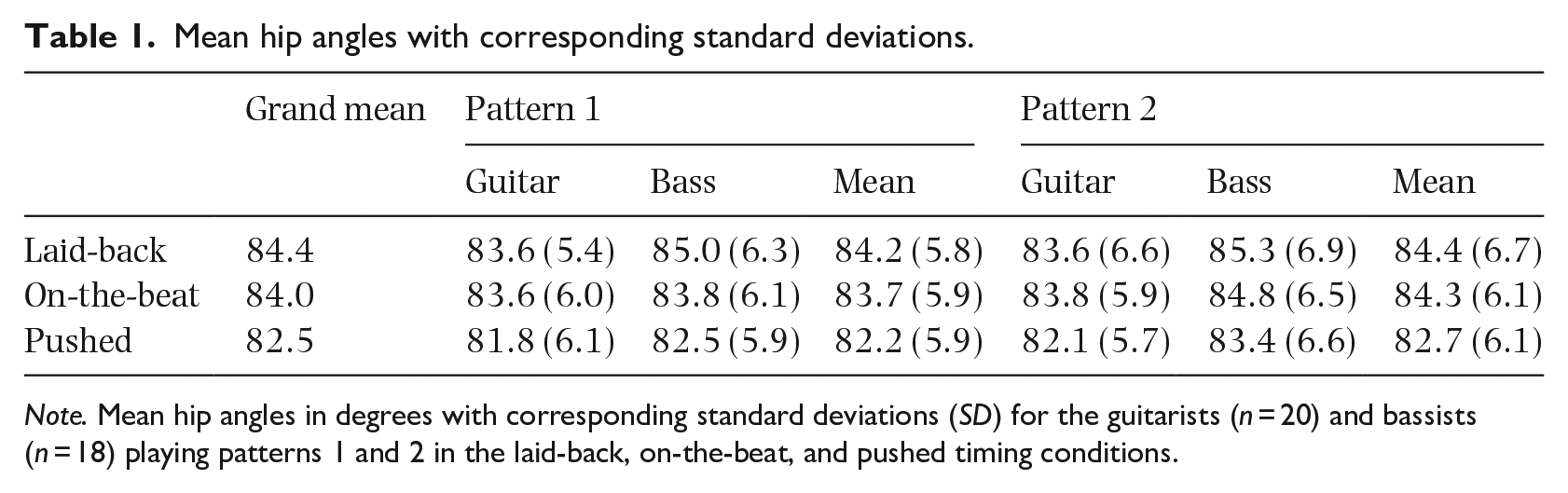
Note. Mean hip angles in degrees with corresponding standard deviations (SD) for the guitarists (n = 20) and bassists (n = 18) playing patterns 1 and 2 in the laid-back, on-the-beat, and pushed timing conditions.
Analysis of variance revealed a significant main effect of timing condition on mean hip angles, F(2,72) = 8.243, p < .001,
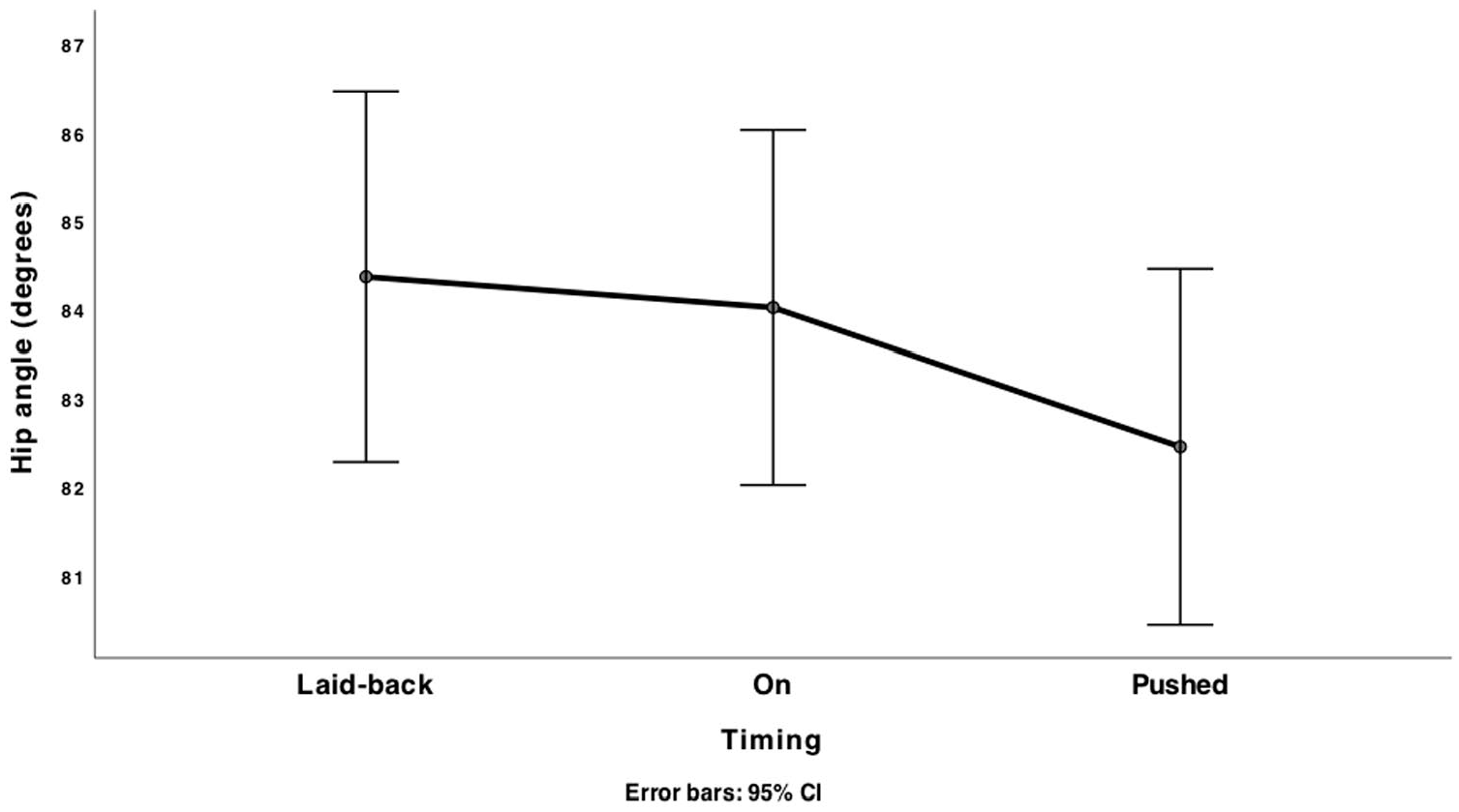
Mean hip angles under the three instructed timing conditions.
Discussion
This study sought to investigate the effect of instructed timing on changes in guitarists’ and bassists’ body posture. The results showed that participants systematically leaned forwards when asked to play in a pushed, as opposed to laid-back or on-the-beat manner. We have reported elsewhere that instructed timing influences sound production and the temporal placement of sound events (Câmara et al., 2020a), as well as sound-producing actions (Câmara et al., in 2023). The results of the present study show that instructed timing also influences performers’ posture and, by extension, the overall bodily feel of the performance. Even though the effect of instructed timing on posture was small (
The results are particularly interesting given that the primary aim of the experiment was to investigate the effects of instructed timing on sound-producing movements and the sonic features of the music played. Accordingly, the instructions did not focus on change in body posture; participants were simply asked to play the patterns with pushed, on-the-beat, and laid-back timing. Thus, although it is possible that participants perceived change in posture to be a demand characteristic of the experiment, we do not believe that this was the case.
In the follow-up interviews with participants, we found further support for a link between posture and the bodily experience of playing with a pushed feel. We did not ask about or even mention posture, yet many participants evoked the bodily sensations of pushing the beat by leaning forwards in their chair, and of laid-back playing by returning to a more upright position or settling back in their chair. The fact that participants leaned forwards not only when performing but also when recalling playing in a pushed manner suggests that timing, as it is experienced by the performer, may be reflected in their body language. Furthermore, when comparing their pushed with on-the-beat sound-producing movements, participants used terms such as “narrower,” “tighter,” “quicker,” and “jerkier.” These adjectives correspond well with the sense of being ahead, or rushed, that we hypothesized for pushed playing.
When comparing their laid-back with their on-the-beat playing, by contrast, participants reported that it required “wider,” “looser,” “slower,” and “smoother” movements. They could therefore have been expected to lean backwards when playing in a laid-back as opposed to an on-the-beat manner. However, no significant differences were found between participants’ mean hip angles under the laid-back and on-the-beat conditions, which suggests that other factors may have influenced their choice of posture. One factor may be familiarity; perhaps, some timing profiles are used more often than others in groove-based music. Participants reported that, in the context of most (although not all) groove-based music genres, on-the-beat and laid-back playing are practiced more often than playing in a pushed manner, implying that they are more common in general. Pushing the beat might therefore require more mental effort. This suggestion is supported by the interview data, as both the guitarists and the bassists reported that they felt most tense or stressed in the pushed condition, which required the greatest concentration, and least tense or stressed under the on-the-beat condition, which required the least concentration. Participants may thus have leaned forward under the pushed condition because they were feeling tense and stressed.
Body posture might also correspond to the sonic features typical of the different timing profiles and the effort required to produce the sound. Câmara and colleagues (2020a) found that bassists, in particular, regularly reported playing “harder” strokes to achieve a pushed feel and “softer” strokes to achieve a laid-back feel. This was confirmed by analyses of the audio-recordings, which showed that, on average, strokes in the pushed condition were played with higher sound-pressure level (SPL). It was speculated that they were played with higher SPL because it was more difficult to play under the pushed condition. In the present study too, then, participants may have leaned forwards because the greater difficulty of the condition placed greater demands on their effort/concentration and skills.
If players lean forwards because they have to make more mental effort, they could be expected to change their posture according to the complexity of the rhythm patterns they were asked to play. There was no significant difference between mean hip angles attributable to rhythm pattern, however, perhaps because—despite the syncopations and pickups in Pattern 2—there was not much difference in their complexity and they were both easy to play, particularly in comparison with those used as measures in previous studies of the groove (Sioros et al., 2014; Witek et al., 2014). In addition, both patterns are often used in groove-based music genres and would have been familiar to all the participants.
Leaning forwards can also be seen as a way for the performer to show the audience and/or co-performers that they are pushing the beat in their playing. In this study, however, participants were playing alone, without an audience, accompanied by a prerecorded backing track. This suggests that they leaned forward not to communicate their intention but rather to convey their experience of playing. Given that performers’ movements while playing are intrinsic to the way the audience perceives the music (e.g., Nusseck & Wanderley, 2009; Schutz & Lipscomb, 2007; Thompson et al., 2005; Vines et al., 2006)—well as an important dimension of musical communication in general (e.g., Broughton & Stevens, 2009; Davidson, 2006)—is likely that they are so well practiced that musicians make them whether or not an audience is present. This would be worth exploring in future research.
In this article, we have discussed the relationship between instructed timing and musicians’ movements, focusing on changes of posture measured in terms of hip angle. This is not to say that musical feel is reflected exclusively by the performer’s posture or that embodied timing can be reduced to the angle of the hip. We would simply point out that movements of the body that do not produce sounds are as important as sound-producing movements to music performance in general, and expression and feel in particular. Posture represents a good starting point for investigating the embodied nature of timing, and our results point to the expression of microrhythm in groove-based music as encompassing onset timing, acoustic features, and timing-related movements related to the feel of the music as it is experienced by performer and audience alike.
Conclusion
Our results indicate that the posture of the musician is intrinsic to their intended timing; that is, musicians are significantly more likely to lean forward when pushing the beat than when they are playing on the beat or with laid-back timing. We frame this change in body posture as an expression of an embodied groove experience that is closely related to theories of musical metaphors, or the ways in which our understanding of musical concepts is tightly connected to bodily experiences. Since it appears that playing in a pushed manner corresponds to a feeling of being ahead or stressed, we suggest that this change in posture is related to a change in the microrhythmic feel of the music as it is experienced. In addition, because musicians generally practice laid-back and on-the-beat timing more regularly than pushed timing, in the context of groove-based music, they may lean forward to a greater extent because they are making more mental effort and experiencing more tension. Our results support the view that movements that do not produce sound are not random but rather integral to musicians’ performances. Intrinsically related to movement (sound-producing and otherwise) are not only the sound, structure, and/or emotional interpretations of the music but also the general feel of the music and the effort required to produce it.
Limitations and future work
In the present study, we investigated participants’ changes of posture. In future studies, we want to include other movements of the body that do not produce sounds, exploring how the shapes of periodic pulse-related movement differ among timing conditions. We are also interested in how performers’ timing-related movements influence the audience’s experiences of groove. One limitation of the present study was that we could not disentangle the potential effects on mental effort of the instruction to play in a pushed manner, and the difficulty of playing in such a way. In future studies, then, we could revise the instructions and ask participants to play early or late rather than push and be laid-back. This could eliminate the possibility that participants saw a change of posture as a demand characteristic of the experiment. Conversely, it could be argued that the terms early and pushed, and late and laid-back, while often related, might produce different microrhythmic feels. This testifies to the very fine-grained differences between the types of articulation mastered and produced by expert groove musicians.
Supplemental Material
sj-docx-1-msx-10.1177_10298649231182039 – Supplemental material for Instructed timing and body posture in guitar and bass playing in groove performance
Supplemental material, sj-docx-1-msx-10.1177_10298649231182039 for Instructed timing and body posture in guitar and bass playing in groove performance by Mari Romarheim Haugen, Guilherme Schmidt Câmara, Kristian Nymoen and Anne Danielsen in Musicae Scientiae
Footnotes
Declaration of conflicting interests
The authors declared no potential conflicts of interest with respect to the research, authorship, and/or publication of this article.
Funding
The authors disclosed receipt of the following financial support for the research, authorship, and/or publication of this article: This work was partially supported by the Research Council of Norway through its Centres of Excellence scheme, project numbers 262762 and 249817.

Supplemental material
Supplemental material for this article is available online.
Notes
References
Supplementary Material
Please find the following supplemental material available below.
For Open Access articles published under a Creative Commons License, all supplemental material carries the same license as the article it is associated with.
For non-Open Access articles published, all supplemental material carries a non-exclusive license, and permission requests for re-use of supplemental material or any part of supplemental material shall be sent directly to the copyright owner as specified in the copyright notice associated with the article.
