




Abstract
Music preferences have consistently been found to follow a five-factor structure (i.e., Mellow, Unpretentious, Sophisticated, Intense, and Contemporary, in short MUSIC), in the West. These factors are associated, in turn, with the Big Five personality traits. However, the stability of this structure and its association with personality in non-Western cultures are underexplored. Moreover, behavioral traits other than personality traits might relate to music preferences. High systemizing traits, as often seen in people with autism, tend to be associated with a preference for Intense music. However, whether this generalizes to autistic traits in the general population remains unclear. The current study therefore attempted to examine the five-factor MUSIC model and test its association with Big Five personality traits and autistic traits in an online study of Malaysians. A total of 444 participants, of whom 59.7% were of Chinese ethnicity, rated their preference for 50 brief musical excerpts and completed the Ollen Musical Sophistication Index, the Ten-Item Personality Inventory, and the Autism-Spectrum Quotient-28. The original MUSIC model was partially replicated with virtually identical Sophisticated and Intense factors. However, once age, gender, and musical sophistication were controlled for, most of the previously reported associations between Big Five personality traits and music preferences were not found. Instead of a positive association between autistic traits and Intense music, a negative association was found between autistic traits and Contemporary music. These findings partially support the validity of the MUSIC model in Malaysia and highlight the importance of undertaking research on music preferences in non-Western contexts.
Five factors underlying music preference are consistently found in the literature. Rentfrow et al. (2011, 2012) repeatedly found and confirmed a five-factor model of music preferences in a series of studies using musical excerpts across different samples. The five factors are Mellow (soft rock & soul), Unpretentious (pop & country), Sophisticated (classical & jazz), Intense (rock & heavy metal), and Contemporary (rap & electronica), or MUSIC. Sonic (e.g., loud, fast, distorted) and psychological attributes (e.g., sad, relaxing, complex) explained a significant amount of variance in the MUSIC factors, suggesting that their emergence is not based solely on genres (Rentfrow et al., 2012). The robustness of the MUSIC model was confirmed in other large, mostly Western, samples, across a range of age groups (Bonneville-Roussy et al., 2013, 2017). Hence there appears to be mounting evidence for a five-factor model of music preference in the literature.
The empirical examination of the MUSIC model thus far has focused on Western samples, but the replicability of the MUSIC model in non-Western samples remains underexplored. Culture may affect the replicability of the MUSIC model since music perception is highly influenced by culture. For instance, individuals from different cultures may perceive different emotions to be conveyed by the same musical excerpts (Lee & Hu, 2014). Given that the psychological attributes of music explain unique variance in the MUSIC model, cross-cultural differences in perceiving psychological attributes may affect its replicability. There is some evidence that the MUSIC model may be culturally invariant as it has been partially confirmed in a Southeast Asian (i.e., Singaporean) population (Heng et al., 2018), albeit with a relatively small sample (N = 83), and fully confirmed in a study with Brazilian adolescents (Lorenzo-Quiles et al., 2020). The objective of the current study was therefore to evaluate the replicability of the MUSIC model with a larger, Malaysian sample.
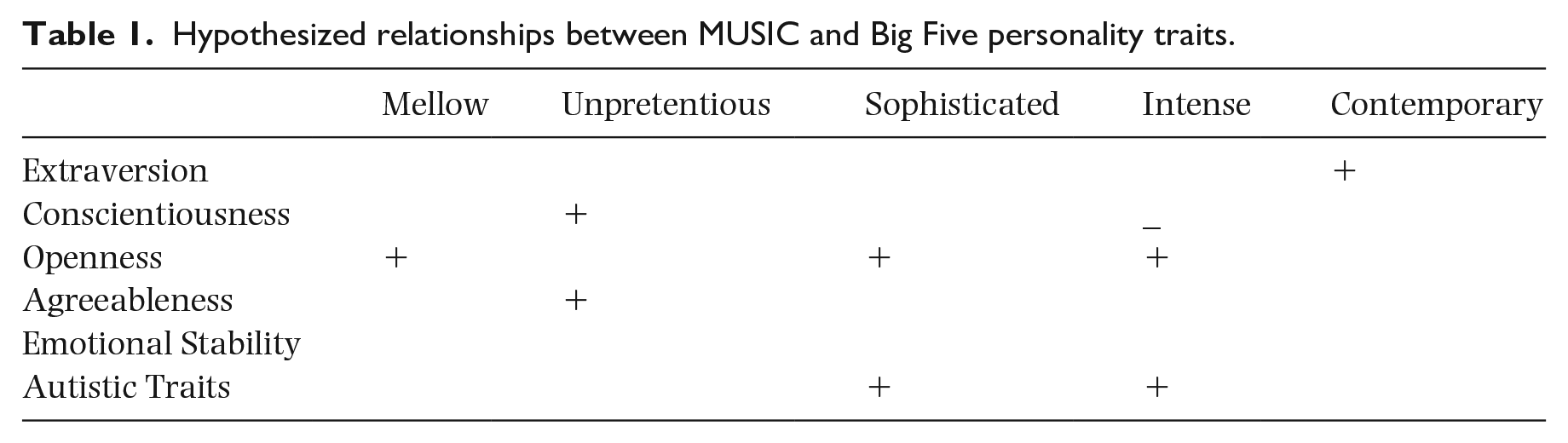
Associations between musical preferences and Big Five personality traits have been found in a range of different studies. Positive associations have been found between Openness and a preference for reflective and complex music (i.e., Mellow, Sophisticated, and Intense); between Extraversion and a preference for energetic music (i.e., Contemporary); between Agreeableness, Conscientiousness, and gentle-sounding (i.e., Unpretentious) music. A negative association has been found between Conscientiousness and a preference for music that is loud and distorted (i.e., Intense; see Table 1 for a summary; Bonneville-Roussy et al., 2013; Delsing et al., 2008; Rentfrow & Gosling, 2003; Zweigenhaft, 2008). The sizes of these associations are small but consistent across studies, and persist after controlling for demographic variables (Bonneville-Roussy et al., 2013; Greenberg et al., 2016) such as age and gender, which are known to influence music preferences (Bonneville-Roussy et al., 2013; Colley, 2008; Lorenzo-Quiles et al., 2020).
Hypothesized relationships between MUSIC and Big Five personality traits.
Links between music preference and personality have been studied extensively. It is known, for example, that individuals with and without musical training differ in their preferences (Ginocchio, 2009; Gürgen, 2016). However, the role of musical sophistication in the relationship between music preference and personality is unclear. Musical sophistication is a construct broader than musical ability or musical training; it also includes musical engagement and receptive skills such as the ability to appreciate music and perceive musical emotions (Ollen, 2006). It is likely that individuals’ music preferences are influenced by their receptive skills. For this reason it is worth controlling for musical sophistication when examining associations between music preferences and personality traits.
Besides the Big Five personality traits, autistic traits might be associated with certain music preferences. Autistic traits are those reflecting the symptoms of Autism Spectrum Conditions (American Psychiatric Association, 2013), such as difficulties with social interaction and communication, and repetitive behaviors. Although there are no clear indications that autistic traits are related to certain music preferences, cognitive styles related to autism, that is, empathizing and systemizing (Wheelwright et al., 2006), have been linked to specific music preferences. Empathizing refers to identifying and responding appropriately to others’ emotions and predicting their behaviors (Baron-Cohen & Wheelwright, 2004), and is negatively related to autistic traits, whereas systemizing refers to analyzing systems and the rules that underlie them (Baron-Cohen et al., 2003), and is positively related to autistic traits. Empathizing and systemizing account for significant variance in autistic traits (Greenberg et al., 2018), and might explain individual differences in music preferences (Greenberg, Rentfrow, et al., 2015; Vuoskoski, 2015). Specifically, people who are highly empathizing seem to prefer Mellow music and highly systemizing individuals prefer Intense music (Greenberg, Baron-Cohen, et al., 2015). Given the close relationships between empathizing, systemizing, and autistic traits, we wanted to discover if the findings from research on empathizing and systemizing could be generalized to autistic traits.
The current study attempted to determine whether the associations between music preferences and personality traits would be confirmed in a Malaysian population, when age, gender, and musical sophistication were controlled for, and had three aims: (1) to confirm the MUSIC model in a sample representing the Malaysian general population; (2) to examine the associations between music preferences and the Big Five personality traits; and (3) to examine the associations between music preferences and autistic traits. First, we hypothesized that the MUSIC model would be confirmed, specifically the Mellow, Sophisticated, Intense, and Contemporary factors (Heng et al., 2018). Second, we asked if the relationships already identified between music preferences and the Big Five personality traits would be found in a Malaysian sample (see Table 1). Finally, we hypothesized that autistic traits would be positively associated with Intense and Sophisticated music (Greenberg, Baron-Cohen, et al., 2015).
Method
Participants
Ethical approval to administer an online survey was obtained from the Science and Engineering Research Ethics Committee of the University of Nottingham Malaysia (Ethics Identification Number: CZJ160719). Participants were recruited through the university recruitment email and social media. A total of 939 responses were recorded. It would take at least 15 minutes to listen to all the excerpts and complete all the questionnaires. Participants were therefore excluded if they (1) took less than 15 minutes to complete or did not complete the survey (n = 409), (2) did not confirm that they had not participated in the pilot survey (n = 67), (3) responded to the survey more than once (n = 10), and (4) were not Malaysian (n = 9). The final sample consisted of 444 participants (332 females, 101 males, and 10 who preferred not to say) with an age range of 17–69 years (M = 23.0, SD = 6.0). Of the 444 participants the majority (265 or 59.7%) identified as Chinese, 125 (28.2%) as Malay, 30 (6.8%) as Indian, and 24 (5.4%) as of another ethnicity.
Materials
Musical excerpts
All 94 unreleased professionally made musical excerpts used in the original study were acquired from the authors (Rentfrow et al., 2011). In line with Rentfrow et al. (2012), we used 50 excerpts. Three were not available (Through the Years by The O’Neill Brothers, Sweet 5 by Kush, and Electro by Leo the Lionheart). We selected three excerpts in the same genres from the remaining 44 excerpts (Falling Down by Ezekiel Honig, And What You Hear by Twelve 20 Six, and Feed Your Head by Phaedra) to replace those that were not available. Each excerpt is around 15 seconds long. A pilot study with 23 participants confirmed that all the excerpts were unfamiliar to Malaysians. In the main study, participants had to rate each excerpt on a Likert-type rating scale from 1 (dislike extremely) to 9 (like extremely).
Musical sophistication
The Ollen Musical Sophistication Index (OMSI; see Supplementary Material) was used to estimate musical sophistication (Ollen, 2006). Musical sophistication includes duration of musical training and receptive abilities. The OMSI comprises nine items. Six items assess experience of musical training and education (e.g., How many years of private music lessons have you received?) and three items assess personal experience of musical activities (e.g., Which option best describes your experience of composing music?). The OMSI was originally scored in a binary fashion (less vs more musically sophisticated), but we used the continuous scores when we controlled for musical sophistication. According to Ollen (2006), OMSI has acceptable internal reliability (α = .74).
Big Five personality traits
The Ten Item Personality Inventory (TIPI; see Supplementary Material) is a 10-item questionnaire that measures the Big Five personality traits (Gosling et al., 2003). Each personality trait is measured by two items of which one is reverse-scored. Participants rate each item on a 7-point Likert-type scale from 1 (disagree strongly) to 7 (agree strongly). The TIPI has adequate test–retest reliability, converges with the standard instruments, and showed predicted associations with external correlates such as political view and depressive traits when the Big Five personality traits were measured using a different instrument such as the Big Five Inventory (Gosling et al., 2003). Moreover, Big Five personality traits measured using the TIPI have been associated with musical preferences in previous research (Bonneville-Roussy et al., 2013).
Autistic traits
The Autism-Spectrum Quotient-28 (AQ-28) (Hoekstra et al., 2011) was used to quantify autistic traits (see Supplementary Material). It consists of 28 items (e.g., “I find social situations easy”), of which nearly half are reverse-scored, to be rated on a Likert-type scale from 1 (definitely disagree) to 4 (definitely agree). A higher score indicates more autistic traits. The AQ-28 was found to have acceptable internal reliability in the current study (α = .71).
Procedure
At the beginning of the survey, participants could choose to respond either in English or Malay. Six participants (1.35%) responded in Malay. After they had given their informed consent to participate, they were asked to rate their degree of liking for each of the 50 musical excerpts, presented in random order. Participants then completed the OMSI, TIPI, and AQ-28, also presented in random order. At the end of the survey, participants were informed of the purpose of the research. They were given information about their musical preferences, as shown by their responses, and the links between musical preferences and personality traits according to previous research (Rentfrow et al., 2012). Psychology students from the University of Nottingham Malaysia received study credits in return for their participation.
Results
Confirmation of the MUSIC model
The following analyses were conducted using SPSS v25, AMOS v25, and R. The dataset was randomly split to be able to conduct principal component analysis (PCA) in half of the data and confirmatory factor analysis (CFA) in the second half of the data.
PCA with varimax rotation was conducted on the first half of the data (n = 222). Both the Kaiser–Meyer–Olkin Measure (.89) and Bartlett’s Test (p < .001) indicated that PCA was appropriate to conduct on our data. We followed the procedure for performing PCA exactly as described in Rentfrow et al. (2011). The PCA produced a first factor that accounted for 24% of the variance. The scree plot suggested an elbow around five factors. A parallel analysis of Monte Carlo simulations suggested that the first five eigenvalues were also greater than chance in explaining the variance. Successive PCAs were then conducted for one-factor through six-factor solutions and the sixth factor was found to explain a relatively small proportion of the variance (3%). Together, the analyses suggested that no more than five factors should be retained.
The five-factor solution with a factor loading cutoff of >.4 appeared to be consistent with the MUSIC model found in the Western samples (Rentfrow et al., 2012). Our first and third factors confirmed the Intense and Sophisticated factor (see Table 2). The second factor comprised all the Mellow factor excerpts from the original MUSIC model, but three excerpts from the Unpretentious factor also loaded onto our second factor. The fourth factor confirmed the Contemporary factor, but two original excerpts did not load onto this fourth factor. The fifth factor consisted mainly of excerpts representing the Unpretentious factor, with three excerpts that were previously loaded onto the Contemporary factor.
Factor loadings on the MUSIC dimensions between the current study and Rentfrow et al. (2012).
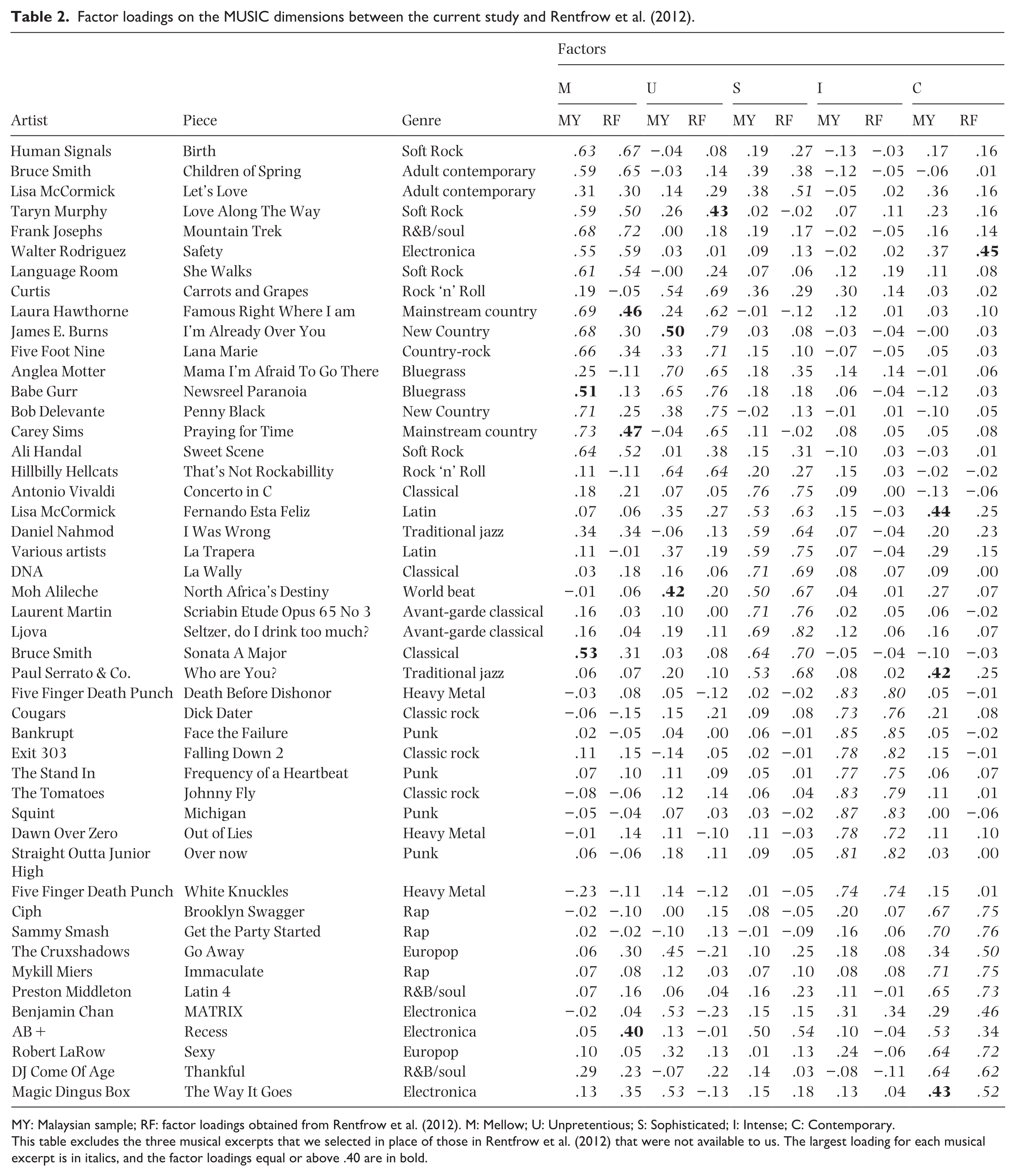
MY: Malaysian sample; RF: factor loadings obtained from Rentfrow et al. (2012). M: Mellow; U: Unpretentious; S: Sophisticated; I: Intense; C: Contemporary.
This table excludes the three musical excerpts that we selected in place of those in Rentfrow et al. (2012) that were not available to us. The largest loading for each musical excerpt is in italics, and the factor loadings equal or above .40 are in bold.
Tucker’s congruence coefficient was computed using the psych R package (Revelle, 2021) to determine the similarity between the factors found in the current study and Rentfrow et al. (2012) (see Table 3). A value between .85 and .94 indicates a reasonable similarity, and a value above .95 suggests that the factors are more or less identical (Lorenzo-Seva & ten Berge, 2006). The values for the Sophisticated and Intense factors found in the two studies were both .88, indicating reasonable similarity. Those for the Contemporary and Mellow factors, however, were .80 and .72, respectively, indicating potential dissimilarity, and the value for congruence between the Unpretentious factors in the two studies was only .56.
Comparison of findings from current study and Rentfrow et al. (2012): Tucker’s congruence coefficients.
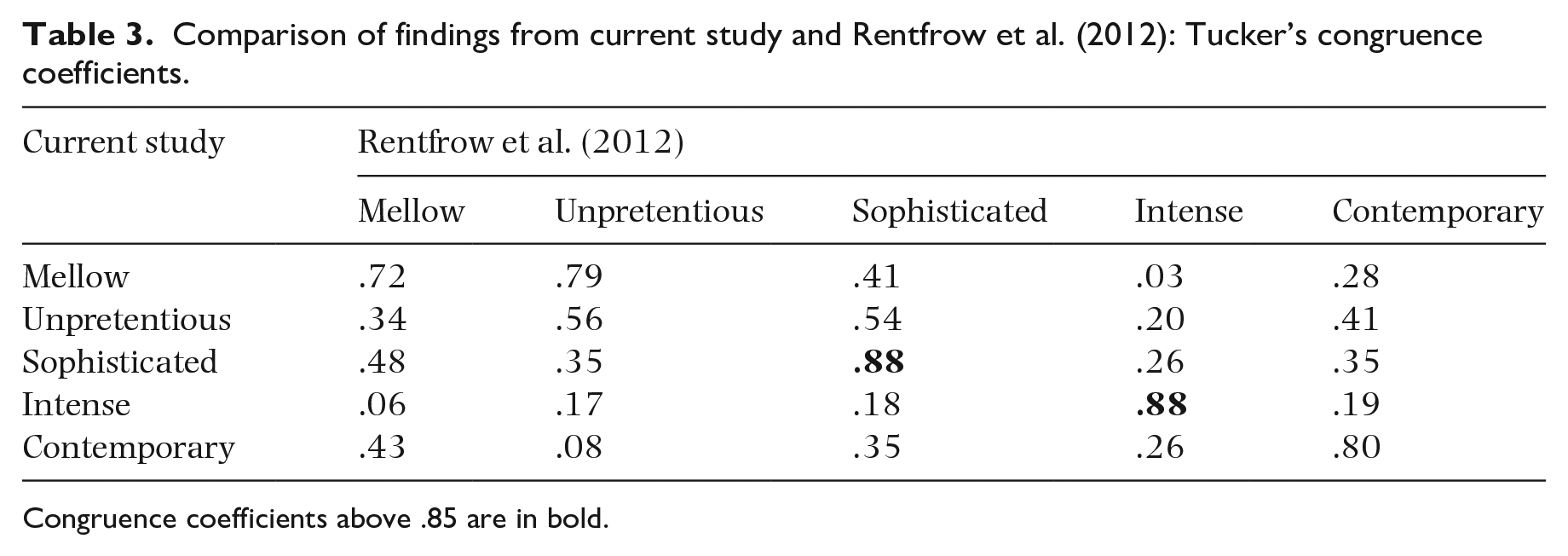
Congruence coefficients above .85 are in bold.
CFA was conducted using SPSS Amos v25 on the second half of the sample (n = 222). We compared the original MUSIC model with the model obtained from the PCA reported above. As shown in Table 4, both models showed poor fit to the data with fit indices falling below the acceptable values (CFI & TLI > .95, RMSEA < .06; Hu & Bentler, 1999). The original MUSIC model (Rentfrow et al., 2012) demonstrated a slightly better fit overall. For this reason we used the original MUSIC model in our subsequent analyses of music preferences.
Fit indices for the original MUSIC model and the explored model.
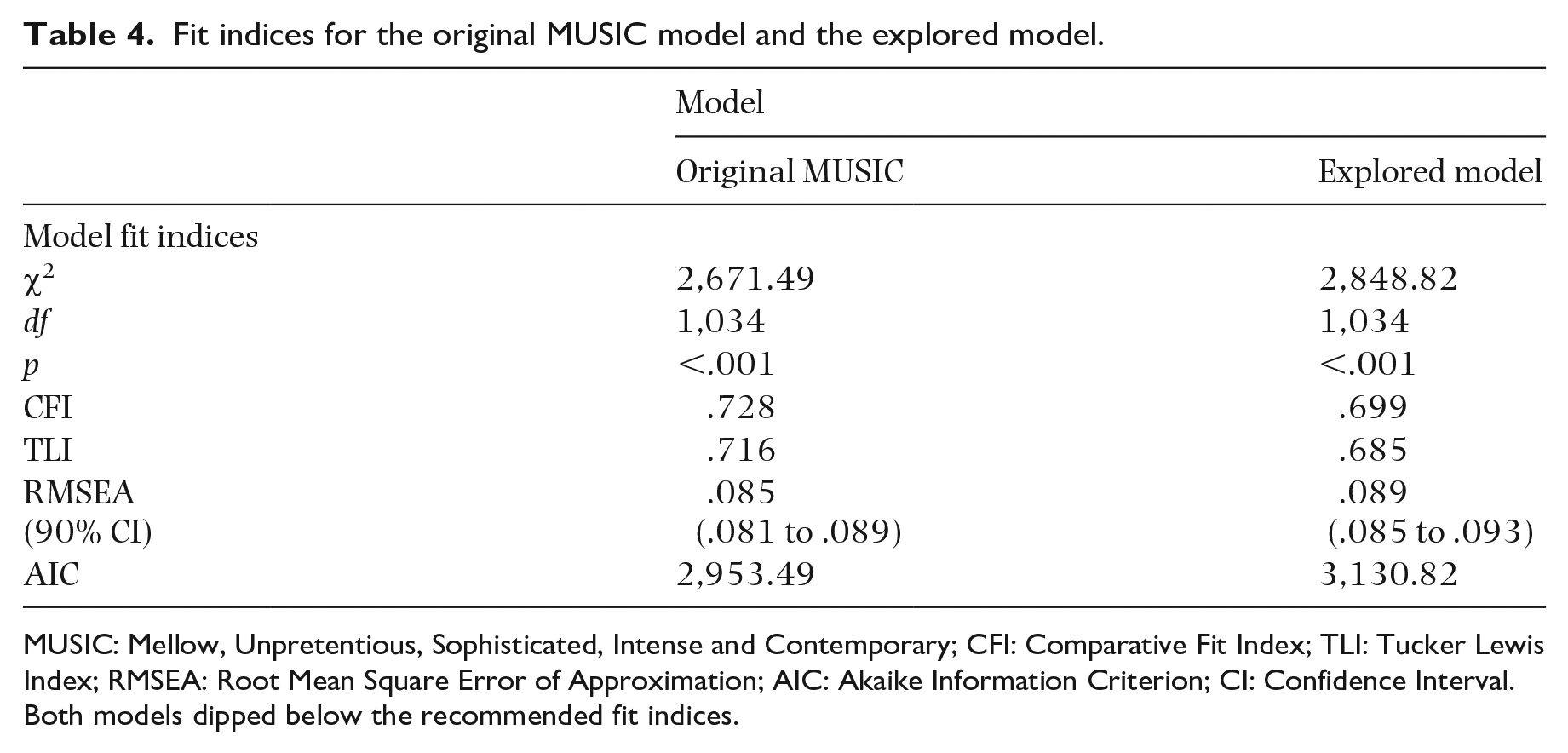
MUSIC: Mellow, Unpretentious, Sophisticated, Intense and Contemporary; CFI: Comparative Fit Index; TLI: Tucker Lewis Index; RMSEA: Root Mean Square Error of Approximation; AIC: Akaike Information Criterion; CI: Confidence Interval.
Both models dipped below the recommended fit indices.
Music preferences, personality and autistic traits
The weighted preference for each of the five MUSIC dimensions was calculated using the formula reported by Greenberg, Baron-Cohen, et al. (2015). Each weighted preference takes into account participants’ preference rating for each excerpt and the factor loadings of that excerpt found in the current study (see Table 2) on each dimension. For example, the weighted preference for the Intense factor was calculated as [(preference rating for Excerpt 1 * loading of Excerpt 1 on the Intense factor)] + [(preference rating for Excerpt 2 * loading of Excerpt 2 on the Intense factor)] + . . . + [(preference rating for Excerpt 50 * loading of Excerpt 50 on the Intense factor)]/(sum of preference ratings for all 50 excerpts).
Given the influence of age, gender, and musical sophistication on music preferences (Bonneville-Roussy et al., 2013; Gürgen, 2016; Soares-Quadros et al., 2019), we conducted hierarchical regressions to examine the predictability of Big Five personality traits and autistic traits on the MUSIC dimensions controlling for these variables. No issues of multicollinearity, normality, or outliers were detected. However, there was a potential issue with homogeneity of variance across all models. We therefore conducted hierarchical regressions with weighted least squares estimation. Age, gender, and musical sophistication were entered as control variables in Step 1 and Big Five personality traits and autistic traits were entered in Step 2 for each model. The results of the regressions are shown in Table 5. Extraversion positively predicted preference for Mellow music. Agreeableness positively predicted preferences for Mellow and Unpretentious music, and negatively predicted preference for Intense music. Openness positively predicted preference for Intense music. Autistic traits negatively predicted preference for Contemporary music.
Standardized beta coefficients for autistic traits and Big Five personality traits on the MUSIC dimensions.
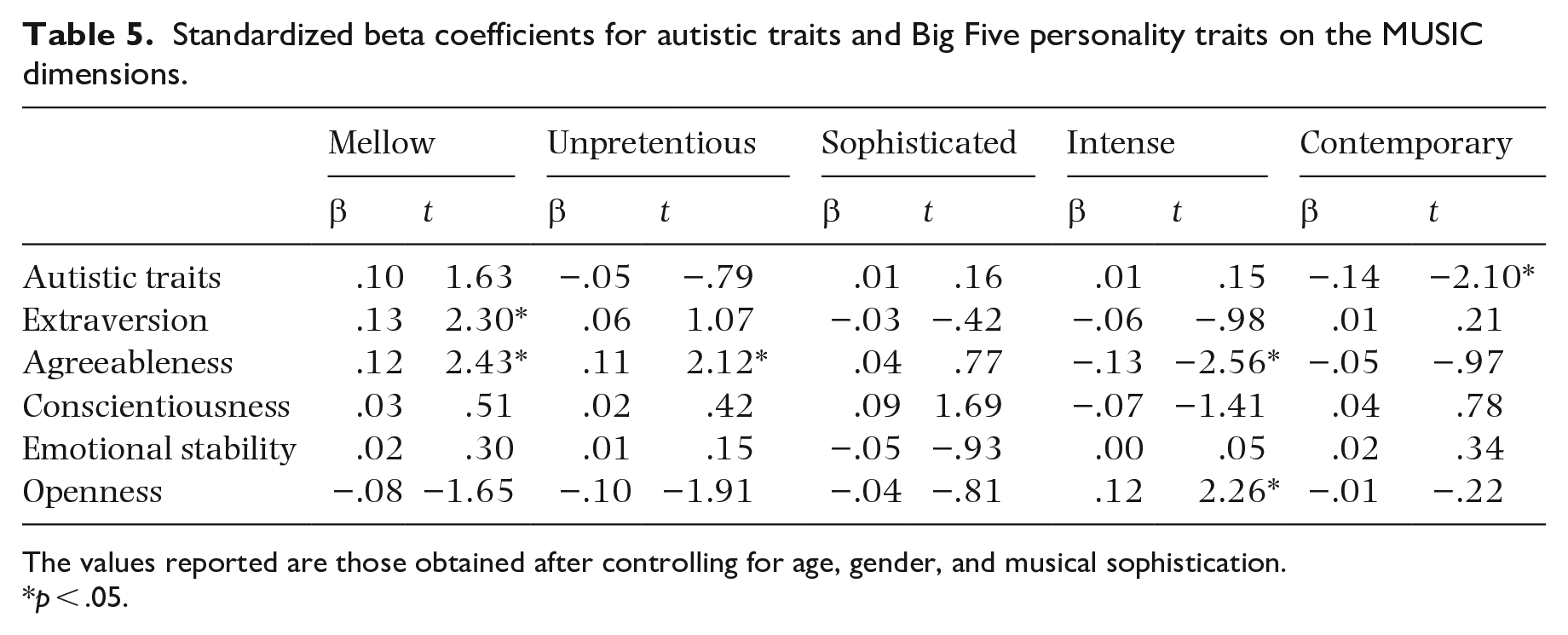
The values reported are those obtained after controlling for age, gender, and musical sophistication.
p < .05.
Discussion
The current study attempted to confirm the MUSIC model and examine the associations between Big Five personality and autistic traits and musical preferences. In line with our hypotheses and preliminary findings, the MUSIC model was partially confirmed among a Malaysian sample. In particular, the Intense and Sophisticated factors were similar. The associations between musical preferences and Big Five personality found in the current study were somewhat inconsistent with those found in previous studies, once age, gender, and musical sophistication were controlled for. Moreover, contrary to our hypothesis, autistic traits were not associated with a preference for Sophisticated or Intense music but were negatively associated with Contemporary music.
The MUSIC model
The MUSIC model was partially confirmed with two emerging factors corresponding to the Intense and Sophisticated factors previously reported by Rentfrow et al. (2012). This corroborates the findings of similar research with a Singaporean sample that failed to replicate the MUSIC model perfectly (Heng et al., 2018), although in that study the Intense and Sophisticated factors were similar to those originally reported by Rentfrow et al. (2012). Broad genres such as heavy metal (i.e., Intense) were ranked similarly across 47 countries (Schedl, 2017). While Malaysia was not included in the study by Schedl (2017), the emergence of these two factors comprising broad and popular genres suggests that Malaysians are exposed to these genres to a substantial degree. The confirmation of the Intense and Sophisticated factors among Malaysians suggests that they are familiar with them.
The Mellow and Contemporary factors found in the current study are somewhat different from those identified by Rentfrow et al. (2012). Some excerpts failed to load onto the original factors. Cultural differences in music-evoked emotions might explain the discrepancy, given that the perceived psychological attributes of music explain unique variance in the MUSIC model (Rentfrow et al., 2012). Emotional reactions to music were found to differ across cultures (North & Davidson, 2013), which may relate to the finding that emotions such as surprise, spirituality, astonishment, anxiety, happiness, love, pride, and interest are more prevalent in collectivistic cultures than in individualistic cultures (Juslin et al., 2016). Korean, Chinese, and American participants perceived the same set of musical excerpts as conveying different moods (Lee & Hu, 2014), and extramusical associations between musical genres and listeners’ characteristics might also differ according to culture (e.g., the belief that people who listen to classical music are more intelligent than those who listen to other genres). Such extramusical associations underlie the stereotyping of fans of particular kinds of music (Rentfrow et al., 2009; Rentfrow & Gosling, 2007), but the pattern of associations differs across cultures. For instance, Kristen and Shevy (2013) found that while there were a number of similarities between American and German listeners’ extramusical associations between genres and fans, hip hop was an exception insofar as Americans but not Germans associated hip hop with minority ethnicity. Inconsistencies between the findings of previous studies and the current study may be attributable to such cultural differences.
The Unpretentious factor was the only one that did not reach the threshold for congruence between the current study and that of Rentfrow et al. (2012), as was also the case with the Singaporean sample (Heng et al., 2018). Besides the explanations already put forward, the instability of this factor across cultures may be attributable to (un)familiarity, as suggested by Heng et al. (2018). In both Malaysia and Singapore, which are geographically and culturally similar, listeners are unlikely to be exposed to country and folk music, the genres that make up the Unpretentious factor. Familiarity has consistently been shown to influence and explain a substantial portion of variance in music preference (Fung, 1996; Teo et al., 2008). For example, it plays a key role in listeners’ emotional engagement in music (Pereira et al., 2011) and was the strongest predictor among those that were investigated, including demographic characteristics and personality traits, for the music preferences of South Korean and American participants (Yoo et al., 2018). More importantly, familiarity stands out from perceived musical emotions and extramusical associations because generally more cross-cultural similarities have been found than differences (Juslin et al., 2016; Kristen & Shevy, 2013). Low familiarity with specific examples of music in a particular genre implies limited knowledge about that genre more broadly; this in turn could make it difficult for participants to recognize excerpts as belonging to the same genres. We might therefore have failed to replicate the Unpretentious factor because its genres were unfamiliar to participants.
In a recent study, the MUSIC model was replicated in a study involving Brazilian adolescents (Lorenzo-Quiles et al., 2020) and reported to be invariant across 53 countries, including Malaysia and Singapore (Greenberg et al., 2022). The apparent contradiction between our findings and those of these earlier studies can be resolved as follows: first, although we did not fully replicate the MUSIC model, the original MUSIC model (Rentfrow et al., 2012) showed a better fit in our data than the model based on our EFA. This aligns with its invariance across countries (Greenberg et al., 2022); second, despite this invariance, there were variations in its construction according to geographical location (Greenberg et al., 2022). Specifically, three major clusters were found with one cluster consisting primarily of Asian countries. These may have emerged because of cross-cultural differences in music cognition and familiarity with the excerpts presented to participants. Thus, while the findings of the current study and those of both Lorenzo-Quiles et al. (2020) and Greenberg et al. (2022) provide some evidence of the consistency of the MUSIC model across countries, we have been able to show where and suggest why the inconsistencies occur.
CFA assumes zero cross-loadings. The analysis revealed significant cross-loadings, however, which may explain the overall poor fit of the MUSIC model. While we chose CFA for its parsimony, alternative methods such as exploratory structural equation modeling could be used to test the model in future (Bonneville-Roussy et al., 2013; Marsh et al., 2014). Also, our sample size was relatively small for a CFA, so in future research a larger sample should be recruited.
Music preferences and personality
In the current study we replicated the relationships between Agreeableness and Openness with the Unpretentious and Intense factors, respectively. We failed to replicate other associations between Big Five personality traits and MUSIC factors, however. There may be several explanations. First, in previous research only age and gender were controlled for (Greenberg et al., 2016; Nave et al., 2018; Vella & Mills, 2017), while we also controlled for musical sophistication. A positive correlation has been shown between musical training and music preferences such that participants with more than five years of training tended to give higher preference ratings regardless of genre compared with those with less training (Ginocchio, 2009). Also, participants with more musical training appeared to use music differently from those with less training, which contributed, in turn, to an increased preference for certain genres thought to be more complex than others, such as classical music and jazz (Getz et al., 2014). In the current study, however, excluding musical sophistication from the regression model did not change its results. It seems that while musical sophistication was positively associated with a preference for Mellow and Sophisticated music, controlling for this variable did not reveal any associations previously found between personality traits and the Mellow and Sophisticated factors. We would therefore suggest that these associations should be generalized from one culture to another with caution.
Second, while the Big Five personality traits were found to be relatively stable across 56 countries (Schmitt et al., 2007), and associations with music preferences were fairly consistent across 53 countries (Greenberg et al., 2022), the Big Five personality traits show low validity among Malaysian and other non-WEIRD (i.e., Western, educated, industrialized, rich and democratic) populations (Hee, 2014; Laajaj et al., 2019). Failure to replicate the associations identified in previous research might therefore stem from the low validity of the TIPI, or the Big Five traits in Malaysia. However, the TIPI is an instrument often used in music preference research (e.g., Greenberg et al., 2022). Moreover, our replication of the associations between Agreeableness and Unpretentious, and between Openness and Intense provides partial support for the reliability of the TIPI in capturing these personality traits. Our findings of a significant positive association between Extraversion and Mellow suggests, however, that the proposition that extraverts prefer energetic and upbeat music (Vella & Mills, 2017) does not apply in Malaysia. This aligns with Lui et al.’s (2020) finding that assertiveness and activity are linked to Extraversion for European Americans but not for Asian Americans. A related finding is that the degree of similarity between the (perceived) personality traits of artists and listeners’ own personality traits predicts the latter’s music preferences (Greenberg et al., 2021). Cross-cultural differences in the way personality traits are conceptualized might result in cross-cultural differences in the way artists’ personality traits are perceived, explaining the discrepancies between our findings and those of other studies identifying associations between Big Five personality traits and music preferences. In short, the association between Extraversion and Mellow in Malaysia undermines the view that relationships between personality traits and music preferences are universal. We also found an association between Agreeableness and the Mellow and Intense factors, supporting the hypothesis that individuals who are high in Agreeableness prefer warm, calming, and inoffensive music (Bonneville-Roussy et al., 2013) but contradicting the findings of Rentfrow and Gosling (2003). Whereas Bonneville-Roussy et al. (2013) found a positive association between Agreeableness and a preference for Unpretentious music, we did not replicate the latter factor, so it is not surprising that we did not find an association between it and Agreeableness. We attribute the inconsistency between our findings and those of the earlier research to cross-cultural differences.
Music preferences and autistic traits
We did not find the positive association between autistic traits and preference for Intense music that we had hypothesized on the basis of research with individuals who are high in systemizing (Greenberg, Baron-Cohen, et al., 2015), perhaps because although systemizing is related to autistic traits (Greenberg et al., 2018; Wheelwright et al., 2006), it is only a small part of the picture. We used the AQ-28 to measure autistic traits more broadly, including those related to social interaction and communication.
Also, we did not find the positive association between autistic traits and preference for Sophisticated music that we had hypothesized according to the theory that people with autism have enhanced perceptual functioning (Mottron et al., 2006), and specifically lower-level auditory perception. Although the AQ-28 has been shown to measure the same latent traits in people with and without autism (Murray et al., 2014), there may be qualitative differences between those with clinical diagnoses and those who score higher on the AQ-28. Moreover, the autism spectrum is heterogenous. For example, only some people with autism display superior musical abilities (Heaton et al., 2008). These people might represent a genetically distinct subgroup (Nurmi et al., 2003) who display enhanced perceptual functioning and therefore, unlike those who do not, prefer Sophisticated music. This could be investigated in future research within and between clinical and non-clinical populations.
We did not hypothesize a relationship between autistic traits and the Contemporary factor but, when we controlled for the Big Five personality traits, we found a negative association between them. In a recent study, Extraversion was found to mediate the relationship between autistic traits and emotional responsiveness to music (Sivathasan et al., 2022). The negative association between autistic traits and preference for Contemporary music could be explained by the latter’s sociable and danceable functions (Bonneville-Roussy et al., 2013; Rentfrow et al., 2012), as higher scores on the AQ-28 denote more social difficulties. A decreased preference for Contemporary music might hence result from the social component of this factor. Our findings suggest that members of the general population with more autistic traits, regardless of their age, gender, and musical sophistication, are less likely to prefer Contemporary music.
Limitations and future directions
The first limitation of this study was the risk of self-selection bias, given that individuals interested in music might have been more likely to participate. The majority of participants were young adults including university students who consume more music than older adults and consider it more important (Bonneville-Roussy et al., 2013). The sample may have included highly musically engaged participants likely to express stronger preferences. The findings should therefore be generalized to the wider general population with caution and future researchers should replicate the study with a more representative sample.
The second limitation was our choice of brief measures of personality traits and musical sophistication. Although they both significantly predicted preference for certain types of music, it would be worth using more extensive instruments such as the Big Five Inventory (John & Srivastava, 1999) and the Goldsmiths Musical Sophistication Index (Müllensiefen et al., 2014) in future research, especially in non-Western contexts.
Third, because we wanted to confirm the MUSIC model empirically, we had to use the same set of musical excerpts as in the previous research. To develop a model of music preferences applicable to Malaysian listeners, however, the stimuli used by future researchers should include a wider range of genres, and particularly those to which that Malaysians are regularly exposed, such as Malay, Mandarin, and Korean pop music.
Conclusion
The main objective of the current study was to confirm the MUSIC model and its association with Big Five personality traits in Malaysia. To the best of our knowledge, we are among the first to investigate the replicability of the MUSIC model among a relatively large Malaysian sample. The model was partially confirmed insofar as the Sophisticated and Intense factors were virtually identical to those found in prior research and, in line with previous findings, Agreeableness was positively associated with the Unpretentious factor, and Openness was positively associated with the Intense factor even when musical sophistication was controlled for. Agreeableness was also positively associated with a preference for Mellow music and negatively associated with a preference for Intense music. Autistic traits were negatively associated with a preference for Contemporary music. Overall, while our findings provide partial support for the MUSIC model in Malaysia, they also highlight the need for music preferences to be studied in non-Western contexts given potential cross-cultural differences between them and their associations with listeners’ characteristics.
Supplemental Material
sj-docx-1-msx-10.1177_10298649231167488 – Supplemental material for Replication of the music preference (MUSIC) model and evaluation of its association with personality and autistic traits
Supplemental material, sj-docx-1-msx-10.1177_10298649231167488 for Replication of the music preference (MUSIC) model and evaluation of its association with personality and autistic traits by Zhong Jian Chee, Yvonne Leung and Marieke de Vries in Musicae Scientiae
Footnotes
Acknowledgements
The authors thank Dhivagari A/P Gopala Krishanan for her help with the data collection.
Declaration of conflicting interests
The authors declared no potential conflicts of interest with respect to the research, authorship, and/or publication of this article.
Funding
The authors received no financial support for the research, authorship, and/or publication of this article.

Supplemental material
Supplemental material for this article is available online.
References
Supplementary Material
Please find the following supplemental material available below.
For Open Access articles published under a Creative Commons License, all supplemental material carries the same license as the article it is associated with.
For non-Open Access articles published, all supplemental material carries a non-exclusive license, and permission requests for re-use of supplemental material or any part of supplemental material shall be sent directly to the copyright owner as specified in the copyright notice associated with the article.
