




Abstract
Listening to music is a widespread activity. Openness to experience in particular has been found to be one of the dimensions of personality that most consistently predicts music preference. However, the singular facets of openness to experience have never been looked at in depth. This study tried to uncover the impact of the openness-to-experience facets of both the five-factor (FFM) and HEXACO models of personality on music preference. A total of 374 college students completed two openness-to-experience measures (FFM and HEXACO) and one music preference measure (ratings of music excerpts). In line with Rentfrow and colleagues, confirmatory factor analysis (CFA) suggested five dimensions of music preference. Dominance analysis (DA) was used to evaluate the relative importance of each facet in predicting music preference. It was observed that openness facets relate to music preference in ways that are not apparent when general openness to experience is used as a predictor of music preference.
Listening to music is a widespread activity (Spotify, 2022) and, thanks to streaming services and mobile phones with vast music libraries, music is easily accessible to most people. The International Federation of the Phonographic Industry (IFPI) reports that people around the world spent an average of 18.4 hr listening to music each week in 2021. This statistic is even higher in the United States where, in 2019, the average time that people spent listening to music each week was 26.9 hr (IFPI, 2019).
Of course, musical styles are diverse, and people’s music listening is at least partly a function of their music preference. Thus, music preference tells us something about people (Schäfer & Sedlmeier, 2010). Specifically, music preference is associated with multiple psychological (Vella & Mills, 2017), social (Schäfer & Sedlmeier, 2009), and cultural (Boer et al., 2013) aspects of people. Other research has explored the structural properties of music itself; these studies show links between music preference and the complexity of music pieces (Güçlütürk & van Lier, 2019) as well as the acoustic qualities of music (Rentfrow & Gosling, 2003). Thus, understanding people’s music preferences provides an important perspective not only on music but also on individual differences.
Compared to other research topics in psychology, it is fair to say that music preference research is still in its youth. It was not until the early 2000s that music preference research began to gain traction, mostly thanks to the seminal paper by Rentfrow and Gosling (2003). In their paper, Rentfrow and Gosling not only investigated many possible predictors of music preference but also observed that preference for music genres clusters into a small number of factors. Specifically, using a measure of how much people self-reported liking different genres of music (based on the genres’ labels), they found four factors of music preference: (a) reflective and complex (e.g., blues, jazz, classical), (b) intense and rebellious (e.g., rock, alternative, heavy metal), (c) upbeat and conventional (e.g., country, soundtracks, pop), and (d) energetic and rhythmic (e.g., rap/hip-hop, soul-funk, electronica-dance). From this, Rentfrow and Gosling developed the Short Test of Music Preferences (STOMP), a label-based self-report measure of music preference. Later research suggested five factors of music preference: sophisticated, unpretentious, intense, mellow, and contemporary (Rentfrow et al., 2011). Subsequent research on music preference has benefited from these conceptual definitions.
The music preference research field is rapidly evolving beyond self-reports. A very promising direction for the field is that of measuring music preference by using computer-extracted features (e.g., sound profile, instrument types) of musical pieces. Fricke et al. (2018) reported that musical-features extraction can both be a fully automated process that evaluates hundreds of musical pieces simultaneously and produce an accurate measure of music preference. Applying this approach to an individual’s library on music streaming platforms could provide quick and accurate measures of the listener’s music preference. The music-preference field has recently started to take advantage of the wealth of information about people’s listening habits and music preferences offered by music streaming platforms. For instance, Anderson et al. (2021) drew on data from 5,808 Spotify users to measure nuanced music listening behaviors such as the diversity of individuals’ musical preferences and their preference for discovering new music. Thus, measuring music preference ideally goes beyond mere self-report.
Personality and music preference
One of the most commonly researched predictors of music preference has been personality, as represented by the Five-Factor Model (FFM), a conceptualization of personality that partitions it into five dimensions or traits: openness to experience, conscientiousness, extraversion, agreeableness, and neuroticism (McCrae & Costa, 2008). Past studies exploring the relationship between personality and music preference have commonly reported weak or nonsignificant findings (Schäfer & Mehlhorn, 2017). For example, neuroticism was found to be positive albeit weakly related to preference for classical music in a handful of studies (Delsing et al., 2008; Dunn et al., 2012); yet just as many studies found nonsignificant correlations between classical music and neuroticism (e.g., Ferwerda et al., 2017; Zweigenhaft, 2008). Similarly, conscientiousness and agreeableness seem to be negligible predictors of music preference (Schäfer & Mehlhorn, 2017). Although such results contribute to the general consensus about neuroticism, conscientiousness, and agreeableness, it is challenged by a recent large-scale study. Utilizing machine-learning techniques to predict music preference from participants’ personality, Anderson et al. (2021) found significant relationships between music preference and many of the personality dimensions that were previously thought to be unrelated to it. It is entirely possible that in 10 years, thanks to new advances in the field of music preference research, there will be a completely different general picture regarding the importance of neuroticism, conscientiousness, and agreeableness.
Compared with these three traits, extraversion appears to be more promising for predicting music preference. For instance, Rawlings and Ciancarelli (1997) found that extraversion was positively correlated with a preference for popular music (e.g., pop, pop rock, popular soundtracks). Sensation seeking or excitement seeking, a facet of the extraversion personality trait that has many names but is essentially the same construct with different labels (Zuckerman, 2010), has been found to consistently predict preference for arousing and intense music such as heavy metal (McNamara & Ballard, 1999). Still, it is not clear whether sensation seeking is what links extraversion with music preference, as another study could only find an indirect link between sensation seeking and music preference (Nater et al., 2005). Thus, while extraversion may be promising as a predictor of music preference, its role remains nebulous.
Openness to experience and music preference
Openness to experience is the personality trait that has yielded the most consistent results in the field of music preference research. Openness to experience reflects a cluster of individual differences that center on receptivity to new ideas and experiences (McCrae & Costa, 2008). In line with its label, openness to experience is linked to a preference for a wide array of musical genres (Rawlings & Ciancarelli, 1997); Rentfrow and Gosling (2003) found a correlation of r = .44 between openness to experience and preference for genres such as classical, jazz, blues, and folk. Indeed, it may be the only personality trait that reliably produces significant correlations with music preference for certain music styles (e.g., Dunn et al., 2012; Vella & Mills, 2017).
An approach that surprisingly has not been used very often is that of observing the lower-level components of personality traits (McCrea & Costa, 2003) or facets, in this case, the facets of openness to experience. In the FFM, these are imagination, artistic interest, emotionality, adventurousness, intellect, and liberalism. Other conceptualizations of openness to experience exist. The HEXACO model of personality (Lee & Ashton, 2004), named after the six broad factors of personality in that taxonomy (honesty-humility, emotionality, extraversion, agreeableness, conscientiousness, and openness to experience), has four facets of openness: aesthetic appreciation, inquisitiveness, creativity, and unconventionality. In a small-sample study, Zweigenhaft (2008) found that most FFM facets of openness to experience were positively correlated with the reported liking of reflective and complex music and reported liking of energetic and rhythmic music, whereas they were negatively correlated with the reported liking of upbeat and conventional music. Among Japanese college students, Brown (2012) found significant positive correlations for almost all of the HEXACO openness facets with a preference for gospel, jazz, and opera music.
These studies certainly point to the value of examining facets of openness to experience as predictors of music preference. However, there are some limitations to the existing literature. First, these studies have relied on label-based measures of music preference (e.g., the STOMP). Because people may interpret labels differently, and because genre labels may change meaning over time, there would be benefits to measuring music preference in response to actual musical excerpts; this would be consistent with the recent trend of using audio information to measure music preferences (e.g., Anderson et al., 2021; Fricke et al., 2018). Second, studies that rely only on the FFM or only on the HEXACO conceptualizations of openness cannot take areas of difference and overlap between the two taxonomies into account. Studies examining facets from both perspectives would be valuable. Third, an examination of correlation coefficients neglects the likely overlaps between facets of openness. Techniques that can take such overlaps into account are needed. In the present study, we addressed the issue of how openness to experience facets predict music preference using an approach well suited to correlated predictors—dominance analysis (DA).
Dominance analysis
DA (Azen & Budescu, 2003) is a statistical technique that allows importance of a specific predictor to be evaluated relative to other predictors. DA examines the unique contribution in variance explained (i.e., R2) by each predictor variable in a regression. This process is carried out by calculating the average of the squared semipartial correlations that each predictor would add to any possible subset of regressions including any number of predictors. For instance, if there were three predictors (X1, X2, X3), DA would calculate the average additional variance explained that each Xi predictor adds for each possible regression model with either 0, 1, or 2 of the other predictor variables as regressors.
The advantage of DA over Pearson correlations is that it offers a way to evaluate the relative importance of a predictor while also taking other predictor variables into account. Some of the facets of openness to experience are highly correlated; this condition, known as multicollinearity, is known to make regression coefficients hard to interpret and mask the unique effects of predictor variables (Graham, 2003). DA mitigates the issue of multicollinearity by computing the additional variance explained by each predictor variable with all possible combinations of other predictor variables. Thus, DA puts more emphasis on specific predictors one at a time instead of trying to evaluate all of them simultaneously.
Aim of the study
Although there are studies that have tested the link between music preference and openness to experience empirically (e.g., Rentfrow & Gosling, 2003; Vella & Mills, 2017), specific facets of openness to experience have rarely been examined in this area. Ashton and colleagues (2014) argue that facet-level scales can have increased predictive validity over factor-level scales when there is a strong conceptual link between the factor-level scale and the criterion variable. Given the empirical evidence reviewed, it seems reasonable to assume that the link between openness to experience and music preference is a solid one; facets could then tell us much more about what informs this consistently reported link between openness to experience and preference for certain kinds of music.
Our purpose was therefore to conduct DA on facets of openness to experience to see which facets are the strongest predictors of music preference. In addition to measuring the FFM’s openness to experience facets, the HEXACO openness to experience facets was measured because there appear to be some differences between the openness to experience construct according to the two models (Christensen et al., 2019). Moreover, music preference was measured via music excerpts to avoid the problems with label-based measures referred to above.
Our research question was more exploratory, but based on previous research, we predicted that some specific facets of openness would be especially relevant in predicting music preference. For instance, the liberalism facet, which is essentially a proxy measure of political views, could be expected to play an important role in predicting music preference (Mellander et al., 2018). People’s tendencies to have strong aesthetic inclinations tend to be more appreciative of music as a whole (Silvia et al., 2015). Both the artistic interest (FFM) and aesthetic appreciation facets (HEXACO) could tap into this aspect of openness to experience. Finally, it has been reported recently that curious individuals show greater liking of music genres belonging to the sophisticated, unpretentious, and contemporary music dimensions (Galvan & Omigie, 2022). It was possible that this connection between music preference and curiosity would be captured by the intellect (FFM) and inquisitiveness facets (HEXACO).
Method
Participants
From an initial sample of 478 college students in the United States, 374 completed the majority of items without failing the attention check (see Procedure section). The mean age of the participants was 19.40 years (SD = 1.56). Most participants identified as female (n = 327; 87%), 42 (11%) identified as male, two identified as another gender, and three declined to report their gender. Most participants identified as White (n = 271; 72%), 45 (12%) identified as Hispanic, 33 (9%) identified as African American, seven (2%) identified as Eastern Asian, four (1%) identified as Indian Asian, 13 identified as another racial/ethnic group, and one declined to answer.
Measures
Openness-to-experience facets
The facets of openness to experience according to the FFM were measured through the openness to experience subscale of the International Personality Item Pool (IPIP) measure of the FFM (60 items; Goldberg, 1999), a copyright-free measure of personality tailor-made to resemble as closely as possible the NEO-PI-R (Costa & McCrae, 1992). Correlations between the IPIP and the NEO-PI-R are extremely high, reaching .94 once correlations are corrected for attenuation (Goldberg, 1999). The openness facets according to the FFM are measured with six subscales containing 10 items each: imagination (α = .83), artistic interest (α = .84), emotionality (α = .81), adventurousness (α = .80), intellect (α = .83), and liberalism (α = .84).
HEXACO’s openness to experience was measured by the openness to experience openness-to-experience subscale of the IPIP measure of the HEXACO personality model (40 items; Ashton et al., 2007). Once again, the correlation between the IPIP measure of the HEXACO model and the HEXACO-PI (HEXACO-PI; Lee & Ashton, 2004), the measure created by the authors of the HEXACO model of personality themselves, is extremely high, and the IPIP version of the HEXACO-PI was endorsed by Ashton and colleagues (2007). The openness-to-experience facets according to the HEXACO model is measured through four subscales containing 10 items each: aesthetic appreciation (α = .80), inquisitiveness (α = .78), creativity (α = .84), and unconventionality (α = .78).
Music preference
Music preference was measured by having participants listen to and report preference from 1 (do not like at all) to 7 (like a great deal) for twenty 15-s long musical excerpts. These musical excerpts were used by Rentfrow and colleagues (2011) to measure five dimensions of music preference: Mellow (electronica/dance, new age, world; α = .72), Unpretentious (pop, country, religious; α = .84), Sophisticated (blues, jazz, bluegrass, folk, classical, gospel, opera; α = .80), Intense (rock, punk, alternative, heavy metal; α = .87), and Contemporary (rap, soul/R&B, funk, reggae; α = .76). The excerpts with the four highest factor loadings for each factor (from Study 2 of Rentfrow et al., 2011) were selected for each music preference dimension (4 excerpts for each dimension, 20 excerpts in total). Music preference dimension scores were computed by averaging preference across the four music excerpts of the respective music preference dimension. The genre of these music excerpts has been categorized by 10 professionals in the music industry; furthermore, these musical excerpts are commonly used in other studies measuring music preference through musical excerpts rating (e.g., Güçlütürk & van Lier, 2019).
Procedure
This study was approved by the Institutional Review Board at the authors’ university. Data were collected during the Fall 2021 semester. Participants were recruited through the authors’ university psychology department participant pool. Participants who took part in the study were required to be 18 years old or older and enrolled in a psychology course (but not necessarily be a psychology major). This study was one of several in which students could volunteer to participate. Participants received extra course credit for taking part in the study.
Students who participated in the study accessed a Qualtrics survey that contained all study materials. First, participants read the informed consent form and decided whether to participate in the study. If they agreed to participate, participants were asked to report their age, gender, and ethnicity. Then, participants were asked to complete the FFM openness measure, the HEXACO openness measure, and the measure of music preference. Order of administration of these three measures was counterbalanced. Moreover, music excerpts were presented in random order to every participant. To increase the quality of collected data, an attention check was inserted in the musical excerpts section. The attention check consisted of a 15-s long audio clip instructing participants to select a specific number on the 1 to 7 Likert-type scale. Data from participants who failed to select the appropriate response required by the audio clip were discarded. After completing all measures, participants read a debriefing in which they were thanked for their participation and informed about the study’s purpose.
Results
Confirmatory factor analysis of music preference measure
To ascertain that the measure of music preference did in fact measure the intended dimensions of music preference (i.e., sophisticated, unpretentious, intense, contemporary, and mellow), confirmatory factor analysis (CFA) was utilized. The proposed model specified five latent factors (i.e., the five dimensions of music preference) with four indicators per latent factor (i.e., four musical excerpts). The estimation method used was maximum likelihood (ML), and the estimated latent variables were allowed to correlate. This analysis was conducted in R using the lavaan package (Rosseel, 2012). The observed variables’ loadings, correlations between factors, and the fit statistics for the posited model are displayed in Figure 1.
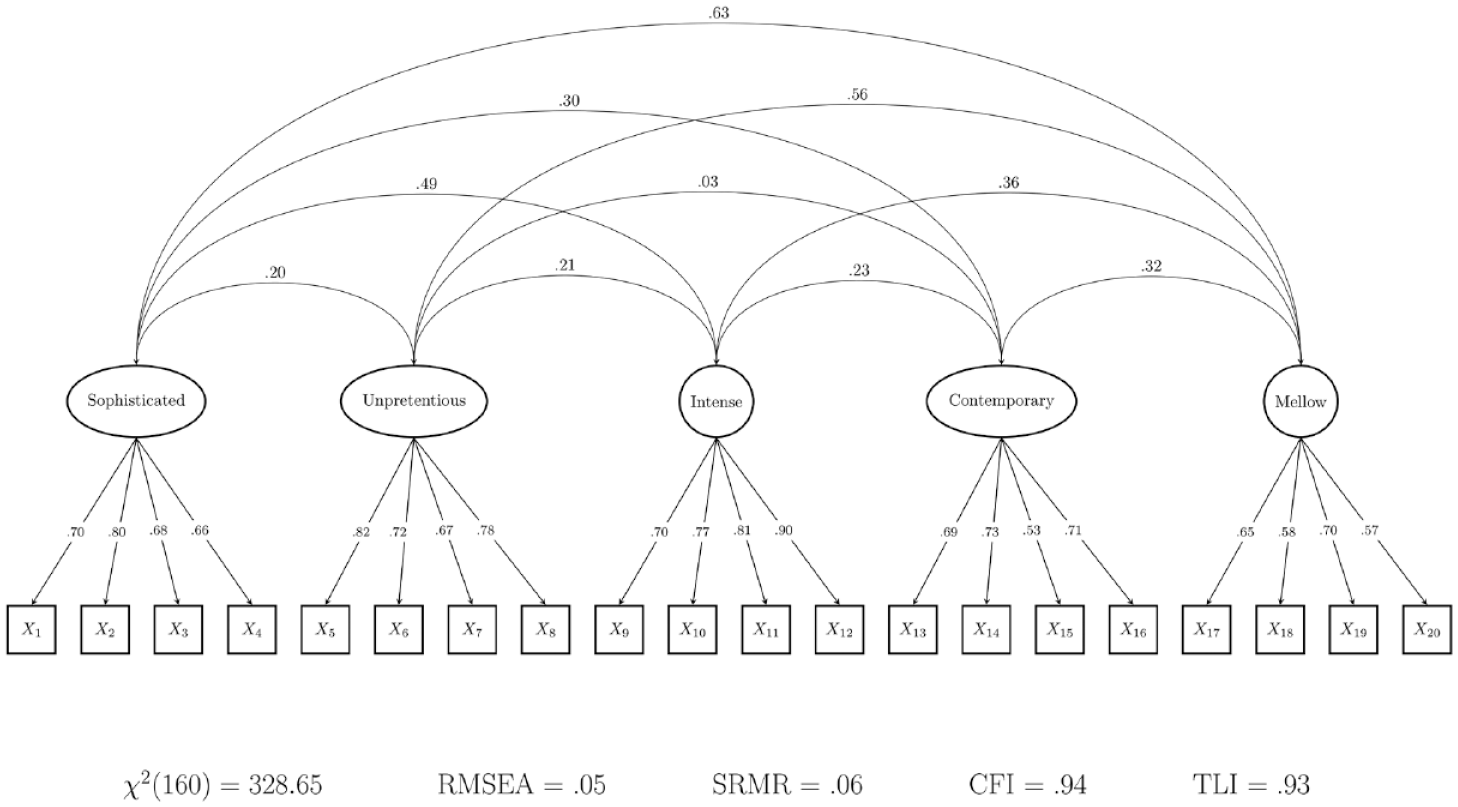
Confirmatory factor analysis of the five-factor model of music preference.
It seems reasonable to argue that the five-factor model of music preference presents a good fit for the data. Although the comparative fit index (CFI) of the specified model did not reach the suggested cutoff value of .95 (Hu & Bentler, 1999), it came extremely close to .94. Similarly, the suggested .95 cutoff value for the Tucker–Lewis index (TLI; Hu & Bentler, 1999) is close to the specified model’s TLI of .93. However, it has been noted that such arbitrary cutoff values may be somewhat restrictive (Marsh et al., 2004). There are other elements that suggest the appropriateness of this model. First, both the root mean squared error of approximation (RMSEA) and the standardized root mean square residual (SRMR) present values that suggest good fit (Hu & Bentler, 1999). Additionally, this model is undoubtedly the one that makes the most sense from a theoretical perspective, as the indicators for each of the factors are four musical excerpts of the genres that should be most representative of the factor itself (i.e., classical and polka music for the sophisticated factor, country music for the unpretentious factor, etc.). Thus, the five dimensions of music preference as first proposed by Rentfrow et al. (2011) have been properly measured by the 20 musical excerpts selected from this study.
Descriptive statistics and correlations
Table 1 presents the descriptive statistics and Bonferroni-corrected correlations between the five dimensions of music preference and the facets of openness to experience for both the FFM and the HEXACO models. Correlations among the 10 openness facets, which ranged from .27 to .96, were omitted from the table. Preference for the sophisticated dimension was significantly positively correlated with artistic interest, liberalism, aesthetic appreciation, inquisitiveness, and unconventionality facets. The only facets that were positively significantly correlated with preference for the mellow dimension were artistic interest, emotionality, liberalism, and aesthetic appreciation. On the other hand, almost all openness facets, both from the FFM and the HEXACO, showed significantly positive correlations with a preference for the intense and contemporary. Finally, the unpretentious dimension of music preferences was uncorrelated with all the facets of openness to experience.
Means, standard deviations, and correlations among the five dimensions of music preference and openness-to-experience facets.
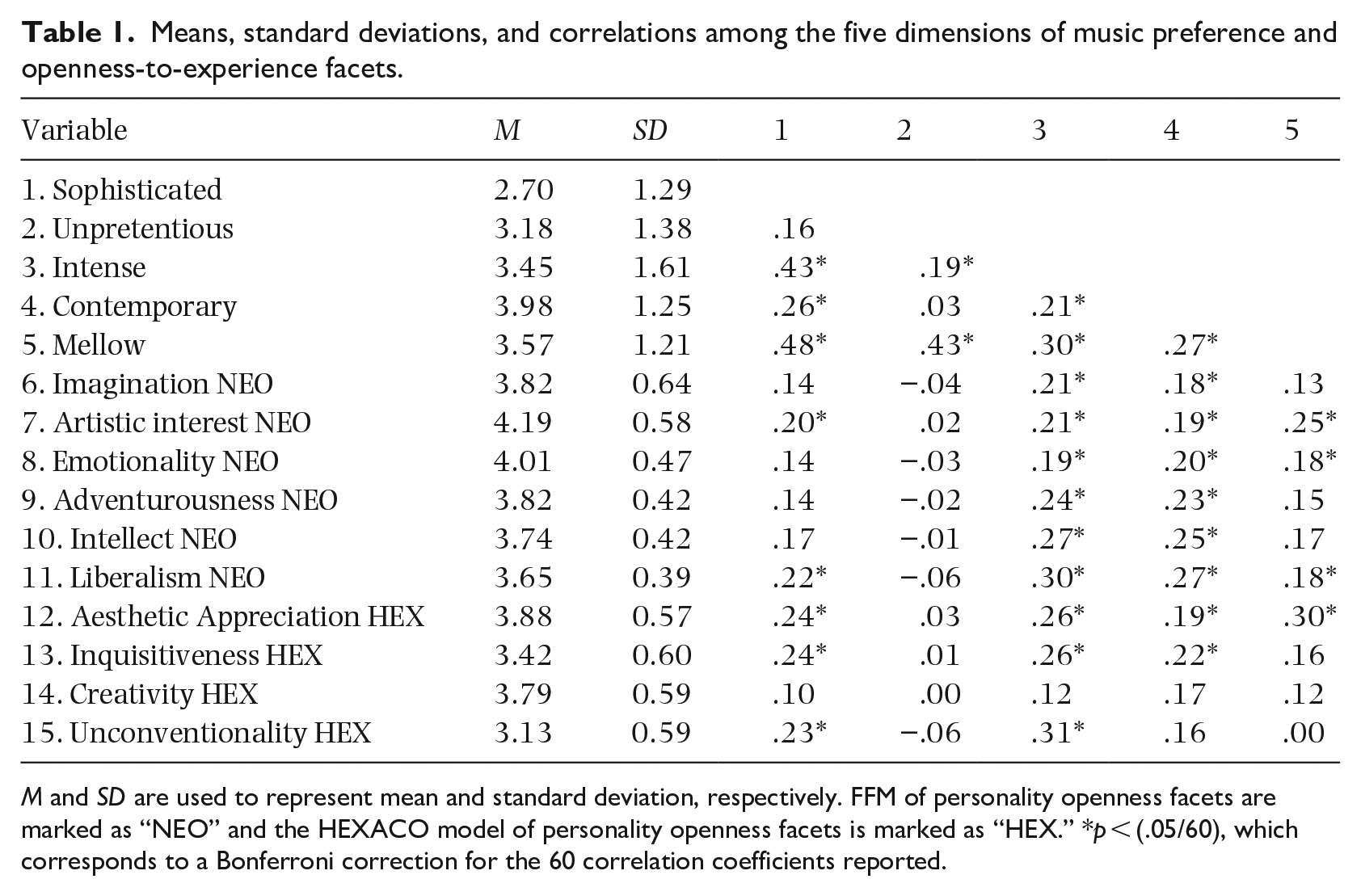
M and SD are used to represent mean and standard deviation, respectively. FFM of personality openness facets are marked as “NEO” and the HEXACO model of personality openness facets is marked as “HEX.” *p < (.05/60), which corresponds to a Bonferroni correction for the 60 correlation coefficients reported.
Dominance analysis
The main goal of this study was to observe the relation between the openness-to-experience facets of the FFM and HEXACO models of personality and music preference. As previously mentioned, DA offers a good way of examining highly correlated predictors by evaluating the additional variance explained in every possible regression subset. According to Azen and Budescu (2003), three levels of dominance between any two sets of predictors can be established. Complete dominance of Xi over Xj is established when Xi’s additional contribution to all subset models is greater than that of Xj. Conditional dominance of Xi over Xj is established when the average additional contribution of Xi across all models with k predictors is greater than that of Xj. Finally, general dominance of Xi over Xj is established when the average additional contribution of Xi across all possible subset models is greater than that of Xj. It is useful to note that complete dominance implies conditional dominance, which in turn implies general dominance. Therefore, one can view these three levels of dominance as being on an ordinal scale of dominance strength, with complete dominance being the strongest dominance level. Although these three levels of dominance are central notions to DA, the applications and nuances of DA extend beyond that which is discussed here. For additional information on how different levels of dominance are established, refer to Azen and Budescu (2006).
The 10 openness facets combined to explain 17% of the variance (i.e., R2 = .17) in the intense dimension of music preference (e.g., rock, punk, alternative, heavy metal). The most relevant predictor for the intense dimension was HEXACO’s unconventionality facet (Figure 2). Not only did HEXACO’s unconventionality show general dominance over the other openness facets in predicting preference for intense, but it also showed conditional dominance over all of the other facets. Thus, unconventionality was the most important predictor of liking of intense music.
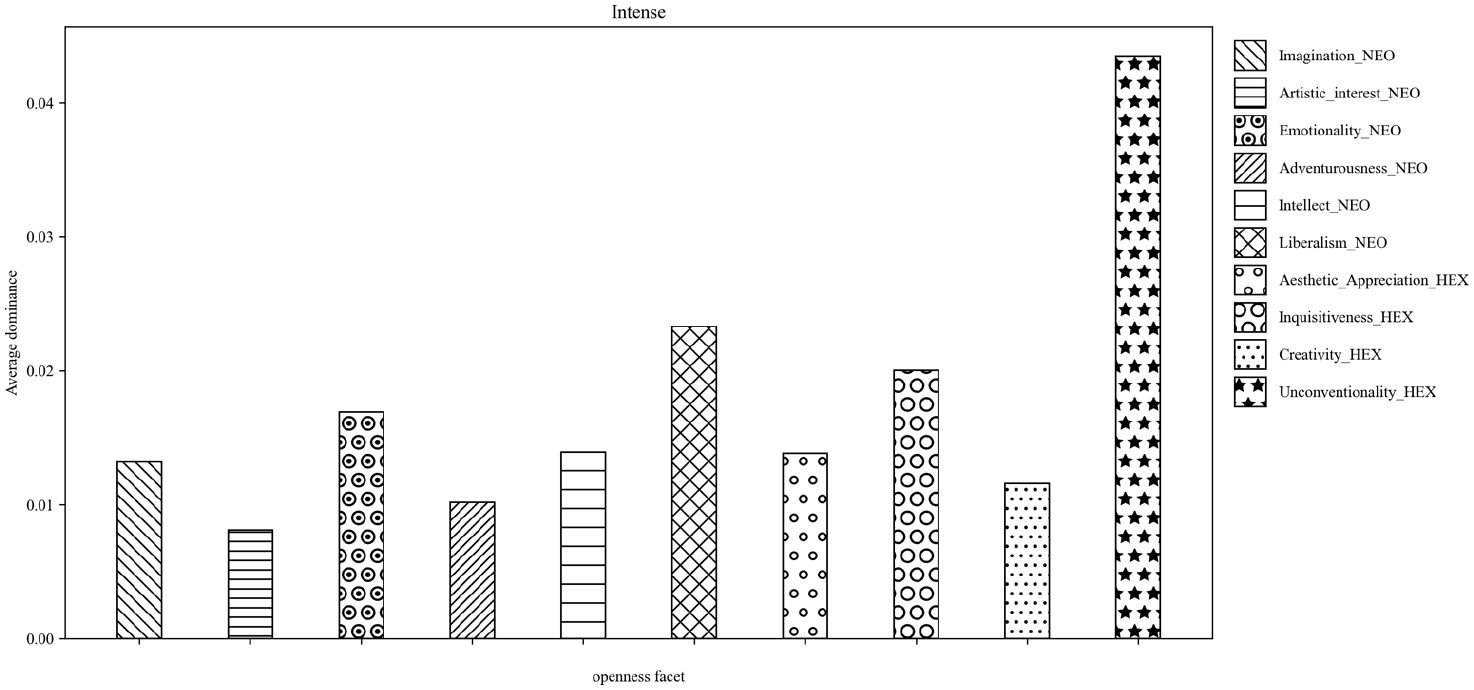
Average dominance of openness facets predicting preference for the intense dimension.
For liking of mellow music (e.g., electronica/dance, new age, world), HEXACO’s aesthetic appreciation facet turned out to both generally dominate and conditionally dominate all other predictors (R2 = .12). As Figure 3 shows, no other facet came close to the importance of aesthetic appreciation when predicting liking of mellow music.
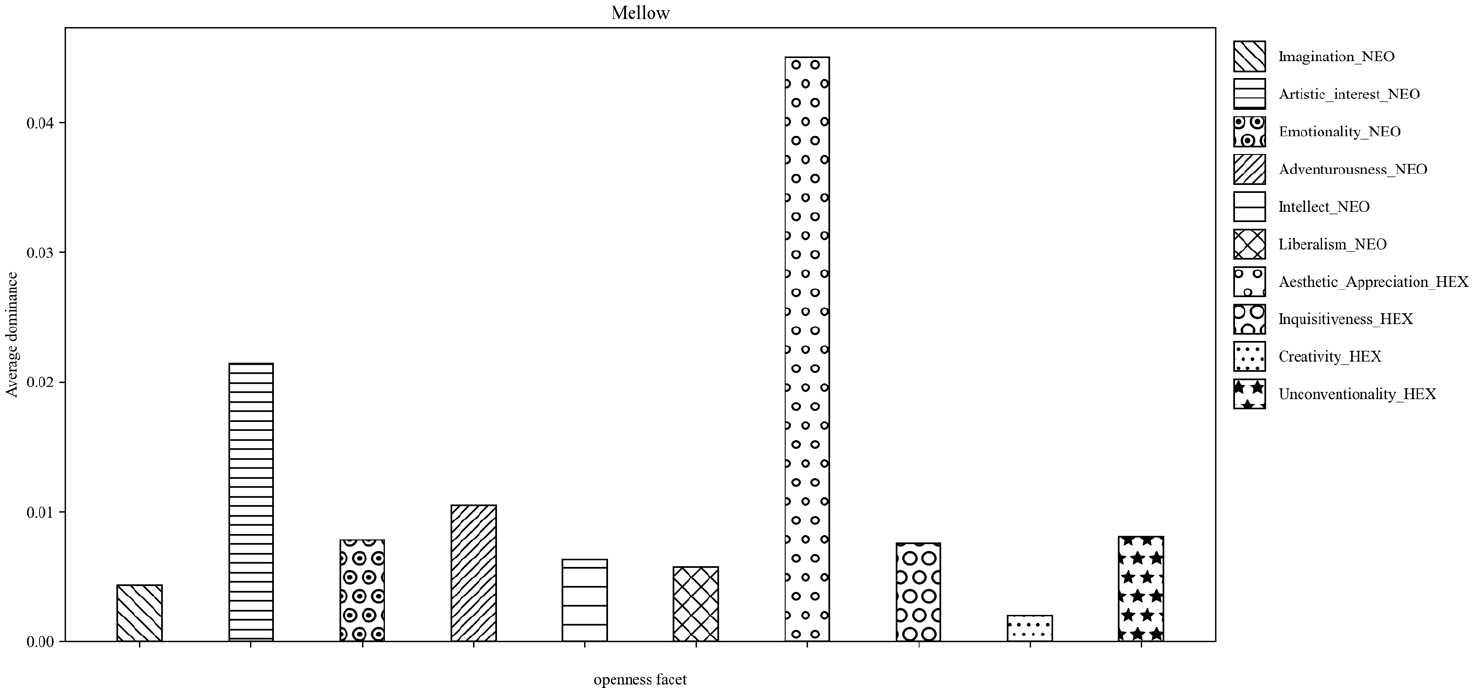
Average dominance of openness facets predicting preference for the mellow dimension.
The liberalism facet of the FFM conditionally dominated all of the other facets for the unpretentious dimension (see Figure 4). The explained variance for unpretentious was only 5%; this suggests that facets of openness to experience are less strongly related to liking of unpretentious music (e.g., pop, country, religious) than other types of music. It is also worth noting that the bivariate correlation between liberalism and liking of unpretentious music was negative but nonsignificant; thus, the effect on unpretentious music is very modest.
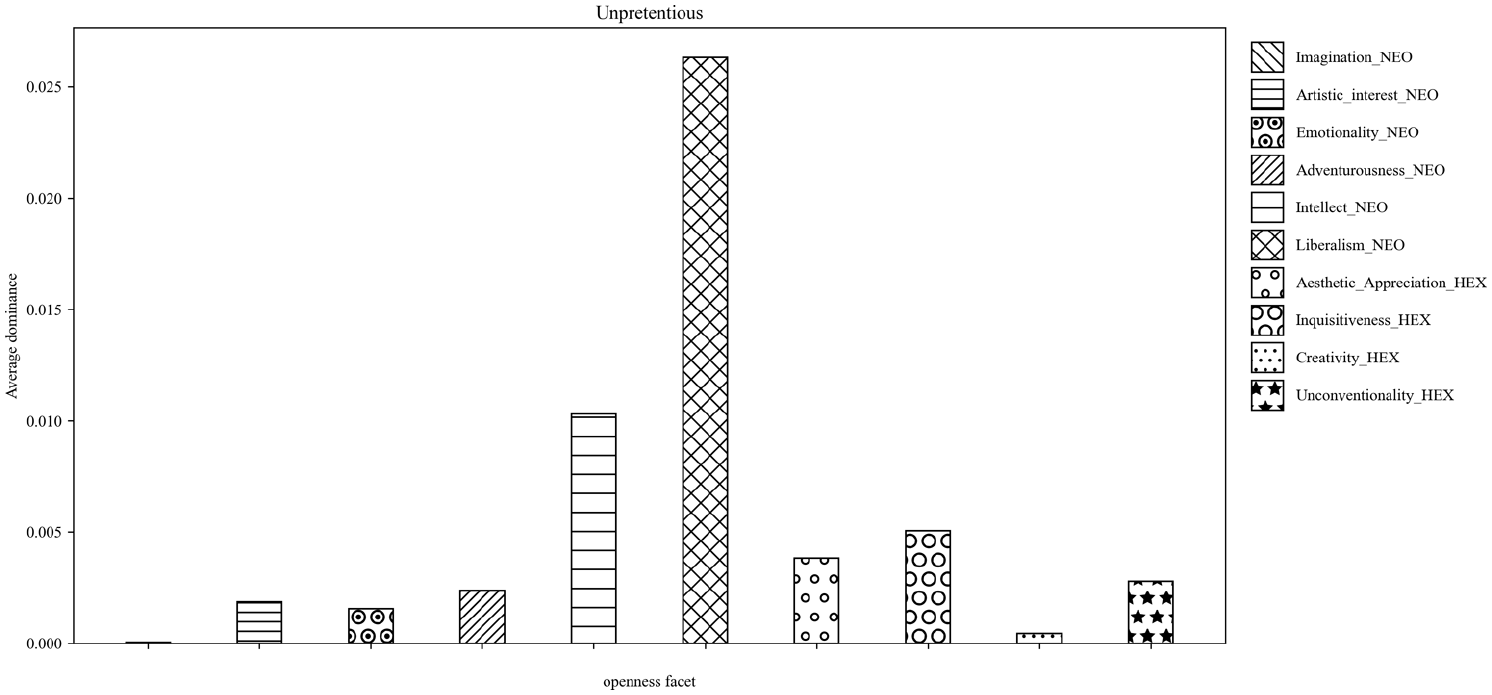
Average dominance of openness facets predicting preference for the unpretentious dimension.
When it comes to liking sophisticated music (e.g., blues, jazz, bluegrass, folk, classical, gospel, opera), HEXACO’s inquisitiveness generally dominated all of the other facets (R2 = .14). Moreover, inquisitiveness conditionally dominated all of the other facets aside from FFM’s imagination and HEXACO’s unconventionality (see Figure 5). Thus, unlike the prior dimensions of music preference, there were multiple facets of openness to experience that showed importance when predicting liking of sophisticated music.
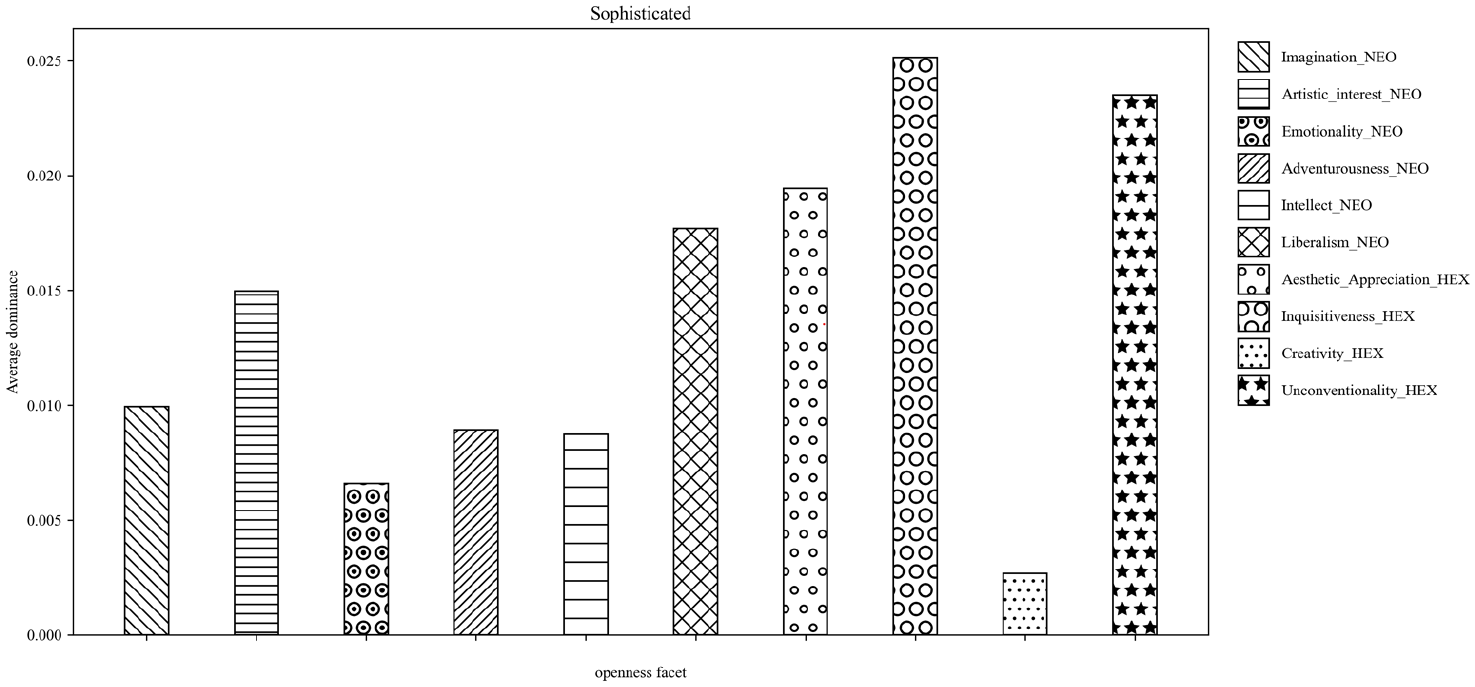
Average dominance of openness facets predicting preference for the sophisticated dimension.
Finally, the FFM liberalism facet generally dominated the other openness facets for the contemporary (R2 = .09) dimension (e.g., soul/R&B, funk, reggae). No clear conditional dominance pattern could be established, however (see Figure 6).
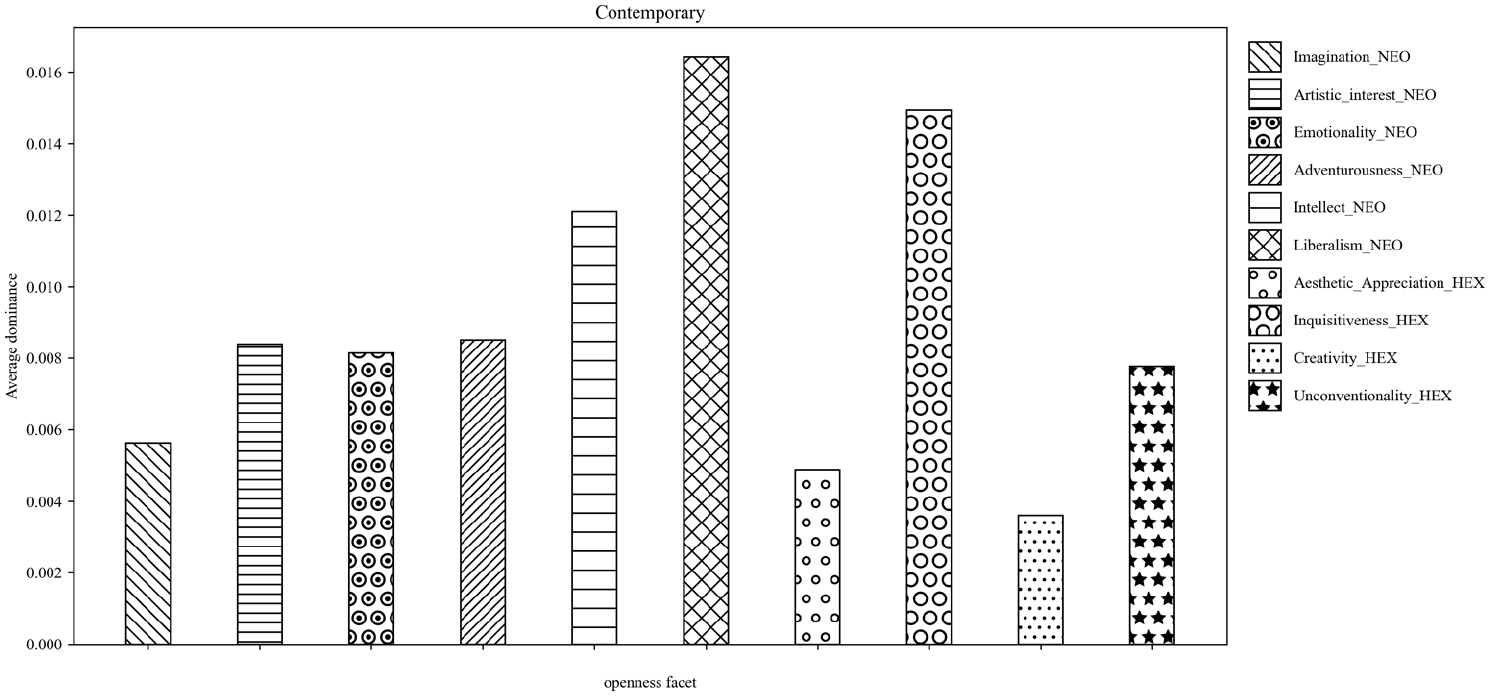
Average dominance of openness facets predicting preference for the contemporary dimension.
Discussion
The CFA of the 20 musical excerpts revealed that the five dimensions of music preference observed in Rentfrow et al. (2011) can be recreated even with a small number of musical excerpts. This result is important because it shows that even after 10 years from the original study, Rentfrow et al.’s (2011) excerpts remain an excellent way to measure music preference. Although these music excerpts have routinely been used as a measure of music preference (e.g., Güçlütürk & van Lier, 2019; Nave et al., 2018), to our knowledge, there has not been a formal analysis of their structure since Rentfrow et al. (2011). It has been proposed that musical excerpts are a better measure of music preference than genre-label measures such as the STOMP due to the lack of objective interpretation of genre labels (Brisson & Bianchi, 2020). We hope that the knowledge that music preference can be measured accurately using just four excerpts per dimension will encourage more researchers to use musical excerpts as a measure of music preference.
Central to the goal of this study, all the openness-to-experience facets of the FFM model had significant positive correlations with all the dimensions of music preference except the unpretentious one. An extremely similar pattern was shown by HEXACO’s openness-to-experience facets. These similarities between the facets of openness in the two models are probably due to the sizeable degree of multicollinearity among the variables. The results of the DA aid in interpreting the relationship between the dimensions of music preference and the facets of openness to experience. For instance, the liberalism facet of the FFM showed both general and conditional dominance over other predictors for the unpretentious dimension. This means that liberalism was the predictor that explained the most variance in preference for unpretentious music by a reasonable margin. Although DA does not show the direction of the relationship between a predictor and a criterion because all the values it generates are squared semi-partial correlations, it is possible that the liberalism facet of openness negatively predicts liking for unpretentious music when controlling for other openness facets. Indeed, in the literature, it is often reported that openness to experience is negatively correlated with a preference for unpretentious music (e.g., Langmeyer et al., 2012; Mellander et al., 2018; Rentfrow & Gosling, 2003). Likewise, liking of unpretentious music was also negatively correlated with liberal political views (Rentfrow & Gosling, 2003). Then, a possible interpretation of what the DA for unpretentious shows is that the liberalism facet of openness to experience might be the facet driving the relationship between openness to experience and unpretentious music that is sometimes observed in the literature.
Another interesting result of the DA was the conditional dominance of HEXACO’s unconventionality facet over the other predictors for intense music. This finding makes sense in the context of the literature that associates preference for rock music and heavy metal music, two genres represented in the intense dimension measured in this study, with rebelliousness and negative attitudes toward authority (Bleich et al., 1991; Swami et al., 2013). Indeed, some of the items that measured HEXACO’s unconventionality were “I rebel against authority,” and “I swim against the current,” which seem to tap into rebelliousness and defiance of authority. This finding is also rather interesting because it might show that HEXACO’s openness to experience, or more specifically its unconventionality facet, relates to music preference in a way that FFM’s openness does not.
The DA also suggested that preference for the mellow dimensions is mostly predicted by HEXACO’s aesthetic appreciation. This finding is harder to interpret, but it could be that people who are artistically receptive may prefer more calming and relaxing music, which is captured by the mellow dimension. The literature that examines the possible link between aesthetic appreciation and liking for relaxing music is scarce, but a recent study by Baltazar and Västfjäll (2020) could provide some insight into this matter. The two researchers reported that participants consistently rated relaxing music much higher than nonrelaxing music for perceived aesthetic value/beauty. It therefore seems possible that participants who are higher in aesthetic appreciation tend to prefer relaxing music, as its perceived features are more congruent with the participant’s personality.
It was not possible to establish clear conditional dominance for any of the openness facets predicting preference for the sophisticated dimension. Still, the 10 openness facets explained a convincing portion of the variance in preference for the sophisticated dimension at R2 = .14. The fact that openness-to-experience facets as a whole is related to preference for sophisticated music is consistent with the literature (e.g., Dunn et al., 2012; Rentfrow & Gosling, 2003; Vella & Mills, 2017). One of the proposed mechanisms by which openness to experience relates to a higher preference for sophisticated music could be the use that people make of music. Vella and Mills (2017) report that the relationship between openness to experience and liking of sophisticated music was mediated by cognitive use of music, the act of listening to music to appreciate the complexity of the composition and its technical execution. The sophisticated dimension of music preference encompasses music that tends to be considerably more complex than other music dimensions, making it well suited for cognitive use.
Finally, although the FFM liberalism facet reached general dominance for preference for contemporary music, no clear conditional dominance pattern could be established. Additionally, the total variance in preference for contemporary music by the 10 openness facets was just 9%. This finding is not unexpected, as in the literature openness to experience is not a significant predictor of preference for contemporary music.
Limitations
The findings of this study are inevitably limited. First, the sample utilized consisted only of undergraduate college students. A sample of undergraduate college students is very likely mostly Western, educated, industrialized, rich, and democratic, a type of convenience sample that is known in the psychological literature as the WEIRD sample. The sample used in this study clearly has some of these features, as 72% of the participants were white, and the entirety of the sample was made up of educated college students. Some researchers correctly point out that it is generally unreasonable to try to generalize from studies using only WEIRD samples (Henrich et al., 2010). Personally, we echo these concerns. There is no guarantee that the findings of this study will generalize to populations with different characteristics. Similarly, the findings could also be strongly dependent on cultural factors. One example would be inferences related to the unpretentious dimension of music preference. The excerpts measuring this dimension were mostly country and bluegrass music, two music genres that are very typically representative of certain American subcultures (Mellander et al., 2018). The observed relationship between the unpretentious dimensions and the liberalism facet may very well not hold in a non-American sample.
The excerpts that were used included a somewhat limited group of music genres. It should be noted that what was measured in this study of music preference was in fact preference for just 20 musical excerpts. Attempts to measure something as broad as music preference cannot but have limitations, as the 20 excerpts used in this study could never be fully representative of the true structure of music preference, which would have to take into account and keep up with all the possible music genres that exist and will be developed in the future.
DA is a useful tool for investigating the relative importance of predictors. Yet, it cannot be used to establish the direction of the relationship between hypothesized predictor and criterion variables. In the present study, this direction can be inferred from the scrutiny of the existing literature, but it would have been better if we could have obtained interpretable regression coefficients. This was not possible because of multicollinearity among the facets of openness.
Theoretical and practical implications
Understanding the psychology of people’s music preferences is inherently intriguing given that music listening is such a ubiquitous activity. The results of this study provide some insight into people’s reasons for choosing to listen to certain kinds of music rather than others. Specifically, this is the first study to show that different facets of openness to experience map onto different music preferences. Moreover, it could be helpful for music streaming platforms seeking to tailor recommendations to users more effectively to be aware of the ways in which personality can predict music preference. In summary, our research provides additional support for the role of personality in choices of music listening.
The results of this study also have some important implications for the field of music-preference research. Using musical excerpts to measure music preference appears to be a robust method, as we found the same factor structure as Rentfrow et al. (2011). Researchers interested in music preference are strongly recommended to use these excerpts to measure music preference.
Finally, DA offered some interesting insights that should not be overlooked. Researchers interested in music preference and openness to experience should take into account the relative importance in this study of all the facets of openness; although correlations between music preference and openness to experience in the FFM and HEXACO models appear similar, DA shows patterns suggesting that the two models of personality predict music preference in different ways. Future research should extend our application of DA to other measures of individual differences in the field of music preference.
Footnotes
Authors’ Note
This research study was part of a master’s thesis by the first author under the direction of the second author. Portions of this research were presented at the 94th Annual Meeting of the Midwestern Psychological Association.
Declaration of conflicting interests
The authors declared no potential conflicts of interest with respect to the research, authorship, and/or publication of this article.
Funding
The authors received no financial support for the research, authorship, and/or publication of this article.
