




Abstract
In the current study, 11 expert music teachers were asked to reflect on their own practice and compare their experience of individual and collective teaching settings. Adopting an approach based on grounded theory, two interrelated themes were identified in the raw data: teaching issues and professional development. In both categories, the notion of ‘presence’ emerged as a defining feature of the comparison. Teachers reported to be less present in collective settings, whereas one would expect that the higher (cognitive, teaching, etc.) demands associated with more learners would result in teachers being instead more involved in the unfolding dynamics of the lesson. Inspired by the conceptual tools offered by the Extended Mind (ExM) approach, we suggest that in collective settings teachers feel less present because they can offload the cognitive role of ‘teacher’ onto the learners, giving rise to a hybrid extended system that fosters a shared sense of responsibility, where pedagogical dynamics are functionally distributed across the whole group. In reporting excepts from music teachers, and adopting a novel perspective to frame our discussion, our research may contribute to existing literature in (collective) music pedagogy.
In recent years, empirical and theoretical contributions to music education and music psychology have demonstrated a growing interest in musical settings that involve reciprocal interaction and collaboration (see Hargreaves et al., 2003; Luce, 2001; Nielsen et al., 2018; O’Neill & Green, 2001). This has been driven by a variety of factors: the lack of existing research; the need to comprehend the cognitive aspects and the dynamics involved in musical participation (Cross, 2014; Turino, 2008; Small, 1998); the development of interactive and embodied approaches to human cognition (De Jaegher & Di Paolo, 2007; Thompson, 2007; Varela et al., 1991); the scholarly interest around less formalized teaching methods (Green, 2008; Smith et al., 2018); and the reconsideration of traditional assumptions about what constitutes effective teaching and learning (Bowman, 2004; Elliott & Silverman, 2015; van der Schyff, 2015). In the context of music education, the interest in interactive musical settings is being developed, among others, by research that explores the various benefits of collective music classes (see Hanken, 2016; Hmelo-Silver et al., 2013).
An important aspect of this involves a shift in focus onto the process of teaching, rather than its outcome (van der Schyff et al., 2016). This places more emphasis on understanding the meaning of musical activity for the positive development of students – one that takes more seriously the cognitive, ethical, social and cultural dimensions associated with personal growth (Chappell, 1999; O’Neill, 2009, 2010; Rostvall & West, 2003; Silverman, 2012, 2014). It has been argued that musical environments where students can learn from each other – i.e. where they are minimally facilitated by a teacher – can foster creative thinking and action (Schiavio et al., 2018), and that understanding how and why this occurs could lead to the development of more effective pedagogical approaches (Borgo, 2007; Sawyer, 2007). This perspective also offers growing evidence that participation in settings where music is taught collectively provides important benefits in terms of social cohesion, inclusion, and well-being more generally (see Burnard et al., 2008; MacDonald et al., 2012). Likewise, this more relational and process-based perspective also encourages teachers to reflect more deeply on their professional development – to explore more adaptive and open-ended approaches that might help them better meet challenges and issues related to class organization and assessment (Gaunt, 2013). As collaborative forms of learning are increasingly developed by music educators in formal environments and are being adopted by learners and performers both inside and outside of the classroom (Bjøntegaard, 2015; Gaunt & Westerlund, 2013; Lebler, 2007, 2008), the effectiveness of more traditional approaches based on teacher–apprentice settings is being questioned (Schiavio & Cummins, 2015). While the majority of contributions explores this topic from the perspective of the student (e.g. Gaunt, 2010; Johansson, 2013; Jørgensen, 2000), less is known about how teachers approach and experience the differences between individual and collective settings (but see e.g. Gaunt, 2008). This may limit our comprehension of how music educators and students interact during class, prepare for their lessons, motivate themselves, set relevant objectives, and reflect upon and assess their teaching and learning. As such, a richer understanding of how teachers participate in individual and collective pedagogical settings is needed.
In this paper, we wish to take a step towards this goal by focusing on how music teachers reflect on their own practice, comparing their experiences of both teaching contexts (individual and collective). To do this, we will report findings from an exploratory qualitative study and develop insights relevant to the following two themes:
Teaching issues (e.g. how do teachers design the collective class? What objectives do they pursue? How are assessments developed?)
Professional development (e.g. what challenges does collective learning pose for the music teacher? What motivations are necessary to successfully teach in such contexts?)
Although the excerpts we report on here are necessarily specific to the limited sample of teachers who participated in our study, we consider how a theoretical framework based in the Extended Mind (ExM) hypothesis associated with contemporary cognitive science (Menary, 2010; Wheeler, 2011) might help us contextualize many of the key points that emerge from our data. This approach was introduced in a well-known paper by Clark & Chalmers (1998) and has since been developed by a range of scholars (see Menary, 2010). ExM theory advances the general idea that, when given conditions are met, one’s cognitive system can reach beyond the physical boundaries of skull and skin, extending the cognitive domain of the individual. By this light, cultural, social, technological and physical factors of the environment are often coupled with aspects of our mental life (Donald, 1991; Malafouris, 2015). This allows for the achievement of cognitive tasks that might be too mentally demanding when understood as limited to the brain and body of the individual. For example, we use tools and objects to aid with memory and calculation (note pads, computers). Likewise, when we use musical instruments we expand the possibilities of what we can do with sounds, and often come to rely on the relationships enacted between the body and the sound-making properties of the instrument. This can also be understood in social contexts – e.g. the shared cognitive ecology brought forth by interacting musicians who continually negotiate tasks related to rhythmic entrainment, phrasing and intonation, timbre, dynamics, emotional expression, and more. As ExM is currently offering useful conceptual tools in the context of music cognition and emotion (Cochrane, 2008; Krueger, 2014a, 2014b, 2018), we expect that it may provide important insights in the domain of music education as well.
The paper is structured as follows. We first report on our exploratory qualitative study, which was designed to compare individual and collective music teaching, focusing on the issues and challenges music teachers face when preparing and taking part in a collective music class. This entails a mixture of questionnaires with open-ended questions and semi-structured interviews with 11 music teachers. We then develop the educational implications of our analysis in light of the ExM thesis. It should be noted that this theoretical framework was adopted to interpret our findings, rather than motivate the original idea of the study.
Method
Participants
Eleven expert music teachers from different nationalities, cultural backgrounds and locations (North America and Europe) were recruited via social media (Facebook, Twitter, etc.), and via personal messages (in case they were already known to the authors). They were required to have broad experience in music education and musical performance, having studied an instrument for at least 10 years (median = 26.1; range 10–45), and having taught both collective and individual classes within formal educational settings. They teach different instruments: piano (n = 6), guitar (n = 2), drums (n = 1), flute (n = 1), violin (n = 1), in the contexts of classical music (n = 8), jazz (n = 2) and improvisation (n = 1). Their ages range between 27 and 59 (median = 43.3). All participants were part of a larger study also involving music students from conservatoires and music schools. They all signed a written informed consent that explained the procedure and provided information concerning how data will be anonymized for publication. The ethics committee associated with research at University of Graz approved this study in December 2017.
Questionnaires and interviews
Questionnaires were administrated either in English or Italian (depending of the mother tongue of the participant) to eight teachers, and the completed documents were later translated into English when needed. All questionnaires comprised an initial general part where information concerning demography and musical background was requested, followed by 18 open-ended questions aimed at exploring important aspects of the participants’ teaching experiences. These questions were grouped into two sections: the first 11 questions (section 1) concerned themes associated to individual tuition, and the last seven (section 2) were focused on both collective forms of tuition and their differences from individual ones. To elicit more elaborate responses, deliberately non-specific and broad questions were asked. This allowed teachers to compare the two pedagogical settings in detailed and personal ways. Examples of open-ended questions present in the questionnaire are: ‘What are the aspects that you like the most in collective/group music lessons (ensemble or other practice-based classes)?’; ‘What are the main differences between individual and collective lessons?’; ‘Which aspects of the learning/teaching process would you like to improve?’ The final version of the questionnaire was approved by all authors of the present contribution after a number of mutual assessments and reflections on the appropriateness of the material, which was refined and improved through a ‘reflexive and interactive inquiry journey’ (see Agee, 2009; Flick, 2006). Participants received the questionnaire via email after mutual agreement with one of the researchers and were asked to complete it in a timely fashion on their own computer (i.e. through a word processor).
Additionally, semi-structured interviews were conducted with three participants and then transcribed verbatim by a research assistant. Each interview lasted for approximately 30 minutes and was based on the same set of questions developed for the questionnaire. However, as these interviews were collected after all questionnaires were received, new sub-questions were generated on the basis of the initial data. This is a common occurrence in qualitative research – new questions and sub-questions tend to emerge, both during the primary inquiry and in the collection and analysis of data; this can expand the scope of the original questions to better address the complexities of the phenomenon under investigation (Agee, 2009). This allowed for more detailed elaborations of aspects that did not always emerge clearly in the questionnaires, as it enabled the interviewer to ask for concrete examples. The flexibility of such an approach – which is particularly well suited for music research – allowed the research team to discover new themes or items that were not initially considered.
Data analysis
The participants’ answers were analysed by two of the present authors using an inductive method framed within the approach known as grounded theory (Oktay, 2012; Rostvall & West 2003; Stebbins, 2001; Strauss, 1987). In this approach, codes and categories are extracted from the data (Charmaz, 2003). This method is based on content analysis and was successfully implemented for analyses of interviews in previous research (e.g. Biasutti, 2013). During the coding process ATLAS.ti 7 software for qualitative analysis was used. The coding process consisted of two main steps: categorization and reduction. In the first step, the primary documents were read, segmented, and organized according to a coding scheme; in the second step, relations were determined and the list of codes was systematized by category. At the beginning of the coding process, an immersion process was developed by the researchers, which consisted of reading the participants’ answers several times in order to attain a high level of familiarity with the raw data. The coding began with the selection of text quotations relevant to the research. During the categorization, different answers were recognized and specific codes were assigned to them. In assigning codes, a careful re-reading of the text was undertaken in order to avoid redundancies and repetitions; before generating a new code, the researchers verified whether it was possible to assign the quotation to an existing code and a new code was introduced only if the quotation did not fit within an existing one. A total of 10 codes emerged during the categorization step. During the reduction step the codes were sorted into categories. The categories could be considered a higher-order level of classification, enabling further categorization of the codes into macro-categories. The following two categories summarizing the content of the codes emerged: (i) teaching issues, and (ii) professional development. The data were then discussed by the research team to compare individual interpretations. During the discussion, the codes and categories were verified, and ambiguous statements were analysed and assigned to a precise code. At the end of the discussion, all the researchers had a common understanding of the codes and categories. This process was later validated by an independent researcher who separately verified the coding scheme. Any contrasting result was further discussed until full agreement was obtained. A scheme summarizing the categories and the codes identified through the analysis process is reported in Figure 1. The categories represent the practice of the teachers during individual and collective music lessons. The quotations reported below are marked with ‘T1’; ‘T2’ … ‘T11’ (where ‘T’ stands for ‘teacher’), to allow the reader to compare insights and comments belonging to the same individual.
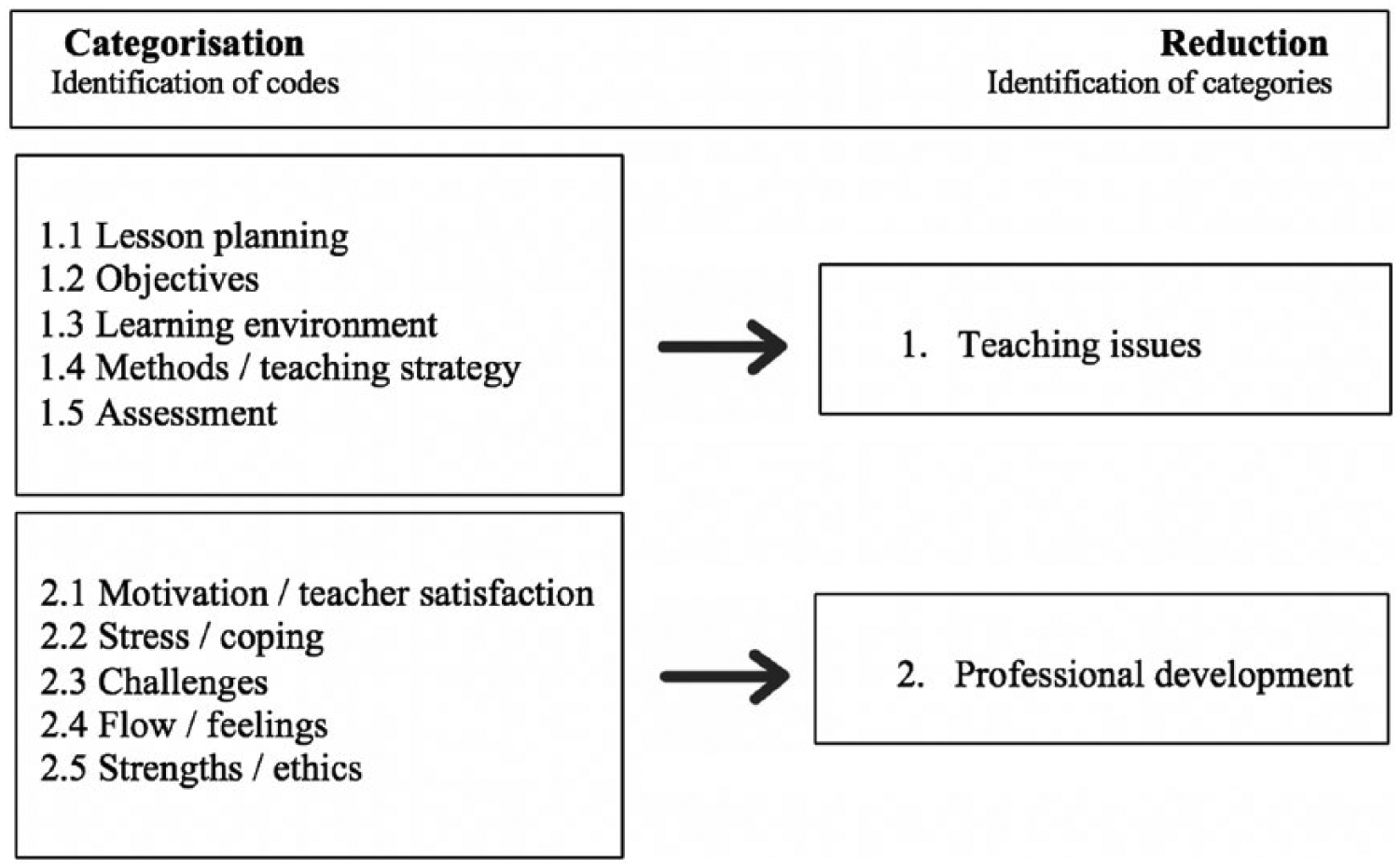
Diagram of the analysis of the answers.
Results
Teaching issues
Several meanings were provided by the participants for the category teaching issues, which includes aspects linked to lesson planning, setting-up objectives, defining a proper learning environment, managing the contents. In addition, aspects of the teaching methods were clarified, and teaching strategies and assessment were reported. In what follows we specifically focus on each code.
Lesson planning
This code refers to the actions developed by the teachers for designing and preparing the lessons. It includes activities such as selecting scores to match the level of the students’ abilities and rehearsing the pieces. In our analysis, we found two main areas that concern teachers as they plan their lessons in both individual and collective contexts. One involves the evaluation of a student’s career, previous assessments and future plans. The other is focused on the moment-to-moment relational dynamics between students and teachers. With regard to the former, consider how two teachers describe their preparation for individual classes: T1: ‘I usually go through the progress sheet for each student and think what they need at this certain point; e.g. more ear training, more relaxed state for better learning, working on extending attention span.’ T2: ‘depending on what has been done in the former lesson, I review the contents, I study and practise those and figure out how to integrate the same with more solutions. Try to advance each lesson grounding the work on taken previous steps.’
Similarly, for collective classes, a teacher affirms: T4: ‘a lot of time is spent selecting repertoires that will provide a balance of challenging material that will stretch the players and material that they will be able to get in hand within a reasonable period of time. Striking the balance between effort and accomplishment and regulating that cycle over a semester or year of work is always challenging. Because I work with some ensembles with unusual instrumentation, I also spend a lot of time composing and arranging. In some cases, extensive score study and analysis are required so that I have the repertoire in my head before we start rehearsal. In other situations, there may be musical ideas/concepts/techniques that I need to learn in order to communicate more effectively to the students.’
However, while for both situations planning appears to be essential for the lesson, a difference emerges in how this is actually conceived of. In individual settings, the teacher’s planning mostly entails looking at each student’s individual development. Conversely, in collective situations the focus becomes the group as a whole: the score, the parts to be performed, and the selection of the repertoire. Here, the more macro- or ensemble-level components require more attention from the teacher, as compared to the focus on the needs of specific students in individual lessons. This does not mean that planning collective lessons is more challenging than individual ones, as one of the teachers reported: T8: ‘it is more difficult to tailor lessons to individual needs. Sometimes the individual needs to be more independent and look after themselves in group lessons.’
This suggests that planning group lessons involves implementing broader strategies that foster group cohesion and a shared sense of accomplishment, while individual lessons require the development of more specific and idiosyncratic approaches that are adapted to a specific student. But not all teachers share the same focus on planning. For example, some highly experienced teachers are able to jump into their individual lessons without much preparation: T6: ‘having taught for so many years, there is nothing specific of preparation on the days of actual teaching.’
Similar quotes are also reported with regard to collective teaching, implying that an effective interplay between students and teacher might not always require meticulous preparation. The following discussion on lesson objectives appears to align with this.
Objectives
In this code, the objectives pursued during teaching are included. As a teacher rightly points out, the matter cannot be approached too easily – many variables and outcomes may influence a given objective: T8: ‘it largely depends upon the level of ability of the student. A balance of technique and understanding of the larger form and processes. Oscillating back and forth between the smaller and larger considerations.’
The focus on the individual may be beneficial in pursuing objectives associated with the development of traditional musical skills. And indeed, one teacher reports a few examples of what a student might ask from the teacher in the context of individual tuition: T5: ‘how to make a piece sound more baroque? Does it fit a certain style of jazz? How to improvise, how to emulate certain styles, how to better tell a story while performing.’
Conversely, we do not find the same focus on technical skills in collective settings: T1: ‘in group class one of the most important aspects is observing and listening to others while being engaged in music, or musical-related activities. Cooperation and finding mutual interests in music is more relevant in a group class setting. In group class setting, students are also able to evaluate their own strengths and weaknesses in regard to the class’ mean.’
In collective settings, an individual’s development is less dependent on a student’s relationship with the teacher. Rather, it emerges mostly through interactions with the ensemble itself. Here students learn from each other in ways that are not (and cannot be) always fully captured by the list of objectives associated with a lesson plan. This is seen as a positive aspect of collective learning – teachers enjoy the flexible interplay enacted by their students. Consider the following two quotes from the same teacher: T4: ‘there is a certain energy that comes from working and learning in a group. I think students learn a lot from each other as well as from the instructor. There are kinds of music that can only be realized through team effort. This kind of effort is very appealing to me in a fundamental, emotional way. I find goals achieved through ensemble work much more satisfying than goals achieved through individual effort alone. Perhaps humans are “programmed” for this?’ T4: ‘students have to take more responsibility for the role they play in the group and the effects their actions or inaction may have on the collective.’
Finally, while discussing the objectives pursued in collective classes, two teachers (T9 and T11) reported that ‘vibrating together as a unique body’ and ‘union, cohesion and empathy’, respectively, are important aspects of musical experience. 1 While such dynamics are likely to emerge in individual lessons to a degree, it seems that collective environments provide contexts where such factors may be experienced and developed in more sustained ways.
Learning environment
With regard to the learning environment, several aspects were mentioned. Teachers indicated the importance of defining a friendly and relaxed environment in which learners can express themselves and give their best. Again, this plays out differently in individual and collective contexts. Concerning the latter, one teacher (T9) explains that a safe learning environment is achieved ‘through active participation. Through listening and playing. Through discussion and analysis.’ In other words, such an environment is ‘highly associated to practice itself’; or as another teacher (T1) puts it: ‘teaching group classes, especially to young children, is more similar to a performance situation.’ These statements underlie the lesson structure and the development of various activities within the classroom. However, the role of the teacher in these performance-like situations can sometimes stand apart from the participatory dynamics of the students. Consider the following quote, in which a teacher reports on an important difference concerning individual and collective lessons: T9: ‘the main difference is about the type of relationship that emerges: in a group you must become a positive leader, an example on both personal and musical level […] In individual lessons there is a dyadic relationship where the needs of the single individual are given priority.’
In individual contexts the relationship between students and teachers appears to be more intimate. Here the teacher does not take on the role of ‘leader’, but rather helps the student to flourish through a focus on his or her needs and potentials. By contrast, in collective settings the teacher can be more of an outsider – some of his or her feelings are not even included within the context of the lesson. As one teacher (T9) explains: ‘my own comfort isn’t part of the lesson. I focus upon making the students comfortable while challenging them.’ Similar passages will be described later in more detail with reference to the notion of ‘presence’, which helps capture the various changes in the teachers’ relational dynamics with students in collective pedagogical contexts. First, however, it is important to see if this difference also emerges in how the teaching strategies are described.
Methods/teaching strategies
In this code, teaching methods and strategies that participants adopted are included. For example, the following quote expresses how issues and challenges arise in relation to concrete performance-related contexts, and how discussing them at a theoretical level can help improve group cohesion and performance: T4: ‘I generally address issues as they arise from challenges presented by the repertoire. One example might be that problems with tuning a chord can be a result of misunderstanding of harmonic function or harmonic density. Similarly, a problem playing half note triplets over a bar of 4/4 might stem from a lack of understanding of the smaller subdivisions upon which those triplets are built. Theoretical constructs around form and structure often make the most sense in the context of ensemble playing. I don’t mind taking time out from rehearsing to address these things. I’ll spend as much time as necessary to get the idea across as I think so-called theory is just a way of describing practice anyway and not the other way around.’
However, in individual lessons things may be different. Surprisingly, while these situations often involve more attention on the needs of single students, they appear to focus less on discussions about theory. Instead, other parameters, such as technique and tone production, are privileged: T2: ‘in individual lessons, considering that improvement is closer and personally tailored for each student, it means that theory can take less time from the lesson, whether it is more important to work practically and stress muscularity, independence, sound-wise improvements.’
Although collective contexts are described as focused mainly on performance skills and practice, they also require time to discuss theoretical points. In individual lessons, however, the concern is mostly with the physical aspects of playing the instrument at hand. The apparent dichotomy between concrete performance skills and music theory is reconciled by the following quote, in which a teacher describes how the dynamics of the group learning can facilitate the integration of the two: T5: ‘theoretical knowledge is taught partially through memorization of scales and triads, some etudes, partially through being told “this isn’t a set of notes that go together in this key”. When playing with a group or accompaniment, it is easier to hear if the note choice was wrong. Sometimes, notational theory or techniques are learned through emulating your peers.’
Assessment
With regard to assessment, teachers commented that evaluating students is a very important aspect of their activities, and that there have to be clearly defined moments where this takes place. As one of our teachers reports, individual lessons are often centred on a specific assessment strategy: T9: ‘I evaluate students in light of their correct execution of the piece, and in particular in terms of how it is interiorized, becoming part of the cultural repertoire of the pupil. This means that I evaluate whether the student gladly performs the piece spontaneously by heart, even if I did not ask for it. They do it spontaneously.’
This entails a strong focus on performative skills – one that seems to contrast with the dynamics inherent to collective forms of tuition. Within collective contexts, another teacher (T11) individuates one more valuable aspect that should be assessed, namely ‘cohesion and the capacity to create a unique sound’. As we have begun to consider – and will discuss further in the concluding section of the paper – our analysis shows a number of differences concerning how individual and collective musical learning settings are understood and approached by teachers. While collective settings are more concerned with how groups develop meaningful relational forms of musicking, they also tend to detach the role of teachers from the activities of the students. Here, teachers take on leadership roles, facilitating environments, repertoire and activities intended to foster positive interactions and development within the ensemble. The descriptions of individual lessons, by contrast, often portray a more ‘present’ teacher, who works closely and collaboratively with students – striving to help them develop musical abilities in more direct (i.e. less theoretical) ways.
Professional development
Several aspects were mentioned by the participants for the category of professional development. Here the different ways teachers are ‘present’ in class are captured by their own reflections on the nature of teaching and the main features this entails. For ‘being present’, we mainly refer to their active participation in the unfolding dynamics of the lesson – how teachers control and shape the learning trajectory of the students. Again, group and individual settings provide different challenges and possibilities for teachers and students to interact and develop – where in some contexts a teacher’s presence may be more overt (i.e. involving direct interventions) or, in others, it may remain more in the background, facilitating appropriate environments for musical development to occur, where a larger degree of collaborative and student-led activity is involved.
Motivation/teacher satisfaction
Motivation and teacher satisfaction are important aspects of the professional development of a music teacher. They also manifest paradigmatic differences in terms of collective and individual lessons. Concerning the latter, one teacher comments: T11: ‘I feel empathy for students’ efforts in the achievement or first attempts to achieve something. I am moved and motivated by such things if I think it mirrors what I have been through in my early studies.’
Note in many quotes how, when discussing collective tuitions, the teacher’s focus shifts from the individual (‘I feel’, ‘I am’) to the collectivity, even if the question specifically addresses the teacher’s own motivations. This refers, for example, to the satisfaction of observing students working well together, where the teacher is made happy by ‘the fact that students, if in a good tuning, spontaneously create little relational moments, and reciprocally discuss musical aspects’, as reported by one of our teachers (T10). With regard to this point, consider now the two following contrasting quotes – the first of which involves an individual class and the second a collective setting: T4: ‘I enjoy watching someone have an “aha” moment where they realize or accomplish something that has previously eluded them. I enjoy turning people on to different styles of music or musicians that they may not have known about before. I enjoy the challenge of finding different ways of teaching a skill and finding the way that will work best for an individual.’ T2: ‘[a teacher’s satisfaction lies in] the fact that it can trigger a healthy competition between participants. Dealing with different levels it is also a joy whether a skilled student may be encouraged to take a “teaching” role for his/her fellows. This would encourage both, strengthen also the acquired – or need to be achieved – knowledge.’
These two quotes show a difference concerning the quality of the presence for individual and collective classes. In the latter, the teacher appears to create an environment where his or her tasks can be offloaded onto the group, allowing them to take on roles and responsibilities, and to interact and adapt in ways that contribute to their collective development. As we will discuss in the final section of the paper, this idea strongly resonates with the Extended Mind thesis.
Stress/coping
Teaching music is not as easy task. It often requires considerable ability to cope with stress and solve other problems of the lesson. In this code, different considerations and issues are included. A first aspect is that stress is not necessary a bad thing: T3: ‘yes, of course, at certain moments when the highest concentration of forces is required, when it is necessary to “jump above oneself”, it is stressful (both for the student and for the teacher). But without stress there can be no higher achievements – neither in sports, nor in art. Another thing, stress should not be a constant background of occupations, there should be no fear or disrespect.’
While this is valid for collective and individual forms of teaching, a difference in the mechanisms adopted to cope with stressful situations emerges: T4: ‘when I taught a lot of individual lessons in a week I found it very stressful, but I had limited options for “coping” in the sense that bills had to be paid and money had to be made. I was raised with a pretty strict work ethic; you just do the job you are supposed to do and thank God that you have the means to support yourself. I suppose performing music on my own terms was the most important coping mechanism in the sense that it always connects me with the spiritual/emotional reasons for doing what I do.’
Performing music is considered a valuable solution to cope with stress and escape the difficulties your everyday job might involve. Reasonably, this principle should be valid also in collective situation. However, the same teacher also notes that: T4: ‘in a classroom setting, I tend to feel more energy coming back from the students. This may be because teaching a class is a more performative activity and somehow engages the part of my brain that enjoys performance.’
This quote seems to point to the idea that the coping mechanism is offloaded into the performative practices of the students themselves. This could explain why individual lessons are felt to be much more stressful: T4: ‘frustration was a big one. This was usually related to students who had not practised or done the work they were asked to do. The raw repetition of similar repertoire day after day was sometimes difficult to cope with and produced a feeling of boredom or disengagement. Teaching individual lessons made me feel drained.’
Notably, however, one teacher (T7) held a very different take, stating that ‘if you feel stress it means you are not a good teacher, and it would be better if you change job’.
Challenges
This code is crucial to validate the previous observations concerning the differences between individual and collective lessons. And indeed, we find here that teachers indicate some aspects central to collective teaching as being crucial for improving individual tuitions. Consider the following quotes, in which codes such as selection of repertoire and concrete performative skills emerge: T4: ‘I am no longer teaching individual instrument lessons. I probably will not do so again in the near future. If I were to do so again, I think I would like to try and be less uptight about the mechanics of playing.’ T1: ‘[examples of challenges are] finding new musical pieces suitable to each student; finding creative and multi-media ways to teach a concept.’
It comes as no surprise, then, to find that – as one teacher (T5) put it – ‘incorporating a student’s ideas and questions into a lesson, [and] focusing less on note memorization’ is also considered an important challenge a teacher needs to face in individual settings. Conversely, one of the dynamics to be reinforced in the collective settings is the ability to individuate (and protect) the individual within the group: T8: ‘I would like to make sure that everyone always feels safe. Occasionally some of the participants may overstep their bounds and disrespect another. I would like to catch that even faster than I have.’
Flow/feelings
‘Flow’ can be defined as a state of intense absorption occurring during a particular (musical) task, and may include affective and physiological aspects linked to optimal experience (Biasutti, 2017). A teacher provides an interesting example of such a state: T5: ‘I try to feel the emotions of the story I tell with the music. They depend on the storyline I come up with, and sometimes on historical interpretations of the music.’
Consider now the different declinations this concept may have when described within individual and collective contexts. The following quotes from another teacher present an aspect of flow that is central to individual learning settings, where the student needs to put together practical abilities and emotions in a way that must be learnt: T6: ‘if there is no emotion and affect involved with playing, there is no music. The technical worries must be completely removed in order to allow the emotions to flow. The key is to keep a student interested in the music making even while they have to cope with the technical processes of learning to read music, fingering technique, etc.’ T6: ‘one must be incredibly aware of balance, weight into the keys, muscular response, and avoidance of overuse of muscle use when playing piano. The balance of the hands, particularly use of the thumbs, is completely opposite for being a human being (balance is thumbs forward in “grabbing” mode) versus being a pianist (balance must come up from the opposite side of the hand so that the thumb just becomes another finger); [it] is not natural and must be practised.’
With respect to collective situations, instead, the concept of flow appears distributed across the entire group; it becomes a property of the collectivity rather than of the single individual: T4: ‘I think it runs the whole gamut. When everyone is working well together in an ensemble, there is a feeling of exhilaration and “flow” coupled with a kind of edginess that comes from the multiplied potential for error or problems. In a classroom setting where discussions are taking place, a focused group is capable of developing greater insight and depth because of the diversity of experience and perspective. That feeling of being part of a group discovery or special collective insight can be quite magical.’
This has been described in different ways by our teachers: T5: ‘I feel the emotions others project into their performances, and try to match them, in order to meet the conductor’s (or other person with the dream’s) target performance.’ T10: ‘I feel those sensations stronger in group teaching, perhaps due to the fact that I have more “ears and eyes” on me, so I should be very cautious on using proper, clearer words.’
These quotes highlight the different qualities of the relational dynamics inherent to individual and collective settings, from the perspective of the teachers.
Strengths/ethics
The last code describes strengths and ethics of the teacher in delivering classes. Here a teacher admits that in individual contexts he tends to control how the lesson should unfold: T4: ‘I tend to want to control the trajectory of lessons, perhaps more than I should. I don’t know if this would be better in terms of musical learning, but it is an ethical ideal that I believe in.’
It is interesting to compare this statement with what another teacher (T9) says about collective classes. Within these contexts, ‘it is important to have an ethics and to obtain mutual respect and listening [skills]’. This aligns with our previous observations on the role of presence, where individual and collective settings highly differ with regard to how a teacher ‘inhabits’ the class, participates as an individual, and develops relational dynamics with the group. Unsurprisingly, one of the most important strengths of collective teaching is therefore: T11: ‘knowing how to create a good class environment – that is fundamental to develop a good teacher–student relationship. If the class displays a good atmosphere (safe, reassuring) then the students come happily to class and feel very motivated.’
In describing the strengths of individual lessons, again the focus shifts from relational dynamics to the individual performative skills: T9: ‘I think I can motivate and help every student to bring forth something musical. Well, perhaps I can make very non-musical students play something and sing – even those who consider themselves always out-of-tune.’
In what follows, we will consider the comparisons between individual and collective learning contexts discussed in this section through the lens of the Extended Mind thesis. After this, we will describe what implications for music pedagogy may emerge.
Discussion: an ‘Extended Mind’ perspective
When we look at teaching paradigms based on the master–apprentice model, the classic metaphor adopted to describe such settings involves a unidirectional stream of information, or knowledge, that the teacher transmits to the students. This often occurs though sequential – stimulus–response – units, where a given model presented by a teacher is perceived, elaborated and transformed into behavioural output by each student, who then receives feedback from the teacher (Yarbrough & Price, 1989). This model can be useful to capture certain aspects of how individual and collective lessons unfold, where the teacher asks their student to observe, imitate and internalize a given musical phrase. However, when talking to teachers about how learning occurs in actual contexts, a more complex view emerges. Most notably, it appears that the traditional model does not effectively account for the differences between how teachers experience individual and collective classes. In particular, our data point to a difference in ‘presence’: our teachers appear to be less directly present in collective classes as group dynamics are privileged. The difference between collective and individual classes, however, cannot be captured simply by appealing to a shift of focus by the teacher. Instead, this difference in ‘presence’ also requires an exploration of the extended cognitive and social dynamics associated with each context. We should note here that we conceive of ‘presence’ as a fluid notion – one continuous with the set of strategies that teachers might develop to modulate the unfolding dynamics of the classroom. This can involve their active participation in musicking with the students, the amount of suggestions and comments proposed, as well as the optimization of the right balance between flexible and rigid norms negotiated within the learning environment. This leads to important questions when reflecting on pedagogical practice: are these aspects always coherently implemented in both collective and individual pedagogical settings? And what kind of theoretical model can best capture the shifting relational domains stemming from the diverse ways educators inhabit their classes? We suggest that the theoretical framework of the Extended Mind (ExM) thesis can offer valuable resources to explore these pedagogical dynamics and address similar questions.
As we briefly mentioned in the introduction, proponents of this view hold that many cognitive tasks can be achieved through the functional coupling of agents with biological and/or non-biological elements of the environment (see Menary, 2006, 2007, 2010; Sutton, 2010). Consider how we manipulate external artefacts and devices to store information that may exceed the storage and the processing capacity of our brain (Donald, 1991). In a sense, biological and non-biological memory form a hybrid cognitive system when tools such as computers and smartphones (or pen and paper, and notebooks) are used to store and retrieve information required to remember, for example, how to reach a particular location. Directions are offloaded onto the devices such that although one may forget where a place really is, one can always access such information by looking at a laptop or by consulting a notebook where this information has been stored. Likewise, social situations can involve offloading and taking on certain tasks, memory functions, and even sharing forms of emotional and aesthetic experience (e.g. performing music) which can form a hybrid – extended – cognitive system (Krueger & Szanto, 2016; van der Schyff, 2017). As this coupling can compensate for the intrinsic limits of our own cognitive possibilities, there is a strong sense in which our relationships with each other and with the artefacts we create and use (i.e. with society, culture and technology) can be understood as environmentally (socially and materially) extended (see Malafouris, 2013, 2015). As also mentioned above, extended forms of social cognition have begun to be explored in real-time musical contexts, where performers depend on each other to keep the musical environments they co-create ‘alive’, for example by offloading and taking on various tasks, by coordinating with each other, and by instigating and adapting to shifts in ensemble dynamics (Salice et al., 2017; Schiavio & Høffding, 2015; Walton et al., 2015, 2018).
While the ExM paradigm has been recently applied to educational settings in various ways (see Heersmink & Knight, 2018), we are not aware of any contribution that looks at music education from such an approach. This framework can thus be helpful for clarifying the contrasting dynamics of the individual and collective music learning environments explored above. Both contexts can be understood in terms of extended dynamics, but with different degrees of asymmetry in the relationships between students and teachers. In individual settings, teachers take on a focused and sustained workload as they examine and adapt to the needs of individual students. The relationship here is highly asymmetrical as the focus tends to be on the technical details of the student’s musicking. The roles of ‘teacher’ and ‘learner’ tend to be more prescribed, and if not approached carefully this can result in an overly self-conscious and stressful environment for both participants – which reflects the comments made by some teachers concerning the relative difficulty associated with individual lessons. Conversely, in collective situations certain pedagogical dynamics tend to be functionally distributed across the entire group. Here we might also consider how our data point to two important principles of ExM: ‘parity’ and ‘complementarity’. The former is associated with the original ExM formulation by Clark and Chalmers (‘first-wave ExM’) and is used to describe how certain resources of the environment may play the same functional role of our biological states. The latter notion (central to ‘second-wave ExM’ approaches) emphasizes how tools and objects external to the agent do not simply serve the same function of processes occurring within the individual (e.g. emotional or metabolic states, etc.). Instead, this ‘second wave’ approach aims to capture how internal and external states can complement each other, forming cognitive assemblies that lead to new states and configurations of the hybrid (teaching) system being developed (see Sutton, 2010). Concerning the parity principle, students in collective settings are often seen taking new roles that may serve a similar function to those of teachers – where the latter, because of this, may tend to ‘step back’ and be less directly involved in the unfolding learning dynamics. However, because learning cannot be reduced to a fixed process involving a specific outcome, this newly developed functional isomorphism cannot tell the whole story. Indeed, when considering how students participate in shaping the trajectory of the lesson, they often complement existing teaching goals (often brought forth by the teacher), allowing novel strategies to be formed and developed within the learning context.
This resonates with recent work that looks at how collaboration may enhance the creative resources of single agents: indeed, ‘although creative individuals are often thought of as working in isolation, much human creativity arises from activities that take place in a social context in which interaction with other people and the artefacts that embody collective knowledge are important contributors to the process’ (Fischer, 2014, p. 209). By fostering the right kind of learning environment (safe, friendly, creative, with challenges appropriate to the level of the students) the teacher can ‘offload’ certain responsibilities onto the ensemble, forming a hybrid teaching setting that is less socially and cognitively asymmetrical – one where the boundaries between individuality and collectivity, and the roles of teacher and learner, are not so strictly defined. While these situations necessarily involve self-reflection (and an awareness of technical difficulties, and so on), they are more collaborative in nature. Here, teachers can step back and allow students greater responsibility in helping each other develop musicality. Nevertheless, teachers do participate in this process by extending their own cognitive reach. 2 They scaffold and shape the extended learning environment through the group, offering interventions that, again, contribute to the development of new challenges and possibilities, which are either complemented or systematically coupled by the students. Another interesting aspect concerns whether the offloading dynamics by which teachers extend their cognitive ecology are best understood as conscious or unconscious. While many teachers reported to have voluntarily allowed students to be more active and responsible during class, it remains unclear whether this can really be considered a planned strategy – one that is specifically organized before a lesson – or a more instinctive (or improvised) feature that emerges when certain conditions are met (when the learning trajectory displays certain properties that meet or violate the pedagogical expectations of the teacher, or when it simply ‘feels right’ to step back). This aspect might be critically explored in a future research.
Conclusion
The current qualitative study was originally designed to compare individual and collective music teaching with particular attention to the issues and challenges music teachers face when preparing and taking part in a collective music class. While many interesting themes were investigated through our codes, the notion of ‘presence’ emerged as the most significant one. Our analysis suggests that in collective music settings, teachers can sometimes be less directly present, because they can offload the cognitive role of ‘teacher’ onto the learners, giving rise to a hybrid extended system that fosters a shared sense of responsibility where participatory learning dynamics are distributed across the whole group. This does not mean that educators in these environments are less concerned for their students, nor that their interest in the learning process is necessarily reduced. Rather, it shows that they can and do ‘step back’ in such situations, so that students may begin to take charge of their own learning. This finding is somewhat surprising, as one might expect teachers to be more present and more actively involved when engaging in collective settings when compared to individual ones. For example, it could be intuitive to think that a teacher might feel encumbered by having to engage a considerable amount of his or her cognitive resources to meet the needs of each student, provide a safe environment for the learners, and constructively assess and cultivate all the technical aspects necessary to acquire and develop musical skills in the context of group lessons. In doing so, teachers would feel strongly involved in all the vicissitudes of the class, and thus highlight this dimension in their written or oral interviews. Instead, a rather different story was reported.
To explain such results, we have adopted conceptual tools central to the ExM thesis, which helped us describe how the role of the ‘teacher’ is offloaded onto the group. Musical learning, then, often becomes a collective effort whereby the cognitive domain of the teacher is distributed in the concrete dynamics of learning that occur at different levels and timescales between peers. This interpretation could offer a useful way of framing future research that goes beyond the preliminary study offered here (see Schiavio & van der Schyff, 2018). By examining the patterns of reciprocal interactivity that characterize these contexts more closely – i.e. how, when, and why teachers and students take on and offload various roles and tasks – researchers and educators might better understand those factors that promote and inhibit the health and development of the unfolding musical ecology. It could also provide an important philosophical orientation for teachers to examine and think about the dynamics of the ensembles they work with (see also Gower 2012; Nikkanen & Westerlund, 2017; Partti & Westerlund, 2013; Westerlund et al., 2017). Likewise, a comparative orientation drawing on this theoretical perspective could also help us better understand and reconceptualize the more asymmetrical and fixed teacher–student roles that often emerge in individual learning contexts, where insights drawn from studies of collective contexts might aid in developing less rigid environments for individual learning.
While individual lessons will likely always be characterized by a more asymmetrical dyadic relationship between teacher and student than collective lessons are, there may well be moments where activities can be introduced in which the learner–teacher dynamic can take on a more flexible, reciprocal, collaborative, and perhaps less stressful character. This orientation could help teachers reflect on when they might be too controlling (not allowing the student to take on enough responsibility) and thus develop strategies for adjusting the degree of asymmetry in the relationship as necessary. This might involve, for example, the introduction of periods where student and teacher take an activity based on a technical or conceptual issue and develop it together in creative ways – e.g. through improvising (see Azzara, 2002; Campbell, 2009; Hickey, 2009). It could also entail the teacher asking the student to introduce music and skills they want to learn, offering them the chance to take the lead in developing the material before intervening with suggestions. Again, this could be enhanced by activities where the educator and student explore the music – and the challenges it poses – in more collaborative ways, helping to distribute the roles of teacher and learner across the dyad with benefits to both parties.
Before concluding, we wish to clarify that while many possibilities for collective and interactive music pedagogies exist, the present contribution is limited in that it deals mainly with teachers working in formal institutions (e.g. music schools, conservatoires) and whose expertise is in western classical music, or jazz. As such, we cannot offer a complete story that captures the full complexity of collective music pedagogies, or that can speak to diverse musical genres and cultures. Nevertheless, our results have offered some preliminary insights into how comparing individual and collective learning situations can help us better understand the challenges and dynamics involved in both contexts. In our discussion, we briefly explored how considering such insights through the lens of the ExM perspective can help us break down assumptions of fixed student–teacher roles, providing new possibilities for thinking about how the relationships between students and teachers develop as the learning process unfolds. This aligns with current research and theory which sees musical learning as a complex collaborative process (Bamberger, 2005; Kenny, 2015; Lange, 2011; Lewis, 2007; Sawyer, 2006). As mentioned in the introduction, collective music classes offer environments where students (and teachers) can develop their abilities to lead and learn from each other – to engage with and develop their possibilities as empathic, adaptive and socially extended beings. We hope, then, that the approach we have begun to consider in this paper will be developed more fully in future offerings. Among other things, this will involve integrating the perspectives of students, as well as developing more detailed studies on what kinds of collaborative learning environments might foster richer and more positive understandings of the experience difference and diversity that characterizes music and education in the 21st century.
Footnotes
Funding
The authors disclosed receipt of the following financial support for the research, authorship, and/or publication of this article: A. S. is supported by a Lise Meitner Postdoctoral Fellowship granted by the Austrian Science Fund (FWF): project number M2148. D. v.d. S. is supported by a postdoctoral fellowship granted by the Social Sciences and Humanities Research Council of Canada.
