




Abstract
Fostering transversal skills is important for adapting to an ever-changing world. This study aims to evaluate the socioemotional skills of undergraduate university students participating in semester-long international mobility programs. To this end, an initial sample of 128 students from a public university in Spain participated: 49 mobility students and 79 non-mobility students. The results indicate that students who participate in mobility programs have a different socioemotional profile from their peers before starting mobility, with higher levels of self-concept and empathy. In addition, after the stay, mobility students improve their empathic skills, social skills, and resilience. It is also observed that students who maintain friendships at their destination with national hosts develop empathy, resilience, and social skills to a greater extent than those who do not. These results shed light on the socioemotional skills of international mobility students and the changes they undergo after mid-length stays at other universities.
Introduction
The number of university students participating in international mobility programs is growing rapidly (Organisation for Economic Cooperation and Development [OECD], 2022). This is not surprising, given that studying outside the daily environment positively impacts students’ knowledge, skills, and employability (Di Pietro, 2023; Farrugia & Sanger, 2017; Souto-Otero et al., 2019).
In a rapidly changing world, it is essential to develop transversal skills (also referred to as transferable skills, soft skills, cognitive and non-cognitive skills); that is, skills that are not specifically related to a particular job, task, academic discipline, or area of knowledge and that can be used in a wide variety of situations and work environments (UNESCO International Bureau of Education [UNESCO-IBE], 2021b). High-quality teaching is key to fostering transversal skills, but developing them comes with a number of significant challenges. To begin with, current university educational models are still largely focused on environments in which students tend to assume a receptive attitude (Whittemore, 2018), academic schedules are organized around single-subject lessons with no interaction between them (Warren, 2019), and teachers are trained in specific subjects (Zadok, 2020). This context does not promote the interrelationship between different areas and subjects, possibly hindering the development of transversal skills in academic environments (OECD, 2021).
Therefore, although transversal skills are in strong and growing demand in the labor market and are important for personal growth (Di Pietro, 2022), they are not sufficiently developed in university education (Bolli et al., 2021). Scientific evidence suggests that generic or technical skills can be taught in the classroom more easily than transversal skills (UNESCO-IBE, 2021a), which can be developed to a greater extent in an applied context through internships, stays, and mobility programs (Silva et al., 2018; Terzieva et al., 2015).
There are different options for undergraduate students within the framework of mobility programs. National programs allow for staying in the same country where one usually resides, while international programs offer opportunities to move to a country other than one's country of residence. One of the most cited definitions of international student mobility is that of Kinginger (2009), who describes it as a temporary stay of predefined duration, carried out for educational purposes. In addition, in terms of the length of stay, the Institute of International Education (IIE, 2024) defines three types of academic credit mobility for undergraduates: (1) short-term, eight weeks or less during the academic year or summer; (2) mid-length, one or two quarters or a semester; and (3) long-term, an academic or calendar year. Distance learners are not considered mobility students.
In recent decades, international university mobility has been promoted for its positive impact on students. Multiple studies on the mobility of university students emphasize the benefits of international mobility. According to the most recent review studies in the field, studying abroad improves a wide variety of students’ skills, such as intercultural, linguistic, cognitive, academic, personal, and professional skills (Bradly & Iskhakova, 2022; Gümüs et al., 2020; Luo et al., 2023). However, Hernández-Torrano and Kymbat (2024) point out that there is no conclusive evidence to indicate that such benefits can occur and that the acquisition of skills may differ greatly amongst international mobility students.
The OECD (2018, 2019) defines three types of transversal skills to be promoted by educational institutions by the year 2030: cognitive and meta-cognitive skills, socioemotional skills, and practical and physical skills. In addition, it emphasizes the importance of socioemotional skills, which are essential to strengthen academic and job prospects or to function in school or work environments with increasing social diversity. The OECD even indicates that socioemotional skills may be equally or more important than cognitive skills in becoming a responsible citizen. In the same vein, the Collaborative for Academic, Social, and Emotional Learning (CASEL, 2020) points out that learning socioemotional skills is an integral part of education and human development. It is the process through which youth and adults acquire and apply the knowledge, skills, and attitudes to develop healthy identities, manage emotions, achieve personal and collective goals, feel and show empathy for others, establish and maintain supportive relationships, and be responsible and caring. It is a broad skill with multiple components that can manifest in the form of thoughts, feelings, and behaviors, which prepares students to succeed in school, at work, in the family, and, ultimately, to exercise civic responsibilities.
Although there are many ways to define and organize socioemotional skills (Berg et al., 2017), Taxonomy Project (EASEL Lab Team, n.d.; Jones et al., 2021) is developing a classification that seeks to structure the wide range of designations associated with these skills, identifying six categories: cognitive regulation, emotion, social, values, perspectives, and identity. Within these six categories, there are twenty-three subcategories that delimit the content of each category. The cognitive regulation category comprises the subcategories attention control, inhibitory control, working memory and planning skills, cognitive flexibility and critical thinking. Emotion is composed of emotional knowledge and expression, emotional and behavioral regulation, and empathy/perspective taking. Social is composed of understanding social cues, conflict/social problem solving, and prosocial/cooperative behavior. The values category involves ethical values, performance values, civic values, and intellectual values. Perspectives is composed of gratitude, optimism, openness, and enthusiasm/zest. Finally, identity consists of self-awareness, purpose, self-efficacy/mental growth, and self-esteem.
The first three components or categories of the taxonomy encompass a set of traditional socioemotional skills that can be learned, practiced and applied in daily life. The last three components, often overlooked, refer to a belief ecology that influence how people perceive themselves and understand the world around them. In addition, these last three components also affect the ability to deploy and use the skills of the first three components. For more specificity, see the work of Jones et al. (2021). Berg et al. (2017) proposed a seventh category called “other,” noting that the Taxonomy Project (EASEL Lab Team, n.d.) is oriented toward early and middle childhood populations, and that there is a need to expand the categorization for adolescent and adult populations given the differential developmental characteristics of each stage. The designation “other” would serve to categorize cultural competencies that do not fit into the pre-established categories, and would encompass the subcategories autonomy, relational self, intimacy and attachment, resourcefulness, and coping and resilience.
Despite the interest in analyzing socioemotional changes produced in students by mobility stays, historically, it is a line of research that has been scarcely studied (Bradly & Iskhakova, 2022). The scarce amount of literature that analyzes mobility students’ socioemotional skills indicates that after the stays, students increase their skills in variables such as critical thinking (Cai and Sankaran, 2015), self-confidence and social skills (Farrugia & Sanger, 2017; Souto-Otero et al., 2019), coping skills and resilience (Dresen et al., 2019), empathy (Leong, 2007; Souto-Otero et al., 2019), and emotional stability (Leong, 2007). However, most of the studies that refer to mobility students’ socioemotional skills only collect post-mobility data (Luo et al., 2023) and, moreover, do not compare them with any control group (Bradly & Iskhakova, 2022). In fact, some studies include very diverse university students in the sample (bachelor's, master's and/or doctorate degrees) or do not specify the duration of the mobilities, which leads to an indiscriminate grouping of students. Clearly, more studies with different research designs and a greater delimitation of variables are needed to provide more detailed information in the field.
Concerning the duration of mobility programs, the review by Bradly and Iskhakova (2022) about short-term study abroad indicates that stays of eight-week or less offer an opportunity for cultural development, language development, personal development and professional development for students. Meanwhile, the review by Gümüs et al. (2020) indicates that short-term stays abroad (probably referring to credit mobility although it is not clear) mainly produce changes in students’ language, learning, or intercultural skills. On the other hand, the same study reports that long-term stays (probably referring to degree mobility although it is not clear) impact students at a socio-cultural, academic, and emotional adjustment level. In the coming years, it is expected that the growing body of research that considers the duration of student mobilities (short-, mid- or long-term and exact length of stays) will continue to shed light on the similarities or differences in skills acquired in one or other stays.
On the other hand, some studies analyze mobility students’ international friendship networks and their impact on different socioemotional variables (e.g., De Federico, 2003; Hendrickson et al., 2011). Most of the existing literature in the field indicates that friendships with students of the same nationality (co-nationals) or transnational friendships with students from other countries who also participate in mobility programs (multinationals) tend to be the most common; there is little contact with local students (national hosts). However, research by Hendrickson et al. with undergraduate and postgraduate students who enjoyed long-term stays has shown that having a high proportion of people from the host country in one's network of friends increases satisfaction and contentment, and decreases the nostalgia and social disconnection of international mobility students, positively affecting their personal adjustment. These results denote the development of important socioemotional skills in students based on their friendships at their destination.
It should be noted that it is difficult to find studies in the scientific literature that compare the socioemotional skills of mobility and non-mobility students before the period of stay. A few authors, such as Leong (2007), have contributed to the field, finding differences between the two groups in emotional stability and social initiative. It would be interesting to compare the two groups to determine possible pre-existing socioemotional differences more precisely. In addition, this would help determine to what extent the changes produced in the mobility students are derived from stays at other universities.
The present study arose from the interest in evaluating the initial socioemotional skills of university mobility students and the impact of participation in mid-length international mobility programs on them. Based on previous findings, various components of three categories proposed by EASEL Lab Team (n.d.) were chosen to analyze—emotional, social, and identity—along with the additional component—other—proposed by Berg et al. (2017) given the age of the target population. Specifically, the following three objectives were pursued: (1) to analyze the existence of previous differences in socioemotional variables (self-concept, empathy, social skills, and resilience) in students participating in a mid-length mobility program compared to those not participating in any mobility program; (2) to study possible changes in these variables in each group (mobility and non-mobility students); (3) to examine possible differences in these same variables in the group of mobility students according to the friendships they had maintained during the stay (co-nationals, multinationals, and national hosts).
Method
Participants
In the pretest phase, the initial sample comprised 128 people from the same Spanish public university: 49 people in the mobility group and 79 in the non-mobility group. Five people from the non-mobility group had to be eliminated from the sample due to the high rate of missing values in their responses. The sampling was incidental, and participants’ age ranged from 19 to 40 years (M = 20.24, SD = 2.25); 79.5% were women. The participants were studying different university degrees, although they mainly belonged to the educational field: Degree in Anthropology (0.8%), Degree in Early Childhood Education (43.1%), Degree in Primary Education (47.2%), or Degree in Pedagogy (8.9%).
The main inclusion criterion was that the students were in the second year of university studies. The mobility group members had to participate in an international mobility program (Erasmus+: 63.3% or Latin America: 36.7%) during the first semester of the 2023/24 academic year. The duration of the international stays ranged from 5 to 6 months (M = 5.39, SD = 0.48). Students who were going to participate in an annual international mobility stay, international stays shorter than a semester or international stays during the second semester were discarded. To be included in the non-mobility group, it was necessary to be in the same studies as the classmates in the mobility programs but not participate in any mobility program during that period.
In the second phase of the study—posttest— a total sample of 57 people was obtained: 24 in the mobility group and 33 in the non-mobility group. In this case, 3 people in the non-mobility group had to be eliminated from the sample due to the high rate of missing values in their responses. In addition, during this second phase, there was a high mortality rate in the sample due to the duration of the research (two academic years in which students repeat, enroll partially, find work and do not attend classes, are distributed in different groups of students, etc.) and the added difficulty of contacting the sample of mobility students (students who extend stays at destination, multiple validations of subjects at origin, transfer of transcripts to host universities, etc.).
Instruments
Five instruments were used to evaluate the variables under study.
− Sociodemographic, training, and mobility questionnaire. This was prepared ad hoc for the present research. It collected various data from the students before or after the stay: age, gender, university studies, international mobility program, and friendships maintained during the stay. − “Autoconcepto- Forma 5” (AF-5 [Self-concept Form-5]; García & Musitu, 2014). This questionnaire assesses a person's perception of their self-concept. It consists of 30 items, divided into 5 dimensions: (1) Academic/Labor dimension refers to the person's perception of the quality of their performance as a student or worker; (2) Social dimension consists of the self-perception of one's competence in social relationships; (3) Emotional dimension is the person's perception of their emotional state and their responses to specific situations; (4) Family dimension is the perception of personal involvement, participation, and integration in the family environment; (5) Physical dimension consists of a person's self-perception of their physical appearance and physical condition. The response format is numerical and ranges from 1 to 99, with participants choosing a value according to the level of agreement or disagreement with each item. High scores indicate a higher level of self-concept. In the present study, the internal consistency indices (McDonald's omega) were .826 for the total scale and .894, .734, .812, .776, and .728 for the academic-work, social, emotional, family, and physical dimensions, respectively. − “Test de Empatía Cognitiva y Afectiva” (TECA [Cognitive and Affective Empathy Test]; López-Pérez et al., 2008). This questionnaire assesses the person's self-perception of their empathic capacity. It comprises 33 items and has a four-factor structure: (1) Perspective-taking, which refers to the intellectual or imaginative ability to put oneself in the place of another person; (2) Emotional comprehension refers to the ability to recognize and understand other people's emotional states, intentions, and impressions; (3) Empathic stress is the ability to share another person's negative emotions; (4) Empathic joy refers to the ability to share another person's positive emotions. The response format is Likert-type, ranging from 1 (Strongly disagree) to 5 (Strongly agree). High scores indicate a higher level of empathy. In the present study, the internal consistency indices (McDonald's omega) were .820 for total empathy, and .580, .747, .717, and .698, respectively, for the dimensions of perspective-taking, emotional comprehension, empathic stress, and empathic joy. − “Escala de Habilidades Sociales” (EHS [Social Skills Scale]; Gismero, 2010). This questionnaire explores people's self-perception of their assertiveness and social skills. It comprises 33 items grouped into six dimensions: (1) Self-expression in social situations reflects the ability to express oneself spontaneously without anxiety in various types of social situations; (2) Defense of one's consumer rights reflects the expression of assertive behaviors to strangers in defense of one's rights in consumer situations; (3) Expression of anger or disagreement reflects the ability to express discrepancies and confront other people; (4) Saying no and cutting off interactions reflects the ability to interrupt undesired interactions and refuse to lend some possession when one does not wish to do so; (5) Making requests reflects the expression of asking other people—either a friend or in consumer situations—for something one desires; (6) Initiating interactions with attractive people refers to the ability to begin interacting with people who are perceived as attractive and to be able to spontaneously compliment, praise, or talk to them. Responses are rated on a Likert-type scale ranging from 1 (It isn't at all like me; most of the time it doesn't happen to me or I wouldn't do this) to 4 (Strongly agree and I would feel or act like this in most cases). A higher overall or specific subscale score indicates that the person presents assertive behaviors and social skills in different contexts. For the present study, the internal consistency indices (McDonald's omega) were .896 for the total scale, and for the previously described dimensions, they were .781, .591, .554, .717, .594, and .674. − Connor-Davidson Resilience Scale (CD-RISC-25; Connor & Davidson, 2003). This questionnaire assesses the participant's self-perception of their resilience. It comprises 25 likert-type items with five response options ranging from 0 (Not at all) to 4 (Almost always). The scale ranges from 0 to 100, with higher scores indicating a higher level of resilience. Although the original validation of the scale showed a 5-dimensional factorial structure, García-León et al. (2019) found a unifactorial structure with a good internal consistency index in a sample of the Spanish population. The latter study was chosen to interpret the results of the present research. McDonald's omega, in this case, was .872.
Procedure
The faculty where several of the research authors work was selected for the study because it is the faculty with the highest volume of students on the campus where it is located. First, research team informed the Dean's team about the study and requested permission to carry it out. Second-year students from the different degrees were then offered the opportunity to participate in the study. The anonymity of the responses, the confidentiality of the data, and their exclusive use for research purposes were ensured, underlining the voluntary nature of the students’ participation. After obtaining informed consent, participants completed the paper-and-pencil questionnaires at the beginning of a face-to-face class, lasting approximately 30 min. The study followed the Declaration of Helsinki (World Medical Association, 2015).
The procedure was carried out in three phases: (1) Pretest was carried out in April of the 2022/23 academic year, before the end of the course and before the mobility students traveled to their corresponding destination, administering the pretest to both the mobility and non-mobility groups; (2) Mobility period: The students participating in the mobility programs carried out the stay during the first semester while the people in the non-mobility group remained in the faculty; (3) Posttest was conducted in January of the 2023/24 academic year. After completing the mobility stay and at the beginning of the second semester, the posttest was administered to mobility and non-mobility students in parallel.
Data Analysis
Several mean comparison tests were conducted to comply with the study's objectives. First, possible prior differences in socioemotional variables between mobility and non-mobility students were examined using Student's t-test for independent samples. Student's t-tests for paired samples were used to compare each group's mean scores in the pretest and posttest. Finally, the mobility students’ differences in socioemotional variables were examined according to the type of friendships they had maintained during the stay. For this purpose, we used Student's t-tests for independent samples. Cohen's d were calculated for all comparisons to estimate the effect size of the observed differences. Data analyses were performed with the statistical software SPSS (v.29).
Results
Differences Prior to the Mobility Period
Concerning the first objective, statistically significant differences were found before the mobility period as a function of the group. Specifically, mobility students obtained a higher mean score (M = 7.45, SD = 1.21) than non-mobility students (M = 6.88, SD = 1.38) in social self-concept, t(121) = 2.387, p = .019, d = 0.44. In addition, mobility students had a higher mean score (M = 31.02, SD = 2.88) than non-mobility students (M = 29.49, SD = 3.37) in perspective-taking, t(121) = 2.617, p = .010, d = 0.48. No statistically significant differences were found in the rest of the socioemotional variables analyzed.
Pre-Mobility and Post-Mobility Differences
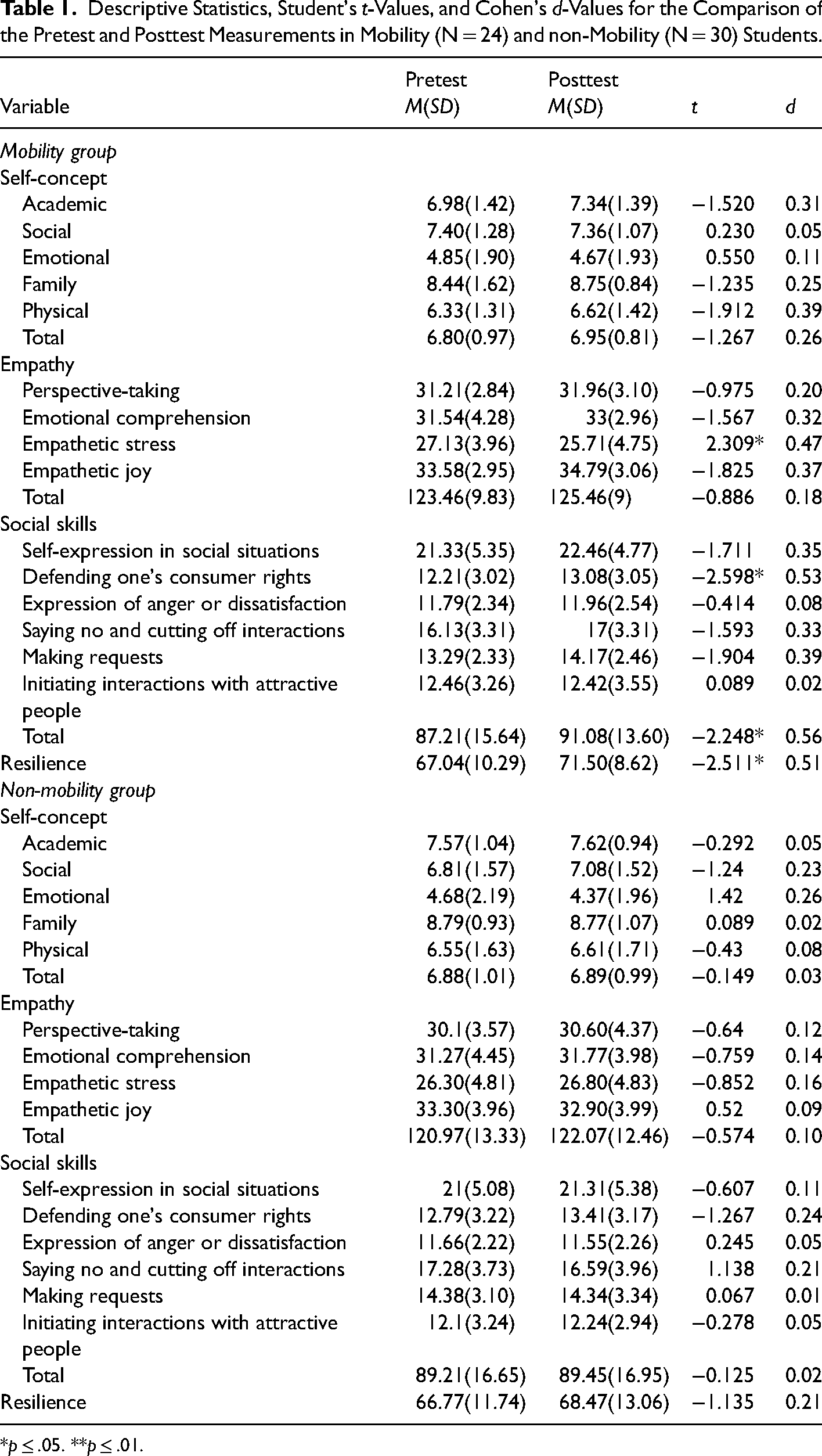
Regarding the second objective, Table 1 presents the results obtained in the comparisons of means between the pretest and posttest measurements in the mobility and the non-mobility groups.
Descriptive Statistics, Student's t-Values, and Cohen's d-Values for the Comparison of the Pretest and Posttest Measurements in Mobility (N = 24) and non-Mobility (N = 30) Students.
*p ≤ .05. **p ≤ .01.
As shown in Table 1, the mobility group obtained higher mean posttest scores than at pretest in social skills (both in the dimension of defending one's consumer rights and in the total score) and resilience, and these differences reached a moderate effect size. On the other hand, this group obtained a lower mean posttest score compared to the pretest phase in empathic stress, and this difference was moderate. No statistically significant differences were found between the pretest and posttest measurements in the non-mobility group.
Differences According to the Type of Friendships Maintained During the Mobility Period
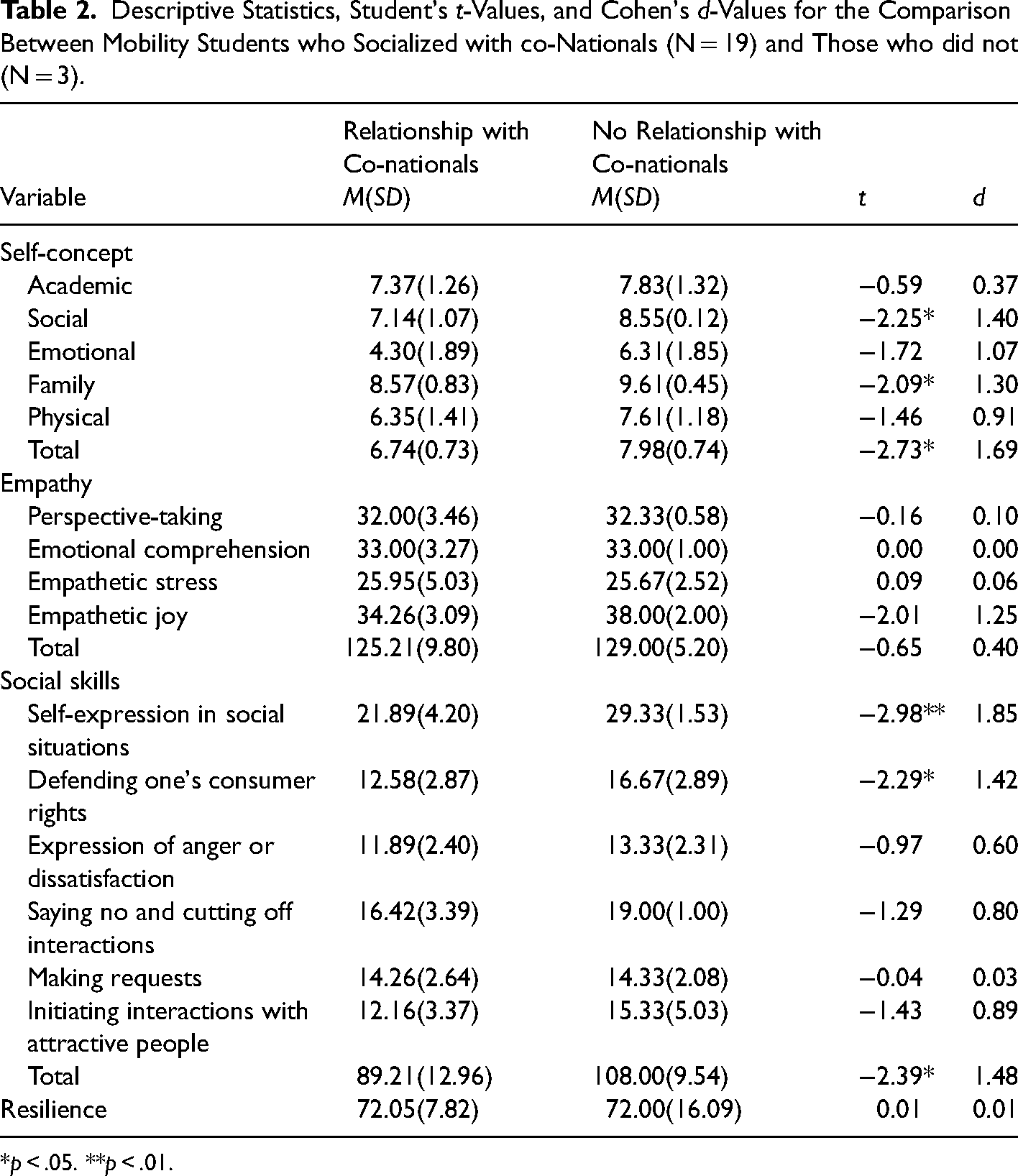
Regarding the third objective, Table 2 compares the means between mobility students who socialized with co-nationals and those who did not. As can be seen, the students who socialized with co-nationals, compared to the students who did not, obtained lower mean scores in self-concept (both in the overall score and the social and family dimensions) and social skills (both in the total score and the dimensions of self-expression in social situations and defense of one's consumer rights). These differences had large effect sizes. Other differences also showed moderate and large effect sizes (e.g., emotional self-concept and empathic joy) but, due to the limited sample size, they did not obtain statistical significance.
Descriptive Statistics, Student's t-Values, and Cohen's d-Values for the Comparison Between Mobility Students who Socialized with co-Nationals (N = 19) and Those who did not (N = 3).
*p < .05. **p < .01.
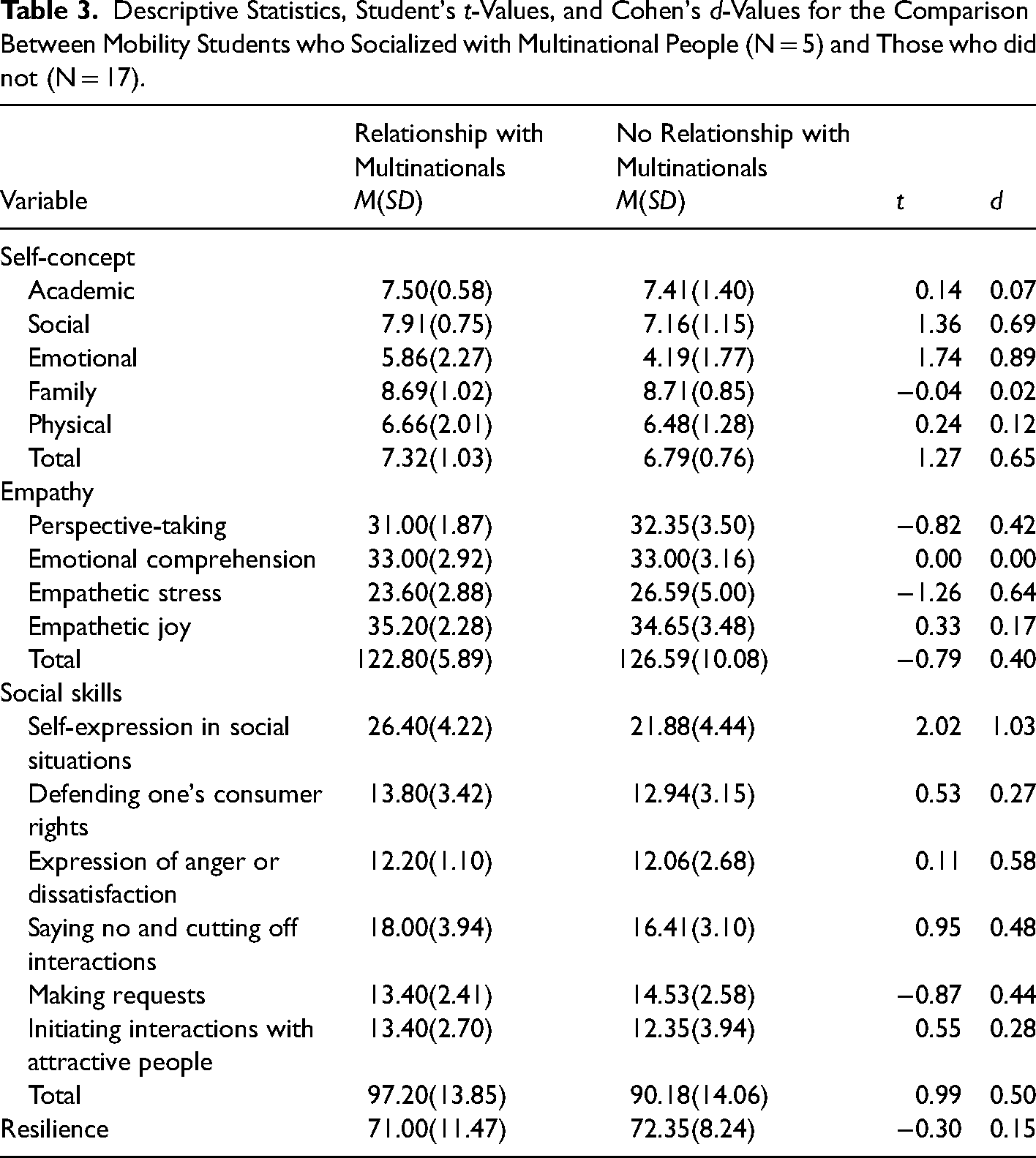
Table 3 shows the results obtained in the comparisons of means between mobility students who socialized with multinational people and those who did not. We note that no statistically significant group differences were found, although some comparisons showed a moderate or large effect size. Students who socialized with multinationals obtained higher mean scores (e.g., in emotional self-concept and total social skills).
Descriptive Statistics, Student's t-Values, and Cohen's d-Values for the Comparison Between Mobility Students who Socialized with Multinational People (N = 5) and Those who did not (N = 17).
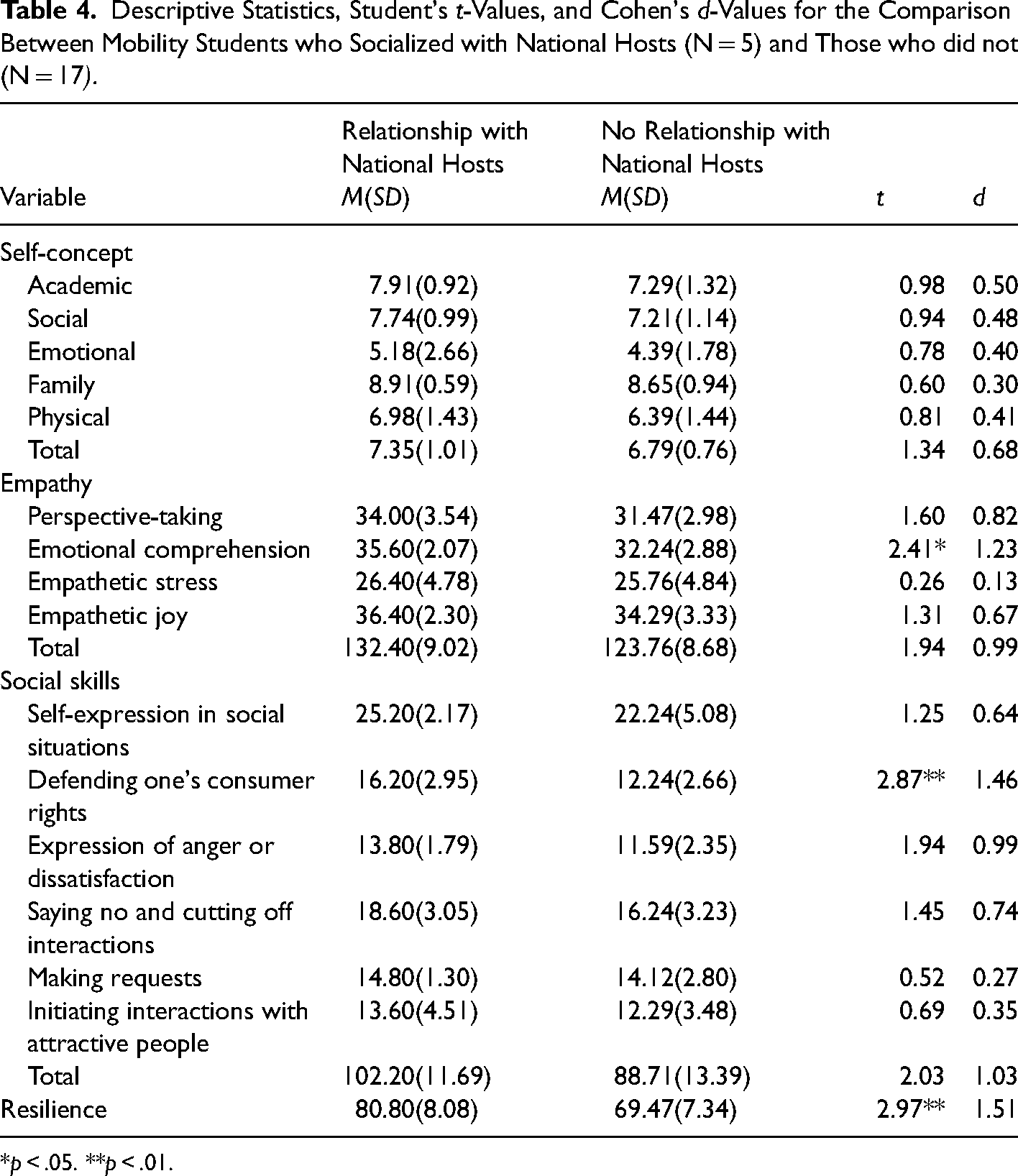
Finally, Table 4 shows the results obtained in the comparisons of means between mobility students who socialized with national hosts and those who did not. As can be seen, the former presented higher mean scores in emotional comprehension, defense of one's consumer rights, and resilience, with large effect sizes. Moreover, several non-statistically significant comparisons also showed a moderate or large effect size, with higher mean scores obtained by people who socialized with national hosts (e.g., in perspective-taking and total soft skills).
Descriptive Statistics, Student's t-Values, and Cohen's d-Values for the Comparison Between Mobility Students who Socialized with National Hosts (N = 5) and Those who did not (N = 17).
*p < .05. **p < .01.
Discussion
This research analyzes the impact of one-semester international mobility stays on university students’ socioemotional skills. The findings show that mobility and non-mobility students have different socioemotional profiles in the pre-mobility phase. Specifically, mobility students show a higher social self-concept and greater empathetic perspective-taking. These results partially coincide with the findings of Leong (2007), indicating that mobility students have greater emotional stability and social initiative but do not show differences in cultural empathy compared to students who do not participate in mobility programs. Students who are willing to participate in mobility programs may, a priori, present a greater confidence in their relational skills and openness to new social and cultural experiences. In any case, more research on the subject is necessary, given that the present study and Leong's study use samples from different geographical origins (Spain and Singapore) and students from very diverse degrees (socially oriented studies vs. heterogeneous studies). In addition, neither study identified students who wished to participate in a mobility program but could not do so for some reason, mixing them in the same group with students who did not want to participate in any mobility experience. By differentiating the two types of students in the non-mobility group, the differences in socioemotional skills compared with mobility students might increase for those students who did not wish to participate in mobility programs. To clarify these issues, more research is needed to analyze the pre-mobility group differences.
Secondly, it has been observed that after mid-length international mobility stays, there is a decrease in empathic stress (related to neuroticism according to López-Pérez et al., 2008) and an increase in social skills (the defense of one's consumer rights and general social skills) and resilience. On the other hand, in the same period of time, there are no notable socioemotional changes in the classmates who have not participated in mobility programs. The socioemotional differences produced in mobility students align with the findings of various studies in the field (Dresen et al., 2019; Farrugia & Sanger, 2017; Leong, 2007; Souto-Otero et al., 2019). However, they contrast with the results of the review of Gümüs et al. (2020), which relate the socioemotional changes in mobility students to long-term stays and not to short or mid-length stays. These inconsistencies may be due to the limited research in the scientific literature on mobility students’ socioemotional skills and to the different durations of short and mid-length mobility stays, which does not allow us to reach definitive conclusions. In short, to clarify the impact of the different durations of mobility on students’ socioemotional skills, considerably more research is needed.
Thirdly, it should be noted that students who maintained friendships with co-nationals during their stay, compared to students who did not, developed to a lesser extent total self-concept and social skills (specifically, total social skills and skills related to self-expression in social situations and the defense of one's consumer rights). However, no socioemotional differences were found between students who maintained friendships with multinational people and those who did not. The students who maintained friendships at the destination with national hosts developed higher emotional comprehension, defense of their consumer rights, and resilience than those who did not. Generally, international mobility students often encounter many obstacles to connecting with national hosts: language, culture, constant changes of classes that do not allow the continuity of relationships, being grouped at destination with multinational students, etc. However, the personal effort to interact with local students can be rewarding, as observed in this research. In the same vein, Hendrickson et al. (2011) indicate that co-national friendships offer short-term support but hinder the long-term adaptation process. In this study, no socioemotional differences were found between students who maintained multinational friendships and those who did not, although this is probably due to the small sample size. In future research with larger samples, it would be interesting to continue delving into the relationship of each type of friendship (co-national, multinational, national hosts) or possible combinations thereof with mobility students’ socioemotional skills.
The present study shows that mid-length international mobility programs promote the development of different socioemotional skills—transversal skills that are the objective of educational institutions for the coming years (OECD, 2018, 2019) and essential for people's academic, work, family, and civic success (CASEL, 2020). Specifically, students participating in one-semester mobility programs compared to those who have not, initially and based on the taxonomy of socioemotional skills proposed by EASEL Lab Team (n.d.) and complemented by Berg et al. (2017) for the target population of the present study, present higher values in several components of the categories related to emotion and identity. In addition, after the stays, mobility students reinforce various components of the emotional, social and other categories. Considering the differences between the two groups, students participating in mid-length mobility programs have a more pronounced social disposition than non-mobility students before the start of the stay, and during the stay they manage to reinforce multiple socioemotional components. In particular, they manage to strengthen the ability to interact positively with others, understanding and managing emotionally charged situations, and coping with daily difficulties. In any case, during the stays the students have managed to reinforce traditional (emotional and social) and cultural (other) socioemotional skills, but not deep skills (identity). The result makes sense considering that the mobility stays evaluated were mid-length and that the traditional and cultural components of socioemotional skills are more susceptible to learning and modification compared to the deeper components (Berg et al., 2017; Jones et al., 2021). It would be interesting for future studies to delve into the analysis of a larger number of socioemotional categories and subcategories to observe whether this pattern holds in mid-length mobilities and whether changes also occur in socioemotional categories less studied to date. In any case, the great diversity of existing classifications and definitions of socioemotional skills does not favor the comparability of the studies. Future research would have to start from taxonomies based on scientific evidence to deepen the knowledge of these skills.
High-quality university education should actively promote the development of students’ socioemotional skills. In this sense, the present study has shown that participation in international mobility programs is, in itself, beneficial. Therefore, it is essential to continue promoting this type of initiative. Furthermore, given the positive impact that contact with local hosts has on the socioemotional development of visiting students, host universities should systematically implement activities designed to strengthen such interpersonal interactions. These could include mixed face-to-face classes with local and visiting students, joint university clubs and associations, multicultural events, peer mentoring programs, buddy program, shared sports or volunteering activities, and online spaces for planning meetings and events, among others.
Strengthening socioemotional competencies will undoubtedly influence students’ future job performance. According to existing literature (Silva et al., 2018; Terzieva et al., 2015), international mobility experiences represent an excellent opportunity to enhance such skills. As mentioned in the study of Souto-Otero et al. (2019), the impact on personality traits of an average mobility stay of six months can be equivalent to a life experience of four years. The same probably occurs in the socioemotional field, with mobility stays encouraging students to leave their comfort zone and promoting the fast development of different socioemotional skills. For this reason, it is important that educational institutions and governments continue to promote international mobility, given the favorable effects it has on students. Being fluent in work environments with increasing social diversity will become more and more essential to thrive professionally (OECD, 2018, 2019).
Universities, in the race to qualify their students as well as possible, will have to continue to look for ways to increase their employability and adaptation to the labor market. The enhancement of transversal skills and, in particular, of socioemotional skills can respond to the growing demand for them in the labor market (Di Pietro, 2022).
The development of socioemotional skills related to the mobility of university students has historically been a scarcely studied topic in the scientific literature (Bradly & Iskhakova, 2022), so the present study deepens our knowledge. Specifically, mid-length mobility stays have been shown to be valid for strengthening participants’ different relevant socioemotional skills. For this purpose, a pre-post research design with a control group was used, which offers quality guarantees in the results. In addition, to ensure the comparability of the groups, students from the same educational stage, the same studies, and a similar duration of mobility stays were selected. In addition, an evidence-based taxonomy of social skills has been chosen. In any case, more research in the field is needed to understand the impact of different mobility programs on students’ socioemotional development.
Like all studies, this research has some limitations. The small sample size and high experimental mortality make it difficult to generalize the results. It would be desirable in future research to obtain larger and more varied samples to balance the weaknesses of small and local samples. Specifically, the sample could be expanded to include students from different branches of knowledge (art and humanities, sciences, social and legal sciences, health sciences, and engineering and architecture), different university training stages (bachelor's degree, master's degree, and doctorate), different mobility programs (national and international), different lengths of stays and/or students from different backgrounds (national and international universities). In addition, it would be interesting to explore whether or not students receive any kind of support or mentorship during their stay at the host university and to compare the socioemotional development of both groups. It would also be possible to study what type of support or mentorship has a greater impact on students’ socioemotional skills. There is a wide range of possibilities to be explored, which would allow us to deepen our knowledge about the changes in the socioemotional skills of mobility students. It would also be interesting to analyze whether the changes are sustained in the long term.
In short, this study highlights that mid-length international mobility stays lasting between five and six months are effective for students’ rapid socioemotional development, an essential transversal skill that society and the labor market demand for universities to promote in addition to generic or technical skills. The practical implications of these findings are clear for governments or higher education institutions interested in students making the most of these mobilities. In any case, more research is needed to understand the impact of mobility programs on students’ socioemotional development and to generalize the findings of the present study.
Footnotes
Funding
The authors received no financial support for the research, authorship, and/or publication of this article.
