




Abstract
This study explores and compares the experiences of international students studying through internationalisation abroad (IA) and at a distance (IaD) at a UK university through the lens of Ecological Systems Model. In doing so, we propose a revised Ecological Systems Model, integrating the co-existing but fluid and liminal virtual/physical and home/host dimensions. Thirty-two interviews were conducted with international students who studied either: 1) in-person, 2) online in their own country, or 3) first online and then in-person. Our findings identified that the perceived learning environments of IA and IaD students were not distinct from one another, yet the differences in their learning ecologies impacted their experiences significantly. Compared with geographically mobile students, international distance learners experienced a discrete process of internationalisation with limited intercultural learning. Our findings suggest our revised Ecological Systems Model provides a stronger conceptual framework for the digital era of international higher education.
Keywords
Introduction
Internationalisation forms a background for understanding students’ (im)mobilities in higher education, particularly given its role as a change agent in global practices (de Wit & Altbach, 2021). Although internationalisation is conceptualised differently across institutions (Kehm & Teichler, 2007), it is commonly defined as ‘the process of integrating an international, intercultural or global dimension into the purpose, functions or delivery of post-secondary education’ (Knight, 2003, p. 2). Whilst internationalisation considers a wide range of activities and processes, international students are one key focus both in research and practice.
Defining international students and their (im)mobility can be categorised in two ways: internationalisation abroad (IA) and internationalisation at a distance (IaD). Internationalisation abroad refers to the geographic movement of education across borders (de Wit & Altbach, 2021), such as students travelling to another country for education. The OECD (2023) estimates that there are over five million internationally mobile students.
Internationalisation at a distance focuses on international education supported by technology, recognising that cross-border education happens while students, staff and institutions remain ‘at home’ but enrol (online or distantly) with an institution based ‘abroad’ (Mittelmeier et al., 2019). While data about IaD students is limited, scholars have argued that we are entering an ‘online global era’ (Guo et al., 2020) as programmes increasingly provide online options to globally distributed students, boosted by the COVID-19 pandemic. However, empirical research about the lived experiences of IaD students is still limited. Furthermore, little is known about how experiences in IaD settings (i.e., learning abroad while staying in one's own country) compare to learning through IA settings (i.e., being geographically mobile). Given growing online international options, this comparison has important implications both for institutions offering a global experience in various forms, as well as for students when deciding where and how to study. More importantly, as traditional conceptual models of students’ development and transitions are proposed primarily based on IA students’ experiences, this comparison offers a possible revision to existing models of students’ experiences.
Exploring IaD students’ lived experiences and comparing them with IA students’, we consider their holistic learning environments through different levels, as ‘online’ and ‘abroad’ only reflect parts of the contexts they develop within. Therefore, we investigate IaD and IA students’ perceived environments through the lens of the Ecological Systems Model and compare findings between these two groups emerging from semi-structured interviews with 32 postgraduate taught students at a UK university. Based on our exploration, we rethink the Ecological Systems Model (Bronfenbrenner 1994) in a digital age, and propose a revised version of the traditional Ecological Systems Model.
Students’ Experiences in Internationalisation Abroad and Internationalisation at a Distance
Research about international students’ experiences has made a significant contribution to higher education studies, but most studies focus on students who travel to another country (i.e., IA students) (Jing et al., 2020). For example, scholars have considered international students’ transition experiences (i.e., the changes experienced by students when moving from one context to another), arguing that transitions can be multiple and multi-dimensional (Jindal-Snape & Rienties, 2016). IA students may experience contextual (Arthur, 2017), interpersonal (Sözen & Hakyemez-Paul, 2023), academic (Moosavi, 2020), intercultural (Bethel et al., 2020) and psychological (Bulgan & Çiftçi, 2017) transitions. For IaD students, their experiences have been less explored, but their transitions regarding intercultural awareness (Righetti et al., 2019), academic and social adjustment (Mittelmeier et al., 2019), and intercultural communication (Ou et al., 2022) become increasingly evident.
Despite this emerging evidence, there is no known evaluation of how experiences in these two settings compare. This means more exploratory work is needed to provide an initial insight into the comparison of IA and IaD experiences and to probe the suitability of conceptual and empirical approaches in these contexts.
After all, it is expected that students’ experiences would indeed differ. Jones (2017), for instance, argued that international students’ experiences are affected by personal, familial, institutional and national environmental factors. Even if taking the same courses, IA and IaD students study and live in different environments, and their experiences would be affected differently. Therefore, a starting point for understanding how students’ experiences differ is to unpack the perceived differences in students’ environments.
Students’ environments can be evaluated through the lens of learning ecologies, the contexts where the students direct their activities and strategies that mediate their learning, develop interpersonal relationships that contribute to their learning, and make use of resources or mediators to achieve learning objectives (González-Sanmamed et al., 2019; Sangrá et al., 2019). By exploring their perceived ecologies, how IA and IaD students’ experiences are influenced and shaped by environmental factors can be compared. We turn our attention to these ecologies next.
Theoretical Framework: Ecological Systems Model
To gain insight into students’ learning ecologies, Bronfenbrenner's ecological systems model provides a suitable analytic framework. By considering students’ environments through the lens of spatio-temporal ‘systems’, comparisons of individuals’ environments become possible. According to Bronfenbrenner (1994), individuals’ environments are systems of subsystems, including patterns of interactions in one's immediate surroundings (microsystems), connections of such microsystems (mesosystems), settings that indirectly influence the individuals (exosystems), the broader national or cultural contexts (macrosystems), and the changes or consistencies of the environment over time (chronosystems). These subsystems affect individuals’ development differently, and their experiences are impacted accordingly.
Originating from childhood psychology and development, Bronfenbrenner's model has been frequently used to evaluate international students’ experiences when transitioning into their new environments (e.g., Elliot et al., 2016; Tobbell & O’Donnell, 2013; Xu et al., 2021; Zhang, 2018). However, traditional understandings of these systems may not be enough to understand international students’ ecologies, as scholars have argued that they simultaneously exist within home and host ecologies (Garton et al., 2021), and virtual environments add another form of microsystems: virtual microsystems (Navarro & Tudge, 2023). Hence, we take a macro approach looking at holistic systems, exploring how intertwined home/host and physical/virtual environments impact international students’ experiences. We also take an exploratory approach by focusing on students’ perceived environments, including both virtual and physical systems, and understandings of ‘home’ and ‘host’ environments. For instance, IA students are primarily learning in the physical world with some use of virtual tools, while IaD students almost exclusively learn in the virtual environment; IA students are physically living within the host environments, while IaD students are still physically living within their home environments. As Bronfenbrenner's model traditionally focused primarily on the physical ‘face-to-face’ world, how the combined physical and virtual worlds shape international students’ learning ecologies remains unclear.
We argue that physical/virtual and home/host boundaries can be blurred. For example, students can interact with the same group of people in both physical and virtual settings, or interact with each other online while physically being together. They may also experience some forms of their home culture within their host country. Developing from the nested arrangement of structures (Bronfenbrenner, 1977; Figure 1), we propose a new Ecological Systems Model that is more applicable in international and blended face-to-face/virtual settings (Figure 2).
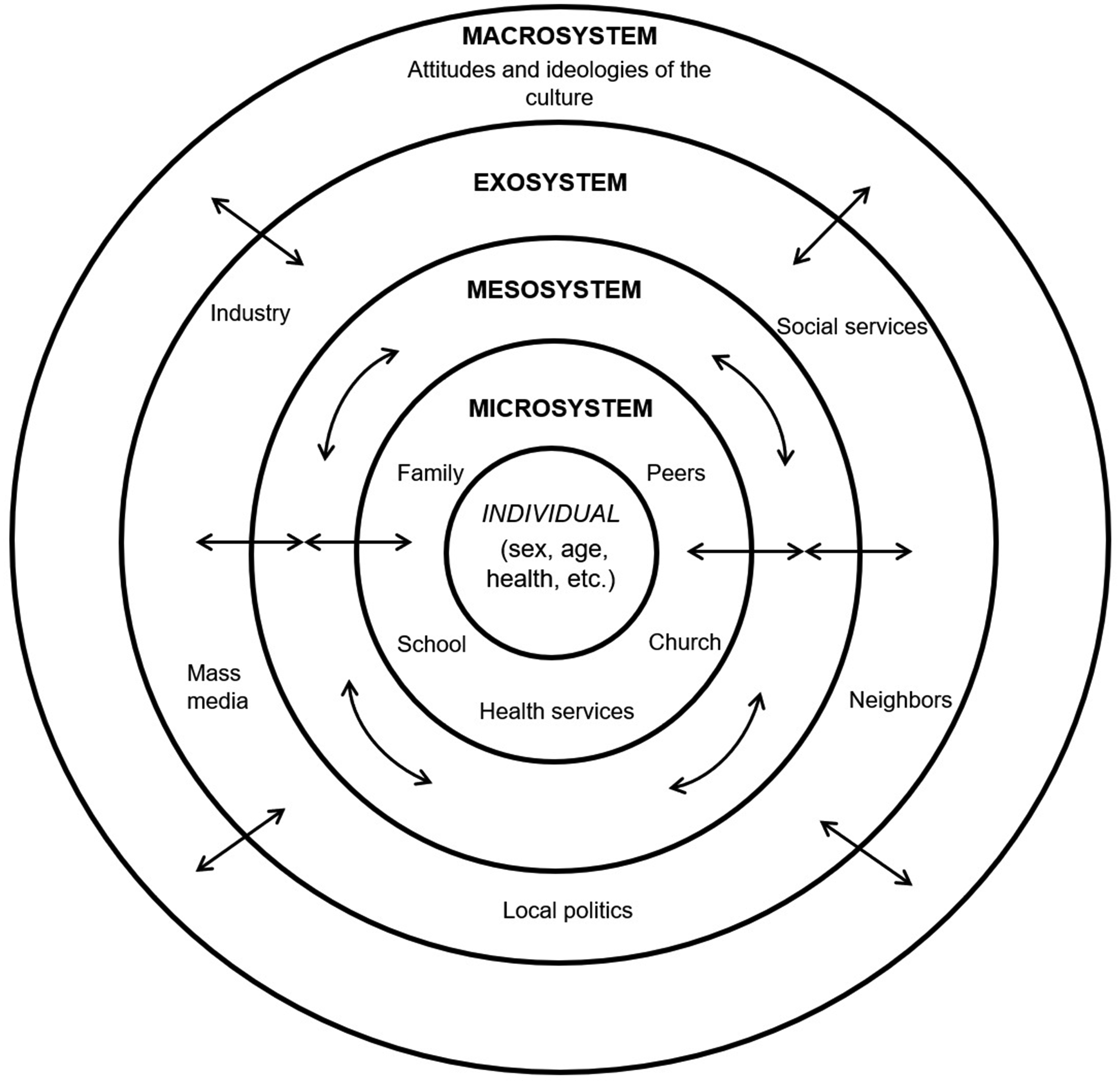
Illustration of the ecological model, adopted from Vélez-Agosto et al. (2017, p. 902).
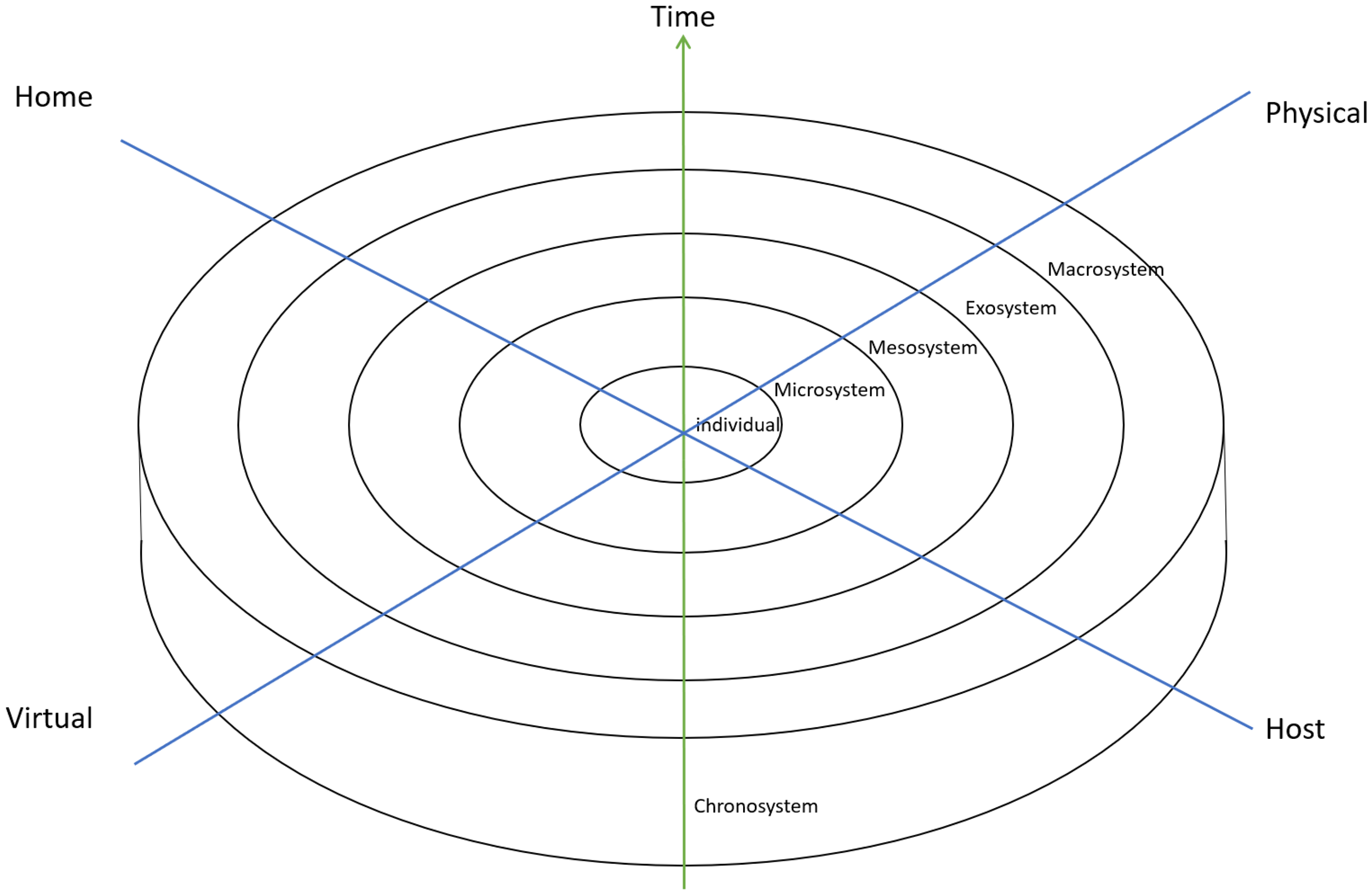
Adapting ecological systems model to study internationalisation abroad and at a distance.
Figure 2 demonstrates that students’ environments can be either more physical-host, physical-home, virtual-host, or virtual-home, as indicated by four quadrants. Here, the physical-virtual and home-host axes should be viewed as continuums with blurred boundaries between them. The vertical axis adds a third dimension, time, which indicates any changes over time, i.e., chronosystem.
Research Questions
To test this proposed model, we compared IA and IaD students’ perceived learning ecologies through the following research questions:
Methodology
Setting and Participants
This study was conducted in 2022, and participants were recruited from a one-year taught education master's course based in a major city in Northern England. As the university had special dual-delivery teaching policies for COVID-19, students could choose to come to the UK for face-to-face teaching (i.e., IA students) or take online classes from their own country (i.e., IaD students). Students took taught in-person classes that were delivered online live via dual delivery, followed by a summer dissertation research period. Nearly all students were international students, with the vast majority originating from China. The course design, contents and materials, academic requirements and intended learning outcomes for students were the same for both study modes. The pandemic forms the background of this research as the online version of the programme was only offered as a special emergency practice, but the findings highlight important considerations for learning experiences under IA and IaD more broadly.
Participants were students who either: (a) chose to come to the UK for on-site learning for the whole academic year (IA students) (14 students); (b) chose to stay in their own country for online learning for the whole academic year (IaD students) (11 students); and (c) chose to stay in their own country for online learning for the first semester and then come to the UK for on-site learning for the second Semester (IaD + IA students) (7 students). As the students in the programme were mainly from China, all 32 participants were Chinese and they completed their undergraduate studies in China. This contextual circumstance is common for many UK higher education programmes (OECD, 2023). While we recognise the limitation of exploring this through only one nationality group, we argue that the results are likely transferable to experiences of students from other countries or backgrounds.
Data Collection Approach
Online semi-structured interviews were conducted, allowing participants to reflect on their environments and study experiences. Concentric circles were used as a tool for mapping out and understanding students’ ecologies (Kitchen et al., 2019), playing an effective role in promoting thinking and talking. Participants were given a link to Google Jamboard, an online interactive whiteboard, where they could write down key elements in their environments by adding ‘sticky notes’. They were asked to place the ‘sticky notes’ in the concentric circles based on their reflections on how influential or important those elements were. Each participant had 10 min to reflect and complete the task, followed by discussions. As all participants were Chinese, they were given the option to use English or Chinese to ease freedom of expression. All participants chose to discuss primarily in Chinese, but some used English.
Figure 3 shows the concentric circle used for data collection and Figure 4 shows an example provided by an IaD + IA student; she used tags demonstrating her experience as an IaD student (left) and as an IA student (right).
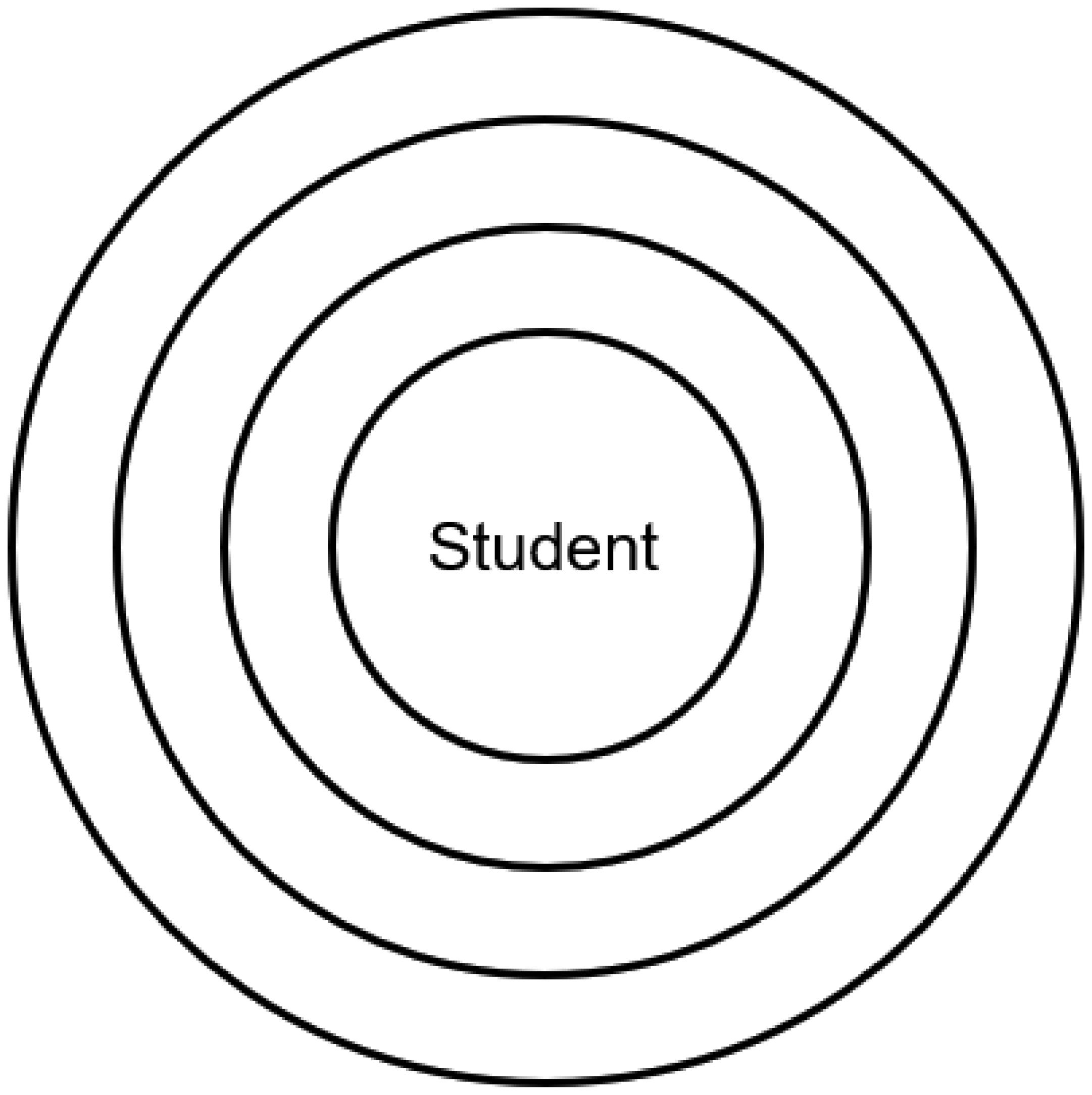
Concentric circle used during interviews.
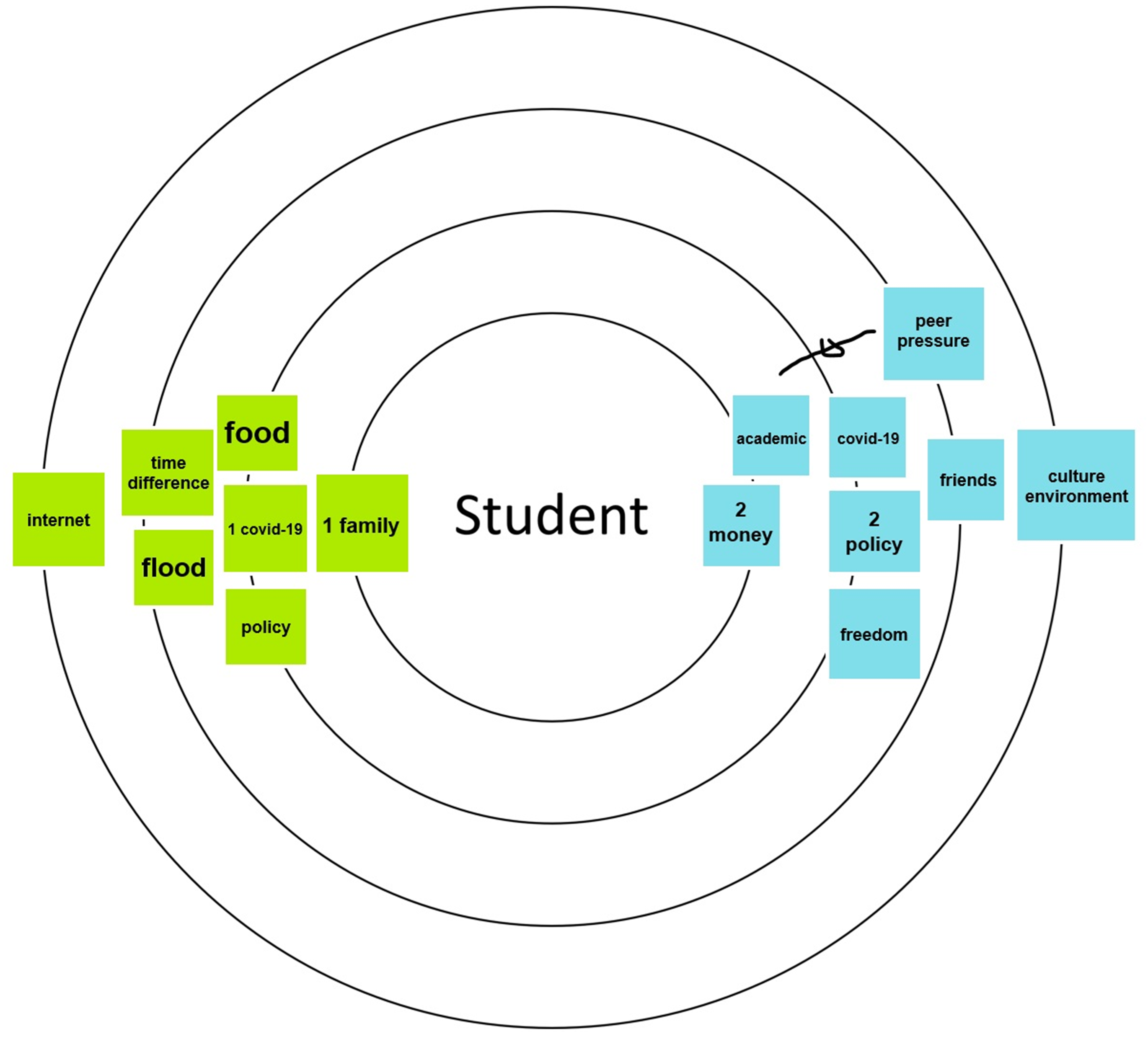
Example of participant's response on the concentric circle.
Data Analysis
Data was analysed bilingually in Chinese and English. After data collection, reflexive thematic analysis was conducted. Introduced by Braun and Clarke (2021), reflexive thematic analysis can be particularly useful for describing participants’ lived experiences, examining influential factors on their experiences, and identifying participants’ views on phenomena. Since this study aimed to explore participants’ perceived learning ecologies, reflexive thematic analysis was deemed appropriate. Following the guidelines provided by Braun et al. (2019) and Terry et al. (2017), the data was analysed through six stages: data familiarisation, coding, constructing themes, reviewing themes, defining themes, and producing report. The data analysis was primarily based on data from the semi-structured interviews, and the keywords from concentric circles enriched and validated the themes constructed. As the concentric circles included participants’ self-reflections on their environments, they provided participant-generated codes and themes about their environment as a starting point for analysis. The interviews were transcribed and checked for accuracy, and codes were identified after several rounds of reading of the transcripts. The themes were generated from the codes, and they were reviewed repeatedly based on the codes and the concentric circles. Once the themes were reviewed, key themes were revised, defined, and reported.
This study obtained ethical approval from the researchers’ university, and all identifiable information was removed from the final transcripts and report.
Limitations
Several limitations are recognised. First, the available student population in this programme meant that all participants were from China. While their experience provides important insights into our research questions, we recognise that future research ought to consider how findings may apply to other groups. Second, COVID-19 forms a contextual backdrop to students’ experiences in this study. Although findings are transferable to other distance learning contexts, we recognise that research can build upon our work to develop these ideas further as teaching practices have returned back to ‘normal’ in many countries. Third, our macro focus means that we are not able to conduct a deep analysis of all issues raised by participants or an in-depth evaluation of pedagogic structures. Nonetheless, this macro approach provides a foundation for future research to consider and evaluate such matters at micro levels.
Findings
Our analysis compared how IA and IaD students perceived their individual learning ecologies during their studies. In the interviews, students felt most comfortable outlining their immediate environments, microsystems, and the impact of culture and policies (i.e., macrosystems), but they had limited recognition of their mesosystems and exosystems.
We found that IA and IaD students’ learning ecologies are not fully distinct from one another, despite their varying study settings. Although participants tended to categorise their ecologies into categories of ‘physical’ and ‘online’ in the concentric circle activities and through discussions, both groups admitted to living in a hybrid environment where both physical and virtual systems impact their experiences. These reflections tended to, therefore, focus on the actual functions and influences of systems on their experiences, rather than being delineated by form and medium. Nonetheless, there were subtle yet important differences in their learning ecologies between each group, described next.
Contextual Impacts
Policies
International policy environments formed an underpinning macrosystem that influenced decisions to be (im)mobile, whereby all participants discussed how national travel and visa policies influenced their study mode choice. For instance, participants were influenced by COVID-19-related policies, where they had the choice of coming to the UK or studying at home. Also, students were influenced by COVID-19 travel restrictions, such as quarantines and reduced flights. Students considered policies from both home and host countries, and they considered these policies as a whole, not separately. For example: …if the immigration policies, including flight regulations and quarantine policies upon return, are the same as if there were no pandemic, I would definitely go abroad right away. (An, IaD)
Another key difference between IA and IaD students was that, compared with IA students, IaD students were more clearly influenced by Chinese policy, even if all students were from China. In other words, home policies impacted IA and IaD students differently. In this study, IaD students were generally influenced by Chinese educational policies that could potentially affect students’ career plans, while IA students seemed to focus more on their lives in the UK. One possible explanation was that students learnt about policies from social media, and things they could see from social media were different based on their physical location. For example, Double Reduction Policy, a newly-implemented Chinese educational policy aiming to reduce students’ academic burden and private tutoring, was a heated discussion in Chinese social media. Almost all IaD students discussed the impacts of this policy, but no IA student mentioned it. As stated by Fang (IaD), that ‘Double Reduction Policy is quite relevant to our education industry as it reduces certain job positions. This policy has affected me through social media and has given me a feeling of anxiety’.
Physical Environments
IA and IaD students were living in distinct physical environments, which had an immediate impact on the microsystems of their ecologies. Unsurprisingly, IA students enjoyed the facilities provided by their university, such as libraries, study rooms, classrooms, and IT services. They also discussed their experiences in local supermarkets and parks. IaD students discussed their rooms at home, as well as their digital devices such as computers and internet connections, which were essential for their studies. Together, this showed how participants saw IA experiences as expanding their ecologies, while IaD students’ ecologies were reflected as limited to familiar spaces.
Yet, some learning ecologies were shared, such as the tendency for participants in both contexts to highlight the influence of the weather. For example: …I really like sunny days. I feel very happy on sunny days. Although I am also happy on cloudy days, they make me want to sleep and feel like it's a waste not to sleep in this weather. On sunny days, I feel more motivated to study. (Shuang, IaD) …I didn't expect the weather to be so bad, with such a long difference in daylight between winter and summer… Although you used to think it was ridiculous when British people talk about the weather, there are actually quite a lot of things to talk about, and I think this aspect has had a pretty big impact on me. (Jing, IA)
Interpersonal Relationships and Interactions
As expected, all participants discussed their relationships and interactions with people within their microsystems. IA students who were internationally mobile were much more likely to highlight the influence of relationships and interactions from their physical world in the UK, with relatively limited influence of connections from their virtual world in China. However, participants taking the online course (i.e., IaD students) tended to reflect on their interpersonal connections in the physical and digital worlds as separate entities.
When reflecting on the interpersonal relationships that impacted their learning, all participants highlighted their relationships with friends and peers, as well as communication with their lecturers and tutors. Participants were encouraged, supported, and influenced by these individuals, and they acknowledged how necessary such relationships and interactions were for making their experiences valuable, regardless of the mode of study. … In many cases, our family members are far away from us, so the friends around you are the ones who can help and encourage you the most. (Yan, IA) … For me, classmates are the biggest support in coming to the UK. My main circle of friends is with my classmates. (Mei, IaD + IA) … If I consult a teacher when I have a problem, and if he or she can give me some useful advice, I feel it has a very positive impact on me. (Zhi, IaD) … One group of people who you may have the most contact with during your year abroad are classmates and friends. You have daily communication with them through WeChat or other means. (Li, IA) … My friends in real life have no intersection with my current classmates. (Fang, IaD)
Participants also reflected that, by nature, online interactions differed from socialisation norms in face-to-face settings. This informs the different patterns of interactions of IA and IaD students. For example, when an IaD student talked about her interactions with lecturers: … When I ask questions in person, I will follow up and make sure I understand all the details. However, when I write emails, I may send a question that is 600 or 700 words long, and the teacher may reply with just 10 or 20 words. I don't know if the teacher truly understands what I am trying to express, or if they haven't understood my intended meaning. (Wei, IA) … If I were to go to the UK, I would establish a certain network of interpersonal relationships there… However, these [online] relationships can only be maintained during the year of study. If we don't see each other again and haven't met in person before, then they will basically disappear. (Wen, IaD)
Moreover, participants highlighted that their studies were influenced by people they lived with, even if these people were not necessarily from their ‘learning’ contexts. For example: …Because roommates live together every day, their influence can be particularly significant…If my roommate is noisy every day, it will affect my efficiency in studying. (Ning, IaD + IA) …Sometimes parents’ beliefs can greatly affect your mood during the learning process…Sometimes there are conflicts, and sometimes I feel like my parents don't really support me in taking this online course. (Qi, IaD) …People here are generally polite and will greet each other proactively. For example, when I get off the bus, I will say thank you to the driver. It seems like it's not as common in China, maybe because there are too many people and it's not possible to do this. (Shu, IA) …Here, you may encounter some people with racial discrimination, which is something you wouldn't experience in China. I've encountered it twice: just when I'm walking on the street with a mask on, someone would deliberately come up to me and call me ‘COVID’. (Xin, IA)
Our participants commonly agreed that such daily interactions were essential for students to have a more meaningful or authentic internationalised experience. For instance, IaD students’ connections to the university were restricted to online, which were thought to be lost once disconnected from the internet. IA students’ internationalised experiences, however, were viewed as more continuous. One of the key consequences of such differences is their perceived intercultural encounters which emerged as a prominent theme amongst students and will be unpacked next.
Reflections on Encountered Differences
Participants were asked to reflect on their intercultural experiences during their degree programme, whereby IA students were found to have more diverse intercultural experiences. IA students generally believed their intercultural experiences were accumulated from the classroom to daily life, but IaD students’ intercultural experiences were exclusively limited to their online interactions. Participants who experienced both modes of studies acknowledged the opportunities of experiencing a different culture, where coming to the UK was seen as meaningful: … The difference is significant. In my first semester, I mainly learned about these things through literature, but in the second semester, you experience these things your own, which is completely different. Only when you truly empathize with something can you deeply understand some of the principles, you know. (Guang, IaD + IA)
For both IA and IaD participants, studying at an international university led to opportunities to encounter and discover differences in academic conventions and cultural values of learning. This was facilitated in part because IA and IaD students took the same courses, learned from the same lecturers, and completed the same assessments using the same criteria. Therefore, the mode of study seemed not to influence how participants encountered learning materials. For example, when talking about academic writing, participants from different groups expressed similar opinions: …When writing essays here, even after submitting it, I still worry about whether or not it will be considered academic dishonest. Even if it's all written by myself, I still feel nervous. The academic rigor in the UK is even more strict than I imagined, and the ability for critical thinking is required to be more demanding than in China. (Yu, IA) …When writing essays, I feel that they are quite rigorous. It's an overall approach that involves supporting arguments, reflection, and critique. (Wen, IaD) …I can feel another culture from the way of writing emails. Because before, when I chatted with others, it was more like saying whatever comes to my mind. But here, I learned a kind of culture of being fake polite. (Wen, IaD) …I had a special training on how to write emails, because I don't want to end up not knowing how to send emails to professors. You don't know if it's appropriate to add “warm regards” or “have a lovely day” at the end. (Feng, IA) …We are more polite to everyone, saying sorry and thank you all the time. I feel like my English has regressed since coming here, and I only know how to say “thank you” and “have a nice day” now [laughs]. (Ying, IaD + IA) … The biggest difference I think between British culture and Chinese culture is that British culture is very inclusive…and my own level of inclusiveness has also increased. (Chen, IA) … To be honest, the public opinion atmosphere here is indeed better than in China, it's more relaxed. Whether it's about LGBT or tolerance for women, I feel that it's easier overseas… No one will judge me, so I feel a sense of freedom in terms of language and clothing, which makes me happy. (Hua, IA) …The teachers here are more diverse, in terms of their sexual orientation and age range. This includes differences in the way foreign teachers dress compared to some of the teachers in Chinese universities, and I feel that cultural differences are reflected in this. I feel that the level of inclusivity is stronger here. (Zhi, IaD)
Discussion
By interviewing 32 international students studying through IA or IaD, our findings uniquely compare students’ learning ecologies in different study modes. Within the context of digital shifts towards international distance education programmes, we believe this is the first study to compare international students’ experiences between being geographically mobile (IA) or learning internationally at a distance (IaD). One key finding is that both virtual and physical microsystems play a role in students’ learning ecologies in both settings, thus confirming the roles of these two forms of microsystems proposed by Navarro & Tudge (2022). It was revealed that the influence of the microsystems was not determined by the form of the systems (i.e., physical or virtual), but rather by the interactions between the students and their microsystems. For example, both groups highlighted the importance of their interactions with their peers and lecturers, regardless of whether they took place in physical or virtual environments. Extended from the two forms of microsystems, both IA and IaD students were impacted by virtual macrosystems such as online communication culture and policies. This confirms the co-existing nature of virtual and physical systems, as we proposed earlier. This implies that when considering IaD students’ learning and experiences, we should extend our focus from ‘what is limited by their physical immobility’ to ‘what can be achieved from their virtual mobility’.
Our findings also provide further evidence for the significance of the roles of the simultaneously existing home and host ecologies (Garton et al., 2021), although the extent of their influence on IA and IaD is shown to be different. For instance, both IA and IaD students were impacted by the macro-systemic policies and cultures of their home and host countries, reflected on the differences, and behaved based on their judgements. However, IA students were less influenced by their home ecologies, and the host ecologies had a more limited impact on IaD students. As outlined in our literature review and together with what we discussed above, these findings support our proposal that virtual/physical and home/host are not binaries, but rather co-exist and are fluid and liminal. As shown in Figure 2, students’ environments are multi-dimensional, and the boundaries between such dimensions are blurred. Based on students’ perceptions, their ecologies can be, for example, ‘more virtual’, or ‘more about home’.
In this study, IaD students showed a stronger delineation between what is ‘study’ and what is ‘real life’, while IA students tended to think ‘study’ as part of ‘real life’. Such differences led IA students to reflect on experiencing a continuous and consistent process of internationalisation, while IaD students’ internationalisation experiences were felt to be more discrete and based almost entirely on their online learning activities. It, therefore, can be argued that modes of study make subtle differences in the ways that internationalisation is recognised and approached by students. It highlights the need for higher education institutions to revise their internationalisation agendas and strategies by not only considering what they offer and value in terms of internationalisation, but also recognising what students experience and perceive about internationalisation.
Another important contribution of this work is the identified differences reflected by participants regarding their encounters with cultural differences. Within existing internationalisation literature, one frequently assumed benefit of studying in a new context is the opportunity to encounter new ideas and values in intercultural environments (see, for example, discourses used by Leask, 2009). This was corroborated in our findings, whereby IA students shared meaningful informal intercultural encounters in their daily lives, as well as experiences reflecting on differing notions of diversity and inclusion. Yet, such reflections were hardly recognised by IaD participants, highlighting that important assumed values of internationalisation were unmet in a context where such intercultural learning opportunities were not explicitly centred. This demonstrates the need for a new research agenda which explores evidence-based practices that can encourage (inter)cultural learning opportunities for students studying through IaD, particularly if it is to be seen as an equitable alternative to IA. Our findings also add further precedence to the arguments made by Mittelmeier et al. (2019) that IaD is a distinct learning environment in need of further research within internationalisation literature.
More importantly, as demonstrated in the findings and discussion sections above, our proposed Ecological Systems Model (Figure 2) provides a better fit for the digital era and reflects the important role of both home and virtual ecologies in international students’ experiences (e.g., Garton et al., 2021; Navarro & Tudge, 2023). Our contribution about the co-existing and fluid nature of home-host and virtual-physical ecologies provides a more comprehensive analytical tool to understand the environments that international students, particularly IaD students, learn and develop within.
Conclusions and Implications
This study is the first known comparison of international students’ learning ecologies studying abroad and at a distance. While most research has looked at either IA (for example, Arthur, 2017; Jindal-Snape & Rienties, 2016; Moosavi, 2020) or IaD (for example, Mittelmeier et al., 2019; Righetti et al., 2019; Ou et al., 2022), our work has analysed the perceived environments of international students in these two study modes through the lens of Ecological Systems Model. By capturing the experience of IA and IaD students from similar programmes provided by a UK university, we have identified the co-existence of physical/virtual and home/host environments and highlighted the roles of different ecologies. We have also proposed a revised model of ecological system theory (Figure 2), integrating the dimensions of physical/virtual and home/host into the well-known nested model.
Our findings have important implications for higher education institutions to further develop their online and distance offerings for international students. Currently, there are two important aspects of internationalised learning potentially missing from mainstream online courses: continuous and experiential learning. Compared with IA students, the internationalised learning of IaD students is not continuous and is restricted and limited by their online activities. Programme designers should consider developing and integrating tasks that require students’ continuous learning and output beyond the online environment, consciously and explicitly introducing experiential intercultural learning elements in the curriculum and courses. For instance, IaD pedagogies should be further developed, so that IaD students can learn in a purposefully-designed setting that is beyond the replicated version of IA online activities. There are existing pedagogic innovations like Collaborative Online International Learning (COIL) that highlight the possibilities of developing students’ intercultural competence and awareness through international online partnerships (Mittelmeier et al., 2024), yet it remains unclear how pedagogies can be developed holistically in IaD programmes. Programme designers should consider developing and integrating tasks that require students’ continuous learning and output beyond the online environment and experience a more immersed intercultural learning environment.
At the same time, we recognise that our exploratory findings are worthy of further research, particularly considering we investigated students’ experiences in one specific context at only one timestamp. We recommend future research to compare IaD and IA more comprehensively by looking at students’ experiences longitudinally and in different programme settings. This would allow scholars to develop IaD pedagogies that better support the continuous and comprehensive internationalisation of IaD offerings, while developing the Ecological Systems Model further to better fit and reflect the complex learning environments that international students are developing in.
Footnotes
Funding
The authors received no financial support for the research, authorship, and/or publication of this article.
