




Abstract
Extant research has explored practices and challenges for developing intercultural interactions on campus, but there is limited work on how cultural disdain has affected the development of intercultural interaction between domestic and international students. Drawing on interviews with 25 international students and 14 Chinese students in two Chinese universities, this study reveals that China's social history of intercultural encounters and internationalisation, together with people's individual intercultural experiences have fuelled Chinese students’ perceptions of the superiority of English language and Anglo-Saxon culture. While Chinese students prioritise communication with peers who are English native speakers, they tend to develop deeper intercultural friendships with students from non-Anglo-Saxon countries. This study uses the theory of cultural disdain to interpret the complex dynamics of intercultural interaction on campuses. It argues that Chinese universities need to increase cultural diversity and foster equality between different cultural groups in order to promote fruitful intercultural interactions for all students.
Introduction
In the context of global student mobility and the internationalisation of higher education, intercultural interaction between international and domestic students is regarded as an essential component in the cultivation of intercultural competence and global citizenship (Richardson, 2016). For example, Forbush and Foucault-Welles (2016) examine the benefits of intercultural networks formed by international students with friends from the host country. These networks are reported as useful in supporting international students with language skills and academic work and alleviating their psychological stress. Opportunities for intercultural interactions are depicted as beneficial for domestic students in developing friendly international relationships (Caspersz & Olaru, 2017), and for those not intending to study abroad to engage in intercultural dialogues (Watkins & Smith, 2018). For domestic students, such dialogue has the potential to promote intercultural awareness, intercultural competence and closer understanding of people from diverse socio-cultural backgrounds (Almeida et al., 2019).
Although higher education institutions globally have implemented programmes which seek to provide students with extensive opportunities for intercultural interactions (Ou et al., 2020), there is limited evidence of positive outcomes of these formal initiatives (Zou & Yu, 2021). Language differences, lack of cultural awareness including ignorance of cultural differences and similarities are key factors which inhibit interaction between domestic and international students (Alizadeh & Chavan, 2016). Conversely, welcoming and accepting attitudes on the part of host students have been shown to reduce newcomers’ uncertainty and increase their willingness to make social and cultural contact (Kim, 2001).
The fluid nature of university provision and student agency also contributes to how intercultural relationships develop between international and domestic students (Kudo et al., 2019, 2020). In particular, social-environmental conditions can serve either to restrict or nurture the engagement of international students with domestic students and the newcomers’ integration into the institutional community (Yu & Moskal, 2019). For instance, in China, international students are treated as a privileged group in universities and provided with many services that are not available to domestic students (An & Chiang, 2015). This provision includes accommodation schemes which separate international students spatially, adding to cultural distance instead of supporting integration with domestic students and the host culture (Peters, 2020). There is a need for further research to explore how students experience intercultural interaction within Chinese universities where international students are treated as a privileged group.
While the roles of individual agency and environmental/structural influences are well recognised in the literature, the majority of existing studies on intercultural interaction have paid limited attention to the cultural disdain which shapes intercultural student relationships. Cultural disdain here means that people with a symbolically prestigious language (for instance, English) and related culture are prioritised and distinguished from others (Macedo et al., 2015), based on perceived cultural capital and cultural identity.
This study will examine why and how cultural disdain has facilitated or impeded intercultural interactions on university campuses in China. Drawing on interviews with 25 international students and 14 Chinese students from two universities in Shanghai, the research explores how the invisible “chain of cultural disdain” operates among Chinese students to influence their intercultural interactions with non-Chinese peers.
Cultural Disdain/Distinction
Cultural disdain has two aspects of meaning. One meaning relates to cultural differentiation and ideas of national superiority as articulated in neo-racism theory (Bonilla-Silva, 2006). For instance, people from certain countries are welcomed more than others in intercultural interaction, depending on their race, language and the economic level of their home country. The other aspect is the tendency for people with symbolically prestigious cultural capital to be prioritised and distinguished from those without such capital (Anwar & Ali, 2021). For instance, because the English language (and related cultures) is perceived to have high utility and value, individuals or groups may hold unconscious disdain for other foreign languages and cultures (Bourdieu, 2000).
Neo-Racism Theory
Neo-racism focuses on culture and nationality rather than on race. It emphasises cultural differences and national superiority (Bonilla-Silva, 2006). The theory has been used extensively to interpret international students’ racialised experiences in host countries. For instance, Lee and Rice (2007) point out that international students of colour are more likely than white students from the Global North to experience discrimination in the traditional host countries due to race, language, and national economic factors. The discrimination includes negative stereotyping and ignorance on the part of the hosts. Similar discrimination is not new in the non-traditional host countries. For instance, in South Korea, international students, particularly those of colour, appear to have lower status in their relationships with domestic students (Kim, 2009).
There is a growing number of studies that investigate the issues and challenges that international students experience in China, such as loneliness (Peters, 2020), acculturative stress (Tian & Lu, 2018), intercultural identity (Gao & Hua, 2021) and the impact of linguacultural resources (Song & Xia, 2021). However, there is a shortage of research to interpret the development of intercultural interaction from the perspective of neo-racism. Few studies have explained why Chinese students prefer to interact with students from Anglo-Saxon countries rather than students from countries within the Belt and Road Initiatives.
Cultural Capital in the Social Interaction
While neo-racism theory probes hierarchies of nationality, language and race to understand the priorities and discrimination underpinning intercultural interaction, it oversimplifies the complex motivations and dynamics behind that. The underlying rules of social interaction, power structures and functions of institutions are based on symbolic capital (Ritzer & Stepinsky, 2014), which is constructed in a complex and constantly changing set of circumstances, involving multiple social and institutional practices, and forms and systems of exchange that are symbolic. Symbolic capital is a form of embodied knowledge, a ‘disposition’ which social actors acquire via their family backgrounds and education (Bourdieu, 1986). Social actors develop by way of early life experiences through which they make sense of the social fields they engage with.
Cultural capital is a collection of symbolic elements that one acquires through being part of a particular social class. It becomes ‘social relations of power’ (Bourdieu, 1989), whether it is embodied, objectified or institutionalised (Ritzer & Stepinsky, 2014). In other words, it becomes an object of struggle where individuals seek to maximise the material or symbolic benefit of valued resources in order to derive advantages in social relations. Cultural practices, as a form of social action, should not be considered removed from people's social historical contexts and their personal experiences (Bourdieu, 2000).
English-Related Cultural Capital in China
English language education grew in importance in China after the 1950s, replacing Russian as the first foreign language taught at schools and universities and English is an obligatory subject in college entrance and postgraduate examinations (Pang et al., 2002; Xu & Gao, 2014). The Chinese state's privileging of the English language in these ways has been sustained and there are no indications that the value ascribed to English is giving way through recognition of any other languages and cultures (Haida & Fang, 2019). For example, Chinese students are more familiar with English-related cultural knowledge and identity than with other languages and cultures.
English language fluency has become a highly valuable commodity and source of symbolic capital for individuals in China. English proficiency is perceived as a passport to a better life and enhanced socio-economic status (Brown et al., 2019). It can also influence an individual's scope to take part in intercultural communications (Van Weijen, 2012). People with skills in the symbolically prestigious English language distinguish themselves from those without such skills (Anwar & Ali, 2021). Returning to Bourdieu (2000) and the notion of cultural disdain: because English language and culture has high value in Chinese society, individuals may tend to show disdain, consciously or unconsciously, for other foreign languages and cultures. The greater a person's English proficiency, the more social capital they could accumulate in their social life, which generates cultural disdain.
To sum up, in this study, the chain of cultural disdain is interpreted from the perspective of new racism as well as through the cultural capital theory of social interaction. The combined theories pave the way for a broader and richer understanding of how the chain of cultural disdain is constructed and shapes intercultural interaction. Both theories recognise the tendency to accord priority, impose hierarchies and marginalise groups, based on the factors of language, nationality (and ideas of national superiority), and perceived symbols. The two theories together encompass the individual, social and national dimensions of intercultural interactions, so they can explain the actions and actors at the micro-level (the person) and contexts at macro-level (countries and regions). Drawing on the combined theories, the following theoretical framework is used to examine the empirical data in this study to investigate why and how the chain of cultural disdain influences intercultural interaction. (see Figure 1)
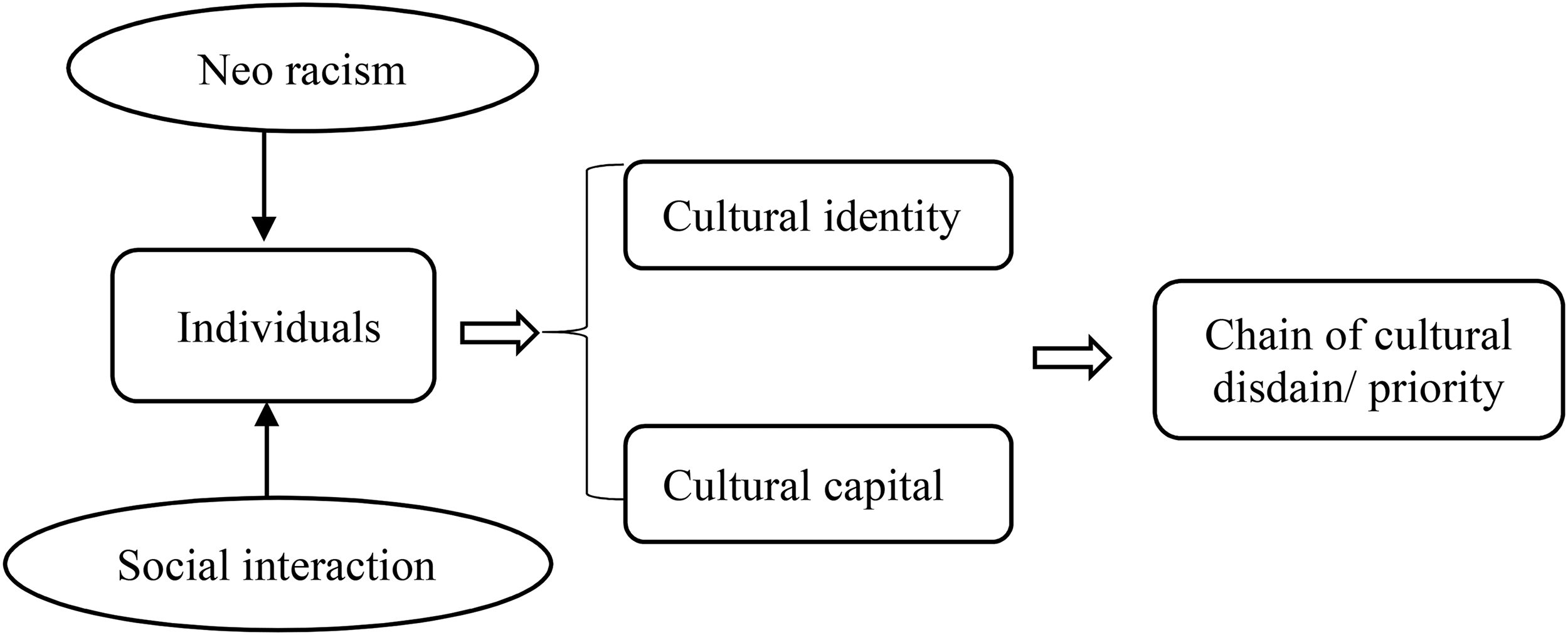
Theoretical framework.
Methodology
This research is a qualitative study. Semi-structured face-to-face interviews were the main research methods used to explore in depth the experiences of intercultural interaction between international students and domestic students in Chinese universities. Semi-structured interview was used to enable the participants to freely share their experiences but still ensure that the key topics were covered (Punch, 2013). The interview schedule contained open-ended, non-directive questions to encourage free narrative and detailed responses.
A snowball sampling strategy was used to recruit 25 international students and 14 Chinese students studying postgraduate programmes in two universities in Shanghai. The universities are internationally well-known and each has a large population of international students from over 150 countries. The numbers of international students in both universities are among the top-ten universities in China according to the updated data (MOE, 2023). Approximately and respectively, over 16% and 23% are international students in each university (MOE, 2023). Snowball sampling was chosen for this study because it has been extensively used for conducting qualitative research and is generally regarded as a highly effective sampling technique due to its ability to access hard-to-reach groups and previously unheard voices (Woodley & Lockard, 2016).
The researchers were fully aware of the limitation of snowballing in the recruitment of research participants and in the field work such as biased selection and lack of representativeness. They minimised the limitations through two main approaches. One approach is to encourage the interviewees who took part in the first round of interviews to refer to as many people as possible who were willing to join the study. The other approach was to carefully select the recommended potential research participants according to nationality (developing and developed countries), subject major, number of years of studying in China, and etc. This process helped build useful and representative samples to include different voices and perspectives.
The study followed the ethical review and guidelines and protocols from the institutional ethics board. Participants gave their written consent at the beginning of the interview. We anonymised the identity of the research participants and their universities in both the quotes and the findings to ensure confidentiality.
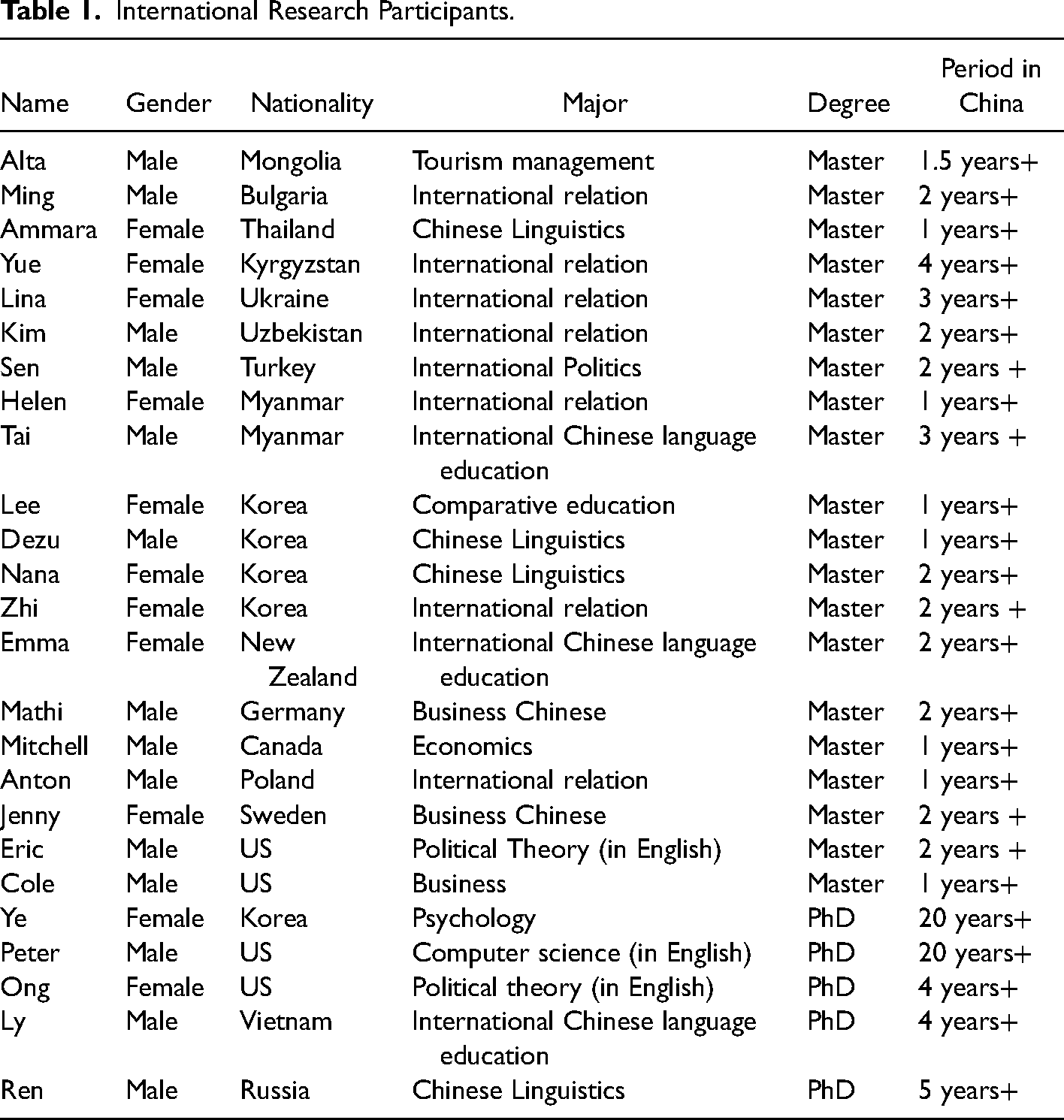
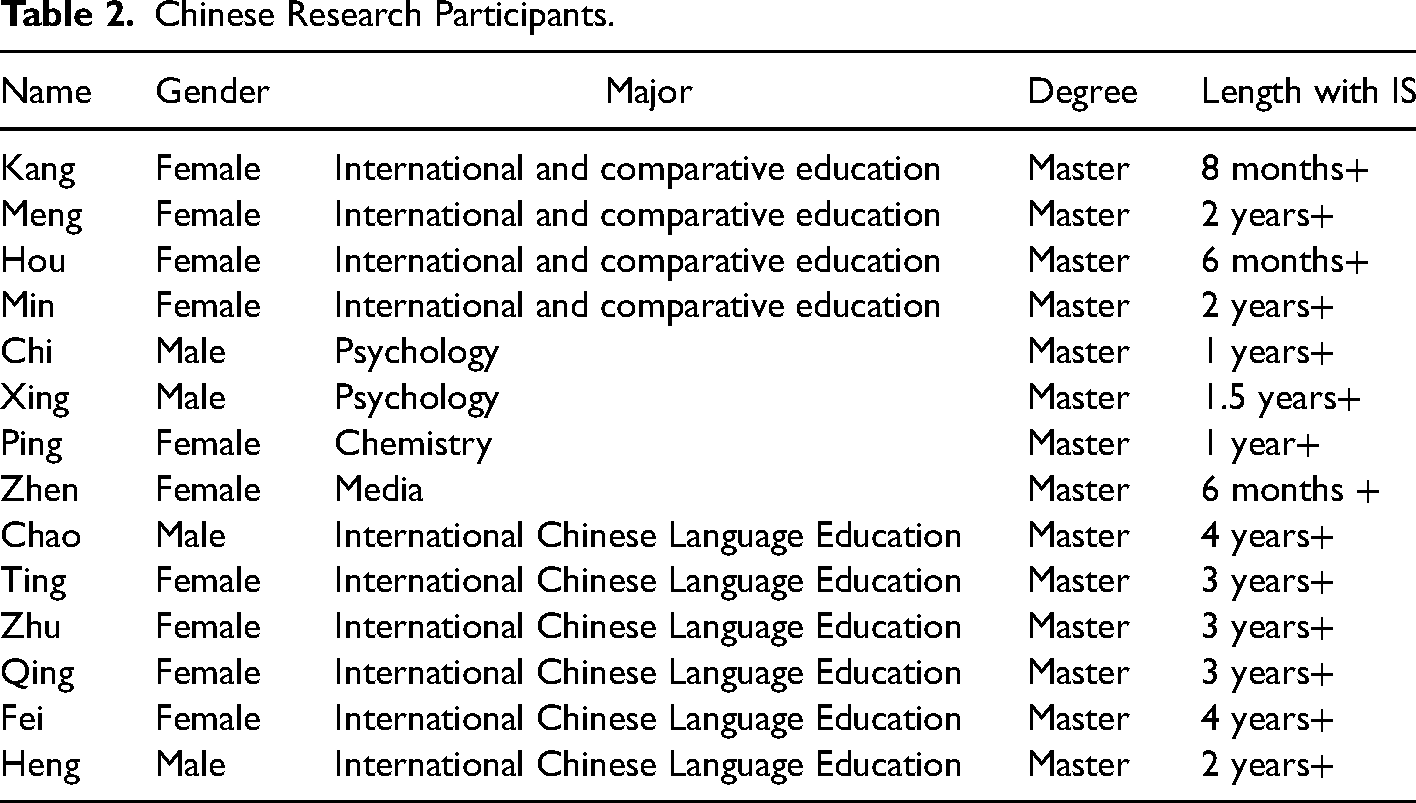
All participating international students had been studying their postgraduate programmes in China for more than six months by the time of the interviews. Chinese postgraduate students who were peers of the international students were also selected for the study. More information about the research participants is set out in Table 1 and Table 2.
International Research Participants.
Chinese Research Participants.
The interviews were conducted in Chinese or English according to the participants’ preferences, and each interview lasted approximately 60 min from the years of 2019–2021. All the interviews were audiotaped and professionally transcribed. The interview transcripts were analysed using a thematic approach and coded using NVivo software. After the emergent themes were generated, a complete round of analysis was carried out, which identified a hierarchical structure of superordinate themes and subthemes (Smith & Osborn, 2008). This process enabled critical interpretation of the key themes and the relevant excerpts which offer valuable insights into the students’ experiences. The identified key themes reflected why and how the intercultural interaction was (or not) developed and maintained between international students and domestic students in China. The themes and interpretations were double-checked and validated by the research team.
Findings
Participants in this study shared their experiences and reflections on their intercultural interaction on campus. Their comments demonstrated that the embedding of the English language in Chinese social, cultural and education systems, and the internationalisation of higher education, have increased the perceived advantages of knowing the English language and Anglo-Saxon culture. These advantages have led to the development of a chain of cultural disdain in Chinese students’ intercultural interaction which has shaped the quality of intercultural relations on campus.
The Value of Anglo-Saxon Cultures
The majority of Chinese student participants were interested in knowing and understanding Anglo-Saxon culture, which motivated their active contact with students from Anglo-Saxon countries. A Chinese student explained why there was favourable disposition towards Anglo-Saxon nations and cultures: Not just Chinese students, I think Asian people broadly, like to make friends with white people whose mother tongue is English. Historically, foreigners and the things they used were regarded as good or superior in China. Maybe foreigners did not put it that way, but we did and we were taught to have such ideas since childhood. For instance, if you go abroad to study in the US, people around you would consider you to be awesome. (Zhen, China)
Internationalisation of Higher Education
The internationalisation of higher education in China, particularly the development of Anglo-Saxon curriculum models and the importation of Anglo-Saxon scholars, further strengthened Chinese students’ preferences for Anglo-Saxon countries and culture. Here is a comment from a master's student in Comparative Education: Our major is comparative education, so we had presentations to report and compare the education issues in different countries, like US, Australia…. If you want to discuss the education in one country, you have to understand its culture, its national context, etc. I think it is better to know more about the country, the people from that country. (Hou, China)
Some international courses are delivered in English by lecturers from Anglo-Saxon countries. They are quite popular, much more popular than similar topics in Chinese. This suggests that Chinese students really want to communicate with foreign teachers and students. (Min, China)
As Min suggested, Chinese students welcomed the lectures in English due to the internationalisation of the curriculum in the university. The so-called international courses in fact referred to courses delivered in English and by teachers from Anglo-Saxon countries. There was only a small number of these courses available to Chinese students compared with the courses delivered in Mandarin, yet these international courses have attracted large numbers of Chinese students.
The internationalisation of curriculum and pedagogy in Chinese schools and universities ultimately has served to emphasise the priority given to the developed countries in the Anglo-Saxon world and forged a separation from other countries. Thanks to internationalisation trends and the privileged place of English in all stages of Chinese education, Chinese students tended to hold very positive images and impressions of Anglo-Saxon culture (cultural identity) and therefore desired to gain its cultural capital. This attitude manifests the “socially constructed” significance of English language and culture that students wish to pursue and practise (Bourdieu, 2000). It is also important to note that Chinese students preferred international students from the US, the UK, Canada and Australia (Bonilla-Silva, 2006), based on differentiating national factors including economic position as well as English being the first language of the majority.
Furthermore, the emphasis on Westernisation in Chinese schools and universities has been at the expense of exposure to other cultures. A few Chinese student participants shared their experiences of contact with students from Asian Belt and Road countries and explained that their ‘fears and doubts’ about interaction were linked to their unfamiliarity with those cultures, despite these countries being geographically closer and more culturally similar to China than Anglo-Saxon countries: I don’t think Chinese students would connect with Asian students, unless they are learning Korean, Japanese or Thai as the second or third language. We are definitely more familiar with Korean or Japanese cuisines, quite popular in China. However, for students from other countries along the Belt and Road, we know little about them. That may bring about some fears and doubts before interacting. (Ting, China)
The intensive interaction between Chinese students and Anglo-Saxon students challenges the belief that the wider the cultural distance, the less intercultural understanding there is (Stanciu & Vauclair, 2018). There is significant cultural distance between Chinese and Anglo-Saxon cultures, yet Chinese students are more familiar with Anglo-Saxon culture due to its greater exposure and popularity in China, with the corollary that there is less of a sense of cultural understanding or affinity with other countries, including those Asian nations in the Belt and Road programme.
The Pursuit of Cultural Capital
The majority of Chinese participants in this study reported that they use English when communicating with English-speaking peers, reflecting the influence of English language and culture and the perceived cultural capital from interaction with peers from Anglo-Saxon developed countries. Those Chinese students who planned to apply for international courses in English-speaking countries believed that these interactions would help them get ready for intercultural communication in their host countries in the future. This echoes Brooks and Waters’ (2013) findings that international students from East Asia were keen to acquire fluency in English as a form of cultural capital.
Half of the Chinese participants also highlighted the importance of English language skills for the job market. For instance, Shan noted that: I was preparing for my IELTS test at that time, because I needed a certificate to prove my English language competency [for future employment]. I thought I really had to practise my oral English. Then I looked for opportunities and found the volunteering project that helped international students. I did practise English a lot with them. Now I have the IELTS, so I left the project. (Shan, China)
Furthermore, international student participants who were not native English speakers perceived Chinese students using English as ‘showing off’, for example as one Vietnamese student described: There are loads of international students from Asian countries, in particular, from Southeast Asia. Chinese students may not want to interact with them. They prefer students from Europe or America, because they find those international students classy. If you have some European or American friends, you could show off with other Chinese students to prove that you could speak good English, your lifestyle is Anglo-Saxonised, you belong to an elite group, or something like that. (Ly, Vietnam)
Cultural Disdain in Intercultural Interaction
As a form of symbolic capital, knowledge of the English language and cultural identity operates in Chinese students’ intercultural communication to shape their perceptions of others and decisions on whom to interact with in order to gain social capital, producing an esprit de corps based on notions of national/cultural superiority (Bonilla-Silva, 2006; Bourdieu, 2000). It also generates cultural disdain by creating orders of priority in intercultural interactions between Chinese students and international students in China (see Figure 2). The more that Chinese students valued English language and Anglo-Saxon countries and cultures, the less they mixed with international students whose first language was not English.
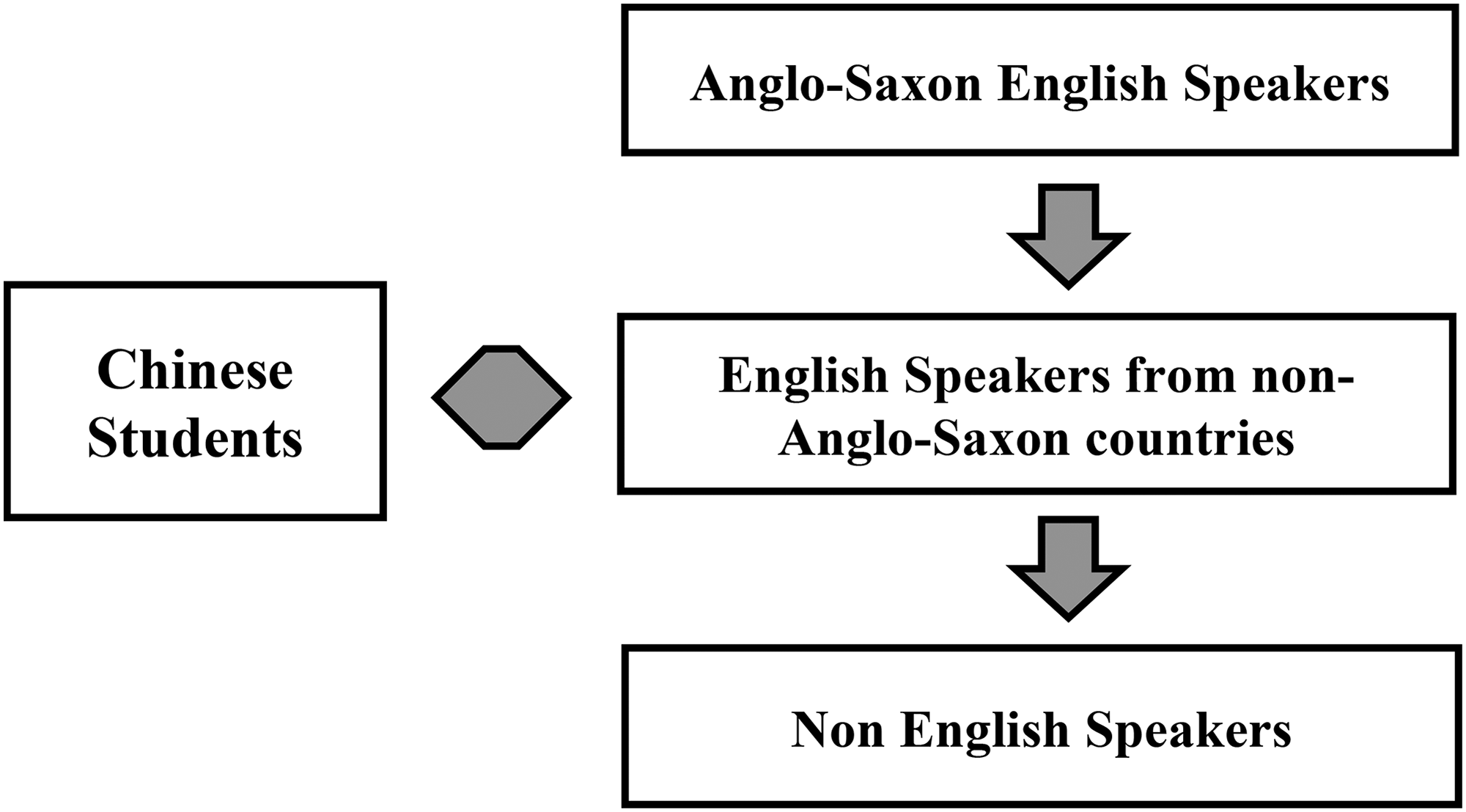
Chain of Cultural Disdain for Chinese students.
One Chinese student explained this view clearly: Some Chinese students only want to interact with students from Europe or America. I guess the language motivation is very strong. International students, especially those from south east Asia, they usually do not have a good English skill. (Meng, China)
Chinese people want to learn English and practise English, but I do not speak English. I don't think it's useful for them to talk to me. They find some British, European and American students to talk to. European students’ English is very good. (Kim, Uzbekistan)
Kim's comments implied that English language status shaped the way Chinese students differentiated other groups (Bourdieu, 1989). The ethnicity of certain non-English speakers was regarded by Chinese peers as inferior because there was no language or cultural advantage to be gained from interactions with those speakers. Ammara from Thailand compared her experience with that of her Polish friend and explained that having English skills could facilitate European students’ interaction with Chinese students: I think it's easier for him (friend from Poland) to make Chinese friends, because Chinese students want to learn English and practise oral English with him. Chinese students are more willing to make friends from Europe. (Ammara, Thailand)
Two-thirds of the international students from non-Anglo-Saxon countries who participated in this study felt being treated as outsiders in their interaction with Chinese students. This view underscores the finding that the Chinese students, in the pursuit of English language fluency as symbolic capital, were prioritising the students from Anglo-Saxon nations (and adjacent regions, such as Europe) over international students whose first language is not English.
Towards Long-Term Friendship?
One salient discrepancy between the Chinese students and favoured international students relates to their conflicting needs in their interaction, even though both groups of speakers are at the top of their own chains of cultural disdain. Chinese students were keen to interact in the medium of English, but international students preferred to speak Chinese as they prioritised Chinese culture in their chains of cultural disdain. This led to frustration and even conflict in their interactions. Interviewees reported that it was often the case that two students would need to negotiate in order to continue their interactions either in English or Chinese. For example, some international students would offer written English language support to Chinese students in order to have time together to practise Chinese language. However, this kind of arrangement did not lead to meaningful friendship. For example, Emma from New Zealand shared her experiences: Sometimes I really had to fight to speak Chinese, because they (Chinese friends) just wanted to practise English. Some of my Chinese friends, we were sort of language buddies, which was not necessarily a friendship. You just feel like a utility. You know, we would agree to meet for coffee, and then they turned up with an essay for me to check. That's not really a friendship. (Emma, NZ)
It's quite frustrating for me because I want to practise my Chinese. They come speak to me in English, and I want to speak Chinese, so sometimes I said I don't speak English. I pretend I could not speak English, because we have to speak Chinese. You know because I came all the way to China to speak Chinese, very tricky. I didn't come to China to speak English. (Mitchell, Canada)
Mitchell's insistence on speaking Chinese suggests that he treated international interactions primarily as opportunities to improve his Chinese language skills. This stance towards Chinese students partially explained why he developed close bonds only with other international students despite his intensive contact with Chinese students in his daily life. His main objective with the host students was Chinese language as cultural capital rather than as a means of real friendship.
Some native English-speaking international students deliberately took advantage of Chinese students’ desire to pursue English and Anglo-Saxon culture. For example, one Chinese student explained that the strategies of these English speakers were detrimental for the domestic students and did not foster genuine connections: Some international students [who speak English] knew well about Chinese students’ need for English language, and they made use of that, like a bait, to attract Chinese students to help them, something like tutoring or proofreading in Chinese. These were very negative experiences for Chinese students. Many found it very uncomfortable to be taken advantage of. I don’t think they want meaningful friendship. (Fei, China)
It is interesting to note that although the Chinese students operated in a chain of cultural disdain and preferred to communicate with Anglo-Saxon students, our participants’ experiences indicate that quality intercultural relationships often developed between Chinese students and students from Belt and Road countries. For example, five Chinese students said that their connections with students from non-Anglo-Saxon countries were more long-term than those from Anglo-Saxon countries. I think it is more about Chinese cultural identity or one cultural identity. For example, if international students understand Chinese culture or are willing to accept the culture, that does not mean we could have a long-term friendship, unless they like Chinese culture. My international friends like Chinese culture very much and have strong Chinese cultural identity. (Ting, China)
Discussion
On one hand, the Chinese students in this study demonstrated they were willing and motivated to take part in intercultural interaction with international students. This contrasts with previous research (Cotton et al., 2013) that suggests domestic students are indifferent or hold negative attitudes towards intercultural communication with international students. On the other hand, the Chinese students distinguished between groups of international peers and treated them differently, due to the chain of cultural disdain arising from the perceived supremacy of English language and Anglo-Saxon culture. Native English speakers from Anglo-Saxon countries were the most popular peers among Chinese students in this study. International students from outside Asia who speak English as a second language were more popular than Asian students. The least popular group of international students was non-English-speaking students, most of whom were from developing countries. This latter cohort makes up over half of all international students in China (MOE, 2019). The study's findings on the chain of cultural disdain indicate that the utility of the English language, the perceived superiority of Anglophone countries, and English-related symbolic capital have led Chinese students to identify with English culture and develop preferences in their intercultural interaction. This phenomenon corresponds with Bourdieu’s (2000) argument that potential inequality and lack of diversity in intercultural interaction can produce elitism and social-cultural differentiation.
The social history of intercultural encounters between China and the West and the process of China's internationalisation, together with the impact of compulsory formal English education in modern China, have valorised cosmopolitanism through ideas of the superiority of nations with Anglo-Saxon heritage. The product is Anglo-Saxon symbolic capital (Brown et al., 2019). Individuals’ situated agency works with this symbolic capital to co-construct the chain of cultural disdain in intercultural interaction among Chinese students and their international peers.
Long-term compulsory English language education and exposure has nurtured the Chinese students’ English-centric intercultural awareness and sense of cultural identity and affinities. These contribute to individuals’ cultural biases and pursuit of English language-related cultural capital as well as to discrimination (conscious or not) against non-Anglo-Saxon cultures. Such cultural priority is the ‘invisible’ structural element of domestic students’ intercultural practices (Zou & Yu, 2021). It restricts Chinese students’ wider cultural integration and limits their cultural diversity and global awareness. Whether in primary, secondary or higher education, China needs to launch multi-language and multi-culture educational strategies, not least to increase Chinese young people's knowledge of the countries in the Belt and Road Initiative. Chinese students appeared to have limited knowledge of the cultures of Asian countries along the Belt and Road, despite their geographical closeness and cultural similarities with China. These nations and cultures (other than Korea, Japan and Thailand) have limited exposure in China, with the outcome that Chinese students are not curious or motivated to interact with students from these countries. Patterns of intercultural relationships on campus are influenced by the host country's social history, multicultural context and intercultural elements of school education – in addition to the factors such as student agency and university policies and provision (Kudo et al., 2020).
Regardless of efforts to tackle barriers to intercultural interaction on campuses (Peters, 2020), including university-run activity programmes for international students to meet and socialise, the chain of cultural disdain may continue to cause discrimination and lead to inequality. Chinese students’ preference for international students from Anglo-Saxon countries will likely continue to make other international students feel treated unfairly. This will delay the development of balanced and wide-ranging intercultural awareness and internationalisation at home (Caspersz & Olaru, 2017). Currently, Chinese students who are keen to practise English can feel frustrated when international students insist on practising Chinese language with them (and vice versa). This indicates that both Chinese and English languages can be perceived as social capital depending on the students’ personal objectives and the context of communication.
This article further develops the theory of cultural disdain and reveals how the chain of cultural disdain emerged and influenced intercultural interactions between Chinese students and international students (see Figure 1). Indeed, this theoretical framework for the chain of cultural disdain is not limited to Chinese students in intercultural interaction; it also applies to other groups of individuals in the student milieu. Essentially, each individual is assumed to have their own chain of cultural disdain based on their cultural identity and desire for cultural capital. If the participants or cohorts in the intercultural interaction have conflicting needs in their pursuit of social capital, they must learn to negotiate with the member(s) of the different culture concerning their different needs. Otherwise, the development of intercultural relationships may be stalled at the stage of mutual reciprocity (Kudo et al., 2020). This study therefore argues that universities implement programmes to educate all students to develop authentic intercultural communication, to facilitate reciprocal learning that is embedded within respect for diversity and equality.
Based on the findings, the authors recommend that future studies of intercultural interactions on campus should consider the complexities of interactions between international and domestic students as well as recognising that cultural constructs are hybrid and malleable. It is vital to delve into the students’ attitudes and motivations for intercultural engagement, their diverse backgrounds, the institutional setting and even the national setting. Future research could investigate the purpose of intercultural communication, the dynamics of the intercultural environment and related social-cultural factors in various host countries.
Further, this study focused on postgraduates in Shanghai. Future studies could include undergraduates in order to compare whether and how levels of study could affect student's experiences. The location of this field work is Shanghai which is cosmopolitan and has great exposure to western culture. Future research could extend to universities in different regions of China to explore whether location could influence how cultural disdain affects intercultural interaction on campus.
Conclusion
This study uncovers the cultural disdain in students’ intercultural interactions. The findings contribute to the development of cultural disdain theory to understand the changing dynamics of relationship development among participants in intercultural interactions. It argues that meaningful intercultural interaction should be inclusive of different cultural groups and move beyond biased perceptions of the supremacy of the English language and Anglo-Saxon culture. However, this aspiration brings challenges for Chinese universities. The chain of cultural disdain and potential exclusion from intercultural interaction of certain groups of students indicate that the universities need to find effective ways to promote cultural diversity, equality and respect on campus, for instance, increasing the education related to multicultural knowledge, intercultural awareness, and communication skills. This is essential for development of rich intercultural interactions which would support all students to have positive international experiences.
Footnotes
Conflict of Interest
The authors declare that they have no conflict of interest.
Funding
The authors received no financial support for the research, authorship, and/or publication of this article.
