



Abstract
This study explores the strengths and more importantly the limitations of the current research of Internationalization at Home (IaH) in relation to equity. To do this, I draw on a survey of Chinese university students to 1) examine the relationship between their intercultural interaction with international students, partly operationalizing IaH, and their intercultural competence; 2) compare the effects of intercultural interaction and study abroad on students’ intercultural competence; and 3) examine the extent to which students’ opportunities for intercultural interaction with international students depends on the type of their institutional affiliation. It finds that study abroad, interaction with international students and learning foreign languages are positively associated with students’ intercultural competence. However, the effects of study abroad and intercultural interaction do not differ and are not additive. It also finds that students from prestigious universities are more likely to have high intercultural interaction with international students. The findings confirm the strength of IaH as an equitable approach at the institutional level. However, it raises questions on the impact of systemic inequities on IaH and calls for rethinking the objective of IaH for all students from a system perspective.
Introduction
Internationalization is a globally recognized institutional practice in higher education and is widely regarded as an institutional imperative (Hudzik, 2011). This imperative is justified for its link to better research performance, higher ranking, prestige and better outcomes for student development (Buckner et al., 2020). Particularly, internationalization is linked to students’ intercultural competence both through study abroad and internationalization-at-home (IaH) (Beelen & Jones, 2015). Considerable literature on study abroad finds that it is beneficial for students’ long-term global engagement and career development (Nguyen, 2017).
Yet, only 2.48% of the students in higher education worldwide in 2018 had the opportunity to study abroad (UNESCO Institute for Statistics, 2021b). This extremely low percentage reflects a long-standing concern about the elitist tendency in internationalization in which only a small number of students have international education opportunities (de Wit, 2020). In light of this elitist concern, the studies on internationalization have started to define internationalization of higher education with explicit values. For example, de Wit et al. (2015) modifies Knight’s classic and value neutral definition of internationalization, and redefines it as follows The intentional process of integrating an international, intercultural or global dimension into the purpose, functions and delivery of post-secondary education, in order to enhance the quality of education and research for all students and staff and to make a meaningful contribution to society” (de Wit et al., 2015).
More specifically, IaH is advocated as a more equitable approach primarily at the institutional level to ensure on-campus internationalization activities, such as international curriculum and intercultural interaction between international students and local students, are encouraged and implemented to benefit all students at institutions, particularly those who cannot study abroad (Beelen & Jones, 2015). The definition of IaH has undergone several iterations, from the early simple of definition of including any international activity except for outbound student mobility (Nilsson, 2003), to a more detailed definition as “the purposeful integration of international and intercultural dimensions into the formal and informal curriculum for all students, within domestic learning environments” (Beelen & Jones, 2015). This latest definition takes into account formal and informal aspects of international curriculum and stresses the objective that IaH is for all students. However, it is not clear whether all students refer to individual institutional level or the system level.
Most current literature on IaH tend to focus on students at a single institution, rarely has the literature considered the characteristics of higher education systems to understand how systematic issues affect the intended objective of IaH benefiting all students. For example, it has long been recognized that higher education systems in China is stratified, with prestigious institutions enjoying extra resources that may provide students with more opportunities (Zha, 2021). In addition, students from prestigious universities also tend to come from better social-economic backgrounds (Guo et al., 2019). Applying this to IaH, which largely depends on the capacity of institutions to provide international opportunities, it is not clear how IaH can benefit all students in the whole higher education system, when institutions may differ significantly in their internationalization resources.
Moreover, most of the studies were conducted in the Western context. The role of international students in countries such as China, where the number of international students ranked the third in the world in 2018 (Institute of International Education [IIE], 2020), is less understood. International students in China are typically framed as enhancing the country’s soft power and international standing (Kuroda, 2014; Wang, 2014). The cultural role of international students interacting with local students is rarely discussed. Although China is a multi-ethnic country, the number of ethnic minorities is still small in major cities and many of them are largely integrated with the Han culture to become important aspects of the Chinese culture (Zhang, 2017). Thus, compared to major Western countries which receive immigrants worldwide, cultural diversity in China is less overt, particularly in large cities, where most university campuses are located. In contrast, the diversity international students bring to Chinese campuses are overt, in terms of language, race, religion, and educational experience. As such, it is significant to investigate the cultural role of international students in China, where most local Chinese students are less exposed to overt cultural diversity on campus. Moreover, China’s higher education is stratified (Zha, 2021), making it an appropriate case to explore how systemic issues affect the intended objective of IaH.
This article explores the strengths and more importantly the limitations of the current research of Internationalization at Home (IaH) in relation to equity from both institutional and systemic perspectives. To do this, a survey of Chinese university students was conducted with the following research questions: 1) What is the relationship between Chinese university students’ intercultural interaction with international students and their intercultural competence? 2) How does the effect of intercultural interaction compare to that of study abroad? 3) To what extent students’ institutional affiliation explain their opportunities for intercultural interaction?
Intercultural competence and intercultural interaction in higher education
This study defines intercultural competence as “the ability to communicate effectively and appropriately in intercultural situations based on one’s intercultural knowledge, skills, and attitudes” (Deardorff, 2006). The concept of intercultural competence is discussed in many disciplinary frames. This definition of intercultural competence is selected as it is widely recognized and it is the result of rigorous discussion among intercultural experts (Deardorff, 2006). Moreover, it is identified and studied as the student outcome of internationalization (Deardorff, 2006), which fits the context of this study.
Many studies investigate the factors affecting students’ intercultural competence in higher education, such as study abroad and IaH, which includes on-campus intercultural programs (Soria & Troisi, 2014). Particularly, studies on intercultural interaction found that intercultural interaction, i.e., the intergroup contact between international and local students, positively affect students’ intercultural competence. Studies have found that increasing intercultural interaction between local and international students through residence and intervention programs positively enhances the intercultural competence of local students (Nesdale & Todd, 2000; Wang et al., 2019).
However, a systematic review on intercultural development in university settings finds that intercultural interaction may have a negative impact on the intercultural relationships between local and international students (Kudo et al., 2017). For example, language barrier, lack of institutional intervention, and competition among students for resources lead Chinese students and the local U.K. students self-categorize themselves as “us” and “them”, hindering intercultural understanding (Hou & McDowell, 2014). This contested literature calls for a re-examination of the relationship between intercultural interaction and students’ intercultural competence, to understand whether IaH, operationalized by intercultural interaction, has the potential to contribute to the intercultural development of all students, particularly the non-mobile students.
Intercultural competence and higher education internationalization in China
In the Chinese context, studies on university students’ intercultural competence primarily focus on the role of foreign language learning and intercultural communication courses. For instance, Zhao and Coombs (2012) demonstrates that teaching English to Chinese students require students to critically examine their collective traditions and ensures a personal paradigm shift towards becoming a global citizen. Similarly, interviews with international and domestic students in China find that Chinese universities implement strategies to increase intercultural dialogue between international students and Chinese students, yet the contact tend to be short and superficial (Wang & Holmes, 2019C. Wang & Holmes, 2019). In studying the impact of IaH on students’ global competence, studies find that students’ contact with international students on campus activities, are positively associated with students’ global competence in Chinese universities (Meng et al., 2017). In addition, they also find that students from 985 and 211 universities, i.e. more prestigious universities in China, tend to have higher global competence (Meng et al., 2017). However, these studies did not wholistically consider factors such as study abroad, foreign language learning and intercultural interaction, leaving the findings dubious. In this study, intercultural interaction, study abroad, and foreign language learning are all included in the analysis of regression models to see to what extent intercultural interaction still significantly explains students’ intercultural competence.
International students from and to China
China is an appropriate case for the study to explore the strengths and limitations of IaH. First, China remains the largest country of origin for international students in the world. It accounts for around 17.8% of the total mobile students worldwide, much higher than the second largest country India, whose outbound students make up 6.7% of the world’s total (UNESCO Institute for Statistics, 2021a). Yet, China’s outbound mobility rate, meaning the percentage of all tertiary students study abroad, is only 2.2% (UNESCO Institute for Statistics, 2021a). In other words, roughly 98% of Chinese students will never study abroad, and it is on their own university campuses that they will develop their understanding and appreciation of international diversity. China’s situation is in line with the global reality that study abroad is an elitist experience that is not available for most university students. Thus, research on IaH in China may provide insight for other countries, particularly contexts where the society tend to have less overt cultural diversity.
International students have been an important part of China’s internationalization policies (Yang, 2014). They feature in China’s “outward-oriented” approach to higher education internationalization, in which they are seen to promote the goal of educating talent with Chinese characteristics for other countries, and to enhance China’s geopolitical standing (Ma & Zhao, 2018; Wu, 2019). As such, there has been an exponential growth in the number of international students in China, which has become the third largest country of destination for international students in the world, receiving 9% of the world’s total outbound students in 2019 (IIE, 2020). This immense growth in the number of international students in China’s higher education presents an excellent and timely opportunity to explore the strengths of IaH that may benefits the intercultural development of most local Chinese students who do not study abroad.
China’s stratified higher education system
However, China’s stratified higher education system points to potential limitations of the current understanding of IaH from a system perspective. The stratification is partly manifested in successive plans, such as the Double First-Class initiative, focusing on building world-class universities. In the latest Double First-Class plan, only 147 universities, out of over 2700 Chinese higher education institutions, are designated to become world first-class universities or to house world-class disciplines. These universities have been largely protected from massive enrollment expansion to ensure quality and are given extra resources for their development in areas such as teaching and research (Zha, 2021).
The stratified Chinese higher education system raises concerns of inequity, which in turn affect higher education internationalization. Numerous studies find that students from better socio-economic backgrounds are more likely to be admitted to prestigious higher education institutions in China (Guo et al., 2019). Namely, privileged students are more likely to enjoy the extra resources, such as the international resources, these institutions have, compared to students in lower-status institutions. This study explores this through examining whether students’ institutional affiliation, with prestigious or non-prestigious universities, is associated with their opportunities for intercultural interaction on campus. Examining this extends our understanding of how the intended objective of IaH benefiting all students may be affected by systemic issues such as stratification or inequity.
Theoretical framework
This study draws on Allport’s contact theory to conceptualize the factors related to students’ intercultural competence. The contact theory posits that in-depth contact among different social groups could lead to members of the groups changing predisposed negative attitudes and reducing prejudice (Allport et al., 1954). Allport hypothesizes that the positive effect of intergroup contact is dependent on four conditions: equal group status, common goals, intergroup cooperation, and support of authority, law or custom (Pettigrew, 1998). More recently, the contact theory has been used to understand students’ intercultural development in the higher education context (Jon, 2013; Soria & Troisi, 2014). In this study, intergroup group contact refers to the interaction between local and international students.
Although international and domestic students may come from diverse economic, cultural, and social backgrounds, they study in the same institutional environment. Their status as students in the same institution, despite being differentiated by citizenship, constitutes an important aspect of equal status in the contact theory. In addition, the two groups of students share a common goal of studying and socializing on campus. They may engage in formal and informal curricular activities, constituting various forms of intergroup cooperation. As international students are present on campus, if not always in classroom with domestic students, it could be considered that their possible interaction is permitted, if not explicitly arranged. All the above aspects suggest that the interaction between international and domestic students largely meet the pre-conditions of positive intergroup contact. In addition, numerous empirical studies on different social groups provide evidence of the positive effect of contact in reducing prejudice, even though not all of them meet all the pre-conditions (Pettigrew, 1998).
This study hypothesizes that intergroup contact could possibly reduce the potential bias and prejudice between international and domestic students, which is essential for communicating effectively and appropriately in intercultural situations and results in intercultural competence (Deardorff, 2006). Drawing on Allport, this study argues that there are two possible ways to develop intercultural competence in the inter-group contact setting. The first, dominant in the literature, is to study abroad. Students study and live in an unfamiliar cultural environment and will have to interact with the host society. Another way, a key feature of IaH, is to interact with international students coming to their home country. Therefore, this study hypothesizes that Chinese students can develop intercultural competence through two pathways: study abroad and/or interacting with international students on campus. However, two issues remain unclear in the literature: firstly, is the effect of the two pathways different? Namely, which pathway develops more effective intercultural competence? And secondly, are the two pathways additive? Namely, do students who have done both: study abroad and interact with international students, develop a higher level of intercultural competence? The findings will illuminate on the two issues.
One issue is that the inter-group contact theory as applied in higher education has largely ignored the importance of context at the system level. In this study, considering the stratified higher education context in China, it is hypothesized that the impact of the inter-group intercultural contact on students’ intercultural competence is modified by context. That is to say, the effect of intercultural interaction is likely to differ between students from more prestigious and less prestigious institutions in the Chinese context.
Data and methods
Data collection
The data of this study comes from a self-designed survey, as no previous data on the interaction between international students and domestic students in China exists. Data collected from surveys allows for descriptive analysis and examination of the relationship between different variables (de Vaus, 2013), which is the objective of this study. The survey was administered to undergraduate and graduate students in Chinese universities using an online survey platform through the snowball sampling method. Snowball sampling does not guarantee representative samples (de Vaus, 2013) and this is a limitation of the study. However, it enables the study to reach its specific group of interest, i.e., university students who are possibly exposed to international students. It also allows the study to reach students from different institutions to examine how the opportunities for intercultural interaction may differ in different types of institutions. A total of 232 Chinese students from 50 Chinese universities completed the survey online. It is hard to estimate the response rate of the survey as the total number of students who received the survey is unknown. The final analytical sample is 194, after removing students who do not fit the target population.
In the final sample, 113 students were from 27 prestigious universities selected in the “Double First-Class” initiative. Given the large size of the Chinese higher education sector, the sample of the survey is small and over-represented by students from prestigious universities in China. University affiliation is included as a control variable in the regression analysis to account for this issue, which also allows the study to examine whether university affiliation is a predictor of students’ participation in intercultural interaction and their intercultural competence.
The survey consists of four parts: 1) demographic information including students’ institutional affiliation, academic year, gender, and discipline of study; 2) whether they have studied abroad and have the habit of reading international news, and the number of foreign languages learned; 3) the interaction between domestic students and international students, which includes questions on the frequency and types of interaction with international students; and 4) a measurement on students’ intercultural competence.
Measures
Intercultural competence
The intercultural sensitivity scale (ISS) is used to measure domestic students’ intercultural competence due to its proved validity (Chen & Starosta, 2000), including in the Chinese context (Wang and Zhou, 2016). The ISS consists of 24 statements measuring students’ intercultural sensitivity. Respondents are expected to choose from five Likert scale items for each statement: strongly agree, agree, uncertain, disagree, and strongly disagree. Respondents receive a score of five for choosing strongly agree and a score of one for choosing strongly disagree. 1 The total score of the 24 items is calculated, indicating the degree of respondents’ intercultural competence. Therefore, intercultural competence is a continuous variable.
Intercultural interaction
Seven items in the survey are used to measure the degree of intercultural interaction, which operationalizes both the formal and informal aspects of IaH. They include frequency of interaction, participation in curriculum and co-curriculum activities with international students such as travel, class discussion, and group homework. These items partly draw on previous research that used similar items such as frequency of interaction and having conversations to measure intercultural interaction (Jon, 2013). Principal Component Analysis (PCA) was conducted to generate a composite score for intercultural interaction using the seven items. The overall Kaiser-Meyer-Olkin value is 0.81, exceeding 0.70, indicating that it is suitable to use PCA for these seven items (de Vaus, 2013; Jolliffe, 2011). The score of the first principal component retained is used as the raw intercultural interaction score. Moreover, a reliability analysis was performed to examine the internal consistency of the intercultural interaction scale. The analysis reveals that the intercultural interaction variable is a reliable scale (Cronbach’s α = 0.81) (Urdan, 2016).
To differentiate students with low and high intercultural interaction, a binary variable called intercultural interaction was created based on the raw interaction score generated with the PCA method explained above. For the binary intercultural interaction variable, 0 indicates students with a low level of intercultural interaction, and 1 indicates students with a comparatively higher level of interaction. This study differentiates low and high levels of interaction for two reasons. First, the effect of intercultural interaction on intercultural competence may not be completely continuous, i.e., a slight increase in intercultural interaction does not necessarily equate to an absolute and significant increase in intercultural competence. Second, this allows the study to compare different types of students: students who have low and high intercultural interaction, and students who have or have not studied abroad, which is one of the objectives of the study.
Study abroad
Study abroad captures whether students have experience of studying abroad regardless of duration. It is a binary variable where 0 indicates they have never studied abroad and 1 indicates that they have. This binary variable allows the differentiation of students by whether they have studied abroad or not. This study only differentiates students who have and have not studied abroad, instead of focusing on the duration or location of their study abroad experience. Previous research has found that study abroad for even a short period of time is beneficial for students’ global engagement (Paige et al., 2009) because it entails a transformation in students’ academic and social environment. Therefore, this study hypothesizes that the act of study abroad itself is related to intercultural competence, regardless of the duration.
Foreign language
Foreign language is an ordinal variable with a minimum of one and maximum of four, where 1 indicates that they have learned one foreign language, and 2 means they have learned two foreign languages etc. In the Chinese education context, English is a mandatory subject, hence the minimum of one. The number of foreign languages learned would capture students’ interests in foreign culture and affairs, which indicates that they would acquire a certain degree of intercultural competence through learning foreign languages.
Prestigious university
A binary variable called prestigious university is created, with 1 indicating students from prestigious universities, defined by being selected in the national “Double First-class” initiative. The sample is over-represented by students from prestigious universities in China. This variable allows the study to differentiate students by institutional category (prestigious or non-prestigious) and examine the extent to which students from prestigious and non-prestigious universities differ in their intercultural interaction and competence.
International news
International news is a binary variable, where 1 indicates that students have the habit of reading international news, and 0 means that they do not have the habit. This variable would capture students’ interest in foreign culture and affairs, which tends to be related to intercultural competence.
Analytic strategy
Multiple ordinary least squares (OLS) regression
The ordinary least squares (OLS) multiple regression is conducted using Stata to analyze factors related to students’ intercultural competence. Multiple regression allows the examination of the nature and strength of the relationship between variables, controlling for confounding variables and allowing the test of interactions (Urdan, 2016). This is appropriate for the objective of this study.
An interaction term was created using two variables: study abroad and intercultural interaction. This allows the study to compare the intercultural competence of four types of students: 1) students who did not study abroad and have low intercultural interaction with international students at home; 2) students who studied abroad but have low intercultural interaction; 3) students who did not study abroad but have frequent intercultural interaction at home; and 4) students who studied abroad and have frequent intercultural interaction at home. Differentiating the four types of students allows the study to compare the impact of intercultural interaction and study abroad on students’ intercultural competence.
Multiple logistic regression
Multiple logistic regression was conducted to examine whether institutional affiliation (prestigious vs. non-prestigious institutions) is related to students’ degree of intercultural interaction. Logistic regression allows the examination of relationships when the outcome variable is a binary variable, and it predicts the likelihood of an event happening or not (Pampel, 2000). In this study, the outcome variable in the multiple logistic regression models is intercultural interaction, a binary variable with 0 indicating a low degree of intercultural interaction and 1 indicating a high degree. Using multiple logistic regression allows this study to examine factors associated with students’ likelihood of participating in a high degree of intercultural interaction.
Findings
Descriptive findings
Intercultural interaction
Percentages of students in each item of intercultural interaction (N=194).
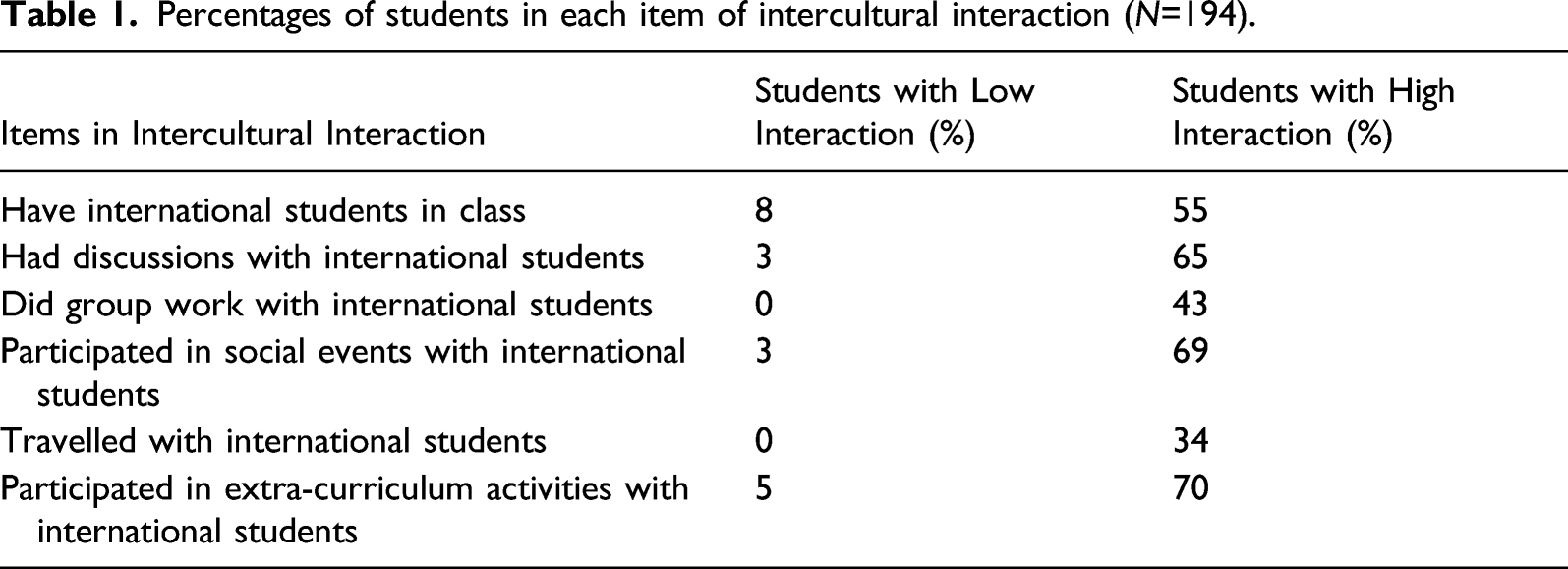
OLS regression findings
Ordinary least squares regression on students’ intercultural competence (N = 194).
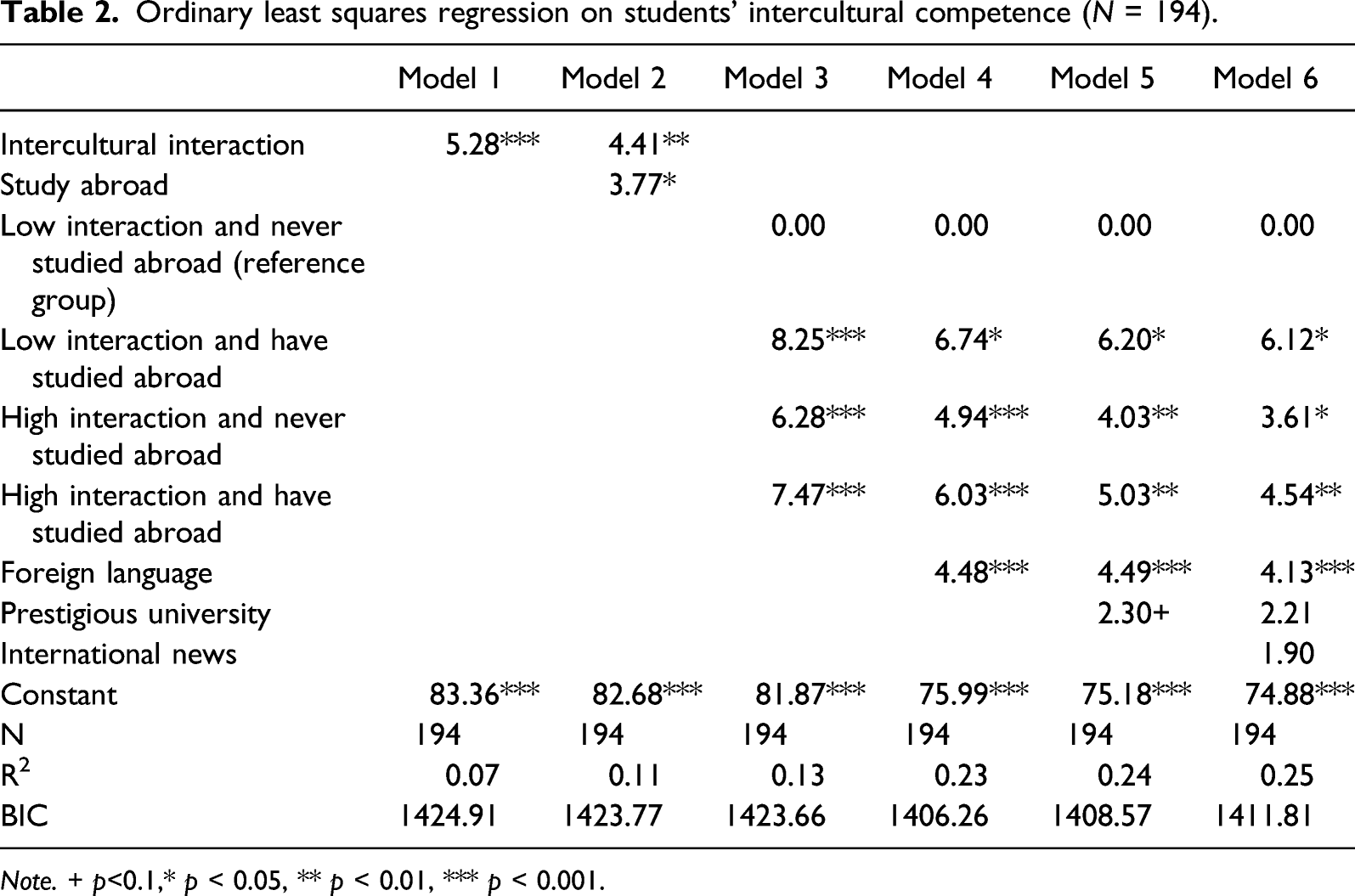
Note. + p<0.1,* p < 0.05, ** p < 0.01, *** p < 0.001.
In Model 3, an interaction term of study abroad and intercultural interaction is created. This model allows the comparison between four types of students, differentiated by whether they have studied abroad and whether they have low or high intercultural interaction as previously explained. Students who have not studied abroad and have low intercultural interaction is the reference group. Compared to them, students who have studied abroad but have low intercultural interaction score 8.25 points higher in intercultural competence (p < .001); students who have high intercultural interaction and studied abroad score 6.28 points higher in intercultural competence (p < .001); and students who have high intercultural interaction and have not studied abroad score 7.47 points higher in intercultural competence (p < .001).
In Model 4, foreign language is added to see if it is associated with intercultural competence. The results show that learning one more foreign language is associated with 4.48 points increase in intercultural competence score, controlling for study abroad and intercultural interaction (p < .001).
To see if students’ institutional affiliation is associated with their intercultural competence, the variable prestigious university is added to Model 5. It shows that institutional affiliation is positively associated with students’ intercultural competence. Students from prestigious universities score 2.30 points higher in intercultural competence (p < .1), controlling for study abroad, intercultural interaction, and foreign language.
The variable international news is added to Model 6 to see if it is associated with students’ intercultural competence. The results show that it is positively associated, but not statistically significant. 2
Using Bayesian Information Criterion (BIC) for model fit, Model 4 is the preferred model because the BIC is the lowest. To conclude, study abroad, high intercultural interaction, and foreign language significantly predict students’ intercultural competence. In addition, further analysis is conducted to test if there is statistical difference between the coefficients for the interaction term of study abroad and intercultural interaction. Results in Stata show that there is no statistical difference between coefficients, suggesting the effects of intercultural interaction and study abroad on students’ intercultural competence are not different or additive.
Multiple logistic regression findings
Multiple logistic regression on students’ likelihood of high intercultural interaction with international students (in probability).
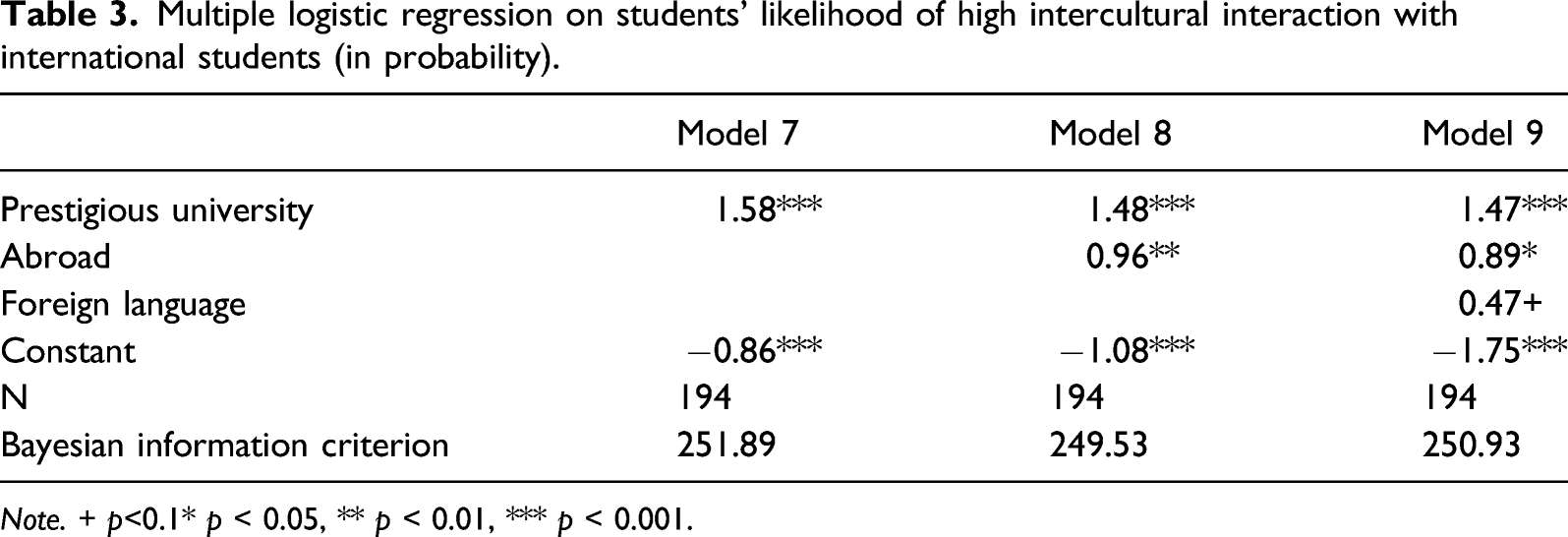
Note. + p<0.1* p < 0.05, ** p < 0.01, *** p < 0.001.
Using BIC as a criterion for model fit, Model 8 is the preferred model because BIC is the lowest. It shows that attending a prestigious university is associated with a higher degree of participation in intercultural interaction. Specifically, students who attend prestigious universities are 148% more likely to have a high degree of intercultural interaction, controlling for study abroad (p < .001). In addition, students who have studied abroad are 96% more likely to have a high degree of intercultural interaction, controlling for prestigious university (p < .01).
Discussion and conclusion
This study explores the strengths and more importantly the limitations of the current research of Internationalization at Home (IaH) in relation to equity from both institutional and system perspectives. To do this, it draws on a survey of 194 Chinese university students from 50 institutions to examine the extent to which IaH, operationalized by intercultural interaction, is related to students’ intercultural competence, how it compares to study abroad, and how systemic issues such as stratification may affect the intended objective of IaH benefiting all students. This study finds that study abroad, intercultural interaction with international students, and foreign language are positively associated with students’ intercultural competence. This finding is in line with previous research on the positive impact of study abroad and foreign language learning on students’ intercultural competence.
This study also finds that intercultural interaction with international students is positively associated with Chinese students’ intercultural competence. This is in line with previous research in China that shows students’ interaction with international students on campus is positively associated with students’ global competence. In light of the longstanding debate on whether intercultural contact actually benefits students’ intercultural competence in higher education (Gregersen-Hermans, 2015; Kudo et al., 2017), this study provides empirical evidence from the Chinese context supporting the positive role of intercultural interaction with international students on local students’ intercultural development. Particularly, this finding suggests that IaH could serve as an equitable approach to benefits all students.
Previous findings suggest that IaH activities may yield more benefits than study abroad on students’ intercultural and global competence (Soria & Troisi, 2014). However, this study finds that the impact of study abroad and intercultural interaction on students’ intercultural competence do not differ. Namely, no evidence suggests students must study abroad to improve their intercultural understanding. This suggests that IaH might be just as effective as study abroad for students’ intercultural development. However, it is important to note students do not necessarily study abroad for the sole purpose of improving intercultural competence. Nonetheless, this finding contributes to the broad discussions on the importance of IaH benefiting all students, in particular the nonmobile students. Future research may further examine how different types of international experience, such as international internships, international curriculum, affect students’ intercultural competence and compare the effects of different types of activities.
This study also finds that the impact of study abroad and intercultural interaction on students’ intercultural competence are not additive. It suggests that focusing on one type of international experience, if it is deep and frequent, may be just as effective as engaging in multiple types of international experience. This is a new contribution to the literature, as previous studies have rarely considered how different types of international experience might work together to benefit students’ intercultural development. Future research may further examine this question by comparing the intercultural competence of students who have one or multiple types of international experience, to shed light on the extent to which engaging in different types or one type of international experience benefit students and how effective they benefit students’ intercultural competence. Further research along this line has implications for institutional practice on how to provide different international activities for students so as to benefits more students’ intercultural development.
Another important finding is that students studying in prestigious universities in China are more likely to have higher intercultural interaction, which is significantly related to students’ intercultural competence. This finding suggests students attending elite universities may be more likely to benefit from the IaH approach. This is a concern as students in elite institutions are also more likely from higher socio-economic backgrounds in China (Wu, 2017). It is almost a consensus in the field that IaH is an equitable approach that benefits all students on campus (de Wit & Jones, 2018). However, this consensus seems to mainly focus on the discussion on individual institutions, instead of the higher education system overall. Not all institutions have international students and faculty, international partnerships, and internationally minded staff, among others, to implement IaH. In reality, institutions may differ significantly in the amount of IaH resources available. This suggests that the IaH approach for equity in internationalization largely depends on how equitable the higher education system is. Yet, research on IaH has largely focused on a single institution, while little research has examined the impact of stratification on internationalization resources, and how this affects the experience of their students who come from different socio-economic backgrounds. This is an important area for future research to further address the inequity issues in IaH from a system perspective.
It is important to note that this study is limited in its small sample size, sample representativeness, and the inclusion of only a limited number of factors that may be associated with students’ intercultural competence. Moreover, in the Chinese case, even prestigious universities, included in the Double First-Class plan have varying capacities for internationalization. Therefore, it is important to not generalize the findings. Future research may collect more rigorous data at the student, institutional and system levels to examine what other IaH activities are associated with students’ intercultural competence, and how IaH may be different across different types of institutions and in different systems. Despite the limitations, through the empirical analysis, this study makes unique contribution to the literature of IaH through highlighting how the intended objective of IaH to benefit all students may be justifiable for individual institutions but could be overshadowed by systemic stratification or inequities. This is an important aspect that is severely understudied in IaH and internationalization in general.
Supplemental Material
Supplemental Material - Rethinking internationalization at home from a system perspective: Evidence from China’s higher education institutions
Supplemental Material for Rethinking internationalization at home from a system perspective: Evidence from China’s higher education institutions by You Zhang International Journal of Chinese
Footnotes
Acknowledgement
This manuscript has benefited from extensive feedback from Dr Elizabeth Buckner, Dr Ruth Hayhoe, Dr Emma Sabzalieva, Ms. Adriana Marroquin, and members of the thesis group in the Higher Education program at OISE, University of Toronto. The author is grateful for their feedback and intellectual guidance in making the manuscript possible.
Declaration of Conflicting Interests
The author(s) declared no potential conflicts of interest with respect to the research, authorship, and/or publication of this article.
Funding
The author(s) received no financial support for the research, authorship, and/or publication of this article.

Supplemental material
Supplemental material for this article is available online.
Notes
References
Supplementary Material
Please find the following supplemental material available below.
For Open Access articles published under a Creative Commons License, all supplemental material carries the same license as the article it is associated with.
For non-Open Access articles published, all supplemental material carries a non-exclusive license, and permission requests for re-use of supplemental material or any part of supplemental material shall be sent directly to the copyright owner as specified in the copyright notice associated with the article.
