




Abstract
Internationalisation of higher education has diverging implications for climate change, on the one hand entailing greenhouse gas emissions through mobility, but also contributing to climate action through international collaboration. These apparent contradictions and resulting trade-offs present significant challenges to universities. This paper puts forward a framework for understanding the combination of impacts, the interactions between them and implications for the climate crisis. It distinguishes between three dimensions of internationalisation: actors (movements of students and staff), practices (integration of the international into curriculum and research) and influence (the global reach of the various impacts of the university). Internationalisation in these three dimensions can have positive or negative implications for climate action and sustainability, through direct impacts (greenhouse gas emissions) and indirect ones (changes in individuals, societal structures, knowledge and technologies). Implications are drawn out for the actions and strategies of universities, as well as for the global system of higher education.
Keywords
Introduction
The deeply ingrained internationalism of universities would seem to make them ideally placed to address the climate crisis. The history of higher education is one of international engagement – whether in the mediaeval European universities, Nalanda in India, or the Islamic universities in North Africa – with student and staff mobility part of the fabric of their functioning. In addition, universities have rarely been tied to a national curriculum and have engaged with international bodies of knowledge and scholarship. To this have been added more deliberate attempts at internationalisation in recent years as a means of enhancing university quality, reputation, performance and finances.
Climate change is unavoidably a planetary question as changes in temperatures and weather patterns are not confined to specific nations, and human actions in one location will affect those elsewhere. Responses to the climate crisis also require forms of international coordination. The engagement of universities with climate change then appears at first sight a ‘match made in heaven’. Yet there are various factors upsetting this blissful harmony. First, the international engagement of universities magnifies their negative as well as positive impact, and there are a number of ways in which higher education is exacerbating the climate crisis. Second, developments in the sector through the 20th and 21st centuries have challenged the internationalism of the early period of universities, with the prioritisation of national aims for higher education, and the emergence of locally focused institutions, leading to unevenness in international engagements (De Wit & Altbach, 2021). Third, there are many forms of internationalisation of the university, with divergent and sometimes contradictory implications for climate change (Campbell et al., 2022; Rumbley, 2020). These difficult questions make it crucial to explore deeply the complex relationship between internationalisation and climate action in higher education.
In response, this paper puts forward an analytical framework for understanding the implications of internationalisation in higher education. It assesses the various direct and indirect influences on the global crisis, drawing on a framework put forward in previous work (McCowan, 2019, 2020) for understanding the impact of universities on climate change and sustainable development. The framework observes the operation of five modalities of university action (education, knowledge production, services, public debate and campus operations) on society and the ecosphere. This paper applies this framework so as to understand how processes of internationalising the university affect, in the first place, the functioning of the modalities, and second, the impact on climate change. It also develops a new area of theorisation around the reach, intensity and timescale of university impact, and the movement between local, national and global levels.
Implications are then drawn out for international higher education practice and policy at two levels. Knight. (2004) draws our attention to the need to think about internationalisation both at the institutional and the national level. Yet there are also important implications here for the global system of higher education (even though it may be neither an integrated nor a coordinated system), the distribution of institutions and their distinct functions. The latter element is also extremely relevant for climate action, since the relationships and complementarity between institutions of higher education around the world are crucial for addressing this multifaceted and ubiquitous phenomenon.
There is an emerging body of literature on internationalisation of higher education and climate change, with many professionals engaged in this area becoming increasingly aware of the sustainability implications of their work (CANIE, 2022). Most of the publications to date have focused on the environmental impact of student mobility (e.g., Nikula, 2019; De Wit & Altbach, 2020; Davies & Dunk, 2015). Shields. (2019), for example, showed that the CO2 emissions from student flights were between 14.01 and 38.54 megatons in 2014, with the high estimate similar to the annual emissions of the entire country of Croatia or Jamaica. Some publications have also focused on the impact of academic staff travel for conferences and fieldwork (e.g., Bjørkdahl et al., 2022; Gill, 2021). Critical reflections on the impact of internationalisation have weighed up these emissions against the positive educational influence through intercultural understanding and global citizenship (e.g., Ilieva and Tsiligiris, 2021). Yet there is also a need to consider the broad range of activities of universities, including their research programmes, public service and campus operations, to understand their various influences and their relationships with each other. The next section will start by outlining the underlying framework for understanding impact on climate change, before it is applied to the question of internationalisation in the sections that follow.
A Framework of University Impact on Climate Change
Two factors make it particularly demanding to determine the influence of universities on climate change. First, the climate system is complex and is influenced by a range of factors – though emissions of CO2 and other greenhouse gases have been identified as primary anthropogenic causes. Furthermore, the contribution that universities might make either to mitigating or exacerbating climate change involves not only direct emissions, but also indirect influences: producing technologies, influencing ideas, and shaping work, civic and personal practices that determine the emissions of our societies. The second factor alerts us to the complexity of universities as institutions. Their most prominent function is to educate young adults, but they also have a range of other activities, in particular research, which influence climate change in different ways.
For this reason, a model is needed for understanding the interactions of these two complex systems. While there are different ways of categorising the functions of the university, in this case they are divided into five modalities, as outlined in figure 1 below.
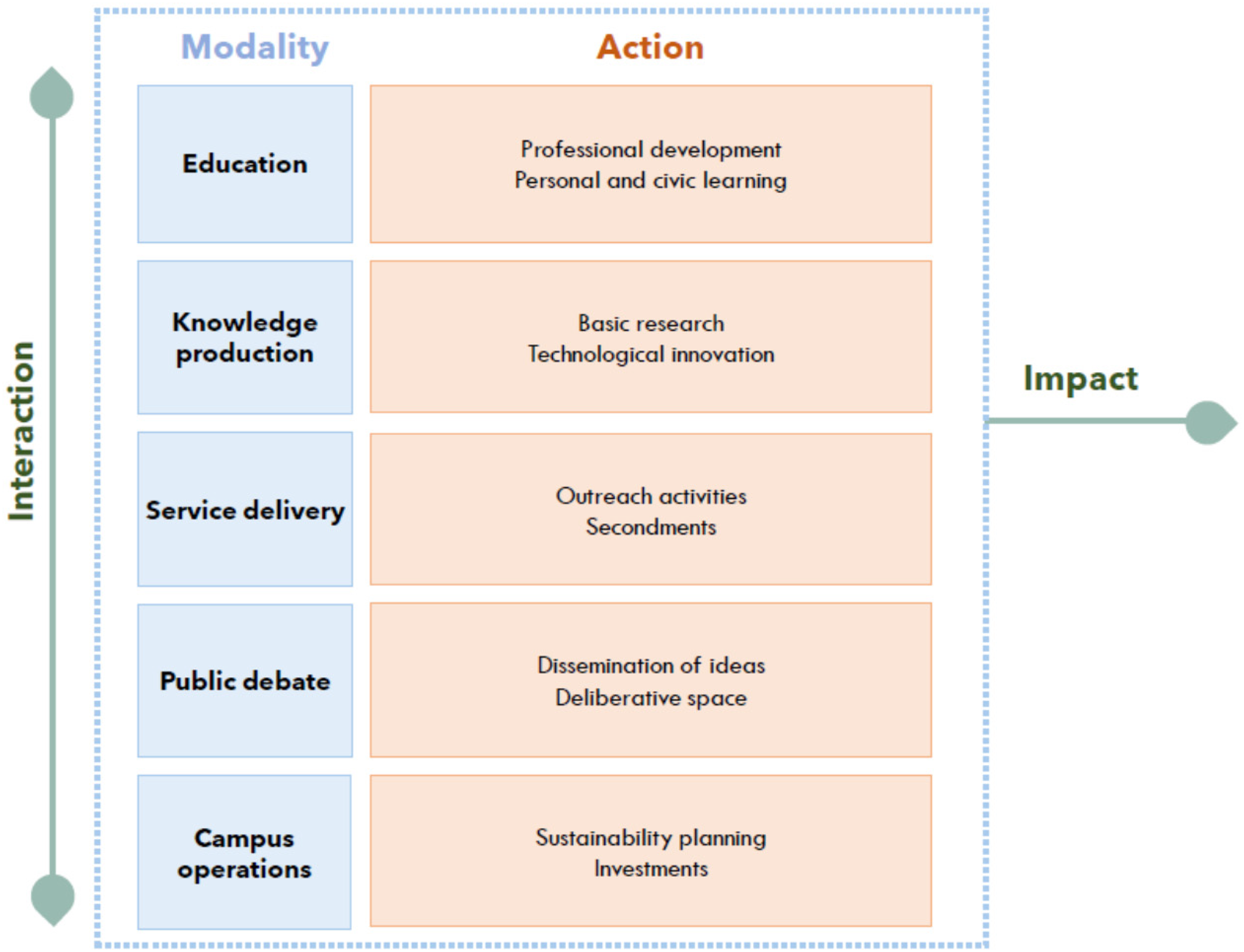
University modalities.
Education covers the activities of teaching and learning in formal courses at undergraduate and graduate levels, as well as non-formal education in other spaces of the university (as explored in McCowan, 2021). Knowledge production covers research and scholarship of a ‘blue skies’ nature, as well as applied research, innovation and development of technology. There are broad range of activities encompassed by the modality ‘services’, 1 designating those activities which directly serve citizens or support the work of other organisations or communities, for example provision of hospitals and legal clinics, professional development programmes, consultancy and secondments to government or the private sector. Public debate involves promoting spaces for deliberation, as well as the communication of research findings and political mobilisation. Finally, campus operations refer to the organisation of the physical university space, its staff and students, and the impacts that they have directly on the ecosphere. 2
There is a wide diversity of different kinds of activities undertaken under these five banners, and indeed not all of the five are practised in all institutions. Most notably, many institutions focus on teaching, and have minimal activities in the sphere of knowledge production, services and public debate. There are a series of factors (of a cultural, economic and political nature) that determine the nature of these five modalities, constituting movement from the far left of the diagram (their ‘conditions of possibility’ [Unterhalter et al., 2018]). The modalities also influence each other – the quality of interaction. Depending on the institution, there are greater or lesser degrees of porosity between the different modalities, and/or deliberate attempts to integrate.
The final dynamic, and the one of most interest in this article, is the impact of these various activities. Figure 2 below shows the possible trajectories of impact on the ecosphere, passing through two intermediary stages. The first of these is denominated ‘bridging actors’, those individuals or communities which come into direct contact with the university. This category involves communities involved in local engagement projects, as well as organisations commissioning research and consultancy, but the primary constituency is the large number of graduates who emerge from various degrees and move out into society, taking with them the influences gained. There are also actors from within the university (students and staff) who serve as bridges with external communities, but here the focus is on those outside the institution.
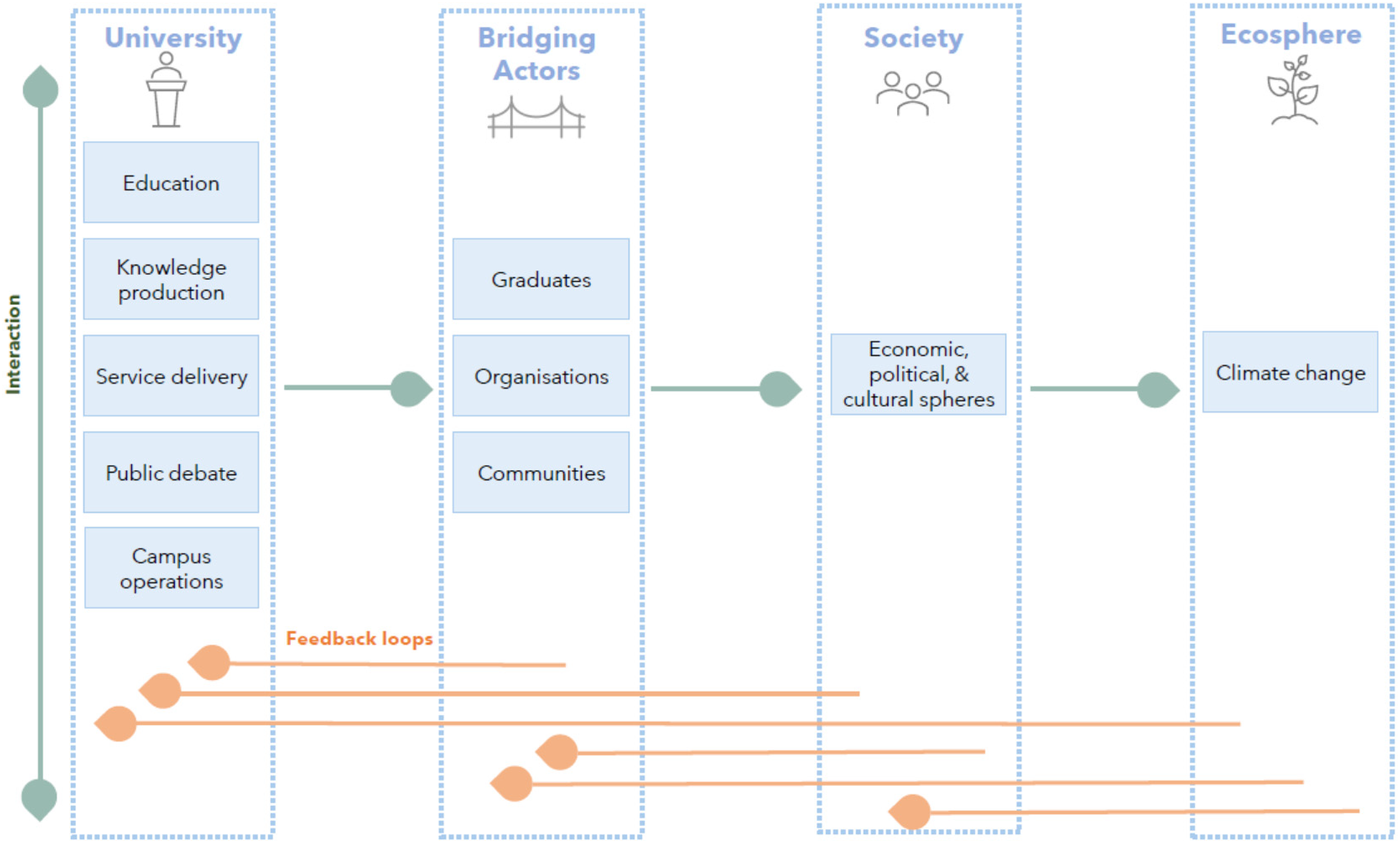
Stages of impact.
These bridging actors influence the broader society in various ways, through their professional activities, civic engagements and everyday interactions. Yet the influences of universities on the broader society do not only go via bridging actors, there are also direct channels. Universities produce technologies that are taken up by households and industries, provide policy advice that shapes governance, and generate research and develop ideas that gradually filter into popular conception. Higher education also plays an important role in society as a mechanism for distribution of opportunities, offices and resources, serving either to promote social mobility or entrench inequalities and hierarchies. Some of these influences are positional, operating on a zero-sum game basis, without providing net benefit to society, and there is significant variation in the extent to which universities produce public goods, with trends towards marketisation privileging the private ones (Marginson, 2011; McCowan, 2019). These more diffuse influences are hard to measure, and may occur over a long timeframe, but can be highly significant.
There are also direct impacts on the ecosphere. Universities have their own emissions of greenhouse gases from their campuses and the activities of their staff and students. The standard frame for categorising these omissions is scope 1, 2 and 3: those arising from its fuel usage (1), from purchased electricity (2) and upstream and downstream activities (commuting, investments etc) (3). The impacts of universities therefore can take various pathways, either going straight from stage I to stage IV (e.g., international student flights), or moving via society (e.g., use of energy-efficient household appliances) or via bridging actors (e.g., professional development of environmentally aware engineers).
Naturally, the impact of universities on society and the ecosphere is not the only direction of influence. There is also movement from right to left, constituting feedback loops and further independent impacts. The impact of the ecosphere on universities is likely to become more obvious and dangerous as the impacts of climate change worsen, as explored by Alexander. (2023, in press), along with changes brought about in human societies, for example migration and refugees (Ergin et al., 2019). Societies shape the policies, funding and cultural backdrop within which universities function, and bridging actors influence them directly. There are, therefore, multiple influences, and ones that are too complex to show in full on a single diagram.
The above frame, therefore, represents a general tool for understanding the diverse trajectories of impact, to help us understand the various components of university work that we need to take into account, and to gauge the configurations of interaction and impact of these elements. Yet how are these processes and outcomes influenced by internationalisation? Does the process of internationalising the university enhance the capacity of universities for contributing to climate action, or exacerbate the negative impact, or both simultaneously?
University Impact in the Context of Internationalisation
Internationalisation of higher education manifests itself in many different ways, including attracting students from elsewhere in the world, international mobility of home students, an international staff body, diversified curriculum, research collaboration, global research focus, and global impact of research, amongst many others. There has been extensive attention paid to categorising the diverse forms of internationalisation, with the most prominent distinction made between ‘internationalisation at home’ (incorporation of global perspectives into the curriculum) and ‘internationalisation abroad’ (student and staff mobility, and transnational education) (De Wit & Altbach, 2021). While making use of this distinction, for the purposes of this paper another categorisation will be introduced: that between actors – who is involved? - practice – what is happening? – and influence – who or what is affected?
Internationalisation involves diversification of actors – the people involved in universities: most obviously the student body, but also the make-up of academic staff, the collaborators in a research project and the bodies commissioning consultancy. It also involves changes to the activities carried out and the way in which they are conducted (practice). So in the curriculum it involves a diversification of subject matter and epistemic framing, in research and community engagement it involves changes in the geographical focus of activities. It also involves changes in the influence of those activities. The graduates of an institution may return to their home countries and take with them the attributes acquired, applying them in their professional, civic and personal lives. Innovation and basic research are also disseminated at a global level to an increasing extent.
While these three elements are intimately linked in practice, it is analytically useful to separate them out, as they exist in varying configurations and with different implications (both generally and specifically relation to climate change). For example, a university can have a largely national student body, but still incorporate an internationalised curriculum; conversely, a university may have a highly internationalised student body for revenue generation purposes, but maintain a narrow nationally-focused teaching and learning experience. In relation to research, some institutions achieve global reach with their findings and publications (on account of the high standing in which their researchers are held) despite not having close engagement with issues and researchers in other contexts.
These questions relating to actors, practices and influence are ones that we can pose of any internationalisation initiative. The choices for each of these will have impact on climate change, either through direct impacts (emission of greenhouse gases, mitigation or regeneration) or indirect impacts (through influences on individuals, society and technology). It is important to emphasise from the outset that internationalisation is not an either/or. No universities are exclusively local or national, and no universities are purely international. There is a continuum of internationalisation, or perhaps continua, operating in parallel in relation to the different dimensions identified above (student body, curriculum etc). This section will assess the influence that the movements along the continua of internationalisation have on climate action through each of the five modalities of education, knowledge production, services, public debate and campus operations.
Education
The education modality shows well the contradictions involved in internationalisation. On the one hand it is the most prominent cause of greenhouse gas emissions through the flights of international students, and on the other it represents the most powerful potential means of transformation towards a sustainable world. The most obvious manifestation of internationalisation of higher education is student travel. 3 The greenhouse gas emissions arising from transport (predominantly air travel) are the most tangible and best documented of all impacts of internationalisation. There is also mobility of academic staff for the purposes of teaching, either between different institutions or amongst the international branch campuses (IBCs) of a single organisation. Internationalisation of actors is, therefore, predominantly negative in terms of its direct impacts. There have, however, been efforts in a number of institutions to mitigate these impacts, through moves to online education (reducing student travel) and online conferences and meetings (reducing staff travel), as well as carbon offsetting and broader moves towards net zero campuses. The establishment of the Climate Action Network for International Educators (CANIE 4 ) and its accord for higher education institutions (CANIE, 2022) shows the increasing awareness in the sector of the need for concerted action.
In addition to these direct impacts, there are ones occurring indirectly – through the value of a diverse student body and the linkages with internationalisation of the curriculum and global influence. Internationalisation of the student body brings a dramatic change in the influence of universities through their graduates, as – even allowing for a proportion who remain to work in the countries in which they studied – most will return to their countries of origin or to a third country, thereby contributing to global circulation of ideas and skills. Having diverse perspectives in the classroom aids in understanding the complex nature of climate change, involving difficult compromises between the interests of different countries: and for those travelling it can be a life-changing experience fostering more pro-environmental attitudes (Campbell et al., 2022; Wynveen et al., 2012). These outcomes are not inevitable, but depend on how internationalisation is curated: in some cases the international student body may be fairly homogeneous, or if diverse, that diversity may have little impact on academic culture, with other knowledge traditions subordinated to mainstream, Western ones.
In terms of practice, many publications have advocated for internationalisation of the curriculum, intercultural understanding and global citizenship (e.g., De Wit & Altbach, 2021; Ilieva & Tsiligiris, 2021). In relation to climate change specifically, this diversity of perspective is crucial given the inevitably global nature of the issue, and the need for new forms of thinking to address complexity, and to draw on the resources of indigenous knowledge (McCowan, 2022a). One of the rationales for internationalisation (e.g., Qiang, 2003) is to equip graduates for the global workplace, interacting with people from diverse cultures, languages etc. This rationale is also relevant to climate change, given the need for international working. However, some of these forms of internationalisation are pernicious in relation to climate change if they are wedded to paradigms of global employability at all costs, prioritising individual career advancement and corporate profit above public good and environmental protection. In some cases these aims are embedded within marketing strategies and explicit graduate outcomes (sometimes problematically merged with notions of global citizenship), but in others they are implicit or unwittingly supporting a predatory transnational elite.
Knowledge Production
Internationalisation of research also presents diverging implications. On the one hand, it is widely recognised that international collaborations in research are not only highly esteemed, but also lead to impactful and high quality outputs (Gazni et al., 2012). As emphasised above, in relation to climate change these forms of collaboration are particularly important, given the global and multifaceted nature of the phenomenon. These positive benefits stem not only from the ‘actors’ component, but also the ‘practice’ and ‘influence’ ones, in engaging with diverse contexts in research and innovation, including comparative perspectives. Although rarely achieved in practice, these forms of collaboration can also display an ‘ecology of knowledges’ (Santos, 2015), when juxtaposing and bringing dialogue between diverse epistemic perspectives, languages and worldviews. International dissemination of research naturally increases its reach and influence, and also enables a global dialogue.
However, there are also some pitfalls of internationalisation of knowledge production. While not reaching the levels of student mobility, the transport of academic staff through mobility, fieldwork and conferences is also a significant cause of direct emissions (Bjørkdahl et al., 2022; Gill, 2021). These forms of travel are not without their value in research terms, so there will inevitably be some trade-offs to be made. There are also potential indirect downsides: international research collaborations have historically been dominated by elite institutions located in the Global North, at worst reducing partners in the Global South to data collectors, while analysis of collaborative publications shows that they are dominated by high-impact, Western institutions (Gazni et al., 2012). While more attention is now paid to genuine partnership and avoiding asymmetrical relationships, these patterns are still entrenched (Grieve & Mitchell, 2020). With the global science and publication system heavily weighted in favour of high-income English-speaking countries, there is a danger of non-central cultures being reduced to the ‘local’ and marginalised from the debate. These potential drawbacks are not inevitable, however, and should not dissuade universities from engaging in diverse forms of international collaboration in knowledge production.
But just as we need to move from mitigation and adaptation to regeneration in environmental terms, so we need to move from simply avoiding or reducing negative forms of research collaboration to creating new transformative ones. Coproduction with diverse communities and participatory action research can both empower those usually marginalised from knowledge production processes and enhance the quality and relevance of research, putting in place the conditions for social and environmental regeneration (Climate-U, 2021).
Services
The services modality can involve a range of different activities, and varies dramatically from institution to institution. In the case of large institutions corresponding to Clark Kerr's. (1963) ‘multiversity’, these will be extensive and involve hospitals, spin-off firms, sporting and artistic facilities for use by local communities, environmental services and wide-ranging consultancy and secondments of staff. Not all of these will be significantly influenced by internationalisation and may continue to take place within a largely local and national remit, particularly if they require physical access (e.g., a health clinic). But internationalisation leads to some services being provided globally, for example consultancy and technical support conducted at the international level, facilitated by developments in information and communications technology (as well as increases in international travel).
These varying forms of technical support might have negative consequences in involving unnecessary flying of experts around the world, with direct and indirect influences: direct in terms of the emissions, but also indirect in undermining local expertise and reinforcing dependency. The positives include cross-fertilisation of ideas in the application of knowledge between diverse contacts, and also between diverse sectors of society.
Public Debate
Extending the public debate role of universities internationally is vital in relation to climate change, with awareness raising, deliberation over possible solutions, considerations of justice, and learning from alternatives taking place beyond national boundaries. Developments in technology, in particular the internet and social media, have meant there are real opportunities for making public engagement global, although some fora will still remain local and national. Cross-cultural communication and debate is facilitated by linguae francae, in particular English, though herein lies a risk of asymmetrical opportunities for participation, privileging those who have English as native tongue, or have had high quality education in the language, and marginalising others. There are number of other factors that also hinder the equal participation of certain groups in debate, even in conditions of formal equality, so attention is always needed to barriers to voice, expression and contribution – both as a question of justice, and in order to maximise the possibilities of creative solutions being found.
Campus Operations
In most cases, campus operations are by definition a local matter. While internationalisation may bring international students and staff onto campus – and increase the total number, and therefore the environmental impact – the traditional campus remains bounded in physical, local space. Greenhouse gas emissions of course are inevitably global, so this aspect is and always has been internationalised in terms of its influence, regardless of the actions of the university.
However, there are some new developments that affect how we understand campus operations. The development of online education has reduced the emphasis on the physical campus, and in some cases has led to entirely virtual institutions. The environmental implications of these virtual campuses are distinct: while there is a significant reduction in transport costs, the energy usage of powering the computer systems must be factored in. A second development is the increase in transnational education of a face-to-face nature, primarily through IBCs. Management of a network of international campuses may significantly decrease international travel, but may bring some environmental costs, particularly if it involves mobility of staff and students from the ‘home’ campus.
While we think of campus operations primarily in terms of negative impacts – scope 1, 2 and 3 emissions – there is the possibility of transformative action, in the form of regeneration. While this process may occur independently, there are ways in which internationalisation can enhance the human and environmental forms of regeneration, in a similar way to ecotourism – as argued by Lee and Lundemo. (2021). Furthermore, internationalisation can enhance campus sustainability through bringing an awareness of the global ramifications of local actions.
The sections above have outlined some of the prominent implications of internationalisation of higher education for climate change. Not all of these will apply for all institutions, and there will inevitably be others not listed here – institutions should carry out this mapping process in accordance with their specific contexts. It is important to highlight also that – with the exceptions of outcomes in the form of measurable greenhouse gas emissions – categorisation into positive and negative is challenging, with many activities having shades of both, and needing nuanced treatment. Furthermore, the complexity of the climate system (and the higher education system) is such that many impacts are unpredictable, especially in the medium to long term, so flexibility and constant monitoring and revision is required.
An important task, therefore, is for universities to carry out their own diagnosis of activities. The figure below represents a kind of diagnostic tool that might be used, using the example of the education modality. For this figure, the direct impacts are listed on the left hand side, and the indirect ones on the right, with the positive influences towards the top half, and the negative ones towards the bottom. The influences are colour-coded in relation to the dimensions of actors, practices and influences. As stated above, there is no neat binary between positive and negative impacts, and the reality is one of a continuum; many activities will have elements of both, but will veer one way or the other Figure 3.
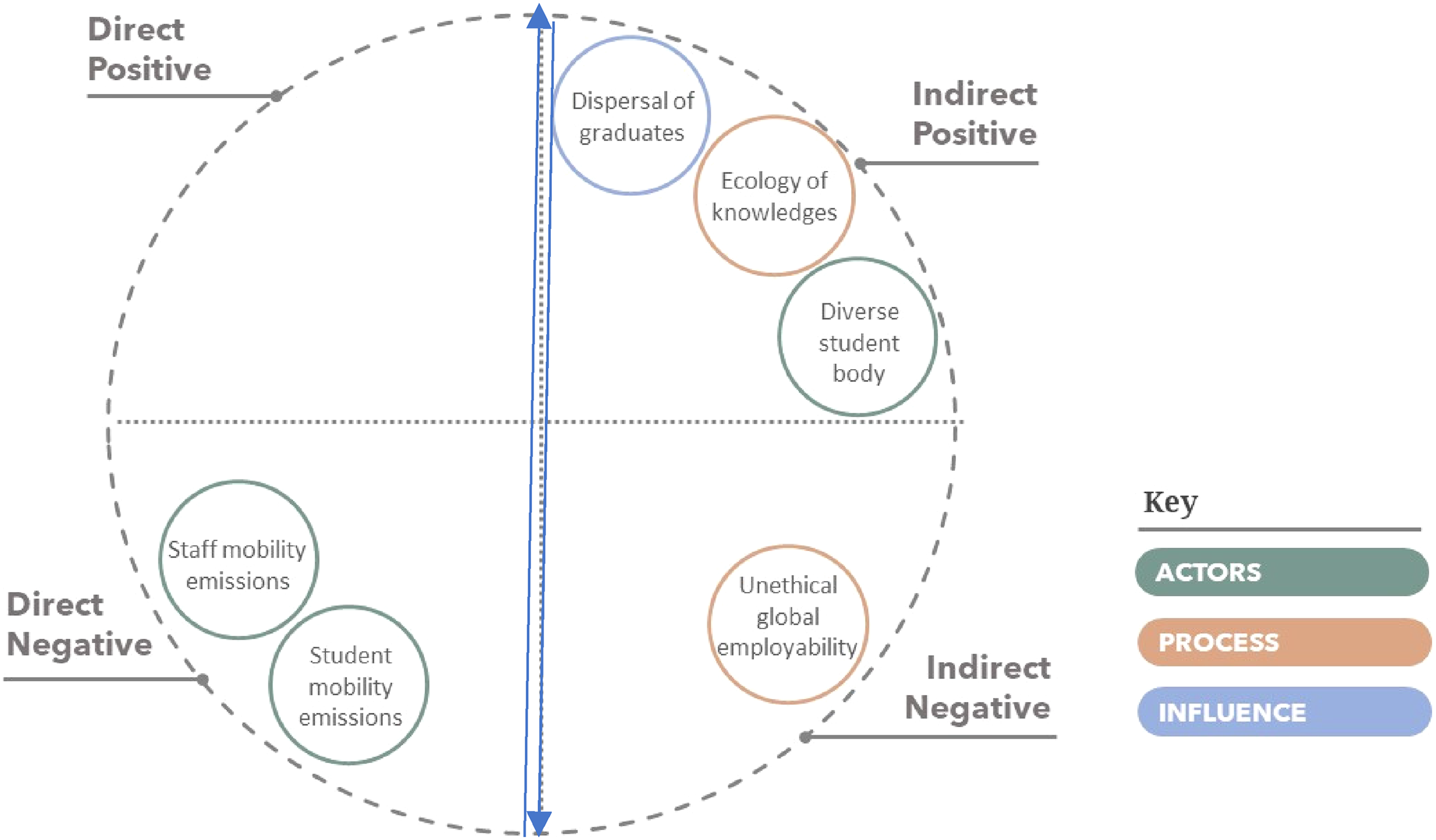
Prominent climate impacts of the education modality.
Inevitably, looking at this diagram (and indeed looking at the central contradiction of internationalisation of higher education), there will be an urge for comparison between different activities. A university might pose the question: if we maintain our high levels of international students and increase our research into clean energy usage in Africa, will the latter cancel out the former? In most cases, these kinds of comparisons cannot be made precisely. The direct emissions of various activities can be compared, but rarely the indirect impacts. In some cases the issue is the difficulty of quantitative measurement; in others impact is diffuse or occurring over a long timeframe, making difficult any kind of assessment (McCowan, 2022b). Cordero et al. (2020) attempt with some success to convert university learning to tons of CO2 emissions, though not all indirect impacts will be so amenable. It is possible to trace the graduates of a module, but not all of the audience of a radio programme, for example.
Further challenges of comparison are raised when we are dealing with regeneration (Lee & Lundemo, 2021) – of not only decreasing greenhouse gas emissions (mitigation) or finding ways of living with changes in the climate (adaptation), but in transforming our communities and natural environments for a flourishing future. Nevertheless, while we must accept that some impacts occur but can never be adequately gauged and attributed, there are creative ways in which comparisons can be made and trade-offs understood, and holistic assessments made. In any event, while some prioritisation will always be necessary, universities will normally need to be working all of these areas simultaneously.
Dynamics of Impact Through Internationalisation
The discussions above have to a large extent assumed impact to be a unitary force emanating from universities (although with potentially positive or negative impacts on society and the environment). Yet it can vary in significant ways. Three of these characteristics are particularly important: first, intensity – the strength of the influence, for example if the impact of learning about renewable energy alternatives has been relatively superficial, or alternatively profoundly life-altering, leading to a permanent shift away from fossil fuels. The second is timescale: the speed with which the impact takes place. There is significant variation in this factor, with some influences being immediate – for example the publication of a groundbreaking discovery about ice loss, accompanied by extensive news coverage and policy debate; and others being very gradual, for example the uptake of electric cars across a population. The final factor is reach. This factor indicates the extension of the influence, in other words the number of people affected, and the spread across locations and countries. The element of scale is acknowledged to some degree in the movement between the phases of bridging actors, society and ecosphere, in the movement from the more particular and local to the more diffuse. Yet there is still substantial scope for variation within each of the phases.
These three characteristics interact. Some impacts will provide a subtle influence over a large proportion of the population, while others will lead to a major transformation but in a restricted number of people. Normally one would expect an inverse relationship between intensity and reach – so the more focused the impact is the stronger it will be, and the more dispersed the weaker (though this is not always the case). Some university impacts will be low intensity but act over a long time, whereas others will be strong and short-lived. In some cases the level of intensity will change over time, either growing stronger or weaker. There may also be interactions between reach and timescale, with influence becoming broader over time: though there are certainly exceptions, particularly in the internet age, in cases of almost instantaneous global uptake of an idea.
What impact then does internationalisation have on these dynamics? The previous section has analysed the ways in which internationalisation manifests itself within the five modalities, and knock-on impacts on climate change. Intensity, timescale and reach are closely bound up with the modality in question: so for example, the timescale of impact of campus operations is usually more immediate than research, and the reach of a legal clinic is usually more restricted than a social media post. Internationalisation, therefore, operates within the bounds of these modality-specific dynamics. However, there is an obvious influence on the third characteristic reach through internationalisation, with actors, practices and influence inevitably expanding. So, universities extend the reach of their teaching through IBCs and distance programmes, the influence of their international graduates extends potentially throughout the globe, and the partnerships forged with institutions in other continents and dissemination through international journals brings their research to global audiences.
These dynamics can be seen on the figure below. Internationalisation is constituted by changes in actors and practices, and then via the five modalities on the influence, moving between local, national and global levels. Influence demonstrates varying levels of intensity, reach and timescale Figure 4.
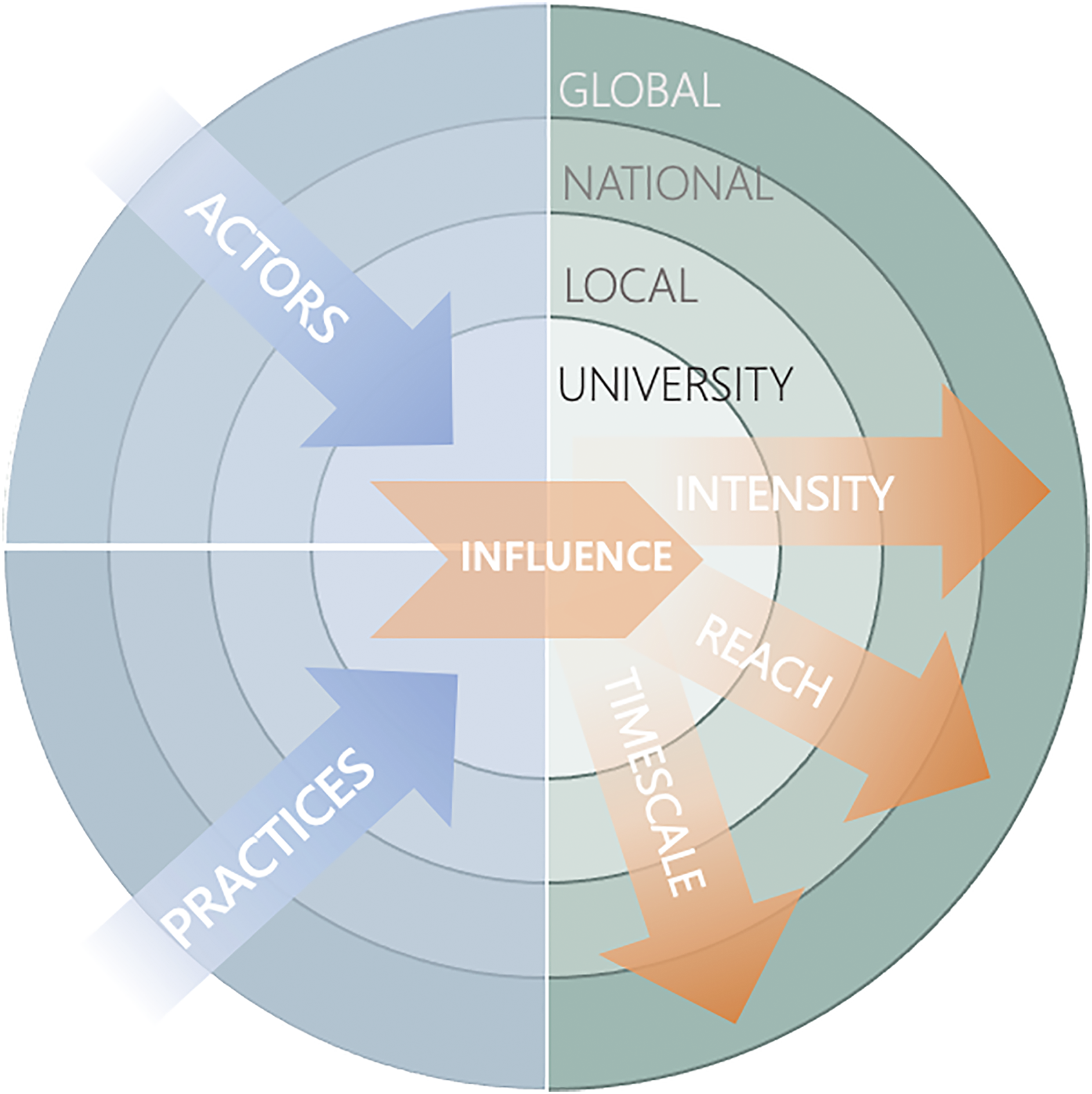
Dynamics of impact through internationalisation.
Universities vary in their focus of engagement, with some having intense impact in their local area, though with less visible global impact, while others focus on their global reach, but may have less contact with their local communities. All universities have concentric circles of influence, though they may be more strongly concentrated close to themselves, or more distantly. Does global reach spread out gradually from the university to the local, national and global, like ripples from a pebble thrown into a pond? Some forms of influence may well move like that, in the vein of the Malcolm Gladwell's. (2000) tipping point, describing the movement of viruses, ideas, behaviour and fashion. Yet it is possible for global reach to bypass the local and even the national in the internet age. This is the case of social media engagements, when an academic's tweets may have repercussions on the other side of the globe, but not in the local community; or when a university may be publishing and disseminating its research for global not local audiences – both of these dynamics intensified when the language (e.g., English, Spanish, French) is not spoken by the local population. 5
This figure can again serve as a mapping tool for institutions and systems of higher education in understanding the influences of their activities across different scales. In contrast to reductive notions of impact, it is important to acknowledge the potentially long-term ramifications of learning and scholarship, the varying intensity and reach of influences, and the multidirectional movements between university, local, national and global.
Conclusion
Given the interlocking global crises, the question facing universities in the context of climate change is not whether to internationalise, but of how to do so – as discussed in relation to the divergent rationales for internationalisation (e.g., Knight, 2004; Buckner & Stein, 2020). The five modalities analysed above present significant choices for universities in this regard. The ways in which this process occurs, and the people it involves, determine the extent to which internationalisation can drive sustainability and regeneration, or alternatively environmental degradation and climate injustice. It is hoped that the framework presented here will contribute to unpicking the multiple forms of influence that universities have on climate change, and provide a basis on which to maximise the possibilities of addressing the crisis.
The influence of internationalisation on the reach of university impact would normally be considered a very positive thing for a university. As long as expanding influence to the national and global does not negatively affect universities’ potential for local impact, then it is surely desirable. But what are the implications when we look beyond individual universities to the global system of higher education? In considering a ‘wicked' problem such as climate change which inevitably requires collective actions, it is essential for us to think not only how a university impacts climate change, but how a system of universities impacts climate change.
Currently there are severe inequalities in global higher education, in terms of proportions of population enrolled, resources available and recognition of quality. These inequalities mean that universities do not interact on a level footing in a global system, with vast disparities of income, and with some institutions having global recognition (listed in the international rankings, engaging in elite academic publishing, attracting international staff and students) and others limited to national or local recognition. The issue here is not differentiation. It is not inherently problematic that there are universities with different areas of focus, some more locally-oriented, and others more globally-oriented. There are important contributions to be made in working closely with local communities (in climate-related adaptation and regeneration) and in teaching students originating from local communities. The problem is that these foci are closely linked to levels of resource and public recognition, with those locally-oriented institutions often unable to fund a basic level of teaching and learning quality, pay their staff an adequate salary and so forth.
A few globally active universities can do much in a global crisis, as was seen by the work carried out by institutions such as Johns Hopkins University (monitoring infections and deaths) and University of Oxford (vaccine development) in the Covid pandemic. But this kind of action will never be sufficient in the context of a challenge like climate change, which is rooted in societal structures and everyday practices, and will not be solved by technical breakthroughs and advances in knowledge alone. The global higher education system we need may, therefore, have some differentiation, and not all institutions may have the same level of global reach and types of activity, yet they will all need to be vibrant and adequately resourced centres of intellectual activity and practice in order to bring about the necessary transformation. In addition, even locally-oriented universities will benefit from some aspects of internationalisation, through global intellectual engagement and providing opportunities for students to develop an international outlook, even if not attracting large numbers of international students to campus.
Does the need for complementarity in the global higher education system entail global coordination and governance? In fact, it may not be necessary to have any central coordination of a highly effective global higher education system: the task facing us may simply be to remove impediments and distortions. One of these is the international university rankings, which (in the mainstream versions at least) have significant limitations in the recognition they give to the contribution of universities to climate action in the context of internationalisation. The proxies used for internationalisation do not capture many of the most positive dimensions (relating to the creation of an ecology of knowledges), and provide little recognition of local impact (Molebatsi & McCowan, 2022). Furthermore, they promote competition between individual universities, rather than the cooperation and complementarity within and between countries that is needed for effective climate action.
Horizontal differentiation between institutions may bring further benefits in terms of a global ecology of knowledges. Internationalisation at home may bring benefits of dialogue between different cultures and knowledge traditions, but that dialogue is only possible if a diversity of cultures and knowledge traditions still exists and has resisted the marginalisation of globalisation. Internationalisation of actors brings possibilities of curriculum diversity in internationalised universities, but does pose the risk of a homogenisation across the whole system. It is important to promote epistemic pluralism and linguistic diversity globally, because of their inherent worth, but also as a means to addressing the climate crisis.
Internationalisation, therefore, is a process that is engaged in by individual institutions, in the context of national systems, but is also one that raises implications for the global system of higher education. Circulation of actors and ideas, and the extending of the reach of universities to a global space, inevitably raises questions of the relationships between them, and the distinctive roles they play in an interlocking system of higher learning, knowledge production and application. Climate change requires global solutions, but also close attention to local contexts, meaning that a complementarity of different forms of institution (in a context of horizontal resources and public recognition) is needed.
The analyses above point to two key dilemmas for internationalisation. The first is of how to provide experiences of engagement with difference without burning fossil fuels. Student and staff mobility bring great benefits for the individuals involved and knock-on positive benefits for society, but are unsustainable in their current formats and levels. The second is of how to ensure global reach and influence of universities without homogenising and marginalising (Buckner & Stein, 2020). Global circulation of information and ideas, public debate across borders and collaborations between institutions are highly beneficial, but can solidify hierarchies and monoculture. There are no easy ways out, and universities – in distinct ways in their particular contexts and conditions of working – must grapple with them over the coming years if we are to safeguard the future of humanity and the planet.
Footnotes
Acknowledgments
I am grateful to David Heymann and Knema Gardner for graphic design on the figures.
Funding
The author(s) received no financial support for the research, authorship, and/or publication of this article.
