




Abstract
Integration is vital to student well-being in higher education but integrating new students from different countries can be challenging. To ascertain students’ integration into their new environment, this mixed method study combined the data collected from weekly diary entries of home and international students at the start of one engineering program, with follow-up interviews. These students studied primarily online due to the pandemic. The diary entries focused on their adjustment to the program from an academic, social and pair work perspective. Results show that the students reacted slightly negatively to the academic experience but very positively to their pair work. It seems that the teacher-formed pair work helped to bridge the academic and social gap and not only alleviate some of the stress caused by assignments, but in some cases, provided new social contacts. The article concludes that structural factors within the course can facilitate interaction and thus support integration.
Keywords
Introduction
Academic and social integration are extremely important to student success in higher education (Rienties et al., 2014; Severiens et al., 2006). Research has shown that students who feel part of the university community, feel at home, participate in university activities, and/or feel connected to fellow students are more inclined to continue studying and more likely to get higher grades (Glass & Westmont, 2014; Severiens et al., 2006). But what is meant by integration? As a working definition for this article, we use the following: “the process of becoming a full member of a group or society, and becoming involved completely in its activities” (Macmillan dictionary, 2007, our italics). This definition broadens the concept of integration from being solely a process of friendship-making in social contexts to one in which students also form relationships through academic activities and become members of an academic community. It is also important to emphasise that integration takes time.
Investigating integration and pathways to promote it is crucial as higher education continues to become more internationalised. The number of students studying abroad and campuses with international students have increased dramatically this century and continue to do so (OECD, 2021). There are different challenges for integration, whether a student is a so-called “home” or “international” student – “home” student defined as a permanent resident of the country where the university is situated, and “international” student defined as a student who has left their country of origin and moved to another country for the purpose of study (OECD, 2021). For example, the university experience can be more stressful for international students (Rienties et al., 2014) and certain nationality groups can potentially have more difficulty integrating than others (Merola et al., 2019).
The gap between home and international students on campus is well-documented (e.g., Leask, 2009; Spencer-Oatey & Dauber, 2019a), leading at times to feelings of loneliness and isolation, particularly for the international students. The British Council amongst others raise the importance of integration of all students “not only due to immediate student outcomes of comprehensive learning and cultural awareness but also to long term benefits for the individual, the institution and the UK” (2013, p. 1). Hence, while integration is important for students in general for retention and well-being, it is even more crucial on the international campus.
An additional challenge to integration, in 2020, was the pandemic. Globally, and often with very short notice, campus programs went online, at least in part (Armoed, 2021). In Sweden, and the technical university where this study is situated, most teaching similarly took place online and since students were asked to work from home, international students could stay in their home countries. This physical distance and the ensuing digital contact created specific challenges as regards integration into campus life. The complexity of this situation invites a closer look at various dimensions of integration, beyond physical proximity of the students. Which aspects, academically and socially, support or challenge integration?
Two educational approaches that have been claimed to contribute to integration are problem-based learning (PBL) and team-based learning (Parrish et al., 2021; Severiens & Schmidt, 2009). Severiens and Schmidt (2009) followed three institutions who used PBL to varying degrees and concluded that this method encouraged both social and academic integration more than conventional teaching methods. Parrish et al. (2021) found that classes who met their teams physically experienced a greater sense of connectedness to their peers than those students who did not meet in teams or met their teams online. Thus, there is reason to believe that these two factors might be significant in the international classroom as well.
This study aims to examine the process of integration for home and international students working in pairs in an online-PBL based course. It focuses on engineering education where group work is very common as a way of solving complex tasks. Engineering education is also one of the most international programs, second only to business studies (OECD, 2021).
Academic and Social Integration
Since integration is vital for student engagement and success in their studies, various models have been presented to define it. One commonly used and influential integration model in education is Tinto's study (1975) on student retention, where he included academic and social integration as key components for a student in deciding whether to stay. While Tinto's study was on home student integration, his model has been applied to a variety of student settings, both home and international (e.g.; Rienties et al., 2012; Severiens and Schmidt, 2009). For Tinto, “academic” was loosely defined as both the normative and structural elements of the educational environment, for example, expectations of college life (normative) and grades (structural). “Social” refers to a student's social relationships and interaction while at college, for example in student societies. However, Tinto also emphasised the social within the academic sphere, pointing out that in some circumstances, the social needs to occur in the classroom (Tinto, 1997). Such a situation was the case during the pandemic. Tinto additionally noted the key role that peer groups serve both socially and academically, arguing that peer group contact “served to bridge the academic-social divide that typically plagues student life.” (1997:610). In this study, we maintain that relationship-building, which is fundamental to integration, takes place in the academic as well as the social sphere, as illustrated in Figure 1.
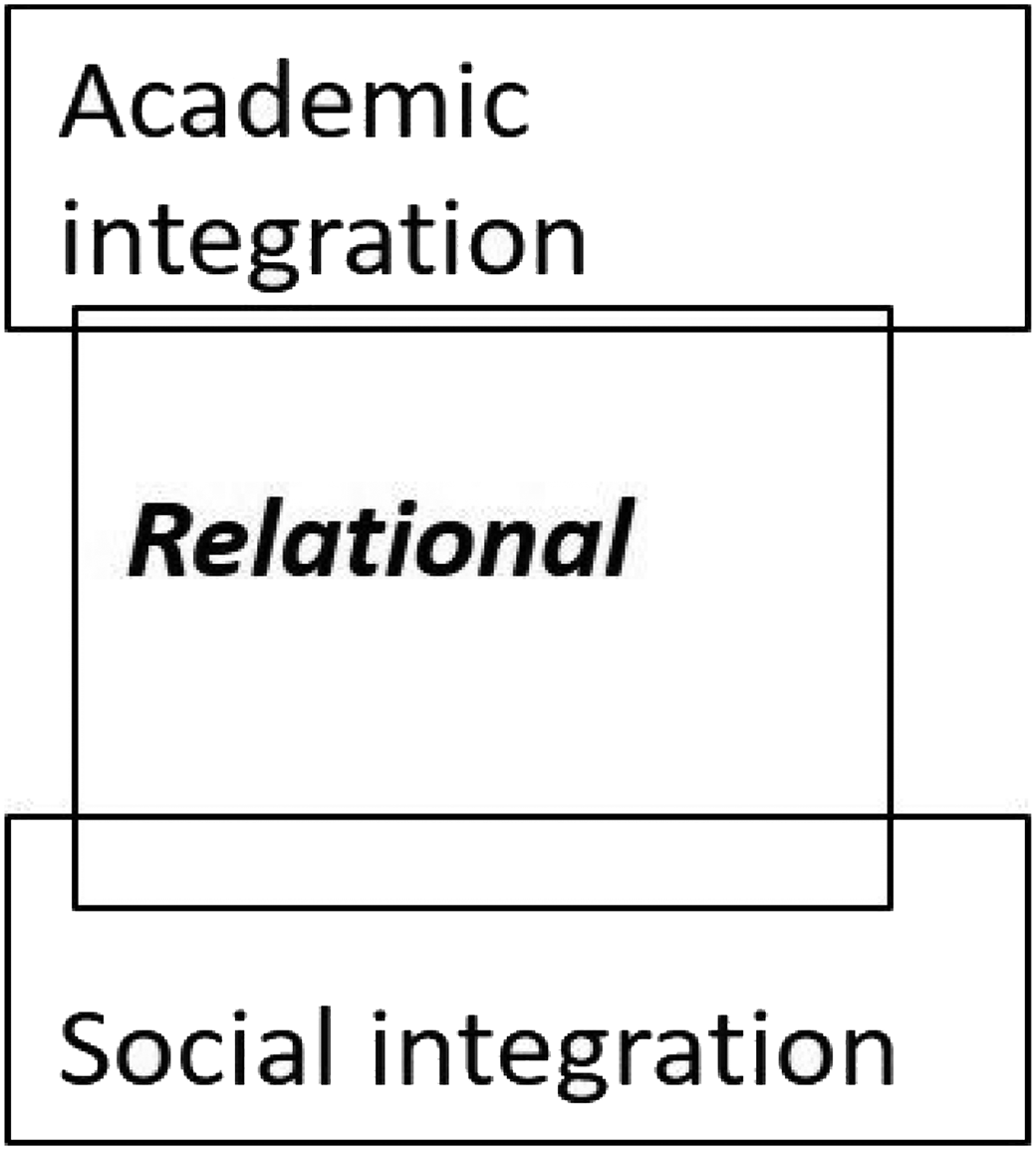
Adapted model of integration (based on Tinto, 1997).
Moreover, much work on integration has focused on the steps that students take (or do not take) to integrate. However, Spencer-Oatey and Dauber (2019b) argue that the responsibilities for integration do not lie only with the students; rather, they propose a three-level framework: individual level (e.g., individual student or member of staff), community level (e.g., a student cohort or academic program) and institutional level (e.g., university). They also distinguish between “human” and “structural” initiatives, where human interaction is juxtaposed with structural elements (e.g., internationalisation of the curriculum, support units) for which the department or institution is responsible. Thus, this study takes this broader approach to integration. In particular, it examines how far structural pedagogical decisions made about the course affected the ease with which students could integrate.
Studying in a Pandemic
One key aspect that might have affected integration in this study is that the students started the program during a pandemic. Though no studies have investigated the effect of the pandemic on the integration of students, some studies have examined student well-being. For example, Daniels et al. (2021) reported that university students’ achievement goals, engagement, and perceptions of success decreased while their perceptions of cheating increased. In connection to this, Holzer et al. (2021) emphasised the importance of perceived competence, autonomy and self-regulated learning among university students in working in this online environment. Other studies seem to indicate a link between students feeling highly competent and coping well online (Pelikan et al., 2021). On a psychological level, a local student union survey carried out in 2020 indicated feelings of loneliness and isolation, particularly among the international students.
The pandemic pushed online much of the groupwork that would have taken place on campus. Kolm et al. (2021) examined studies focusing on global virtual teamwork and emphasised the possible reduced team commitment and lower performance which can result from not meeting face to face. Reduced team commitment can be caused by lack of trust in the team (Cheng et al., 2016), which can lead to failed processes. Kolm et al. (2021) argue that groups working virtually need International Online Collaboration Competences (IOCCs) which include ICT, intercultural skills, communication, self-management, collaboration and domain specific skills in order to build trust and compensate for the lack of physical contact.
In summary, three main points arise from previous research. The first is that integration is important for all students both academically and socially. The second is that integration between home and international students is challenging. The third is that integration is even more challenging virtually. Thus, this study examined home and international engineering students’ experiences and adaptation to the academic and social environment when starting a new program during the pandemic. In particular, this study investigated integration through the pair work carried out as part of problem-based learning in this international, online environment.
These questions have been focused on:
Which factors helped and hindered home and international students’ integration into their study environment? How did the online set up affect the students’ integration?
Methodology
This mixed method study takes a constructivist perspective (Creswell & Plano Clark, 2011; Hua, 2016) where culture is seen as socially constructed, to capture the richness and complexity of the data. Data was collected in two ways: a structured diary which all students filled in every week for eight weeks, and follow-up interviews with eight volunteer students following the research process trialled by Beaven (2012) and inspired by Gu et al. (2010). In this way, the broader picture has been captured as well as the individual voices. While we have partially associated culture with nationality in grouping and describing the students, nationality has not been used as an indicator of behaviour, nor were conclusions drawn from nationality alone.
Setting / Participants
This study took place at a technical university in Sweden at the start of a two-year master's program broadly within the area of mechanical engineering. It focused on the students’ work in a compulsory course, where the majority of students were full-time students. At this technical university, as is often the case at technical universities in Sweden, only master's programs are given in English, therefore internationalisation is discussed primarily at graduate level. Of the total number of students on the course (64), 14 nationalities were represented where 39% were Indian, 25% Swedish and 10% Chinese. All students were new to the program, though the Swedish students had done their undergraduate education at the same institution. English was the second or additional language for the majority of students and lecturers.
The course used PBL pedagogy in the sense that there were three assignments for which workshops were provided to help the students. The assignments were 40% of the final grade and were open problems. Students were grouped in pairs for the assignments – the first assignment pair was set by the course examiner where pairs were randomly assigned (with the aim of mixing nationalities) and the second and third pairs were formed by the students themselves, on condition that they work with another nationality as far as possible. Otherwise, the course consisted of more traditional lectures followed by a final exam (60% of the final grade). In the results of this article, the term “assignments” refers to the three assignments carried out in pairs and the term “course work” refers to the individual student work to prepare for the lectures and exam.
Pandemic regulations in Sweden encouraged students and staff to work from home as much as possible and university education was online, unless it was essential to meet (for example, lab activities). This course therefore took place on Zoom, and all contact between teachers and students happened online. Some of the students were located abroad, at least at the start of the studies, and either came to Sweden during the course or were still abroad at the end. The campus was open to students, and they could meet physically if they respected social distancing regulations and were not showing symptoms.
Previously, the course had been given completely on campus with the only online component being the learning platform where the materials for the course were located. The only adjustment made to the online environment was having the lectures and workshops on Zoom. The students on this program were studying two parallel courses which ran over two months. In this iteration, the other course was also given completely online where the students also worked in pairs on assignments.
Data Collection
A convergent parallel design (Creswell & Plano Clark, 2011) was used for data collection to facilitate triangulation. It comprised semi-structured weekly diaries kept by all the students and follow-up semi-structured interviews with volunteers when the course finished, based on the diaries (Mittelmeier et al., 2021) as shown in Figure 2.
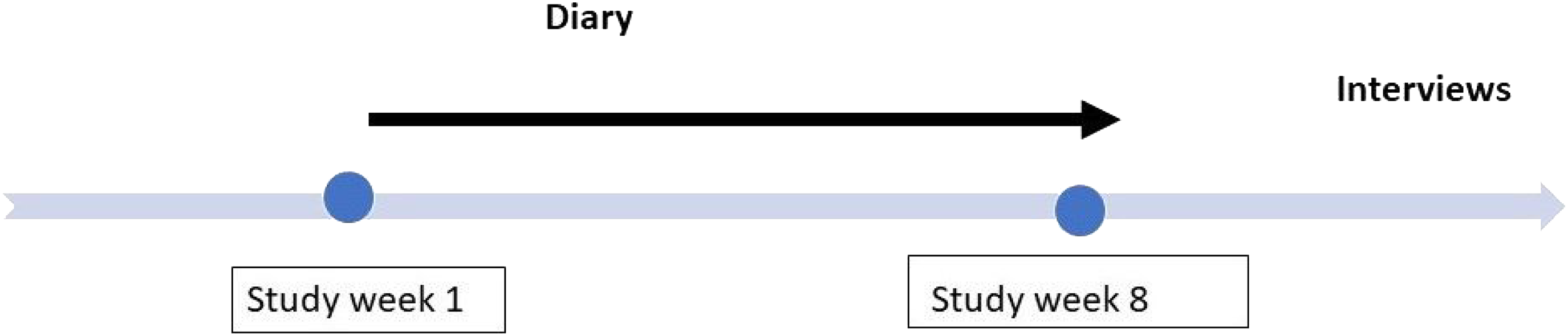
Data collection.
The diaries contained weekly prompts (Beaven, 2012) for the students to react to over a two-month period, which were divided into three broad areas: academic (the course contents, assignments and the level of English); pair work (the level of communication, respect for each other and the division of work) and social (friendships on the program, their social life at the university and day-to-day life). The students responded on a Likert scale from 1–6 (Jamieson, 2008) and with open comments. For example, one prompt from the academic area was “The course work is easy” to which students could disagree completely (1) to agree completely (6).
The follow-up interviews took place at the end of the course. Using purposive sampling (Bryman, 2016), the students who had completed the diary every week were contacted and asked to provide more insight into the comments given. Eight students volunteered, seven male students and one female student, five of whom came from India, one from China and two from other countries, neither of which were Swedish. Since Swedish students did not volunteer for interviews, the results focused particularly on the diary data which was completed by both groups and the interviews were used to support those findings. Pre-interview, the researchers summed up the students’ individual diary entries in a graph and included the comments for each week and section, which the student received before the interview. In the interview, generative questions such as tour questions (Saldaña, 2011) were employed (the student discussed what had happened at different stages of the course regarding the three areas of academic, social and pair). The interview also included a brief discussion of the student's background, based on a pre-course survey. The interview was carried out physically or online, according to the student's preference (Saldaña, 2011), then audio-recorded and transcribed.
Data Analysis
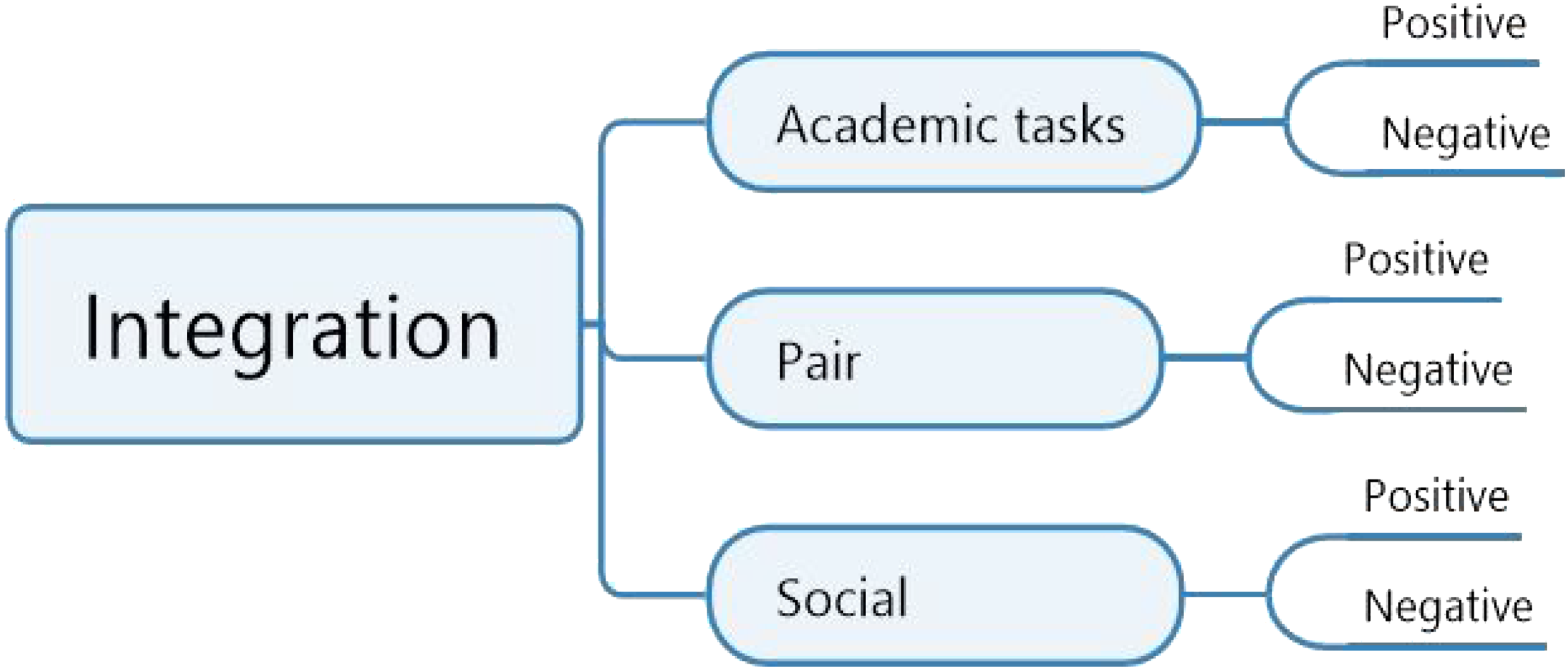
The main data (from the diaries and the interviews) was processed in the following ways. A descriptive statistical analysis was carried out on the Likert scale data to map any trends over time. Meanwhile, the comments made in the structured diaries were input into NVivo and codes and categories were formed using qualitative content analysis (Cho & Lee, 2014). Initial coding of the comments took place using process coding (Saldaña, 2011) and these codes were trialled with volunteer researchers before working with the emerging categories. The unit of analysis used was the whole comment made by the student, which at times was categorized in two or more places. For example, the student comment “Assignments are tough and a lot” was categorized under two places “high workload” and “high level of the material”. The initial categories were grouped into positive and negative comments for each of the sections, academic, pair work and social (see Figure 3) though a few fell into a neutral category, which were judged to be insignificant.
Average weekly diary responses to questions on academic aspects.
Diary responses to pair work questions.
Categories for coding of diary comments.
The transcriptions of the interviews were used for abductive interpretations of the diary data. This meant that the diary comments within a category were compared to statements made in the interviews to provide additional depth and richness. After the first coding and comparison with the interview data, the theme of online education emerged as interesting and the diary comments for all categories were recoded for this theme.
The study followed Swedish ethical requirements and GDPR regulations, in that participants completed a consent form, both for use of the diary data and the interview transcript. All information was stored in a secure location and students’ names were replaced with codes (P1, P2 etc). The main author had the role of lecturer in the course since she met the students at the start of the course and middle of the course for two workshops on working in diverse groups, but she was not involved in the grading of the course.
Results
In the light of the integration models presented earlier, the results focus on all the students’ reactions to their study environment, both home and international, and the impact of the course structure on the students’ integration (in the online circumstances). Three themes emerged from the data which affected integration both positively and negatively: high workload, affordances of pair work and issues with online learning
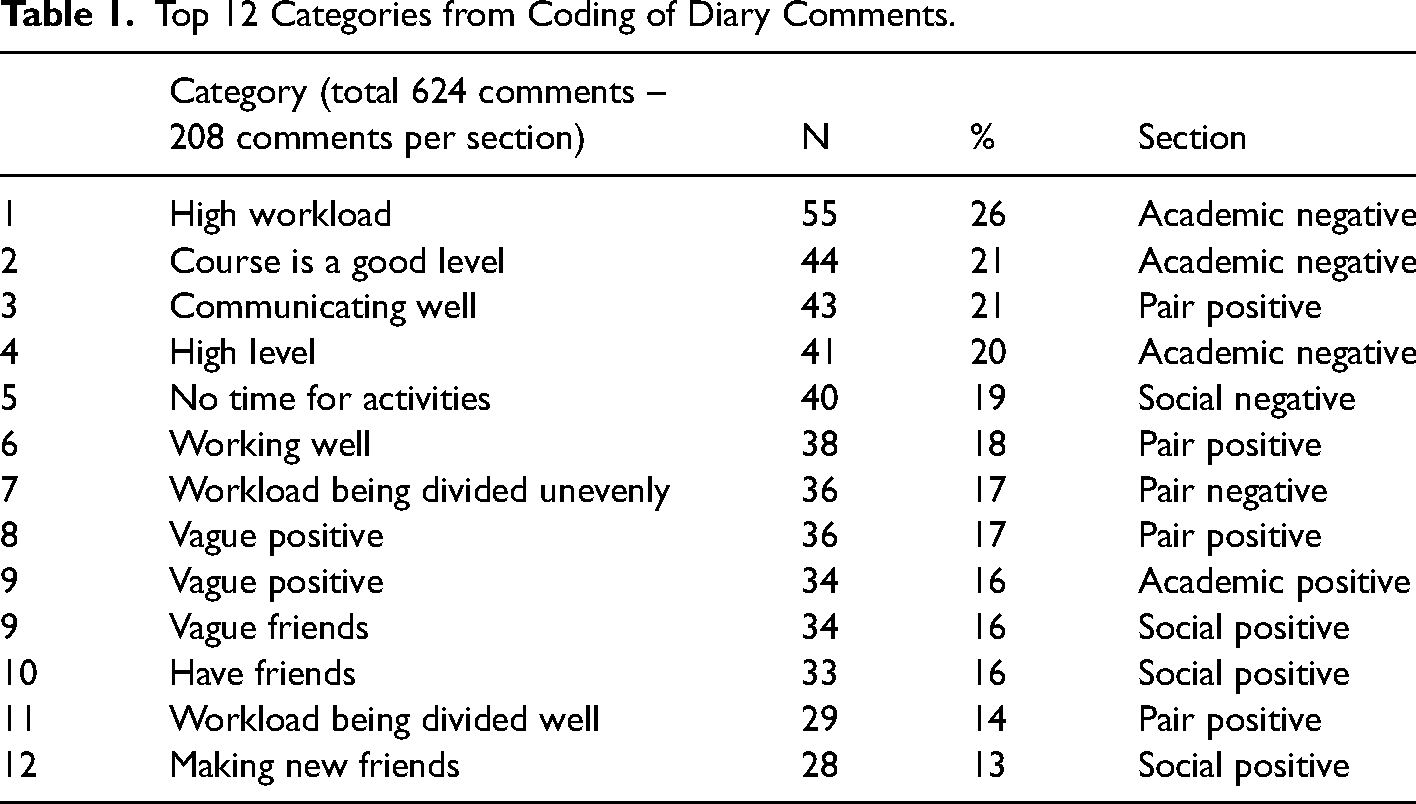
Table 1 shows the top 12 categories from coding the diary comments; the total number of comments was 208 for each section (academic, pair and social). The percentage given refers to the percentage of comments within each of the three sections. The following sections discuss these categories in more detail. All student quotations, from both diary and interviews, have been used verbatim, without correcting language issues.
Top 12 Categories from Coding of Diary Comments.
High Workload
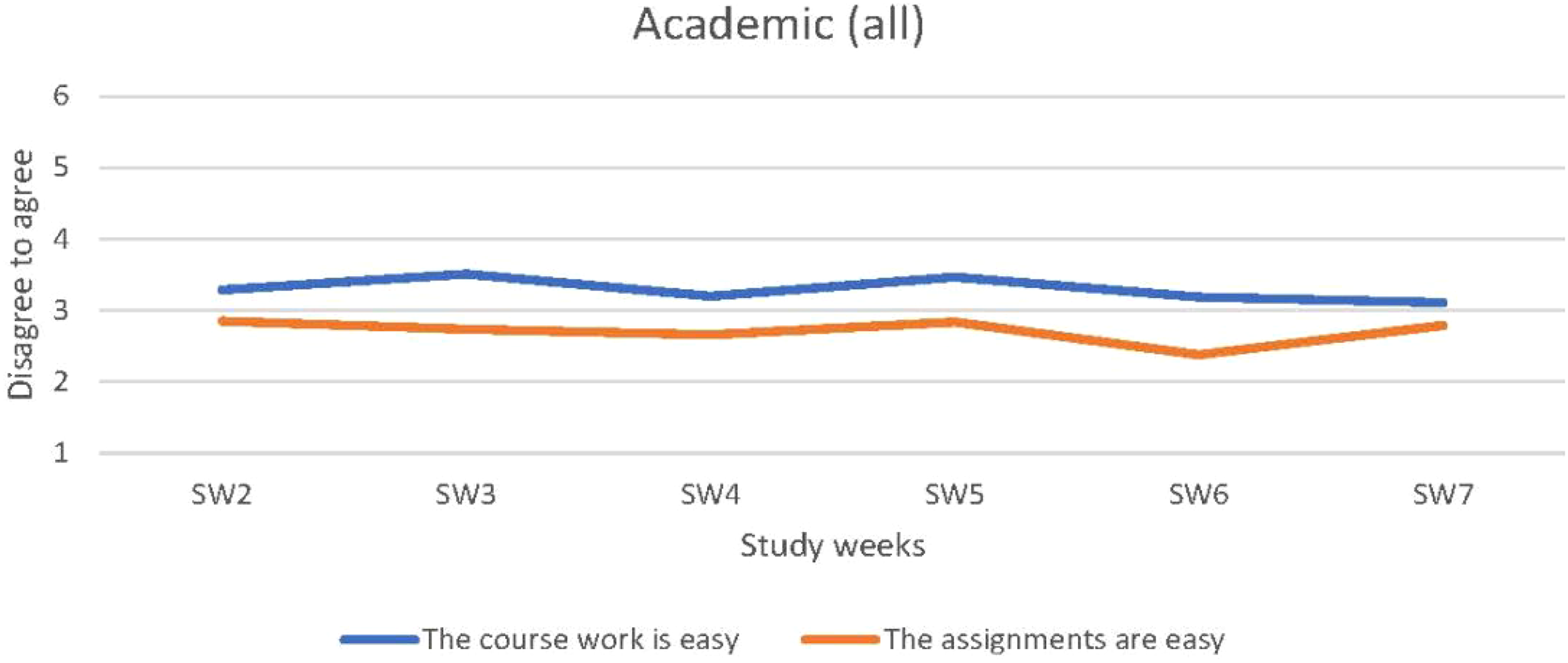
The largest number of diary comments concerned the high workload (26%) as shown in Table 1, specifically connected to the pair work assignments in the course. This high workload was presented as negative by the students. The majority of comments concerned finding time for the assignments, particularly if they overlapped with another course. The level of the assignments was closely connected to this (see category 4, Table 1). This issue did not become easier with time (see Figure 4):
As shown in Figure 4, the students responded to some statements about their studies on a range from “disagree completely” (1) to “agree completely” (6). Both course work (lectures) and assignments were experienced as slightly difficult by all students, with the assignments experienced as more difficult than the course work (between 2.23 and 2.85). The average for the assignments across all weeks was 2.71.
One contributory factor to the workload and level of the assignments, indicated in the diaries, was lack of prior knowledge and course expectations. As regards the former, the assignments involved using software, particularly Matlab (mathematical software), which some of the international students were unused to. As regards the latter, some of the international students also reacted to carrying out assignments during the course since some were used to a structure of only having exams at the end.
These reactions were supported in the interviews. P1 and P2 for example commented that the level of the course was fine, but they were challenged by the fast pace with the assignments, particularly the fact that there were overlapping deadlines. P4, an Indian student, felt that the assignments interrupted the “real” studying for the course which he felt should take place through reading the textbook.
Thus, the structure of the course became an issue as regards integration in part because it did not match students’ expectations. It also became a challenge for social integration outside the classroom since it took up so much of the students’ time. However, though the pace was perceived as problematic, the pair work which the assignments entailed was much appreciated, aiding the social side of integration.
Affordances of Pair Work
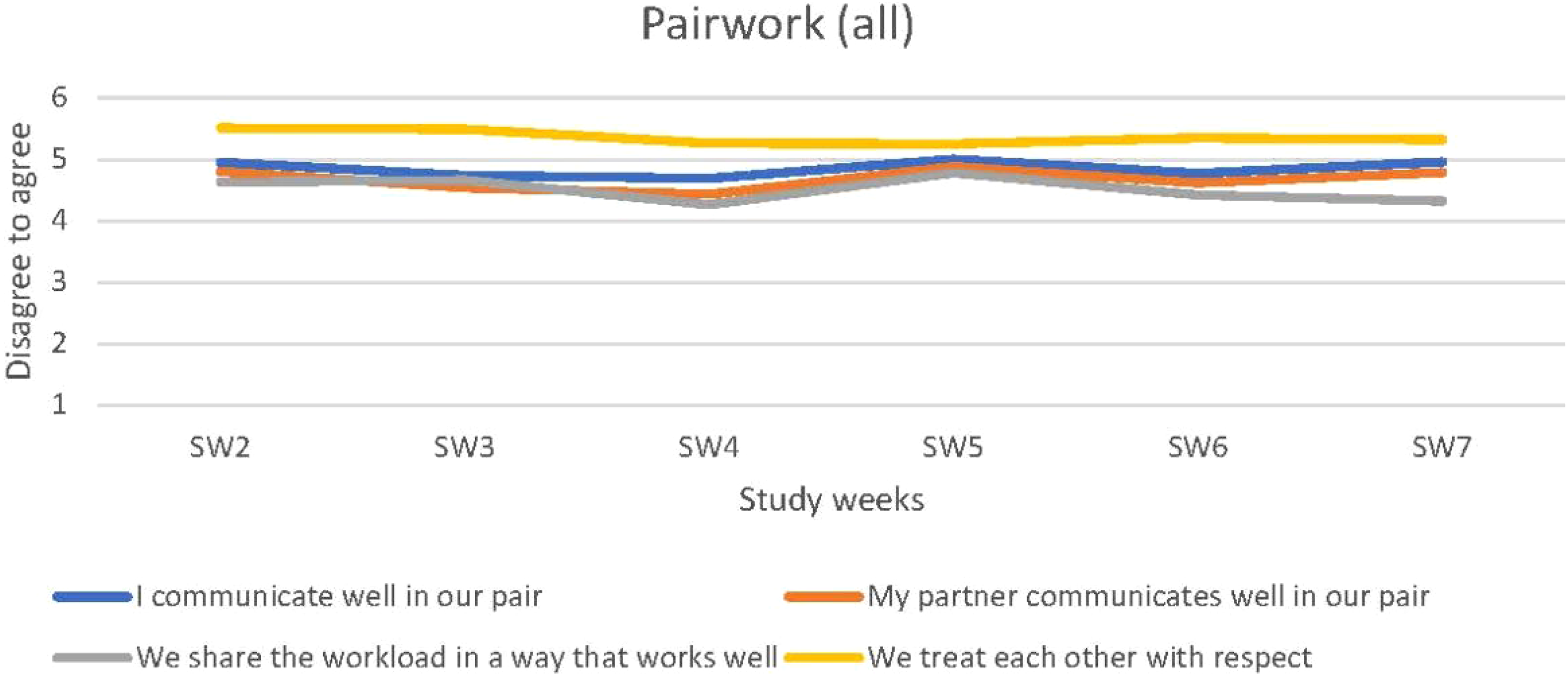
While the PBL aspect in terms of assignments was perceived as problematic in terms of workload, it is clear from the coding that the students received significant support from the pair work in several ways. The third largest category of comments (see Table 1) was “communicating well” (21% of the total pair work comments) and the sixth largest category was “working well” (18%). The responses from all students on a weekly basis were consistently high across all categories (between 4.26 to 5.51) (see Figure 5):
As shown, the statement “We treat each other with respect” ranked highest with little variation over time. Since one of the prompts the students had was “We treat each other with respect”, it is perhaps unsurprising that there were several comments which simply echoed this sentence. Some students however, tried to elaborate what they meant: “I feel like we were always respectful and tried to help each other out when we could.” (diary quote 1, week 4, international)
“We show up in time and treat each other with respect and help each other out” (diary quote 2, week 3, home)
These quotes suggest that respect for these students included being helpful and punctual to meetings. This definition was backed up with comments where students felt there was a lack of respect which referred to poor time management, the partner not responding to messages and the partner being perceived as not engaged.
Communication in Pair Work
The results for communication in pair work were both interesting and surprising. Unlike previous research (Poort et al., 2019; Spencer-Oatey & Dauber, 2017) which reports communication as a major issue in intercultural group work, in this data “communicating well” is one of the highest coding categories with 21% of the total comments (Table 1). The two prompts connected to communication (Figure 5) were also ranked uniformly high (between 4.3 to 5.25) with little variation over time, with results being slightly more positive for the statement “I communicate well with my partner”. Comments in the diaries on communication ranged from the very enthusiastic, such as: “My partner has been amazing! We figure out the assignment problems together and explain to one another if one has an issue, we treat each other with at most respect and im enjoying his company.” (diary quote 3, week 2, international) “I would say we both try to communicate well with each other.” (diary quote 4, week 4, international)
The interviews also reflected this range of communication, from long conversations about shared interests to more problematic situations. P4 for example, describes the shared interest that he and a partner had in cars: “we used to meet up and we used to just do the task for about 10, 15 min and then he just used to talk about the car stuff for 45 min. That was a lot of fun.” (P4, interview)
P6 described how he used the course policy of working with different nationalities to meet as many different people from different backgrounds as possible: “I was more interested in working with people from other nationalities because I’ve done my bachelor's in India as already we know, so I mean I wanted to see what the working culture would be like and what's the thought process what's happening there, so that's what I wanted to do. Yeah, move out of my comfort zone” (P6, interview)
English was rarely described as an issue in these exchanges, even though it was most of the students’ second language. In the diary responses, the average response to the statement “The English level is challenging” was 1 (disagree completely) and in Table 1, 11% of the academic comments were connected to English not being an issue. This is not to say that language was unproblematic though. Some pairs experienced issues which were exacerbated at times by working at a distance. P2 described how his first partner was located in China. In their initial contact, he had explained the task and felt that they had communicated well. However, on the second contact, he realised that they had not understood each other and P2 wrote down his message instead. His partner then translated the message into Chinese and formulated an answer in Chinese which was then translated back to English. This made progress rather slow though he felt that this improved over time.
Other pairs described how accents could be a problem, particularly online where there was a lack of clues to interpret each other. P5 described how she had issues understanding her Indian partner online but that it was much easier when they met on campus.
Other issues with communication are elaborated on in the section on online learning below.
Dividing the Workload
Of the three categories, respect, communication and sharing the workload (Figure 5), the latter was the most contentious. The scores for sharing the workload were lowest and showed more variability for the statement “We share the workload in a way that works well” (between 4.26 and 4.78) though these figures are still higher than average.
In the diary comments (Table 1), there were slightly more comments on uneven workload division (17%) compared to workload being divided well (14%). A major challenge when it came to dividing up the workload was previous knowledge. As mentioned earlier, all three assignments used Matlab, which was known to some students and new to others. This made it challenging to divide up the work fairly as reflected in this comment: “but last assignment I hade to do almost all the work since he newer used Matlab before” (diary quote 5, week 4, home student)
Other pairs had other approaches: “my partner had not worked as much in Matlab as I have so I try to help him and let him try to code aswell so he gets better.” (diary quote 6, week 3, home student)
In some cases, this learning process benefitted the pairs later as shown in this student comment: “I am getting better in programming so we can share the work a little bit easier” (diary quote 7, week 3, international student)
Strategies that helped this learning process became clearer in the interviews. P4 explained how when working with a partner who was good at Matlab, he took on the task of explaining the instructions. P6 described how the two of them tried to code together, taking responsibility for different tasks.
One might expect that this learning process would mean that working together would become easier as students learnt the software and became more familiar with the working pace. This is not shown in Figure 4 and there are some reasons behind this, made clear from the comments in the diaries and the interviews. Firstly, the fast pace of the course and the assignments made it difficult to follow through on the learning, as shown in this comment: “It sometimes happens that one has to take over the load more than the other. We are just trying to get done with the work and not bother to discuss the results with each other because of the narrow submission deadlines.” (diary quote 8, week 7, international student)
Secondly, the level of the assignments was continuously increasing throughout the course.
To sum up, though the pace of the assignments was experienced as challenging, working in pairs in the assignment provided important contact for both social and academic integration.
Issues with Online Learning and Integration
Online learning provided a barrier to both academic and social integration. Working online was generally experienced as problematic. Approximately 1/6 of the total comments across all categories mentioned working online specifically (97 out of 624 diary comments), and of those, more than half of the comments concerned the difficulties of socialising online and over one third concerned the increased difficulties with course work and assignments when working online. About one quarter of the comments were about the communication issues that the students experienced online.
Due to the work pressure, many students felt that they had no time to socialise (see Table 1, category 5, 19% of the social comments). But the online aspect made socialising even more challenging. This was partly because regular social events that the program would have held for the students were cancelled but also because spontaneous meetings such as breaktimes between lectures did not take place. In the interviews, P7 described some of his frustrations. He was initially in his home country (India) at the start of the course but then moved to Sweden halfway through the course. He felt in general that socialising online was impossible, commenting: “when you say social life you expect fika, to have coffee and cinnamon buns and sit around but this is restricted to your assignment teams so you don't have the usual fun. That's a general meaning of socialising it's not just you talk about assignments you actually talk to a person freely you talk freely about other things..” (P7, interview, “fika” Swedish term meaning to take a break with coffee and a snack)
For some, this meant that the time pressure around the assignments, which was already tight, became even tighter, with the extra time taken to communicate tasks online. As one student commented: they found “online collaboration on assignments very time consuming” (diary quote 9, week 3, international student). P7 expanded on this with reflections that the online set-up did not allow for spontaneous chats with other students to ask questions or sort out doubts. He commented: “If it was in class, probably we would have been meeting each other like regularly. We could keep asking each other, what exactly is the situation. Like: “Where have you reached in the assignment?” So, that we can help each other and progress.” (P7, interview)
The lack of physical contact also became mentally taxing for some: “I feel quite isolated with the lectures online and only know one classmate on the program…My daily life is going up and down from time to time. The isolation is definitely affecting me.” (diary quote 10, week 4, home student).
To conclude, the online learning environment was generally perceived in negative terms by both home and international students, who were often comparing it to what they might have had on campus. They missed the social contact and, in some cases, felt lonely and isolated. Working online was also perceived as more time consuming in an already time-pressured environment. Some felt that it made studies more difficult, concerning getting help and understanding the material. Therefore, the online environment made both the social and academic integration more challenging.
Discussion
Integration to a new campus and program is important for students to feel connectedness, which in turn contributes to student retention on a program (Rienties et al., 2014; Tinto, 1997). This study has highlighted human and structural factors which promoted integration, and others which affected it negatively. The course structure of PBL through pair work assignments both contributed to and challenged integration. Pair work was generally helpful in supporting both academic and social integration whereas the high work pace and working online detracted from it. This seems to confirm existing findings (Parrish et al., 2021; Severiens & Schmidt, 2009).
In terms of the work pressure that they experienced, the combination of an international, problem-based learning course with a time-limited, online setting contributed to the students feeling overwhelmed. The international setting proved challenging, primarily because of varying background knowledge needed to tackle the problems in the assignment, for example, lack of programming knowledge. It also meant that several pairs were located in different countries due to the pandemic. The problem-based learning elements with ongoing assignments in two concurrent courses meant continuous pressure that pushed out social activities and created stress. The time limitation aspect, due to the course length of eight weeks, made it difficult for students to both understand the material and settle into the new environment, reinforcing the importance of course design in online learning settings. The online setting meant that studies took more time, and made socialising more difficult.
However, the pair work structure for the assignments aided integration. Students were positive about all categories within pair work: communication, sharing workload and being respectful. While these scores hid a more challenging reality, for example with different academic experiences, some student pairs circumvented this through inventive ways of sharing tasks, problem solving together, and in some cases, going beyond the tasks to forming friendships with one another. In this sense, the pair work played an interesting role in the initial integration of students. Much has been written about intercultural group work, defined as ‘a collaborative approach to learning in which three or more students from different cultural or national backgrounds work together on set tasks’ (Poort et al., 2019), and the role it can play in integration (Poort et al., 2019; Spencer-Oatey & Dauber, 2017). However, the pair work in this case, provided affordances that are not always possible in group work. In a pair, being silent is less of an option, for example. A pair is also forced to deal with knowledge imbalance in a way that does not necessarily happen in a group where some group members may end up on the sidelines while others take leadership roles.
From a relational perspective, the student dialogue was both transactional (i.e., in this context, about the academic content) and interactional (i.e., in this context, sharing personal attitudes and building social relations) (Brown & Yule, 1983). This communication seems to have helped students feel connected and even make friends on the program. As one student commented: “The assignments helps getting friends especially now during covid-19.” (diary quote 11, week 3, home student). While the assignments created some stress, they also promoted the social side, particularly when social possibilities were more limited during the pandemic situation.
Limitations and Further Research
One possible criticism of this study is that the students may have felt socially obliged to be positive in their diary comments about their pair work, despite the fact that their entries were only available to the researchers. However, the same students made many negative comments on other aspects, such as on the high workload, and they are likely to have felt similarly socially obliged to avoid offence. We thus do not believe social desirability has affected the results in any noticeable way.
Further research might investigate the structural aspects of integration further, for example community and institution's actions to promote integration in the international environment (Spencer-Oatey & Dauber, 2019b). It would also be interesting to collect more interview data from home students and compare these students’ experiences to those in a more regular period of study.
Conclusion
Integration needs to happen for all students, both home and international, within and outside the classroom. It is affected by human and structural factors at individual, community and institutional levels and is a process which takes time. In an international, online environment, it takes more time. The course organisation can play a crucial role in facilitating this integration. Structural factors within the course such as teacher-formed pair work and PBL can facilitate interaction and thus support the process of integration.
Footnotes
Declaration of Conflicting Interests
The author(s) declared no potential conflicts of interest with respect to the research, authorship, and/or publication of this article.
Funding
The author(s) received no financial support for the research, authorship, and/or publication of this article.
