




Abstract
Higher education institutions actively pursue transnational strategic alliances at the organizational level, but what are the rationales, pathways and benefits behind this pursuit? A systematic literature review in the Web of Science and Scopus reveals the majority of studies touching on this topic are descriptive, lacking definitions and theoretical underpinnings, with the word ‘strategy’ used in a generic, redundant or implicit manner. None of the 72 studies identified in this research takes a combined approach to considering the “why”, the “how” and the benefits derived from pursuing such alliances. This is necessary to explore the rationales and interconnected mechanisms that lead to strategic pathways, and to address the interplay between approaches taken and benefits derived. In addition to identifying a research agenda, this literature review points to the need for more comprehensive and theoretically grounded studies to support this emerging research area and evidence-based decision-making by policy-makers and senior leadership.
Introduction
In their review of the internationalisation of higher education literature, Kehm and Teichler (2007) refer to institutional strategies of internationalisation as one of the seven key themes addressed. A decade later, Bedenlier et al. (2018, 127) labelled “… the applied aspects of managing and steering internationalization at the institutional level, including questions of quality, strategic development, and the curriculum” as one of the two key strands in papers in the Journal of Studies in International Education. This attention to strategic management of internationalization raises the question what scholars – and policy makers and institutional leaders – can learn from this research conducted thus far. This is our broad point of departure for this contribution.
There are different means to advance internationalization strategically. One of the increasingly desirable vehicles to internationalize is through transnational strategic partnerships. These partnerships are defined as institutional collaboration between a minimum of two higher education institutions (HEIs) in two different countries (Beerkens, 2002; Karvounaraki et al., 2018). Such collaborative endeavours have also been called strategic alliances (used interchangeably in the article), which could be bilateral (also known as dyadic) or multilateral partnerships (Beerkens, 2002), with the latter taking the form of inter-institutional consortia or networks, but also associations (Beerkens and van der Wende, 2007; Gunn and Mintrom, 2013; Stensaker, 2018). Surveys of practitioners show that HEIs worldwide are eagerly pursuing these partnerships; for some institutions these numbers lie in the hundreds (Banks et al., 2016; Sandström and Weimer, 2016). This desire to pursue them has also been reflected by multiple funding calls, for example of European agencies with the European Universities Initiative (Karvounaraki et al., 2018), but also national governments worldwide (Pfotenhauer et al., 2013; Sidhu et al., 2011).
Through institutional support, or that of national governments and supranational organizations, HEIs invest substantial human and financial resources to foster transnational strategic alliances over the years. HEIs naturally strive for ideals such as the pursuit of excellence, prestige and legitimacy through transnational alliances. Since international collaboration between HEIs is viewed as a strategic means (Craciun and Orosz, 2018; Oleksiyenko, 2010; van der Wende, 2007), it begs questions on drivers, processes and benefits. This is particularly of interest in terms of avenues to propel HEIs forward, to solve complex (grand) challenges, and potentially offer a transformative space to solve the conflicts of our time. Empirical research on collaboration has shown that there is limited quantitative research on costs and benefits of partnerships in the last twenty five years (Craciun and Orosz, 2018), that there are fragmented and sometimes conflicting rationales behind transnational strategic alliances (Lizarraga, 2011; Szyszlo, 2018), differences between the espoused and true motives (Saffu and Mamman, 2000), and diverse institutional obstacles, both in terms of partnership selection and management (Ayoubi and Massoud, 2012; Jones and Oleksiyenko, 2011). This specific form of institutional strategic cooperation therefore forms a salient point of departure for embarking on the question what the pertinent literature teaches us about motives, approaches and effects of such partnerships.
By using the term ‘strategic’, this contribution emphasises modes of transnational collaboration at the organizational level, and not single school, program, or individual faculty-member partnerships. Considering the multitude of existing and emerging definitions for strategy or strategizing, we focus on the main concepts widely agreed upon in strategic management. Strategy addresses the long-term direction of the organization (Johnson et al., 2014), even if its pursuit takes an emergent, iterative or incremental approach. It offers lenses through which one can see gaining advantage to remain competitive by aligning the organization to a changing environment (Johnson et al., 2008; Mintzberg et al., 2003; Porter, 1991). On the other hand, strategy also offers a post-rational inward-looking perspective focusing on the intra-institutional dynamics (Mintzberg et al., 2003). We chose to look at strategy through both the ‘inside out’ and the ‘outside in’ perspectives to explore which approaches were selected by the contributions in the systematic literature review to illustrate or analyze their transnational strategic alliances. Whereas the perspectives differ, they both have a clear interest in the “why” (motives, drivers, rationales), “how” (either in the search process, the actual implementation or institutionalisation of cooperation, or the specifics of collaboration) and benefits (effects, outcomes, realisations) of transnational alliances.
Thus, to uncover the impetus, pathways and benefits of transnational strategic partnerships at HEIs, we conduct a systematic literature review to map what scholars portray as strategic. To spill the plot, we come to the conclusion that the existing body of literature on strategic alliances hardly offers us solid insights into why, how and for what (robust) benefits transnational strategic partnerships are pursued. The contributions also make no distinction between collaboration as a dimension of internationalization that plays a minor role in the overall vision, missions and strategy of the university versus it being at the heart of the overall institutional transnational strategy, encompassing all missions and vision. Even further, none of the studies look at the interplay between why, how and for what outcomes HEIs join transnational strategic alliances. We contend that the “why” is paramount to reveal the rationales behind multiple pathways and choices for the “how”, assuming that in order to pursue a strategic collaboration, the “how” is dependent on the “why”. The outcomes are also affected by the “how”, since the “how” – the strategic process approach and the content – also in terms of the specifics of the collaboration or context, may change over time. If the interrelatedness is not revealed, a strategic alliance runs the risk of being not more than an empty signifier. After the review, we follow up by delineating elements of a future research agenda for transnational strategic alliances that offers insights into the strategic components of transnational partnerships. In that research agenda, we particularly pay attention to theoretical approaches and methodological innovations.
Methodology: A Systematic Literature Review
A bibliographic and multi-word search was undertaken in the Web of Science (the Core Collection that includes both the Social Sciences Citation Index – SSCI, and the Emerging Sources Citation Index – ESCI) and Scopus. The Web of Science (WoS) database was used to ensure the coverage of a multitude of high status journals (Tight, 2012). The following Boolean search led the systematic literature review process: ((“international*” OR “global” OR “cross-border” OR “transnational”) AND “strateg*” AND (“partnership*” OR “alliance” OR “collaboration” OR “cooperation”) AND (“tertiary” OR “higher education” or “universit*”)). No start date was chosen for the search, which concluded on April 14th, 2022.
The review included search words within titles, abstracts and key words, both in the WoS and Scopus. The PRISMA guidelines were used for the identification, screening and to determine the eligibility of contributions (Kamalulil and Panatik, 2021; Moher et al., 2009). A flow diagram following the PRISMA guidelines (Moher et al., 2009) is presented for both WoS and Scopus (Figure 1). To identify contributions as a first step, 2,114 relevant contributions were generated in the WoS, while Scopus identified 3,676 contributions. The second step involved the screening process, which was based on three criteria. Only articles and conference papers were selected, those that were in the English language, and contributions that came from social and behavioural sciences. The remaining 871 records from WoS and 761 records from Scopus were then exported to Excel sheets for further analysis and coding. The third step, related to the eligibility of contributions, involved the manual whole-text screening by both authors. The inclusion criteria involved a two-pronged approach. The first criterion included all records that were based on a cooperation between a minimum of two HEIs. The second criterion included the contributions that represented collaboration at an organizational level. On the other hand, the exclusion criteria, were related to strategic alliances that were based in the same country (i.e., triple-helix, intra-institutional or national partnerships), or contributions, whereby strategy was mentioned once or twice in passing, and no related concepts were dealt with.
Flow diagram of the Web of Science and Scopus selection process of the contributions (Adapted from Moher et al., 2009).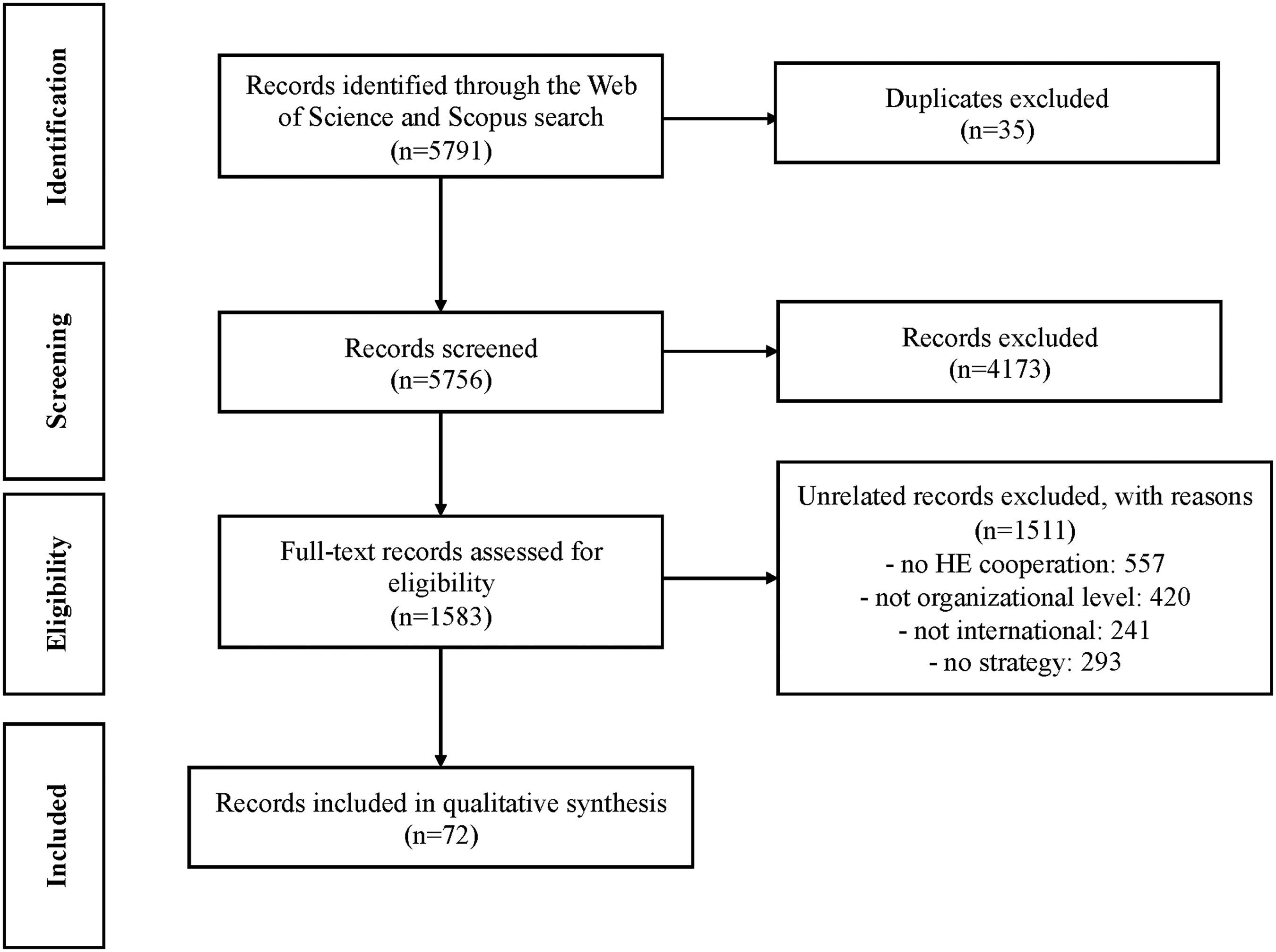
Authors discussed their results for both databases in multiple sessions. Through this interaction, the authors arrived at a common understanding of how to assess the papers in both databases. In terms of inclusion at that stage, our estimation of agreement was 90%, indicating strong inter-rater reliability. By reviewing the records together on the contributions where authors had diverging views, further discussion led to consensus. In all, 52 records were included from Scopus and 55 from WoS. Since 35 contributions appeared in both databases, and were excluded as duplicates in the beginning, the total number of records considered is then 72.
The discussed articles are presented with an asterisk in the reference section 1 . The findings and discussion are presented in the next section.
Findings and Discussion
This systematic review revealed that the 72 contributions were distributed in this way: 11 contributions solely investigated the “why” (i.e., drivers, rationales), 43 records explored various aspects of the “how” (i.e., approaches, enabling and disabling factors, challenges and obstacles), eight studies examined the benefits (i.e., mostly outputs), and the other ten looked at two out of the three dimensions. For those contributions looking at two of the three dimensions, nine studies looked at the “why” and “how”, and one looked at the “how” and benefits. None of the sample studies examined the interplay of all three dimensions simultaneously, including the interplay between rationales, approaches and benefits. A major focus was on strategic collaborations with China, represented by nineteen contributions. Others focused either on European collaborations with other countries (i.e. UK, Portugal, Norway) or individual countries in Africa (i.e. Congo, Tanzania, Kenya, South Africa). Authors focused mostly on bilateral partnerships, with few on (larger) networks. The earliest study dealing with strategic issues in collaboration was published in 1999.
We first present forms and definitions of strategic partnerships in our sample of studies, and then elaborate on four themes, in terms of the use of theory and methods, rationales – the “why”, (strategic) pathways and the specifics of collaboration – the “how”, and outcomes.
Forms of Alliances and Definitions
The contributions in our sample portray transnational strategic alliances as very diverse inter-organizational configurations. For example, they involved bilateral collaborations between universities in two different countries (Pfotenhauer et al., 2013). Others took the organizational form of an association, with member universities in at least two different countries (Stensaker, 2018). Some were networks and consortia with numerous transnational members (Kristensen and Karlsen, 2018).
Despite the diverse forms of strategic alliances presented, their definitions and explanations why they are strategic remain scarce. The words strategy and strategic are used without any elaboration, unpacking or linking them to existing strategy concepts in the academic literature. Only one first author, publishing with others in three different studies, explicitly defines strategic alliances as alliances of transnational education - obtaining degrees from UK institutions based in China only or in both countries (Li et al., 2011; Li et al., 2014; Li et al., 2016). The strategic elements are conceptualised with reference to the literature on multi-national companies. The engagement in and further development of the UK-China alliances is explored through concepts of foreign investments, ownership, localisation and transaction costs. Such an approach is clearly strategic in that choices regarding the “why” and “how” of international cooperation are consciously made in light of costs and benefits and the “best” form to achieve the partnership's objectives. Also Kristensen and Karlsen (2018: 21) do engage with strategies – although briefly referencing to standard strategy textbooks – as tools to move from the present situation to an envisaged future: “The organization must not only formulate but also put the formulated strategy to work before the strategy can be of any specific value”. Most other publications in our sample did not define or conceptually explore the partnerships from a strategy perspective. That there are challenges associated with defining strategic alliances in higher education has been contended by scholars in the past (Oleksiyenko, 2010; Li et al., 2011). Without offering definitions of what authors mean by strategic alliances, and how their rationales are connected to the approaches that lead to the road with desired outcomes over time, so-called strategic endeavours may end up being not more than a label.
Use of Theory and Methods
As rationales are to provide explanations for why transnational strategic partnerships are pursued, engagement with theoretical perspectives that suggest why certain approaches are taken are crucial to uncover their (hidden) purpose. It is therefore surprising that the majority of the contributions are descriptive, and do not engage with either theoretical nor conceptual frameworks. The focus appears to be on sharing empirical examples of alliances and reflections on institutional or personal experiences. If theories are indeed used, authors frequently use theories of the multi-national company (Li et al., 2011). The use of organisational sociology theory (Stensaker, 2018), and international relations theory (Fominykh, 2016) is less frequent.
Secondly, in terms of methodology, 53 out of the 72 contributions offered a descriptive analysis, making unjustified conclusions without data triangulation, theoretical data saturation, with some authors writing about their own institutions without explaining their positioning, and hence questionable reliability and validity. Very few studies conducted a full analysis, mostly qualitative, though none of them examined the interplay between why, how and benefits. Some quantitative studies presented very small-scale surveys (Sidhu et al., 2011), while others did not discuss the results of their survey. Moreover, a fair number of studies did not actually report their methodological choices.
Rationales
More than half of the contributions offered unclear motivations for transnational strategic alliances, of which 11 focused on the “why” and nine on “why” and “how”. For example, authors contend that strategic alliances are an instrument to increase performance (Beerkens and Van der Wende, 2007), improve quality (Kristensen and Karlsen, 2018), and achieve global recognition (Wu and Chen, 2016). These claims are made without offering substantial evidence or a rich account on what they mean concretely by their statements, how those ideals were to be achieved, or what concrete benefits emerged through their alliances.
While not defining their strategic alliances, some studies do give us a richer description, through which the rationales could be assumed. One qualitative study points to rationales, such as market and global rankings for the pursuit of such alliances, but also sociocultural and geopolitical dynamics for some Chinese universities (Montgomery, 2016). Another study emphasizes the global research environment and national competitive and comparative measures as crucial drivers for strategic partnerships (Alexiadou and Rönnberg, 2022). The next speaks of financial imperatives or rationales to become “world class” (Poole, 2001). In two other studies, transnational partnerships are seen as long-term strategic vehicles to build capacity in certain countries, such as in Portugal (Horta and Patricio, 2016; Pfotenhauer et al., 2013) and Singapore (Sidhu et al., 2011). These authors contend that the corresponding governments injected substantial resources to link local institutions with leading institutions abroad to advance selected strategic focus areas. They concretely describe what was done in terms of the specifics of the collaboration. In Portugal, the collaborations were used as a vehicle to increase the diversity of the (international) student body, create centers of excellence and revamp engineering education. Similarly, in Singapore, collaborations were used to internationalize research and education initiatives in order to create a knowledge hub. This ties well to the next section, which focuses on the how – the process behind these alliances, and the specifics – the type of activities that are embarked upon.
(Strategic) Pathways and the Specifics of the Collaboration - “the how”
The majority of the studies in the sample, of which 43 focus on different aspects of the “how”, nine of which focus on the “why” and “how” and one of which focuses on the “how” and benefits, do not address the “how” in terms of specific steps within strategic pathways or processes taken, stakeholders involved and illuminate the internal intricacies of decision-making. This applies to the intra-organizational dynamics specifically: the concrete process of selection, management and evaluation, and implementation over time. A handful of studies refer to some steps in passing, but not in a consistent or systematic way (e.g., Devonshire and Siddall, 2011; Marginson, 2015). Other studies do offer some insights into the process of partner selection and maintenance. For example, one study within the “how” body of literature offered different strategies, depending on the partner selection and arrangement (Ayoubi, 2013). Another study's findings suggest that once a level of an alliance was selected (i.e. from basic level alliances to equity joint venture campuses), movement between levels was very limited (Willis, 2001). While one study showed that senior leadership and faculty were loosely coupled when it comes to collaborative strategies (Trondal, 2010), none of the studies examined the intra-institutional dynamics in terms of processes and (governance) structures for decision-making on transnational strategic alliances.
A handful of studies from the “how” pool of studies address some factors that influence partnership processes. For example, one study offers some insights into the process of how knowledge is shared in different forms of strategic alliances (Li et al., 2014). Other studies look at the strategic partnership success, such as longevity and trust (Devonshire and Siddall, 2011), faculty member engagement and them leading initiatives rather than top-down steering (Brierley et al., 2018; Devonshire and Siddall, 2011), as well as the importance of boundary spanning roles (Li et al., 2016; Ma and Montgomery, 2021). Others argue that social connectedness plays a role in the partnership formation, with trust, organisational learning and cultural proximity affect the partnership survival, performance and partnership evolution (Wu and Chen, 2016). On the other hand, some studies explored factors that impede collaborative success, such as challenging intercultural interactions (Spencer-Oatey, 2013), political, economical, cultural, funding and quality control issues (Ayoubi and Massoud, 2012), constraining factors such as size and geography (Alexiadou and Rönnberg, 2022), and asymmetrical relations, whereby partners are not formed based on mutuality (Dow, 2010; Mwangi, 2017).
We explored another perspective for the “how”: the specifics of cooperation (the type of activities pursued), and what mission they contribute to. The majority of researchers contend that transnational strategic alliances serve the education mission. They aim to contribute to teaching and learning, for example through creating new programs and curricula, pedagogical approaches, and mobility of faculty and students. A few authors claim that strategic alliances contribute to the third mission, for example to innovation through technology transfer (De Moortel and Crispeels, 2018) or through capacity-building (Pfotenhauer et al., 2013; Sidhu et al., 2011). None of the studies viewed transnational strategic partnerships as an integrated organizational-level endeavour, contributing simultaneously and in a variety of (multidisciplinary) areas to the education, research, and the third (social) missions.
Benefits in Terms of Outputs, Outcomes, Impact
Eight contributions looked at benefits only, and one study looked at both “how” and benefits. While some authors claim achievements and successes (McHale et al., 2010), or increased performance (Beerkens and van der Wende, 2007) as outcomes, they do not specify nor define what has been accomplished, nor offer explanations for best practices. In other contributions, outcomes are either not empirically confirmed (McHale et al., 2010; Popescu and Elshof, 2016), nor described in a consistent and systematic way (Courtois and Veiga 2020; Kristensen and Karlsen, 2018), echoing the earlier concerns regarding the use of methods. The majority of the contributions focus on outputs as benefits (some studies present them as outcomes), such as courses, programmes, curricula, joint and double degrees (see Hintea, 2012; McHale et al., 2010), and they do not make the link between outputs, as a means to achieve desired outcomes or achievements. For example, Bogdanova et al. (2016) contend that in 2013, their strategic partnership generated sixteen conference papers and publications, six bilateral research projects and three funding applications. They also refer to the betterment of the international image and rankings of the partner universities, though no elaboration in this regard is offered. Further, as impact is concerned, some authors contend that “…determining the impact of study abroad [is] a difficult task” (Grindei et al., 2017, 6). None of the studies looked at the impact through strategic collaboration as longer-term achievements with a longitudinal research design. Thus, the majority of the studies do not clearly and systematically examine outcomes. This is in line with what Craciun and Orosz (2018) found, noting that very few empirical quantitative studies have been done to examine the cost-benefit of transnational partnerships in the last twenty-five years.
Key Elements of a Future Research Agenda for Transnational Strategic Alliances
We address the future research agenda by first offering potential theoretical and methodological improvements, and then an account on how transnational alliances in higher education could be looked at through strategic perspectives rooted in the organizational and management literature.
Potential Theoretical Lenses
Just like firms, HEIs function in constantly changing environments, having to respond to global and national waves of change. It has been argued that HEIs are becoming more strategically managed organizations (Bleiklie et al., 2017). They act like strategic actors, especially in terms of accountability, goals, structures and management (Krücken and Meier, 2006). One would expect some parallels to corporate-level strategy, without arguing that HEIs are businesses. While the context and the “how” may differ across sectors, the rationales for transnational strategic alliances remain the same, regardless of the type of organization. These partnerships are concerned with inter-organizational relations, as interdependent entities, each balancing investments and benefits (Todeva and Knoke, 2005). Strategic management and planning, in terms of selection, management and evaluation (what, how, and outcomes) are about decision-making, which is just as applicable in the public sector (Bovaird and Löffler, 2009).
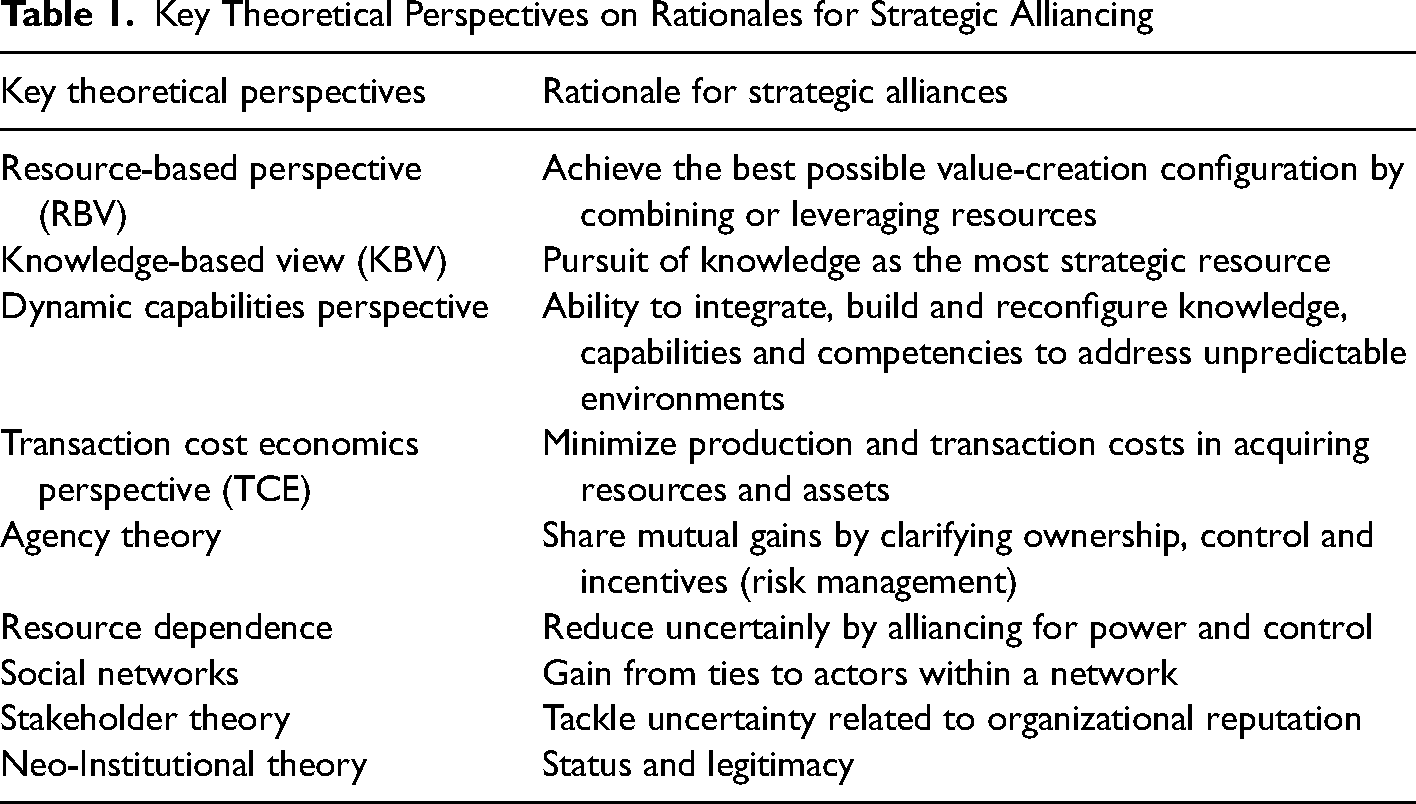
To gain a scholarly understanding of the rationales (and hence prevent a strong focus on describing practices and developments), the established theoretical underpinnings from the organization and strategic management literature are explored (see Parmigiani and Rivera-Santos, 2011 for a review). From a resource based perspective (RBV, Barney, 1991) for example, strategic alliances are conceptualised as voluntary partnerships with the intended goal of value creation, which has performance consequences (Gulati, 1998; Ireland et al., 2002). Value creation has to do with sharing resources to acquire social capital, knowledge and competencies (Ireland et al., 2002). The alliance thus combines inter-partner resources to create something new (e.g., Beerkens and van der Wende 2007), tangible or intangible, with social capital being the unique relationship that partners develop over time. As a result, there is an effect in the joint performance, which does not have to be economic. The value creation is the actual produced content, whereas the transformation that takes place over time is the process that changes both institutions as a result of entering the alliance.
Related theories to RBV are the knowledge-based view (KBV) or the dynamic capabilities perspective, the transaction cost economics perspective and agency theory (Parmigiani and Rivera-Santos, 2011). Such perspectives focus on building and advancing organizational learning, capabilities and competencies. From this standpoint, HEIs would pursue transnational strategic alliances to generate new discoveries and synergies (e.g. De Moortel and Crispeels, 2018). The transaction cost economics perspective (TCE) (e.g. Li et al., 2011), on the other hand, explains that institutions pursue collaboration with the goal of minimizing production and transaction costs, ensure expansion or acquire assets and resources internationally (Parmigiani and Rivera-Santos, 2011). The partnership then is a gateway for organizations to jointly invest, share risks, or expand their operations in other countries. Branch campuses could be an example of this in higher education.
Furthermore, agency theory suggests alignment of incentives between agents and principals, when control and ownership are separated (Parmigiani and Rivera-Santos, 2011). Agents are those who have the control to act, for example, individuals managing or coordinating transnational strategic alliances, whereas the principals would be those that have a stake in it, hence ownership, be that senior leadership of an HEI, or for some institutions, principals would be ministries that lay out guidelines for collaboration. Regulation, incentives and monitoring would be key management themes that play a role in this regard.
As the interconnection between the organization and the environment is concerned, other theories could enrich our understanding of motivations for strategic alliances. The four strands of the organization theory perspective are resource dependence, social networks, stakeholder theory and institutional theory (Parmigiani and Rivera-Santos, 2011). Resource dependence theory suggests that organizations are dependent on their environment (Pfeffer and Salancik, 1978). The rationale for strategic alliancing from this perspective would be to reduce environmental uncertainty and dependence (Hillman et al., 2009), by alliancing with those that have power and control over resources.
These assumptions about dependence on the social context are shared with the social network theory, which connects all actors in the network through ties (Borgatti and Foster, 2003). An example of this in higher education is the increasing number of networks and consortia globally, with strong and weak ties to each other, with the strength of weak ties within a network not to be underestimated (Granovetter, 1973). The rationale to join these consortia could then be of intangible value, such as gaining reputation.
Similarly, from a stakeholder theory perspective (Freeman, 1984), alliancing is a vehicle to tackle uncertainty related to organizational reputation. This approach relies on better understanding the internal and external stakeholders’ views, and align, position and channel these as a driver for legitimacy. Understanding and ensuring buy-in from stakeholders across the institution, as well as external actors playing a role in transnational strategic partnerships would be key to manage and direct views in a desired direction. This is similar to the sociological perspective of neo-institutional theory (e.g. Alexiadou and Rönnberg, 2022), one of the most prominent organisational theories, which explains that organizations seek to partner for status and legitimacy, and to fulfill expectations, set for example, by government or funding agencies (DiMaggio and Powell, 1983). The conformity to social expectations ensures their organizational success and survival (Oliver, 1991). As a result of this pressure to conform, organizations mimic each other, especially those that seem to be a template for perceived success.
Table 1 presents the key theoretical perspectives for strategic alliancing described above:
Key Theoretical Perspectives on Rationales for Strategic Alliancing
Against this backdrop of a multitude of theoretical perspectives, and the paucity of use of theories for strategic transnational alliances in higher education, these theoretical perspectives could further our understanding on why, how, and for what outcomes we pursue them in higher education.
Potential for Methodological Improvements
More than half of the studies used descriptive analysis to write about strategic alliances at their own institution. These personal reflections may offer a biased point of view. A recommendation for future research is to ensure data triangulation and theoretical saturation, and validity and reliability for qualitative studies. A minimum requirement would be that authors explain their position (as research and member of staff of the unit of observation) and what they have done methodologically to offer a plausible account. Authors could base their claims on more evidence with more examples or larger samples, and take a longer time horizon. They could explain the relative position of transnational strategic collaboration within the overall institutional vision, missions and strategy, and clarify their distinct positions as an author and owner (i.e. as a senior leadership member, faculty member, practitioner) of the described case, or offer comparative perspectives based on different (national) contexts. At the same time, the quantitative studies conducted based their unwarranted conclusions in very limited samples, and in some cases, made claims of strategic alliance success, without presenting the data. Securing larger samples would provide better evidence for generalizability, and make stronger cases for the findings. Finally, in terms of gathering evidence for strategic success, longitudinal studies would be necessary to gain insight into outcomes.
Addressing Strategy in Transnational Alliances in HEIs
Future contributions dealing with strategic transnational alliances could analyse them from an inside-out strategy perspective, outside-in or both. When considering the inside out perspective, one could look at how the pursuit of transnational strategic alliances enables partners to jointly align better with a dynamically changing environment over time – achieving strategic fit (Johnson et al., 2008; Teece, 2009). Strategic fit refers to the idea of continuous alignment with the changing environment by influencing or gaining from it to remain competitive (Teece, 2009). Strategizing in this outward integration illuminates how HEIs “interrelate with their organisational environment-including the organisational field” (Frølich et al., 2013, 80), but also institutional positioning within the field (Fumasoli and Huisman, 2013). Rationales for engagement, could be for example to attract new resources or power, lobbying and influencing ever-changing national or supranational political agendas, or gaining legitimacy within the national, supranational and global higher education field.
At the same time, just as the external environment affects the rationales, strategic pathways and outcomes, so do the intra-organizational dynamics. Strategy offers an outside in perspective then. An in-depth institutional account, which has not received enough attention in organizational studies in higher education (Fumasoli and Stensaker, 2013), would be necessary to understand the intra-organisational dynamics of decision-making on transnational strategic partnerships. More specifically, rich descriptions of the role of strategic change factors, such as leadership, decision-making procedures, communication and evaluation are crucial to understanding institutional strategic change (Stensaker et al., 2014), all of which are first and foremost, dependent on the rationales. It is only with an interconnected “why” and “how” approach, as well as between the “how” and the expected benefits as value creation, do we get a complete and integrated picture of the role strategy plays.
Future studies should explore whether single or multiple rationales for transnational strategic partnerships are possible, mutually-exclusive or concurrent over time. For example, Stensaker (2018) contends that rationales for strategic alliances could change over time. This is in line with the strategy literature, which suggests that strategic alliances have a termination date, when the set goals have been achieved. Uncovering the environmental factors that affect the changing rationales would shed light on the “how”, as well as the outcomes. This would explain whether there are (causal) mechanisms behind transnational strategic partnerships and shifting paradigms in geopolitical dynamics, which could have an impact.
Finally, studies could take a broader meta-perspective, looking at rationales, strategic trajectories taken and benefits gained over time to achieve strategic fit, while simultaneously illuminating the intra-institutional dynamics. This would represent a more integrated approach to transnational strategic alliances, particularly when all missions HEI deliver on are analysed.
Conclusion
Alliances may offer a pathway for strategic institutional transformation. Our conceptual study that involved a systematic literature review, surprisingly, discovered that the insights gained from analysing transnational strategic partnerships are very limited. 53 out of 72 studies offered a descriptive analysis (e.g. Brierley et al., 2018), eight were conceptual contributions (e.g. Tadaki and Tremewan, 2013), and eleven conducted a full analysis (theory, methods, empirics) (e.g. Mwangi, 2017; Li et al., 2014). The scarcity of definitions for transnational strategic alliances, engagement with theoretical anchoring to explain rationales, and the limited number of studies with a combined “why”, “how” and benefits approach were significant gaps.
Our criticism on the state of the art in research on transnational collaboration concerns researchers that uncritically take “strategic” for granted and without scrutiny. A limitation of our study is the focus only on contributions in the English language, but also the exclusion of further sources forms, such as books and reviews. Further studies should investigate the argument this article makes: analysing the interplay between the “why”, the “how” and benefits questions comprehensively: what mechanisms are in place, especially in terms of (governance) structures and processes to select, manage and evaluate transnational strategic partnerships, and how they lead to desired benefits. In a dynamically changing environment that HEIs find themselves in, knowing more about why and for what benefits institutions pursue transnational strategic partnerships and how they are strategic, could likely unlock new opportunities for HEIs.
Footnotes
Acknowledgements
Both authors would like to thank two anonymous reviewers for their helpful comments. The authors are also grateful to Sil Allaert, a Master of Sociology student at Ghent University, who assisted with the Web of Science search.
This article has been inspired by the first author's dissertation “Strategic Change or Inertia? Transnational Alliances in Higher Education” (forthcoming). The first author is very thankful that her dissertation was supported by the Elsa Neumann Scholarship of the State of Berlin, and subsequently by the completion scholarship of the Humboldt-Universität zu Berlin.
Funding
The author(s) disclosed receipt of the following financial support for the research, authorship, and/or publication of this article: This work was supported by the Elsa Neumann Scholarship and the Completion Scholarship of the Humboldt-Universität zu Berlin.

Notes
Author Biographies
He is editor of Higher Education Policy, co-editor of the SRHE/Routledge book series and co-editor of the Emerald series Theory and Method in Higher Education Research. He is furthermore member of the editorial board of Journal of Studies of International Education, Studies in Higher Education, European Journal of Higher Education and Tertiary Education and Management. He is also member of the Executive Committee of EAIR (and past chair, 2011–2016), a European society for linking policy, research and practice in higher education.