




Abstract
Transnational higher education is big business. However, it is unclear what transnational universities must do to behave in a responsible way or to gain a social licence to operate. Examining the University of Nottingham Ningbo China (UNNC) and Xi'an Jiaotong-Liverpool University (XJTLU), we discuss what universities could do to gain approval from host communities. They have to meet home and host country regulations, and the expectations of local communities and other stakeholders. Consideration of their social licence and of the negative and positive social impacts they create will contribute to their reputation and ability to access local knowledge. To earn a social licence to operate and grow, universities must understand and respond to their local context, share benefits with local communities, and have effective community engagement practices. In the universities we studied, there was limited information provided to community stakeholders and poor stakeholder engagement. However, high levels of trust from residents existed, partly because of the good reputation of universities generally.
Keywords
Introduction
There has been a rapid expansion of transnational higher education worldwide (Knight, 2016; Montgomery, 2014). Transnational universities are situations where a university from one country (e.g., Australia, France, UK, USA) operates in another country, often a developing country (Guimón & Narula, 2020). There are various forms of transnational higher education, including partnerships, branch campuses, and new institutions (CBERT, 2021). With a rapidly-increasing economy and strong desire to develop its higher education sector, China has become a large target market for transnational higher education (Fang & Wang, 2014; Mok & Xu, 2008; Montgomery, 2016). By 2020, the Ministry of Education had approved over 1,000 transnational higher education programs, around 100 partnerships at faculty level between a Chinese institution and a foreign higher education institution, and 9 transnational universities are now operating in China in conjunction with a Chinese university partner.
Like all organizations (Bair & Palpacuer, 2015; United Nations, 2011; Vanclay & Hanna, 2019), transnational universities need to consider their corporate social responsibility obligations and meet formal requirements in their home and host countries. They also need to meet the expectations of many stakeholders, including those of local communities (Chen & Vanclay, 2021; Jones et al., 2021; Rahman et al., 2019). Transnational universities tend to be different from domestic universities in management philosophy, financing arrangements, and source of students (Feng, 2013; Wilkins, 2017). These peculiarities will likely affect local community views about the university and its level of “social licence to operate”. A social licence to operate (or “social licence” for short) represents the extent of approval or social legitimacy of a project or organization that is accorded to it by local communities and other stakeholders (Bice & Moffat, 2014; Dare et al., 2014). Social licence is an intangible, metaphorical, rhetorical device (Boutilier, 2014; Moffat et al., 2016; Vanclay & Hanna, 2019; Veenker & Vanclay, 2021). We argue that universities (especially transnational universities) should utilize the concept of social licence to consider how they might build a good reputation within their local communities and gain the support of local residents (Parsons & Luke, 2021).
The concept of social licence has been widely discussed in academic and industry circles (Boutilier, 2014; Dare et al., 2014; Jijelava & Vanclay, 2017, 2018; Vanclay & Hanna, 2019). It has been applied to many fields (Bice & Moffat, 2014; Boutilier, 2014; Vanclay, 2017), including higher education (Chen et al., 2021; Kostrykina, 2021). Most papers about social licence have focused on large projects, such as mines or dams (Moffat & Zhang, 2014), while only a few papers have discussed projects that might be characterized as societally friendly (Jijelava & Vanclay, 2014; Vanclay, 2017). From the perspective of host communities, university campuses are large-scale projects that have potential to create significant negative as well as positive social impacts (Chen et al., 2019, 2021). Consideration of social licence by university managers might lead to a reduction in the negative social impacts created by a particular university (i.e., its campus, staff and students), and to an improvement in its relationship with local residents.
Universities are generally considered to positively contribute to the development of a community and are typically perceived as having a good relationship with nearby residents (Perry & Wiewel, 2015; Sedlacek, 2013), although the behavior of students in public is often a concern (especially hazing) (Salinas & Boettcher, 2018). However, whether or not universities actually gain a social licence from local communities has had little attention. Many transnational and other universities claim they have a good relationship with their local community, but typically there is little evidence for these claims, and it remains unclear what universities must do to gain approval from local residents. To earn a social licence and be able to continue to grow and expand (in terms of the numbers of students and land required), university managers must consider how to improve the effectiveness of their university-community engagement activities (TEFCE, 2021). Given that social licence is dynamic and fluctuates over time, ongoing monitoring and adaptive management is needed to maintain an organization's social licence (Chen et al., 2021; Dare et al., 2014).
In this paper, we discuss what universities must do to earn a social licence to operate and grow. Two transnational universities operating in China were chosen as case studies: the University of Nottingham Ningbo China (UNNC), and Xi'an Jiaotong-Liverpool University (XJTLU). The strategies and activities that potentially relate to their social licence were considered. Our conclusions contribute not only to transnational universities, but potentially to all universities and other organizations.
University-Community Engagement and Social Licence to Operate
The role universities play in contributing to local communities has been much discussed (de Rassenfosse & Williams, 2015; Papadimitriou & Boboc, 2021). Universities are generally expected to facilitate social development through teaching and research (Jones et al., 2021). Arguably, community engagement is the third role of universities (Bernardo et al., 2012; Gunasekara, 2004). Thus, universities should consider their contribution to society, not only in terms of providing theoretical knowledge, but also by contributing economically, socially and culturally (Jones et al., 2021; Stephenson, 2011). Boyer (1996) argued that universities should seek answers to the world's pressing social, civic, economic and moral problems, and that they had four roles: the science of discovery; the science of integration; the science of sharing knowledge; and the science of application. We agree, but we argue that universities also need to be mindful of their interactions with and impacts on local communities. Only by engaging with communities and co-creating, co-sharing, and co-integrating relevant knowledge with local stakeholders will universities effectively contribute to sustainable development and community wellbeing (Mbah, 2019).
University-community engagement is beneficial to universities and potentially can contribute to local communities (Kruss, 2012). It increases a university's understanding of its local context, encourages sharing of facilities and knowledge, identifies additional resources that can be utilized, facilitates sustainable development, and improves its reputation (Chile & Black, 2015). To be fully effective, university-community engagement must be embedded in an institution's philosophy, vision and mission, as well as in its policies, practices, organizational culture, and be clearly positioned in its research and teaching activities (Mtawa et al., 2016; Papadimitriou & Boboc, 2021). However, the role of local communities in university-community engagement is under-considered, especially in developing countries (Mbah, 2019). We argue that effective university-community engagement contributes to obtaining a social licence for the university, and is especially important for transnational universities.
Emerging in the late 1990s (Boutilier, 2014; Jijelava & Vanclay, 2018), the concept of social licence has evolved from its original positioning in the extractives sector and is now widely utilized across many industries and sectors (Dare et al., 2014; Santiago et al., 2021; Vanclay, 2017). It has become a key concept in exploring the relationships between an organization and its host communities (Jijelava & Vanclay, 2017). Whether or not an organization gains a social licence influences the risks it faces and its future development options (Moffat & Zhang, 2014; Vanclay & Hanna, 2019). Consideration of social licence can assist organizations in enhancing the positive impacts and mitigating the negative impacts of their operations on local communities (Jijelava & Vanclay, 2017). Social licence should be considered throughout the whole project lifecycle, especially in situations where there are significant negative impacts (Dare et al., 2014). Social licence changes over time, thus an organization must continually monitor its impacts and adapt its strategies.
Thomson and Boutilier (2011) developed a conceptual model to help understand what organizations need to do to gain a social licence (see Figure 1). Their pyramid model is a continuum with four levels. The bottom level is withdrawn/withheld, with residents likely to openly exhibit strong opposition towards the organization. The next level is acceptance, implying that the organization has some level of legitimacy from residents. Approval is the next level, with the organization having credibility. The highest level of social licence is psychological identification, where there is a strong positive trusting relationship between the organization and its host communities.
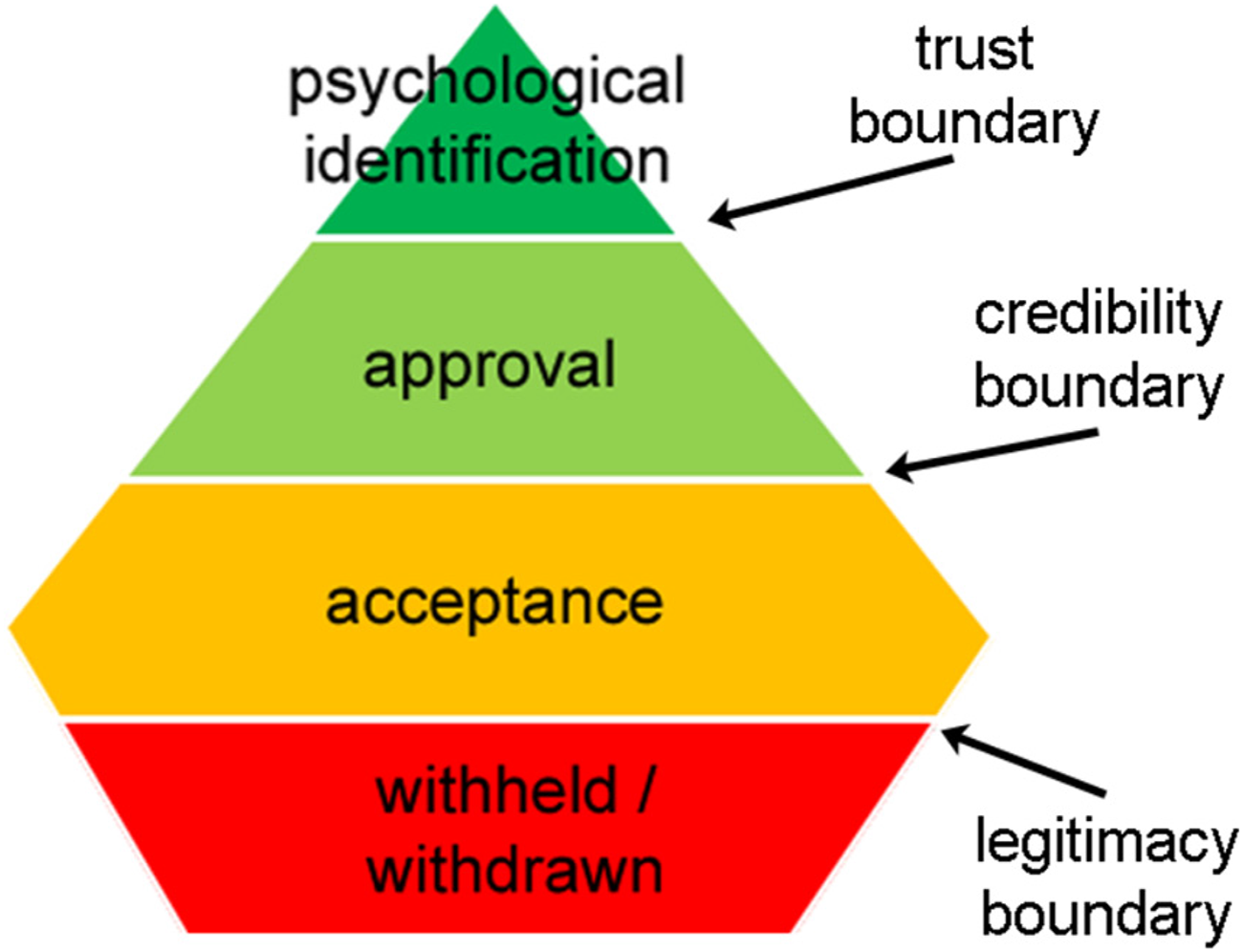
The pyramid model of social licence to operate (Thomson & Boutilier, 2011).
Using the three factors nominated by Thomson and Boutilier (2011) – legitimacy, credibility and trust – we discuss how transnational universities could consider their social licence and impacts on local communities. In essence, legitimacy is fairness: a fair distribution of benefits, and fair process. It includes legal-administrative legitimacy, as well as economic legitimacy and social legitimacy. To obtain legal-administrative legitimacy, an organization needs to observe national and international standards. Economic legitimacy requires that an organization provide adequate compensation and benefits to the community. Social legitimacy requires effective stakeholder engagement. Credibility is gained by the organization consistently providing accurate, clear and believable information to the community. To achieve credibility, organizations need to provide benefits to communities, and local people need to be engaged at all stages in the development of a project. The highest level of social licence is achieved when there is trust between the community and the organization. Trust is manifested as perceiving each other as partners, respecting each other, and having common interests (Jijelava & Vanclay, 2017). Ideally, a social licence to operate needs to be obtained from all groups in a community, including vulnerable and marginalized groups (Vanclay & Hanna, 2019).
Methods
Using a case study approach, we considered the social licence of two transnational universities in China: the UNNC, which is located in Ningbo, Zhejiang Province (about 200 km south of Shanghai); and the XJTLU, in Suzhou, Jiangsu Province (about 100 km west of Shanghai). For each case study, a mixed methods approach was applied and many social research methods were used, including document analysis, media analysis, in-depth interviews, and semi-structured interviews. Where permission was granted, interviews were recorded. Signed informed consent sheets were not used, because they are not culturally appropriate in the Chinese context, however the general principles of ethical social research including informed consent (Vanclay et al., 2013), were observed.
To understand the background of each case, we checked all relevant news and reports about each university using the Google and Baidu search engines using searches in English and Mandarin. We did site visits to interview key informants and obtain first-hand impressions. We analyzed all relevant documents we could find, including some provided to us by interviewees. Fieldwork was conducted in November and December 2018. To gain the views of internal stakeholders, we did key informant interviews with 4 senior management staff of UNNC and 6 senior management staff of XJTLU. To understand how daily student life interacts with the local community, we also interviewed 17 students of UNNC and 24 students of XJTLU.
We also conducted semi-structured interviews in the host communities of Ningbo and Suzhou. Using four research assistants in each location, a total of 34 interviews were conducted in Ningbo and 82 in Suzhou. Interviews were completed face-to-face, with participants being approached in public places (on the street, in cafes and malls) within the vicinity of each university. The vast majority of people approached were happy to be interviewed. Each interview took between 5 and 15 min depending on the extent to which the participant was willing to discuss the issues. After establishing that the person was aware of the existence of the university (a few non-local people were not), questions relating to social licence were asked. Most questions related to the factors in the Thomson and Boutilier model (Figure 1). Some additional questions were also asked, including: Do you regard your current job as being due to the establishment of the university?; Through which channels do you obtain information about the university?; Did the university make any commitments to the community when it was established?; Were the commitments fulfilled?; and What expectations did you currently have about the university's contribution to the community?.
Legitimacy was considered by asking questions such as whether: the establishment of the university was important to the community; residents benefit from the university; the positive impacts outweigh negative impacts; and what community engagement activities were conducted by the university. Credibility was considered by asking about whether: the community engagement was professional and effective; the university consistently provided accurate, clear and believable information about its plans; a mechanism to provide comments or complaints to the university was available; the university listens to and respects community opinions; the university is willing to change its practices in response to community concerns; and whether the university fulfills community expectations. Trust was considered by asking about whether: community engagement involved all groups in society (e.g., including elderly people, women, newcomers); the university tried to establish a good relationship with the community; the university has a good relationship with the community; and whether the university and residents are “on the same team” and have shared interests.
We also undertook indepth interviews with 38 residents in Ningbo (in the neighborhood of UNNC) and 45 residents in Suzhou (in the neighborhood of XJTLU), including staff from the local Community Committees, owners of local businesses (e.g., restaurants, bars, hotels, gyms, real estate), and some residents. To gain a general impression of community life, our research also involved informal observation in the communities.
Background to the Two Case-Study Universities
University of Nottingham Ningbo China
UNNC was the first foreign university partnership in China. Established in 2004, UNNC is operated by the University of Nottingham (UK) in cooperation with the Zhejiang Wanli Education College. In 2019, there were more than 750 staff, and around 8,000 students, including 700 international students, spread across three faculties, Business, Science & Engineering, and Humanities & Social Sciences, with a total of 29 undergraduate courses and 13 postgraduate courses. UNNC is located in the Yinzhou district of Ningbo, Zhejiang Province, on China's east coast. The 58 hectare campus in the Ningbo Higher Education Park has many attractive features, including Chinese and English gardens, and a replica of the University of Nottingham's iconic Trent Building, complete with a clock tower. Most students live on campus in halls of residence. The campus is fully fenced, with security guards checking all persons who seek to enter. Visitors are only able to enter by invitation of a UNNC staff member or student using the online visitor registration system.
Xi'an Jiaotong-Liverpool University
XJTLU was established in 2006 as a cooperation between the University of Liverpool (UK) and Xi’an Jiaotong University. Offering undergraduate and postgraduate programs, it has 16 academic departments. Occupying around 25 hectares in Suzhou, Jiangsu Province, the campus has two parts, which are connected by an underground passageway beneath a road that splits the campus. There is no perimeter fence, and both parts of the campus are open to the public. In 2019, there were around 500 staff, 15,000 students, including 800 international students. Student accommodation is provided in the Suzhou Dushu Lake Science and Education Innovation District (SEID), which is managed privately by the Suzhou Industrial Park Education Development and Investment Limited Company. SEID is a well-planned area developed for high-tech institutions and contains around 40 universities and higher education institutions. SEID arranges the accommodation, libraries, sporting fields and other facilities for all institutions collectively, and many facilities are open to the public. According to its public announcements, XJTLU focuses on establishing a symbiotic relationship with business, industry, and the community. Some XJTLU students and staff undertake community service activities, and there are knowledge-sharing events for local residents.
University Activities Considered from a Social Licence Perspective
Legitimacy
Our evidence suggested that XJTLU had a slightly higher legitimacy than UNNC. One reason for this was that more people in Suzhou had a job directly related to the university than in Ningbo. Because the location of XJTLU (an innovation park, SEID, in Suzhou) was designated and planned for higher education institutions, most local jobs related to serving university staff and students. Therefore, residents who worked in the area would likely have benefitted from the establishment of XJTLU. Furthermore, SEID provided libraries, sporting fields and other facilities that local people were allowed to use. In contrast, UNNC was located in the Ningbo Higher Education Park, which only otherwise contained a few small colleges, so most residents did not feel there was much relationship between the establishment of UNNC and their livelihood.
Residents from both Suzhou and Ningbo generally agreed that the establishment of the transnational universities generated more positive than negative impacts. Given that universities are generally considered to be good-reputation land use activities and neighbors, the establishment of both UNNC and XJTLU were readily accepted by the respective local residents. However, both UNNC and XJTLU had a lack of community engagement activities. Both universities should improve the effectiveness of their community engagement activities and interact more with their local communities.
Credibility
According to their respective local communities, the community engagement activities of UNNC were more professional and effective than those of XJTLU. However, our interviews suggested that XJTLU conducted more community programs than UNNC. Nevertheless, some Suzhou residents have complained about the arrogant attitudes of some XJTLU students participating in the community service programs, and they thought that students from local domestic universities behaved better.
Students at UNNC and XJTLU generally came from wealthier family backgrounds than students at other nearby institutions. The tuition fees for these two universities were 10 to 20 times higher than those of domestic institutions. They also provided the possibility to participate in study abroad programs in the UK, USA and elsewhere. The goal of many students at UNNC and XJTLU was to work in transnational companies, and therefore they did not consider serving the local community as volunteers to be part of their purpose or self-identity. Some students had been spoilt by their wealthy families, had never done any menial tasks in their life, and had no interest in doing community activities of any kind. However, since some community engagement activities were compulsory, the students were obligated to participate, but they exhibited negative attitudes and poor behavior towards local people, as some residents complained to us. Unlike the traditional hierarchical nature of domestic universities, both UNNC and XJTLU had a European egalitarian way of interaction between staff and students, which meant that the staff could not command the students to do things, and the staff had to be careful about their comments and behavior towards students, because otherwise the students might complain about them in teaching evaluations and the like. Some staff reported that they found it difficult to convince students to show respect towards local people: “The students are still young and short-sighted to some extent. However, we cannot instruct them to change their attitudes.”
XJTLU provided more information about its development plans to its local community, had more interactions with residents, and paid more attention to their comments than did UNNC. We consider that there were three main reasons why XJTLU had greater credibility than UNNC. Firstly, XJTLU was an open campus, so nearby residents could easily enter the campus and were more likely to develop connections with XJTLU staff and/or students. Secondly, XJTLU had a Department of Urban Planning & Design, whose staff regularly supervised student activities in the community, including conducting focus groups, interviews, field observations, etc. Residents could obtain information about XJTLU through these activities, and they could provide their thoughts directly to the staff and students. Thirdly, at the request of local Community Committees, XJTLU staff (and sometimes students) frequently conducted community courses for local residents, including on topics like managing money, household chemistry, and household maintenance. XJTLU also had many university open days to which local residents were invited to inspect the campus and its facilities, and at which there were science demonstrations and public talks. These interactions provided residents with many opportunities to get to know the university.
UNNC also conducted activities on campus to which the public was invited. However, because UNNC was a gated campus with a strict security procedure requiring pre-approval, residents found it inconvenient to gain entry. Due to its course profile, there was no need for UNNC students to conduct fieldwork in the community, and therefore residents had little opportunity to connect with the university. As the local Community Committee complained, “The campus is gated and we never have any idea about what is happening in the campus … and there are limited opportunities and a lack of invitations from UNNC”. Furthermore, since the committee knew little about the university, it could not identify what activities might be conducted together with UNNC.
Trust
Despite XJTLU generally performing better than UNNC, actually there was higher trust among the residents of Ningbo (UNNC) than Suzhou (XJTLU). One reason for this was that UNNC performed better than XJTLU in involving vulnerable groups. Both universities conducted various activities in their neighboring communities. The activities XJTLU conducted were perhaps too innovative for some community members. Some activities they undertook included: staff giving talks in local schools; local families inviting foreign students into their homes and/or “adopting” them as a family member; and various creative activities. While these activities were innovative (at least in a Chinese context), they tended to appeal to younger rather than older people. UNNC, however, tended to conduct traditional activities, such as visiting elderly people and teaching English in schools.
Another explanation for the higher level of trust is that UNNC was the dominant university in its location, and was perceived as having created significant benefits for the community. UNNC had turned Ningbo from a suburban to an urban area, and local residents anticipated ongoing improvement in their lives because of the university. Conversely, XJTLU was located in a science park (SEID) with around 40 other institutions. Therefore, residents did not feel that XJTLU made a particularly strong contribution to their community, especially in comparison to the other institutions, most of which had been there much longer.
Another explanation for the lower level of trust of XJTLU might relate to the local concern about students renting accommodation off-campus. Many XJTLU students disliked having to live in student dormitories, and were wealthy enough to rent apartments nearby. Some of these students behaved badly (at least as far as local residents were concerned) and many residents complained about loud activities late at night. Some foreign students also preferred to rent accommodation off campus, but exhibited cultural behaviors that were not always considered acceptable by their neighbors. Even though not all people behaving badly came from XJTLU, according to local residents XJTLU students were in the majority. Local residents argued that: “XJTLU students were easily identifiable by their clothing, by the fact that there were usually accompanied by foreigners, and by their speech [accent/language]”. In contrast, UNNC was a gated campus some distance from the community. As a result, most students lived in halls of residence on campus, and there was no community perception of a problem with the presence of students.
Discussion
Our results indicated that both UNNC and XJTLU had some level of social licence from their host communities. However, both universities lacked transparency and effective communication with local communities. Both universities had publicly stated that they intended to make a positive contribution to their local community. However, in these statements the universities were likely to have been referring to a wider region such as the whole city, rather than just to nearby residents, especially given that many of their public engagement activities were a considerable distance from the campus. The high level of trust they experienced arguably came from the good reputation of universities generally, rather than from the activities of these universities directly. Residents trusted the universities partly because they thought they benefited from them, even if in an indirect way. However, both UNNC and XJTLU did not have adequate community engagement activities to develop a strong relationship with their local communities, and thus they had lower credibility than might have been expected.
Transnational universities typically have newly-built campuses (at least soon after establishment), although one intended transnational university in China was to have been an upgrade of an existing institution (Chen & Vanclay, 2020; Chen et al., 2019). Given the positive image of universities generally, transnational universities are likely to have some level of social licence from the community, at least initially. However, any social licence is temporary, and all universities will need to undertake appropriate actions to maintain and strengthen their social licence over time. We argue that effective university-community engagement contributes to obtaining, maintaining and strengthening a university's social licence to operate and grow. In our research, residents in Ningbo and Suzhou were somewhat satisfied with their involvement in the university's engagement activities, from which they obtained information and knowledge, as well as having an opportunity to exchange views. Even though some staff and students believed that they learned something from residents during these engagement activities, they considered that the engagement process was primarily about the university serving its communities (thus a one way rather than a two way process). Ideally, university managers should determine how to interact with local communities to enhance knowledge creation both for communities as well as for the university.
For any organization operating in a foreign country, gaining a social licence to operate and grow can be difficult, especially because of the cross-cultural context, and in having to balance home country and host country expectations. Proper consideration of social impacts and reflecting on social licence offer the potential to assist in understanding the local context and in utilizing the local knowledge of communities in developing the project (Stephenson, 2011; Vanclay, 2012). It was clear from our research that communities could provide local knowledge and experience to assist universities, and that this would assist in the universities getting a social licence. However, there was no evidence that either UNNC and XJTLU had given any consideration to the potential input from local residents. Furthermore, the lack of consideration of local concerns led to some dissatisfaction amongst the local communities. The limited means by which local communities could express their concerns and have themselves heard led, for example, to the universities failing to be aware of and managing the misbehavior (as perceived by the local communities) of students. In order to gain a social licence to operate and grow, universities need to have effective community engagement practices, effective feedback or grievance redress mechanisms that communities can use, and share benefits with local communities, for example by making contributions to community development, sharing facilities, and interacting with local community organizations (Vanclay & Hanna, 2019).
We found that Thomson and Boutilier's (2011) pyramid model of social licence was useful in understanding the relationship between transnational universities and their communities. However, we also found that, even at the lower levels of the model – acceptance (legitimacy) and approval (credibility) – trust was also important and relevant. In other words, trust is fundamental to the notion of social licence, and not just something at the pinnacle (Moffat & Zhang, 2014). In the two universities we considered, the level of trust was high, while credibility was relatively low. We argue that the positive reputation of universities generally contributed to this initial level of trust, but their relatively low level of credibility suggests that these universities need to undertake more effective measures to interact with their local communities to maintain and develop their social licence.
Our analysis of UNNC and XJTLU indicated what transnational universities should do to obtain a social licence. Although universities generally require a large landtake and some even displace local people (Chen et al., 2021), universities are not likely to have a major negative impact on the local environment (at least in comparison to a mine or dam), therefore, they are likely to reach a relatively high level of legitimacy. Nevertheless, all three forms of legitimacy – legal-administrative legitimacy, economic legitimacy, and social legitimacy – are important, and each form should be carefully considered by university managers. Our case studies revealed that the community engagement processes and activities of the universities were not fully effective, potentially impacting on their legitimacy. We also noted that sharing facilities (e.g., the library, playing fields) with residents contributes to gaining legitimacy and a social licence.
Achieving high levels of credibility requires effective positive action by organizations. Transnational universities tend to conduct more community engagement activities compared to domestic universities due to their different philosophies and situation. However, we suggest that these activities should focus more on the quality of the activity rather than on the quantity of activities (Moffat & Zhang, 2014). A significant issue, however, is that students are an important element of universities and the behavior of students in public places significantly influences residents’ views about the university and the level of social licence they are likely to assign to it. In community engagement activities, the bad behavior and negative attitudes of some students can create a poor impression of the university amongst local community members and impact negatively on them. In China, there typically is a high level of social control that permeates society, culture, and all institutions (including domestic universities). In contrast, in transnational universities, western philosophies and values around freedom of expression, academic freedom and personal freedom can sometimes lead to social and cultural impacts on local communities. Therefore, creating greater mindfulness among students about the impacts of their behavior on local communities could be desirable. Some interviewees considered that the sudden exposure of Chinese young people to the openness/liberalism of transnational universities might lead to moral confusion and an inability to self-manage, which could be responsible for the expression of socially-undesirable behavior.
Conducting course-based fieldwork in local communities could be a way for universities and communities to understand and learn from each other. Arguably, universities should encourage more community-based fieldwork, as well as encourage the various student societies and interest groups to organize activities in local communities. Greater cooperation with local communities might resolve the issue of the lack of information. Residents want to know about what will happen with the university, and managers should establish more channels to engage with residents and receive feedback from them.
Having a gated campus might contribute to the management of students and to a reduction in conflict between residents and poorly-behaved students. However, a gated campus is a barrier, and residents will complain about being locked out. With transnational universities typically attracting wealthier students and foreign students, the sense of distance between the university and the local community can be great. Having a gated campus exacerbates this distance, restricts communication, and reduces mutual understanding (or at least the perception thereof).
In their early phases, transnational universities tend to have support from local residents due to the good reputation of universities generally. However, to maintain and strengthen their social licence to operate and grow over time, effective strategies and actions are needed, especially in relation to community engagement and benefit sharing. When attempting to improve their social licence, university managers need to consider the local social context. A transnational university needs to make decisions that balance its development and its contributions to the community, as well as home country and host country expectations.
Ineffective community engagement and limited information exchange create misunderstandings between an institution and its local community, and negatively affect the institution's social licence. In contrast, effective community engagement activities and the proper management of negative social impacts will assist residents in coming to the view that the institution is a trustworthy, reliable partner with interests in common with the community. Nevertheless, to be fully effective, community engagement activities should be strategic, and contribute to the development of both parties (Esteves & Vanclay, 2009). Addressing an organization's negative social impacts and consideration of its social licence potentially assist in accessing local knowledge and skills, contributes to institutional development, and to earning not only a social licence, but to a social licence to operate and grow (Vanclay, 2020).
Conclusion
This paper was a reflection on the concept of social licence to operate, especially in the context of a type of project normally considered to be in the public good and beyond reproach – higher education institutions. Nevertheless, even universities create negative social impacts on their host communities, especially in terms of the acquisition of land, displacement of existing residents, studentification, and ongoing nuisance, including from the behavior of students (Chen & Vanclay, 2021; Chen et al., 2021, 2019). It should be noted that research for this paper was based on only two case studies, both United Kingdom based universities that have established transnational campuses in China. Qualitative research methods were used, with semi-structured interviewing of local residents, local officials, students, and university staff. We acknowledge that our findings and interpretations could be influenced by the small sample size, structural bias in terms of who was interviewed, by the specific characteristics of these two institutions, and by our personal belief that all institutions should respect human rights and behave fairly and responsibly.
Our starting and finishing premise was that all organizations, including universities, need to gain and maintain a social licence to operate and grow (Vanclay & Hanna, 2019). Transnational universities would especially benefit from careful thinking about their social licence. We also consider that “having a social licence” should be a component of the notion of “university social responsibility”, and therefore social licence should be entrenched within each university's vision, mission and practices, just as it is in many other industry sectors. An important point to realize is that a university campus is usually a large footprint project that is intended to operate for many decades or even centuries. Host communities are likely to be long-term neighbors, and some local residents might spend their whole life living alongside the university. These local residents might support and assist in the development of the university, or they might disrupt or restrict its operations and activities. Effective community engagement is essential to gaining and maintaining a social licence to operate and grow.
Arguably, the gaining and maintaining of social licence is expected from the perspective of university social responsibility (Chen & Vanclay, 2020; Chile & Black, 2015; Larrán Jorge & Andrades Peña, 2017; Meseguer-Sánchez et al., 2020; Rahman et al., 2019). However, because of the good reputation of universities generally, in the two cases we studied, local residents were largely oblivious about the potential negative impacts of the campuses (at least before they were established). Furthermore, there was no process by which their views were considered in the development of the universities. Ultimately, local residents were left having to experience some negative social impacts created by the establishment and operation of the universities, as well as having the feeling of not being consulted or able to contribute input. We suggest that social impact assessments be done for all new projects (including universities) and that there be due diligence assessments on a regular basis (Vanclay & Hanna, 2019).
Transnational as well as other universities have a role in contributing to achieving the United Nations Sustainable Development Goals (e.g., Quality Education; Reduce Inequalities; Sustainable Cities and Communities). However, this reveals some contradictions and complexities. How could universities be trusted if they fail to operate sustainably in their host communities? How could they improve the global community if they ignore their own local communities? Clearly, universities need to walk the talk, and lead by example. We argue that transnational universities can use the notion of social licence to assist in seriously considering their university social responsibility expectations and environmental, social and governance (ESG) issues, especially in terms of mitigating negative social impacts, providing benefits to local residents, and meeting international ESG and human rights standards. Consideration of social licence will help universities to think deeply about the relevant issues and inform their policies and practices. Social licence will help in developing strategies that enhance campus development while behaving in a responsible way.
We believe that universities are falling behind other organizations in understanding their ESG and human rights obligations, including to their host communities. With “corporate social responsibility” being an alien concept to many university leaders and writers in the field of higher education, the concept of “university social responsibility” has emerged and is taking shape. We believe that, in the near future, universities will be assessed (including in sustainability rankings) on their performance in terms of ESG, university social responsibility, and their social licence awareness and practices.
Footnotes
Acknowledgments
China Scholarship Council (CSC). The authors thank the staff and students at the University of Nottingham Ningbo China and Xi'an Jiaotong-Liverpool University for their assistance.
Declaration of Conflicting Interests
The author(s) declared no potential conflicts of interest with respect to the research, authorship, and/or publication of this article.
Funding
The author(s) disclosed receipt of the following financial support for the research, authorship, and/or publication of this article: This work was supported by the Chinese Scholarship Council
