




Abstract
This article argues that students’ attitudes and dispositions can be important enablers or blockers to effective internationalization of the curriculum in higher education. Using a case study of teaching African studies at a Dutch Liberal Arts and Sciences college, this article shows that students have mixed explicit attitudes toward the subject matter, but more consistent implicit dispositions that influence their understanding. Specifically, our students show strong dispositions toward agency, rationality, separation, and similarity, which clarifies some aspects of the course content but obscures others. As such, they function as both enablers and blockers to intercultural learning. Since dispositions are common among university students and relevant to a wide array of intercultural learning contexts, this study offers important insights for designing and implementing effective internationalization—in particular, the need to tailor our efforts to the specific constellation of attitudes and dispositions, the course content, and the skills of both teachers and students.
Keywords
Introduction
Over the past 25 years, internationalization has become a central priority for postsecondary educational institutions across the globe (De Wit et al., 2015). What constitutes internationalization has evolved in line with shifting political, economic, and normative motivations for its development but has been commonly defined as the intentional process of integrating an international, intercultural or global dimension into the purpose, functions and delivery of post-secondary education, in order to enhance the quality of education and research for all students and staff, and to make a meaningful contribution to society. (De Wit et al., 2015, p. 29)
Understood this way, internationalization goes beyond creating foreign campuses or sending students abroad; it includes developments “at home,” for example, by recruiting diverse student bodies and developing internationalized curricula (Beelen & Jones, 2015; de Wit & Jones, 2018; Leask, 2013, 2015; Leask & Bridge, 2013). Growing policy commitments to the internationalization of the curriculum (IoC) promises to enhance the “international” attributes of university graduates, in terms of their skills, knowledge, and attitudes (Green & Whitsed, 2015).
Yet despite growing policy commitments, the effective implementation of IoC is hindered by cultural, institutional, and personal “blockers” (Leask, 2015). So far, the analysis of enablers and blockers has largely focused on the commitment (or lack thereof) to internationalization among educational policy makers, university administrators, and teachers (Green & Whitsed, 2015; Robson et al., 2018). Some attention has been paid to students’ attitudes, recognizing that students not only need to value the goals of internationalization but also need to be motivated to learn how to communicate across linguistic and cultural boundaries (Leask, 2015; Leask & Carroll, 2011). Yet we argue that students’ views matter in other ways than their explicit attitudes toward intercultural work.
We highlight that in addition to their explicit attitudes toward the intercultural content, there is a deeper level of potential blockage in their “dispositions” toward understanding the world around them. By “dispositions,” we mean the personal attributes and orientations that, often implicitly, shape the way we view the world and the “inner-workings” that filter the thinking of our students (Schussler, 2006). By acting as analytical filters, their more superficial attitudes and their deeper dispositions can either facilitate or hinder learning new intercultural information and fully comprehending differences.
To illustrate the importance of students’ attitudes and dispositions as enablers or blockers in practice, we present a case study of teaching African studies, and in particular African religion, to Liberal Arts and Sciences (LAS) students at Leiden University College (LUC) in the Netherlands. LUC’s learning objectives are in line with an internationalized curriculum that aims to engage students with diverse international perspectives and develop their skills and attitudes to become globally competent professionals and citizens. As LUC teachers, we experience few institutional or personal constraints on our ability to provide this internationalized education and, in fact, feel quite strongly supported in pursuing this goal by our university and our students. In this case of teaching religion, we argue that a major blocker to our efficacy comes from the dispositions that we ourselves and our students bring into the classroom.
Following a brief description of the setting and methods, we discuss how our students’ relevant attitudes and dispositions enable or block their ability to understand African religion and religiosity. Although many students find religion important to understand, they have varying explicit attitudes toward it. Their dispositions, however, are more consistent, revolving around commitments to agency, rationality, separation, and similarity. As each of these dispositions filters students’ understanding of course material and learning experiences, we argue that they are important determinants of the efficacy of internationalization efforts.
Such dispositions are very likely quite common among university students in the Netherlands and elsewhere, and relevant to a wide array of intercultural learning contexts well beyond the teaching of African religion. Therefore, this study suggests that further research is needed on how students’ dispositions filter their learning. It demonstrates how internationalization efforts need to be tailored to the specific constellation of course content, skills, and attitudes and to dispositions of both teachers and students. Effective internationalization requires a process of reflexivity and cultural evaluation and critique in addition to providing value-neutral knowledge and teaching generic cross-cultural communication skills. This has important implications for curriculum and course design, as well as for teacher training and the selection and application of teaching techniques. It also requires student-centered partnership approaches to internationalization (e.g., Brown, 2008; Green, 2019; Healey et al., 2014; Wright, 2011), that is, real engagement with students to explore their deeply held and often taken-for-granted dispositions. The recognition and critical evaluation of these dispositions, inextricably linked to issues of privilege and social position, also contribute to efforts to “decolonize” higher education in intercultural exchange and learning (e.g., De Carvalho & Flórez-Flórez, 2014; Le Grange, 2016).
Setting and Method
Given the methodological challenges of observing or measuring attitudes and dispositions, we use evidence drawn from different sources (triangulation), both qualitative and quantitative: survey data of undergraduate students we have taught; our teaching experiences in the classroom; and our fieldwork experiences from Kenya, Tanzania, and Nigeria. The survey data and most of the teaching experience are based on our work at LUC, an LAS college established in 2009 with an annual intake of roughly 200 students and a total student population of about 600. The class studied for this article comprised 207 students, 55% of them being non-Dutch and 69% female. LUC’s status as an Honors College within Leiden tends to attract students who have performed well at academically minded (international) schools, have been exposed to some degree of internationalized secondary education, and often, though certainly not always, have a relatively high socioeconomic status. The non-Dutch students come mostly from other European countries, but also from elsewhere (e.g., the United States, Mexico, Chile, South Korea, or Kenya).
Institutionally, internationalization is one of the pillars of LUC’s educational vision, which aims to enable students to respond critically and creatively to the flow of a rapidly changing world and [. . .] enable them to look at issues from creative and novel perspectives. Our clearly defined international profile creates an intercultural experience that proudly culminates in our community of global citizens. (Leiden University College, n.d.)
As teachers at LUC, we have substantial freedom and support to innovate and experiment in our courses and classrooms. The authors, for example, have developed field course programs, global classroom courses, and service-learning projects. As such, we do not consider LUC as a “blocker” to internationalization—rather as an “enabler.”
The curriculum at LUC is made up of a compulsory set of first-year courses, including academic skills and also broad introductions to Global Challenges (GCs) (Peace and Justice, Sustainability, Prosperity, and Diversity) and the disciplines that study them. The survey data were collected as part of two of these first-year courses: GC Prosperity and the subsequent GC Diversity. At the start of each of these courses, the online survey questionnaires were sent to all 207 first-year students, of whom 185 (GC Prosperity) and 135 (GC Diversity) responded. Survey questions, which are available upon request, used Likert-type scales and open-ended formats to probe students’ dispositions in the four main domains analyzed in this article: agency, rationality, separation, and similarity. Furthermore, the surveys aimed to elicit students’ views on religion, such as their beliefs in the spirit world, their theories on the origins of Africa’s presumed religiosity, and their ideas on divine justice (“karma”). The survey was anonymous and collected limited background information of students’ choice of major, their religion, and their nationality. Students were informed of the purpose of the survey, and they were free to choose whether or not to fill it out. The surveys were intentionally administered before the students had received any specific training in their major and before they had followed courses on Africa or on religious studies.
Our teaching experiences are based on courses in development studies, human security, and African studies. African religion features in almost every course we teach, given its prominence in the political and social dynamics on the continent. In most of these courses, classes are relatively small (maximum of 20 students) and seminars are highly interactive, with substantial student engagement in discussions. This means that we, as teachers, are able to get quite a good sense of where students stand on issues we discuss, including religion, and also that students are likely influenced by our positions. In this regard, it is relevant to mention that we are both agnostic and, by inclination, critical toward forms of hierarchical, organized religion. Fieldwork in deeply religious contexts, both in East Africa (Caroline) and in West Africa (David), has challenged some of our assumptions and has opened us up to forms of spirituality that we find difficult to understand. Due to this experience, we do not feel “under-informed, under-supported, under-prepared and under-confident when it comes to IoC,” and specifically teaching religion in our classrooms (Green & Whitsed, 2015, p. 10).
Students’ Attitudes Toward Religion
What do our students think of religion when they start at LUC? Do they see value in learning about the religious lives of others? Most of our students do not outwardly reject religion or religiosity. Some have self-declared faith. Among the first-year cohort of 2016 that responded to the Prosperity survey, almost a third (31%) self-reported a religious affiliation of some sort, another third (35%) were atheist, and the final third declared to be agnostic or uncertain. Among those who declared faith in an organized religion, the large majority were Christian, followed by Muslim and Buddhist. Some students struggled to decide which label fits. The “Other” category (3% of respondents) includes students, for example, who specify meditation as well as others who seek fluidity in religious affiliation: “Does it count if I say a bit of everything depending on what speaks to me for various reasons?”
In addition to their own religious identity, students also feel religion is an important factor to understand the world around them. When the Diversity survey asked students to choose the most significant diversity challenge among the following options—class, gender, race, nationality, and religion—23% of students chose religion, second only to race. This finding matches our experience in the classroom, where students are generally curious about religion and, specifically, its impact on politics and development around the world.
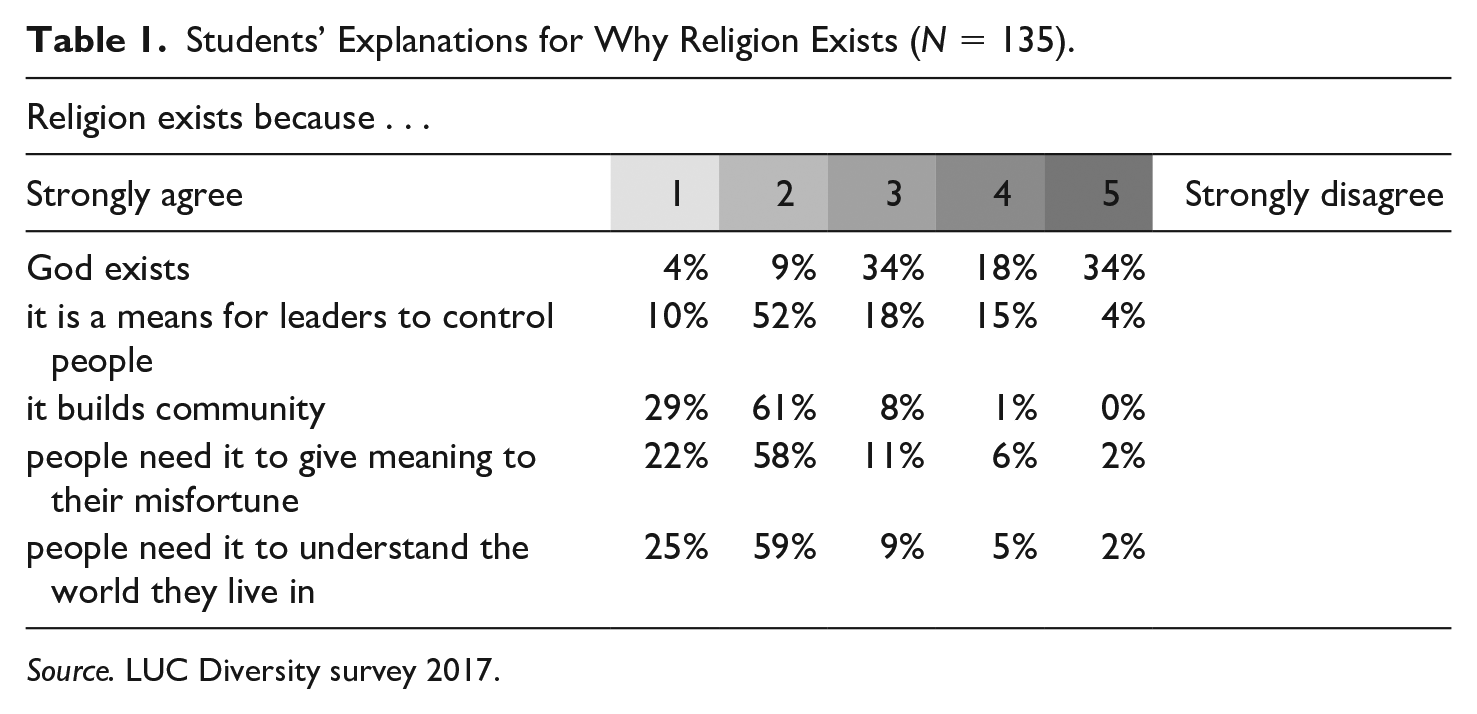
Yet this does not mean students view religion necessarily in a positive light. For example, when the Prosperity survey asked whether religion promotes prosperity, only about a quarter of students responded positively. There is also a common concern that organized religion restricts freedoms and perpetuates inequality. When the Diversity survey asked whether religion empowers women, half the respondents disagreed and only 15% agreed. Many students also considered religion in the cynical light of politics. As a telling illustration, in a course we co-taught on international development, we set out to teach the class on the important roles that faith-based organizations play in providing development assistance in Africa and elsewhere. To put it mildly, our students expressed little faith in faith-based organizations. Several were quick to share their associations of missionary work and evangelical activities with self-interest, extortion, and neo-imperialism. These concerns are confirmed in the Diversity survey, when 63% of students agree that “religion exists because it is a means of leaders to control people” (see Table 1).
Students’ Explanations for Why Religion Exists (N = 135).
Source. LUC Diversity survey 2017.
At the same time, our students also point out some of the important social attributes of religion and how, for example, religious affiliations can facilitate the establishment of community, provide a shared identity, and solidify ties of social support and security. As Table 1 shows, 90% of students who agreed with the Diversity survey claim that “religion exists because it builds community.” Eighty-four percent of students agreed that “religion exists because people need it to understand the world they live in,” and, similarly, 80% agreed that “people need it to give meaning to their misfortune.”
Explicit attitudes toward religion thus show a mixed picture when it comes to affiliation, religion’s importance, and its causes and impact on society. These attitudes are important for us, as teachers of African religion, because they highlight where our students are starting from when they engage, often for the first time, with our subject matter. On the one hand, they highlight explicit biases and preconceptions, which may need to be challenged or corrected. On the other hand, these attitudes can also prove helpful teaching tools. For example, in the classroom we can use their own affiliations to highlight similarities and differences between their experiences and those of African faiths. Moreover, we can make use of the variation in positive and negative evaluations among students to build a nuanced and multifaceted understanding.
As we have suggested above, however, students’ explicit attitudes on religion also hide more implicit, analytical dispositions that students use when trying to understand religion and religious life. Specifically, we argue that students show strong dispositions toward agency, separation, rationality, and similarity. These dispositions are not uniquely applied to understanding religion; in fact, we would argue that they act as lenses through which our students engage with most socially relevant information they learn in their courses. Like most analytical lenses, these dispositions are both helpful and detrimental to our students’ understanding: They reveal certain aspects of social phenomena while obscuring others. In the next section, we explore each of these dispositions in turn, highlighting evidence for their prominence as well as their impacts as blockers or enablers of students’ understanding of African religion.
Dispositions: Agency, Separation, Rationality, and Similarity
Agency
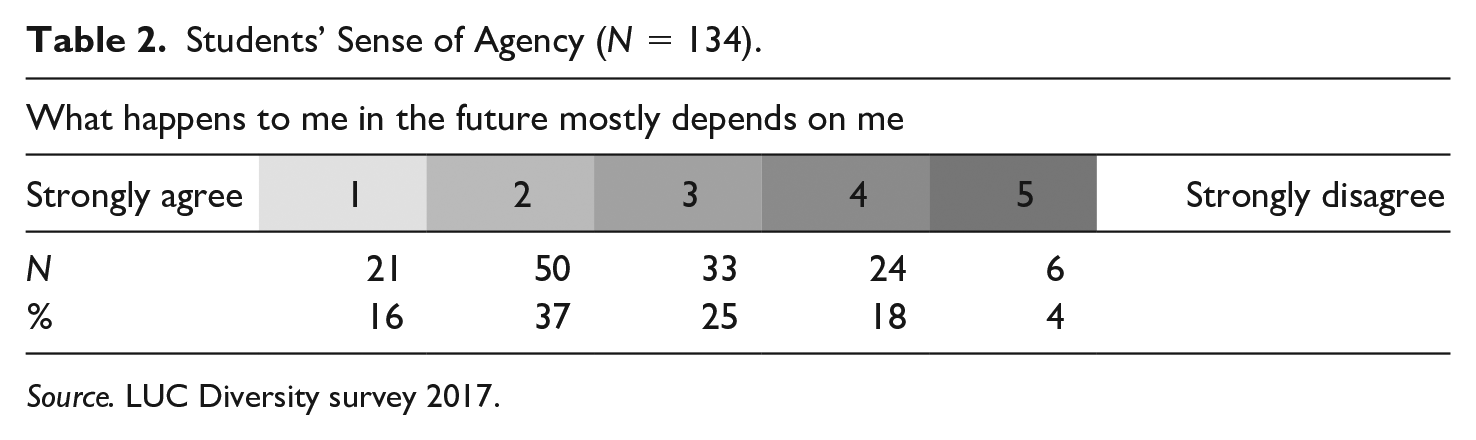
Agency is conceived here as the engagement by individuals of their environment in a way that reproduces or transforms it (Emirbayer & Mische, 1998). Belief in the power of agency, and in particular the capacity of individuals to transform their environment, is an attribute we actively select for in our student body. In the admission process, we pour over CVs, looking for signs that these students believe can change the world. In the interview process, we routinely ask them where their passions lie in confronting global challenges. And while we, as teachers, find ourselves sometimes needing to temper their enthusiasm and confront their naiveties, by no means do we wish to extinguish their drive to become agents of change. Our students constantly communicate a strong sense of agency and confidence that they have direct control over their own lives and they can bring about directed change in the world. The first-year Diversity survey offers a glimpse of this agentive disposition, with less than a quarter (22%) of students disagreeing with the proposition that “what happens to me in the future mostly depends on me” (see Table 2).
Students’ Sense of Agency (N = 134).
Source. LUC Diversity survey 2017.
We therefore argue that the first disposition of our student body is a strong belief in agency, illustrated by a classroom simulation exercise we designed to let students explore the experiences of poverty. In groups of four, the students try to take on a year in the life of an imaginary income-poor family. Within very limited financial means, the students must make decisions on where to live, what to eat, what to buy, and what to do as different circumstances change in the course of the life of the family. They start the simulation knowing that the family comprises a young, Latino couple, “still madly in love,” surrounded by friends and family, who after the unexpected arrival of their twins both had to drop out of high school and begin working. The husband works overtime as a line cook for minimum wage. The mother works in a hair salon but only part-time due to a car accident that resulted in chronic back pain. The twin girls attend a nearby primary school and are looked after by their grandmother.
Their “honest” income is meager and not enough to house their family safely, feed them well, and provide for their children all of the opportunities they wish for, let alone pursue their own career aspirations. They are allowed to supplement their income with illegal income-generating activities (stealing, drug dealing, and/or prostitution) for which specific remunerations are generous and attractive. However, this would come with risks, dangers to their lives, health, and happiness along with the possibilities of being caught, stigmatized, and sent to prison. As the weeks progress and the students make different choices, more and more attributes of the family members are formulated and disclosed. The goal of the exercise is clearly stated from the start. It is not to make the family rich, nor is it a competition over which group can get their family safely out of poverty quickly. Rather, it is for the students to experience and empathize with those in poverty and to feel the weight and constraint of poverty on multiple facets of people’s lives.
The students take on this simulation exercise with great fervor. They do not accept the constraints of poverty and immediately set off to find a solution. They are resourceful and creative in finding ways for the family to make more “honest” income. They scour the internet for opportunities, they sign up their families for every government subsidy they can find, they start legal proceedings for accident compensation, and they pour over the classified ads in an attempt to give their family members new starts at more profitable careers. Every week is a challenge to slow down their momentum and to get them to consider, recognize, and respect that their family members, given their particular circumstances, may not have the skills, confidence, or energy to be pursuing some of these solutions. Through this exercise, students are repeatedly confronted with their heightened sense of agency and how this might be an important obstacle in empathizing with others, particularly those struggling in poverty.
In relation to religion, this same exercise highlights how the agency disposition may obscure or render religion and religiosity invisible. Although there are many ways in which religion empowers people and gives them a sense of control over their lives, many faiths also require fundamental submissions, constraints on behaviors and choices, and relinquishing of control. In our experience in East and West Africa, across many different faiths, the will of God(s) shapes and often dominates the intentions, hopes, and plans of man. Yet in the simulation, it is quite remarkable how long it takes for students to even consider the religious orientation of this family. Even after revealing that this is a devout and practicing Catholic family, students make little time for faith in their busy agendas. They easily put the parents to work on Sundays. Nor do they contemplate the (meta)physical consequences of sin in the pursuit of illegal income-generating activities like prostitution, theft, or drug dealing.
Our students’ strong belief in agency raises the question regarding to what extent our students can empathize with the submission and constraints that are often an essential part of African religion and religiosity. In our experience, they find this exceedingly difficult. Instead, they often reach for an alternative model for understanding religion that is more consistent with their agentive worldview: religion as a rational and instrumental choice.
Rationality
Among the most prominent formulations of rationality is Weber’s fourfold typology of social-action, in which he posits that humans reason and act in combinations of instrumental (means-ends), value-driven (belief), affectual (emotional), and traditional (ingrained habituation) rationality (Weber, 1991, p. 28). For our students, the lure of instrumental, means-to-end thinking in human action looms large. They prefer to envision people as making decisions for themselves rather than passively socialized, unthinking, or at the mercy of the structures and institutions they live among. This inclination to approach religion with instrumental rationality was made apparent in an open-ended question in the Diversity survey in which our students were asked the following: In a rural East African community, the number of people reporting to believe in God has substantively increased in the last 10 years. What would be your best guess as to what may explain this growing trend in religiosity?
Only two students responded in a way that was not directly instrumental. One of them claimed, perhaps somewhat tongue-in-cheek, that it could be “divine intervention,” whereas another explained that “it will be different for every person.” The rest provided extrinsic motivations for the increase in religiosity. Most commonly, students surmised that the community had experienced some kind of hardship (an increase in poverty, conflict, or natural disasters) that drove them to seek psychological comfort, security, hope, structure, and certainty in religion. Several guessed that, for various reasons, members of the community took up religion to enhance their sense of belonging in the community. One student thought it could be a product of demographic change, with higher fertility among religious families bringing about a perceptible rise in reported religious belief.
Another popular explanation suggested that religiosity increased due to international influences and evangelism. Many identified an increased presence of missionaries and evangelists and faith-based charities. In some answers, elite manipulation was a factor, suggesting that religion is used (and abused) by leaders to control the poor and vulnerable. One student went so far as to associate it with neo-colonialism: “The substantially shameful position in which they have been put by Eurocentric countries.” Yet another supposed that it may be the result of religious persecution under a new religious regime: “A growing fear for what may happen when you are not religious under a religious regime.” They also postulate less sinister sources of exposure brought about by media, information technology, and human mobility/migration.
We agree that instrumental theories are critical to understanding religion in Africa and beyond. Religious organizations can be networks of support and reciprocal assistance, for example, in contexts where resources are scarce and state organizations are not oriented toward the provision of public services (Furness & Gilligan, 2012; Nishimuko, 2009). Religions have also been said to influence people’s decisions and ways of life: For example, there are clear relationships between religious affiliation, contraceptive use, and family size (Heaton & Darkwah, 2011; Yeatman & Trinitapoli, 2008). Of course, the impacts of religion are not necessarily positive; in fact, there are many examples where religion is associated with communal violence and other negative social outcomes (Hall, 2003).
So we agree with our students that people can use their religious affiliation in instrumental, strategic ways to get access to the things they want. But we also want them to learn that religion can matter in ways that go beyond its instrumental effects. For example, in Weber’s terms, people also believe because they value it intrinsically, because of certain affective or emotional reasons, or simply because of ingrained tradition (Weber, 1991). Moreover, religiosity may not be much of an explicit choice, particularly to those who have been raised and socialized in deeply religious societies. To them, being religious is simply stating that you believe in the truth. Yet given our students’ dispositions toward agency and rationality, their ability to empathize with alternative interpretations and explanations for religiosity is limited.
Separation
“[T]he public/private distinction stands out as one of the ‘grand dichotomies’ of Western thought” (Weintraub, 1997, p. 1). Although this opposition has raised considerable debate, our students have a strong proclivity to separate a “private” from a “public” realm of everyday life. LUC is quite unique among other Universities and University Colleges in the Netherlands in the way it organizes its residential campus life. Students live and school in one building. Their game room and bar is on the second floor. Their classrooms and cafeteria are on the third floor. Teachers’ offices and administrative staff are all on the fourth floor. And from the fifth to the 21st are their dorm rooms. Only in their third (and final) year are they permitted to live off campus (out of building). If the students do not already come with an inclination to set boundaries and create space between their personal and public lives, the highly integrated spatial LUC environment seems to demand it from them.
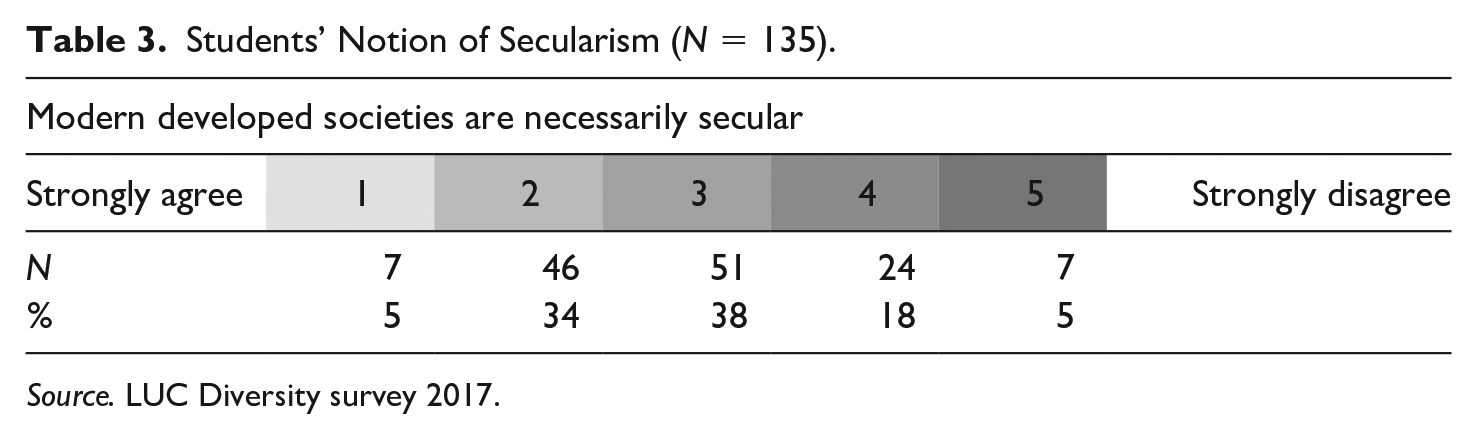
We see these efforts of separating the private from the public spheres in our classrooms, not least when it comes to religiosity. The Diversity survey asked whether “modern developed societies are necessarily secular,” and as Table 3 shows, roughly equal proportions agreed and were neutral, whereas less than a quarter disagreed. This pattern matches our experiences in the classroom, where students display a mixed and often ambivalent attitude toward the public position of religion. On the one hand, religion is present in Dutch society and in its politics, for example, through publicly funded, religiously inspired schools and Christian-Democratic political parties. Yet on the other hand, religious discourse and arguments are rarely considered valid in a public discussion, and truly religious activities, such as prayer or other forms of worship, are carefully kept within the private sphere.
Students’ Notion of Secularism (N = 135).
Source. LUC Diversity survey 2017.
So while religion can have a place in the public sphere, acts of faith and religiosity are firmly considered to belong within the private sphere. In our classrooms, this means we have regular intellectual discussions about the origins and roles of religion in the world and where religion or religious expressions belong, but rarely do religious students draw from, or even acknowledge, their own religious convictions. As a consequence, within the LUC academic environment, the religiosity of our religious students is conspicuously absent. Between us, we have only had a handful of teaching occasions when students have openly disclosed their religious affiliation and drew from their religiosity to take a position on an issue or to offer an idea. In fact, we have met several religious students who explicitly note their reluctance to mention their religiosity for fear that students (and teachers) will misunderstand or even judge them. This pattern is quite well recognized at LUC, also among students.
We see, among our students, a strong analytical disposition toward separation, between the private and public faces of religiosity. Different students draw the public/private line in different places, but few dispute that it exists or that religion straddles both spheres. Yet while some religious people may recognize themselves in this bifurcated model, many do not—not least in African religious communities. In both our fieldwork sites, in fact, religion is inextricably intertwined with every aspect of life, from electoral politics and the judicial system to children’s education and even the local markets. It is flexible and fluid in ways that make clean public–private separations impossible. Hence, we suggest, our students’ disposition toward separation, and the relegation of parts of the religious experience to the exclusively private sphere, is an obstacle to their understanding of African religiosity.
Similarity
As one would expect in a Dutch LAS program, the vast majority of our students value and aspire to equality of opportunity. In rhetoric, if not always in action, our students are devoted to leveling the playing field, lifting people out of poverty, and removing bigotry and racism, sexism, and elitism. This steadfast ideological commitment, we feel, is grounded in a deep-seated belief in human equality. Many of our students have learned to think that differences between cultures and ways of living are, in the end, relatively superficial and mask the same underlying ways of thinking, feeling, and being. But how deep do our students think the differences go?
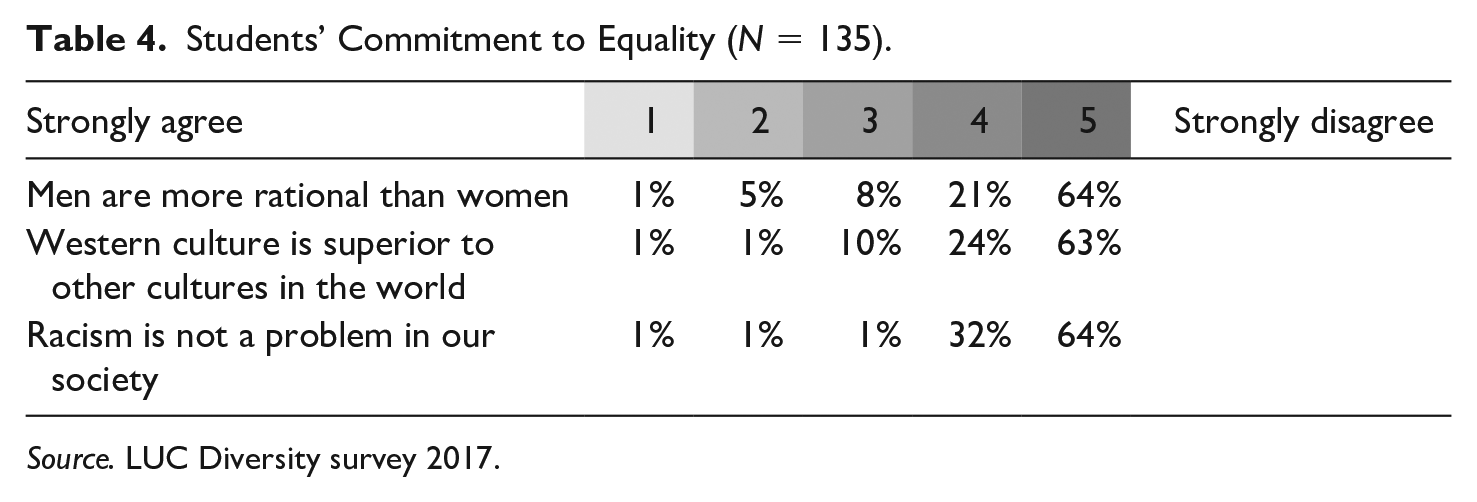
Overall, they seem fairly unanimous in rejecting “natural” or essentialist theories of racial, ethnic, and sexual difference; in other words, they are all constructivists now (Bader, 2001). In the Diversity survey, while questions around religion and belief generated, on average, a third of indecisive responses, students were unequivocal when it touched on issues of equality, whether it be gender, class, religion, or race. For example, only 6% of students agreed that “men are more rational than women,” only 2% agreed that “Western culture is superior to other cultures in the world,” and only 2% of students agreed that “racism is not a problem in our society” (see Table 4).
Students’ Commitment to Equality (N = 135).
Source. LUC Diversity survey 2017.
Politically, the idea that differences are constructed and that there is a moral imperative to value each individual equally is understandable and arguably helpful in orienting students in the political battles of their time—be it about Brexit, Trump’s vision for America, or the gendered politics of university bathrooms. As an analytical disposition, however, these beliefs do little to help students understand the meaning of contemporary cultural, religious, gender, and other differences. In fact, we argue that these analytical starting points obscure difference rather than elucidate it, as they deny both its social significance and its moral value. Difference becomes a hurdle in the pursuit of equality, rather than a phenomenon that should be understood in its own right, let alone a necessary condition for human flourishing and happiness.
In our African fieldwork, we have both come across situations that are so fundamentally different, so alien to us that they were difficult to understand, let alone empathize with. Religion was one of the major sources of this difference. But students’ ideological commitment to see similarity, particularly across racial or economic boundaries, obscures this from their view. An example from one of our courses may illustrate this further. In a class discussion on nongovernmental organization (NGO) work in Africa, a student narrated a story that seems to serve as a popular trope for development gone wrong: An NGO offers lessons on contraception to African villagers by placing a condom on a broomstick. Years later, the NGO is dismayed to find bedrooms across this community armed with condom-covered broom handles but little to no progress in rates of sexually transmitted diseases (STDs) or reductions in fertility. “Come on. They are not stupid!” exclaims one student, condemning the racist undertones that depict African villagers as ignorant and irrational.
Although we have heard this story in various forms and concur that it is likely some NGO myth-making, the discussion quickly turned to something else. In insinuating that it would be “stupid” to place a condom on a broomstick to ward off conception or STDs, this student rendered incomprehensible the villagers’ actions as possibly derived from a system of belief. The symbolic use of a broomstick in the story clearly conjures up notions of witchcraft and magic, belief systems that students in this class seem to have neither the inclination to understand nor the predilections to believe. In the students’ reaction and the ease with which the rest of the class concurred, the message was clear: Africans are just like us. They are just as intelligent and rational. Witchcraft and magic are irrational beliefs. This is a racist joke by development experts whose job it is to portray Africans as behind and backwards and in need of their help and intervention.
This interpretation leaves little room for different systems of spirituality and belief that are important and powerful among many Africans, well educated or not.
In sum, students’ ideological commitment to equality and their analytical disposition toward similarity hide the presence, and potential intrinsic value, of difference and obscure some of the fundamental ways in which African religious experiences diverge from their own.
Conclusion: A Research Agenda
In an effort to contribute to the internationalization of higher education, this article is responding to recent calls to pay close attention to practice in our classrooms (e.g., Söderlundh, 2018). In particular, we are arguing to pay attention to our students as enablers or blockers of effective internationalization. We have explored these in the case of teaching African religion to our LAS undergraduate students at LUC in the Netherlands.
The ability and extent to which our students are internalizing internationalization, we argue, is mediated by two distinct levels of filters: their surface attitudes toward the “internationalized” knowledge and experiences and the more deeply held dispositions that they use to understand the world around them. While a focus on students’ attitudes is not new, much of this attention has been on their explicit attitudes around, on the one hand, students’ conceptualizations of internationalization (e.g., Cotton et al., 2019) and, on the other hand, the way their attitudes shape their demand for, or participation in, internationally oriented programs, courses, and content (e.g., Beerkens et al., 2016; Briers et al., 2010; Mitchell & Vandegrift, 2014). To the best of our knowledge, the role of more specific content-related attitudes and, in particular, the deeper dispositions of our students as they undertake internationalization have not been carefully examined.
We have shown above that our students enter our classrooms with a firm commitment to internationalization, but mixed attitudes toward religion. They also bring in deep dispositions for agency, rationality, separation, and similarity, which shape the way they filter and engage with the “new” knowledge and experiences they encounter in our classrooms. These dispositions help students quite clearly see aspects of African religiosity that match their own views, but aspects that are different and are much more easily obscured. The contribution of our case study is to highlight how IoC requires more than bringing together diverse students and intercultural knowledge, or even teaching intercultural competencies. It requires identifying, acknowledging, and seriously engaging with students’ attitudes and dispositions, and helping them understand and evaluate their views in relation to the course content.
This sets out at least two critical avenues for further comparative research. First, how do we identify and measure relevant dispositions in our students, and perhaps ourselves? And second, how can we work with these dispositions in our curricula and in our classrooms if we want to enhance internationalized education?
With this study, we have made a first attempt to systematize and describe relevant dispositions that our students hold in the specific context of LUC. Of course, the four dispositions we focus on are not a complete picture of the “inner-workings” of our students; moreover, the strength with which students hold to them varies. But we would suggest that these four dispositions are likely important to many students outside the LUC, and that their impact on learning may be relevant to a much wider array of subjects and educational fields where education is internationalized. Further research could therefore aim to identify other dispositions that matter to the efficacy of internationalization efforts, especially comparatively across geographical areas and educational contexts. While we are advocating to pay close attention to the practices in our classrooms and our specific students, we recognize that such dispositions stem not only from individual life experiences but also from epistemological traditions and broader institutions and settings for learning. We therefore consider it critical to link with the current scholarship on, for example, institutional and disciplinary blockers, as well as the decolonization of education, to help us identify and measure student and teacher dispositions (i.e., Leask & Bridge, 2013; Le Grange, 2016).
Once recognized, the second critical avenue of further research is how to engage with these dispositional biases. In our courses, we have experimented with a number of techniques. For example, we have used simulations, fiction, and film for students to “get in the skin” of others with different life experiences and worldviews; collaborative and project-based pedagogies to help students work across social boundaries; and learning diaries, personality testing, peer feedback, and personal reflection essays as ways to encourage self-reflection about dispositions (Scharf, 2014). These experiments have yielded some success—but we think there is still much to gain. For example, internationalization in our classrooms may require us to collaborate more closely with our students as partners, co-creating curricula, and educational techniques that are tailored to the specific constellations of attitudes, dispositions, and skills of both teachers and students that we find in our courses (cf. Green, 2019). We therefore call for further research on the measurement of student and staff dispositions and educational techniques to work with them, with a special focus on the potential for staff–student co-creation.
Moreover, in our experiments we have found that activities to foster internationalization take time—time that can come at the expense of other course content. This potential trade-off between internationalization and other content is unfortunate, and we urge researchers and practitioners to identify and share ways to circumvent the trade-off and promote synergy. Furthermore, we have found that this type of teaching becomes harder as the diversity and size of the classroom increase, as students (and teachers) find their own preconceptions challenged more frequently and fundamentally. This experience highlights the need to explore internationalization curricula and techniques that can be scaled up beyond the small, intensive classrooms of an LAS college and adapted to a wider range of educational contexts.
Finally, our experiments also made teaching a more personal and, at times, confrontational activity, as we found our own attitudes and dispositions analyzed and evaluated publicly—sometimes with unexpected emotional intensity. This underlines the need to see internationalization as a skill in itself that requires training, self-reflection, and development of teachers as well as students (cf. Kelchtermans, 2009). More fundamentally, it also pushes us to review our own epistemological persuasions and pedagogical approaches and consider experimenting with alternatives that rely more heavily on, for example, student-centeredness, self-reflexivity, and collaborative learning of students and teachers (co-production of knowledge).
Footnotes
Declaration of Conflicting Interests
The author(s) declared no potential conflicts of interest with respect to the research, authorship, and/or publication of this article.
Funding
The author(s) received no financial support for the research, authorship, and/or publication of this article.
