



Abstract
Internationalization of Curriculum (IoC) has been identified as a significant strategy to training graduates with awareness, skills and knowledge required to thrive as global citizens. In China, Chinese-foreign Cooperation in Running Schools (CFCRS) represents one of the most prominent and policy-supported education for advancing IoC. But even so, faculty engagement in curriculum internationalization is inadequate, which raise concerns about the sustainability and high-quality development of CFCRS. Drawing on Leask’s Blockers theory, this study adopts an explanatory sequential mixed-methods design to investigate the barriers that hinder faculty participation. A survey involving 442 faculty members from 14 CFCRS-hosting universities in Jiangsu Province, China, revealed significant difference in perceived blockers across academic fields and professional titles. Cultural and institutional blockers emerged as the dominant categories of obstacles, with disciplinary mindsets difference and perceptions of educational marketization representing the most influential factors within each category. Interviews with 20 faculty members suggested disciplinary dispositions, intercultural understanding, and interdisciplinary knowledge underpinning disciplinary mindsets difference, while revenue-driven enrolment policies and shift in educational missions supporting perceptions of educational marketization, can hinder faculty engagement. Recommendations are proposed to mitigate these barriers, offering insights for policymakers to enhance faculty participation and advance IoC.
Introduction
Over the past three decades, internationalization has gone from being marginal in higher education to becoming a global and mainstream factor (Knight & de Wit, 2018). Given the appeal for more inclusive approaches to internationalization and addressing disciplinary and professional outcomes, the focus on curriculum internationalization has gained prominence. The Internationalization of Curriculum (IoC) constitutes a relatively recent area of scholarly investigation, attracting researchers in the field of education (de Wit & Altbach, 2021). As many institutions worldwide claim to educate global citizens, this necessitates a strong focus on internationalization of the curricula. Leask (2015, p. 9) defines IoC as “the incorporation of international and intercultural dimensions into the content of the curriculum as well as the learning outcomes, assessment tasks, teaching methods and support services of a program of study”. The central aim of IoC is to cultivate well-rounded citizens with professional skills and competencies for global social engagement.
In China, IoC has become an increasingly important strategy for the internationalization of higher education institutions (HEIs). The Outline of China’s National Plan for Medium and Long-Term Education Reform and Development (2010-2020) (Ministry of Education, 2010; hereinafter the Outlines) and Opinions on Accelerating and Expanding the Opening Up of Education in the New Era (Ministry of Education, 2020; hereinafter the Opinions) clearly set forth the need of internationalization of HEIs, the aim of which is to train talents with global perspectives, aware of international norms, capable to participate international activities and tackle global issues. The focus has shifted from outward staff and student mobility to inward high-quality educational development through IoC (Fang, 2022). Chinese-foreign Cooperation in Running Schools (“Zhongwai Hezuo Banxue” in Chinese, meaning cooperation between Chinese and foreign countries in operation or management of HEIs), as a main carrier of higher education internationalization, emerged since 1980s and stepped onto a track of regulated development since 2003 when the China State Council issued the Regulations on Chinese-Foreign Cooperation in Running Schools (State Council, 2003; hereinafter the Regulations). Lin (2022) reported that CFCRS institutions and programs comprise about 90% of all transnational institutions and programs, enrolling roughly 600,000 students with over two million graduates. Curriculum internationalization is considered crucial for high-quality development of CFCRS and for training the high-level talents required by Ministry of Education (MoE) in China.
However, the process of IoC is intricate and ongoing, requiring the active participation of all stakeholders. Faculty engagement, as a frequently reported issue hindering implementation of IoC (Green & Mertova, 2016; Whitsed & Green, 2016), has already been defined by western scholars. IAU 3rd Global Survey Report reveals that the interest, capacity and involvement of faculty members act as a major barrier to moving forward curriculum internationalization (Beelen, 2011). The fifth IAU Global Survey also mentions that “faculty ability to integrate international and intercultural dimensions into teaching” is a most important way to internationalize the curricula (Marinoni, 2019). Studies in China show that academic staffs exhibit limited engagement in IoC (Deng & Mei, 2023; Li, 2020), which has been recognized as a prominent issue impeding the long-run development of CFCRS. Previous research has identified several key factors that might hinder academic staffs from engaging in IoC initiatives from the institutional lens. These factors include insufficient introduced quality educational resources, tensions between “public welfare” and “profit-making” (Lin & Liu, 2014), inadequate academic evaluation and teacher-student interaction mechanism (Zhao, 2014), limited teaching skills of faculty, lack of regulations on faculty management (Li, 2025), etc. However, previous research on curriculum internationalization focus primarily on conceptual discussions and policy-oriented analyses, while large-scale empirical investigations remain relatively limited. In particular, prior studies have predominantly examined institutional or program-level conditions, with less attention paid to variations among faculty groups in their perceptions of barriers. The existing literature lacks empirical research on the significance of blockers at cultural, personal, and institutional levels, and nor does it explore how these barriers are constructed from faculty’s viewpoints. The blockers theory proposed by Leask (2015) provides a suitable theoretical framework for investigating cultural, personal and institutional barriers that constrain CFCRS academics’ participation in curriculum internationalization. Based on this framework, this study explores the following research questions: (1) How do varied cohorts of faculty members perceive the blockers differently? (2) What are the key blockers to faculty involvement in IoC? (3) What are the significant factors underlie the key blockers that prevent faculty participation in IoC?
Literature Review
Internationalization of Curriculum (IoC) in a Global and Local Context
Defining internationalization of curriculum (IoC) is a prerequisite for its effective implementation. The Organisation for Economic Co-operation and Development (OECD, 1996) viewed IoC as integrating international dimensions into curricular design and operation. Mestenhauser (1998) described it as a less common internationalization approach that develops students’ global perspectives. Zhang et al. (2013) advocated that IoC should include intercultural perspectives, shifting focus from international to local students and encouraging them to address local issues with a global perspective. Leask stressed the importance of teaching, learning, and assessment in IoC. She defined it as the “incorporation of international and intercultural dimensions into the content of the curriculum, along with the learning outcomes, assessment tasks, teaching methods, and support services of a program of study” (Leask, 2015, p. 9). These definitions highlight two key aspects: incorporating international and intercultural dimensions into the entire curriculum process and guaranteeing benefits for all students, including those without mobility opportunities.
While the concept of IoC has been widely discussed in global academic circles, its implementation are closely related with national policies and institutional frameworks, particularly in China (Huang, 2008; Yang, 2023). Formalized in the Regulations (2003), reinforced in the Outlines (2010) and the Opinions (2020), CFCRS aims to introduce high-quality international educational resources into Chinese domestic universities. Lin (2022) defined these resources as advanced educational concepts, curricula, teaching methods, faculty, management systems, and policies. Of all the resources, curriculum remains central, emphasizing IoC’s crucial role in ensuring both quality and internationalization in China’s higher education.
Faculty Engagement in IoC
Drawing from Leask (2015, p. 9)’s theory of Internationalization of Curriculum, faculty engagement in IoC can be understood as “faculty member’s incorporation of international and intercultural perspectives into the curriculum content, learning outcomes, teaching methods, assessment tasks and support services thought a program of study”. Faculty members are at the forefront of IoC process and play a very fundamental role in its successful implementation. Ji (2020) outlined faculty roles in IoC as follows: defining the expected outcomes of cross-cultural knowledge, skills, and attitudes, showing how these goals will be achieved, creating opportunities to practice relevant strategies, and making assessment criteria explicit. This highlights three key dimensions of curriculum internationalization, namely learning outcomes, pedagogical methods and assessment practices.
While faculty members hold vital positions in internationalization initiatives, their level of engagement in curriculum internationalization remains insufficient (Beelen, 2011; Li, 2020). Yin and Huang (2021) assessed the present state of higher education internationalization in China and the challenges encountered by local universities. The findings underscore that without proactive engagement of faculty members, achieving the expected outcomes of IoC becomes challenging.
Cultural, Personal and Institutional Blockers to Faculty Engagement in IoC
Leask’s (2015, pp.106–108) theory of Blockers and Enablers provides a valuable theoretical framework for analyzing and understanding the dynamics of IoC. Although the theory highlights both factors that hinder or facilitate IoC, this study concentrates specifically on blockers. Blockers are broken down into institutional, cultural, and personal levels. Cultural blockers stem from the values, beliefs, and dominant ways of thinking within the discipline. Institutional blockers reflect the structural and procedural ways in which a university organizes and conducts its operations. Personal blockers refer to the capacity, willingness, and commitment of key actors in IoC to engage, initiate change, and address challenges.
From the cultural perspective, disciplinary paradigms significantly influence faculty engagement in IoC. Disciplinary approaches and academic cultures differ extensively in curriculum internationalization and collaboration. Dominant paradigms within disciplines often proves to be restrictive than liberating (Leask, 2022; Xu & Wang, 2017). At the institutional level, support mechanisms such as transparent policies, financial resources, improved infrastructure and institutional networks facilitate internationalization. The absence of clear strategies, regulations and faculty management policies may constitute significant barriers to faculty participation and effective implementation of IoC (Ho et al., 2023; Li, 2025; Van den Hende et al., 2024). At the personal level, individual experiences, intercultural competence, along with interpersonal and soft skills such as communication, problem-solving, cultural fluency, and particularly English proficiency as the key medium for academic research and instruction, exert a strong influence on faculty involvement (Nyangau, 2018; Zayed, 2020).
Methodology
Sampling and Participants
Demographic Details of the Participants (N = 20)

Data Collection
In the quantitative phase, a structured questionnaire was developed: (A) background information (including CFCRS type, institution type, professional title, academic field, CFCRS teaching experience, overseas education background, and language proficiency), (B) faculty engagement in IoC, and (C) blockers to IoC. Sections B and C employed a 5-point Likert scale (Section B: 1 = not at all to 5 = great; Section C: 1 = strongly disagree to 5 = strongly agree). Faculty engagement was measured through learning outcomes (5 items), teaching methods (11 items), and assessment tasks (5 items), based on Leask’s (2015) IoC questionnaire. Blockers were grouped into cultural (4 items), personal (5 items), and institutional blockers (8 items), adapted from Leask’s (2015) Blockers Survey. Questions were translated using back-translation (Brislin, 1970) and reviewed by three experts to ensure content validity (Lynn, 1986). A pilot test with 80 CFCRS faculty confirmed the clarity of instructions, questions, and scale items. Reliability analysis yielded a Cronbach’s alpha of 0.988, indicating excellent internal consistency. The Kaiser-Meyer-Olkin (KMO) measure (0.982) and Bartlett’s test of sphericity (χ2 = 39,224.794, p < 0.05) confirmed that the data is suitable for factor analysis. Surveys were distributed via international office managers from targeted universities using Wen Juan Xing QR code, which yields 442 complete responses (78.9%).
In the qualitative phase, the interview protocol was based on the quantitative survey results and focused on addressing the key blockers, refined through expert review. Sample questions included how disciplinary mindsets constraints and perceptions of educational marketization act as a hindrance to faculty engagement in IoC. Interviews were conducted in Chinese, either face-to-face or online, lasting 60 to 90 min. Participants were notified for voluntary participation, anonymity and confidentiality. Consent was obtained, and interviews were recorded, transcribed and verified for translation accuracy by a bilingual expert.
Data Analysis
Quantitative data were analyzed using SPSS27. Inferential analyses were conducted, with one-way Analysis of Variance (ANOVA) used to examine differences in perceived blocker scores across faculty groups. Pearson correlation examined the strength of the relationship between cultural, institutional and personal blockers and faculty engagement in IoC, identifying key strong blockers based on Leask (2015)’s Blocker Framework. Correlation values indicate both direction and strength, with values near 0 showing little relationship and values near ±1 indicating stronger associations (Pallant, 2020).
Qualitative data were analyzed using NVIVO 15 through a hybrid deductive-inductive thematic analysis to identify main themes, categories and subcategories (Braun & Clarke, 2006). Member checking and peer debriefing were conducted in accordance with ethical guidelines to enhance credibility and trustworthiness. Twenty faculty members were coded by case numbers (CA1–CA20) and demographic abbreviations.
Results
Perceived Blocker Scores Across Different Faculty Groups
One-Way Analysis of Variance Comparing the Perceived Blocker Scores Across Different Faculty Groups (N = 442)

Key Blockers to Faculty Engagement in IoC at Cultural and Institutional Levels
Pearson Correlations Between Three Constructs of Blockers and Faculty Engagement (N = 442)

Note. CBL = cultural blockers; PBL = personal blockers; IBL = institutional blockers; ENG = faulty engagement.
**Correlation is significant at the 0.01 level (2-tailed).
Pearson Correlations Between Cultural Blockers and Faculty Engagement (N = 442)

Note. CBL = cultural blockers; ENG = faulty engagement.
**Correlation is significant at the 0.01 level (2-tailed).
Pearson Correlation Between Institutional Blockers and Faculty Engagement (N = 442)

Note. IBL = institutional blockers; ENG = faulty engagement.
**Correlation is significant at the 0.01 level (2-tailed).
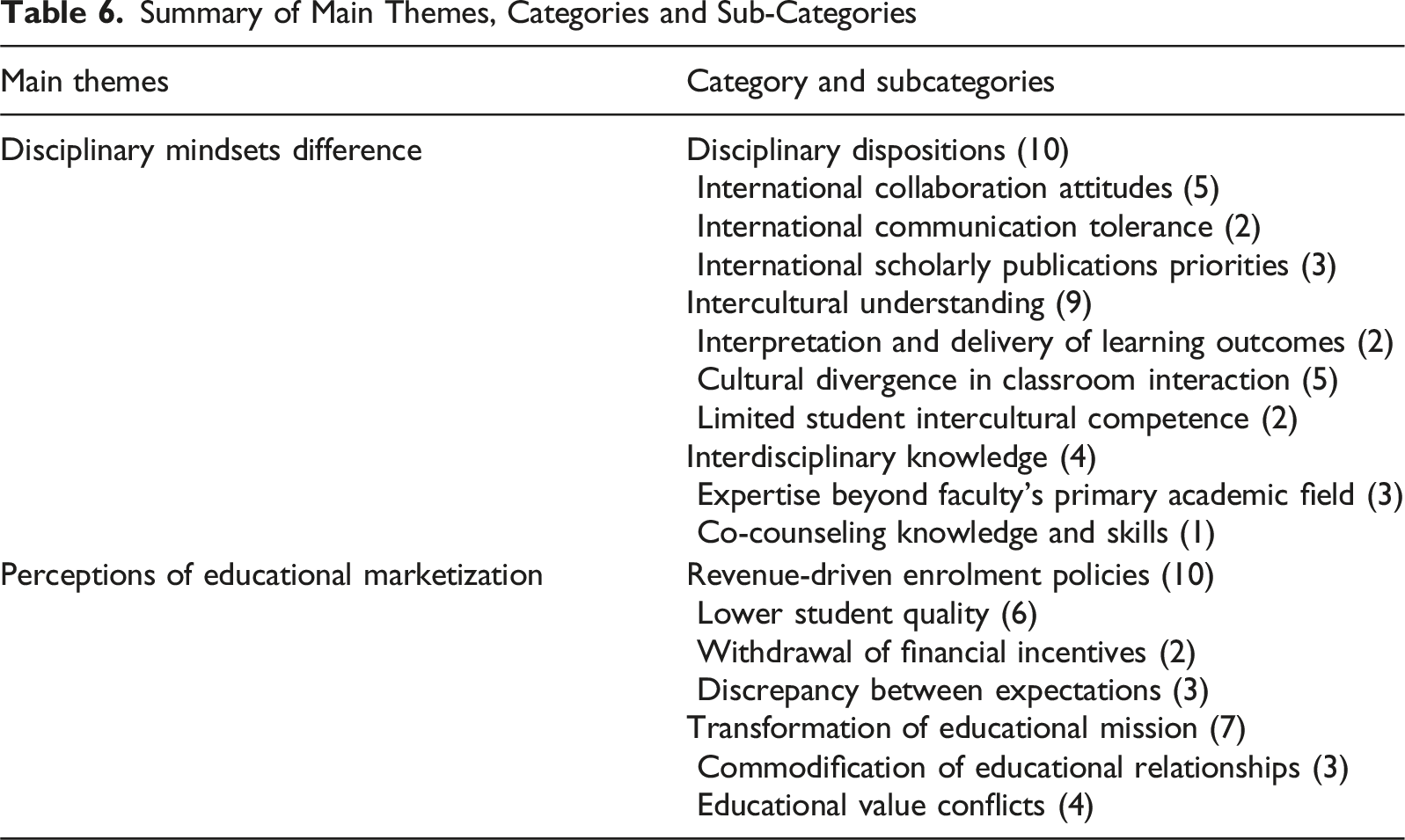
Summary of Main Themes, Categories and Sub-Categories
Disciplinary Mindsets Difference
Many participants agreed that disciplinary dispositions, reflecting faculty’s tendencies and preference can undermine faculty engagement in IoC, manifested in international collaboration attitudes, international communication tolerance and scholarly publication priority. For example, one department head indicated that SSH faculty are less open to international collaboration than STEM faculty due to dispositions caused by some deeply rooted Chinese beliefs: CA3: “An old saying goes, ‘There is no absolute best in the literary world, but in martial arts there is always a champion.’ This may lead SSH faculty to believe they are highly competent in their own cultural context or academic field, making it more difficult for them to recognize their foreign peers’ strengths and engage in collaboration proactively.” (CA3, SSH, L, DH)
Some participants noted that SSH faculty display lower levels of tolerance in addressing communication issues: CA9: “For example, in the speed of replying to emails and responding to requests, faculty in SSH may not offer as much tolerance. Once there are any conflicts in communication, they may immediately call to me and ask for a solution. In technical fields, communication tends to be smoother, and there will be not so much complaints.” (CA9, AM, AP, PL)
Fundamental cultural beliefs could impact faculty attitudes toward international teaching collaboration. The old Chinese saying cited by CA3 underscores a disciplinary mindset in which professional academic authority is viewed as subjective, which may discourage external collaboration. CA9 further noted that communication tolerance is disciplinarily differentiated by emphasizing SSH faculty’s expectation of quicker responses to requests. Participants also mentioned differences in priorities in regards to international publication. CA16: “In engineering, the way concepts are explained is completely consistent, whether in China or internationally. However, many humanities scholars need to publish in journals like Peking University Core Journals written in Chinese. The way certain ideas are expressed in Chinese may differ from how they are conveyed internationally.” (CA16, ET, P, PL)
Some participants believed that STEM faculty are expected to produce SCI-indexed publications. As CA16 suggested, this early and sustained exposure to English-language scholarly communication socializes STEM faculty into the global academic discourse, which boosts their international collaboration and curriculum design. SSH faculty, prioritizing local relevance, may be less familiarized with global academic discourse.
Participants also identified limited intercultural understanding as a second hindrance. They emphasized divergent understandings of curricular learning outcomes across countries. For instance, one faculty engaged in a Wechat dialogue with a Russian professor during the co-teaching process. CA1: “The professor commented: ‘I understand that you want to teach instead of me. Of course, in terms of language, it would be easier for the students. But, what is the main goal of this course—subject content or language?’ Then I responded: ‘Learning English and learning professional knowledge are not contradictory. My support for the students is not meant to replace your teaching, but to help them better grasp the knowledge you impart.” (CA1, AM, AP, F)
The dialogue between CA1 and the Russian professor highlights debates over whether international courses should prioritize disciplinary content or language proficiency as the learning outcomes. Participants also elaborated the dilemma caused by different ways of classroom interaction. In western background, students are typically active and ready to raise questions. However, in China, students are taught not to interrupt the instructors in class. As one participant explained: CA11: “When some foreign teaching staffs first arrive, they may question why students appear unresponsive in class. They feel that there is little interaction with the students during class, yet their time is being taken up after class.” (CA11, SSH, P, DH)
This reflects differing pedagogical expectations that international faculty favour student-centered learning, whereas Chinese faculty follow traditional norms. Another participant, CA5, introduced a similar situation, noting that “Students are eager to interact with foreign fly-in faculty but they are still navigating and learning how to communicate effectively.” CA5 explained that students’ silence caused by limited intercultural communication competencies bring about misunderstandings in intercultural interactions.
The third hindrance stemming from disciplinary mindsets difference is interdisciplinary knowledge. Participants stated that knowledge within or beyond their academic backgrounds is both indispensable for addressing students’ problems. CA13: “As a German language teacher, I focus more on the interdisciplinary communication content in my class. However, I may lack sufficient knowledge of STEM subjects when teaching engineering students.” (CA13, SSH, L, F)
Despite CA13’s expertise in German language, the limitations she faces underscore a deeper disconnect between her disciplinary training and the real-world demands of her learners. This mismatch also increases faculty’s workload, as they must navigate unfamiliar disciplinary terrain to response to students’ aspirations. Some participants further noted the importance of co-counseling expertise. As CA5 stated, lack of co-counseling knowledge and skills made her “struggle to help student get out of the blue mood when they are struggling to adapt to life in a foreign country”. In her case, the student trusts her as a friend in life and therefore sought help beyond the classroom.
Perceptions of Educational Marketization
The most influential institutional blocker identified in the quantitative study is perceptions of educational marketization. Two categories are suggested, namely revenue-driven enrolment policies and transformation of educational mission. Overall, participants disagreed the revenue-driven enrolment policies, and their concerns are: lower student quality, withdrawal of financial incentives and discrepancy between expectations.
Some participants highlighted that prioritizing revenue by charging higher tuition fees could lead to lower entrance scores, resulting in reduced student quality. And with removed subsidy, faculty are reluctant to take on the teaching tasks of CFCRS classes. For example, one faculty explained in this way: CA7: “Higher tuition fee of CFCRS programs has led to a decline in student quality. Lower student quality demotivates faulty in their teaching. Specifically, faculty as class supervisors are particularly reluctant to take on CFCRS classes because they used to receive subsidies, but now those subsidies have been removed.” (CA7, ET, AP, DH)
Some participants noted that, compared with teaching regular program students, teaching CFCRS program students may create discrepancy between expectations. As indicated by CA15: CA15: “Due to the lower student quality, both classroom management and instruction can be harder. The score difference has led to noticeable gaps between CFCRS and regular student’s learning abilities and overall competence, which cause the mismatch of our expectations.” (CA15, BM, AP, F)
In their descriptions, participants noted that revenue-driven enrollment policies lowering admission thresholds undermine perceived student quality. This perception constrains their engagement. More critically, the withdrawal of financial incentives has removed a key extrinsic motivator. CA15 highlighted how this student disparity leads to discrepancy between expectations. When educators are placed in settings where student engagement and capabilities fall short of expectations, teaching becomes exhausting and disheartening.
Many participants agreed that educational marketization is driving education away from its original purposes. Two crucial factors, commodification of educational relationships and educational value conflicts, are identified. Some participants questioned the commercialized roles of faculty and students. CA11: “Education should view students as individuals rather than commodities. I feel that marketization somewhat goes against the original intention of education. For those students who perceive themselves as customers, they may start viewing teachers as service providers. ” (CA11, SSH, P, DH)
Some participants also questioned the educational value. One faculty argued for the essence of education. CA13: “Education itself is not an economic activity. Education is a matter of conscience, not for increasing revenue, but a hope to provide students with better education through my efforts.” (CA13, SSH, L, F)
CA11’s account raises a concern that if education is regarded as a product rather than a learning journey, and teaching is reduced to service rather than meaningful guidance, then the very essence of education is undermined. Instead of viewing education as an economic transaction, CA13 framed it as the responsibility and imperative to promote students’ intellectual growth.
Conceptually, perceptions of educational marketization constrains faculty’s IoC participation through two interconnected mechanisms. Revenue-driven enrolment policies that cause a drop in CFCRS student quality exacerbate pedagogical challenges and reduce faculty enthusiasm for IoC participation. The transformation of educational mission, underpinned by commodification of educational relationships and educational value conflicts, deviates faculty from their original career commitments and challenges them to balance quality and standards in IoC process.
Discussions
The study reveals that social sciences and humanities faculty perceive the fewest blockers in curriculum internationalization, whereas agriculture and medicine faculty report the highest constraints. Disciplinary differences reflect varied international orientations across professional fields (Shahjahan et al., 2024). This is also pronounced in CFCRS context. SSH relies on globally circulating theories and faces fewer local or accreditation restrictions (Arnó-Macià & Aguilar, 2018), promoting internationalization. By contrast, agriculture and medicine are context-dependent, embedded in national regulations, local conditions, and established professional practices, which imposes limitations on integration of international perspectives and increases perceived blockers.
Regarding professional titles, lecturers and associate professors reported fewer blockers to curriculum internationalization than professors. Professors’ heavier research responsibilities, multiple institutional roles, and stronger research-oriented identities reduce their time and incentives for IoC and make them more critical of such initiatives. In contrast, junior and mid-level faculty see IoC as an actionable approach for teaching innovation and professional achievement, therefore, are faced with fewer hindrance. This suggests a misalignment in China between curriculum internationalization and evaluation systems, where international teaching engagement is less valued than research outputs in promotion criteria.
This study identifies the major cultural and institutional blockers to CFCRS faculty engagement in IoC. From a cultural perspective, it stresses the impact of differing disciplinary mindsets, aligning with earlier research that emphasize challenges posed by established pedagogical traditions within disciplines (Van den Hende et al., 2024; Xu & Wang, 2017). From an institutional standpoint, CFCRS faculty perceive marketization of education as the most significant barrier. They believe that institutional strategy and policies could greatly enhance or undermine faculty engagement (Ho et al., 2023). This result highlights the tension between public welfare and profit-making dimensions of education.
The factors underlying the blockers are further explored. Disciplinary dispositions, limited intercultural understanding and insufficient interdisciplinary knowledge represents three influential barriers underpinning disciplinary mindsets difference. Disciplinary orientations shape international collaboration attitudes, communication tolerance and scholarly publication priorities. Disciplinary groups form distinctive global communities with unique cultures and intellectual values (Leask, 2015). Although SSH faculty reported fewer blockers in general, interviews revealed that STEM faculty demonstrate greater openness to international pedagogical collaboration. This differs from the claim that “hard pure” disciplines are more resistant to internationalization discourses (Clifford, 2009). Hard pure disciplines underscore universally applicable methods, explaining why STEM faculty often view their fields as inherently international (Shahjahan et al., 2024). STEM faculty are more solution-oriented and their frequent exposure to global academic discourse aligns them with international publishing norms, creating advantages for international teaching practices. Nevertheless, SSH faculty, influenced by sensitivity to communicative nuance, may exhibit less communication tolerance toward international partners, and their preference for publications in domestic, highly indexed core journals results in more focus on internal pedagogical research and practices.
Challenges concerning intercultural understanding include differing interpretations of learning outcomes, cultural divergence in classroom interaction, and limited student intercultural competence. Despite English-medium instruction is often viewed as central to curriculum internationalization (Akıncıoğlu, 2025), it is actually subject knowledge that play a more decisive role in internationalized learning. This challenges the prevailing “Englishization” approach and supports Feng’s (2023) call for a “transformation approach” that the international and intercultural perspectives integrated into the curriculum must be practical, acceptable and relevant to the local context. A reciprocal process balancing local and global academic values is needed in delivering learning outcomes. Cultural differences in classroom interaction shaped by two distinct pedagogical traditions (student-centered learning versus faculty-led learning) are evident. The lack of mutual awareness and respect for diverse educational paradigms hinders collaboration and achievement of learning outcomes. In this context, students’ limited international communicative competence aggravate the misunderstanding and hinder the achievement of intercultural goals.
Interdisciplinary knowledge is another significant factor linked to disciplinary mindsets. Faculty face challenges from limited expertise beyond their academic fields and insufficient co-counseling skills. IoC requires thinking beyond dominant paradigms and the acquisition of intercultural knowledge for effective integrated instruction (Leask, 2015). As the students’ needs of knowledge are growing diversified, faculty should broaden interdisciplinary understanding to meet expectations. Language faculty need to undergo pedagogical transformations to support professional learning in class. Similarly, subject course instructors need to enhance English proficiency across disciplines. In CFCRS context, acquiring co-counseling knowledge and skills is equally important, as the increased learning pressure requires faculty to support students’ mental health as well as academic growth.
With regards to perceptions of educational marketization, revenue-driven enrolment policies and transformation of educational mission are identified as as two major hindrances. As CFCRS programs charge higher tuition fees and admit students with lower Gaokao scores, it often results in lower student performance. Given that many students in these programs come from affluent families, student management has also become increasingly difficult for faculty members. Faculty teaching efforts may not be equally appreciated compared to teaching regular program students. This corroborates with earlier concerns that uneven competencies of CFCRS students can impact learning process and endanger teaching quality (Yu & Shao, 2020). Once financial incentives are reduced, the imbalance between effort and reward may intensify, as faculty’s time and dedication are not adequately compensated. Commodification of educational relationships and educational value conflicts are significant factors underlie transformation of educational mission. The blurring of roles between faculty and students risks undermining the very essence of education. The market-oriented enrolment and management policies in CFCRS lead to misunderstanding on educational values. From faculty’s viewpoints, education should be more on supporting students in their personal development than pursuing financial returns.
Conclusion, Policy Recommendations and Limitations
The finding suggests that faculty participation in curriculum internationalization is enhanced more by institutional and cultural conditions and less by personal preference. The significant difference of perceived blockers across academic fields and professional titles indicate that faculty is not a homogeneous group, thus one-size-fits-all IoC initiatives may overlook the most constrained parts. Disciplinary priorities embedded in cultural traditions, limited cross-cultural understanding, as well as insufficient knowledge across disciplines constrain faculty perceptions or performance in IoC, which further undermine international pedagogical alignment between Chinese and foreign partner universities. The process of Marketization lowering the threshold of student quality can intensify pedagogical challenges. The commercialized student-faculty role also places faculty in a dilemma as they struggle to balance academic standards and teaching quality.
In order to mitigate the barriers, one primary focus is to bridge the underlying cultural divides across disciplines. Targeted discipline-embedded IoC training and training in disciplinary discursive competence can help faculty across academic groups build confidence in international teaching collaboration. Establishing interdisciplinary team-teaching models is vital. Communities of Practice (CoPs) within departments or across faculties can be a good approach to share the best practices and help address common issues across disciplines, by organizing regular workshops, seminars or IoC activities on this platform. Another strategy is reducing the institutional emphasis on English-medium instruction in IoC process. Faculty should be encouraged to adopt multilingual teaching approaches to preserve local disciplinary characteristics while they are internationalizing the courses. In such cases, they can better prepare students for their future careers in the Chinese context. The “synchronous classroom” model, engaging both foreign faculty and local faculty in the same class, can be promoted to strengthen the transformation of global knowledge into local backgrounds. The third strategy is that leadership should reaffirm the core academic value of CFCRS through institutional incentives, such as merit-based selection systems that involve outstanding faculty in IoC courses, the provision of honorary titles to those who devote more time to IoC in order to strengthen their professional recognition, and the organization of teaching competitions specifically for CFCRS instructors to cultivate a stronger academic community. Specialized program funds should be established to help increase faculty-led students’ exposure in international forums. Funding for organizing program activities to involve in foreign visiting professors is also necessary, as is support for curricular innovation, access to global academic materials, and facilities strengthening cross-border collaboration.
This study extends Leask’s (2015) blockers framework by identifying two most influential barriers within the CFCRS context. While Leask identified 17 potential blockers, the findings highlight the impact of disciplinary mindsets difference and perceptions of educational marketization. Despite its contributions, the study has several limitations. The sample selected was limited to faculty members involved in CFCRS teaching within a single province in China, which provides in-depth regional insights but restricts the generalizability of the findings. The analysis primarily reflects one perspective from faculty themselves. Future research could incorporate the views of students, administrative staffs, and university leaders to develop a more comprehensive understanding of IoC implementation and governance. Given the prominence of disciplinary mindsets as a major blocker, comparative analyses among different academic fields are recommended for future studies to explore how disciplinary values and pedagogical traditions shape faculty perspectives and competences for IoC.
Footnotes

Ethical Considerations
The Ethics Review Committee at Universiti Kebangsaan Malaysia (UKM) approved our research in May, 2024. This study also received ethical approval from the Review Committee of the Department of Social Science of Suzhou University of Technology (Approval no.: 2024-014) in May, 2024.
Consent to Participate
Respondents gave written consent for review and signature before starting interviews.
Funding
The authors disclosed receipt of the following financial support for the research, authorship, and/or publication of this article: This work was supported by the General Project of Jiangsu University Philosophy and Social Science Research in China under Grant 2023SJYB1453 and 2024 Shanghai Education Science Research Project under Grant C2024200.
Declaration of Conflicting Interests
The authors declared no potential conflicts of interest with respect to the research, authorship, and/or publication of this article.
Data Availability Statement
The data that support the findings of this study are available from the corresponding author upon reasonable request.