




Abstract
Internationalization efforts in higher education have often been categorized according to Jane Knight’s binary of “Internationalization at Home” (IaH) and “Internationalization Abroad” (IA). However, a rising number of technology-supported activities have created new opportunities for university internationalization. For example, students can now remain “at home” while using technology to study with an institution or program that is simultaneously located “abroad.” We have conceptualized these activities as a new third category called Internationalization at a Distance (IaD). In this article, we introduce the concept of IaD and outline an in-depth case study of an international distance education provider at scale, the University of South Africa.
Keywords
Introducing Internationalization Abroad and Internationalization at Home
“Comprehensive internationalization” outlines the complex and individualized approaches taken by institutions to integrate global or international elements across their teaching, research, and service deliveries (Hudzik, 2011). A wide variety of activities in higher education might fit within the broad concept of “comprehensive internationalization,” not least limited to study abroad provisions, internationally minded social opportunities, branch campuses, international student recruitment, diversification of staff, diversification of programs offered, and/or inclusion of foreign language study, among many others. Comprehensive internationalization has historically taken unique and varied forms between different institutions and across local and global geographic boundaries (de Wit & Leask, 2015).
Comprehensive internationalization activities in higher education have commonly been given a binary classification: Internationalization Abroad (IA) or Internationalization at Home (IaH) (Knight, 2004). IA focuses on the movement of education across national borders, including the movement of students (Choudaha & Chang, 2012), staff (Kim, 2009), and programs (Waterval et al., 2015). International students (i.e., those who relocate to another country for their full academic qualification) and study abroad students (i.e., those who relocate to another country for a portion of their academic qualification) are perhaps the most obvious examples of IA. Indeed, over 4 million students studied internationally in 2017 (UNESCO, 2018). In recent years, there has also been increasing diversification of traditional “receiving” and “sending” countries, with growing regional hubs of international students in countries such as China or South Africa (Kondakci et al., 2018).
Much literature has outlined the personal and professional benefits of obtaining a full or partial higher education qualification abroad for both individuals and their institutions (see, for example, Jindal-Snape & Rienties, 2016; Elliot et al., 2016; Gu et al., 2010; Potts, 2015). Over the last half century, a wide variety of research has also focused on the multifaceted academic, social, and emotional transition experiences of students studying in other countries (for a summary, see, Jindal-Snape & Rienties, 2016; Zhou et al., 2008). There has additionally been extensive focus on the perceived economic (Institute of International Education [IIE], 2018) and cultural benefits (Leask, 2009; Leask & Carroll, 2011) received by host countries, along with the assumed “soft power” benefits embedded within policies toward international students (Lomer, 2017).
Yet, one assumption within IA is a geographic relocation of students from one country to another country for the purpose of education. There has been growing recognition, however, that educationally motivated mobility is not a reality for all students, due to a wide variety of personal, logistical, and financial circumstances (Brooks & Waters, 2011). For example, it has been argued that IA can contribute to the perpetuation of social disadvantage, whereby access to international educational opportunities is withheld for those with significant privilege (Waters, 2012). The experience and rights of international students also often vary between (Choudaha, 2017) and within (Tannock, 2013) countries.
Given these challenges, an alternative to IA provisions is IaH, which is the “purposeful integration of international and intercultural dimensions into the formal and informal curriculum for all students, within domestic learning environments” (Beelen & Jones, 2015, p. 8). IaH aims to provide an internationally focused learning experience within domestic environments, thereby providing students with opportunities to receive the benefits (and face the pitfalls) of internationalization without leaving “home” (Crowther et al., 2000). In this way, IaH is “characterised by the attempt to move beyond mobility and into curricular internationalisation, and into internationalization of higher education institutions” (Wächter, 2003, p. 7).
One important element of IaH is the growing focus on “curriculum internationalization,” which has developed into a broader umbrella term for the range of internationally minded learning activities adopted in higher education. A classic definition of curriculum internationalization is provided by Leask (2009): Internationalisation of the curriculum is the incorporation of an international and intercultural dimension into the content of the curriculum as well as the teaching and learning processes and support services of a program of study. (p. 209)
Curriculum internationalization has become an area of increased research interest, with growing recognition of international elements in the academic content and pedagogic tools used across the formal, informal, and hidden curricula (Bhambra et al., 2018; Leask, 2015; Leask & Carroll, 2011) and their relationship to students’ intercultural learning opportunities (Dunne, 2011). In this regard, it is recognized that IaH requires a purposeful and reflective approach toward developing meaningful intercultural learning opportunities (Tadaki & Tremewan, 2013), including the ethical inclusion of international students’ voices as equals into pedagogical development efforts (Lomer & Anthony-Okeke, 2019). However, there have been mixed reception about evidence-based approaches for supporting IaH and culturally responsive pedagogies. For example, some researchers have pinpointed group work with peers from different countries as a powerful pedagogical tool for support intercultural learning (Rienties et al., 2015), whereas others have outlined social and cultural challenges in such environments (Harrison & Peacock, 2009).
Harrison (2015) provides a comprehensive summary of some of the embedded assumptions within IaH. These include the following: assumptions that the presence of diversity in the classroom can serve as a learning resource; challenges toward the purposeful internationalization of the curriculum; and challenges associated with culturally sensitive pedagogy. In particular to our aim, two additional assumptions are pertinent. The first is that IaH assumes that students who are geographically located within their home country are enrolled at an institution that is also based in that same country. This is outlined by the very definition of IaH, whereby “at home” signifies an opportunity to gain an intercultural learning experience without having to go “abroad.” Second, there is often an accepted distinction in IaH contexts between “home” and “international” students that is linked to mobility across international borders and/or visa status at a national level (see, for example, IIE, 2018). In this context, “home” students are typically defined as those who are living and studying in an institution within their own country of citizenship, thereby differentiating from those are “international” students, who cross international borders to study outside their country of citizenship. Thus, the concept of IaH has embedded assumptions about who is “at home” and what constitutes the temporal spaces of “home” (often national borders).
Introducing Internationalization at a Distance
Growing advances in educational technologies have led to new forms of internationalization activities which are difficult to categorize as either IA or IaH (Madge et al., 2009). One prime example is the rise of online distance learning models, as increasing numbers of students are enrolled in online distance education programs across geographic borders (Simpson, 2013; Subotzky & Prinsloo, 2011; Tait, 2018). This trend potentially provides distinctive opportunities for students to gain many of the advantages of IA, such as learning through the cultural and historical approaches to education in a new country, while simultaneously remaining “at home.” International distance education also blurs the aforementioned distinction between “home” and “international” students, as those studying distantly in another country are often neither mobile across international borders nor eligible for a student visa in the host institution’s country. For example, a student may live in the United Kingdom and study distantly through an institution in South Africa, but never visit the country where their university is based and their institution may not legally be able to sponsor them for a student visa.
Furthermore, institutions are increasingly incorporating blended learning technologies into the classroom for students to learn from activities such as online guest-lectures or group projects with other students and/or staff located in different countries (Baroni et al., 2019; Commander et al., 2016; Villar-Onrubia & Rajpal, 2016). While such activities might be classified as IaH, we argue that there is often a distinction in their positioning in IaD, whereby institutions in different countries form a partnership for joint benefits in both contexts. As such, the distinction of “home” is once again blurred, as knowledge is ideally transferred across borders in mutual exchange. Nonetheless, it is worth noting that partnerships may not always be equal, particularly in light of existing power relations between countries such as those in the Global North and Global South.
Each of these cases represent distinct experiences that are not quite IA (as students have not geographically relocated for the purposes of study), but also not quite IaH (as students are not wholly affiliated with only an institution at “home,” but rather one located in another country). Therefore, there seems to be an emerging third category of internationalization that does not seem to fit into typically categorized IA and IaH activities. This third category, Internationalization at a Distance (IaD), complements existing internationalization conceptualizations. The phrase was first coined by Ramanau (2016), but we have more comprehensively defined it as: All forms of education across borders where students, their respective staff, and institutional provisions are separated by geographical distance and supported by technology. (Mittelmeier et al., 2019a)
In this way, IaD activities involve some form of exchange across geographic borders where knowledge and ideas are internationally mobile with the support of technologies, rather than the students themselves. At the same time, IaD learning activities have a broader intended audience than simply “home” students, given the physical distance between students and their corresponding institutions, staff, or peers.
Our prior work (Mittelmeier et al., 2019a) has provided an empirical evaluation into the differences in experiences between students within these three internationalization categories (IA, IaH, and IaD). By evaluating results of the Student Adaptation to College Questionnaire (SACQ) from 1,141 distance learning students studying at a South African higher education institution, we identified distinct differences in students’ reflections of their learning experiences between home students studying within South Africa and those undertaking a South African education from their own countries of residence around the world. Although this has provided an empirical rationale for distinguishing IaD as a separate internationalization category, we aim in this article to further define this concept and provide suggestions for further work on this topic.
Technology-Supported Internationalization
The literature on internationalization has long pointed to the growing influential role of technology, albeit often subtly or as a suggestion for further investigation. For example, Leask (2004) argued over a decade ago for the potential supporting role of technology in internationalization: The use of the Internet by all students to access information, communicate with teachers, and interact and collaborate with other scholars and learners all over the world means that distance and time are, theoretically at least, no longer barriers to international exposure and awareness for any student with access to a computer and a modem. (p. 340)
Similarly, Haigh (2014) outlined “connected e-learning” as one of the eight layers of internationalization in higher education. In a footnote, Altbach and Knight (2007, p. 304) noted that, while technology-supported learning was outside the scope of their work, “these delivery services—fast-growing elements of internationalization—deserve separate analysis.” It has been outlined since that many of the underlying goals of internationalization align and converge with models such as online distance learning (Pumela, 2012). However, it was Ramanau (2016, pp. 567–568) who first posited that features of online distance learning seemed to blend the distinction between internationalization “abroad” and “at home” and questioned whether the term “internationalization at a distance” might better describe distance learners’ experiences. Although the author stopped short of fully theorizing this phrase, we aim to build on his work to conceptualize this idea further.
A distinctive feature of IaD is its ability to blur boundaries between what is traditionally considered “home” and “international,” as new technologies have provided opportunities to reimagine comprehensive internationalization activities through new forms of intercultural exchange. Yet, in doing so, we recognize that technologies are not neutral (Strate, 2012) and cannot be seen as a driving force for internationalization on their own without human intervention. Rather, there is need for technologies to be underpinned and supported by pedagogy through critical and contextual reflection (Selwyn, 2010). In light of curriculum internationalization, this means critically reflecting on how digital technologies might purposefully contribute to, as outlined by Leask and Carroll (2011, p. 655), “meaningful intercultural interaction.”
To demonstrate existing models of IaD, we draw on two forms outlined in previous literature: (a) international distance learning models and (b) technology-supported international classroom activities in blended learning contexts. Afterward, we provide an in-depth case study of one example of IaD at scale through the international distance learning model of the University of South Africa (UNISA).
International Online Distance Learning Models
Online distance learning models provide unique opportunities for students to study at an institution based in another country while simultaneously remaining within their own country of residence. Indeed, in the last 20 years, there has been an increase in the number students participating in international online distance education through an institution located in another country (e.g., Simpson, 2013; Subotzky & Prinsloo, 2011; Tait, 2018). Although experiences can vary between institutions and programs, these models typically involve some form of online content delivery between the institution and the student, often supplemented by synchronous or asynchronous learning activities or other pedagogical supports.
In online distance learning, digital technologies support two broader benefits of internationalization. The first is the opportunity to learn from the cultural and pedagogical perspectives of a host institution in a different geographical location. Indeed, a wide range of research on the experiences of “traditional” international students in IA has outlined their multiple transitions toward new culturally rooted models of learning (Jindal-Snape & Rienties, 2016; Wang & Lin, 2018). In this way, research has shown that there are opportunities within IA to encounter new ideas and values through transformative learning in new cultural contexts (Song & McCarthy, 2018). IA is also frequently viewed positively by international students as offering opportunities for personal growth (Elliot et al., 2016; Gu et al., 2010) through learning and growing in a new context.
Yet, in light of potential mobility barriers for many higher education students (Brooks & Waters, 2011), one consideration is the extent to which IaD might provide alternative opportunities for such transformative intercultural learning. Indeed, our own research has highlighted that students in IaD environments draw upon other people and technologies within their existing localities as infrastructures to stay immobile (Breines et al., 2019). After all, IaD allows students to still encounter new types of materials, pedagogical approaches, and activities from a host institution that is located abroad while remaining at home. For example, students in IaD environments may gain access to different teaching styles, learning materials, learning activities, and cultural approaches to education compared with learning in an institution within their home context. However, we recognize that further research and comparative studies are needed to establish the extent to which IaD benefits students and their sending or receiving societies.
Arguably, the second internationalization benefit supported by online distance learning is international engagement between students and staff located around the world. For example, Gemmell et al. (2015) analyzed the experiences of international distance students working alongside peers from other countries using online collaborative discussions and activities. Their findings indicated that distance students valued the opportunity to learn from the diverse perspectives of their peers at a distance, which improved their understanding of the course unit content. Similarly, online distance learning often incorporates a variety of synchronous and asynchronous peer learning methods (Broadbent & Poon, 2015; Martin et al., 2017), which provide students opportunities for intercultural exchange across geographic borders. Outside of the formal curriculum, platforms such as social media (Madge et al., 2019) also establish outlets for students and lecturers to communicate informally throughout their formal and informal distance learning experiences.
However, IaD does not always occur at such massive scale. Indeed, there are many good examples of technology-supported internationalization activities embedded within face-to-face and blended learning environments, toward which we turn our attention next.
Technology-Supported International Classroom Activities in Blended Learning Contexts
One common IaD approach is through cross-institutional collaborations or partnerships between lecturers and students located in different countries who complete blended learning activities together supported by technology. For example, various online communication platforms have been used to facilitate communication between campus-based students in different countries. Commander et al. (2016) provided an example of using an online discussion forum to facilitate informal communication between students in China and the United States. Deng et al. (2017) also explored the use of discussion forums and informal Facebook groups to encourage communication between students in Hong Kong and Taiwan. Other researchers have described the use of language-learning partners in different countries, such as the partnership between language classrooms in Korea and Iran outlined by Lee (2018).
Technology can also provide a platform for online group work tasks between campus-based students in different countries. For instance, Villar-Onrubia and Rajpal (2016) described an institutional platform for collaborative learning tasks for students in the United Kingdom with peers around the world. Another example is provided by Ambrose et al. (2017), who developed virtual teams among students in Australia and Indonesia to conduct peer activities related to global health. In this way, O’Dowd and Lewis (2016) have argued that the pedagogic features of online group work provide a platform for supporting intercultural learning and exchange between students from diverse backgrounds. Indeed, a recent European project (Baroni et al., 2019) with 1,018 students physically studying at one of the 34 institutions showed that virtual exchanges with peers in paired institutions abroad could help develop intercultural awareness, technological skills, and language learning.
An additional example is that of online collaborative seminars, where campus-based students have the opportunity to learn digitally from lecturers and classrooms based in institutions in other countries. For instance, Dorner (2018) partnered institutions in Europe and the United States for synchronous seminar discussions. García Peñalvo et al. (2015) also outlined a “virtual placement” system, where university students were matched with businesses located across Europe to work together online on authentic problems.
The significant feature of these example activities is the international collaboration between institutions or people located in different countries using technologies, which transcends the assumption in IaH that internationalization occurs “within domestic learning environments” (Beelen & Jones, 2015, p. 8). After all, students participating in these IaD activities have the opportunity to learn from culturally based models of education and the diverse perspectives of institutions around the world, but without ever leaving their country of residence.
Distinguishing IaD
The examples provided thus far have demonstrated there are several features that make IaD distinctive from the current binary classifications of IA or IaH, which is summarized in Table 1. First, the geographic location of the student must be considered. Within IaD, the student is geographically located within their own country of citizenship or residence and studying with an institution based in a different country. With this in mind, we recognize that different forms of internationalization may occur simultaneously for individual students and that the lines between IA, IaH, and IaD are porous rather than rigid. For example, a student from the United States may study abroad in China (IA) and simultaneously participate in an online group work activity with students based in Argentina (IaD).
Distinctive Features of Internationalization at a Distance (IaD).
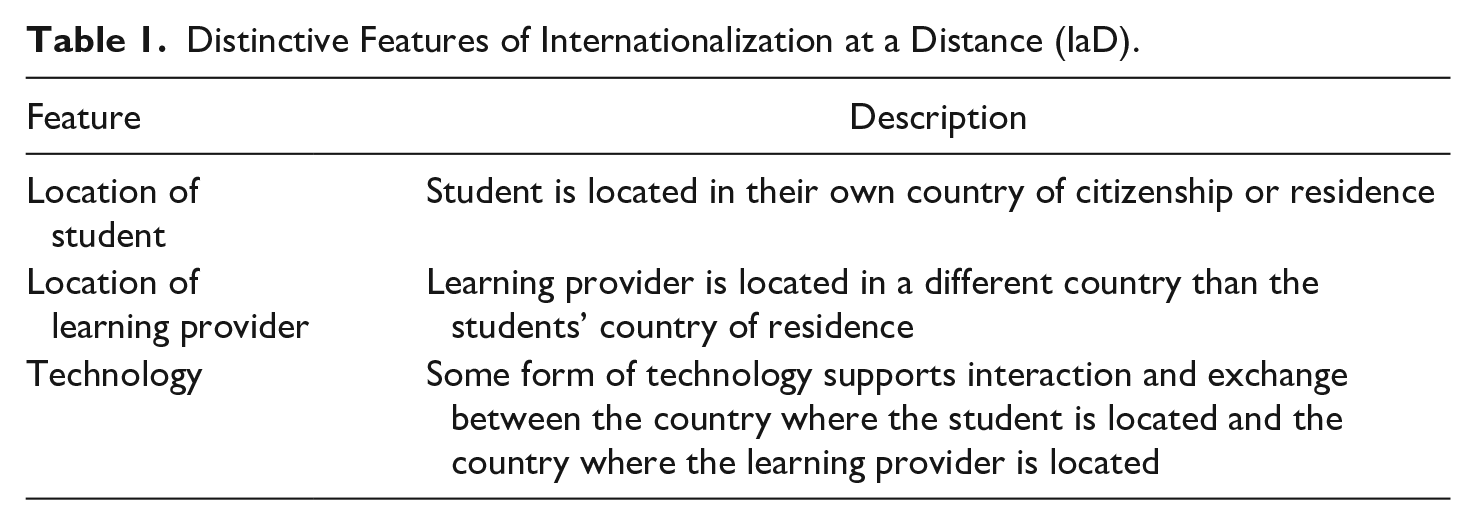
A second consideration is the geographic location of the learning provider. In the case of IaD, the primary geographic location of the learning provider is in a different country than the location of the student. We also highlight primary geographic location, as it is recognized that some distance learning providers may have branch offices in other countries to facilitate activities such as examinations, advising, or tuition payments. Nonetheless, the distinctive feature of IaD is that the pedagogic perspectives and curriculum materials are developed and devised outside of the student’s home country. The “learning provider” in this case is meant to be intentionally broad, as it may refer to universities, lecturers, or peers who are geographically located in another place.
Finally, technology is used in some form as a support mechanism for the sharing of ideas, knowledge, skills, and pedagogies between the student and the learning provider across geographic distances. We recognize that this may take many different forms, depending on the particular pedagogies used or learning goals. In our description of IaD, we include students studying through both distance learning programs and blended programs with online elements connected to universities in other countries. Again, this is left intentionally broad to encompass the vast array of technology-supported IaD opportunities (as outlined above).
Within IaD, we also recognize that the boundaries between “home” and “international” student are blurred, as they have been traditionally defined in IA or IaH contexts in light of international mobility and/or possession of a student visa. In IaD, students cannot be assumed to be geographically mobile across international borders and, indeed, may use distance or blended learning provisions as opportunities to remain immobile (Breines et al., 2019) and purposefully stay within their own home contexts. In many cases, distance learning students are also not eligible for student visas (where necessary) and distance learning providers cannot legally sponsor student visas. As such, we refer to an “internationalization at a distance student” as one who remains within their country of residence, but studies internationally at an institution based in another country. As the needs and intentions of those studying through online and blended learning models are highly diverse, we consider both students studying for a full qualification or one-off course units.
The final aim of this article is to provide an in-depth example of IaD at scale through a case study of one of the world’s largest distance education providers: UNISA. In doing so, we highlight the “distinctiveness” of this IaD provider, while also describing unique challenges to internationalization for consideration in future developments on this topic.
Example at Scale: UNISA
UNISA is a mega open distance learning institution in South Africa, with 381,483 students registered in 2018. Its scale and regional reputation as a provider of quality education means it attracts students from 90 countries with over 29,000 IaD students (i.e., non-South African students, who are primarily located in their own country of residence). The large reach of UNISA has led to the university setting up exam centers in 30 African countries and 63 exam centers throughout the rest of the world, giving the institution a very large global footprint. Indeed, the size and scale of the institution means it is one of the largest providers of international distance education globally. This is made possible by the fact that UNISA has no locational requirements for enrolment and students can be geographically based anywhere in the world (Subotzky & Prinsloo, 2011), thus presenting a clear example of IaD.
Although all students at UNISA engage with learning at a distance, IaD students face a unique situation as nearly all undertake international degrees while remaining in their own countries of residence. Nevertheless, IaD students at UNISA are part of a multifaceted network that brings together other students, IT infrastructure, and social media to materialize the university (Mittelmeier et al., 2019b; Madge et al., 2019). For example, IaD students have access to the virtual learning environment of UNISA, where they engage with taught materials and use discussion forums with fellow students, e-tutors, and lecturers. myUNISA is an additional online platform for registered students, which includes communication tools for student-to-student contact. Although pedagogic tools vary between programs, many courses incorporate collaborative elements between peers in different geographic locations, such as shared communication spaces, wiki or other shared document creation, and interactive blogs (Mbatha, 2014).
IaD is also materialized through the South African focus of UNISA’s curriculum. As with other international education providers, the home market (which makes up a majority of the student and staff population) has a strong influence on all aspects of the curriculum. UNISA too is undergoing a process of Africanizing and decolonizing its curriculum (Le Grange, 2016), placing stronger emphasis on local perspectives, knowledges, and pedagogies. This is challenging, as it requires addressing the historical and colonial inheritance of course materials, pedagogical tools, and examination modalities from the Global North (Long et al., 2019), but also raises questions about whether decolonizing the curriculum is a South African or an African endeavor. This perspective is highlighted throughout their online promotional materials (www.unisa.ac.za), which claims “decades of service to South Africa and beyond” and “celebration and promotion of our African roots.” Indeed, UNISA’s core mission is “toward the African university shaping futures in the service of humanity.” Therefore, IaD students may find that they need to “adapt” to a South African model of education with little transitional additional support from the institution. This has implications for the experiences of large numbers of IaD students based outside of South Africa, particularly those residing in non-African countries (Mittelmeier et al., 2019a).
One additional challenge faced by students at this institution is that there is little additional internal support from the institution specifically tailored for IaD students, such as bespoke advice or financial support. As a result, IaD students often join an existing network of students who work together to coordinate their interaction with the university. Social media plays a key role in interacting with other IaD students from their home country, but equally with South African students who can form a link across distance as they visit university centers on IaD students’ behalf (Madge et al., 2019). Other issues are unique to the IaD student cohort at UNISA, such as international money transfers for tuition payments or receiving physical copies of assigned texts (Mittelmeier et al., 2019b). Yet despite these challenges, many IaD students, particularly those from countries in Africa, cite the benefits of getting an “international” degree (Mittelmeier et al., 2019a, 2019b).
Altogether, UNISA represents an example of IaD on a massive scale, whereby large numbers of students study with an institution located “abroad” while simultaneously remaining “at home.” Although this has provided unique pathways toward intercultural exchanges of knowledge, the institution has experienced aforementioned challenges in its IaD provisions. Therefore, suggestions for research in this area are the focus of the final section of this article.
Areas for Future Research
In this article, we have conceptualized IaD as a third modality of comprehensive internationalization. However, we recognize that much work is needed to more fully develop this concept theoretically and better understand the learning experiences of students, staff, and institutions participating in IaD. We particularly suggest continued work in the following areas.
Comparisons Between IaD and IA/IaH
In our preliminary work at UNISA, we identified differences in experiences between those distance learners located within South Africa and those residing outside (Mittelmeier et al., 2019b), as it continues to be gendered, racialized, and classed (as is also often the case for face-to-face study) (Sparke, 2017). However, our work considered students’ experiences at only one timestamp in one context. Therefore, we suggest that future research should focus on theoretically and empirically investigating this perceived distinction between IaD and IA or IaH in a more comprehensive manner. In particular, there is need to unpack the extent to which IaD can be compared with the documented benefits and challenges of IA and IaH.
Further Developing IaD Pedagogies
Many studies have explored the distinct challenges of using technologies to facilitate learning across countries and cultures (Baroni et al., 2019). For example, students often find online intercultural communication challenging during activities such as group work (Mittelmeier et al., 2018). Other concerns have been raised about the lack of authentic engagement with international perspectives in online contexts (Ramanau, 2016). Although Leask and Carroll (2011, p. 655) suggested that internationalized activities “must be designed in a way that, because of their very nature, they cannot be completed satisfactorily without a meaningful intercultural interaction,” global evidence suggests that this is often far from the case in IaD activities. Therefore, we argue that more research is needed to understand, differentiate, and support inclusive technology-supported internationalization pedagogies.
Exploring Staff and Institutional Experiences
Few studies have considered the perspectives of the staff or institutions that provide IaD provisions to students. In light of the wealth of research focusing on the benefits and affordances of teaching in online and distance learning contexts, a specific focus on staff perceptions of the international and intercultural elements embedded within many programs is needed. For example, it remains unclear whether staff feel they have the appropriate training or preparation for working online with students based around the world. Similarly, more work is needed to understand how IaD fits within or influences existing comprehensive internationalization strategies at existing institutions around the world.
Although this list is not exhaustive, we feel that further understanding in these three areas are key to the ongoing development of research related to internationalization, educational technologies, and IaD.
Conclusion
In this article, we have conceptualized a new third category of university internationalization—IaD—which outlines the importance of technology-enabled learning across geographic boundaries “abroad” while students simultaneously remain at “home.” Although the term “technology” can be conceptualized broadly, what is clear is that online and blended learning models open new opportunities and issues for internationalization. However, we recognize that this concept at present remains underresearched and undertheorized. In particular, there is need for more investigations into the distinctions between the three internationalization categories (IaD, IaH, and IA). Although our previous research has provided empirical evidence that students’ experiences across these three broad categories do indeed differ (Mittelmeier et al., 2019a), we suggest that future work build upon these initial findings to understand this phenomenon more comprehensively. Research on this topic should additionally be broadened beyond our initial investigations into distance learning models to include other forms of online, blended, and technology-supported learning in internationalized contexts.
In a pivotal article about internationalization more broadly, Knight (2004) provided a list of questions to ponder over the next phases of ongoing changes in the higher education sector. As research on this topic continues to work toward addressing her original questions, we offer several additions of our own related specifically to IaD. As with Knight (2004), we offer these in no particular order and recognize that these questions are not comprehensive or even always distinctive to IaD:
How can IaD contribute to inclusive and sustainable intercultural engagements in higher education? How can technology-supported pedagogies and curricula contribute to intercultural understandings around the world?
What are the implications of IaD activities on student and staff experiences in higher education?
What challenges do students, staff, and institutions face in various IaD activities? What evidence-based supports mitigate these challenges?
What are the implications of the growth in online international distance learning models on traditional campus-based institutions? How does IaD disrupt or impact the wider higher education sector? How are current institutions (both traditional and distance) changing their practices in light of increasing IaD provisions?
What are the implications for increased technology-supported mobility of knowledge across geographic borders? Which groups of people and forms of knowledge are privileged by IaD? Which are disadvantaged?
To what extent can IaD reach a broader audience of university students compared with more “traditional” internationalization activities, such as those categorized under IA?
To what extent does IaD (particularly though online distance learning) contribute to massified higher education models? What are the implications for these massified models on the higher education sector broadly, as well as for local communities and individuals?
The examples provided in this article highlight that technology is changing the forms and functions of internationalization in higher education. Indeed, it has opened up new opportunities and avenues for connecting students, staff, and institutions around the world in ways previously unprecedented. These changing dynamics mean our classifications of internationalization activities need to be reviewed and reconsidered. It is in this vein that we put forward IaD and suggest further investigations into its affordances and challenges for supporting meaningful intercultural learning for and between students around the world.
Footnotes
Acknowledgements
The authors acknowledge the varied contributions of all the other team members involved in the wider project.
Declaration of Conflicting Interests
The author(s) declared no potential conflicts of interest with respect to the research, authorship, and/or publication of this article.
Funding
The author(s) disclosed receipt of the following financial support for the research, authorship, and/or publication of this article: The IDEAS project was funded by the Newton Grant and supported by the Economic and Social Research Council (grant number: ES/P002161/1); and the National Research Foundation (grant number: UTSA160329161196). The IDEAS project involved an interdisciplinary and international team of researchers.
