




Abstract
Background:
Bystander cardiopulmonary resuscitation can improve the survival rate of patients with out-of-hospital cardiac arrest. Teaching cardiopulmonary resuscitation in schools by teachers is one of the ways to increase the number of bystanders who can perform cardiopulmonary resuscitation. Nevertheless, there have been no studies on the readiness of teachers in Hong Kong to teach cardiopulmonary resuscitation in their schools.
Objective:
To assess whether secondary school teachers are prepared to teach their students cardiopulmonary resuscitation.
Methods:
This was a questionnaire survey. Teachers from 22 local secondary schools were recruited. The questionnaires were designed with questions covering their knowledge about cardiopulmonary resuscitation and attitudes towards teaching their students cardiopulmonary resuscitation. A knowledge score and attitude score were calculated.
Result:
557 teachers completed the questionnaires. Most had never witnessed a cardiac arrest and over half of them had never been trained cardiopulmonary resuscitation or use of an automated defibrillator. About 25% of them answered all questions on knowledge wrong. Only 25% supported teaching cardiopulmonayr resuscitation in schools and 32% were willing to teach it. Legal liability was a major concern.
Conclusion:
Local teachers’ readiness for teaching students cardiopulmonary resuscitation in secondary schools is likely poor. More efforts are required to raise their knowledge level on cardiopulmonary resuscitation and instill a positive attitude towards cardiopulmonary resuscitation education in schools.
Introduction
Early bystander cardiopulmonary resuscitation (CPR) increases the probability of survival in out-of-hospital cardiac arrest by two to four times.1,2 Teaching CPR in schools is a means that can potentially increase bystander CPR rate. It has gained widespread support from multiple professional bodies to improve the prognosis of out-of-hospital cardiac arrest. 3 In many developed countries like Norway, Japan, and the United States, CPR training has been part of their school curricula.4–7 There are advantages using teachers as CPR instructors. For example, it could be considered a long-term investment as teachers can teach successive student groups. 8 Few studies evaluated the views of school teachers about teaching CPR in schools, nonetheless. In a Belgian study, less than half of the 4000 teachers surveyed were confident or willing to teach CPR in schools. 9 In Spain and Greece, schools preferred a healthcare professional to teach their students CPR.10,11 There has been no similar study among teachers in Hong Kong or other Asian countries. It is also unknown how many secondary schools in Hong Kong teach their students CPR.
The objective of this study was to evaluate the readiness of Hong Kong secondary school teachers to teach CPR in schools. Readiness is defined as the teachers’ attitudes towards teaching CPR in schools and their knowledge about CPR. By understanding their readiness, the practicality of including CPR training in the local secondary school curricula could be better understood.
Methods
This study was a questionnaire survey conducted from 1 March 2017 to 30 November 2017. The teachers invited to participate in the survey were from the 22 local secondary schools that had joined the project of ‘Compression-only CPR training programme for secondary school students’ organized by the Emergency Medicine Unit of the University of Hong Kong in 2017. This project was funded by the Quality Education Fund of the Education Bureau of the Hong Kong Government. All full-time teachers in these schools, regardless of whether they were actively involved in the project and the subjects they taught, were invited to participate in the survey. The questionnaires were given to the teacher representative in the project by hand at the commencement of on-site CPR training of students and from whom the questionnaires were distributed to other teachers in the same school. Each questionnaire was accompanied by an information sheet detailing the background and procedures of the study. Participation was voluntary and anonymous. Completion of the questionnaire implied consent to participate. It took about 20 min to complete the questionnaire. No reward was given to the teachers. Completed questionnaires were to be collected in 2 weeks. The study was approved by the Institutional Review Board of the University of Hong Kong/Hospital Authority Hong Kong West Cluster (UW 15-612).
The questionnaire used in this study consisted of three sections. The first section was for the demographic information of the teachers. The second section asked about their knowledge on CPR. It consisted of five 4-stem multiple-choice questions. The questions were based on the Basic Life Support guidelines of the American Heart Association issued in 2015. The third section evaluated their attitudes towards teaching of CPR in schools. The questions in this section were designed by the research team because similar questionnaires in the medical literature are limited. They may not be applicable in Hong Kong for difference in socioeconomic and cultural context. There were six questions in this section. One question asked the respondents about the need for mandatory CPR training in secondary schools. The remaining five questions addressed their attitudes to teaching CPR in schools. To ensure content validity, the questions were designed on the basis of the findings from three focus group interviews of 20 local secondary school teachers about the facilitators and barriers of teaching CPR conducted by the research team between January and April 2016. Before the questions were finalized, they had also been discussed and modified by three clinicians with extensive experience in teaching CPR in the community and schools. They used a 5-point Likert-type scale. Each position on the scale was given a score from 1 to 5. Questions measuring negative attitude were reversely scored. The higher the score, the more positive the attitude was.
The demographic characteristics of teachers were reported with descriptive statistics. Their level of knowledge on CPR was expressed as the number of correct answers to the five multiple-choice questions. The attitude questions were also analysed by descriptive statistics. The responses to the questions with Likert-type scale were treated as ordinal data and reported as median and interquartile range. Significance testing was done with the Mann–Whitney U test or chi-square test where appropriate. A P-value ⩽0.05 was considered significant.
Results
There were 557 teachers (out of 1304 teachers from the 22 schools) who completed the survey. The response rate was 42.7%. Their characteristics were shown in Table 1. Among these respondents, there was female predominance (60.32%) and about a third were aged between 25 and 34 years. Having a person aged 60 or above in the household was uncommon (33.4%). The majority of them (94%) had never witnessed a cardiac arrest. Over half of them did not have training in automated external defibrillator (69.7%) or CPR (51%). For those who had ever been trained in CPR, only about 13% held a valid CPR provider certificate at the time of the survey.
The characteristics of teachers completing the questionnaire.
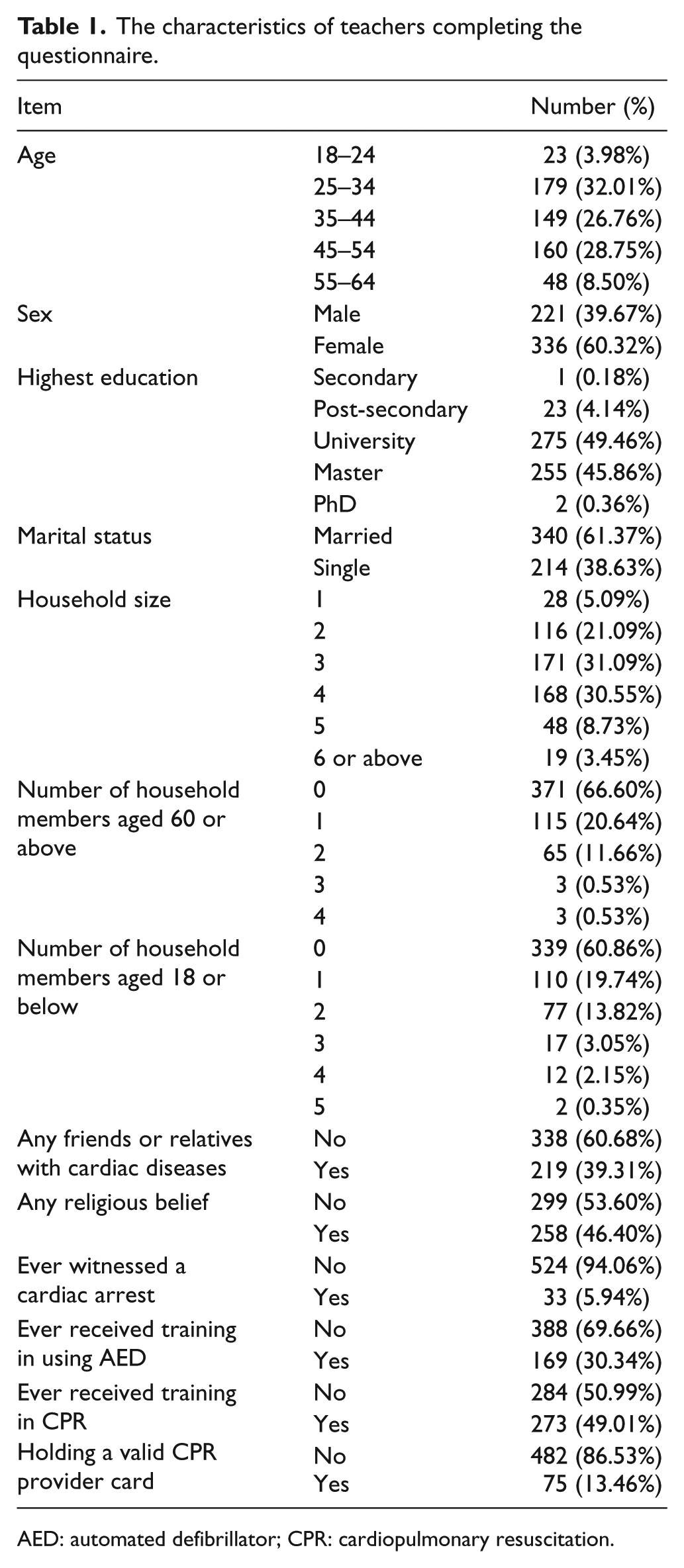
AED: automated defibrillator; CPR: cardiopulmonary resuscitation.
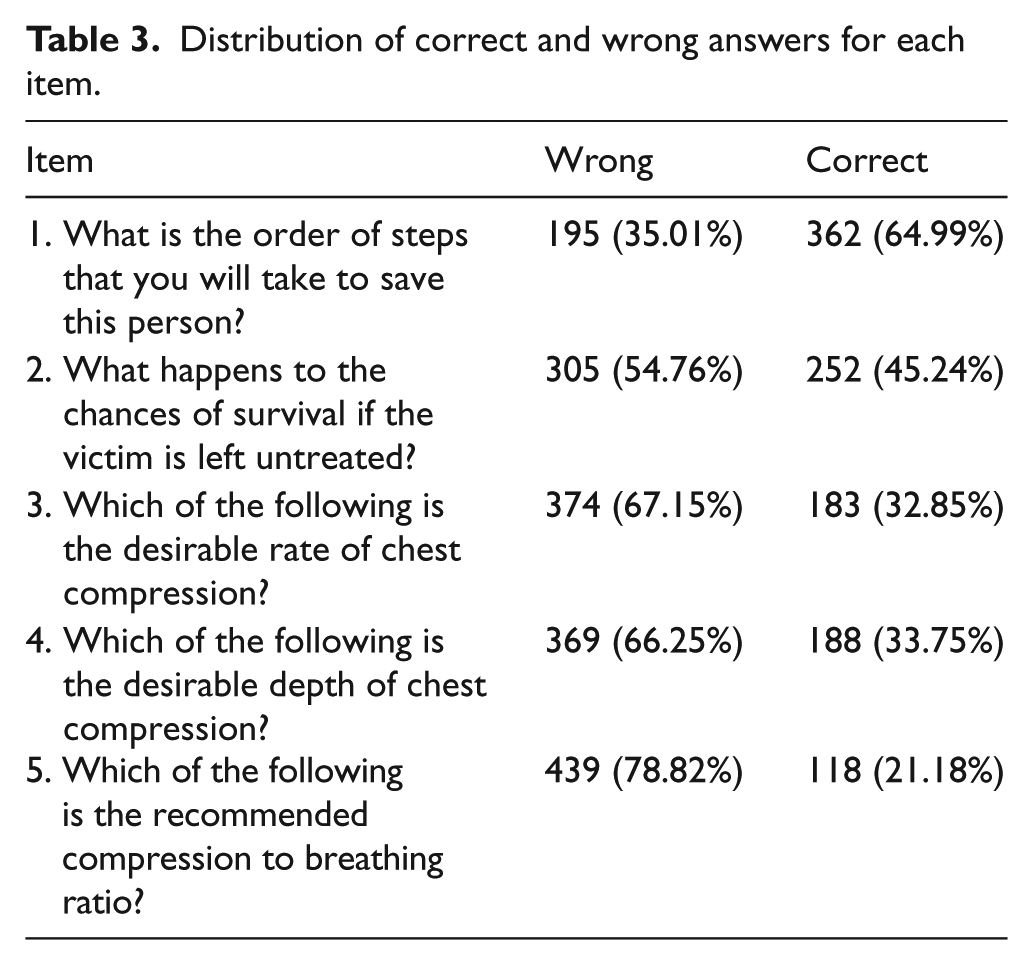
Their level of knowledge about CPR was shown in Table 2. The median number of correct answers was 2. About 21% of them got all five questions wrong. They performed especially poor in the skills of CPR. About 60% of them did not know the correct depth and rate of chest compression. Nearly 80% did not know the correct compression-to-ventilation ratio (Table 3). Those teachers who had been trained CPR or automated defibrillator (AED), who held a valid CPR provider certificate or who had witnessed a cardiac arrest achieved a higher score than those without (Table 4).
The total score of CPR knowledge testing.
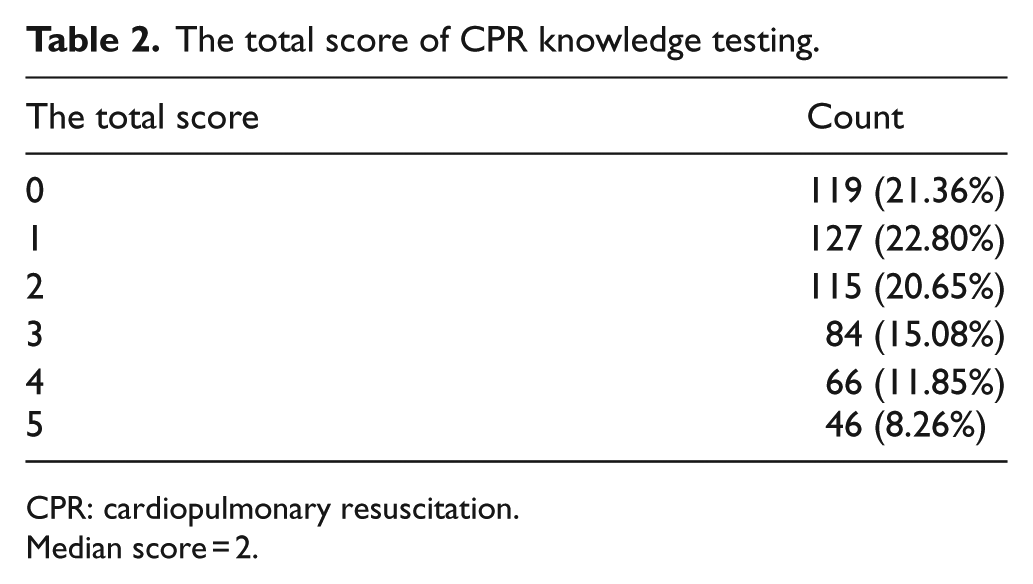
CPR: cardiopulmonary resuscitation.
Median score = 2.
Distribution of correct and wrong answers for each item.
The CPR knowledge scores of teachers among groups.
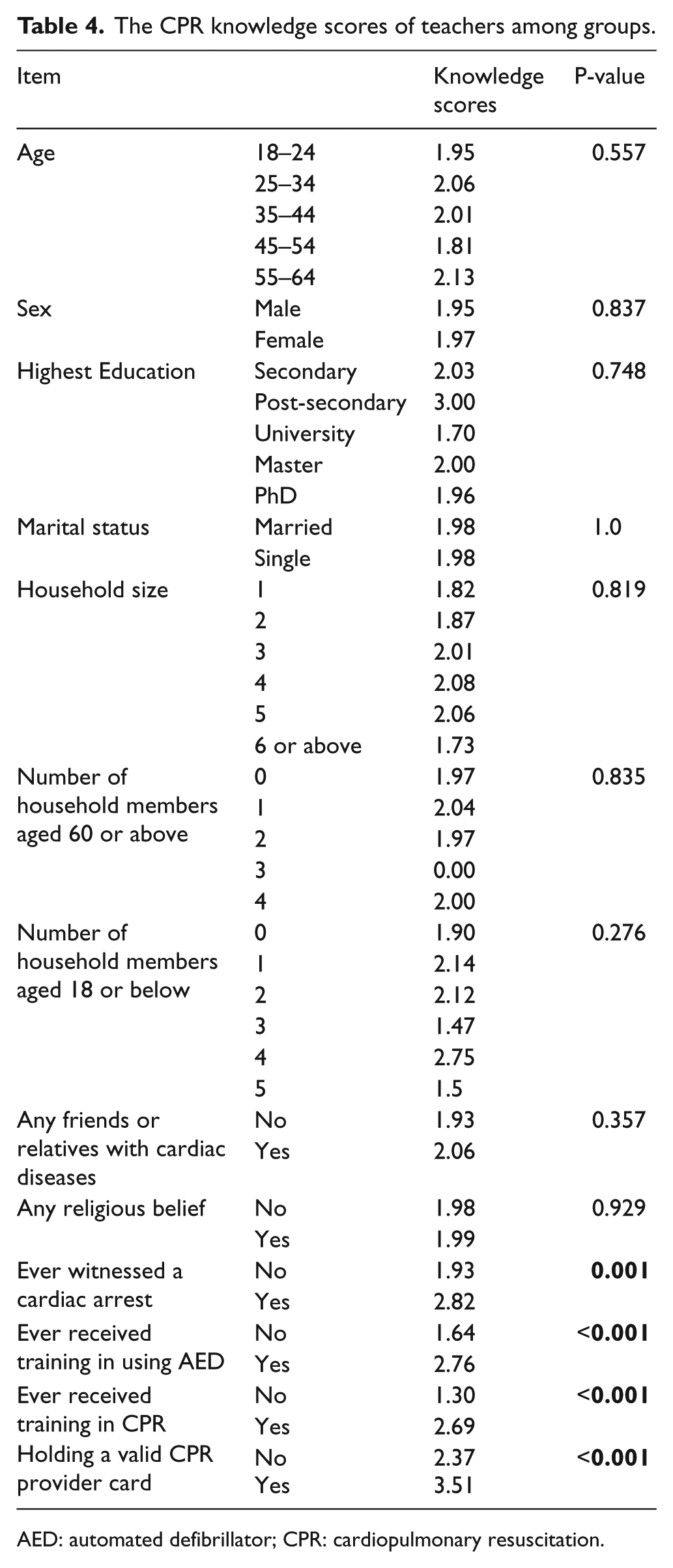
AED: automated defibrillator; CPR: cardiopulmonary resuscitation.
Concerning the need for mandatory CPR training, 26% of them believed that it should be done in secondary schools. For the attitude questions, a score of 20 or above is considered positive (‘agree’ or ‘strongly agree’ in five questions). Their median attitude score was 12 indicating an overall negative attitude. About 32% of them gave an affirmative answer to their willingness to teach CPR. Most lacked confidence. Of note, 80% had concern of legal liability (Table 5).
Number and percentage of teachers in response to items.
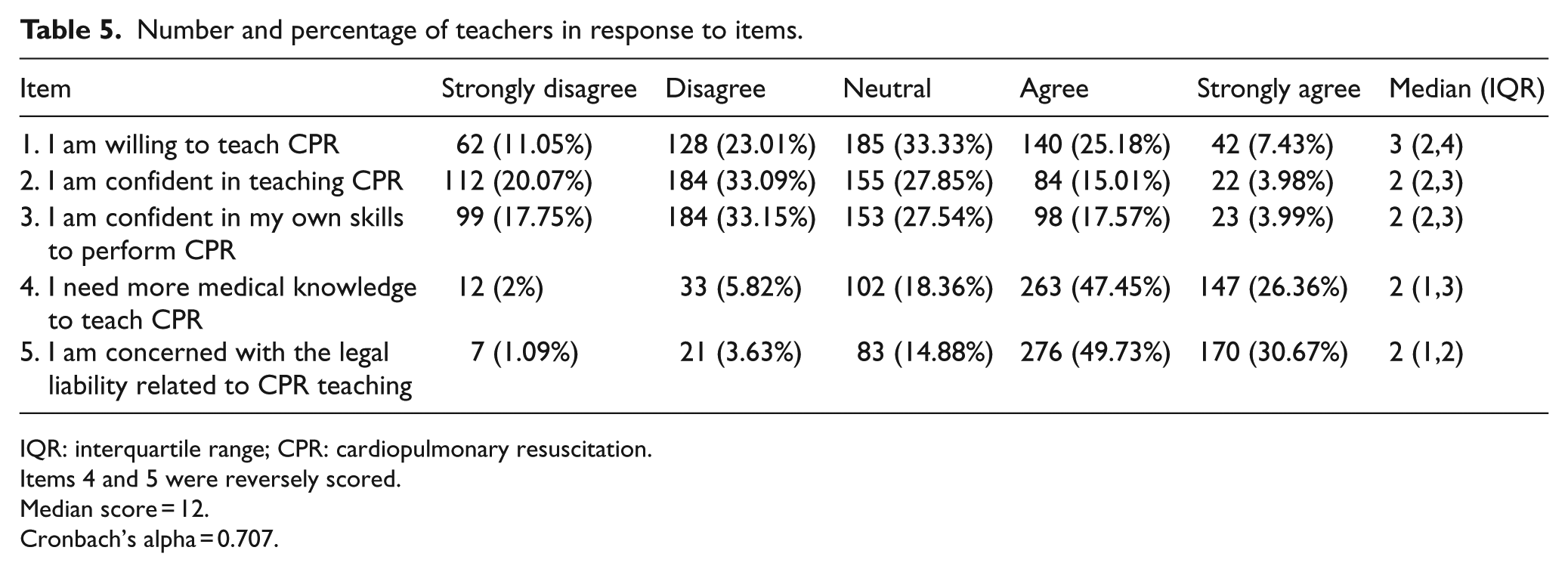
IQR: interquartile range; CPR: cardiopulmonary resuscitation.
Items 4 and 5 were reversely scored.
Median score = 12.
Cronbach’s alpha = 0.707.
Discussion
On the basis of findings from this survey, the readiness to teach CPR by the secondary school teachers surveyed is low. Their level of knowledge on CPR is poor and only a minority of them held a positive attitude towards teaching CPR in schools. Although the number of respondents in this survey constitutes a small proportion of all secondary school teachers in Hong Kong, the findings of this survey suggest that a lot more have to be done before implementing CPR teaching in local secondary schools.
Teaching students CPR by their teachers has been advocated by many professional bodies. To make this happen, the teachers themselves have to be CPR trained. For example, the European Resuscitation Council has stressed the importance of having all teachers being trained in CPR. 12 In the United States, more and more states have made it statutory that a certified teacher must also be CPR trained. 13 In Hong Kong, the only requirement is that at least two teachers in the school are trained in first aid. 14 It is thus not surprising to find that less than 30% of teachers surveyed held a valid CPR provider certificate and nearly 50% had never been trained CPR.
This survey revealed that the teachers’ knowledge about CPR is poor. This is in line with the finding that the general public in Hong Kong also has poor knowledge in CPR. 15 There was no significant difference in knowledge with regard to age, gender or education background. However, teachers with prior training in either AED or CPR or experience of witnessing a cardiac arrest had significantly better knowledge than those without. The latter may be because teachers who had witnessed a cardiac arrest are more likely to seek more knowledge of how to manage a cardiac arrest. It also suggests that using the pedagogy of experiential learning for CPR training may be helpful. Overall, there is a need to provide CPR training to teachers irrespective of their background.
The teachers’ attitude towards teaching CPR in schools is negative. This aligns with their response to the direct question asking whether they supported mandatory CPR training in schools. Only a little more than a quarter of them were affirmative. A significant proportion of them lacked confidence. There may be multiple reasons for this. But lack of training should be a reasonable postulation. Nearly 80% of them were concerned of legal liability. Strictly speaking, because of the absence of Good Samaritan legislation in Hong Kong, legal liability cannot be completely avoided. It is essential to explain to the teachers by legal professionals in case CPR training in schools is implemented.
Limitations
This study is limited by the small sample size and low response rate. The sample may also lack representativeness. There were about 28,000 secondary school teachers at the time of the survey. Therefore, a survey with bigger and more representative sample is required for better understanding of teachers’ attitudes to CPR training in schools. Furthermore, in this study, the specialty of a teacher taught was not considered. Teachers teaching physical education may have different knowledge levels or attitudes compared to teachers teaching other subjects. Bias is also present because of the self-report nature of the survey. Some might just give socially desirable answers.
Conclusion
The local teachers are probably not ready to teach CPR in schools. Efforts to increase their knowledge in CPR and instill a positive attitude to teaching CPR are needed. The former could be achieved by provision of CPR training. For the latter, besides training, offering legal advice about their ability may help.
Footnotes
Acknowledgements
Concept development: L.-P.L., R.L.; supervision: L.-P.L., K.L.F.; data collection/processing: R.L., F.M., S.H.; Data analysis/interpretation: F.M.; writing: L.-P.L., F.M.
Declaration of conflicting interests
The author(s) declared no potential conflicts of interest with respect to the research, authorship and/or publication of this article.
Funding
The author(s) received no financial support for the research, authorship and/or publication of this article.
Ethical approval
The study was approved by the Institutional Review Board of the University of Hong Kong/Hospital Authority Hong Kong West Cluster (UW 15-612).