




Abstract
Introduction:
A variety of exotic reptiles are kept as “pets” and the ownership of these animals is rising in Hong Kong. Two lizard species are known to be venomous: the Gila monster (Heloderma suspectum) and the Mexican Beaded Lizard (Heloderma horridum). Both of them are native to the North America but are traded in the pet markets. Bites from these lizards are capable of causing severe envenomation in humans.
Case presentation:
A 41-year-old man presented to the emergency department after bitten by his exotic pet. His right hand was bitten by a Gila monster resulting in local swelling and intense pain. The local envenomation lasted for about 12 hours and then gradually improved.
Discussion:
Bite by Gila monster could result in local and systemic envenomation. Local envenomation includes intense pain of the injured site, edema and paraesthesia. Systemic envenomation including hypotension and airway edema occurs in severe envenomation.
Conclusion:
With the increasing popularity of keeping exotic pets in Hong Kong, envenomation by exotic venomous animals may be encountered by the emergency physicians. Knowledge about the potential envenomation effects of these exotic animals is essential for proper management of the patients.
Introduction
Most envenomation related to reptile bites encountered in the local emergency department (ED) is due to bites from wild venomous snakes.1,2 There is an increasing trend of keeping non-native (exotic) reptiles as pets. Bites may occur during the care and handling of the exotic venomous species by amateur collectors. 3 Envenomation by non-indigenous venomous species is an uncommon but often serious medical emergency. Exotic venomous snakes have become a problematic source of envenomation worldwide. In a retrospective study about the exotic snake envenomation in the United States, 258 cases involving at least 61 unique exotic venomous species were recorded in the National Poison Data System database between 2001 and 2011. A total of 70% of the bites occurred in private residences. 4 The presence of exotic venomous pets in European homes is also common. Another study about the bites and stings by exotic pets in Europe reported 404 cases in four poison centers in Germany and France from 1996 to 2006. Exotic snake bites from rattlesnakes, cobras, mambas, and other venomous snakes caused about 40% of envenomation. 5 However, there is no epidemiological study about envenomation by exotic pets in Hong Kong. Apart from snakes, lizards are also popular exotic pets. Bites by large species, such as common green iguana (Iguana iguana) could result in serious injuries. 6
Envenomation from lizard bites is rare. Only two lizards are known to be venomous: Gila monster (Heloderma suspectum) and Mexican beaded lizard (Heloderma horridum). Both of them have venomous secreting glands, and bites by them could result in severe envenomation.7–9 Gila monster lives naturally in the southwestern United States extending into Mexico, whereas the beaded lizard is only native to Mexico. Gila monster is a protected species in the Convention on International Trade in Endangered Species of Wild Flora and Fauna (CITES), 10 and all the wild populations of Gila monster are protected in the United States. Bites by wild Gila monsters are uncommon as they are slow-moving, docile animals. Captive-bred Gila monsters are traded in the international pet markets. Upon our literature search, this is the first reported case of envenomation by Gila monitor bite in Hong Kong.
Case Presentation
A 41-year-old man with good past health presented to the ED about 2 h after bitten by a sub-adult Gila monster with a total length of 30 cm and a head diameter of 4.5 cm. (Figure 1) The Gila monster was kept by the patient as a pet. His right hand was accidently bitten by the Gila monster. The bite occurred when the patient was handling the Gila monster without wearing protective gloves. The lizard’s jaw remained attaching to the patient’s hand for approximately 10 s, and it made chewing movements on the bite wound during the bite. It relaxed its bite spontaneously. The patient developed immediate and intense pain over the injured site, and he recorded a visual analog scale pain score of 10/10. At presentation, he had Glasgow Coma Scale score 15/15, blood pressure 126/82 mm Hg, pulse rate 90 beats per minute, and temperature 37.5°C. There were puncture bite wounds over his right hand with erythema and swelling (Figure 2) No tissue necrosis was noticed. There was no evidence of compartment syndrome, and the distal circulation was intact. His chest was clear. Neurological examination was normal, and he has full muscle power over his four limbs. There was no evidence of bleeding tendency. He also did not have rash, mucosal lesion, or stridor. Laboratory tests including complete blood picture, liver and renal function, creatine kinase level, clotting profile were all normal. Electrocardiogram revealed normal sinus rhythm. X-ray of his right hand showed no fracture, subcutaneous air, or foreign body. He was admitted to the emergency medicine ward (EMW) for further management. He was given intravenous amoxicillin/clavulanate and a tetanus booster. The intense pain lasted for about 12 h and then gradually improved. His haemodynamic state was all along stable. No airway edema and neurological symptom was noticed. He was then discharged from hospital after 18 h of observation in the EMW. After 5 days of the injury, he had completely recovered.
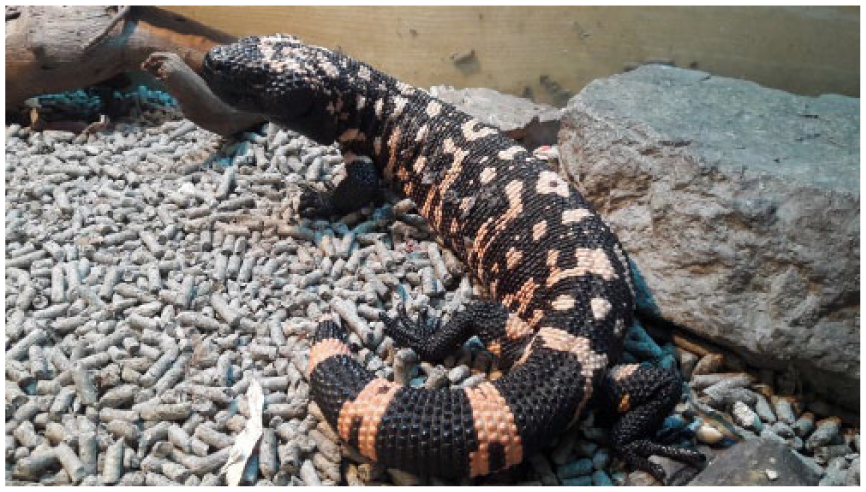
Gila monster (Heloderma suspectum).
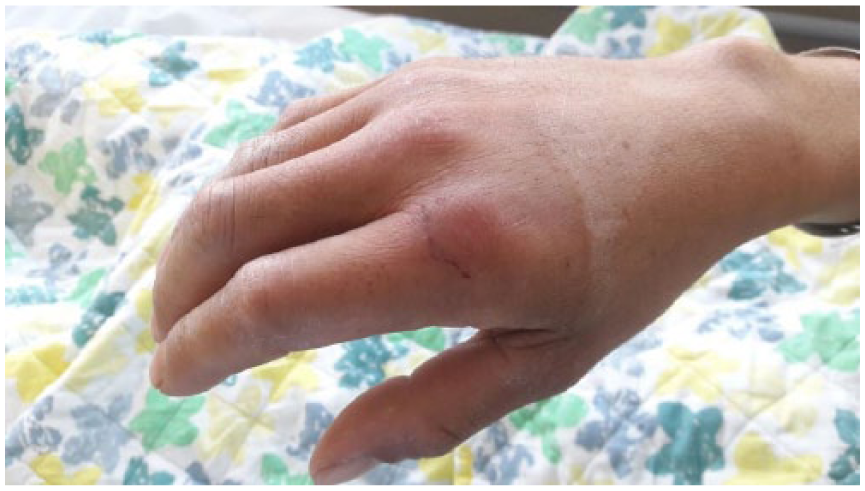
Bite wound and localized swelling on the right hand of the patient.
Discussion
Both Gila monster and beaded lizard belong to the Helodermatidae family. Gila monster is a large, colorful, and slow-moving lizard with length up to 60 cm. There are two subspecies, the reticulate Gila monster (Heloderma suspectum suspectum) and the banded Gila monster (Heloderma suspectum cinctum), characterized by different color patterns on the body. 11 Gila monsters are slow-moving, nocturnal animals. In the wild, they primarily eat small birds, mammals, and eggs. They spend most of their time underground. Thus, human encounters are infrequent. However, bites by Gila monsters could cause severe envenomation. Gila monster bites with its multiple sharp teeth in both the upper and lower jaws. Venom glands of helodermatid lizards are located in the lower jaw. Unlike snakes, helodermatid lizards lack the musculature to inject its venom; instead, the venom is released from the venom gland into the saliva during chewing. 8 The venom in Gila monster consists of a variety of proteins including gilatoxin, a kallikrein-like protease, which can hydrolyze kininogen and produce bradykinin.8,12
The commonly reported envenomation effects after Gila monster bites include intense pain of the injured site, edema, paraesthesia, weakness, dizziness, and nausea. Hypotension occurs in severe envenomation. 13 The intense pain, edema, and hypotension are likely to be bradykinin-mediated effects. Use of vasopressors for the treatment of hypotension may be needed. Edema has been reported to occur in airway structure regardless of the sites of bite. Airway edema is a manifestation of systemic toxicity from the Gila monster venom and is mostly detectable upon initial presentation to a healthcare facility but may occur late up to 12 h after the bite.12,14 Nevertheless, severe envenomation from Gila monster occurred only in a minority of patients. In a retrospective study analyzing all the cases of Gila monster envenomation in the National Poison Data System of the American Association of Poison Control Centers from 2000 to 2011, 105 cases of human exposure to Gila monsters were recorded, and 70 cases were referred to healthcare facilities for medical treatment. In total, 11 cases required admission to hospital, and 5 were cared in the intensive care unit. A total of 6 patients developed airway edema, and 3 of them required emergent airway management including 1 requiring cricothyrotomy. 12
Gila monster and Mexican beaded lizard are the only two lizards known to be venomous. They have special color patterns on their bodies, but species identification may be difficult by non-experts. As both Gila monster and Mexican beaded lizard are protected species, captive Gila monster and Mexican beaded lizard are mostly kept by experienced exotic pet owners. Thus, species identification can often be provided by the owners. Seeking expert opinion (from local zoologist in the Kadoorie Form and Botanic Garden) may be needed for patients with exotic lizard bites in case of difficulty in species identification. Treatment of Gila monster bite in the acute phase is generally supportive. Intravenous crystalloid infusion and vasopressors may be required for treatment of hypotension in severe envenomation. Radiographic assessment is needed to look for retained teeth and subcutaneous air due to the chewing-like action during the bites. However, care must be exercised to watch out for retained teeth, as it has been reported that Gila monster teeth remaining in the wound were not detectable by soft-tissue radiography. 13 Standard wound care including adequate analgesic, removal of foreign bodies if any, tetanus prophylaxis according to the tetanus immunization status. Prophylactic antibiotic should be considered in view of the potential presence of pathogens in the oropharynx of Gila monsters related to its feeding habit. Currently, no antivenom to Gila monster is commercially available. 15 Observation for at least 12 h after Gila monster bite is recommended. 12
Conclusion
In summary, reptiles are a growing part of the exotic pet trade, and injuries from these exotic pets are expected to increase. Although, majority of the lizards are nonvenomous, bites by those venomous species may be encountered. Emergency physicians have to be familiar with the proper management of lizard bites, and be able to recognize and manage the potentially fatal complications of the bites from venomous species.
Footnotes
Declaration of conflicting interests
The author(s) declared no potential conflicts of interest with respect to the research, authorship, and/or publication of this article.
Funding
The author(s) received no financial support for the research, authorship, and/or publication of this article.
Availability of data and materials
Patient’s clinical history and investigation results were reviewed by O.F.W. from the clinical records.
Informed consent
Informed consent has been obtained from the patient for the publication of the clinical information and photo.
Ethical approval
Ethical approval has not been applied for this case report study.
Human rights
This case report study was done in accordance with the principles outlined in the Declaration of Helsinki.