



Abstract
How does digitalization change corporate governance in German industry? Does it lead to further atomization of inter-corporate relations in the race for the development and deployment of technologies and skills, or can we discern new forms of cooperation and coordination against the backdrop of institutional legacies and the pressure to adjust industrial business models? The present paper engages with these questions with a focus on industrial firms’ own digital agency, a less understood aspect. We identify the development and deployment digital technologies and the proliferation and integration of the corresponding skills portfolios as a dual challenge. With a focus on the German political economy and on mergers and acquisitions as one of the principal tools to overcome this dual challenge, we analyze more than two decades of M&A deals to explore shifts in acquisition activity and to map corporate linkages and overlapping investments. One of the consequences of this activity is the emergence of interconnections that have given rise to a new structure, which we term Industry 4.0 Inc. and which is likely to induce further collaboration among participating incumbents.
Keywords
Introduction
How does digitalization change corporate governance in German industry? Does it lead to further atomization of inter-corporate relations in the race for the development and deployment of technologies and skills, or can we discern new forms of cooperation and coordination against the backdrop of institutional legacies and the pressure to adjust industrial business models? The present paper engages with these questions with a focus on industrial firms’ own digital agency, a less understood aspect of how incumbents react to the challenges of digitalization. While it has become evident, even to the most cautious observer, that the increasing importance of gathering, storing, and processing ever-larger amounts of data transforms everyday corporate practices, the answer to these questions is far from obvious. In an interview with Bloomberg TV in July 2025, Siemens CEO Roland Busch emphasized that Germany must leverage its abundance of data across industrial companies to take advantage of artificial intelligence (AI) (Gallu and Crook, 2025). To achieve this, the company partners with United States (US)-based technology firms Amazon, via Amazon Web Services, and Nvidia. In another example, Schwarz Group, the parent company behind European retail giants Lidl and Kaufland, started offering cloud computing and cybersecurity services to corporate customers, and has now become a “‘a credible regional challenger’ to large incumbents such as Amazon Web Services, Google and Microsoft” (Storbeck, 2024). These cases represent different decisions on a continuum of responses to digitalization challenges. On the one hand, incumbent firms might depend on US technology giants (Big Tech), which increasingly penetrate sectoral borders, to acquire existing proprietary technologies. In a representative survey among German industrial firms, 81% said they were dependent on digital imports from the US such as cloud computing, AI or big data analytics (Bitkom, 2025). On the other hand, companies from non-digital technology sectors could strive for greater autonomy, develop their own solutions, and attempt to gain a competitive advantage. In reality, we often find combinations of collaboration and co-dependence, especially in the transition from the platform economy to cloud capitalism (Tan and Thelen, 2025).
Based on the literatures on the wider digital transformation of the economy (Dolata, 2024; Hind et al., 2022; Lechowski et al., 2023; Nylen, 2021; Ozalp et al., 2022; Rikap, 2023) and the move toward the knowledge economy (Di Maio and Trampusch, 2022; Diessner et al., 2025; Emmenegger et al., 2023), we identify the development and deployment of digital technologies and the proliferation and integration of the corresponding skills portfolios as a dual challenge. While the permanent availability of digital technologies is mandatory for the sustainable and profitable transformation of industrial business models, companies also require an adequately trained workforce to put technologies into use. In theory, the deployment of such technologies could be (a) facilitated by leading digital technology providers, mainly based in the US, (b) developed in-house, presupposing the right skills composition, or (c) acquired through investments in target firms. This situation forces industrial incumbents to make tough strategic decisions: Do they rely on the transactional provision by global flagship firms with high usability but the danger of falling prey to weaponization in an increasingly tense geoeconomic climate? Or do they prefer to shore up their own capacities through cooperation, research and development or (joint) investments? We zero in on the German political economy and focus on mergers and acquisitions (M&A) as one of the principal tools to overcome the dual challenge of skills and technology. Our analysis centers on manufacturing companies and places particular emphasis on the automotive industry, two of the areas most affected by digitalization challenges (Bajgar et al., 2019; Brühl, 2020). While management research offers an array of studies on changing organizational practices, new forms of human resources management, or efforts to improve sustainability (Matt et al., 2023), so far, comparative political economy (CPE) has had surprisingly little to say about the strategies of industry incumbents or the consequences for the relationships between companies (Kemmerling and Trampusch, 2023). Most CPE literature deals with how Big Tech and US platform firms colonize other industries. In Germany, the widespread belief is that the digitalization of industry further reinforces the oligopolistic lead of these firms since manufacturers depend on US digital infrastructures and technologies (Butollo and Schneidemesser, 2022; Franco et al., 2023; Kenney et al., 2021; Lechowski and Kryzwdzinski, 2022). In a similar vein, research reports and benchmarking papers by the KfW development bank (Zimmermann, 2021) or the European Commission (2022) stress that German industry is lagging behind and struggling with digital transformation.
Contrary to this perception, examples such those above and other cases from the automotive industry suggest that car manufacturers and suppliers play a much more proactive role. Incumbents such as Volkswagen, BMW, or Bosch, for example, have developed strategies and practices to avoid the great lock-in effect of Big Tech proprietary technologies (Gärtner, 2018: 25–28). On the one hand, they have been cooperating for many years with MS Azure and other hyperscalers on issues such as autonomous driving (Boes and Ziegler, 2021). On the other hand, they target digital technology firms and start-ups through increasing M&A activities with the goal of creating alliances. As the 2023 edition of the annual Global Automotive Supplier Study by Roland Berger and Lazard financial advisors notes, “…mergers, joint ventures and other forms of collaboration with both OEMs and other suppliers will be essential to properly master the capex-intensive industry transformation” (Mogge et al., 2023: 9).
We build on this ambiguous perception and turn our attention to the relevance of M&A. By analyzing how industry incumbents gain traction in the ongoing digital transformation and respond to the related dual challenge of technology and skills, we address an underappreciated aspect of political economy discussions on digital industrial transformation and help to fill a persistent gap in the CPE literature. Merger and acquisition activities have not only become more prominent, but changed over time. We link this trend to opportunities for cooperation within German industry and the domestic legacies of coordination between firms. These developments inform our research questions: (1) Do we see trends in M&A activities by German non-digital technology companies that can be read as a reaction to the dual digitalization challenge? (2) Can we identify opportunities for cooperation and coordination across incumbents?
To answer these questions our article presents a three-pronged analysis. First, we analyze over two decades of data on M&A deals between industrial firms to explore shifts in acquisition activity. In a second step, we draw on the literature on the impact of ownership structures on coalition building (Aguilera and Jackson, 2003; Casper and Matraves, 2003; Gourevitch and Shinn, 2007; Höpner, 2003; Streeck and Höpner, 2003; Voss, 2024) and map the emergence of new corporate linkages and overlapping investments as a consequence of this activity. Third and lastly, the paper discusses the kind of alliances this structure might generate via four vignettes of company cases. Our analysis is based on a novel dataset of 2,483 deals by 38 firms in the 2000–2021 period. To the best of our knowledge, this is the first comprehensive analysis of digital M&A activities in German industry. Our exploratory study yields a number of important findings. First, Germany’s industrial firms have substantially shifted their M&A activities toward minority holdings in the digital technology sector. Second, these transactions give rise to a new structure that we term Industry 4.0 Inc. 1 Third, it seems likely that this structure will induce further collaboration aimed at joint (and hence, less risky) integration of digital technologies and the corresponding skills portfolios.
The remainder of the paper is structured as follows. The next section recapitulates the literature on the digital transformation of German industry. Section three develops our theoretical argument on M&A behavior and corporate linkages. The fourth section details our case selection, data, and methodology. Section five presents our findings regarding M&A activities along with a set of descriptive statistics, network visualizations, and select examples which serve as validity tests. The final section concludes.
The digital transformation of industry and the dual challenge of technology and skills
In comparative and international political economy there has been an increasing interest in the far-reaching impact of digitalization dynamics. Contributions elaborate how this “growing importance of digital technologies and data for value creation and of digital infrastructures as a backbone of economic activity” (Kemmerling and Trampusch, 2023: 1854) affects labor and welfare (Collington, 2022; Hassel and Sieker, 2022; Staab, 2024), data commodification and surveillance (West, 2019), industrial policy (Rothstein, 2024), or geo-economics (Abels and Bieling, 2023). Like in retail (Durand and Baud, 2023) and finance (Breuer and Knetsch, 2023), the use of digital technologies and infrastructures has become an integral part of the manufacturing and automotive industries (Boes and Ziegler, 2021; Kerber and Gill, 2019; Trampusch, 2024), frequently with profound consequences for businesses and employees. One example is the implementation of AI tools and cloud computing. These two central features of digitalization do not merely create new markets and business opportunities (Mitsch et al., 2024: 6), for instance in data collection and processing. Their impact is more encompassing, as they “affect all areas of production” (Staab and Nachtwey, 2016: 458) and restructure the modus operandi of industrial businesses in the “old economy” in a variety of ways. In a study prepared for the European Parliament’s Committee on Industry, Research and Energy (ITRE), Brown et al. (2021: 47) stress that digitalization signifies “the move from a hardware-oriented sector to one increasingly driven by software and (digital) services.” This is essential for realizing the productive potential of the Industrial Internet of Things (IIoT), 5G networks, autonomous driving, or platform production. According to Brühl (2020: 138), “artificial intelligence is transforming” the German automotive and mechanical engineering industries into “smart industries” and “competence in cross-sectional technologies such as cloud computing or cybersecurity is gaining in importance.”
While it is uncontested and well researched that digitalization upends production and output across industries, so far, firms’ capacities and strategies for navigating this transformation and the challenges it presents, remain much less understood. We conceive of these capacities and strategies as firms’ own digital agency, not only in reaction to exogenous developments, but, more importantly, in proactively shaping how these developments are directed from within. Contributions on the digital transformation (Dolata, 2024; Hind et al., 2022; Lechowski et al., 2023; Nylen, 2021; Ozalp et al., 2022; Rikap, 2023) and the knowledge economy (Di Maio and Trampusch, 2022; Diessner et al., 2025; Emmenegger et al., 2023) identify two of the most fundamental digitalization-related challenges for industry incumbents in the manufacturing sector. The first concerns the role of technology and the related adoption of new business models based on data collection, processing, and monetization, for which incumbent firms often rely on software and infrastructure provided by the digital technology companies as the ultimate beneficiaries. The second challenge relates to the reconfiguration of skills portfolios on the firm level. Adopting new business models requires more than just technological upgrading, especially since skills and technologies evolve at the same time. These dynamics are, of course, interrelated. In the following, we discuss each of the two challenges in detail.
Starting with the first challenge, the wider literature on the digital transformation of industries highlights the role of large (US) digital technology corporations (Big Tech) as providers and intruders. Because of their privileged position in the digital value chain, their unique expertise in handling unprecedented amounts of data, and their superior digital infrastructure, dominant Big Tech firms are able to expand their sphere of influence. Ozalp et al. (2022: 84) illustrate how these firms enter healthcare and education as a form of “digital colonization” that starts with the provision of data infrastructure services to incumbents and ends with industry capture. Similarly, Rikap (2023) notes that the digitalization of healthcare benefits Google’s expansionary strategy. Lechowski et al. (2023) emphasize the dependence of (German) industry on international firms for data management. For the automotive sector, Hind et al. (2022: 10) go even further and argue that carmakers “will become usurped by Big Tech” in the process of “platformization of automobility,” which Nylen (2021) views as “Big Tech’s next monopoly game.” A common denominator of most contributions is that they assume some form of vertical specialization pattern. Here, Big Tech are at top of the digital hierarchy as they provide AI, cloud infrastructures, and more to incumbent industrial manufacturers, who are at the bottom (Lechowksi and Krzywdzinski, 2022). As a consequence of these “strong power imbalances” (Butollo and Schneidemesser, 2022: 1) between those who supply digital infrastructure and software services and those who use them, “leading cloud platforms have now gained considerable influence over industrial platform strategies” (Dolata, 2024: 22). For manufacturing in general and the automotive industry in particular, being able to monetize software and data becomes indispensable for reaping profits in the future. In the case of carmakers, for instance, “the transition will fundamentally tilt the modus operandi away from designing, building and selling cars (…) towards software and services” (Inagaki et al., 2025: 15). As a consequence, integrating new technologies enables industry incumbents to adapt their business models to the digital economy. This might, however, come at the cost of potential lock-ins and dependences.
Embedded into this wider trend, the literature on the knowledge economy adds the proliferation of skills to the acquisition of technology as another necessary component for successfully mastering the digital transformation. As Diessner et al. (2025: 2224; italics added) put it, this knowledge economy represents a mode of organization “characterized by the co-production and co-deployment of technology and high-level skills.” Distinct combinations of skills allow for country-specific patterns on the path toward becoming a more knowledge-intensive political economy that can rely on both large services and manufacturing sectors (Diessner et al., 2025). For German manufacturing, for instance, the digital transition has “rendered the recruitment and retention of high-skilled workers [with engineering and IT-related degrees] increasingly vital for continued success” (Diessner et al., 2022: 128). For labor, digitalization may imply further fragmentation and splits, not only between traditional insiders and outsiders but even within the highly skilled workforce, for example, in the transition to battery electric vehicles (Hancké and Mathei, 2024). In principle, companies can meet this skill challenge in different ways. Internally, they could train and “upskill” their workforce by investing in higher vocational education or tertiary education programs (Di Maio and Trampusch, 2022; Emmenegger et al., 2023). Externally, they could hire the professionals they need, form strategic alliances with other firms, or acquire knowledge, technology, skills, and people through M&A (Hanelt et al., 2021). For the automotive sector, an ideal-type representation of German manufacturing, the latter seems both plausible and promising, especially as M&A allow them to avoid the lengthy and cumbersome process of domestic vocational education and training (VET) reform (Hildebrandt et al., 2015).
We appreciate the merits of these contributions outlining the aforementioned dual challenge. However, we further argue that incorporating the increasing relevance of strategic M&A activities by industrial incumbents complements existing studies on the digital transformation in two important ways. For one, the comparative political economy literature on the knowledge economy tends to concentrate on the internal training or external hiring of high-skilled workers. From our perspective, M&A offer an additional route to acquire the necessary skills. Second, in relation to the centrality of technology and the leading role of Big Tech, our focus on M&A stresses industrial firms’ digital agency in reshaping their business models. We argue that companies can use a variety of instruments to foster digital transformation and defend or even expand market shares. These instruments include, for example, cooperation with prominent hyperscalers (Meta, Apple, Microsoft, Amazon, or Alphabet) (Boes and Ziegler, 2021; Kemmerling and Trampusch, 2023), internal research and development (Franco et al., 2023), or mergers and acquisitions, often processed through corporate venture capital units (Fernandez-Vidal et al., 2022; Szalavetz and Sauvage, 2023).
In the next section we develop our argument about M&A in greater detail. We further elaborate on why, despite its traditionally high level of (inter-firm) non-market coordination, Germany’s political economy has not been insulated from global M&A trends, and yet, why, because of its coordination-enhancing institutional configuration, strategic acquisitions of firms unfold in a specific way.
Reacting to the dual challenge: The importance of mergers and acquisitions
Mergers and acquisitions are a plausible response to the dual challenge of securing the development and deployment of digital technologies and the high-skilled workforce they require. Concerning the adoption of new technologies, for instance, a PricewaterhouseCoopers (PwC) report notes that while there can be different motivations for incumbents to engage in M&A, “the pressing strategic need for many companies to adapt and transform business models [...] is the very essence of dealmaking” (Levy, 2024: para. 2). For a large sample of North American listed companies engaging in technology acquisitions Jin et al. (2022: 339) find that “M&A may help facilitate an on-ramp for incumbent firms to expand into new technological categories, as a way of addressing competitive pressure.” Providing further evidence Hanelt et al. (2021) investigate data for 23 carmakers and document how firms use digital M&A to access knowledge. In a broader sense, Liang et al. (2014: 1) stress the centrality of digital-oriented mergers and acquisitions, or DOMA, as “a strategic approach that enables companies to cultivate the necessary digital capabilities and facilitate their digital transformation.” These aspects do not, however, fully encapsulate the impact of digital M&A on non-digital incumbents, as the literature on “acqui-hires” points out. Boyacıoglu et al. (2024) stress that the incorporation of new talent via M&A is a prevalent strategic mechanism in the digital economy. In such instances, post-acquisition labor integration has an even stronger impact if the target company—often a start-up—offers (disruptive) innovation potential; a clear case of non-digital incumbents transforming their business models. The effects of these “acqui-hires” can even go beyond talent acquisition as usurping the target firms’ specialized labor force might also be a means to bolster the preferential position (or even monopsony power) of the acquirer in a specific market (Bar-Isaac et al., 2025).
Despite the fact that, traditionally, M&A have formed an integral part of liberal, shareholder-oriented systems of corporate governance (Aguilera and Jackson, 2003), it is plausible to assume that the increasing importance of strategic M&A cuts across national institutional configurations of capitalist political economies. In fact, persistent institutional rigidities in skill formation and the focus on incremental innovation on the company level might even act as additional drivers of such a development. Entrenched interests and path dependency in VET favor the status quo (Busemeyer, 2012; Trampusch, 2009). They can block, or delay, transformative industrial change, as the (non-)transition toward electric vehicles in Germany illustrates (Hancké and Mathei, 2024). Furthermore, M&A provide direct, non-time-intensive access to knowledge. This is beneficial since internal upskilling involves more uncertainty and much slower adaptation due to inert organizational culture (Hanelt et al., 2021). In sum, while we do not test specific arguments about the drivers behind M&A or their respective rank order, it is likely that M&A help to address skill shortages and facilitate the deployment of the necessary technologies (Hildebrandt et al., 2015). This reasoning informs our first empirical expectation: E1 Since the start of the new millennium, German incumbents from non-digital technology industries have been increasingly engaging in mergers with and acquisitions of digital technology target firms.
However, general trends in the evolution of capitalist political economies unfold along the lines of national political economic institutions. This results in changes, continuities, and bifurcations being dispersed in country-specific ways. For the German context, a rich literature offers insights into the selective liberalization, dualization, or financialization of related institutions such as labor relations (Thelen, 2003), corporate governance (Callaghan, 2018; Höpner and Jackson, 2001), or finance (Braun and Deeg, 2020; Schwan, 2021; Vitols, 2004). These contributions also inform the way we think about mergers and acquisitions. Specifically, the interlocking directorates and dense crossholdings of what was once dubbed Germany Inc. (Deutschland-AG), with heavy industry and manufacturing sectors at its core (Beyer, 2003; Höpner and Krempel, 2004), bring potential legacy effects of non-market coordination and strategic interaction. This would imply that, notwithstanding the emergence of a European market for corporate control (Ringe, 2015) and Germany’s move toward an outsider-oriented system with dispersed institutional ownership and disintegrated directorates (Hutzschenreuter and Jans, 2022), remnants of coordinative capacity exist also in the digital industrial transformation. Consequently, we argue that despite the “fundamental sea change in the German capital market and in M&A activity” since the 1990s (Mager and Meyer-Fackler, 2017: 34), the corporate sector retains some aspects of its traditional stakeholder orientation and hence represents a unique mix (Bottenberg et al., 2017; Jackson and Thelen, 2015). Looking at a number of corporate governance indicators, Giovanazzi (2024: 19) concludes that, despite observable aspects of liberalization, firms in Germany “preserve comparative advantage specific to CMEs and bolster their resilience against further corporate financialization.” When it comes to M&A, such a mix of different elements leads to a combination of the continuing institutional legacies of strategic coordination and a general increase in M&A activity. For one, compared to Anglo-Saxon markets for corporate control, hostile takeovers have been less common in Germany, with majority and partial acquisitions being favored over mergers (Bouwens and Dankers, 2014; Jackson and Miyajima, 2007). Furthermore, realizing the full potential of M&A for technological exploration requires ex post informal coordination between acquirer and target companies (Dao and Strobl, 2019). This stands in contrast to the type of coordination through full integration into the parent company that is more common in the US or the United Kingdom (Gerstenberger, 2018; Jackson and Miyajima, 2007). To be clear, M&A are not specific to any capitalist variety and follow cyclical patterns. However, they do happen in certain institutional contexts, such as continuing non-market coordination on the vertical and horizontal levels (Bouwens and Dankers 2014). Following Windolf (2014), traditionally, corporate acquisitions in Germany have served to foster inter-firm cooperation. Similarly, Jackson and Miyajima (2007: 22) note that “M&A markets remain more ‘coordinated’ through a past network or relationships and institutional legacies.” This is in line with studies on the persistence of regional and sectoral coordination mechanisms in the country-specific response of German firms to digitalization dynamics, driven by political economic institutions and their legacies (Hassel and Sieker, 2021; Hubrich and Staab, 2024; Mitsch et al., 2024; Schröder et al., 2023). In this vein, Thelen (2019: 304) highlights that “Germany’s transition to the knowledge economy has not represented a sharp departure from traditional strengths, but instead a (so far extremely successful) doubling down on strategies supporting ever higher quality and increasingly digitized manufacturing.” These insights inform our second empirical expectation: E2 In accordance with the rise of digital technology M&A by German industrial incumbents from the non-digital technology sector, persisting forms of non-market coordination favor joint ventures and joint acquisitions of digital technology firms.
Per definition, joint ventures and joint acquisitions are minority investments in the same target firm, which would align with the general trend toward more flexible, minority-oriented M&A. We explore these expectations via descriptive statistics, network visualizations, and further qualitative evidence from company reports, newspapers, and the business press. In addition, we provide four vignettes of specific company cases that illustrate our argument. Before presenting and discussing our findings, in the following section, we will describe our methodology and data.
Methodology
Our empirical analysis combines descriptive statistics on 2,483 M&A deals by 38 German industrial firms in the period from 2000 to 2021 with network visualizations. Our research strategy consists of two steps. First, we explore M&A deal data and highlight trends in minority and digital technology acquisitions. Second, we investigate how continuing legacies of coordination enshrined in the German political economy could steer these trends in the direction of joint ventures and joint acquisitions. To illustrate such dynamics, we systematically search for overlaps in target firms in our M&A deal data. Based on these overlaps we generate a series of network graphs spanning five-year periods from 2005 onward, plus a final graph for 2021, the last year of data availability. One of the difficulties when constructing these network graphs from the deal data is the lack of information on potential divestments. To ensure continuity we cross-validated each overlap in each network graph using annual reports, press releases, and corporate financials.
Our M&A data stem from Bureau van Dijk’s Orbis M&A database. It covers the period from 2000 to 2021 and therefore not only captures the boom in M&A throughout the 2000s (Mager and Meyer-Fackler 2017: 33-34), but also the rise of the knowledge economy as documented by Diessner et al. (2025). 2 We code deals as “minority” if a firm acquired less than 50% of a target company and as “digital technology” if the target “leverage [s] digital technologies as critical elements of [...] [its] business model” (Hanelt et al., 2021: 24). Digital technology deals were hand-coded based on the NACE codes and descriptions provided by the database. Our sample includes many of the largest firms in core industries such as the automotive sector (e.g., Volkswagen, Daimler, BMW, Bosch, and Continental), energy (e.g., RWE, E.On, and EnBW), chemicals (e.g., BASF, Bayer, and Merck), electricals (e.g., Siemens and Phoenix Contact), mechanical engineering (e.g., Trumpf, Schunk, and Dürr), and metalworking (e.g., ThyssenKrupp and Salzgitter). We initially collected M&A deal data for a set of 24 Industry 4.0 firms as of May 2020 and then expanded our sample in consecutive waves through the gradual inclusion of additional firms that had participated in any M&A deal involving at least one of the original firms. In so doing, we ended up with a final sample of 38 firms. More information about the data collection, coding procedure, and firm sample is available in the supplementary material.
Results
The trend toward minority and digital technology investments
The first major trend in M&A is the shift toward minority investments. Unlike majority acquisitions or full corporate mergers, purchasing a minority stake allows for flexible coordination and signifies a looser coupling between the acquirer and target firm. From the perspective of an individual company this makes sense in the context of digitalization, where new technologies are especially prone to high-risk/high-reward dynamics. Moreover, minority deals facilitate collaboration among different investors and therefore encourage alliances. Figure 1 depicts the total number of annual deals in our sample and splits them into minority and majority transactions. Two observations stand out. First, the turbulent years in global and European finance (2009–2013) saw the annual total number of M&A deals for our set of German industrial firms reach a low point of 54 deals in 2013. In the years that followed, this number steadily rose, reaching a new peak of 201 deals in 2021. Second, this overall increase in M&A deals is driven by a sharp growth in minority investments. Over the first decade of our observation period, the share of minority deals in total M&A hovered around the 40-percent mark. From 2014, however, it constantly surpassed the 50-percent threshold—often by large margins. In 2021, the final year in our observation period, minority deals accounted for over 80% of all deals. Minority and majority deals of German industrial firms, 2000–2021. Notes. Minority deals N = 1407 (corresponds to approx. 56.7% of total deals), majority deals N = 1026 (corresponds to approx. 41.3% of total deals), total deals N = 2483.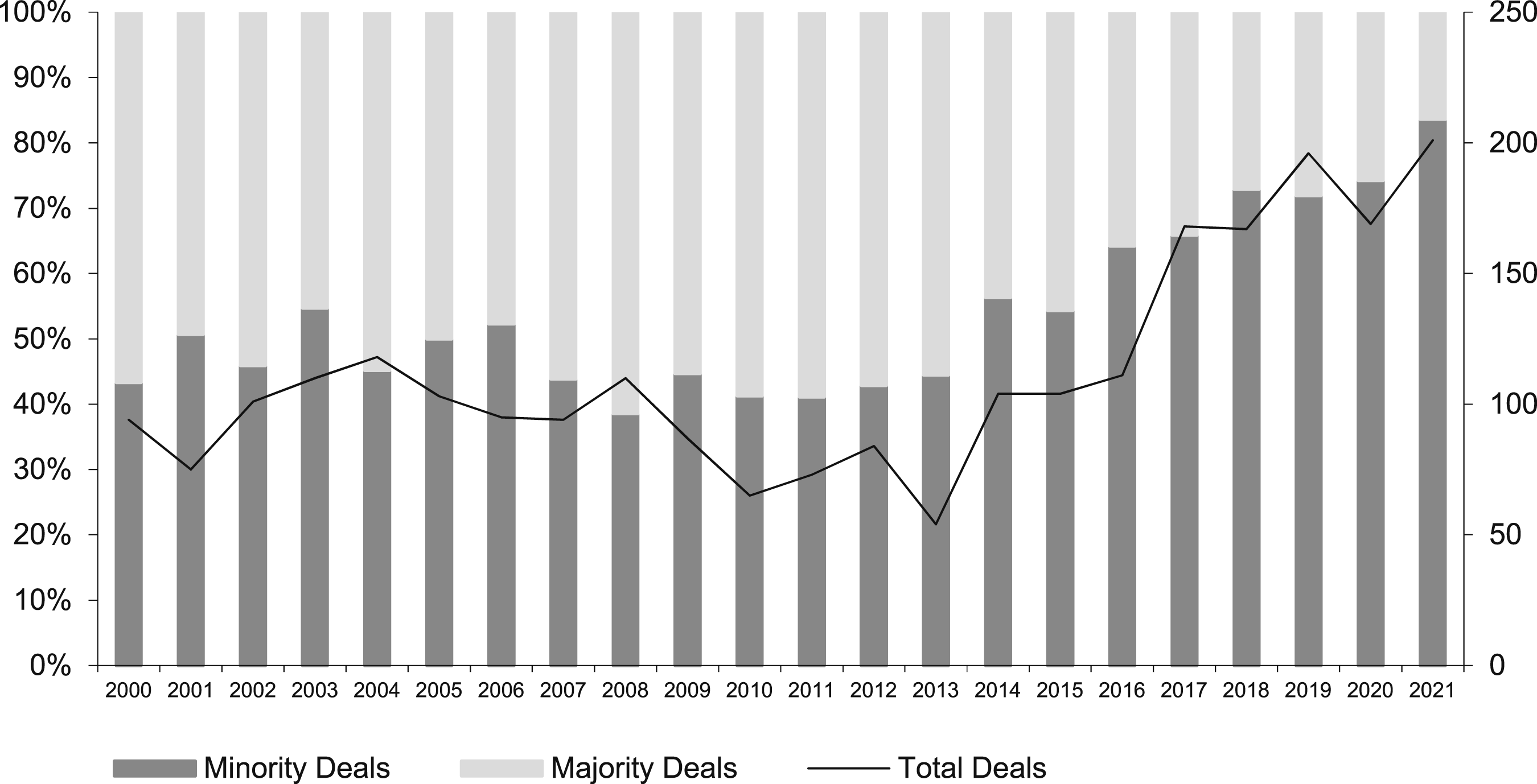
In a similar vein, Figure 2 breaks down total M&A by digital tech status. Confirming the trend toward minority investments, we observe a pronounced rise in the number of transactions through which an industrial firm acquired a stake in a digital technology company. In contrast to the steady, but flat share of minority deals in the years preceding the five-year crisis period (2009–2013), the development in digital tech M&A resembles more of a slight u-shape. Mirroring the New Economy bubble, at the start of the millennium, between a quarter and a third of all deals targeted digital technology companies. After declining to around 10% in the late 2000s, digital tech M&A comprised more than half of all deals from 2017. Linking the two trends and consistent with our expectations, almost all of these digital tech deals (84%) involve minority participation. Digital-tech and non-digital tech deals of German industrial firms, 2000–2021. Notes. Digital-tech deals N = 871 (corresponds to approx. 35.1% of total deals), non digital-tech deals N = 1612 (corresponds to approx. 65.0% of total deals), total deals N = 2483.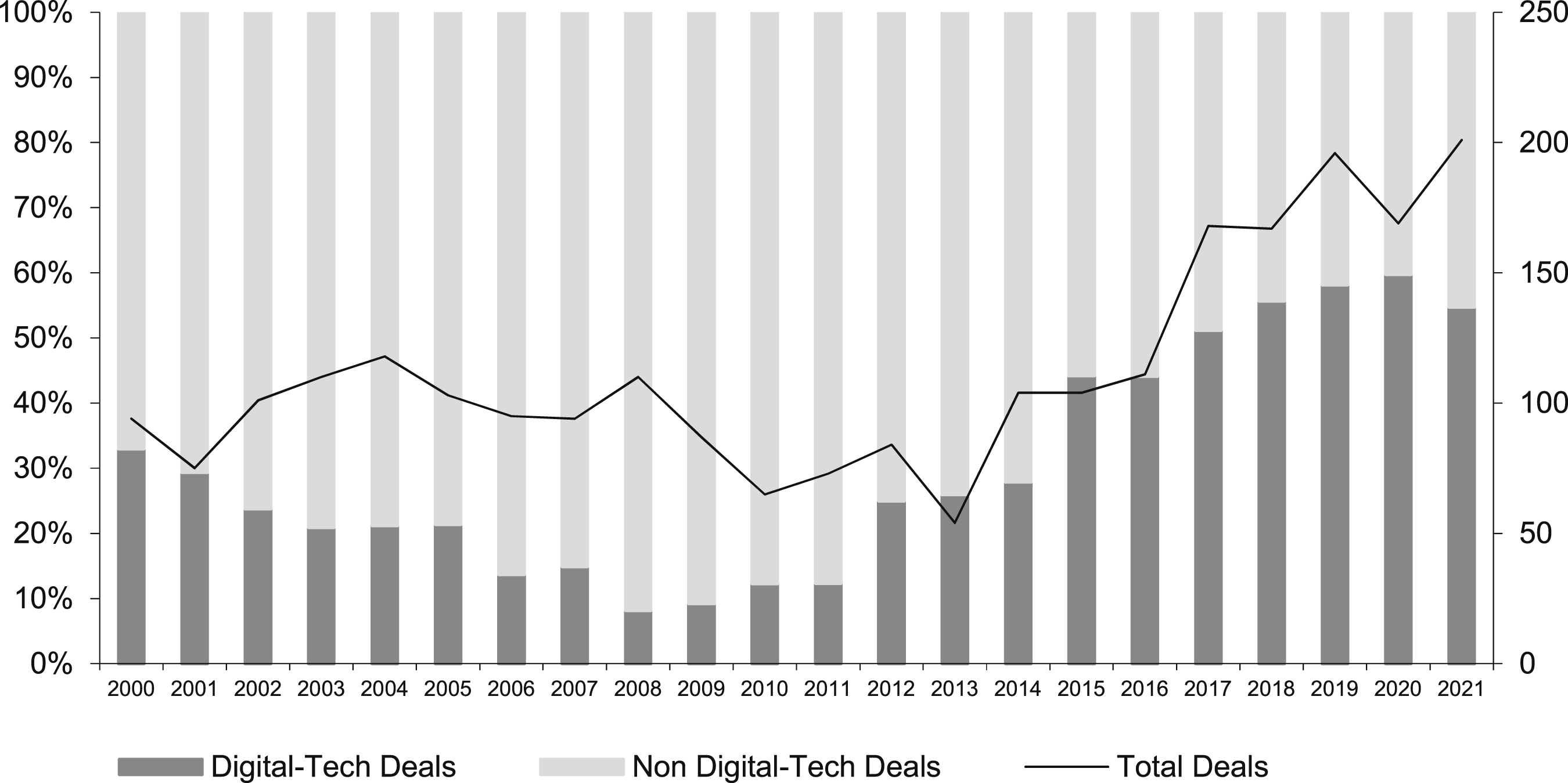
On the contrary, non-digital tech acquisitions are still mostly majority deals (55%) (see Table A1 in the supplementary material). Thus, throughout the second half of the 2010s and early 2020s, the M&A activity of the 38 German industrial firms in our sample became increasingly driven by and focused on minority digital tech investments. This supports our first expectation (E1). Because of persisting forms of coordination in the German system, leading to industrial firms across sectors acquiring minority stakes in the same digital tech targets, we expect these M&As to spur the emergence of a new network-like structure (E2). We explore this development in the following paragraphs.
Overlapping acquisitions and joint ventures
To investigate how continuing legacies of coordination enshrined in the German political economy could steer M&A trends in the direction of joint ventures and joint acquisitions, Figures 3 and 4 present different stages of a developing network in five-year intervals. They demonstrate the growing number of intersections between large German industrial firms as acquirers and smaller digital technology companies as targets. Reflecting the rise in digital tech M&A in the latter half of the 2010s, intersections were rather scant at the beginning of our observation period (Figure 3). This has changed dramatically in recent years. At the end of 2021, we identify a total of 40 digital tech targets in which at least two industrial incumbents had a joint investment (Figure 4). This represents a substantial increase compared to just four intersections in 2005. With reference to both former Germany Inc. (Höpner and Krempel, 2004) and Germany’s industrial digitalization strategy (Industry 4.0), we term this novel structure Industry 4.0 Inc. Unlike its historical predecessor, this structure is characterized by indirect connections between different industrial firms through (predominantly) minority stakes in the same digital target firms (i.e., A and B hold shares in C). Furthermore, this new structure enables cross-sectoral collaboration, exemplified by joint investments emanating from the chemical, electrical, energy, engineering, and automotive industries. Unlike Germany Inc., where coordination happened via board membership and finance (Beyer 2003), the indirect and predominantly minority participations of Industry 4.0 Inc. Offer a wide range of possibilities for forming new flexible alliances around digital technological upgrading and the strategic acquisition of important targets. The emergence of Industry Inc. 4.0, 2005–2015. Industry Inc. 4.0, 2021.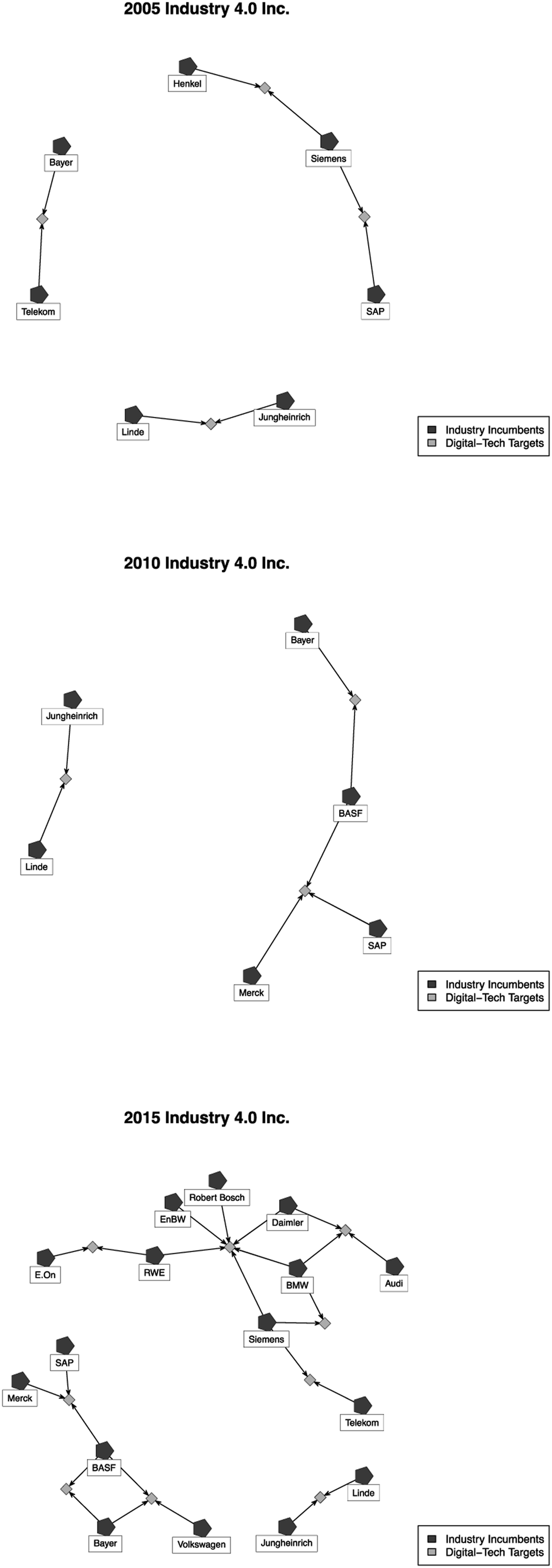
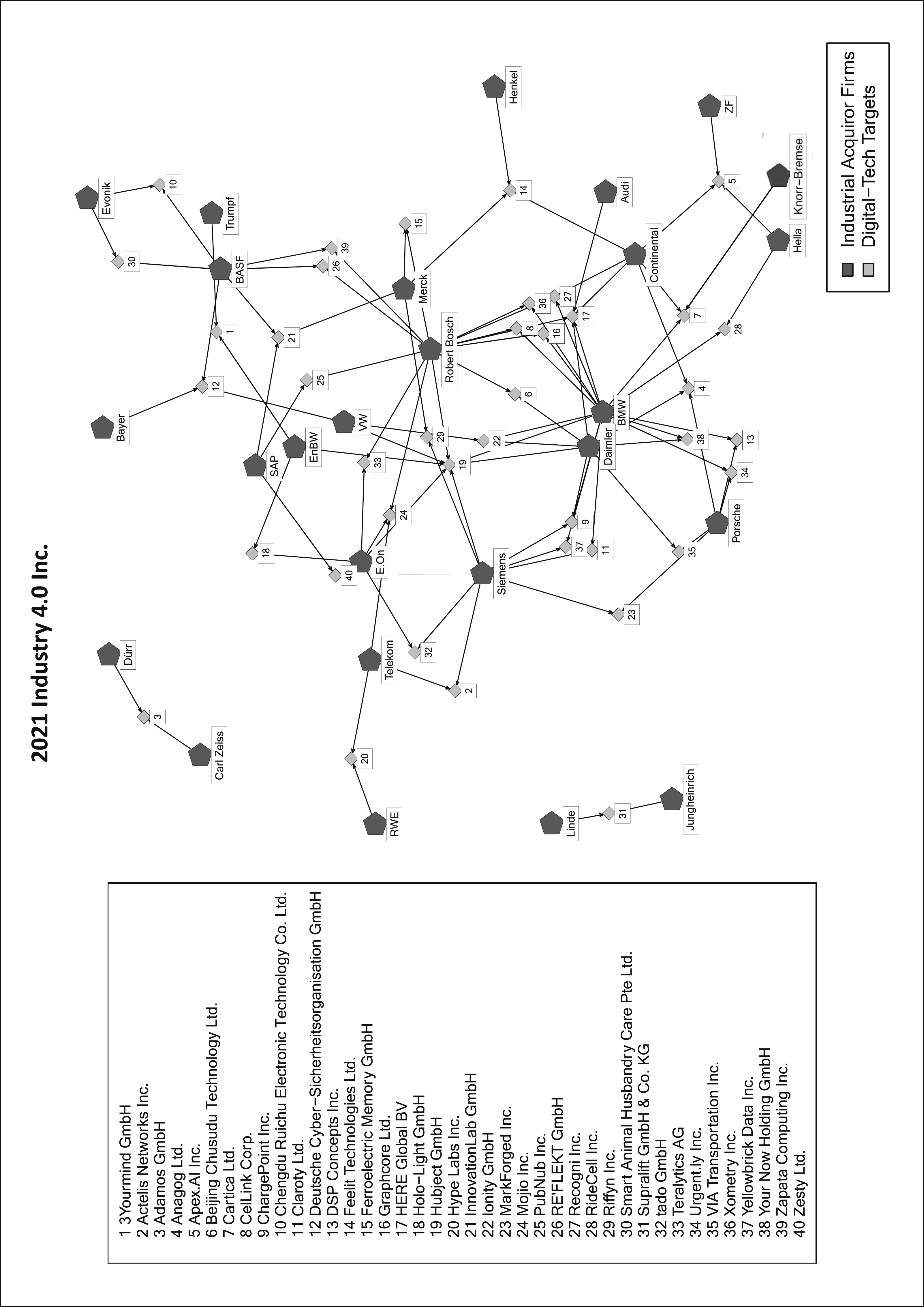
Industrial incumbents show different degrees of involvement in Industry 4.0 Inc. As Figure 4 depicts, for ten incumbents, there is just one intersection through a joint investment with another industrial acquirer. A common feature across all sectors is that larger, often multinational corporations are much more prominent, while medium-sized, often family-owned companies tend to remain outside. This finding is not surprising as bigger multinational firms have more budget to spend on acquiring stakes in other firms. When it comes to which firms are involved in the structure, there are further differences between and within industries. Between industries, the automotive sector forms the centerpiece of this new network-like structure. This is a plausible observation given the extensive restructuring of the sector as a result of digitalization. Major industry players such as BMW (15 intersections), Bosch (13), or Daimler (8) are at the core of Industry 4.0 Inc, with electrical (Siemens, 9), chemical (BASF, 6), and energy (E.On, 5) companies following suit (see also Figure A5 in the supplementary material). Differences in the degree of involvement in Industry 4.0 Inc. also exist between companies within the same industry. While in the automotive industry, for instance, major car manufacturers like BMW and Daimler maintain prominent positions in the structure, Volkswagen (as parent company) is not as involved and only exhibits 3 intersections. 3 This implies that there are cross-firm differences in strategies for approaching digitalization even within industries.
We conclude our analysis of the Industry 4.0 Inc. structure by identifying trends regarding the targets connecting the different industry incumbents. First, nearly all targets are either start-ups or joint ventures, with intersections through 32 of the 40 target firms stemming from corporate venture capital investments into the same start-ups, and seven of the remaining targets being joint ventures between different industry incumbents. There are also differences between the targets regarding the location of their headquarters: 29 targets are located outside and 11 within Germany (the latter including all seven joint ventures). To summarize, we find that German industrial incumbents collectively invest in digital technology firms, which leads to the emergence of a novel network-like structure we call Industry 4.0 Inc. Hence, our second expectation (E2) is also supported. We contend that the alliances within this emerging structure help German industry to tackle challenges associated with digitalization. In the following, we provide some illustrative evidence to underline this point.
Addressing the dual challenge through industry 4.0 Inc
Drawing on four examples, we illustrate how alliances in the Industry 4.0 Inc. structure allow incumbents to address the dual challenge of technology and skills. Specifically, we choose four targets from the automotive industry that all feature investments by multiple industrial firms and exhibit certain differences in their characteristics (our targets include both joint ventures/start-ups and international/German firms). We analyze press releases and newspaper reports and identify four ways through which alliances help incumbents.
Hubject GmbH: Developing joint technology
Hubject GmbH (Figure 4, #19), which has received investments from seven of the 39 firms in our sample, offers an e-roaming platform for EV charging stations. Thus, while the joint venture between various car manufacturers (BMW, Daimler, and Volkswagen), automotive suppliers (Bosch and Siemens), and energy companies (E.On, EnBW, and Enel) does not operate charging stations itself, it develops digital technology allowing for interoperability among the different stakeholders in the charging value chain. Such interoperability is crucial for the expansion of charging infrastructure, which itself is essential for the shift from combustion engines to EVs. The members of the alliances stress the relevance of collaboration in providing this technology. Hubject considers itself an “open platform” aiming for “inclusion of as many partners as possible” (Robert Bosch GmbH, 2012). Hubject CEO Christian Hahn, for instance, emphasized that “seven strong shareholders from three sectors of industry” form the “ideal basis for systematically pursuing [...] e-mobility” (Volkswagen Group, 2016). Thus, through Hubject, industry incumbents from different industrial sectors jointly develop the digital technology (the e-roaming platform) needed for the EV transition.
Apex.AI: Collaboration for proprietary products
Firms can leverage the alliances by using the technology they provide to collaboratively develop new technology for their own products. The investment of three major German car suppliers (Continental, Hella, and ZF) in Silicon Valley-based start-up Apex.AI (Figure 4, #5) allowed for such synergies. Apex.AI develops an operating system for cars that makes use of open-source software code and is especially advanced in the field of autonomous driving. Their stakes in the firm allow the three suppliers to apply Apex.AI’s system for improving their own technology. In a press release announcing the investment, a representative of Continental, for instance, stresses that the system “will significantly shorten the development cycles of new mobility functions” (Continental AG, 2021b). More generally, the press release emphasized “intensified collaboration” between the two partners and declared the investment to be “another example of how targeted investments and partnerships enable significant technology leaps towards sustainable mobility of tomorrow” (Continental AG 2021b). Similar quotes on how Apex.AI’s software enables firms to develop their own technology can be found by representatives of both Hella and ZF (Apex.AI, 2023; ZF Group, 2021).
Recogni: Skills transfer
Incumbents can profit from skills that lie within the firms they have invested in. We illustrate this point with the example of automotive incumbents’ joint investment in U.S. start-up Recogni (Figure 4, #27). 4 Recogni received venture capital investments from car manufacturer BMW and suppliers Continental and Bosch. The start-up develops an artificial intelligence-based vision cognition system and a complementary chip for autonomous driving applications. Thus, its technology helps the vehicle to orientate itself based on sensors enabling it to become autonomous. When announcing the investment, the incumbents particularly underscored the relevance of expertise. BMW, for instance, praised Recogni’s “experienced team” and especially the “deep industry experience in system design, AI, vision, and custom silicon design” (BMW Group, 2019). Continental, in turn, emphasized the two partners “complementary expertise” (Recogni Inc., 2021), highlighting that it will also contribute its own “expertise in the field of AI, vehicle sensors and advanced driver assistance systems to further the development of the chip design” (Continental AG, 2021a).
HERE Technologies: Strengthening digital agency
Alliances within (and beyond) Industry 4.0 Inc. allow incumbents to expand their own digital agency vis-à-vis otherwise dominant Big Tech companies. HERE Technologies (Figure 4, #17) 5 develops maps which are central components for both navigation and autonomous driving (Pachamuthu, 2023). Initially in the hands of Nokia, in 2015, HERE was acquired by a consortium of German carmakers (Audi, BMW, and Daimler) that were then joined by automotive suppliers (Continental and Bosch) and international technology firms (NTT, Pioneer, Mitsubishi, and Intel). The automotive incumbents bought HERE not only to get easy access to central technology, but also to strategically push back Alphabet and its mapping service Google Maps (Hubik, 2024). When the initial transaction was announced in 2015, Dieter Zetsche, former chairman of Daimler’s board of management, stated that the goal was “to secure the independence of this central service” (Glies, 2015). The strategic use of HERE went so far that the firm’s management felt the need to point out that while “HERE has not been run as an independent and self-determined company in the past,” it will be doing so in the future to attract further clients (Hubik, 2024; Lindner, 2024). Thus, the investment in HERE allows automotive firms to develop the technological capacities for their digital transformation independent of Big Tech companies. 6
Conclusion
In this article, we have analyzed how incumbent industrial firms in Germany use M&A activities to deal with the challenges of digitalization. Moving the focus onto the digital agency of firms outside the digital technology sector, our exploratory study yields several important findings. First, Germany’s industrial firms have markedly shifted their M&A activities toward minority holdings in the digital technology sector. Second, these transactions give rise to a new structure with the automotive sector at its center. Albeit fundamentally different from the Germany Inc. of the past, this new Industry 4.0 Inc. is likely to have a substantial impact for years to come. It encourages strategic coordination within and across economic sectors, which is especially important against the backdrop of an industrial transformation unfolding under challenging geo-economic circumstances. While in Germany Inc., industrial firms were fully, and reciprocally, embedded as both acquirers and target firms in cross-shareholdings, Industry 4.0 Inc.’s structure emanates from industrial firms’ role solely as investors. This results in a different kind of intertwinement, characterized by indirect rather than direct intersections, themselves the result of joint investments in the same start-ups and joint ventures. Despite the differences from Germany Inc. with its interlocking directorates and block holdings, Industry 4.0 Inc. creates new alliances in the market, which foster inter-firm collaboration, for instance for lowering costs and minimizing the risks of adopting new technologies. In line with our findings, it is plausible for the automotive sector to occupy a central position within Industry 4.0 Inc., as the car industry, with its hierarchical or focal networks, has a long tradition of network coordination along the entire supply chain (Hirsch-Kreinsen, 2002). Lastly, we presented four vignettes of target cases within Industry 4.0 Inc., illustrating several ways in which industry incumbents can utilize joint digital technology M&A as a means of digital agency to respond to the dual challenge of technology and skills provision that comes with the wider digital transformation and the move toward the knowledge economy. 7
With these findings, our analysis contributes to advancing the understanding of digitalization on several fronts. On a macroscale the focus on firms and their interplay in emerging institutional structures adds to the literature on the new political economy of the firm in a changing global context. One narrative in this literature is what Reurink and Garcia-Bernardo (2021) call “the great fragmentation” which captures the decomposition of corporations into separate, highly specialized units for tax and financing purposes. Another strand approaches corporate reorganization from an ownership perspective and identifies an overarching “great re-concentration” marked by the rise of (mostly passive) institutional investors (Braun, 2022). We complement both perspectives by combining organizational and sectoral restructuring through digital technology acquisitions with M&A originating from industrial firms as opposed to being directed toward them. Such a complementary perspective sheds light on important processes taking place in the (German) corporate sector against the backdrop both of persisting institutional hybridity, with coalitions shielding corporate governance from becoming fully financialized (Giovanazzi, 2024), and specific drivers of growth and their transformation in the form of a strong manufacturing sector with a dominant export orientation (Baccaro and Höpner, 2022).
Related to the focus on firms, our study makes the case for taking corporate agency, and its ambiguity, seriously. While it is evident that US global players from the digital technology sector pursue expansionary strategies into areas such as healthcare or education (Rikap, 2023), our findings emphasize a potential counterstrategy adopted by industrial incumbents seeking to increase their digital capacities, withstand engulfment, and maintain relative autonomy in the face of global competition. This links to further questions on the relationship between incumbency and newcomer status and large versus small firms. Although larger firms from established industries are at the core of Industry 4.0 Inc., smaller companies, including start-ups, and their interaction with incumbents form an integral part of this structure. This links our study to analysis of the importance of entrepreneurial (often micro) firms in enhancing the digitalization capacities of industries (Miozzo et al., 2024). While our vignettes offer some insights on these aspects, the precise impact of strategic minority M&A is notoriously hard to quantify, especially when target firms are still in their start-up phase. As table A4 (supplementary material) shows, Industry 4.0 Inc. target firms vary substantially in size. The list includes larger nodes like Ionity GmbH, a leading provider of EV charging infrastructure with more than $556 million in assets or Here Global BV, one of our case vignettes, with $2.9 billion, and smaller targets such as Supralift GmbH, a B2B online marketplace for forklifts and warehouse equipment, with less than $1 million. Different legal structures, disclosure rules and incorporation practices impede in-depth comparisons within Industry 4.0 Inc. and between German and US acquirors. Finally, the sheer size of US start-ups and the depth of the North American venture capital market, paired with the higher average appetite for risk, are likely to inflate deal volumes for US digital technology firms. In short, when considering the impact of Industry 4.0 Inc. deals, it is less about asset volumes than about core dynamics, strategic interactions and enabling structures.
As an emerging field of research, the comparative political economy of digitalization needs to take this seriously. Future research might pick up some of our findings. Regarding the drivers behind these trends, future studies, for example, could investigate further the role of skills acquisition, especially considering the ongoing rapid technological change in the field of Generative Artificial Intelligence (GenAI). The clearest case in our set of vignettes, Recogni, illustrates the importance of skills transfer. Other joint investments by BASF, Bayer and Volkswagen in Deutsche Cyber-Sicherheitsorganisation GmbH, a “competence center” for cybersecurity in German industry, or by BASF, Merck and SAP in InnovationLab GmbH, a science-industry collaboration for organic electronics, underpin this development (Business Standard, 2014; Volkswagen AG et al., 2015). The case of EV charging stations, for example, offers potential for comparative analysis on varieties of digitalization infrastructures across political economies. In the wake of the European rollout of fast and modern EV charge points, conflicts over regulatory standards, and unified versus fragmented solutions came to the fore (Serrano, 2025). In this context, Hubject is an important counterpart to Tesla. How much impact does an industry alliance have in such cases? Do domestic firms, for instance, pursue similar strategies abroad? Furthermore, within-sector heterogeneity remains highly relevant as digitalization challenges business associations’ sectoral focus and encourages new cross-sectoral alliances. This might add another dimension to the internal cleavage structure of the corporate sector, supplementing the domestic–international, large–small, or consumption–export divisions with new rifts between those who are capable of successfully implementing digital technologies and those who are not.
Finally, a further avenue for future research could be to investigate whether and how the developing alliances and structures impact public policies. In line with recent studies on the profound effects of digitalization on power resources and businesses’ policy preferences (Kemmerling, 2023; Trampusch, 2024), we assume that M&A activities may also equip industrial firms from the non-digital technology sector with new digital power resources (DPR). The latter feature two dimensions. The structural dimension includes control of data and the corresponding technologies for handling that data. The infrastructural dimension includes control of data centers, communications infrastructure, or private regulation of general-purpose technologies through standard-setting (Kemmerling and Trampusch, 2023). Acquiring stakes in smaller digital technology companies can increase an industrial firm’s DPR and reinforce existing DPR via complementary technologies—for instance by adding a physical EV charging infrastructure to current software capabilities—or expand the scale and scope of DPR through new technologies or new members joining the structure. By means of M&A, acquirer firms connect with each other and create joint innovation capacities. Future studies could investigate the extent to which the developing alliances and network-like structure result in similar policy preferences and strategies for achieving common goals, for instance in the areas of regulation and standard-setting.
How these developments eventually play out remains to be seen. What seems crystal clear, however, is that they are extremely dynamic and here to stay, as reports on new cooperation (“Siemens partners with Nvidia,” Frühauf, 2024), widening internal gaps across industries (Bitkom, 2024), and continuing geo-economic competition (“Industrial AI and digital shop floor: China stays in the global lead,” MHP, 2024) vividly illustrate.
Supplemental material
Supplemental material - Industry 4.0 Inc.—Mergers and acquisitions and the digital transformation of German industry
Supplementary material for “Industry 4.0 Inc.—Mergers and acquisitions and the digital transformation of German industry” by Michael Schwan, Christine Trampusch and Jonas L. Horn in Competition & Change
Footnotes
Acknowledgments
The authors would like to thank Moritz F. Walter and Michael Kemmerling for their helpful comments on earlier versions of this paper. Our thanks also go to Eliah Blum-Minkel, Tobias Burgwinkel and Ray Yung for their outstanding research assistance. We are grateful for the comments we received on an earlier draft from participants of the annual meeting of the German Political Economy Section (DVPW), University of Witten/Herdecke, September 21-22, 2023, the second workshop of the Research Network on Political Economy (RNPE), Max Planck Institute for the Study of Societies, May 2–3, 2024, the FEB Brown-Bag Series on AI/Digitalization, University of Groningen, May 6, 2024, and the 30th International Conference of Europeanists (CES), Science Po Lyon/Université Lumière Lyon 2, July 3–5, 2024.

Funding
The authors disclosed receipt of the following financial support for the research, authorship, and/or publication of this article: This research received funding from the German Research foundation (DFG) under Germany’s Excellence Strategy – EXC 2126/1-39083886.
Declaration of conflicting interests
The authors declared no potential conflicts of interest with respect to the research, authorship, and/or publication of this article.
Supplementary material
Supplementary material for this article is available online.
Notes
References
Supplementary Material
Please find the following supplemental material available below.
For Open Access articles published under a Creative Commons License, all supplemental material carries the same license as the article it is associated with.
For non-Open Access articles published, all supplemental material carries a non-exclusive license, and permission requests for re-use of supplemental material or any part of supplemental material shall be sent directly to the copyright owner as specified in the copyright notice associated with the article.
