




Abstract
We address the social sustainability dimension of labour-intensive industrialization (LII) and manufacturing activities and apply it to the analysis of Mauritius, a regional forerunner in textile and garment production. While the country’s socioeconomic development trajectory has caused some scholars to label it as an African success story, we do not evaluate its industrialization against traditional economic theory on achieving sustained growth. Instead, we analyze the LII component based on garment manufacturing from the early 1970s onwards against the criteria of social sustainability. We investigate the specific interplay between the development of social policy and the establishment and transformation of the garment manufacturing sector. Further, we follow changes in workers’ conditions in the manufacturing sector over time. Based on primary and secondary data and building on new developmentalist research, we examine the fulfilment of basic needs, employment levels, and the quality of jobs applying inclusiveness as a cross-cutting theme. Moreover, we address social policy’s role in tackling problems of inequitable outcomes from industrialization. We contribute a more nuanced understanding of Mauritius’ industrial history by highlighting its mixed outcomes, with some periods working more towards properties and outcomes of social sustainability than others. Finally, we provide some lessons for global South countries currently forming their industrialization strategies pertaining to trade-offs between sectoral change and social sustainability, and we hypothesize about the future of Mauritius’ textile and garment industry.
Keywords
Introduction
In recent years, several economists and policy organizations have advocated for labour-intensive industrialization (LII) and manufacturing activities as an engine for broad-based economic growth in low- and middle-income countries (UNIDO, 2017). One influential voice is New Structural Economics (NSE) arguing for government intervention to upgrade endowments and industrial structures to increase labour productivity. Countries with abundant low-skilled labourers should focus on low-tech manufacturing activities for export while building physical and human capital to climb the ‘ladder’ of the global division of labour (Lin, 2012). The critics of NSE’s neoclassical foundations and application highlight that industrial policies should also attempt to defy a country’s comparative advantage, for example, through infant-industry protection to nurture domestic industries and transfer technology. Empirically, the arguments are highly influenced by the catch-up examples of the Asian Tigers (Hong Kong, Singapore, South Korea, and Taiwan) during the 1960s–1990s, even if views differ on the exact (market- or state-led) industrialization model when interpreting their growth experience and industrial policies (Lin and Chang, 2009).
Today, Sub-Saharan Africa contains some of the poorest countries in the world with the lowest levels of industrialization while also being the centre for future population growth. Subsequently, the African Union (2015) has made LII one of its priority areas. Some scholars point out that, independent of varying GDP per capita levels and labour costs across the continent, wage levels historically and today have generally remained higher in Africa than in Asia at the time of its initial industrialization (Frankema and Van Waijenburg, 2018). Meanwhile, others claim that Africa has a comparative advantage in labour-intensive segments of globalized production, such as the sewing process of ready-made garments. This is provided governments commit to building infrastructure, implementing strategic policies, and enabling technology transfer and linkages to the rest of the economy to develop domestic capabilities (Chang et al., 2016; Lin, 2012; McMillan and Zeufack, 2022). Indeed, several African countries have established or are currently developing industrial hubs for their manufacturing sector, with the aim of creating employment opportunities with the traction of foreign investments and improving human development outcomes (Gelb et al., 2020).
These industrializing countries in the 21st century must recognize contemporary societies’ most important social and environmental challenges. This means encompassing industrial activities anchored in sustainability concerns and an ever-changing global context (Aiginger and Rodrik, 2020). Financialization and the structure of global production networks, for example, have led to limited policy space and squeezed suppliers’ profits and workers’ wages in labour-intensive industries in the global South (Andreoni, 2022). In tandem, automation technologies can cause job losses, although risks are cushioned by various barriers and the complexity involved, such as handling fabrics (Hauge, 2023). This article addresses light manufacturing activities’ social sustainability dimension broadly associated with basic human needs, well-being for all, equality, and the ambition to ‘leave no one behind’ (Purvis et al., 2019). This is an issue that, over the last few decades, has garnered concern from labour geographers and feminist political economists who find cases of social downgrading even in sectors experiencing economic upgrading (Barrientos, 2019). Similarly, development economists arguing for ‘green’ industrialization pathways allude to the need for industrial policies to advance social welfare goals (Hauge, 2023; Lebdioui, 2024).
We study Mauritius, a country that, together with Costa Rica, stands out in a world comparison displaying the most promising trajectory from 1992 to 2015 in terms of meeting basic needs (social thresholds) while transgressing comparatively few biophysical boundaries (Fanning et al., 2022). It is an African forerunner whose labour-intensive garment-based industrialization from the 1970s onwards contributed to national sustained growth and structural transformation accompanied by significant social developments, such as poverty reduction and improvements in health, education, and life expectancy (World Bank, 2021). The country’s development trajectory has been used previously for retrospective socioeconomic analysis. By many it has been hailed an uncontested success (Meisenhelder, 1997; Subramanian and Roy, 2001), although others have more recently raised concerns regarding growing nationwide inequalities (Bunwaree, 2014) and the changing fortunes of the country’s manufacturing as the export-oriented garment industry has become less competitive (Ancharaz, Forthcoming). Still, the interplay between industrial and social policy and the different stages of labour-intensive manufacturing activities vis-a-vis social sustainability criteria warrants further interrogation. To this end, we ask the following research questions. To what extent and in what ways has Mauritius’ garment-based industrialization process from the 1970s to the present day progressed towards greater levels of social sustainability? What enabled or inhibited this type of manufacturing to contribute to socially sustainable development over time?
Given the plurality of approaches to social sustainability (Åhman, 2013), we treat the concept as a cluster of fundamentals relevant to industrialization that brings about critical social goals based on a process of inclusiveness. We primarily build on structuralist perspectives (see, i.e., Tregenna, 2023 and her discussion of Mkandawire’s structuralist approach to development) and critical new developmentalist research on ways (garment-based) industrialization can or cannot produce social sustainability (Andreoni and Chang, 2017). This is because they explicitly situate late industrializers’ attempts at developing manufacturing sectors within a global reality of changing structural interdependencies and hierarchies. We use both primary and secondary data to empirically examine the fulfilment of basic human needs, employment levels, and the quality of jobs in terms of working conditions. In dialogue with theories on industrialization, we also address social policy’s role in complementing industrial policy and reconciling tensions of inequitable outcomes from the industrialization process. Based on a more nuanced understanding of Mauritius’ industrialization trajectory stemming from a narrative analysis of these changing social fundamentals (including when, in what ways, and for whom), we tease out the extent to which labour-intensive garment-based manufacturing activities contributed to the broader delivering of social sustainability. Since various African countries have sent government representatives to Mauritius to learn from the country’s industrialization process (EDB & UNCTAD, 2023), we end with proposing some lessons for countries in the global South currently forming their industrialization strategies with ambitions to leverage labour-intensive manufacturing activities for social sustainability.
The paper is structured as follows. Next, we reflect on various approaches to the social dimension of sustainable development and their implications for labour-intensive industrial production in the global South today. The subsequent section consists of a chronological account of Mauritius’ social and industrial history divided into three periods. It is followed by a discussion further addressing the implications for social sustainability, and the current state of fundamental challenges for garment manufacturing in this regard. We conclude by highlighting possible lessons learned and hypothesizing about Mauritius’ way forwards.
Debates on social sustainability and industrialization
The Brundtland report (WCED, 1987) spoke of social sustainability as the well-being of the world’s populations arising from a system addressing poverty, exclusion, and inequality. It declared the urgency of meeting basic human needs while preserving natural resources in solidarity with present and future generations. Subsequently, nation-states are expected to address the social dimension when pursuing sustainable development (Purvis et al., 2019). Societal actors must negotiate different causes of action, and public engagement is needed to promote social cohesion (Dempsey et al., 2011; Åhman, 2013). Ergo, policy governance and implementation must be consciously integrated across society, embracing well-being, equity, and inclusion. Social sustainability is both an outcome, as in the achievement of aspired values (the substantive or what) to solve related ever-changing problems, and a property, as in how to go about these values (the procedural) (Boström, 2012).
While themes linked to the ability to ensure a basic humane level of absolute standards ensuring life-making are recurring, social sustainability remains a context-dependent concept applied within various disciplines (Purvis et al., 2019). To some extent, it has validated the human development approach, where the central idea was to re-orient development towards improving human lives via expanding a person’s capabilities and achieved functionings (Sen, 1999). In related literature, it is conceptualized to include a spectrum of normative issues ranging from basic physical needs, such as access to adequate nutrition, sanitation, and housing, to less tangible ones, such as education, employment, equity, and social justice (Vallance et al., 2011).
The human development approach challenges growth-centric visions of ‘progress’ by highlighting social issues that development processes should attempt to solve. However, it dismisses production processes and the necessity for structural economic changes, since policy proposals emphasize poverty reduction schemes targeting individuals (Andreoni and Chang, 2017). Meanwhile, degrowth approaches advocate fundamental economic restructuring and reduced consumption and production. Their strive for social inclusion, reduction of inequality, and improvements in human well-being is to some extent comparable to the ‘humanist’ approach, except theirs is more globally situated. One argument is that LII is an option for low-income countries, connecting the potential for ‘fair wages for labour’ in the global South to ‘degrowth in the North’ (Hickel, 2021: 1109). Echoing dependency theory, building local industrial capabilities via manufacturing activities to ‘catch up’ is even seen as a right to develop by many countries in the global South (Mkandawire, 2011).
Whether capitalist development processes are socially sustainable depends on the configuration of power relations and conflicts within and beyond countries to create or support ‘productive coalitions’ willing to invest in collective productive capabilities. The welfare state is an example of such a coalition. It becomes especially important as a social insurance provider for workers in labour-intensive manufacturing, as activities change structure when countries continue to diversify their economies and become more capital-intensive. Despite northern governments and companies applying pressure to erode industrial relations and press down labour costs in manufacturing, low-income countries can still shape the inclusiveness of their industrial policy (Chang and Andreoni, 2020) and the subsequent social sustainability of their respective industrialization trajectory.
New developmentalist research has shed light on the importance of industrial policy targeting transforming productive structures while delivering employment, skills development, and social policy (Andreoni, 2022; Andreoni and Chang, 2017). In this literature, industrialization is deemed socially sustainable if it generates structural transformation, and a development-oriented state can adapt to changing global circumstances and build legitimacy by delivering social progress. Here, the interests and ideas of elite groups within a country’s political settlement and their capacity to generate coalitions are seen to play a key role in determining the success of industries for long-term development purposes (Khan, 2010).
Rather than emphasizing growth per se, as in traditional development conceptualizations or individual agency and freedoms in the early human development approach, the focus in new developmentalist research is on learning-based industrialization creating employment and improving job quality in terms of material and intellectual–emotional rewards. Only then can development trajectories reduce chronic poverty and be truly socially sustainable. Priority is given to improving job quality compared to its baseline and other sectors of the economy since, realistically, poorer and less industrialized countries cannot offer excellent quality jobs in early development phases. Even if this research refrains from using the notion of ‘decent work’, key aspects of it such as ‘fair wage’ provision, skills development, training, and social dialogue in conditions of freedom, equity, security, and human dignity (ILO, 2008) are closely intertwined with overarching values and properties of social sustainability.
Basic human needs, such as achieving a healthy and educated labour force, are deemed essential in enhancing individual capabilities and creating opportunities for higher quality productive work but insufficient for an industrialization process and its outcomes to qualify as socially sustainable (Andreoni and Chang, 2017). This builds on Alice Amsden’s (2010: 7) critique of ‘grassroots’ approaches to poverty alleviation, which suffers from ‘job dementia’ in assuming the economy works according to Say’s Law (those workers that will be supplied will be demanded) rather than emphasizing a more substantial role for demand-side factors such as industrial policy to create jobs. Her critique can be extended to a recent book published by the World Bank aiming “to advance the concept of social sustainability and sharpen the analytical foundations on which it rests” (Barron et al., 2023: 93). While the four critical components (a cohesive, inclusive, and resilient society, with process legitimacy as the driver) overlap thematically with structuralist approaches to socially sustainable development trajectories, the emphasis remains on supply-side interventions.
Labour-intensive manufacturing activities have a high potential to create employment and include marginalized groups. Still, some groups can be left behind, calling for targeted interventions also to include those people and households (Klasen and Fleurbaey, 2018). This is given less emphasis in new developmentalist research. Yet, even in a welfare state, labour market inclusion in industrialization processes risks being on harmful terms, such as disparities based on gender, ethnicity, or migrant status. Feminist economists have made particular contributions in this area based on empirical documentation of different individual and group experiences. They push for social sustainability to be defined as the maintenance of social relations in the community, including the recognition of social provisioning and reproductive work, given its necessity for long-term human and societal well-being (Benería et al., 2016). Industrial development processes must, therefore, have inclusiveness as a cross-cutting objective, as also outlined by the 2030 Agenda Sustainable Development Goals (SDG) number 8 (promoting sustained, inclusive, and sustainable economic growth, full and productive employment with decent work for all) and 9 (recognizing the critical role of industrialization for development, including the challenges of inclusiveness) (United Nations, 2015). At the very least, this means having domestic policies, industrial relations, and labour laws dedicated to workers’ rights, including the right to organize and express concerns.
Relatedly, it is well established in the literature on LII and joint implementation of Export Processing Zones (EPZs) that employment conditions often are based on segmentation and, at times, segregation (see i.e. Tejani and Milberg, 2016). However, it is less spoken of that industrial policies must work in tandem with other public policies for industrialization pathways to be socially sustainable (Chang and Andreoni, 2020; Mkandawire, 2001). Justin Lin (2012), for instance, does not highlight this as an essential component for socially desirable industrialization. Instead, he hints that labour is merely a production factor that can facilitate sustained development for the greater good. Even when social policy, including government provision of social welfare and accessible (re-)training, is emphasized in the development literature, there are different views. While it is essential for workers’ capabilities, also when LII declines in relative significance, social policy is not mainly about managing risks or coping with shocks at the individual or household level (as emphasized in more mainstream development thinking), nor can it replace industrialization and structural transformation strategies. It must deliberately go together with catch-up strategies to absorb social conflict and sustain social cohesion when industrial policy inevitably brings about strenuous distributional consequences. Widespread social policy that builds capabilities is also vital for sustaining an appropriate labour supply, increasing labour productivity and technological progress – ultimately having a transformative impact (Mkandawire, 2001, 2007).
Mauritius’ trajectory
When Nobel Prize–winning economist Meade visited Mauritius in 1960, 99% of export revenues came from raw sugar and associated products while the limited landmass and tropical climate restricted alternative agricultural development. Despite already high population density, annual population growth was three % and Meade feared the island state was heading into a Malthusian trap, risking violent conflict between its different ethnic groups (Hindus and Muslims of Indian origin, Creoles of African descent, Franco-Mauritians, and Sino-Mauritians). Still, he identified a potential for labour-intensive production and stated, “Mauritius will be able to find productive employment for a greatly increased working force only if she can establish and expand some manufacturing industries” (Meade, 1961: 524). After Independence in 1968, the government pushed for capitalist development and socioeconomic progress to reduce poverty and provide opportunities for all, while the institutional setup fostered consensus-building, social cohesion, and (relative) inclusion (Bräutigam, 1997; Ramtohul, 2020). Job creation became a key strategy, and Prime Minister Seewoosagur Ramgoolam spoke of development as “meaningless unless it means the creation of productive employment for our youth” (Government of Mauritius, 1971: Foreword). The establishment of labour-intensive garment manufacturing with emphasis on knitwear was, together with tourism, one of the early crucial efforts to initiate socioeconomic transformation, and, with ups and downs over the years, the sector continued to play an important role in Mauritius’ development trajectory (Meisenhelder, 1997).
We divide our analysis of Mauritius’ labour-intensive manufacturing trajectory – heavily based on export-oriented garment production – into three approximate periods: (1) 1970–1983, when the social transformation started with relatively broad ownership, but working conditions and wages in manufacturing remained low and unequal; (2) 1984–2001, when employment creation took off more substantially, garnering ‘golden years’ in some respects while improvements in job quality were minor and inequitable; and (3) 2002–present, when employment took a downward trend, the sector experienced multiple crises, and there has been an increased inflow of migrant workers. We address interconnected social sustainability fundamentals, namely basic needs provision, employment creation, comparatively decent working conditions, and transformative social policy, and we consider indications (or absence) of inclusiveness throughout. While the years and events are specific to Mauritius, we suggest that the periods represent somewhat generalizable phases of a labour-intensive light manufacturing trajectory in contemporary development wherein some social sustainability fundamentals can improve, but gains are difficult to sustain over time.
Our empirical material is derived from several sources and combined to construct our narrative. We engage with previous studies on labour-intensive manufacturing and inclusive development in Mauritius, showing the particularities of social sustainability in our case and reflecting on the broader relationship between garment manufacturing and socially sustainable development. Further, we have retrieved and constructed trends from openly available descriptive statistics related to employment numbers, worker composition, and average earnings, mainly from Statistics Mauritius, to substantiate our arguments on changing social sustainability fundamentals. Unfortunately, this quantitative component is hampered by restricted data availability as official statistics do not cover our entire investigation period. Finally, our analysis and discussion of the material are informed by three fieldwork sessions totalling 5 months in Mauritius (2022–2024), during which we retrieved government documents from Mauritius’ National Archives and conducted semi-structured interviews. Through purposeful sampling, 54 stakeholders were interviewed, spread across factory managers, government officials, workers, and business and labour organizations. Interviewees were asked about developments, key events, social issues and tensions, needs and challenges, and the politics surrounding the garment industry and its workforce over time. This material triangulated our other data, and a few selected interviews are referenced in the latter part of the text to shed light on forces working for and against social sustainability.
1970–1983: Initial transformation
In 1970, an EPZ 1 was launched to establish export-oriented manufacturing and, ultimately, structural transformation. Industrial policies incorporated recommendations by Lim Fat, a Sino-Mauritian businessman and professor in engineering with extensive transnational networks and collaboration with the Mauritian government, who had studied EPZs in Taiwan and Puerto Rico (Whitfield, 2023). Incentives for investors included fiscal provisions, tax reliefs, a guarantee against nationalization, subsidized power rates, and duty-free imports of capital equipment and inputs (Ramtohul, 2020). This coexisted with some degree of import-substituted industrialization. The limited size of the main island, roughly 2000 km2, and the fact that it was designated as an EPZ in its entirety meant that industrial estates were erected near the workforce. This made the industrialization process less socially disruptive with availability of work throughout the country (Ramtohul, 2020). The EPZ strategy took off in the early 1980s, after which Mauritius, recovering from repercussions of the global oil crises and severe cyclones in the late 1970s, introduced a significant rupee devaluation to boost exports and generally deepened the export-led and labour-intensive manufacturing strategy (Bräutigam, 1997). Investments were sourced from foreign capital (mainly Hong Kong garment manufacturers concerned with the retrocession to China while seeking new countries without quotas) and domestic capital (mainly Franco-Mauritian sugar industrialists). The latter played a surprisingly important role, whereas the former primarily brought technical know-how (Whitfield, 2023).
Meanwhile, the political leadership paid much attention to balancing the relationship between ethnic groups and promoting intra- and inter-generational social well-being, all of which represent important markers of social sustainability as both means and ends. While the state primarily consisted of British-trained Indo-Mauritian politicians and bureaucrats, wealth was concentrated among the small minority of Franco-Mauritians who kept their sugar plantations in return for surrendering political power (Sandbrook, 2005). This political arrangement became what Wade (2018) terms the ‘coalitional glue’ as the economically dominant minority group bargained for and adapted their position to reflect the majority’s demand for the national development project. There was a general awareness of the conflict risk if inequality along ethnic divides stayed unchecked, and the island-specific vulnerability to economic shocks and natural disasters disciplined the elites and the general population in line with national prosperity objectives, including social sustainability strategies (Sanches et al., 2022).
Social and industrial policy complemented each other since a new progressive export tax on the booming sugar industry (where large sugar plantations paid the most) enabled state expenditures on widespread welfare measures, such as universal age pensions, healthcare, education, and subsidized foodstuffs (Sandbrook, 2005). Primary education has been free since the 1950s, and in 1976, the government also granted free secondary education (Bunwaree, 2014). In return for expanding social policy ambitions, the state gained legitimacy among the public and could push for industrial policies. By subsidizing the EPZ, corporations that benefited from high sugar prices were incentivized to invest their profits in, for example, garment manufacturing (Ulriksen, 2012). The Industrial Relations Act (IRA) in 1973 and following Labour Act gave EPZ employers greater flexibility to terminate employment, made 10 hours of overtime work compulsory, permitted night shifts, and set minimum wages lower than other sectors.
While minimum wages increased yearly following tripartite discussions in attempts to compensate for cost-of-living increases, sectoral differentials remained similar, and it was only for a few years in the mid-1970s that the EPZ minimum real wage increased (Hein, 1988). Keeping social welfare provision also during the economic slowdown and uncertainty was crucial for the state to earn citizens’ buy-in to the long-term national development plan for higher prosperity prospects. For example, although wage restraints were enforced starting in 1979 with the Structural Adjustment Programmes (Hein, 1988), the education system remained largely intact despite the IMF and World Bank’s conditional austerity recommendations (Bunwaree, 2014). Meanwhile, the EPZ had created significant job opportunities since the start, with almost 23,000 employees in 1983 (see Figure 1). Young women with some primary education who had previously been outside of the workforce filled most jobs. Many were satisfied earning money and gaining more social contacts, even if factory work came with fatigue, long hours, and low pay. In fact, the minimum wage for women in the first year of employment was set as low as 57% of that of a man over 18 years old, and only minimal improvements in the discriminatory wage ratio can be observed during this period (Hein, 1984). The principle permitting significantly lower wages for women rested on social norms imposing a subordinate role for women as housewives and not providing for family livelihoods (Ramtohul, 2008). Employment in Mauritius’ EPZ and unemployment. Source: Constructed with data from Statistics Mauritius (2024a, 2024b, 2024c, 2024d).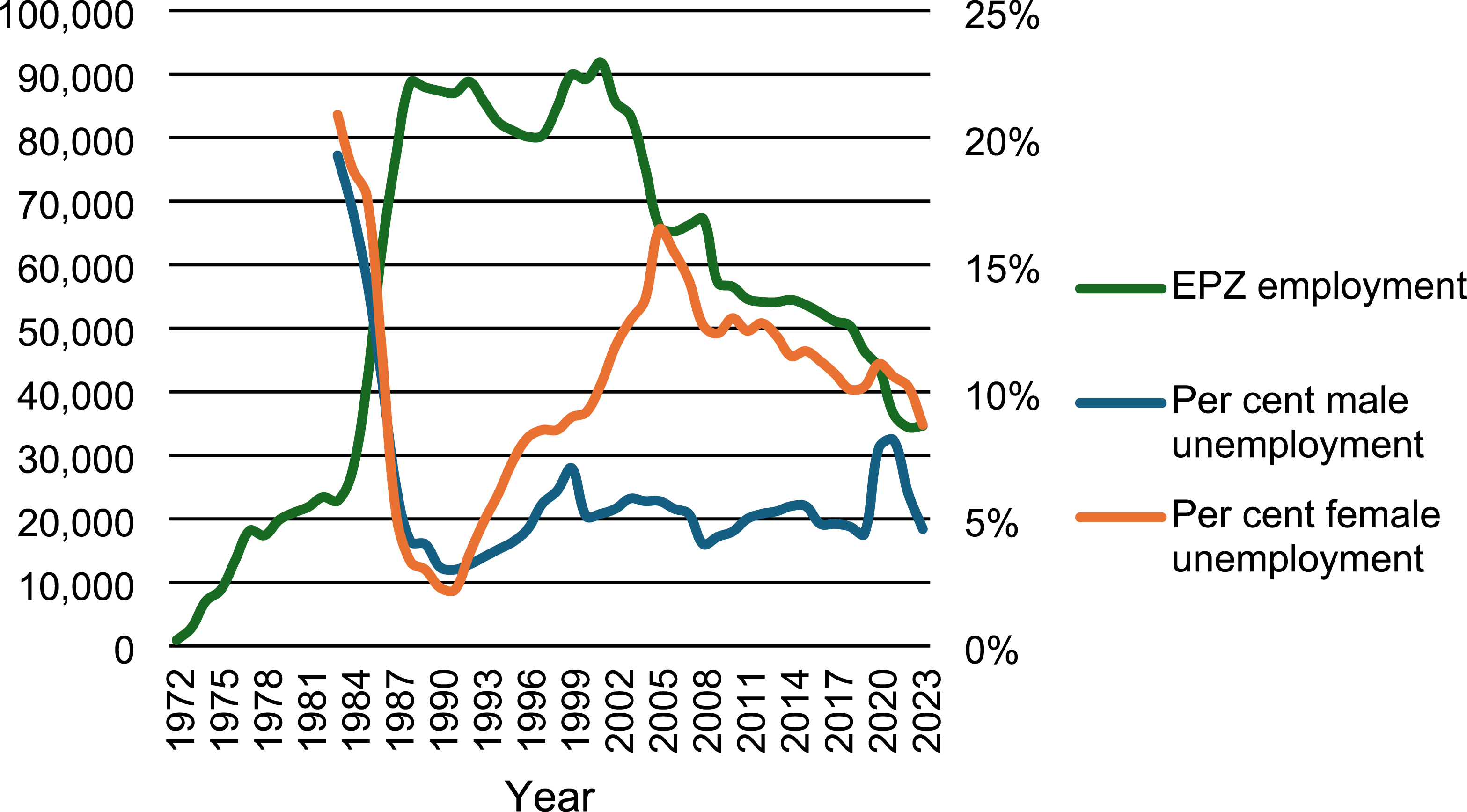
Although workers’ rights to form or belong to a trade union were technically allowed by the IRA, most were unorganized, with EPZ unionization rates well below the national average (Hein, 1988). Further, the government had the right to declare strikes illegal based on their potential to cause extensive economic damage (Ramtohul, 2008). Neveling (2015) criticizes this (patriarchal) model of flexible and precarious labour relations whereby workers were made docile and productive in return for economic growth and global market integration. Hence, he challenges Meade’s (1961: 534) suggestion that “low wage-rates combined with a social-security system constitutes a very sensible economic framework [for Mauritius].” While the minimum wages were lower than in other sectors and unequal between men and women, there were few, if any, better employment opportunities for this population stratum, whose alternatives were domestic work or farm labour in the sugar industry (Hein, 1984).
1984–2001: The ‘golden years’
The number of jobs in large manufacturing establishments (employing 10 or more people) increased substantially to 117,000 people in 2001, of which 91,800 were directly employed in the EPZ. At the time, EPZ employment comprised over 30% of the large establishments’ workforce, and most jobs (82,100) were in textile and garments. While a broad range of products was initially encouraged, the textile and garment sector took off and contributed as much as 89.5% of manufactured exports 2 at its peak in 2000 (Statistics Mauritius, 2024a, 2024b). Meanwhile, fertility rates had declined sharply from 6.2 births per woman in 1960 to 2 in 1986, where it roughly stabilized until the early 2000s, after which it dropped further (World Bank, 2021). This drastic change eventually led to a demographic dividend that further drove growth rates.
Figure 1 shows the substantial and drastic changes in EPZ employment and captures the correlation between the fall in male and female unemployment from around 20% in 1984 to about 3% towards the end of the decade. A couple of factors help explain the take-off in job creation in the export-oriented light manufacturing sector in 1984. First, the government abolished wage segmentation between men and women to reduce the number of unemployed men by increasing their share of EPZ employment (Hein, 1988). While the objectives succeeded, male wages declined to female wages, and women kept dominating the industry overall, suggesting a deep-rooted preference for women workers. Second, the increasing female labour force participation over the 1980s may also be attributed to revisions in 1980 and 1981 of the Code Napoléon, which had constrained women from pursuing employment (Ramtohul, 2008, 2020).
Meanwhile, the state’s deliberate policy of expanding national collective capabilities provided an educated labour force suitable for different emerging sectors (Gokulsing and Tandrayen-Ragoobur, 2014) and broadened the long-term tax base. Throughout the 1980s, the state imposed gradual trade liberalization, cut social expenditures, lowered export taxes, and implemented a regressive sales tax (Bräutigam, 1997). Still, the general social policy of redistribution and meeting people’s basic needs and the right to welfare through subsidized rice and flour, free healthcare and education, non-contributory pensions, and targeted payments to vulnerable individuals and households remained, albeit to a lesser degree (Anker et al., 2001; Ulriksen, 2012). The IRA continued to dictate industrial relations overall, but the tightening labour market and nearing full employment in the EPZ coincided with more labour inspections and subsequent improvements to working conditions, such as health and safety. Several remuneration orders were issued, requiring a minimum pre-notice for overtime and annual and maternity leave in line with other sectors (Hein, 1988). By the late 1980s, a survey covering close to 150 large firms and over 32,000 workers in the EPZ found that 70% of workers had received training, which helped labour productivity to rise and actual wages to improve. Nevertheless, the sector gap persisted, most likely influenced by the high female share of EPZ work and union density being less than 10 % (Anker et al., 2001). Moreover, workers were entitled to small, occasional loans and grants from the newly implemented Mauritian Export Processing Zone Labour Welfare Fund (now called the Manufacturing Sector Workers Welfare Fund). Yet, there were no significant improvements in the strenuous and flexible working conditions (Bunwaree, 2007). This was mostly difficult for the predominantly female workforce, many of whom were mothers with young children (Ramtohul, 2020).
By the 1990s, costs had been rising, and labour became scarce, making industrial policy prioritize creating new production skills via various government initiatives (Ramtohul, 2020). Concurrently, garment industrialists shifted their most labour-intensive and high-volume production of basics to cheaper locations, with in-house operations requiring more specialized skills staying in Mauritius. Thereby, the sector continued its ascent on the development ladder, outsourcing the lower-value aspects of the value chain (Gibbon, 2008). This trend can also be attributed to the fact that the EPZ – encompassing mostly elementary occupations – became increasingly socially and culturally defamed (Ramtohul, 2020). This was compared to the leading alternative sector, namely tourism, offering more skilled occupations (Anker et al., 2001). Simultaneously, Mauritian garment manufacturing firms faced increasing competition as South Asian countries started participating in low-wage, labour-intensive production (Gibbon, 2008). One of the government’s responses to changing local and global conditions was permitting employers to recruit (seemingly more productive) foreign migrant workers, beginning in 1993 as part of a 3-year guestworker system (Ramtohul, 2020). This policy change allowed the garment industry to stay competitive for a while longer, but the IRA did not officially recognize foreign workers’ rights to organize or join unions, and there were reports of deportation upon any protests, creating conditions of inequality and insecurity (Rambaree, 2009).
2002–present: Major restructuring
China’s entry into the WTO in 2001 and the dismantling of the Multi-Fibre Arrangement (MFA) in 2004 meant that Mauritian firms no longer received favourable prices for garment exports to the EU and the US and garnered significant consequences for Mauritius’ manufacturing industry and industrial policies (Ancharaz, Forthcoming). While the delocalization of the most labour-intensive and low-cost production segments had already started in the 1990s (mainly to Madagascar), the dispersion of buyers and local industrialists to cheaper sourcing locations intensified. One economist stated that, even with initiatives to help the industry, such as the Textile Emergency Support Team, “we were still losing jobs… when the MFA was dismantled, we clearly couldn’t compete with countries like China and Bangladesh, but also our level of development was going up – therefore our low wage competitiveness really changed.” 3
While this caused former investors to relocate, it also opened opportunities for smaller Mauritian investors to take over formerly foreign-owned firms (Whitfield, 2023). Larger Mauritian industrialists pursued inter-sectoral upgrading while the offshore finance sector started contributing to sustained economic growth, becoming the largest source of foreign exchange by the early 2000s following the relative decline of manufacturing and government strategies for further diversification and becoming a tax haven (Behuria, 2022). Alternative labour-intensive industries, such as fish processing, also grew in absolute size and share of manufactured exports (Statistics Mauritius, 2024a).
Garment manufacturing firms started pursuing upgrading strategies such as diversifying their customers and moving into more fashion-oriented women’s wear (Gibbon, 2008). This contributed to a steep upward trend in labour productivity, which had been ongoing since the early 1980s, with export-oriented manufacturing activities growing the fastest and achieving levels above the aggregate economy (Statistics Mauritius, 2024e). While the heightened labour productivity should have allowed for greater remuneration and benefits and better job quality overall, improvements proved challenging to implement on the back of a narrow industrial base, mainly relying on a relatively low-skilled product group (garments) for global buyers. Indeed, wage developments in EPZ manufacturing were kept low and real mean wages barely rose (and even stagnated for several years) between 1993 and 2012 (Statistics Mauritius, 2024b). Figure 2 shows how the average monthly nominal earnings in the EPZ have been lower than other sectors and that they have developed at slow rates in the 21st century. Average nominal earnings in large establishments by major economic sectors. Source: Constructed with data from Statistics Mauritius (2024b).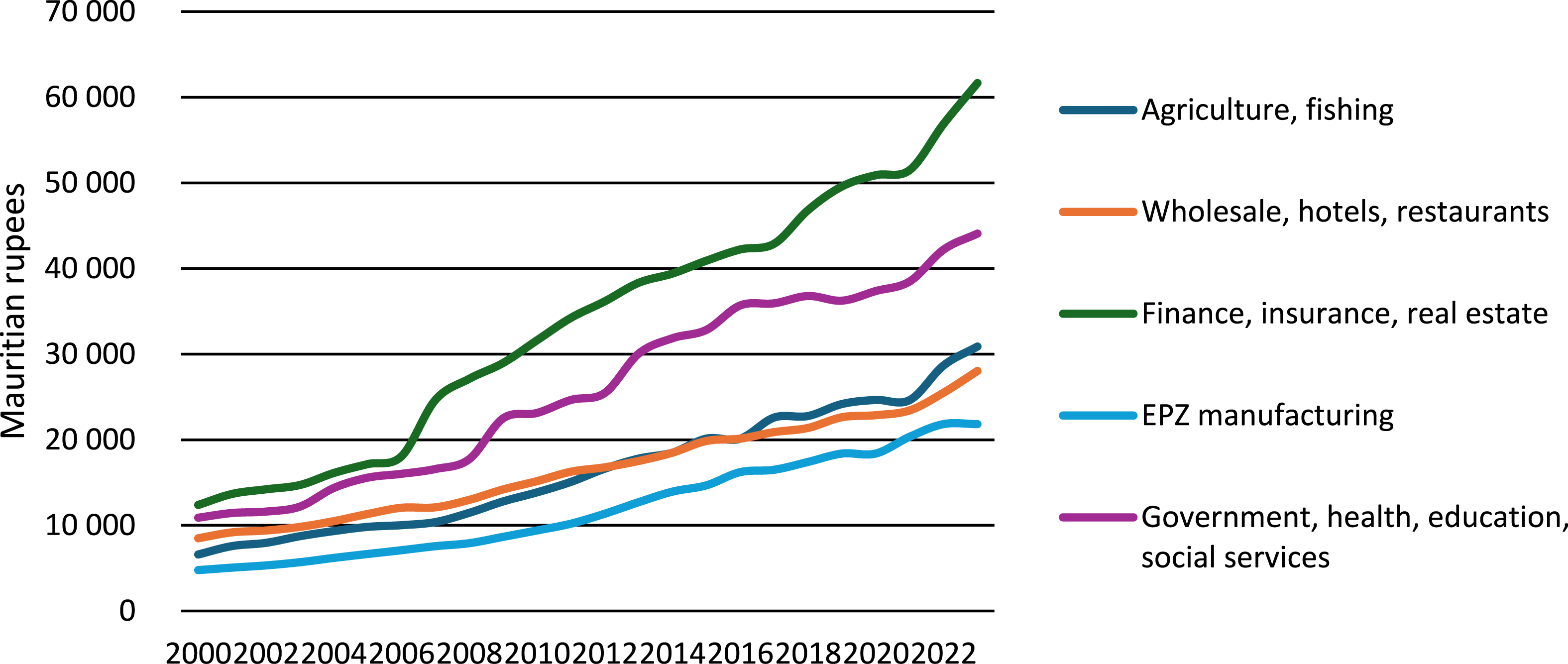
Still, labour was not cheap enough for Mauritius to compete internationally to the same extent as before. Layoffs continued into the 2000s, with sudden factory closures disproportionately affecting women, leading to documented experiences of psychological trauma, stress, and ill-health among those who lost their jobs (Bunwaree, 2007). Unemployment reached its most recent peak at 16% in 2005, 1 year after the dismantling of the MFA (see Figure 1). Female unemployment remained higher than men’s, bringing the degree of inclusiveness into question. While sectoral change meant job creation in alternative economic activities such as tourism and, more recently, ICT and financial services, Mauritian women have been disproportionately excluded from employment with the development of more skill-intensive and higher value-added industries (Gokhool et al., 2018; Ramtohul, 2008). In fact, instead of facilitating capability expansion and occupational transitions via skills training needed by other prominent sectors, the policy focus has been, to this day, to set up micro-enterprises in the traditional informal sector. Hence, many former workers, such as female garment employees, are missing (i.e. digital) skills and have ended up in vulnerable and unproductive employment (Gokhool et al., 2018; Kasseeah and Tandrayen-Ragoobur, 2011).
Labour-intensive manufacturing was undeniably accompanied by poverty reduction and improvements in human development up until this period. Nevertheless, poverty statistics have become problematic since the turn of the millennium, when we have more data (Statistics Mauritius, 2024f). On the positive side, the share of the population living on USD 5.50 per day (2011 PPP) and seen as vulnerable to poverty has declined. However, absolute numbers have risen, with vulnerability almost tripling in 20 years. Meanwhile, relative poverty (measured by the ratio of persons living below half of the median monthly income per adult) has increased since 2001, especially among women. These signs of feminized poverty support previous findings (Bunwaree, 2007) and suggest that Mauritius has not sufficiently rectified its structural change and development strategy over time to fit with social sustainability objectives of employment creation and inclusion.
By 2023, the number of people employed in large manufacturing establishments had declined to 51,800, comprising 17% of the respective workforce, of which 7% were involved in textiles and garment manufacturing (Statistics Mauritius, 2024b). Meanwhile, as shown in Figure 3, the composition of EPZ employees kept shifting from Mauritians to foreign migrant workers (first from China and Madagascar and later Bangladesh), the majority of whom are increasingly men. In the EPZ garment manufacturing sub-sector, migrants comprised over 60% in 2023 (Statistics Mauritius, 2024a), and it is acknowledged that “migrant workers are the ones that take care of peak production.”
4
Together, concerns related to labour repression (Sambajee et al., 2019) and the garment industry’s failure to create conditions that attract local workers (given persistent vacancy trends (Statistics Mauritius, 2024b) make the sustainability of this replacement strategy debatable. As migrants are on temporary contracts (with a maximum of one renewal, except the total number of years has been extended over time), it jeopardizes the potential for collective learning and transfer of skills in production. EPZ employment by women and foreign migrants. Source: Constructed with data (for large and small enterprises, the month of December) from Statistics Mauritius (2024a).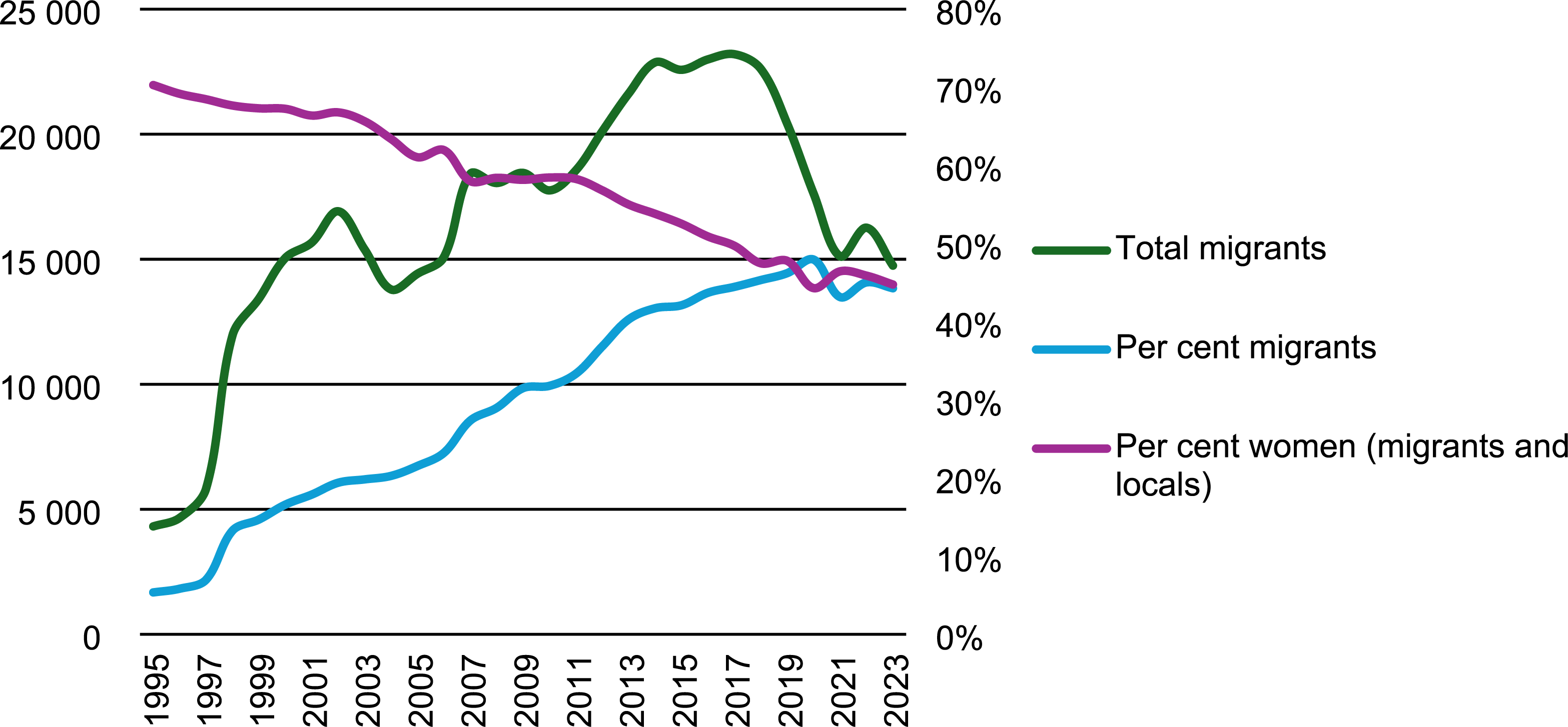
In 2008, the government revised the IRA via the Employment Relations Act to strengthen trade unions’ collective capacities while enabling labour force flexibility. In effect, the right to strike was still technically allowed but, in actuality, was almost impossible, with a compulsory cooling-off period extended to 140 days across the economy. Legal trade union registration required at least 30 members, migrant workers’ right to form and join unions was explicated, and collective bargaining was on the condition that these unions were chosen by an absolute majority of employees in a particular workplace (Rambaree, 2009). Given the circumstances of EPZ manufacturing, with a considerable proportion of the workforce being migrants and with different living arrangements and working conditions (not being able to bring family members, for instance), it is understandable that this made worker organization around collective issues difficult.
Indeed, migrant workers rarely join unions, which is argued to be mainly structural. They live in cramped dormitories near or on factory grounds and remain in a weak position vis-a-vis their employers with production pressures (Sambajee et al., 2019). Conditions will likely worsen by allowing third-party labour contractors to employ migrant workers on behalf of firms as of 2024, thereby making recruitment and employment less secure and regulated. “… once [a work permit] is approved, the responsibility to cancel the work permit is on the employer. If the employer wants to return a migrant worker, no clearance is needed from any authorities.” 5 This example implies several workers’ rights risks, in the case of migrants.
Still, the most recent Workers’ Rights Act 2019 makes no official distinction between migrants and Mauritians and in some ways, it brought about more state-backing for workers with the implementation of severance allowance, a wage guarantee fund, gratuity payment upon retirement, and a nationwide statutory minimum wage (in contrast to the previously sector-specific ones). From the start of industrialization, all workers have been entitled to free healthcare, and specific to the EPZ is that the state, since 2019, has subsidized industrialists’ heightened wage bill via the Mauritius Revenue Authority. In practice, however, migrant workers are not entitled to various welfare schemes, such as pensions, and other concessions have been made, as acknowledged by a government official: “Migrant workers are supposed to be granted free lodging, free meals and so on, but we have allowed industrialists in the EPZ to deduct all costs of lodging and food from the minimum wage.” 6
The combination of lower employment generation and Mauritius’ heavy dependence on tractable, cheap(er), and non-unionized migrant labour ultimately contribute to a concern for deteriorating working conditions. Improvements to the terms of work have been unevenly applied and come across as add-on measures to increase the industry’s resilience and cushion the effects on (Mauritian) workers of sudden factory closures and financial liquidity problems. This may constitute a development trap (Aiginger and Rodrik, 2020), and it certainly hinders progress along the social dimension of sustainable development, whereby certain groups are adversely included in the country’s structural transformation.
Social sustainability and garment-based industrialization
Mauritius has climbed the development ‘ladder’, including upgrading into higher-value stages of garment production and, to a lesser extent, new manufacturing activities, combining recommendations from both Justin Lin and Ha-Joon Chang (2009). The country has certainly benefited from its elites’ transnational business networks and early preferential trade agreements that catered to the garment industry. However, policymakers had to take advantage of these unique circumstances, too. Building higher prosperity for the masses would also not have succeeded without the state involving its citizens in the national project that, from the start, contained both social and industrial policies in tandem. Over time, learning (especially local firms learning from foreign industrialists), knowledge, and innovation in complementary industries and services (such as design and marketing capabilities) were promoted, which enabled higher-value garment production (Gibbon, 2008). Also, more technologically advanced textile production has grown as a share of Mauritius’ export composition (Statistics Mauritius, 2024a). Meanwhile, the evolving light manufacturing industry has supported small and medium enterprises in other types of production, many of which provide high-value-added services to larger firms in the country (Ancharaz, Forthcoming). This highlights that garment production offers some learning opportunities and suggests that, to a large degree, Mauritius followed a socioeconomic trajectory proposed by new developmentalist research, which gave the country in its entirety the possibility to ‘develop’ over the long run.
Nevertheless, the speed of direct job creation was challenging to sustain. Even if the state eventually started implementing policies to gradually improve working conditions in the EPZ, it sat uncomfortably with the fact that (women) workers were already starting to lose their jobs by the end of the second period, and migrant workers started filling a larger share of the manufacturing jobs available. Working conditions in the industry have always been unevenly applied in practice. Improvements with the Workers’ Rights Act 2019, for example, have mostly benefited local workers, who comprise an increasingly smaller share of the manufacturing workforce.
The garment industry’s dependence on migrants on temporary contracts for over two decades makes it more vulnerable and challenging to enable collective learning and broad-based labour organization. Further, it taints strong class formation, something Tregenna (2023) has highlighted as a general limitation of the political economy of Africa’s industrialization because regional or ethnic identities tend to be more prominent. Several stakeholders in Mauritius’ export-oriented labour-intensive industries emphasize views such as “all enterprises would close if it were not for migrant workers.” 7 This dependency is unsustainable since there is a narrower depth and breadth of broad-based interests across different fractions of Mauritian society rooted in the successful continued industrialization and advancement of socioeconomic prosperity. On the positive side, manufacturing jobs were spread out across various regions within Mauritius, historically bringing work to workers. Mauritians also made up a very high and increasing share of firm ownership and high-skilled jobs early on (Anker et al., 2001), enabling broader ownership of this development trajectory at the upper echelons of garment manufacturing.
The question is whether efforts to harmonize industrial relations in the export-oriented garment industry have been too little too late. Several investors have already left to pursue either garment growth opportunities in the region or other economic sectors in Mauritius, such as real estate and finance. While this can be expected as countries mature economically, it can be problematic for those workers involved in the industry and for the country at large unless there is a diversification plan early on. To some extent, Mauritius had this with the development of ICT and finance when the garment industry started shrinking. Still, these newer industries could not sufficiently ‘pick up’ those workers who left the garment industry upon factory closures, work insecurity, and limited manoeuvre for collective bargaining. The situation may have looked different if retraining and redeployment had been more broad-based. Above all, employment schemes fell short of providing good employment options for those less skilled and educated workers who used to work in the garment industry when it was most labour-intensive. Thereby, social and industrial policy fell short of fostering a new nation-building project with equity and inclusiveness as cross-cutting themes (Mkandawire, 2007).
Even more concerning is that Mauritius as a country appears to face ‘adverse incorporation’ concerning these sectors’ positioning within global value chains (Behuria, 2022). This echoes the plight of Mauritian firms in the 21st century garment industry, given well-known experiences of ‘supplier squeeze’ similarly experienced elsewhere (Anner, 2020), whereby buyers’ practices involve paying low(er) prices while demanding high(er) quality and short(er) lead times in contexts of extreme order volatility. This work intensification tends to be borne by particularly vulnerable and non-unionized groups of workers. Together, these sectoral developments have worrying long-term socioeconomic repercussions for creating good quality jobs and, ultimately, the financing of the welfare state.
It also gets to the tricky question of whether the garment industry’s properties are inherently socially sustainable, especially in terms of improving job quality in an equitable and inclusive way. A labour-intensive industry like garment manufacturing should arguably only stay if it can contribute to long-term social sustainability alongside economic prosperity instead of merely dampening short-term economic problems in other sectors. With fierce competitive dynamics of global production networks, however, choices are inevitably limited, and it can be tempting to keep an industry for reasons other than the sector’s efficiency, as explained by one trade unionist: “The Mauritian government wants to keep the garment industry because it’s a big source of foreign exchange, and this is precisely what helped us during the COVID-19 pandemic. The tourism sector was completely down, but the garment industry was working since migrant workers were kept in fenced dormitories and were allowed to go to work.” 8
While there appears to be cohesion that the industry should continue to operate, the premise of relatively undiversified manufacturing operations domestically and regionally (via the capitalization of regional supply chains) has led to the relative exclusion of some workers living and working in unfair and precarious conditions. As a contribution to new developmentalist research, this means that it is insufficient for an industrialization trajectory to be socially sustainable based on the state seemingly succeeding in managing potential conflicts between workers in particular industries and the wealthy. Workers are not a homogenous group, and there can be secondary divides, beyond class, that change shape alongside industrialization processes, which makes it important to delineate the social buy-in of ‘workers’ further. While the aforementioned literature importantly discusses tensions of social marginalization and the risk of ‘leaving many behind’ unless there are forms of collective representation (Andreoni, 2022: 16), these ‘many’ need to be explicated. Given rising numbers of non-citizens taking up mostly low-skilled manufacturing jobs, we need to think more about how states can build legitimacy to deliver social sustainability in its true meaning.
This also stands in contrast to ways in which government officials talk about fostering supposed sustainability conditions in the industry, something that a director at the Economic Development Board (EDB) of Mauritius motivates in the following way: “We have moved from fibre to fashion over 50 years, and we are still going strong. Now we are embarking on another path toward sustainable production. It is important for us because we are a small island developing state, we care for planet earth. We also care about serving the emerging middle class of Africa that needs to be put – if you want – in fashion. We want to play a strategic role from the perspective of Africa.” 9
Just as environmental sustainability has become a way to maintain a competitive edge in the global economy (Lebdioui, 2024), social sustainability may do the same. Indeed, the Mauritian garment industry is still seen as a tool for accomplishing broader desirable socioeconomic outcomes. It considers itself to have been a ‘good student’ of labour and social compliance, and following social minimum standards is seen to be of strategic importance for international competitiveness, now and in the future. Notwithstanding, there are several challenges to fulfil ever greater levels of social sustainability, and we must keep probing this trajectory.
Regarding the fulfilment of basic needs for the masses, the government has always prioritized health and education to earn legitimacy for its political and economic agenda. Public social spending remains high as a share of GDP compared to other regional and middle-income standards. Yet, effective policies for the welfare of specific groups of people disadvantaged by light manufacturing have been given less attention. In a systematic review of the recent national programs (2015-2019; 2020-2024) and budget speeches (2020-2021; 2021-2022), Bunwaree et al. (2022) argue that as the government is preoccupied with becoming a high-income economy, specific social (and environmental) goals for sustainable development are disregarded. For example, a study by Tandrayen-Ragoobur et al. (2021) shows that social protection measures co-existing with industrial policy leave much to wish for regarding gender inclusiveness. There has also been an increasing reliance on social protection provisions through dispersed communities, religious bodies, and civil society organizations (Kasseeah and Tandrayen-Ragoobur, 2011), and education has become increasingly privatized.
Indications of rising poverty and inequality since the early 2000s are also worrying and indicative of exclusion. They coincide with structural changes in the economy and labour market alongside increased demand for more skilled labour (World Bank, 2021). The labour income share of GDP has also declined from 42.2% in 2004 to 40.3% in 2020 (ILO, 2023). This suggests that growth has become less wage-led or directed towards full employment ambitions, perhaps also explained by most of the tax coming from regressive VAT (World Bank, 2021). Overall, the welfare state that was implemented by the post-independence government, funded by domestic taxation, and shaped by labour demands prevails, as does its efforts to provide basic needs, but the trajectory and reach are no longer as positive or far-reaching.
Ultimately, the analysis shows that LII and garment manufacturing can only be socially sustainable to a certain degree. There are also temporal limitations to the extent that a garment industry can create jobs. Once social and industrial upgrading start (not necessarily together), better wages should arise in garment manufacturing. Still, it comes with slower domestic job creation since investors and buyers of this particular product group tend to move elsewhere. State efforts to move beyond basic needs and employment creation may thus fall short, given the threat of factory closures, job losses, and the reality of a divided workforce. Therefore, conditions of ‘fair employment’ are not necessarily guaranteed as seen in the case of Mauritius’ industrialization.
Concluding remarks
Although developmentalist literature highlights many significant socioeconomic opportunities of LII and light manufacturing activities, such as technological progress, (relatively good) job creation, and poverty reduction (Aiginger and Rodrik, 2020), they do not necessarily occur all at once. Even in the longer term and while experiencing substantial sectorial change and development, achieving social sustainability fundamentals remains challenging. This is evident in our retrospective examination of Mauritius’ trajectory of labour-intensive garment-based manufacturing.
For countries in the global South currently launching their industrialization strategies, we draw three interrelated lessons from our case study regarding to what extent and in what ways social sustainability and light manufacturing develop together. First, and in line with Mkandawire’s (2001, 2007) perspectives, a continuous interplay between active social and industrial policies is important for meeting the wider population’s basic needs, as well as for building production capabilities, social cohesion, and accountability vis-à-vis the state, firms, citizens, and workers. In this way, widespread job creation – enabling, for instance, women to join the formal labour market – constitutes a strong initial force towards poverty reduction and acts as an implicit form of social policy even when wages are low. Secondly, LII offers a time-bound pathway that can deliver transformative outcomes to an undiversified economy. Still, given that capitalist development is likely to eventually experience setbacks and crises, such as changing global trade rules and local contexts of labour shortages and rising labour costs, the sustainability of a valuable industry for collective capabilities risks being jeopardized altogether. This is aggravated if labour rights are not sufficiently protected and (specific groups of) workers are made to work more under relatively poor conditions. In fact, Mauritius shows us that socially sustainable development cannot be mastered by a single light manufacturing sector. This relates to the third lesson. Because LII and light manufacturing are (only) stepping-stones towards more technologically advanced, capital-intensive, and diversified production, it is important for the state, in tripartite collaboration with industrialists and workers, to craft an ‘exit strategy’ early on, even before the sector becomes socially defamed and reliant on workers from countries further down the ‘ladder’ of the global division of labour.
Does the future hold opportunities for a higher degree of social sustainability in Mauritius? There is still much room for improvements in workers’ rights and conditions to deliver intra- and inter-generational social justice. The country’s ambition to ‘repair the industry foundations’ as expressed in the Industrial Policy and Strategic Plan 2020-2025 (Ministry of Industrial Development, SMEs and Cooperatives and UNCTAD, 2020) is somewhat promising. Given its critical mass and integration, it outlines the textile and garment industry as the most likely to succeed regionally and globally. While this may be true, the particular product base only has so much leverage to be socially sustainable and to contribute to socially sustainable development. Within Mauritius, further labour market adjustments and shifts into higher-end garments and textiles will be needed, as well as other manufacturing products where the competition is based on factors other than cheap labour. While some firms have been able to do so, the extensive use of labour facing unfair wages and poor working conditions (first women and then migrant labour on short-term contracts) suggests the country is still at a crossroads concerning offering qualitatively improved working conditions to all and establishing a genuinely socially sustainable industry. As an African forerunner and growing regional player, it will be even more critical in the future to understand how Mauritius’ continued industrialization trajectory adopts social sustainability fundamentals and what trade-offs and tensions come with it.
Footnotes
Acknowledgements
We thank Cristina Chaminade, Andrés Palacio, Anna Tegunimataka, Malin Nilsson, Kristoffer Marslev, and two anonymous reviewers for their useful comments. This study was conducted within the project Sustainable Development of Small Island States funded by the Swedish Research Council (VR 2019-04117).
Declaration of conflicting interests
The author(s) declared no potential conflicts of interest with respect to the research, authorship, and/or publication of this article.
Funding
The author(s) disclosed receipt of the following financial support for the research, authorship, and/or publication of this article: This work was supported by the Vetenskapsrådet; VR 2019-04117.
