




Abstract
Drawing on research into medical gloves global value chains (GVCs), this article examines the interacting roles that states differently positioned in GVCs have played in preventing and eliminating forced labour. Our case study, based on a worker survey and semi-structured interviews across GVC actors, focuses on forced labour in the Malaysian medical gloves sector during the COVID-19 pandemic, linking production in Malaysia, end markets in the UK (primarily through procurement for the National Health Service) and migrant-sending countries, especially Nepal. We analyze the intermeshing effects of the different roles of states, operating at either the horizontal or vertical level of GVC governance, in terms of contributing to issues of forced labour. We identify three state roles in the Malaysia–UK medical gloves chain: producer state (Malaysia), migrant-sending state (Nepal) and regulator-buyer state (UK). We also identify some of the most persistent barriers to resolving forced labour in the value chain. Our research illustrates that Malaysia’s complex regulatory, political and institutional dynamics most directly influence forced labour in gloves production, but Nepal’s migration policies and the UK’s healthcare procurement practices also create forced labour risk in Malaysia. Advancing Gereffi and Lee’s (2016: 25) notion of “synergistc governance” and Jessop’s (2016) strategic-relational approach (SRA) to the state, we thus argue that the creation of sustained and positive regulatory synergies among states differently positioned in GVCs is necessary for the prevention and elimination of forced labour.
Introduction
At the height of the COVID-19 pandemic, demand for Personal Protective Equipment (PPE), including masks, gowns, aprons and medical gloves, escalated dramatically as these items became crucial materials used in healthcare and other settings to help reduce the spread of infection. This increased demand put immense pressure on production and, by extension, the workforce in factories, and this was clearly the case for medical gloves production, most of which takes place in Malaysia for supply to global markets (MARGMA, 2020). Evidence was reported of exacerbating problems of forced labour (FL) in this sector, which had been noted as an issue prior to the pandemic (Bengtsen, 2019). This included FL in factories producing gloves for the UK’s National Health Service (NHS) (Lovett, 2021).
Whilst there has been significant attention to labour standards in value chains for consumer goods for several decades, often locating responsibility with corporate buyers through an era of economic liberalization and deregulation, there has been less attention paid to labour conditions, including problems of FL, in value chains supplying goods to the public sector (Hughes et al., 2019). Against this backdrop, our paper attends to the location of responsibility for labour standards in these value chains, focusing on medical gloves produced in Malaysia for use in the NHS. We emphasize multiple state roles, in terms of creating the conditions for FL in this value chain as well as reducing and preventing the problem. Our paper critically considers the intersecting roles states play in contributing to, as well as addressing, instances of FL in global value chains (GVCs). FL remains a significant and persistent phenomenon, with an estimated 27.5 million people in FL in the global economy in 2022 (ILO, 2022), working in multiple sectors, including agriculture, seafood and production of manufactured goods such as garments, electronics and medical goods (US Department of Labor, 2022). This article builds on notions of vertical and horizontal value chain governance and “synergistic governance” (Gereffi and Lee, 2016: 25) for improvement of workers’ wages, conditions and rights (Barrientos et al., 2011) and on Jessop’s (2016) SRA to the state. It responds to LeBaron and Phillips’ (2019) call to investigate states’ underlying conditions of political economy that generate FL, thus identifying these as key barriers to, as well as potential enablers of, positive change.
Prominent explanations for FL have focused on the business models of firms and supply chain structures (Crane, 2013; Stringer and Michailova, 2018) and on the “adverse incorporation” of workers into exploitative conditions (Phillips, 2013: 171). Recently, more attention has shifted to how states may contribute to FL (Hughes et al., 2023; LeBaron and Phillips, 2019), in contrast to approaches which view state action in terms of countering it. States are responsible for creating a regulatory and policy terrain that can facilitate FL, for example through policies rendering migrants vulnerable to labour exploitation, or legal enforcement of workers’ rights. This paper contributes to the analysis of the state and FL in GVCs by focusing on the value chain linking medical gloves produced in Malaysia with procurement and use by the UK’s NHS. We evaluate the intermeshing effects of differently positioned states’ roles in both aggravating and confronting FL. Whilst we consider some aspects of private sector influence and corporate responsibility, we foreground the multiple roles of states. We do so for two reasons. First, there is less attention to state roles in the literature on FL in value chains, leaving an important gap to be filled. And second, the position of the NHS as a public sector purchaser lends itself to analysis of public governance alongside regulatory roles of the state in commodity producing and migrant worker-sending countries.
Gereffi and Lee (2016) highlight how governance of labour standards in GVCs operates in various contexts through differing combinations of private and public governance. These combinations can incorporate business, state and civil society roles. Here, we focus on the state, and highlight the negative side of synergistic governance in which the actions of three states in a medical gloves GVC combined to engender instances of FL. These states are Malaysia as the producer state, Nepal as a migrant-sending state and the UK, specifically the NHS, in a regulator-buyer role, primarily through procurement of medical gloves. We demonstrate how FL risks are generated by state action in these roles at horizontal and vertical levels of governance (Gereffi and Lee, 2016). The UK, as a public procurer and regulator of corporate buyers domiciled in its territory, operates at the vertical axis. Malaysia and Nepal operate at horizontal axes as they respectively govern medical gloves production and the emigration process, both shaping Nepali migrants’ circumstances as foreign labour in Malaysia. We highlight how states’ labour governance is an expression of underlying political and economic tensions. Patterns of governance reflect a balance of social forces operating within specific political settlements and institutional structures (Jessop, 2016). Our case study suggests that producer states most directly shape FL but regulator-buyer and migrant-sending states also have effects, which can act as additional transmission mechanisms for FL risks and their amelioration. By focusing on different state roles in shaping and confronting FL, the article contributes to GVC literatures on FL and public procurement, as well as on labour emigration governance.
In the second section of the paper, we engage with literature on FL in GVCs. The third section considers existing approaches to governance of GVC labour standards. The fourth puts forward our analytical approach to the intermeshing roles of state governance of labour in GVCs. The fifth explains the data collection and analysis methods used in our case study, and the sixth applies our analytical approach to the case of Malaysian medical gloves, first considering Malaysia’s producer state role in enabling FL, then detailing Nepal’s emigration governance, before exploring the UK’s actions as a regulator-buyer state. It also considers the intermeshing effects of these state roles and the potential for engendering positive change through more synergistic action. A final concluding section suggests further research needs and makes recommendations for advancing positive synergies able to prevent and eliminate FL in GVCs.
Forced labour in global value chains
FL is a pervasive phenomenon in GVCs (Hughes et al., 2023; McGrath, 2013; Raj-Reichert, 2020b; Vandergeest and Marschke, 2020), and is here understood as an empirically complex continuum of labour conditions rather than a free/forced binary (Strauss, 2012). It entails a labour relationship entered into under coercion or which becomes coercive once entered (Strauss, 2012), although the mechanisms through which coercion is enacted can be both complex and subtle, and incorporate physical, psychological, financial, social and legal elements (ILO, 2016). In contrast, modern slavery, a currently prominent framing of FL-related issues, includes various forms of FL but also a broader set of relations such as forced marriage (ILO, 2022). One influential understanding of FL is as an illicit or anachronistic form of employment that lies outside the normal operations of capitalism (Lerche, 2007). Critical scholars have, however, indicated that various forms of FL are not exterior to capitalism but constitutive of it (Phillips and Mieres, 2015; Vandergeest and Marschke, 2020). LeBaron et al. (2018) identify key supply and demand factors as causes of FL in the global economy. In terms of supply, these are: poverty, identity and discrimination, limited labour protection and restrictive mobility regimes. In terms of demand, they are: concentrated corporate power and ownership, outsourcing, irresponsible sourcing practices and public and private governance gaps.
The structure and power dynamics of GVCs have been identified as key factors driving FL (Crane, 2013; LeBaron et al., 2018; Stringer and Michailova, 2018). This is in a context of globalization and deregulation of trade and markets since the late 1980s (Gereffi, 2018). Analysis has focused on firm-level practices and inter-firm relationships internal to GVCs (Anner, 2019; Crane, 2013; Stringer and Michailova, 2018). Global restructuring has seen lead firms, often based in high-income countries, constituting important final product markets and exercising significant purchasing power to outsource production to an array of suppliers operating in multi-tiered chains in lower-cost locations situated in low- and middle-income countries (Barrientos, 2013a; Gereffi, 2018). Irresponsible sourcing practices (driven by competitive pressures) such as lower price demands, short lead times and high order volatility place pressure on suppliers to reduce their own costs resulting in issues including excessive overtime, supervisor abuse to induce worker productivity, and health and safety cost-cutting (Anner, 2019, 2020; Barrientos, 2013a; Locke, 2013; Prentice and Trueba, 2018). Crane (2013: 49) suggests that in value chains with high labour intensity, a lead firm squeeze on value distribution and high elasticity of demand (e.g. garments), “modern slavery” becomes more likely to be adopted by firms as a “management practice”. FL is more likely to exist in the more difficult to monitor and sub-contracted lower tiers (LeBaron et al., 2018; Stringer and Michailova, 2018). Phillips (2013: 171) has argued that poverty-driven “adverse incorporation” into the structures of the global economy is a key process giving rise to FL. We understand FL as an inextricable but specific subset of broader labour relations (Lerche, 2007) and we thus place our analysis in this frame (Barrientos et al., 2011).
Global governance of labour in value chains
LeBaron (2020) has persuasively highlighted that more effective labour governance is a question of politics as powerful corporate actors have deflected governance into Corporate Social Responsibility (CSR) and away from more stringent public regulation. However, there has been a shift over the past 20 years from a primary focus on inter-firm governance, CSR, and economic upgrading spearheaded by Gereffi et al. (2005a, 2005b) to greater consideration of governance incorporating a wider set of actors including government departments and civil society organizations (Ponte and Sturgeon, 2014). As pointed out by Bartley (2011: 520), transnational governance of labour rights is often a “layering of rules” where private standards are overlain on states’ national regulation. A more diverse terrain of governance has developed in line with Ponte and Sturgeon’s (2014) observations of multipolar governance, where influence derives from multiple nodes both inside and outside the value chain.
Gereffi and Lee (2016) have highlighted six distinct avenues for social upgrading (improving workers’ conditions and rights): market-driven; CSR-driven; multi-stakeholder; labour-centred; cluster-driven; and public governance. Multipolar labour governance has incorporated public and private actors in “hybrid” governance programmes such as the ILO/IFC’s Better Work Programme (Bair, 2017: 169). Scholars highlight how private initiatives complement or substitute state enforcement of standards dependent on national context (Locke, 2013). Multistakeholder initiatives incorporating constellations of public, private and social actors have also gained prominence (Donaghey and Reinecke, 2018), and the important role of workers’ own agency in social upgrading is increasingly recognized (Marslev et al., 2022). The ILO, the United Nations’ supranational agency for labour, lacks political capacity to enforce standards (Lerche, 2007). However, Posthuma and Rossi (2017: 186) note the ILO’s role in setting normative global standards and providing a framework for “coordinated governance – the interaction and complementary efforts of public, private and social stakeholders,” including its Protocol on Forced Labour.
Synergistic governance and differently positioned states’ roles in driving and addressing forced labour in GVCs
Following on from the above summary of literature conceptualizing the governance of labour issues in GVCs, in this section we hone in on understandings of the different roles of states in this arena. Gereffi and Lee (2016: 25) suggest that multiple avenues to social upgrading operate in forms of “synergistic governance”: “a confluence of ‘private governance’ (corporate codes of conduct and monitoring), ‘social governance’ (civil society pressure on business from labour organizations and non-governmental organizations) and ‘public governance’ (government policies to support gains by labour groups and environmental activists).” Whilst we touch on cases where private and public governance combine in the case of FL in medical gloves value chains, we foreground how a subset (that between states) of that synergy operates. Moreover, we identify how a form of negative synergistic governance, the interaction of different countries’ public governance, has been instrumental in generating FL in the industry.
Our analytical framework draws on, first, Gereffi and Lee’s (2016: 25) notions of vertical and horizontal governance of GVCs and “synergistic governance” to explain the macro-level governance of the chain, emergent from the intermeshing effects of governance actors; and second, the SRAto the state (Jessop, 2016) to dig deeper into the underlying barriers to change at the level of national states. Gereffi and Lee (2016) distinguish between the vertical and horizontal dimensions of GVC governance. They categorize actors operating along these axes into private (firms), public (governments) and social (civil society). In our case study, we identify three government roles in the chain: 1) the producer state as the national-institutional setting for where the commodity (in this case, medical gloves) is produced, 2) the migrant-sending state (the home state of transnational migrant workers) and 3) the “regulator-buyer state” (Raj-Reichert et al., 2022: 760): state buyers of GVCs’ products or regulators of state-domiciled purchasing firms. We locate the producer (Malaysia) and migrant-sending (Nepal) states at the horizontal axis, while the regulator-buyer (UK) operates along the vertical axis, as regulator-buyer actions have transnational implications for supplier conduct. Horizontal governance is the place-based coordination of economic and social relations between firms as well as the local and national institutions which govern them. Vertical governance is the transnational coordination of buyers and suppliers in different countries each of which add value to the final commodity (Gereffi and Lee, 2016: 30). Public governance at the horizontal level refers to local, regional and national regulation shaping economic and social relations (Pyke and Lund-Thomsen, 2015).
Bartley (2011: 520) conceptualizes transnational governance of labour rights as a “layering of rules” resulting from the intersections between public and private standards. In our view, this layering also applies to how workers’ conditions are shaped by the multiple legal-political jurisdictions they are subject to. These legal-political jurisdictions can drive or ameliorate FL risks in given employment situations, thereby blocking or facilitating social upgrading, or even causing social downgrading of previous conditions (Marslev et al., 2022). When two or more states contribute to risks, we understand this as a form of negative synergistic governance, whereby “governance gaps” are compounded (LeBaron et al., 2018: 55) and incidence of FL is greater than it would be if only a single state’s action contributed. In our case study, Malaysia most directly shapes FL but Nepal and the UK also have effects, which act as additional transmission mechanisms of risks.
We utilize insights from the SRA to explain state action and its origins in political-economic processes (Jessop, 2016), adding to literature applying the SRA to GVCs/Global Production Networks (GPNs) (Marslev et al., 2022; Smith, 2015). The SRA understands the state as a complex, non-unitary, heterogeneous “institutional ensemble” and as a social relation (Jessop, 2016: 6). The SRA focuses on “the exercise and effects of state power as a contingent expression of a changing balance of forces that seek to advance their respective interests inside, through and against the state system” (Jessop, 2016: 54). The balance of forces is mediated through the institutional structures of the state as they are embedded in the wider political system and social relations. This wider system and sets of social relations involve workers themselves as well as trade unions and worker representative organizations that can enact both “associational” and “structural” forms of worker power and influence in GVCs (Marslev et al., 2022: 837). It is noted later in the paper, however, that trade unions in the Malaysian medical gloves sector are in a weak position. The state mediates the capital–labour relation and shapes a diversity of labour and welfare regimes (Jessop, 2016). Different actors within the state system face varying sets of constraints and opportunities such as institutional organization and political settlements that provide a strategic context for their action, thereby selecting for some courses of action over others. This means that structure is “strategically selective rather than absolutely constraining” (Jessop, 2016: 55). State actors’ strategic choices and policy options are thus subject to path dependencies due to these “structurally inscribed strategic selectivities” (Jessop, 2016: 56). Each state in our case study, whether operating along the vertical or horizontal axis, faces its own political-economic constraints, which have selected for pathways generating increased FL risks. We turn to these state roles and the relations between them as under-researched aspects of GVC labour governance, following an overview of our research methodology.
Methods
Our empirical case study is the medical gloves GVC, as it connects production in Malaysia, end markets in the UK and migrant-sending countries, especially Nepal. It is estimated that in 2019 the Malaysian gloves industry employed 71,800 people (Hutchinson and Bhatthacharya, 2021). Nepal was chosen as a focus both because of the large numbers of Nepali citizens working in Malaysian gloves factories, and also because of the ways that Nepal’s attempts to implement measures to protect Nepali migrants have been complicated by internal political-economic factors. The research was conducted between August 2020 and April 2021 in Malaysia and the UK (see below) to investigate the impacts of the COVID-19 crisis on FL and broader labour standards in Malaysian medical glove factories, and the role played by UK public procurement.
An initial review of academic, policy, advocacy and media-based literature was conducted to provide context on the gloves sector in Malaysia and supply chains connecting to the UK’s NHS. We draw on this material in Section 6 to analyze governance in the gloves value chain. Ethics approval was obtained from the lead University’s ethics committee before the start of data collection. This data collection included a survey conducted by trained local survey interviewers in August and September 2020 of 1,491 gloves factory workers employed across multiple Malaysian gloves manufacturing companies. The survey was conducted in person in some cases, where possible, but mostly online. Methods also included 11 semi-structured interviews in Malaysia with Nepali and Bangladeshi migrant workers (W1-W11), 1 three interviews with Malaysian gloves manufacturers (Quality, Sales & Marketing and Social Responsibility Managers; M1, M2, M3), three with UK government officials (G1, G2, G3), three with suppliers (managers and directors: S1, S2, S3) and five with UK procurement managers (P1, P2, P3, P4, P5), two of whom represented NHS Supply Chain (P1 and P2) with the others representing hospital and regional procurement hubs. Workers were identified using the existing networks of one of the research collaborators, and were employed across multiple Malaysian gloves manufacturing companies supplying the NHS as well as other international buyers. 2 Worker survey and interviews included questions focused on a wide range of labour issues, including those corresponding to the following 11 ILO FL indicators: abuse of vulnerability; deception; restriction on movement; isolation; physical and sexual violence; intimidation and threats; retention of identity documents; withholding of wages; debt bondage; abusive working and living conditions; and excessive overtime. Interviews with other informants covered themes including manufacture, supply and procurement both before and during the pandemic; labour standards specified in contracts, labour issues encountered and their monitoring; legal requirements, and perspectives on opportunities for, and barriers to, change in labour standards in the Malaysian medical gloves GVC.
Survey data was analyzed using descriptive statistics on the pattern and extent of FL indicators. Interview data was analyzed using NVivo, first coding the data into themes before scrutinizing content to connect themes. Themes emerging from the survey and interviews were then triangulated to verify findings, with a further round of analysis focused on connecting and corroborating evidence, and to triangulate with data from the document analysis.
The Malaysian medical gloves value chain and state governance
The role of Malaysia as producer state
The national regulatory, political and institutional context of states in which commodity (in this case, medical gloves) production takes place is a central determinant of labour standards outcomes. State industrial relations frameworks and labour market, migration and social protection policies provide the parameters for social upgrading through workers’ agency (e.g. trade unions) (Marslev et al., 2022). A state’s regulatory and institutional orientation and capacity delineates the effectiveness of its policy implementation and legal enforcement (Anner, 2021; Distelhorst et al., 2015; Strauss, 2012). LeBaron and Phillips (2019: 2, original emphasis) note that “states are often considered predominantly as the vehicles for responses to FL, rather than as actors who play a causal role in shaping the conditions that give rise to it”. However, states can also create conditions of vulnerability and conditions of profitability, which both have effects on generating FL (LeBaron and Phillips, 2019). Conditions of vulnerability increase workers’ susceptibility to FL, such as non-enforcement of legislation prohibiting FL. State-created conditions of profitability and state procurement’s emphasis on value for money and cost saving (Hughes et al., 2023) contribute to market forces heightening risks of exploitation. For LeBaron and Phillips (2019), states have particular capacity to establish conditions of unfreedom in three areas: migration governance, labour market policy and inadequate enforcement of labour standards.
The Malaysian medical gloves sector accounted for 67% of the global market in medical gloves in 2020 (MARGMA, 2020). The sector originated in Malaysia’s attempts to upgrade its rubber production base into manufacturing. Malaysian business, with government research and development support, moved into downstream production of rubber products in the 1980s (Kawano, 2019; Lebdioui, 2022). The gloves sector is therefore an example of successful economic upgrading through effective industrial policy (Lebdioui, 2022). The sector subsequently underwent further economic (product) upgrading when it started producing nitrile synthetic rubber gloves in the 1990s. The industry is currently dominated by a ‘Big Four’ of companies responsible for the majority of production (Hartalega, Kossan, Supermax and Top Glove), and a second tier of smaller manufacturers (Hutchinson and Bhattacharya, 2020). In contrast to other manufacturing sectors in Malaysia such as electronics, the large medical gloves factories are majority owned by domestic capital, facilitated by fewer technical entry barriers and less dependence on technology transfer (Kawano, 2019). As detailed below, the medical gloves sector is a success story of economic upgrading enmeshed in wider economic upgrading failures and the latter’s subsequent negative implications for social upgrading. The sector supplies markets worldwide, including major markets in North America and Europe (M1, M2, M3 interviews). Companies produce both own-branded gloves and original equipment manufacturer (OEM) stock, which distributor intermediaries in the value chain sell under their own brands (interviews M1, M3, S3). Value chains for medical gloves, a relatively straightforward product, are short in comparison to multi-component manufacturing such as electronics. A common supply chain in the UK linked a manufacturer, who sold directly to a UK distributor, who then sold to final consumers (including institutions) and retailers (see Figure 1). Medical examination gloves value chain for NHS England.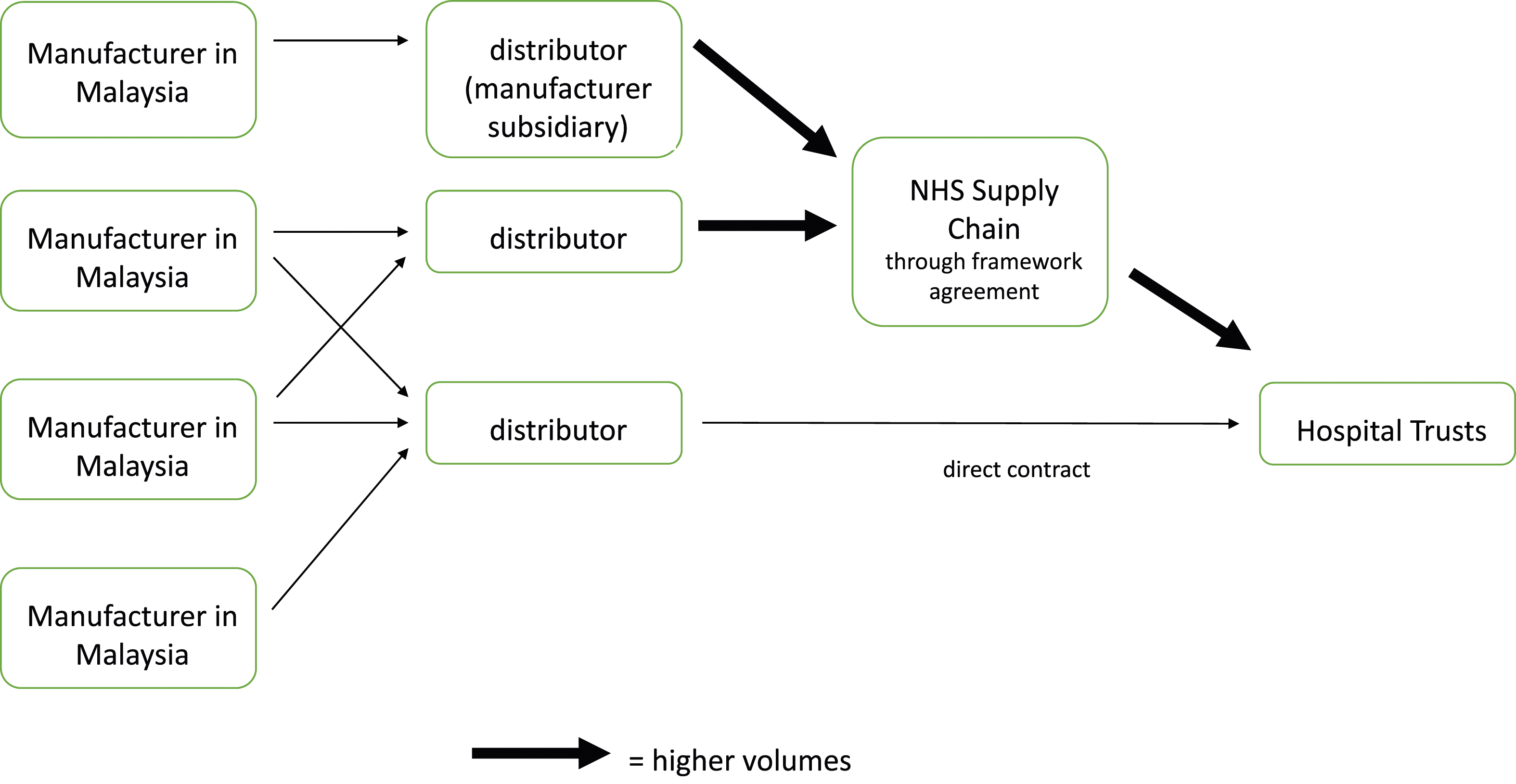
The COVID-19 pandemic proved a boon for the Malaysian medical gloves sector, as demand for personal protective equipment (PPE) skyrocketed. Malaysia’s earnings from gloves exports increased by 103% in 2020, more than doubling to RM 35.3 billion ($8.6 billion) and rising to RM 54.8 billion ($12.2 billion) in 2021 (Malaysian Rubber Council, 2022). In 2019 the Malaysian rubber gloves industry employed 71,800 people, of whom 39% (28,000) were Malaysian nationals while foreign migrants represented 61% (43,800) (Hutchinson and Bhatthacharya, 2021). During the COVID-19 pandemic, increased demand for medical gloves created the need to grow the workforce in the sector by a third (Hutchinson and Bhatthacharya, 2021). Whilst government strategy amidst the pandemic limited foreign labour recruitment, there was increased hiring of local Malaysian workers (at higher rates of pay) but also some redeployment of existing migrant workers already in the country (Khadka, 2020a). Our research findings provide evidence of multiple indicators of FL, as detailed below (see also Bhutta et al., 2021; Hughes et al., 2023). Media reports have also documented serious, long-standing labour rights infringements in Malaysian gloves factories that parallel our findings of FL (see for instance Bengtsen, 2019; Ellis-Petersen, 2018), indicating that aspects of FL are endemic in the industry.
Malaysia’s industrial upgrading, industrial relations and immigration policies are drivers of FL. Malaysian export-oriented manufacturing, initially developed in the 1970s–1980s on a labour-intensive, low-wage model, has become “reliant on foreign capital, markets, technology and management” (Sundaram and Wee, 2013: 55). Malaysian development strategy since the 1990s has aimed for high-skill employment and moving the country into the higher ends of GVCs in sectors such as electronics (Government of Malaysia, 2015). However, there has been a lack of coherent research and development and technological upgrading policy that could promote SME integration into higher value-added tiers as well as reduced enthusiasm among foreign investors for technology diffusion (Gomez et al., 2021; Rasiah, 2015). In part, this is due to the Malaysian state prioritizing channelling state rents and patronage to bumiputera (Malay and other indigenous groups), as a group poorer than the economically dominant Chinese Malaysians, and the base of electoral support for the dominant party, the United Malays National Organization (UMNO) (Gomez and Lafaye De Micheaux, 2017; Gomez et al., 2021; Rasiah, 2015). 3 The Malaysian economy has remained dependent on foreign investment and labour-intensive manufacturing. Manufacturing companies, both domestic and foreign, have chosen to remain in this value chain niche in Malaysia due to relatively low-cost labour, tax exemptions and good infrastructure (Devadason and Meng, 2014; Raj-Reichert, 2020a) and have “resisted attempts to discourage the import of cheap labour” (Gomez et al., 2021: 784). The successes of the previous round of industrialization have created a path-dependency selecting for a labour-intensive GVC niche. This has been exacerbated by a political settlement of inter-ethnic distribution limiting the strategic pathways for transformative industrial policy (Suffian, 2019), illustrating the influence of socio-political policies and histories that the SRA highlights (Marslev et al., 2022).
Labour in Malaysia has been consistently subordinated to the state’s development strategy of ensuring high profits and high levels of foreign and domestic investment (Gomez and Lafaye De Micheaux, 2017; Rasiah et al., 2015). Trade unions have “no real power to negotiate with employers” and “lack the political space and resources to demand reform” (Crinis and Parasuraman, 2016: 216). Previous rounds of industrial upgrading were predicated on incorporating a large number of workers while restricting their rights and interests in favour of those of investors and the state. Foreign workers, who make up the bulk of the manufacturing workforce, are even more circumscribed, prohibited from forming their own unions. Pre-pandemic official estimates stood at 1.8 million documented workers in 2017 and including undocumented at 2.3 million (World Bank, 2019). Significant sections of the Malaysian economy (e.g. palm oil and electronics) have become structurally dependent on foreign labour (Devadason, 2021). The Malaysian Government views the country’s dependence on foreign workers as a disincentive for employers to invest in automation and a hindrance to moving industries up the value chain (Government of Malaysia, 2015). The medical gloves industry has undergone some automation (MARGMA, 2020). However, survey data indicates that most foreign workers work in ‘harder to automate’ areas such as quality control and packing.
Trade unions were not present at any surveyed factory, reflecting the Malaysian state’s marginalization of unions. This facilitated a situation where 18% (265) of all surveyed workers and 28% (187) of Nepalese reported they would not be comfortable raising a grievance at their workplace. Reasons given included a lack of response from managers, fear of retaliation, lack of awareness of grievance channels and ethnic discrimination. The state’s mediation of industrial relations and workers’ inability to access grievance mechanisms thus led to isolation, a key FL indicator. Isolation from protective mechanisms is exacerbated by institutional arrangements for labour migration. Foreign worker policy is under the Ministry of Home Affairs, the ministry responsible for public security and immigration, reflecting Malaysia’s policy of discouraging long-term migration (Garcés-Mascareñas, 2012). In contrast, the Ministry of Human Resources (MoHR) is responsible for enacting protective legislation such as the Employment Act. The MoHR however lacks enforcement capacity rights and has limited effectiveness (ILO, 2019), thereby allowing other FL indicators to persist (see below). Malaysia ratified the Protocol of 2014 to the Forced Labour Convention in March 2022. However, the law prohibiting FL in Malaysia appears to be limited to formal employment relationships, and commentators have noted that there is not yet complete alignment of Malaysian legislation with the Protocol (Surendran, 2022).
Migration policies also play a key role in FL. The Malaysian Government has been under pressure from the Malaysian Rubber Glove Manufacturers Association (MARGMA), particularly during the pandemic, to allow labour in to meet demand, 4 which effectively facilitates a low-road manufacturing model. Migration policy has seen numerous changes in the past two decades, but the overall approach has been to view labour migration as undesirable and prevent permanent migration. The Malaysian Government has traditionally perceived immigration not only as a barrier to structural economic upgrading but also as a political and security issue (Garcés-Mascareñas, 2012; ILO, 2020; Nee Lee, 2020). Government efforts have at times prioritized political concerns by cracking down on undocumented migrants or attempted to reduce the economy’s dependence on migrant labour, for example by freezing foreign recruitment. These policies have been balanced against employers’ demand for workers (Devadason, 2021). At the time of writing, the Malaysian Government, following a period where checks and balances on overseas labour recruitment were relaxed and which enabled large-scale entry of migrant workers and reported collusion between Government representatives and recruitment agencies, placed a deadline of 31st May 2024 for overseas worker entry before a freeze on further recruitment (Hall, 2024).
A result of balancing these conflicting policy aims has been an immigration policy that facilitates FL. In particular the Visit Pass (Temporary Employment) (VP TE) 5 creates the conditions for significant restriction of movement. Foreign workers are limited to fixed-term work permits and must acquire a VP TE to be legally employed. The VP TE is valid for 12 months but may be renewed at the employer’s discretion, giving employers significant control over work permits and their renewal. A VP TE is tied to a single employer, and workers are unable to unilaterally switch employers without losing their legal status. An employer can provide a “release letter” or “no objection certificate” but Nepali migrants have reported “huge difficulties” in obtaining these (Sunam, 2022: 644). This establishes a situation where workers are restricted from leaving jobs and “excessive dependency of workers on employers” (ILO, 2019: 40). Our research indicated that 47% (703) of all workers, and 53% (350) of Nepali workers, felt they were unable to leave their employment due to contractual or other restrictions. Workers reported not being able to leave before their annual work permits had expired (interviews W2, W4) or before the end of their 3-year contracts (interviews W3, W6, W7). Those leaving before contract end were responsible for paying the expensive work permit costs and flight tickets (often borne by companies for workers serving out 3-year contracts), so further discouraging leaving (interviews W3, W4). There is no legal obligation for migrant workers to remain in employment for 3 years. Companies therefore appeared to be placing financial and contractual conditions on workers to prevent them leaving. Restriction of movement is undergirded by the Malaysian state’s restrictive policies such as the VP TE. Illustrating how public and private governance work in combination, it is how the VP TE is translated in corporate practice and through employer–employee relations that enacts policy in this case. The ILO has highlighted that a legal termination of employment relationships in cases of rights violations “would necessitate a review by the government of its migrant workers’ sponsorship system” (ILO, 2019: 40). The case of Malaysia thus demonstrates the central role a producer state can play in engendering and exacerbating FL through the sets of “horizontal,” place-based, local relations theorized by the SRA (Jessop, 2016; Marslev et al., 2022; Smith, 2015).
The path dependency of Malaysia’s labour-intensive GVC niche, and the pressure from companies to supply them with sufficient labour, is in tension with the state’s economic and political requirement to reduce migrant labour. These competing interests simultaneously promote and limit labour migration. The interests of state and capital are thereby refracted through the state system to create a “strategic selectivity” (Jessop 2016: 56) for governance which raises FL risks, prominently in the form of restrictive visa conditions, limited institutional labour rights enforcement and restrictions on migrant union organizing.
The role of Nepal as migrant-sending state
Migrant labour is often essential for the production of many GVC goods (Hamada, 2016; Rosewarne, 2010), entailing that migrants’ home state governance contributes to shaping their employment circumstances in overseas producer states. Networks of brokers, recruitment agencies and contractors have become key in organizing labour migration flows. Regulation and enforcement of labour market intermediaries is thus a key area of concern to mitigate FL (Barrientos, 2013b). Barrientos (2013b) describes how labour intermediaries are central in providing the flexible labour required by contemporary GVCs. Labour intermediaries’ commercial position creates significant FL risks, as unscrupulous actors implement coercive measures to extract profits. FL does not only happen in informal or illicit channels but also through formal, regulated organizations, where vulnerabilities lie in inadequate regulation and enforcement or corrupt activity within recruitment organizations (Azad, 2019; Kern and Müller-Böker, 2015). Workers may be subject to high recruitment fees, deception over contractual terms and conditions, threats and intimidation, and retention of identity documents during home country recruitment (ILO, 2016). Lack of regulation of debt and credit markets can also make workers vulnerable. Debt incurred, often at exorbitant rates from informal sources, through payments to labour market intermediaries can lead to debt bondage (Breman, 1996; Hughes et al., 2023). Unequal distribution of resources such as land, education or job opportunities may also act as push factors for migration and for workers’ “adverse incorporation” (Phillips, 2013: 171) into the economy and local labour markets, characterized by highly precarious and exploitative forms of employment and a perpetuation of chronic poverty and vulnerability (Phillips and Sakamoto, 2011).
Nepal is one of the largest contributors of foreign workers to the Malaysian medical gloves industry, providing 44% (653) of our surveyed workers. The Nepal Government has not managed to adequately protect its emigrant workers from issues associated with ILO FL indicators including debt bondage, intimidation and threats and deception, all originating or occurring in Nepal. These issues exist in other migrant-sending countries (Azad, 2019). Remittances contributed 24% of Nepal’s GDP in 2019 (World Bank, 2022), with the Government issuing over four million labour migration approvals between 2008 and 2019 (Shivakoti, 2022). The economy is therefore structurally dependent on international migration in a context where more broadly-based economic development has been stymied by civil war, inadequate policy and rent seeking (Basnett et al., 2019). A key driver for migration is financial need in a context of rural poverty, post-war recovery and lack of job opportunities (Malla and Rosenbaum, 2017). International labour migration is largely organized through private recruitment agencies. Agencies often work through local-level brokers, who operate informally to recruit workers in rural areas and navigate the complex migration system on their behalf (Kern and Müller-Böker, 2015). Recruitment agencies and brokers charge significant fees, which encourages job-seekers to take out loans, raising vulnerability to debt bondage. Foreign employment recruitment agencies have thus become a lucrative business and an integral part of the Nepali economy (Shrestha, 2018). In our survey, Nepali workers paid on average US$1427 in recruitment fees. In 2020, the Nepali legal minimum wage was $1339 per year (Republica, 2021). These fees were paid in Nepal to various brokers and recruitment agencies. Migrants saw high recruitment fees as a major problem and our interviewees explained their removal would be a key improvement in the recruitment process (interviews W1, W2, W3, W4, W5). The fact that the Nepali state has not prevented recruitment fees thus compounds the problem of FL. The Nepali Government also mediates debt relations that make workers vulnerable to debt bondage. It has allowed high recruitment fees to persist (see below) whilst most people in Nepal lack access to formal bank loans. Job seekers are therefore subject to paying high interest rates to informal money lenders for loans taken out to pay recruitment fees (Oosterhoff and Sharma, 2018). The Government also does not effectively enforce laws preventing high interest rates (Oosterhoff and Sharma, 2018).
853 recruitment agencies were operating in Nepal in 2021, and in 2018–2019, 310 agencies were sending workers to Malaysia (Government of Nepal, 2020). Recruitment agencies receive demand quotas from foreign employers. Competition between agencies for limited worker quotas creates incentives for charging higher recruitment fees and pressuring job-seekers to accept worse terms and conditions in employment contracts. The FL indicators of intimidation and threats and deception were present in our sample. 30% (194) of surveyed Nepali workers reported recruitment agencies had threatened or intimidated them against speaking about recruitment fees, raising the likelihood fees would not be repaid and of debt bondage. Deception over contractual terms and conditions at the recruitment stage was also evident. 37% (244) reported not receiving an offer letter in their local language, meaning they did not have full and informed consent about contractual terms and conditions. 10% (67) of surveyed Nepali workers were paid different amounts to what was promised at recruitment.
Recruitment-stage FL issues are facilitated by the Nepali Government’s governance of the sector. Migration has been governed through the 2007 Foreign Employment Act, but legislation has been criticized for being “oriented towards regulation and facilitation of the movement of migrant workers rather than protection of their wellbeing” (Sapkota, 2015: 120). Under-resourcing of the Department of Foreign Employment, the main institution overseeing migration, the high number of agencies to monitor, and systemic corruption have hindered effective enforcement and remediation (Khadka, 2021; Paoletti et al., 2014). The lucrative nature of the recruitment industry has reportedly generated collusion between high-level state officials and recruitment agencies to commit malpractice against migrant workers and share profits (Khadka, 2020b; Paoletti et al., 2014). Private recruitment agencies have strong connections with parliamentarians and are able to “turn decisions and policies in their favour” (Shivakoti, 2022: 3920).
Despite the aforementioned challenges, the Nepali government has made legislative and policy efforts to protect their international migrant workers from labour abuses due to “a changing balance of forces that seek to advance their respective interests” (Jessop, 2016: 54). The Nepali state is characterized by clientelism, political interference in policy delivery and corruption (Drucza, 2019). These factors hinder effective implementation of foreign employment regulation, but the state’s parliamentary republic institutional structures (Drucza, 2019) open space for civil society and elements within the state to pressure for effective migrant policy (Khadka, 2020b; Paoletti et al., 2014). The Nepali Government halted their workers from going to Malaysia in May 2018 after a crackdown on illegal practices in recruitment agencies. Nepal and Malaysia subsequently signed a memorandum of understanding (MOU) and implemented a zero-cost (to workers) recruitment policy in September 2019 (Poudel, 2018). Despite the policy, many Nepali workers still pay recruitment fees. In part, this is due to the entrenched culture among workers expecting to pay fees (Khadka, 2020b). Interviewed workers indicated that they were aware of the zero-fee policy but also that the Government inadequately enforced it (W1, W3). Shivakoti (2021) explains that enforcement is compromised by political-economic dynamics, including those associated with the powerful recruitment agency lobby (Shivakoti, 2021). What the influence of the Nepali state shows, through its migrant worker sending position in the medical gloves GVC, is a second dimension to the horizontal forms of public governance that has received less attention in the SRA and its application to GVC research. We thus argue that appreciating the intersection of these two state roles is important in understanding how conditions for FL are created and aggravated. Moreover, it is the ways in which the labour recruitment process operates across the different regulatory domains of producer and migrant sending states that makes this intersection so crucial to understanding both the drivers and remediation of FL. The need to grasp these relational geographies of FL drivers and regulation is picked up again in Section 6.4.
Regulator-buyer states: UK public procurement
States can act as both buyer and regulator (as well as producer) within GVCs (Horner, 2017). Gereffi and Lee (2016: 30) conceive the vertical axis of public governance in GVCs as enacted by international organizations (e.g. the ILO) or international trade agreements (Hafner-Burton 2010). However, we propose that states acting as globally significant buyers and regulators of lead firms domiciled in their territories place them at the vertical axis as their actions have transnational implications for supplier conduct. Raj-Reichert et al. (2022) note that in public procurement the state has a hybrid role as both regulator and buyer. As regulator they promote or restrict economic activity and make market access more exacting or permissive. As buyers, in terms of potential for socially-responsible procurement, “governments can favour firms able to meet social [procurement] criteria and discriminate against those who cannot” (Raj-Reichert et al., 2022: 767).
Public authorities’ roles as large-scale purchasers of GVC final products incur responsibility for labour practices in their supply chains and this has generated interest in public procurement as a labour governance mechanism, not least because the scale of public procurement contracts potentially confers a high degree of leverage over supplier behaviour through requirements to meet buyers’ labour standards (Martin-Ortega et al., 2015). Public procurement thus occupies an analogous position to that of lead firms in buyer-driven GVCs, in the sense of being able to affect supplier behaviour through purchasing practice. States are however “less likely to be driven [than firms] by the motivation of excess profit, but shaped very strongly by imperatives of value for money” (Hughes et al., 2019: 245; Trueba et al., 2020). Strong “socially responsible public procurement” would provide legal clarity on social criteria in public procurement (legal), be able to monitor and enforce compliance with social criteria (institutional), reinforce legal clarity on social criteria in public contracts (judicial) and support institutional action and decisions including policy action (discursive) (Raj-Reichert 2022 et al.; Semple, 2017: 293). Public sector buying practices focusing on low price often drive squeezed suppliers to reduce costs and engage in FL practices (Crane, 2013).
The regulator-buyer state also has a role, arguably receiving less attention in existing literature, in driving or addressing FL. In UK medical gloves procurement, before the COVID-19 pandemic, a wider institutional context of austerity and market-based reform was, to use Jessop’s (2016: 55) terminology, “strategically selective” for buying practices and supply chain legislation which facilitated FL, constituting a form of “vertical governance” (Gereffi and Lee, 2016). The demand for PPE during the pandemic also transmitted additional pressures for FL through requirements for high volumes of medical gloves to a producer country context with entrenched FL dynamics. Weak supply chain legislation and institutional labour monitoring systems are similarly a result of a broader political balance of forces selecting for fewer social constraints on market actors (LeBaron and Rühmkorf, 2019).
The broader political economy of value in the public sector has channelled procurement practices in some directions that aim to improve labour standards. UK and European Union law have sought to integrate social value (positive social, environmental or economic impacts, including labour standards) in public buying (Martin-Ortega et al., 2015). In practice, however, in the NHS a narrow approach to value in terms of low unit cost price has prevailed (Meehan et al., 2017) and this has tended to be the case within medical gloves framework agreement contracts (interviews P1, P5, S1, S3, M3). This approach must be understood in light of financial pressures on the NHS and the context of austerity in the decade after the 2008 financial crisis and to the present. The Coalition Government pledged to protect the NHS from budget cuts yet the institution has come under significant financial pressure (Berry, 2016). A focus on efficiency savings pre-dated the austerity period as part of an increasing turn to market-based governance structures, but has gained new impetus as the rate of funding reduced (Meehan et al., 2017; The King’s Fund, 2017). The approach has “primarily been driven by a focus on reducing the unit price and achieving the saving” (interview P1; interviews P3, P5). In medical gloves framework agreements, this was evident in attempts to rationalize and centralize glove supply prior to, during, and since the COVID-19 pandemic, favouring fewer and larger providers (interviews P1, S3). A Malaysian manufacturer highlighted the knock-on effect on labour, suggesting that the “NHS wants a ruthlessly low price” and manufacturers will pay workers if they themselves are paid (M1). Purchasers’ downward pressure on prices has been identified as a driver of excessive overtime, depressed wages and increased physical harms and verbal abuse to drive productivity (Anner, 2019, 2020; Prentice and Trueba, 2018). These are longstanding labour issues in the Malaysian medical gloves sector (Bengtsen, 2019; Ellis-Petersen, 2018) and correlate with our data. 10% (150) of surveyed workers reported they were not always paid in full. 8% (119) of surveyed workers reported working 14 hours as the longest continuous time worked in a day. 7% (110) reported verbal or physical threats from supervisors. There is evidence of, respectively, issues associated with the FL indicators of withholding of wages, excessive overtime and intimidation and threats. NHS purchasing practices therefore appeared implicated in generating working conditions which were in turn harder for workers to resist due to the restriction of movement and isolation caused by Malaysian government policy and the Nepal government’s role in facilitating debt bondage, deception and intimidation and threats. This demonstrates how the regulator-buyer state role intersects with policies of the producer and migrant sending states to generate the conditions of FL. To fully understand and address the circumstances experienced by workers in Malaysia it is imperative to apprehend these relational state roles.
A self-reporting approach has predominated in NHS procurement FL monitoring systems. NHS Supply Chain, the NHS’s procurement arm, launched the Labour Standards Assurance System (LSAS) in 2012. At the time of fieldwork, LSAS was due to be replaced as NHS Supply Chain acknowledged it had “no teeth” for addressing labour issues (interview P2). The LSAS was a desk-based assessment of information NHS Supply Chain receives from suppliers. Suppliers were required to submit an annual independent audit of their supplier manufacturers (Bhutta et al., 2021). LSAS was thus an arms-length mode of FL monitoring which placed primary responsibility on suppliers. The LSAS also suffered from the widely reported problems of audits inadequately identifying labour abuses, particularly acute at the height of the pandemic (interviews M1, S3). The 2015 Modern Slavery Act in the UK, by omitting public sector organizations from its purview, allowed the NHS to shift responsibility to suppliers for identifying labour standards abuses, thus enacting a form of private governance in a value chain where end users are part of a public service. Furthermore, suppliers, without the strictures of legal sanctions for non-compliance, faced little external pressure to ensure supply chains did not include FL. The NHS thus became dependent on the robustness of its suppliers’ FL monitoring systems, which could not be guaranteed and were not incentivized by the extant legislation (interviews M1, S1, S3). The extent to which the Modern Slavery Act and LSAS have been ineffective is evidenced by the persistence and prevalence of FL in the Malaysian factories supplying the NHS (Bhutta et al., 2021; Ellis-Petersen, 2018). During the COVID-19 pandemic, the switch to virtual forms of social auditing and the emergency procurement of gloves through a supply chain parallel to those working through the pre-existing framework agreements exacerbated FL in a sector with longstanding issues (see Hughes et al., 2023).
Successive governments’ top-down structural reforms (Meehan et al., 2017) and organizational focus of the NHS on market governance and cost principles place constraints on procurement officials that hinder integration of social value. Price focus also appeared at odds with efforts elsewhere within the state system (Jessop, 2016) to establish social value and combat FL. Advocates within Government still have to work hard at generating “buy-in at senior levels across Government” to establish the tackling of FL as a priority for social value (interview G2). This has been demonstrated by the Government’s repeated engagement with the glove manufacturer Supermax, despite persistent allegations of FL (Bengtsen, 2019; Campbell, 2021). Taken together, purchasing practices, ineffective supply chain legislation and lax NHS-level institutional monitoring formed the vertical dimension that entered into a negative synergy with the horizontal dimension of labour governance in Malaysia and Nepal to drive FL. What our study and analysis show, therefore, is that public procurement is influential along the vertical axis of GVC governance, and that we need to understand how the state buyer-regulator role identified by Raj-Reichert et al. (2022) intersects with horizontal governance in producer and migrant sending states both to create FL issues and to provide remedies to the problems. This builds on SRA applications to GVC studies that hitherto have not honed in on the intersections of these different state roles.
Synergistic state governance of FL in GVCs
Our case study has identified three government roles in global value chains: 1) those associated with the producer state, 2) those related to the migrant-sending state and 3) functions of the regulator-buyer state. Producer states and migrant-sending states generate FL risks through sets of “horizontal,” place-based, local relations which manifest in states’ “structurally inscribed strategic selectivities” (Jessop 2016: 56) for governing migrant labour flows. These selectivities determine the formal “rules” (Bartley 2011: 520) in terms of state policy and legislation but also the institutional and political arrangements (formal and informal) which implement, or fail to implement, those rules, causing governance gaps in both legal protection and also enforcement (LeBaron and Phillips, 2019). In our case study, the “layering of rules” from the producer and migrant-sending states (Bartley, 2011: 520) have created mutually reinforcing binding conditions for migrant workers. Taking the ILO FL indicator deception as an example, as shown, misleading contractual information at the recruitment stage in Nepal reinforced misleading contractual information in the Malaysian factories to create a brake on free movement. It is highly plausible that recruitment-associated indicators in the migrant-sending state are thus exacerbated by conditions in the producer state or vice versa, not only on a single indicator but on various interacting indicators. Multiple permutations of FL indicators may be possible. It is beyond the scope of this paper to give a full account of these permutations, but our research suggests some possible interactions. These include debt bondage (governance gap in migrant-sending state) exacerbated by withholding of wages and isolation from effective grievance mechanisms (governance gap in the producer state) leading to longer debt repayment periods. Conversely, isolation from grievance mechanisms (producer state governance gap) may be exacerbated by intimidation and threats at recruitment to not speak about abuses (migrant-sending state governance gap).
Our case study also highlights that the regulator-buyer state on the vertical axis, whose action is also shaped by the contingent strategic selectivities of a balance of forces working through the state, can enter the synergistic picture in two main ways that either reinforce or ameliorate the producer and migrant-sending state-generated risks. On the one hand, its purchasing practices may squeeze suppliers (Anner, 2019; Barrientos, 2013b), motivating management practices such as withholding of wages and intimidation and threats at the factory level (a producer country governance gap) (Crane 2013), in turn exacerbating debt bondage (migrant-sending governance gap), as appeared to be the case in the NHS medical gloves example. Alternatively the regulator-buyer can offer fairer terms that can reduce this risk. The regulator-buyer’s layering of rules, such as contractual clauses and legislation on monitoring and sanctioning FL, can incentivize company managers to provide better working conditions, thereby ameliorating weak enforcement around multiple indicators (producer state governance gaps) (Swedwatch, 2016). The regulator-buyer may also incentivize company managers to implement ethical recruitment or recruitment fee remediation thereby helping to address debt bondage (migrant-sending governance gap) (Swedwatch 2016). The regulator-buyer’s shortcomings in implementing its leverage through monitoring and legislation is an act of omission that may allow FL to flourish in producer and migrant-sending states, as illustrated by the persistent allegations of FL in the NHS’s lax pre-COVID and pandemic monitoring systems.
Conclusion
FL in the Malaysia–Nepal–UK medical gloves GVC has witnessed multiple governance-based drivers operating in negative synergy. These stem from state action across the diverse institutional geographies linked by the GVC. State (in)action has been determined in large part by underlying political-economic factors acting as key barriers to preventing FL and blocking social upgrading. Malaysia as the producer state has been most directly responsible, but the Nepali and UK states have also contributed. No single state in a GVC can be absolved of responsibility. This is especially true of regulator-buyer states whose social and physical distance from working conditions may obfuscate their role in its facilitation. It is also true of countries intimately connected to the GVC through labour flows. In all three cases of state roles, there is a notable disconnect between the existence of labour protective policy and legislation and actual state practices that facilitate FL. In this regard, actors working to counter FL may wish to consider what strategies, tactics, alliances and coalitions can be built to coordinate complementary governance reforms across differently positioned states in GVCs, and how this work relates to the broader field of synergistic governance (including private and civil society actors). Our key contribution to knowledge of synergistic governance and the SRA is thus attention to the role of public governance and, crucially, to broaden explanation of it beyond the national-institutional context in which commodity production takes place. Our paper emphasizes multiple state roles in shaping capital–labour relations, including those creating the conditions for FL. We argue that relations between these state roles play a critical part in shaping the conditions of work in export-orientated industries with the demands and terms of government procurement, for example, combining with the limitations of national labour laws and weak regulation of recruitment intermediaries to create labour issues. FL can thus result from the conjuncture of different state roles and their performative effects. Moreover, there are important relational geographies at play when it comes to understanding synergistic state governance of labour in GVCs. Conjuncture and its geographies matter here not only because the commodity – in this case, medical gloves – crosses national borders, meaning that its production, trade and procurement occur within different legal settings, but also because migrant labour and exploitative intermediaries cross national borders too. Attention to different state roles and relations between them is not to downplay the pivotal parts played by commercial organizations – in our case study, for example, the dominant and highly profitable gloves-producing corporations in Malaysia and recruitment agencies. Rather, it is to shine a spotlight on state roles, and particularly their intersection, that have been marginalized in explanatory accounts to date.
As Malaysia’s industrial development illustrates, a country’s positioning within GVCs may generate FL causality as countries grapple with the challenges of late development in a GVC landscape often dominated by lead firms domiciled in high-income countries. This suggests a need for further analysis of how FL relates to the developmental dynamics of countries’ insertion into GVCs. Further comparative research of national FL legislation and procurement strategies is also of importance. Public procurement utilizing its power of commercial leverage potentially transforms the field of incentives and tightens the parameters in which FL makes sense. GVCs have multiple end markets and the identification, promotion and circulation of good practice in procurement and supply chain legislation is necessary for maximum efficacy. From a perspective recognizing synergistic state governance, the medical gloves case study suggests the need for greater collaboration at the inter-governmental level to cohere countries’ procurement policy and supply chain legislation, as well as between territorial governance scales within countries. Ultimately this involves the long-term work of altering the political settlements and institutional arrangements that generate FL risks.
Footnotes
Acknowledgements
We gratefully acknowledge the support of a grant funding the underpinning research for this paper from the Modern Slavery and Human Rights Policy and Evidence Centre (the Modern Slavery PEC) and the Arts and Humanities Research Council (AH/V008676/1). The project was undertaken in partnership with Impactt Limited, and we are appreciative of their collaboration in this work. We thank survey and interview participants in the research and the research project interviewers. We are also grateful to Andy Hall for his advisory insights. The views expressed in this paper are those of the authors and not necessarily of the Modern Slavery PEC. We thank the Editor, Gale Raj-Reichert, and referees for constructive comments on earlier drafts of this paper.
Declaration of conflicting interests
The author(s) declared no potential conflicts of interest with respect to the research, authorship, and/or publication of this article.
Funding
The author(s) disclosed receipt of the following financial support for the research, authorship, and/or publication of this article: This work was supported by the Modern Slavery Policy and Evidence Centre/Arts and Humanities Research Council; (AH/V008676/1).
