




Abstract
While the recent extension of the Growth Models perspective to advanced peripheral economies is a laudable endeavor, we argue that the utilization of the social bloc concept needs conceptual refining. We contribute to this debate by drawing explicitly on the writings of Antonio Gramsci. First, we demonstrate that Gramsci differentiated between different forms of state-society complexes in peripheral countries vis-à-vis Western core countries. From a Gramscian perspective, therefore, one might need very different analytical instruments when dealing with the political side of growth models in advanced peripheral economies. Secondly, the widely used notion of intellectual hegemony in civil society—very often associated with Gramsci—refers to the state-society complexes of established capitalist countries and may not necessarily be applied with the same analytical currency in more statist state-society complexes. Our analysis of a variety of Gramscian concepts, which are often overlooked, contributes not only to the study of advanced peripheral economies from a growth model perspective but also to the study of the politics of growth models in general.
Introduction
Especially since the contribution of Baccaro and Pontusson (2016), the role of politics has become a major point of discussion within the Growth Model approach that previously had been the reserve of (heterodox) economics. Whereas the political element has hitherto been limited to macroeconomic policies, Baccaro and Pontusson tentatively argued that the establishment and persistence of a growth model requires some kind of broad sectoral and social support. They framed this idea through the concept of “social blocs” which are connected to specific growth models. The recent turn of the Growth Model approach towards advanced peripheral economies in Comparative Political Economy (CPE) and Post-Keynesian Economics (PKE) (e.g., Akcay et al., 2021; Baccaro et al., 2022; Bohle and Regan, 2021; Dodig et al., 2016; Hein and Mundt, 2012; Morgan et al., 2021; Passos and Morlin, 2022; Schedelik et al., 2023; Wood and Schnyder, 2021) raises the question whether the concept of social blocs, which relates to the writings of Antonio Gramsci, can also be productively applied in those cases.
To provide a first answer to this question, we address the concept of social blocs in general, particularly its relation to Gramscian political analysis. We argue that the concept of social blocs can be fruitfully used if its Gramscian foundations are worked out more comprehensively. This is especially important for an application of social blocs to peripheral growth models as it requires a differentiated approach which can preclude a Western-centric mode of analysis. The aim is not to propose a Gramscian agenda in Comparative Political Economy: rather, we aim for conceptual clarification and theoretical consistency when employing Gramscian concepts. Not because we think that contemporary Growth Model analysis suffers from a “wrong” reading of Gramsci but because these concepts need to be constructed carefully if they should help us in understanding growth models in peripheral economies.
Our argument proceeds in four major steps: First, we take stock of existing applications of the concept of social blocs in the context of growth model analysis. Next, we contrast these applications with an alternative conceptualization based on a closer reading of Gramsci. The subsequent sections spell out the elements of Gramsci’s perspective in more detail while the Conclusion returns to the established strands of social bloc analysis and highlights the circumstances under which a Gramscian approach might be more appropriate.
Current concepts of social blocs: Definition, theoretical status, and necessity for Growth Model analysis
The concept of social blocs plays a prominent role in the Growth Model approach insofar as it deals with the political dimension of growth models. Often, social blocs are presented as being rooted in Gramscian political economy. In order to develop a conception of social blocs that has analytical leverage also for advanced peripheral economies, we first have to reconstruct the existing usage of the term. For this, we take a closer look at major recent studies in the respective literature. How are “social blocs” actually defined in there? What is the theoretical status of social blocs in the Growth Model approach?
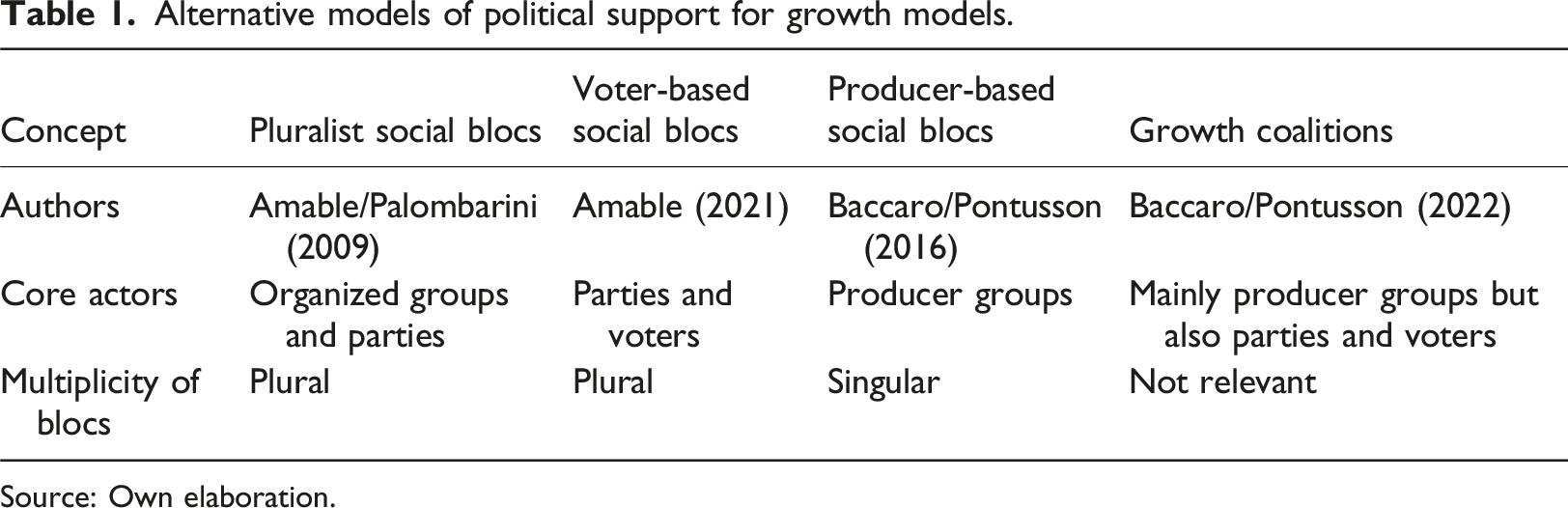
In the recent debate on social blocs in advanced economies, we can identify two strands of research: One highlights electoral cleavages, putting parties and voter preferences center stage (Amable and Palombarini, 2009: 131–132; Amable et al., 2012: 1176–1177; Amable, 2017, 2021; Amable and Darcillon, 2022; see also P. Hall, 2020, 2021); another one highlights sectoral industry cleavages, pointing to cross-class alliances and interest group lobbying (Thelen, 2019; Baccaro and Pontusson, 2019; Rothstein, 2022; see also Haffert and Mertens, 2021). Both approaches are not without problems (Baccaro et al., 2022: 32–34), particularly when applied to advanced peripheral economies. Most fundamentally, not all of the latter are democracies. And where democracies exist, programmatic, policy-based party competition tends to be weaker than in established democracies and political parties rely more heavily on clientelism or ethnic social networks to ensure voter support (Stokes et al., 2013; Wang and Kolev, 2018). Furthermore, most peripheral economies are characterized by weak trade unions and large informal sectors, while business sectors are often dominated by large multi-sector business groups and multinational corporations, where business associations play only minor roles (Puente and Schneider, 2020). Sectoral conflicts and cross-class alliances, therefore, are less salient in these settings.
Originally, however, the notion of “social bloc” was coined by the French Regulation School, in particular by Lipietz (1994) and further elaborated on by Amable and Palombarini (2009). The latter define a dominant social bloc as a “social alliance whose interests are protected by the public policy and which is sufficiently strong to politically validate such a policy” (Amable et al., 2012: 1169), or, in a more recent statement: “A social bloc gathers social groups that express different and sometimes antagonistic demands. It is unified by a political strategy that aims to satisfy the most important demands of the relevant social groups. The role of political leadership is to select among social demands those that will be satisfied and those that will be left out. This choice is made under different economic and internal compatibility constraints. Yet the main criterion that political actors consider is the ability of the different social groups to supply political support, which includes but is not limited to vote. […] A social bloc is dominant when the strategy that unifies its constituent groups is politically successful” (Amable, 2021, without pages).
In their reconstruction of the two antagonistic social blocs (Left vs Right) that competed for political dominance in post-War France until their break-up in the 1990s and 2000s, Amable and Palombarini (2009; Amable et al., 2012) focused on organized socioeconomic groups (capital factions and trade unions) and political parties as driving forces. Analyzing the reshuffling of the French party system after the 2012 presidential elections, Amable (2017: 84; 2021) more recently draws on individual voter preferences and survey data for the identification of a newly emerging “bloc bourgeois” which has supported the presidency of Emmanuel Macron. In this perspective, “[a]n individual’s position in the social structure is assumed to influence her or his expectations with respect to economic policy. These in turn determine the political preferences and the degree of support to the different parties. One can also take into consideration the direct effect of the social position on the political preferences, representing support not mediated by policy expectations” (Amable, 2017: 84). Whereas the earlier approach can be located somewhere between the strands of producer-group politics and electoral politics highlighted above, the latter approach clearly resonates with the electoral camp and marks a shift in theorizing about social blocs. Hence, we can distinguish between an “old” and a “new” conception here.
In both versions, however, a dominant social bloc is basically a coalition of groups which uses the political sphere to mold the economy according to their needs: “the institutional configuration of an economy depends on the formation of a stable dominant social bloc coalescing different socio-political groups prone to support a coalition with a certain political strategy. Implementing this strategy will lead to institutional change in a direction that is beneficial to the dominant social bloc” (Amable, 2003: 66). In such an approach, politics is merely an instrument to pursue economic interests which can be directly derived from one’s (individual or collective) position in the socioeconomic structure. The way coalitions come together and articulate their demands into the political sphere follows pluralist rules (Amable, 2003: 68). As a consequence, the analysis of the political aspect of growth models through the concept of “blocs” remains largely in the categories of coalitional dynamics, group conflict, and—in the later works of Amable and associates—voter preferences (Amable et al., 2012; Amable, 2019; Amable and Darcillon, 2022; see also Avlijaš et al., 2021: 418–9).
Baccaro and Pontusson’s early notion of social blocs draws heavily upon the conventional approach to politics in Comparative Political Economy that focuses on producer coalitions, or alliances of production-related groups in a broader sense (Baccaro and Pontusson, 2019: 11). They tentatively define social blocs as “coalitions of social forces, typically straddling the class divide, that can legitimately claim to represent the ‚national interest‘” (Baccaro and Pontusson, 2016: 26). At this stage, their idea of social blocs draws on the early work of Amable and Palombarini, on “dominant social blocs” (Amable and Palombarini, 2005, 2009).
From the outset, Baccaro and Pontusson have been clear that the concept of social blocs needs further development. For them, social blocs are not simply outcomes of pluralist coalition building but are characterized by internal hierarchies in which power within the bloc is distributed unevenly: “Relations of dominance reflect unequal exit options as well as unequal organizational resources and policy access among the groups that participate in the social bloc” (Baccaro and Pontusson, 2019: 11). From this follows that, unlike in Amable’s perspective, “there is only one social bloc in any given place and time” (ibid., Baccaro and Pontusson, 2018; see also Lipietz, 1994)—if there were multiple blocs competing for “ruling” the growth model, the analytical purchase of the social bloc concept vis-a-vis the producer coalitions approach would be lost. 1 For Baccaro and Pontusson, it is the very essence of bloc hegemony that unprivileged groups are incorporated, believing that rules and institutions are beneficial to them as well. They therefore depart from an instrumentalist notion of power towards an idea of structural power that resonates with the Gramscian idea of hegemony, although this remained, however, still underspecified (see below). In one place, hegemony loosely refers to the “ideational tradition” (Baccaro and Pontusson, 2019), particularly along the pluralist constructivist lines of Blyth (2002) or Schmidt (2008), in another, it is the discourse of a social bloc that needs to be hegemonic (Baccaro and Pontusson, 2018: 21). This loose specification has led to misunderstandings in subsequent research. Although the concept of hegemony in Gramsci has a strong ideational element, it goes further than “ideas matter.” As we will see, it crucially distinguishes ideology from common sense for which the aspects of civil society and intellectuals as brokers of common sense are essential.
In a nutshell, social blocs are therefore the coalitions in the sphere of production plus accompanying groups that are not part of the alliances in the first place: “social blocs might be conceived as enduring sectoral cross-class alliances between, on the one hand, groups of corporate owners and executive managers and, on the other hand, workers with sector-specific skills (i.e., skilled workers in most cases). But social blocs must include additional class segments – certainly, the affluent middle class – in order to be politically viable over extended periods of time” (Baccaro and Pontusson, 2019: 14). For the “old” Amable approach, social blocs are the extension of the cross-class alliances into the political sphere; for the Baccaro and Pontusson approach they are extensions of these alliances into other class segments. In the “new” Amable approach, cross-class alliances are largely abandoned and aggregated voter preference and occupational structures become key variables.
Alternative models of political support for growth models.
Source: Own elaboration.
The essence of the social bloc concept therefore does not differ a lot from the corporatist paradigm that focused on sectoral alliances and which has been dominant in CPE hitherto, only that the notion of social blocs indicates a somewhat broader stretch of producer groups’ influence. However, neither the scope nor the conditions for the efficacy of social blocs are specified. Correspondingly, we are not able to specify when we speak about social blocs or sectoral alliances only. This makes it possible for Rothstein (2022), for instance, to speak of “social blocs” composed of the tech and venture capital sectors in the Silicon Valley, whereas his analysis reads no different than other CPE studies on particular sectors—and rather fits much better with the later Baccaro and Pontusson concept of growth coalitions.
It seems that the hidden motivation behind contemporary Growth Model analysis and the idea of social blocs is to connect sectoral and macroeconomic analysis with broader socio-political dynamics in a way that extends previous CPE research. To some extent, this resonates with Robert Cox’ famous distinction between “problem-solving” and “critical theory” (1981) where the critical approach always aims to explain current phenomena in their historical and political contexts. For this, the macroeconomic analysis of the conditions of growth models would have to be accompanied by a similar macro-political analysis. This, however, requires a far more substantial modification of CPE’s toolkit. Turning to Gramscian concepts can be a reasonable step into such a direction, acknowledging Gramscian political theory, without at the same time sticking to an austere reading of Gramsci (Morton, 2003).
A Gramscian approach to social blocs
Many contributors to Growth Model analysis in recent years therefore made references to Antonio Gramsci or Gramscian concepts in general. Again, Baccaro and Pontusson argued that “growth models […] rest on ‘hegemonic sectoral blocs’” while “‘hegemonic’ and ‘bloc’ are meant to establish a link with Gramsci’s political theory” (2019: 18). Through invoking the concept of hegemony, they aimed to incorporate ideational and discursive aspects into Growth Model analysis. Although Baccaro and Pontusson now speak of “growth coalitions” (Baccaro et al., 2022; Baccaro and Pontusson, 2022), their reference to Gramscian concepts lives on and is inspiring numerous other works (e.g., Ban et al., 2023; Bohle and Regan, 2021; Germann, 2023; Rothstein, 2022).
The affinity of the Growth Model approach to Gramscian analysis is not least due to an implicit understanding of political economy that we know from Régulation Theory and other critical approaches: the need for socio-political stabilization of capitalist accumulation processes. Whether we approach accumulation through institutions (as in Amable and most Régulation Theory) or through growth models is secondary here: both share the general idea that accumulation cannot sustain without socio-political support. In this way, the Growth Model research program in CPE can be understood as a régulationist extension of the Growth Model agenda in Post-Keynesian Economics. Growth Model analysis is, similar to Régulation Theory, aware of the two spheres—macroeconomic dynamics and the socio-political sphere that stabilizes it—which immediately opens the inroad for a Gramscian take on growth models, because much of Gramsci’s work has been on the question of how structure (capitalism) and superstructure (politics and culture) are mutually related (see Femia, 1981; Francese, 2009; Liguori, 2015; Martin, 1998; Mouffe, 1979).
So how is Gramsci actually reflected in Growth Model analysis? Often, scholars of Growth Model analysis use terms that have a lexical affinity to Gramscian concepts, yet without fully employing their explanatory value. This refers particularly to the notion of “social blocs”: Gramsci developed the notion of social or “historic blocs” (“blocco storico”) in the context of his overarching question: why could the capitalist bourgeoisie successfully resist communist revolution in Western Europe and what political strategies are needed for politico-economic transformation? Although the rules of the economy are fundamentally superior to the political, it is not possible to derive political developments from it. There is a relative autonomy of politics and society and the open question was (and probably still is) how economy and politics are actually connected. This is the main question of the base-superstructure-problem: how to account for politics within a materialist ontology (Gramsci, 1971, 465ff; Q8 §182, Q10-II §12). Gramsci grappled intensively about this question, tentatively framing the superstructure as consisting of two levels: the political society (government and the ruling state apparatus) and civil society (the ensemble of “private” organisms; Gramsci, 1971: 365-6; Q12 §1; see also Cox, 1981, 167). For Gramsci, therefore, there is a realm of politics outside the state apparatus which is crucial in mediating economic conditions.
A historic bloc represents the unity of base (“structure”) and superstructure, where the socio-economic essence and its “ethico-political form” correspond (Gramsci, 1995: 360; Q10-I §13 N5, 376-7; Q7 §19). The rules of capital determine social dynamics in the first place, but a thorough social transformation depends on accompanying processes on the political, ideological, and cultural level. The main thrust of Gramsci’s work has thus been, arguably: one cannot forecast the future of capitalist development by reworking the calculations in “Capital” but needs to study politics and culture which—because of their relative autonomy—follow different rules (Crehan, 2002; Hall, 1986; Hall et al., 1978; Showstack Sassoon, 2000). A hegemonic bloc establishes when the dynamics of structure and superstructure closely work together. Thus, a Gramscian account rejects the simple derivation of political interests out of economic conditions but at the same time refrains from asserting that politics is completely autonomous from the economy. This means for our discussion: calculating growth contributions from national account statistics and finding perfect evidence for a growth model are not enough—we also need to prove that politics are geared towards that very model if it is to be of socio-economic relevance.
This is what Amable, Baccaro, Pontusson, and others are trying to show through the concept of social blocs. Yet, politics is more than parliaments, coalitions, and public opinions. Charismatic leadership, patrimonialism, nepotism, dictatorship, dirigisme, and many other expressions could also ensure the function of a growth regime: perhaps not in the traditional poster cases of Comparative Political Economy research but in many other parts of the world, in particular in advanced peripheral economies. Although this sounds trivial, growth models need to be understood in their social and political contexts. Crucial in this respect is the question whether the state is the prime orchestrator of social relations and how it is able to organize potentially diverging social forces.
Peripheral state-society complexes
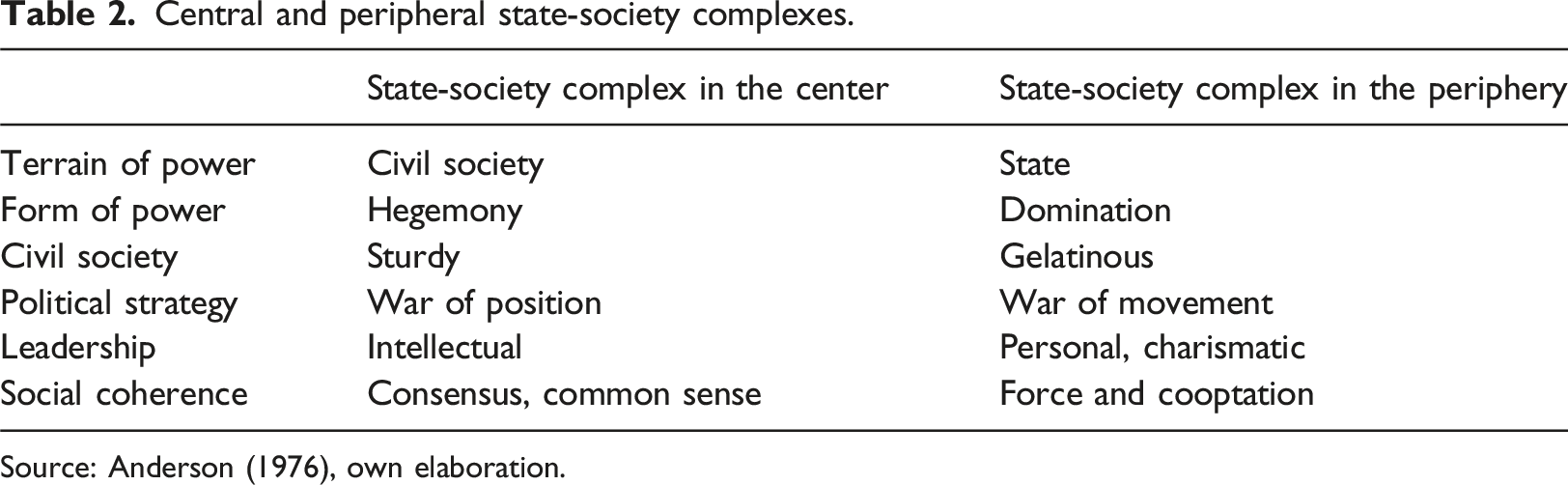
A Gramscian analysis therefore always starts with the analysis of the state-society-complex (Cox, 1981: 134ff). For Gramsci, social conditions differ and so does the nature of politics and capitalism (Bieler et al., 2015). In different state-society complexes, social and political power are differently located. He observed early that the Italian South, with a dominance of peasantry and the church as leading intellectual force, could not easily be subsumed under a communist strategy that had its base in the industrial proletariat of Northern Italy (Gramsci, 1994: 321-3). Similarly, the distinction between “East” (usually illustrated with the establishment of the Soviet Union) and “West” (with most references to Western Europe) is central to Gramsci’s thinking about the reasons for fundamental change—or the absence thereof (Anderson, 1976). In his famous analysis of the revolutionary situation, Gramsci concluded that “in the East, the state was everything, civil society was primordial and gelatinous; in the West, there was a proper relation between state and civil society, and when the state tottered, a sturdy structure of civil society was immediately revealed. The state was just a forward trench; behind it stood a succession of sturdy fortresses and emplacements” (Gramsci, 1971: 238; Q7 §16, Cox, 1981: 165). Here, “West” and “East” are less geographical labels, but rather a heuristic (Munck, 2013: 31), or “metaphors” (Hall, 1986: 17) with which Gramsci tried to grasp the social foundations of bourgeois rule and potential revolution. “West,” in the Gramscian sense, is then a question of organization, as where “mass socialist and labor movements” exist (Hobsbawm, 1982: 24-5); it stands for “a new terrain of politics, created by the emerging forms of state and civil society and new, more complex relations between them” (Hall, 1986: 18).
The Growth Model debate so far has ignored Gramsci’s differentiation of state-society-complexes and treated some of the concepts Gramsci had developed for the “West” as universal categories. This is important because the nature of state-society-complexes defines how the stabilization of a growth model can take place. For Gramsci, “the depth and breadth of societal and state structures [are linked] to particular forms of conflict, struggle, competition, and strife” (Fontana, 2010: 348). Although the dualistic fashion might first appear as too simplistic, Gramsci and others at least made a necessary distinction in the first place where others would just judge all political economies along Western measures. His analysis of the political situation in Russia and Northern and Southern Italy (Gramsci, 1971: 90–100; Q19 §26, Urbinati, 1998; Rosengarten, 2009) displays his “awareness of conditions of unequal development” (Morton, 2003: 135) or of “unequal geographies” (Said, 2000: 467) that was hitherto missing not only in Marxist theory but—for our purposes—also in contemporary Growth Model analysis. Whether the difference Gramsci made is laid out between West and East, or “weak” and “strong” states, respectively (Schecter, 2015), “center” and “periphery” (see, e.g., Showstack Sassoon, 2000: 66-7), or “liberal” and “statist” state-society-complexes (Van der Pijl, 1998), many would agree that strategies to acquire political support for a growth model (or any other form of capitalism) need to acknowledge the difference of political conditions.
Central and peripheral state-society complexes.
Source: Anderson (1976), own elaboration.
We will explain these concepts subsequently in more detail. The task is not to put country cases in categorial boxes for the sake of typologization, like in much Varieties of Capitalism analysis. Our argument is conceptual and is not meant to allocate countries to specific types. Similarly, these concepts must not be understood in an essentialist way. We put the main concepts into dualistic relationships (as Gramsci himself often did, see Said, 2000: 467), in order to highlight the analytical difference they entail.
Terrain of power: Civil society versus state
Gramsci argued that it was an appropriate revolutionary strategy to take over the state in Russia where all political power culminated within the state. In Western countries this strategy failed because political power was not only located in the state apparatus but also in civil society, understood as “the ensemble of organisms commonly called ‘private’” (Gramsci, 1971: 12, Q12 §1). “Civil society” here means more than “public sphere”: it refers to the establishment of the bourgeois society as an autonomous political arena that came into place with the Glorious Revolution in 1688. It manifested the rising power of merchants and traders (the bourgeoisie) vis-à-vis the aristocracy, which became ever more dependent on merchant’s credit. As a consequence, the newly formed bourgeoisie claimed for power while refraining from taking over the state: “From then on we can begin to speak of a civil society, a society from which the state has withdrawn” (Van der Pijl, 1998: 67 emphasis in original). In capitalist societies, civil society is the realm of power of the property-owning classes, or, in Gramsci’s words, the “private apparatus of hegemony” (Gramsci, 1971: 261, Q6 §137).
The state supports this mode of private power in the form of legal private property rights and by resorting to non-violent modes of political conflict in order not to inhibit private business. The 18th century then cemented the power of the property-owning classes through the development of Liberalism as a legitimizing philosophy. Liberalism essentially claims that power is not in the hands of particular people (monarchs and dictators) but a universal and impersonal property. Any social development is not made by men but by “invisible hands” (Smith), contracts (Locke), or human reason in general (Kant). The regions which are reigned by civil society constitute the “Lockean heartland,” whereas the other regions (the “Hobbesian contenders,” in the terminology of the Amsterdam School) are characterized by a statist social formation (Van der Pijl, 1998). The notion of civil society is essential for a Gramscian understanding of hegemony because it is the realm where hegemony is actually established. It is plain to see in the prison notebooks how Gramsci tried to come to terms with the relationship between the state and civil society, whether as analytically separate entities or as a totality of an “extended state” that comprises state-government and civil society as well (e.g., Gramsci, 1971: 262-3, Q6 §88). Essentially, however, any hegemonic strategy in the context of the “nature of modern state power” (Sassoon, 1982: 17) cannot be limited to the governmental apparatus. There are capitalists and political leaders, but there is also the “popular-national mass” (Gramsci, 1971: 204; Q14 §18), which stands behind and beyond the political avant-garde. In his famous diction, civil society is the trenches, where the “war of position” is fought out (Gramsci, 1971: 235; Q13 §24).
What does a Gramscian analysis of politics mean for the concept of social blocs, particularly in peripheral economies? First of all, it calls for a perspective on political power that goes beyond the state. For European or Northern American economies, this would mean to trace the activity of social blocs in civil society rather than just in the state apparatus. For advanced peripheral economies, which are beyond the Lockean heartland, bourgeois rule through civil society is limited. This does not mean that civil society is completely absent: it is simply not the major site of political power (Munck, 2013). At the same time, not all peripheral political economies are fully statist. We have strong statist state-society complexes in many parts of Asia, which are well studied. For example, the discussion on the “developmental state” in East Asia (Haggard, 2018) has amply demonstrated how important strong central leadership by the state has been for the establishment of successful growth models during the 20th Century. The more recent rise of “state-permeated capitalism” in China and India (Nölke et al., 2020) does not feature this type of strong central leadership, but rather informal networks of public–private coordination based on reciprocity (May et al., 2019). Similarly, civil society plays a minor role for political power in Arab “patrimonial capitalism” (Schlumberger, 2008) or “segmented market economies” (Hertog, 2022), where state classes are in charge. The same holds true for many former Soviet bloc countries, such as those in Eastern Europe, where the dominant FDI-led growth model was based on elite deals between multinational corporations and state officials (Bohle and Regan, 2021). Obviously, any social bloc in these economies would neither require parliamentary majorities, cross-class coalitions, or broad political support.
Other advanced peripheral countries, however, are mixed cases, characterized by a structural conflict between state and civil society as sites of political power. They saw the emergence of nuclear national capitalist classes, which, unlike in the Lockean heartland, failed to establish a thriving civil society as the terrain where their combined political power finds its place. Instead, different property-owning classes (e.g., agricultural lords and industrial capital) compete with each other about who can monopolize state power for their gains (Bresser-Pereira, 2015; Sierra, 2022). Here, instances of civil society do exist, but not as major sites of political power.
Political strategy: War of position versus war of movement
If a social bloc in a Gramscian sense is crucial for the attainment and stabilization of political power for a specific growth model, there are at least two ways to achieve it: through a sudden “war of movement” when the state-society-complex is tilted towards a strong state, or through a long-enduring “war of position” when civil society is dominant. A war of movement in which a revolution takes over the state apparatus “is appropriate where the state and civil society are less developed so that political power is more fragile and mass trade unions, pressure groups and party organizations are not yet developed”, (Sassoon, 1982 16).
In this militaristic analogy, hegemony can only be achieved when the trenches are won over in an enduring war of position which means winning over civil society. However, we already saw that a “sturdy” civil society in this sense only applies to a rather small selection of countries. We might imagine civil society to emerge wherever capitalist socialization spreads—in the liberal idea that economic growth leads to the establishment of a middle class with demands for participation and accountability. However, this cannot be generalized. Rather, we see many regions where a social struggle between statist rule and civil society endures over decades or longer. The political history of countries such as Brazil, Egypt, Malaysia, Mexico, or Turkey may serve as a case in point, with their alteration between civil and military rule and a powerful role of the military even under formally civil rule. Where the military continues to be an important power factor, it poses a constant threat of seizing the state and, thereby, limits the development of a Lockean civil society (Barany, 2012). In addition, authoritarian successor parties (parties that emerge from authoritarian regimes) are ubiquitous in many parts of the world and often establish authoritarian enclaves at the subnational level, defending the prerogatives of the military (Loxton, 2019).
Although Gramsci made this distinction within a strategy of communist revolution, it refers to the nature of political strategy in general that again differs between state-society-complexes (Cox, 1981: 165). Even where the peripheral state is less characterized by authoritarian but rather bureaucratic rule, this does not allow more space for civil society. We know about successful state-driven growth projects in Asia and beyond (see the previous section), which have been state-directed for a reason: because civil society in the bourgeois sense had not been unfolded as elsewhere. Even within the confines of advanced capitalist cases, the difference between, for example, France and Great Britain is telling. The power relation between state and civil society defines the nature of the political process: the more powerful civil society, the more a political strategy needs to achieve hegemony in the political, cultural, and ideological field, as in Great Britain. Where the state is stronger, the struggle for political power usually takes place within the confines of state institutions, as in France. While the difference between France and Britain is obvious, we can safely say that the variance between statist forms of political power is much greater once we expand the number of country cases towards advanced peripheral economies (Centeno et al., 2017). Social bloc analysis in a Gramscian way would have to take these different political strategies into account.
Form of power: Hegemony versus domination
A transformative strategy must take the different terrains of power into account. It is rather easy to overthrow a leader through a coup d’état, but one cannot overthrow a philosophy of free people and free enterprise in the same way. In the Lockean heartland, power must be won over in civil society to gain hegemony. The idea that a Gramscian analysis is always about hegemony, however, is misleading: hegemony is the predominant mode of social power in liberal capitalist societies whereas in most other cases, social power rests in the state or clans which rule by sheer domination. This is why Gramsci distinguished between ruling (which might simply occur through the coercive power of the state) and leadership (e.g., Gramsci, 1971: 12-3; Q12 §1).
Hegemony thus requires a foundation in civil society which depends on intellectual leadership that manifests itself in the common sense. Common sense are those ideologies that go without explanation, as they are perceived to be natural or universalist, for example, human rights, rule of law, and the public–private-distinction in advanced capitalist societies. Such a unified common sense is crucial to ensure widespread compliance to a particular social and economic model (Hobsbawm, 1982). While it is tempting to pinpoint business leaders as “intellectuals” and therefore claiming that their visions automatically represent the “hegemonic discourse,” there is more mileage to go from mere sectoral interests to a “vision of the world” (Amable, 2019: 435), from a sectoral business ideology towards a sedimented common sense that defines the world for the popular masses. 2 The neoliberal project achieved hegemony not least by the spread of a rationalist logic of homo oeconomicus across the population, manifesting inter alia in practices of self-optimization, where people strife to develop “unique selling points” and the “best version of oneself.” Persons perceive themselves as market participants, and life courses became projects that require thorough management. Where people become quasi-firms, neoliberal ideas appear as natural.
At this point, the difference between a Gramscian-based account of hegemony and the constructivist-inspired “ideational tradition” in Political Economy (Blyth, 2002; Schmidt, 2008) becomes clear: whereas the latter focuses largely on the emergence and diffusion of economic policy ideas that are relevant for political and economic elites in charge of institutional engineering, the former adopts a much broader and encompassing perspective which includes the national-popular masses and their ordinary lives (see also Germain and Kenny, 1998: 14; Lynch and Watson, 2022: 440). This is why Gramsci stressed the role of the peasantry and popular beliefs in the Italian question (Gramsci, 1971: 323; Q11 §12, Gramsci, 1994: 327-33). A fully established hegemony as cement for a social bloc has to reach out to those segments of society as well, providing world-views that prove meaningful every day.
Such a broad social embeddedness of a growth model is, however, rather rare. Germany can be considered as an example of such a tight connection between a pronounced export-led growth model and an exportist ideology that is manifested in common sense. The export-led growth model that has emerged in Germany after the Second World War is associated with an extremist ideology of exportism (Nölke, 2020). Exportism is a corporate ideology of particular business groups and parts of the mainstream media, but not of the average voter. Rather, the economic common sense of Germans consists of a fear of inflation, austerity, national superiority (“world export champion”), and a general suspicion against excessive debt. Although in normal times very much unfounded, the German ideology is obsessed with inflation that continuously threatens to destroy the wealth of Germans (Haffert et al., 2021). Germans have a self-understanding of a saving nation, which is why those savings are perceived to be constantly endangered. As savers, (excessive) debt is considered as problematic: “proper Germans” do not borrow extensively because a well-run household would not need to borrow. The “Leitbild” of German fiscal common sense is the thrifty housewife from Southern Germany (the “Swabian housewife”), who knows that one cannot spend more than one earns (Howarth and Rommerskirchen, 2013). This common sense metaphor not only provides ample support for austerity programs because it reduces complex fiscal matters to the level of a 5-year old child wondering what to do with its pocket money, but it also lends support for an exportist strategy because it tells citizens that they have to earn first (i.e., selling abroad) before they can buy something (i.e., import from abroad). Undervaluation of the domestic currency, another crucial element of an export-led growth model, often was defended by using religious categories such as “sin, guilt, and penitence” (Höpner, 2019: 25). We find an interdiscourse (i.e., the deliberate mix of genres and topics to create meaning beyond the actual text, see Fairclough, 1995) of economic policy, private household practices, and historical traditions that all add sense (or meaning) to the idea that exports are best for German prosperity. This belief is shared by Germans unintentionally because it is part of their common sense, their idea of how the world objectively exists. An exportist growth model with an accompanying ideology is compatible with that common sense whereas, for example, an investment-led model is not, because it would contradict the deeply engrained disdain against debt and (even moderate) inflation. The power of the export-oriented groups in Germany therefore is massive because their preferences are engraved in what ordinary people would perceive as “natural.”
The stabilization of growth models in advanced peripheral economies, however, usually goes without intellectual hegemony. Instead, the stability of a growth model often depends on domination. Amongst the most vivid examples are the authoritarian developmental states in South Korea, Taiwan, or Singapore, where the central governments effectively steered their export-led growth models by allocating funds to businesses in strategic sectors, investing in technology and suppressing trade unions (Haggard, 2018: 36-7). More recently, the Chinese state still exerts tight control over key economic institutions such as capital markets and steers economic actors’ business strategies via 5-year plans, managing to shift the nation’s growth model from exports and global integration to domestic consumption and increasing self-reliance (Petry, 2020; The Economist, 2021). In contemporary Hungary, a municipality such as Debrecen has no sufficient autonomy to give local development coalitions any substantial say in upgrading strategies (Volintiru et al., 2024). Importantly, the politics of a particular growth model can be dictated by the ruling forces because there is no need for the consent or tacit acceptance by the common people. From a Gramscian perspective, hegemony of a growth model requires sources of power that tend to be different in peripheral than in advanced economies: In the former, suppression and instrumental power are sufficient, while in the latter structural and discursive power are required for hegemony.
Leadership and social coherence: Common sense versus force and cooptation
This resonates with Gramsci’s distinction between rule and leadership. The powerful groups “rule” through the organization of the state, whereas they must “lead” if their power is based in civil society (Gramsci, 1971: 10-7, Q12 §1). Where civil society prevails, leadership takes on an intellectual form in which organic intellectuals actively shape and influence social ideologies and, more importantly, common sense (see Showstack Sassoon, 2000). It is crucial that the powerful groups take on leadership for the whole society, whether they rule in the state apparatus, or not.
A social bloc which grows “organically” and is broadly supported by civil society is more likely to remain a sturdy pillar of a growth model than one which is only supported by an ad hoc consensus. In the 1930s, when Gramsci analyzed the Italian situation, religion (i.e., the Catholic Church) and culture were central to the attainment of hegemony. Nowadays, the instruments might be different ones but the function is similar: Telling the people that particular world-views are actually universal ones. It is this universal concept of ideology as a “conception of the world that is implicitly manifest in art, in law, in economic activity and in all manifestations of individual and collective life” that serves as “cement” for the social bloc (Gramsci, 1971: 328, Q11 §12). “Hardening” of this cement requires a long process of social sedimentation. When a producer association claims that, for example, nanotechnology is crucial for the national well-being (Rothstein, 2022), it does not mean that the “popular mass” adopts this vision immediately. Ideology, in a Gramscian perspective, is less the articulation of corporate ideas but rather the “field in which class conflict takes place in particular forms” (Hall et al., 1978: 51). Where civil society is robust, such particular ideas need to be transformed and reformulated in order to connect with ordinary people. This is the task of organic intellectuals. Such intellectuals are not just academics or artists, but any instance that makes sense of the world as it is. Emerging from the popular masses themselves, they are crucial in developing a “common sense” (Gramsci, 1971: 330-3; Q11 §12).
In many advanced peripheral economies, however, power struggles are not based on ideologies and intellectual hegemony but rather on the fight for domination of the state. In those settings, where civil society is “gelatinous,” there are no grounds for a universal common sense and compliance is brought about through sheer force or various forms of cooptation such as clientelism or patronage. A social bloc underpinning a stable growth model in statist complexes, hence, more often will be based on such means of compliance. This holds especially in societies which are neither fully liberal nor statist. Where neither the rule of civil society nor state domination is guaranteed, power translates through “soft” political mechanisms: “Between consensus and force stands corruption-fraud,” where hegemony is difficult to achieve and the use of force is too dangerous (Gramsci, 1971: 80; Q13 §37). We find these modes of leadership and social cohesion in many peripheral societies. The dense personal and often family-based linkages between political and economic elites in highly unequal societies such as Brazil, Colombia, India, or Mexico facilitate the persistence of a given growth model despite of formal changes in government (Mertens et al., 2022). In China, where the Communist party is not only in charge of ruling the political system of the country but also sits on the boards of most of the major Chinese companies and has recently begun to establish party branches in private enterprises, the social bloc is potentially even more solid (Yan and Huang, 2017). In any event, given that a Lockean civil society is mostly absent, social blocs in these economies are formed around personal linkages between elites via direct command and force, or more indirect via reciprocal relations, such as the cooptation of domestic business by the Fidesz government in Hungary (Naczyk and Eihmanis, 2023). The popular masses are largely excluded from these processes. Again, broad support is less required in peripheral economies because often, elites are able to authoritatively rule a growth model.
Conclusion and implications
The study of social blocs has gained a renewed prominence in the context of the rise of Growth Model analysis in Comparative Political Economy. So far, most of these studies have focused on the economies of the center rather than on advanced peripheral economies. Our contribution probes the application of the social bloc concept in the latter context. For this purpose, we have taken stock of existing studies that apply the social bloc concept in Growth Model analyses and have identified the most important applications. We also have taken a closer look at the definition, theoretical status, and link to growth models in the existing study of social blocs within the center economies. Based on this, we suggested a more detailed reading of the origins of the concept of social bloc in Gramscian thought. If we are about to expand the Growth Model approach to peripheral economies and want to retain the concept of social blocs for the analysis of the politics of growth models, we should be more precise with regard to the theoretical implications that a Gramscian take on politics entails.
Our approach highlights several analytical concepts that are still absent from the current discussion. First, we highlighted the fact that Gramsci’s analysis focuses on “state-society complexes,” with a potentially important role for the state apparatus as such, and the interplay between civil society and the state. Second, we pointed to Gramsci’s notion of the “terrain of power,” that is, the realm where political power is located and where the struggle over it takes place. This is closely related to, third, the form power takes in different contexts, be it more through hegemony or domination. Fourth, we argued that Gramsci’s concept of civil society is frequently misunderstood and more complex, especially for analyses of advanced peripheral economies. In the latter, fifth, political strategies will mostly take the form of sudden “wars of movement” instead of “wars of position,” as in the civil societies of core economies. Sixth, we argued that social coherence can be achieved either through common sense, organized by “organic intellectuals,” or outright force and cooptation.
While parts of the Comparative Political Economy literature have moved away from the Gramsci-inspired notion of social blocs and turned to “growth coalitions,” we argue that our conceptual considerations are still helpful for this discussion. Rather than discarding Gramscian conceptualizations for pragmatic reasons (such as the tricky measurement of “civil society” or “common sense”), we argue instead to incorporate Gramscian ways of analysis into the Growth Model approach—not least because we see the similarities between, for example, the Régulation and Growth Model approaches with regard to the question of how politico-economic structures are politically stabilized (see also Amable, 2022). We have shown that a Gramscian take on this fundamental question adds significant analytical leverage and, therefore, can be very useful for Growth Model analysis and beyond.
Our contribution is twofold. On the one side, we have demonstrated that Gramsci pointed towards potentially very different forms of state-society complexes. Whether we draw on Gramsci’s differentiation between “East” and “West,” or between liberal or statist societies: we need different analytical instruments when dealing with the political side of advanced peripheral growth models to avoid a Western-centric analysis. More specifically, the most widely used notions of intellectual hegemony in civil society refer to the established state-society complexes in the West and may not necessarily be applied with the same analytical currency in more statist state-society complexes. However, many political systems will be mixed cases and Gramsci’s categories may often also be useful for the analysis of political systems in the advanced economies.
On the other side, we have argued that the Gramscian notion of a hegemonic “social bloc” should be reserved to depict rare situations where the dynamics of structure (growth model) and superstructure (politics and culture) work tightly together, with a very high degree of congruence. Thus, the notion of two competing social blocs is inappropriate if “social bloc” refers to Gramsci’s understanding of the term. There can only be one hegemonic social bloc in a country at a given point in time if there is a hegemonic bloc at all. Correspondingly, it makes a lot of sense to search for different analytical terms—such as “growth coalitions” (Baccaro et al., 2022; Baccaro and Pontusson, 2022; Hopkin and Voss, 2022) or simply “classes” (Amable and Darcillon, 2022: 1348)—to depict struggles for political dominance in highly divided pluralist settings.
Footnotes
Declaration of conflicting interests
The author(s) declared no potential conflicts of interest with respect to the research, authorship, and/or publication of this article.
Funding
The author(s) received no financial support for the research, authorship, and/or publication of this article.
