




Abstract
The Great Recession renewed calls for a return of state activism in support of the European economy. The widespread nationalizations of ailing companies and the growing activism of national development banks led many to celebrate the re-appearance of industrial policy. Despite this reappraisal, however, comparative political economy (CPE) contributions to the study of industrial policy are still scarce. This review article critically overviews the existing literature linking CPE and industrial policy meeting three goals. First, to trace the evolution of the goals, protagonists, and policy instruments of industrial policy in the European Union (EU) since the post-war period. Second, to provide a periodization of the evolution of industrial policy based on the distinction between the inward-looking forms of state intervention prevalent until the late 1970s and the open-market industrial policy of later decades. Third, to outline future research pathways based on the integration between CPE, heterodox economics, and economic geography.
Keywords
Introduction
Over the last decade industrial policy has become something of a buzzword in debates about the European economy. This revival was mainly caused by the dramatic economic repercussions of the Great Recession, which called into question the neo-liberal consensus and forced even the US and the UK to bail out large domestic banks and struggling car-markers. Despite the fact that these operations were deemed to be temporary, governments of many advanced capitalist economies still retain participations acquired at the peak of the crisis (Szalavetz, 2015).
Like the Great Recession, the recent COVID-19 emergency prompted once again calls for the state to play a more activist role in the economy. The European Commission lifted state aid restrictions and allowed, even encouraged, member states to acquire stakes in strategic companies to fend-off takeover attempts by Chinese cash-rich state-backed giants (Financial Times, 2020a, 2020b).
Despite this recent reappraisal, however, comparative political economy (CPE) 1 still pays limited attention to industrial policy. This is puzzling, as many early seminal contributions to the field were devoted to the study of different forms of state intervention across Europe (Hall, 1986; Katzenstein, 1978, 1985; Shonfield, 1965; Zysman, 1984). This literature review constitutes an attempt to refocus the CPE debate on the study of industrial policy by relying on insights from the heterodox economics and economic geography literatures. Concretely, this is done by fulfilling three objectives. First, taking a long-term historical perspective the paper reviews the evolution of the goals, protagonists and policy instruments of industrial policy in the European Union since the post-war period. Second, it shows how the Great Recession did not mark a watershed moment for industrial policy (Szalavetz, 2015), but was rather the latest step of a process of reconfiguration of the role of the state in the economy dating back to the transition from the Fordist to the Post-Fordist 2 model of production in the 1970s. Third, by engaging with insights from heterodox economics and economic geography it lays the groundwork for a better integration of the study of industrial policy, and state intervention more in general, within current debates on comparative capitalism.
The rest of the literature review is organized as follows. Section two provides a definition of industrial policy, reflects on the fading attention for the topic within the field of CPE, and highlights how industrial policy is currently shaped by the bilateral interactions between state actors and large corporations. The third and fourth sections take an historical perspective to critically overview the existing literature linking CPE and industrial policy. This allows to trace the evolution of the goals, protagonists, and policy instruments of industrial policy since the post-war period. The third section reviews the main elements of the inward-looking patterns of state intervention characterizing the first three post-war decades. The fourth section argues that the transition from the Fordist to the Post-Fordist production system caused the decline of inward-looking industrial policy and the emergence of new open-market patterns of state intervention characterized by new goals, protagonists and policy instruments. The fifth and concluding section outlines ideas for a research agenda linking CPE and industrial policy that draws on two key concepts borrowed from heterodox economics and economic geography: place-based interventions and conditionality.
Industrial policy: What it is and why it was marginalized within the CPE debate?
Industrial policy is defined as “any type of intervention or government policy that attempts to improve the business environment or to alter the structure of economic activity toward sectors, technologies, or tasks that are expected to offer better prospects for economic growth or societal welfare than would occur in the absence of such intervention” (Warwick, 2013: 16). It is therefore in its essence a process of “institutional engineering” aimed at shaping the nature of the economy (Cimoli et al., 2009: 2–3). Many different state actors can engage in industrial policy interventions, from the central government, to regional or municipal authorities, from state-owned development banks, to sovereign wealth funds and unelected specialized investment or developmental agencies.
Industrial policy can be conducted using a variety of direct and indirect instruments including grants, subsidies, tax credits, low-interest loans, public guarantees, procurements, credit provisions, and equity investments (Bianchi and Labory, 2006b; Cimoli et al., 2009; For an overview see Warwick, 2013 p. 25–27). The goal of state intervention is typically to support “specific sectors, technologies or areas of economic activity, such as advanced manufacturing, knowledge-intensive business services or the ‘green’ economy, with the aim of fostering new sources of economic growth” (Warwick, 2013: p. 7). Upgrading can be either achieved strengthening existing comparative advantages, or targeting new sectors or activities (Bianchi and Labory, 2006b: 606; Warwick, 2013). The expected industrial upgrade is ultimately meant to serve long-term economic policy goals such as fostering employment, growth, and export-competitiveness (Katzenstein, 1985, 25). However, states make also frequent use of defensive industrial policy measures aimed at restructuring declining industries (Bianchi and Labory, 2006b: 605). Irrespective of the orientation a key element of industrial policy is its territorial element, with state actors engaging in interventions “in favour of particular social groups, firms or sectors understood by the decision-makers as insiders because of their territorial status” (Clift and Woll, 2012, 308).
While neoclassical economics justifies industrial policy only as a fix to market failures, the motives for state intervention are more complex and diverse. They include the following: responding to deep structural shifts in the domestic and international economy, triggered by phenomena like globalization, the IT revolution, or more recently Industry 4.0 (Bailey et al., 2019b; Bianchi and Labory, 2006b, 2019a; Durazzi, 2021; Oqubay, 2020); tackling societal challenges like global pandemics or climate change (Warwick, 2013); restructuring the economy in the aftermath of shocks like the global financial crisis or the current COVID-19 pandemic (Bailey et al., 2015); and reducing the competitiveness gap vis-à-vis a foreign competitors 3 (Bianchi and Labory, 2006b; Shonfield, 1965).
Given its explicit focus on the interaction between the economy and politics, CPE as a discipline is in principle particularly well-equipped to study industrial policy. And, indeed, throughout the 1970s and 1980s industrial policy, mainly intended as the capacity of state actors to influence industrial outcomes, was at the center of a stimulating debate between the founding fathers of the study of comparative capitalism (Katzenstein, 1978, 1985; Shonfield, 1965; Zysman, 1984).
However, since the 1980s the deepening of the process of EU market integration, coupled with the global push towards privatizations, liberalizations and the rise to prominence of unelected regulatory agencies caused the decline of post-war industrial policy (see section 3). This apparent retreat of the state, coupled with the widespread diffusion of neo-liberal predicaments about the inefficiency of state intervention led policy-makers and academics alike to progressively shift their attention away from industrial policy, and state intervention more in general (Clift and Woll, 2012: 307–309). Within the field of CPE this attitude is best epitomized by the highly influential Varieties of Capitalism 4 (VoC) framework (Hall and Soskice, 2001). In the introduction to their seminal volume, Hall and Soskice criticize the state-centered literature of the 1970s and 1980s for overstating the capacity of state actors to influence economic outcomes, in particular in a context of economic openness, advocating instead for the adoption of a firm-centered perspective (Hall and Soskice, 2001: p. 4).
The defining impact VoC had on CPE (See Nölke, 2016; Streeck, 2010) confined industrial policy, and the study of the role of the state more in general, to a marginal role in debates about the institutional features of European capitalism(s). Many prominent contributors within the field proclaimed the disappearance of industrial policy among developed economies (Häusermann and Kriesi, 2015: 208; Leibfried et al., 2015; Levy, 2006). Parallel, and partly connected, to this decline of interest, was the emergence of a stimulating debate among CPE and IPE scholars on state-led developmental experiments in rising economies like Korea, India, and more recently Brazil and China (Ban, 2013; Ban and Blyth, 2013; Evans, 2012; Nölke et al., 2015; Schrank and Kurtz, 2005). Despite the important merit of broadening the geographical scope of CPE beyond Western developed economies, this refocus came at the cost of neglecting the efforts the old states of Europe were making to engineer new forms of industrial policy compatible with the Post-Fordist regulatory framework (However see Clift and Woll, 2012; Naqvi et al., 2018; Ornston and Vail, 2016; Schmidt, 2009). The recent Growth Model (GM) (Baccaro and Pontusson, 2016) 5 theory has continued in this tradition, rightly emphasizing the importance of macroeconomic policy and its repercussion on growth patterns while remaining silent about industrial policy (However see Bohle and Regan, 2021). This is an important omission, as industrial policies are decisive in helping the adaptation of core economic sectors to structural shifts in the international economy and in favoring the transition to new areas of sectoral competitiveness—two dynamics that in turns shape the emergence, transformation, and adjustment of GM.
Consequently, despite signs of a recent reappraisal (Brazys and Regan, 2017; Clift and Woll, 2012; Clifton et al., 2010; Colli et al., 2014; Iversen and Soskice, 2019; Mertens et al., 2021; Ornston and Vail, 2016; Thatcher, 2014b), industrial policy is still understudied among scholars of comparative capitalism and EU public policy. This is regrettable, as the pervasiveness of supranational market integration makes the European economic space an ideal vantage point to study patterns of state intervention. In fact, the many multi-level overlaps between economic and judicial spaces of competence resulting from market integration alter the patterns of state intervention in a non-univocal matter (Scharpf, 2002: Chapter two). While on the one hand, the EU competition policy and state aid regimes constrain member states in the range of policy instruments they can deploy to support selected sectors or industries (Clift and Woll, 2012; Jabko, 2006), on the other the opening of formerly protected markets to competition broadens the geographical and sectoral scope of state intervention allowing for the adoption of outward-looking industrial policy strategies (Colli et al., 2014; Di Giulio, 2018; Thatcher, 2014b).
A less pessimistic take on industrial policy has it that the transition from the Fordist to the Post-Fordist model of production led to the demise of “vertical” industrial policies targeted at specific firms or sectors, in favor of pro-business “horizontal” interventions.
Within the EU, 6 the European Commission has emerged since the 1980s as the main advocate of horizontal industrial policy (Pianta, 2014, 278–279). Underlying this shift of focus, is the idea that, rather than “picking winners,” state actors should implement measures aimed at establishing framework conditions favorable for all companies (Warwick, 2013: 13). Prescribed horizontal measures, heavily inspired by then-dominant Washington Consensus, include reducing corporate taxation, strengthening the education and vocational training system, improving the infrastructural network, and loosening labor market regulations (Aiginger and Rodrik, 2020: 195; Wade, 2012: 226).
However, although few would deny that state actors increasingly revert to pro-business horizontal policies, this did not lead to the demise of vertical measures targeted at specific firms or sectors altogether. In fact, since the early 2000s even the Commission acknowledged this reality, taking a more pragmatic approach and explicitly recognizing the importance of more vertical and place-based measures (Pelkmans, 2006; Landesmann and Stöllinger, 2020)—aggressively pursued through the Smart Specialization Strategy (S3) (Barzotto et al., 2020). 7 In fact, in a globally interconnected economy dominated by a handful of corporate giants, industrial policy increasingly takes the form of bilateral interactions between state elites and large transnational corporations (Babic et al., 2017; Berry, 2021; Brazys and Regan, 2017: 411–417; Colli et al., 2014: 488–495)—which are quintessentially vertical in their nature and are generally characterized by a power asymmetry in favor of large corporate actors (Cowling and Tomlinson, 2011: 836–837). In their interactions with state actors, large corporations are favored by two key power resources: their large financial means and the availability of multiple investment destinations. Their global reach gives MNEs the possibility to follow a “divide and rule” strategy putting states, regions and cities in competition with each other to attract investment and leading to the awarding of ever-more generous subsidies and tax exemptions (Cowling and Tomlinson, 2005: 44–45), in a dynamic that is further accentuated by the process of transnational market integration in the EU. As it will be argued in the concluding section, the fundamentally unbalanced nature of this relationship calls for a serious engagement with the issue of conditionality, that is to say the establishment and enforcement of rules to reduce the conflict of interest between corporate and state actors (Maggor, 2021).
Inward-looking industrial policy: From the post-war period to the demise of fordism
A rich literature details the decisive role state actors played in the reconstruction of the European economy after the Second World War (Linsi, 2020: 866–868; Shonfield, 1965; Warlouzet, 2017, Introduction). Industrial policy is identified as a key pillar of the economic order underpinned by the Fordist production regime and Keynesian-inspired macroeconomic policies (Buch-Hansen and Wigger, 2010, 26). In this phase, state intervention mainly focused on developing a solid manufacturing base in sectors like steel, car-making and chemicals, with the attention gradually shifting since the 1970s towards electronics, aircraft, and biotechnology (Pianta, 2014, 277–278).
Industrial policy in this phase can be portrayed as inward-looking as the ultimate goal of state intervention was to protect the domestic economy from foreign interferences, while attempting to reduce regional disparities in economic development, foster employment, and ensure the provision of basic services to the entire population (Scharpf, 2002: Chapter two). Between the 1950s and the 1970s, member states faced limited restrictions to their capacity for economic intervention, as European integration did not affect the co-existence of heterogeneous models of capitalism (Höpner and Schäfer, 2010: 349).
Behind “semi-permeable economic boundaries” (Scharpf and Schmidt, 2000, 25) member states could therefore deploy an array of selective and interventionist (Bianchi and Labory, 2006b, 2019a) policy instruments to strengthen strategic sectors including state-owned enterprises, credit rationing, long-term planning, legal monopolies and merger control. Firms, industries, or sectors could be subsidized via state-led circuits of credit as in France and Spain (Monnet, 2018; Pérez, 1997; Zysman, 1984), state-owned banks as in Italy (Deeg, 2005), private banks providing long-term lending, or subsidized export credit lines as in Germany (Höpner and Krempel, 2004; Naqvi et al., 2018, 676–677).
National champions are often presented in the literature as the undisputed protagonists of post-war industrial policy (Hayward, 1995). Across Europe, strategic sectors like gas, electricity, railways, banking, and telecommunications were dominated by state-owned monopolists tasked with fulfilling “public service” obligations (Majone, 1997, 144; Thatcher, 2007, Introduction). Until the emergence of the European competition policy regime in the 1980s (Buch-Hansen and Wigger, 2010), member states leveraged their full regulatory authority over domestic mergers to speed-up industrial consolidation in strategic sectors (Hall, 1986: Chapter six). Historical analyses highlight how, after the first oil shock and the consequent slow-down of the post-war boom, state intervention was retooled to support declining industries like steel, shipbuilding, and textile with measures of defensive industrial policy (Moraitis, 2020; Warlouzet, 2017: Chapter five).
In terms of the protagonists, the existing literature finds that in the post-war period the priorities of industrial policy were still largely defined by the central government. Although managers of state-owned companies and planning bureaucrats could enjoy a certain degree of autonomy in implementing day-to-day market interventions (Barca, 2010: Chapter 1; Hall, 1986: Chapters 6 and 7; Shonfield, 1965: 71–236), there was widespread agreement on the fact that governments should have a say in defining long-term industrial priorities, and most executives around Europe had a Ministry devoted to the administration of state-owned companies.
The crisis of the Fordist wage-led production regime since the mid-1970s triggered a series of interrelated events that ultimately sanctioned the demise of post-war industrial policy (Bianchi and Labory, 2006b; Moraitis, 2020: 555–556). These include the following: the abandonment of Keynesian macroeconomic management in favor of inflation targeting by independent central banks; the underperformance of many state-owned enterprises, whose losses started weighting heavily on public finances given the low growth environment (Bianchi and Labory, 2006b Ch. 1); the globalization—and later regionalization—of value chains, and the consequent emergence of new economic powerhouses like China (Oqubay, 2020); the hegemonic diffusion of neo-liberal predicaments leading to the liberalization and privatization of public service industries including financial services, air, road, and rail transport, telecommunications, and energy (Cowling and Tomlinson, 2011; Scharpf, 2002: 647); and the anti-dirigiste turn (Clift, 2013, 110) taken by the process of European integration with the Cassis de Dijon ruling which paved the way for the adoption of the SEA and the Single Market Project (Scharpf, 2002, Ch. 2; Hoepner and Schafer, 2010, 349–351).
The combination of these factors made the pursuit of inward-looking investment strategies untenable (Scharpf and Schmidt, 2000: Chapter 2). The consequent proliferation of cross-border capital inflows put member states in direct competition with each other for attracting FDI from large corporations (Reurink and Garcia-Bernardo, 2021). These deep structural shifts in the global economy called member states to develop new forms of industrial policy.
Open-market industrial policy and its main features
The evolution of industrial policy since the post-war period.
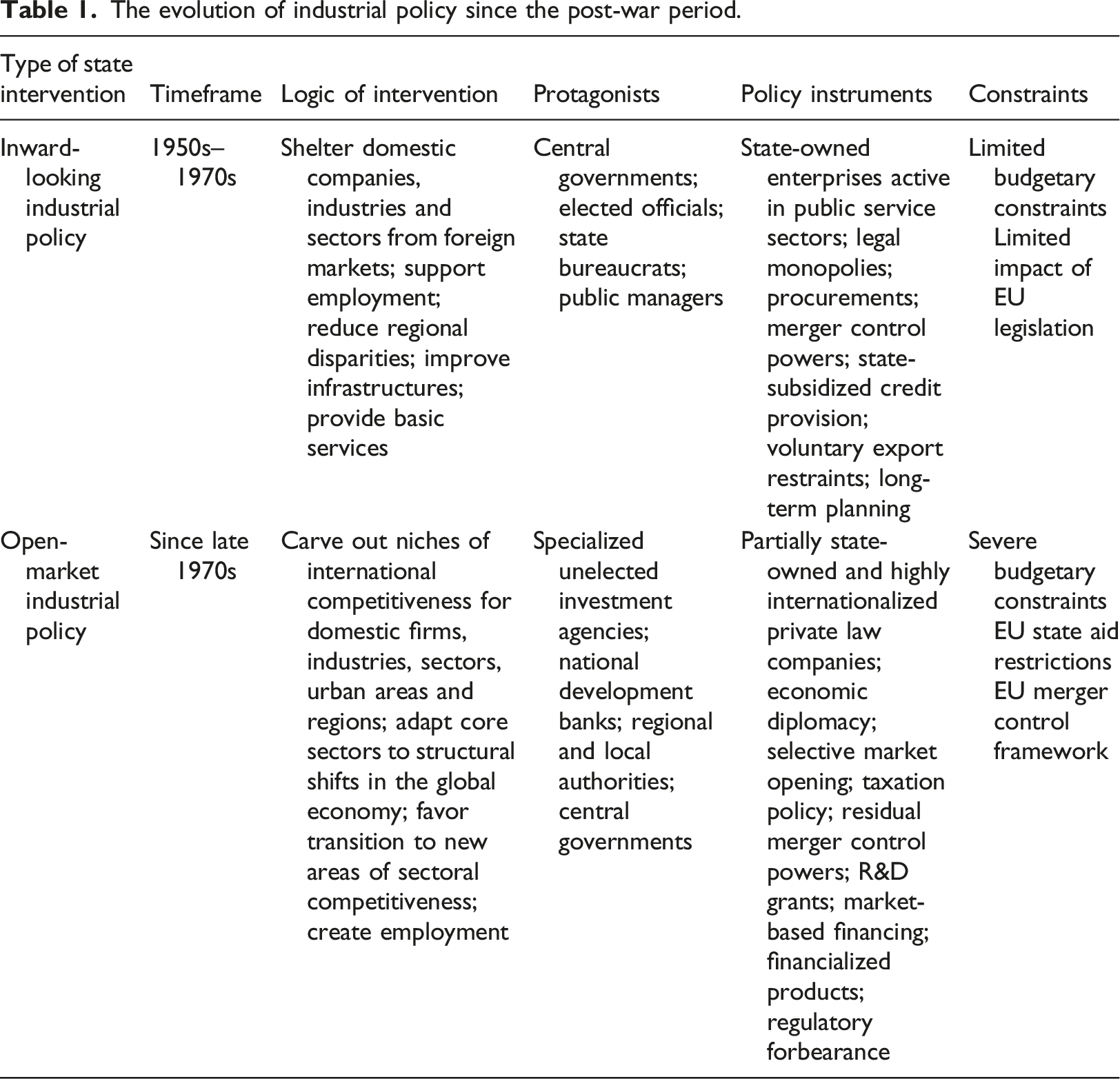
This new, more indirect, form of industrial policy centers on an unbalanced bilateral interaction between state actors and large corporations, whose success crucially depends on state’s capacity to establish and enforce strong conditionality (See Pathways for future research: Integrating CPE, heterodox economis, and economic geography). A quantitative overview covering all OECD countries shows how growing budgetary constraints restricted the use of direct policy instruments of industrial policy like state ownership and subsidies (Zohlnhöfer et al., 2018). These restrictions, coupled with the emergence at the European and global level of a regulatory environment limiting the scope for the implementation of discriminatory policies, meant that industrial policy interventions had to become more pragmatic, creative, and indirect. 8 Member states had to find creative ways to support strategic sectors and firms by combining vertical measures, horizontal measures and selective liberalization (Bianchi and Labory, 2006a: 619–620; Bianchi and Labory, 2006b Ch. 1; Clift and Woll, 2012; Dewey and Di Carlo).
EU member states designed a series of fiscally neutral instruments to support their economy (Clift and Woll, 2012; Thatcher, 2014b). For instance, tax policy has been identified as a key tool for mid-range interventions aimed at favoring specific sectors, industries, or firms on account of its less evident fiscal repercussions (Haffert, 2021; Katzenstein, 1978, Introduction). Similarly, a recent study finds how regulatory forbearance replaced direct subsidies as a tool to promote the development of specific sectors or firms when state actors lack the fiscal space and legal competence to do so (Dewey and Di Carlo, 2021). Fiscal constraints also pushed state actors to intervene in the market through the deployment of financialized products like public-private partnerships, derivatives and leveraged instruments (Lagna, 2016; Nölke, 2014, Introduction). In terms of the specific state actors engaging in economic intervention, existing studies observe in this phase a triple process of decentralization, technocratisation and Europeanization with a relative decline in the importance of central government counterbalanced by a growing activism among subnational authorities, unelected specialized agencies and EU authorities like the Commission and the European Investment Bank (Bianchi and Labory, 2006b; Block, 2008; Mertens and Thiemann, 2019; Szalavetz, 2015: 76).
One should note, however, that even though direct instruments like equity investments or subsidies were less widespread, they did not disappear. In fact, behind the rhetoric of free markets, even the most liberally minded member states continued to engage sotto voce in interventionist policies (Bailey et al., 2015; Bianchi and Labory, 2006a: 24; Cimoli et al., 2009), as confirmed by the evolution of EU state aid figures (Bianchi and Labory, 2006a: 611–613). The Commission could even tolerate these measures when they allowed to fulfill long-term integrationist goals like the emergence of high-tech clusters or the creation of globally successful European companies. In those instances, to paraphrase Amsden and Hikino, the liberal bark of the EU appeared worse than its bite (Amsden and Hikino, 2000: 110).
The remainder of this section describes in more detail the main features of this second generation of industrial policy by focusing on two forms of state intervention frequently discussed in the literature: the internationalization of formerly protected national champions and the emergence of FDI-dependent industrial clusters. These two forms of open-market industrial policy differ in the sectoral scope of state intervention. While in the first instance state actors help the adaptation of historically competitive sectors to structural shifts in the international economy, in the second they favor the transition to new areas of sectoral competitiveness.
The commanding heights of the economy: From nurturing domestic champions to creating global firms
Sectors like electricity, telecommunications, gas, banking, and air transport make a large chunk of the European economy. State-owned monopolists active in sheltered public service industries played a decisive role in the post-war recovery of the European economy. Their strategic importance went beyond the provision of essential services, as governments used these state-owned giants as vehicle to support domestic demand and employment (Hayward, 1995; Zohlnhöfer et al., 2018). Given the pivotal importance of these sectors, their progressive marketization and opening to international competition led to a radical rethinking of the role of the state across all advanced economies. Formerly populated by inefficient inward-looking lame ducks, public services are now home to many of the largest and most dynamics EU multinationals. The existing literature (Bulfone, 2019, 2020; Clifton et al., 2010, 2011; Colli et al., 2014; Thatcher, 2014a) connects the emergence of global leaders like Deutsche Telekom, Telefonica, EDF, ENEL, BNP Paribas, or Banco Santander with the progressive opening to competition of service industries that has been taking place since the mid-1980s on the initiative of the European Commission (Jabko, 2006; Schmidt, 1998). The Commission supported market integration as a way to realize its long-term ambition to have European champions capable of competing on an equal footing with American and Japanese service multinationals (Clifton et al., 2010, 988–990; Shonfield, 1965, 376; Thatcher, 2014a, 443–448). The liberalization of entry regulation and the consequent cross-border integration of the EU market meant that the most efficient national champions could expand abroad taking over foreign competitors 9 (Clifton et al., 2010; Colli et al., 2014; Hayward, 1995). Large and economically powerful member states deployed an array of policy instruments to make sure their domestic firms would emerge victorious from the wave of consolidation that followed market integration.
The gradual pace of market integration favored the implementation of activist industrial policy measures, allowing member states to shape domestic liberalization in a way so as to favor home-based incumbents (Colli et al., 2014; Thatcher, 2014b). In this sense, “protectionist liberalization” (Etchemendy, 2004: 623–626) itself has been identified as a key ingredient of an industrial policy strategy mixing stick and carrot. On one hand, state authorities could use selective market opening to force domestic incumbents and their management to seek investment opportunities abroad. This is the case, for instance, in the energy sector where governments forced former monopolists to shed part of their productive capacity to make space for new market entrants (Bergami et al., 2012, 31–36).
On the other hand, liberalization was not pushed to the extreme as state authorities delayed the dismantling of some protectionist measures to make sure that incumbents retained an important advantage vis-à-vis new entrants (Clifton et al., 2010, 1002–1003). Clifton et al. (2010) identify the capacity of governments and other state regulators to strike this difficult balance between market opening and incumbent protection as one of the decisive factors behind successful internationalization (Clifton et al., 2010: pp. 1002–1004). This pattern of protectionist liberalization unavoidably created tensions between the management of domestic companies and the newly established independent regulatory authorities, eager to speed-up market liberalization. In their role as arbiter, governments would typically side with the former.
Despite the fact that public service providers went from being departmental agencies incorporated within the public administration to private law companies, direct state ownership did not disappear (Schmitt, 2013, 552). Many electricity, telecommunications, railways, and air transport companies across Europe still have the state as the largest shareholder today. Even in cases in which direct ownership is limited to a small participation, governments can retain a firm grasp over strategic firms via control-enhancing measures like dual voting shares, poison pills or voting caps (Hayward, 1995, 351).
Although a recent quantitative analysis covering a large sample of energy and telecommunications companies from 20 OECD countries finds that the relationship between state ownership and successful internationalization is inconclusive (Mariotti and Marzano, 2019), qualitative case-base studies highlight how most leading EU companies in sectors like electricity, air transport, railways, and telecommunications are still partially state-owned (Colli et al., 2014: 496–500). These studies identify direct state ownership, or more rarely the provision of patient capital by private investors loyal to the state 10 as a decisive factor behind successful internationalization (Bulfone, 2019, 2020). This is due to the fact that the transition from sheltered monopolist to successful private law multinational is less difficult when managers can rely on the protection from long-term investors willing to shoulder the short-term losses unavoidably inherent to the process of industrial restructuring (Bulfone, 2019; Nölke, 2014: 189).
Along with direct share ownership the available literature finds that state actors deployed as well their (residual) regulatory power over domestic mergers to favor domestic consolidation. For instance, throughout the 1990s the German and Spanish authorities favored a process of sheltered consolidation among regional electricity companies that was aimed at favoring the emergence of two large competitors per country (Colli et al., 2014, 500–502; Mariotti and Marzano, 2019, 677–678). A similar dynamic of sheltered consolidation occurred across the entire EU in the banking sector (Goyer and Valdivielso del Real, 2014; Pérez, 1997).
The growing foreign activism of incumbents made economic diplomacy a central tool of state intervention. Economic diplomacy is particularly important in network industries and other service sectors characterized by high sunk costs, as foreign acquisitions are the preferred form of internationalization. Cross-border takeover battles involving iconic national champions are likely to spark outraged reactions from the public, forcing the central government to take position on the issue. In this context, the negotiating skills of elected officials and diplomats might prove decisive in determining the successful outcome of a foreign takeover (Colli et al., 2014, 492–493; Prontera, 2018, 516–520). While high profile takeovers will be dealt with directly by central governments on a bilateral basis (Chari, 2015; Prontera, 2018), other state actors can engage in diplomatic efforts to support strategic firms before the Commission or the European Court of Justice (Fioretos, 2011).
Compared to the Fordist era, from the 1980s national champions had to seek for new forms of financing. The separate circuits of credit allocation used to channel subsidized financing towards strategic companies or industries were dismantled (Deeg and Perez, 2000, 136–141), while the liberalization of banking meant that state-owned banks were privatized and forced to operate at market conditions. Existing studies highlight the role of NDBs in filling this financing gap by stepping up their export credit capacity. However, NDBs are restricted in their activity by the obligation to abide by state aid regulations (Bulfone and Di Carlo, 2021; Mertens et al., 2021). Consequently, strategic firms were encouraged to embrace market-based financing strategies such as multiple listings (Clifton et al., 2011, 771–773).
Successful internationalization of the strongest public service companies was conditional on the availability of open markets for investment. Service firms from large member states generally found two investment outlets for their foreign venues: small old member states that shared strong economic and cultural ties with a larger neighbor; and new member states from the Central and Eastern periphery. During the accession process, liberal political elites in Central and Eastern European countries allowed the foreign colonization of profitable public service markets including energy, telecommunications, and banking. As a result, by the early 2000s the share of foreign ownership in electronics and banking across the Visegrad countries ranged between 70% and 90% of total ownership (Nölke and Vliegenthart, 2009: 683). This dynamic was favored by the fact that EU authorities forced new member states to prioritize the creation of a favorable legal and judicial environment for foreign investors over the support of domestic firms (Bruszt and Vukov, 2017; Madariaga, 2017: 650–656). In other words, the promotion of horizontal market-friendly industrial policy in the East created the ideal conditions for the success of the vertical industrial policy of core member states.
The opening of formerly protected sectors to competition led to the concentration of corporate control in a few large countries with France and Germany leading the way and followed at a distance by Spain and Italy (Chari, 2015; Clifton et al., 2010; Clifton et al., 2010, 2010; Colli et al., 2014). This trend is confirmed by a recent large scale analysis of cross-border investment by state-owned companies finding that the acquisition of European competitors is by far the most frequent form of internationalization in the case of German and French state-owned companies (Babic et al., 2020, 451–455). Two factors seem to play a role in explaining this success: the size of the domestic market and the backing from financially solid sovereigns that were, consequently, under less severe pressure to privatize profitable companies. Scandinavian countries could also punch above their weight, leveraging their ample financial resources, and the early market integration of public service sectors in the region.
Most of the existing literature takes electricity and telecommunications as case studies, as these sectors share two features: their pivotal strategic and economic importance, and the fact that the European market was radically reshaped by a process of EU-led cross-border integration. More limited attention was paid to the role played by state actors in favoring incumbents’ internationalization in banking (However see Deeg, 2012; Epstein, 2017; Goyer and Valdivielso del Real, 2014; Massoc, 2020), oil and gas (However see Etchemendy, 2004; Prontera, 2018), insurance, and sectors of more recent liberalization like railways (However see Di Giulio, 2018).
The literature on the internationalization of public service companies provides as well an interesting perspective to analyze the recent spreading in Hungary and Poland of an activist, and nativist, industrial policy. During the accession negotiations, like most countries in the Central and Eastern periphery, liberal political elites in Hungary and Poland supported the foreign acquisitions of strategic companies in sectors like energy, telecommunications, and banking as part of an EU-driven process of economic restructuring (Bohle, 2018: p. 241–242; Bruszt and Vukov, 2017). However, the severe recession and deep current account imbalances hitting the region as a result of the Great Recession led to a critical re-assessment of a model shaped around volatile FDI inflows (Bohle and Greskovits, 2019: 1084–1088; Miklós and Simons, 2021; Naczyk, 2014; Naczyk, 2021). In Poland, this nationalistic and illiberal turn originated from the dissatisfaction of some segments of the business elite including managers of foreign-controlled service companies, that during the crisis developed growing frustration for the loss of control over decision making in their banking groups. This in turn led to the design of more explicit policies to create strong indigenous companies including the establishment of a wealth fund for strategic equity investments (Naczyk, 2021). In Hungary, Viktor Orban used sectoral taxes and re-nationalizations to increase the share of domestic ownership in public service sectors like telecommunications, banking and electricity (For a detailed analysis of banking see Miklós and Simons, 2021). This protectionist attitude can be portrayed as an extension to the Eastern periphery of the national champions policy practiced by old member states (Naczyk, 2014).
However, nativist industrial policies were not extended to manufacturing sectors like automobile, pharmaceuticals, and chemicals. In the latter case the government confirmed its long-term commitment to FDI attraction designing generous aid packages based on cash grants and tax incentives (Bohle and Greskovits, 2019, 1079). As a result, along with the other Visegrad countries, Hungary and Poland topped the EU state aid rankings between 2014 and 2017, spending on average 3.7% of the GDP in support measures (Landesmann and Stöllinger, 2020: 642).
FDI attraction and the emergence of industrial clusters
The lifting of capital controls and other investment restrictions has led since the 1990s to an exponential increase in FDI flows among advanced economies (Babic et al., 2017: 25–28). While benefitting from a favorable tax regime is undoubtedly a priority for foreign investors, recent analyses provide compelling evidence of the fact that investment decisions are not solely driven by fiscal considerations (Brazys and Regan, 2017; Reurink and Garcia-Bernardo, 2021). The ideal mix of incentives for FDI attraction depends on the sector of activity, or corporate function, a country is willing to attract.
Winning and retaining comparative advantage in FDI attraction requires an effort of re-regulation, institution-building and economic diplomacy led by state actors, be they regional governments, city councils, unelected investment agencies, or NDBs (Bohle, 2018; Bohle and Regan, 2021; Brazys and Regan, 2017; Šćepanović, 2020). Hence, like in the case of national champions, industrial clusters are not the result of state retreat, deregulation, and cut-throat tax competition, but of a constant state involvement to fend-off competition from other potential destinations as well as to react to the structural changes affecting strategic industries.
The creation of a long-term relationship between foreign investors, domestic firms, and local authorities is identified as a crucial ingredient behind successful cluster policy. This is particularly true when state actors seek to attract large multinationals with a global reach that can choose between multiple investment destinations. Hence, the literature highlights how cluster policy often takes the form of vertical bilateral interactions between state actors and foreign companies (Brazys and Regan, 2017, 415–417). Given the need to create long-term relationships with prospective investors, the definition of these policies is often left in the hands of specialized unelected investment agencies (Breznitz and Ornston, 2013; Linsi, 2020: 869–872; Wade, 2012: 230). Compared to elected officials, specialized agencies have less frequent turnover in their personnel and can therefore combine superior technical expertise in tailoring industrial policy measures with close personal connections with prospective investors (Bohle, 2018; Brazys and Regan, 2017; Ornston, 2014).
The existing literature allows to observe how the geographical distribution of industrial clusters seems to mirror the developments in terms of national champions internationalization, with large economies underperforming vis-à-vis smaller member states (Reurink and Garcia-Bernardo, 2021). Smaller markets are an asset in this case, as they allow for more leverage in the use of taxation for industrial policy purposes and facilitate the coordination between state actors and private companies. Historical legacies also play a role, since given their size, the small economies of Northern Europe had to find a way to cope with foreign investors earlier than their larger counterparts (Katzenstein, 1985).
A recent quantitative analysis of FDI flows by Reurink and Garcia-Bernardo (2021) calls into question the sectoral bias of most of the existing literature showing how countries are increasingly specializing in the attraction of specific business functions across sectors. These include manufacturing affiliates, shared service centers, R&D facilities, intermediate holding companies, and top holding companies. This finding opens to many potential interesting avenues for future research exploring the factors leading some countries to focus on specific functions, the puzzlingly different capacity to attract FDI displayed by countries with similar models of capitalism (see also Ornston, 2014, 704–706), and the impact different profiles of FDI attraction have on the redistribution of resources across sectors, or among organized interests and voters’ groups (Bruszt and Langbein, 2020). The interaction between the three actors identified as the decisive catalysts for the formation of industrial clusters—elected authorities, unelected investment agencies, and large domestic companies acting as anchor firms—needs also to be explored. In this regard, it would be particularly interesting to investigate the way in which anchor firms interact with state actors in defining the strategy leading to the formation, strengthening or refocusing of existing clusters.
In their recent volume Democracy and Prosperity, Torben Iversen and David Soskice (2019) provide an analysis of the agglomeration of high-tech urban clusters and its impact on advanced capitalist economies. Borrowing from economic geography, Iversen and Soskice have the merit of presenting the emergence of skill-intensive urban clusters as one of the defining phenomena in modern capitalism, and of acknowledging how this dynamic was shaped by industrial policy. However, their uncritical portray of the relationship between democracy, prosperity, and capitalism leads them to overlook important distributive issues. This neglect is in turn the result of two limitations in their approach: the misinterpretation of the power relationship between state actors and large corporations, and the equation between state activism and horizontal pro-market industrial policies.
Iversen and Soskice center their analysis around the idea that globalization made the “capitalist democratic state” stronger vis-à-vis large corporation. This strength in turn derives from the fact that FDI from large corporations is immobile, as it is increasingly tied to skill clusters located in “successful cities” (Iversen and Soskice, 2019: p.2) in which knowledge is shared in thick social networks. It is only in the “nonadvanced world” that the capital of MNEs is “footloose” and can move costlessly from a location to another (ibid, p. 145). This polarization between advanced and (“nonadvanced”) developing economies leads Iversen and Soskice to overlook a growing divergence in the growth performance and high-tech output between advanced economies. In fact, high value-added FDI tends to cluster in a handful of locations like the UK, Belgium, Ireland, and the Netherlands, at the detriment of EU peripheral economies, but also of core economies like France and Germany (Reurink and Garcia-Bernardo, 2021). In a similar vein, in spite of bleak estimates of massive relocations, London managed to retain and even strengthen its leading position as a global financial center after Brexit (Kalaitzake, 2021). In fact, while Iversen and Soskice’s claim that FDI is immobile might hold water for a handful of locations in which large MNEs develop high value-added R&D activities, like London, New York, or in the EU context Amsterdam or Dublin, in most other instances the competition between different investment destinations takes place between relatively weak state actors—keen to promote high value-added employment in a finite geographical space—and powerful corporate interests that have the possibility to choose between multiple investment destinations (Hathaway, 2020). This often results in state actors awarding generous fiscal and monetary advantages to corporations in a dynamic that has important repercussions on the distribution of resources across economic sectors, as well as between capital and labor (Baccaro and Pontusson, 2016; Bailey and Tomlinson, 2017; Barca, 2012; Barzotto et al., 2019; Johnston and Regan, 2018; Nölke, 2016). As it is argued in the following section, this dynamic calls for a systematic investigation of the conditions under which, despite this power asymmetry, state actors nevertheless manage to tie financial concessions to formal rules that alter corporate behavior fostering inclusive growth and the creation of quality employment.
The second limit relates to Iversen and Soskice’s reductionist view of industrial policy. According to Iversen and Soskice, to favor a successful transition to the knowledge economy state actors should limit themselves to the implementation of horizontal, place-neutral, and abstract—pro-business—measures like enforcing product competitiveness, loosening labor market regulations, and investing in education training and research (Iversen and Soskice, 2019, 6–10). However, the effectiveness of these measures has already been questioned since well before the global financial crisis. The following section argues that, to tackle these limitations, CPE scholars need to engage more systemically with some key insights from heterodox economics and economic geography.
Pathways for future research: Integrating CPE, heterodox economics, and economic geography
This article reviewed the existing literature linking CPE and industrial policy in Europe providing an overview of the evolving goals, protagonists and policy instruments of state intervention since the post-war period. This final section presents pathways for future research aimed at bridging between CPE, heterodox economics, and economic geography.
The fact that over the last two decades CPE largely overlooked industrial policy, and the study of state activism more in general, does not mean that the theme did not receive any academic attention. In fact, industrial policy was at the core of a stimulating debate in the fields of heterodox economics and economic geography. This section builds on the main insights from these two disciplines to lay out pathways for future research aimed at integrating heterodox economics, economic geography and CPE. This mutual dialogue could help the advancement of all fields. On the one hand, a more systemic engagement with insights from heterodox economics and economic geography could help overcoming some of the limitations of the CPE literature. On the other hand, integrating a CPE perspective could shed light on some understudied, yet crucial aspects, of the new patterns of state involvement in the economy.
Recent contributions to the industrial policy debate highlight the importance of place-based state interventions. The core idea behind place-based industrial policy measures is that they should be context-specific, that is to say geared towards the needs and features of specific (and spatially limited) geographical areas, be them cities, urban areas, or regions (Barca, 2012). The place-based approach, recently espoused as well by the EU with the Smart Specialization Strategies, developed in clear opposition to the space-neutral horizontal market-friendly predicaments of the Washington Consensus (Bailey, et al., 2015; Barca, 2012; Barzotto et al., 2020). By acknowledging this local dimension CPE could move beyond the methodological nationalism still characterizing most of the literature. In fact, while CPE scholars have showed growing attention for the interactions between the domestic and the European level, the study of the differentiated impact of market integration across regions or cities (Barca, 2012), and of regional and urban industrial policy strategies (Bianchi and Labory, 2006b: 22) is still in its infancy (However see Clift and Woll, 2012).
Place-based policies also attempt to move beyond the focus on specific sectors, prioritizing instead cross-sectoral missions like fighting climate change or improving energy security (Mazzucato, 2018). This perspective could help moving beyond the sector-based approach and the manufacturing bias still characterizing the CPE debate (Bailey and Tomlinson, 2017). For its part, with its long tradition of thick qualitative analyses of historical cases CPE would be methodologically suited to advance the study of place-based policies, grasping the specificities of state activism in different localities be them countries, cities, regions, or other places (Bianchi and Labory, 2019b; Blyth, 2009; Cimoli et al., 2009: 31–32).
Place-based policies crucially aim at making local spaces “stickier” by attracting and retaining FDI from transnational corporations, while making sure that these corporations contribute to local development (Cowling and Tomlinson, 2011: 844–845). This in turn allows to introduce a second key insight from heterodox economics and economic geography: the importance of conditionality. There is by now widespread consensus in the literature about the fact that effective industrial policy hinges upon the capacity of state actors to condition the awarding of financial support or tax advantages to large corporate investors to the respect of a series of previously agreed conditions. Conditionality comes in the form of rules, governance structures, benchmarks and ownership agreements that align the preferences of state and corporate actors thereby limiting the scope for rent-seeking behavior and strategic failures (Bailey et al., 2015: 176–177; Barca, 2012: 148; Block, 2008: 172; Cowling and Tomlinson, 2011: 847; Maggor, 2021; Mazzucato, 2015; Oqubay, 2020; Schrank and Kurtz, 2005). Crucially, these rules should establish mechanisms to enforce discipline when corporate actors fail to meet performance benchmarks (Maggor, 2021). The intrinsically unbalanced power relationship between governments and large corporations means that success stories of biting conditionality and effective enforcement (Maggor, 2021) will be less frequent than instances in which corporate short-termism prevails due to bad policy design (Bailey and Tomlinson, 2017). While the heterodox economics literature focuses mainly on how to design effective conditionality measures, a promising avenue for CPE scholars would be to focus on the political conditions leading to the establishment, and enforcement, of strong conditionality (Oqubay, 2020). For instance, Maggor shows how the establishment and enforcement of strict conditionality in the Israeli context depends upon the political support from a broad coalition spanning state agencies, corporate actors, banks, organized labor and the military (Maggor, 2021). Similar studies should try to identify the political conditions underpinning the establishment of strong conditionality, or lack thereof, in the European context.
A CPE perspective on industrial policy could help shedding light on the distributional repercussions of state involvement, an issue that has so far drawn limited attention in the heterodox economics and economic geography literatures. In fact, studies in the latter fields are primarily concerned with deriving policy recommendations for the design of efficient and sustainable industrial policy measures (Bailey et al., 2015; Bianchi and Labory, 2006b, 2019b; Oqubay, 2020; Warwick, 2013). Being instead driven by a long-standing concern for the distributional conflicts that determine winners and losers in the political process (Blyth, 2009; Oqubay et al., 2020), CPE scholars could explore the way in which industrial policy interventions alter the domestic redistribution of resources between organized interests and voters’ groups. For instance, they could shed light on the repercussions of FDI attraction policies on domestically oriented sectors like the public sector or construction (Bohle and Regan, 2021), the relationship between foreign multinationals and domestic SMEs—in their dual role as producers and voters’ group (Bulfone and Tassinari, 2021; Cowling and Tomlinson, 2011)—the labor market repercussions of state interventions (e.g., the downsizing of public utilities after privatization or the loosening of labor market regulations to attract FDI), the role political parties have in redistributing rents and legitimizing policies privileging core economic sectors or activities, and the demand repercussions of supply side industrial policies (Baccaro and Pontusson, 2016). The investigation of these key distributional issues could help countering the progressive de-politicization and technocratization of economic intervention thereby identifying the political conditions necessary for a democratization of industrial policy (Bailey et al., 2019a).
Footnotes
Acknowledgments
For comments on earlier drafts the author is particularly grateful to Sebastian Billows, Dorothee Bohle, Benjamin Braun, Björn Bremer, Donato Di Carlo, Martin Höpner, Marina Hübner, Manolis Kalaitzake, Andreas Nölke, Arjan Reurink, Sidney Rothstein, Fritz Scharpf, Jasper Simons, Matthias Thiemann, and participants of the European University daInstitute workshop on the return of industrial policy held in Florence, May 27–28, 2019, and the Annual Meeting of the Society for the Advancement of Socio-Economics held in New York, June 27–29, 2019.
Declaration of conflicting interests
The author(s) declared no potential conflicts of interest with respect to the research, authorship, and/or publication of this article.
Funding
The author(s) received no financial support for the research, authorship, and/or publication of this article.
