



Abstract
Specialized clusters rely on common knowledge resources and extra-cluster linkages, but how such resources develop over time is unclear. A case in point is how extra-cluster linkages are integrated into intra-cluster networks and the role of different cluster actors in enhancing cluster absorptive capacity. The paper explores the role of cluster intermediaries in linking clusters to external knowledge sources and contributing to knowledge dissemination among cluster firms. This perspective is relevant as manufacturing firms are facing rapid changes in technology, such as those associated with ‘Industry 4.0’. Two manufacturing clusters in Norway are studied regarding cluster absorptive capacities and the role of cluster intermediaries. The authors derive two types of cluster intermediaries with different kinds of service provision well-adjusted to the firm structure. Cluster intermediaries in both cluster contexts can assist firms in tracking and adapting to rapid technological developments.
Keywords
Introduction
Few theoretical constructs in the economic geography and regional science literatures rival the cluster concept in terms of academic interest and popularity among policy-makers (Asheim and Coenen, 2005; Harris 2021; Isaksen, 2009; Maguire and Davies, 2007; Porter, 2000; Trippl et al., 2015). The cluster approach has gained international prominence and resulted in a wide range of initiatives to develop or strengthen co-located (at local, regional or national levels) industries (Uyarra and Ramlogan, 2016), not least in EU countries (European Commission 2021). Policy-makers have played a vital role in coordinating and promoting innovation for the cluster development under the extensive specialized towns programme in Guangdong province of China (Barbieri et al., 2019). In Norway, from which we draw the empirical material for the analysis in this paper, a state-supported cluster programme (the Norwegian Innovation cluster programme) was initiated in 2002 and has since supported approximately 100 different clusters that differ in terms of sectoral scope, maturity and global competitiveness.
A key point emphasized by researchers and policy-makers– who design and provide public funding for cluster programmes – is that cluster development needs to be orchestrated by actors who usually have public support and mandate for this (Maguire and Davies, 2007). In this paper, we refer to such actors as cluster intermediaries. They can take various roles and can be public, private or semi-public. Typically, their aim or mandate is to contribute to knowledge upgrading, innovation, profiling and networking between firm and non-firm cluster members, both internally and externally.
A key assumption is that cluster firms effectively share knowledge between them via various localized knowledge spillover mechanisms (Delgado et al., 2014). However, cluster firms and organizations need to source extra-cluster knowledge and develop extra-regional linkages in order to stay competitive (Bathelt et al., 2004; Grillitsch and Trippl, 2014; Karlsen and Nordhus, 2011; Kesidou and Snyjders, 2012). Extra-cluster knowledge inputs are perhaps especially important in times of rapid and comprehensive technological change. Recent technological developments associated with the term Industry 4.0 (De Propris and Bailey, 2021), which is notably relevant in the context of manufacturing industries, creates a momentum for discussing technological upgrading in clusters and the necessary absorptive capacity (Cohen and Levinthal, 1990) for upgrading to occur. So far absorptive capacity for technology upgrading has largely been analysed on the individual firm level (Kesidou & Snijders 2012), while less attention has been paid to the cluster level.
Initially, Cohen and Levinthal (1990) explain absorptive capacity as firms’ ability to recognize the usefulness of new external information and then aquire and utilize it. Building on firm-level absorptive capacity, Giuliani (2005: 280) introduced the concept ‘cluster absorptive capacity’ (CAC), defined as ‘the capacity of a cluster to absorb, diffuse and creatively exploit extra-cluster knowledge’, which ‘depends on the knowledge bases of its firm members’. This CAC concept places key emphasis on firms’ absorptive capacity, yet highlights the role of ‘receptor’ firms’ or technological gatekeepers in accessing and absorbing extra-cluster knowledge.
Despite the broad academic debate on cluster dynamics over the last two decades, there is however a dearth of research on the key actors that is set up – often with public support – to orchestrate and facilitate knowledge development, learning and innovation across cluster firms (Trippl et al., 2015). We find this surprising given the importance of cluster strategies in state-supported innovation and business development programmes (Barbieri et al., 2019; Uyarra and Ramlogan, 2016). In recent research on regional clusters, there is a quest for knowledge about the role of agency in cluster dynamics and development (Harris, 2021). Inspired by Laur et al.’s (2012) work on cluster initiatives as intermediaries, we suggest that non-firm intermediary actors (i.e. cluster organizations) can be instrumental in the identification, assimilation and diffusion of external knowledge within clusters. We define this type of intermediaries as cluster intermediaries (CIs). CIs are organizations that facilitate and promote knowledge flows between industry and knowledge institutions both locally and extra-locally and by coordinated joint actions they are able to support clusters of small producers (Clarke and Ramirez, 2013). CIs may also support the development of absorptive capacities such as workforce skills and competences (Smedlund, 2006). Whereas former research highlight the central role of CIs in cluster development, we argue that they typically take one of two distinctive roles dependent on the cluster context in terms of firms’ R&D resources, predominant type of knowledge and knowledge linkages.
Against this background, and with an aim to provide policy recommendations on how localized industry clusters can be supported, this paper focuses on the role of CIs in enhancing CAC and contributing to technology upgrading. We do so by investigating the different roles of CIs in linking extra-cluster and intra-cluster knowledge and in enabling localized knowledge spillover processes. As such, we contribute to the existing literature which has focused on firms as technology gatekeepers in clusters (e.g. Giuliani, 2005). The following research questions guide our theoretical discussion and the subsequent empirical analysis:
How and to what extent do cluster intermediaries facilitate intra- and extra-cluster linkages that provide cluster firms with new knowledge? What roles can cluster intermediaries take to enhance absorptive capacities in different cluster contexts?
Empirically, we analyse recent developments with regard to knowledge development and technological upgrading in two Norwegian manufacturing clusters. Both clusters are located in and around two relatively small towns (Kongsberg and Raufoss) in proximity to the Oslo capital region and originate from large state-owned defence-related companies. Following processes of vertical disintegration and diversification of these companies, both clusters have become diverse in terms of markets (e.g. defence-related, automotive, aerospace and offshore subsea) and products, yet cluster firms have distinct and shared knowledge bases that differ between the two localities. Upgrading in both clusters is in various ways supported by the state, most notably via a publicly funded cluster programme. By comparing the two clusters with regard to recent strategies and absorptive capacities for upgrading (including advanced technology platforms associated with Industry 4.0), we discuss the significance of knowledge bases, knowledge linkages and the role of cluster intermediaries.
Through analytical generalization (Yin, 2018) based on our findings, we develop typologies of cluster intermediary roles in technology upgrading that correspond with key cluster characteristics, including cluster firms’ R&D resources, predominant knowledge base (analytical/synthetic) and knowledge linkages. In light of the substantial impact of cluster thinking on policy and public funding schemes (see, e.g. Barbieri et al., 2019; Maguire and Davies, 2007; Sacchetti and Tomlinson 2009; Uyarra and Ramlogan, 2016), the proposed typology of CIs can enhance policy-makers’ ability to tailor cluster policies to local and regional particularities and thereby, potentially, ensure better utilization of public funding. We recommend cluster intermediaries to find a role that is sensitive to existing industrial contexts and simultaneously accommodating to future knowledge needs.
Cluster and technology upgrading
Research suggests that firms located in clusters tend to have better innovation performance than non-cluster firms (Delgado et al., 2014). Cluster firms’ enhanced performance is related to formal and informal linkages between cluster firms, based on social capital (shared values, trust, interpersonal relationships, etc.), a shared knowledge base and common pool of human capital, and the presence of supportive institutions (Barbieri et al., 2019; Chapman et al., 2004; Malmberg and Maskell, 2002). Various definitions of clusters exist, and these also differ in terms of territorial scope (see, e.g. Malmberg and Maskell, 2002; Porter, 2000). De Propris and Driffield (2006) define clusters as geographical agglomerations of small- to medium-sized firms specialized in one or a few related sectors. Here, we follow the understanding of clusters that is typical in economic geography and regional studies, that is, as agglomerations of interlinked firms and other organizations (Chapman et al., 2004) with emphasis on cluster firms’/organizations’ shared competences. Cluster research has emphasized different cluster qualities and intra-cluster relations as vital for enabling knowledge sharing, innovation and technology upgrading. Here, we focus on the benefits that cluster firms in manufacturing industries gain from non-market-based interactions (Bathelt et al., 2004) with regard to processes of knowledge exchange and technology upgrading wherein cluster intermediaries may play important roles.
Manufacturing clusters differ in terms of being based primarily on a synthetic or an analytical knowledge base (Asheim and Coenen, 2005). Synthetic knowledge concerns hands-on practical knowledge, which is typically applied to solve specific problems occurring in interactions with customers and suppliers. For firms relying on a synthetic knowledge base, innovation is mainly incremental. Analytical knowledge embraces scientific and codified knowledge and is often applied when creating new products or new processes (i.e. more radical innovation) (Asheim and Coenen, 2005). Knowledge bases have implications for skills, training and education in local industry. In Norwegian manufacturing clusters, the education system is typically well connected and adapted to the local industry. Skilled personnel at various educational and organizational levels tend to have a key role in workplace innovation (Lund and Karlsen, 2019). However, both skilled personnel and the related education system is challenged in the face of technologies typically associated with Industry 4.0 (e.g. automated production, 3D printing and cyber-physical systems) as the actual discovery and implementation of such technologies relies on analytical knowledge. Intra-cluster circulation of skilled personnel provides knowledge spillover and territorially embedded knowledge bases (Malmberg and Maskell, 2002).
Extra-cluster knowledge linkages are however also needed in order to ensure that cluster firms remain innovative and competitive (Grillitsch and Trippl, 2014; Molina-Morales et al., 2019). Given that Industry 4.0 is often about combining different kinds of technologies and that clusters often rely on specialized competence and expertise, exploiting extra-local complementary knowledge sources seems key both for firm-level technological upgrading. These new technologies may also influence interaction and synergies among cluster firms, for instance, by enabling new business models or by allowing for smoother information flows along value chains (Dalmarco et al. (2019).
Intra-cluster and extra-cluster linkages
Bathelt et al. (2004) argue that the co-existence of key strategically developed extra-local knowledge linkages (‘global pipelines’), high levels of localized informal and formal knowledge sharing (‘local buzz’) and active coupling of the two, enable cluster firms’ access to vital external knowledge while taking advantage of exclusive local knowledge. However, this line of argument has been criticized for reducing local interaction to informal social networks, and global linkages to strategically selected and formal networks, thus neglecting a wider spectrum of linkage forms (Grillitsch and Trippl, 2014; Trippl et al., 2015).
Knowledge exchange could take place on an international level through the value chain (customer-supplier relationships), mobility of skilled labour, formal industry and R&D collaboration, informal networks in virtual communities, participation in temporary clusters, and foreign direct investments/foreign ownership, and at a local level, through formal collaboration and mobility in the labour market (Grillitsch and Trippl, 2014; Trippl et al., 2017). Furthermore, the cluster debate tends to emphasize local/regional and international level linkages and often disregards the national level as an important frame for industry-R&D linkages and policy implementation (Sæther et al., 2011). As already elaborated, cluster studies often emphasize the significance of cluster firms’ ability to utilize extra-cluster knowledge sources and more or less explicitly deal with the concept of absorptive capacity.
Firm-level absorptive capacity
In their seminal contribution, Cohen and Levinthal (1990: 128) defined absorptive capacity as the ability of firms to ‘recognize the value of new, external information, assimilate it and apply it to commercial ends’, which in turn depends on the organization’s existing knowledge stock. Building further on this, Zahra and George (2002: 186) define absorptive capacity ‘as a set of organizational routines and processes by which firms acquire, assimilate, transform, and exploit knowledge to produce a dynamic organizational capability’. They see knowledge sharing and exploitation as distinct processes and distinguish between potential and realized capacities. Acquisition (the capability a firm has to identify and acquire vital knowledge created externally) and assimilation (routines and processes that enable firms to analyse, process, interpret and understand the information) form the potential absorptive capacity. Transformation (the firm’s ability to refine routines so they could combine existing and newly acquired and assimilated knowledge) and exploitation (the application of knowledge in terms of incorporating acquired and transformed knowledge into the firm’s operations) constitute the realized absorptive capacity. As such, Zahra and George (2002) focus on ‘social integration mechanisms’ that facilitate the sharing and potential exploitation of knowledge.
In sum, the firm’s absorptive capacity relies on the expertise within the organization and the structure of communication within and between organizational subunits, as well as with the external environment. This way of thinking also makes sense at an inter-organizational or cluster level. Moving from the firm level to the cluster level of analysis, the conceptualization of absorptive capacity increases in complexity.
Cluster absorptive capacity
Giuliani (2005) explains cluster absorptive capacity (CAC) by focusing on firms’ knowledge bases, which are defined by Dosi (1988: 1126) as a ‘set of information inputs, knowledge and capabilities that inventors draw on when looking for innovative solutions’. In her taxonomy, Giuliani (2005) distinguishes between ‘basic’, ‘intermediate’ and ‘advanced’ CAC stages. Firms in clusters with advanced CAC have strong knowledge bases, contribute by investing in in-house R&D, have dense knowledge linkages and absorb knowledge from extra-cluster sources with the help of technological gatekeepers. Basic CAC clusters are by contrast characterized by firms that are weak in all these regards. Use of the levels basic, intermediate and advanced CAC risks disregarding other combinations of advanced and basic knowledge bases and intra- and extra-cluster linkages, thus neglecting cluster heterogeneity. Clusters with weaker knowledge bases could, for example, be compensated for by strong intra-cluster linkages and/or vital roles of gatekeepers, or vice versa.
Giuliani (2005) (see also Kesidou and Snyjders, 2012) stresses that clusters need technology gatekeeping. This is typically performed by firms with strong knowledge bases that are capable of connecting extra-cluster knowledge and local knowledge systems. Foreign subsidiaries are, for example, considered as vehicles for implementing Industry 4.0 technologies (Jankowska et al., 2021). Gatekeepers allow local actors to draw on their external relations. As firms (gatekeepers) are mostly driven by self-interest, their diffusion of external information may target only selected local firms rather than the cluster as a whole.
This may result in cluster firms being left without support in both external and internal knowledge sharing. Thus, in some contexts, other organizations may be needed to perform this gatekeeping and networking role, and such organizations are often initiated and supported by policy (Kesidou and Snyjders, 2012). Because the term ‘technology gatekeepers’ is primarily associated with large firms and their intra-firm (but potentially cluster external) knowledge processes, we opt for the term ‘intermediaries’. This allows for more emphasis on the role of policy (Smedlund, 2006) and non-private organizations (Clark and Ramirez, 2013) in cluster development and dynamics (Trippl et al., 2015). Intermediaries are regarded as brokers that ‘connect and coordinate otherwise disconnected others’ and also work to strengthen existing linkages (bonding) (Clark and Ramirez, 2013; Foster et al., 2015). Intermediaries may therefore ensure that knowledge spillover processes are more inclusive for local firms and thereby contribute to developing cluster absorptive capacity (CAC).
The role of intermediaries in cluster absorptive capacity
Non-firm actors comprise knowledge and support institutions (including cluster organizations) that are vital for cluster development. Cluster initiatives (organizations) may be managed by different organizations; however, the main variants are non-profit associations, universities, elected representatives from local governments and public agencies (Maguire and Davies, 2007). In order to unpack CAC and technology upgrading amongst firm and non-firm actors in manufacturing clusters, we employ the concept of intermediaries.
Intermediary organizations could have a vital role in building efficient regional technology-transfer systems, for instance, between universities and firms, provided that regional firms have sufficient absorptive capacities (Kodama, 2008). More specifically, intermediaries can coordinate projects, provide and diffuse knowledge, and help to adapt existing knowledge to new contexts (Clarke and Ramirez, 2013). Through their influence on policy, intermediaries can also enhance the organizational support structure of the region (Trippl et al., 2017) and support the development of absorptive capacities such as workforce skills and competences (Smedlund, 2006). Intermediaries will, to varying extents, be embedded in local settings and incorporated in social environments (Foster et al., 2015). They should have field-specific competences and skills, as well as substantial knowledge about the region, which is important for their ability to recognize the needs of regional industry when facilitating interaction between actors specialized in production, development and research, respectively (Smedlund, 2006).
We understand CIs as cluster organizations – private, public or semi-public – that differ from gatekeepers in that they have a mandate to link cluster firms to extra-cluster knowledge sources, facilitate technology and knowledge transfer, and to organize intra-cluster collaboration (Clarke and Ramirez, 2013). In other words, CIs can help cluster firms in acquiring, assimilating and potentially exploiting external knowledge, and play a key role in promoting overall CAC. As such, CAC depends on cluster firms’ analytical knowledge in terms of R&D intensity, but also relies on the ability of intermediaries to access (relevant) extra-local knowledge and contribute to the translation of that knowledge for intra-cluster diffusion. Here, we see that – depending on the nature of the cluster organization – CIs can take on both a public and a private role. We argue that CIs can be public-private intermediaries, which enables them to enhance both cluster firms’ absorptive capacities (through dedicated R&D services or educational programmes) and the overall cluster absorptive capacity (through accessing and disseminating extra-local knowledge).
Cluster research needs to be attentive to place-specific contexts (Asheim and Coenen, 2005; Giuliani, 2005; Tödtling and Trippl, 2005). As having an integrative role in cluster policies, intermediaries should reflect and be well adapted to the cluster contexts (Clarke and Ramirez, 2013). Through analytical generalization we develop CI typologies with regard to (1) the provision of human capital and skills (in line with Smedlund 2006) and (2) the facilitation of applied R&D and innovation collaboration (in line with Kodama 2008). We argue that these ideal CI types fit two different manufacturing clusters contexts, especially with regard to (cluster) firm R&D intensity and predominant types of knowledge.
Qualitative methods: Comparison of two mature manufacturing clusters
Our empirical analysis focuses on two mature clusters that are specialized in manufacturing industries and semi-peripherally located. Our comparative research design is in line with a multiple case study approach (Yin, 2018) in the sense that the two clusters have both similarities (historical background, high-tech size) and differences (knowledge base, focus on product or process innovation). Sacchetti and Tomlinson (2009) employed a similar approach in their comparative study of two distinct and mature industrial districts that developed along different trajectories. Our two clusters are among eight high-tech agglomerations in Norway1 and their development has been dependent on the support of national political initiatives, public research institutions and entrepreneurial state-owned companies (Onsager et al., 2007). The clusters moreover were host to two of the six first Norwegian Centres of Expertise (the official Norwegian cluster programme) appointed already in 2006. They have thus been targets for (cluster) policy support for decades, and the respective cluster organizations have developed their roles as cluster intermediaries. The high-tech character of the Kongsberg and Raufoss firms makes the clusters relevant for studying implementation of Industry 4.0 technology. It is important to note that both clusters are defined more by shared competences (i.e. knowledge base) among cluster firms than by industrial sector. The clusters also differ with regard to firm sizes, firms’ R&D intensity, structure of networks and support institutions.
R&D per employed in industry by economic region (2018).
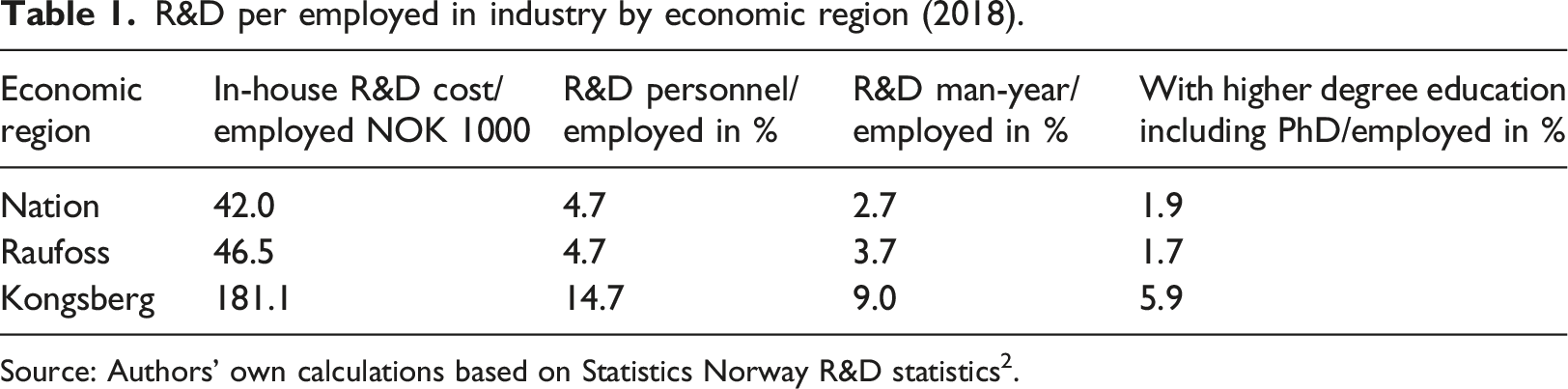
Source: Authors’ own calculations based on Statistics Norway R&D statistics2.
We triangulate between data sources in our comparative case study. Our primary data stems from 22 in-depth semi-structured interviews with key informants – predominantly managers – from key cluster firms (9), cluster organizations, R&D institutes, university and vocational education providers conducted during the period December 2016–January 2019. This variety of informants provided different perspectives on cluster dynamics and the role of intermediaries. Several of the informants were also knowledgeable about both clusters. The interviews were conducted at the informants’ workplace, lasted 1–2 h and were recorded and transcribed. Interviews focused on technology upgrading (i.e. Industry 4.0 technologies), and covered topics derived from the existing literature: firm’s innovative activities, their R&D resources in-house and externally, linkages along value chains and to affiliated organizations (mother company), linkages to universities, R&D institutions, vocational schools and technology suppliers and involvement in (organized) cluster activities. Participatory observation at seven (2015–2020) industry-meets-academics workshops organized by the research centre SFI Manufacturing provided the researchers vital insights concerning technology and knowledge development processes in the cluster firms. We triangulate findings from this primary data with secondary data material including reports from the cluster organizations (NCE System Engineering, 2016) and cluster scheme evaluations (Røtnes et al., 2017). Primary and secondary data was coded in the qualitative data analysis software NVivo, in which codes reflected theoretical concepts such as technology upgrading, intermediaries, absorptive capacity, and intra- and extra-cluster linkages and knowledge bases. Key categories for the analysis included ‘local provision of skills and competences’ derived from Smedlund (2006), and ‘facilitating R&D and innovation collaboration’ derived from Kodama (2008). Through systematic comparison of the two cases we develop a typology of ideal cluster intermediaries that corresponds with key cluster characteristics such as firm R&D intensity, predominant knowledge type and knowledge linkages. This development of ideal types is an appropriate strategy for analytical generalization beyond the specific cases (Yin, 2018), which we briefly present in the following subsections.
The Kongsberg cluster
The town of Kongsberg has 27,000 inhabitants, while the Kongsberg region compromises c.34,000 people (2019). Kongsberg has its origins in a mining company established in 1624 following the discovery of rich silver deposits in the region. Today, the Kongsberg technology agglomeration comprises c.20 companies and c.4000 employees, of which more than 70% are employed in the five largest companies. These five companies all have their roots in divisions of the Kongsberg weapon factory that was established by the state in 1814. Core activities among cluster firms are production of technological equipment and systems for the offshore, maritime, aircraft, automotive, and defence industries. The key cluster firms all primarily rely on a predominant analytical knowledge base (Isaksen, 2009) and have overlapping competences in system engineering (SE – i.e. design, develop and implement advanced systems). Most of the firms produce small (or one-off) batches of complex system products, reflecting the core systems engineering knowledge base.
The Raufoss cluster
The town of Raufoss has c.7500 inhabitants, which forms a part of the Gjøvik region currently home to c.70,000 people. Many of today’s private companies located in Raufoss have their roots in divisions that evolved within Raufoss ammunition factory, which was established in 1896 by the state (Johnstad and Utter, 2015). The Raufoss manufacturing cluster has 5 core companies (mainly in automotive and defence) and a network (TotAl-gruppen) of 46 small enterprises, which mainly serve the core cluster companies. All in all, the companies and small enterprises have c.5000 employees. Today the cluster consists of 17 consortia firm partners. Reflecting the industries that constitute their main markets, Raufoss firms are generally specialized in mass production, and have been recognized to rely on a predominant synthetic knowledge base (Isaksen, 2009). The cluster firms rely on a common knowledge base on material technology and automation in manufacturing processes.
Empirical analysis
Firm-level absorptive capacity
Because CAC constitutes more than the sum of firm-level absorptive capacities (Giuliani, 2005), yet is dependent on cluster firms’ existing knowledge base, it is necessary to elaborate the absorptive capacity of the individual firms in Kongsberg and Raufoss. In this section, we discuss the influence of education levels and both parent company and value chain linkages on the cluster firms’ absorptive capacity.
R&D intensity in firms in Kongsberg and Raufoss regions
We use R&D costs and personnel as indicators of R&D intensity and dominant knowledge base in the respective economic regions.
The Kongsberg region has R&D indicators that are between 2.4 and 3.9 times higher than corresponding indicators in the Raufoss region: ‘In-house R&D costs per employee’ are 3.9 times higher, and ‘R&D man-year with higher degree education including PhD in per cent of employed’ is 3.5 times higher. For most indicators, the Raufoss region is close to the national average, whereas the Kongsberg region’s R&D intensity is significantly higher (Statistics Norway R&D statistics, 2018). These contrasting figures underscore previous research showing that firms in the Kongsberg cluster rely heavily on analytical knowledge bases, whereas the Raufoss cluster firms have a more synthetic knowledge base (Isaksen, 2009). In general, the Kongsberg cluster firms are more oriented towards product innovation and small-batch production, whereas the Raufoss cluster firms to larger extent focus on process innovation and mass production.
Following the line of argument in the literature on firm-level absorptive capacity (e.g. Miguéles and Moreno, 2015), where R&D spending and employees are used as proxies for absorptive capacity, the above figures indicate that Kongsberg cluster firms have high absorptive capacities, whereas Raufoss cluster firms have low absorptive capacities.
Parent company and value chain linkages
In order to improve a firm’s capacity to innovate, it is necessary to access external knowledge sources. Such sources can be found along the value chain and within the company structure of multinational corporations (MNCs). Seven of the Kongsberg and Raufoss cluster firms are subsidiaries or branch plants of MNCs and find strength in being owned by a foreign parent company, as they benefit from competences and resources from the corporation’s broader activities. In Kongsberg, the head of research and technology at an aerospace manufacturer explained that they have a fruitful collaboration with their Swedish sister company, and that the parties draw on mutual advantages of considerable knowledge exchange (interview with head of R&D, 2017). In Raufoss, a company executive in an automotive branch plant explained that they received help from their German parent company when implementing new robot technologies in production and sent some of their employees to Germany for training and education (executive at car component manufacturer, 2016). The two examples illustrate how parent company linkages provide extra-local knowledge that improves the absorptive capacity of the cluster firms. While parent companies may function as gatekeepers also for other cluster firms than their subsidiary, we find no empirical evidence for that in our two cluster cases.
A corresponding pattern concerns individual cluster firms having limited access to knowledge from other cluster firms’ customers. The cluster firms consider their customers as the most important source of knowledge for their innovations. This is particularly the case in Kongsberg, where the firms develop and manufacture highly customized products in close interaction with their customers (interviews with business informants). A component producer for an international defence industry company takes part in customer organized workshops on topics such as robotization, digitalization and data capture (technical director, 2019). The core Kongsberg cluster firms draw on electronics and machining firms from the wider region of Eastern Norway and other suppliers dispersed around the country (former cluster organization CEO, 2016; R&D director in aerospace company, 2017). In Raufoss, two local technology suppliers play key roles in implementing advanced manufacturing technologies in firms’ production lines. A management executive at a defence and aerospace manufacturer claimed that it was ‘a great advantage’ to have the technology provider ‘in the neighbourhood’ (interview with VP operations, 2018). Evidently, external knowledge sources connected to single cluster firms are important for the innovativeness of each respective firm in both Raufoss and Kongsberg. Given the respective dominant knowledge bases – notwithstanding the fact that firms rely on combinations of analytical and synthetic knowledge – and supplier network structure, we may, as a point of departure, expect that individual cluster firms in Kongsberg are more directly exposed to cluster external knowledge impulses than are single cluster firms in Raufoss.
Whereas many quantitative studies base the CAC on proxies such as employees’ educational level, R&D expenditure and patents (Miguéles and Moreno, 2015), this qualitative study regards the function of cluster intermediaries (CIs) as complementary to cluster firms’ internal R&D resources, and parent firm and value chain linkages and, as such, essential in the development of CAC. Therefore, we explore the role of CIs in facilitating extra-cluster knowledge and their influence on CAC from the perspective of both the CIs and the cluster firms.
Cluster initiatives as cluster intermediaries
Historical linkages resulting in different CI function
The contrasting organization of the CIs in Raufoss and Kongsberg has historical reasons. The Kongsberg CI, (Kongsberg innovasjon) ran the National Centre of Expertise in Systems Engineering3 (2006–2016). After the NCE funding ended in 2016, Kongsberg Innovasjon became an innovation company and incubator, and continues to take part in national innovation programmes.4 However, the Raufoss CI (SINTEF Manufacturing – hereafter referred to as SM) has historical linkages to the internal R&D unit that existed within the state-owned ammunitions company, that after a demerger in the 1990s became a separate (applied) R&D actor within the Raufoss industrial park. SM (partially owned by the Raufoss industry) thus came to function as a common good – R&D provider – for all cluster firms (Johnstad and Utter, 2015). By contrast, the core Kongsberg cluster firms have kept their R&D personnel in-house since the disintegration of the Kongsberg weapons factory in the late 1980s.
Cluster intermediaries: Enhancing firm absorptive capacity
At Raufoss, SM got a public mandate to coordinate the collaboration between cluster firms following the establishment of a publicly funded cluster programme NCE Raufoss5 (2006–2016). As we will see below, as a public intermediary, SMs works as a common good for networks of cluster firms, in terms of facilitating extra-cluster R&D linkages. The cluster initiative (NCE Raufoss) was awarded public funding to further develop the cluster’s specific knowledge base on automation and lightweight materials. During the same period, under different names, SM was a private R&D institute, also providing R&D services to individual cluster firms. As a private R&D institute, SM provides core cluster firms with access to laboratory facilities and experts/researchers on materials and automated production processes. Today, SM functions as the cluster firms’ laboratory, which according to an R&D manager at an automotive cluster firm was of key importance when they showed international customers and partners their ‘R&D tool kit’ (interview with R&D manager, 2017). In its capacity as a private intermediary, and a dedicated provider of applied research, SM contributes to enhancing cluster firms’ absorptive capacity through knowledge upgrading. An example of this is a cluster firm manager stating that ‘the NCE collaboration has been vital, and approximately half of our turnover has clear links to R&D projects done in the NCE Raufoss community’ (NCE Raufoss, 2014). Another example of this is how a car component manufacturer recently reshored its production from China due to ‘the competence on development, technology and R&D’ that SM has contributed to developing (interview with former CEO, 2018). In practice, it is hard to separate the NCE cluster initiative from the private R&D institute. According to a senior advisor at SM, this is intentional, and the idea is that they are supposed to go ‘hand-in-glove’, where ‘NCE is the glove and SM is the hand’ (interview with senior advisor, 2017). Based on this duality, working as both publicly funded cluster initiative and providing R&D services to cluster firms, we define SM as a public-private intermediary in line with Clarke and Ramirez (2013).
A second intermediary at Raufoss, the TotAl-gruppen (TG) is geared towards suppliers located outside the industrial park. TG’s primary function is to develop collaboration and joint action within a business network of 46 small enterprises. The network was established in 1998 – initially with 15 firms, many of them spin-offs from Raufoss ammunition factory – in order to ensure stability for the suppliers in terms of access to customers. The manager of TG underlined that craft skills, including tacit knowledge, was essential for member firms’ performance. However, some of the larger firms in the cluster are also members of the group and thus contribute to the development of both the network and the suppliers. The collaboration also enables core cluster firms to, in some degree, take control of the development in their own supply chain, ‘ensuring that all these suppliers are qualified to deliver to us [core cluster firms]’ (cluster organization representative, 2017). We thus recognize TG as a subordinate intermediary connected to the main Raufoss CI, reflecting how territorially embedded the local manufacturing firms and intermediaries are.
SM has mainly facilitated network collaboration, particularly with regard to applied R&D in line with the second type of CI already introduced. As elaborated below, the efforts of Kongsberg Innovasjon have by contrast mainly been to enhance firms’ absorptive capacity by providing the cluster firms with skilled candidates in line with the first type of CI.
Enhancing firms’ absorptive capacity through education and training
At Kongsberg, the emphasis of the cluster has always been on the development of the core cluster knowledge on Systems Engineering (cluster organization CEO, 2017). Originating in American defence since the 1960s, system engineering has been developed as a cluster-specific knowledge base for the Kongsberg industry. This interdisciplinary field is about developing advanced systems and complex products for several industries. This legacy from the former weapons factory was highlighted in the cluster initiative’s application for NCE Systems Engineering and has been a focal area for both higher education and research in Kongsberg. The most prevalent example of this is the development of a master’s programme in systems engineering at the regional university (USN) in 2006, in close collaboration with core cluster firms, and the subsequent establishment of the Norwegian Institute for Systems Engineering at USN in 2012. The content of the master’s programme is very much adapted to the needs of the cluster firms, which host the candidates during internships and often recruit candidates before they complete their degree (NCE System Engineering, 2016).
Supported by KI, USN operates alongside other providers of skilled candidates, on lower levels. Three major companies established Kongsberg Technology Training Centre (K-Tech) to provide industry-relevant vocational education and apprenticeships. These companies’ workforce becomes technologically upgraded as the students are given access to up-to-date machinery and are provided with a training arena similar to that on ‘real’ production lines. The vocational college in Kongsberg has developed a new educational programme that covers topics such as the Internet of Things, industrial intelligence, autonomous systems and Big Data, which are technologies expected to permeate future industry (De Propris and Bailey, 2021; Lund and Karlsen, 2019).
In sum, we recognize that the CI and supportive institutions in Kongsberg have contributed substantially to the renewal of educational programmes and training, and to prepare cluster firms’ knowledge base for the implementation of new technology. The strategic and continued development and institutionalization of systems engineering knowledge, led by the CI, has resulted in international customers commenting on how Kongsberg has ‘the best eco-system in the world’ (Head of research and technology at aerospace manufacturer, 2017). Provision of candidates with skills in novel technologies is important for the upgrading of core cluster firms, that demonstrate high ambitions with regard to the implementation of Industry 4.0 technologies (Operations manager at car component manufacturer 2016; Technical director at defence manufacturer, 2019). At Raufoss, the CI has been less successful in developing collaborations with regional and local education institutions, notwithstanding recent efforts at the vocational college (Lund and Karlsen, 2019).
Cluster intermediaries: Facilitating extra-cluster knowledge linkages
SM: Accessing national level R&D institutions
By virtue of being a public intermediary, providing a common good, SM has facilitated two Centres for Research-based Innovation (SFI), SFI Norman (2007–2014) and SFI Manufacturing (2015–2023) aimed at improving manufacturers’ competitive advantage by implementing advanced manufacturing technologies and material technology in production. Four core cluster firms in Raufoss and one in Kongsberg participate in SFI Manufacturing and additional eight extra-cluster firms participate in the centre coordinated by SM. In the ongoing SFI Manufacturing, key knowledge providers are NTNU (Trondheim) and SINTEF (Trondheim and Oslo). Thus, SM has a key role in accessing extra-cluster knowledge and technology on a national level. In line with Clarke and Ramirez’ (2013) discussion on the role of CIs, SM also has a key role in business network formation. Cluster firms’ participation in the ongoing SFI enabled them to develop relationships with firms located outside the cluster, which they could benefit from in future projects and collaborations (ammunition manufacturer manager, 2017; cluster organization representative, 2017).
Within the SFI Manufacturing framework, SM has put Industry 4.0 on the agenda. The interdisciplinary centre focuses on robust and flexible automatization, multi-material products and production processes, sustainability and innovation. SM has organized R&D projects that focused, for example, on flexible and integrated production systems employing enabling digital technologies, and large-scale robotized additive manufacturing. Furthermore, following an SM initiative, the state awarded Raufoss a Norwegian Catapult Centre in manufacturing technology, where Industry 4.0 technologies will be tested in six mini factories.6
In general, cluster firms’ understanding of Industry 4.0 varies and tends to be vague. A commonality, however, is that Industry 4.0 refers to potentially disruptive technologies. Some of the business actors mentioned that Industry 4.0 is about connecting different parts of the production process and even the supply chain, but technological integration of cyber-physical systems has not yet been realized. At Raufoss, key cluster firms already have extensive application of automated robots and production lines. As efforts initiated by SM are partly about implementation of more technologies (or more advanced versions of existing technologies) than firms already have, ensuing innovation is mainly incremental. Only some cluster firms have explicit strategies towards utilizing the potential in additive manufacturing (3D technologies), and even fewer have implemented such technologies.
SM provides cluster firms with access to extra-local firms that could potentially be collaboration partners, and as such enhances potential CAC (on acquisition and assimilation of knowledge). As discussed in the previous paragraph however, these efforts do not automatically lead to realized CAC understood as the transformation and exploitation of knowledge and the implementation of (for instance) I4.0 technologies. Firms’ representatives highlighted the challenges associated with being up-to-date on new technology, given that their time was ‘eaten up by their working day and specific customer projects’ and day-to-day productivity goals (interview with head of development at a car component manufacturer, 2016). While SM can facilitate research project applications and participation, Raufoss firms are part of extremely competitive industries (e.g. automotive) in which long-term plans for technology implementation is difficult. SM has therefore raised cluster firms’ awareness about Industry 4.0, but implementation of these new technologies is yet to materialize. We can thus conclude that SM has supported potential CAC, while realized CAC is mostly a matter of the future. Furthermore, SM has strategically attracted public funding for cluster programmes, research centres and a catapult programme, using the former as stepping stone for the latter (cluster organization representative, 2017) to enhance the analytical knowledge base in a cluster where firms predominantly rely on a synthetic knowledge base.
NCE SE/Kongsberg Innovasjon: Linkages to primarily international universities
In Kongsberg, the core firms’ strategic knowledge providers have historically been national (NTNU, SINTEF and Norwegian Defence Research Establishment) or international research institutes and universities (Isaksen, 2009). However, since the late 2000s, local knowledge institutions seem to have gained positions as providers of human capital, expertise and skills.
Through its engagement in developing the master programmes in systems engineering and establishing the Norwegian Institute for Systems Engineering (NISE), the Kongsberg CI has been instrumental in establishing relations with national and international universities. This has strengthened the core competitive advantage found in the cluster knowledge base on systems engineering. The Stevens Institute of Technology (USA) has been an important source of extra-regional knowledge for USN in terms of providing professors for teaching and the collaboration was essential in order to provide master’s courses (interview with NCE System Engineering representative, 2017). Today, NISE also collaborates with Georgia Tech (USA) on model-based systems engineering, Stanford University (USA) on design, and NTNU on ‘lean product development’. In addition to developing education programmes, NCE System Engineering initiated a 3-year research programme that coupled four cluster firms to USN and NTNU in Trondheim. The ‘Knowledge-based Development’ project aimed to improve firms’ efficiency in product development and resource utilization, and entailed identifying, sharing and exploiting best practices from the cluster firms’ different industry sectors (NCE System Engineering, 2016).
Despite having initiated some research activity, the lion’s share of NCE SE’s activities as a CI has revolved around providing cluster firms with university graduates specialized in System Engineering and sourcing industry-relevant knowledge from national and international universities. In sum, the Kongsberg cluster mainly rely on absorptive capacities at the firm level, probably due to their employees’ short cognitive distance to academics at R&D institutions. Firms in the Raufoss manufacturing cluster, on the other hand, rely heavily on CAC where the CI has a vital role. The CIs are adapted to the respective cluster contexts in terms of firms’ R&D resources, predominant type of knowledge and knowledge linkages. First, cluster firms in Raufoss typically rely on local networks, whereas key firms in Kongsberg mainly rely on extra-local networks. Second, and related to the respective network and industry structures, the two clusters differ in their predominant knowledge base as argued also by Isaksen (2009).
Discussing ideal types of cluster intermediaries and tailor-made cluster policies
Typologies of intermediaries and firm characteristics with regard to cluster absorptive capacities.
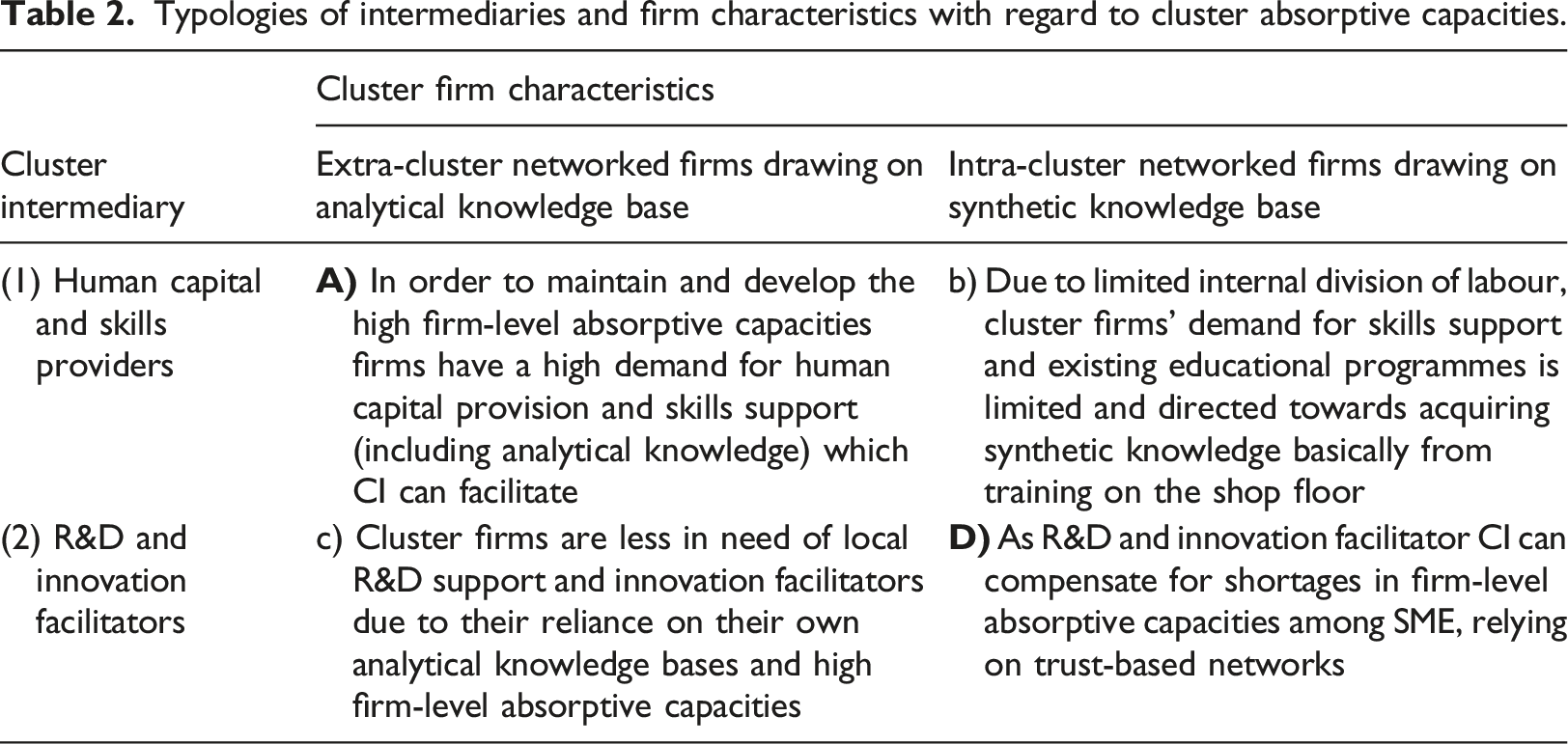
Based on the Kongsberg case, we propose that Type 1 is appropriate for and likely to be found in clusters that rely mainly on firm-level absorptive capacities and where firm collaboration takes place more at arm’s length. Type 2, which reflects our findings from Raufoss case, is likely to be more prevalent in clusters consisting of locally networked firms that have more trust-based collaboration and where firms rely more on cluster-level absorptive capacities.
Both intermediary types may be found in the stylized cluster contexts described in Table 2. This results in four possible intermediary types (
CIs should be future-oriented and contribute to the identification, acquisition and implementation of new technology and associated knowledge, and adapted to cluster-specific contexts. Based on our findings, we suggest that CIs in clusters with a predominantly synthetic knowledge base (appearing in the
Insofar as cluster firms characterized by high level in-house R&D resources are typically affiliated to MNCs or part of global production networks, they (firms) will generally be capable of developing and maintaining their own extra-local R&D networks. However, as cluster firms need to cultivate their R&D linkages both at the national and international level, the CIs may take responsibility for the cluster as a collective and facilitate extra-regional R&D linkages for firms beyond key cluster firms in order to update and prepare them for new technologies and related knowledge demands (support also from CIs in developing R&D networks in the frame of the c combination).
Generally, CIs should frequently reconsider and, when considered necessary, modify their traditional role and reconfigure the institutional support structure by developing complementary knowledge institutions at a cluster level that extend activities beyond those that have been adapted to short term demands from cluster firms. In practice, policy-makers and cluster intermediaries should learn from other cluster experiences when adapting their own models. External impulses, through acquisition and assimilation of knowledge, are timely for enhancing potential absorptive capacities in the face of new (disruptive) technologies.
However, based on our findings, we recognize some limitations in knowledge translation particularly for the exploitation of new technologies. This is what Zahra and George (2002) recognize as realized absorptive capacity, which has been applied at the cluster level by Molina-Morales et al. (2019) amongst others. Most of the cluster firms in Kongsberg and Raufoss have built up potential absorptive capacities aided by CI initiatives. Several cluster firms have already realized technology upgrading by implementing industrial robots, whereas more advanced Industry 4.0 technologies (e.g. 3D printing) have so far only been adopted by a few firms. For cluster firms, territorial embeddedness and trust-based relations and collaboration do not suffice in terms of acquiring and assimilating new technologies (potential CAC). Further cultivation and exploitation of extra-cluster linkages is essential. If and when such linkages are limited, CIs can contribute to creating and maintaining them.
Conclusions
Clusters and cluster initiatives are of high interest to both researchers and policy-makers. This paper provides novel insights into how cluster organizations develop different roles as intermediaries. The paper adds to the ongoing debate on cluster dynamics by proposing a conceptual framework that combines the cluster intermediary and absorptive capacity concepts for investigating the role of non-firm actors in different cluster contexts.
The paper recognizes cluster absorptive capacity (CAC) as a quality beyond the sum of firm-level absorptive capacities and suggests that cluster intermediaries and the knowledge linkages that they serve to establish are essential to enhance CAC. Our empirical analysis revolved around how this is important when manufacturing firms are faced with new and potentially disruptive (I4.0) technologies. In so doing, we build further on Giuliani’s (2005) CAC typology by highlighting the role of intermediation given cluster-specific conditions, for instance, in terms of knowledge bases. On the one hand, we recognize that clusters with in-house R&D resources, relying predominantly on analytical knowledge bases, are in less need for CIs as facilitators of R&D linkages. In such clusters, CIs should be oriented towards education and thus help ensure that skilled human capital is available to industry. By contrast, manufacturing clusters with a more synthetic knowledge base and less R&D resources could benefit from CI support to develop networks and linkages to relevant extra-cluster R&D resources. CIs in both cluster contexts can assist firms in tracking rapid technological developments requiring new knowledge and skills, and ideally then flexibly adapt their ‘service provision’ accordingly. We consider it unlikely that ‘technology gatekeepers’ in the form of firms take on such roles, underpinning the relevance of our attention to CIs with a public mandate.
The typology of ideal type CIs developed in this paper should be applicable in analyses of clusters also in other contexts. We recognize that intermediaries rely on knowledge institutions and firms on multiple scales in their efforts to contribute to cluster adaptation to changing circumstances. In contrast to previous CAC studies, we find that national level R&D institutions are significant for technology upgrading among cluster firms. This is probably typical in the context of a small and coordinated market economy like Norway with strong trust-based collaboration between firms and non-firm actors. Such institutional settings may have heavy bearings on the conditions for CIs to operate, suggesting that future research could compare cluster dynamics and CIs across different institutional contexts. Cluster participation and the prevalence of SME support organizations vary considerably across Europe (European Commission, 2021). Both our case clusters evolved from old single-firm manufacturing towns, where industry and institutions have co-developed over time. The ideal types that we derive may be less recognizable in less mature clusters, or clusters largely based on foreign direct investments by MNCs.
The typologies developed in this paper could help inform more effective use of public funding to support cluster development in general and the role of CIs in contributing to enhancing CAC in particular. CIs should be sensitive to existing local contexts and be able to accommodate future knowledge needs. Our focus on clusters’ preparation for new technologies mirrors also the European Commission (2021) recommendation that cluster activities should focus on sustainability, digitalization and resilience. Inspired by our CI typology, policy-makers could thus draw on local and regional institutions’ and policy-makers’ key experience with, and knowledge about, regional industry to develop national cluster policies that better accommodate industries’ existing and future knowledge needs. Furthermore, arenas for knowledge exchange across clusters and between CIs could be developed in order to stimulate discussion, learning and sharing of experiences also internationally.
Endnotes
1 Each high-tech agglomeration has minimum 1500 jobs and 50% or higher employment in high-tech industries in the local labour market area than the national average. 2 It covers all firms with more than 50 employees and a randomized selection of firms with 10-49 employees. Firms in sectors with limited R&D are not included. The Raufoss region (named Gjøvik by Statistics Norway) includes Gjøvik, Vestre Toten, Østre Toten, Søndre Land og Nordre Land. The Kongsberg region includes the municipalities Kongsberg, Flesberg, Rollag, and Nore and Uvdal. The employment among the respective cluster firms embrace more than half of the employment covered by the R&D statistics in the respective regions. 3 In 2006, a National Centre of Expertise (NCE) on Systems Engineering was established with financial support from the national support organizations Innovation Norway, RCN and Siva. 4 The cluster in Kongsberg (NCE System Engineering) has recently been integrated into the Innovation Norway led programme Omstillingsmotor (loosely translated to ‘tranition engine’), where a grouping of established clusters (Kongsberg, Molde, Oslo and Halden) are to accelerate digitalization, digital transformation and the innovation capability in more than 200 Norwegian SMEs. 5 National Centre of Expertise on lightweight materials and automated production. 6 Initiated and controlled by SM, Raufoss currently hosts the Manufacturing Technology Norwegian Catapult Center (MTNC) funded by the Norwegian Ministry of Trade, Industry and Fisheries. Additionally, SM is responsible for the Omstillingsmotor on advanced manufacturing.
Footnotes
Declaration of conflicting interests
The author(s) declared no potential conflicts of interest with respect to the research, authorship, and/or publication of this article.
Funding
The author(s) disclosed receipt of the following financial support for the research, authorship, and/or publication of this article: This work support from the Centre for Research-Based Innovation SFI Manufacturing in Norway and is partially funded by the Research Council of Norway under contract number 237900.
