




Abstract
This article revisits the developmental state literature that stresses the unitary role of the state in steering economic development in East Asia. Focusing on the Korean state actors’ diversity and their agency after the trend of globalization and democratization, this article highlights various state actors as agents and looks into how the role of state actors has changed with industrial development, using the setting of the Korean online gaming industry over the past two decades. By examining government policy measures on the industry, I found that the state actors have actively engaged with the industry, however, this agency has not been uniform due to the different purposes of the actors and sometimes led a detrimental effect against the needs or expectations of the industry. The findings, thus, contribute to the literature by suggesting the potentiality of agent-driven institutional change and the heterogeneity that comes from the state actors’ policy engagement.
Introduction
With the ascendance of East Asian economies, a latecomer, industrialization came to the fore as a feasible option for aspiring developing economies. Indeed, the ‘East Asian miracle’ (World Bank, 1993) placed the developmental state model (Haggard, 1990; Johnson, 1982; Wade, 1990) at centre stage. However, the usefulness of this model, both for practical policy purposes and as an instrument for understanding the East Asian experience, has increasingly been challenged. A major turning point was the 1997 Asian financial crisis, which is suggested to have ushered in a new era of more market-conforming practices at the expense of a top-down approach to development and economic growth spearheaded by the state sector. As the economic environment in East Asian economies changed after the 1997 financial crisis, the debate regarding the fate of the developmental state has gained continuous attention, but the issue of the extent to which the developmental states have been transforming themselves into liberal market economies still remains unresolved (Chu, 2009; Suh and Kwon, 2014; Witt and Redding, 2013).
Apart from discussion on the fate of the developmental state as such, research on the developmental state model has also been criticized for its singular focus on the activities of politicians and the economic bureaucracy, including their relationships with the commanding heights of business. In other words, the definition of the state in the developmental state literature has tended to be narrow, as a unitary form of the state, mainly a central government (Carney and Witt, 2014). Yet, the form of a state actor can be diverse, including local governments, ministries and government-affiliated organizations, and they may exercise different political capabilities, particularly with the trend of liberalization and democratization. Hence, a better conceptualization of the state’s role is needed, by allowing multiple state actors to look at the differing roles of the actors. Some countries may have unitary state actors under authoritarian or central government-led regimes, but others may provide more room for many state actors to engage with the institutional environment after democratization or globalization. Thus, the role of state actors can be diverse and evolving under external or internal pressures, unlike the existing developmental state literature, which stresses the role of the state as a leader, feeder and designer for economic development.
To address the problem, this article sheds light on various state actors as key actors in influencing institutional change by analysing the policy engagement in industrial development. The analysis focuses on the case of the Korean online gaming industry and the state actors’ policy implementations with it. The emergence and success of the online gaming industry in Korea may seem surprising (Casper and Storz, 2016), as the Korean economy has been depicted as a large conglomerate-led and heavy industry-oriented economy with strong central government intervention. Despite the unique and interesting context of the Korean online gaming industry, the emergence and development of this new industry and the Korean state actors’ role in it have not been afforded much attention. The major exception is Casson and Park (2014), with their contribution emphasizing the role of government in correcting market failures (e.g. by providing infrastructure and supporting education) and in providing a supporting environment for private entrepreneurs. Yet, except for this work, a careful analysis of various state actors’ policy engagement on the industry still has not been covered in the literature.
Looking at state actors’ diversity and their policy engagement on the industry is meaningful for the current debate in the developmental state literature for several reasons. First, there is limited understanding of the changing role of state actors in the literature. Although the issue regarding the future of developmental states has been hotly debated, very little attention has been paid to the changing role of state actors thus far. In the Asian comparative capitalism field, Carney and Witt (2014) categorize different types of state models – regulatory, predatory, welfare and developmental state – and explain the role of the state in each model, but a sophisticated analysis on the issue is still lacking. Second, linking with the first one, the developmental state literature has failed to address evolutionary changes in state–firm (or industry) relations (Yeung, 2017). As the developmental states have been under pressure from globalization and democratization as such, the power structure and the relationship between state and firm have also been transformed. In this sense, it is necessary to bring an evolutionary perspective to understand state actors’ diversity and their changing roles with industrial development. Third, it also could make it possible to consider multi-scalar analysis by an increasing role of decentralized state actors with their own policy targets in the developmental state literature. Some scholars, such as O’Riain (2004), Breznitz (2007) and Lee et al. (2014), have already underlined the importance of multi-level governance of policy implementation by various state actors, raising doubts about the static view on the state of the developmental state literature. Lastly, the developmental state literature has not covered how state actors’ agency (here, policy implementation) affects institutional change in national economies. Pulling the state actors’ agency and its impact on institutional change would contribute to understand dynamics within the developmental state literature.
To examine how the agency of various state actors has engaged with the industry over time and its implications on institutional change, this study particularly brings the literature of gradual institutional change (Mahoney and Thelen, 2010; Streeck and Thelen, 2005) into the current developmental state thesis. Mahoney and Thelen’s framework (2010) has provided implications to explain why actors (here, state actors) take certain actions (here, policy implementation) and how their actions influence institutional change by incorporating with the political context and the characteristics of institutions of national economies. Such characteristics of the political context and institutions may give a clue for understanding why state actors in Korea have expanded their roles and how they have engaged with the online gaming industry over the past two decades, as well as the impact on the process of gradual institutional change of the Korean economy. In this sense, borrowing the framework of Mahoney and Thelen (2010) would help contribute to the developmental state literature, which lacks a deeper understanding of gradual and evolutionary institutional change caused by state actor pluralism.
This article’s contribution is at once more open ended – it does not presuppose a decisive turn away from the developmental state model but rather remains agnostic on that score. The first and main contribution relates to the current literature of the aftermath of the developmental state (Chu, 2016; Lim, 2010; Thurbon, 2016; Yeung, 2014). By analysing the state actors and their agency in policy implementation in the case of the Korean online gaming industry, it would provide answers to the questions of what roles the state actors take, what specific agency the actors have when it comes to policy implementation, and how the state actors influence institutional change while engaging with the industry. Specifically, this study points out that the role of the state is not static and unitary; rather, state actors may engage in various behaviour by implementing policy measures on the industry. In this sense, this study would support the argument of Yeung (2017) in which a static view of the state’s role cannot account for the evolutionary dynamics of key actors emerging from these state-led projects and of rapidly growing new firms and industries.
The role of state actors revisited
The developmental state has been the key subject of analysis in political economy studies over the past three decades. Based on the successful experience of the developmental state in Japan, Korea and Taiwan, scholars of the developmental state literature, such as Johnson (1982), Amsden (1989), Haggard (1990) and Evans (1995), have consistently insisted that relentless state interventions via active industrial policy, and selective financial allocation have enabled domestic firms to overcome their latecomer disadvantages. Hence, the developmental state literature argues that rapid economic development is driven by the relationship between an authoritarian state and the business sector. In this respect, Weiss (2000: 23) claims that the developmental states can be distinguished by three major characteristics: (1) the state’s developmental priorities; (2) a pilot agency, which decides and controls economic planning and (3) a strong linkage between the state and economic agents such as big business – ‘chaebols’ in Korea. This state-centric approach has provided important insights into the understanding of industrialization and economic development in East Asian economies.
Yet, since the 1980s, there have been critiques that the developmental state thesis cannot explain the developmental challenges beyond catch-up economic development and has limitations in dealing with the transition away from a manufacturing-based economy and towards the newly emerging knowledge economy. In the debate regarding the aftermath of the developmental state, some works (Chu, 2009, 2016; Wong, 2004) point out that the developmental state is adapting or hybridizing while maintaining the developmental mind-set of state bureaucrats (Thurbon, 2016). On the contrary, other works argue that the developmental state has been dismantled after the neoliberal restructuring of 1997 (Pirie, 2005, 2016). While such debate about the fate of the developmental state has gained attention, the transformation and the evolution of state actors’ role has not been actively addressed in the literature (Yeung, 2014, 2017). Whether the developmental state literature would take either direction – revision of its claim of strong state influence on national firms or reorientation of its analytical focus away from state policies and capacities to national firms – there is a need to shed light on various state actors and their changing agency since the late 1980s to understand its impact on the institutional environment.
Previous work in the developmental state literature tended to see the state as a unitary form or a dominant actor, emphasizing the top-down decision making from the state (Evans, 1995; Weiss, 2000). Yet, the expansion of globalization and democratization since the late 1980s has led to the retreat of government in its direct involvement with industry, and its role in economic development has become more restricted (Lim, 2009; Thurbon, 2016; Wade, 2010). This decline of direct state intervention was matched by an increase in the state’s indirect influence via a growth in the regulatory apparatus. Wong (2011) argues that the decentralization of functional expertise within the state (e.g. the expansion of state actors) has seriously weakened the leadership role of the central government. Similarly, Chu (2016) and Yeung (2016) offer interpretations of the changing role and capacity of the developmental state in guiding new high-tech industries in East Asian economies.
By the 1990s, the balance of power and the nature of the relationship between the state and industry changed, and the developmental state no longer disciplined domestic firms as it had during the developmental state period (Wong, 2011). First, the developmental state underwent significant internal transformations since the late 1980s. For instance, Korea experienced democratization in the late 1980s and political realignments in the early 1990s, and the state (central government) began to loosen the strong grip of the developmental state in steering domestic economic governance (Shin, 2012). Second, the power of the market has increased and has changed the relationship between the state and industry with the advent of globalization and neoliberalism. Perhaps the most important event is that East Asian economies, including Korea, were hard hit by the 1997 Asian economic crisis and were forced to carry out market-based institutional reforms that brought new challenges. For example, in Korea, after the crisis, market-based reforms of financial systems and the labour market were introduced on the basis of the International Monetary Fund’s policy. These reforms were characterized by forceful liberalization, fundamentally transforming the nature of the Korean economy and the role of state actors. During the developmental period, the developmental states had disciplined industries and made domestic firms national champions with their extensive support, but globalization and its associated technological and organizational changes have provided wider incentives and opportunities for private firms beyond the reach of the developmental state and further diminished the power of the state (Yeung, 2017).
Due to the above reasons, the traditional role of the state has transformed, and new state actors have begun to engage with the national institutional environment. The existing developmental state literature predicates the bureaucratic rationality and internal coherence of the state. As pointed out by Evans (1995), ‘embedded agency’ is a critical condition for the efficacy of the developmental state in carrying out its roles as either ‘midwifery’ or ‘husbandry’ of industries. The concept ‘embedded agency’ of the developmental state does not really provide an explanation of the evolutionary relationships between the state and firms over time, since the state and domestic firms both are conceived as static actors in the given relationship (Yeung, 2014). Yet, the state’s role can be more diverse, as various state actors may intentionally or unintentionally influence the institutional change process with various interests. For example, local governments, central governments, ministries and national assemblies have their own agendas, and political capabilities can take certain actions by the implementation of policies while cooperating or competing with one another. In sum, unlike previous research that underscored the unitary form of state action, this research suggests that there is a need to consider multiple state actors’ agency, which potentially influences institutional change.
Institutional change in the developmental state
Specifically, to analyse how the agency of various state actors has engaged with the industry over time and its implications on institutional change, a better understanding is needed of institutional change caused by actors. Until the 1990s, as Thelen and Steinmo (1992) pointed out, discussion about institutional change was underdeveloped in the institutionalist literature, and most works tended to focus on exogenous forces to alter institutions. To address the problem, some scholars (Mahoney and Thelen, 2010; Streeck and Thelen, 2005) introduced processes and types of institutional change while highlighting incremental and endogenous institutional change and actors in the process. This study also borrows the framework of Mahoney and Thelen (2010) on gradual institutional change to look into various state actors and their policy engagement on industrial development, as well as their effect on institutional change in the Korean economy. It may provide important implications to the current developmental state literature. Although it is in a transitional period from a developmental to a neo-developmental or post-developmental state, including Korea, while pointing out new emergent institutional logics against the traditional logics of given economies (Breznitz, 2007; Chu, 2016), the field still, however, has a limited understanding of how state actors and their policy implementations influence institutional change. In this sense, the idea and framework of Mahoney and Thelen (2010), who care about contexts (structure) and actors (agency) together, would give more nuanced explanations of state actors’ actions on the industry and their effects on institutional change.
This research looks particularly into the policy measures of state actors for analysing their agency. In some historical institutionalist accounts, institutions come close to being policies, consisting of rules or regulations governing financial markets, labour regulations or social welfare system (e.g. Thelen and Mahoney, 2015). In this study, a view is taken of policies and regulations as formal institutions and among the devices that can be leveraged to affect the degree and direction of coordination between actors in an economy, often by having an impact on institutions (and then, in particular, formal ones). In other words, the stance taken is that policy measures may include the use, modification, addition or removal of formal institutions in the form of laws or legislation on the one hand, and policy measures as an outcome of institutions may influence informal institutions by engaging with an institutionalizing process, on the other. As discussed in the debate within the developmental state literature, the policy implementation of state actors has had a large influence on the institutional change of national economies (e.g. Chu, 2009, 2019; Hamilton-Hart and Yeung, 2019). Yet, the developmental state literature has been less interested in the dynamics and processes of policy implementation of state actors thus far. The framework of Mahoney and Thelen (2010) would permit further understanding of the dynamics and processes of policy implementations by providing a contextual explanation of the institutional environment of national economies.
Hence, this study sees state actors as agents who leverage resources to create new institutions or transform existing institutions and analyses how the state actors’ agency on industrial development links with institutional change by applying the idea of Streeck and Thelen (2005) and Mahoney and Thelen (2010) on gradual institutional change by actors: conversion, layering, displacement and drift. While this study adopts the framework and the concept, it does not directly apply them per se. Rather it takes the basic concept and reformulates it to serve the purpose of this research (Figure 1). Mahoney and Thelen (2010) explain institutional change, in which characteristics of the political context and characteristics of institutions influence the type of dominant change-agents. The agents’ actions then influence the formation of the type of institutional change. The framework adapted in this article sees the Korean developmental state’s transition towards a post-developmental state as the political context, and the dominant institutional logic and arrangement of the Korean economies refers to the institutional context. The present authors also see the state actors’ agency (here, policy implementation activities) as the dominant change-agents’ agency. The state actors’ agency, in the end, participates in and shapes the direction of the institutional change process.
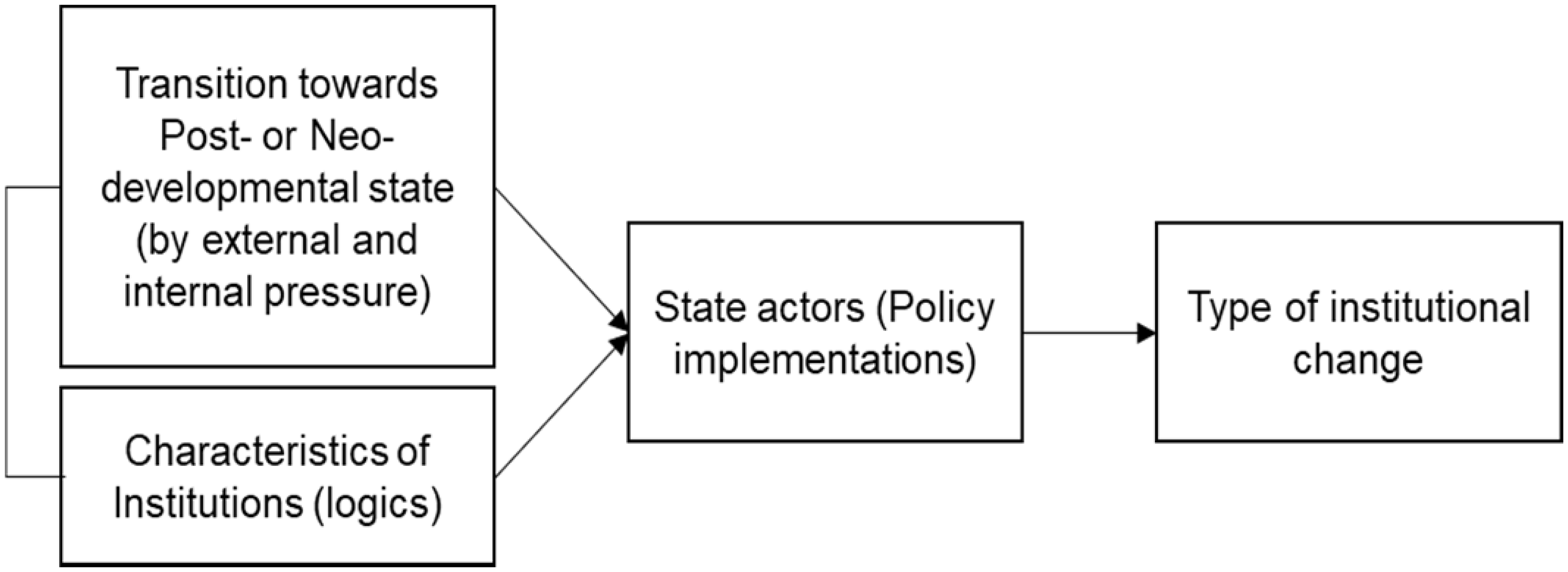
Framework for explaining modes of institutional change. Source: Adapted from Mahoney and Thelen (2010: 15).
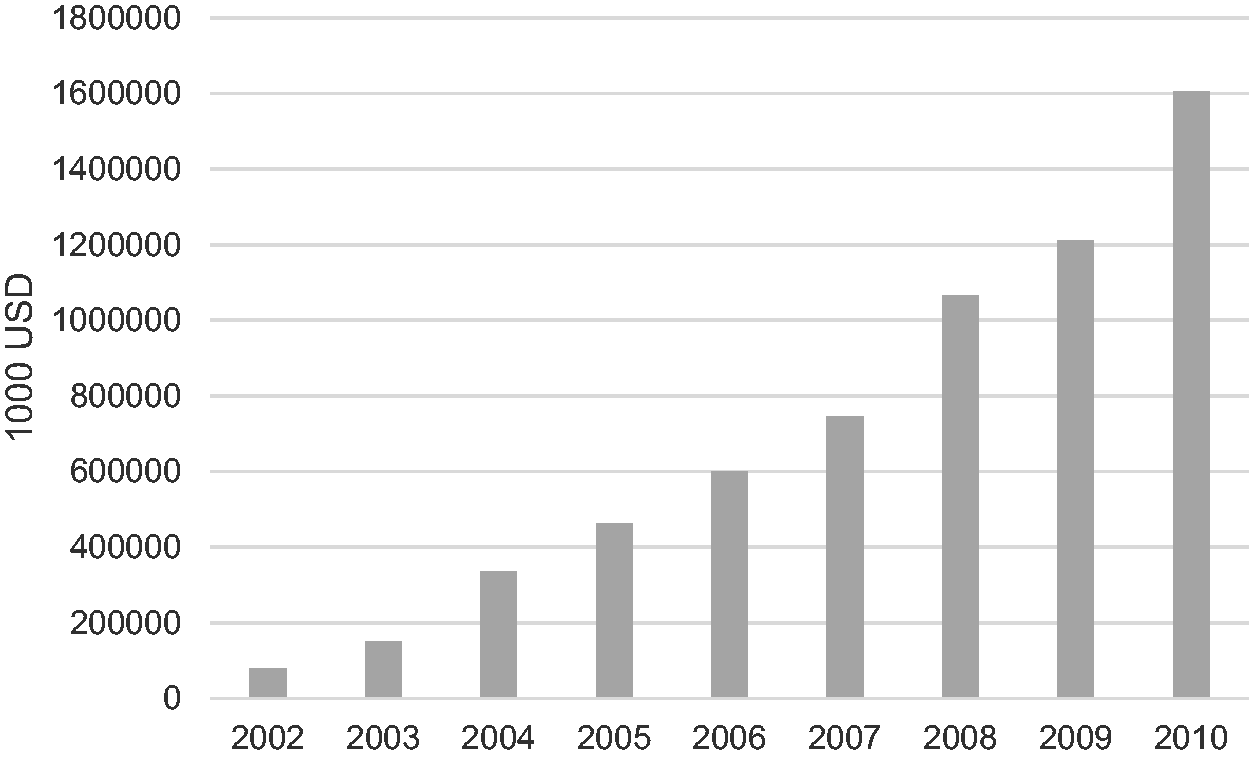
Export size of the Korean online gaming industry trends (2002–2010). Source: KOCCA’s white papers (2003–2011)
The adapted framework and the findings based on it aids understanding of the process of how Korean state actors in certain institutional contexts engage with institutional change relating to the online gaming industry’s development. In particular, the current literature of the developmental state lacks consideration of state actors’ growing political competition and dynamics within the industry’s development. In this regard, utilizing the adapted framework of Mahoney and Thelen (2010) would not only help one understand the internal dynamics in gradual institutional change caused by multiple state actors’ policy implementations but would also locate the developmental state literature more closely into the literature of institutional change. It would fill the analytical void in the developmental state thesis that has shown less interest in institutions and institutional change per se.
The context: The changing role of the state in Korea
Korea has long been considered a typical example of a developmental state, with its own developmental paths, through the establishment of pilot agencies (the Economic Planning Board [EPB]), the building of major manufacturing industries, the concentration of national resources in a few large conglomerates and the protection of domestic firms (Amsden, 1989; Kim, 1997; Woo-Cummings, 1999). In this regard, the Korean central government played a major role in designing the national economic development. However, by the late 1980s, the process of democratization and the political realignments of the early 1990s in Korea weakened the authoritarian government’s grip and provided much wider room for both society and business (Kang, 2010).
The Kim Young-Sam administration (1993–1998) thus abandoned its traditional developmental state position. For example, in 1993, the EPB, which played a central role in economic development, was abolished. Furthermore, the government abandoned its five-year economic plans, one of the major features of Korea’s developmental state model since the 1960s. In addition, many reforms to establish a liberal economic order – mostly deregulation and privatization – were undertaken. Along with the changes owing to democratization and deregulation, the 1997 Asian financial crisis brought major institutional reforms. In particular, after the crisis, market-based reforms of the financial systems and labour market were introduced.
Faced with new challenges, the Korean government could not adopt similar developmental strategies as in the 1960s–1980s. For example, due to market-based reforms in the financial sector, the government could not use banks as state-controlled vehicles for funnelling capital to targeted chaebols. The government lost its capacity to control financial flows across sectors and to use financial measures to discipline domestic firms. However, it quickly became clear that the state could no longer support these conglomerates and other industries after the 1997 financial crisis. Furthermore, while a series of reforms to pursue economic liberalization under the guidance of the International Monetary Fund has been maintained, the central government has lost much of its power to control the private sector (Shin and Chang, 2003). Former president Roh Moo-Hyun (2003–2008) clearly mentioned this power transfer from the state to the private sector. In a meeting with CEOs of large conglomerates in May 2005, he commented, ‘Power is handed over to [the] market (or business)’ (Hankyoreh, 2005). This is a very symbolic phrase, indicating the demise of the traditional developmental state and the rise of the private sector.
What is important to note here is that, while the role of the central government has weakened over time, that of other actors, for example, state actors’ political capacity, has expanded. More specifically, as Casper and Storz (2016) argued, the Asian financial crisis as a critical juncture created an opportunity structure in which traditional patterns within the Korean economy were disrupted, creating new opportunities not only for entrepreneurs to start their businesses but also for state actors to exercise their power with various policy measures. As the Korean economy has been in the process of institutional change by economic liberalization and democratization, extant institutional complementarities and strong coordination between firms and the state have been unstable. Given the circumstances, various state actors, such as ministries and local governments, are likely to have more space to act than before the crisis. Hence, one may assume that the multiple agendas that state actors may have can bring new dynamics to the Korean economy. Therefore, the research questions of this article include the following: (a) How did the Korean state actors as agents engage the online gaming industry with industrial and public policies? (b) Why did the state actors implement certain policies? (c) How did the Korean online gaming industry change over time due to government policies? (d) What institutional change we can find from the state actors’ policy engagement? Answering these questions will have implications for the developmental state literature, which lacks consideration of multiple state actors, their agencies and their impact on internal dynamics and gradual institutional change.
Data and methods
This research takes a single case study design to examine the story behind the relationship between state actors and the Korean online gaming industry. A single case study design is justified when the case under study represents an extreme and rare or unique case, as well as when exploring new phenomena (Siggelkow, 2007; Yin, 2013). Another reason for choosing a case study design is that this study on the Korean online gaming industry and state actors’ agency would provide good stories (Dyer and Wilkins, 1991). Since this study’s aim is to search for new interpretations of the role of state actors as agents and its influence on industrial development, it is important to offer rich descriptions that cover the policies and the industry over time. Furthermore, the engagement of the state actors in the online gaming industry could potentially provide some lessons for other regions where creative industries have been developed. Some research on the Korean online gaming industry has already provided some insights for other countries’ followers, yet there is a need to look into the dynamics behind the industry’s development and what agency the state actors take during the time to provide new lessons for followers.
This research relied on purposeful sampling for case selection (Patton, 1990), which has clear advantages in selecting information-rich cases for study in depth. I conducted 17 semi-structured face-to-face interviews from June 2016 through March 2017 (including eight email interviews after the fieldwork). The interviews included government officials from gaming industry-related public organizations, researchers within the information technology area, online gaming company executive directors, university-based researchers and game developers.
During the fieldwork, I visited three online gaming firms in the Pangyo area and one quasi trade union association for a game developer in Seoul. The interview questions of this article were broad and open ended to encourage the interviewees to elaborate on their answers. The interviews covered issues from the interpretation of the online gaming industry ecosystem to the evolution of the respective policies within the industry.
At the beginning of the fieldwork (June 2016), I adopted a snowball sampling strategy; this involved asking friends, colleagues and key informants. During the first phase, five interviewees were selected (one professor, two government officials, one former employee of private company and one executive director of a private company), who provided the background of the online gaming industry and recent problems in the industry. The initial interview experience helped advance the research further and focused on the government policy area. At the end of each interview, respondents were asked if they could introduce us to others who might be interesting to speak with. Through this process, 12 interviewees were obtained, working at private firms, government organizations and a university. After having clear research questions and directions, in the second phase, March 2017, 12 interviews were conducted to further grasp the effects of government intervention on the online gaming industry. All interviews were conducted in Korean and lasted between 30 and 90 minutes. In addition, with permission, they were recorded. These interview data were then triangulated with secondary data gathered from published and unpublished government reports related to the industry, such as white papers (2001–2016) from the Korea Creative Content Agency (KOCCA), company reports, survey data of 87 online gaming firms conducted by the Korean International Trade Association and various forms of media coverage. The empirical data cover the entire period from the late 1990s to the year 2017.
The data analysis started with detailed readings of interview transcripts and documents. To organize and analyse the interview data, NViVo 10 was used. The analytical approach involved three steps. Based on insights from Langley (1999), this study utilizes the methodology of process study, which is ‘understanding how things evolve over time and why they evolve in this way’ (Langley, 1999: 692). To do so, interview scripts were first coded and arranged with a focus on the policies and regulations on the online gaming industry. When arranging the policies, I ordered them sequentially to describe how the state actors have engaged with the industry over time. The time frame was divided into three different phases, from the emergence of the industry to the plateau period. In this stage, specific events and policies that many of the interviewees mentioned were identified. During the interviews, interviewees pointed out several key regulations on the industry, and the published policy reports by KOCCA suggested regulations and policies that relate to the industry. Second, successive rounds of coding focused on analysing who (state actors) implemented (played) what (policies), to capture the dynamics between the actors. Linking state actors’ policy implementations made it possible to capture the dynamics between the actors. In the process of data analysis, several interviewees were contacted to check the validity of the data. Then, the state actors’ agency, its impact on institutional change surrounding the online gaming industry and the consequences of government policy intervention were discussed. The findings are elaborated in the following section.
Policy engagement in the Korean online gaming industry
Early phase of industry development (late 1990s to early 2000s)
The online gaming industry produces sophisticated products that combine high-end programming technology with artistic content and interactive user-based services (Ström and Ernkvist, 2012; Tschang, 2007). While the online gaming industry shares similarities with other creative industries, such as music and film, which feature cultural influences, reliance on information and communication technologies and a strong economic contribution, the online gaming industry is the strongest among all creative industries (Gong and Hassink, 2019). Online games consist of primarily two types: massively multiplayer online games (MMOGs) and casual online games. MMOGs, which dominate the market in terms of revenues, include games in which thousands of players play a game simultaneously in virtual worlds on computer servers, often over the course of many years. The first group of commercially successful MMOGs was released in the 1997–1999 period. Among MMOGs, Korean online gaming companies paved the way of developing massive, multiplayer online role-playing games 1 during that time. For example, one of the major gaming companies in Korea, NCsoft, released Lineage in 1998 and still has a large number of consumers after more than two decades (Casper and Storz, 2016; Ström and Ernkvist, 2012). Furthermore, at the time, the Korean online gaming firms rather benefitted from a relatively weak intellectual property right in Korea. While the weak intellectual property right has long been regarded as a main reason for the underdevelopment of video, console and personal computer (PC) games in Korea (Casper and Storz, 2016). However, such system in Korea did not impede the emergence of online gaming firms during the 1990s (Wi, 2006). The main reason is that online game software was stored in the official servers of publishing firms and was not easily counterfeited by other game domains.
When the online gaming industry first emerged, the Korean central government under Kim Dae Jung (1998–2003) played a limited role in promoting the industry. The government tended to be indifferent towards the online gaming industry and had no particular industry-specific policies for the industry in its initial phase of development. Hence, the online gaming industry initially appeared at the periphery of the Korean business system, which was dominated by large conglomerates. While Korean conglomerates, such as Samsung Electronics, Hyundai Electronics and LG Electronics, tried to enter the video game business as part of their diversification strategy during the 1980s and 1990s, they retreated from the business due to its lack of attractive software and the financial crisis of 1997, which affected most conglomerates (Wi, 2006; Yoshimatsu, 2005). The lack of involvement by these conglomerates in the gaming industry created room for a new community of individual entrepreneurs. While the government failed to see the potential of the online gaming industry, these entrepreneurs recognized the potential of the Internet as a new gaming platform (Casper and Storz, 2016; Wi, 2006).
However, a key factor helping to explain the emergence of the Korean online gaming industry is the Korean central government’s infrastructure policy surrounding broadband Internet access. Following the financial crisis, the Kim administration and the information and communications technology (ICT) industry recognized that Korea likely had a comparative advantage with its vast number of Internet users and technologies and made broadband access a major target of industrial policy. The expansion of broadband Internet networks in Korea during the late 1990s was phenomenal. By 2001, the broadband penetration rate in Korea had reached 13.8 subscribers per 100 inhabitants, substantially ahead of Sweden (4.1) and the United States (3.2) (OECD, 2002). Moreover, the number of Internet users in Korea grew from 730,000 in 1996 to 24.4 million in 2001 (Yoshimatsu, 2005: 162). While the central government initially implemented broadband infrastructure policy for the ICT industry, the policy unexpectedly influenced the growth of the online gaming industry as well. Hence, the early investment in infrastructure for broadband Internet enabled the creation of a large potential user base for online gaming in Korea, facilitating increased demand for online games.
Furthermore, Korean online gaming firms benefitted from extensive entrepreneurship policies; however, the original target of such policies was not online gaming firms. To reorient industrial policy targets and promote innovation, the central government sparked a policy shift with laws, such as the 1997 law of special measures to promote venture businesses and the law of promotion of technology for small–medium-sized enterprises. These laws contained favourable measures for high-technology start-ups, including additional tax incentives, incubator programmes and special treatment for research and development (R&D). Most importantly, the central government enhanced access to financing by supporting venture capital financing and allowing lower standards for listing on the Korean Securities Dealers Automated Quotations, a local stock market focusing on start-ups. Thus, many entrepreneurial firms, including online gaming firms (the initial financing of which came from personal savings, families and friends), were expected to benefit from these supportive policy measures.
Such policies (i.e. broadband policy and the special laws to promote venture businesses and new technology) contained various incentives for financing investment and R&D infrastructure that could be applied across sectors; however, they were primarily planned to promote ICT industries. Along with the extensive horizontal industrial policies of the central government, the Ministry of Culture and Tourism began to implement policies regarding the gaming industry in 1999 with the Amendment of Sound Records, Video and Game Product Act. The Act mainly set up standards and guidelines for game products and the gaming industry. Moreover, in 1999, the Ministry also established the Korea Game Industry Agency (KOGIA) 2 and the Game and Record Industry Division under the Ministry of Culture and Tourism to promote and support the gaming industry (Table 1).
List of regulations (late 1990s).
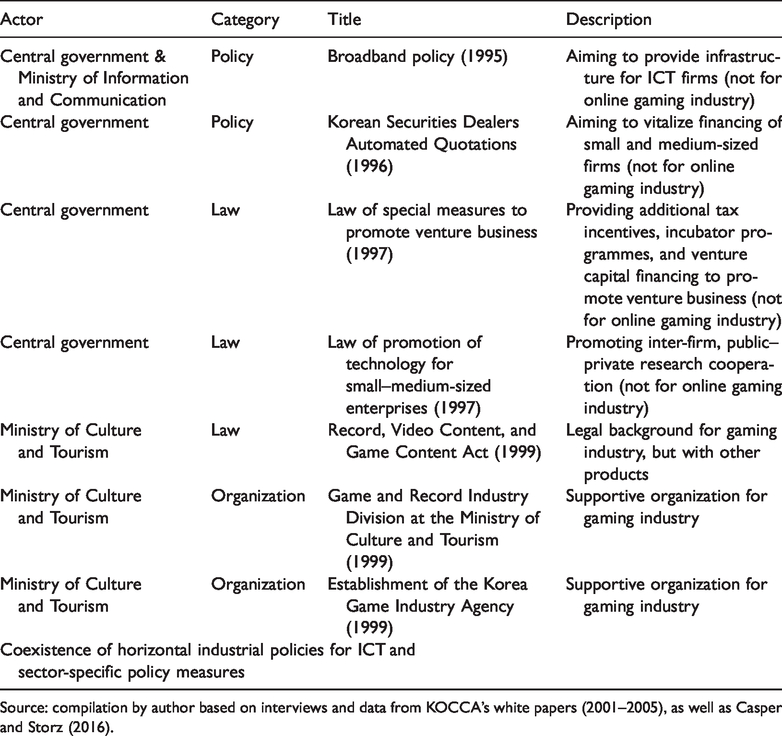
Source: compilation by author based on interviews and data from KOCCA’s white papers (2001–2005), as well as Casper and Storz (2016).
Despite these policies of the central government and the Ministry of Culture and Tourism, it would be incorrect to conclude that the emergence of the Korean online gaming industry was caused primarily by government policies (Casper and Storz, 2016). It is not without reason that Wi (2006) and Casson and Park (2014) argued that the most important driver of the emergence of the online gaming industry in Korea was not the intervention of government and conglomerates but the emergence of a community of entrepreneurs and their activities. Yet, it is still important to note that the Ministry of Culture and Tourism was an agent that implemented policies for promoting the gaming industry. In fact, there was a competition between the Ministry of Culture and Tourism and the Ministry of Information and Communication
3
as to who should take the initiative in embracing the gaming industry within their boundaries. Even other Ministries (e.g. the Ministry of Health and Welfare and Ministry of Industry of Industry and Energy) also were in charge of gaming industry-related policies before the Ministry of Culture and Tourism seized the initiative in respect to the gaming industry. Despite the initiative of the Ministry of Culture and Tourism, this may portend future conflicts among the ministries and other state actors. Ministry of Information and Communication people thought that they are the main contributor to building an ecosystem for the online gaming industry. They believed that the broadband system is a key factor of industrial development. However, the Ministry of Culture and Tourism quickly began to take the initiative with regard to the gaming industry. One remarkable example is that they established the Game and Record Industry Division, which has responsibility for gaming industry-related tasks within the Ministry. Before the Ministry of Culture took charge of the gaming industry, game rooms fell under the jurisdiction of the Ministry of Health and Welfare, and arcade games were under the control of the Ministry of Industry and Energy. (Interview with an official at the Ministry of Culture and Tourism)
Rapid growth of the online gaming industry (2000s)
During the 2000s, Korea became a big player in the online gaming industry, based on a high ratio of broadband Internet penetration and new games with innovative technologies (Huhh, 2008). Most importantly, the rapid growth of the online gaming industry in Korea began with the introduction of massive, multiplayer online role-playing game. Even though the Korean online gaming firms did not aim to enter the global market at the beginning, they managed to export their products to the world market and achieved huge success (Figure 2). The online gaming market in Korea increased by 41.3% between 2004 and 2005. Moreover, Korean online games comprised 32% of the world online gaming market by 2007 (Jin and Chee, 2008: 42). In 1999, when the Korean online gaming industry was still in its infancy, a total of 694 gaming companies existed. This number soared to 3797 companies by 2005. The total number of employees rapidly increased from 13,500 in 2000 to 60,669 in 2005 (Jin and Chee, 2008: 43). During its heyday, popular online games, such as Lineage (NCsoft), Maple Story (Nexon), Sudden Attack (CJ Internet), Kart Rider (Nexon) and Special Forces (Neowiz) received consumer support both in Korea and in international markets (Lee et al., 2007). Thanks to this success, from 2002 to 2008, the Korean online gaming industry ranked first in terms of exports, market share and worldwide sales (KOCCA, 2009). The most important export markets of the Korean online gaming industry have been China and Japan since 2000s (KOCCA, 2013). For example, in 2010, China (35.3%) and Japan (26.1%) maintained the position of the Korean online gaming industry’s largest export country. Choi (2010) and Ström and Ernkvist (2012) pointed out both countries’ similarities in terms of user’s cultural preferences as one reason why the Korean online gaming firms have gained some advantage to enter the markets. The size of the online gaming industry is relatively small compared to traditional manufacturing industries in Korea. Yet, it is expected to be one of the industries with substantial potential for growth (Choi, 2010).
Thanks in large part to the success of major online gaming firms, state actors became strong proponents of the industry and introduced sector-specific policies for the online gaming industry. For example, the Ministry of Culture, Sports, and Tourism (formerly, the Ministry of Culture and Tourism) strengthened the institutional foundation of the online gaming industry with the enactment of the Game Industry Promotion Act of 2006. The Act covers a number of policy measures by setting legal boundaries for gambling and gaming and providing an industry promotion plan, such as training programmes, R&D cooperation and entrepreneurial activity support. Interestingly, besides the Ministry of Culture, Sports, and Tourism, major political parties also submitted bills for promoting the gaming industry. Both opposing party (the Hannara Party) and ruling party (the Uri Party) members submitted similar bills to the one submitted by the Ministry of Culture, Sports, and Tourism, and they willingly wanted to become involved in the gaming industry. It was a heyday of the online gaming industry. Parliamentary members wanted to meet us to discuss bills. We also could see their growing interest in the industry. And the Ministry of Culture, as a supporter, also helped us in many ways, not only by introducing the Act but also by arranging events. (Interview with former executive of NEXON)
These supportive policies for the online gaming industry were accompanied by significant organizational change within the Ministry of Culture, Sports, and Tourism. Since the success of gaming companies heavily depends on securing talented and well-educated employees (Mulligan and Patrovsky, 2003), the Ministry set up new organizations to educate game developers, that is, the Korea Game Academy (a two-year, game-specific training programme). This new organization has been sponsored by the government since 2000 and has trained 250 graduate developers annually (Tsang and Park, 2013: 242). One of most remarkable policies related to the industry was a special military exemption policy that was introduced by the Ministry of Culture, Sports, and Tourism and the Ministry of National Defense. This special military exemption was critical to the early growth of the Korean online gaming industry (Wi, 2006). It allowed college graduates majoring in ICT to avoid military service and to work for 32 months at small gaming companies. The policy provided a good opportunity for small online gaming companies to hire young employees. All these measures had a goal of facilitating the online gaming industry. Building the Game Academy and the military exemption policy, in particular, appeared to promote employment, education and skill systems within the industry.
While Korean online gaming firms could not directly benefit from government policies in the early period of their development, thanks to the success of several online gaming firms, state actors made a drastic switch in their approach to online gaming industries in favour of being an active supporter (Table 2). In particular, sector-specific policies were introduced with various approaches. For example, the Game Industry Promotion Act of 2006 and industry promotion plans of 2003 and 2008 include many types of measures. While the former mainly provided guidelines and institutional foundations for the gaming industry, the latter revealed specific measures to promote the industry, including technology development, partnering between the public and private sectors and the internationalization of online firms. To facilitate these policy measures, newly built organizations for supporting industrial development, such as Korea Game Industry Agency and the Game Academy, along with the military exemption policy, were introduced. With such support, some of major online gaming firms actively took internationalization strategy (Ström and Ernkvist, 2012) and participated in co-production process with foreign firms (Choi, 2010).
List of regulations (2000s).
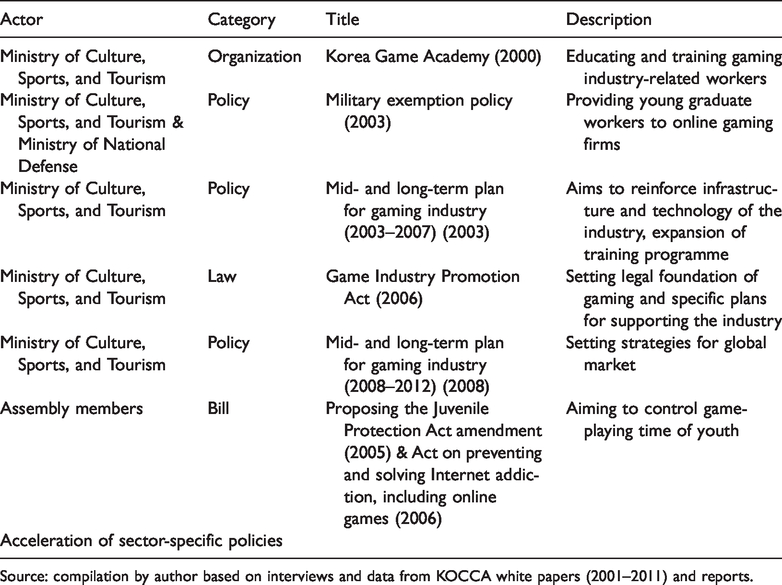
Source: compilation by author based on interviews and data from KOCCA white papers (2001–2011) and reports.
Yet, during that phase, state actors, such as assembly members, began to approach online gaming in a different way. Several assembly members introduced bills regarding the control of game addiction among youth. In this process, other stakeholders’ voices played an important part in building public opinion about the game addiction issue. For example, the Commission on Youth Protection
4
and the Christian Ethics Movement of Korea maintained the need for game addiction control laws to ensure the health of youngsters, providing them with enough sleeping hours. With the support of such stakeholders, in 2005, 2006 and 2008, several assembly members of the Hannara Party (conservative party) actively participated in the legislation process to control game-playing hours by youth. The purpose of this bill was obviously to set up minimum standards or guidelines for controlling youth game addiction. While the Ministry of Culture, as an active supporter, engaged with the industry, some assembly members who cared about the game addiction issue did not think much about its impact on the industry. Rather their concern was voters—parents’ thinking about the game. […] (I think) the Ministry people did not take such legislation action seriously. Because Korean online gaming industry had a heyday in those days and the Ministry’s policies worked well without facing problems. (Interview with an employee at KOCCA)
Plateau period (2010–)
As the online gaming industry’s success grew, the Ministry of Culture, Sports, and Tourism, as a main actor, led the initiatives and implemented a variety of policies in the name of promoting the industry. Yet, since the year 2010, other state actors have begun to emerge and influence the industry in a variety of ways. For example, in addition to the extant industrial policies, several public policies for the industry came up to solve the game addiction problems of youths.
As noted above, in the traditional Korean developmental state, the national economic development associated with large conglomerates was dominant, and all the other issues, such as societal issues, were subordinate to the national economic interest. In this manner, public or social policies functioned as a supplementary part of national economic development, and the state sometimes used the policies for the purpose of endorsing and facilitating a national development strategy. However, contrary to those policies, in the developmental period, various public policies on game addiction and the industry that the state actors has implemented have crossed the boundary of industrial policy and unintentionally influenced the online gaming industry ecosystem.
Most importantly, two laws regulating game playing by youths – the Juvenile Protection Law of the Ministry of Gender Equality and Family and the Game Industry Promotion Act of the Ministry of Culture, Sports, and Tourism – were revised in 2011 and 2012, respectively. Under these laws, a compulsory and a selective shutdown system were implemented. The compulsory shutdown system refers to online gaming companies’ restriction of youth aged under 16 from using online games from midnight to 6 a.m. The system is referred to as the ‘Cinderella Law’, in that online games are shut down at midnight. The purpose of this regulation is to prevent game addiction among adolescents and to ensure a minimum amount of sleep time necessary for growth and learning (Kim et al., 2015). In response to this regulation, the Ministry of Culture, Sports, and Tourism introduced a selective shutdown system in the Game Industry Promotion Act. Unlike the compulsory one, it allows parents more control over their children’s gaming. The selective shutdown system states that the legal guardian (parents) can set the game availability period for their children under 18 years of age.
The Ministry of Culture, Sports, and Tourism, as a main actor, has led the initiatives regarding the online gaming industry, emphasizing the cultural aspects of games. Yet, the Ministry of Gender Equality and Family suddenly involved itself in the gaming industry by implementing the revised Juvenile Protection Law, including the compulsory shutdown system. Pressure from stakeholders and policymakers compelled them to work on legislation to amend the Juvenile Protection Law. Since the Ministry of Gender Equality and Family, as an agent, has clear objectives to control the youth game addiction problem, their view about gaming is rather negative. Hence, the stance of the Ministry of Gender Equality and Family on gaming collided with the Ministry of Culture, Sports, and Tourism’s view. Regarding the growing tension between the two ministries, one KOCCA employee mentioned: After the compulsory shutdown system, the Ministry of Culture, Sports, and Tourism was afraid of losing the initiative about the gaming industry. And the Ministry people were concerned about harmful effects of the compulsory shutdown policy. So they did not want to introduce the shutdown policy or a similar type of regulation, but after the compulsory shutdown system was implemented, they had to move on to legislate a new one, the selective shutdown system. It is not a pre-emptive policy but a reactive policy against the compulsory one to keep their initiative in the gaming industry. Before the shutdown policy implemented, around 2010, my company planned to release a new game within two years and was financed by different ways, venture capital and banks, governmental subsidies. Although we prepared and developed the game for a long time, we suddenly faced a hurdle to set up a new server due to the shutdown policy. Unfortunately, we did not have enough money to finalise the game and build new infrastructure and hire someone to manage the new system, so we just sold all codes and story IP to big companies and were disassembled. I’ve seen many similar cases in my field.
After several public policies were implemented, the Korean International Trade Association surveyed 87 online gaming firms to find the effects of government regulations. Regarding the question of greatest concern for companies after the implementation of the shutdown system, 32.2% of respondents answered that they were concerned about the spread of negative perceptions by the public on the gaming industry, and 27.6% of respondents expressed concern about a decline in the online gaming market. While the main target of the public policies was to control the gaming addiction of youth, as many companies expressed, there is a great deal of concern that the public policies influence the industry in many other ways. This may illustrate that the boundaries between public policy and industrial policy have become blurred.
As the industry has developed and reached its plateau period, the scope and the degree of policies and regulations on the industry have expanded (Table 3). Public policies that once worked with industrial policies and developmental goals took diverse directions due to the intentions of state actors. As agents, the two ministries introduced different types of shutdown systems, which reflected their own interests and unintentionally had a negative influence on the online gaming industry by imposing costs on the industry. Other state actors, namely, assembly members, also exercised their agency by trying to regulate online gaming products by defining them as addictive substances.
List of regulations (2010s–).
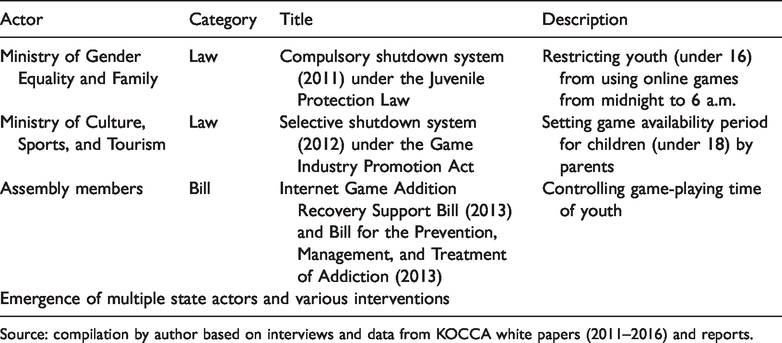
Source: compilation by author based on interviews and data from KOCCA white papers (2011–2016) and reports.
Furthermore, it is important to note that since 2010, KOCCA and the Ministry of Culture, Sports, and Tourism’s main focus has moved to the music industry and other cultural industries thanks to the success of the ‘Korean wave’, the term used to describe the popularity of Korean popular culture (Shin and Kim, 2013). Since the mid-2000s, the popularity of Korean dramas and music has spread further to Asian countries, including the neighbouring Japan and China, as well as in Southeast Asia and all around the world. Although the Korean wave describes an overarching diffusion of Korean popular cultural products of multiple genres, the online gaming industry has already been one of the most successful industries (Kwon and Kim, 2014; Peichi, 2008; Ström and Ernkvist, 2012). As shown in Table 4, the Korean gaming industry including the online gaming industry still is a leading exporter among cultural industries. However, as the other cultural industries, especially the Korean music industry (K-pop industry), have grown and diffused across the world, the Ministry heavily invested their resources in such industries. The stance on the gaming industry thus became more indifferent than before (interview with a KOCCA employee). In a similar vein, Kwon and Kim (2014) also discuss that while game industry division in the Ministry of Culture, Sports, and Tourism has maintained since 1999, changes in the organizational structure for governing cultural industry such as building new divisions, ‘popular culture industry’, have influenced some distortions within cultural industry-related policy making process.
Korean cultural industries’ export and import figures in 2015 (thousand USD).
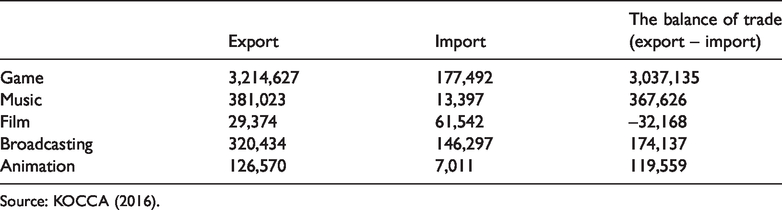
Source: KOCCA (2016).
As described above, after the industry’s heyday, the government’s intervention included a variety of policies that have become more intense and diversified over time. While the central government and the Ministry of Culture, Sports, and Tourism aimed to promote the online gaming industry with policy measures, the Ministry of Gender and Family, along with assembly members, saw games as addictive substances and began to influence the industry by implementing newly revised laws and introducing bills. While the conflict between the state actors surrounding the industry has appeared and heightened, the industry has thus faced an unfavourable environment, such as the decline of online gaming firm revenues and the decline of the industry ecosystem (Figure 3).
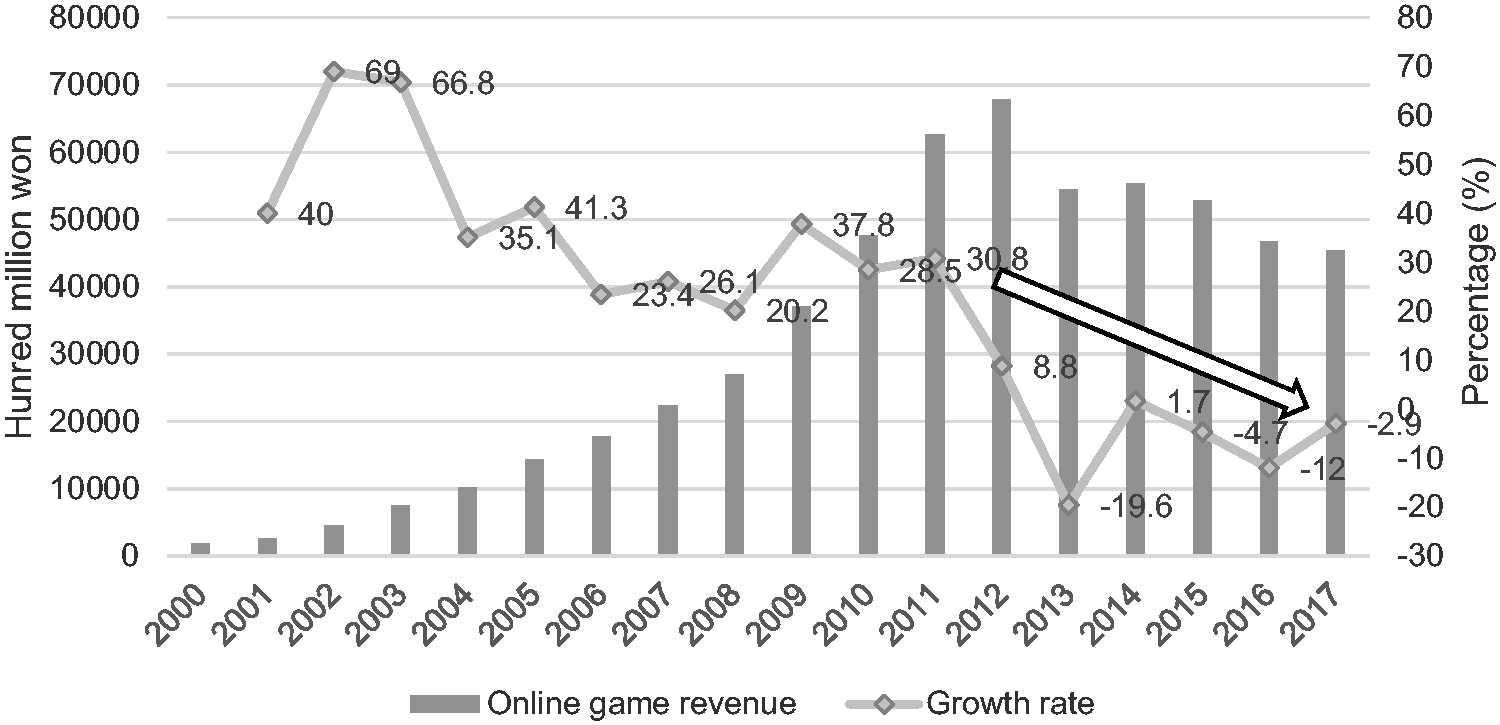
Revenue and growth rate of the Korean online gaming market (2000–2017). Source: KOCCA (2019).
In addition to the state actors’ involvement, there may be other various reasons behind the decline of the industry, such as the maturation of the industry, the emergence of new platforms and national economic conditions. Yet, it is worth noting that Korean online gaming firms’ representatives attribute the cause of current challenges to government regulations. In a 2014 survey from the Korean Game Industry Association and Korean International Trade Association, 43.1% of respondents regarded government regulations as a major reason for the decline of the online gaming industry.
Furthermore, the shutdown policies and legislation activities of assembly members influence online gaming industries’ export strategy. While the shutdown policies only target online gaming firms by regulating online game-playing time of youth in Korea, major online gaming firms have turned their attention more to export markets than domestic markets. At the same time, some of the major firms have actively entered the mobile gaming market due to the pressure derived from such policies on the online gaming industry. Regarding the changing strategy, an executive member of NCsoft stated: It is a must-do-thing for us. Indeed, not only because of the shutdown policies and negative cognitions on gaming, but also because of our global strategy, we decided to focus on foreign markets. We rather thought that we are lucky since our company already has a good reputation in the gaming market, has a technology that easily adapts to the mobile gaming market, and has an IP to use or sell. I also see other major firms take a similar stance to escape from unfavourable domestic market conditions.
Discussion and conclusion
This study found that the changing political and institutional contexts, the transition from the traditional developmental state to the neo- or post-developmental state and its impact on institutions influence the expansion of state actors and their roles. In particular, it can be argued that external (globalization) and internal (democratization) pressures both provide room for state actors (e.g. ministries, assembly members) to engage with the online gaming industry. While the pressures are obvious, their impacts on state actors and their actions and capabilities have been less discussed in the developmental state literature. Hence, this study sheds light on the diverse role of state actors and their policy engagement on the industry. In particular, by taking the adapted framework of Mahoney and Thelen (2010), this article recognizes the mechanism of institutional change, layering, in terms of state policy engagement on the online gaming industry. The layering mechanism refers to when a new set of rules, policies and practices coexist and layer on existing ones without replacing them. Different institutional logics are at play at the same time; old institutions thus do not simply break down but new institutional forms are overlaid. In the following, I discuss why the case of Korean online gaming industry and state actors’ policy engagement presents layering mechanism.
It was found here that some characteristics of new state actors and policies for the online gaming industry are similar to the ones from former state actors during the developmental period. One major component of policies that the Ministry of Culture, Sports, and Tourism implemented for the online gaming industry has been the promotion of the industry. Hence, a strong commitment of the state to the industry is still alive but on a smaller scale than it had during the developmental period. In this sense, the finding suggests that the Ministry of Culture, Sports, and Tourism and related organizations are, in a sense, abridged and target-specific pilot agencies for the online gaming industry. Their institutional logic thus is slightly similar to the logic of the pilot agency (e.g. EPB) during the developmental period. Yet, it is still different, since, unlike the EPB as designer and leader, the Ministry of Culture, Sports, and Tourism and the sub-organizations in it cannot control finance and labour but play a major role only for promoting the industry as a supporter.
In this sense, during the 2000s, the Ministry of Culture, Sports, and Tourism, as a major veto player, could have blocked institutional change and maintained dominant institutional logics, which focus on promoting industry development. Hence, other state actors thus could not actively engage with the online gaming industry and might not enjoy high discretion in the interpretation of institutions during the time. Yet, since the late 2000s, some assembly members and NGOs have built a political alliance to raise their voices on the game addiction issue. With their support, the Ministry of Gender Equality and Family implemented the compulsory shutdown policy. Their efforts may have weakened the veto capability of the Ministry of Culture, Sports, and Tourism regarding the online gaming industry and allowed other actors to have more discretion in the interpretation of institutions. In other words, the changing political and institutional contexts allow state actors pluralism. Dahl (1961) also suggests similar findings by providing state actors’ pluralism, but in a different context, with the case of New Haven politics. He illustrates the changes in the power structure of state actors from an oligarchy ruled by a patrician elite to a pluralistic model ruled by several elites. In line with an historical institutionalist explanation, this study is also interested in the power structure of actors and distributional conflicts, but at the same time, this study focuses on how inter-agency conflicts regarding the online gaming industry began to reduce the cohesion of the developmental state while highlighting the process of policy implementations and the impact on institutional change.
Given such a changing environment, policies and regulations such as the compulsory shutdown policy of the Ministry of Gender Equality and Family and the attempts of assembly members to introduce Acts for controlling the game-playing time of youth also add new institutional logics onto existing ones. The existing developmental state’s institutional logic stresses the coherent, uniform agency of state actors, mainly the central government. However, the institutional logic that the Ministry of Gender Equality and Family and assembly members brought to protect youth health and resolve the game addiction problem collided with the logic of the Ministry of Culture, Sports, and Tourism to promote the online gaming industry, since the state actors have their own agency to achieve their own ends and goals. In this sense, the findings support the idea that institutional environments are characterized by a plurality of different logics (Crouch, 2005; Thornton and Ocasio, 2008) and overlapping logics. As described, the dynamics and process of the policy engagements of the state actors show a ‘layering’ mechanism, but it may be argued that the mechanism is currently in a transition period due to the changing political context and level of discretion in interpretation of institutional logic. It is difficult to tell whether the Ministry of Culture, Sports, and Tourism will lose their leadership and veto power, but what is obvious here is that other state actors will enjoy broader space for implementing policies or engaging with the industry than before. It thus may be assumed that two different institutional logics – promoting the industry for economic development as an industrial policy and controlling game addiction as a public policy issue – will collide more often with the political discourse between state actors.
The other interesting finding is that the Ministry of Gender Equality and Family and the assembly members did not intend to hinder the online gaming industry’s development, but their policy implementations unintentionally affected the firms and the industry’s revenues and costs. Therefore, those actors played roles as guardians of youth health intentionally and as obstructers against the online gaming industry unintentionally. The ambivalent roles of state actors also can add interesting implications to the institutional change literature. While Mahoney and Thelen (2010) open a new avenue for the gradual institutional change literature, there has been little discussion about unintended outcomes on institutional change from actors’ behaviour thus far. In this sense, this finding also provides an important implication to the current literature of gradual institutional change.
The findings of this research thus contribute to the current debate in the developmental state literature by highlighting various state actors’ agency and the institutional logics that the actors bring. While acknowledging the importance of the state as an agent in the institutional environment, the research findings further suggest that the state is, in fact, not a singular entity but rather is a sphere of society in which various agents act, at times, with a unity of purpose, at times, at cross-purposes. This is quite unlike the traditional developmental state literature, which argues that unity of purpose and an organizational structure to match characterize the pursuit of the overarching goal of economic growth and development. Thus, unlike in the past, when the EPB held sway, more recently, various agencies have primarily focused on their own agendas. As covered above, the Korean government and the Ministry of Culture, Sports, and Tourism have strongly aimed to promote the industry. However, the Ministry of Gender Equality and Family implemented a shutdown system that impeded industrial development. Although this particular outcome may not have been expected (or intended), the contradictory stances of the state actors can be associated with internal heterogeneity or internal institutional change that derives from agents. In other words, agents in the state sector do not always act consistently or in a singular fashion, but may, at times, take independent action for themselves. This also contrasts with the traditional Korean state role, with the EPB as a pilot agency, during the 1960s–1980s. Therefore, with the findings of this article, it is argued that the dominant conception of the developmental state, preconditioned on enduring structural relations of embedded autonomy with society and the economy, needs to be recast in light of evolutionary changes in state–firm relations in the economy.
This study shows that changing the institutional environment and political context offers latitude to the state actors to deviate themselves from dominant existing logics. It is widely assumed that the openness of economies, democratization and growing participation in global production networks by domestic firms have created pressures that erode opportunities and incentives for government–business collaboration (Yeung, 2014). Yet, economic openness and greater freedom for actors, including state actors, has not meant any extensive retreat of the state. The state actors’ presence also varies within national economies. State interventions and roles have been actively refashioned, as political contexts and supporting institutional conditions have changed (Hamilton-Hart and Yeung, 2019; Stubbs, 2011). In line with this point, this study shows that variations of policy engagement on the online gaming industry facilitate the new institutional logics that potentially run counter to the traditional developmental logic of Korean economy. This also challenges the predominant view in the developmental state thesis that state actors (mostly the central government) maintain or sustain their logics through promoting conformity to dominant logics. In sum, state actor pluralism co-evolves with institutional pluralism or heterogeneity by adding new institutional logics onto traditional logics.
This article also contributes to the modest literature of the Korean online gaming industry. While the growth of the industry has been addressed thus far, there has been limited attention to the importance of the role of state actors in industrial development. Hence, this study fills this void by analysing the state actors’ policy implementation and engagement with the Korean online gaming industry. It was found that various types of engagement on the part of state actors have influenced the industry’s development. Despite the importance of the role of state actors in relation to the industry, as noted in this study, clear causality cannot be assumed between the regulations and the industry. In this regard, further studies must be carried out to validate the impact of regulations on the industry in a quantitative manner. In addition to such quantitative studies, further studies are needed to assess the effects of informal institutions (e.g. Ernkvist and Ström, 2008) and the multi-scalar institutional pressures (e.g. Gong and Hassink, 2019) on the online gaming industry.
Further works could also provide implications for the research on policy instruments for industrial development. In practice, motivations or expected outcomes of policies have been inclined to the positive side. Yet, the outcomes can be diverse and are not always as successful as planned. As seen above, the recent policy measures for the online gaming industry show unexpected negative consequences due to policy misalignment. Thus, this finding points to the real possibility that policy outcomes can vary from sector to sector, and sometimes government regulation can have detrimental effects on industry with a conspicuous presence of the state in economic activities. Especially, many of the ‘catch-up’ economies, both advanced and newly industrializing, which share the characteristics of a developmental state, can benefit from the insights derived.
Footnotes
Acknowledgements
I would like to thank Örjan Sjöberg, Cornelia Storz and Patrik Ström for their comments on earlier versions of this article. I am also grateful for the guidance and insightful comments by Leo McCann and anonymous reviewers of this article.
Declaration of Conflicting Interests
The author(s) declared following potential conflicts of interest with respect to the research, authorship, and/or publication of this article.
Funding
The author(s) disclosed receipt of the following financial support for the research, authorship, and/or publication of this article: This research was supported by the Johan & Jakob Söderberg Foundation.
