



Abstract
This article interrogates the notion of state capitalism, exploring the contributions and limits of the concept as a means of theorizing the more visible role of the state across the world capitalist economy. We critically synthesize the key arguments, outlining commonly cited properties and practices of state capitalism, in three bodies of literature: strategic management, comparative capitalism and global political economy. We find that the term not only lacks a unified definition, but actually refers to an extremely wide array of policy instruments, strategic objectives, institutional forms and networks, that involve the state to different degrees. For this proliferation of competing usages to be productive and not lead to analytical impasses, we argue that there is a need for a heightened level of reflexive scrutiny of state capitalism as a category of analysis. In that spirit, we identify three issues that the literature must further grapple with for the term to be analytically meaningful, that is, capable of rendering (state)capitalist diversity amenable to analysis and critique: (1) the ‘missing link’ of a theory of the capitalist state, (2) the time horizons of state capitalism, or the question of ‘periodization’, (3) territorial considerations or the question of ‘locating’ state capitalism.
Keywords
Introduction
Recent transformations in the global economy have sparked renewed interest in the role of the state in capital accumulation. Such transformations include a ‘return’ to various forms of state-led development across the global South since the early 2000s (in China, Russia and other large emerging economies), extensive state intervention following the 2008 global financial crisis in the global North and the multiplication of various forms of ‘state–capital hybrids’ such as sovereign wealth funds (SWFs) and state-owned enterprises (SOEs). For instance, the number of SWFs increased from 50 to 92 between 2005 and 2017, while assets under management grew to over $7.5 trillion, which is more than hedge funds and private equity firms combined (Preqin, 2018). According to figures quoted in Bruton et al. (2015: 92), ‘SOEs generate approximately one tenth of world gross domestic product (GDP) and represent approximately 20% of global equity market value’. SOEs now dwarf even the largest privately-owned transnational corporations, with PetroChina currently leading the list with a market value of more than $1 trillion. Three of the top five companies in the 2018 Fortune Global 500 are Chinese SOEs (State Grid, Sinopec Group and China National Petroleum Corp). Significantly, these state–capital hybrids have also become increasingly integrated into transnational circuits of capital, including global networks of production, trade, finance, infrastructure and corporate ownership. Does this renewed state activism – and its remarkably outward orientation – indicate a changing role of the state in capital accumulation and the emergence of new political geographies of capital?
For many commentators, this polymorphism of state intervention signals the resurgence of ‘state capitalism’ under a new form. Despite the widespread mobilization of the concept for both categorization and explanation, there is neither consensus about what it exactly means nor about its implications. Scholars have deployed the concept (and cognates) to designate a national variant of capitalism (Nölke et al., 2015), a new brand of SOE and/or state-sponsored investment fund (Lyons, 2007; Musacchio and Lazzarini, 2014), a particular type of state–business relation (Nölke, 2014; Zhang and Whitley, 2013), a threat or an alternative to (Western-dominated) (neo)liberal capitalism (Bremmer, 2010; McNally, 2013), a reconfiguration of the global ‘state–capital nexus’ (van Apeldoorn et al., 2012) and the use of market mechanisms for the promotion of geo-economic and geopolitical goals (e.g. Kurlantzick, 2016). Hence, the term not only lacks a unified definition, it refers to an extremely wide array of practices, policy instruments and vehicles, institutional forms, relations and networks that involve the state to different degrees and at a variety of levels, time frames, and scales.
This raises three sets of questions. First, what do commentators mean by state capitalism? What are its specific properties and unique features? What is driving its emergence? Where is it located, and what is new about it? Second, if scholars agree that the new state capitalism is ‘hardly monolithic’ (Kurlantzick, 2016: 226) and that it is a ‘variegated force’ (McNally, 2013: 38), what is the nature of this diversity across political, ideological and geographical contexts, and how do we explain it? Is the ‘rebound of the state’ (van Apeldoorn et al., 2012) in the global North and the global South the product of the same historical forces and dynamics? Finally, what is the relation between the new state capitalism and the Western-dominated liberal capitalist world order? What is its relationship with the current pattern of financialized globalization and neoliberalism as the dominant hegemonic project?
While this proliferation of competing definitions and loose conceptualizations is not necessarily problematic, it nonetheless warrants a heightened level of reflexive scrutiny. In particular, we contend that it raises the fundamental issue of the concept’s analytical value (i.e. describes much, but explains nothing). We argue that the loose, if not imprecise, conceptualizations of the category have allowed it to become some sort of ‘banner to unite under’ for a number of commentators with extremely different theoretical outlooks, methods and objects of inquiry. As such, it has opened the possibility for a critical dialogue that could lead to a more holistic account of the changing role of the capitalist state and the new political geographies of capital. Nevertheless, much remains to be done to turn state capitalism from an umbrella term into a powerful heuristic tool. Indeed, our analysis shows that state capitalism, as it is currently deployed in much of the literature, does not bring ‘recognizability’, even less ‘clarity’, to the seemingly more visible role of the state across the world capitalist economy. Furthermore, its use does not offer ‘ready-made analytical expedience and insight’, and as a whole, its critical properties have not been sufficiently established (see Christophers, 2015: 184). Consequently, we submit that, at this stage, the analytical value of the concept is weak.
However, we do not argue that the concept of state capitalism should be discarded. Rather, we wager that its analytical value can be bolstered. Although our perspective on state capitalism and the state in capitalism is informed by historical materialism and critical political economy, we aim to foster intellectual inclusiveness on the topic through engaged pluralism with scholars across various fields of enquiry. 1 In that spirit, we identify three issues that research on state capitalism must further grapple with for the term to be analytically meaningful, or more precisely, capable of rendering (state) capitalist diversity amenable to analysis and critique. We posit three issues that need serious engagement if a productive dialogue is to be fostered between academic disciplines and for the concept to be useful in making sense of the changing political geographies of capital and of the polymorphism of state intervention. These are: (1) the ‘missing link’ of a theory of the capitalist state, (2) the time horizons of state capitalism, or the question of ‘periodization’ and (3) territorial considerations, or the question of ‘locating’ state capitalism.
In the first part of the article, we critically review the key arguments made in three bodies of literature: strategic management and corporate governance (‘Managing state capitalism’ section), comparative capitalism (CC) (‘State (comparative) capitalism’ section) and global political economy (GPE) (‘State capital in the GPE’ section). Our survey is necessarily limited such that we risk providing schematic and simplified accounts of the distinctive features and nuances within these bodies of literature. Nonetheless, we aim to reveal their underlying set of assumptions, common principles, theoretical underpinnings, as well as points of disagreement. In the ‘Pushing the limits’ section, we explore the limits to state capitalism as a research agenda, emphasizing the blind spots, tensions and questions left unanswered by the literature. We conclude by discussing future research directions.
Managing state capitalism
In the strategic management and comparative corporate governance literature, or simply management, state capitalism is seen as a particular organizational and governance form in emerging and transition economies. Hence, it is worth clarifying that debates in this literature are actually not about capitalism (understood as a historically specific mode of production). Rather, they are concerned with firms where the state plays a strategic management role, or put differently, in state ownership and/or control of capital. Management scholars argue that there has been a transformation of the ‘well-known model of state capitalism’ – by which they refer to wholly-owned state-owned enterprises (SOEs) ‘as extensions of the public bureaucracy’ – into ‘new models’ (Musacchio and Lazzarini, 2014).
What is fundamentally new about those models is that ‘since the late 20th century … [state versus private] ownership boundaries are not fixed’ (Peng et al., 2016: 298). SOEs have become ‘hybrid organizations’ (Bruton et al., 2015), where states own majority or minority equity positions in firms, or what has been termed ‘partial state ownership’ (Inoue et al., 2013). Moreover, various ‘marketized’ forms of state ownership and control (Li et al., 2017) have gained in importance, such as state-owned holding companies, SWFs, state-controlled pension funds and life insurance funds, national development banks, the provision of strategic support to private firms using subsidized credit and/or other forms of support and protection to stimulate new firm capabilities and upgrading and the facilitation of merger and acquisitions in strategic sectors. In short, the ‘new form’ of state capitalism is characterized by ‘market orientation’ and by ‘increasing globalization’ (Grosman et al., 2016: 202). Management scholars suggest that those various forms of state-controlled and state-directed capital deserve attention because they are ‘thriving’ not only in their home countries but also in the global economy, where they are ‘taking centre stage’ (Musacchio et al., 2015).
Indeed, one of the main concerns of this literature is to explain ‘the centrality and longevity of SOEs as an organizational form in the global economy’ (Peng et al., 2016: 312, emphasis added), as illustrated by the indicators mentioned in our introduction. Management scholars consider this a new research puzzle, whereas the literature previously assumed SOEs or state-controlled enterprises as temporary organizational forms (Grosman et al., 2016). From that conventional perspective, SOEs are relics of central planning destined to be privatized as countries transition to modern market economies. Hence, the central research question: ‘what contributes to their ability to survive and, in some cases, prosper?’ (Bruton et al., 2015: 93).
The second main research puzzle is to explain how SOEs are performing at least equal to, if not better than private companies. Again, what must be emphasized is that the conventional management literature on SOEs predicts that the latter will, as Musacchio et al. (2015: 116) remark, ‘underperform their private counterparts under almost any circumstance’. This is due to what the literature calls ‘the liabilities of “stateness”’, which broadly refers to how ‘dysfunctional political interference’ negatively affects firm-level economic performance (for surveys on the performance and efficiency costs of state ownership, see Estrin et al., 2009; Megginson, 2017; Megginson and Netter, 2001). The key concern is with the economic performance at the firm level of various types of organizational and governance arrangements involving state ownership or control.
Importantly, this is also what frames the interest of the management literature in diversity/variety. The literature is concerned with three types of diversity: (1) various forms of state ownership/control (or what is sometimes termed ‘organizational diversity’), (2) different outcomes in terms of firm performance, strategy, and organizational effectiveness, and (3) different country-level institutional arrangements. Although it is important to underline that, in contrast with the CC literature examined in the next section, country-level institutional diversity is only examined inasmuch as it affects the previous two types of diversity. For instance, Musacchio et al. (2015: 116) seek to ‘identify the institutional conditions that will affect the performance of each type of state capitalism’; Bruton et al. (2015) examine how (national) institutions affect the systems of governance, and hence the incentives that board members and executives face and Meyer and Peng (2016: 6) argue that ‘[w]ith respect to state ownership, differences in political systems translate into substantive differences in the objectives, governance structures, and top management team composition in SOEs’. The cognate field of international business follows a similar approach: it is concerned with ‘how organizational diversity of emerging economy SOEs derived from macro-institutional reforms [encompassing administrative and fiscal decentralization, privatization, market liberalization, and industrial restructuring] can extensively impact their overseas venturing strategies’ (Li et al., 2014: 998).
Overall, this literature is concerned with how variegated institutional change is ‘a driving component of SOE strategy [encompassing institutional logics and strategic objectives, capabilities and patterns of resource allocation, and internal organizational dynamics and structures] in emerging economies’ (Li et al., 2014). It explains diversity as follows: institutional variety at national and local level leads to organizational diversity of SOEs at field-level, which in turn leads to differing firm-level strategies (for instance, in terms of overseas investment). Moreover, while this literature provides excellent ‘thick’ descriptions of the evolution and path-dependency of state control in particular countries, it is little concerned with theorizing the reinvention of state capital, its nature, and the extent of its diversity beyond firm-level and across national contexts.
A critical assessment
These debates in the management literature, particularly the most recent, have made important contributions to the study of state capitalism inasmuch as (1) they provide a nuanced framework to analyse the various forms of state capital beyond the usual polarized view of state versus private ownership; (2) they challenge the stereotypical view (prevalent in the wider management discipline) that the performance of SOEs is tendentially bad; and (3) they draw attention to the role of country-level institutional diversity in the emergence of various forms of state capital and different strategic, performance and organizational outcomes at the firm-level. Nevertheless, we argue that the literature has at least three limitations.
First, it under-theorizes the relationship between the state and SOEs. It tends to take for granted that the influence of state bureaucrats and politicians is a source of ‘dysfunctional political interference’ in state-controlled firms. This ontological view, and the broader normative stance about the public–private divide in which it is grounded (the public as a source of interference, the private as a source of economic efficiency), is extremely problematic, because it does not leave room (if any) for scenarios where firms are efficient in economic terms and simultaneously perform functions that further the strategic interests of state actors. It also precludes considerations of (geo)economic and (geo)political strategies that involve both private and public actors.
Second, the literature tends to conceive of the scope and motives for state action in narrow terms. For instance, Musacchio and Lazzarini (2014: chapter 3) explain in their influential account that they firmly ground their arguments about state capitalism in three fundamental logics for state intervention: fixing market failures, providing social goods and industrial policy. While this is of course a perfectly legitimate theoretical decision, this is nonetheless a restricted understanding of state capitalism. Those three logics, as important as they are, only cover a fraction of the multifaceted role of the state in accumulation. Reducing the polymorphism of state intervention to those three logics leaves the strategic management literature inadequately equipped to grasp a great deal of phenomena deeply entangled with state capitalism, many of which will be further commented upon below, such as the role of state capitalism in re-configuring economic and political sovereignty, in negotiating neoliberalization, financialization, and globalization, or in mediating geopolitical competition between different states.
The third limitation is the claim of novelty. As Musacchio et al. (2015: 115, emphasis added) argue, governments around the world have transformed the well-known model of state capitalism by which they owned and managed wholly-owned state-owned enterprises (SOEs) … into new models in which the government works hand in hand with domestic and foreign private investors to develop new strategic capabilities using novel governance arrangements.
Similarly, it is unclear what exactly is novel about the strategic capabilities that state-controlled capital strives to develop. In their discussions of such capabilities, Musacchio et al. (2015) actually refer to upgrading, diversification, national champion policy, innovation policy, investment in research and education, and infrastructure provision. Those were all, as the authors acknowledge, key objectives of industrial policy in the paradigmatic case of the East Asian developmental state. If new governance and organizational forms have indeed emerged, such as the listing of large SOEs on stock exchanges, the professionalization of their management, the adding of boards of directors with independent members and a certain budgetary autonomy (Musacchio and Lazzarini, 2014: 48), we remain unconvinced that this is sufficient ground to claim that a new form of state capitalism has appeared. Has this translated into a change in the functions of SOEs, or into a reinvention of the influence of the state in the economy? The concrete implications of those new governance and organizational forms in terms of the role of the state in capital accumulation must be specified to substantiate the claim of novelty at the core of the management literature. We return to this important issue in the penultimate section.
Finally, by primarily locating state capitalism in emerging and transition economies phenomenon, the literature paints an incomplete (if not misleading) picture about the geographies of state capitalism: as Babic et al. (2017: 35) note, ‘the TSOE [transnational state-owned enterprises] phenomenon clearly goes beyond emerging markets and is prevalent in the industrialized West as well’, such as in France, Germany and Japan. Similarly, Haberly and Wójcik (2017: 252) argue that the ‘state capitalist [corporate ownership] network sprawl, has increasingly spread beyond commodity exporters and developing countries, to larger developed countries with historically strong interventionist streaks.’
State (comparative) capitalism
In early variants of CC scholarship, the state’s role was given limited analytical treatment and taken for granted, save for some specific variants. For instance, Whitley (2000) identifies a ‘state-organized business system’, while Schmidt (2002) argued that ‘state capitalism’, epitomized by French dirigisme d’état, is a third European variety of capitalism alongside the coordinated-market economy (CME) and liberal-market economy (LME) ideal types. While extensions have since been made to the frameworks to better account for the importance of the state (e.g. Hancké et al., 2007; Schmidt, 2009), there is still a widespread sense, including amongst some of the key proponents of those approaches, that the role and diversity of state intervention are still underplayed in the CC scholarship (e.g. Wilkinson et al., 2014; Witt and Redding, 2013; Zhang and Whitley, 2013). This has of course become more obvious given the recently more visible role of the state everywhere, but also because the literature has considerably extended its geographical scope, from a rather narrow focus on Western Europe, North America and Japan, to Asia, Central and Eastern Europe and Latin America. What clearly appeared from this ‘globalization’ of the field (and from the inclusion of more countries in its typologies) is that the CC scholarship did not capture well the role of the state and its various forms of intervention in spaces beyond Europe and in national economies that diverged from the two central CME/LME ideal-typical varieties of capitalism (Carney and Witt, 2014).
To correct this myopia, a number of CC scholars strive to identify and outline the institutional contours of national varieties of capitalism that are state-led. Here, mainly three factors linked to the form and role of the state are included as institutional dimensions in the process of categorization of capitalist diversity: (1) the nature and extent of state intervention (from direct involvement in production and investment to the promotion of specific sectors); (2) the nature of state–business relations (particularly the network governance arrangements that link the state to private sectors actors, such as policy networks, business associations, deliberation councils and interpersonal relationships); (3) the type of state (is the state considered characterized by more ‘developmental’, ‘predatory’, ‘regulatory’ or ‘welfare’ elements?).
For instance, Walter and Zhang (2012) identify a state-led variety of capitalism in Asia, in which they include China and Malaysia, featuring strong state intervention (large industrial output produced by SOEs, large government investment) and tight state control of business and labour organizations. The typology of Asian business systems proposed by Witt and Redding (2013), though ultimately rejecting the validity of a state-led capitalist variety (more on this below), also includes a categorization of the state in the countries studied (following the four ideal types previously mentioned). Carney and Witt (2014) offer yet another typology of Asian business systems, in which a state-led version of capitalism mixes both predatory and developmental state elements, and includes countries such as Malaysia, Thailand, China, India (the more developmental ones), and Vietnam, the Philippines, Laos, Indonesia (the more predatory ones). Using a similar typology, Fainshmidt et al. (2018: 316) claim the state takes an active and direct role in the economic ordering of society. In these systems, political networks often serve as the mechanism thorough which economic activity is coordinated. These networks tend to monopolize and sustain power, introducing predatory elements to the state.
While many of the abovementioned studies (and much of the CC literature) are mostly concerned with comparing country-level institutional diversity in a static manner (often using modelling and cluster analysis), a number of studies consider how various institutional forms of strong state intervention have changed over time. For example, Zhang and Whitley (2013) look at how patterns of institutional change and economic governance arrangements have evolved in varieties of East Asian capitalism between the 1980s and the 1990s–2000s. They argue that Japan, Taiwan, Thailand, and Malaysia faced common ‘external pressures’ (growing global capital and product market integration and intensifying political pressures from Western governments and multinational institutions) which contributed to ‘[eroding] direct state intervention in the economy and weakened state-controlled institutions through which economic activity was governed’ (2013: 322). Nevertheless, those common pressures did not shape institutional change evenly across East Asian economies. This is because those pressures were mediated by, ‘the interest and power configuration of dominant coalitions, particularly the number and variety of different socio-economic actors represented in the coalition, such as big business in different sectors, SMEs, landlords, farmers and labor’ (Zhang and Whitley, 2013: 323). According to Zhang and Whitley, of the two East Asian economies considered state-led in the 1980s (Malaysia and Taiwan), only Malaysia remained so in the 2000s (Taiwan became a ‘co-governed’ variety of capitalism, characterized by reduced state intervention). This is an important argument to explain the uneven persistence of the state-led variety of capitalism over time.
Finally, an influential strand of CC research that draws upon international political economy and international business, proposes to characterize state capitalism explicitly in terms of its form of external integration in the GPE, or what is referred to as the ‘transnational embeddedness’ of state capitalism (Nölke et al., 2015: 542). For the key proponents of this argument, the ‘state-permeated’ variety of capitalism – which is ‘typical for large emerging markets’ such as Brazil, India, and China – is not only defined by ‘dense informal relationships between public authorities and major domestic corporations, which function as the central coordination mechanism of the economic system’ (Nölke, 2014: 79–80), as much of the CC literature argues. State-permeated capitalism is also characterized by both a ‘deep immersion’ in international trade and global production networks and by a ‘policy of selective and phased integration into the global economy’ (Nölke et al., 2015: 545; Ten Brink, 2014), including the strategic use of inward and outward foreign investment, and various forms of support to ‘their’ emerging transnational corporations. Importantly, the strong role of the state in those economies is seen as an attempt at orchestrating ‘catch-up’ development. Indeed, it is intimately linked to their timing of insertion into the global economy. In other words, these authors ground their analysis of state-permeated capitalism in (neo-)Listian theories of the developmental state and in Gershekron’s theory of late development (McNally, 2012; Nölke, 2014: 4).
What distinguishes ‘state capitalism 3.0’ from ‘previous waves of state capitalism’ is that ‘third-generation late developers’ are not coherently directed by a central planning body, and they use sophisticated policies not simply to shield themselves from global competition in a protectionist fashion but to improve their relative position in the world economy (McNally, 2012: 755; Nölke, 2014: 89). As we further discuss below (in ‘Pushing the limits’ section), this is an important argument in terms of placing state capitalism within dynamics of uneven and combined geographical development, and in periodizing state capitalism.
A critical assessment
The renewal of interest within the CC scholarship in the role of the state in (re)producing capitalist institutional diversity is welcome. This literature has contributed significantly to the study of state capitalism in three ways. First, it demonstrates that various state institutions and modalities of intervention shape and are shaped by national variants of capitalism. Second, it highlights the importance of examining state–business relations and (formal and informal) networks in the study of state capitalism and has provided a more nuanced picture in that regard than the strategic management literature. Third, it shows the crucial role that ideas and conflicts between various interests play in the persistence of strong state intervention (albeit in changing forms) in relation with globalization pressures. This is an important argument to understand the diversity of state capitalism, and its reproduction (or not) over time. Nonetheless, this literature has several shortcomings.
As previously discussed, the CC field has reacted to its previous lack of attention to the state in two ways, and reached diametrically opposite conclusions, both of which are problematic in our view. On the one hand, commentators have upheld the validity of the category state(-led, -permeated) capitalism, and have fleshed out what are deemed to be its key institutional features. However, this has proved to be a particularly thorny exercise, and commentators tend to disagree over the specific institutional contours of state capitalism. The issue is not so much the dissensus. The debates about what institutions and forms of intervention to include (or not) and about how to measure/quantify features such as ‘strong state intervention’ are potentially endless (the proliferation of typologies attests to that). Consequently, one wonders about the potential of this analytical strategy in yielding fresh insights into the nature of state capitalism. Moreover, a relatively small methodological difference in the institutional characterization of state capitalism as an ideal type (or in the institutional variables used to perform a cluster analysis) may result in significant changes in the categorization of national economies as state capitalists. This may depict very different pictures of where actually existing state capitalism is located in the world economy, from an exclusively Chinese or East Asian phenomenon, to a state-led variety distributed across emerging economies, or across regions and continents. In short, a small change in what CC scholars look at might lead to a dramatic shift in the geographies of state capitalism. This has major implications for how we understand state capitalism, its nature and drivers.
This leads us to the second claim by some CC scholars, which has been to reject altogether the categorical validity of state capitalism on the basis that the state plays a pervasive role in most if not all of the national economies investigated. This position can be summed up as strong capitalist states everywhere, state capitalism nowhere, as Witt et al. (2018) argue. This conclusion is equally problematic for at least two reasons. First, it does not allow moving beyond the (somewhat trivial) statement that ‘the state matters’, and it does not say much if anything about the recently more visible role of the state. Second, it eludes the question of explaining why the role of the state is so variegated across the world capitalist economy. Indeed, and perhaps ironically given the focus of the CC field on institutional diversity, by emphasizing commonality (the strong role of the state), this conclusion dilutes diversity. The key issue here is that an effective theory of variegation must be able to account for both what is similar (i.e. underlying common processes), and the continuous reproduction of difference, both between state capitalism and other forms of capitalism, and between different varieties of state capitalism (Brenner et al., 2010). Overall, both conclusions remain wanting, and arguably reflect the analytical impasse that the field has reached in the study of state capitalism.
Furthermore, if the CC literature has done a good job at explaining the maintenance or persistence of state capitalism in the face of pressures emanating from globalization, it does not say much about its resurgence, renewal and reinvention. In particular, and with some important exceptions (e.g. Nölke et al., 2015), it has done little to explain the transnational dimensions of state capitalism, or how state capitalism itself has been a driving force of globalizing capital (via foreign investment, cross-listing of shares, M&A, transnational networks of elites, etc.). This is highly unfortunate, given that those transnationalizing tendencies are identified across the social sciences as the single most important features about the new form of state capitalism, i.e. what makes it distinctively different from previous forms/periods of state capitalism. While we do not want to rehearse here the critiques of the geographical and territorial assumptions of the CC scholarship (see Dixon, 2014), let us simply emphasize that the conceptual and methodological nationalism that profoundly shapes the analytical outlook of this literature might be a considerable hurdle to grasp the transnationalizing tendencies of state capitalism and the new political geographies of capital.
State capital in the global political economy
The contribution of GPE research on state capitalism is somewhat heterogeneous. While it is clear that management scholars are mostly interested in statist (state-owned or state-controlled) capital, and that the CC literature is concerned with (national) state-led varieties of capitalism, state capitalism in GPE covers a highly diverse range of research topics and objects of inquiry. 2 We identify four (overlapping) themes that cover the main contributions of the field.
First, GPE scholars have discussed the implications of state capitalism as a source of cross-border finance, and particularly, a source of patient capital. For instance, Kaplan (2016) argues that the longer-term horizons of Chinese state-to-state lending provides more fiscal space to Latin American debtors than when they borrow from financial markets, thereby affecting their policy choices. For Kaplan, this has the potential to trigger a move away from the more traditional (Western) market-centric governance of sovereign borrowing. Critical scholars are more sceptical: for Gonzalez-Vicente (2017), state capitalism as a source of finance and investment is unlikely to significantly alter South–South relations. Taylor (2014: 354) argues similarly that, ‘state capitalism as exported to Africa serves the class interests of externally oriented fractions with aspirations to become internationally competitive, accumulate mega-profits and entrench their domestic positions’. The question of state capitalism as a source of finance is not reserved to the developing world. Thatcher and Vlandas (2016) show how both state and private actors in Germany and France have actively sought to attract investment from SWFs. Indeed, Asian and Middle Eastern SWFs helped recapitalize distressed banks and automotive firms in the West in the post-2008 crisis environment (Haberly, 2011, 2014). This also increased the participation of state-controlled capital in the global network of corporate ownership and control (Haberly and Wójcik, 2017).
Second, GPE scholars have studied state capitalism in light of the reconfiguration of the state under conditions of globalization and financialization in order to achieve developmental objectives, maintain state sovereignty, and preserve existing domestic political orders. For instance, Nem Singh and Chen (2018) show how the internationalization and upgrading of SOEs allowed designing new developmental policies across the developing world. SWFs can play a developmental role (when used to invest in ‘strategic’ sectors, firms or projects) but can also be used as state instruments to retain sovereignty at home and/or extend it abroad (Dixon and Monk, 2012). For Carney (2015) and Huat (2016), the rise and persistence of state capitalism (under the shape of SOEs) can be explained by its ‘stabilizing role’ in the face of financial globalization. By addressing macroeconomic and financial volatility, and protecting from ‘political challengers’ who may benefit from financial globalization, state capitalism contributes to regime maintenance and the preservation of domestic political orders. Haberly and Wójcik (2017: 258) suggest interpreting the new state capitalism as ‘politically-mediated Polanyian double-movements of marketization and societal-protection, surrounding the advance of neoliberalism and globalization’. This has given rise to what Haberly and Wójcik call ‘a market-conforming, financial-return oriented state capitalist paradigm […] not as a reaction to neoliberalism and globalization, but rather as a means for sustaining them’ (Haberly and Wójcik, 2017: 251).
The Amsterdam School of critical IPE argues similarly that the current crisis of global capitalism has triggered a ‘reconfiguration of the global state–capital nexus’, marked by ‘the combination of a “return of the state” with a continued deepening of the process of capitalist transnationalization and globalization’ (van Apeldoorn et al., 2012: 472–473). In the West, the crisis has forced the state to take on an extraordinary role in order to protect the interests of capital in general, although this has so far not led ‘to any durable statist direction of the market’ but rather to an instrumentalization of the crisis to promote further neoliberalization (van Apeldoorn et al., 2012: 478–479). Across the global South, the particular configuration of the state–capital nexus corresponds to a statist version of capitalism (involving both rentier and developmentalist strategies) in which the state plays a particularly important role in directing capital accumulation. In both the West and the global South, they argue, the reconfiguration of the state–capital nexus is geared towards deepening commodification of labour and nature.
Third, GPE commentators have explored the interplay of statist and commercial strategies in the internationalization (or transnationalization) of state capitalism, via SWFs and state asset management bodies, SOEs’ outward FDI, M&A, and equity investment, and the creation of ‘national champions’. The key issue here is the following: are the going-abroad strategies of state capitalism more driven by state (geo)political interests, such as the acquisition of key resources and the expansion of statecraft, or by profit-maximization? Empirically, contributors have sought to answer this question by focusing on statist capital overseas investment in a number of strategic sectors such as natural resources and energy. For instance, a much-debated case is that of the oil industry. Meckling et al. (2015: 1161) identify three types of perspective on the matter. Scholars often close to Western corporate and policy-making circles have articulated the first type of perspective. It contends from a realist standpoint that the going-abroad strategies of state capitalism (largely seen as an emerging market phenomenon) are ‘a product of statecraft’ (e.g. Bremmer, 2010; Kurlantzick, 2016). National oil companies are typically seen as ‘arms of state power’. This is generally perceived as a threat (for a number of reasons detailed below), and those accounts are often characterized by an alarmist and anxiogenic tone.
The second type of approach claims, on the contrary, that when going abroad, national oil companies are ‘commercially minded’, and that ‘governments follow firms more than they lead their internationalization’ (Meckling et al., 2015: 1162; Steinfeld, 2010; Victor et al., 2012). The third type of perspective provides a more nuanced account. For example, Meckling et al. (2015) argue that the internationalization of Indian and Chinese national oil companies is neither primarily state-driven nor market-driven; rather, it follows a ‘hybrid’ pattern characterized by ‘the co-existence of cooperation and conflict between increasingly entrepreneurial, profit-driven national oil companies pulling to global markets and partially supportive and interventionist home governments’ (Meckling et al., 2015: 1160).
Similarly, for de Graaff and van Apeldoorn (2018: 121), Chinese energy SOEs perform a ‘dual role, adhering to commercial principles abroad (e.g. prioritizing profit-making) but retaining the responsibilities of a state-owned company at home (e.g. prioritizing energy security and social stability)’ (see also de Graaff, 2012). This constitutes ‘the essentially contradictory nature of Chinese transnationalizing state-directed capital’ (de Graaff and van Apeldoorn, 2018: 121). Jones and Zou (2017) explore the case study of a Chinese SOE investing in hydropower energy in Myanmar. For them, the analytical distinction between state-driven or market-driven internationalization is problematic, both empirically (they find evidence for both theses), and theoretically, because it relies on a poor conceptualization of the relationship between the state and SOEs. Their key argument is that Chinese SOEs have ‘considerable power and autonomy to pursue profit-making activities and are very weakly regulated’, due to the dispersal of power and authority to diverse, cross-cutting state apparatuses that are unevenly fragmented, decentralized, and internationalized. Nevertheless, parts of the state also ‘strive to control SOE activities where their interests are at stake. Thus, party–state/SOE relations are best understood in terms of an evolving struggle within a transformed, multilevel governance structure’ (Jones and Zou, 2017: 755).
Fourth, GPE scholars have debated the relation between the rise of state capitalism and the future of the (Western-dominated) liberal economic order and the global hegemony of neoliberalism. The Chinese model is often the key concern here. Here again, a number of general perspectives can be identified. The first one sees the resurgence of state capitalism, and especially its Chinese instantiation, as a threat to the ‘free market’ and liberal democracy. For instance, Bremmer (2010) contends that state capitalism is quite simply antithetical to Western liberal capitalism and seriously risks impairing the smooth functioning of markets. Kurlantzick (2016) provides a slightly more nuanced account and makes a distinction between authoritarian ‘types’ of state capitalism (China, Russia, Egypt, Vietnam) and more democratic ones (Brazil, Indonesia, etc.). In his view, the former ‘could undermine the best aspects of free-market capitalism – innovation, entrepreneurship, individualism, and democracy’, while the latter ‘could coexist with individuals’ economic and political freedoms’ (Kurlantzick, 2016: 11–12). Furthermore, while acknowledging that some of the modern state capitalists … – Singapore and Malaysia come to mind – are important pillars of the world trading system, generally follow its rules, and – in the case of Singapore – have been leading advocates for expanding free trade globally and in Asia (Kurlantzick, 2016). Kurlantzick (2016) still argues that overall state capitalism ‘presents a real potential alternative to the free-market model, and as an alternative it presents serious threats to political and economic stability around the world’, inasmuch as ‘these countries will provide much the world’s growth over the coming decades, and so will command ever-larger power in international institutions’ (p. 23).
Another set of GPE scholars also emphasize the potential of state capitalism in reshaping the liberal order, though importantly, this is not necessarily perceived as a threat. For example, for Nölke et al. (2015), the liberal order is unlikely to deepen – rather, it will be increasingly influenced by the state-permeated model prevalent in large emerging economies (see previous section on CC). The ‘common economic institutions shared by this group’ have the potential to become a ‘State Capitalist Consensus’, which could replace the ‘Post-Washington Consensus’ (Nölke et al., 2015: 540–541). Besides, the ‘foreign economies strategies’ of state-permeated economies are already ‘facilitating such a process’ (Nölke et al., 2015: 541). McNally (2013) makes a similar argument: ‘the refurbished state capitalisms of emerging market economies, especially from China, … seems to be producing a truly monumental alternate model of [neoliberal market] capitalism’ (p. 37). In contrast with Nölke et al., the primary distinction with neoliberal market capitalism does not reside so much in a set of common economic institutions than in their ‘considerable distrust of markets and full-out economic liberalization’, their ‘pragmatic use of markets’ and in their shared ‘strong belief in the potential benefits of state power, a belief that undergirds their economic management philosophies’ (McNally, 2013: 38–39). For McNally (2013: 43–44), ‘the possibility of a struggle between the established Washington Consensus and refurbished state capitalisms has become quite prominent’, although he emphasizes that ‘refurbished state capitalisms are deeply enmeshed in the GPE and their practitioners own immense amounts of global financial assets, most significantly U.S. treasury debt. Both models of capitalism are thus simultaneously co-dependent and in competition’.
The possibility that co-dependence and competition will lead to a scenario of ‘co-existence’ of the Western liberal capitalist model and the Chinese state capitalist model is envisaged by de Graaff and van Apeldoorn (2018), who argue that each could ‘maintain their own distinct political and economic system, both systems being – in different ways – part of and compatible with a capitalist and globally interlinked world economy. In this hybrid scenario China retains a relatively autonomous trajectory, partially adapting to the rules of the game of the liberal order, but at the same time holding on to distinctive aspects of its state–society model and foreign policy orientation’ (de Graaff and van Apeldoorn, 2018: 115). In another article, they further contend that the rise of state capitalism outside the Western core is leading towards, ‘an increasingly multipolar order’ and might ‘force a more active role of the state in the West’ (van Apeldoorn et al., 2012: 482).
Table 1 below summarizes the key insights of our analysis. As a whole, the recent literature on state capitalism has provided valuable insights into an extremely wide array of practices, policy instruments, institutional forms and governance arrangements that involve the state to different degrees and at a variety of levels, time frames and geographical scales. However, we have also underlined a number of serious limitations and shortcomings, which we further discuss in the remainder of the article in order to push the study of state capitalism forward.
Mapping of the state capitalism literature.
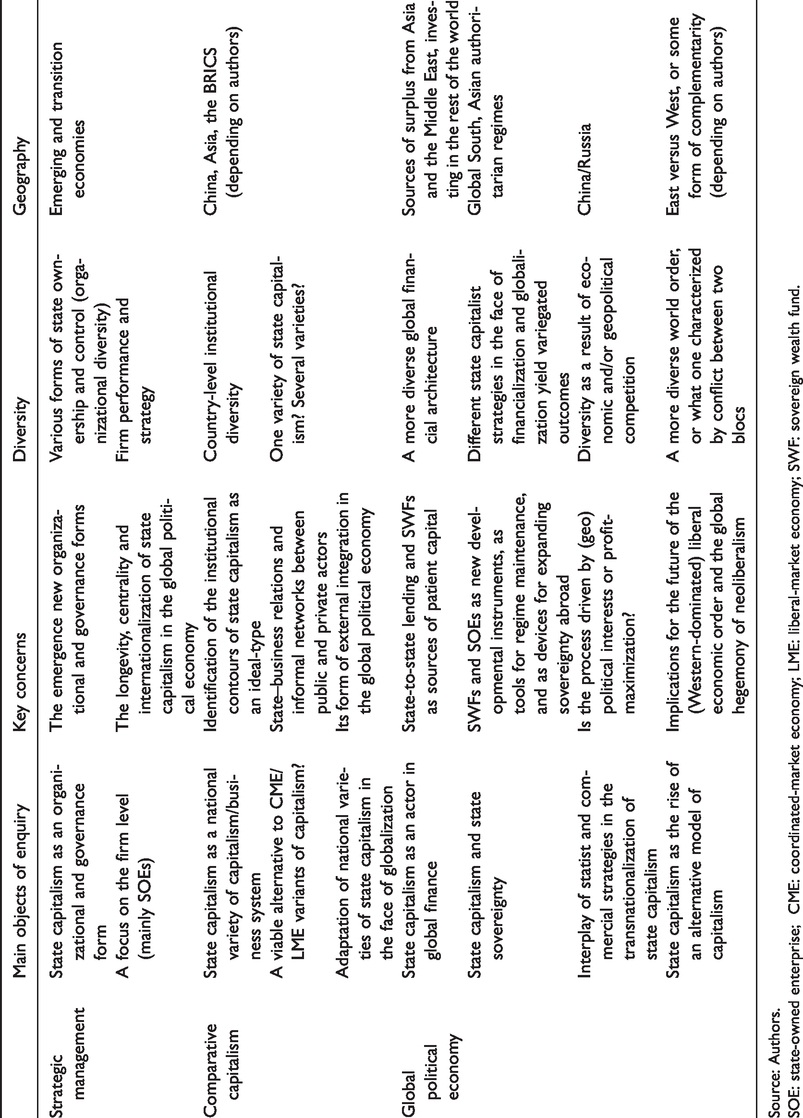
Source: Authors.
SOE: state-owned enterprise; CME: coordinated-market economy; LME: liberal-market economy; SWF: sovereign wealth fund.
Pushing the limits
We propose that research on state capitalism must grapple with three critical issues for the term to be analytically meaningful. To be capable of rendering the changing political geographies of capital and the polymorphism of state intervention amenable to analysis and critique, research must address: (1) the ‘missing link’ of a theory of the capitalist state, (2) the time horizons of state capitalism, or the question of ‘periodization’, (3) territorial considerations, or the question of ‘locating’ state capitalism. Many of the limitations and shortcomings previously discussed actually result from an incomplete or unsatisfactory engagement with these three deeply entangled issues. To be clear, by encouraging state capitalism research to engage further with those issues in particular, we do not attempt to enforce a universal consensus on those questions, which would be neither possible nor desirable. Rather, our main contention is that state capitalism research would benefit from a keener attention to those issues. This would bolster the analytical value of the category, strengthening the key claims of the literature (especially related to the ‘reinvention’ of state capitalism), and as such, would provide the basis for productive dialogues between different fields and approaches. Avowedly, in what follows, we raise more questions than we provide answers, although we hope to demonstrate the centrality of the three issues to the study of state capitalism. We provide initial reflections on those with the objective of sparking a debate.
The ‘missing link’: A robust theory of the state
Much of the literature uses state capitalism as a heuristic device to broadly refer to configurations of capitalism where the state plays a particularly strong role in organizing the economy and society, in supervising and administering capital accumulation, or in directly owning and controlling capital. If this conceptualization appears to be clear and straightforward, it pivots on a particularly thorny issue: what does strong actually mean? What is the backdrop against which the strong role is assessed and following what criteria? We contend that there is quite simply no way of rigorously defining what is meant by a strong role of the state without establishing in the first place what is the normal role of the state in capitalist society. In other words, what are the essential features and basic functions that all states must perform? Only on this basis can there be a reflection on the specific conditions, characteristics, and implications of an extraordinarily strong role of the state. In short, arguments about state capitalism must be grounded in a robust theory of the state, or as historical materialists would put it, in a theory of the socially necessary role of the state in capitalist society. While our understanding of the state is informed in part by historical materialism, our purpose here is not to advocate for a particular theory over others. Rather, we want to highlight that, with very few exceptions (e.g. van Apeldoorn et al., 2012), the state capitalism literature does not feature such theory and relies instead on other ways of defining strong state intervention.
While we do acknowledge that many political economists will disagree that a unified theory of the capitalist state is necessary (if possible at all), 3 we nonetheless want to substantiate our claim about the need for a robust theory by highlighting some of the issues the absence of such a theory might raise. The CC literature, for instance, considers institutional dimensions and assumes that the presence of particular institutions or forms of intervention attests to a strong role of the state. Such an analytical focus, if not grounded in an overall theory of the state, constantly runs the risk of fetishizing some specific institutions and forms of intervention at the expense of others that might be less visible but equally important (for instance, the ‘hidden’ industrial policy in the United States, e.g. Block, 2008; Wade, 2012), or, as a matter of fact, policy interventions that are both very visible and very important but simply not considered by the CC literature in its discussion of state capitalism (e.g. monetary policy, the military-industrial complex, etc.).
Similarly, the management literature runs the risk of reifying specific types of organizational forms and governance arrangements, and misinterpreting the complex relations between states, ‘their’ SOEs, and private firms. Fetishizing specific institutions or governance arrangements might be particularly problematic inasmuch as the function of institutions does not necessarily follow from their form. In fact, institutional function is often variable and context dependent (Dixon, 2014; Ho, 2018).
Other students of state capitalism have attempted to define the strong role of the state by quantifying it. For instance, Kurlantzick identifies state capitalists as countries whose government has an ownership stake in or significant influence over more than one-third of the five hundred largest companies, by revenue, in that country … Below this one-third level of government ownership of companies by revenue, the economy is still determined primarily by the market, even though the state may play a significant role. (2016: 9)
By contrast, van Apeldoorn et al. (2012) suggest examining the recent resurgence of state activism in light of a historical materialist theory of the state. This is not the place to outline what such a theory should look like, or to rehearse their argument. What interests us is that this theoretical grounding affords nuance to the claim that the state is ‘back in business’. Indeed, the state has never left, even in the spaces of the world economy that have experienced the deepest rounds of neoliberalization and apparent state rollback, and even in spaces often considered liberal market economies. Thus, the lesson, or challenge, for state capitalism as a research agenda is to account for both the permanent and pervasive role and functions of the state in capitalism and for the recent more visible role of the state.
Finally, there has been little discussion in the literature about the limits to the power of the state in state capitalism. Surely, the historical achievements of the state in terms of social transformation and nurturing capital accumulation have been remarkable. But the recurrence of devastating economic and political crises also suggests that there are limits to what the state can achieve, even in state capitalism(s). Hence, there is a need for further research in at least two regards. First, what are the limits to state power set by legitimacy constraints (the need to secure legitimacy from different domestic constituencies and social groups, other national states, international investors, etc.)? Second, and more fundamentally, what are the limits to state power set by its subsumption into capitalist social relations based on private property? In effect, how far can states go without subverting them? Such reflections on the limits to state power are arguably crucial if we are to understand the contemporary nature of state capitalism. Yet, they cannot happen without robust theoretical foundations about the role of the state and its relation to the economic sphere.
In sum, a theory of the state is necessary if we are to identify the specific features and unique elements of state capitalism, in contrast with other forms of capitalism. Our argument about the need for a robust state theory is neither a call for theoretical parsimony, nor is it a call for a unified theory of state capitalism. In fact, given the diversity of state capitalist configurations, the multiplicity of their drivers of emergence (as shown in the literature), and the variety of the objectives they are set to achieve, we suspect that the search for such a theory might well be elusive. Rather, it is a call for critically interrogating the specific relations between state and capital and the particular configurations of political and economic power in each of the concrete instances of state capitalism under investigation. In that sense, we suggest that the concept of state–capital hybrids, sometimes used in the literature, might be more useful than the category state capitalism, as it draws attention to the specific organizational, institutional, legal, and spatial forms that politically mediate the relationships between state and capital. 4
As such, the concept opens up productive avenues for combining the valuable insights of the literatures previously discussed (given their respective objects of enquiry, as shown on Table 1) in the study of state capitalist diversity. The concept of state–capital hybrids starts from the idea that the capital relation is always political, and that political and economic power are always entangled. But it does not stop there. The concept prompts us to reflect upon how specific organizational and governance arrangements (as discussed in the strategic management literature), particular institutions and forms of state–business relations (as discussed in the CC literature) and transnational state capitalist practices (as discussed in the GPE literature) contribute to a multifaceted process of reconfiguration of political and economic power in relation to broader dynamics of accumulation. Put differently, these are not only different objects of enquiry in and of themselves in the study of state capitalism. Rather, they are various entry points from which to investigate specific configurations of political and economic power in concrete instantiations of state capitalism, and who benefits from them. Importantly, the concept of state–capital hybrids is not necessarily a call for methodological and conceptual eclecticism in the study of state capitalism, which might very well have problematic epistemological implications, but it pushes us to selectively draw upon the various disciplines in order to scrutinize the multifarious forms of mediation of the relationships between state and capital. We wager that such combination can help us shed light on the multiple dimensions of contemporary state–capital hybrids, and ‘actively problematize’ – as Sperber puts it (2019: 116) – ‘the balance of power and of influence between public and private actors’ in the context of wider dynamics of accumulation. This has the potential of stimulating the state capitalism research agenda in exciting new directions.
Such attention to the specific features of contemporary state–capital hybrids is also particularly important given the pervasiveness of the role of the state in capitalist society (in enforcing the rule of law and property rights, managing labour and land-nature, regulating money and finance, etc.), and the breadth of the tasks it has performed throughout the historical geographies of capitalism. Which leads us to the essential – and intimately related – issue of periodization.
On the time horizons of state capitalism: The question of periodization
Looking at the state in capitalism from an historical perspective, we are faced with two outstanding facts: first, the remarkable historical continuity of its pervasive role; second, its conspicuously changing character (in terms of the scope and depth of state intervention, but also, more broadly speaking, in terms of the shifting boundary between public and private spheres). This underlines the importance of clearly delineating the time horizons of state capitalism. In short, what exactly is new about the new state capitalism? This is particularly important given how much the literature relies on notions of ‘novelty’, ‘return’ and ‘reinvention’.
A thoroughly defined periodization is crucial to substantiate the claim of historical novelty. Here our argument is not that the state capitalism literature does not provide any periodization – several contributors actually provide very comprehensive ones. For instance, the historically-attuned account offered by Musacchio and Lazzarini (2014: chapter 2) is useful in showing how state ownership has changed since the late 19th century. Nevertheless, as discussed in ‘Managing state capitalism’ section, they do not specify the concrete implications of those new governance and organizational forms in terms of the role of the state in capital accumulation. As a result, it is uncertain what is qualitatively different in the new period. The claim of historical novelty lacks substantiation. Another issue is that their periodization covers almost all the historical geographies of capitalism, from state ownership of infrastructure in the colonies, to the planned economy of the Soviet Union, large-scale nationalizations in the West after the Second World War, etc. If state capitalism is a permanent feature of capitalism, as this periodization suggests, how analytically useful is the concept in making sense of the recently more visible role of the state and the changing political geographies of capital?
Nölke (2014: introductory chapter) suggests a periodization underpinned by a different principle. He identifies three waves of ‘successful’ catch-up capitalist development, each corresponding to a period of state capitalism: (1) Germany and Japan (in late 19th century); (2) the New deal in the United States, Fascism, Stalinism, the Swedish Model and East Asian developmentalism (from the 1930s to the rise of neoliberalism in the 1980s); (3) state capitalism 3.0 in emerging economies (in the contemporary period). Here, the issue is that by covering such a variety of economic models and experiences, the periodization de facto considerably stretches the boundaries of the concept. Besides, it is highly debatable if those models and experiences were actually driven by the logic of catch-up development (and if they were ‘successful’), and here again, state capitalism looks like the historical norm. While providing historical depth to the concept, this periodization also stretches it so much that it risks diluting its analytical purchase (‘everything becomes an instantiation of state capitalism’).
Our point is that although the historical depth of those two accounts is admirable, they also face significant difficulties and limitations in delineating the time horizons of state capitalism. What those two examples show is that periodization is not easy. Yet, we would argue that it is necessary. Debates about how to periodize and on the basis of what principle(s) could considerably help in strengthening the analytical value of the concept and in substantiating the claims of historical novelty. For periodization to be effective, it must allow answering four key questions. First, what is qualitatively different, both historically and theoretically speaking, about the new capitalism, and how does it compare to earlier ‘waves’ or ‘brands’ of state capitalism, as they are often referred to in the literature? Second, how is the past of state capitalism materially and ideologically inhabiting the present? Answering this question is important so that the framing in terms of newness does not occult the link between past and present forms of state capitalism. Third, what are the unique features of the current historical conjuncture that drive the (re)emergence of state capitalist configurations? Fourth, which of those drivers are linked to structural transformations, and which are more contingent?
While providing a comprehensive exploration of these questions is beyond the scope of this article, we suggest that our proposed concept of state–capital hybrids might be useful for at least two reasons. It prompts us to be attentive to what exactly is driving the reconfiguration of political and economic power and the renegotiation of the boundary between public and private sphere that characterize specific instantiations of state–capital hybrid across variegated political and ideological contexts. The objective here is to precisely identify the strategic, structural/epochal, or more contingent factors involved in the emergence of particular state–capital hybrids, as well as the specific institutional, organizational, and legal forms that facilitate such emergence. This opens up the possibility that there may be different periodizations for different concrete types of state–capital hybrids. This also opens up the possibility that the development of new institutional, organizational and legal forms may not necessarily signal a reconfiguration of political and economic power. Rather, such development might be driven by the reproduction of the same power configuration under new conditions. For instance, financialization and globalization may push states to develop new institutions, policy tools, and forms of intervention in order to continue performing tasks and functions that they have long performed, such as industrial policy, maintaining financial stability, preserving some form of economic sovereignty or providing public goods.
Put differently, by virtue of the highly dynamic – some would even say revolutionary – character of capital accumulation, the forms of state intervention constantly change. Although some of these episodes of transformation can be quite drastic (often in the aftermath of crises), we argue that they do not always warrant the identification of a new period of state capitalist development. The added value of the concept of state–capital hybrids is that it pushes us to periodize not on the basis of specific forms (e.g. institutions, governance and legal arrangements, etc.) or specific objectives (e.g. ‘catch up’ development), but on the basis of the reconfiguration of political and economic power. Such analytical focus not only allows a better appreciation of historical continuity and various forms of change in the polymorphism of state intervention, but also a closer attention to what social group or social force benefit from the reconfiguration of political and economic power, and to the implications for the wider dynamics of capital accumulation.
Locating state capitalism: Territorial and geographical considerations
Our critical survey of the literature shows the importance of territorial and geographical considerations in making sense of state capitalism in at least two respects. First, we have seen that there are different views on where state capitalism is geographically located: in China, Asia, emerging and transition economies, and Middle Eastern oil-exporting countries. Others argue that varieties exist across regions. Second, many contributors emphasize the transnationalizing dimensions of state capitalism. We contend that further unpacking the multiple and interlocking geographies of state capitalism is arguably crucial to strengthen the analytical value of the concept. To do that, we suggest further engagement with three key territorial and geographical considerations.
First, much of the state capitalism literature still relies upon deeply problematic geographical imaginaries that tend to pit an illiberal, opaque, corrupt and threatening capitalism located in the East, against a pure liberal democratic free-market capitalism that allegedly predominates in the West. Those representations have widespread currency amongst Western business and policy-making circles concerned with the growing competition from large economies outside the ‘core’ such as China and Russia. This process of ‘othering’ configurations of capitalism outside the Western core, and the geographical imaginaries it produces, are both politically dangerous – witness the anxieties they generate – and analytically misleading. Miron (2015) provides a telling example: ‘[China] has state capitalism, not true capitalism.’ Not only is this view profoundly problematic in itself (inasmuch as it does not help understanding the political geographies of capitalism in the East), it also completely obfuscates the dynamics of state capitalism in the Western core (Pradella, 2017), particularly with the erosion of global liberal institutions and the strengthening of right-wing populism (Nölke, 2017). As such, it is a major hurdle to elucidating the phenomenon of state capitalism in both its globality and its totality. It is therefore imperative that the state capitalism literature radically breaks away from those geographical imaginaries. By further questioning the Western-centric undertones of the literature, postcolonial perspectives on state capitalism could play a crucial role in ‘de-centring’ it (Alami and Dixon, 2019).
Second, and from a more methodological perspective, geographical outlooks that are not centered on the national state are necessary to grasp the spatial practices and strategies of the new state capitalism at a variety of scales that cut across the national, as well as their interconnection. For instance, the methodological nationalism of the CC literature is ill-equipped to deal with the relation between the regional and the transnational, which is important to understand the nature of contemporary Chinese state capitalism. Indeed, much of the state support to the internationalization of Chinese SOEs is provided by provincial states, often in partial autonomy from the central government (see Gu et al., 2016). The national state remains of course a key site in the political geographies of state capitalism, but the literature might benefit from a deeper sensitivity to the multi-scalar relations that contribute to the reconfiguration of economic territory and sovereignty via diverse state capitalist strategies and practices. A number of GPE contributors have gone some way in this direction when considering the fragmentation of the state and the question of multi-level governance (e.g. Gu et al., 2016; Jones and Zou, 2017).
Third, we submit that the state capitalism literature might benefit from further engagement with the notion of uneven and combined geographical development. This concept is particularly well positioned to grasp state capitalism in light of its growing integration into transnational circuits of capital (including global networks of production, trade, finance, infrastructure and corporate ownership) and in light of interstate competition in the context of a deeply polarized world market. Let us take two examples to illustrate this argument. The first one is that of the recent creation of state investment funds in Western economies such as Ireland, France and Italy (Dixon, 2017; Mertens and Thiemann, 2018). This development is inseparable from state capitalist practices that originate elsewhere: they are a reaction to the growing volumes of state-controlled investments from the Middle East and China in those economies. Similarly, the renewal of state activism in Brazil during the rule of the Workers’ Party was intimately connected to state-led capital accumulation and urbanization in China, and the boom in primary commodity prices that it generated from the early 2000s to the mid-2010s. Indeed, the extraordinary large rents from commodity exports flowing into Brazil provided the material basis for renewal of state activism in the economy. Both examples show that state capitalism, understood as a global phenomenon and in its multiple geographically specific manifestations, must be grasped in light of dynamics of global uneven development, and of politically mediated capitalist competition. In our view, this is also crucial to uncover the drivers of diversity in state capitalism, that is, the common tendencies and the continuous reproduction of difference both between state capitalism and other forms of capitalism, and between different varieties of state capitalist configurations.
Here again, a focus on state–capital hybrids rather than on state capitalism, may prove useful to explore the remaking of the political geographies of capital under conditions of uneven development and capitalist competition. Indeed, it pushes us to investigate how different historically and geographically specific institutional and political forms, practices, and flows contribute to the re-scaling of relations between firms and nation-states, and the reconfiguring of spaces of political power and authority beyond national territories and in geographical settings that span north/south and east/west boundaries. For example, Dixon and Monk (2012) show how different types of SWFs differentially contribute to the remaking or resilience of economic sovereignty under conditions of globalization and financialization.
Conclusion
Debating state capitalism is not new. There have been previous rounds of academic debates about state capitalism, each at historical junctures characterized by deep capitalist crises and renewed state activism from the end of the 19th century to the 1970s and 1980s (see Sperber (2019) for an excellent intellectual-historical overview), not unlike the contemporary conjuncture. State capitalism as a research agenda in its current form has provided valuable insights into an extremely wide array of spatially diverse practices, policy instruments and vehicles, institutional forms, governance arrangements and networks that involve the state to different degrees and at a variety of levels, time frames, and geographical scales. As such, it has contributed to our understanding of the present polymorphism of state intervention across the world capitalist economy. Furthermore, the term’s capaciousness and its wide circulation have allowed state capitalism to become some sort of ‘banner to unite under’ for a number of commentators with extremely different theoretical outlooks, methods, and – perhaps more importantly – objects of inquiry. It has thus opened the possibility for critical dialogue and cross-fertilization between various fields and approaches, which could lead to a holistic account of the more changing role of the capitalist state and the new political geographies of capital. Nonetheless, this dialogue, it is worth insisting, is yet to happen. Furthermore, despite its capaciousness and wide circulation, the term state capitalism has not been subjected to the same level of reflexive scrutiny that other widely used categories of political economic analysis have been subjected to, such as globalization, financialization and neoliberalism. Our contribution in this article fills this gap.
As argued throughout the article, we have serious reservations about state capitalism as an analytical category. Our analysis shows that the category state capitalism, as it is currently deployed in much of the literature, does not bring ‘recognizability’, even less ‘clarity’, to the seemingly more visible role of the state across the world capitalist economy. There does not seem to be any agreement about even the most basic critical properties, regularities, or systematic features of state capitalism. Furthermore, many of the key arguments made in the literature surveyed actually rely very little on the category to generate ready-made analytical expedience and insight, besides its (largely gestural) invocation. Or, to put it bluntly, commentators often quite simply could do without. Worse, in some cases, the introduction of the category has actually led to a number of analytical impasses. Consequently, we contend that, at this stage, the analytical value of the concept is weak. This should warrant wariness about the term’s capaciousness, its widespread circulation, and its largely unreflexive use.
Much work remains to turn state capitalism from an umbrella term – harsher commentators might even say a mere buzzword or slogan – into a powerful heuristic tool. We would offer that by refocusing on the ‘missing link’ of a theory of the capitalist state, the time horizons of state capitalism, and territoriality of state capitalism, the analytical value of the category state capitalism can be bolstered. We have also made the case that the concept of state–capital hybrids, which we defined as the concrete historically and geographically specific political forms that mediate the relation between state and capital, is well positioned to refocus the study of state capitalism on the aforementioned issues.
By bolstering the analytical value of state capitalism at a basic level, we would hope that state capitalism research could more effectively engage with other academic debates and topics of contemporary political–economic significance. Notably, issues that were at the core of previous debates about state capitalism are almost completely absent from current debates. Three issues in particular: (1) questions of class configurations and who appropriates surplus; (2) questions of monopoly capitalism (dynamics of concentration and centralization of capital, and of its new relationships with the state) and (3) the repressive and ideological functions of state apparatuses (e.g. Poulantzas, 1978/2014 on what he called ‘authoritarian statism’). All are relevant today. Indeed, it is surprising that the state capitalism literature so far has not engaged at all with other academic debates about the changing forms of the repressive and ideological functions of state apparatuses. The literature should have something to contribute to debates about the rise of the mass surveillance state, the militarization of borders and authoritarian neoliberalism (Bruff and Tansel, 2019; Fabry and Sandbeck, 2018).
Footnotes
Acknowledgements
The authors would like to thank the editors and two anonymous reviewers for their constructive feedback during the review process. The authors would also like to thank Aldo Musacchio and Milan Babic for helpful comments on earlier drafts, as well as feedback received from participants at the Politicologenetmaal in Antwerp and the IIPPE conference in Lille presented. The authors are listed alphabetically and contributed equally to the development of this article.
Declaration of Conflicting Interests
The author(s) declared no potential conflicts of interest with respect to the research, authorship, and/or publication of this article.
Funding
The author(s) disclosed receipt of the following financial support for the research, authorship, and/or publication of this article: This work was supported by the European Research Council under Grant 758430.