




Abstract
While there are heated debates about how digitalization affects production, management and consumption in the context of global value chains, less attention is paid to how workers use digital technologies to organize and formulate demands and hence exercise power. This paper explores how workers in supplier factories in global value chains use different digital tools to exercise and enhance their power resources to improve working conditions. Combining the global value chain framework and concepts from labour sociology on worker power, the paper uses examples from the garment industry in Honduras and the footwear industry in China to show how workers used old and new digital tools to create and enhance associational and networked powers. Digital tools were used by workers and their allies in the global value chain to lower costs of communication, increase information exchange and participate in transnational campaigns during labour struggles vis-à-vis firms and governments in structurally and politically repressive environments. The paper contributes to our understanding of how workers use of digital technologies to exercise and combine different resources of power in online and offline actions in global value chains, as well as how they are confronted by new dimensions of constrains which include digital surveillance and control by the state.
Introduction
When we think about digitalization in global value chains (GVCs), discussion and debates tend to focus on how digital technologies transform production processes, firm relationships and work (Foster et al., 2018; UNCTAD, 2017). Advances in digital technology are revolutionizing production systems across sectors and support from government policies and funding for Industry 4.0 in countries such as Germany and China promise to fundamentally change how factories in manufacturing industries function in the future (Butollo and Lüthje, 2017; Pfeiffer, 2017; Siddivò, 2017). Digitalized, real-time, supply chain management, 3 D printing and virtual design have changed the power dynamics and efficiency between buyer and supplier firm relationships (Rehnberg and Ponte, 2018). Digitalization is also changing the nature of work in GVC factories, for example, with the use of augmented reality and the extended robotization of workers on the factory floor, or in GVC services with crowdworkers on online service platforms (see Berg, 2016; Freddi, 2018). In all of this attention paid to the ‘revolutionising’ role of digitalization on GVCs, there has been less attention on how digital technologies affect workers and their collective powers in GVCs.
To fill this research gap, in this paper, we examine how workers collectively and in alliance with other actors use different forms of digital technologies (what we refer to as ‘digital tools’) to improve their working conditions in GVCs. Fundamentally, this issue requires dealing with power relationships in the GVC, namely workers vis-à-vis firms or the state. Combining the GVC framework and power concepts from labour sociology, we focus our analysis on two power sources held by workers collectively in GVCs: networked power and associational power. Networked power refers to alliance-building between workers, unions or nongovernmental organizations (NGOs) within and across countries. These alliances can create ‘networks of labour activism’ (also referred to as NOLAs) which are able to support workers in specific labour conflicts in GVC firms (Zajak et al., 2017). Associational power refers to the capacity of workers to organize collectively, for example, within a trade union to mobilize union strategies, such as strikes (Hodder et al., 2017; Schmalz and Dörre, 2014).
Combining concepts in GVC research and labour sociology, we base our analysis on two case studies showcasing how workers use digital tools to improve their exercise of networked power and associational power vis-à-vis firms and the state to improve their working conditions. The first case, based on a production location in Honduras of the garments GVC, examines how workers, in alliance with labour organizations, exercised networked power vis-à-vis lead firms with the help of a range of older to newer generations of digital tools. The second case, based on a production location in China of the footwear GVC, examines how workers exercised associational power vis-à-vis the state through the use of internet-based tools and instant messaging smartphone apps such as QQ chat. An important aspect of such actions is the critical connections between online and offline activity, which the case studies show. Because digital tools encompass a range of older to newer generations of technological advancements, in our analyses, we specifically look at digital tools which range from older technologies, such as simple email exchange, blogs, websites and intranets, Skype and Twitter, to more recent smartphone applications. Through these illustrative case studies, we show that, in parallel to ‘revolutionising’ progress in the digitalization of production systems in GVCs, there is a quieter ‘revolution’ emerging, where workers experiment with digital tools to exercise collective worker agency to improve their working conditions. This signals the potential for change in power relationships between workers and firms and the state (particularly those which repress worker rights) through the use of even simple digital tools.
This paper proceeds with a discussion of the theoretical framework we use to understand associational power and networked power as relational collective powers in GVCs. This is followed by a section on our methodology. The third section presents the first case study on the exercise of networked power through the use of digital tools in the garments sector in Honduras. The fourth section presents the second case study on the exercise of associational power and digital tools in a footwear factory in China. In the final and concluding section of the paper, we underscore the need to examine digital tools more closely as mechanisms that can potentially lead to worker empowerment in GVCs.
GVCs, workers and power
GVCs are globally fragmented production systems, created through outsourcing and subcontracting by lead firms (or buyers) to suppliers of various functions necessary for bringing a product to the market. The different functions or processes in a GVC include design, marketing, production of parts and components, prototyping, assembly, distribution and sale, and repair services. Generally, lead or branded firms often maintain responsibility for higher value-added processes, such as design and marketing or sales, and outsource the rest, including worker-intensive and lower value-added functions, to suppliers within their global supply chains (Gereffi et al., 2005).
Workers are fundamental to the functioning of GVCs; however, their incorporation into these global production systems involves exploitative and poor working conditions in many industries. In the garments industry, for example, labour-intensive sewing functions in factories, within the lower value-added segments of the GVC, involve work that is often low-paid and where workers often suffer from labour violations and/or poor working conditions. The collapse of the Rana Plaza garment factory in Bangladesh in 2013 and the violations of health and safety conditions within that factory are well-known examples of the poor working conditions garment workers can face (Safi and Rushe, 2018). Similar conditions are faced by workers in GVC factories throughout the world (Nathan et al., 2016).
Research on labour governance to improve working conditions in GVC factories in developing countries has largely focused on and shown the limits of private governance mechanisms, such as private codes of conduct, auditing and monitoring, to bring about positive and sustainable changes to workers (Locke, 2013; Lund-Thomsen, 2008; Mayer and Gereffi, 2010). These failures largely reflect the lack of effective and enforced national laws and regulations to prevent the exploitation of workers by GVC firms (Anner et al., 2013; Bair, 2017; Bartley, 2010).
Generally, research on labour governance in GVCs, with its greater focus on the role of firms and states, has tended to treat workers as relatively powerless vis-à-vis these other actors (Bair and Werner, 2011). For example, in the conceptual argument that economic upgrading by firms could lead to social upgrading of workers (whereby working conditions and worker rights are improved), workers are treated as passive participants and recipients within this process (Barrientos et al., 2011). Challenging this notion, Selwyn (2013) argued for the de-linking of social upgrading from economic processes experienced by firms to argue for a labour-led process that places worker agency and power as the key force for bringing about positive changes to working conditions. This is a welcomed step in shifting the focus to labour-led processes.
Much of the research on worker power in the GVC literature follows a labour sociology perspective of associational power and structural power. Associational power is the capacity of workers to organize and act collectively including in a transnational manner. Structural power refers to the positioning of workers within economic productive systems. It is divided into marketplace bargaining power, which is accrued through the tightening of the wider labour market or increases in worker skills; and workplace bargaining power, which is accrued within a factory or firm where a localized disruption, such as a strike, can have wider disruptive effects in the economy (Silver, 2003; Wright, 2000) or throughout a GVC. In this vein, Selwyn (2007) has shown how workers in different sectoral GVCs exercised structural or associational bargaining power through trade union membership and negotiations. An example is how the tightly controlled just-in-time global automotive GVC increased the associational power to strike in strategic nodes and times in global production systems during a period when workers faced a weakening of their structural power.
While the exercise of such associational and structural powers is not disputed, much research on worker power in GVCs is based on a narrow perspective of bargaining power tied to trade unions (Anner et al., 2013; Helfen and Fichter, 2013; Selwyn, 2008, 2013). Unfortunately, the overarching focus so far on formal bargaining institutions as the basis of worker power does not account for the limits and challenges of weak and non-independent trade unions in many developing countries with repressive governments in GVCs (Ford and Gillian, 2016; Lüthje, 2013; Raj-Reichert, 2017, 2019). While more recent approaches to worker power in GVCs (and its cognate global production networks approach) has considered worker agency differently, for example, through resilience, reworking and resistance (see Alford et al., 2017; Carswell and De Neve, 2013; Coe and Jordhus-Lier, 2011), we argue that more is still needed.
Hence, our point of departure within this literature on GVCs and worker power is to examine collective worker power in a transnational manner to improve working conditions in specific production or factory locations in GVCs. This is in recognition of the increasing importance NOLAs – a network of labour activists as opposed to trade unions – have become for transnational labour activism in GVCs (Graz et al., 2019; Merk and Zajak, 2019; Piper et al., 2017; Zajak et al., 2017). Specifically, we focus on two forms of collective worker power, associational power and networked power, and connect them with how digital tools are used in their exercise including transnationally. We consider how these power sources can be leveraged further through digital tools such as smartphone apps for instant messaging services and digital information sharing platforms. In the remainder of this section, we discuss the concepts of associational power and networked power separately and how digital technology offers opportunities to further leverage these collective powers within GVCs.
Associational power in GVCs and digital tools
In captive GVCs with worker-intensive processes and low value-added suppliers such as in the garments industry, the structural power of workers is seen as being particularly weak. This is because lead firms or buyers are not highly dependent on a particular supplier and therefore can easily replace a supplier (and its workers) with another (Bair and Palpacuer, 2015). Under such conditions, the capacity of workers to exercise power (to disrupt) is less connected to their structural position in the GVC. In this scenario, associational power becomes more important and GVCs present new opportunities for workers to organize, network and mobilize collectively, including transnationally.
Associational power, which refers to the capacity of workers to organize and act collectively, is a concept with multiple dimensions. According to Schmalz and Dörre (2014: 225), associational power is based on membership size, organizational infrastructure such as trade unions, efficiency of the organization, degree of active member participation and solidarity amongst workers and trade unionists. The underlying assumption is that the more members an organization like a trade union has, the more influence it can assert in capital–labour relations (Brinkmann and Nachtwey, 2013). Associational power manifests itself through workers’ capacity to organize a strike (disruption) (Wright, 2000) or collectively bargaining for higher wages and/or improved working conditions (Leap and Grigsby, 1986). However, this traditional and narrow definition of associational power by Schmalz and Dörre (2014) draws on the national scale and settings of trade unions in industrialized countries and falls short of recognizing the specific characteristics of developing country production locations in GVCs.
From a GVC perspective, however, associational power can entail workers’ actions and workers’ organizing at various loci along the chain of a single company or in a specific sector by multiple trade unions or informal worker groups. It can constitute an agglomeration of diverse actions across borders situated in different legal environments and economic systems. Consequently, in GVCs exercise of associational power across a number of geographical places of action, type of worker organizations, degree of worker organizing, and economic and institutional contexts differs significantly from the old ‘nation-state’ analysis of classical labour movements. Therefore, the context of GVCs is necessary to broaden our conceptualization of associational power to one which is exercised transnationally, and which can account for new opportunities and risks including through the use of digital tools by workers. Research on the use of digital technologies and associational power has also been largely focused on trade unions. Findings generally show a weak take-up of digital tools by trade unions for several reasons. They include organizational culture and path dependencies leading to the continuing reliance on other forms of communication (face-to-face, by phone or email). Unions also tend to be organized hierarchically with relatively centralized control, while digital tools or platform communication suggests more horizontal and grassroots participation (Dencik and Wilkin, 2018). Other barriers, specific to low-waged production locations in GVCs, include a low degree of trade union institutionalization, low numbers of organized workers, hostility towards unions and a lack of funding (Lohmeyer et al., 2018). Where digital tools have provided opportunities, for example in the United States, their use has changed strategies for organizing, collective bargaining and protest including successfully organizing workers in difficult-to-organize spheres, such as low-income workers (Dencik and Wilkin, 2018). Some scholars suggest digital tools are important for enabling transnational networking and organizing of workers across borders within GVCs (Lohmeyer et al., 2018).
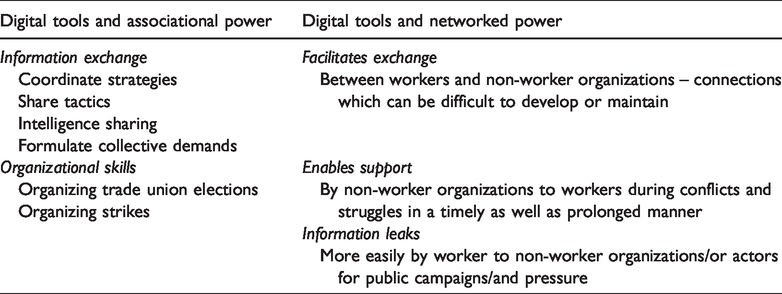
Still, how digital tools are used to increase associational power remains underspecified. An important factor to consider is the interface or connection between the online and offline worlds of organizing for successful outcomes to workers. We emphasize two ways in which digital tools can be used to increase associational power in GVCs (see Table 1). First, it is possible for workers to creatively use digital tools to enhance and increase information exchange. Information gathering and exchange online, through digital platforms, can help workers strategize and coordinate strategies, share tactics or formulate collective demands. Workers can use online communication to organize preparations for offline mobilization and resistance. Similarly, workers can use digital networking tools to bypass physical repression and policing, for example, by exchanging information in the virtual or online world on the physical location of police and military who are trying to break up strikes in the offline world. Hence, digital tools allow for new communication channels that do not exist in an offline world. Second, workers can use digital networking tools to increase their organizational skills, for example, for online organizing of trade union elections and strikes. The interface between online and offline activity is critical for how digital tools are harnessed effectively for exercising associational power in a transnational manner in GVCs.
How digital tools enhance associational power and networked power for workers in GVCs.
Networked power in GVCs and digital tools
While associational power is about forming and institutionalizing alliances amongst workers as a collective or a group, networked power involves forming alliances with other actors from outside the workplace to tap into and combine power resources from different types of actors (Bieler et al., 2015; Waterman, 1991). An example that is relevant for workers in GVCs is NOLAs, which are characterized ‘by the interaction of different types of labour rights, social movement and community organizations, joining forces in complex forms of strategizing vis-à-vis multiple targets’ (Zajak et al., 2017: 899). Within NOLAs, networked power starts when alliances are created across borders and on various scales. An example of this in a GVC context is a transnational campaign where workers at production sites in developing countries strike and join forces with social movements protesting at the headquarters of the lead firm or multinational corporation (MNC) in a developed country. NOLAs are a key source of collective power for workers in GVCs, particularly those without worker rights in low-waged or suppressive developing country production locations, because joining forces with a broad range of actors (global unions, student groups, local communities, social movements in the global North) allows them to combine the power resources of different actors originating in their specific locations within the GVC. For example, workers in a production location without domestic channels for grievances in the global South could ally themselves with global unions or NGOs in the global North in order to access institutional complaint channels or framework agreements with global lead firms.
Digital technology increases the possibility of creating networks of allies within and across countries and ameliorates the difficulties of maintaining them, which is usually done through a mix of online and offline actions (Gerbaudo, 2012; Mattoni, 2017). One key assumption is that digitalization facilitates the creation of NOLAs as platforms for information sharing, allowing communication across regions and more involvement from groups mobilizing workers and creating transnational awareness raising campaigns. By extension, digital tools allow for a larger scope of creating alliances between workers and civil society organizations across South–North and South–South GVCs. This is of particular importance for production sites in the global South, as social movements, community organizations and labour NGOs in these locations have become increasingly important actors in industrial relations (Helmerich, 2019a, 2019b; Nowak et al., 2018). Literature is only beginning to explore the interactions of these ‘new’ actors in labour relations in GVCs from different theoretical and analytical angles (Zajak et al., 2017). Hence, the impact of digital tools on NOLAs remains underexplored.
We emphasize three ways in which digital tools can facilitate alliance formation between workers and other actors in GVC (see Table 1). First, it can facilitate exchange between workers and local community organizations and NGOs which often have problems in establishing and maintaining contact with workers. Maintaining ties with labour organizers is especially challenging as they are often fired or move to other jobs. Second, digital tools can enable support by other actors to workers’ by providing strategic and timely information for specific conflicts or constant communication and backup during prolonged struggles. Third, workers can more easily leak information via digital tools to outside actors to mobilize the public against their employers or lead firms in the GVC.
In practice, networked power and associational power are often interlinked and can function as two sides of the same coin. While associational power is about workers as a collective, networked power can involve those same workers in alliance or coalition with non-worker actors in labour struggles. Hence both forms of power can bring about similar outcomes for workers. Both forms of power can also interact and exist together in GVCs. Nevertheless, we separate the two sources of power in our discussions in the case studies below because of the differences in the degree of cross-border alliance and networking between them. While the first case study on a garments factory in Honduras exemplifies a network of labour activism, the case of a footwear factory in China involves a narrower set of actors and at the local scale. These differences illustrate that worker power, and power generally, in GVCs is specific to the GVC, industry, production location, national setting, buyer–supplier relationship, worker composition and workers’ ties or connections to other actors. This suggests that research into worker power in GVCs must be granular and specific to case-studies in order to understand the complex and messiness of how different types of power operate and function for particular outcomes for workers.
Methodology
The discussion and analysis of how workers exercise associational power and networked power through the use of digital tools are based on extensive fieldwork on two case studies in the garments and footwear industry GVCs. Both industries are labour-intensive industries which have faced poor working conditions and labour violations in the production locations researched and which are major production locations in GVCs. The first case study is on workers in a factory in San Pedro Sula, Honduras, which is part of the garments industry GVC. Honduras is a key production or sourcing country for the garments GVC and is a main exporter of garments in the Central American region and to the United States. The country has for many years faced severe repression of trade unions. Labour rights violations in the Honduran garments sector range from violations against freedom of association, non-payment of social security and benefits to workers, and poor health and safety conditions in factories (International Labor Organisation, 2018).
The second case study is on workers in a Yue Yuen (the biggest athletic footwear producer in the world) factory in Dongguan, China, which is part of the footwear industry GVC. The comparative advantages of cheap labour, low-cost land and a repressive regime prohibiting workers from organizing contributes to China’s attractiveness for foreign direct investment. China’s ‘world factory’ status has relied on hundreds of millions of peasant-workers who have migrated from the countryside to work in factories of suppliers to MNCs in the coastal regions under harsh and exploitative working conditions such as extreme overtime hours, unpaid wages and casual punishments such as fines (Chan, 2014; Ngai, 2005). China has a strong digitalization agenda with a Made in China, 2025 plan which mirrors Germany’s Industry 4.0 goals (Butollo and Lüthje, 2017; Pfeiffer, 2017; Siddivò, 2017). Yet, China is also a country where the Communist Party-led institutions design legal and technological measures including through surveillance of the Internet to control and influence political expressions and repress those that do not ‘fit’ (Chan, 2018; Esarey and Qiang, 2011). Hence, China can be characterized as being at a crossroads with its state-led goals for progress through economic growth and innovation that is mismatched by its opposite continued suppression of dissent and control in society.
Research in both case study locations was aimed at understanding the interactions between workers and other actors in actions to improve working conditions. While each case focussed on different sets of actors – worker interactions with local and international labour NGOs in Honduras, and workers strikes and local labour NGO interactions in China – both cases showcased the influence of digital tools on workers and their collective power. The degree of digitalization between the two countries differs substantially. While China boasts a high degree and widespread use of digital technologies in daily life, Honduras on the other hand has a lower degree of digitalization also seen by the low use of digital technology in production in the garment sector (Associacion Hondurena de Maquiladores, 2017; García Zaballos and Iglesias Rodríguez, 2017; Gobierno de la República de Honduras, 2013). Nevertheless, in Honduras, digital tools enhanced networked power, and in China, digital tools were used in exercising associational power. These dynamics were explored qualitatively in each of the case studies through interviews with key respondents and, in some cases, participant observation.
For the case study on Honduras, the broader context of the analysis of the case study location and the region is informed by research conducted from 2009 to 2014 along the garments sector supply chains. This includes interviews with workers, trade union representatives, labour rights activists, managers of MNCs, managers of apparel factories, representatives of transnational private regulatory initiatives, auditors and women’s rights activists. In Honduras, interviews and observations were conducted with garment workers, trade unions, labour NGOs, company representatives and corporate responsibility specialists in 2011 in San Pedro Sula. As part of a larger research project in 2015, a dataset was created of 132 labour conflict cases in Mexico, Central America and the Caribbean. From these data, we were able to establish and research the alliances and relationships between workers, trade unions and NGOs for labour conflict cases in the region and with other actors transnationally (see Table 2).
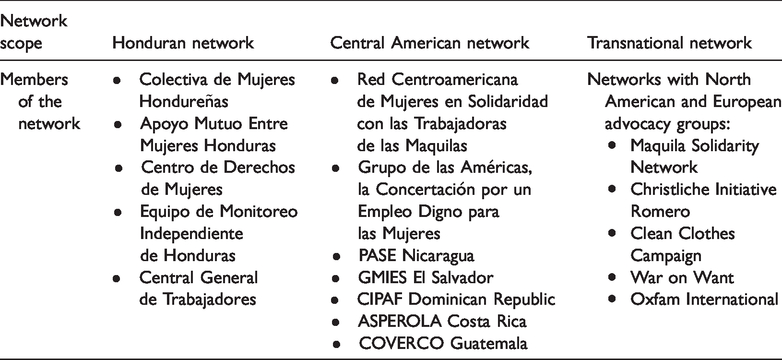
Overview of CODEMUH’s networks at different scales, which encompasses the networks of labour activism.
The case study on the footwear industry in China stems from research that was part of a larger project on labour activism in the country. Fieldwork research was conducted in 2012 and 2018 in collaboration with research partners, considered experts in the field, from local universities in Hong Kong. The research team conducted participant observations, worker interviews and interviews with NGOs during a strike event in 2014. This primary data collection was complemented with analyses of secondary material on labour conflict cases in global supply chains in the apparel industry and secondary material on the digitalization of these GVCs.
Networked power and digital tools: Worker alliances in the garments sector in Honduras
The Honduran garment sector is dominated by four MNCs: Gildan, Hanes, Fruit of the Loom (includes Russell Athletic) and Delta Apparel; and three Honduran firms. In Honduras, there is a strong tradition of independent trade unions despite an overall fragmented landscape of unions (Anner, 2015). A country context with weak political institutions, the situation for trade unionists, however, is dangerous. Unionists receive regular death threats and many of them lose their lives (interview with a union representative, 1 16 March 2011; Kumar and Mahoney, 2014). Between 2009 and 2018, 31 trade unionists have been killed, 200 unionists have been injured in violent attacks and 52 workers have been killed in conflicts with the government and landowners (International Labor Organisation, 2018). Despite this challenging context, there have been small yet ground-breaking victories for garment workers in the past. For example, workers in Fruit of the Loom factories and a Russell Athletic factory were able to pressure the two companies to reopen a closed factory and improve wages and working conditions. These victories were based on a mix of local organizing and transnational advocacy campaigns (Anner, 2015; Kumar and Mahoney, 2014). Labour struggles, including in the garment sector, are embedded in a larger quest of social movements and overall citizen empowerment in Honduras (Portillo Villeda, 2016).
This case study features the combination of a transnational North–South, regional and cross-country social movements which built strong and lasting network of labour activism in the garment sector – a case of a high degree of networked power. The case is focused on one actor in this network, the Honduran labour NGO Colectiva de Mujeres Hondureñas (CODEMUH) which was able to join, build up and sustain networks of labour activists, and how this organization increased its networked power over time. CODEMUH was founded in 1989 by women workers in the garment sector in Honduras fighting for improved working conditions (Tórrez, 2008). This organization has continued fighting for social and labour rights and considers itself a feminist group fighting for all female workers in garment factories in Honduras (interview with CODEMUH organizer on 16 March 2011 in San Pedro Sula).
The strength and success of CODEMUH in supporting female workers in the garments sector in Honduras is reflective of weakening associational power in captive GVCs, which in this case was replaced with networked power for the workers. According to a female trade unionist at Central General de Trabajadores (CGT), all trade unions (except CGT) in the garments sector in Central America have been reluctant to open up their ranks to female workers (interview, San Pedro Sula, 14 March 2011). Consequently, many female garment workers have resorted to joining women’s rights and labour NGOs (Crossa Niell, 2014; Helmerich, 2019b). These organizations, which includes CODEMUH, play an important role for female workers by replacing their low associational power (by being kept out of trade unions) with networked power.
CODEMUH’s efforts in creating and sustaining a network of labour activism depended on digital tools as a precondition for establishing strong network ties amongst actors over time. This not only led to a strengthening of the labour movement on the factory floor, it also led to an integration of formerly marginalized actors, in this case female workers, from the garment factories into national labour politics. Operating in Honduras, CODEMUH’s use of digital tools were limited to older generation and low technology innovations such as email, Skype, text messages and WhatsApp. Despite the low level of technological innovation of these digital tools, however, they were essential for CODEMUH’s work to form a strong network of labour activism. The low level of digital technology use by CODEMUH reflects broader dynamics in Honduras where the use of digital tools in the economy and in society is very low compared to other countries in Central America and globally. A requirement for developing and strengthening information and communication technologies is the provision of broadband internet and use of digital services and applications, both of which are very low in Honduras (García Zaballos and Iglesias Rodríguez, 2017; Gobierno de la República de Honduras, 2013). There is also a low degree of digitalization amongst Honduran companies as well. In recent reports and development plans for the garment industry in Honduras, for example, digitalization is not mentioned (Associacion Hondurena de Maquiladores, 2017). While there is a lack of reliable data on internet access and smartphones use, a recent survey on smartphone use in low-income neighbourhoods in Honduras found 71% of 213 surveyed persons used smartphones in 2016. Almost all of these smartphone users used WhatsApp and Facebook regularly (Fivenson, 2016). There is no survey on smartphone use amongst garment workers specifically in Honduras. However, we can assume it would be significantly low because the majority of these workers are lower-income women, many of which are single mothers, from rural areas (who migrated to cities for factory jobs) whose incomes are not sufficient to cover basic monthly living costs (Crossa Niell, 2014; El Equipo de investigación Laboral and La Red de Solidaridad de la Maquila RSM, 2018). However, with the lowering of smartphone prices, smartphone use has begun increasing in the garments sector and amongst labour NGOs, and garment workers have been found to increasingly use WhatsApp and Facebook to exchange information on their struggles over labour rights (Argueta, 2017).
CODEMUH had an effect on working conditions through its exercise of networked power with the help of digital tools in two areas: (1) impacting the behaviour of a MNC concerning labour rights violations; and (2) establishing a strong online and offline network within Honduras, across Central America and with advocacy NGOs in North America and Europe, resulting in an influence on labour politics and legislation in Honduras. We discuss each of these outcomes in the following sub-sections.
(i) Remediating labour rights violations
The Canadian MNC, Gildan, is one of the largest employers in Honduras (employing 27,000 workers in 2016), is a vertically integrated company which owns and operates supplier factories in Mexico, Central America and the Caribbean (Associacion Hondurena de Maquiladores, 2016). Honduras is its most important production hub for integrated sewing and textile facilities (Gildan, 2018). CODEMUH was able to influence the treatment of workers and health and safety policies by the Canadian MNC, Gildan, in their Honduran plants through its networked power in alliance with other NGOs, which led to the MNC’s repeated concessions and the remediation of labour rights violations.
In addition to regular cases of labour violations such as on freedom of association (Turcotte et al., 2007), workers in the Gildan factory suffered from chronic back injuries and addiction to pain medication, due to the repetitive movements in the production process and a lack of workplace health and safety practices (Fair Labor Association, 2013). From 2004 to 2006, CODEMUH, with the help of doctors, documented the health consequences of female workers in Gildan’s garment factories. Their study found health and safety standards violations in the factories. This was the first study on health and safety in the garments sector in Honduras.
CODEMUH shared their study with staff at Gildan’s headquarters in Canada and locally at the factories in Honduras. Also, CODEMUH launched a transnational campaign against Gildan in alliance with a group of Northern NGOs, Canadian Maquila Solidarity Network, Red Centroamericana de Mujeres en Solidaridad con las Trabajadoras de la Maquila (REDCAM 2 ) and the British NGO, Oxfam International (CODEMUH, 2013; interview with CODEMUH organizer on 16 March 2011, San Pedro Sula). To launch the campaign and transmit their findings, CODEMUH used simple digital tools, such as email, Facebook, blogs, websites and Skype. Even though the digital tools used were quite simple, they were effective. The documentation and the spread of proof regarding violations of health and safety standards quickly diffused over the Internet to consumer organizations and Gildan’s shareholders. In response, Gildan developed an ergonomics policy in its factories in Honduras in 2007 and issued a study by a university-based ergonomic centre and to develop an ergonomic programme (Gildan, 2007: 23, 2009). While Gildan had exchanges with CODEMUH on health and safety issues, the implementation of the ergonomics programme was not effective and did not reach the workers affected by chronic back pain. CODEMUH increased its pressure, this time by submitting a complaint against Gildan to the Fair Labor Association (FLA) in 2011 (Fair Labor Association, 2013), a multi-stakeholder initiative Gildan is a member of. This step was supported by online and offline dissemination and campaigns by the transnational network partners, such as Oxfam International. The third-party complaint to the FLA resulted in improved implementation of the ergonomics programme, the creation of a health and safety management structure with environmental health and safety staff in the early 2010s and the hiring of an ergonomics manager in 2018. This was a significant achievement for CODEMUH at a time when health and safety concerns were ignored by companies in Honduras. For example, a survey in 2007 found only around 22% of companies in Honduras had health and safety programmes in place (Gomez Carrasco, 2007).
The success of CODEMUH’s actions were dependent on its networked power with other labour and international NGOs. It was able to rely on and activate its allies within the network of labour activism through various digital tools and the knowledge of how to best use them to pressure an MNC into improving health and safety at their factories in Honduras. This was especially with the sharing online of the report’s findings and the launching of a complaint online to the FLA. During the, 2000s in the midst of this and other labour conflict cases, Gildan also developed a corporate responsibility programme, became a member of the FLA and re-instated workers who were fired for their organizing activities in a labour conflict in a Gildan plant in El Progreso, Honduras (Maquila Solidarity Network, 2006; Worker Rights Consortium, 2006).
(ii) Establishing networks to influence politics
CODEMUH established and formed part of strong and long-lasting online and offline networks of labour and human rights organizations within Honduras, across Central America and transnationally. These networks (see Table 2), which emerged in the 1990s, built profound ties and joint politics over the course of many years. Because these networks developed prior to the use of digital tools, offline networked power had and continued to play an important role within the various network scales. Since the 1990s, CODEMUH and other labour NGOs in Honduras met regularly in person. Within the regional Central American network, REDCAM (of which CODEMUH is also an active member) and labour NGOs from Honduras, El Salvador, Nicaragua, Guatemala and the Dominican Republic met regularly at workshops and meetings to exchange information on strategies to improve labour conditions, knowledge on MNCs and campaigning strategies (Maquila Solidarity Network, 2013). However, the maintenance and continuation of the networks became dependent on online communication using simple digital tools such as email, Facebook, blogs, websites, Skype and WhatsApp in the 2000s. Websites and blogs in particular were used to diffuse regular e-news bulletins, reports and documentation of labour violations in the garments sector, and about offline meetings. 3
In sum, all three networks, within Honduras, across Central America and transnationally, used a mix of offline and online networked power. Important and necessary offline activities involved training of network members and workers, documentation of regular exchange on labour rights violations, campaigns to remediate labour violations, joint publications on the situation of garment workers in Central America and transnational advocacy. Since the 2000s, REDCAM has published reports on the situation of workers in the garments sector based on first-hand information from worker testimonies, worker surveys, economic and social data, and audits from civil society organizations (Asociación Mujeres Transformando, 2016; Gomez Carrasco, 2007; REDCAM, 2011, 2014). These reports have been taken up by the transnational network, such as Maquila Solidarity Network and Oxfam International (Maquila Solidarity Network, 2006; Tórrez, 2008), and disseminated more widely amongst members in the Central American Network including in English helping spread knowledge to a wider non-Spanish speaking audience (Maquila Solidarity Network and Honduran Independent Monitoring Team, 2003; Maquila Solidarity Network et al., 2012). This included academics who took notice of the civil society publications and used them as background information for case studies (Armbruster-Sandoval, 2005; Esbenshade, 2004; Prieto-Carrón, 2008). Indeed, over the years, there has been a continuous strengthening of the networked power through the ongoing monitoring and diffusion of information on working conditions and labour conflicts in the garment industry.
While the regional network as such developed in and strengthened in an offline world in the 1990s, it deepened and scaled up with the arrival of the internet to Central America and the arrival of smartphones. What changed with the introduction of these digital tools was the scope, density and institutionalization of the network. The digital tools enabled CODEMUH to learn, strategize and increase their leverage in regard to labour rights demands and on health and safety in the Honduran garment sector.
The online and offline interactions within the CODEMUH’s various networks also built the organization into a political actor within Honduran labour politics, giving its members – women from rural areas who had never been politically active before – a voice in politics on issues of health and safety legislation, launching complaints, filing cases in Honduras’ court system and at transnational private regulatory initiatives such as the FLA, and organizing political protests (Crossa Niell, 2014; Fair Labor Association, 2013; Honduran Independent Monitoring Team, 2018; La Prensa, 2016; Tórrez, 2008; UN Women, 2017). In 2015, the organization had success in the Honduran court system when the Honduran High Court of Justice forced the Honduran Labour Ministry to establish a mechanism of inspection to reduce work-related injuries and excessive working hours (Radio Progreso, 2015). It is important to note that CODEMUH’s political engagement takes place in a weak institutional context in Honduras. Yet, formerly voiceless female workers in the garment sector were able to have a strong and regular voice in Honduran politics and the public sphere, exercising political and social rights as empowered political actors in a weak institutional and violent context. CODEMUH’s diverse political actions have matured over time and increased its networked power. This change has a lot to do with the professionalization of the local network in Honduras and the regional network across Central America, capacity building and knowledge exchange in the transnational North-South network and trust building among the network partners (Crossa Niell, 2014; Interview with representative of Honduran Independent Monitoring Team on 16 March 2011 in San Pedro Sula).
This illustrative case analysed the role of digital tools and networked power of CODEMUH, which is embedded in national, regional and transnational networks. This was analysed in two areas of influence: the remediation of labour rights violations in the garment sector and the establishment of a network alliance and the development of CODEMUH as a political actor, as a result of online and offline actions, within Honduran labour politics. We find that networked power is quite strong, and that simple digital tools, such as email, Facebook, blogs, websites and WhatsApp, increased the scope of political actions and helped institutionalize a dense network of actors within Honduras, across Central America and transnationally. Within captive GVCs, such as the garments industry, transnational networked power, for example, through NOLAs, can be more effective in pressuring and influencing powerful lead firms to change their practices. Moreover, spill-over effects of transnational networked power in GVCs can lead to empowering local actors through information exchange and capacity building that would not be possible only in a local scale and domestic context of adverse incorporation in GVCs.
Today, due to the networked power strengthened by the use of digital tools, local workers in the garment industry in Honduras have empowered themselves, learned from each other to strategize and organize protests, increased their know-how to use complaint mechanisms for labour conflicts, established strong and regular ties and communication channels with North American and European labour NGOs and trade unions, participated in the national policy process by proposing draft laws and voiced their demands in the public sphere and perhaps more importantly vis-à-vis lead firms in the GVC. From this case, we can conclude three main findings. First, the combination of offline and online networking is important for sustainable outcomes. Offline meetings and capacity are important for creating trust among members of the network, while online networking fosters easier and more frequent encounters for communicating. Second, the network was strengthened and institutionalized with the introduction of digital tools in the 2000s. The case study findings showed digital tools having a positive influence on the duration of networks. Third, using digital tools, irrespective of how sophisticated they are, made networking easier and lowered its costs.
Associational power and digital technology: Worker organizing in a footwear factory in China
Organizing labour in China remains very difficult. Since its economic opening 30 years ago, when the Pearl River Delta (PRD) of Guangdong Province turned into the factory of the world as part of GVCs, researchers have been speculating about the labour movement in the making (Kuruvilla, 2018; Pringle, 2013). However, in more recent years, China’s economic growth and development has been accompanied by a rising number of strikes and work-related protests since roughly 2003/2004 when the country’s historical labour surplus slowly began to turn into a labour shortage (Chan, 2018). The government introduced new labour regulations, most prominently, the new labour contract law in 2008, in order to stabilize and improve working conditions and reduce strikes – however, with little success. According to China Labor Bulletin (CLB), the number of documented collective strikes in China from 2011 to 2014 was more than 2000, with the major portion (40%) occurring in the PRD. In many cases, the police, local officials or the All-China Federation of Trade Unions members intervened to end resistance.
A key challenge for labour organizing is maintaining strikes across various locations and production sites. This is because the Chinese state has been quite effective in keeping workers’ collective actions separate – with a few exceptions, such as the Honda strike in 2010 (Chan and Hui, 2012). Strikes also remained short-term, un-coordinated and localized. As Friedman and Lee (2010: 521) argued: ‘strikes are fundamentally cellular in the sense that the cells are not combining to form tissues’. Still, as Chan (2014) argues, strikes have become a normalized part of labour politics, suggesting a transition in labour relations, from the individual to the collective. The role of labour NGOs as a place and driver of a genuine labour movement within this transition has also been increasingly debated (Pringle, 2013; Xu and Chen, 2019).
Businesses and local governments have often responded to worker-related actions with increasing repression, police force and imprisonment (CLB, 2015). This situation accelerated after President Xi Jinping took power in 2012 and China was hit by an economic slowdown. Part of the attempt to contain labour unrest has included the imposition of further restraints on labour rights NGOs (Howell and Pringle, 2019). The state has narrowed the independent non-state organizations’ room to manoeuvre, through a new NGO registration law, making the operation of labour centres more difficult. Arrests have also been made on those who run such centres.
In this repressive state context, digital tools can play an important role in the organization and maintenance of a strike. A clear example of this was the strike against Yue Yuen in a footwear factory in 2014. The strike was successful, as it ended with the company paying social insurance owed to its workers (Schmalz et al., 2017). Research on this strike thus far has either focused on the structural and situational reasons for the strike, e.g. middle-aged and older migrant workers in need of pension payments (Chan and Hui, 2017), or used a world systems perspective, or examined international support for strikes in the context of GVCs (Schmalz et al., 2017). However, no attention has been paid to the relevance of digital tools in the organization, maintenance and, thus, effectiveness of the strike. This case study analysis aims to do just that by highlighting the relevance of digital tools for mobilizing workers, sharing information and organizing collective demands as actions of associational power in GVCs.
The case of Yue Yuen
Yue Yuen Corporation is a supplier in the athletic footwear GVC. The company accounts for about 20% of the global manufacturing market for sports and leisure shoes. Nike, Reebok and Adidas are its three biggest customers, and their orders amount to about 60% of Yue Yuen’s production. The athletic footwear industry is also one where digitalization of supply chain management is fairly advanced. However, production techniques in the footwear GVC still remain very non-digital and labour-intensive.
Yue Yuen’s biggest production area is an industrial park in the northwest part of Dongguan, China, which features several factories. In 2007, the number of its assembly lines peaked at 148. Apart from many workshop buildings, Yue Yuen had several office buildings, hospitals and dormitories. The area looked like an independent community. More than 40,000 workers lived and worked there in 2013. The Yue Yuen Corporation has continued to expand over the past few years. However, the MNC came under scrutiny for its labour practices. Research reports released by labour organizations and scholars showed that the Yue Yuen plants in Dongguan did not obey the labour law. Its labour rights violations included forced overtime work, low wages, embezzling overtime bonuses, illegal social insurance, lack of worker protection and unfair contracts (China Labor Watch, 2010).
In 2014, a strike began on 5 April after retired workers from Yue Yuen learned that the pensions they received were far less than the amount required by law. The initial strike was limited to one plant and roughly 5000 workers participated (CLB, 2014). On 14 April, the strike spread to four plants with around 30,000 workers in the industrial park. Workers at a Yue Yuen plant in Anfu in the Jiangxi province followed suit. The collective strike ended on 29 April as a result of violent police repression, the arrest of dozens of workers, some concessionary payments from the company and the establishment of a workplace union (Schmalz et al., 2017).
Within this string of events, we are interested in examining what and how digital tools were used in this process, how online coordination interacted with offline actions and which actors were responsible for the exercise of associational power. We now turn to this discussion.
Digital tools and strikes
On 13 April 2014, when the head of a labour NGO, referred to as ‘R’, met with a few workers in a restaurant near the Yue Yuen factory, police learned of the meeting, arrived at the restaurant and took both him and a colleague to the police station. They were questioned and ordered to leave the factory premises. Although the face-to-face meeting had been disrupted, R and his colleagues were able to remain in close and regular contact with factory workers via smartphones and digital tools such as instant messaging platforms. This helped create a network of alliance between factory workers and labour NGO activists.
However, in the midst of this case, the networked effects or networked power that digital tools can bring through the creation of online collective relationships, in parallel can also be used as important vehicles to transmit information for strategizing and organizing amongst workers themselves for the exercise of associational power. In the case of the Yue Yuen strike, the labour NGO activists used digital tools to collect information on external developments in response to the strike and to disseminate it in QQ worker chat groups and release it on the Internet. They generally shared information with workers on how to connect and organize, create strategies, lead the strikes and avoid risk. According to the head of R, the organization established or joined in dozens of QQ chat groups to discuss these issues. One of the largest QQ chat groups included about 2000 workers. Discussions within single chats, but also across them, dealt with organizing strategies, consensus formation, confirming general and consolidated appeals, forming effective action leadership, proposing collective bargaining offers to the company, protecting worker delegates and reporting daily developments concerning workers’ actions.
These digital forms of communication and sharing of information created associational power built online through connective action (Bennett and Segerberg, 2012), which workers then used offline in collective action and negotiations with Yue Yuen. While the building of associational power amongst workers did not lead to the forming of an independent trade union – a difficult prospect in the repressive Chinese context – it did nevertheless help workers establish a leadership group including workers’ selection of representatives. This creation of an informal group of workers was important because it allowed for the possibility of R to intervene through more formal and legal channels with the support of the workers’ leadership group. Reflecting on the relevance of the digital information exchange with R, a worker suggested the following:
At least he gave us some advice, which I thought was useful, such as social insurance, housing funds, a 30% rise in wages and union election. They were reasonable. He was always appealing to set up a workers’ committee to lead the strike. Someone said that he had other purposes, but at least we did not see that and had no evidence. If there were no organizations like R’s NGO, workers’ spontaneous actions would fail sooner or later. If the company made a small concession, workers would be divided, plus [with] the severe governmental repression, we would be doomed to fail.
Yet despite these interventions by the police and local government, the strike reached such a scale that the local government responded by setting up a joint working group coordinated by the Dongguan Municipal Federation of Trade Unions (DGFTU). The DGFTU announced that the factory trade union committee would be re-elected through a democratic process, when the term of the current committee expired. The DGFTU would assist with employer–employee collective bargaining and promised to provide the workers with election guidelines. Yue Yuen also decided to make concessions to the workers. For example, Yue Yuen agreed to pay the high temperature allowance as required by law, improve wages and inform workers about the details of social insurance payments in the future. However, the company did not agree to pay financial compensation or the 30% pay raise requested by the strikers, leaving many workers still discontented with the situation.
Yue Yuen also stated that workers’ right to join a union would be respected – an outcome where actions online helped buttress the possibilities for offline associational power. Yet such a final judgement would be premature, as the history of Chinese labour relations show, factory unions and workplace committees tend to become coerced into managerial and political administrative structures unable to truly represent workers’ interests. The evidence for such meddling was already clear in Dongguan. According to CLB (2018), the DGFTU was engaged directly in the organization of trade unions in the Yue Yuen factory complex and 35 other privately-owned factories even up to six months after the strike. This occurred while DGFTU publicly claimed these processes of setting up of trade unions was a ‘grassroots union organizing standard procedure’ and was to serve as a model for other regions to follow. CLB, however, has remained sceptical about the degree of grassroots organizing and its lasting effects during this process (CLB, 2018).
Yue Yuen was among the first cases of worker struggles where online strategizing and organizing via digital online chat became prominent. Other similar cases in China, e.g. against Walmart, have since followed (see Li and Mingwei, 2018). While digital tools can facilitate coordination and increase strategic capacities of workers, this should not be confused with or downplay the importance of offline organizational capacity-building (i.e. long-term membership building, the democratic elections of worker representatives, etc.). This is especially true when online informal worker organizations are hard to maintain in a repressive environment, whereby digital communication platforms can be easily infiltrated or closed down. Moreover, not all workers would join or trust online organizing activities in an environment with a heavy and sophisticated state sponsored surveillance system over individuals. Many workers and activists instead choose to keep a low profile or do not use social media at all out of fear of being tracked and arrested. Others resort to different strategies such as using pre-payed SIM cards, deleting messages, continuous switching (and searching) of secure(r) messaging apps and aiming at appearing anonymous on the web – aspects which make organizing and harnessing associational power purely online difficult.
In sum, the use of digital tools allowed associational power amongst workers to be increased, as workers with few resources and little knowledge and experience with organizing or institutional support were able to exchange and gain knowledge, work on strategies together, receive information from outside activists and start an independent organization. These online and offline actions contributed to the prolonging of the protest and its successes. The case in effect illustrates the building of online associational power with spill-over effects on offline associational power. Still, these empowerment effects should not be overestimated in the Chinese context. They often play out only for a short time, only occasionally and marginally challenging power structures within GVCs embedded in authoritarian repressive governmental regimes.
Conclusion
While much of the discussion around technological developments in GVCs, such as automation and Industry 4.0, points to the disadvantage to workers, this article is an attempt to explore and think about examples where workers use digital tools to their advantage for mobilizing actions to improve working conditions. Hence, the case studies we chose are positive examples that allowed us to take a careful and closer look to understand the role digital technology can play for workers in GVCs. Additionally, we have done so by looking beyond formal trade union settings of worker power where structural barriers continue to remain for their effectiveness in GVC production locations in the global South (Lohmeyer et al., 2018).
The case studies focused on the exercise of associational power and networked power by workers, which are often intertwined, through the use of simple digital tools. Case studies of garment workers in Honduras and workers in a footwear factory in China showed their ability to mobilize and strategically use networked power (in the case of Honduras) and associational power (in the case of China) to pressure lead firms and governments to improve working conditions. In the case of the garment sector, protests and strikes in production locations in Honduras took place in combination with transnational alliances through the exercise of networked power at various critical points of the chain, for example, the lead firm’s headquarters. Digital tools allowed for information leaks on labour conflicts, enabled support between local actors and facilitate transnational exchanges in NOLAs. In the case of the footwear factory in China, digital tools facilitated coordination and increased the strategic capacities of workers and supported them in building associational power during the organization of a strike. Digital tools helped workers and their allies in these labour struggles in GVCs to lower costs of communication, information exchange, organizing and transnational campaigns.
Empirically, we find the parallel use of older and newer generations of digital tools, such as emails, Skype and smartphone apps, by these various actors to be strategically important. It shows that worker power, derived from the use of digital technology, is not necessarily dependent on the sophistication of the digital tools themselves, but more on the enlarged scope they provide for the exercise of communication and exchange channels. The ability to use digital tools, however, depends on worker knowledge and skills, their resources and access to technology, and trust that digital online platforms are not under surveillance or can be infiltrated, for example, by the state. In this regard, the Chinese state is an extreme case as no other state in comparison possesses both a high degree of sophisticated digital surveillance tools and is willing and capable of using them to control workers and quell labour unrests. Unlike in Honduras, where online networking fostered offline activity, in China, there are real limits for transforming emerging associational power online into offline organizational capacity-building due to a repressive environment where digital tools are used by the state to increase surveillance of workers.
These case studies have shown how worker power exercised through associational power and networked power are supported and enhanced through digital technological tools in GVCs. Our choice of ‘success’ stories was done to underline the point that worker power does exist in GVCs and that it is exercised beyond formal trade union arrangements and through transnational alliances or NOLAs. This leads us to our main arguments that in order to understand this dynamic, research on worker power in GVCs must pay attention to the new ways workers and their allies use digital technology to enhance or enact different resources of power – namely associational and networked power – through a combination of online and offline actions. Future research on worker power through the use of digital technologies must take into account more strongly new dimensions of digital surveillance and control which can be exercised by the state, lead firms or factory management in the production location to understand how they can undermine and restrict digital networking and capacity building.
Footnotes
Acknowledgements
We would like to thank two anonymous reviewers and the special issue editor Peter Lund-Thomsen for very careful reading of our paper and helpful comments. All errors are our own.
Declaration of Conflicting Interests
The author(s) declared no potential conflicts of interest with respect to the research, authorship, and/or publication of this article.
Funding
The author(s) received no financial support for the research, authorship, and/or publication of this article.
