




Abstract
This article examines crisis corporatism during the COVID-19 pandemic in Türkiye and Serbia. It focuses on how institutional power relations shaped policy responses for vulnerable groups in the labour market. These countries are semi-peripheral economies with weak corporatist traditions and centralised administration, but they diverge significantly with regard to labour relations. Türkiye’s crisis management was top-down with limited social partner input, and social policy measures tended to exacerbate existing inequalities. Serbia combined executive dominance with selective post hoc consultation, resulting in broader social protection through universal cash transfers and job subsidies. Our findings indicate that institutionalised social dialogue is crucial for inclusive crisis policy-making. Serbia’s modest engagement with social partners led to more effective support for vulnerable workers. The article underscores the centrality of institutionalised power relations in shaping corporatist responses during crises and calls for structurally embedded social dialogue to ensure equitable policy outcomes in future systemic shocks.
Introduction
The COVID-19 pandemic was a profound global health and economic crisis. It fundamentally reshaped political, economic and social governance across a wide spectrum of institutional contexts. In response to the disruption caused by the pandemic, states deployed a variety of policy tools to tackle both the immediate public health emergency and the broader socio-economic fallout. Among these tools, crisis corporatism, defined by Meardi and Tassinari (2022) as state-led coordination with organised labour and employers during acute disruption, re-emerged as a pragmatic governance strategy. Any analysis of crisis corporatism concerns more than the inclusion or exclusion of social partners, and extends also to their capacity to influence policy design and, in particular, the extent to which these measures protect vulnerable labour market groups.
Urban (2012) suggests that such disruptive events can catalyse institutional adaptation and open up spaces for the temporary empowerment of traditionally marginalised actors. However, the nature and outcomes of such corporatist arrangements are shaped by existing institutionalised power relations, which condition the inclusiveness and effectiveness of social policy-making. Countries with embedded traditions of social dialogue and more balanced tripartite power structures are better positioned to respond coherently in times of crisis (Schmalz et al., 2018), whereas asymmetric and fragmented systems often give rise to more centralised, exclusionary responses, which may intensify existing inequalities (Guardiancich and Molina, 2021).
This article uses the concept of crisis corporatism – understood here as a temporary, state-initiated form of tripartite coordination activated in periods of acute disruption to craft rapid, consensus-oriented policy responses (Meardi and Tassinari, 2022; Urban, 2012) – to investigate how corporatist mechanisms functioned during the COVID-19 pandemic in Türkiye and Serbia. By focusing on crisis corporatism, the article can connect short-term emergency measures to broader questions of institutional resilience. These two countries offer compelling comparative cases because of their shared characteristics as semi-peripheral economies with centralised governance and weakly institutionalised corporatist traditions. But they also differ in their historical trajectories of labour relations and the structure of their social dialogue institutions (Arandarenko and Aleksić, 2023; Birelma, 2022; Bozkurt-Güngen, 2018; Çelik, 2018). Comparing Türkiye and Serbia allows for an exploration of how variations within similarly constrained contexts shape crisis policy-making outcomes.
To guide this analysis, we adopted an institutional power relations perspective. This highlights how entrenched asymmetries among state actors, employers and organised labour influence the policy-making process and outcomes. Specifically, the article asks: To what extent, and through which mechanisms, did social dialogue shape the design of protective labour market policies for vulnerable groups during the COVID-19 pandemic in Türkiye and Serbia? While the article’s empirical focus is on pandemic responses, the analysis also derives broader lessons. It finds that structurally embedded and autonomous social dialogue mechanisms are essential for protecting vulnerable workers during systemic shocks and that overreliance on executive decision-making tends to exacerbate inequalities.
By tracing the interaction between state preferences, institutional legacies and the strategic actions of social partners, we assess the extent to which these governance models produced inclusive or exclusionary policy responses. We explore whether moments of crisis opened up new opportunities for more participatory governance or, conversely, reinforced existing asymmetries in power and representation.
Our findings indicate that both Türkiye and Serbia adopted policy mechanisms that included formal gestures towards tripartite engagement. However, these gestures often masked policy processes dominated by executive decision-making, with limited substantive input from trade unions or employers’ associations. In Serbia, a form of limited and pragmatic corporatism emerged, whereby the state’s initially unilateral measures gradually incorporated social partners, resulting in broader policy coverage and a modest revitalisation of social dialogue. Türkiye, by contrast, displayed a more executive driven, non-inclusive form of crisis governance, characterised by limited consultation, targeted redistribution and deepening inequality. These cases underscore that ad hoc tripartite gestures are insufficient in the absence of structurally embedded power-sharing arrangements. Sustained and symmetrical social dialogue is essential to ensure the protection of vulnerable workers, particularly in the face of systemic crisis.
The article is structured as follows. Section 2 presents the analytical framework, elaborates our expectations concerning the operation of crisis corporatism in Türkiye and Serbia, and outlines the methodological approach. Section 3 provides an institutional overview of corporatist structures and the role of social partners in both countries, offering some context for understanding their policy capacity. Section 4 examines labour market vulnerabilities before the pandemic and how these were intensified or reshaped by the crisis. Section 5 analyses social policy-making and the extent to which it dealt with the needs of vulnerable workers. This includes an evaluation of the design, reach and inclusivity of the adopted measures, as well as the role of formal and informal social dialogue. Section 6 concludes by summarising the key insights and reflecting on the broader implications for designing inclusive crisis responses under conditions of asymmetric power.
Crisis corporatism meets institutional power relations
The concept of crisis corporatism refers to the revival, adaptation or reconfiguration of corporatist arrangements during periods of exceptional disruption, such as economic downturns, social unrest or public health emergencies. Originating from analyses of European responses to economic crises, crisis corporatism denotes an emergency-driven form of social partnership that is activated when rapid and coordinated intervention is perceived as essential for maintaining socio-economic stability (Meardi and Tassinari, 2022; Urban, 2012). Unlike traditional or ‘embedded’ corporatism – characterised by stable, institutionalised cooperation among the state, labour and employers – crisis corporatism is typically temporary, instrumental and shaped by situational imperatives. It emerges where states seek to mobilise societal support, contain unrest and craft policy responses that demand at least a veneer of legitimacy and participation.
Crisis corporatism has a number of defining features: it is initiated by the state, temporary in nature and consensus-seeking, and it operates through existing or improvised tripartite structures (Meardi and Tassinari, 2022; Urban, 2012). However, the literature highlights significant variation in terms of inclusivity and outcomes. While some authors stress its potential for solidaristic policy-making, others emphasise its limitations, particularly with regard to protecting precarious and informal workers, who are often outside the formal scope of corporatist actors (Baccaro and Howell, 2017; Hassel, 2014).
Crisis corporatism does not emerge in a vacuum. Its viability depends on the existing balance of power and the institutional embeddedness of social dialogue mechanisms. The notion of institutionalised power relations – defined as the stable, legally and organisationally reinforced distribution of bargaining capacity among labour, capital and the state – is essential. Institutional power is expressed through union density, collective bargaining coverage, legal mandates for consultation and the coherence of employer associations. Its effectiveness hinges on social partners’ organisational capacity and the state’s willingness to engage in meaningful dialogue. In well-established industrial relations systems, crisis corporatism may build upon trust and coordination. In institutionally weak settings, it may result in symbolic consultation or selective engagement, which may reinforce asymmetries (Guardiancich and Molina, 2021).
The 2008 global financial crisis exposed the limitations of crisis corporatism in protecting non-standard workers. Relief measures such as short-time working schemes were directed mainly at core workers, excluding temporary and agency staff (Hassel, 2014). These outcomes underscore how the distributive potential of crisis corporatism is tied to the institutional landscape in which it unfolds. The COVID-19 pandemic reignited interest in these dynamics. Research shows that countries with entrenched corporatist systems, such as Germany, the Netherlands and the Nordic states, relied on longstanding tripartite institutions to coordinate crisis policy. In contrast, semi-peripheral or institutionally fragile contexts often defaulted to executive led governance with selective or post hoc consultation (Mrozowicki, 2024).
Where labour and employer associations are fragmented or lack institutional capacity, corporatist arrangements tend to exclude meaningful social dialogue. In authoritarian regimes, corporatism is often co-opted to serve executive interests, and state-sanctioned bodies monopolise representation and suppress an autonomous civil society (Schmitter, 1974). In Türkiye, characterised by centralised executive control, declining union density and a weak associational landscape, crisis policy-making aligns with this authoritarian-corporatist trajectory. We might have expected responses to COVID-19 to bypass or marginalise organised labour and employer groups, resulting in exclusionary social policy-making. Rather than fostering compromise, crisis corporatism in such settings becomes a tool for legitimising executive decisions.
Serbia, while also exhibiting executive dominance and clientelist tendencies, retains more formalised tripartite dialogue and a modest degree of social partner engagement, which are largely absent from Türkiye. Moreover, following a technically successful but socially painful fiscal consolidation (2014–2018), the Serbian government sought to sustain growth and living standards as key elements of legitimacy. We therefore might expect paternalistic crisis corporatism in Serbia, where the state includes social partners selectively, often post hoc. This should translate into somewhat more inclusive and redistributive labour and social policy outcomes.
To assess the workings of crisis corporatism in Türkiye and Serbia, we focus on how social dialogue mechanisms shaped policy responses to vulnerable labour market groups during the COVID-19 pandemic. While crisis corporatism provides a useful lens for understanding state-labour relations, our primary concern is tracing how inclusivity, selectivity and institutional access influenced policy design in practice. Our methodology combines quantitative and qualitative data sources and unfolds in three stages. First, we identify vulnerable labour market groups, including traditional categories and new vulnerabilities emerging during the pandemic. This is based on secondary sources, including official statistics and policy documents. Second, we collect and analyse policy responses from both countries, using government documents, policy briefs, international databases and the DEFEN-CE project’s public policy measure database to trace the timing, nature and inclusivity of adopted interventions. Third, we conducted 19 semi-structured interviews – nine in Türkiye and 10 in Serbia – with representatives from major trade unions, employer associations, relevant ministries, tripartite bodies and civil society. In Türkiye, we also interviewed NGOs that stepped in where formal labour institutions were absent, often providing information, advocacy and direct support to vulnerable groups. Analytically, these NGOs act as alternative channels of social dialogue, partially compensating for the exclusionary or illusory nature of formal corporatist mechanisms. Interviews focused on four themes: identification of vulnerable groups, institutional access to policy-making, perceptions of policy effectiveness, and changes in social dialogue post-pandemic. Responses were thematically coded and triangulated with policy documents and statistical data.
Overview of institutional actors and structures in Türkiye and Serbia
To understand whether and in what ways the crisis opened up opportunities for the reinforcement of corporatism, it is first necessary to examine the key actors who possess the authority or capacity to participate in corporatist decision-making. This includes trade unions, employer organisations and state institutions that formally or informally shape policy negotiations, as their structure, cohesion and relations with the government fundamentally influence the scope and effectiveness of social dialogue. In both Serbia and Türkiye, trade unions are highly fragmented, which weakens their ability to challenge state dominance or negotiate effectively with employers. In Türkiye, three large union confederations – Türk-İş, Hak-İş and DİSK – represent workers in the private and public sectors, while civil servants are organised in three separate confederations (Birelma, 2022). However, the Turkish labour movement has long been plagued by rivalries, particularly among Türk-İş, DİSK and Hak-İş. These divisions have deepened over time, reducing the unions’ collective bargaining power. Furthermore, the ideological alignment between certain unions, such as Hak-İş and Memur-Sen, and the current government has led to a rapid increase in their membership, but it has also reinforced the perception that these unions have been co-opted by the state, further undermining their legitimacy.
Serbia’s trade unions face similar challenges (Arandarenko and Aleksić, 2023). Although there are several national trade union confederations, only two are representative at the national level. As in Türkiye, Serbia also has many smaller unions at the company or sectoral level that are not affiliated with national confederations. This fragmentation weakens the collective strength of the labour movement and reduces its capacity to negotiate with employers or influence government policy. The rivalry and lack of unity among Serbian unions mirror the challenges in Türkiye, where historical divisions and state intervention have reduced the potential for a unified labour movement.
Employer organisations in Türkiye are also divided. Their influence varies depending on firm size and sector. The Union of Chambers and Commodity Exchanges of Türkiye (TOBB) represents small and medium-sized enterprises, while the Turkish Industrialist and Businessmen Association (TÜSİAD) represents large, urban capital owners. The Confederation of Turkish Employers’ Associations (TİSK) is the main employer organisation focusing on labour relations. These organisations play a key role in representing employers’ interests but are sometimes at odds with each other. In Serbia, there is only one representative employer organisation, the Serbian Association of Employers (SAE). However, SAE is considered the weakest social partner, unable to attract large foreign or nationally owned firms, which often form their own associations, independent of tripartite negotiations. As in Türkiye, SAE focuses on labour relations, but its limited membership means that it struggles to meet the legal representativeness threshold required to sign sectoral collective agreements in the private sector. As a result, only a handful of such agreements have been signed outside the public sector in recent years (Arandarenko and Aleksić, 2023).
In Türkiye, union density, though low, increased from 7.3 per cent in 2010 to 13 per cent in 2021 (OECD and AIAS, 2021), suggesting some recovery in unionisation. However, collective bargaining coverage remains stagnant at around 6–9 per cent, indicating that legal changes have not expanded negotiation rights significantly. The absence of social pacts and effective tripartite councils in Türkiye further underscores the state’s reluctance to institutionalise meaningful dialogue. By contrast, Serbia began with a much higher union density (33.3 per cent in 2010), but this had declined to 26.4 per cent by 2014 (OECD and AIAS, 2021), reflecting the loss of unionised jobs after transition. In Serbia, collective bargaining occurs at all three levels. However, national-level bargaining is focused mainly on setting the minimum wage, while sectoral bargaining is concentrated in the public sector. Company-level bargaining is limited to larger, often foreign-owned firms. This structure limits the reach of collective bargaining, especially in the private sector. Collective bargaining coverage also fell from 55 per cent in 2010 to 30 per cent in 2019 (OECD and AIAS, 2021), indicating broader erosion of negotiated labour standards. Unlike Türkiye, Serbia maintains a tripartite council, but its influence is limited given the weakened status of unions and employer associations.
As already seen, both Serbia and Türkiye exhibit state-dominated industrial relations systems with fragmented labour movements and weak dialogue mechanisms. In both cases, the state plays a central role in labour relations, often overshadowing the influence of unions and employer organisations. This is particularly evident in Türkiye, where social dialogue mechanisms, such as tripartite councils, have been largely ineffective for decades, despite being legally mandated to meet on a regular basis (Çelik, 2018). The deterioration of social dialogue has worsened since the 2016 state of emergency (Birelma, 2022). Türkiye’s system retains characteristics from the military era, and while labour laws were reformed in 2012 to ease union formation and collective bargaining, these reforms also increased state control over industrial action. Especially under the current government, clientelist and exclusionary corporatist mechanisms have sidelined independent unions in favour of pro-government ones (Bozkurt-Güngen, 2018), reinforcing authoritarian corporatism and giving the appearance of inclusion while hollowing out real representation.
In Serbia, the state’s dominance is also entrenched, though somewhat less pronounced. Industrial relations are governed by the Labour Code, but the power imbalance between unions, employers and the state remains significant. Serbia’s transition to a market economy in the early 2000s weakened trade unions considerably. The creation of the Socio-economic Council (SEC) at that time followed a top-down approach, aligning with the ‘illusory corporatism’ seen in other post-communist regimes. Illusory corporatism refers to corporatist institutions in form but not in substance, where the state simulates social dialogue to gain legitimacy while undermining genuine participation (Ost, 2000). Tripartite mechanisms in such contexts often serve a performative role, giving the appearance of inclusion while marginalising oppositional or independent voices. Labour Code reforms in 2014 further weakened unions (Arandarenko and Aleksić, 2016) by reducing the workplace rights of union representatives and making it harder to conclude sectoral agreements in the private sector, especially by eliminating the possibility of extending such agreements to non-signatories. Overall, both countries feature systems in which the state dominates industrial relations, and unions and employer organisations struggle to exert meaningful influence.
Vulnerable groups before and during the COVID-19 pandemic in Türkiye and Serbia
Before COVID-19, Türkiye and Serbia’s labour markets faced deep structural weaknesses that the pandemic further exposed. Both countries experienced labour market segmentation and increasing job insecurity, particularly affecting vulnerable groups (Arandarenko and Aleksić, 2023; Duman, 2023). In Türkiye, key issues included a persistent gender gap in labour force participation, widespread informal employment and high youth unemployment. Women and young people were especially marginalised, and the influx of Syrian refugees intensified competition for low-wage informal jobs. Serbia’s challenges stemmed more from its post-socialist transition and demographic decline. Despite progress in employment during the 2010s, the rise of temporary and precarious jobs due to labour market flexibilisation led to unstable working conditions. Involuntary part-time employment was common and affected men and women equally, reflecting difficulties in accessing full-time work (Aleksić et al., 2020).
In Türkiye, between 2008 and 2022, labour force participation increased by nearly 10 per cent, but this growth masked stubborn gender disparities that would prove crucial during the pandemic (Duman, 2023). The agricultural sector’s transformation played a pivotal role in shaping these disparities, as women who had previously worked as unpaid family labourers in rural areas found themselves excluded from urban formal employment by the intersecting barriers of low education levels and societal caregiving expectations (Ilkkaracan, 2012; Mammen and Paxson, 2000). This created a reservoir of vulnerable female workers who would be disproportionately impacted when COVID-19 hit. Youth unemployment presented another critical vulnerability, standing at nearly double the national average of 10.6 per cent in 2022, with young women facing compounded disadvantages from both age and gender discrimination (Duman and Duman, 2021). These pre-existing conditions created fault lines that would rupture under pandemic pressures.
The persistence of the informal sector in Türkiye, still encompassing 29 per cent of workers in 2022 despite gradual reductions, represented perhaps the most significant vulnerability (Duman, 2020a). The Syrian refugee crisis added further complexity, as by 2022 over 3.7 million registered refugees (Goc.gov.tr, n.d.), mostly excluded from formal work permits, were competing with native workers in low-wage informal jobs (Turhan, 2017). This created a perfect storm in which pandemic-induced economic shocks hit society’s most vulnerable workers hardest.
Serbia’s labour market presented a different but equally concerning picture of pre-pandemic vulnerabilities rooted in its post-socialist transition. While employment rates grew by nearly 20 percentage points between 2012 and 2020, this masked deteriorating job quality as open-ended contracts fell from 89 to 78 per cent of employment (Aleksić et al., 2020). The rise of temporary and atypical work arrangements created growing precarity. Serbia’s part-time employment patterns – declining from 11 to 6 per cent, but with involuntary part-time work persisting at 30 per cent, nearly double the EU average – revealed structural weaknesses in job security (Arandarenko and Aleksić, 2023).
In Türkiye, interviewed social partners identified several vulnerable groups in line with existing inequalities. Interviewees emphasised that women faced heightened vulnerability due to low labour force participation, increased unpaid care responsibilities and school closures. Women experienced higher rates of unemployment and non-employment, with many never returning to work. Young people were disadvantaged by disrupted education and declining job prospects, especially in low-income households lacking digital access. Irregular and informal workers – many of them in precarious service jobs, such as hospitality – were severely affected, lacking legal protections and excluded from government support.
The vulnerable groups singled out by social dialogue actors and other interlocutors in Serbia are somewhat different, although there are many overlaps with the findings from statistical data. All our interlocutors highlighted traditional vulnerable groups, such as women, young people and informal workers, as the groups most affected by the pandemic. However, trade unions emphasised that workers on temporary or atypical contracts were the most vulnerable, as job retention subsidies excluded them. While firms could receive subsidies if they kept job cuts below 10 per cent, this condition excluded non-standard workers, allowing companies to lay off precarious staff while keeping benefits. One union respondent noted a failed initiative for a universal lay-off ban to protect vulnerable workers. Employer organisation representatives pointed to retail, tourism and hospitality workers as particularly affected, criticising the lack of targeted, longer-term support.
The COVID-19 pandemic can be seen as a stress test for these pre-existing conditions. Women in both countries faced a care crisis that pushed many out of employment. In Türkiye, school closures and lockdowns forced many women to abandon paid work for caregiving; many never returned to the workforce (Duman, 2023). The lack of affordable child care, already a longstanding issue, became critical under pandemic conditions (Ilkkaracan, 2012). In Serbia, as if increased domestic responsibilities were not enough, the large number of women employed in health care (76 per cent of the total workforce) were at heightened risk of exposure to infection (ILO, 2020). When schools closed, self-employed mothers faced an impossible choice between maintaining businesses and caring for children (Arandarenko and Aleksić, 2023).
Young people’s labour market prospects deteriorated sharply. Türkiye’s hospitality sector, a major youth employer, collapsed under the lockdown restrictions, while the shift to online education disadvantaged low-income young people who lacked digital access (Duman and Duman, 2021). In Serbia, youth employment fell, while inactivity rose, particularly in retail and hospitality. Limited remote working options compared with western Europe left many young workers without alternatives when traditional jobs disappeared (Arandarenko and Aleksić, 2023). These outcomes show how the crisis exacerbated pre-existing youth vulnerabilities.
Informal workers were among the hardest hit, particularly in Türkiye, where 29 per cent of workers lacked formal protections (Duman, 2020a). Excluded from relief programmes, informal workers in construction and domestic services faced destitution. Syrian refugees were particularly devastated, having no safety net when the economy contracted (Turhan, 2017). The pandemic worsened tensions between native and refugee workers competing for informal jobs, exposing how economic shocks can aggravate social fault lines.
In Serbia, temporary workers experienced a 9 per cent employment decline in 2020, showing how flexible employment became a liability during the crisis (RCC, 2021). Essential workers in the grocery and pharmacy sectors endured health risks without adequate protection, while non-essential workers, especially in tourism, faced sudden unemployment. The public sector adapted more smoothly to remote working, while private sector workers underwent chaotic transitions, again highlighting how pre-crisis segmentation shaped crisis outcomes.
While both Türkiye and Serbia had longstanding labour market vulnerabilities, their manifestations and pandemic impacts diverged in important ways. Türkiye’s vulnerabilities were rooted in informality, low female participation and the compounded marginalisation of Syrian refugees. Serbia’s labour market was shaped by post-socialist transitions and widespread flexibilisation, with precarious and part-time workers bearing the brunt of the crisis. In both cases, gender and youth inequalities deepened, while informal and atypical workers were excluded from protections. However, Serbia’s more formalised, if limited tripartite structures offered slightly more room for advocacy – albeit largely unsuccessful – while Türkiye’s authoritarian corporatism left little space for meaningful intervention. These patterns underscore how institutional legacies and labour market structures critically shaped the inclusiveness and effectiveness of crisis responses.
Crisis corporatism in action – Türkiye and Serbia
Social policy-making mechanisms during the COVID-19 crisis
During the COVID-19 pandemic, social dialogue mechanisms in Türkiye revealed significant weaknesses, particularly with regard to relations between government and social partners. Although Türkiye has a tripartite system, decision-making during the pandemic was controlled largely by the executive. At the national level, the Turkish government held a single Coordination Meeting to Combat COVID-19 in March 2020, which included workers’ and employers’ organisations. This initiative was not sustained, however. Most trade unions and NGOs were excluded from policy discussions and were not informed about upcoming measures. This exclusion highlights the weakness of institutionalised power relations in Türkiye, where social actors lack influence to shape government policies (Çelik, 2018). The disconnection between unions, NGOs and other civil society organisations further fragmented Türkiye’s institutionalised power relations.
From a trade union perspective, the pandemic exposed the centralised nature of Türkiye’s governance, in which policy-making power rests with the executive. According to the trade unions, social dialogue did not truly exist. They said that meetings with the government were only advisory and did not influence policy decisions. Despite this, unions took steps to maintain influence, fostering local cooperation and bilateral relations with employers. Some unions negotiated directly with employers to improve worker protection, even without supportive government policies. A trade union representative noted, ‘[w]e were in close contact with our members, we reached out to the employers and talked about what to do, and have tried to mitigate the impact of COVID-19 at the workplaces that we are organised in’. Unions closer to the government reported better access to policy discussions. One such union worked with the executive on implementing measures and channelled demands – such as keeping the pharmaceutical sector operational – through their confederation.
From the employer association perspective, the experience was somewhat more positive. Employer organisations reported being consulted by the government and invited to discussions, especially early in the pandemic. However, they also admitted that these interactions often relied on personal networks rather than institutional mechanisms. One representative stated, ‘dialogue between employer organisations and the government relied on personal connections, as institutional channels were not activated’. Despite the flawed institutional set-up, employer associations collaborated with unions in some sectors. Where bilateral trust existed, they worked together to extend hygiene facilities and urged swift government action to protect the economy and labour market. These joint efforts showed that some cooperation was possible even without strong institutional frameworks.
Both unions and employers recognised that Türkiye’s tripartite system had long been inactive and was largely unused during the pandemic. As one interviewee noted, ‘[e]ven though there can still be participation at the initiation and implementation stages, these are often determined by personal connections rather than institutional channels’. The general consensus, especially among unions and civil society representatives, was that excessive centralisation limited dialogue. The government’s top-down approach, especially via the President’s office, left little room for participatory policy-making. The pandemic underscored the urgent need for better crisis planning and inclusive dialogue mechanisms. While early delays were understandable, the lack of protections for vulnerable people months into the crisis revealed deeper structural issues. Many interviewees concluded that unless social dialogue was strengthened and institutionalised, future crises would exhibit the same weaknesses.
Lack of effective coordination among social partners further hindered crisis management. The pandemic exacerbated existing fragmentation among trade unions and NGOs, which often worked in isolation. Social dialogue was essential in spreading efforts nationally and required participation from all social partners. Even six months into the crisis, many households struggled without stable incomes, showing that policies failed to protect vulnerable groups. The absence of a coherent dialogue mechanism meant that Türkiye’s pandemic response was top-down with minimal social actor input, weakening the ability to protect vulnerable groups.
In Serbia, power relations between social actors were more formalised and the SEC served as a central platform (Arandarenko and Aleksić, 2023). The SEC has functioned as a central tripartite institution for over 20 years. However, power and legitimacy disparities remained between unions, employer organisations and the state. Unions drew most of their strength from the public sector, in which many sectoral agreements were signed. In the private sector, union expansion was aided by post-2010s re-industrialisation driven by foreign direct investment (FDI), but their capacity to negotiate nationally and sectorally remained limited, especially after union-hostile labour law changes in 2014.
The only nationally representative employer association, SAE, operated with limited capacity and was overshadowed by actors such as the powerful Chamber of Commerce and Industry (CCI), membership of which is mandatory, the Foreign Investors Council, and NALED, a business-friendly NGO with strong government and international ties. While trust between the SAE and unions grew, unions and pro-labour think tanks viewed NALED with hostility for promoting business-friendly laws, which they saw as harmful to labour rights. This imbalance highlights Serbia’s social dialogue limitations, as state and business often overshadow labour concerns, especially in the private sector.
The Serbian government opted for a proactive stimulus package to prevent a deeper recession and preserve growth, which is a source of legitimacy for the ruling Serbian Progressive Party. Initially, the government used the SEC mainly to convey political messaging about its generosity to workers and businesses. While social partners were unhappy about being sidelined, they were satisfied with the measures themselves. In March 2020, as lockdowns began, the SEC held one extraordinary meeting. Another meeting in April followed the first aid package. At that meeting, the SEC supported all public health and economic measures: ‘The state should act with all its instruments to maintain the vitality of all economic entities and to ensure that economic growth continues after the pandemic is contained’ (MoLEVSA, 2020).
A union representative emphasised the importance of minimum wage subsidies in preserving jobs in small and medium-sized enterprises. Similarly, an employer organisation representative praised the government for helping businesses to remain operational. Indeed, most employer and union representatives agreed that the government’s decisions to combat the pandemic, though unilateral, were timely and adequate. All social partners welcomed the stimulus package. Unlike traditional crisis corporatism, there were no tough trade-offs to negotiate. The Serbian variant of crisis corporatism can be understood as paternalistic crisis management; that is, state-driven but generous, and largely accepted by social partners.
The second phase, starting in July 2020 as lockdowns were eased, was marked by more frequent SEC interactions and negotiations on targeted support for the hardest-hit sectors and groups. However, the imbalance of institutional power became more apparent. The SEC members felt sidelined by other influential actors, such as the CCI and the Crisis Response Team (CRT), which alongside its core public health responsibilities effectively took charge of many labour-related issues, including health and safety at work and working time. Neither unions nor the SAE were part of the CRT, but the CCI was. A CCI respondent noted that while the government made most decisions, it relied on information from the CCI: ‘the economy simply sees it on the ground, how things work and where the limitations are’. Out of frustration, in March 2021 the SAE proposed that the CRT focus solely on health issues and leave economic matters to the social partners, but this was rejected by political actors.
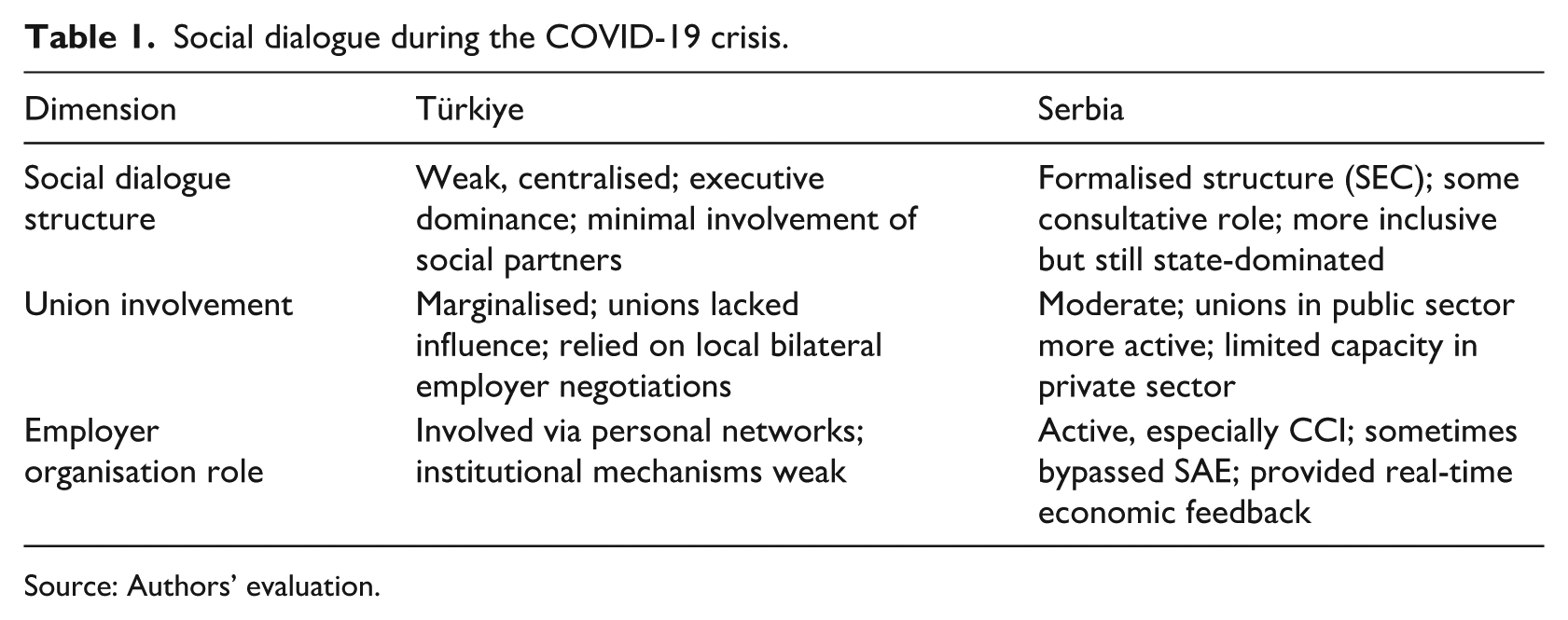
Table 1 summarises social dialogue during the pandemic. The crisis exposed corporatism model weaknesses in both countries, particularly regarding vulnerable populations. In Türkiye, the lack of effective dialogue and centralisation of power severely limited social partner influence. The absence of institutionalised collaboration created a top-down response, prioritising economic stability over protection of vulnerable groups. In contrast, Serbia’s formalised power relations allowed for more inclusive discussions, particularly in the public sector, though vulnerable groups such as temporary and atypical workers were still sidelined. Thanks to the extraordinary and universal nature of Serbia’s intervention, its paternalistic crisis management protected vulnerable interests and laid the groundwork for less conflictual SEC relations in the post-pandemic period.
Social dialogue during the COVID-19 crisis.
Source: Authors’ evaluation.
Protection of vulnerable groups during the COVID-19 crisis
Türkiye’s response to the economic fallout from the COVID-19 pandemic comprised a combination of financial aid for employers, credit expansion, and temporary labour market protections. One of the key initiatives was Decree 7244, which provided financial assistance to employers by supporting minimum wages, thereby reducing labour costs. Additionally, the government imposed a three-month ban on employment contract terminations, although employers were allowed to put workers on unpaid leave. Workers who did not qualify for unemployment benefits or short-term working arrangements received a daily payment of 39 Turkish Lira, or about €4 (Anadolu Agency, 2020), later extended into early 2021. Although the economy began to recover, recording 1.7 per cent growth in the first quarter of 2021 (IMF, n.d.), the labour market continued to struggle. Youth unemployment remained high, and the reinstatement of mobility restrictions in late 2020 hampered any sustained recovery. Türkiye’s economic support index, which measures income support and debt relief, declined sharply after the fourth quarter of 2020 (Bayar et al., 2023).
In contrast, Serbia’s measures were more prolonged. The Serbian government allocated about 16 per cent of GDP to pandemic-related stimulus measures spread over two years, including a mix of direct subsidies to businesses and universal cash transfers (Almenfi et al., 2020). This broad-based approach ensured that most segments of the population received some direct financial support, regardless of employment status. To support businesses, Serbia designed two types of subsidies aimed at preserving jobs (Government of the Republic of Serbia, 2020). For self-employed people and micro, small and medium enterprises (MSMEs), the government provided universal flat-rate subsidies equivalent to the net minimum wage for each permanent employee for three months, without requiring proof of losses. These measures were designed not only to minimise job losses during the state of emergency, but also to provide general economic stimulus to avoid a deeper recession. Large enterprises also received financial support in the form of 50 per cent of the minimum wage for employees whose work was suspended during quarantine. This ‘Keynesian’ stimulus was relatively unconventional, particularly for a country at Serbia’s level of development.
Universal measures in 2020 included a one-time payment of €100 to all adult citizens and an additional €75 to pensioners. While the scope of financial support was reduced in 2021, the government continued similar measures (RCC, 2021), albeit on a smaller scale, providing occasional one-off support to young people, pensioners and the unemployed. By 2021, the labour market had returned to its pre-COVID-19 path, with some temporary jobs converted into permanent positions.
Türkiye relied heavily on conventional tools such as credit expansion and tax deferrals, with significant reliance on financial markets rather than direct fiscal support. Public banks provided cheaper credit to businesses, and taxes and social security payments were deferred for many companies. According to the International Monetary Fund (IMF), Türkiye’s total economic aid reached 12.8 per cent of GDP by 2021 (IMF, n.d.), but unlike in Serbia, much of this aid consisted of credit facilities rather than direct cash support. In terms of direct financial assistance to households, Türkiye offered one-time cash payments of 1000 TL, or about €128 for 2.1 million low-income households. The government’s focus on credit expansion may have helped businesses to weather the crisis, but it provided limited direct assistance to workers, leading to persistent labour market challenges.
Despite its initiatives, Türkiye’s direct coverage of vulnerable groups was limited. Workers outside formal arrangements received minimal daily payments, while much of the support went to businesses in the form of credit. Türkiye’s reliance on credit facilities instead of direct fiscal spending limited the reach of its social policy. The tourism and hospitality sectors lobbied for an easing of restrictions and the government gradually reopened the economy by mid-2020, but unemployment surged, peaking in May 2020. Lockdown measures severely impacted employment in sectors such as tourism, hospitality and retail, and the rebound was slow and uneven. Although some measures were extended into 2021, their overall scale and duration were insufficient to ensure sustained labour market stability.
In Serbia, aggressive fiscal measures helped stabilise the labour market more effectively, partly because the country is less reliant on tourism and hospitality than Türkiye. Unemployment remained relatively stable, and the combination of job retention subsidies and direct cash transfers ensured that most workers, including those in vulnerable sectors, received assistance. Despite the slight GDP decline of around 1 per cent in 2020, major employment and social indicators did not deteriorate. While total Labour Force Survey (LFS) employment remained roughly the same in 2020, formal employment increased by almost 50,000, with an 0.8 per cent improvement in the employment rate.
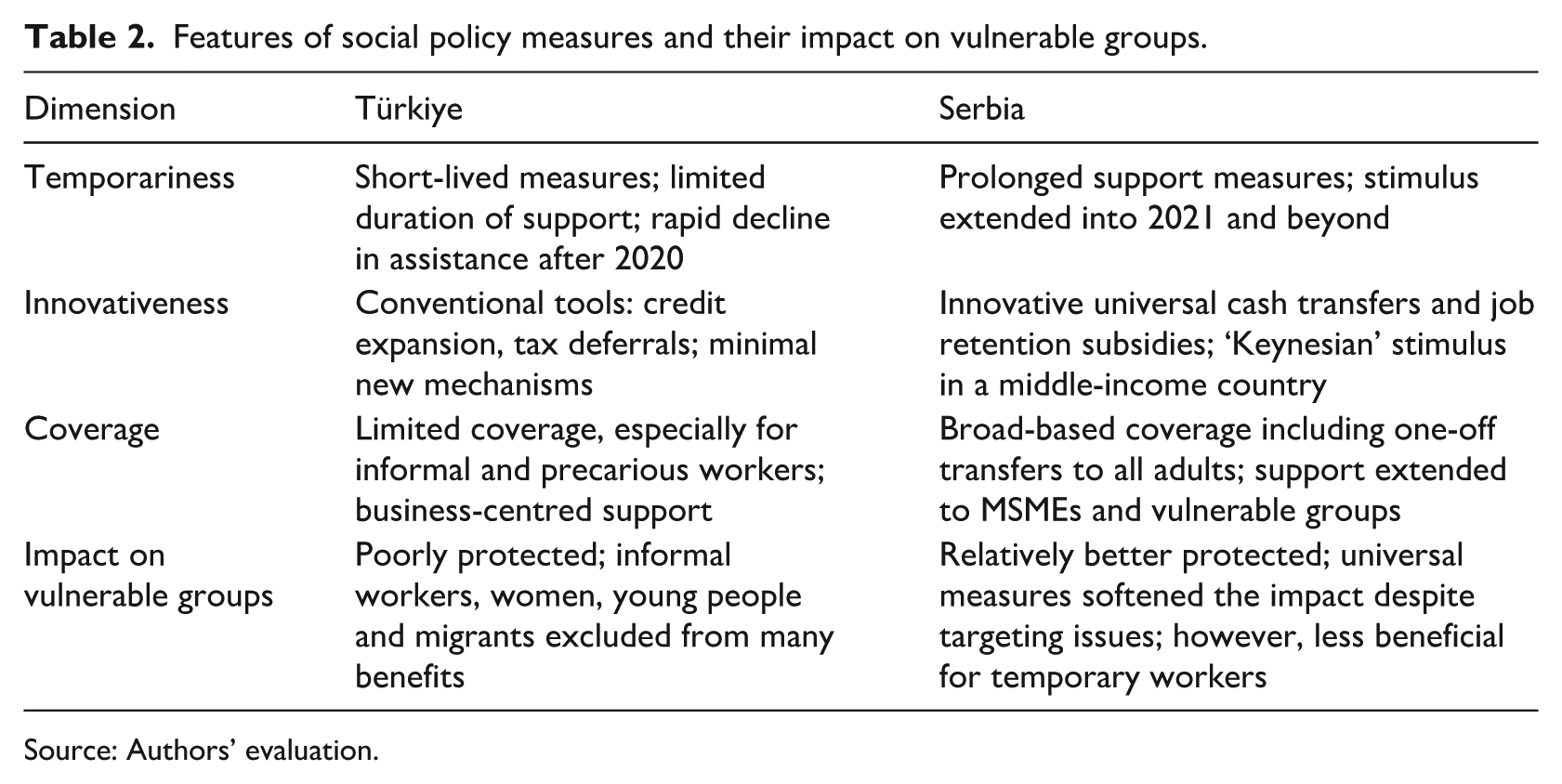
As can be seen from the previous discussion and Table 2, both the Turkish and the Serbian governments attempted to protect vulnerable groups during the pandemic, but the design and effectiveness of their measures differed significantly. In Türkiye, workers on temporary or atypical contracts, as well as informal workers, remained particularly vulnerable. It has been shown that inequality and poverty were likely to deteriorate in Türkiye because of lockdown policies if adequate social assistance and labour market policies were not implemented (Duman, 2020b). Although the government came up with short-term working arrangements and banned contract terminations, the restrictions on eligibility for unemployment benefits and limited cash assistance left many workers without protection. Informal workers, who make up a significant portion of the Turkish labour force, were excluded from government support schemes, as they were not registered and thus did not qualify for unemployment assistance or wage subsidies. Although the government provided support for low-income households, the overall focus on credit expansion and business support meant that the working population received minimal direct assistance (Bayar et al., 2023). The most vulnerable segments of Turkish society, such as the poor, dependent women and young people, as well as immigrants, were not protected to a considerable extent.
Features of social policy measures and their impact on vulnerable groups.
Source: Authors’ evaluation.
In Serbia, vulnerable groups fared better, thanks to the universality and generosity of the government’s response. The flat-rate wage subsidies and cash transfers provided direct relief to most workers, including those in precarious employment. However, workers on temporary or atypical contracts were still at a disadvantage, as job retention subsidies were not designed to protect them. Nonetheless, Serbia’s broad financial assistance helped to minimise the pandemic’s impact on unemployment, and some temporary workers saw their jobs converted to permanent contracts. This contrasts with the widespread job losses experienced by temporary and informal workers in Türkiye. Many vulnerable groups, however, such as young people and workers in negatively affected sectors, were not adequately protected as the benefits were not targeted to mitigate particular risks.
Conclusions
During the COVID-19 pandemic, both Türkiye and Serbia faced unprecedented socio-economic pressures that tested the strength and responsiveness of their formal corporatist arrangements. These responses reveal divergent paths rooted in distinct power configurations and institutional traditions. Türkiye exemplified non-inclusive crisis governance, in which corporatist forms were hollowed out under the weight of executive centralism and weak social partner involvement. Despite the existence of formal tripartite institutions, meaningful social dialogue was conspicuously absent. Instead, decision-making was concentrated and the voices of labour and employer representatives were excluded. Serbia exhibited a form of paternalistic crisis corporatism, characterised by early government centralisation but gradually expanding consultative mechanisms. The broad fiscal stimulus packages, universal cash transfers and wage subsidies were largely endorsed by social partners. Nevertheless, their capacity to shape policy remained limited, reflecting structural imbalances in institutionalised power.
The social policy impacts of these different models are equally important. Serbia’s commitment to universalist measures during the initial phases of the pandemic provided short-term labour market resilience and mitigated social dislocation. Sectoral negotiations, although limited in scope, emerged in the later stages, and unions succeeded in advancing demands related to occupational safety and health in several key sectors. Nevertheless, persistent asymmetries in power relations curtailed more transformative outcomes. Private sector workers on temporary or fixed-term contracts, and younger entrants to the labour market, remained under-protected, reflecting the segmented nature of Serbia’s labour market.
By contrast, Türkiye’s credit-centric response failed to tackle the entrenched vulnerabilities faced by large sections of the workforce, particularly women, young people, refugees and informal workers. The limited redistribution and narrow coverage of social protection measures in Türkiye exacerbated pre-existing inequalities, with disproportionate impacts on marginalised groups. Although containment measures were aimed at macroeconomic stability, they lacked the redistributive or participatory dimensions that are central to effective crisis corporatism. Informal workers, comprising over a quarter of the Turkish workforce, were left outside most state support schemes, while Syrian refugees, many of whom work in precarious sectors, such as agriculture and domestic services, faced compounded vulnerabilities.
Given the highly unequal power relations and pronounced executive centralisation in Türkiye, corporatist practices were expected to remain limited, symbolic and largely orchestrated by the state. Our findings showed that policy-making in this context prioritised economic stability and elite consensus, systematically bypassing inclusive consultation mechanisms. As a result, the exclusion of vulnerable groups – particularly informal workers, low-income households and precarious labour segments – emerged as a structural feature, rooted in social partners’ institutional weakness and political marginalisation. In contrast, Serbia was expected to exhibit a more pragmatic and flexible approach to crisis corporatism, shaped by its institutional legacy of tripartite structures and a strategic interest in preserving social stability. While the Serbian model did not embody fully participatory governance, it allowed for a degree of negotiated inclusion, particularly in sectors in which unions retain influence. Our analysis supported this. We observed gradual and sector-specific social partner involvement during the latter stages of the crisis, which suggests a hybrid form of crisis corporatism that balances executive dominance with selective engagement.
These contrasting cases underscore how institutionalised power relations and the broader political opportunity structures within which social partners operate may shape the possibilities and limits of corporatist crisis governance. In Türkiye, the erosion of associational autonomy and the subordination of interest mediation to the executive not only constrained policy responsiveness during the crisis, but also exposed the deeper deinstitutionalisation of corporatist channels. What emerged was a facade of tripartism with no substantive role for social partners in shaping emergency responses. Crisis governance thus became an extension of authoritarian developmentalism, reproducing structural inequalities rather than mitigating them.
Serbia, while not free from institutional frailties, demonstrated how even a constrained corporatist infrastructure can be partially reactivated in response to crisis. The centralisation of early responses did not entirely displace the role of interest groups; instead, the crisis opened limited windows for negotiated input, particularly as the pandemic unfolded and the need for sectoral and occupational coordination increased. The capacity of unions to raise issues related to occupational safety and health and to participate in targeted consultations shows that even under conditions of structural imbalance, corporatism can remain a living institutional form. However, this form is better described as crisis corporatism without transformation, a tactical inclusion of social partners without significantly reconfiguring power hierarchies or institutional logics.
This comparative analysis contributes to the literature on crisis corporatism by foregrounding the interaction between institutional legacies and contemporary power asymmetries. In contrast to the view of corporatism as a static arrangement, the pandemic revealed its contingent nature, capable of reactivation or erosion depending on the political configuration and degree of autonomy afforded to social partners. The Turkish case demonstrates how corporatist institutions can be systematically emptied of substance, rendering them ineffective during moments of systemic stress. Serbia illustrates that partial corporatist re-engagement is possible under paternalistic frameworks, even if shaped by executive dominance.
Ultimately, the pandemic did not transform institutionalised power relations in either country but rather amplified existing dynamics. In Türkiye, exclusionary governance was reinforced, confirming that corporatism without autonomy serves primarily legitimising functions. In Serbia, the partial revival of corporatist mechanisms highlighted their enduring relevance, though within constrained and unequal frameworks. In both cases, the crisis revealed that the resilience of corporatist governance hinges less on formal institutions and more on the underlying balance of power between the state and social actors, the permeability of decision-making and the autonomy of organised labour and employer associations. This suggests that crisis corporatism must be understood not as an institutional default, but as a contested arena, shaped by historical legacies, political incentives and strategic interactions between state and society. The COVID-19 pandemic, rather than levelling the field, magnified structural inequalities with regard to corporatist capacities. Our comparative analysis contributes to this emerging debate by highlighting the importance of institutional embeddedness and power asymmetries in shaping corporatist responses during systemic shocks.
Footnotes
Funding
This research was financially supported by the European Commission [Grant No. VS/2021/0196].