




Abstract
This article connects crisis corporatism with welfare regime and labour market segmentation theories to examine the responsiveness of social dialogue during the COVID-19 pandemic. Using data from the Eurofound EU PolicyWatch database, covering policy measures (N = 1139 measures) implemented across the EU from 2020 to 2022, it analyses the extent to which tripartite alliances, namely between trade unions, employer organisations and government, were associated with the implementation of policies that targeted the situation of (employment-related, and family- and health-related) vulnerable groups during the COVID-19 crisis in Europe. The findings show that the role of social partners – and in particular tripartite alliances for the vulnerable – was limited in implementing policies for the vulnerable. Regime-specific variations indicate that although social dialogue structures exist across countries, their operational significance and capacity to shape policies vary. Crisis corporatism, rather than reworking systems to foster inclusion, risks reproducing established boundaries.
Introduction
Crisis corporatism can be understood as a policy-making response to a rapid change or crisis that requires the social partners (unions, employer organisations and government) to work together (Ebbinghaus and Weishaupt, 2022; Mailand, 2020; Meardi and Tassinari, 2022). It has been associated with a rejuvenation of so-called ‘alliances of the weak’ (Urban, 2012: 230), which involve the less well-represented or otherwise vulnerable groups in policy-making. Work on crisis corporatism to date, however, has emphasised the input perspective of policy-making; for example, which social partners were involved and what was the nature of the ensuing policy-making process. Less attention has been paid to the output perspective, namely the extent to which vulnerable groups were targeted in such collaborations. We combine these input and output perspectives, and study the extent to which tripartite alliances emerged and resulted in policies targeting vulnerable groups. We refer to them as tripartite alliances for the vulnerable.
Furthermore, work on crisis corporatism is commonly based on in-depth case studies (for example, Ebbinghaus and Weishaupt, 2021; Meardi and Tassinari, 2022; Urban, 2012), which are less effective when it comes to determining how common patterns of crisis corporatism are. In this article, we use quantitative data from the Eurofound EU PolicyWatch database on policy-making during the COVID-19 pandemic across European countries to present a descriptive diagnosis of the emergence of tripartite alliances to implement policies that explicitly target vulnerable groups.
The COVID-19 pandemic (2020–2022) presented an opportunity to assess whether, and under what institutional conditions, tripartite alliances of social partners were associated with policy responses targeting vulnerable groups. First, the nature of the crisis was such that new vulnerabilities emerged alongside existing ones. The COVID-19 pandemic exposed the classic employment-related vulnerabilities by heightening labour market risks (for workers in frontline services, low-paid workers), and by structurally excluding some workers from welfare state protection and the representational channels of social dialogue (for example, non-standard workers, the self-employed). But the COVID-19 crisis also affected the domestic sphere, both directly and indirectly, having profound consequences for family life. These new risks included health-related concerns for some families; inequalities in people’s capacities to work remotely; and the differentiated effects of school closures on families, which for some extended caregiving and home-schooling needs. The nature of the COVID-19 crisis and the required responses allow us to study the targeting of newly emerging vulnerable groups and whether tripartite alliances among social partners also targeted those outside the traditional core of ‘labour market insiders’ (Emmenegger et al., 2012). Labour market segmentation research highlights that formal protections often focus on standard workers with union representation, excluding temporary, part-time or platform workers (Emmenegger et al., 2012). These groups often lack employment security and a political voice in social dialogue. This prompts the question of whether (crisis) corporatism can extend protection for the vulnerable beyond social partners’ traditional constituencies.
Second, the gravity of the COVID-19 crisis required governments to adopt rapid measures to contain a public health emergency, as well as to support labour markets and maintain household incomes. This entailed the adoption of a large number of ad hoc policies. This allows for a systematic quantitative description, which is also sensitive to how crisis corporatism evolved over time in different phases of the pandemic. This is further strengthened by the fact that COVID-19 affected all European countries within approximately the same time frame. We can examine country differences with regard to the degree of crisis corporatism in their responses to fairly similar crisis conditions.
This article addresses three questions. First, to what extent did tripartite alliances (of trade unions, employer organisations and government) represent the interests of the vulnerable, and how much were they associated with the implementation of policies that targeted the situation of (employment-related, and family- and health-related) vulnerable groups during the COVID-19 crisis? Second, how did this involvement change over time as the COVID-19 crisis evolved, and how did the policies that emerged from the involvement of alliances for the vulnerable vary across institutional regimes in Europe? Third, what were the aims of policies adopted by tripartite alliances?
The article is structured as follows. Section 2 conceptualises the link between crisis corporatism and tripartite policy-making towards vulnerable groups in the context of COVID-19 in terms of the power relations theory. Section 3 considers a broader institutional context (including welfare state regime types, labour relations, degree of labour market segmentation) to examine the targeting of policies in a comparative perspective. Section 4 provides the methodological background, and Section 5 the empirical results. The concluding section discusses key findings, limitations and theoretical implications.
Crisis corporatism towards vulnerable groups in the COVID-19 crisis
The importance of crisis corporatism for vulnerable groups during the COVID-19 pandemic lies not only in its reactivation of social dialogue, but also in the institutional tensions it exposes. The magnitude of the COVID-19 pandemic as a polycrisis characterised by a number of different aspects of vulnerability (economic, social, family, health) was one reason tripartite governance targeted groups previously peripheral to social dialogue (Boonjubun et al., 2025; Meardi and Tassinari, 2022). These target groups include workers in insecure employment, persons with limited access to social protection, and households disproportionately affected by weak health and care infrastructure. In other words, the expansion of tripartite governance to such groups is linked directly to the recognition of vulnerability as a condition emerging from interconnected challenges. It is reflected in the precarity of labour market attachment or unstable work conditions, the unequal distribution of resources and protections that determine how robustly people can withstand shocks, and the fragility of care and health systems, which in times of crisis shift the burden of resilience from institutions to households (Brady, 2022; Kalleberg, 2018). Furthermore, unlike ‘routine’ social dialogue, crisis corporatism is shaped by compressed timelines, high political urgency and uneven capacities among actors (Meardi and Tassinari, 2022; Urban, 2012).
In times of crisis, tripartite alliances may vary in inclusivity and voice, as they may operate beyond the normative obligations of established corporatist systems. Power resource theory highlights the institutionalised ways in which social partners can impact policy-making processes, particularly through their participation in tripartite negotiations (for example, Korpi, 1991; Meardi, 2024; Refslund and Arnholtz, 2022). Institutional power allows established partnerships to set and influence agendas across various issues relevant to the workplace, labour protection legislation, and income protection through the welfare state. Institutional power may also be seen as a ‘double-edged sword’, however. While it confers rights on certain actors, it denies power to others and restricts what the people around the proverbial policy negotiation table can do. There can be marked differences between which groups benefit, and which ones lose out. Particular co-determination structures can prioritise or ignore certain groups, especially when they are less central to existing governance relations (Brady, 2022).
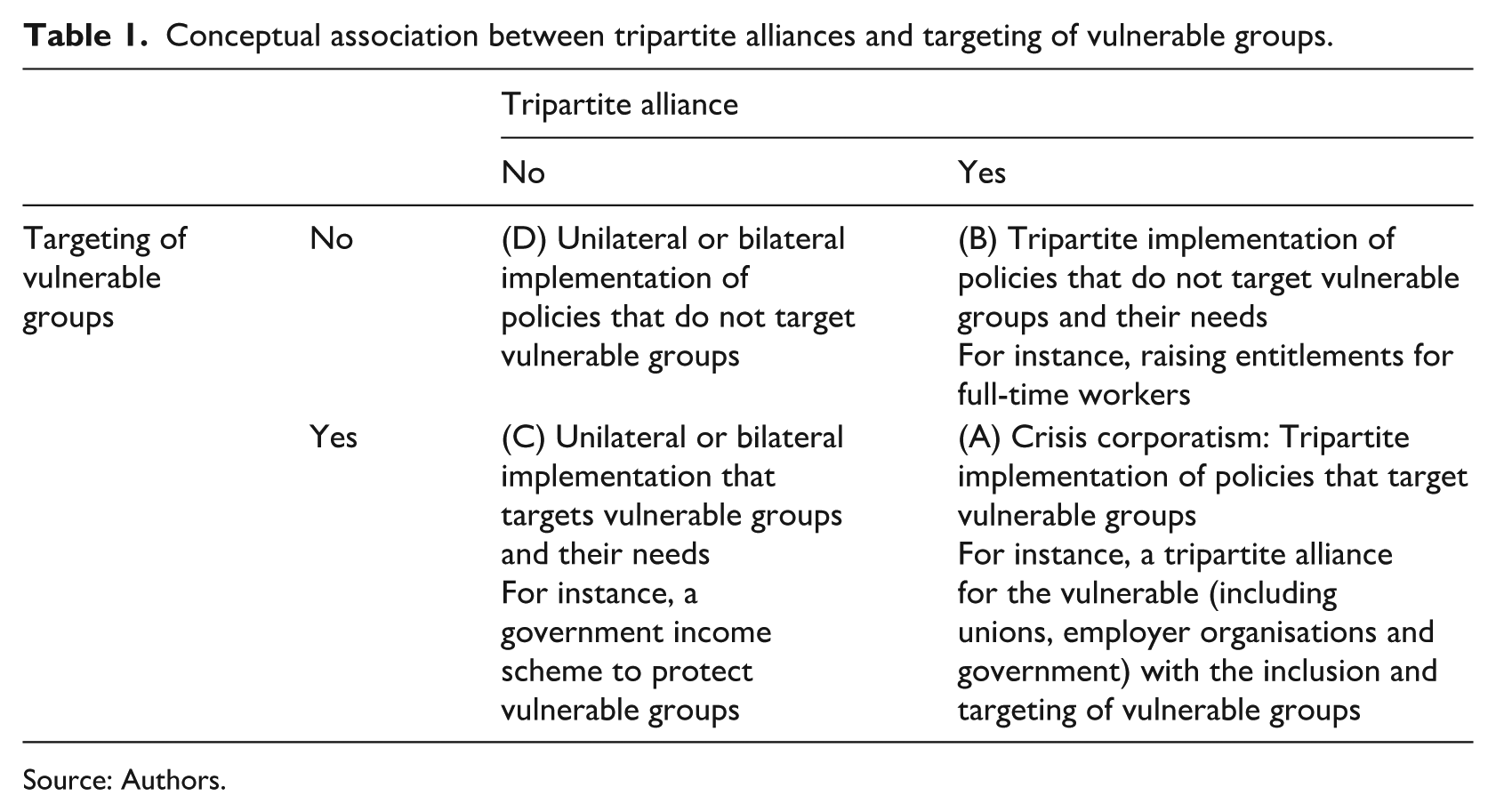
In this article, we theorise crisis corporatism in terms of the greater involvement of tripartite alliances in times of crisis, and in relation to whether these tripartite alliances also entail the implementation of policies that target vulnerable groups. This is illustrated in Table 1.
Conceptual association between tripartite alliances and targeting of vulnerable groups.
Source: Authors.
Table 1 suggests at least four ways in which policy responses during the COVID-19 crisis led to (or not) both tripartite alliances and the targeting of vulnerable groups. First, tripartite alliances can form to adapt to complex crises and to how such crises affect particular vulnerable groups. Alliances can provide pragmatic responses to emergencies targeting different risk categories (economic, labour market, social, health). Furthermore, tripartite alliances can open up avenues for addressing the risks characteristic of new constituencies (for trade unions) (Ebbinghaus and Weishaupt, 2021; see also Boonjubun et al., 2025) and thus bring about new policy foci (Meardi and Tassinari, 2022; Urban, 2012). Tripartite alliances among actors strengthen the legitimacy of measures and provide feedback between policy-makers and policy implementers. This is the ideal-typical understanding of crisis corporatism, namely, tripartite governance combined with targeting of vulnerable groups (cell A of Table 1). These tripartite alliances for vulnerable groups are expected to produce policies that target the needs of such groups.
Second, the pandemic can also call upon revitalising traditional negotiation mechanisms, engaging selected social partners to protect their main constituencies, for example, labour market insiders instead of outsiders, and therefore produce types of policies that do not specifically target the needs of vulnerable groups (cell B of Table 1).
Third, COVID-19 and other crises have highlighted gaps in social protection (see, for example, Greve et al., 2021, 2024) and shifted existing power dynamics by boosting the government’s role in taking more unilateral action to protect vulnerable groups (Brady, 2022; Meardi and Tassinari, 2022). Governments took decisive action rather than leaving it to deliberative tripartite processes, particularly in the area of health policy (Hassel, 2014; Urban, 2012) even before the COVID-19 pandemic. Governments may also address vulnerable groups with targeted policies, which are however not driven by tripartite governance (cell C of Table 1).
The fourth category is residual, including any other option, not including tripartite governance and not focusing on vulnerable groups (cell D of Table 1).
The four patterns related to tripartite alliances targeting vulnerable groups, as outlined in Table 1, are ideal-types. The potential of crisis corporatism to deliver outcomes for vulnerable groups may depend on the institutional arrangements of welfare regimes, which set both the reach and the limits of inclusion (Brady, 2022). Tripartite decision-making in crises therefore requires a wider institutional lens, as welfare state configurations, public administration and legal frameworks shape coordinated action (Greve et al., 2021), buffer shocks and stabilise demand (Greve et al., 2024). Regime and labour market segmentation theories further clarify the relevant policy options and gaps in support for vulnerable groups. This is discussed in the next section.
Variation across labour market regimes and targeting of vulnerable groups
Institutional structures across Europe have produced distinct patterns of labour market protection, collective representation and welfare provision. These configurations condition the capacity of tripartite alliances to target vulnerable groups. While regime theory has long captured the systematic variation in power relations between capital, labour and the state (Esping-Andersen, 1990; Hall and Soskice, 2001), it benefits from being combined with other frameworks to assess how institutions function when workers fall outside formal protections.
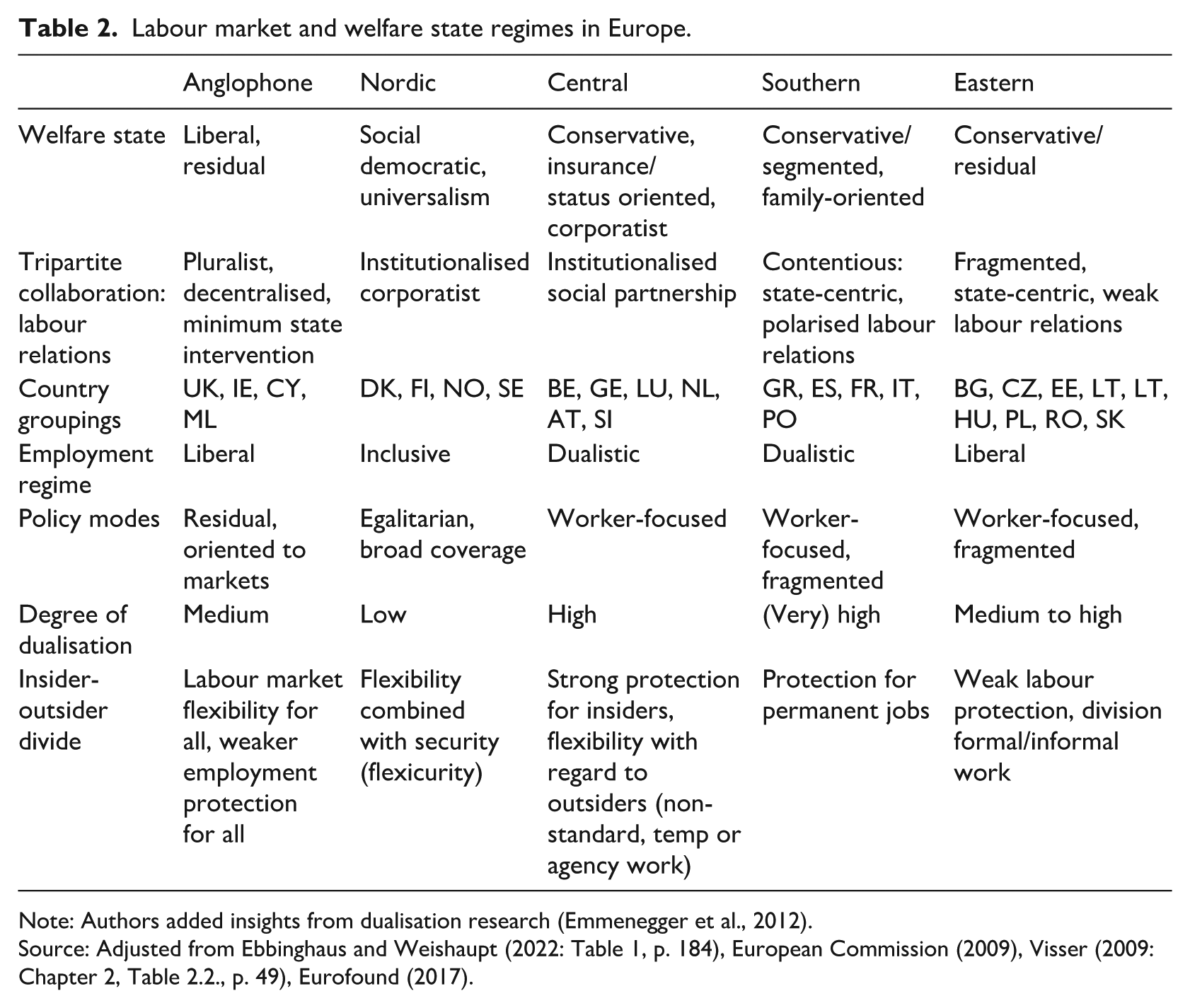
The following section examines the institutional conditions under which tripartite alliances targeted the needs of vulnerable groups during the COVID-19 pandemic. Table 2 outlines regime-specific legacies, such as dualisation, welfare inclusivity and social dialogue structures, to illustrate enabling and/or constraining factors in the mobilisation of inclusive crisis responses in the five well-established regime clusters: Nordic, Central, Southern, Eastern and Anglophone. These frameworks serve as analytical tools for understanding how institutional arrangements enable or constrain inclusive crisis responses.
Labour market and welfare state regimes in Europe.
Note: Authors added insights from dualisation research (Emmenegger et al., 2012).
Source: Adjusted from Ebbinghaus and Weishaupt (2022: Table 1, p. 184), European Commission (2009), Visser (2009: Chapter 2, Table 2.2., p. 49), Eurofound (2017).
These regimes differ in the degree of institutionalised cooperation between the state and social partners; the inclusivity of their welfare designs; and the extent to which they address the insider-outsider divide in labour market protection. The Nordic countries operate under inclusive corporatist arrangements with universalist welfare and strong union–employer coordination. Central European regimes follow a coordinated model but are more dualised, with collective bargaining and social protections disproportionately concentrated on core workers. Southern and Eastern regimes are more fragmented and politically polarised; institutionalised social dialogue is either limited, politicised or largely symbolic. Anglophone countries rely on decentralised labour relations and residual welfare systems, with limited formal social partner involvement in policy-making (Ebbinghaus and Weishaupt, 2022; Hyman, 2018).
These labour market regimes serve as heuristic devices for comparing how institutional features, such as sectoral bargaining structures, welfare state design and labour market segmentation shape the role of unions, employers and the state in broadening the scope of corporatist focus to target vulnerable groups (Gerring et al., 2020). Factors such as dualised labour markets, a divide between insiders and outsiders, and fragmented unions often contribute to weaker protections for vulnerable populations. Research indicates that strong institutional buffers, whether through social protection systems or social dialogue partnerships, offer stronger protection against emerging market risks. Extension of social protection schemes (for example, including extending coverage of unemployment benefits and/or minimum income schemes to non-standard workers), but also active labour market policies (such as training or work subsidies), can mitigate risks by providing income security and maintaining labour market attachment (training, subsidised employment), and also preventing poverty for vulnerable workers.
Additionally, the capacity of tripartite alliances to address the needs of vulnerable groups is not distributed equally across regimes (Josifidis et al., 2015). Scholarship, especially from a production regimes perspective, has shifted attention to how nationalistic capitalist models shape the position of vulnerable groups during crisis (Gallie, 2007). Vulnerability therefore emerges at the intersection of risk exposure and the capacity of institutional actors to address both existing and emerging needs (Trif et al., 2023).
In the
In
In
In
Finally,
Up to this point, we have developed a strict conceptualisation of crisis corporatism as the formation of tripartite alliances in times of crisis to implement policies that target vulnerable groups. Furthermore, we have established that this association depends on a range of institutional conditions, including welfare provisions and labour market segmentation, and is therefore expected to vary by regime. There are, however, contrasting expectations regarding how. On the one hand, vulnerable groups may be more likely to be targeted in regimes with prior alliances and stronger institutional capacity to address such needs, such as the Nordic and Central European regimes. On the other hand, gaps in existing social safety nets (as indicated by the residual policy model and indicated by insider-outsider divides) might necessitate immediate policy responses in times of crisis. This would be expected in, for instance, the Liberal regime.
The empirical work that follows does not allow us to study the causal link between tripartite decision-making and the targeting of vulnerable groups; our empirical ambitions are descriptive and comparative. But in line with the theoretical framework developed here we not only examine this association overall, but also describe variation across regimes with regard to how commonly the different patterns identified in Table 1 occur.
Methods
This article provides a systematic analysis of a large number of ad hoc policies implemented in response to the COVID-19 pandemic in order to describe the extent to which tripartite alliances were behind the adoption of policies targeting vulnerable groups. To that end, we need a large database of policy reforms. This is provided by the Eurofound EU PolicyWatch database (see, for example, Weber et al., 2020). This database was established in 2020 to describe policy responses to the COVID-19 pandemic in European countries, with a particular focus on the roles played by various social partners. The data were collected by a network of Eurofound correspondents, with a quality control check by Eurofound. The data are freely and openly available.
The database contains information on a large number of policies from across European countries, such as when the policies were adopted, whether different social partners were involved or not, what the main aim of the policy was, and what the target group or groups (if any) were. The PolicyWatch database also contains policies that pertain to (responses to) the war in Ukraine, inflation and the cost-of-living crisis, the green transition, emergency measures related to extreme weather events, support measures for companies that need to restructure and for employees affected by this, and policies supporting the digital transformation, but those were filtered out.
The remaining policies were classified as a response to the COVID-19 crisis. The database focus is on social and economic policies, namely those implemented to support citizens, workers and businesses to attenuate the social and economic impact of the COVID-19 crisis. Policies aimed at containing the pandemic itself were not included.
The data enable us to describe how commonly certain forms of (tripartite) decision-making are associated with policies targeting vulnerable groups. But we cannot infer insights into how important specific policies were for vulnerable groups, nor do we intend to infer any particular order of events, let alone causality. In addition, one limitation of our data is that we cannot differentiate explicitly between insiders and outsiders (related to, but certainly not identical to vulnerable groups), nor can we explore the different institutional pathways that may be behind targeting policies towards employment-related vulnerabilities or family- and health-related vulnerabilities.
Operationalisation of variables
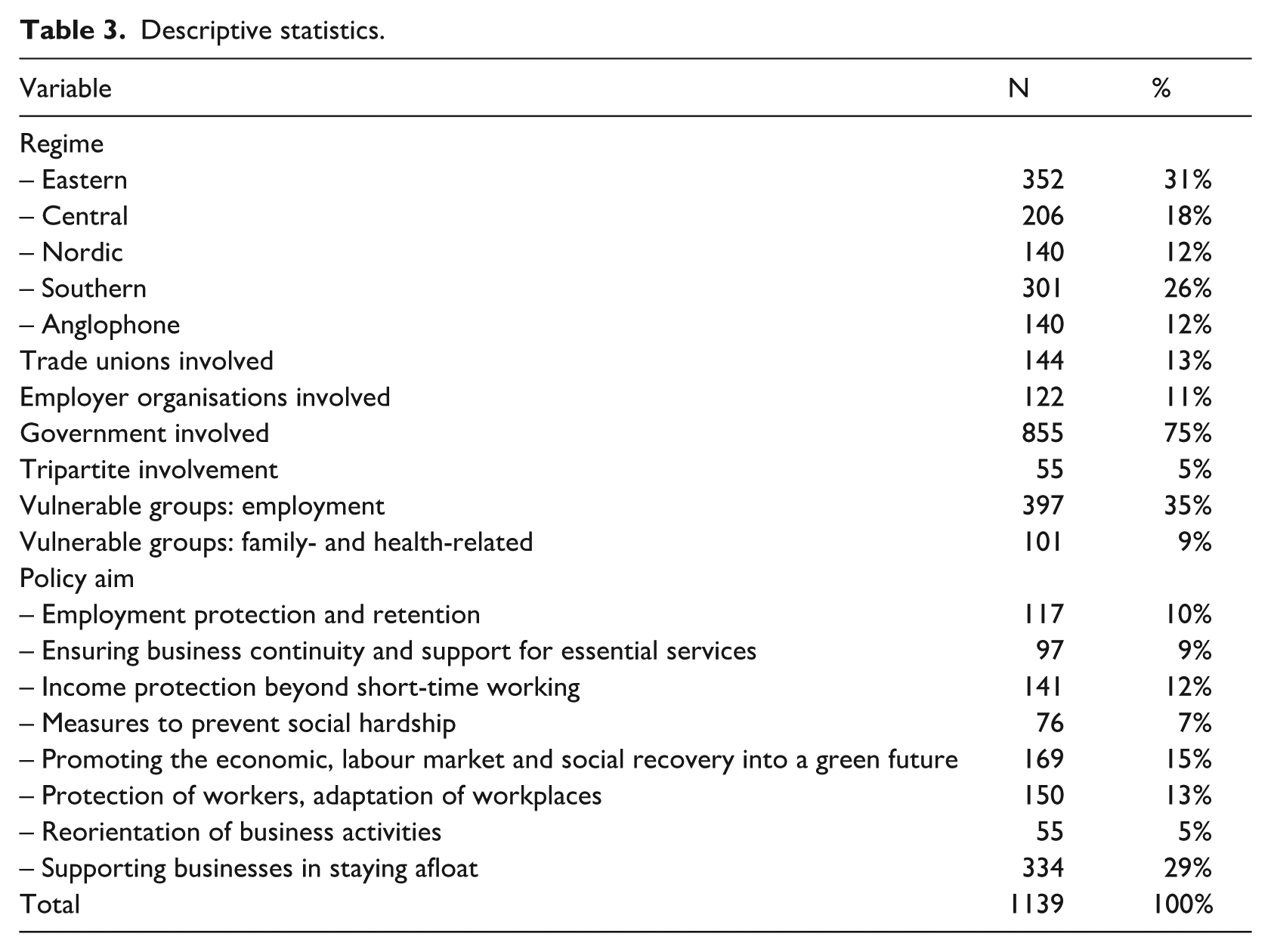
Finally, in Table 3 we present descriptive statistics of the variables. In total, we have complete data on 1139 policies. The policies are fairly evenly spread across the regimes, albeit that we have fewer in the Northern and Western regimes, which are represented by the fewest countries. Trade unions were involved in 13 per cent of the policies, employer organisations in 11 per cent and government in 75 per cent of all policies. Logically, there was tripartite involvement in the smallest number of cases, namely 5 per cent of all policies. In 35 per cent of all policies employment-related vulnerable groups were targeted, while 9 per cent of policies were targeted at family- and health-related vulnerabilities. The policy aims differed and were least likely to aim to reorient business activities (5 per cent) and prevent social hardship (7 per cent). They were most likely to promote the economic, labour market and social recovery into a green future (15 per cent) and to support businesses in remaining afloat (29 per cent).
Descriptive statistics.
In the next section, we present associations between these variables, using figures or tables with percentages and odds ratios. All associations are bi- or tri-variate, but no control variables are used (also not for the odds ratios). It should be noted here that the aim of our analyses is to describe how commonly social partners were involved and how often policies had certain aims. This does not necessarily mean that the most common policies were also the most important, had the largest budgetary consequences or had the biggest impact on how (well) vulnerable groups were protected. Other case studies in this special issue pay attention to these important issues.
Analysis
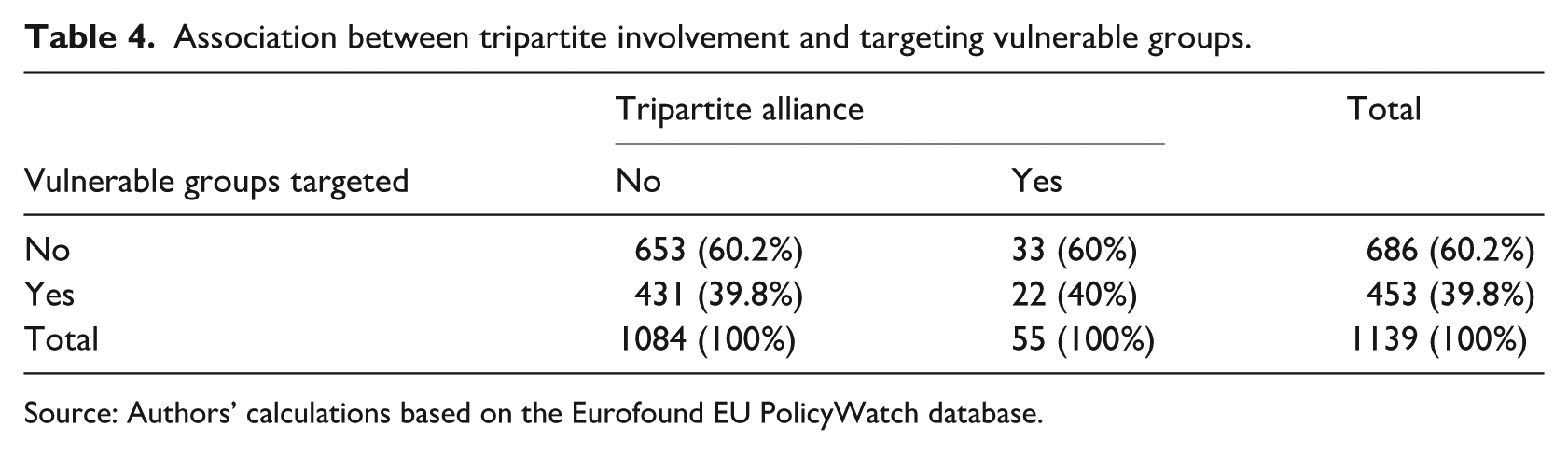
In this section we provide descriptive evidence from the Eurofound EU PolicyWatch database. First, Table 4 provides the most aggregate level view of how tripartite alliances in policy-making and targeting of vulnerable groups are related – akin to the theoretical schema summarised in Table 2. Based on all 1139 policies, there was essentially no evidence that tripartite involvement was associated with a greater likelihood that vulnerable groups were targeted. Moreover, it shows that in the context of policy-making in response to COVID-19, full tripartite involvement of unions, employer organisations and government was uncommon (only 55 out of 1139 policies were implemented with full tripartite involvement).
Association between tripartite involvement and targeting vulnerable groups.
Source: Authors’ calculations based on the Eurofound EU PolicyWatch database.
The evidence presented in Table 4, however, represents a very high average. In what follows we thus differentiate in terms of policies adopted early or later in the pandemic, by specific social partners, by employment- and family- or health-related vulnerabilities, and by regimes in Europe.
We first focus on the policies (in response to COVID-19) that were adopted after tripartite involvement of trade unions, employer organisations and government. Figure 1 expresses tripartite involvement as a share of all policies in response to COVID-19. The dots represent individual policies, and on the vertical axis they are placed to indicate the involvement (or not) of specific social partners. The dots are scattered to indicate the number of policies adopted at the same or a similar point in time. The line indicates the proportion of policies in which the social partners were involved, and was estimated using a LOESS (locally estimated scatterplot smoothing) curve.
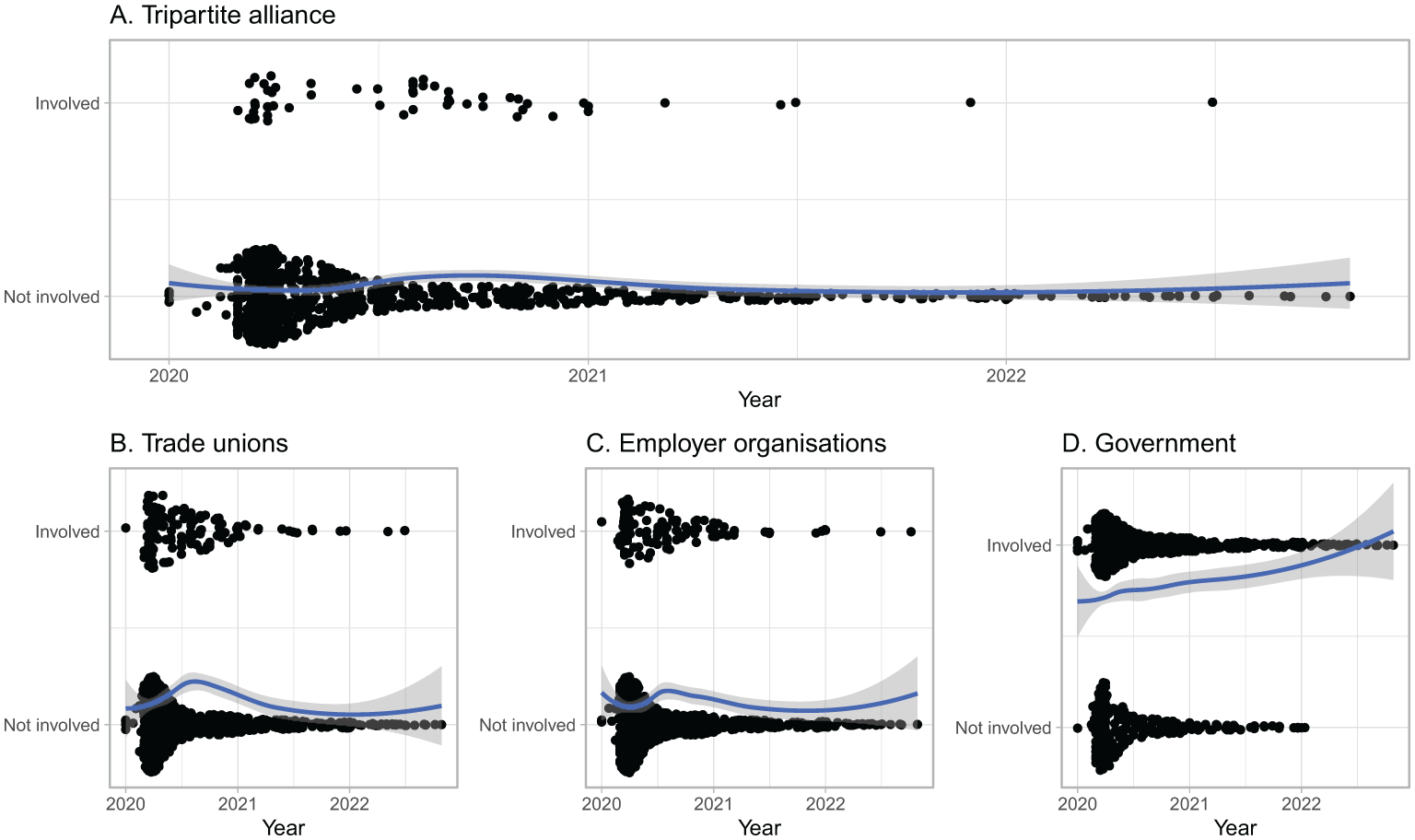
Trends in tripartite alliances of trade unions, employer organisations and government (relative numbers): (a) Tripartite alliance, (b) Trade unions, (c) Employer organisations, and (d) Government.
Panel A shows that in March 2020 the total number of adopted policies was large, but also that only a small share resulted from tripartite involvement (indicated by the line). From a relative perspective, the tripartite involvement was strongest in the second half of 2020, after which it weakened.
Panels B, C and D focus on the relative number of policies adopted in which trade unions, employer organisations and government were involved, respectively. The patterns are similar to those of the tripartite involvement, but more pronounced. Panel B shows that the involvement of trade unions was greatest in absolute terms at the very onset of the pandemic in Europe, and largest in relative terms in the second half of 2020. After that, trade unions were involved much less in the adoption of COVID-19 related policies. The line suggests an uptick at the end of 2022, but it should be noted that this is based on only very few policies and that the confidence interval (the grey area around the lines) indicates substantial uncertainty. Panel C shows a similar pattern for employer organisations of initial involvement at the onset of the pandemic (absolute numbers) and second half of 2020 (relative numbers), followed by a decline. The government (panel D) was involved in many more policies, both in absolute and in relative terms, compared with the trade unions and employer organisations, and their involvement grew over time.
The number of tripartite alliances is too small to allow us to examine the trends by regime, but in what follows we explore several correlates. In Figure 2 we focus on the degree to which newly adopted policies in response to COVID-19 were targeted explicitly at vulnerable groups, specifically employment-related and family- and health-related vulnerabilities. With regard to most policies, the results suggest that there was a focus on vulnerable groups with regard to employment from early in the pandemic. About half of the policies adopted in the first six months were explicitly targeted on such groups. After that, the pace slackened. In contrast, family- and health-related vulnerable groups were hardly targeted at the onset of the pandemic and came into focus only well into 2021. While the results for both types of vulnerability suggest that from late 2021 there was more focus on vulnerable groups, this pertains to only a small fraction of all policies adopted.
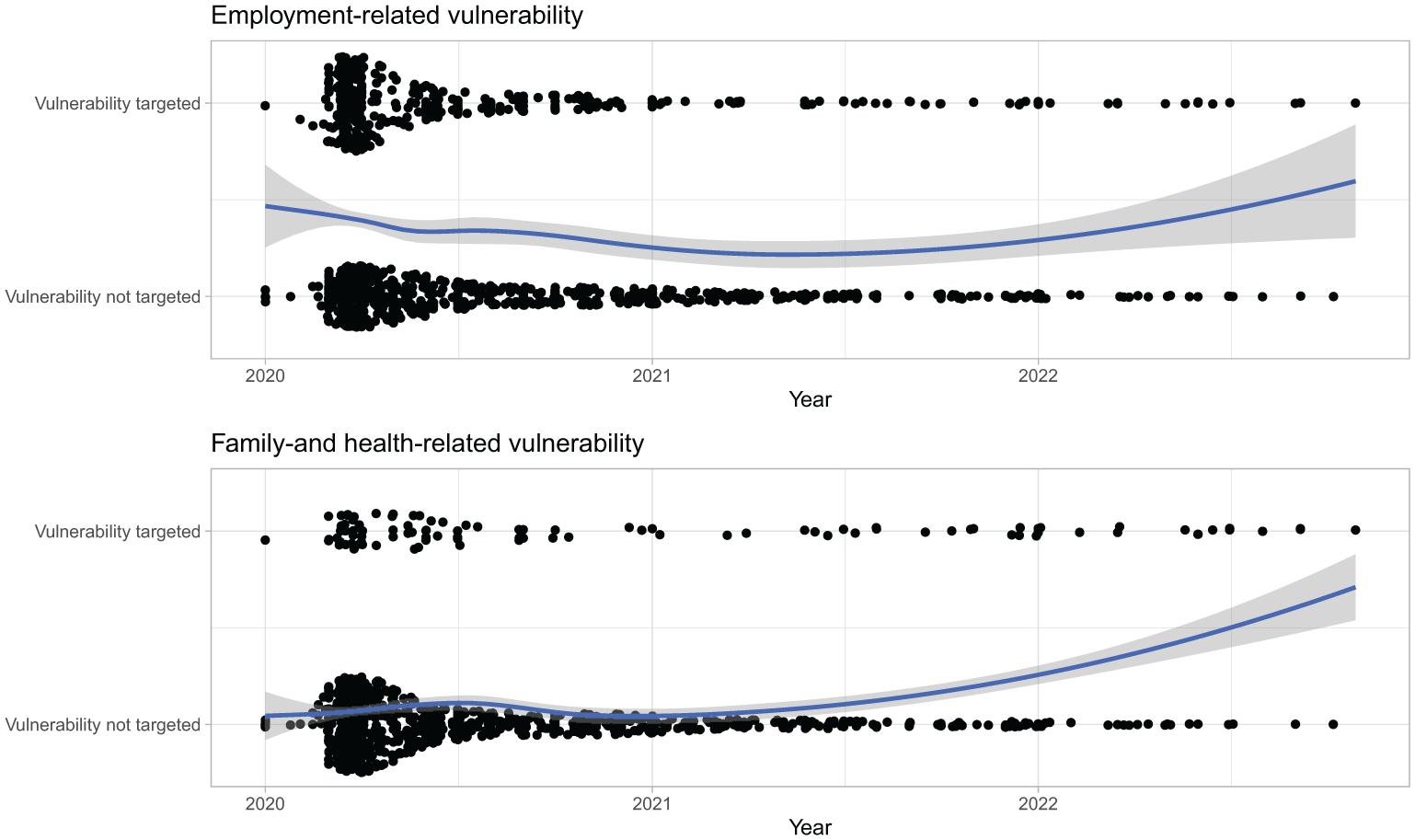
Trends in targeting vulnerable groups.
In the tables that follow, we analyse several aspects of where and how the different social partners were involved in the adopted policies. These analyses expand on the overall association (or the absence of one) we presented above. Table 5 shows the degree to which policies adopted in different regimes targeted employment-related and/or family- and health-related vulnerable groups. The results confirm that employment-related vulnerabilities were targeted more often than family- and health-related vulnerable groups, and in each regime. Both types of vulnerability were most likely to be targeted in Nordic countries (alongside the Eastern European regime with regard to family- and health-related vulnerable groups). Employment-related vulnerabilities were least targeted in Eastern European countries, while family- and health-related vulnerabilities were least targeted in Anglophone countries (but not by a wide margin).
Percentage of COVID-19 related policies targeting vulnerable groups.
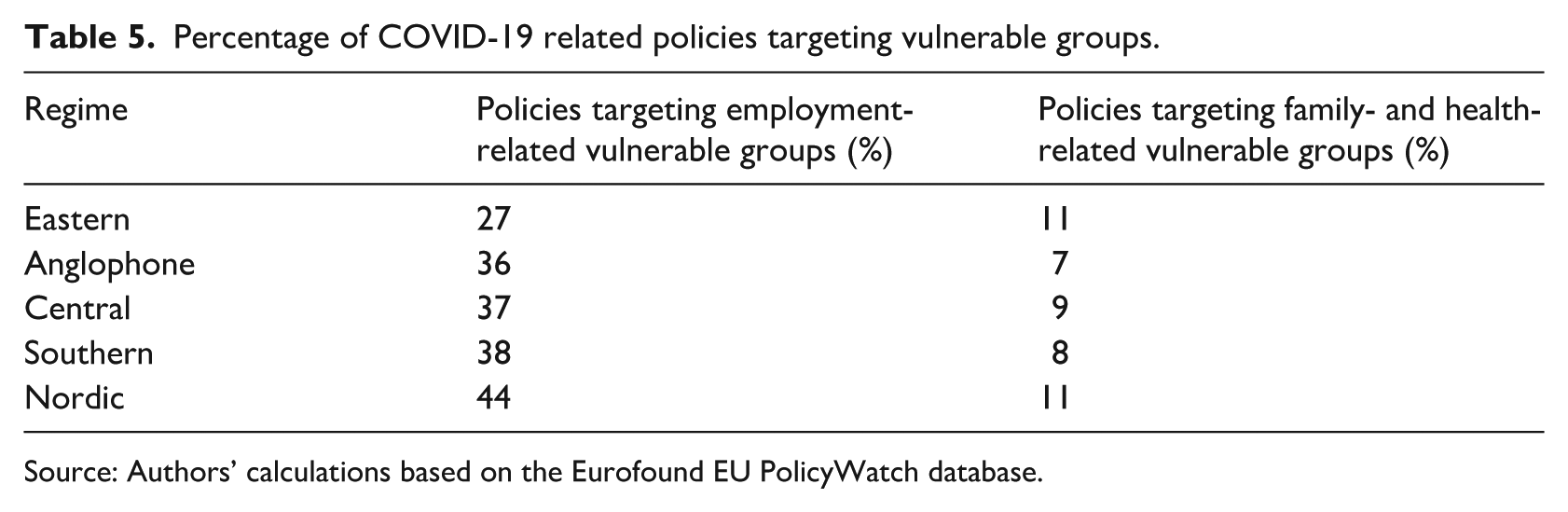
Source: Authors’ calculations based on the Eurofound EU PolicyWatch database.
Table 6 shows the degree to which there was full tripartite involvement in the adoption of policies, along with the degree of involvement of trade unions, employer organisations and government, separately. The results indicate that trade unions were most involved in the policies adopted in the Southern and Anglophone regimes, and least in the Eastern and Central regimes. The involvement of employer organisations was more evenly spread across the regimes, and somewhat lower in the Southern and higher in the Central and Anglophone regimes. The government was least involved in the Central and most in the Nordic and Anglophone regimes. The pattern of tripartite involvement follows that of the trade unions and was comparatively most common in the Anglophone regimes.
Involvement of social partners across regimes (%).
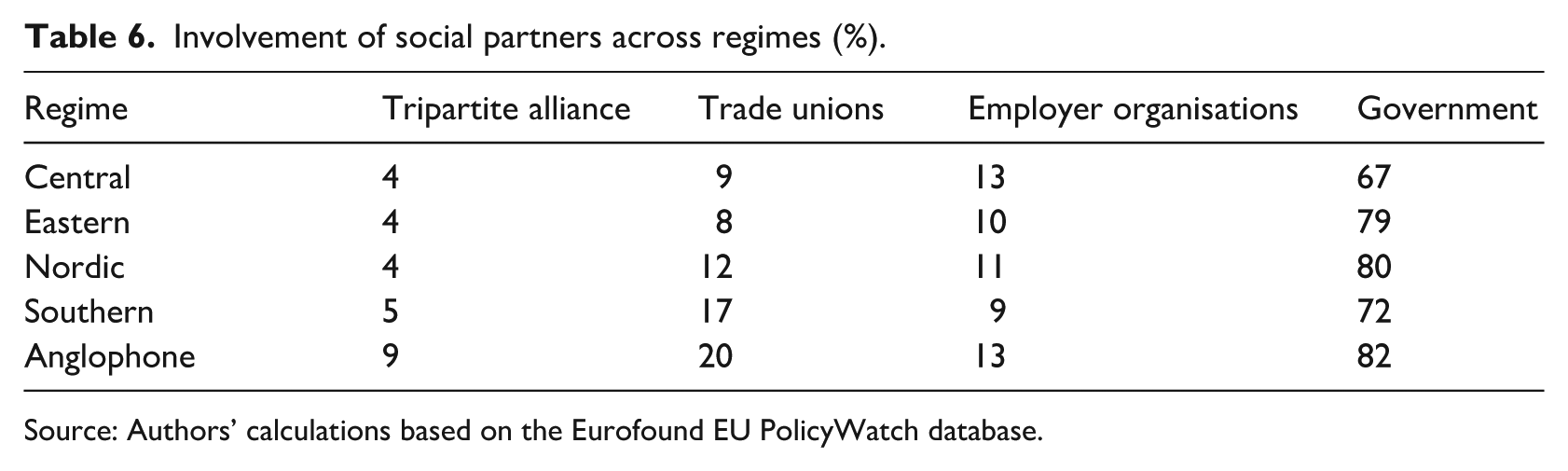
Source: Authors’ calculations based on the Eurofound EU PolicyWatch database.
We examined whether the social partners were more or less likely to be involved in policies that target vulnerable groups. We did this separately by regime. It should be emphasised here that, as in the rest of these analyses, no causal claims can be made. It is unknown from these data whether social partners were more involved in certain policies because vulnerable groups were targeted, or whether social partners – when they were involved in the discussions around a policy – were able to introduce a focus on vulnerable groups.
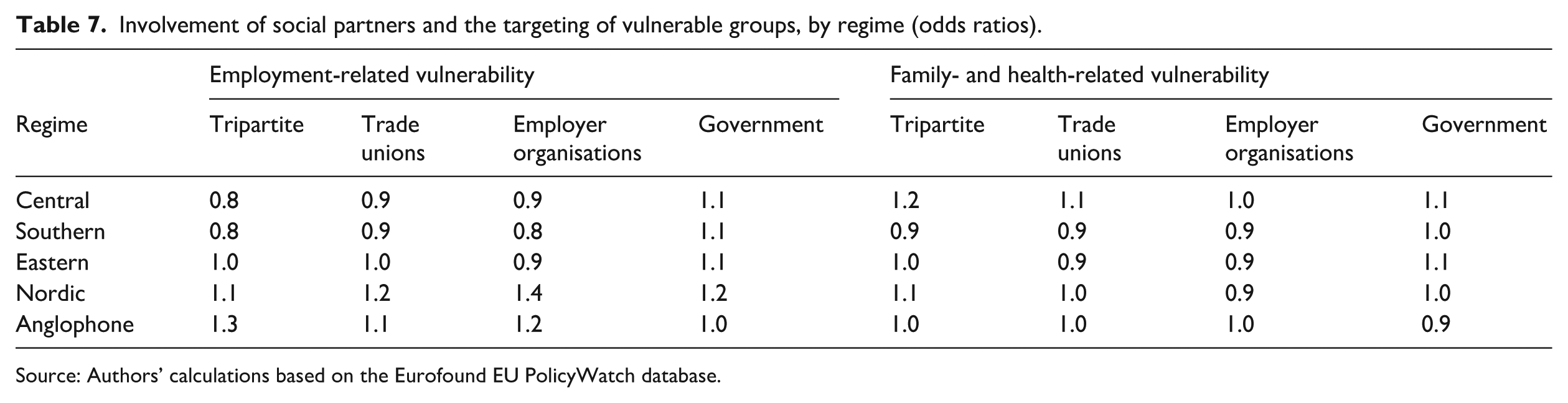
The results in Table 7 are presented as bi-variate odds ratios of an association between social partner involvement and the likelihood that employment-related and family- and health-related vulnerable groups were targeted. An odds ratio larger than 1 means that vulnerable groups were more likely to be targeted when social partners were involved (either as tripartite involvement or by social partners separately), and an odds ratio below 1 means that in such cases vulnerable groups were less likely to be targeted. Whereas we found no overall association in Table 4, here, looking at the results by regime, type of social partner, and type of vulnerability we do find associations, albeit still not very strong.
Involvement of social partners and the targeting of vulnerable groups, by regime (odds ratios).
Source: Authors’ calculations based on the Eurofound EU PolicyWatch database.
The first column shows that employment-related vulnerable groups are more likely to be targeted where there is tripartite involvement (compared with non-tripartite involvement) in Anglophone and Nordic countries, and less likely in relation to tripartite involvement in Central and Southern regimes. Tripartite involvement was associated with greater targeting of family- and health-related vulnerabilities in Central and Nordic regimes, and less so in Southern regimes.
Looking by rows, in the Central regime, we see that the targeting of employment-related vulnerable groups was less likely with tripartite, trade union or employer involvement, but more likely when the government was involved. Family- and health-related vulnerabilities, however, were more likely to be targeted by policies in which there was tripartite involvement, as well as when trade unions or the government were involved.
In Southern countries, vulnerable groups were more likely to be targeted only when the government was involved. Something similar holds for the Eastern countries, but there was no association between trade union involvement and greater targeting of vulnerable groups.
In Nordic countries, vulnerable groups were consistently more likely to be targeted in case of the involvement of any social partner, with the exception that employer organisations were less likely to target family-related vulnerabilities.
In Anglophone countries, the involvement of social partners tended to be more (positively) associated with employment-related vulnerabilities than family- and health-related vulnerabilities. Government involvement alone was not associated with the targeting of employment-related vulnerabilities, however, and social partners typically were not associated with the likelihood that family- and health-related vulnerable groups would be targeted. In that case we observed an odds ratio below 1 between government involvement and the targeting of family- and health-related vulnerabilities.
In the introduction and theory sections we described ‘crisis corporatism’ as tripartite decision-making in times of crisis. It also applies to cases in which all three social partners come together to target vulnerable groups (‘alliances for the vulnerable’). Crisis corporatism in this sense is most common in Nordic and Anglophone countries for employment-related vulnerabilities, and in Central and Nordic countries for family- and health-related vulnerabilities. Overall, the relationships between different social partners and family- and health-related vulnerabilities are weak. This may imply that vulnerabilities during the COVID-19 pandemic that were ‘newer’ from the perspective of established patterns of social dialogue are less prominently represented – or at least targeted – in this form of crisis corporatism. This interpretation is, of course, consistent with the data presented in Figure 2.
Finally, we focus on the aims of policies in which social partners were involved. Figure 3 shows that trade unions were least likely to be involved in policies aimed at reorienting business activities and supporting businesses to stay afloat, and most likely to be involved in worker protection, adaptation of workplaces, and employment protection and retention (the number of cases is too small to allow for further differentiation in terms of whether vulnerable groups were targeted or not).
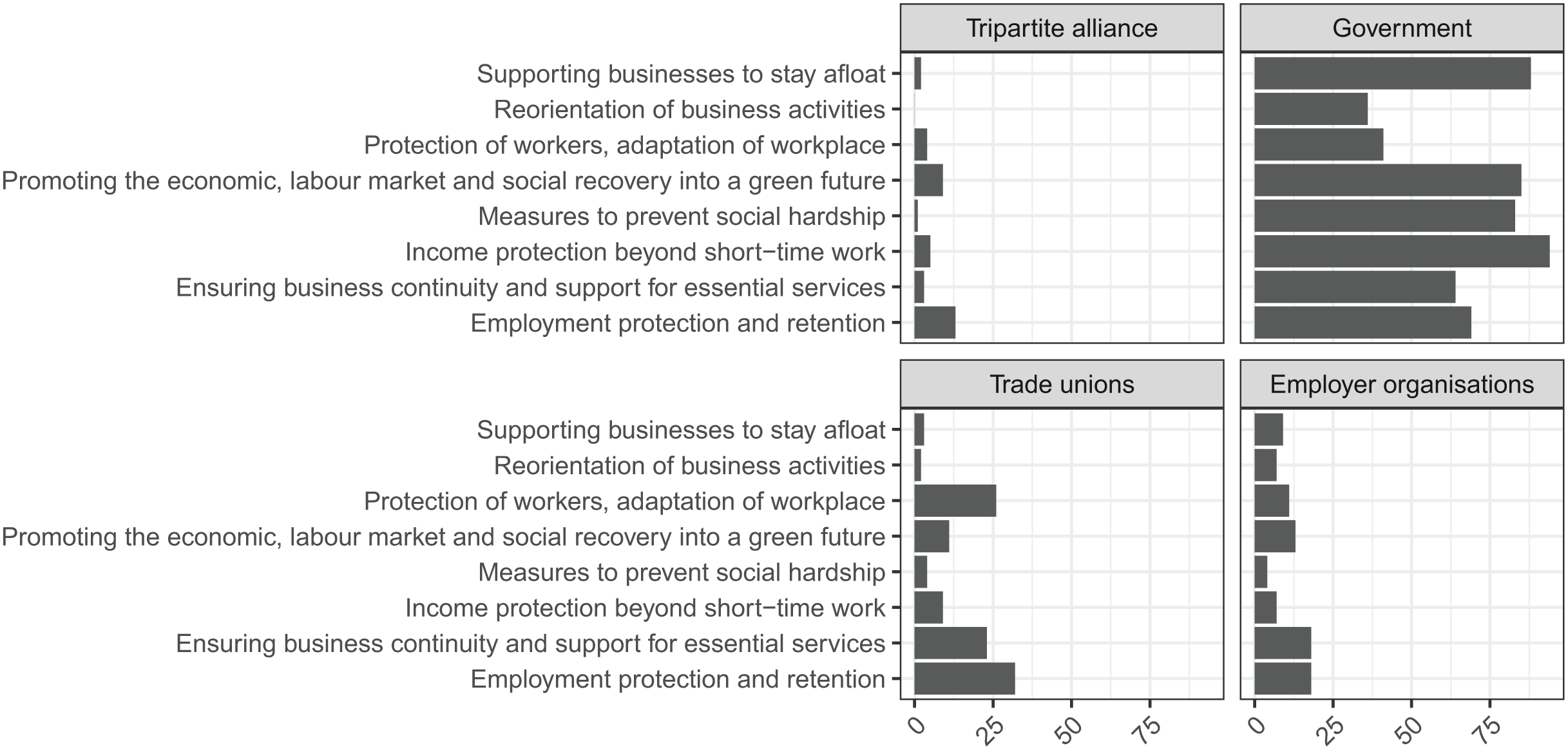
Alliances for vulnerable groups by policy aim (%).
Employer organisations were most involved when it came to policies aimed at ensuring business continuity and support for essential services, as well as employment protection and retention. Trade unions were also involved in the latter, which means that tripartite involvement was highest in relation to employment protection and retention. The government was closely involved in all categories, although to the lowest extent in relation to the reorientation of business activities and the highest in income protection beyond short-time working.
Discussion
This article examined crisis corporatism during the COVID-19 pandemic. This is understood as tripartite alliances to develop policy responses that target vulnerable groups. The magnitude of the pandemic with all its social and economic consequences meant that many people found themselves in vulnerable situations, and that pre-existing vulnerabilities were exacerbated, both on an unprecedented scale. In such situations, the literature on crisis corporatism expects a (re)invigorated social dialogue, which we conceptualise as tripartite alliances for the vulnerable: in other words, unions, employer organisations and the government collectively develop and implement the policy response(s) necessary to address the crisis and to protect the vulnerable. This article found however, that during the COVID-19 crisis the role of the social partners – and in particular tripartite alliances for the vulnerable – was limited. This is in line with findings on the financial crisis of 2007/2008 (Ebbinghaus and Weishaupt, 2022: 191). This was made very clear by the absence of an overall association between tripartite alliances and the targeting of vulnerable groups, although more fine-grained analyses by type of social partner, time, type of vulnerability, and regime, highlighted small but important associations.
Although a considerable proportion of reforms were formally targeted at groups with employment-related vulnerabilities (35 per cent compared with 9 per cent for family- and health-related vulnerabilities), only 5 per cent of the measures involved tripartite alliances, based on our findings from the Eurofound database. The largest share of measures focused on supporting businesses and on promoting recovery. These findings corroborate earlier work (Holubová, 2024). Thus, a key finding was that the relationship between social partner involvement and the targeting of vulnerable groups was neither automatic nor robust. While the social partners were active, and vulnerable groups were targeted in policy design, the intersection of the two was generally weak or absent. Two important insights emerge from this. First, social partners were substantively present in policy-making throughout the pandemic, especially in the early phases of 2020. The involvement of unions and employer associations was not negligible, even though it rarely culminated in formal tripartite arrangements. Second, policies aimed at supporting vulnerable groups were indeed implemented, even though such targeting was more consistently associated with government-led action than with tripartite alliances. Employment-related vulnerabilities were far more likely to be addressed than family- and health-related ones.
This divergence is especially evident when comparing across regimes. The associations appear weak when examining relations between tripartite alliances and policies targeting vulnerable groups. The odds ratios across regimes confirm this. Furthermore, there were only a limited number of cases in which tripartite alliances aligned with a greater likelihood of targeting vulnerable groups. In the theory section, we outlined contrasting expectations of the relationship between institutional context at large and the extent to which tripartite alliances target vulnerable groups. Some evidence was found for both positions. For instance, tripartite alliances were associated with targeting employment-related vulnerabilities in Nordic and Anglophone regimes, and to some extent with family- and health-related vulnerabilities in Central Europe. These findings are consistent with the idea that, although social dialogue structures exist across countries, their operational significance and capacity to shape policies vary. In regimes such as the Nordic, in which dialogue is deeply institutionalised, corporatism tends to follow rooted patterns of inclusive responses. By contrast, where social dialogue is weak, crises can temporarily open up spaces for exceptional collaboration, as in the Anglophone regime. We also found that tripartite engagement, rather than being an instrument for targeting protection for vulnerable groups, was often limited to policies aimed at economic stabilisation and employment retention. Such policies tend to privilege labour market insiders, as seen in the prevalence of short-time working schemes and firm-based protections. In both cases, path dependence remains the constant logic.
As the labour market segmentation theory suggests, the insider-outsider divide is not merely a descriptive observation, but a diagnostic indicator of how institutional systems fail to incorporate structurally marginalised groups. Labour market divisions between insiders and outsiders describe not only welfare access but also signal institutional blind spots in terms of representation. Crisis corporatism, rather than reworking systems to foster inclusion, tends to reproduce established boundaries. As such, the unequal insider-outsider divides are reinforced under the logic of stabilisation. Even when social dialogue is activated, it is rarely extended to those without an institutional voice. In conclusion, our article reveals that despite the expectations of more attentive social dialogue during the crisis, tripartite alliances to protect vulnerable groups remained limited. We found that crisis corporatism did not automatically generate tripartite alliances for the vulnerable. Even when the government dominated the response, the uneven participation of social partners across regimes shows that targeting of vulnerable groups was not guaranteed. This indicates that emergency situations tend to reinforce rather than transform existing patterns of representation. From a power resource perspective, this calls for the strengthening of mechanisms that specifically address the institutional weaknesses that create such a divide. As illustrated by the case studies in this special issue, the involvement of new actors remained limited, further demonstrating how exceptional circumstances did not translate into sustained inclusion.
Footnotes
Funding
This research was financially supported by the European Commission [Grant No. VS/2021/0196].