




Abstract
Crisis corporatism is conceptualised in this article as a temporary governance strategy involving partnerships between the state, labour and employers to mitigate the impacts of crisis to protect vulnerable workers. Using the COVID-19 pandemic as a case study, the article examines how institutionalised power relations in different industrial regimes enabled corporatist decision-making to safeguard vulnerable workers. It presents a conceptual framework linking crisis corporatism with vulnerability, emphasising social actors’ role in advocating for marginalised groups, drawing on empirical studies from European countries. Findings reveal significant variations in corporatist responses, influenced by institutional frameworks, welfare state traditions, and industrial relations systems. Countries with strong corporatist structures effectively mobilised social partners to protect workers, while those with fragmented institutions relied on state intervention or ad hoc measures, often leaving workers exposed to job or income loss. The article highlights social dialogue’s role in crisis resilience and argues for strengthening corporatist structures to ensure inclusive future responses.
Introduction
Eurofound (2023) recently investigated trends in the response of national social dialogue to external shocks or crises. It focused on the ways in which the social partners are involved in policy-making and social dialogue at the national level. The results illustrate a diversity of policies tackling the impact of the financial crisis (2008–2012), the recovery period (2013–2019) and the COVID-19 pandemic (2020–2022). While traditional forms of social partnership may have been crucial in managing the effects of the financial crisis, during the COVID-19 pandemic many governments acted unilaterally even in countries with a strong tradition of social partnership. The ongoing debate on the decline of corporatism (Molina and Rhodes, 2002) can thus be expanded by exploring new variables with a view to fully grasping how corporatist governance, based on social partnership, persists and resists crises.
The COVID-19 pandemic serves as a powerful example of an external shock that tested the resilience of institutionalised power relations and their capacity for crisis corporatism. As the pandemic spread globally, governments were forced to implement policies to protect public health, stabilise economies and safeguard jobs. The effectiveness of these policies varied widely, depending largely on the strength of existing corporatist structures within institutionalised power relations.
This contrast highlights the importance of institutionalised power relations in determining whether crisis corporatism can be mobilised effectively in response to external shocks. This article develops a conceptual framework that bridges two strands of literature that are essential for understanding the root causes and preconditions of corporatist decision-making in varying institutional contexts, beyond typically corporatist countries. The first strand is the literature on European variations on institutionalised power relations, highlighting different industrial relations systems and social partner access to policy-making. The second strand considers social partners’ actions in relation to corporatist decision-making, which is embedded in the empirical conditions of addressing the needs of vulnerable groups in the labour market. These groups were hit hardest during the most recent socio-economic and health crisis. We ask what lessons can be drawn from this case for a conceptual understanding of sudden shocks, such as the last pandemic, to seize new opportunities for established power relations and facilitate new approaches to corporatist policy-making in Europe.
Within the new conceptual framework, we then frame the question of whether and how the most recent crisis – the COVID-19 pandemic – as it evolved over its various phases, created opportunities for social partners beyond their usual relationships and access to policy-making, and whether the social partners seized these opportunities to engage in policy-making to protect vulnerable groups. The pandemic evolved in several waves; this made it possible to finetune the changing roles of corporatist decision-making, and particularly, to align with changing country-specific priorities with regard to who needs protection and what kind of labour market measures should be prioritised. The most recent crisis can thus be viewed as a window of opportunity for institutional change. This article lays the conceptual foundations for empirically studying such changes in country-specific conditions.
The article argues that the lessons learned from the most recent socio-economic and health crisis underline the importance of robust corporatist structures for facing future crises, especially to protect vulnerable groups in the labour market. In countries with strong institutional frameworks, crisis corporatism enables a more cohesive and coordinated response, conferring more protection on vulnerable groups. In countries with weaker institutions, by contrast, the response is often fragmented and the most vulnerable are left to bear the brunt of the crisis. Effective protection for vulnerable groups thus requires not only immediate response mechanisms, but also a long-term commitment to strengthening social protection. The COVID-19 pandemic illuminated the necessity of adaptable frameworks that can respond to sudden shocks, emphasising the role of social actors as advocates for those most affected. In light of the insights gained from the pandemic, it is essential to consider how corporatist structures can be developed to better serve vulnerable populations in future crises. This includes fostering stronger partnerships between government, employers and trade unions, while enhancing the capacity of civil society organisations to advocate for the marginalised and under-represented.
The article is structured as follows. Section 1 theorises and conceptually links crisis corporatism with institutionalised power relations and how social dialogue action is – or is not – instigated to respond and help bring forth policies to protect vulnerable groups via corporatist decisions in crisis conditions. Section 2 presents the diversity of institutionalised power relations in European countries in order to frame an understanding of how corporatism has, and can, evolve in these various systems with the sudden onset of a crisis. These typologies of institutional variations at the macro-level thus raise different expectations of the social partners when it comes to responding in the context of a crisis. Section 3 dives deeply into the debate on vulnerability, and specifically vulnerability in the labour market, to draw conclusions regarding social partners’ corporatist, policy-oriented actions in the context of a crisis. The closing section summarises the main conceptual arguments and outlines potential further empirical research beyond the scope of this article.
Theorising crisis corporatism and institutionalised power relations
In every society, a structured system of interest representation plays a vital role in addressing economic and societal challenges. Corporatism, in its traditional form, is one such structure, in which the state collaborates with organised interest groups – especially labour unions and employers’ associations – to shape economic and social policy. By institutionalising the role of these actors in policy-making, corporatism is believed to reduce industrial conflict, promote consensus and support economic stability (Schmitter and Lehmbruch, 1979). This system of corporatist decision-making relies on institutionalised power relations, in the sense of formal and informal arrangements that govern how power is distributed and exercised among key social actors, notably the state, employers and labour organisations. These power relations are embedded in legal frameworks, collective bargaining systems and political institutions that structure predictable and systematic interaction (Korpi, 1985). A key question is, how do these institutionalised power configurations enable or constrain corporatist action during a crisis? In this section, we seek to clarify conceptually how diverse institutionalised power relations can enhance or shape corporatist decision-making during a crisis (referred to henceforth as ‘crisis corporatism’).
The term ‘crisis corporatism’ is used to describe emerging, ad hoc policy-making collaboration between old and new stakeholders during times of crisis. Often studied in the context of macroeconomic crises, crisis corporatism often refers to new opportunities to develop emergency coalitions, alongside established coordinated interaction between the state, labour and capital. In practical terms, crisis corporatism thus refers to forms of ad hoc governance that emerge in response to exceptional events, such as economic recessions, wars or pandemics (see Schmitter, 1982: 262; Urban, 2012: 228). Unlike traditional corporatism, which is sustained through long-term institutional mechanisms, crisis corporatism is more provisional. It involves short-term cooperation between the state, employers and labour groups to mitigate social and economic upheaval (Molina and Rhodes, 2002). In traditional corporatist contexts, the institutionalised interaction among social partners often produces economic policies that balance efficiency with equity (Schmitter, 1974). In crisis corporatism, however, the priority shifts towards immediate crisis management, often within compressed time frames and characterised by improvisational coordination.
In other words, crisis corporatism tends to be driven by necessity. Crises such as financial collapses, environmental disasters or global pandemics disrupt economic functioning to such an extent that standard market mechanisms and existing policy routines become inadequate. In such contexts, governments may lack the capacity or even the legitimacy to act unilaterally and thus engage in expedited collaboration with social partners. The primary objective is typically to stabilise the economy, preserve employment and restore basic functioning, objectives that often require emergency negotiations facilitated or orchestrated by the state (Meardi and Tassinari, 2022). By forming temporary coalitions, states aim to preserve social stability, prevent large-scale lay-offs and cope with economic uncertainty. Contemporary interpretations of crisis corporatism indicate evolving power dynamics and social dialogue structures, as new actors are incorporated into negotiations to address unforeseen economic disruptions and safeguard employment (Ebbinghaus and Weishaupt, 2022; Pontusson, 2005; Schmitter and Lehmbruch, 1979; Streeck and Kenworthy, 2005).
The COVID-19 pandemic may serve as a paradigmatic case of an external shock, an event that disrupts the normal functioning of society and also exposes existing inequalities. Its impact was global and far-reaching, destabilising supply chains, creating mass unemployment and overwhelming health-care systems. In many cases, government responses included fiscal stimulus, wage subsidies and furlough schemes. However, the design and implementation of these policies often mirrored existing power asymmetries, favouring established actors over marginalised groups. This raises critical questions about whether crisis corporatism can be inclusive or whether it merely reinforces prevailing inequalities under the guise of collective governance.
A growing body of research links the rise of crisis corporatism to the COVID-19 pandemic. Across several European countries, new forms of corporatist engagement emerged, as governments and social partners negotiated compromises to preserve social stability, extend protective measures and allocate the burdens of the pandemic (Baccaro and Howell, 2021; Greve et al., 2022; Keune, 2021; Visser and Law-van Wyk, 2021). These developments indicate that crises can serve as critical junctures for institutional adaptation and broader inclusion, enabling alliances of the weak in the form of coalitions empowering traditionally marginalised actors (Urban, 2012: 228).
However, the literature on crisis corporatism often underemphasises the role of pre-existing institutional power relations. These relations are neither neutral nor evenly distributed; they reflect entrenched structures of access, influence and exclusion. Thus, any form of corporatism, even under crisis conditions, is shaped by the institutional legacy and power asymmetries of a given national context (Brady, 2022; Korpi, 1983). Understanding the success or failure of crisis corporatism therefore requires attention not only to the formal inclusion of actors but also to the power resources they can draw on within institutional arrangements.
We base our conceptual framework on the recognition that institutionalised power relations fundamentally shape the functioning and outcomes of crisis corporatism. We investigate how these power configurations influenced corporatist responses during the COVID-19 pandemic, particularly in relation to the identification and representation of vulnerable groups and the reconfiguration of both new and established forms of social dialogue. We thus contribute to the research agenda outlined by Meardi and Tassinari (2022), which emphasises the need to examine how actors respond to crises within existing institutional constraints and how these interactions may recalibrate corporatist governance. Crisis corporatism tends to be more effective and equitable where institutionalised power is distributed more equally and inclusive practices are the norm. By contrast, when power is concentrated among dominant groups, often within formal labour markets, crisis corporatism may fail to extend protections to more vulnerable populations, including informal workers, migrants and precarious employees.
Nonetheless, the capacity to sustain such inclusive arrangements remains limited by institutional conditions. In contexts in which institutionalised power relations are fragmented or biased toward capital, crisis responses tend to be either unilateral or symbolic. In contrast, where social dialogue is institutionalised and actors possess strong associational capacities, coordinated and inclusive crisis governance is more feasible.
In summary, different combinations of welfare regimes, industrial relations and social dialogue structures shape the capacity for inclusive crisis corporatism. To investigate how crisis corporatism is likely to behave within the framework of different industrial relations models in Europe (Section 4), we first review empirical variations of institutionalised power relations (Section 3) and conceptualise vulnerability, including its dimensions of empowerment, entitlement and how different structures act upon the vulnerable (Section 3).
Institutionalised power relations across Europe
As has been established, crisis corporatism emerges as a temporary form of governance under exceptional circumstances, driven by a need to mobilise collective action between the state, labour and capital. However, its form and effectiveness are not uniform across contexts. Rather, they are profoundly shaped by the configuration of institutionalised power relations, the historically rooted, legally codified and politically embedded relationships among key actors in labour markets and welfare systems. Understanding how these relations vary across Europe is essential for evaluating when and how crisis corporatism can respond effectively to external shocks, such as the COVID-19 pandemic.
The European Social Model provides a shared foundation for welfare and labour protection, but there is considerable variation between countries. Institutionalised power relations are also shaped by the EU’s multi-level governance architecture, which influences social dialogue through funding mechanisms, soft law instruments and policy coordination. National-level variation remains the dominant factor shaping corporatist responses, however. A recent report shows that policies to tackle the impact of the financial crisis (2008–2012) and the recovery period (2013–2019) of countries with corporatist-framed governance (that is, Austria, Belgium, Luxembourg and the Netherlands) or voluntary associational governance (such as Denmark, Finland, Germany and Sweden) were drawn up on the basis of consensus arising from tripartite social dialogue. By contrast, in countries with state-framed governance (such as France and Italy), despite frequent strikes called by trade unions, the government played the main role in policy-making in response to the crisis and its aftermath (Eurofound, 2023). Hence, we expect similar variation in terms of measures adopted during the COVID-19 crisis and role of social partners, depending on the relevant institutional power relations.
Institutional power relations differ in terms of welfare regimes, industrial relations systems and the structure of interest intermediation. These differences shape not only the distribution of power between social actors but also the institutional channels through which crisis corporatism is activated – or fails to be activated – in response to crises. Esping-Andersen’s (1990) typology remains central to understanding this variation. In universalist welfare regimes (such as those of the Nordic countries), the state plays a proactive role in supporting labour market participation through strong public employment services, active labour market policies (ALMPs) and robust unemployment insurance schemes. These regimes are characterised by inclusive and coordinated interest representation systems. The Ghent system, in which unions manage unemployment insurance, reinforces union density and associational power. As discussed in Section 1, such configurations allow for rapid and inclusive corporatist responses, as seen in the extensive use of tripartite negotiations and short-time work schemes during the COVID-19 pandemic.
In contrast, liberal welfare states, such as those of the United Kingdom and the Republic of Ireland, rely more heavily on market forces and provide minimal universal protection. Social dialogue is weak, union density is low and corporatist structures are largely absent. In the United Kingdom, despite having more than 6.5 million members, private sector unions do not play a prominent role in sectoral bargaining and policy-making for the purpose of labour protection. Contributing factors here include the long-term decline in membership, the deinstitutionalisation of the labour market (including restrictions on unions’ ability to call strikes) and changing patterns of work, shifting from traditional employer–employee relationships towards the ‘gig’ economy and short-term contracts. Trade unions were already having to cope with all this prior to the arrival of COVID-19 (Coulter, 2020). During the pandemic, government responses were primarily unilateral and reactive, offering little scope for inclusive crisis corporatism. Vulnerable groups in these contexts often depended on ad hoc, discretionary measures rather than institutionalised social protections (Ebbinghaus and Weishaupt, 2022). Conservative welfare regimes, prominent in Central and Eastern and southern Europe, rely on social insurance systems funded by employer and employee contributions. These regimes offer more protection than liberal ones but vary in their institutional capacities for social dialogue. For instance, Germany maintains strong sectoral bargaining and institutionalised tripartism, enabling coordinated responses during the pandemic. Conversely, in countries such as Italy and Spain, crisis responses often bypassed unions, reflecting weaker coordination mechanisms and a more fragmented industrial relations landscape (Balbona and Begega, 2015).
The ‘varieties of capitalism’ literature further differentiates between coordinated market economies (CMEs) and liberal market economies (LMEs) (Hall and Soskice, 2003). Coordinated market economies – such as Germany and the Nordic countries – are characterised by dense institutional networks supporting coordinated wage bargaining, vocational training and employment regulation. These institutional complementarities enhance the capacity for crisis corporatism by facilitating consensus and policy coherence. In contrast, liberal market economies – such as that of the United Kingdom – have decentralised bargaining and limited government involvement in labour markets. The institutional void in liberal market economies hampers the formation of durable crisis corporatist arrangements.
With regard to interest intermediation, Crouch (1993, 1997) and Ebbinghaus (1998) have offered valuable typologies. In Nordic corporatism, strong and centralised unions interact with cohesive employer associations within state-supported collective bargaining frameworks. In Continental social partnerships, coordination exists but is less centralised, and the state plays a more mediating role. Southern European pluralism is marked by polarised and politically embedded industrial relations, often requiring state intervention to resolve disputes.
Eastern European ‘illusory corporatism’ is characterised by weak tripartism and limited institutionalisation because of the legacy of state socialism and democratic transition (Ost, 2000). These distinctions may explain the uneven uptake and success of crisis corporatism during the COVID-19 pandemic. Bohle and Greskovits (2012) expand on Central and Eastern Europe’s institutional diversity by distinguishing between neoliberal, embedded neoliberal and corporatist trajectories. Neoliberal countries, such as Estonia and Romania, rely on foreign investment, flexible labour markets and weak welfare systems. Their crisis responses were typically state-led, with minimal social partner involvement. In embedded neoliberal states, such as Poland, Hungary and Slovakia, corporatist elements are present, but often fragile. These countries implemented some coordinated measures during the pandemic but struggled with democratic backsliding and weakening of civil society institutions (Becker, 2024).
Türkiye, often viewed as a hybrid case, displays a mixture of conservative and statist traits. State intervention in labour markets is strong, but a high level of informality and weak union density undermine effective corporatist dialogue (Buğra, 2020; Duman et al., 2025). While tripartite structures exist, they are often merely symbolic and subordinate to centralised state authority. By contrast, Serbia – another EU candidate country – is characterised by executive dominance and clientelist tendencies, while retaining more formalised structures of tripartite dialogue and a modest degree of social partner engagement, which are negligible in Türkiye (Duman et al., 2025).
In line with this institutional diversity, policy responses to the COVID-19 pandemic varied markedly across EU Member States (Singh et al., 2025). In some countries, ad hoc tripartite social dialogue was activated, especially where corporatist traditions were strong. In others, the state assumed a dominant role with minimal consultation of social partners. The limitations of crisis corporatism were also evident in its reactive and temporary nature. It was generally mobilised after the crisis had already disrupted economic and social systems, rather than functioning as a preventive or anticipatory governance mechanism (Jessop, 2015). Moreover, the ad hoc cooperation between the state, employers and labour organisations often proved short-lived. Once the immediate crisis subsided, collaborative arrangements frequently dissolved, leaving longstanding issues, such as income inequality and employment precarity, unresolved (Crouch, 2011).
The COVID-19 pandemic added to the complexity of crisis management because response strategies had to combine economic interventions with public health measures, including lockdowns and mobility restrictions (Béland et al., 2021). The effectiveness of these responses varied significantly across European countries, reflecting the differential capacity of national institutional infrastructures to support coordinated action. Moreover, the pandemic further exposed and intensified existing labour market inequalities. Vulnerable groups, including low-wage workers, migrants, women and racialised minorities, suffered disproportionately in both the health and economic dimensions (Berg et al., 2023). These disparities are structurally embedded within institutional arrangements that determine which groups are formally recognised, represented in social dialogue and granted access to protection mechanisms. In many national contexts, gig workers, undocumented migrants and those in informal employment remained outside the scope of emergency measures, such as furlough schemes. This underscores how crisis corporatism can replicate patterns of exclusion when embedded power relations go unchallenged (Purkayastha et al., 2021).
We can thus argue that crisis corporatism’s capacity to function effectively depends on institutional environments in which power is distributed, dialogue is structured and trust among social partners is high. In contexts in which institutionalised power is fragmented or skewed heavily towards state or employer interests, crisis corporatism risks becoming symbolic or exclusionary. The COVID-19 experience reinforced this point. In some countries, well-established corporatist institutions enabled meaningful engagement of social partners in developing wage subsidies and occupational safety protocols. In others, such engagement was minimal or absent, leaving vulnerable workers particularly exposed to labour market shocks. These dynamics illustrate that the potential of crisis corporatism to provide inclusive protection is highly contingent on how power is institutionalised and exercised. In Section 4 we examine in detail how these institutional configurations affected the social partners’ ability to represent and protect vulnerable groups during the COVID-19 crisis.
Understanding vulnerability
The role of the social partners in corporatist arrangements to protect vulnerable groups builds on the understanding of social dialogue as key to addressing the interests of non-standard, precarious and vulnerable workers, a key concern in industrial relations for over a decade (Doellgast et al., 2018; Kalleberg, 2018). Debates on precarious work (Kalleberg and Vallas, 2017) and labour market dualisation (Carver and Doellgast, 2021; Lindvall and Rueda, 2013; Trif et al., 2023) have improved our knowledge of corporatist decision-making but fall short of explaining vulnerabilities in times of socio-economic crisis. This requires a conceptualisation of vulnerability before setting expectations for social partners.
While precarity refers to insecure job conditions, such as low pay and unstable contracts (Holubová and Kahancová, 2022; Kalleberg, 2018), vulnerability includes broader socio-economic factors, such as gender, age or family status (Bodnárová, 2005; Gallardo, 2020; Saunders, 2003). Vulnerability commonly characterises groups such as migrants, minorities, the disabled and low-income families. However, economic crises – including the COVID-19 pandemic – deepened existing vulnerabilities and revealed new ones. This highlights the need to broaden our understanding of who may be considered to be vulnerable. Crisis-induced labour market vulnerability may thus include self-employed workers excluded from employment protection, and employees who struggle to access their rights. It also affects those without access to non-statutory benefits or public programmes, and workers with persistently low or unstable earnings. The crisis exposed new vulnerabilities and vulnerability should be studied as an intersectional phenomenon.
Intersectionality reveals how power structures sustain or challenge inequalities (Crenshaw, 1990, 2017), uncover overlapping vulnerabilities and foster coalition-building (Hankivsky and Kapilashrami, 2020). The COVID-19 pandemic was understood to have exacerbated the vulnerabilities of traditional disadvantaged groups. The lessons from the pandemic also spotlight the nexus between vulnerability and a wider set of intertwining social, economic and health risks. Undeniably, the effects of COVID-19 on intersectionality have impacted some groups of vulnerable workers and some sectors of employment more strongly than others (Boonjubun et al., 2023). People often belong to multiple social groups, and intersecting factors, such as gender, income, ethnicity and occupation, shape how they experience crises. An intersectional lens thus helps to explain why individuals – for example, an elderly immigrant woman with a disability – may have faced layered disadvantages during the COVID-19 pandemic.
After conceptualising vulnerability, we need to understand what dimensions are relevant from the standpoint of actions taken on behalf of the vulnerable. For the purpose of understanding how crisis corporatism can protect the vulnerable, Watts and Bohle (1993) offer a useful analytical approach. They suggest that vulnerability encompasses three dimensions, each associated with some form of societal action (or lack thereof). These dimensions are entitlement, empowerment and the more general consensus conditions, which create the possibility for crisis corporatism to address the needs of the vulnerable (see Figure 1).
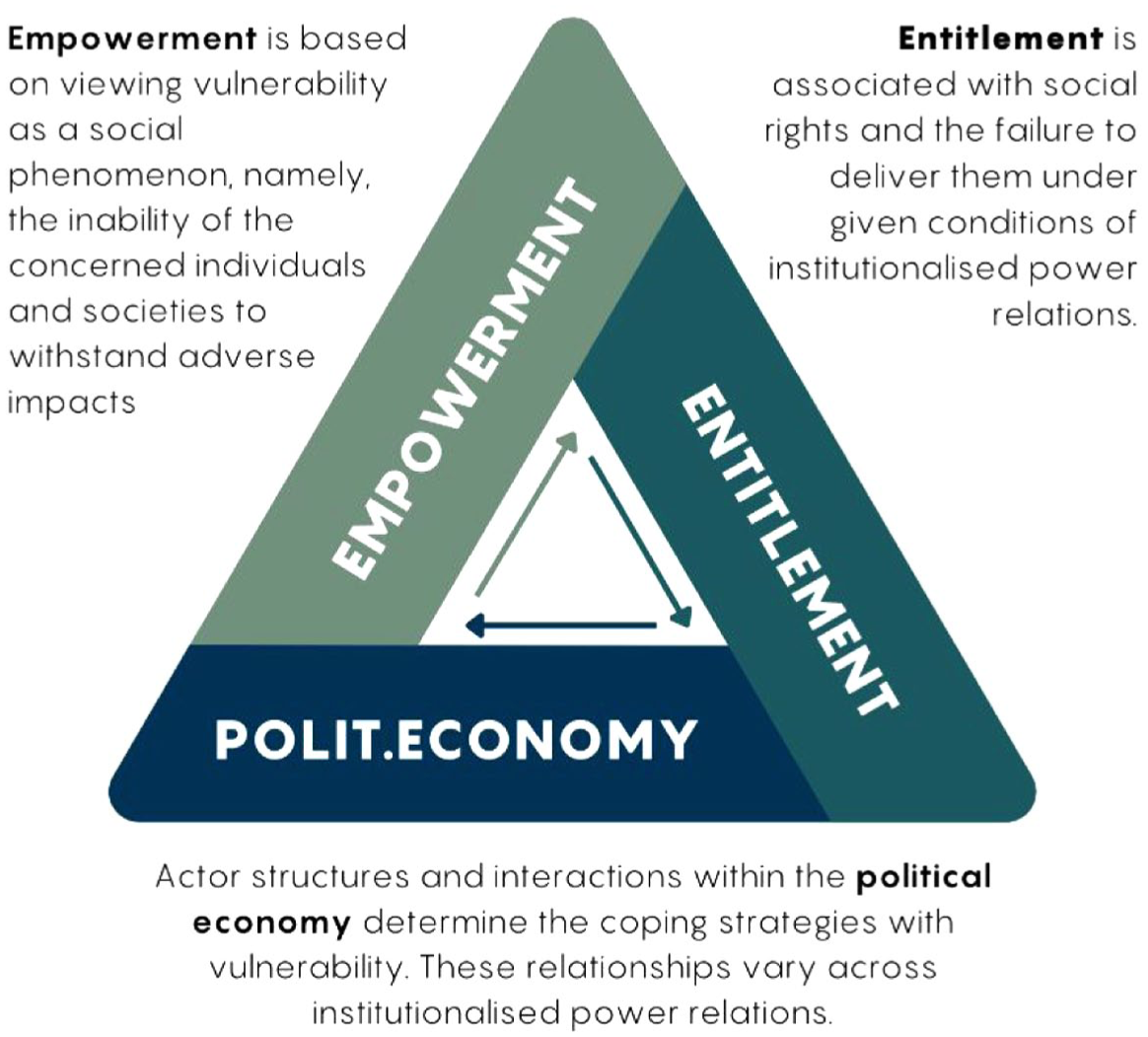
Dimensions of vulnerability.
First, the entitlement dimension of vulnerability is associated with social rights and the failure to deliver them in given conditions of institutionalised power relations. In times of crisis, these failures are even more pronounced, as political economic actors need to mobilise more quickly than usual in order to find the best solutions for distributing entitlements. The root cause of vulnerability, then, is a failure to distribute entitlements in accordance with fundamental societal needs (Sen, 1993). From the standpoint of crisis corporatism, the distribution of entitlements to the vulnerable occurs through mobilising resources and action within social partnership.
Second, empowerment to defend vulnerable groups is based on viewing vulnerability as a social phenomenon, namely, the inability of the individuals and societies concerned to withstand adverse impacts (Sen, 1981, 1984). In turn, it is expected that the capacity of individuals, communities and systems to survive, adapt, transform and grow in the face of stress and shocks increases when conditions require it (Pelling, 2003). From an industrial relations perspective, a crisis that produces vulnerable groups may also trigger interest representation of these groups that seeks to empower the vulnerable or to protect them from adverse societal impacts during a crisis.
Third, interactions of actor structures and institutionalised power relations within the broader political economy determine strategies for coping with vulnerability. These relationships vary across institutionalised power relations, for example, in terms of whether social partnership is inclusive, established and practised beyond crisis situations and beyond the interests of a narrower group of organised (trade union) members.
In summary, vulnerability is a broader concept than precarity, and an intersectional perspective is essential for understanding how crises can create or reshape vulnerable groups. Acting on behalf of the vulnerable involves questions of entitlement, empowerment and power relations that may enable or constrain action. This conceptual framing is crucial in explaining why crisis corporatism may have prompted action or inaction to protect vulnerable groups within specific institutional power dynamics.
Expectations of crisis corporatism
Vulnerability can shift rapidly during a crisis, as explained above, often outpacing the availability of institutional support. This creates openings for corporatist solutions, in which social partners can play a key role. When mobilised effectively, corporatist arrangements can accelerate access to entitlement and empowerment of the vulnerable and deliver targeted policies that meet their specific needs.
Returning to the topic of European diversity in terms of institutionalised power relations, two questions remain. First, how did social partners in different institutional contexts respond to the vulnerabilities that became more pressing, or just emerged, during the pandemic? Second, how successfully did they advance policies to protect the most vulnerable? Whether this response occurred in a corporatist manner depended on the context of institutionalised power relations.
Beyond country-specific institutional differences and social partner coping strategies, it is important to acknowledge that a large-scale crisis triggers similar challenges across various country-specific conditions. Coping strategies within the framework of crisis corporatism may, however, differ exactly because of underlying differences in institutional support for corporatist decision-making, the structure of social actors and the institutionalised and lived power relations between the social partners. The value of social dialogue during crises lies in its facilitation of rapid protective measures for those most affected by labour market disruptions. The social partners, acting in particular institutional conditions, can support such adaptation processes to help mitigate workers’ sudden exposure to socio-economic and health risks.
Table 1 summarises such institutional conditions and their implications for crisis corporatism. In Nordic and Continental institutional types, existing corporatist frameworks can prompt governments to negotiate with trade unions and employer organisations to implement short-time working schemes and wage subsidies, for example, to prevent permanent lay-offs (Ingham, 2023). These measures can help to maintain employment relationships and social stability during economic shutdowns (Baccaro and Howell, 2017). In contrast, in countries characterised by southern European pluralism, government responses may dominate, while trade unions, despite having a strong mobilisation capacity, may find it difficult to have a role in influencing social policy-making on behalf of the vulnerable. In such conditions, we expect employers to remain fragmented and politicised, possibly leading to mostly bilateral or state-led crisis responses, with inconsistent protection for vulnerable groups, depending on union strength and political will.
Institutional power relations and crisis corporatism.
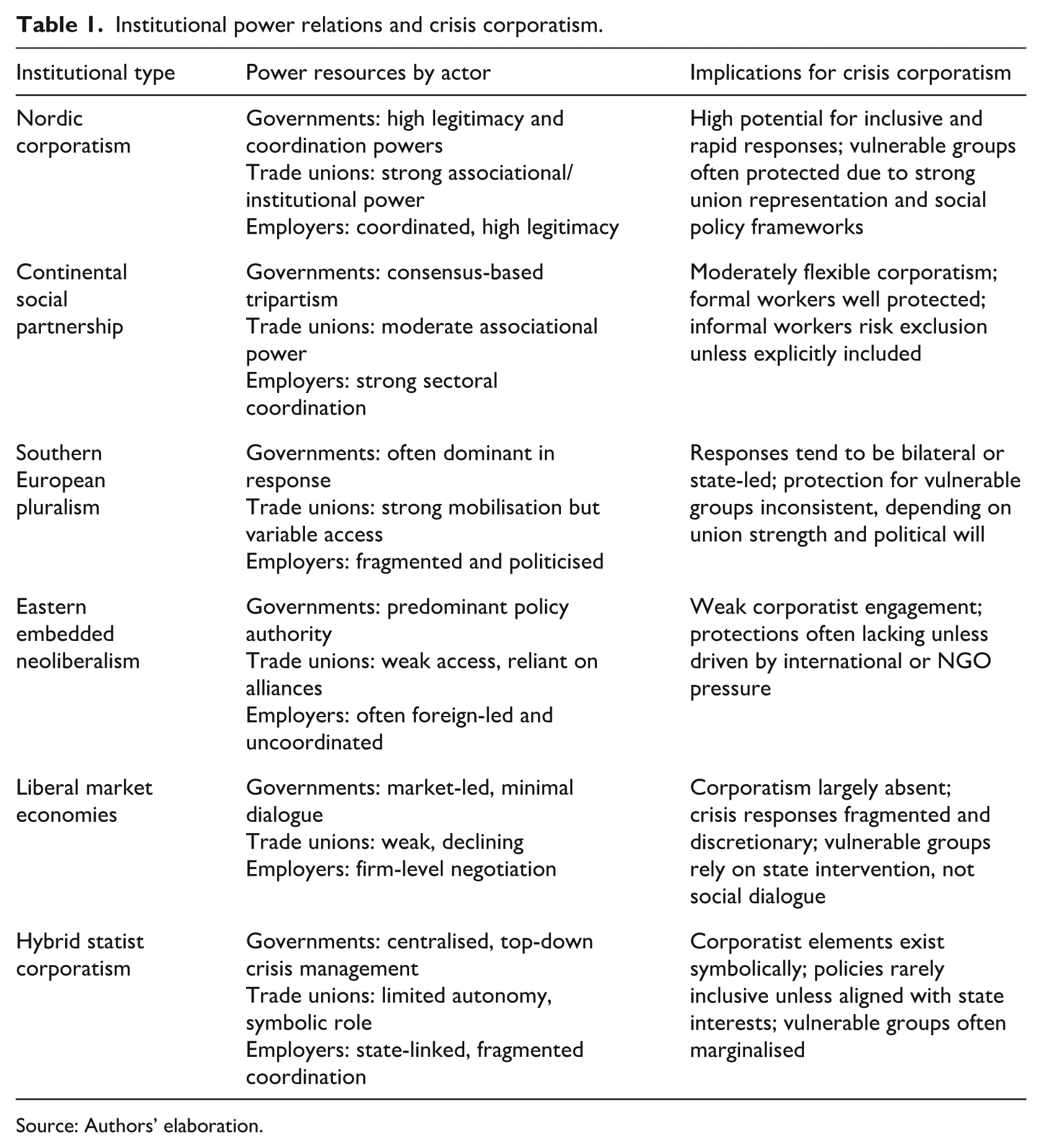
Source: Authors’ elaboration.
Eastern European embedded neoliberalism is marked by strong government dominance in policy-making, weak trade union access, often dependent on political alliances, and fragmented, foreign-led employer representation. As a result, we expect crisis corporatism to be weak, with protections for vulnerable groups typically absent unless driven by international pressures or civil society.
Liberal market economies are characterised by governments that favour market-driven solutions in social policy, with minimal social dialogue, weak and declining trade unions and employers focused on firm-level negotiations. We expect crisis corporatism to be largely absent, and fragmented and ad hoc responses where the protection of vulnerable groups depends on state support rather than coordinated social dialogue.
Finally, hybrid statist corporatist conditions feature centralised, top-down governance, with trade unions playing a largely symbolic role and employers lacking strong coordination, often linked to the state. While corporatist structures are likely to exist, we expect them to be rather symbolic. In terms of crisis corporatism, we expect policies to exclude vulnerable groups unless their needs align with state priorities.
These general expectations can be compared with evidence that proactive trade unions, governed by ethical considerations and equipped with a better understanding of vulnerability, could provide better support to workers.
Based on earlier research covering Belgium, Denmark, Estonia, Finland, France, Germany, Greece, Hungary, Italy, Poland, Slovenia, Sweden and the United Kingdom, Doellgast et al. (2018) analysed how trade union capabilities became weakened by two intertwined factors: (i) structural factors (that is, slow economic growth and the fall of employment in manufacturing), and (ii) institutional changes, such as market deregulation and restrictions on the right to strike.
These two factors have hindered trade union efforts to protect workers’ rights (resembling our empowerment dimension of vulnerability) and preserve their entitlements (referring to our entitlement dimension of vulnerability) (Doellgast et al., 2018; Trif et al., 2023). What is more, according to Doellgast et al. (2018), the result of the combination of already weak trade unions with limited structural resources and the failure to build solidarity across diverse worker groups is a ‘vicious circle’ of growing vulnerabilities. To escape the vicious circle, Doellgast et al. (2018) argued that trade unions have gained associational power by committing to mobilise unorganised workers of similar gender, race, ethnicity, occupation and so on. In light of our framework, this case refers to a higher empowerment of the vulnerable via social partnership. However, the solution they suggested may not be applicable in situations in which there is a lack or deficiency of supportive industrial relations institutions.
A recent study by Trif et al. (2023) discovered that in nine countries – Croatia, Czechia, Hungary, Latvia, Lithuania, Poland, Romania, Slovakia and Slovenia – in which industrial relations institutions are usually not supportive, trade unions could gain associational power to empower unions to represent also the vulnerable by integrating internal resources from a broad spectrum, including proactivity, external links and internal democracy to combat precarity and reduce vulnerabilities. The second significant finding of Trif et al. (2023: 163) concerns the willingness of trade unions to tackle precarity, thus also vulnerability, based on ‘pragmatic and moral considerations’. Lastly, their study points to the acknowledgement of ‘multi-dimensional conceptualisation of precarity [that] enables a more nuanced understanding of the factors’ contributing to vulnerabilities (Trif et al., 2023: 163). These findings resonate with the multi-dimensional conceptualisation of vulnerability, especially with the empowerment and entitlement dimensions, which are relevant for understanding how institutionalised power relations (the third dimension of understanding how vulnerability can be handled) generate specific responses within crisis corporatism across European countries.
Conclusions
Recent large-scale crises, such as the financial crisis or the COVID-19 pandemic, provide an empirical testbed for a systematic conceptual account of corporatist decision-making during crises in the broad sense, including the modes and depth of involvement of social partners in policy-making emerging from socio-economic crises. The pandemic presented a unique challenge for corporatist structures, characterised by their reliance on formalised relationships between the state, employers and workers’ organisations. In this context, expectations concerning actions aimed at protecting vulnerable groups, such as low-income workers, immigrants and those in precarious employment, hinged on several conditions. Key among these was the existence of institutionalised channels for negotiation and representation, which facilitated dialogue between stakeholders resting on their existing power relations.
This article aims to provide a thorough conceptual understanding and linkage of three concepts: crisis corporatism, institutionalised power relations and vulnerability. To summarise the conceptual insights it develops, by vulnerability we mean the characteristics of a person or group in terms of their capacity to anticipate, cope with, resist and recover from the impact of dangerous conditions in the labour market. As a result of such conditions standard employment relations and working conditions that provide vulnerable workers with protection under existing legislation and negotiated policy-making may become attenuated or cease to exist. In turn, vulnerability is measured by the degree to which a group of actors act or respond adversely to harmful influences affecting certain vulnerable groups in the labour market. The degree and quality of the adverse reaction are conditioned by an institutional system’s resilience – in other words, the system’s capacity to absorb and recover from the crisis (see Timmerman, 1981).
Within the framework of existing institutionalised power relations, policy-makers need to tackle the deep-seated power imbalances exacerbated by the pandemic, ensuring that future crises are met with more equitable and inclusive responses within crisis corporatism. By reforming institutionalised power relations, corporatist mechanisms can be strengthened to better protect vulnerable groups and thereby build greater resilience and social cohesion in the face of future external shocks.
Last but not least, more broadly, institutionalised power relations within political economies may hinder governments’ ability to respond effectively to the needs of vulnerable groups in the labour market. In countries with fragmented or polarised political systems, crisis responses can often be delayed or insufficient, leaving many vulnerable groups without adequate protection (Béland et al., 2021).
Finally, it is interesting to explore whether and how the pandemic created opportunities for the emergence of new political power dynamics. Grass-roots movements and civil society organisations mobilised to demand better health-care access, worker protections and more equitable resource distribution. In some cases, these movements successfully influenced government policies, highlighting the potential for political power resources to be redistributed during times of crisis (Pleyers, 2020). Because not all groups were able to leverage social and organisational power resources effectively, this article argues that future resilience is closely linked to strengthening corporatist structures that provide broader social protection and bridge the insiders/outsiders gap to ensure inclusive crisis corporatism. More empirical research on opportunities for developing new dynamics in institutionalised power relations, framing corporatist decision-making (not only) during a crisis, is essential to understand these processes better.
Footnotes
Funding
This research was financially supported by the Directorate-General for Employment, Social Affairs and Inclusion, the European Commission [Grant No. VS/2021/0196].