




Abstract
There has been a substantial increase in calls for so-called workers’ ‘data rights’, including amongst trade unions. Unions see them as a way of tackling some of the challenges of the datafied workplace but questions have also been asked about their relation to employment regulation and wider efforts within the labour movement. In this article we draw on a review of trade union documents along with interviews with 15 trade unions in the United Kingdom to critically engage with data rights as an avenue for protecting and advancing workers’ interests. We argue that while trade unions see possible strategic gains through the pursuit of data rights, such rights are only fully meaningful if pursued in conditions that enable wider workplace democracy. In the absence of such conditions data rights can distract from efforts to foster worker power and may even serve to legitimise what are perceived to be oppressive technologies.
Introduction
The advent of data-driven technologies in the workplace has garnered extensive discussion about the implications this might have for workers and working conditions. Seen to have potential for enhanced efficiency, flexibility and productivity, the datafication of work has also raised concerns about issues such as increased surveillance, work intensification, discrimination, and precarity. Extensive policy efforts have sought to engage with such concerns, particularly within Europe where digital policy has been a prominent item on the regulatory agenda. A key component of these efforts has been the discussion about the need for new or strengthened regulation pertaining to the rights of workers in relation to data collected about them at work. This builds on a wider societal focus on data protection regulation as the dominant framework for contending with the growing collection and use of data. Calls for so-called workers’ ‘data rights’ have therefore been prevalent, including amongst trade unions who have sought to use them as a way to engage with some of the challenges of the datafied workplace. At the same time, questions have been raised about how such rights are related to labour and employment regulation and where they stand in relation to wider efforts within the labour movement to improve the lives of working people.
In this article we critically engage with the question of data rights as an avenue through which to protect and advance workers’ interests. We do so through a review of trade union material and interviews with 15 UK trade unions, exploring their understanding of and responses to the growing use of data-driven technologies in the workplace. The United Kingdom provides us with an interesting case study in light of its relatively weak labour regulations and tough restrictions on trade union activity, especially in the political environment at the time of research. Such conditions would suggest greater prominence be given to new legal frameworks for protecting workers. By interviewing trade unions, we are able to use their own reflections on engaging with the datafied workplace as a way to situate and assess the role that data rights play in that engagement. We argue that whilst trade unions find strategic gains to be made through data rights, there is also a recognition that the protection of workers’ interests in the face of datafication requires an engagement with the underlying conditions needed for enhancing worker power. In this pursuit, data rights may throw light on pressing issues, but can also serve as a distraction from broader structural shifts that are required if trade unions are to organise and advance workers’ interests in the context of digital transformations at work.
Data rights in the workplace
The rapid advancement of data-driven technologies in the workplace has been met with substantial debate on the future of work and working conditions. In this context, workers’ data rights have been hailed as the ‘new frontier’ of the labour movement, regarded as crucial for ensuring that workers are protected against potential harms in the growing turn to data-driven technologies, and artificial intelligence (AI) in particular (Colclough, 2020; Institute for the Future of Work [IFOW], 2021). The notion of a set of data rights for workers has emerged in the context of a wider emphasis on the need for new regulation to address the collection and use of data in society. In Europe, this has been spearheaded by the EU’s General Data Protection Regulation (GDPR) which sets out to advance a set of requirements in relation to the protection of personal data. The premise is that the individual data subject should have particular rights with regard to the ways data about them are collected and used. The focus has especially been on ensuring greater transparency and the possibility to give consent. In some areas, this has also included more advanced notions of explainability and the need for human oversight (Todolí-Signes, 2019).
A particularly noteworthy aspect of the GDPR, however, is the fact that workplace issues are largely absent from its scope, focusing instead on civil and political rights, alongside consumer rights. As a result, significant aspects of the GDPR remain open to interpretation in their application to work. This has also raised questions about the need to establish a new set of data rights for workers. Indeed, while data protection regulation intersects with employment and labour law in significant areas, Molè (2023) considers these as ‘deceptive’ insofar as there is a fundamental mismatch between the spirit of data protection and labour law; while data protection is concerned with identifiability and its consequences, labour law seeks to address workers’ economic and social dependencies on employers and their consequences. Similarly, Abraha (2023) argues that the GDPR’s ‘exclusive focus on individual data subjects and individual rights does not easily fit with workers’ rights and interests’. In particular, the disregard of collective rights and the notion of freely given informed consent that underpins much of the GDPR is not applicable in a workplace context given the inherent power imbalance in the employer-worker relationship (Todolí-Signes, 2019). What is more, as workplace datafication primarily impacts the basic conditions of employment, there are questions as to whether workplace data collection and use should be fundamentally a labour issue rather than one of data protection (Calacci and Stein, 2023).
In this context, calls for new worker data rights are often made on the assumption that neither labour laws nor data protection frameworks currently provide an adequate basis for regulation of data-driven technologies in the workplace (e.g. Abraha, 2023; Adams-Prassl et al., 2023; Bernhardt et al., 2023; Colclough, 2020). It is a matter of debate, however, whether to strengthen employment and labour laws by embedding data rights or whether the GDPR needs to be enhanced with a labour-oriented interpretation of data protection. Bernhardt et al. (2023), for instance, have argued that there is scope for new labour standards pertaining to data use in existing employment regulation in addition to new laws, whilst Molè (2023) sees potential in drawing on the GDPR in pursuing work-related concerns. Collective bargaining rights, for example, can be applied to Article 88 in the GDPR that sets out provisions for social consultation on data processing and which, if utilised, could engender collective agreements on uses of data-centric technologies. For Molè, this provision paves the way for the ‘long-awaited negotiation’ of the algorithm (Molè, 2022b: 94; see also Abraha, 2022). More broadly, Molè (2023) makes a case for eschewing the focus on individual data subject rights of workers and instead advance data protection at work ‘according to the proper function of labour regulation: interfering in the (data) market for a proper balance between economic needs and fundamental labour rights.’ (p. n.p.)
Yet in interpretations of workers’ data rights, the focus has overwhelmingly been on the need to establish a set of rights in order to contend with harmful employer data practices on the one hand, and gaining worker access to and control and consultation over workers’ data and algorithms on the other. In their review of GDPR in relation to employment regulation, for example, Adams-Prassl et al. (2023) argue that the current legal bases for data processing will need to be narrowed to adequately constrain the potential harms of algorithmic management. Furthermore, red lines are needed which prohibit monitoring in relation to specific places, contexts and purposes, as well as the prohibition of automated termination, following Article 22 of the GDPR. Similarly, looking at the impact of digital reputation systems on workers’ rights, Todolí-Signes (2021) argues that whilst the GDPR establishes many restrictions for processing data on workers, it does not sufficiently engage with the way technological developments provide novel ways of controlling workers. More explicit bans are needed on such control mechanisms or better enforcement measures. With regard to data access, this has been framed as an avenue for advancing ‘meaningful’ worker understanding of data-driven technologies, such as decision trees and algorithm classification structures, on the basis that this will embolden collective bargaining approaches to rebalancing the asymmetric escalation of control within datafied workplaces (Molè, 2022a: 11). As Calacci and Stein (2023) point out, ‘limited access to details about the “logic involved” in such systems equates to denying workers access to details of their working conditions’ (Calacci and Stein, 2023: 258). Related to this, Adams-Prassl et al. (2023) highlight impact assessments as necessary for context-specific mitigation and that these could go further than the GDPR by obliging worker participation in the form of representatives verifying assessments. However, Abraha (2023) cautions that any consultation requirement contained in impact assessment rights will depend on the willingness of the employer as they will determine when worker input is appropriate. In this sense, De Stefano’s case for a ‘human-in-command’ approach to algorithmic management may have a stronger basis. He argues that any managerial decision prompted by artificial intelligence ‘be subject to review by human beings who remain legally accountable, together with their organisation, for the decision and its outcomes’ (De Stefano, 2018: 30). This approach relies on existing collective agreements, negotiations and bargaining as pivotal to implementing transparency, human-in-command approaches and control over data. Furthermore, such collective tools could also be leveraged to create bilateral or independent bodies ‘that would own and manage some of the data’ (De Stefano, 2018: 31). Indeed, the importance of collective governance in securing data rights has been widely echoed, with calls for ‘co-governance of data-generating and data-driven algorithmic systems’ (Colclough, 2020; see also Todolí-Signes, 2019).
Data rights in the workplace, however, have also been regarded as limited in their potential to protect and advance workers’ interests by centring the technology itself in the conception and response to employment relations and workplace struggles. A key question in the datafication of work is how this trend impacts on the collective power of workers (Newman, 2017), yet it is unclear that data rights are sufficient to empower workforces to negotiate, challenge or refuse the implementation of particular technologies. Calacci and Stein (2023) argue instead that tools and instruments aimed at regulating data and technology in the workplace ‘should primarily focus on creating circumstances that increase worker power, rather than defining ex ante harms or assigning liability ex post’ (p. 271). This would entail a departure from prioritising data rights, particularly by encouraging worker-centric models and co-determination. For example, German and Austrian works councils already have the general responsibility and right not only to be informed of employer operations, but also to veto and participate in meaningful decision-making regarding technology at work. Indeed, Doellgast et al. (2023) demonstrate in their study that workforces have been better equipped to shape or resist the implementation of data-driven technologies in European countries where unions are strong and workers have formal collective rights to participate in management decision-making. For example, they point out that in Germany works councils have been able to establish co-determination rights to negotiate works agreements that include a structure of rules and committees for evaluating the use of different data-driven tools. In this sense, collective governance structures can play a pivotal role in advancing and institutionalising worker voices as the appropriate mode of governance for workplace technology. These wider labour relations are significant also for the integration of technology into collective bargaining agreements, or what has sometimes been referred to as ‘new technology agreements’ (UK Parliament, 2019). While De Stefano (2018) privileges collective bargaining on the basis that it is an enabling right and rationalisation mechanism for the exercise of managerial prerogatives, Doellgast et al. (2023: 118) point out that not all countries have institutional frameworks that ‘support social dialogue in this area, and those that do have uneven coverage across different groups of workers’.
Data rights therefore occupy an awkward position in relation to work and working conditions, offering avenues for addressing pressing concerns, but also potentially impinging on more traditional forms of engagement in relation to employment regulation and labour concerns more broadly. It therefore becomes paramount to explore how trade unions have sought to respond to the growing datafication of work, and the role of data rights within that.
Trade union engagement with the datafied workplace
According to a recent study by AlgorithmWatch (2023), trade unions in Europe began to demonstrate an active interest in issues pertaining to the datafication of work from 2017 onwards, with a significant increase in engagement between 2020 and 2022. The focus of this engagement has particularly been on issues of algorithmic transparency and accountability, but has remained largely cerebral without practical translation for union representatives and negotiators. A key point of contention is the extent to which unions are able to comprehensively engage with technological developments at work, with regard to both the wider political context in which they operate and their current organisational form. In their study of union activity in food and drink processing plants in Norway, for example, Lloyd and Payne (2021) found that although unions are not included in job design decisions, they are supported by broader societal union power that facilitates involvement in ensuring unskilled workers are retrained to operate robots and pushing management to remove repetitive and dangerous tasks. By contrast, they highlight that the UK’s political and regulatory landscape acted as a constraint on union influence: ‘the UK is a neoliberal economy with relatively weak unions, a lightly regulated labour market, weak employer coordination, low unemployment benefits, and a much-criticised [Vocational Education and Training] system’ (13). In this sense, the challenge of the datafied workplace does not simply require union responses to algorithmic management, but also encompasses engagement with industrial policy, particularly given the unevenness of mobilisation capacities of trade unions across different countries (Martinez Lucio et al., 2021).
Furthermore, Martinez Lucio et al. (2021) query the extent to which the longstanding reliance on collective bargaining rights is still appropriate as a way to engage with technological shifts at work. Although it has been effective in some Scandinavian countries to enable union involvement in the implementation process of more recent data-driven technologies, overall there has been a steady fragmentation and deregulation of collective bargaining that has contributed to undermining unions and collective worker voice. In the United Kingdom, such realities are part of a broader debate about the effectiveness of different models of organising and the role that trade unions are able to occupy in a datafied workplace. In a study of union responses to the deployment of performance management tools in the UK banking sector, for example, Murphy and Cullinane (2021) illustrate how widespread members’ grievances put pressure on the union to change strategy, pivoting from service unionism to local campaign organising. Such a shift, they argue, facilitates more influence over uses of technologies because rather than relying on an individualised servicing model where passive members ‘consume’ union services as and when individual claims and needs arise, organising is distinguished by the objective of emboldening members to take collective responsibility for advancing their interests in a model of unionism that is member-led.
Other studies of union engagement with datafication at work have pointed to the use of litigation, particularly in relation to new forms of work that have emerged in the context of data-driven technologies, such as crowdwork and other forms of platform labour. Court cases have been launched against companies like Uber, for example, in a number of different countries as an important union initiative, although court decisions to date have been uneven and ambivalent (Martinez Lucio et al., 2021). In the United Kingdom, the App Drivers and Couriers Union (ADCU) (formerly United Private Hire Drivers) won a landmark victory for Uber drivers in February 2021 when the UK Supreme Court ruled that Uber drivers are workers and must be entitled to minimum wage and sick pay (Digital Freedom Fund, 2021). Furthermore, on behalf of two of its members ADCU filed a tribunal case against Uber in October 2021 at the Central London Employment Tribunal, for the company’s use of facial recognition software which led to the dismissal of both members (Worker Info Exchange, 2021). The case is still ongoing, but in July 2022 the tribunal refused Uber’s application to have a discrimination claim struck out (Thomas, 2022). Other cases outside the United Kingdom have invoked the GDPR in response to Uber’s failure to provide full access to workers’ personal data and sufficient algorithmic transparency with regard to the dismissal of workers (App Drivers and Couriers Union [ADCU], 2020). Beyond platform labour and the gig economy, unions have pursued cases concerning uses of automated decision-making (ADM), including in relation to social benefits in both Sweden (Kaun, 2021) and in the Netherlands (Wisman, 2020). In the latter case, the Dutch union FNV joined the public campaign against the System Risk Indicator (SyRI) risk profiling tool, helping the campaigners to make contact with Rotterdam communities directly impacted by its implementation (Wisman, 2020). In the United Kingdom, the Big Tech-focused law firm Foxglove has collaborated with several unions in organising and raising awareness among workers, including co-hosting an Amazon worker international solidarity rally with the GMB (Foxglove, 2022).
Union engagement has also been discussed in relation to the datafication of society more widely, particularly with regard to the role of unions in broader political mobilisation. Martinez Lucio et al. (2021), for example, draw on experiences of community unionism as a way of advancing community-based strategies and alliances between unions and social movements that are more attuned to precarious working conditions. The advantage that unions hold in relation to datafication is their ability to draw on and foreground their members’ experiences. For Dencik (2021), community-based or social justice unionism provides a means by which trade unions can get involved in tackling more comprehensive issues pertaining to datafication and its governance, mobilising around people’s lived experiences in solidarity with other progressive groups. In what Dencik refers to as ‘data justice unionism’, unions play a central role in articulating inequalities exacerbated by datafication and how they may be resisted as part of a wider political mobilisation seeking to set out a different vision of technology and society.
Method
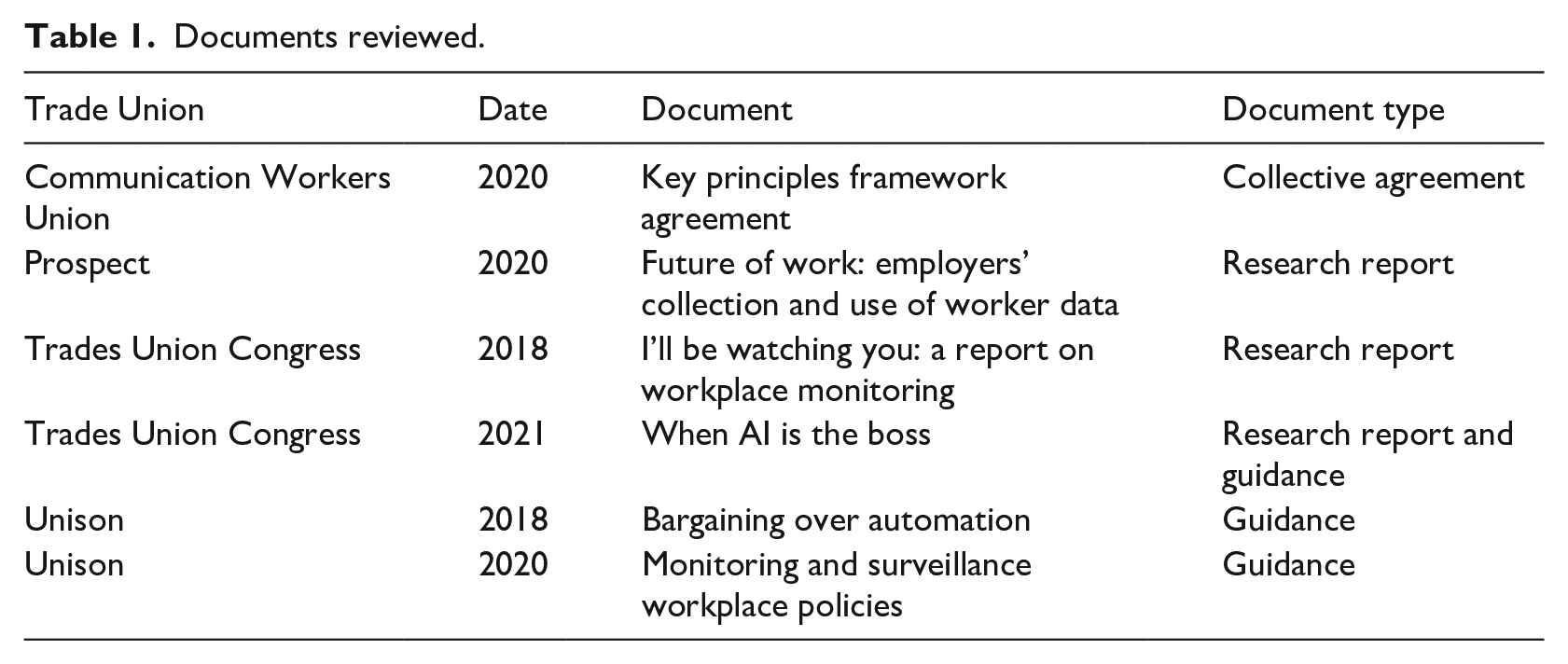
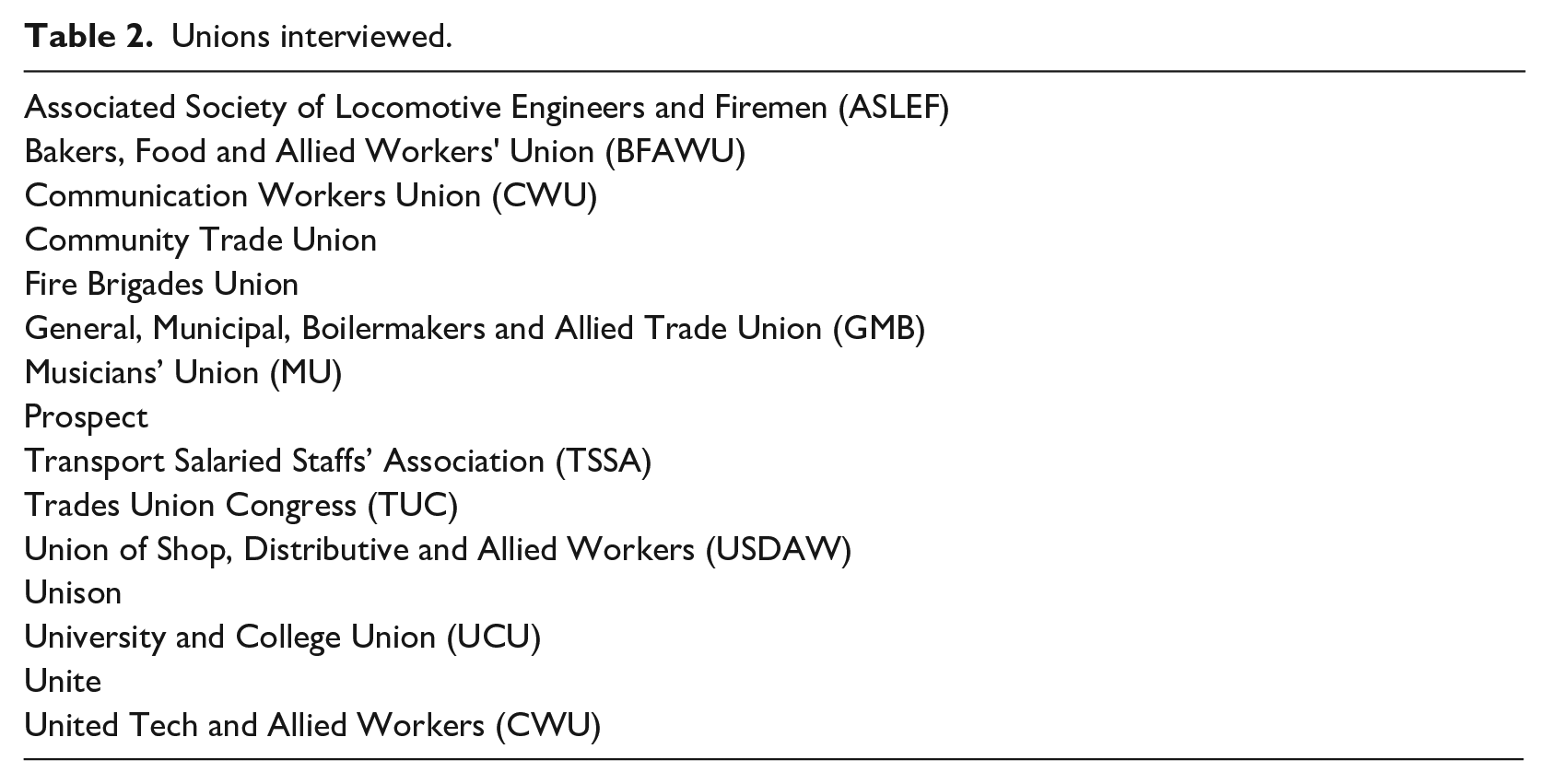
In what follows, we combine insights obtained from a number of public trade union documents relating to datafication at work published between 2018–2021 (Table 1) that capture early engagement with data rights, along with interviews with 15 union representatives from across sectors in the United Kingdom conducted during 2021. The aim is to explore how trade unions themselves understand their engagement with the datafied workplace. As this is a fast-evolving area, there is value in capturing trade union officials’ perceptions of the issues at a pivotal moment of change in workplaces, governance and regulation pertaining to advancements in data-driven technologies through their own reflections. The interviewees were union officials in senior positions, including General Secretary, Head of Research, Policy and External Relations, Director of Research and Communications, and Senior Organisers (for example, Regional Organisers). As the research was carried out during the COVID-19 pandemic, interviews took place online and participants were selected based on the perceived relevance of the union for questions of work datafication and from an existing network of contacts. Importantly, we focused deliberately on union engagement beyond platform labour and the gig economy and our sample is reflective of this (Table 2). The interviews were coded according to themes that emerged across the sample, using the approach of inductive thematic analysis, which allows the data to structure our analysis (Braun and Clarke, 2006). When outlining the findings, we are particularly interested in understandings of trade union responses to datafication at work, and the place of data rights within that.
Documents reviewed.
Unions interviewed.
Findings
Technological shifts in the workplace are a longstanding issue in labour relations, but there is a widespread sense that the more recent turn to digital data infrastructures presents a new challenge to trade unions and the labour movement more broadly. We see this, for example, in the plethora of policies, briefings, studies, guidelines, principles and model collective agreements produced by different trade unions on work datafication over the last few years. Many of these documents point to prominent concerns with these technologies, particularly for the purposes of increased surveillance or misuse of data. For example, Unison’s guide to Monitoring and Surveillance Work Policies published in 2020 states that ‘of particular concern to Unison members is how it impacts on their privacy and . . . [is] sometimes unfairly used for performance related purposes.’ (Unison, 2020: 2). Furthermore, the TUC’s 2018 report on workplace monitoring found that workers are particularly worried about the impact of surveillance on collaborative workplace agreements and ‘that an increase in unregulated surveillance could lead to a rise in discrimination’ (Trades Union Congress [TUC], 2018: 6). Moreover, as part of a joint webinar titled ‘Taming the Algorithm’, Prospect union and the TUC used Thought Exchange to ask attendees ‘what they thought unions should be doing to empower workers in this fast-changing context’ (Pakes, 2020). Almost 70 trade union reps and activists took part and ranked the following priorities: the right to disconnect; fight for privacy; training programme for data reps; company democracy of data collection; no monitoring outside of work; improve understanding of what’s happening now; advocate for use of ethical data; good management of homeworking.
These concerns were echoed in our interviews, highlighting issues with the use of data for managerial control and assessment of worker performance, especially with regard to disciplinary action without any human involvement or opportunity for workers and unions to object. Furthermore, both in public documents and in our interviews, trade unions express concern about workplace democracy, particularly in relation to an absence of worker and union voice in the implementation of data-driven technologies in the workplace and the lack of robust and meaningful consultation (cf. Dencik et al., 2023).
Responses to datafication at work: data rights
In this context, it is imperative to explore how trade unions have responded to these challenges. The notion of data rights has been a central feature in this respect, outlined in several reports and guidelines seeking to address concerns with datafication at work. In the United Kingdom, Prospect, the Trade Union Congress (TUC), the Communication Workers Union (CWU) and Unison – to name but a few – have all produced interpretations of workers’ data rights. Prospect (2020), for instance, calls for the following rights in relation to employers’ collection and use of worker data: privacy, a right to disconnect, a right to equality, consultation and a right to challenge and be involved in data-driven decision-making processes. Equality here refers to the ‘use of existing data and equality laws to ensure new technology, automated decisions and algorithms challenge bias and prejudice’. Furthermore, Prospect has begun negotiations with Vodafone to introduce a right to disconnect, which would provide ‘the ability for there to be an annual negotiation with [Vodafone’s] workforce around when you can switch off and not have to use your technology’. The TUC (2021), meanwhile, have discussed data rights in terms of transparency and consent, and explainability, challenging ‘dangerous’ decisions and unfairness and discrimination. In interviews we found that some unions link such rights directly to the GDPR. For example, one interviewee outlined, ‘what we are really pushing for is for that legislation [the GDPR] to be actually brought up to date and reformed. That policy legislation and codes around practice actually restrict automated decision making in particular and workplace monitoring’ (Community). Employer transparency and accountability needs to be stronger especially, which the same interviewee said could be met by granting workers rights to be informed about: ‘What does your employer actually have on you? How does your employer collect data on a day-to-day basis? What do they currently have? What are they planning to have in the future?’ For them, a specific data rights entity was seen to support this need: ‘I definitely think that something specifically, rather than like wider workers’ rights and wider worker stuff, based on these specific issues would be really beneficial’ (Community). Other unions, however, have engaged with the Information Commissioner’s Office (ICO) to protect workers from unlawful uses of technology. For example, Unison and the GMB submitted a joint application to the ICO challenging the legality of Caerphilly Borough Council’s use of 360° cameras on refuse vehicles. The concern is that the technology is not being used for its intended purpose but instead is ‘being used for disciplinary action against members of staff’.
For some interviewees, the GDPR holds potential in this regard, but currently also has limitations. For example, the GDPR is centred on the individual data subject rather than on the collective experiences that unions engage with: ‘I think there’s a gap in the ICO in that it doesn’t address the issue of groups of persons’ data’ (Prospect). Prospect have carried out research into the potential for labour law and the Equality Act to fill such gaps, in terms of using that ‘to take on some of these issues if we see there are categories or groups of persons who are, we believe, disproportionately affected by the introduction of technology or some data arrangements’ (Prospect). Another interviewee from the TUC stressed the importance of ‘legal redress when AI goes wrong’ both in terms of ‘access to legal representation but also there being a comprehensive set of legal entitlements and protections’, such as protection from discriminatory data-driven decisions, entitlements around consent and the right to know when data-centric tools are being used. Other interviewees spoke about introducing new data rights not covered by the GDPR, for example, concerning issues around assessment and disciplining: ‘I would like to see a law brought in on how they’re allowed to use data on you at work for performance … we need to have legislation to protect workers that’s on a par with legislation which protects consumers’ (CWU). The example of the right to disconnect was highlighted in one interview as having the potential to generate new rights that cut across data and workers’ rights (Prospect).
Data rights as worker control
The focus on data rights therefore provides some concrete definitions of the challenges, but there is also a recognition amongst trade unions that data rights can serve to foster a broader kind of engagement with data-driven technologies not centred on particular harms. In documentation from the TUC, for example, data rights are used as a tool both for addressing individual worker grievances through investigations, assessments, legal advice, and training and education, and as a component of collective bargaining and campaigning, including using workers’ data as a resource: ‘[members can] pool worker data on subjects like pay, commuting time, hours of work, overtime, [which] could help union campaigning’ (TUC, 2021: 11). Moreover, broader agendas like workplace fairness, equality and democracy can be connected to data ownership and worker access to the benefits of datafication and uses of AI. This addresses questions of fairness beyond the restrictive framing of workers as data subjects and suggests an engagement with fairness in terms of control and agency. For example, a TUC interviewee noted that fairness and equality ‘would be a really important part of our vision’ on the grounds that their members said ‘they wanted their colleagues to have fair access to the use of AI at work’. This has encouraged the TUC to think about discrimination not just in terms of ‘how . . . the decisions being made by AI [are] potentially discriminatory’ but also with regard to whether there ‘is . . . some form of discrimination taking place in terms of who actually has access to the benefit of these tools’. Part of this could be tackled by taking steps to empower individual workers with knowledge of, access to, and control over data as an opportunity in terms of ‘the power [that] collective data offers individual workers and the trade union movement to actually take control over that data and use it to further worker and trade union interests’ (TUC). Other interviewees echoed this understanding of where engagement with data should be focused, outlining future visions of the workplace that are centred on ‘rebalancing’ the asymmetry of data access and ownership, particularly so that workers ‘understand’ their data and are ‘empowered and confident enough to stand up, request access to their data, fully understand what an employer has got and be able to turn around and say that’s not acceptable, or be able to actually rebalance how data and tech are viewed and held and hosted by employers and companies as well’ (Community).
The focus on access to and ownership of data is based partly on an assumption that the trend towards datafying workplaces cannot be reversed or substantially resisted: ‘we can’t stop it from happening and it’d be letting our members down by doing that. We’ve got to acknowledge that this is part of the workforce, it’s part of the future of work’ (Community). Similarly, another interviewee noted: ‘If that process is going to happen and we can’t just stop the technology, then you have to at least make sure that the people who are generating that are going to benefit equally from the rewards that that technology is going to generate’ (Unite). The strategic response for unions is therefore to work with employers to pursue workers’ data ownership: ‘If done properly, workers could benefit but workers have to own that data, they have to understand their data in an accessible way and we’ve got to work with employers to make sure that workers can reap the benefits too’ (Community). Moreover, it was noted that in the absence of ‘a more progressive government’ in the United Kingdom, unions cannot rely on or wait for a legal framework that recognises ‘ownership of the data which is generated by employees and then is used by capitalists to make money’ (Unite). Therefore, in order to rebalance and equalise this relation trade unions must try and take charge of developments: ‘part of getting our piece of that pie is to get control over this and to get ownership of what people do as part of their work’ (Unite). One interviewee formulated this type of engagement as a dilemma and argued that getting involved at the level of governance is important but needs to be considered carefully: the priority for unions needs to be ‘governance in a sense of how unions will have a seat at the table to determine usage of these systems’, but that can bring about ‘debate within the union movement itself … [because] … by being involved in it, you are sort of sanctioning its use rather than resisting it or seeking to control it. On the other hand, a seat at the table could also mean that you have a better way of controlling it from the start’ (TFFA).
Data rights in collective bargaining agreements
Linked to this discussion, many of those interviewed noted that the assertion or creation of a set of workers’ data rights is most useful if they can be embedded within collective bargaining agreements. Several interviewees said that collective bargaining should be or is being applied to workplace issues pertaining to data-centric technologies. For example, one interviewee described collective bargaining ‘as the most effective and practical solution to a lot of the problems associated with the use of data driven tools at work’ (TUC), and another said that ‘the easiest way to resolve things are through where we’ve got collective agreements and we can do negotiation to resolve things’ (Prospect). The TUC interviewee expanded on this by arguing that collective bargaining constitutes an important counterbalance to the power asymmetry exacerbated by employers accumulating ‘vast amounts of data about individuals’ for profit while ‘workers are effectively cut out of that process. It’s really trade unions that can provide that sort of collective influence and voice to act as a counter-balance. So I think trade unions and the power of collective bargaining is an incredibly important factor.’ Collective bargaining is seen to give unions the control they need to be able to influence decisions on the implementation of data-driven technologies as well as how they are used, including how data are stored and accessed. For instance, one interviewee emphasised that, ‘because we have collective bargaining with most of these firms […] they are obliged to come and talk to us about this and then we raise the appropriate concerns and debate that with them, and quite often we’re able to modify or get policies in place that would limit . . . use, or [ensure that it is] only used in certain areas.’ Here the role of technology agreements becomes a tool for unions to ‘control the use of data’ by negotiating ‘what [surveillance systems] should look like and how and when they should be used and safeguards for their use.’ (TSSA). In addition, Unison, Prospect and the CWU have restricted the use of surveillance technologies to vehicle safety and security purposes by securing collective agreements. For CWU, the agreement places an important limit on data captured for the purposes of determining driver safety scores: ‘we’ve got an agreement with them on the use of the data, that they’re not allowed to use it in disciplines and things like that’. Similarly, Unison and Prospect secured a collective agreement with the Environment Agency about the use of surveillance in engineers’ vans in response to members’ concern that this would also ‘be used to track and monitor the whereabouts of staff whilst they were in charge of a van’.
One interviewee also indicated that collective bargaining can counter the lack of control workers have regarding decisions to implement new technologies, and pointed to model technology agreements as tools that can help with this. They explained that ‘far too often it’s the employers and the finance people behind them rather than the workers themselves’ and in response is ‘trying to help our members get more control over that by making them more aware of the issues and trying to encourage them to bring these points into collective bargaining and we’ve got some model agreements that we use to try and help with that’ (Unite). For example, Unite have secured an agreement that provides workers with some control through the introduction of new technology representatives in the workplace ‘who are a bit like a health and safety rep, [who] has the specialisations and the training to understand exactly what’s going on and to monitor all the implications and details of what’s happening, and then will be able to bring that to the bargaining table as and when the employer wants to introduce some new piece of technology’. In addition, the CWU’s collective agreement with the Royal Mail Group (Royal Mail Group and Communication Workers Union, 2020) contains explicit provisions for data-driven technology use. While there is mention of data protection regulation in the agreement, concerns are not expressed in terms of algorithmic bias but rather with regard to the assurance that technology will not be used to ‘dehumanise’ the workplace. Furthermore, the CWU agreed to the implementation of the Scan In/Scan Out system on the condition that data will not be linked to pay. More generally, the focus is on control over collective bargaining processes. For example, ‘RMG [Royal Mail Group] also confirm that technology will not replace the need for consultation and negotiation as outlined in the Industrial Relations Framework. Therefore, the use of technology is designed to support more informed discussions between RMG and CWU and not replace them in any shape or form.’
Moreover, it was noted that collective bargaining supersedes legal frameworks because legislation does not give unions the same ‘position of strength’ to negotiate. In this sense, collective bargaining enables data and AI issues to be treated as an industrial relations concern. The best way to organise is therefore to use collective bargaining to obtain new technology agreements, including the appointment of ‘specialist’ new technology representatives in the workplace who can monitor developments and ‘bring that to the bargaining table as and when the employer wants to introduce some new piece of technology’ (Unite). This contrasts with the view of other interviewees, however, who said that legislation must be updated precisely because collective agreements are not legally binding so are failing to protect workers: ‘some of the issue is that when you do get agreements with companies on it, they’re not legally binding. So when they decide it no longer suits them, that’s the end of it and then the workers are back to having no protection. So I think something definitely needs to be in law’ (CWU). Similarly, an interviewee from TSSA stressed that collective agreements ‘rely on the honesty and integrity of the employers that are prepared to reveal what they are doing, and not just get presented with this as a fait accompli when you are dealing with an issue.’ Experiences amongst trade union officials suggest that collective bargaining for new technology agreements is done on a case-by-case basis and applies to specific technologies rather than being comprehensive or preventative. For example, while TSSA was able to negotiate and prevent some uses of vehicle trackers and wearable devices, they have not been able to secure agreements on certain other technologies, such as body worn cameras, that may be enabling harmful practices.
Beyond data rights
Collective bargaining can thus be a useful way of engaging with the datafied workplace but it also has its limitations. Indeed, one interviewee expressed the need for a more pragmatic, sceptical approach to collective bargaining on the basis that the political situation in the United Kingdom hampers it. They emphasised that ‘we’ve got to be realistic around places that don’t have collective bargaining arrangements’ (Prospect) and suggested that more organising nationally is required, especially since collective bargaining is much less prevalent in the private sector. As such, they viewed collective bargaining as part of, rather than a solution to, the wider power imbalance between workers and employers. Indeed, some unions stressed that the datafication of the workplace is happening in a context of weakened labour relations in the United Kingdom, which needs to be addressed: ‘I think firstly, the biggest [challenge] is the lack of labour dialogue or social partnership in the UK’ (Prospect). Tackling issues arising from the datafied workplace is therefore hindered by a generally union-hostile UK government. Indeed, there was a sense that if labour relations were stronger in the United Kingdom then there would be no need to separate data issues from wider workplace issues or for a separate data rights entity because unions would be able to challenge employers effectively. One interviewee referred to the Wales Social Partnership Act as an example of a model that if achieved would facilitate better trade union engagement with the datafied workplace: ‘then you wouldn’t need a separate [data] body. You would just be able to say, if this is not done fairly, then this is how we’re going to challenge this and as a trade union representing working people in the workplace, then we have that ability to be able to challenge that’ (GMB). Similarly, another interviewee stated: ‘what we need are strong and powerful trade unions and I think that this issue [of datafication] can be dealt with in a similar way to most other issues if you have a strong organised workplace, with well-informed and well-supported reps and activists … what’s required [is] that we need to take these things on in the workplace as an industrial issue’ (Unite).
Tackling the datafied workplace is in this sense part of a wider engagement with workplace equality that involves strengthening the position of unions through legislation or otherwise: ‘a trade union movement with the ability to be able to challenge in the way that we always have, but with the redress of statutory underpinning of legislation. That is the way you stop inequality in the workplace’ (GMB). This legislative underpinning may require significant reform: ‘we need to, longer term, look at sectoral agreements for unions or works councils to be set back up again and for things to be agreed at that sort of level rather than individual employers’ (Unite). Several interviewees also saw capacity building and strengthening happen through better collaboration both within the trade union movement and outside it, aimed at addressing the challenges of the datafied workplace: ‘We don’t exactly have the best trade union rights in the UK or access to workplaces … [which requires] … good industrial relations to work together in the interests of our members and workers’ (Community). Similarly: ‘cooperating with other trade unions and not only in this country but also internationally … [is needed] … because this is clearly some global issue and so it requires solidarity amongst trade unions as well as amongst workers’ (Unite). This may also include other social movements and organisations: ‘unions have got to engage with other social movements and civic society groups a lot more on this’ (Prospect).
Conclusion: data rights and worker power
Our research with trade unions in the United Kingdom about their engagement with the datafied workplace highlights some significant questions on the role and nature of data rights. The widespread emphasis on regulatory measures pertaining to data protection has provided a number of critical entry-points for tackling the challenges arising from the growing datafication of work. Although the GDPR is not oriented towards work and workers, as a regulatory measure it has been very significant in instigating and defining a wider public debate about the impact of datafication in society. This has enabled trade unions to engage with a range of concerns pertaining to the datafied workplace. As a framework, it has fostered widespread efforts toward establishing a set of workers’ data rights that can serve as a foundation on which various aspects of the transformation of working conditions can be addressed. In the United Kingdom, in particular, it has been a fruitful way for trade unions to seek influence in relation to broader governance debates about the future of work in a context of a union-hostile political environment. In particular, while the integration of external legal provisions on data rights can strengthen collective agreements, they are also regarded as useful in the absence of such collective agreements. This is especially salient, for example, in light of the recent ruling by the UK Supreme Court to refuse permission for Deliveroo riders to be represented by a trade union for the purposes of collective bargaining.
Findings from interviews with trade union representatives also highlight some important limitations on data rights as a framework for advancing workers’ interests. A central issue is the extent to which their individualised and technology-focused nature might distract from the conditions needed to protect workers adequately in the face of transformations. As Molè (2023) has argued, data rights may not be particularly well-suited as a basis for labour regulation able to interfere in markets to balance economic needs with labour rights. Moreover, there are concerns whether the emphasis on data rights shifts the focus away from underlying questions of workplace democracy and worker power. As some of our interviewees noted, engaging with a data rights framework entails accepting particular assumptions about the future of work and the role of technology within it. This is especially a concern if we consider the datafied workplace as part of longstanding workplace trends that generally seek to diminish the power of labour vis-à-vis capital (Baccaro and Howell, 2017).
In this sense, UK trade unions’ engagement with the datafied workplace underlines the importance of strengthening wider labour relations in order to contend with the challenges of datafication. It is broadly recognised that the extent to which data rights can be leveraged tends to be contingent on institutional structures. This is further evidenced by gains made in other European contexts with regard to uses of technology in workplaces with formal structures of co-determination and worker representation, not to mention legally binding collective agreements (Martinez Lucio et al., 2021). Data rights can be used to secure forms of worker control, but are meaningful predominantly when pursued in conditions that enable workplace democracy. Some trade unions are therefore wary of putting too much emphasis on data rights without such conditions in place. This can distract attention from efforts to foster worker power and may even serve to legitimise what are perceived to be oppressive technologies. Such a concern has relevance beyond the United Kingdom. Much of the focus in current EU regulation, for example, has been on engaging with developments such as algorithmic management by highlighting features of the technology itself. This includes the emphasis on data restriction in the EU Platform Work Directive or on algorithmic bias in the EU’s AI Act, that risk abstracting datafication from broader structural conditions (Niklas and Dencik, 2024).
Broader political mobilisation is therefore important for advancing workers’ data rights in order to meet the challenges of datafication. Mcquillan (2022), for example, has argued that we must look beyond regulation and nurture social movements seeking to establish not only work councils, but ‘people councils’ more broadly as a way to contend with technological advancements and their societal implications. Trade unions have an important role to play in this, but may need to consider how they organise and the need for broader collaboration within and beyond the labour movement to contend with the challenges that datafication poses for working people (Dencik, 2021). Key to such efforts would be to ensure that data rights are embedded within, rather than an entry-point to, visions for a more just society in an age of datafication. Moreover, such visions need to emerge through transnational networks as technologies migrate across borders and are contingent on existing global inequalities for their impact on workers’ lived experiences and (the very possibility of) human flourishing.
Footnotes
Funding
This work was supported by the European Research Council Starting Grant DATAJUSTICE [grant no. 759903] under the Horizon 2020 research and innovation programme.