



Abstract
This article analyses a campaign urging a British university to re-establish in-house cleaning services after years of outsourcing. The small independent union leading the campaign began from an extremely low level of power resources and managed to build enough associational and societal power to win the dispute on cleaners’ working conditions. The study is based on participant observation of the union’s activities, document analysis and interviews. The article argues that the strategy emerging from the study, centred around three key strategies (collectivization of individual grievances, education, and disruption of core business activities), can be articulated in a process following the main categories of Mobilization Theory: organization, mobilization and collective action. Additionally, the union managed to conciliate servicing and organizing strategies, as well as attention to class-oriented and migrant-specific issues.
Introduction
During 2016 and 2017, a campaign for improving pay and conditions of cleaners took place at a British university; it was organized by a small independent union and ended with the university bringing the workers back in-house from the previous outsourced arrangements. The workforce involved was almost entirely composed of migrants with scattered job arrangements, shifts and high turnaround; in addition, the independent union was not recognized by the employers and could count on very few resources. Conversely, larger unions with more resources and strength had previously failed to achieve comparable victories for the same university cleaners despite their good will to help the workers. What are the main factors that explain this unexpected success? And is this extreme case useful to further our understanding of organizing strategies for migrant workers?
Union power resources are increasingly scarce, and unions struggle to organize workers and voice their concerns (Doellgast et al., 2018); this article chooses a case of extreme lack of power resources and examines how a small independent union was able to organize migrant, precarious workers, and help them win an important dispute in an unlikely scenario. After a wealth of studies looking at mixes of strategies (Tapia and Turner, 2013), this case offers the opportunity to formalize the process undertaken by the union and the workers, using the Mobilization Theory framework (Tilly, 1978); the study uncovers the most important factors in the union’s strategy, and proposes a related three-step process to explain how such a campaign went from hopeless to successful. The process emerging from the fieldwork also contributes to the debate about union logic, easing the tension between servicing and organizing models (Heery et al., 2000), and also between focus on universal or particularistic approaches to migrants’ representation (Alberti et al., 2013).
Findings are based on participant observation of the union’s organization and activities at their office during regular working hours and general meetings; document analysis based on the material provided by the independent union, in person and on their active social media accounts; interviews with workers, union representatives, both at the independent and national unions, activists involved in the campaign, and researchers and journalists covering the unfolding events.
After a review of the literature, the article presents the research methods and context of the project; it analyses the campaign focusing on its three-stage process that emerged from the fieldwork: organizing through collectivization of individual grievances, mobilization focused on education of all union members, collective action based on disruption of the core business activities and reputation. It finally discusses the findings and their relevance to the debate and concludes with possible limitations and perspectives for future research.
Literature review
The organizing model and Mobilization Theory
Organizing workers, defined by Connolly and colleagues (2017: 3) as ‘an approach to recruit new workers, empower union members and encourage worker self-organization’, has been linked to union revitalization and renewal strategies since its firsts conceptualizations related to the US trade union movement (Bronfenbrenner and Juravich, 1998) and broadly adopted also in other contexts (Vandaele and Leschke, 2010), including the UK (Gall, 2005; Simms et al., 2012).
In their analysis of British trade unions, Heery et al. (2000) counterpose the organizing model with ‘servicing unionism’; they identify underlying differences in the unions’ purpose depending on their approach. Unions can offer services to their members, both typical to unions’ activities, such as representation of individual grievances, or ‘quasi-union’ kind of services (Murray, 2017), such as financial assistance and training (Waddington and Whitston, 1997); this approach focused on satisfying individual needs is seen as more ‘transactional’, and is often contrasted to a ‘participative approach’ and collective reasons for joining a union (Blyton and Turnbull, 2004). Boxall and Haynes (1997) oppose the idea of a sharp dichotomy between servicing and organizing, because most unions have elements of both, even if in different proportions. Moreover, catering to the needs of individual members, especially through representation of individual grievances, can be the first step to developing a collective approach to representation, and more generally a ‘base for belief in the need for trade unionism’ (Healy et al., 2004: 461). In particular, individual representation of workers can be a crucial part of the organizing strategy; it embodies a typical example of ‘instrumental collectivism’ (Danaj et al., 2018; Healy et al., 2004), where individuals seek help to deal with employers and turn to unions for a collective approach to solving their issues.
The organizing model has been frequently adopted in sectors with low paid jobs, often with high percentages of migrants, which makes the issue of intersectionality of workers’ characteristics increasingly relevant (McBride et al., 2015; Mooney, 2016). Unions’ approaches to the issue can be either universalistic, based on a homogeneous worker identity; or particularistic, targeting migrant workers as members of specific communities, with a focus on their particular needs as migrants (Alberti et al., 2013). Unions’ ability to include migrants in their structure and effectively represent them varies according to many factors, linked both to their strategies and the institutional setting (Marino, 2012, 2015). Tapia et al. (2017) find that organizing with a focus on workers’ multiple identities is key in explaining the success of campaigns involving low-wage employees in the US restaurant sector. Researchers themselves can adopt a more or less mindful approach to intersectionality (Tapia and Alberti, 2019); for example, Alberti and Però (2018) reject a ‘class-only’ approach to their analysis and propose an ‘actor centred’ framework that puts migrant workers’ interests at the centre of the discourse. Connolly et al. (2014) distinguish three different types of union logic, based on class, race/ethnicity and social rights, arguing that they are not mutually exclusive. In particular, they identify a specific typology sitting between class and race/ethnicity logics; according to this framework, the dominant modes of action for British unions have been community engagement (race logic) together with workplace-based representation (class logic).
When discussing the characteristics of the ‘organizing model’, Arnholtz and colleagues (2016) maintain that it entails ‘a very structured and systematic approach’, and Bronfenbrenner and Hickey (2004) show a correlation between the richness of choice of different tactics and the success in organizing workers. However, there is a general lack of systematization of these practices in the literature; we have lists of elements of ‘good practices’ (Heery et al., 2000: 39), ‘range of techniques’ (Waddington and Kerr, 2009: 28), ‘arsenal of overlapping tactics’ (Tapia and Turner, 2013: 602) and ‘mix of tactics’ (Alberti, 2016: 81).
Conversely, Tilly’s Mobilization Theory (1978) is particularly useful in overcoming this lack of structure in the analysis of organizing strategies: analysing the processes of getting workers together and understanding how some specific campaigns have been designed/executed (Jiang and Korczynski, 2016; Rogalewski, 2018). Mobilization Theory has already been applied to the analysis of unions’ attempts to organize workers with an ‘inherently weak position in the labour market’ (Simms and Dean, 2015: 173), like contingent and migrant workers (Martinez Lucio et al., 2017; Tapia and Holgate, 2018). The development of a successful collective action is linked to five different pre-conditions and strategic activities. Interests, and the way they are identified, defined and prioritized by a group, are the starting point of the mobilization process; Kelly (1998) particularly stresses the role played by the perception of injustice in defining them. Organization is related to the structure of the group that needs to be pushed to action, while opportunity relates to the group’s relationship with the surrounding context. The analysis of mobilization, according to Tilly (1978), deals with the way in which the group acquires resources and finally, collective action is strictly speaking related to the action taken by the people who come together to pursue a shared interest. Tilly conceptualizes these five components also as a process that goes from organization to collective action (and to revolution). The theoretical framework offered by Mobilization Theory allows to systematize the key strategies adopted by unions at each stage of the mobilization process.
However, as seen earlier, the recollection of organizing strategies in the literature is often decoupled from the attempt to define a linear process. While most research focuses on the relevance and relative impact of the different strategies, an articulation in terms of ‘process’ of these strategies is missing. This article aims to fill this gap in the literature by analysing a case in which an organizing effort starts from extremely low power resources and gets to the end of a successful campaign; in doing so, it uncovers an ordered series of strategies anchored around the three main active components of Mobilization Theory (organization, mobilization and collective action). The process uncovered in the article may also contribute to reconcile the opposing sides in two debates on union logic. First, the debate contraposing servicing vs organizing unionism, by showing how individual representation has been achieved with a collective approach, and as a step towards successful organizing. Second, within the debate on class and race/ethnicity logics, it shows that both can coexist within the same union and support migrant workers’ representation, combining particularistic migrant-oriented practices with a universalistic class-focused discourse.
Power resources
Studies that look at the conditions under which unions can successfully organize precarious workers (Doellgast et al., 2018) usually analyse cases whereby these unions were equipped with a certain degree of power resources (Korpi, 1983) – either associational, structural, institutional (Dörre et al., 2009; Silver, 2003) or societal (Schmalz and Dörre, 2014) – as a starting point.
First, in terms of associational power, large membership is a crucial asset; sharing commitments, goals and underlying values with other trade unions has been shown to be a source of associational power (Hibbs, 1991), while divisions and rivalries disempower individual organizations and the labour movement in general (Fletcher and Gapasin, 2008). Second, legislation supportive of collective bargaining, workers’ representation and labour rights represents a form of ‘institutional power resources’; for example, Wagner and Refslund (2016) show how a supportive institutional setting has been crucial for the Danish unions’ ability to organize workers in the slaughterhouse sector. Conversely, decentralized collective bargaining and lack of equal treatment legislation have been identified as obstacles to the representation of specific groups of vulnerable workers (Pulignano et al., 2015; Wagner and Refslund, 2016).
Third, in terms of structural power resources, the type of job and industry as well as the general socio-economic situation are crucial in determining the ‘location of workers within the economic system’ and the leverage unions can draw from that position (Wright, 2000: 962). Workers with sets of skills difficult to replace possess a higher ‘workplace bargaining power’ (Lehndorff et al., 2017) compared to more easily replaceable workers. Fourth, societal power is conceptualized as a mix of coalition building capacity and discursive power (Dribbusch et al., 2016), and is related to the ability of unions to count on support from the wider society, or to communicate their values and messages externally; unions have used this power to influence the public discourse as a leverage to influence management decision making (Doellgast et al., 2021). Finally, as shown by Benassi et al. (2019), different types of power resources can interact to determine the success of specific campaigns. Conversely, it is usually considered most unlikely that unions with extreme low levels of power resources of any kind could successfully organize and win a campaign for precarious migrant workers in a short period of time.
In the literature analysing campaigns organized by and for precarious migrant workers, power resources are usually assumed to be at a low level. However, in many studies the associational power resources at onset cannot be considered low to the extreme. For example, Alberti and colleagues (2013) explore four campaigns involving migrants, and organized by two of the largest British unions, UNITE and GMB. Similarly, the US-based campaign Justice for Janitors was led by the Service Employees International Union (SEIU), a major union with 1.9 million members, the leader of which was also the president of the AFL–CIO confederation, with extensive financial resources and expertise (Milkman, 2000; Savage, 2006; Williams, 1999). Tapia and Turner (2013) consider the French ‘sans papiers’ campaign for undocumented workers, organized by the CGT, the main French trade union, which also took advantage of new legislation favourable to undocumented workers, which can be seen as a type of institutional support increasing union power. Other campaigns involving cleaners (Connolly et al., 2017) and other workers from other sectors (Connolly et al., 2019) explore strategies of well-established unions, or campaigns that received a head start through their initial connections with them (Alberti, 2016; Alberti and Però, 2018); other works looking at broader union strategies to include migrants workers (Marino, 2012, 2015) analyse how unions deal with inclusion of migrants in their already established membership and organizations.
The literature exploring campaigns involving migrant workers and trade unions’ attempts to include and represent them provides a clear picture of organizing strategies with low levels of power resources. However, the analysis of a campaign with a more extreme lack of power resources at onset, especially regarding a very low level of associational power, is still missing from the picture. The possibility to add an extreme case to the representation of trade union strategies in precarious contexts would add elements and evidence to the comprehension of power resources building practices and strategies. This holistic single case study (Yin, 2003: 40) aims at filling this gap, providing the opportunity to analyse the activity of a recently born union that did not even have an office for its headquarters and did not have members among the workers it started to represent. The case discussed in this article represents a chance to contribute to the power resources literature with a study that will start to fill the gap at the very beginning of the power resource scale.
Methodology and context
The investigation underlying this article took place after the end of the successful campaign, and soon after the workers were effectively brought in-house by the University.
I focused on uncovering the narrative and the key events in the campaign, highlighting the turning points of the mobilization process, in order to provide a clear picture and timeline for the events. I employed an inductive approach, to let the data offer a narrative of the events, and interpreted them through an ongoing interaction with the results, which also shaped the direction of the fieldwork in real time.
This study relies on information gathered from observation of the Independent Union’s activities and documents they shared confidentially with me, or on their active social media accounts, which offered a clear picture of different stages of the campaign and the focus of their strategy. I took part in some of the Independent Union’s activities, observing their day-to-day work at their headquarters, sitting in on their Annual General Assembly and employment law seminars, and informally talking with activists and members involved in similar campaigns. I also conducted 15 semi-structured interviews with workers, union representatives at the Independent Union, activists involved in the campaign, a researcher and a journalist covering the events; a National Union representative helped in triangulating the information obtained from the Independent Union. I interrupted formal interviews when I reached information saturation; I double-checked dates, events and details with a second round of interviews with the two leading activists at the Independent Union. I had prepared to conduct semi-structured interviews, but I prioritized letting the interviewees tell the story of the campaign, without asking them about particular facts or phases; they were free to emphasize the events they saw as most important and provide their own narrative. In emphasizing the narrative element, I decided to entrust the interviewees with the task of showing their own reality, by letting them develop a ‘discourse organised around time and consequential events’ (Riessman, 1990: 1195); the aim was to obtain different pictures of the progression of the campaign depending on the point of view and personal role that each interviewee had in it. The focus of interviews was the campaign itself; workers tended to add details related to their specific situation, especially a worker who was directly involved with the dismissal at the beginning of the campaign, and a second one who had a personal issue running parallel to the campaign; their narration went back and forth from recounting the general facts to their own personal situation. Union organizers and activists were more focused on the recollection of the campaign itself and talked openly about deliberate strategies.
Some interviews have been recorded and transcribed, while others could not be recorded; some workers shared personal and sensitive information and asked to remain off the record. Hence, I intensively used memoing (Birks et al., 2008) to keep track of findings; I analysed the transcribed interviews and the memos with an open coding method, using traditional materials. I built a detailed timeline of the events (supported with documents and social media content analysis); using the emerging themes, I broke it down into three different phases which were central to the ‘mobilization strategy’.
To protect the identity of those involved, quotations are anonymized as well as the names of the unions, companies and institutions. The union successfully leading the protest will be called ‘the Independent Union’, while the larger union already present on campus will be identified as ‘the National Union’. ‘The University’ will not be named, and the provider of the cleaning services will be referred to as ‘the Contractor’. Details of specific cases are omitted.
Facts and results: The University Cleaners’ campaign
The British institutional context poses many constraints to unions’ activities since the reforms of the Thatcher era, and small unions encounter even more obstacles. The law does not force employers to negotiate with unions, unless they choose to. Otherwise, unions can apply for recognition to the Central Arbitration Committee (CAC), but only if the employer does not already recognize another union. Universities often have recognition agreements with large organizations, members of the Trades Union Congress (TUC). For smaller unions, to be officially included at the bargaining table becomes de facto impossible, unless the employer includes them voluntarily. Moreover, the possibility of going on strike depends on strictly regulated ballots among the workforce with hard to achieve majorities.
Despite this difficult institutional context, campaigns for cleaners have been going on in British universities for many years as part of a broader mobilization for cleaners (Alberti et al., 2013; Tapia and Turner, 2013); one campaign was led by the university cleaners’ branch of a major union (UNISON) in 2011 to obtain the London Living Wage at the University of London and since 2012, further aiming towards three main objectives, i.e. sick pay, holidays and pensions. However, during this last mobilization, the cleaners’ branch decided to leave the parent union in disagreement over the funding of the campaign. Since then, a small galaxy of independent unions (e.g. UVW, IWGB, CAIWU) has emerged from the rank and file of larger unions, like UNISON or UNITE, and led campaigns involving cleaners and others in the most marginalized sectors.
The following sections look at how the small Independent Union managed to organize workers and win a significant improvement in working conditions for cleaners at a British university. Following a framework based on Mobilization Theory, the analysis is divided into three phases looking at the way the Union first organized the workers, started mobilizing them and eventually took action against the Contractor and the University.
Phase 1 – Organization
The first contact of the Independent Union with the cleaners at the University occurred in 2012 over a small dispute, a 30-minute cut to shifts. At the time, the cleaning workforce was made up mostly of Latin Americans and they decided to seek help from the new-born Independent Union who had Spanish-speaking staff. At the time, however, the Union did not carry out any recruitment or mobilization attempts. Two years later, a few workers had been suspended by the Contractor for allegedly leaving their job before the end of their shifts; some sought help from the National Union already active on campus, and from other organizations such as Citizens Advice. However, the remedies proposed and the bureaucratic approach to the problem left the workers frustrated: Everything was so complicated, I didn’t know what to do. They [the National Union and Citizens Advice] couldn’t help; they have been supportive, but they couldn’t help. (Formerly suspended worker, interview 2018)
Eventually, one of the workers who had been there at the time of the Independent Union’s intervention two years earlier, suggested contacting them again. The cleaning workforce’s ethnic and national composition had changed over time, with the Latin American component significantly reduced in favour of Afro-Caribbean and African migrants. Even though the language skills of the Union were less relevant at this point, they were nonetheless seen as more approachable for migrants. In addition, the scarcity of resources that forced them to hold meetings in cafes and use personal resources of the activists for the collective good led the cleaners to perceive them closer to their own situation and more able to understand the struggles of working-class people. The Union wrote to the Contractor asking to waive the suspension for the three workers who intended to fight against the decision; however, soon after receiving the letter, the Contractor dismissed the workers. The Union decided not to start legal proceedings because: . . . remedies available are terrible and the process is a lengthy one and potentially costly since the last Coalition Government introduced tribunal fees. Also, even if we win our case of unfair dismissal the court has no power to enforce an order of reinstatement. (Independent Union officer on social media, 2016)
They decided instead to ‘collectivize’ the issue, organizing demonstrations on campus, engaging with both the Contractor and the University; a small but significant number of workers were ready to demonstrate in favour of their colleagues; students, members of staff and other unions active on campus started supporting them. Following talks with the Contractor’s management, the three workers were eventually reinstated. Seeing their colleagues back to work encouraged more workers to organize and become union members. All the interviewees involved in the campaign since this first dispute, agreed on marking the reinstatement of the three workers as the beginning of the workers’ interest in joining the union and seeking its help: I started to represent more and more entities on an individual basis. They were coming to me with harsh disciplinary hearings they were subjected to or invited to. . . . When I see these issues, I am always looking for ways to connect with them. And so, ultimately a lot of people coming with different issues and problems. And then, that was when we started to discuss how we could take these demands to management, collectively. (Independent Union officer, interview 2018)
The National Union had been present, and tried to help the cleaners on multiple occasions before the campaign. Some of the workers mentioned their ‘support and kindness’, however they had not been able to give breadth to the dispute following individual interactions. This is also acknowledged by representatives of the National Union who have been very active in supporting workers in the context of individual hearings or disciplinary meetings with the Contractor: . . . before the campaign [our way of dealing with casework] was quite individual, focused on individual problems and that was the problem – of it not being collectivised. (National Union representative, interview 2018)
When the Independent Union started representing the three dismissed workers, its associational power resources were low in the extreme: it had no members among the cleaners and had to start building solidarity with other groups from scratch. Then, the union used a tangible example of a successful campaign representing individual grievances to show the workers that there was a chance of victory ‘if they remained united’; this persuaded many of the cleaners, especially those long since employed at the University, to be open to join a union and to the possibility of more collective action to follow.
The first phase of the mobilization strategy appears to be focused on the collectivization of solutions to individual problems. Individual representation is clearly seen not only as a service for attracting members, or even to a lesser extent the main vocation of the union, but as a starting point, leading to collective mobilization. Indeed, the solution to the individual issue is approached collectively, showing vulnerable workers that there is space for action in protecting their rights and improving their working conditions, both individually and collectively.
Phase 2 – Mobilization
When coming together to protest for the reinstatement of their colleagues, the cleaners started sharing their grievances and noticing that they were similar, and that they all felt mistreated. The Independent Union showed them the difference in conditions between them and other comparable in-house workers at the University, highlighting four domains: sick pay, annual leave, parental leave and employer contribution to pensions.
Outsourced cleaners had to wait 3 days of illness before getting statutory sick pay up to 28 weeks, while in-house staff could expect from day one full pay up to 6 months, and then 6 months’ half pay. Annual leave was 28 days for the cleaners and 41 for in-house staff; parental leave was 6 weeks at 90% of the salary and 33 weeks’ statutory pay for the cleaners, and 18 weeks’ full salary for the in-house staff. The employer contribution to pension was 1% for the cleaners and 13–16% for in-house staff.
All the interviewees talk about the moment they realized how much worse the conditions for the outsourced staff were, creating that outrage able to transform a vague dissatisfaction into a sense of injustice, paving the way to further collective action (Kelly, 1998). This was the moment when the feeling of injustice for their common situation started mounting: I don’t think they were actually aware at the beginning that their terms and conditions were so much worse than . . . the rest of the university. (Independent Union officer, 2018)
All the workers I interviewed were particularly angry at the lack of a proper sick pay policy. Losing all income for the first 3 days of illness resulted in people going to work when sick for fear of losing their wages or their job, in the context of an already very low paid and precarious position.
People would come to work when they were very sick. That is not good. (Worker, interview 2018)
The Independent Union began to explain workers’ rights – the law, the contract and how to obtain better conditions. The idea of a strike as a legitimate tool for negotiation and as a fundamental right of the workers was stressed in meetings and seminars. Then, its activists wrote to formally ask the Contractor and the University to offer the cleaners the same conditions on sick pay, annual leave, parental leave and pension contributions that the in-house staff received, as well as an early implementation of the London Living Wage. In addition to these demands, they also asked for a dismissed colleague to be reinstated.
The Union organized a series of strikes to reinforce the workers’ demands; they held a formal ballot in February, obtaining 66% turn out and 100% yes votes to the strike plan. At first, they went on strike for a day or two every week, with picketing organized on campus. Then, they decided to call a strike for a whole week and kept picketing with noisy dances and demonstrations. When asked if they were scared of being on strike and visible on the picket line, the most active workers in the campaign said that ‘going on strike was just our right’. For all the interviewees, it was the first time they had ever gone on strike. Due to being educated about workers’ rights, they felt persuaded about going on strike as a legitimate and acceptable strategy, and not something to fear: A manager told me ‘you are harming the business’ but I said no ‘going on strike is just our way of telling you that we want better conditions otherwise you don’t listen’. (Worker, interview 2018)
In addition, workers seemed to lack consciousness regarding their own rights and the practices and conditions that could be considered acceptable in a workplace. That was before the moment of realization that occurred thanks to the formative and informative activities: Again, because they didn’t know what was . . . acceptable; and so, every now and then you would have a piece of casework and it would be normally a case of ‘this seems unfair to me’. (National Union officer, 2018)
On top of specific information regarding each worker’s contract, the Independent Union routinely organized employment law workshops aimed at teaching all workers their rights, and possible remedies to improve their conditions. They provided exercises to help workers in differentiating between violations of the law – for which solutions can be eventually sought in tribunals – and unfair or poor conditions, that should be tackled with collective action. Seminars were provided both in English and Spanish, allowing members who could speak only Spanish to actively take part in activities. Practical exercises were enriched by explanations and question rounds, and they regarded all the principal aspects of employment relationships: from wages, payslips, holidays and parental leave to discrimination and bullying in the workplace. The workers and activists I met at one of these workshops, with about a hundred participants, were proud of the ongoing formative activity from which they said they derived much strength: Even the workers who are [the National Union’s] members often ask us to help with payslips or their holidays because we know a lot. They come and ask us! (Worker, interview 2018)
Fostering a consciousness of employment rights as well as of the possibilities of collective action was a crucial tool for mobilizing the cleaners. The Union managed to dispel the fears of the workers by showing them what was permitted by law. Learning how to react to threats of dismissal in case of strike, or that they had the right to demand a certain number of hours between each shift, made the workers feel more confident in fighting for their rights. Moreover, the language used in these meetings (i.e. the constant use of the word comrades/compañeros) together with references to the concepts of class struggle, exploitation of the working class, etc., framed the discourse in an ideological position that helped reinforce the collective approach to problem solving, and to adopt a class-struggle perspective.
These meetings were crowded and widely appreciated by members; in the last one I observed, the overwhelming majority voted in favour of increasing their frequency. The atmosphere at the meetings was friendly, welcoming and there was a sense of community showing through the homemade sandwiches and children wandering around the premises. However, it was clear that unlike other initiatives linked to community organizing strategies (Holgate, 2015; Simms and Holgate, 2010) the community built in this context was entirely grounded on a shared typology of jobs performed by members, usually low paid jobs. Indeed, all the Union’s activities I observed were centred around work-related issues and the common identity often highlighted was related to class and work. Central to these seminars was the formative activity framed by the Union activists as the most important tool for the workers’ consciousness of their condition, the ability to decide for themselves and the most important prerequisite for their mobilization.
Phase 3 – Collective action
The Independent Union increasingly addressed the University as primarily responsible for the treatment of workers employed on its campus. The University at first pointed at the Contractor as the legal employer, thus solely responsible for the cleaners’ conditions. The picketing during strike days was organized on campus, in front of the most important buildings for students and staff; the demonstrators wanted to be as visible as possible, with loud music and dancing, which meant that the University had to deal with the disruption anyway. The National Union officers offered support as well: The students were nice. Also [National Union representatives] came with bananas and biscuits for us picketing. (Worker, interview 2018)
The focus of the strategy did not lie in the interruption of cleaning services. Not all cleaners were on strike, and the Contractor’s workforce was big enough to allow supervisors to organize shifts and cover all buildings. The aim of the strike was not to show how dirty the buildings would be without the work of the cleaners. Rather, they intended to portray the University as an institution that aims to work for improving people’s lives, but instead wants to ‘save money by exploiting migrant workers’ (Activist, interview 2018), thus putting pressure on it to accept responsibility for the working conditions of the cleaners. The language used to describe the campaign, both from the interviews and the material gathered from social media, was often harsh, and it referred to power dynamics and class-related categories.
The organizers aimed at the core business of the University in two ways. First, the loud picketing took place at the end of the academic year, when students were either preparing for their assessments or sitting exams. The University had to allow students more time during their exams and ensure that examiners would ‘take these circumstances into account’ when grading exams (University’s written communication to the students, 2017). Second, the protestors aimed at the institution’s status in the community. Protests took place in front of buildings hosting public talks on inequality and social policy, close or even within the most important buildings on campus. Indeed, in the academic sector, an excellent reputation is crucial to attract students, qualified staff and funding, and can be considered a fundamental asset of the core business: Our idea is that the disruption you can bring to the service is not only in terms of money lost by a company. Sometimes disruption can be disruption of the reputation. (Independent Union officer, interview 2018)
Outsourcing is often seen as an instrument to externalize the management and the cost of employees outside the core business. However, by being visible on campus and forcing the University to interact with them, the protestors managed to attract the University’s attention, force it to take responsibility of the disruption, and to pay the cost, both in terms of disturbances to the day-to-day activity on campus, and in terms of public image. Even if the strike was legitimate and decided through formal procedures, the University complained that the way protests were conducted was ‘unlawful, particularly those which deliberately disrupt exams’ (University email, 18 May 2017). This contributed to increasing the workers’ anger, because they perceived their actions as legitimate albeit noisy practices during strikes and demonstrations, also thanks to the formative activities led by the Union.
At some point, the strikers and the Independent Union had lost the support of the National Union, for disagreements on the method of the protests; on these events the accounts of what happened diverge in the details depending on the source, but both unions agree that there was an irreconcilable divergence in the methods chosen, and the level of conflict they were willing to reach. On the other hand, the Independent Union managed to increase their ‘societal power’ by securing support from students, academic staff, members of parliament and columnists from top newspapers and across social media, leading to an escalation of public attention towards the campaign.
After the workers refused a series of offers made by the Contractor, the University decided to take the issue into its hands and bring the cleaning service back in-house, which was even more than the cleaners were asking for. While the Independent Union could not get a seat at the bargaining table, the National Union was held as the official representative for all the cleaners and it claims to have been a strong advocate for the end of the outsourcing. The National Union also remained in charge of the negotiations and the bureaucratic work needed to terminate the service contract and transfer the workers to the University as a direct employer. Conversely, the Independent Union was only involved ‘informally through written communication’ (Independent Union activist, interview 2018). The Independent Union claimed that it had no interest in obtaining recognition from the University, considering such formal agreement with employers a burden that would hinder more aggressive collective action.
The careful negotiation of the National Union was instrumental to coordinate the talks and operations linked to bringing the cleaners back in house; the confrontational and loud approach of the Independent Union was key in forcing the University to take that step. The idea of being physically visible and vocal was central to the strategy, both in the first campaign aimed at the reinstatement of the three workers and in the bigger campaign.
Discussion and conclusion
The campaign analysed in this article shows many resemblances with other grassroots movements organizing precarious migrant workers in cleaning and other sectors (Alberti, 2016; Alberti and Però, 2018; Alberti et al., 2013; Connolly et al., 2017). However, the university cleaners’ case provides the opportunity to analyse a campaign that began from an extremely disadvantaged position in terms of power resources, and went on to build strong membership and support from the public until the successful close to the dispute.
The literature tends to focus on identifying which power resources play the most important role in enhancing unions’ capabilities to organize precarious workers. Authors show how successful strategies are usually built by taking advantage of the leverage that unions have, owing to associational strength (Savage, 2006), institutional support (Pulignano et al., 2015), structural power (Pulignano and Keune, 2015), societal power (Dribbusch et al., 2016) or a combination of them (Benassi et al., 2019). Conversely, this article provides an account of a campaign that has been successful, regardless of exceptionally scarce resources at onset; this is significant because the increasingly precarious and fragmented nature of work means that situations of extremely low power resources are ever more common in the labour market. Instead of identifying existing sources of strength, this article discusses how they can be constructed from an extremely unfavourable position, and argues that despite not always being apparent to the observer, or conscious for the unions, mobilization efforts can be articulated in terms of a linear ‘process’.
Indeed, the literature often tackles different strategies in isolation, or grouped together without a specific logic, or even contrasts different choices of the kind of support unions offer to their members (Ackers and Payne, 1998; Heery and Adler, 2004); conversely, this study identifies the key strategies supporting the campaign, and frames them within three main stages borrowed by Mobilization Theory, organizing them into a linear ‘mobilization process’. The three stages of the mobilization process are: (i) organization, (ii) mobilization and (iii) collective action. The three key strategies linked to each stage of mobilization, and emerging from the case study are: (a) collectivization of individual grievances, (b) education and (c) disruption. A model of the theoretical framework borrowed from Tilly (1978) and the related key strategies emerging as findings of this study are summarized in Figure 1.
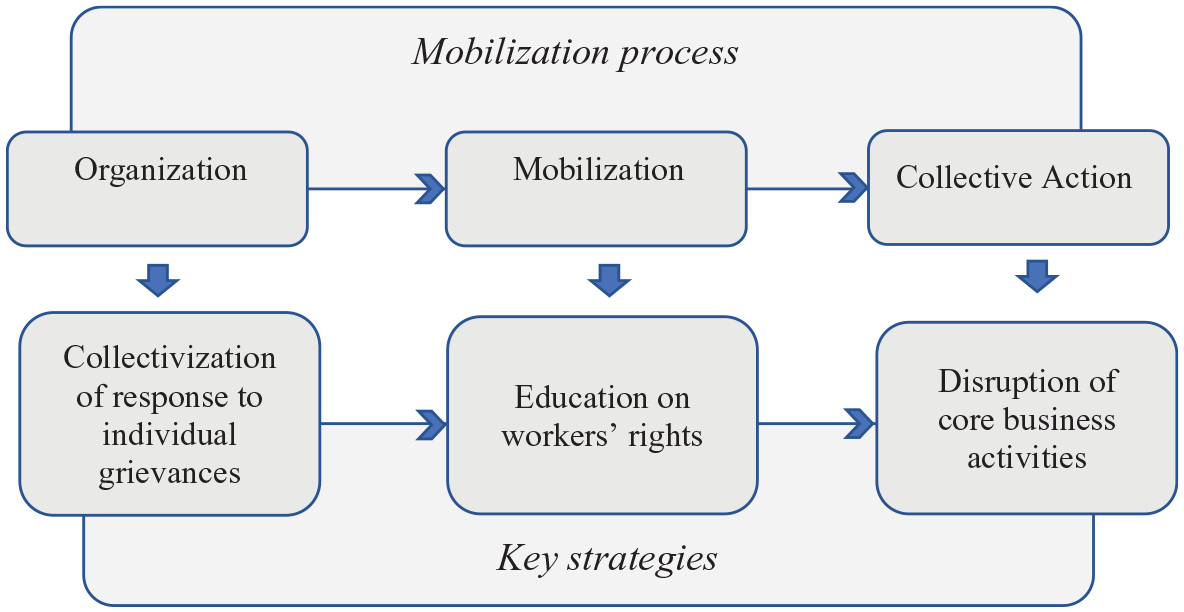
Model of mobilization process and related key strategies from the campaign.
Here I discuss each strategy emerging from the case study, within the framework provided by each stage of Mobilization Theory.
The ability of the union to collectivize the action on individual grievances (a) was the starting point of the campaign; this was the first step of the process, leading to build the structure of the group to be pushed to action, i.e. the organization stage (i). The representation and support of workers through hearings, disciplinary meetings and court cases are usually analysed merely as a ‘servicing’ activity (Boxall and Haynes, 1997) and are usually opposed to the ‘organizing’ activity. Gall analyses the strategy based on identification of ‘semi-collective grievances’, involving a ‘significant number of the members of the workforce’ (2005: 46). However, in the university cleaners’ case, the grievances presented by the workers were chiefly individual and have been tackled collectively. Indeed, the first phase of the campaign’s strategy took the workers from an isolated position of disorientation over their personal situation, to organizing. From the interviews, it is apparent how the initial individual representation of the dismissed workers paved the way for a collective approach to problem solving among workers. This is coherent with Healy et al.’s (2004) discussion of ‘instrumental collectivism’, in which employees start seeing the importance of a collective approach, after getting in contact with unions for individual reasons, and then stay connected to collectively address them.
According to the findings, the second phase was crucial, both for mobilizing (ii) workers in a larger campaign, and for empowering them to endure the sacrifices required during long periods of strike and agitation. This entailed the education (b) of workers through teaching employment law and contextualizing their demands in the framework of a legitimate negotiation, including striking, portrayed as a lawful instrument of collective action. Research usually looks at formative activities organized by unions either as a type of servicing aimed at recruiting members (Heyes, 2009; Warhurst et al., 2007), or as a formative tool for workplace representatives (Murray et al., 2014; Rainbird and Stuart, 2011). However, in this case, seminars and activities aimed at teaching legal technicalities were directed at the whole workforce as an instrument of mobilization. The idea behind this strategy was that knowledge of their rights would help the workers to move from a mere dissatisfaction to a sense of injustice (as in Kelly, 1998), and provide the strength and determination to mobilize the larger number of workers necessary to tackle a dispute over general working conditions, and creating the opportunity to acquire resources to sustain collective action. The pride in feeling knowledgeable on complex matters related to employment law and rights was apparent in the interviewed workers, and they claimed that their awareness was crucial in maintaining the solid determination of striking over working conditions.
Moreover, findings emerging especially from participant observation one of these seminars show that logics of class and race/ethnicity as discussed by Connolly et al. (2017) coexisted in the campaign and beyond. More specifically, using Alberti et al.’s framework (2013), a universalistic discourse and a particularistic, practical approach can coexist and be effective. While the Independent Union heavily relied on ‘migrant-friendly’ practices, like providing multilingual support and organizing meetings with a sense of community rooted in common foreign origins, its discourse and rhetoric were all focused on class and work-related issues. It is possible to reconcile the different logics underpinning unions’ approach to migrants; union strategy can remain class-based and focused on work, while making the context and mode of their activities instrumentally appropriate and welcoming for migrants.
Finally, in terms of collective action (iii), the Independent Union engaged in a disruptive strategy (c) that was not centred on the mere suspension of cleaning activity, but rather on interfering with core assets and activities of the University. Even within the restrictive parameters of the UK legislation that curbs creativity in developing new forms of protest, the Independent Union and the workers successfully engaged in demonstrations that hit the core business of the University. The idea of disrupting the University services, more by being visible than by simply withdrawing one’s work, has proven effective in this specific case. Name-and-shame strategies relying on discursive power are not new among unions’ activities (Doellgast et al., 2021); however, this specific campaign’s visibility relied entirely on the disruptive activities performed during the strikes, more than on the strength of the former union’s ‘communicative power’ in the public debate (Müller and Platzer, 2017). Indeed, the coverage in newspapers and the most popular endorsements came when the dispute was already approaching its end; this final phase shows how the Union, organizing and mobilizing workers, after building associational power by enlarging its membership, managed to gain support from the public as well as from other stakeholders at the University, substantially increasing its ‘societal power’.
The three phases discussed and analysed through the lenses of the different stages of Mobilization Theory are all crucial for the success of the campaign; all steps are closely interrelated and mutually supportive in the transition between the different phases of the campaign.
Some limitations and possible objections must be addressed. First, in term of generalizability among different types of unions. The most confrontational methods of the Independent Union were considered too aggressive by the National Union in this specific case; and the latter’s more cautious approach was exposed as too weak by the Independent Union. This seeming trade-off between dialogue and confrontation could suggest the inapplicability of the more aggressive strategies to unions favouring more cooperative strategies towards employers (Ackers and Payne, 1998; Fichter and Greer, 2004). However, other branches of the same National Union employed a similarly adversarial strategy in organizing cleaners in other universities, showing that principles underlying the process analysed here could also be adopted by less militant and more structured unions. Indeed, the most representative unions in the UK have been engaging with some forms of community organizing (Holgate, 2015). Furthermore, the different roles that the National and Independent Unions played in this occurrence open the debate on the possible complementarity of different approaches to improving workers’ conditions.
The second issue about generalizability is related specifically to the last part of the campaign. The University’s high status and consequent high value attributed to its reputation could be seen as a source of structural power for the workers, facilitating the victory of the dispute. However, while observing the activity at the Independent Union office, other successful campaigns for cleaners in other sectors took place; some involving employers with ‘high status’, like high street retailers, museums, parks and newspapers; but also others for which reputation was a less apparent resource, like cleaners of recycling trucks at a plant in a very remote location on the outskirts of London. Further research could look at the campaigns organized following this specific process and see to what extent the success of the disruptive collective action is correlated to the employer’s status.
This article contributes to the important debate on union organizing of precarious workers, by bringing an extreme case of lack of power resources to the debate. What have we learned through the analysis of this case? Findings show that despite the fact that the literature on organizing has departed from an articulation in terms of ‘process’ of mobilization strategies, this is still relevant, and it is particularly visible in cases when an organizing effort starts from extremely low power resources, and gets to the end of a successful campaign.
The analysis of the campaign carried on through the observation of union activities, documents, social media and interviews has uncovered key activities and strategies that can be grouped into three major themes: collectivization of individual grievances, workers’ education and disruption of the core business activities. These strategies can be understood within the framework of Mobilization Theory, and presented in a three-stage process, each linked to one of the main components of the traditional Mobilization Theory: organization, mobilization and collective action.
The analysis of this mobilization process contributes also to the reconciliation of views on unions’ logic that contrapose organizing to more traditional union approaches, often based on servicing, by showing how representation of individual grievances can be a kick-starter for organizing. Similarly, it supports the compatibility of a focus on class and the attention to race/ethnicity, by showing how migrant-friendly practices can coexist with a class-centred discourse.
Footnotes
Acknowledgements
The author would like to thank David Marsden, Virginia Doellgast, Bob Hancké, Chiara Benassi, Guglielmo Meardi, Sarah Ashwin, Alessandro Vercelli and the participants at the 2018 European Doctoral Workshop at Cornell University for the comments on early drafts of this article. Thanks also to the insightful and generous comments of two anonymous reviewers.
Declaration of conflicting interests
The author declared no potential conflicts of interest with respect to the research, authorship, and/or publication of this article.
Funding
The author received no financial support for the research, authorship, and/or publication of this article.
