




Abstract
The digitalisation of work is associated with a range of technologies, including digital platforms and so-called artificial intelligence (AI), as well as ideas about how they will improve productivity and competitiveness. This article analyses how unions anticipate the consequences of digital technologies and how they mobilise to address their impact on employment, skills, and quality of work. Drawing on qualitative research conducted in aerospace manufacturing in Belgium (Wallonia), Denmark and Canada (Quebec), our findings suggest that unions are mobilising contrasting frames and repertoires of action, drawing on traditional institutions, and experimenting with new ones to shape the future of work in the aerospace industry.
Introduction
Digitalisation of work involves various technologies and concepts, including using digital platforms and ‘artificial intelligence’ (AI). In manufacturing sectors, Industry 4.0 (4.0) is the core concept that includes the development of the ‘virtual factory’ to capture and manage data to improve productivity, flexibility and cost reduction. Digital technologies as a whole body of technical and IT infrastructures are giving new legitimacy to the notion of manufacturing as a new economic project (Pfeiffer, 2017).
The impact of digitalisation on work remains an open and contested question, however. Drawing on qualitative research conducted in aerospace manufacturing in Belgium (Wallonia), Canada (Quebec), and Denmark, our aim is to understand how ideas about the digitalisation of work are embedded in institutions and contexts, and how they shape employment, skills and work organisation. Our findings suggest that unions in the three countries are mobilising contrasting frames, and using and experimenting with traditional industrial relations institutions and other type of organisations, such as industrial regional clusters, to take action on the digitalisation of work.
In Belgium, trade unions perceive digitalisation as a threat to employment and mobilise traditional industrial relations institutions even if they question the capacity of these institutions to regulate the uncertainty related to digitalisation. In Denmark, trade unions are involved in many types of institutions and have much more confidence in their capacity to solve the uncertainty of digitalisation, which is defined as an opportunity to increase the industry’s competitiveness. In Quebec, the trade union also regards digitalisation as an opportunity to create skilled jobs. Union representatives, however, recognise the shortcomings of the decentralised collective bargaining arrangements and are engaging in new spaces, such as regional industrial clusters, to frame the digitalisation of work.
This article proceeds as follows. The first section reviews union engagement with new technologies and innovation policies. The second outlines the importance of ideas for understanding unions’ preferences and interests. This is followed by a description of the context of the research and the method. The empirical results of our sectoral cases are then presented, followed by a discussion of our main findings. The conclusion offers avenues for trade unions to promote a human-in-command approach to digitalisation.
Union engagement with new technologies and innovative policies
The pace and direction of digitalisation and the introduction of AI are being shaped by actors at various levels (Doellgast and Wagner, 2022). The digitalisation of work is variegated and multi-scalar in nature (Rutherford, 2021), partly because it intersects with economic and innovative policies at the regional level (De Propis and Bailey, 2020). These policies have driven the creation of industrial clusters and other intermediary organisations, aimed at expanding the capacity of local actors and organisations to anticipate path development, innovate and select new technologies (Miörner, 2022). These intermediary organisations are tied by sectors or technology at the regional and more localised levels, where labour, innovation and supply chain issues are addressed (for example, Clark, 2014). These intermediaries, such as research centres, industry cluster groups or training centres, vary in terms of stakeholders and focus, but they rest on deliberative processes in which actors take collective decisions, while having competing interests (Clark, 2014; De Propis and Bailey, 2020). Hence, within these spaces, actors shape economic and technological trajectories. As such, variation in how the digitalisation of work unfolds can be understood as an experimental process in which actors coalesce, negotiate meanings and share resources (Heidenreich, 2005).
Thus, because they provide resources and are places in which technological trajectories are discussed, industrial clusters within regions are important spaces for framing and shaping the digitalisation of work. Trade union involvement in these spaces is uneven, however. They have primarily been voicing their concerns within traditional industrial relations institutions, at the national, sectoral and workplace level at which working conditions are negotiated.
These levels of engagement are complementary, and their selections often stem from strategic access to institutional resources and the issues at stake. For example, in the manufacturing sector, Rutherford (2021) shows how the institutional model of collective bargaining adopted in the United States (the ‘Wagner’ model) provides institutional resources that allow unions to engage at the organisational level around collective bargaining (work organisation, intensification of work and stress), while it restricts them from participating at a higher strategic decision-making level where the adoption of Industry 4.0 models and policies affect labour replacement and skills development. In so-called coordinated economies, unions have greater institutional opportunities to engage in early discussion about technologies and the future of work.
The Nordic countries are an example of how institutional arrangements built up over decades provide resources and spaces at both the sectoral and national levels for social partners to jointly define problems and solutions related to employment and skills in the digital age (Rolandsson et al., 2020). Germany is another institutional regime that provides a range of different resources that unions can use to influence the adoption of Industry 4.0 technologies. Haipeter (2020) shows that, while open to technological changes at the macro level, German manufacturing unions have to develop new strategies at the workplace level in cooperation with works councils to be able to shape digitalisation effects on the intensification of work, the complexities of poorly integrated systems and deficient skills and training programmes. Gasparri and Tassinari (2020) further exemplify how, in adverse circumstances, Italian unions have mobilised their (limited) institutional resources by strategically combining action levels depending on the issues at stake. These accounts reaffirm the structure and agency components of union action and reinforce the need to take the context seriously, as resources available, issues at stake and strategic capabilities are all in play.
While the ability to participate in the negotiation of these technological changes is an old theme (Edwards and Ramirez, 2016), current uncertainties about the impacts on employment conditions require new compromises and new forms of action. The ways in which actors act and experiment in the context of their respective institutional landscapes reflect their interests and preferences related to digital technologies. In fact, we contend that the ways in which unions conceptualise these problems and engage with actions depends on their institutions and their respective views on whether or not they are suited to solving these problems. In their model of co-construction of institutions, Kristensen and Morgan (2012) suggest that actors respond to crises through a process of building on existing institutions and capabilities, and creating new ones to adapt or displace the ones that are prohibitive to adaptation. These engagements are, however, not straightforward: they create dilemmas to which there are no easy answers.
Importance of ideas for understanding unions’ preferences and interests
Researchers have been trying to broaden the definition of preferences and interests by including ideas and interpretations developed by actors in relation to their situations. In an effort to expand materialistic or formal institutional explanations of capital and workers’ interests, employment relations studies have followed the ideational turn in sociology (Snow et al., 2014) and political science (Blyth et al., 2016), and turned their attention to how ideas shape collective actions. Sense-making, framing and blending are some forms of ideational work carried out by workers (Rothstein, 2019) or unions (Preminger, 2020) to develop new power resources to challenge workplace or national policies (McLaughlin and Wright, 2018). From these perspectives, ideas are linked to power (Carstensen and Schmidt, 2016) and some have more traction than others in the definition of the future of work (Ainsworth and Knox, 2022). Ideas are important as they define the problem and they are formed in the interaction between actors and institutions as they perpetuate a certain vision of how social problems have been resolved (Béland and Cox, 2011).
Ideas about digitalisation are thus linked to workers’ and unions’ experiences of their institutions. These ideas are also connected with the way actors anticipate the impacts of digitalisation on work. Sense-making may come from broad and macro-level ideas such as neoliberalism and the need for competitiveness (Morgan and Hauptmeier, 2021) or from more down-to-earth issues such as job losses, control, stress and safety issues. Ideas are not given; they are constructed through a complex web of ambient discourses, political and cultural institutions and actors’ experiences.
The literature labelled ‘Future of Work’ is growing in both the academic and the business consulting worlds. Ideas about technological change are diverse, with some dominated by different emphases (positive or negative) and contents (what is at stake or to what effect) (Marenco and Seidl, 2021). Empirical studies reveal a mixed picture of the consequences of these changes on work and employment relations. After predicting a significant surge in the number of jobs lost, recent studies have shown a more nuanced effect, with job polarisation and medium-skilled work being transferred to the upper and lower ends of the employment spectrum (Autor, 2015). Although specific to particular manufacturing sectors, the OECD (2017) has nevertheless shown that routine manufacturing jobs are often reallocated to the lower-paid service sector.
These debates directly concern the notion of quality of work and how technologies can significantly change the managerial powers of control and direction of work. In fact, how new digital technologies impact work organisation is uncertain, although accounts of work intensification, increased surveillance, and loss of autonomy due to algorithmic management have been reported (Wood, 2021). Whether workers will assume new roles with technologies or be redeployed in a worse employment position is strongly linked to the issue of skills. Optimists envision that digital technologies will result in upskilling, while pessimists predict deskilling (Downey, 2021).
As such, this transformation is neither unidirectional nor straightforward, and outcomes vary depending on actors’ positions, resources, institutions, and broader socio-economic factors. As suggested by Marenco and Seidl (2021), actors respond to digital technologies according to their institutional arrangements and how they discursively construct the problem. Whether unions perceive these technologies as threats or opportunities with regard to employment, skills and/or work organisation is linked to ‘how novel problems are assimilated, but also how actors can use their discursive agency to depart from institutional paths’ (Marenco and Seidl, 2021: 407). A range of ideas exist therefore about the challenges raised by the diffusion of these technologies and the actions undertaken to address them.
In her accounts of US manufacturing industries, Lowe (2021) shows that workforce intermediary organisations are important spaces for shaping employers’ ideas about skills, employment and quality of work. The work of the actors within these intermediaries has led to a reinterpretation of problems and solutions related to the transformation of the labour market. They were able to convince employers to take on a more extensive role in skills development and to implement new technologies in ways that enhance job quality and business growth instead of cutting jobs.
To better understand trade unions’ engagement with digitalisation, we examine their experience with, and use of, both industrial relations institutions and intermediary organisations; and how, in turn, trade unions frame the problem of digitalisation and anticipate its impact on employment, skills and work organisation. Building on an expanded understanding of the anticipated impact of these changes, we illustrate that trade unions’ frames and ideas about digitalisation are embedded in their specific institutions and contexts.
Digitalisation in the aerospace industry: common international trends, varied responses
The approach adopted in this article draws on a contextual rather than a matched comparison (Locke and Thelen, 1995). It seeks to demonstrate how similar trends in the digitalisation of work are mediated by national and regional contexts and institutions. Via institutions common trends manifest themselves in the form of different problems in various contexts and trigger specific tensions and conflicts between actors. This contextualised comparison puts cases side by side and highlights distinctive features of work digitalisation in aerospace manufacturing in Belgium (Wallonia), Canada (Quebec), and Denmark.
The aerospace industry has been at the forefront of technological innovation in terms of products, materials and production processes, notably through the implementation of computer-aided manufacturing and automated processes (Noble, 1984).
Digital technologies such as AI are often portrayed as disruptive and radical, but in the aerospace industry, implementation corresponds more to a gradual and incremental process. Since the mid-1970s, technological changes have gradually transformed patterns of work organisation from the traditional skilled machinist used to operating versatile general-purpose machine tools to the implementation of computer numerical control which relies on the codification and translation of a machinist’s skills to a computer by a programmer (Noble, 1984). This process has been enhanced by the introduction of computer-aided engineering tools and computer-aided design systems, which have also favoured the integration of various segments of the workforce (conception/design/computation). These technological innovations were steps towards the monitoring of the whole process of manufacturing activity, including engineering, production, marketing and support functions. Nowadays, its maturity and its complexity have created a highly uncertain environment where the implementation of digital technologies aimed at reducing costs and improving quality is critical (Deloitte, 2019).
These technological trends have taken varied forms in response to the particular nature of the aerospace industry in each country. The size of the aerospace industry in each region, its position within the national and international value chain and its dominant activities are quite distinct.
In Belgium, the largest proportion (almost 70 per cent, according to Skywin) of aerospace industry establishments are concentrated in Wallonia, with nearly 5500 jobs. The structure of the aerospace industry in Wallonia is composed of companies that are suppliers to the large prime contractors or system integrators, including engine manufacturers and maintenance and repair of commercial aircraft (Skywin, 2022: 8).
Digitalisation has been integrated into the regional economic strategy in Wallonia since 2015 (Gouvernement Wallon, 2015) and has gradually been introduced at the cluster level (Skywin, 2022). A 2020 report on the digitalisation of manufacturing in Wallonia based on the most advanced organisations included seven aerospace firms (PWC, 2020). The aggregated data indicate that robotisation and automation are the main priorities for these firms: 85 per cent of them indicated that they had implemented robots and/or automation, 73 per cent internet of things, 62 per cent 3D printing and 31 per cent AI.
In Denmark, the aerospace industry is integrated into the broad manufacturing sector, which includes various industries (such as pharmaceuticals and food processing) and employs 350,000 workers (2022). 1 Aerospace is therefore not organised as a separate industrial sector, but data show that under that broad umbrella, this sub-sector employs around 1000 workers (2020). 2 As technological development and adoption in this area have strong ties with the windmill industry and defence sector, however, this sub-sector is relatively well supported in terms of innovation funding, and automation, with AI at the forefront of strategic development (McKinsey and Company, 2016).
There is a long tradition of companies, universities, and research centres working together on automation to support businesses and their international competitiveness. To maintain international competitiveness, manufacturing actors generally agree that customised systems and integrated solutions are key. According to data collected by the Iris Group, companies have mentioned that they are going to invest in robotics (50 per cent), other automation technologies (69 per cent) and Enterprise Resource Planning (ERP) systems (46 per cent). 3
In Quebec, aerospace is the most important manufacturing industry, comprising approximately 200 companies. These include four Original Equipment Manufacturers (OEMs), a dozen system integrators and hundreds of subcontractors, which, together, employed nearly 35,000 people in 2021. The industry is oriented primarily to commercial markets, as opposed to defence or space, and is ranked in the top three globally for the production of civil simulators, turboprop and helicopter engines, business jets, and regional aircraft.
Industry’s response to the digital trend has so far been oriented towards the monitoring of the manufacturing process rather than the introduction of AI (Statistics Canada, 2017): 56 per cent of aerospace firms have incorporated technologies such as computer numerical control machining, additive manufacturing, and robots; 41 per cent of firms have an ERP system (or a sensor network) to collect data from their machines; and 26 per cent have reported using business intelligence technologies, such as real-time monitoring and data displays, for decision-making. However, only 16 per cent report having an internet of things ecosystem, and just 11 per cent use AI.
Industrial relations institutions and intermediary organisations
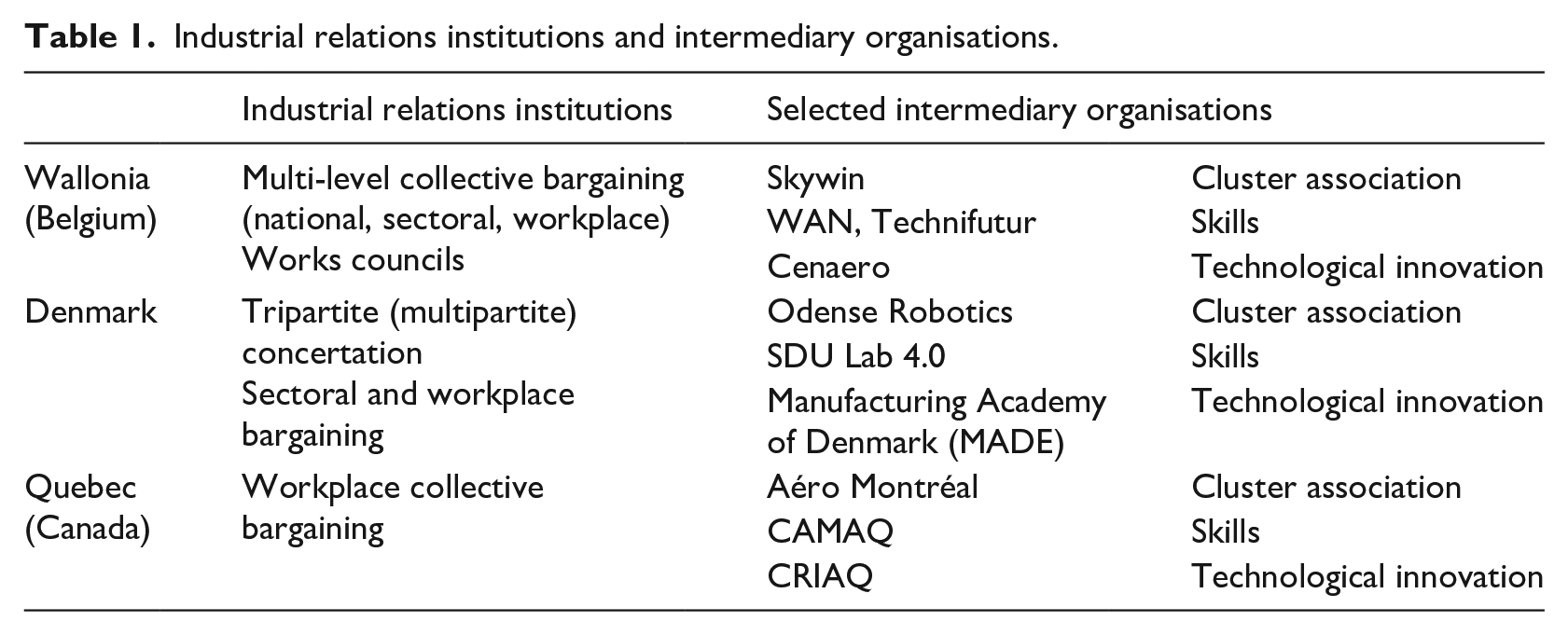
The aerospace industry in each country is embedded in specific industrial relations institutions and intermediary organisations. In both Belgium and Denmark, industrial relations rests on strong and coordinated institutions that encourage the involvement of social partners (employer and union confederations) in work-related matters at the national level (broadly defined, labour market policies), and sectoral, regional and workplace levels. In Belgium, works councils also play an important role in the regulation of employment issues at the workplace level. In contrast, in Quebec, collective bargaining in manufacturing industry is decentralised at the workplace level. Nevertheless, union density in Quebec remains high (40 per cent 4 ) in the North American context, but does not reach the unionisation rates observed in Denmark (67 per cent 5 ) and in Belgium (49 per cent 6 ).
Industrial relations institutions in each country coexist with intermediary organisations aimed at strengthening concertation in areas vital to regional economic development, such as training and skills, and research and technology transfer (Heidenreich, 2005: 741). Over recent decades, governments in Belgium, Canada and Denmark have implemented industrial policies aimed at institutionalising territorial clusters and fostering collective action. This has led to the creation of the aerospace clusters Aéro Montréal (Quebec) and Skywin (Belgium), as well as the robotic cluster Odense Robotics (Denmark).
While these policies vary, they are all characterised by a rescaling of resources and decision-making processes based on the assumption that industrial actors are best suited to select optimal courses of action and innovation (Heidenreich, 2005). Therefore, states have supported the creation of various intermediary organisations dealing with cluster policy implementation, skills development and technological innovation.
The question of how clusters and aerospace manufacturing firms should adapt to digital technologies has been an important issue for intermediary organisations in Belgium, Canada and Denmark. The involvement of trade unions in skills development is paramount in the three countries, while none of them is involved in intermediary organisations with the main focus on technological innovation. Quebec is the only region where trade unions are involved in the cluster association. Table 1 describes the main industrial relations institutions and the selected intermediary organisations in each country.
Industrial relations institutions and intermediary organisations.
Research methodology
To understand how trade unions mobilise these institutions and organisations to frame ideas about the digitalisation of work we draw on a qualitative approach that combines interviews with direct observation in trade union forums and secondary data. A total of 87 semi-structured interviews, lasting on average 75 minutes, were conducted between 2015 and 2019. We gathered information from trade union representatives (10 in Quebec, seven in Wallonia, four in Denmark), managers in aerospace firms (12 in Quebec, six in Wallonia, four in Denmark) and key informants, such as cluster associations and intermediary-organisation representatives in the areas of research and skills development (20 in Quebec, 17 in Wallonia, seven in Denmark). These primary data were complemented with direct observation at trade union meetings and conferences in the three countries and with secondary data, including union communications and reports, and government and industrial reports on digitalisation.
Trade union ideas on digitalisation of work
Wallonia: anticipating threats in times of uncertainty
Wallonia has experienced job destruction and socio-economic challenges as a result of the decline of traditional industries. Regional policies have attempted to restore Wallonia’s economy but, to this day, it is experiencing a very slow recovery (Halleux et al., 2019). Hence, the trajectory towards growth, including the role and nature of manufacturing and innovative activities, as well as relations between them, is subject to debate (Jacques et al., 2021).
Digitalisation is defined in terms of threats of job losses. It is perceived as part of a known socio-economic problem, namely that investments in new technologies no longer lead to the transformation and maintenance of workers’ jobs. Anticipation of the potentialities of digitalisation, namely what these new technologies can achieve, however, increases the scale of known problems further by realising the ‘employers’ dream: a factory without workers’ (Union, in 2019). This echoes the main trends in Walloon aerospace, where firms have prioritised automation and robotisation.
Moreover, the uncertainties are compounded by the fact that the employers seem to be one step ahead in terms of the knowledge needed to master digital technologies. Furthermore, not only does there seem to be a knowledge gap, but the speed of change is significant. For unions who have for years experienced the challenges associated with workers being left behind and juggling to find solutions to keep jobs local, digitalisation is a known problem but of greater magnitude.
the employers are moving forward. The next 4.0 factories are already almost in place [. . .] we don’t have a solution yet because when you’re going to cut 30-40-50-60% of the staff, what are you going to do with these people? (Union, in 2019)
While the issue of job destruction is central, the effects of these technologies do not seem to be limited to a deterioration of the manufacturing fabric. The issue of skills gaps is also pressing, mainly because digitalisation is depicted as leading to skill polarisation. Workers’ ability to adapt to new requirements is viewed as highly problematic. This issue is also extended to the labour market where many have been unemployed for a long time and training systems are dysfunctional. Underlying these issues is a questioning of the roles of the state and employers in assuming the risks and responsibilities related to digitalisation.
The jobs created do not correspond to people’s qualifications in the region and this is a problem of training. The training organisations follow the evolution of the industry as closely as possible [but] it is not up to the public to provide all the training. Companies must invest in training and take their share of responsibility. (Union, in 2019)
If the integration of these technologies leads to a scenario that is unfavourable to workers, trade union actors nevertheless recognise the legitimacy of finding ways to remain competitive in a sector in which pressure on prices is strong and in a region where labour costs are high. The solutions to these problems are not clear. They are framed as a threat to the sustainability of the Belgian social model.
Trade unionists engage with digitalisation mainly in the inherited institutional arena related to skills, employment and training within the system of social concertation. Occupying this space is seen as the main way of securing influence and power in a context in which employers’ strategies could try to erode them.
In the système de concertation sociale, the fact that we are considered social partners, if this prerogative is taken away from us, we are dead [. . .] The influence that we have, they would like to strip us of that. (Union, in 2017)
This system also allows trade unionists and employers, at different levels, to discuss various topics – including digitalisation. These discussions help them to gather information, acquire knowledge about the potentialities of the new technologies and therefore limit uncertainty.
Lobbying and calling for the state to act through legislation is also part of the legacies being mobilised in the context of digitalisation. Trade unions also focus on relationships and spaces for action at the European level, which is seen as important. Internally, digitalisation pushes unions to question how their structures could contribute to the erosion of solidarity between workers. It also prompts them to gather information about these new technologies to try to understand what digitalised work really entails.
Thus, digitalisation is placed within what is depicted as the ‘deliberate project’ of the employers: the gradual decline in the co-location of innovation and production activities on the same territory (Union, in 2017). Trade unions believe that state action is contributing to this ‘deliberate project’ via its industrial policy focusing on research, technological innovation and clusters. Furthermore, the aerospace cluster is seen as space for employers’ collective action, in which the industry’s priorities, not workers’, are central. Therefore, the cluster and its intermediary organisation, both named Skywin, are portrayed as an arena dedicated exclusively to the employers’ projects and needs.
The more you invest in Skywin, the more jobs you lose. Skywin is not a job-creating project. [. . .] our money is invested in R&D to create jobs elsewhere. (Union, in 2017)
Skywin is responsible for the selection of collaborative projects funded by the state in the areas of R&D, training and investments, as well as developing a long-term sectoral strategy. It has also attempted to influence firm managements via, for example, the dissemination of initiatives aimed at standardising SME management practices. Trade unions tend to put aside the impact of Skywin on the regulation of work even though it has the potential to shape technological trajectories. Unions are present, however, on the board of the aerospace and machining training centres affiliated with the cluster, Technifutur and WAN (Wallonie Aerotraining Network).
In sum, the problem of digitalisation in Wallonia is defined mainly in terms of job destruction and skills gaps. Trade unions feel that they need to protect and occupy their traditional institutional landscape, and this is where they tend to try to tackle problems of digitalisation. This presents trade unions with a critical dilemma: they seek to create jobs through traditional mechanisms that might become less relevant while the design of new technologies and the digitalisation of work are being addressed in arenas from which unions are absent.
Denmark: anticipating digital challenges as continuous progress
In Denmark, developing and adopting new digital technologies in aerospace manufacturing is indisputably viewed as crucial to maintaining business competitiveness. As a small state overly dependent on international trade, Danes have historically seen technological change as one of the main vehicles for innovation and productivity, two elements conducive to business growth in a context of globalisation. Whether through its defence policies, digital strategies or new robotic clusters, there have been substantial government and private efforts to push for organisational adoption of digital technologies.
Digitalisation in the manufacturing sector is mainly seen as a driver for productivity increase and competitiveness and companies are responding by investing in automated production processes and the adoption of smart industrial robots. For the state, the survival of the expensive Danish social model (high expenditure on social, health care, education and labour market policies) depends on a strong business sector able to pay high salaries to which high tax levels can be applied.
For the major union organisations in this sector (Dansk Metal and the Confederation of trade unions FH), technological change is seen as a normal process to support business competitiveness, thus safeguarding manufacturing companies from relocation out of Denmark. In their opinion, the risks associated with digital technologies are more significant if companies and government do not embark on this transition. The trade-off must be that they can negotiate a fair share of the productivity gains (salary increase) and that adequate training measures be put in place to secure the skills transitions of affected workers. For representatives, this trade-off stems from past technological waves and applies to today’s technologies, including AI.
From our point of view, the Danish Trade Union Confederation, new technology has always been a productivity driver in society and that is a good thing, but the important part is, do you have strong labour unions? Can you ensure that labour get their fair share of this productivity gain? And this was important 100 years ago and it is also important today. So for us, that is the essential question. (Union, in 2019)
The way issues are framed is related to the distribution of productivity gains, which could be associated with a desire to maintain/improve the quality of work (and high salaries). Upgrading skills is the other side of the coin and gains importance in union collective action, as shown by numerous calls from the leader of the Confederation FH to improve education and vocational training for workers affected by digital technologies. These arguments have also been put forward in sectoral bargaining by the chairman of Dansk Metal (acting as chair of the sectoral organisation CO-Industri), a strong advocate of lifelong learning. As reported by the Dansk Metal representative: ‘we need tougher retraining [. . .] which is why also our chairman has a big focus on lifelong learning. When he negotiates the collective agreements [. . .] that is one of the key points for those negotiations, lifelong learning’ (Union, in 2019).
To tackle these problems, the unions are acting quite traditionally as they make use of the Danish Model developed over the past 100 years. FH, CO-industri and Dansk Metal have all stated that they have confidence in the Danish Model and its capacity to resolve issues adequately with tripartite consultations at the national level and collective bargaining at the sectoral level (manufacturing). Relying on past experience, trade unions trust the Danish system to maintain the consultation mechanisms needed to design a fair digital transition.
As social partners the trade unions are consulted on the design of different digitalisation strategies, such as the Disruption Council, the Danish Council for Digital Economy and the Danish Strategy of Digital Growth, which includes considerable funding for increasing people’s digital skills, and digitalisation of businesses and SMEs (Danish Government, 2018; 2019).
At the sectoral level, Dansk Metal is using collective bargaining institutions to negotiate productivity gains and address the lifelong-learning side of the problem. Other ways are being used to push unions’ interests, as illustrated by the active role played by the Dansk Metal chairman in institutions at the sectoral level. He participates in the board at the Innovation Fund Denmark to financially support innovation and digital solutions in companies; the Industry Skills Development Fund to support the development of employee skills; various industrial policy forums and robotic clusters to maintain workers’ voice in these developments; and in the development of the latest industrial defence policy, to name only a few.
Union action in this transition shows the active work needed to mobilise traditional institutions and to operate in new areas. If positive framing of new technologies as economic progress and lifelong learning has allowed Danish workers to achieve high quality employment in the past (Kristensen and Morgan, 2012), this time around, the lack of union participation in the design and development of these digital technologies may be harmful, particularly in the context of potential job polarisation (Rolandsson et al., 2020). In that case, lifelong-learning solutions may be more beneficial for skilled workers and less so for workers who see their jobs being transformed with more AI controls, resulting in deskilling. This could put contradictory pressures on trade unions on at least two fronts. One is a potential shift of members to the upper and lower ends of skilled workers represented by different unions, and the second is increased tensions within the FH confederation regarding how to reform lifelong learning in this context of polarisation. Furthermore, while Danish manufacturing employers are joining forces and experimenting, together with universities, in creating new coordinated institutions for developing digital technologies (that is, new clusters on robotics and AI, MADE, and so on 7 ), the unions are not formally participating in these fora and are missing opportunities to shape their impact on work. These contradictory pressures may call into question the traditional solidarity that is one of the major pillars of the Danish Model.
Quebec: anticipating opportunities to safeguard jobs and industry
In Quebec, the major employment issue is related to the development of a skilled workforce. Historically, for trade unions, skills gaps have limited the growth of the aerospace industry and employment for the local workforce. To address labour shortages, and to attract aerospace companies, unions argued that a skilled workforce was a key competitive advantage for the industry. As a result of trade union pressure, the federal and provincial governments created a sectoral joint union–management committee in 1982 (Comité sectoriel de main-d’oeuvre en aérospatiale, CAMAQ), which until early 2000 was the primary locus of coordination within the industry. Through the work done by CAMAQ, trade unions participated in the development of specialised training from high school to college, through to university.
These actions, focusing on the supply of a skilled workforce for the industry, quickly showed their limits. The uncertainties caused by economic restructuring have prompted trade unions to claim that the industry should act on the demand side by investing in new technologies to safeguard employment. The industry’s response has been oriented towards monitoring the manufacturing process through the integration of basic digital technologies and the interconnection of systems, machines and employees to gain access to real-time data to support decision-making. There is much variation between firms in terms of Industry 4.0’s adoption of these digital technologies. Some firms are fully engaged and are currently operating a virtual factory, whereas others are in the early stage of capturing and formatting data. The union has to deal with a fairly variable technological landscape.
Trade union participation in the board of directors of Aéro Montréal has, however, opened space for them not only to voice their concerns, but to obtain a broader vision of the industry and to participate in the discussions related to strategic decisions. To accelerate the adoption of digital technology Aéro Montréal has created programmes, such as MACH Fab 4.0, to support SMEs financially and to provide a ‘customised coaching program’ to support projects related to the implementation of Industry 4.0.
The participation of representatives from the Fonds de solidarité du Québec in the board of directors of Aéro Montréal is another lever that trade unions can pull to shape technological innovations through the funding of Industry 4.0 projects. This trade union investment fund has developed a special programme to assist firms, notably SMEs, in their transition towards Industry 4.0. In a public interview, one of their representatives defined Industry 4.0 as follows: Our vision of 4.0 is the opportunity for workers to develop their skills to better contribute to the company‘s productivity while enjoying their work more fully, with an increased quality of life and safety. In each of our investments related to 4.0 projects, we ensure that jobs are maintained and that the changes are positive for people and the environment. (Fonds de Solidarité du Québec, in 2021)
Following the acquisition of Bombardier by Airbus in 2018, trade unions from Quebec and France strengthened their relations through various meetings and plant tours. The latter activities allowed the Quebec union to recognise that aerospace companies in Montreal were lagging behind their counterparts in the implementation of new technologies, particularly in relation to Industry 4.0. These inter-union relationships reinforced their idea that employers and the state needed to accelerate the transition towards the digitalisation of work.
In seeking to frame narratives in new areas, such as technological innovation, trade union representatives consider that value chain weakness, the lack of technological investments and enterprise inefficiencies are as much a challenge for workers and trade unions as they are for management. Hence, they are not resisting technological change but are trying to be an active actor in its deployment. However, they recognise that there are many flaws in their capacity to shape technological change. First, trade unions remain a junior partner on the board of Aéro Montréal and they are not involved in the sectoral intermediary organisation (Consortium de recherche et d’innovation en aérospatiale au Québec, CRIAQ) dealing specifically with the development of technological innovation. This limits their ability to intervene upstream of technological changes. As such, their capacity to frame the digitalisation of work is limited.
Second, collective agreements are not suited to keep up with the rapid technological changes occurring at the workplace level. The introduction of algorithmic management is not regulated in collective agreements and this situation weakens workplace representatives’ capacity to solve the immediate needs of workers on the shop floor who are being directly affected by these new management practices related to work digitalisation. They are crafting a counternarrative, in which manager reliance on technology and statistics, and the undermining of tacit knowledge on the shop floor compromise efficiency efforts. In this battle over the frontier of control over work organisation, however, these representatives have few means in the collective agreement to contest decision-making, because what is algorithmically evaluated is obscured to both workers and line managers.
For trade unions, in the context of the current shortage of labour, safeguarding the industry is related to the recruitment of new workers, which is directly related to the quality of jobs (IAMWA, 2019; UNIFOR, 2019). This can be achieved only through strong collective agreements and labour standards, however, which are not addressed within the intermediary organisations dealing with industrial strategy, skills development, and technological innovation. Trade unions are facing a real dilemma: the current decentralised industrial regime constrains their capacity to diffuse and scale up the labour relations experiment, while intermediary organisations are not designed to address these issues. Trade unions are thus framing new narratives and developing new action repertoires at the sectoral level, but they are struggling to maintain and extend their reach around traditional employment relations issues related to the quality of work.
Discussion
These accounts show that in the aerospace manufacturing sector, while technological changes are gradual and unequal, they are also significant. They suggest that processes of work digitalisation are context-dependant. Common international trends are thus mediated by national and regional institutions, and translated into different problems.
In Wallonia, digital transition is viewed as a threat to employment (job destruction and skills polarisation) and also to traditional industrial relations institutions. This leads unions to mobilise these institutions at all levels to create new jobs, while asserting the legitimacy of these institutions. This presents the unions with a dilemma. They seek to create new jobs through traditional institutions, while work and employment issues are also addressed within sectoral intermediaries where unions are not involved.
In the Danish manufacturing sector, the union sees the adoption of digital technologies as a regular way for business to boost its international competitiveness. As a consequence, unions participate in many types of forum as a way of helping to shape national strategies, as well as sectoral collective bargaining in order to obtain a fair share of productivity gains and improve lifelong learning. By focusing on productivity, the manufacturing union may face a dilemma in seeking the right pathway in the knowledge economy. As suggested by Ibsen (2021), unions have to make uneasy choices between ‘going academic’ while still ‘going old-school’.
In Quebec, in anticipation of the shortcomings of collective agreements at the enterprise level when it comes to safeguarding jobs and the industry, the union feels strongly that enlarging its repertoire of action within the framework of regional and sectoral intermediaries represents an opportunity not only to maintain jobs and the industry but also to frame problems and solutions related to the digitalisation of work. Trade union involvement does not increase their capacity to act on workers’ immediate needs in the workplace through traditional collective bargaining, however.
Our analysis shows how important it is to trace ideas deeply held by union actors in order to understand their different approaches to digital technologies and the future of work. These ideas are formed by unions’ overall experience (past and present) with technological changes and their trust in their institutions’ ability to address the new challenges adequately. Coordinated industrial relations institutions in Denmark and Belgium enable unions to frame ideas about the digitalisation of work through collective bargaining and social dialogue, even though union engagement in Denmark, based on their corporatist tradition, appears to be stronger. In Quebec, because the traditional decentralised collective bargaining system creates fewer opportunities for unions to deal adequately with work digitalisation, they are more inclined to experiment with new repertoires of action and ideas within intermediary organisations. Thus, depending on the ideas and institutions available to unions, they anticipate the problems differently and mobilise different frameworks when engaging in collective action.
These different framings and engagements create context-specific dilemmas for each union. Nevertheless, in all three countries, unions are encountering difficulties in getting involved in early development and design of digital technologies while employers are coordinating to foster collaboration on research and development with universities and research consortia to advance their technological agenda. As Noble (1984) pointed out over 35 years ago in his study of the aerospace industry, the successful implementation and adoption of new technology rests on the early involvement of workers and trade unions.
Conclusion
This study highlights how industrial relations institutions and intermediary organisations shape available ideas, as well as the trade unions’ framing of and engagement in the digitalisation of work. Coordinated industrial relations institutions, as opposed to decentralised arrangements, create more space for unions to frame technological trajectories. As highlighted by the Belgian case and by previous research (Doellgast and Wagner, 2022), however, even coordinated institutions are fragile and their relevance to the framing of work digitalisation, and appropriate action, may be under threat. Our findings also show that intermediary organisations are becoming increasingly important in the development of AI and new technology for the manufacturing sector.
In this context, technological trajectories are discussed collectively, resources are allocated and actors frame a common understanding of the digitalisation of work. Unions in Belgium, Denmark and Quebec are involved in intermediary organisations dealing with skills issues, and in Quebec, they are also involved in the governance of the aerospace cluster. None of these trade unions are involved in shaping how intermediary organisations address technological innovations, however. As Edwards and Ramirez (2016: 111) have suggested, ‘a key issue for trade unions and workers is to engage early in the process, that is, before a technology becomes fixed’.
It is difficult to assess whether trade unions’ low level of involvement is related to their lack of opportunity, or lack of internal resources or willingness to get involved. These elements are probably intertwined in complex ways. What seems obvious is that, in the context of AI and current digital technologies, the need for a ‘human-in-command’ approach (Aloisi and De Stefano, 2020) constitutes an opportunity to exchange ideas about the legitimacy and need for unions to shape the design of technologies upstream. This opens up possibilities to think about the future of work more comprehensively and renewed options for union engagement to shape the effects of this transition upstream. In order to take part in the framing and shaping of work digitalisation, however, trade unions need to develop new coalitions with universities and research centres (Bosch and Schmitz-Kießler, 2020; Haipeter, 2020). They will also need to rely on external experts and to organise themselves internally to train representatives to become experts in AI (Dagnino and Armaroli, 2019). Perhaps, most importantly, trade unions are currently engaged in a long process of experimentation, and they need to build sustainable alliances with other trade unions to learn from their own experience and that of others so that they can position themselves in the present and anticipate the future. The challenges are huge but the stakes are high.
Footnotes
Acknowledgements
The authors wish to acknowledge helpful comments by the Transfer guest editors (Virginia Doellgast and Valerio De Stephano) and the anonymous referees. We are grateful to the people who were interviewed and shared their experience with us. We also want to thank our broader research team: all of the students and colleagues who helped shape and frame this research project.
2
3
Iris Group (2021); see also  .
.
4
7
See, particularly, Odense Robotics, and Manufacturing Academy of Denmark (MADE).
Funding
This work was supported by the Social Science and Humanities Research Council (Canada) – Insight Program [grant number 435-2013-1426].