




Abstract
Introduction
Concomitant acromioclavicular joint (ACJ) disruptions with coracoid base fractures are rare high energy injuries. The management of these injuries can be challenging. The aim of this study is to assess the functional and radiographic outcomes of a retrospective case series of patients presenting with concomitant ACJ and coracoid base injuries managed with a clavicle hook plate with subsequent hardware removal at a later stage.
Methods
Six patients were identified for inclusion in the study. Radiographic and clinical data were available which allowed for collection of demographic information as well as classification of the fractures. Telephone consultation with patients allowed for collection of functional scores which included the Oxford shoulder score (OSS), QuickDASH (Q-DASH), Euroqol-5 Dimension (EQ-5D) and the SF-12 score.
Results
All patients were male with a mean age of 39.8 years and a median follow-up period of 34 months. All patients underwent a successful operative procedure with a median time to union of 3.75 months. Good functional outcomes were reported by all patients: mean OSS 45.0, mean Q-DASH 4.8, mean EQ-VAS 82.8 and encouraging SF-12 scores (mean PCS 56.0, mean MCS 56.4).
Conclusion
The use of a lateral clavicle hook plate can achieve good healing and functional outcomes when managing patients with acromioclavicular joint disruptions associated with a coracoid base fracture.
Keywords
Introduction
Acromioclavicular joint (ACJ) disruption is a common injury, most frequently occurring in men in the 20–40 years age group and typically occur as a result of low to moderate energy trauma. 1 The ACJ is one of the components of the superior shoulder suspensory complex (SSSC). The SSSC is a bony and soft tissue ring which also comprises the glenoid process, coracoid process, the distal clavicle, the coracoclavicular ligaments and the acromion. 2 A single disruption to the SSSC, such as an isolated distal clavicle fracture or an isolated ACJ disruption, does not breach its overall integrity, however, a double disruption produces an unstable construct which can lead to difficulty healing and poor functional outcomes.3,4 A subgroup of patients that present with a high energy ACJ trauma sustain a more complex pattern of injury which involves the base of the coracoid process. These represent a double disruption to the superior shoulder suspensory complex (SSSC). Whilst these injuries can be treated non-operatively in elderly patients or those with lower functional demands, younger active patients require operative treatment to achieve a good functional outcome.2,5 Traditionally, operative treatment involves open reduction and internal fixation (ORIF) of the coracoid base fracture with cannulated screw fixation as well as ACJ repair or stabilisation.6,7
We present a series of six patients with concomitant ACJ disruption and a coracoid base fracture treated successfully with a lateral clavicle hook plate, with the aim of encouraging the use of the clavicle hook plate to address an acute concomitant ACJ disruption and coracoid base fracture. This technique allows for direct reduction of the ACJ disruption whilst indirectly reducing the coracoid base fracture.
Anatomy
The coracoid process serves as an essential anchor for several ligamentous and tendinous structures. From medial to lateral, the tendons are that of the pectoralis major, coracobrachialis and the short head of the biceps. The ligamentous attachments include the transverse scapular ligament, the coracoclavicular (CC) ligaments and the coracoacromial (CA) ligament. The CC ligaments confer clavicular vertical stability and the CA ligament contributes to glenohumeral stability by acting as a restraint to humeral head migration in addition to helping to transmit load across the scapula. 8
Classification of coracoid fractures
The Eyres classification 9 divides coracoid fractures into five groups as follows: Type I, tip fractures; type II, mid-process fractures; type III, basal fractures; type IV, extends into the superior body; type V, extends into the glenoid fossa. Eyres et al. 9 suggest that fractures of types I, II and III can be treated non-operatively and types IV and V require surgical management. The Ogawa classification 7 classified fractures depending on their location in relation to the attachment of the coracoclavicular ligaments. Type I fractures are proximal to the ligaments and type II fractures are distal to the ligaments. Ogawa et al. 7 advocate operative fixation of type I fractures and non-operative treatment for type II fractures.
Patients selection
We conducted a retrospective case series at a single tertiary centre. Institutional Review Board and/or ethical approval was not required as this piece of work was deemed to be an audit of clinical practice. Patient consent was obtained for use of radiographic imaging in the study. The PROCESS (Preferred reporting of case series in surgery) Guideline was used to explain the methodology and results.
Summary of patients included in case series with classification of injury, treatment, time to union, and functional scores.

Operative technique
The patient is positioned in the beach chair position under general anaesthesia and an interscalene block. Intravenous antibiotics and tranexamic acid are administered on induction. After careful preparation and draping, an incision is made obliquely in Langer’s lines between the coracoid and the ACJ. A transverse fascial incision is made and the soft tissue is carefully dissected posterior to the ACJ to create a path for the insertion of the hook plate. All fixations took place using a locking compression plate (LCP) hook plate (Synthes, Raynham, MA). An appropriately sized plate is chosen and the hook is passed under the acromion. The plate is positioned superiorly on the lateral clavicle. If the realignment of the ACJ is overcorrected, a hook plate with a larger depth was used so that correct alignment was achieved. The plate is then fixed onto the distal clavicle under x-ray guidance and final radiographs saved. In all cases, the coracoid was indirectly reduced by the hook plate and x-rays were taken intra-operatively showing a reduction of the ACJ and coracoid.
Follow-up
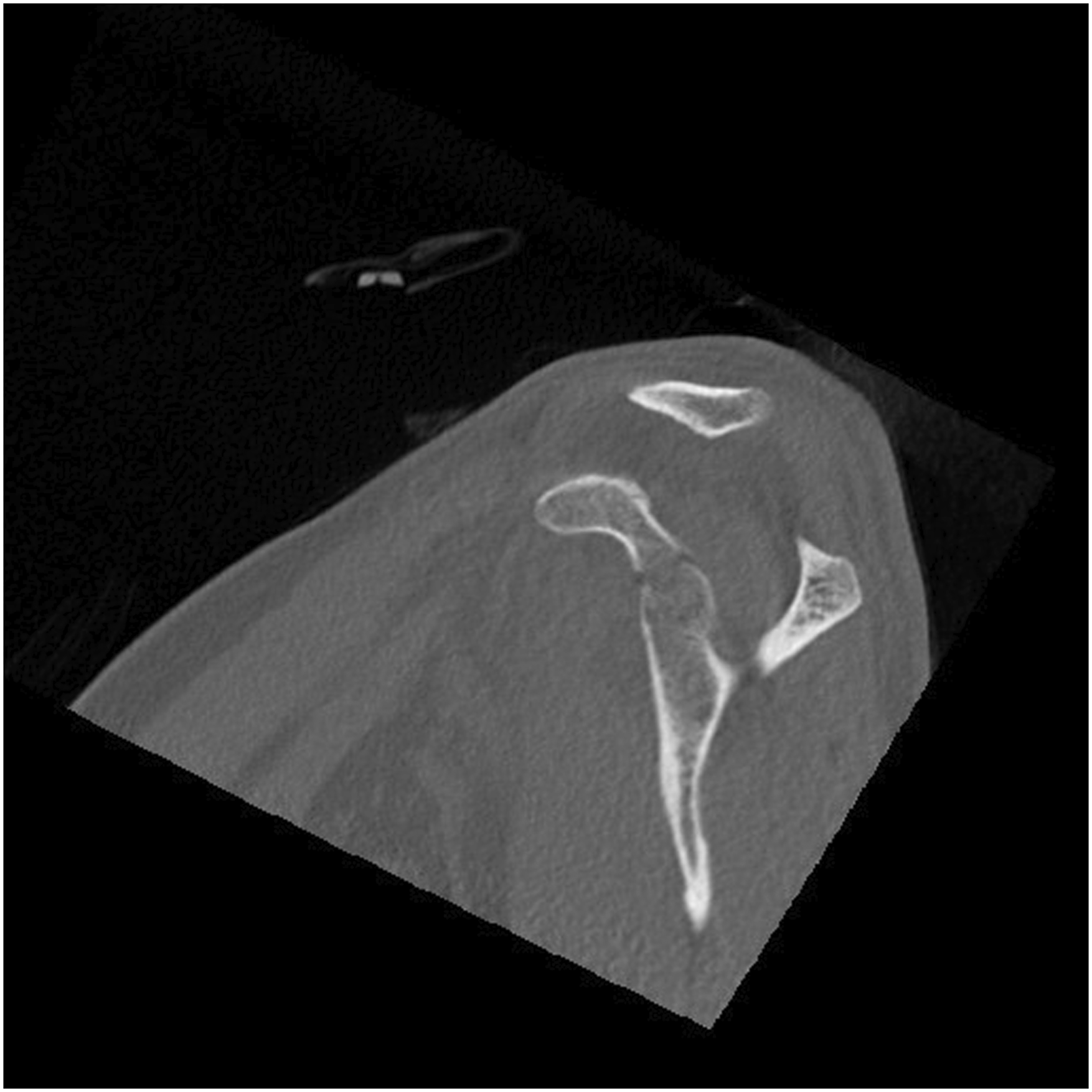
Patients were serially assessed in an upper limb consultant-led fracture clinic and radiographs were taken to assess coracoid healing and ACJ alignment. Patients were started on early physiotherapy regime which involved initial range of motion exercises. Flexion and adduction of the shoulder against gravity was restricted for the first 4 weeks to restrict the deforming forces placed upon the coracoid. Once satisfactory healing was achieved, the plates were removed to avoid irritation of the acromion and impingement of the rotator cuff. Figures 1−7 showcase radiographic and CT images of an example case that was included in this study. Telephone encounters with the patients allowed for patient reported outcome measures (PROMS) to be obtained based on their function. The median follow-up period was 34 months. Functional scores collected included OSS, Q-DASH score, EQ-5D and the SF-12 score, which comprised of a correlated physical score (PCS) and correlated mental score (MCS). The OSS addresses shoulder problems within the last 4 weeks, taking into account both pain and function. The Q-DASH scoring system is a shortened version of the Disability of the Arm, Shoulder and Hand (DASH) scoring systems and contains 11 items.
10
It is reported from 0 to 100, where 0 points represents no disability and 100 points signifies total disability. The EQ-5D questionnaire asks patients to evaluate their mobility, self-care, pain and activities of daily living, and the EQ visual analogue scale (VAS) giving themselves a health score from 0 to 100, with 0 being in the worst health imaginable and 100 being in the best health imaginable.
11
The Short-Form Health Survey (SF-12) contains 12 items which have physical and mental components (PCS and MCS).
12
Anteroposterior radiograph of the shoulder demonstrating acromioclavicular disruption and coracoid base fracture. Anteroposterior cephalic view radiograph of the shoulder demonstrating acromioclavicular disruption and coracoid base fracture. Scapular view radiograph of the shoulder further demonstrating the acromioclavicular disruption. Computed tomography sagittal view demonstrating the coracoid base fracture. Anteroposterior radiograph of the shoulder demonstrating reduction of the acromioclavicular disruption and coracoid base fracture with a hook plate. Anteroposterior cephalic view radiograph of the shoulder demonstrating reduction of the acromioclavicular disruption and coracoid base fracture with a hook plate. Computed tomography sagittal view demonstrating reduction of the coracoid base fracture with the hook plate.




Results
All six patients were male, with a mean age of 39.8 years. Four of the patients sustained their respective injuries falling from a bicycle, one patient was involved in a road traffic accident, and another patient sustained the injury through a direct fall. All of the patients had a type I Ogawa fracture. When using the Eyres’ classification, four patients had a type IV, one type V, and one type III.
All of the patients in the case series underwent a successful operative procedure with good healing seen radiographically prior to the metalwork being removed. Union was achieved and demonstrated in all patients radiographically, either on plain radiographs or CT scans taken within 6 months of the fixation. The median time to union was 3.75 months. There were no complications associated with any of the fixations.
All of the patients had an OSS between 40 and 48, indicating satisfactory function of the shoulder. Q-DASH scores ranged from 0 to 10.52, with a median score of 4.88. This represent a very low level of disability. With regards to the EQ-5D, patients reported ‘no problems’ to most of the criteria which is summarised in Table 1. In terms of the EQ-VAS, the median score was 80. The median PCS and MCS were 56.1 and 57.2 respectively. This implies that patients in general reported excellent physical and mental wellbeing.
Discussion
The cases described concur with what is reported in the literature regarding epidemiological data, classification and injury mechanism. In agreement with what is described in the literature, the majority of our patients sustained their respective injuries from a high-energy traumatic incident. Coracoid fractures can easily be missed on plain radiographs as they are often minimally displaced and the injury can be obscured by overlapping bony structures on plain radiographs.13,14 High vigilance is needed when assessing patients with shoulder girdle injuries, particularly ACJ disruptions. A double disruption of the SSSC represents an unstable injury with adverse long-term consequences. 2 It is crucial to diagnose coracoid fractures which are associated with ACJ injuries. The mechanism of injury supported by imaging (including AP view, cephalic view, and scapular view) as well as a computer tomography (CT) scan may be needed for a definitive diagnosis and accurate assessment and evaluation of associated injuries.
Our case series demonstrates that a clavicle hook plate can be used effectively to treat an ACJ disruption with an associated coracoid base fracture whilst preserving the coracoclavicular ligaments. Fluoroscopic images taken intra-operatively showed a reduction of the ACJ and coracoid base fractures in all six cases. A clavicle hook plate, which is a rigid system, achieves direct ACJ reduction as well as indirect reduction of the coracoid fracture. As the coracoclaviclar ligaments are intact we did not use any added augmentation techniques. By addressing the ACJ injury directly, we were able to convert an unstable injury into a stable injury. Due to indirect reduction of the coracoid fracture, we felt it not necessary to perform an additional procedure to fix the coracoid fracture. However, if the coracoid base fracture was not reduced after application of the hook plate, it would be prudent to address the coracoid fracture separately with supplementary fixation. All six of our patients underwent uneventful healing of their respective injuries. PROMS were encouraging with good functional outcomes being portrayed via the different scoring systems used in our study.
Though satisfactory results have been shown using a conservative approach for this type of combined injury 15,16 the unstable nature of a double disruption of the SSSC pushes authors to favour surgical management. There is only one report found in the literature which describes the use of a lateral clavicle hook plate to address a concomitant ACJ injury and coracoid base fracture. 17 This report depicts two patients that underwent an ORIF for a type I Ogawa fracture associated with an ACJ dislocation – thus the ACJ is reduced directly and the coracoid fracture reduced indirectly. Both of the patients included in this report exhibited good healing and excellent functional scores post-operatively. 17 Moreover, a systematic review by Ogawa et al. 18 aimed at analysing types of coracoid fractures and determining appropriate treatment showed that the most common type of coracoid fracture was an Ogawa type I injury, and when associated with an injury to the SSSC, operative intervention is recommended . The review also concludes that non-operative treatment is recommended for type I and type II injuries in isolation . Where there is an avulsion fracture of the coracoid tip, evidence has shown that these injuries can be treated non-operatively. 19
A case report by Zhang et al. 20 describes their management of a patient with a combined coracoid fracture with an ACJ dislocation. This patient underwent fixation using a lateral clavicle hook plate to address the ACJ dislocation and a 3.5 mm cannulated screw for the coracoid fracture. Similarly, Nakamura et al. 21 using both cannulated screws and a lateral clavicle hook plate to address a patient with a concomitant coracoid fracture and ACJ dislocation. Furthermore, another case report describing the management of a coracoid fracture associated with a grade III ACJ injury, both injuries were addressed separately, involving the use of FibreTape to reconstruct the AC ligament and a cannulated screw for coracoid fixation. 22 Further authors have also described addressing both injuries separately to achieve horizontal and vertical stability.6,23,24 All of these studies boast good results with encouraging functional outcomes. Although fixing coracoid fractures directly using screws have been found to show adequate healing and post-operative functional outcomes, it is not without its risks such as increased operative times and further fragmentation of the coracoid fracture. Martetschläger et al. 25 conducted a biomechanical study which showed that with drilling through the coracoid using drills greater than 2.4 mm increases the risk of iatrogenic fractures.
Advantages, disadvantages, pearls and pitfalls of our technique.

In conclusion, one must be vigilant to detect this high energy injury. A clavicle hook plate can be safely used to treat a double disruption of the SSSC in the form of an ACJ dislocation and a coracoid fracture. Our case series illustrates that good healing and satisfactory patient function can be achieved post-operatively and we recommend the consideration of such method as a surgical treatment option for these combined injuries.
Footnotes
Declaration of conflicting interests
The author(s) declared no potential conflicts of interest with respect to the research, authorship, and/or publication of this article.
Funding
The author(s) received no financial support for the research, authorship, and/or publication of this article.
Ethical approval
Institutional Review Board and/or ethical approval was not required as this piece of work was deemed to be an audit of clinical practice. Patient consent was obtained for use of radiographic imaging in the study.
Contributorship
W.W. and O.A.-O. involved in data collection, analysis and write-up of paper. A.C. involved in data collection. M.L., K.R., and A.R. conceived the study and researched the literature.
