




Abstract
Given the fragmented and small size of land holdings in Nepal, the viability of crop production is a pressing concern. Rental or tenancy arrangements, which equalise marginal returns from factors of production across households, offer a solution to this viability crisis. In this context, our study is unique as it not only examines the incidence and forms of tenancy, but also identifies the determinants of the land leasing decision of rural households, and discusses their implications for agrarian development in Nepal. Drawing on primary survey data from 350 households in six districts of plains and hills, we provide evidence of the widespread prevalence of informal tenancy in Nepal. Despite locational variations explained by the location-specific cropping patterns, sharecropping and fixed-rent are found to be the primary forms of tenancy contracts. A Tobit regression analysis identifies certain household level, farm level, and location-specific characteristics as important factors influencing land leasing decisions. Our analysis suggests that the land supply in the land lease market may increase in the future, and therefore, it is pertinent to examine the legal provisions that govern the use of such lands. Hence, we also examine the legal provisions concerning tenancy relations.
Introduction
Land and labour are the most essential factors of agricultural production. Rural households, however, rarely possess these resources in the right combination. Since the land sale market is thin, and the ownership right usually changes hands through inheritance and marriage, rental or tenancy arrangements have historically emerged as a mechanism to alter factor combinations to optimal ones in farm activities (Bliss & Stern, 1982; Himanshu et al., 2018; Khan & Bezbaruah, 2024). Our study aims to delve into the current prevalence of tenancy in Nepal, particularly its forms, determinants, and implications for agrarian development. Through tenancy, households with more land than labour lease out their land to households with more labour than land and vice-versa.
Like in other developing countries, Nepal’s land distribution is uneven. There is a predominance of small and marginal holdings, and the incidence of landlessness is high. A recently released report highlights that 26.1% of Nepalese households are landless. The incidence of landlessness is the highest among the Dalit households (AINS et al., 2019). While 36.5% of Dalit households in the hills are landless, the percentage of landless Dalit households in the plains is 41.4% (AINS et al., 2019). Even those households who own land, their holdings are exceedingly small. The average holding size for the entire country is less than 1 hectare and is declining over time (Adhikari, 2019). The preponderance of small and marginal holdings raises a question about the viability of cultivation (Sharma & Malik, 2021). However, access to land through rental arrangements can potentially be a solution to the viability crisis. Another implication of the small size of land holding is that there is now minimal scope for redistributing the ownership right of land (Adhikari, 2019; Central Bureau of Statistics, 2013b; Goswami & Giri, 2022; Zaman, 1973). If transferring full ownership of land is not feasible or politically contested, tenancy arrangements can improve access to land through user-right distribution (Sharma et al., 2014).
Another issue concerning agricultural land in Nepal is fallow land. The increasing trend of migration out of the country has turned a sizeable amount of cultivable land into fallow land (Adhikari & Hobley, 2015; Paudel et al., 2014; Sharma et al., 2014). As per the record of the Ministry of Agriculture and Development, Government of Nepal (2016), an estimated 20%–25% of the country’s total cultivable land remains fallow. The share of fallow land, especially those owned by absentee landlords, is rising (Adhikari, 2019, 2022). The presence of rental markets can facilitate the use of the fallow lands. The land rental market can promote occupational mobility, too (NITI Aayog, 2016). Tenancy arrangements allow households that own land but are not interested in agriculture to move from the farm to the non-farm sector. These households can lease their lands and utilise their labour in the non-farm sector.
Given the above-discussed reasons, an analysis of Nepal’s agricultural land rental arrangements becomes pertinent. The literature on land use in Nepal covers many aspects, such as landlessness (AINS et al., 2019; Deuja, 2004), fallow land (Adhikari, 2019; Hussain et al., 2016; Jaquet et al., 2015; KC & Race, 2019; Maharjan et al., 2020; Sunam & Adhikari, 2016), land inequality (AINS et al., 2019; Sunam, 2014; Sunam & McCarthy, 2016; Wily et al., 2008) and so on, the issues of tenancy relations have not been adequately explored. The discussion in the prevailing literature regarding tenancy relations centres on Nepal’s land reform measures implemented since 1951 wherein the central issue of discussion is the rights of the sharecroppers (Adhikari, 2019; AINS et al., 2019; Community et al., 2009; Dhakal, 2011; Regmi, 1961; Sharma et al., 2014; Shrestha & Deuja, 2021; Wily et al., 2008; Zaman, 1973). Some other studies, such as Acharya (1993), Acharya and Ekelund (1998), and Aryal and Holden (2011, 2013), explored the economic implications of sharecropping for resource use efficiency in Nepal. Though Nepal’s agricultural census revealed the emergence of fixed-rent contracts as a major form of rental arrangement in the country (Central Bureau of Statistics, 2013a), the literature on tenancy relations and land use is yet to explore issues associated with different forms of tenancy arrangements besides sharecropping. There is also a dearth of research on the current nature of tenancy relations and the factors influencing tenancy relations. Because of these limitations of the existing literature, the present study examines certain aspects of Nepal’s agricultural land rental markets that have not been explored adequately. Further, the comparative analysis of the tenancy situation across hills and plains of Nepal adds additional value to our study.
Using primary survey data from 350 households collected from six districts of Nepal, the article estimates the incidence of tenancy and identifies various forms of tenancy contracts that prevail therein. Further, an analysis was carried out to identify the factors that affect the land leasing decisions of rural households. We find that tenancy is widely prevalent and informal in Nepal. Notwithstanding locational variations, fixed-rent and sharecropping are the major forms of the tenancy contract. A particular form of tenancy contract in a location is associated with the location-specific cropping pattern. Further, along with other socio-economic variables, we find that the education level of the head of the household and the migration status of the household significantly affect the household’s leasing decision. Highly educated households are more likely to lease out land. On the other hand, while recent migrants are likely to lease the land, early migrants are likely to lease out the land. Finally, the desired reforms in tenancy relations have also been discussed.
The study is organised as follows: the second section explains the sampling design and methods used for data analysis. The third section presents the results of the empirical analysis. The fourth section discusses the results. The fifth section concludes the article with the implications of the policy results.
Data and Methodology
Data
The study uses data from a primary survey of 350 households between November 2021 and February 2022. Of the three ecological regions, the study is limited to Nepal’s hills and terai (plains). The mountain region is excluded because the share of arable land in the total land area of the mountains is only 8%. The corresponding figures in hills and terai are 56% and 36%, respectively (Timilsina et al., 2019). Further, the incidence of tenancy in mountains is less than in hills and terai (Central Bureau of Statistics 2013).
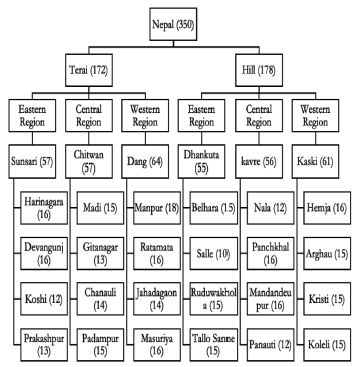
Following a multi-stage sampling technique, we divide the hill region into three sub-regions (Eastern, Central, and Western) in the first stage. In the second stage, one district from each sub-region is selected. In the third stage, we select four villages from each district. While selecting the districts, we ensure that the agro-climatic conditions of the respective regions are well represented. Further, the villages are selected in a manner so that they represent the socio-economic features and agricultural practices of the districts. At the final stage, we select 10% of the households in a village that either own or/and operate on land by using a simple random sampling technique. A similar process has been followed in the plains to identify the sample households. While Dhankuta, KZavre, and Kaski districts have been selected from the hills, Sunsari, Chitwan, and Dang districts have been selected from the plains. In this way, we have a total of 350 households in our sample that represent the geographical scope of the study. These households have been interviewed using a structured questionnaire. Figure 1 summarises the multi-stage sampling procedure.
Sample Design.
Methodology
We begin our analysis by examining the incidence and forms of the tenancy contract at national, regional, and district levels using two indicators of tenancy. These indicators are the percentage of households leasing in the land and the percentage of leased-in area in total operational holding. The key socio-economic characteristics of lessor and lessee households, such as education, ethnicity, occupation, and migration status, are then analysed to understand the association of these household characteristics with the land leasing decision. The final part of the analysis involves estimating a both-sided censored Tobit regression model that identifies the factors influencing households’ land leasing decisions.
The dependent variable in the regression equation is an index that captures the magnitude and intensity of tenancy. Following Goswami & Bezbaruah (2013) and Goswami (2018), we formulate the index as follows 1 :
The index (Y) is the difference between the operational and ownership holdings divided by their combined total. This index reflects the magnitude and intensity of tenancy by considering both the ownership and operational holdings. It automatically includes information about the owned, leased-in, and leased-out land areas.

where, Y∈ [–1,1]
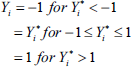
The value of our dependent variable (Y) lies between -1 and 1. For a pure lessor, the value of Y is –1. On the other hand, the value of Y is 1 for pure tenants and 0 for owner-operator households. While the owner-operator-cum lessor households have a value between –1 and 0, the index takes values between 0 and 1 for owner-operator-cum tenants. Given that the dependent variable (Y) is restricted within the range of –1 and 1, using the ordinary least squares method to estimate the model is inappropriate as the predicted values may not lie within the range. Instead, the double-censored Tobit model is considered appropriate in the present context. The double-censored Tobit model handles situations where the dependent variable is constrained within certain limits- in our case, between -1 and 1. This regression model accounts for these bounds by censoring the predictions at the lower and upper limits (Greene, 2003). The double-censored Tobit model uses the latent variable, as in equation 1, which might take any value but cannot be observed.

where Xi is the set of explanatory variables, and Ui is the random disturbance term.
The observed dependent variable
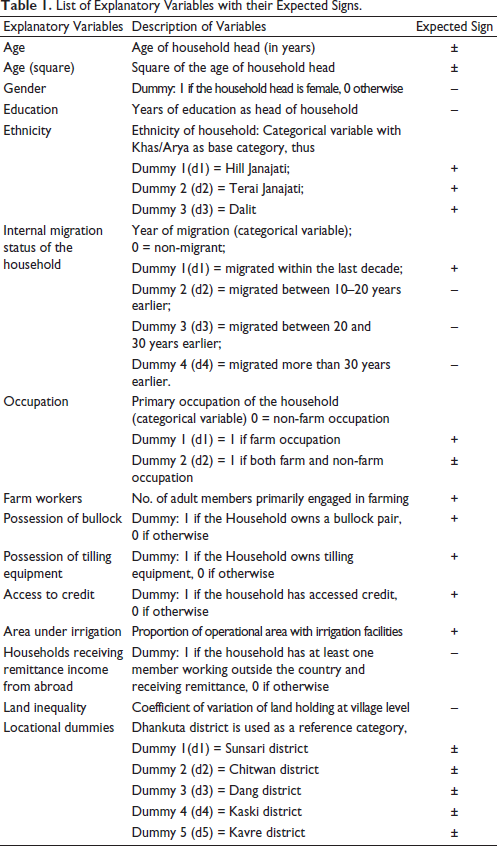
We use Stata 17 to obtain the maximum likelihood estimates of the parameters. Table 1 lists the set of explanatory variables (
List of Explanatory Variables with their Expected Signs.
Results
Distribution of the Landholdings
Table 2 shows the distribution of land ownership in terms of holdings and area. Overall, landless (11.43%), marginal (16.29%), and small (51.14%) holders constitute 78.86% of the sample households who own less than 40% of the owned area. In contrast, the proportions of medium (14.29%) and large (6.86%) holders are smaller, though these two categories of households own a larger share of the sampled owned land (about 60%). These figures indicate the inequality in land ownership, which is also reflected in the high value of the Gini coefficient (0.57).
Distribution of Ownership Holdings and Area Owned (in %).
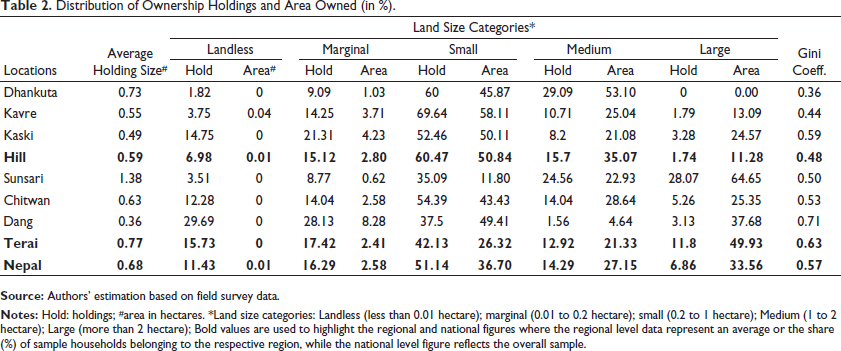
However, considerable variations exist in ownership holdings and areas owned across hills and plains, as well as within hills and plains in terms of shares of different land size categories, average size of holding, and inequality of land holding. The inequality in land ownership is higher in terai (Gini coefficient = 0.63) than in hills (Gini coefficient = 0.48). The incidence of landlessness and the average landholding size are also higher in terai than in hills. While 15.73% of the sample households are landless in Terai, the corresponding figure in hills is 6.98%. On the other hand, the average landholding size in Terai is 0.77 ha, which is 0.59 ha in the hills. Although the smallholder category is dominant across plains and hills, the share of this category in hills is much higher than that in plains. This category constitutes 60.47% of the total ownership holdings that own 50.84% of the sampled owned land in the hills. The corresponding figures in plains are 42.13% and 26.32%, respectively. There is a striking difference between hills and plains regarding the share of the large holder category. While the share of the large category in total ownership holdings in Terai is 11.8%, this category constitutes only 1.74% in the hills. The large holders own 49.93% of the sampled area in Terai, whereas the same category owns only 11.28% of the owned areas in the hills.
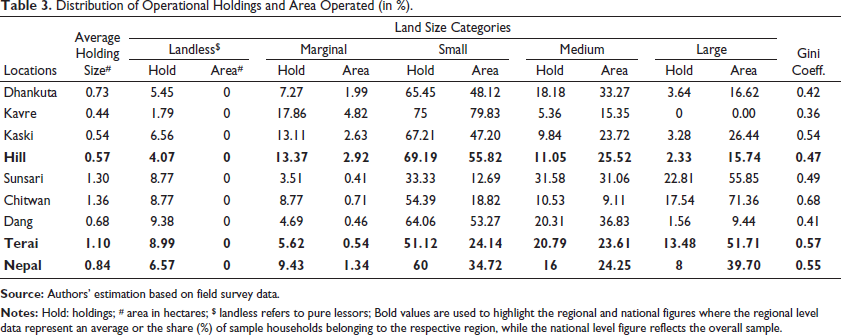
Table 3 shows the distribution of operational holdings and areas operated in the field study locations. Overall, operational holdings’ distribution is similar to ownership holdings. Small and marginal farmers comprise 82.56% of the operational holdings but operate on only 59% of the farmlands. On the other hand, medium and large farmers constitute 24% of the operational holdings and operate on 64% of the sampled land. The Gini coefficient of the distribution of operational holdings is slightly lower (0.55) than that of ownership holdings (0.57), and the average size of operational holdings (0.84 hectares) is slightly higher than that of ownership holdings (0.68 hectares). As in ownership holdings, substantial variations exist across hills and plains and within hills and plains regarding shares of various size categories, average size of operational holdings, and inequality in operational holdings.
Distribution of Operational Holdings and Area Operated (in %).
Incidence and Magnitude of Tenancy
Table 4 displays the distribution of sample households based on their tenure status. The households have been categorised into five groups, namely, pure tenant, owner-operator-cum-tenant, owner-operator, owner-operator-cum-lessor, and pure lessor 2 . Overall, the ‘owner-operator’ is the dominant group (39.71%), followed by ‘owner-operator-cum-tenant’ (30%), ‘owner-operator-cum-lessor’ (12.57%), ‘pure tenant’ (11.14%), and ‘pure lessor’ (6.57%). Given this categorisation, it is evident that the incidence of tenancy is relatively high. The proportion of sample households that leased in land is 41.14% (pure tenant and the owner-operator cum tenant together). The incidence of tenancy is higher in Terai (48.88%) than in the hills (33.14%). Among the field study locations, the prevalence of tenancy is the highest in Dang (68.75%), followed by Chitwan, Kaski, Dhankuta, Sunsari, and Kavre.
Distribution of Sample Households by Tenure Status (in%).
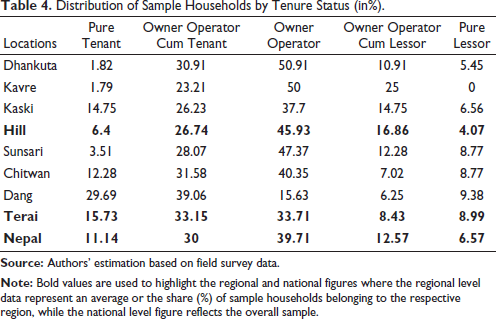
Table 5 shows the prevalence of tenancy in terms of the share of leased-in areas in total operational area. Overall, though most of the operated area is under owner-operation (54.33%), the share of the leased-in area is also substantial (45.67%). The proportion of leased-in area is higher in terai (54.49%) than in hills (28.06%). Among the field study locations, the proportion of leased-in areas is the highest in Dang (75.89%), followed by Chitwan (69.49%), Kaski (38%), Sunsari (26.28%), Dhankuta (25.75%) and Kavre (18.52%).
Percentage of Leased-in and Owner-operated Area in Total Operated Area.
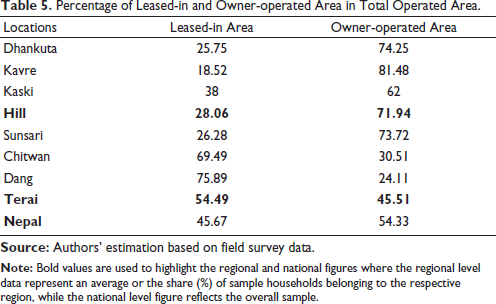
Tables 4 and 5 provide evidence of Nepal’s wide prevalence of tenancy. While 41.14% of the sample households cultivate on leased-in land, the share of leased-in land in the total operated area is 45.67%. These figures, regarding the shares of tenant households and leased-in areas, suggest that tenancy is more prevalent in terai than in hills. Further, considerable variations in the prevalence of tenancy are visible across the field study locations. Both in terms of the shares of tenant households and leased-in areas, Dang (68.75%) has the highest prevalence of tenancy, followed by Chitwan (43.86%) and Kaski (40.98%).
Forms and Pattern of Tenancy Contracts
Table 6 presents the forms and patterns of tenancy contracts among tenant households. Notwithstanding locational variations, fixed-rent and sharecropping are Nepal’s two predominant forms of tenancy contracts. While 45.7% of tenant households leased in land under fixed-rent contracts, 42.38% of such households leased in under sharecropping. The percentages of tenant households leased in land under terms such as mortgage, others, and mixed tenancy are only 4%, 3%, and 5.3%, respectively 3 . Further, Table 6 indicates that within fixed-rent contracts, the cash payment mode (40.4%) is more dominant than the payment-in-kind (5.3%) mode 4 . On the other hand, within sharecropping contracts, the most prevalent variant is cost-sharing (27.81%), wherein the costs of major inputs such as fertilisers and seeds are shared between the tenant and the lessor.
Location-wise Pattern of Tenancy Contract: Tenant Households by Terms of Lease.
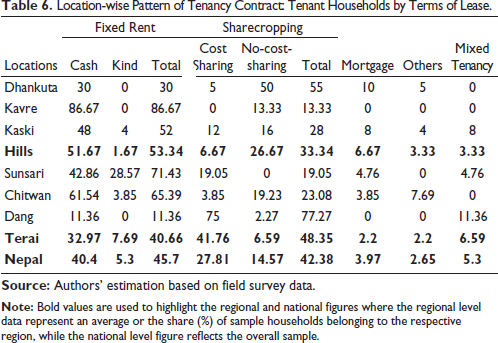
Table 6 shows substantial variations across field study locations regarding the prevalence of various forms of tenancy contracts. While fixed rent is the predominant form of tenancy contracts in the hills, sharecropping is the major form in Terai. Further, while cost-sharing is the dominant form of sharecropping contract in Terai, no-cost-sharing is the main form in the hills. However, rent in cash is the most preferred form of tenancy contract within fixed rent across hills and terai. The variations in the forms of tenancy contracts can also be found across various field study locations. A fixed rent in cash is the most dominant form of tenancy contract in all but Dhankuta and Dang Districts. While sharecropping with cost-sharing is the major form of tenancy contract in Dang, the no-cost-sharing sharecropping arrangement is widely prevalent in Dhankuta.
Table 7 shows that fixed rent, especially fixed rent in cash, is the major tenancy contract in terms of the area under the lease. Overall, 67.59% of the leased-in area is under fixed rent. The area under sharecropping is only 28.19%. This pattern can be observed across hills and terai. The variations in area under lease across field study locations show a similar pattern as those in tenant households in Table 6.
Pattern of Tenancy Contract: Area by Terms of the Lease (% of Total Leased-in Area).
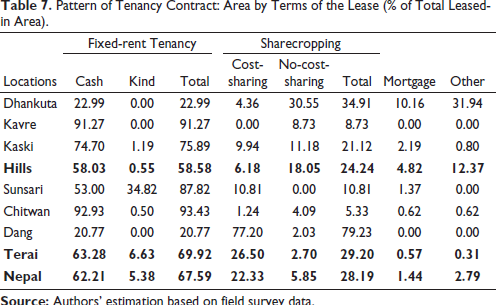
Although the difference is more significant regarding the area, Tables 6 and 7 show that fixed rent is Nepal’s predominant tenancy contract form. About 45.7% of tenant households leased-in land under fixed-rent contracts and operated on 67.59% of the total leased-in land. On the other hand, 42.38% of the tenant households are sharecroppers, and they operate on only 28.19% of the leased-in area. However, the prevalence of tenancy contracts across field study locations is not uniform.
Factors Affecting Land Leasing Decision
The regression analysis results that identify the factors affecting the leasing decision of households are presented in Table 8. The estimated results show that duration of internal migration, education of the head of the household, primary occupation, ethnicity, possession of bullock pair, area under irrigation, number of farm workers, access to credit, inequality of land holdings, and locational characteristics have significant impact on the leasing decision of the households. On the other hand, the age and gender of the household’s head, possession of tilling equipment, and status of international migration do not impact the leasing decision.
Tobit Regression Results: Factors Affecting Leasing Decision.
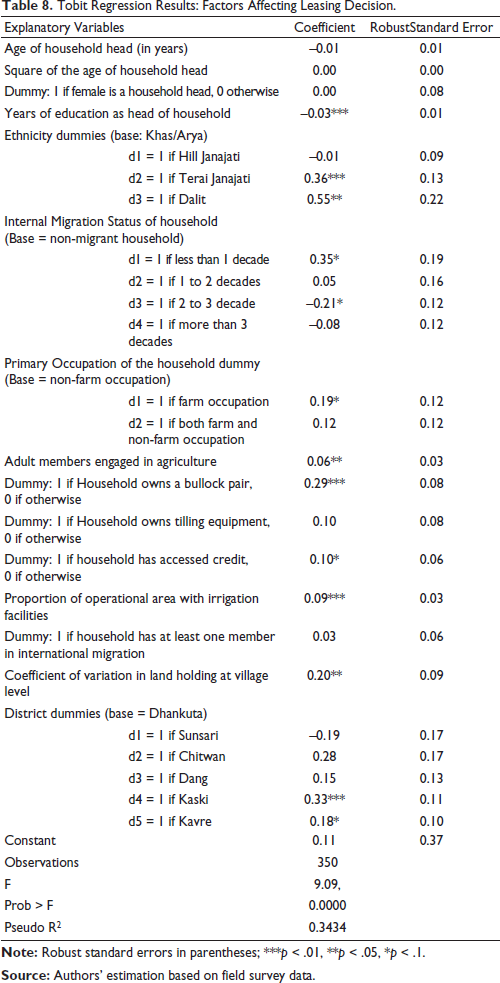
The coefficient of the ‘dummy for internal migrant households who migrated to their current residence within the previous decade’ is positive and significant at a 10% significance level. However, the dummy for ‘internal migrant households who migrated two decades earlier’ has a negative and significant coefficient (at a 10% significance level). Thus, these findings suggest that the migration history of the household plays a role in their decision to lease in or lease out land. While recent migrants are more likely to lease land than non-migrants, the early migrants are more likely to lease out land. The results show that the coefficient of ‘years of education’ is negative and significant at a 1% significance level, indicating that households tend to lease out the land as the education level increases. As for occupation, the dummy for ‘farming as the primary occupation’ is positive and significant at a 10% level. This suggests that households whose primary occupation is farming are more likely to lease land than those primarily engaged in non-farm activities.
The ‘number of agricultural workers’ coefficient in a household is positive and significant (at a 5% level), implying that households with more agricultural workers are more likely to lease the land. The coefficient of the ‘ownership of the bullock pair’ is positive and significant at a 1% level of significance. This indicates that households who own bullock pairs are more likely to lease land compared to those who do not possess bullock pairs. As hypothesised, the coefficient of ‘area under irrigation as a proportion of operational holding’ is positive and significant at a 1% significance level. This result suggests that households with a higher share of irrigated land in operated areas are likely to lease in land. The dummy coefficient for ‘access to credit’ is positive and significant, implying that households with access to credit are more likely to lease land compared to those households who do not have access to credit. The estimated result shows that the ‘inequality in land holding’ coefficient is positive and significant. This implies that a household located in a village where the inequality of land holding is high is more likely to lease in the land than a household located in a village with a relatively even distribution of land holdings.
The coefficients of dummies for ‘Terai Janajati’ and ‘Dalits’ are positive and significant, which suggests that households belonging to these ethnic categories are more likely to lease land compared to the base category Khas/Arya households. Finally, the regression results suggest that the ‘locational dummies’ coefficients are significant only for Kashi and Sunsari districts. While the coefficient of the locational dummy for the Kaski district is positive and significant, it is negative and significant for the Sunsari district. In other words, a household in the Kaski district is more likely to lease land than one in the Dhankuta district. The opposite is true in the case of Sunsari district.
Discussion of the Results
The results show that landless, marginal, and smallholders constitute 78.86% of the sample households and own less than 40% of the owned area. In contrast, the relatively small proportion of medium and large holders own a larger share of the sampled owned land (about 60%). These figures indicate a preponderance of smallholders, and Nepal’s inequality in land ownership is high (the Gini coefficient is 0.57). A similar pattern can also be observed in the case of operational holdings. Further, substantial variations exist in the distribution and inequality of land ownership and operational holdings across locations.
Tenancy is widely prevalent in Nepal. Our data show that 41% of sample households leased in land, constituting about 46% of the total area under operation. Our findings, though limited to six selected districts, document a much higher incidence of tenancy than what is revealed in the most recent publicly available official report. According to the Agricultural Census 2011, tenant holdings constituted only 15.38% of the total holdings, and leased-in areas accounted for only 11.74% of the total operated area (Central Bureau of Statistics, 2013a). The fact that secondary data underreport the incidence of tenancy has already been illustrated in the literature (Dhakal, 2011). Dhakal (2011) also reported that tenancy was largely informal or concealed. The lessors did not want formal tenancy contracts. They feared that formal disclosure of tenancy (especially sharecropping) might make it legally binding for them to give ownership rights to their tenants (Dhakal, 2011).
This study finds that sharecropping and fixed rent are Nepal’s primary tenancy contracts. Here again, contrary to the official statistics, the study finds the fixed rent tenancy predominant. For example, the Agricultural Census 2011 found that about 56% of the tenant households leased in land under sharecropping, and only 19.1% of the leased-in land was under fixed rent contracts (Central Bureau of Statistics, 2013a). The current study shows that about 45% of tenant households are fixed-rent tenants, and 42.38% are sharecroppers. Regarding the area, our finding shows fixed-rent to be the major contract, with 68% of the total leased-in area under it, and only 28% of the leased-in area is under sharecropping.
The figures in Tables 6 and 7 show that while fixed-rent tenancy is widespread in Chitwan, Kaski, Sunsari, and Kavre districts, sharecropping is predominant in the Dang and Dhankuta districts. We explain the variations in the prevalence of sharecropping and fixed-rent across locations in terms of the location-specific cropping patterns. Table 9 reveals that winter paddy is the most widely cultivated crop across regions in Nepal, covering about one-third of the total cropped area, followed by maize (15.53%), summer vegetables (10.26%), fruits and high-value crops (9.27%), winter vegetables (5.92%), wheat (5.87%), legumes (5.73%), mustard (5.36%), potato (5.36%), and fodder grass (2.69%). Table 9 further reveals that, except for the Sunsari district, the locations with a higher prevalence of fixed-rent tenancy are also the locations where the combined share of cash crops such as summer vegetables, winter vegetables, potatoes, fruits, and other high-value crops is higher than that of cereal crops such as winter paddy, maize, wheat, and others cereals 5 . On the other hand, cereal crops are primarily cultivated in locations where sharecropping is the major form of tenancy. For instance, the share of cash crops in total cropped area is much higher in Kaski (49.11%), Chitwan (46.91%), and Kavre (42.32%) than in that in Dhankuta (23.91%) and Dang (6.12%). In contrast, the share of cereal crops in the total cropped area in Chitwan (41.6%), Kaski (43.78%), and Kavre (51.86%) is significantly lower than that in Dang (77.42%) and Dhankuta (69.51%).
Cropping Pattern Across Locations (% of Total Cropped Area Under Different Crops).
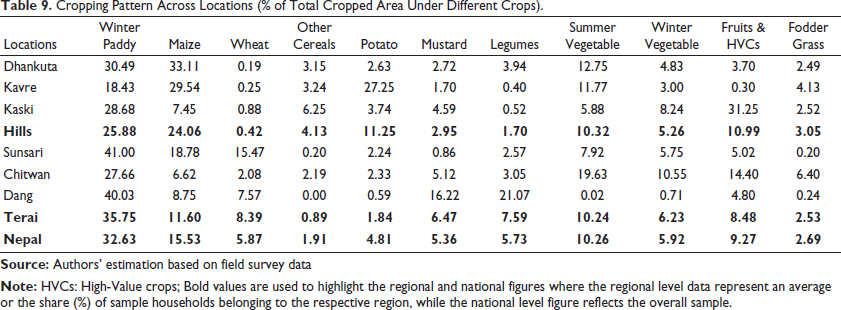
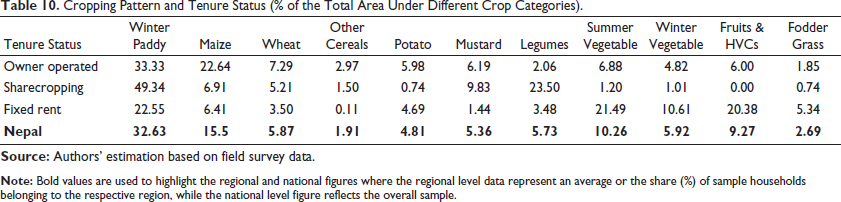
Table 10 features the cropping pattern across tenure status. In conjunction with Table 9, we see in Table 10 that the combined share of cereal crops is much lower in the plots operated under fixed-rented (32.57%) compared to that under sharecropping (62.36%) and owner-operated plots (66.23%). Conversely, the combined share of cash crops is significantly higher in fixed-rent plots (57.17%) than those in owner-operated (23.68%) and sharecropped plots (2.95%). Thus, it becomes clear that while fixed rent is preferred when tenants lease land to cultivate cash crops, sharecropping is the preferred form of tenancy contract when tenants cultivate cereal crops like winter paddy.
Cropping Pattern and Tenure Status (% of the Total Area Under Different Crop Categories).
The reason for preferring sharecropping for cereal crops and fixed-rent for cash crops, such as vegetables and high-value fruits, and the presence or absence of weather risk is associated with the cultivation of these crops. Winter paddy, the most popular cereal crop among sharecroppers, is planted during the monsoon season and is exposed to weather-related risk and uncertainty (Goswami & Bezbaruah, 2013). Sharecropping allows the tenants to not only share the output but also the production risk. Consequently, the tenants prefer to lease land under sharecropping while cultivating crops like winter paddy. However, this is not the case with cash crops like fruits and vegetables exposed to relatively low weather-related risks (Goswami & Bezbaruah, 2013).
The low level of weather risk incentivises the tenants to cultivate high-yielding varieties and apply purchased inputs like fertilisers, pesticides, and irrigation that further minimise production risk and increase production, productivity, and returns. Under such circumstances, tenants are motivated to grow these crops for markets, and they prefer fixed-rent contracts that allow them to retain the entire return. These crops are perishable, so landlords prefer to receive the rent in cash when leasing land to cultivate such crops. Further, many of these landlords are erstwhile owner-operators who used to cultivate cereal crops. These landlords with prior experience cultivating cereal crops can supervise the work of their tenants if they cultivate cereal crops. However, monitoring the more labour-intensive and complex cultivation process of fruits and vegetables is challenging for them. A fixed-rent contract allows them to avoid the responsibility of monitoring the cultivation of such crops. Goswami and Bezbaruah (2013) also reported similar findings in the context of Assam in India.
It should, however, be noted that winter paddy (22.55%) and other cereal crops (10%) constitute a sizeable portion of the cropped areas under fixed rent. The concern for food security may be the reason for devoting land to cereal crops even under fixed rent. Cultivation of cereal crops is a strategy rural households choose for self-sufficiency as cereals, especially rice, are the staple food of Nepalese households. This strategy enables them to meet their food requirements without relying heavily on external sources. It also provides resilience against natural disasters and market fluctuations (Barlett, 1980; Scott, 1976; Wharton, 1971). Holmelin (2021) documented subsistence farming as a self-sufficiency and shock resilience strategy among Nepal’s rural households. The fact that only a few sharecroppers and fixed-rent tenants sold paddy in the market indicates that regardless of the tenancy forms, farmers mainly grow cereal crops to ensure the households’ food security. Even the landlords in sharecropping contracts prefer to receive rent as paddy to fulfil their requirements.
The regression analysis shows some interesting results. We find that, among the internal migrants, while the early migrants are likely to lease out, the late migrants are more likely to lease in land. James and Roumasset (1984) found a similar result in their study on the evolution of tenure contracts in Palawana, Philippines. They argued that the early migrants were comparatively in a better position before migrating. They had resources and could afford the risk of migrating to a new place where, whereas the late migrants had fewer resources to start with and were primarily dependent on early migrants to work as wage workers or as tenants. In a study on the Government’s land resettlement plans in Nepal’s Chitwan and Nawalparasi districts, Shrestha (1989, 2001) documented that the early migrants (who arrived before 1965) were more successful in acquiring larger tracts of land than those who migrated in the latter two decades (1966–1975 and 1976–1988). Shrestha (2001) also noted that those who migrated early were resourceful households who could afford the risks of early settlement. Shrestha (2001, p.181) discussed the ‘preemptive advantage’ that early migrants could harness due to the abundance of virgin land in the early phases of the resettlement plan. The government provided lands in grants and also allowed to clear forests for settlement and cultivation purposes. However, the pressure on existing land increased as the population grew due to further migration and natural births. The later migrants could acquire land for cultivation through outright purchase or lease. However, the population pressure on land and improvements in land quality resulting from farming by early settlers led to a rise in land prices, making it impossible for the late migrants to purchase land. Thus, to sustain in their new settlement, late migrant households picked up farming on leased-in land as a primary source of livelihood or as a secondary occupation to diversify their livelihood strategies.
The findings also show that the household head’s education (years of education) negatively and significantly affects households’ leasing decisions. Households headed by an educated head are likely to lease out land. Existing literature supports our finding that education creates an aversion toward agriculture (Bliss & Stern, 1982; Goswami & Bezbaruah, 2013; Kimura et al., 2011; Kuri, 2003; Zhou & Chi, 2022). Educated households tend to leave farming and engage more in non-farm activities. The regression result also confirms that households primarily engaged in non-farm occupations are likely to lease out land compared to those primarily engaged in farming. This is obvious as households with non-farm as a primary occupation would like to release labour and other resources from agriculture to be utilised more effectively in the non-farm sector (Goswami, 2018).
The regression analysis results show that households with more adult farm workers and bullock pairs are likely to lease in land. The possession of more farm workers and bullock pairs allows the households to expand the scale of operation by leasing the land. Muraoka et al. (2018) and Ayaz and Mughal (2024) also found that having more family labour helped a household to expand the scale of farming activities besides ensuring better utilisation of the existing land and other resources. The estimated results also suggest that households having access to credit and a higher share of irrigated land in the total operated area are more likely to lease in land. Li et al. (2020) also reported that access to credit increased the likelihood of leasing in land in rural China. On the other hand, Mandal et al. (2019), in their study in Uttar Pradesh, India, documented that households with a higher proportion of irrigated land were more likely to lease additional land. Access to irrigation and credit are essential for expanding and intensifying farming. Farmers with access to these inputs can scale up cultivation using better-quality inputs.
As for the implication of the ethnicity of a household for leasing decision, regression results show that Terai Janajati and Dalits are more likely to lease in land compared to the dominant Khas/Arya group. This is a common finding in several works in Nepal and India, where the ethnicity/caste dynamics are more or less similar (Adhikari & Hobley, 2015; Sunam, 2014; Sunam & McCarthy, 2016). Historically, Dalits and other low-caste groups have been marginalised and excluded from land ownership due to the caste system and discriminatory land policies (Sunam, 2014). In the context of our sample, 90% of the landless households belong to Dalits and other lower ethnic strata of the society. These households can only access land for cultivation through rental arrangements.
Locational characteristics are also important determinants of leasing decisions. The results show that a household is likely to lease in land if the inequality of land holding is high at the village level. Inequality of land holdings implies a mismatch in factor endowments. If only a handful of people own land in a village, rental arrangements become the natural way for most rural households to access land for cultivation. As for the locational dummies, the coefficient of the dummy for the Kaski district is estimated to be positive and significant, which implies that households in the Kaski district are more likely to lease in land than those in the Dhankuta district. Pokhara, a metropolitan city in Kaski, provides a market to the farmers in the neighbouring villages that fetch remunerative prices for agricultural products. Consequently, the small and marginal farmers in these villages find it a profitable livelihood strategy to lease in land. Dhankuta does not offer any such advantage. On the other hand, a negative and significant coefficient of the dummy for Sunsari district indicates that households in Sunsari are more likely to lease out land than their counterparts in the Dhankuta district. The substantially higher concentration of large landowners in the Sunsari district may be the possible reason for such a finding.
Conclusion and Policy Implications
This article explores the existing agricultural land rental arrangements in Nepal and analyses the factors influencing the land leasing decisions of rural households. Using data from a primary survey of 350 households in six districts of Nepal, the study shows that tenancy is widely prevalent in Nepal. While more than 41% of sample households are tenant households (pure tenants and owner-cum-tenants households combined), about 46% of the total operated area is under lease (Refer Table 2). Sharecropping and fixed-rent are two predominant forms of rental arrangements, although the fixed-rent contract has more leased-in areas than sharecropping. While rent in cash is found to be a more dominant arrangement within fixed rent, cost-sharing arrangements between tenants and lessors within sharecropping are more popular. There are, however, substantial variations in the incidence and forms of tenancy arrangements across locations. The variations in the forms of tenancy contracts across locations have been explained in terms of the location-specific cropping patterns.
Compared to non-migrant households, we find that early internal migrants are more likely to lease out land, whereas late internal migrants are more likely to lease in land. This contrasting tendency can be attributed to the preemptive advantage that the early migrants usually enjoy. The early migrants benefitted from the government-supported land resettlement plan. Under the land resettlement plan, early migrants became owners of larger plots, which they eventually leased out to the late migrants. Late migrants, on the other hand, faced challenges in acquiring ownership of land because of population pressure on land and the resulting very high land prices in recent decades. Apart from the status of internal migration, we find other socio-economic factors, namely, education level of the head of the household, ethnicity, primary source of livelihood, number of farm workers, ownership of a bullock pair, access to credit, proportion of operated area under irrigation, unequal land distribution, and locational characteristics to be important determinants of households’ leasing decisions.
The findings suggest that if the head of the household has a higher level of education, it increases the likelihood of that household abandoning farming by leasing out land. This result suggests that with the increase in education among the rural population, there will be more land supply in the land lease market. We also find that households in a village set-up where the inequality of land holding is high are likely to lease in land. Inequality of land holding in Nepal, at least in the context of our study, is high. Because of the high inequality of land holding, more land to lease in is desired. The challenge, however, will be to ensure efficient use of this land.
Nepal’s current institutional setup challenges efficiently utilising a substantial portion of arable land. Out of the total arable land area, only approximately 75% is formally registered in the land administration system. The remaining 25% of arable land falls outside the formal cadaster, spreading over an estimated 10 million parcels. The prevailing tenure system on these parcels of land is predominantly non-statutory or informal (Government of Nepal et al., 2018). This implies that a substantial portion of the population resides or cultivates on land parcels that lack spatial recognition and have no security of tenure. Without legal protection, families with informal land tenure constantly face the threat of eviction. The informal land tenure system not only prevents the formal transfer of land titles but also poses obstacles to agricultural investments, accessing credit facilities and government assistance at times of disaster, and complicates the functioning of the land lease market.
The Land Act of 1964 is a major legal framework influencing Nepal’s tenancy relationship terms. The fourth amendment of this act in 1997 wanted to grant the registered sharecroppers, who have cultivated leased-in land for at least an agricultural year, an entitlement of 50% of the land under the tenancy. All tenancy relationships were to be registered within a time frame of six months after the amendment. The aim was to eliminate the dual ownership of land under sharecropping within two years from the date of the fourth amendment. However, only 10% of 4,70,000 registered sharecroppers could secure their share of the land by the end of 2019 (Deuja, 2019). Since dual ownership persists, landlords and tenants face difficulties exercising their property rights over the land, using land as collateral to access credit, transferring ownership title, or utilising their share of the land as they desire (Deuja, 2019, 2023). The Land Use Policy 2019 also aims to end dual land ownership.
Although the legal provision of sharing the ownership rights of leased-in land is not applicable in the case of a sharecropping contract that has been agreed upon after the fourth amendment, a large section of contemporary landlords remains hesitant to engage in a written contract and get it registered in the local bodies (Adhikari, 2019, 2022; Wily et al., 2008). Despite the legal protection, the fear of losing land looms large among the landlords due to political reasons. During the decade-long civil war (1996–2006), the rebel group promised to ensure that the tenants get their rights, including land ownership. This sentiment may not have withered away yet. The election manifestos of the major political parties and their leaders continue to advocate for ‘scientific land reform’, akin to the classical land reform measure of transferring ownership rights (Adhikari, 2022; Dhakal, 2011, 2018). Consequently, those who lease out land are reluctant to register the tenancy contracts for fear of losing the ownership of their land (Wily et al., 2008). In other words, tenancy relations have become largely informal or concealed 6 . Further, owing to the same issue, a lessor does not want to lease out land for an extended period to the same tenant (Wily et al., 2008) 7 . The shortening of the duration of tenancy contracts and concealed tenancy are two unwarranted outcomes of the perceived narrative around land tenancy.
While concealed tenancy makes it impossible for sharecroppers to claim protection under the law that regulates rent and forced eviction, short contract duration discourages investment in soil productivity and health by tenants. Even the fixed-rent contracts are mostly verbal, and those few written ones are not registered. A written and registered contract protects the landlord and tenant’s interests. Furthermore, a registered and written tenancy contract facilitates tenants’ access to credit, crop insurance, and government-sponsored grants for agriculture (Wily et al., 2008). It may be mentioned here that although sharecropping is illegal, a sharecropper does not get the same recognition as a registered fixed-rent tenant. While a registered fixed rent tenant can access credit and other benefits from the government using the contract document, the same does not apply in the case of a sharecropper. It is imperative to rectify this disparity. Given these complexities, this study emphasises the urgent need to address the issues associated with informality in landholding, efficiently and effectively eliminate dual ownership of land, and foster a political consensus for implementing the existing tenancy laws. Policymakers should focus on facilitating the smooth functioning of the land rental market, which will improve the access of land-scarce households to land. The Nepal government’s 2020–2021 fiscal budget, which includes creating a land bank to facilitate user rights distribution, is a positive step in that direction.
Footnotes
Annex:
Declaration of Conflicting Interests
The authors declared no potential conflicts of interest with respect to the research, authorship and/or publication of this article.
Funding
The authors received no financial support for the research, authorship and/or publication of this article.