



Abstract
Persistence of sharecropping tenancy, and increases in farm productivity resulting from regulations protecting tenant rights have been observed in many developing countries. This paper examines if these can be explained by alternative models of sharecropping with two sided efforts/investments, namely, complete contract models, either without wealth constraints (Eswaran-Kotwal, 1985) or with a wealth constrained tenant (Mookherjee, 1997; Banerjee-Gertler-Ghatak, 2002), and incomplete contract holdup models without wealth constraints (Grossman Hart, 1986). In the absence of wealth constraints, the complete contract model always results in (incentive constrained) surplus-maximizing productivity; thus, there can be no scope for tenancy regulations to raise productivity. In the incomplete contract model, tenancy regulations would raise productivity only if the tenant’s investments are more important than the landlord’s investment. But in that case, sharecropping tenancy would not persist in the absence of wealth constraints, as the tenant would have purchased the land right ex ante from the landlord. The model with wealth constraints helps explain both the persistence of tenancy and the productivity/surplus enhancing effects of tenancy regulations.
Introduction
The widespread prevalence of sharecropping tenancy in agriculture-where a landlord leases land to a tenant for cultivation, with rent payments varying based on actual output—has puzzled economists since the time of Adam Smith. Sharecropping, akin to an income tax, presents well-known incentive issues that can lead to reduced productivity. So, why does this practice not only exist but also persist? What factors determine the choice between sharecropping and alternative methods of organizing agricultural production, such as fixed rent tenancy (where the tenant pays a fixed, rather than variable, rent), self-cultivation (where the landlord personally tends to the land) or cultivation with wage labour (where the landlord coordinates production and employs workers at a fixed wage to assist with cultivation)?
Subsequent theoretical work has aimed to elucidate the economic institutions of production as constrained optimal contractual responses to issues stemming from incomplete markets and informational asymmetries. 1 This paper revisits one of the classic papers in this literature by Eswaran and Kotwal (1985; hereafter EK).
A pivotal innovation in EK was their emphasis on the fact that farming entails not only the task of cultivation itself but also the management of related productive inputs. These inputs encompass activities such as selecting crops and cropping methods, acquiring quality seeds, fertilizers, irrigation, and marketing the crop. Both management and cultivation tasks could be undertaken by either the landlord or the cultivator, resulting in three possible organizational alternatives: where both tasks are handled by either the landlord or the cultivator, or through a partnership where each specializes in one of these tasks.
Their theory offers a range of organizational alternatives by combining these options with various contractual arrangements for sharing the output. Sharecropping tenancy is one of these alternatives where the landlord specializes in management and the cultivator in cultivation, and financial transfers between them are contingent on realized outputs. Their explanation for the prevalence of sharecropping tenancy is rooted in the idea that the landlord and cultivator each possess a comparative advantage in management and cultivation tasks, which motivates a partnership model. Additionally, in the presence of moral hazard, where the inputs provided by either party are not observable by the other (or by third-party contract enforcers), sharecropping can emerge as the optimal contract. This arrangement ensures that each agent is appropriately incentivized to deliver their assigned input.
The EK theory presented a simple and tractable explanation of sharecropping, one that remains valid even in a world where both parties are risk neutral. This stands in contrast to the prevailing explanation, which depends on a trade-off between incentives and risk-sharing (as in Cheung, 1969; Stiglitz, 1974). It is worth noting that their theory extends its relevance beyond the realm of agriculture. It applies to various contexts, including joint ventures and partnerships among firms in the industry, as well as contractual arrangements for the procurement of inputs by firms or governments from other firms.
This essay provides a critical examination of their theory while considering various extensions and drawing connections to our own research on agricultural tenancy (Mookherjee, 1997; Banerjee et al., 2002; henceforth referred to as MBGG). While EK primarily focused on explaining alternative forms of agricultural organization based on the characteristics of the production process, underlying information and incentive problems and the opportunity costs of landlords and tenants’ time, which in turn reflects the relative scarcity of land and various types of labour inputs, our own work had a distinct focus. We concentrated on assessing the productivity effects of land or tenancy reforms. Implicit in our work were questions related to optimal ownership of assets: If empirical evidence indeed suggests that land or tenancy reforms can enhance output, why wouldn’t the tenant opt to purchase the land? This theme touches on a fundamental question at the core of another branch of literature in the economics of organization, namely the optimal ownership of assets. The canonical model in this domain is the Grossman-Hart-Moore (GHM) theory of property rights, founded on the concepts of incomplete contracts and hold-up (Hart, 1995). In this paper, we also endeavour to elucidate the interconnectedness between EK, MBGG and GHM.
After the production environment is laid out in the second section, the third section clarifies the role of moral hazard in the EK model by working out the implications of the case without any moral hazard. The fourth section replicates the EK model with moral hazard. We use the analysis to study the effects of tenancy reforms and show that the EK model cannot explain observed effects of tenancy regulations such as Operation Barga in West Bengal during the 1980s and 1990s, in contrast to MBGG.
A key difference between EK and MBGG is that the latter incorporates wealth constraints. On the other hand, MBGG abstracts from the coexistence of cultivation and management tasks. Hence, the two models are not nested. The fifth section develops a hybrid of the EK and MBGG models, which incorporates wealth constraints into the EK model and explains the observed outcomes of Operation Barga. This hybrid version enriches the MBGG model by additionally incorporating the co-existence of management and cultivation tasks, which enlarges the range of predictions of the MBGG model
Finally, the sixth section develops a GHM version of the EK model and examines its predictions for effects of Operation Barga. We find that the predictions of the GHM model are not consistent with the empirical findings in West Bengal. The reason is that in their model there are no wealth constraints and, so, if tenancy or land reform is productivity enhancing, then the land market would have taken care of the problem earlier, with the tenant buying off the land.
Environment: Technology, Payoffs and Organizational Forms
We consider a less-general production environment compared to the original EK model, mainly to simplify the exposition. The virtue of this more special environment is that it permits closed form solutions to optimal contracts and resulting welfare levels. Most of the qualitative results however do not depend on this specific formulation.
There is a fixed asset (e.g., a plot of land) whose productivity depends on two inputs: x and y. Think of these as management and cultivation tasks respectively. These inputs cannot be procured on competitive markets. Therefore, individuals need to provide these inputs on their own or get someone else to provide them with terms that they negotiate.
There are two individuals, A and B. A has a comparative advantage in supplying x and B has a comparative advantage in supplying y. 2 Each individual can provide both these non-marketed inputs on their own, or form a partnership where each person specializes in providing the input they have a comparative advantage in. 3
The advantage possessed by either individual appears in the productivity of their efforts, rather than the costs they incur in supplying the effort.
4
Independent of who is supplying the input, the costs of supplying x and y are assumed to be the same:

And if A provides x and B provides y then the total cost of the two parties is the same.
Output, however, depends on who is supplying the input. Let

We assume that

where
Under a partnership,

There is also a fixed asset needed for production, namely a specific plot of land, and one of the parties, say A, owns it. We refer to A as the landowner. We shall also assume that in all contractual negotiations, A has all the bargaining power. 5
If A carries out both tasks (we will refer to this organizational form as an A-type organization), then

If B carries out both tasks (we will refer to this as a B-type organization), then

Comparing these three expressions, it is clear that the parameter γ captures the extent of loss due to lack of specialization. We assume the same degree of loss due to lack of specialization under both arrangements for simplicity.
As in the ‘moral hazard in teams’ literature, there is no third-party ‘budget-breaker’, and the realized output must be divided between the two individuals. Let
An important assumption of the EK model is that there are no constraints on side payments between two individuals. Hence, there are no constraints on the choice of ex post payoffs
This set-up, while quite specialized, allows for a whole range of possibilities. For example, if any of the inputs are not important, we can set
Since both parties can provide both inputs, there can be three types of production organizations: A-type, where A provides both x and
First Best: The EK Model with no Moral Hazard
In the absence of any informational frictions, the inputs provided by each individual are publicly observable and can therefore be mandated by a contract. Then, there is no moral hazard problem in a partnership and the first-best outcome is achievable in any of the three organizational forms. Below, we work out the first-best outcomes for each form and then compare the resulting payoffs.
Owing to the linearity of payoffs in transfers and absence of any constraints on side payments, optimal contracts will maximize the expected value of the aggregate social surplus, that is, the sum of expected payoffs of the two individuals subject only to participation constraints. And owing to the requirement that the team’s budget must always be balanced, the expected aggregate transfer of the two agents equals the expected output. Hence, the maximand is expected production less aggregate input costs, which depend only on the levels of the two inputs chosen. In the following calculations, we initially ignore the participation constraints and later check whether they can be satisfied.
If a partnership is chosen, the first-best outcome is the solution to

which yields the first-order conditions

Since

The first-best social surplus under partnership (gross of the opportunity costs of A and B of participating in this activity) is
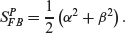
Let
Under an A-type organization, A will solve

which yields the first-order conditions

The social surplus (gross of opportunity cost of
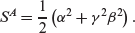
Under a B-type organization, B will solve

which yields the first-order conditions

The social surplus (gross of opportunity cost of B’s participation) is
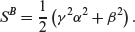
Clearly, if we continue to ignore the opportunity costs of the two parties from their outside options (which is legitimate if u and v are either 0 or close to 0), a partnership dominates A-type or B-type organization in terms of social surplus, because it harnesses the comparative advantage of the two parties in the two tasks.
Now, let us incorporate the participation constraints. Then the relevant maximand is the net social surplus, which subtracts opportunity costs of participation from the expressions for aggregate surplus derived above. Under (first-best) partnership, A-type and B-type organizations, taking into account the outside options of A and B, are



We assume that at least one of these expressions is strictly positive, as otherwise the activity would not be economically viable.
The condition for an A-type organization to dominate a B-type organization is

The condition for a B-type organization to dominate an A-type organization is when this inequality holds the other way:

The condition for a partnership to dominate both A-type and B-type organizations is

This condition is stronger than the ones relating to comparing A-type and B type organizations, since either
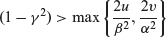
Even though it is quite simple, this model gives an intuitive set of predictions regarding the optimal organizational form in the absence of any frictions. The choice between A-type and B-type organizations turns on the relative importance of the inputs (α and β), the importance of comparative advantage

The effects are in the directions we would expect. For example, if the managerial inputs are more important than the cultivation tasks (
For a first-best partnership to dominate both A-type and B-type organizations, the conditions are more stringent: the productivity gains from exploiting comparative advantage relative to autarchy for a given input has to be higher than the opportunity cost of time of the party with the comparative advantage in that input, for each input separately. This means that if any of the two inputs are not very important in production (either α or β is low) then a partnership can never dominate an organization run on a sole-proprietor basis by one of the parties (the one whose input is not unimportant). If both inputs are equally important
It is interesting to note that while EK did not consider the first-best case, some of their predictions about when partnership will emerge versus either of the two pure organizational forms (owner farmer or tenancy) are very similar to what we get here. For example, in their analysis for higher values of γ too, either fixed wage or fixed rental contracts would dominate, while for lower values of γ, sharecropping would dominate. 7 Also, they too show that the more important an input becomes relative to the other, the parameter zone for partnership to emerge as the preferred organizational form shrinks relative to that of sole proprietorship by the specialist in that input. Similarly, the higher the opportunity cost of time of a party, the parameter zone for the specialist in that input to engage in sole proprietorship as opposed to partnership to be the preferred organizational form expands.
However, explaining the variation in the crop share was an important part of the EK analysis, and for that we need to introduce agency costs. This is because in a first-best world, any sharecropping contract generates the same aggregate surplus as an alternative contract where transfers to one of the agents is a constant, with the other agent picking up the residual, and the expected value of transfers is the same. So the first-best version cannot discriminate between wage cultivation, fixed rent tenancy and sharecropping.
We now return to the original EK model, where both x and y are unobservable and subject to moral hazard. This is similar to the model of moral hazard in teams (Bhattacharya & Lafontaine, 1995; Holmström, 1982). Output is
observable, but given that it is stochastic, the efforts cannot be directly inferred from output and an incentive contract has to be used under partnership. There tends to be an undersupply of effort by both individuals, as each neglects the benefits accruing to the other from raising effort. This problem does not affect the A-type or B-type mode, since the same individual selects both inputs and fully internalizes all the benefits arising from supply of each input.
Therefore, we focus below on the optimal contract in the partnership mode. The optimal contract will now be additionally subject to incentive compatibility (IC) constraints for both parties and will obviously generate lower aggregate net surplus compared to the first best. The conditions for the partnership mode to dominate either A - or B-type will now become more stringent. On the other hand, the outcomes of sharecropping, fixed wage and fixed rent contracts in a partnership will no longer be equivalent, thereby providing a nontrivial theory for either of these types of contracts to be optimal.
A contract is a pair
A ’s payoff in partnership under a contract

and B ’s payoff is
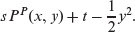
As one would expect, if we add the two payoffs, we get the total surplus (gross of the opportunity costs of the two parties).
The inputs x and y are assumed to be chosen simultaneously (as opposed to, say, A moving first). Then the ICs are as follows:


The optimal contract maximizes the payoff of A subject to the two ICs and the participation constraint (PC) of B. This reflects the assumption that A has all the bargaining power. As we shall explain below, this assumption is inessential in the absence of wealth constraints.
We now proceed to characterize the optimal contract

subject to


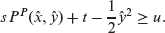
Substituting the values of

subject to

Since there are no restrictions on t, we can substitute its value from the PC into the objective function of A and rewrite the optimization problem as

Let

It is a globally concave problem, as
Therefore, the interior solution for s is

This can be interpreted as a sharecropping arrangement, which clearly dominates either a fixed wage or a fixed rent contract. As we would expect in this environment, the more important is a tenant’s input relative to that of the landlord, the higher is the former’s share. Note also that as one input becomes sufficiently more important relative to the other input (i.e.,
We still have to check conditions under which the partnership mode is viable and dominates either A - or B-type.
Plugging the expression for the optimal share into the objective function,

The social surplus (gross of the reservation payoffs of A and B) is

Let
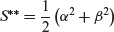
The fact that
Sharecropping is viable when
As A owns the land, under sharecropping he will earn a net surplus of
The partnership mode will be chosen only if

A direct comparison of the partnership mode and the A-type mode yields the following condition for

which simplifies to
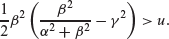
Recall that the corresponding condition under the first-best outcome was
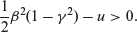
Similarly, comparing partnership with the B-type, we get the following condition for

which simplifies to
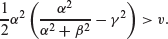
The corresponding condition under the first-best condition was
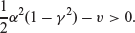
By combining these conditions for sharecropping to emerge in the second-best world as an optimal contractual form, we can express them as

The corresponding condition under the first-best outcome is
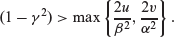
As expected, the condition for a partnership to emerge is more stringent than in the previous section when there were no agency costs associated with partnerships. That aside, the conditions have similar interpretation: if either α or β is too low, if γ is too high, or if u or v is too high, sharecropping cannot emerge.
Let us consider an illustrative example. Suppose
Introducing agency problems makes the choice of the crop share to be an important aspect of organization design and allows us to study how it is affected by the parameters. In our framework, the optimal share simply reflects the relative importance of the two inputs in the production process.
Predictions of Effects of Operation Barga
What does the EK model predict regarding the effects of tenancy regulations, of the kind embodied in Operation Barga, which was introduced by the Left Front government in West Bengal after coming to power in 1978? This reform offered tenants and landlords the opportunity to register their tenancy contract. Registered contracts were subject to a minimum share for the tenant, and restrictions were placed on the ability of the landlord to evict the tenant. Further details of this reform as well as empirical estimates of the reform on farm productivity are provided in Banerjee et al. (2002) and Bardhan and Mookherjee (2011). Both these papers found that productivity (measured by rice yields or farm value added per acre) rose as a result of the reform and that these effects were not restricted to farms where tenancy contracts were registered. This suggests that there were also many tenants who did not register their contracts, and in those farms also productivity rose.
Now let us examine what the EK model predicts would be the effect of a minimum share that must accrue to tenants. Suppose the share to the tenant is now legally stipulated to be
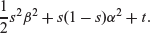
This is maximized when
We will consider two cases. First, suppose the pair has to abide by the regulation. This is the case where the tenant and landlord do not have the option of not registering the contract: every tenant farm is subject to the regulation. In this case, each party’s choice of the input level will be determined by the respective ICs:

The expected output under the original share was

Observe that the expected output is monotonically increasing in s when
A few qualifications are in order. Is it possible that even the tenant is worse off with regulation even though his share his higher than the initial level that was the result of private contracting? Clearly, the tenant is better off when
Another qualification that should be noted is that even if β is larger than α, it is possible the surplus falls by so much that the partnership form is discarded and replaced by full specialization (e.g., self-cultivation by A), and in that case output could fall.
However, Operation Barga did effectively give tenants the option to not register their contract. Even if they do not register, the reform may still affect productivity as it alters the tenant’s outside options and therefore the outcome of contractual negotiation with the landlord. It is also evident that not registering the contract weakly dominates the option to register, since the landlord-tenant pair always has the option of selecting exactly the same share that would be chosen after registration. So we need to analyse the outcomes of contractual bargaining when the contract is not registered. An incumbent tenant’s default (or disagreement) payoff is now no longer u. It is what his payoff would be, under the legal share of
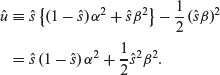
If the new outside option does not exceed u, nothing changes obviously, so the relevant case is one where it is higher than u. If this is higher than u, the landlord and the tenant will renegotiate the tenancy contract, treating
It is also evident that a similar argument will also apply for more general specification of the production and cost functions than we have considered so far. Hence, the EK model would not be able to explain the observed effects of Operation Barga. More generally, an extended version of the Coase Theorem applies to the EK model. Owing to the perfect transferability of utility via side payments between landlord and tenant, changes in outside options or bargaining power will not have any productive consequences. For the same reason, it does not matter who owns the land: A or B. Even if B were to own the land and contract with A for provision of marketing services, the same share
EK withWealth Constraints: The Hybrid EK-MBGG Model
A key differentiating feature of the MBGG model is that it incorporates limits to side payments between A and B, owing to wealth constraints. The other main distinction between EK and MBGG is that the latter does not allow any scope for management tasks, aside from cultivation. Hence, the two sets of models are not nested. We now develop a hybrid of the two models, incorporating both wealth constraints and co-existence of management and cultivation tasks. This is accomplished by adding a limited liability constraint (LLC) to the EK model, which requires
In the choice of the optimal contract, A still has all the bargaining power, but now as we will see below, if B ’s threat point changes, that may matter for the contractual form that is chosen as well as expected output and surplus. Now, the optimal contracting problem under a partnership is modified as

subject to:

where

Limited Liability Constraint Not Binding
If the LLC is not binding, the agent’s PC must be binding, because otherwise t can be reduced and A would be better off. First, let us consider this case. Substituting t from the binding

As in the previous section, this yields the following:

Substituting in the PC, we get

where
Limited Liability Constraint Binding
Now we turn to the relevant case where the LLC is binding:

subject to

Let us define

Then the relevant parameter space is

If
As is standard in these types of models, the PC may or may not bind. If the PC does not bind, B will earn an efficiency utility; namely his net payoff will exceed his actual outside option.
Ignoring the PC, if A maximized his payoff with respect to s, the first-order condition would be
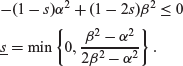
If
Next, consider the case where
Let

or

the optimal contract is
Suppose now that

Let us denote the value of s that satisfies
Clearly,
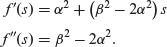
There are several cases to consider depending on parameter values.
If
If
Now we are ready to state the key result of this section:
The important implication of this proposition is that now the tenant’s share s is not determined solely by technological parameters, as in the polar EK model. It also depends on the outside option of B and any liquid wealth he owns. While his share can never exceed
Intuitively, when the tenant is wealth constrained, it restricts the scope for the tenant to bear much residual risk, implying that the tenant’s share cannot be too large. Accordingly, the optimal share falls below the second-best EK share
Predictions of the Hybrid Model Regarding Effects of Operation Barga
Let us revisit the exercise we considered earlier: suppose Operation Barga comes into effect and the share to the tenant is now legally stipulated to be
If
If, however, the parties can opt out of the regulation subject to the altered default payoff of the tenant, then they will do so because abiding by the regulation lowers their aggregate surplus. The landlord would be better off offering a different (unregistered) contract to the tenant which solves the optimal contracting problem with a different outside option for the tenant, which incorporates the latter’s option to register the contract. Since this new outside option will be higher than in the absence of Operation Barga, the tenant will receive a larger share, leading to an increase in farm productivity. Aggregate surplus will also rise.
Here are the relevant details of the argument. After Operation Barga, the tenant’s default (or disagreement) payoff is no longer u, but what his expected payoff would be under the legal share of
This is a major difference from the EK model without wealth constraints: in that case, changes in the outside option only affected the division of the surplus but not the share and the resource allocation itself. Therefore, Operation Barga and its productivity effect is what serves to ‘reject’ the original EK model, in favour of its hybrid EK-MBGG version.
Moreover, as in the MBGG model, wealth constraints imply the Coase Theorem no longer applies. The allocation of bargaining power has productive as well as distributive consequences. Who owns the land also matters for the same reason. If B owns the land and contracts with A for marketing services, B has a higher outside option compared with when A owns the land. This outside option is the payoff B would achieve with the B-type organizational mode, where B performs both marketing and cultivation tasks. This will typically be higher than u, the outside option when A owns the land. Hence, a transfer of ownership of land from A to B will have productive consequences: if
What does the hybrid version add to the original MBGG model, which corresponds to the case
Comparison with the Incomplete Contract (GHM) Model
Now assume that x and y are non-contractible, but once the efforts are undertaken, they are observable ex post and any initial contract can be renegotiated, as in the GHM framework (Hart, 1995). This allows the owner of land to tear up the original contract and replace it with a new one where the owner can threaten to ‘fire’ the other individual while appropriating the input supplied and utilizing it a lower level of efficiency, denoted by
One important difference is that the GHM framework assumes no wealth constraints or impediments to ex ante side payments. As explained further below, this implies that the land market operates efficiently and transfers the ownership to whichever party generates the higher aggregate surplus. Another difference, which is less important, is that bargaining power is equally allocated between the two parties when contracts are renegotiated (as represented by the Nash bargaining solution). We also consider the case where their ex ante outside options u and v are both 0.
Under A-type and B-type organizations, there is no hold-up problem, and so we only focus on the partnership case. If A invests x and B invests y, as these inputs are observable ex post (but not contractible ex ante), we can have both a non-stochastic and a stochastic version of the production process. In the former case, the output is
As before, suppose A owns the asset (i.e., is the landlord). In the GHM model, this gives him the right to ‘fire’ B ex post. Therefore, the outside options in the ex post contract renegotiation following supplies x and y of the two inputs are as follows:
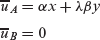
Input costs do not appear here because they are already sunk at the time of renegotiation. When B is fired, A pays B nothing, so B ends with a 0 continuation payoff, while A appropriates the inputs supplied (albeit at a lower level of efficiency for B ’s input).
Applying the Nash bargaining solution, A ends up with a continuation payoff of

while B receives

Notice that these payoffs do not have a simple interpretation of a sharecropping contract as B gets a share of the contribution to output due to his investment only. However, if the outside options were both 0 then we could interpret the situation as a sharecropping contract with equal shares.
Anticipating these ex post continuation payoffs, each party will choose the level of ex ante input supply by maximizing the difference between their respective continuation payoffs and upfront input supply costs. This yields

As one might expect, the hold-up threat lowers the input supply of B by an extent that depends on
The total expected surplus (gross of the opportunity costs) under a partnership when A is the owner is
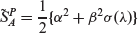
where

Notice that
Next consider what would happen if B was the owner of land instead. Now under a partnership, B has the right to ‘fire’ A. For simplicity, assume that in the event of a bargaining breakdown, B gets to retain the same fraction λ of the input supplied by A, so the ex post outside options are
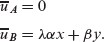
The share of A from the surplus due to the investments is now

The share of B is

This yields the following investment levels

The total expected surplus (gross of the opportunity costs) under partnership when B is the owner is
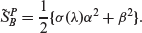
If we compare this with the expected surplus in a partnership when A is the owner, which one is larger would depend on the relative size of α and β. This is the standard result of the standard GHM model. Under the strong parametric assumptions made so far, the aggregate surplus is higher when
Evidently, the Coase Theorem does not apply to this setting: changes in asset ownership or bargaining power have productive consequences. However, recall that there are no impediments to ex ante side payments in this model.
Hence, it predicts the ex ante market for land will operate to allocate ownership to maximize the aggregate surplus of the two agents, between the two alternatives of A-type ownership and B-type ownership.
The baseline GHM model does not allow for one party providing both inputs. Our framework based on the EK model allows us to compare partnership (under different owners) with autarchic forms of organizations.
Recall that under an A-type organization and a B-type organization the social surplus (gross of opportunity cost of participation of the parties) is
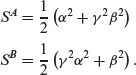
A partnership (when A or B is the owner) can emerge as a preferred organizational form if the hold-up problem is not so severe (λ is not too low) compared to the loss of efficiency due to the importance of the comparative advantage parameter (γ is low). Otherwise, either an A-type or a B-type organizational form would emerge depending on the relative values of α and β.
GHM Predictions of Effects of Tenancy and Land Reforms
Now let us review the predictions of the GHM model for effects of Operation Barga. Suppose A owns the land and Operation Barga comes into effect. Assume for the time being that contract registration is mandatory; we will review later what happens when the agents have the option to not register the contract.
There are two ways in which this regulation would have an impact on the GHM model. First, it would remove the capacity of A to fire B expost. That would raise B ’s and reduce A’s ex post bargaining power. Essentially, the eviction protection component of the reform provides a commitment device for the landlord to not hold up the tenant. Second, Operation Barga also imposes a minimum share
If the regulation is strictly enforced, the disagreement payoffs are 0 for both parties. As the reform eliminates the possibility of hold-up by the landlord, there is no scope for renegotiation. So, the ex ante payoffs of A and B are simply
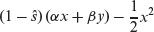
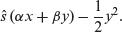
The investment levels are now

Earlier, the output was
This has the interesting implication that if we take the GHM model without wealth constraints literally, then if tenancy regulations are passed, they will have a negative effect on productivity, since tenancy exists only when
If we allow the agents’ option to not register the contract ex ante, then under the regulation the disagreement payoffs are now determined by the regulation
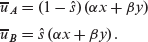
This outcome is ex post efficient, so there is no scope for a Pareto improving renegotiation. Therefore, the ex ante payoffs of A and B are identical to what they were when the regulation is strictly enforced and the results are the same as in that case.
Therefore, the observed effects of Operation Barga are not consistent with those of the canonical GHM model without introducing wealth constraints or some other friction. Suppose we consider a coercive redistribution of land from A to B. Such a change can only lower the net surplus as in an equilibrium A would be the owner only when it is the efficient allocation. So if B has the right to sell the land, one would expect A to buy back the land from B. In that case, the land market would ‘undo’ the negative productivity effect of the land reform.
Conclusion
In this paper we contrasted three different models of tenancy and their implications for tenancy and land reform. We examined the roles of wealth constraints and ex ante ownership of assets via the land market, and different types of contracting frictions, namely double-sided moral hazard and holdup problems.
Our analysis brings out several interesting insights: for example, if tenancy regulations are rigorously enforced then both EK and the hybrid version of the EK and MBGG models with wealth constraints are consistent with productivity going up. That is not the case with GHM since without wealth constraints, the market for land would eliminate tenancy when it is inefficient ex ante with the tenant buying out the land. Therefore, to the extent tenancy is present, GHM would predict that tenancy regulation would have a negative productivity effect. However, if tenants and landlords can opt out of the law and renegotiate their contract, EK with wealth constraints and MBGG are consistent with positive productivity effects of tenancy or land reform, but not EK without wealth constraints or GHM. Our paper highlights the fundamental importance of wealth constraints in understanding contractual choices as well as productivity effects of policies that affect the terms of a contract.
Footnotes
Acknowledgement
The authors thank Parikshit Ghosh and Debraj Ray for helpful feedback.
Declaration of Conflicting Interests
The authors declared no potential conflicts of interest with respect to the research, authorship and/or publication of this article.
Funding
The authors received no financial support for the research, authorship and/or publication of this article.